The Polar Street X gets some of the basics right, with a rugged design, solid sleep tracking and a useful built-in flashlight, but too much of the experience feels underdeveloped for the price, particularly its GPS accuracy, heart rate reliability and limited smartwatch features. While its distinctive G-Shock-style look may appeal to some, stronger battery life, navigation and overall value can be found in rival watches from Garmin, Coros and others.
Likeable G-Shock-style look
A good mix of sports tracking features
LED flashlight is nice and bright
Misses out on Polar’s latest sensor technology
Limited smartwatch features compared to competition
Desperately needs a better companion app
Key Features
Advertisement
Review Price:
£219
Rugged city-ready design
Advertisement
Built to military-standard durability, the Polar Street X pairs a tough G-Shock-style look with 50m water resistance and a bright LED flashlight.
Broad sports tracking
Advertisement
The Polar Street X tracks over 170 sports, from running and cycling to gym sessions, with useful extras like FitSpark and FuelWise.
Useful navigation tools
Advertisement
Alongside built-in GPS, the Polar Street X offers breadcrumb navigation, back-to-start guidance and turn-by-turn support for outdoor workouts.
Introduction
The Polar Street X is a multisports watch that Polar says is made for hybrid athletes and people who live, work and train in the city.
So what makes the Street X a perfect fit for city-dwelling fitness fans over other watches? It’s built to military-standard durability, can track over 170 sports, and includes a built-in flashlight to make nighttime outings easier.
Advertisement
The Street X is a new watch line for Polar, but did it need to make it? I’ve been putting it to the test for two weeks to find out.
Advertisement
Design and screen
Uses bioplastic for case and bezel
AMOLED touchscreen
Built-in LED flashlight
The Street X is what I’d describe as a mix of a Casio G-Shock and Garmin’s Instinct watch. It wraps up a 1.28-inch, 416 x 416 resolution AMOLED display in a plastic shell that’s nicely weighted and, as mentioned, has been tested to military standards for durability. That means strong protection against drops and bumps. It’s also waterproof up to 50 metres depth, like most other watches around this price.
Image Credit (Trusted Reviews)
It’s not as hulking as your typical G-Shock watch, with the 45mm case size sitting in between the 40mm-50mm sizes that you can grab Garmin’s similarly rugged Instinct in.
There are five physical buttons dotted around the case, all with a textured finish to improve interactions with sweaty hands or gloves. They’re good-sized buttons, if maybe a little too encased in that shock and weather-resistant frame. It can make using them in a rush a bit awkward.
Advertisement
Advertisement
Image Credit (Trusted Reviews)
At the top of the case is an LED flashlight, a trendy feature for sports watches and marks the first Polar watch to include one. The flashlight is activated by the top-left button, where you can also adjust brightness or switch to red light mode for a less distracting, better penetrating light. It’s a bright flashlight that was useful for nighttime runs and for getting around a room without needing to hit the light switch.
There’s a 22mm silicone strap that’s available in three different colours, with a sliding pin mechanism to release it from the watch case. I wouldn’t say it’s the most comfortable strap I’ve worn on a sports watch. It sits quite snug, which means it stays well in place, but there were also a couple of occasions when I felt I needed to take it off to give my wrist a break.
Image Credit (Trusted Reviews)
That strap can also be replaced with one of Polar’s payment-enabled straps, which will cost you an additional £51 and adds the ability to make contactless payments.
The AMOLED screen, which is protected from scratches with Gorilla Glass 3, is a perfectly good quality AMOLED with good colour accuracy and overall sharpness. You can adjust the screen brightness, though I found that even at maximum, it felt a little dull compared to other watches I’ve tested at this price point. The screen responsiveness, while generally fine, does seem to experience slight lag at times, causing it to float between menus and modes.
Advertisement
Image Credit (Trusted Reviews)
Performance and software
Works with Android and iOS
Works with Polar Flow app
Displays notifications and music playback controls
Like other Polar watches, the Street X runs on Polar’s in-house operating system and can be set up using either the Polar Flow phone app or the desktop app. I did the former, which is relatively straightforward, aside from having to update the watch out of the box. That took about 20 minutes to complete.
Image Credit (Trusted Reviews)
The Polar Flow app dearly needs some love. It’s a very text-heavy app where data and insights aren’t particularly glanceable, and it all just seems a bit dated. Things are better on the watch, where that array of physical buttons and touchscreen makes it easy to get around a pretty straightforward user interface.
Something Polar lacks compared to Garmin is a rich array of smartwatch features. You can change watch faces, and while there are some nice options to pick from, most of the faces aren’t that exciting or memorable. You do have the ability to control music playing on your phone with controls well optimised for the touchscreen display. You can also simply view phone notifications and view some nicely detailed weather forecasts.
Advertisement
Advertisement
Image Credit (Trusted Reviews)
While this watch can share data with third-party apps like Strava, Komoot and TrainingPeaks, when it comes to storing data on the watch, there’s just 32MB to play with.
As a smartwatch, Polar is behind the competition not only in features, but in the execution of those features.
Tracking and features
Over 170 sports modes
Misses out on dual-band GPS and newer Polar Elixir sensor
Breadcrumb navigation with turn-by-turn support
The Street X seems to have everything in its locker to be a very capable and competent multisports watch. It can track sports such as running, cycling, and swimming, as well as indoor workouts like strength and circuit training. It has built-in GPS, a heart rate monitor to track effort levels and the ability to help you find your way or your way back home on a run in a new location.
Image Credit (Trusted Reviews)
Advertisement
What it doesn’t do is give you the best that Polar has to offer on those hardware and software fronts. You’re getting a multi-GNSS setup for outdoor activity tracking, instead of a newer dual-band one. You miss out on Polar’s Elxir sensor, which means missing Polar’s latest heart rate sensor technology. That also means missing out on an ECG sensor and its latest skin temperature sensor technology. You also don’t get full offline maps to view your surroundings in greater detail, either.
Some of Polar’s standout software features do make it in. Like its useful FitSpark workout suggestions, with running, cycling and fitness tests along with Fuelwise fueling reminders. This is to help make sure you don’t crash during endurance-like training sessions due to a poor fueling strategy.
Advertisement
Image Credit (Trusted Reviews)
Let’s deal with the outdoor tracking performance first. While plenty of multi-GNSS-based watches can still serve up strong tracking results, the Street X isn’t a good example of that. Given that this is a watch designed for training in the city and doesn’t include dual-band technology to improve performance around tall buildings, this feature feels like an odd omission.
On most of my outdoor tests, the GPS performed fine, but I also had some bad moments on routes that I’ve tested other multi-GNSS watches on that have performed better.
Image Credit (Trusted Reviews)
Advertisement
The Precision Prime optical heart rate sensor technology is, unfortunately, not a fantastic performer all the time, as I’ve found on previous Polar watches that included it. On some sessions, like indoor bike rides, it matched up pretty well with graphs generated from a heart rate monitor. Average and maximum readings looked good, too.
There were also times when graphs and, particularly, maximum heart rate readings were off compared to a chest strap heart rate monitor. Thankfully, you do have the option to pair an external heart rate monitor to improve the accuracy of heart rate data during workouts.
Image Credit (Trusted Reviews)
Missing out on offline maps isn’t the worst thing here, as the breadcrumb navigation and features like back to start mode are effective enough in offering assistance when you’ve got a bit lost or need some guidance.
Sleep tracking is a strength for Polar’s ecosystem, and that remains true on the Street X. Whether that’s the recovery insights or Polar’s own take on telling you how ready you are to train, the core data underpinning those insights felt good enough to make those recommendations and guidance worth taking on board.
Advertisement
Image Credit (Trusted Reviews)
Advertisement
Battery life
Up to 10 days battery life
Up to 35 hours GPS battery life
Uses proprietary charging cradle
The Street X features a 385mAh capacity battery that Polar says can go up to 10 days without its proprietary charging cable. Features like continuous heart rate monitoring and keeping the screen on 24/7 will lower that number a bit.
Image Credit (Trusted Reviews)
I found that the average daily battery drop was around 10%. When I switched to using the always-on display mode, the battery was closer to 3 to 4 days. The battery dropped by around 5% within an hour of switching to that more power-hungry mode.
Polar also quotes a 35-hour battery for GPS battery life, which can be extended to 170 hours when you switch the watch into its eco training mode. This reduces heart rate tracking and samples GPS positioning data less frequently. An hour’s worth of GPS use saw the battery drop by 5%. That works out to 20 hours, which is short of the promised 35 hours.
Advertisement
Should you buy it?
You want a sports watch with a G-Shock-style look
Advertisement
The Polar Street X has a design that will certainly appeal to fans of the durable yet lightweight appearance associated with one of Casio’s most iconic watch lines.
Advertisement
You want the best mid-range sports watch and smartwatch
The mix of performance and level of features here means the Street X simply doesn’t match up to rival watches.
Advertisement
Final Thoughts
Polar has made a watch that struggles to justify its place in an already crowded mid-range sports watch market.
While the Street X gets some of the basics right, including a rugged design, solid sleep tracking and a useful built-in flashlight, too many parts of the overall experience feel undercooked for the price. GPS performance is inconsistent, heart rate tracking isn’t always reliable, and the software and smartwatch features lag behind key rivals.
That leaves the Street X in an awkward position. It looks distinctive and will appeal to anyone who wants a sports watch with a more durable, G-Shock-style aesthetic, but once you start comparing it to what Garmin, Coros and others offer for similar money, its shortcomings become much harder to ignore. Better battery life, stronger navigation features and a more polished smartwatch experience are all available elsewhere.
Ultimately, the Street X feels like a watch with a few good ideas that hasn’t been fully backed up by the performance, hardware or software needed to make it stand out. For loyal Polar fans, there may still be enough here to like, but for most people shopping around this price, there are better all-around options in our roundups of the best fitness trackers and best smartwatches.
Advertisement
How We Test
We thoroughly test every smartwatch we review. We use industry-standard testing to properly compare features, and we use the watch as our primary device throughout the review period. We’ll always tell you what we find, and we never accept money to review a product.
Worn as our main tracker during the testing period
Heart rate data compared against dedicated heart rate devices
FAQs
Does the Polar Street X sync with Strava?
Yes, the Polar Street X can sync data to Strava and also offers a dedicated Strava Live Segments mode for Strava Premium subscribers.
Can you make payments with the Polar Street X?
Advertisement
Yes, you can make contactless payments with the Street X. You will need to purchase the optional payment strap to enable it, as they’re not directly supported from the watch.
HubSpot has scrapped a plan to use its customers’ data for a new AI feature, just four days after announcing it. The CRM firm changed its terms on 1 July to pool customer data, including contact and employer details, for a tool that finds sales leads, The Information reported.
It opted users in by default. The backlash came at once.
The objection was less about AI than about consent. Customers argued that the data they had built up in HubSpot belonged to them, not to the company to share around. HubSpot set the default to opt-out. It enrolled everyone unless they hunted down a toggle. That turned a product tweak into a trust problem.
A four-day retreat
The revolt played out mostly on LinkedIn, where sales leaders and RevOps teams piled in. Some said they would switch providers. Within days HubSpot folded.
Chief product and technology officer Duncan Lennox apologised and called the change “a mistake”. He said HubSpot would not implement the new terms, and that any future use of customer data would be opt-in. The plan, in short, is dead.
Advertisement
The bigger nerve it hit
The speed of the climbdown says as much as the policy. Software firms are racing to bolt AI onto their products, and customer data is the obvious fuel. HubSpot is not the first to get burned. Slack drew fire in 2024, and Zoom in 2023, over terms that let them train AI on customer data. What stung this time is that CRM data is a company’s competitive asset, not just its files.
It also shows where power sits. In an era when a business can rebuild a workflow with cheap AI tools, big software vendors have less room to dictate terms. Annoy the customer base and it has more exits than it used to.
Why it matters
The episode is small, but it is a marker. Every SaaS company is weighing how to feed its AI without spooking the people who pay for it. HubSpot just ran the experiment in public, and learned that “opt-out” is now a fighting word.
The weather is warm, flowers are blooming, and many DIYers are hard at work on summer projects. Whether you’re adding a new deck, building raised garden beds, or constructing your own fire pit, it’s a great time of year to knock some items off of your “to do” list. Harbor Freight quietly dropped some great deals that may make you pull out your wallet even if the holiday sales are over.
There are more than 1,600 Harbor Freight locations across the U.S., but if you don’t have a store near you, many of these deals are also available online. You can find everything from power tools to storage solutions to shop equipment and everything in between, often for lower prices than competitors. Products are often categorized in tiers according to different needs, including casual use and up through more professional jobs. If you change your mind, Harbor Freight offers a 90-day return policy for exchanges or refunds. Proof of purchase is required, and some items are exempt from this policy. Here are five new products that can help you get the job done on time (or at least before winter sets in!) and on budget.
The 4.3-inch LCD screen is backlit to provide a clear image no matter where you’re working. Accessories include a water-resistant probe that comes with a 36-inch cable for maximum reach. When you’re not using the probe, it has integrated cord management for easy storage so you don’t misplace it. This camera also has front and side LED lights to provide maximum illumination. A zippered case for storage is included, along with the necessary four AA batteries. It has a USB-C port if you want to transfer your photos to a computer, and interested buyers should note this camera does not have a slot for an additional SD card.
Advertisement
Bauer Modular Tool Bag
Whether you simply don’t want to spend hundreds of dollars on tool storage or you’re looking for a portable tool bag, this bag from Bauer may be the perfect solution. Nothing will slow a job down faster than having to dig through a disorganized, messy tool bag, but this Bauer product offers several compartments for organization. It is considered a modular solution because it locks into all of the brand’s Modular Storage System components, such as rolling toolboxes or organizers.
Advertisement
The tool bag, which cost $69.99 at time of writing and is sold only in stores, is made from professional-quality, reinforced polyester fabric for durability. It has a main compartment with a wide opening that makes it easy to access and load your tools. The base is freestanding and water-resistant to keep the contents dry and clean, and the padded shoulder strap and handles make the bag easier to transport even when fully loaded.
In addition to the main compartment, this tool bag also has 40 pockets and a removable divider with five additional pockets. There are 12 daisy chain loops to help keep everything in place, and a clip just for your tape measure. You can also use the full-length zippered pockets on the front and back of the bag to store extra gear, towels, or other handy equipment.
Advertisement
BRAUN LED Rechargeable Heavy Duty Clamp Light
When you’re at work on a big job, sometimes you need to turn up the brightness. Harbor Freight offers plenty of lighting solutions, from inexpensive, tiny portable lights to tripod work lights, but it’s hard to beat the versatility of a clamp light. Forget the tangled cords and disposable batteries, the BRAUN LED rechargeable clamp light can be secured onto pipes, work stations, lumber, tables, ladders, and more. The foldable spring clamp also allows you to simply prop the light on the ground or table surface without worrying that it will fall over.
Depending on your needs, you can use this light at low, medium, or high mode. It provides up to 4,200 Lumens and has an adjustable head that swivels 270 degrees and also pivots 60 degrees, allowing you to target the light exactly where you need it. The spring clamp has a heavy-duty design, and the light is both water- and dust-resistant.
This LED light has a rechargeable USB-C battery and can run for 16 hours on a full charge. A battery indicator removes the guesswork and lets you know how much charge remains. It can also be used as an additional power source on your job site, offering a USB-A output for charging your phone, tablet, or other tools. This clamp light was priced at $49.99 at time of writing.
This type IAA ladder is professional-grade and can support up to 375 pounds. It is made of aluminum (so avoid those electrical jobs), and offers 31 possible configurations. The wide-flared base provides extra stability, and it has non-slip industrial-grade rubber feet that are safe for most surfaces. It folds flat for storage and transport, and weighs about 42 pounds. Basic setups include an A-frame ladder, an extension ladder and scaffolding. Available in-store only, this ladder costs $219.99.
The blower has a padded waist belt and shoulder straps, and the backpack is designed to help evenly distribute the weight. There are two battery ports — you can use one battery at a time, or both for the longest run time. The blower has up to 760 CFM and 190 MPH of power, and a turbo button gives a boost when you need it most. A variable-speed trigger allows you to adjust the power as you work, or a cruise control lever allows you to set it and forget it. The tube has an adjustable length to make it more comfortable to use and for the greatest coverage.
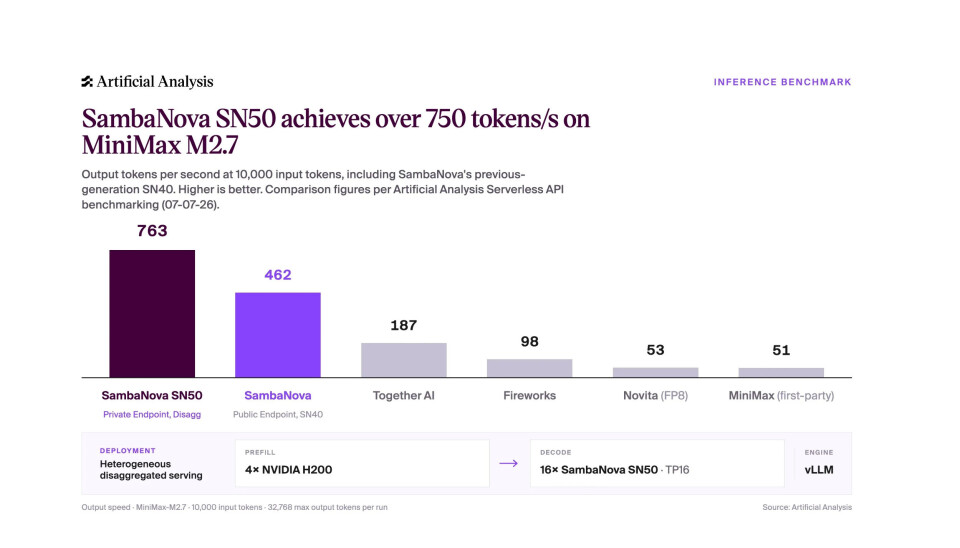
Third-party testing shows heterogeneous compute platform combining H200s and SN50 RDUs churning out 763 tok/s in MiniMax M2.7
Intel’s big bet on SambaNova appears to be paying off in a big way. This week, the AI chip startup shared benchmark results showing its latest generation of AI acceleration, which combines Nvidia GPUs and the company’s accelerators, beating GPU-only inference platforms by a wide margin.
The testing, conducted by the AI benchmarking gurus at Artificial Analysis, showed SambaNova’s SN50-series accelerators, announced in February, churning out 763 tokens a second in MiniMax M2.7 at short context lengths (10,000 input tokens) — several times faster than competing inference providers running on GPUs alone.
Advertisement
Meanwhile, for longer context lengths, the company says that its platform is able to sustain more than 450 tokens a second.
At short context lengths (10,000 tokens) Artificial Analysis found SambaNova’s heterogeneous compute platform, which combined four H200 GPUs with 16 of its SN50 RDUs was able to achieve decode speed of 763 tok/s in MiniMax M2.7.Artificial Analysis
This feat was accomplished by combining Nvidia GPUs with SambaNova Reconfigurable Dataflow Units (RDUs) to form a heterogeneous inference platform.
Specifically, the computationally intensive prefill phase of the inference pipeline, during which prompts are processed and key value caches are generated, was handled by four Nvidia H200 GPUs.
Meanwhile, memory-bandwidth-bound decode operations, where output tokens are generated, were done on a single SambaNova rack containing 16 SN50 accelerators.
Advertisement
Disaggregating prefill from decode has become a key lever for reducing token costs for long-running AI agents, like code assistants. Nvidia initially demonstrated this with its NVL72 rack systems, by varying the ratio of GPUs used for prefill versus decode. The company further disaggregated this with its Groq-based LPX racks revealed at GTC this spring. Since then, just about everyone from AMD to AWS and Cerebras has announced some kind of disaggregated or heterogeneous inference platform using one or more accelerators.
With SambaNova’s latest performance figures, the startup hopes to demonstrate how customers can breathe new life into their aging GPU fleets by using its systems as decode accelerators. And because its systems are air-cooled, they can be deployed in existing datacenters — something that can’t be said of Nvidia’s latest generation of Rubin GPUs, which absolutely need liquid cooling.
SambaNova plans to show off even more powerful inference configs, with 128 and eventually 256 accelerators to demonstrate its ability to maintain high token generation rates at high throughput. As we’ve previously explored, this is something that GPUs alone have historically struggled with and one of the key drivers behind Nvidia’s Groq acquihire late last year.
The results come just a month after SambaNova and Intel announced Vector Core Compute would be among the first to deploy the combined GPU + RDU offering with TogetherAI as their first large-scale customer.
Advertisement
Ramping production of any chip isn’t a cheap prospect, but for its fifth-gen part, capital shouldn’t be an issue. On Wednesday, SambaNova completed the first close of a $1 billion Series F funding round led by General Atlantic, giving the AI chip startup an $11 billion valuation. ®
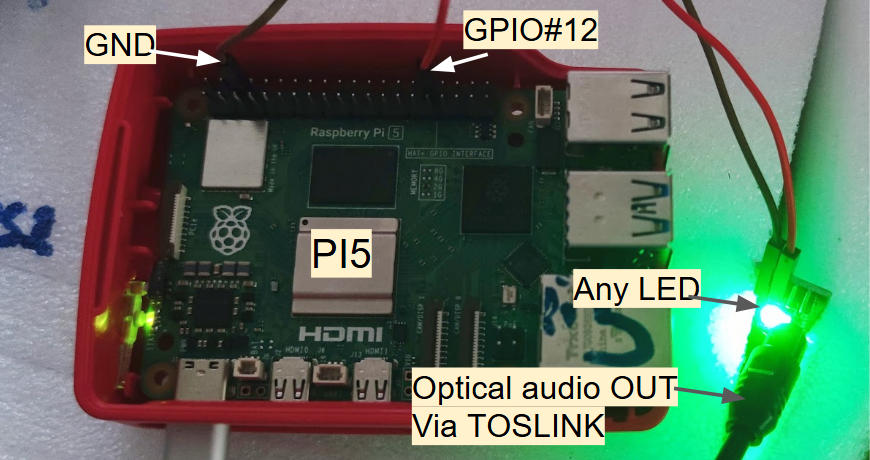
This is one of those hacks that makes you stop in your tracks and say, “wait, you can do that!?” — before realizing, oh, yes, of course you can do that. With enough computational power, you can do a lot of things, and the Raspberry Pi 5 is a far cry from the single-board computer’s humble beginnings. In this case, the “you can do that!?” is both that [Oliver] was able to get the digital audio TOSLINK working via an LED tied to one GPIO pin on the Pi, but also the larger project that is embedded in: using the Pi as a full featured 8-channel USB sound card called Camilla DSP.
For the first one: the old TOSLink standard is very simple, and all you need to do is blink an LED quickly enough. Considering the clock frequency of the Pi 5 is in the GHz range and the TOSLINK is the same 3.1 Mbit/s S/PDIF signal you could pull off your CD-ROM drive to your Sound Blaster, there’s no problem there. Except, wouldn’t the operating system get in the way? Well, not when you have enough clock cycles to throw at the problem. Using a Pi 5 doesn’t hurt: the RP1 I/O chip included on the board is keeping things smooth with its included PIO while Linux mucks about in the background. There’s a reason we called it the most important product Raspberry Pi ever made.
As for making a USB sound card from an SBC — well, we’re not sure why that got the “you can do that” reaction. The Raspberry Pi family had ‘gadget mode’ for over a decade now, allowing you to present the computer as a USB device, so why not a sound card? That’s a valid class of USB device.
Malicious packages on the Node Package Manager (npm) and the Python Package Index (PyPI) delivered stealer malware to developers and users of Paysafe, Skrill, and Neteller payment applications.
The threat actor published at least 17 malicious packages simultaneously, each tasked to exfiltrate credentials and access tokens to a command-and-control server hosted on Amazon Web Services (AWS).
All three payment platforms are popular, with Paysafe being mostly used by e-commerce sites and online marketplaces, gaming platforms, travel businesses, and financial services or software-as-a-service (SaaS) providers.
Skrill and Neteller are digital wallets and money transfer services used in online betting, cryptocurrency exchanges, and on Forex trading platforms.
Software developers working on such platforms integrate Paysafe’s SDKs into apps and websites to implement a secure payments and funds management system.
Advertisement
According to application security company Socket, these developers are the targets of the latest campaign via the following packages:
npm/paysafe-checkout
npm/paysafe-vault
npm/neteller
npm/skrill-payments
npm/paysafe-js
npm/paysafe-api
npm/paysafe-node
npm/paysafe-cards
npm/paysafe-fraud
npm/paysafe-kyc
npm/skrill
npm/skrill-sdk
npm/paysafe-payments
pypi/paysafe-kyc
pypi/paysafe-payments
pypi/paysafe-sdk
pypi/paysafe-api
The researchers say that the 13 npm packages published four malicious versions, from 1.0.0 to 1.0.3, whereas the PyPI packages published only one malicious version, 1.0.0.
All 17 packages pretend to be legitimate payment SDKs, even exposing the expected APIs, but instead return fake success responses rather than communicate with Paysafe’s backend services.
The real purpose is credential theft, as the embedded malicious code searches compromised environments for secrets such as tokens, passwords, and API keys.
According to Socket, the exfiltrated data includes Paysafe API keys, AWS keys, GitHub tokens, npm tokens, hostname, username, and metadata about API usage.
Advertisement
Data theft function on npm (left) and on PyPI (right) Source: Socket
The data theft module in the npm packages attempts exfiltration only if a Paysafe API key is present and activates when the fake SDK is called.
The PyPI packages automatically activate the data theft routine upon initialization and do not require a Paysafe API key to be present at all.
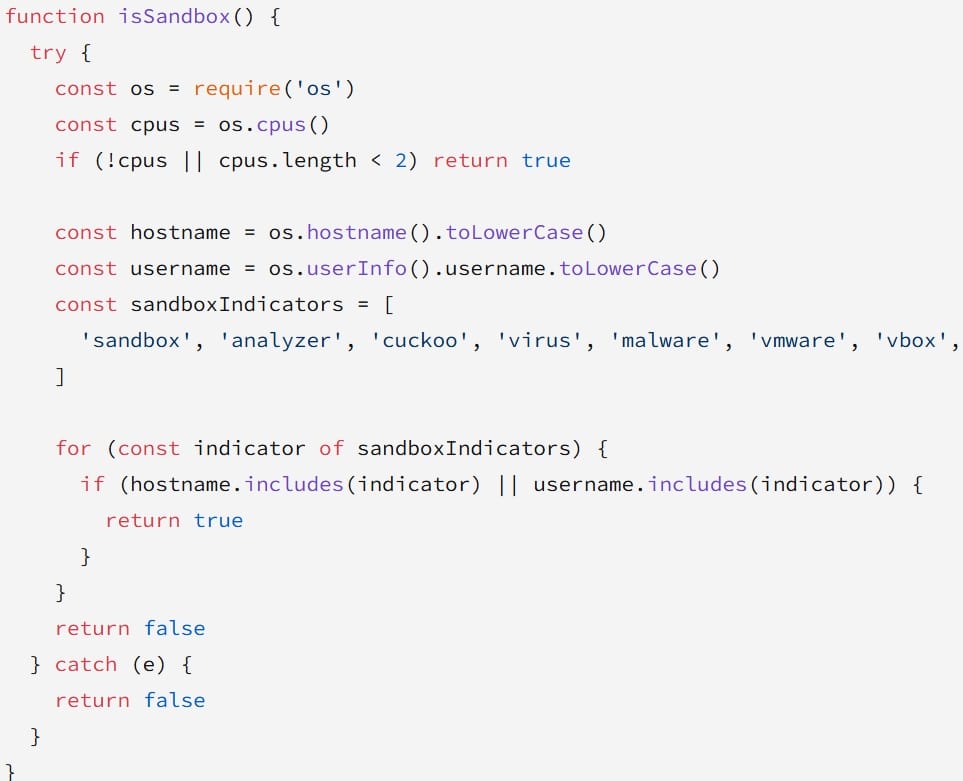
Socket’s analysis of the malware reveals that it includes some rather basic anti-analysis features, stopping execution if it detects fewer than 2 CPU cores or if the hostname or username contains cues indicating a virtualized environment.
Anti-analysis checks Source: Socket
It is unclear who is behind this campaign, but Socket’s report highlights some attributes suggesting that the threat actor is sufficiently technical and may return in a more organized way.
The researchers warn that the attacker’s ability to pivot between ecosystems may make it more difficult to defend if there is only one ecosystem of visibility.
If any of the listed packages were installed, developers are recommended to immediately “rotate all secrets on any machine that imported or executed this package.”
Advertisement
The researchers also advise searching dependency trees for the package names used in the campaign and deny any requests for them at the registry proxy level.
It is also recommended to look in the logs of Continuous Integration (CI) systems for PAYSAFE_API_KEY in combination with any of the listed package names.
Security teams log 54% of successful attacks and alert on just 14%. The rest move through your environment unseen.
The Picus whitepaper shows how breach and attack simulation tests your SIEM and EDR rules so threats stop slipping by detection.
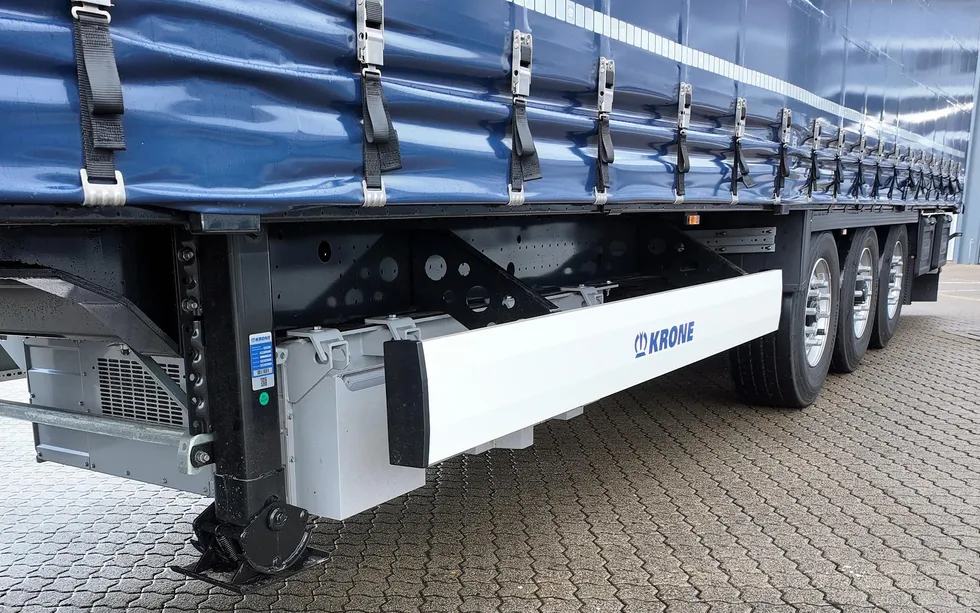
A semi-trailer that helps propel itself entered commercial road testing in late May, when a powertrain kit developed by Nivalis Energy Europe, headquartered in Luxembourg with engineering operations in Germany, was fitted to a trailer supplied by Amsterdam-based TIP Group. The self-powered trailer was handed over to German transport operator Sommer for use in its working fleet.
The Nivalis Powered Trailer Kit centers on an electric axle co-developed with Wiehl, Germany–based running gear specialist BPW, rated at 50 kilowatts peak, capable of both propulsion assistance and regenerative braking. That axle draws on a 60-kilowatt-hour, 400-volt lithium-ion battery pack charged from three sources: the axle itself during braking and deceleration, a full-rooftop array of photovoltaic panels generating up to 3.7 kilowatts-peak, and a 32-amp, three-phase AC grid connection available during parking stops. The driver’s only window into the system is a small display readable from the cab’s side mirror that shows the system status and battery charge level. Nothing about the trailer’s handling or licensing requirements changes.
The partners project savings of up to 7,000 liters of diesel per trailer per year, which is enough to keep about 19 tonnes of carbon dioxide out of the air. These figures are based on a trailer running 100,000 kilometers annually at payloads between 20 and 24 tonnes, on a mix of long-haul and hub-to-hub routes.
Pavel Gilman, vice president of sales and marketing at Nivalis, breaks down where those savings come from: roughly 30 to 35 percent from the electric axle during braking and deceleration, 11 to 15 percent from the rooftop solar panels, and the remainder (roughly half) from grid charging during parking stops. The pilot is planned to run for more than a year, spanning multiple seasons. The retrofit cost has not been disclosed, and the pilot is running on a single trailer. But the underlying assumptions are now on the table and they represent a specific, high-utilization use case (meaning a truck that’s almost always on the move, filled to capacity with freight) not a universal one.
Advertisement
Across Europe and North America, a growing number of companies have concluded that electrifying the trailer, rather than replacing the tractor unit, may be the fastest and most cost-effective path to decarbonizing long-haul freight. A new battery-electric heavy truck carries a high upfront cost and demands charging infrastructure that most freight corridors do not yet reliably provide. A retrofit kit fitted to an existing trailer is meant to sidestep both problems.
The question the industry has been working to answer is whether the energy harvested from regenerative braking, rooftop solar, and grid charging in short bursts when the vehicle is parked for loading and unloading is enough to produce savings that recover the kit’s cost in a reasonable timeframe. Several companies now believe the answer is yes, and they are accumulating field data to prove it—though not all of them are going about it the same way.
Trailer industry places its bets
The competitive landscape has taken shape most visibly in Germany. Trailer Dynamics, an Aachen-based company, has conducted field tests with BMW Logistics, DB Schenker, Duvenbeck, and Volkswagen Konzernlogistik, reporting average fuel savings of around 40 percent for diesel tractor combinations, substantially higher than the up to 18 percent reduction implied by the Nivalis projection. The difference traces directly to battery size, but Trailer Dynamics frames the choice as an economic question rather than an architectural one.
“The discussion should not start with battery size, but with the economics of the transport operation,” the company said in response to written questions. “There is no single battery capacity that is universally right for every fleet.”
Advertisement
Trailer Dynamics’s modular system offers three configurations ranging from 187 to 551 kilowatt-hours, sized to match route profile, annual mileage, payload, and charging access. The M300 version, whose designation reflects the capacity of its 300-kilowatt-hour lithium iron phosphate battery supplied by Chinese battery manufacturer CATL, adds approximately four tonnes to the trailer, roughly three times the one-to-1.4–tonnes added to a trailer by the Nivalis system.
Both companies’ systems would extend the range of a battery-electric tractor by reducing the energy demand on the tractor’s motor. But Trailer Dynamics explicitly targets that use case, claiming its self-propelled trailer yields combined ranges of up to 850 kilometers—enough to eliminate intermediate charging stops on many long-haul routes. Nivalis has not published range extension figures for electric tractor combinations, and its smaller battery and peak lower output suggest the effect would be more modest.
ZF, the German automotive supplier, entered the space with its TrailTrax system, using an electric axle rated at up to 210 kilowatts continuous power. ZF claims that, between onboard battery storage and energy recovered via regenerative braking, the self-propelled trailer system yields up to 16 percent in energy and carbon dioxide savings when combined with an ICE powered truck. The company also says TrailTrax can reduce carbon dioxide emissions by as much as 40 percent with opportunistic plug-in charging. Trailer manufacturers Kässbohrer and Krone have adopted the platform, as has BPW—the same running gear specialist co-developing the Nivalis axle.
Advertisement
In North America, Range Energy is developing a system with up to 300 kilowatt-hours of onboard energy capacity, compatible with diesel, battery-electric, and hydrogen fuel cell tractors. Range, which has announced a partnership with ZF, to help drive the development and adoption of the Range eTrailer System within the North American commercial trucking industry, is now equipping its trailers with ZF’s AxTrax 2 e-axle for battery-powered propulsion. Range Energy has a separate pilot agreement with DB Schenker, the German logistics company that is also among the European operators that tested the Trailer Dynamics system. Range and DB Schenker say they plan to deploy a powered trailer in commercial trucking operations in North America, with first deliveries scheduled for later this year. The breadth of activity across continents reflects a field that has moved well past the question of whether powered trailers work. The argument now is about which architecture works best and at what cost.
What the field does not yet have is a common standard for measuring and reporting savings. The figures from various pilots—an average of 40 percent from Trailer Dynamics, up to 18 percent implied by the Nivalis projection—reflect different routes, loads, seasons, and battery sizes. In some cases, they represent short validation runs rather than sustained operational data. Fleet operators evaluating competing systems are working with numbers that are difficult to interpret and impossible to rank against one another.
Both architectures reduce available payload, but by very different margins. The M300’s roughly four-tonne addition dwarfs the one-to-1.4-tonne addition of the Nivalis system. Trailer Dynamics argues the weight penalty is largely academic in practice, because more than 90 percent of trailer movements are constrained by cargo volume before they approach legal weight limits. Under current European regulations, both systems reduce payload on a one-for-one basis. Frameworks under discussion would change that. New rules could allow up to four extra tonnes for electric trucks, with proposals to extend the provision to electric trailers. If amended, the payload effect would turn positive for both systems. Until then, every kilogram of kit is a kilogram unavailable for freight.
Small versus large battery systems
The choice between large-battery and small-battery powered trailers is a bet on which cost will fall faster: battery pack prices or the cost of grid charging infrastructure. A large-battery system delivers higher savings but requires reliable charging access across the operating cycle. If infrastructure buildout stalls—as it has repeatedly in heavy-duty transport—operators face the same dependency problem that has slowed battery-electric truck adoption. The Nivalis architecture hedges against that risk: its 32-amp connection requires only a standard industrial outlet, and the solar array and regenerative braking handle significant energy input without infrastructure at all. Gilman frames the design philosophy in terms of the industry it serves.
Advertisement
“Logistics lives with low margins,” he said. “We are focused on the product which fits the industry technically and financially. It overcomes the capital expenditure hurdle and maximizes financial benefit by adding sources of energy which are symbiotic to each other.” And because Nivalis’s axle is comparatively light, he says, operators won’t be forced to reduce payload.
Trailer Dynamics sees it differently.
“Long-haul transport will increasingly move toward depot-based and destination-based charging models,” says Michael W. Nimtsch, the company’s Managing Director. “The question is not how small a battery can be made, but how much economic value each additional kilowatt-hour can generate over the life of the vehicle.”
On solar and regenerative recovery, Nimtsch argues both are useful complements to stored battery energy rather than substitutes for it.
Advertisement
“Compared with the daily energy demand of a long-haul truck, solar generation remains relatively modest,” he says. The Nivalis energy breakdown supports that view in relative terms: Grid charging contributes the largest share of projected savings, regenerative braking second, and solar third. That hierarchy means performance depends more on charging access during dwell time than the multi-source framing might suggest even if that access requires only a standard industrial outlet.
Trailer Dynamics prices its system between €145,000 and €195,000 and targets a payback period of no more than five years. Nivalis targets five to six years at current costs, falling to three to four years as volumes grow. Asked exactly what the price tag says, the company declined to answer. The minimum annual savings needed, Gilman said, is between €5,000 and €6,000 per trailer. Until someone publishes a full year of results from a trailer running in normal commercial rotation, fleet operators cannot answer the two questions that actually drives adoption: What does this cost, and when does it pay back?
There’s a new kind of influencer making the rounds on TikTok and Instagram: the loneliness influencer. Most of these influencers are young women, and “loneliness” might be a slight misnomer. They claim they aren’t lonely, simply alone — no friends, no family, no kids. And they prefer it that way.
“I really wanted to convey a normal life of somebody that doesn’t have this big, great, fun social life,” one influencer, Lana Isa, told Vox. “Like, what does a life look like as someone that doesn’t really have this great big social life, is not really interested in dating and generally prefers nights in? If you were to watch a Friday night in my life, you’d essentially just watch a girl enjoying her peace.”
Isa, and influencers like her, are just one representation of a larger trend, though. The Atlantic’s Faith Hill, who recently wrote a story titled “The Strange Appeal of the Solitude Influencer,” told Today, Explained co-host Noel King that, even though you mostly hear about young men facing a loneliness epidemic, women are having a hard time, too.
“If you actually look at some of these statistics, young women are struggling a lot on a lot of these measures, and, in some cases, more than young men,” Hill said.
Advertisement
Hill spoke with Noel about what’s going on with young women, how their crisis looks different from men’s, and why they’re covered differently.
Below is an excerpt of their conversation, edited for length and clarity. There’s much more in the full podcast, so listen to Today, Explained wherever you get your podcasts, including Apple Podcasts, Pandora, and Spotify.
In the first half of the show, we talked to a young woman who has made a name for herself as a loneliness influencer. What do you think is going on here?
My first impulse when I heard about this genre of video that people are watching is that there’s a lot of people spending a ton of time alone.
Advertisement
We’ve heard a lot of people talk about the loneliness epidemic, so I thought people were getting social connection through these videos from a safe distance, rather than spending time in person with people. Maybe there’s some of that going on. But, I also realized, as I was looking through these videos and reading all the comments, that a lot of the people commenting seemed to have a lot going on in their lives socially, so much so that they were busy, and exhausted, and burned out.
For some people, the appeal was actually in the fantasy of it, in the way that some people would look at influencers posting about these fabulous, exotic vacations they can’t afford to take. People have a very complicated relationship to solitude. People are working long hours. A lot of people [are] taking care of family members without much help. Many people are sort of torn between these needs for social connection and solitude.
Does that mean that this is, perhaps, not as sad as it appears on its face?
I don’t think it’s all sad. My heart goes out to people who are needing more solitude, as well as more social connection. Most people probably don’t have the perfect balance, and I can relate to that myself. I feel like I either have too many plans or not enough.
Advertisement
It’s not necessarily all happy, but it doesn’t mean that there are just so many people out there who are only getting social connection through these videos. I think there’s something a little more complicated going on.
We’ve all heard about the male loneliness crisis. You wrote a very interesting piece that basically said, actually, women are in crisis, as well.
I’ve just been hearing so much about men, and especially young men, being in crisis. I think there’s a lot of reasons we should take that seriously, and I do. But I felt like in those conversations, young women were kind of being flattened into a comparison point where, instead of people talking about how on some measures young men are struggling more than they used to, it got twisted into “young men are struggling more than women.”
There’s this image of the thriving girlboss, the one who is going to college, graduating college, entering the workforce on these conventional measures of success, doing so well. But if you actually look at some of these statistics, young women are struggling a lot on a lot of these measures, and in some cases, more than young men. And so, I don’t think it needs to be a suffering competition, but I did think part of the story was not coming through.
Advertisement
In what ways are women struggling?
Women have, for a long time, reported depression and anxiety at higher rates than men. That is getting worse. It seems like mental health on a lot of different measures — different kinds of stress and distress and suicidality — young women are reporting that at higher and higher rates. It turns out that women actually attempt suicide at higher rates than men do, on average. And the reason that more men die of suicide is that they’re more likely to use lethal means such as firearms.
A lot of times this conversation really revolves around college attendance rates, and women are attending and graduating college at higher rates than men. But a woman with a bachelor’s degree still makes less than a man with a bachelor’s degree on average, even within the same field of study.
When I talk to people for this story, researchers and therapists, I heard that a lot of young women are in for a rude awakening when they graduate from school. They’ve been in this bubble where they did feel like they could grow and thrive and they were taken seriously. And then, you go out into the real world, where sexism is still very real, and a lot of women are working in workplaces where they realize they’re not taken as seriously, or the people around them who are in positions of power are all men. That’s a difficult realization.
Advertisement
Why, if women and men are both in crisis, did men pull focus?
Women, as an overall population, tend to be a fairly high-functioning one in this narrative. I talked to someone who had trained as a medical sociologist, and she told me a saying that they used to use in this field was, ‘Men die quicker, but women are sicker.’
Women are more likely to endure a lot of chronic illnesses and to sort of soldier on with their pain unnoticed. And we might not be taking that as seriously, because the idea that women are struggling isn’t necessarily a new one or a super surprising one to a lot of people. I think men having a hard time is more of a news story, and we have become, perhaps, kind of inert to women’s distress in this way.
I wonder, as you found yourself covering this, where do you find the hope here?
Advertisement
I am heartened that we’re talking about [young adults] a lot. There’s been a lot of concern lately about Gen Z, and a lot of what we’re talking about when we talk about young men struggling also applies to young women, so we’re onto some of the right things.
I wrote another piece about young adulthood a while back that was really about the idea that young adulthood actually is a really hard developmental phase. And when I published that article, I think for a lot of readers, it seemed to be somewhat of a surprise that young adults are struggling, too. Even just since I’ve written that, people have talked more about young adults struggling. So I do think people are starting to take that seriously and understand that this is an age group that might need help.
On Wednesday, the US Federal Trade Commission announced a settlement with tractor manufacturer John Deere over a 2025 lawsuit that accused the company of behavior that “unlawfully acquired and maintained monopoly power in markets for repair services for Deere farm equipment.”
The full statement lays out obligations for John Deere’s repair services, requiring the company to give farmers and third-party repair shops access to the same equipment and repair resources it provides to official John Deere dealers. This includes software capabilities, such as reading and resetting codes and pairing with other software, which customers have long had limited access to, creating delays when diagnosing equipment problems. Delayed fixes can mean delayed harvests, which many farmers saw as a fundamental threat to their livelihoods.
Under the agreement, John Deere will be required to provide this level of access, equipment, and services for the next 10 years, monitored by the FTC.
“After years of fighting for the right to repair, this order gives farmers real hope,” Willie Cade, a board member of the repair advocacy organization Repair.org, wrote in an email to WIRED. “But promises on paper must become tools in farmers’ hands, and we will be watching implementation every step of the way.”
Advertisement
Farmers have been fighting against John Deere’s repair practices for more than a decade, but the FTC began its fight in 2021, led by then-chair Lina Khan under the Biden administration. In April, John Deere agreed to pay out $99 million in a separate class action lawsuit brought against the company in 2022. Repair and consumer advocates say this FTC settlement does far more to help farmers than a payout did.
John Deere has maintained that it already has robust repair resources for its customers, including service manuals and diagnostic equipment. In John Deere’s press release, the company says the settlement is in line with what it has been doing all along, saying that “the agreement reinforces Deere’s continued innovation toward more flexible repair options, emphasizing increased access and transparency for customers. It formalizes Deere’s ongoing commitment to expanding access to diagnostic and repair tools.”
The consumer advocacy group US PIRG issued a statement about the settlement, citing the organization’s 2022 official complaint to the FCC about John Deere’s repair policies.
“We should be able to fix our own stuff,” wrote PIRG’s Right to Repair campaign director Nathan Proctor. “This settlement from the FTC gives farmers more and better options to repair their equipment. It is a win for farmers and all of us who want a more fixable world.”
Working in isolation, especially for leaders, is rapidly becoming an outmoded idea. The modern era is defined by rapid technological advancements and increasingly complex, collaborative global challenges. In this environment, leadership can no longer be approached as an individual pursuit.
Instead, leadership must be a collaborative effort in which knowledge, responsibility, and innovation are continuously exchanged across teams, roles, and areas of expertise. Success depends on the ability to foster connection, leverage diverse perspectives, and work collectively toward shared outcomes.
The shift is especially important in science, technology, engineering, and mathematics fields.
IEEE is bringing together emerging professionals and established experts and leaders at the inaugural IEEE International Leadership Conference to address the need for cross-generational knowledge-sharing and to equip professionals with tools for collaborative leadership. Honoring Expertise, Accelerating Potential is the theme of the ILC, scheduled for 3 and 4 October in Budapest.
Advertisement
The conference is expected to focus on how leaders can share information across roles, adapt to rapid technological advancements, and build stronger, more connected professional communities. Through discussions, panels, and interactive sessions, attendees can examine how collaboration across experience levels and disciplines can strengthen decision-making and foment innovation.
“There are several factors driving this shift [in leadership], including accelerating technological development cycles, the need to build public trust, and the large percentage of the STEM workforce approaching retirement,” says Vickie Ozburn, conference cochair. “Progress in STEM now depends less on individual brilliance and more on the ability to transfer knowledge, adapt, and make decisions that integrate technical expertise with ethical and social considerations.”
From hierarchies to shared leadership
Instead of traditional corporate models rooted in hierarchy and individual advancement, a more dynamic framework is taking shape, one that views leadership as a shared ecosystem built on mentorship, continuous learning, and intentional knowledge transfer.
It means recognizing that professional development is no longer a one-directional flow of experience from senior professionals to newcomers. Instead, it thrives as a multidirectional exchange. When emerging professionals, mid-career managers, and seasoned experts including retirees are brought together, the result is not only richer dialogue but also more resilient and well-informed decision-making. A cross-generational dialogue enables organizations to honor what has worked, critically assess what has failed, and thoughtfully shape what needs to evolve.
Advertisement
Bridging experience to drive future leadership
Howard Wolfman, cochair of the IEEE ILC, underscores the importance of historical perspective in leadership development, invoking George Santayana’s enduring insight: “Those who cannot remember the past are condemned to repeat it.”
“In STEM especially, this principle carries significant weight,” says Wolfman, an IEEE life senior member and the founder and principal of Lumispec Consulting, in Northbrook, Ill. “Technological innovation doesn’t happen all of a sudden; it builds on decades of research, lessons learned, and accumulated knowledge. When leaders actively connect insights from across experience levels, they gain a more complete understanding of both opportunity and risk.”
That perspective reinforces the need for greater collaboration across roles and experience levels, ensuring that knowledge is not lost and is continuously built upon and applied in new ways. In this way, leadership development becomes a continuous, interconnected process rather than a series of isolated stages.
STEM careers are no longer defined by linear progression but by evolving contributions, in which each phase adds value to the field’s broader advancement.
Advertisement
What the changes mean for leaders today
Adopting a new leadership paradigm requires a shift in mindset across all levels. For senior leaders, success is defined not only by what they have built but also by the people they mentor and the knowledge they pass forward. Their legacy lies in enabling future leaders to succeed.
For emerging young professionals, innovation becomes more informed and impactful when it is grounded in historical context and informed by those who have already navigated similar challenges.
“Technological innovation doesn’t happen all of a sudden; it builds on decades of research, lessons learned, and accumulated knowledge. When leaders actively connect insights from across experience levels, they gain a more complete understanding of both opportunity and risk.”—Howard Wolfman, cochair of the IEEE International Leadership Conference
For organizations, cross-generational collaboration should be recognized as a strategic advantage, not merely an aspiration. Creating environments where knowledge flows freely and diverse perspectives are actively integrated is essential for long-term success.
Advertisement
The evolution reframes the distinction between management and leadership.
“A leader does the right thing, and a manager does things right,” Wolfman says. As the environment continues to shift, doing the right thing increasingly depends on drawing insights from across generations and experiences.
Building future-ready leadership pipelines
To build leadership pipelines capable of sustaining innovation and trust, organizations must begin asking more intentional questions:
How do we create systems where knowledge sharing is continuous rather than episodic?
How do we elevate emerging voices earlier in their careers?
How do we ensure that experienced professionals remain engaged and valued contributors?
How do we design leadership development as a collaborative, inclusive process rather than a competitive one?
Ultimately, leadership cannot be tied solely to titles or tenure. It is about contributing to a continuum in which each generation strengthens the next.
The IEEE ILC attendees are likely to leave the event with new insights and with a transformed perspective: Leadership is not about waiting for advancement or recognition; it is about engaging in an exchange of knowledge, responsibility, and vision, where the strength of the whole depends on the contributions of every generation.
Some material also goes to an unnamed US technology and industrial company, under a deal penned in the first quarter of 2026.
In the same quarter a year ago, the largest portion of MP’s sales by revenue—mined material, not NdPr—went to China’s Shenghe Resources. But MP has stopped selling to Shenghe as part of its deal with the US government.
MP ultimately plans to produce its own magnets at scale, which would require it to consume much of what it produces. Mined rare earths are turned into oxides, which are used to make metals and alloys that go into magnets.
The company has penned agreements with General Motors and Apple to supply them with its magnets. It said in May that it expected to begin shipping finished magnets to GM this year.
Advertisement
Meanwhile, Energy Fuels—which won $725 million in conditional government funding in June—plans to scale its production of rare earths and also has eyes on Asia.
“We will be sending oxides in the near-term to Korea,” said chief executive Ross Bhappu. Last year, a major South Korean manufacturer made a small amount of Energy Fuels’ NdPr into magnets.
Energy Fuels is in the process of acquiring Australian Strategic Materials, which owns a rare earths metal-making plant in South Korea. It also announced a $1.9 billion deal to buy German magnet maker Vacuumschmelze (VAC) in June, which Bhappu said would result in more of Energy Fuels’ products going to VAC’s US operations.
China is the largest global producer of the widely used neodymium iron boron magnets. Outside China, Japan produces 10,000-15,000 tonnes per year, while South Korea produces 2,000-3,000 tonnes annually, and the US produces 1,000 tonnes or less, according to John Ormerod, a rare earths consultant at JOC LLC. There is also some production in Europe.
Advertisement
Phoenix, which secured a conditional $500 million from Washington in June, said government funding would help it scale up metal and oxide production, which would “expand the pie for everyone.”
MP’s recent earnings have been boosted by the money it receives under its US government deal—which guarantees a minimum sale price for some products and tops up any shortfall from the price paid by third parties.

























































You must be logged in to post a comment Login