I tested the Premium plan extensively in the UK and briefly in Europe. It was quick and easy to set up in the Saily app and kept me connected as I roamed, offering decent speeds up to around 300 Mbps on 5G networks in city center locations, inevitably dropping off to 4G and around 15 Mbps in more rural spots. The specific speeds you’ll get depend entirely on the local network. Saily piggybacks on local providers, mainly connecting to EE and Vodafone during my month of testing.
The Ultra plan includes 30 GB of high-speed data. In this case, high-speed simply means unfettered; the actual speed you get depends on coverage where you are. After that 30 GB is gone, you get unlimited throttled data at up to 1 Mbps. In practice, I found this lower speed was enough for messaging, web scrolling, and navigation, but anything data-hungry, like video, is out.
It’s worth noting that the 30 GB limit is for the month. Most folks use around 20 GB of data in a month, so 30 GB sounds like a lot. But consider that you are probably connected to Wi-Fi most of the time at home or work, and you may not be when traveling. That 30 GB can disappear surprisingly quickly, and you should take advantage of Wi-Fi whenever you can on your travels. One of my top travel tips is to download videos and maps before you go, or when you’re connected to Wi-Fi.
Advertisement
If you’re only visiting one or two countries, it’s probably better to get a pay-as-you-go plan for that specific region or country. For example, Saily offers unlimited data in the UK for 15 days for $49, but there’s a fair usage policy that will throttle you after 5 GB in a single 24-hour period (until the next day). Unlimited data across Europe (35 countries) for a month will cost you $72, with the same 5 GB daily limit. You could also just buy 20 GB of data to use over 30 days for $23 in France or $31 in the UK.
Having used a few different international eSIM and regular SIM services for travel over the years, Saily compares favorably on performance and ease of use but is relatively expensive. That said, most other eSIM services don’t come with a bundle of extras.
Plenty of Perks
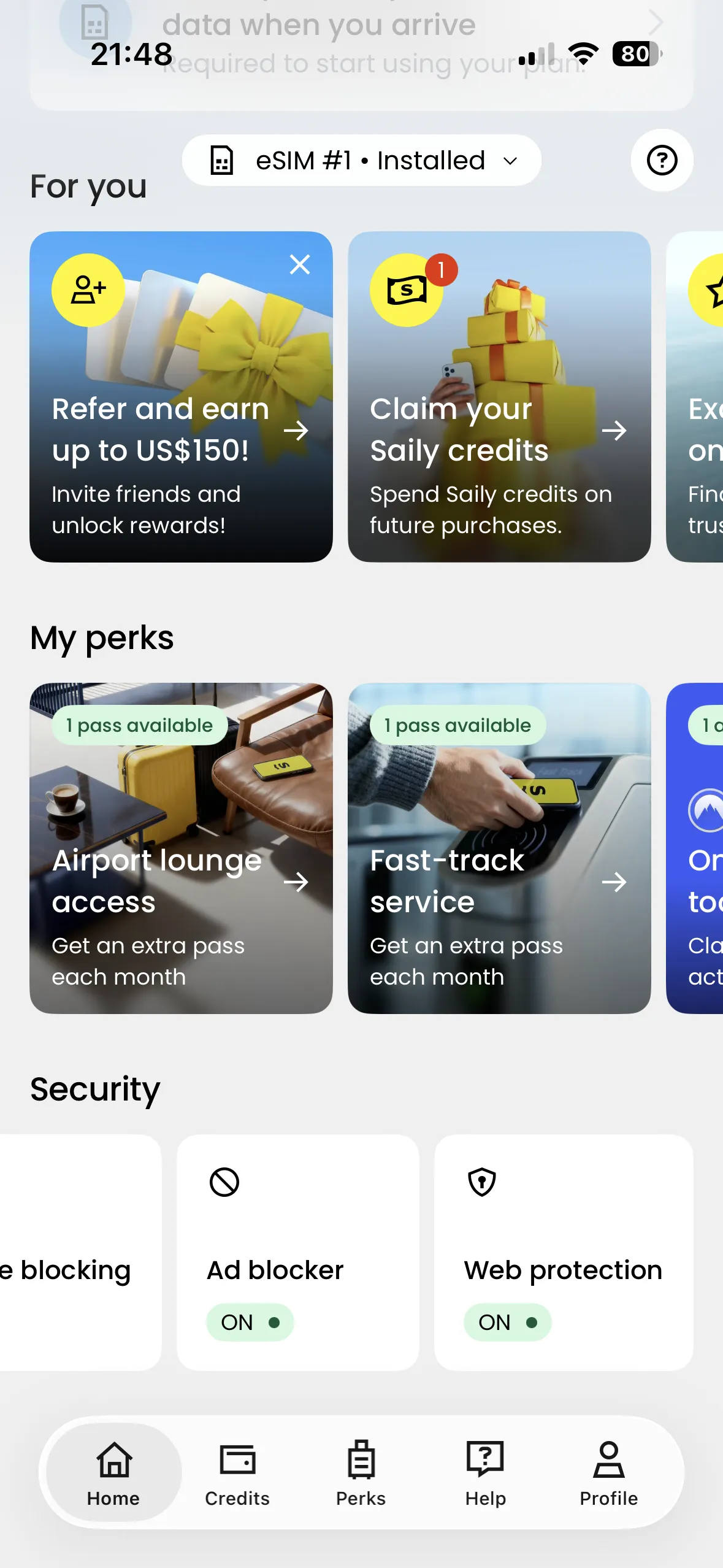
Saily Ultra will be a hard sell for most folks simply looking at the data, but frequent travelers will appreciate the plentiful perks. Here’s what you get:
Screenshot
1x Airport Lounge Pass per month: Airports can be noisy and uncomfortable, but airport lounges offer quieter spaces where you can work or relax, with fast Wi-Fi, comfier seating, and complimentary food and drink. If you’re stuck in an airport for a few hours, a lounge pass can make your wait as painless as possible. With Saily Ultra, you get one free pass per month for one person. It generates a QR code in the app that’s valid for 30 minutes. Here’s the complete list of supported lounge destinations. You also get a free lounge pass for that trip if your flight is delayed for more than two hours (contact support in the app).
1x Fast-Track Pass per month: You can skip the long security queue with fast-track and get straight through into the terminal. With Saily Ultra, you get one free fast-track pass for one person, generated as a QR code in the app. Here’s the complete list of supported fast-track destinations. Availability is far more limited than with the lounge pass, so I was unable to test this.
Online Security Tools: You get access to NordVPN, NordPass, NordLocker, and Incogni with an activation code in the Saily app. Saily’s parent company is Nord Security, so it makes sense that its popular VPN service, password manager, and secure cloud storage are included. Incogni is a privacy tool that can help you remove personal data from the internet.
Saily lists several other perks on its website, including priority support, an ad blocker, and 8 percent back in Saily credits. The ad blocker is handy and also reduces your data usage, and you can use any credits you accrue to buy data plans or extra perks, like additional lounge passes. It’s also worth noting that lounge and fast-track benefits rollover for up to three months if unused, though you can’t share them. Saily also lists a ClassPass subscription on the site right now, but that wasn’t available when I tested. The perks are subject to change, so it’s important to check what’s included at the time of purchase.
Chinese chip companies are running unusually broad equity schemes to keep engineers, with Cambricon covering 85.3% of its workforce and AMEC more than 97%. Europe’s semiconductor sector has a talent gap estimated at 65,000 workers.
Chinese chip companies are giving away equity at a scale that looks less like a bonus scheme and more like a defensive measure. Cambricon has unlocked around 600,000 shares for 124 core staff, worth an average of 5.57mn yuan each, or about $828,000.
The breadth is the more striking number. The same company has granted 5mn shares to 944 employees, which is 85.3% of its workforce, in a plan running to 2028.
It is not alone in that approach. Zhongji InnoLight, which makes optical transceivers for AI data centres, allocated 2.48mn shares to 99 key personnel with average yields above 26mn yuan, and the chip equipment maker AMEC has a restricted stock plan covering more than 97% of its staff.
Advertisement
Cash is moving in the same direction. ByteDance and Tencent have reportedly offered pay increases of up to 150% and bonuses of around 35% to secure AI talent.
The pressure behind it is domestic as much as geopolitical. Chinese firms are poaching from one another while export controls have made domestic chip design a national priority, which concentrates demand on a small pool of engineers.
The awards are not unconditional. Cambricon has tied an incentive plan to a revenue target of roughly $14.8bn, which turns retention into a performance instrument rather than a gift.
Europe’s problem is described in the opposite terms. The European Chips Skills Academy has put the continent’s semiconductor talent gap at 65,000 workers, in a region that has more AI talent than the United States by headcount.
Advertisement
What Europe lacks is the instrument rather than the people. Many of its relevant employers are listed incumbents, research institutes or university spinouts, and employee share schemes differ so much between member states that equity is a harder tool to reach for.
Its answer has largely been training. Skills academies, apprenticeships and Chips Act programmes address supply, on a timescale measured in graduate cohorts rather than quarters.
The American answer is simply money. TNW has reported that Anthropic pays the highest salaries in AI research, to the point that its chief executive has worried aloud about people joining for the pay.
So three regions are answering the same shortage differently. China is offering ownership, America is offering cash, and Europe is offering courses, which is the only one of the three that cannot be accepted immediately.
Remember that rush rescue mission for NASA’s $500M space telescope? It failed, reports CNN, and the LINK satellite won’t be able to boost the telescope’s orbit. NASA says its decades-old Swift telescope will now continue losing altitude, until it reaches Earth’s atmosphere later this year and burns up.
CNN reports:
Just weeks after LINK lifted off on July 3, it started to spin out of control. [Satellite designer] Katalyst was able to regain control of the satellite, but the company acknowledged that the issue cost it time, which would delay LINK’s rendezvous with Swift by about a month. However, that postponement — at least initially — did not seem to be a deterrent to the mission. Now, NASA and Katalyst have announced that LINK’s mission will not capture and boost Swift to a higher orbit “due to ongoing attitude control issues,” according to statements Wednesday.
“NASA should be willing to move quickly and take smart risks when the potential return is worth it, and that is exactly what we did with this mission,” NASA Administrator Jared Isaacman said in a statement. “This is not the outcome we were working toward, but it does not change why this mission was worth attempting. The team moved with extraordinary speed to give Swift a chance to carry out more science while advancing capabilities America will need for satellite servicing in the future….”
Advertisement
The mission team is forging ahead with its plan for LINK to rendezvous with Swift — but as a demonstration rather than a rescue. “We are going to learn everything we can from LINK’s rendezvous attempt and put those lessons to work on the missions that follow,” Isaacman said… Swift wasn’t designed to be serviced in space, which means that insights from the demonstration could be used for future missions… “We have already learned a tremendous amount,” [said Ghonhee Lee, CEO of Katalyst Space Technologies], “and now our job is to turn those lessons into something durable — building a repeatable playbook to inform future rendezvous and proximity operations and satellite servicing.”
Across the world, rising costs and an uncertain economy mean that smartphone sales are falling, yet Apple’s iPhone has still seen a 5% growth in the latest quarter.
The latest figures from Europe recently showed that as the smartphone market continues to contract, the iPhone continues to grow. Now figures for Latin America are saying a similar, but not identical thing.
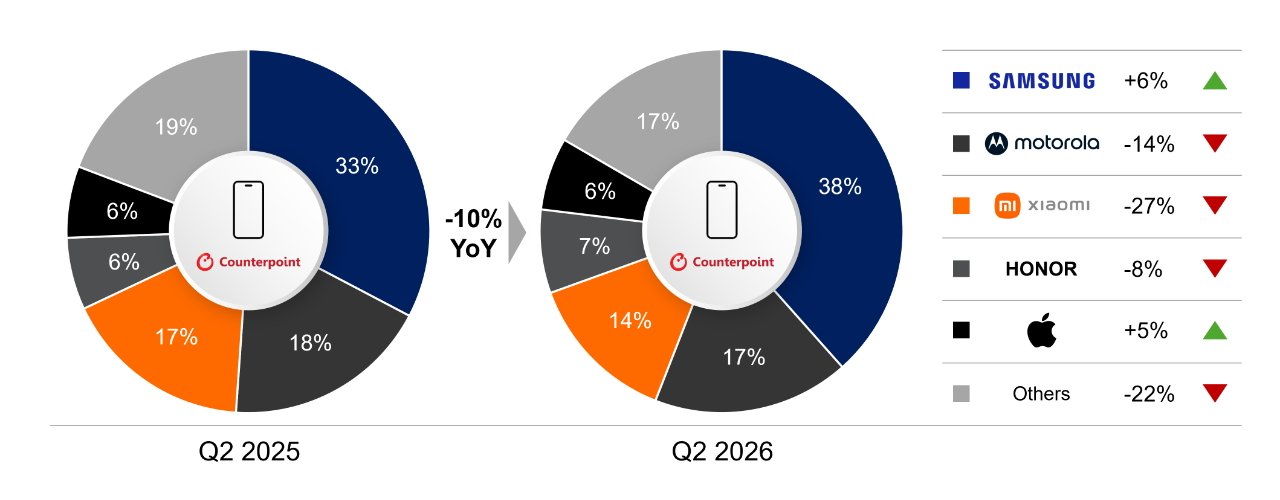
According to Counterpoint Research, smartphone sales in Latin America for Q2 2026 saw their largest decline in three years. Compared to the same period in 2025, the market shrunk by 10%.
In Europe, Apple still saw its market share rise during that period, but for Latin America, the result is less clear cut. Apple remains behind Samsung, Xiaomi, and Motorola for market share, but it still grew its shipments by 5%.
Advertisement
Only Samsung did better at with a 6% increase. All others saw sales decline, with Xiaomi the worst affected with a 27% drop year over year.
LATAM Smartphone Shipments by OEM, Q2 2025 vs Q2 2026 YoY – image credit: Counterpoint Research.
The price rises from the global chip shortage contributed to the overall drop, with the greatest declines seen by the entry-level and mid-tier brands. Those account for three quarters of all the smartphones sold in the region.
Researchers credit Apple’s growth in the premium market in part to the company absorbing price rises, at least for the time being. They also report that there is consistent demand for the iPhone 17 Pro Max.
Advertisement
There was also steady demand for older iPhones, while the quarter benefited from the then still quite new iPhone 17e. That had launched midway through March, the last month of the previous quarter.
Apple’s fiscal Q2 runs from April to June, and there were no new iPhone launches in that time. The third quarter runs from July to September, so there will be a launch of the iPhone 18 Pro range toward the end of that quarter.
That will probably benefit Apple, but overall the research expects that Latin America smartphone sales will not improve until at least 2028.
Making a film camera is a project within the reach of almost anyone, from the experimenter with cardboard and sticky tape, to the machinist with an aluminium billet. But 3D printing has opened up the world of cameras to whole new set of experimenters, and we’ve seen some very impressive builds here as a result. For all that, there’s always been a particularly tricky aspect to a home made camera: the shutter. In particular, making one with variable speed has proved almost impossible. Now [Camera Things] has given it a very good shot, with a sliding 3D printed design.
To cock it, both the strips are pulled across, before the blind strip is pushed back, and the shutter operates by sliding back under the influence of a rubber band. The clever part in this case is that the blind strip can be partially pushed back to affect the size of the shutter opening. The effect is then of a variable width strip of light passing over the film, which is equivalent to varying the speed of a conventional shutter.
Due to space constraints he’s only able to make it a half frame shutter, so he’s abandoning this design in favour of a more complicated set of vertical leaves. Sadly he’s not made the files available, but we thing proficient CAD users should be able to make their own version. The video is below the break.
The universe is full of cool and interesting things, like black hole stars and nightmare planets that get scorched by their host star. Now researchers have found a star that moves ridiculously fast, and it’s right in our celestial backyard, whipping around the Milky Way’s supermassive black hole.
Say hello to S301, a star near the center of our galaxy that was discovered by researchers at the Max Planck Institute for Extraterrestrial Physics in Germany. It joins the massive catalog of more than 1.8 billion stars, but it has some properties that researchers believe make it special. The first, and most obvious, thing about S301 is that it’s the fastest-moving celestial object ever observed by science.
This superswift star hits a peak speed of around 15,500 miles per second, or about 55.8 million miles per hour. That happens, researchers say, after S301 accelerates as it nears Sagittarius A*, the black hole in the middle of the Milky Way, hitting that 15,500 mps mark as it makes a sharp turn to go around. It then slows as it takes a much wider loop back around to repeat its orbit.
To give you an idea of how fast that is, the prior candidate for the fastest-moving celestial object ever recorded was a low-mass star and its accompanying super Neptune planet that zip at approximately 1.2 million mph, which translates to about 333 mps.
Advertisement
Our solar system moves through space at about 500,000 mph, or approximately 140 mps, and the fastest human-made object ever created, the Parker Solar Probe, is cruising along at 430,000 mph. It still pales in comparison to the speed of light (186,282 mps), and the host of things that are almost that fast, like gravitational waves and black hole jets, but S301 beats out all other planets and stars observed by humans.
S301’s other notable quirk is its proximity to Sagittarius A* — 10 times closer to the black hole than the previous closest star, S2 — and according to the study, this is the speedy star’s true value. It’s so close that it can feel the effects from the black hole much more acutely than anything else humans know about. Researchers aim to study those effects to learn more about how black holes work.
This is important because looking at black holes is exceptionally difficult. Black holes have so much gravity that nothing can escape, not even light, so scientists have to measure the effects a black hole has on objects around it. A perfect example of this is the first picture of a black hole. You can’t actually see the black hole itself, but you can see the accretion disc that formed around it.
Researchers at the Max Planck Institute have already found and measured some of these effects on S301 and are hoping that observing and studying the star over the next decade can give them some insights about how black holes work. Since S301 is so close, researchers can test various theories that they were unable to before because no other known objects were close enough to feel these effects.
One such example is the frame-dragging, or Lense-Thirring, effect, which was predicted by Albert Einstein in his general relativity theory. It states that massive rotating objects (like supermassive black holes) drag spacetime around with them, creating a rotating wave of spacetime that can alter and interact with nearby objects.
Advertisement
Think of yourself standing in a swimming pool with one arm out, palm open, just below the water surface, and then spin. You’ll notice a wave form in front of your arm as your rotation pushes your arm through the water. Einstein’s theory states that rotating black holes have this same effect on the fabric of spacetime.
S301 is close enough to feel this effect, and researchers have already measured the Lense-Thirring effect on it.
“S301 is the first star to orbit directly in the region around Sagittarius A* where the frame-dragging effect is extreme,” Felix Mang, Ph.D. student and corresponding author of the study, said in a statement. “We’re not just measuring spacetime curvature; we are measuring how it gets distorted by the rotation of the black hole itself. That is unique.”
The biggest challenge to studying S301 is that it’s extremely dim, about two billion times dimmer than Betelgeuse, which is the 10th brightest star in the sky. The crew at the Max Planck Institute employed a small army of instruments and methods to detect it in the first place, including the Gravity instrument on the Very Large Telescope and the Micado instrument on the Extremely Large Telescope, both located in Chile and part of the European Southern Observatory.
Fractile was founded in 2022 and operates from two primary locations in London and Bristol.
UK AI hardware start-up Fractile is in talks to raise funding of around $600m at a pre-money valuation of $6.5bn, according to Bloomberg.
The new valuation is estimated at more than six times that of the company’s last funding round in May, when it raised $220m.
The new funding is set to be co-led by Lightspeed Venture Partners and Redpoint Ventures, with the possible involvement of Thrive Capital and Founders Fund, according to Bloomberg’s sources.
Advertisement
Fractile aims to enable the scaling of cheaper AI token processing for faster model reasoning by building hardware that offers “low latency and high throughput”, with its operations spanning “transistor-level circuit design up to cloud inference server logic”, according to the company.
The start-up has also reached an initial deal to sell around $250m of its chips to Anthropic for deployment in 2027, with an intention to expand the contract in the future, according to Bloomberg.
Proceeds of the May funding round – which was led by Accel, Factorial Funds and Founders Fund, with participation from Conviction, Gigascale, 01A, Felicis, Buckley Ventures and 8VC, alongside existing backers – were to be used by Fractile “to accelerate the path to getting our first chips and systems into customers’ hands”, it said at the time.
Fractile was founded in 2022 by CEO Walter Goodwin, who has a University of Oxford PhD in AI. It operates from two primary locations in London and Bristol but has previously also hired in Taiwan and San Francisco.
This week, AI inference start-up Etched raised $700m in a new funding round led by US trading firm Jane Street, which the company said boosted its valuation to $21bn.
ChangXin Memory Technologies, a Chinese manufacturer of dynamic random-access memory chips, recently replaced Tencent as the world’s most valuable Chinese company.
Earlier this month, AI giant Anthropic confirmed previously rumoured plans to design its own chips in response to a worldwide shortage and increased pressure to develop faster, more advanced AI systems.
On the tenth anniversary of UHD Blu-ray Disc, we sat down with three A/V industry experts to discuss the future of physical media and digital downloads, and whether 8K resolution will play any role in either.
Our panel included a Sony executive, who also serves as a committee chair at the Blu-ray Disc Association, the North American president of Magnetar, maker of high performance UHD Blu-ray Disc players, and the CEO of digital download platform Kaleidescape.
Their answers reveal something rather interesting: none of them appears to be waiting around for an 8K revolution.
Without further ado, here is how each of these experts views the role of 8K resolution in the broader consumer video landscape, along with what the future may hold for physical media and digital downloads.
Advertisement
Victor Matsuda, President and Chair of Global Promotions Committee at Blu-ray Disc Association, Vice President of Visual Entertainment, Sony Corporation
eCoustics: Is any working group at the BDA currently studying a commercial 8K movie-disc format or enhancement to the UHD Blu-ray standard to support 8K resolution?
Victor Matsuda: The BDA is not currently working on any commercial 8K disc format, and I don’t see us doing so in the near future. This has been our position for a while, and it hasn’t changed because we don’t see anything from content creators or consumers that indicates a need. Both are extremely satisfied with what Ultra HD Blu-ray delivers, so there isn’t a driving reason to stand up new work around an 8K disc format at this time.
eCoustics: Does the existing recordable 8K broadcast specification have any relevance to prerecorded entertainment?
Victor Matsuda: A recordable broadcast spec and a prerecorded, mastered entertainment format are built for different jobs. The broadcast spec is optimized to capture a live transmission in real time at a sustained bitrate. Prerecorded entertainment is mastered and authored for the best possible picture and sound, using tools like object-based audio that go beyond what a recordable spec needs to support.
With regard to Japan, the BDA already has a specification that touches this directly. Since 2018 we’ve licensed a 4K/8K broadcast-recordable format that lets Japanese consumers record satellite 8K broadcasts, NHK’s BS8K channel being the main example, onto BD-R and BD-RE discs, using the HEVC codec up to 8K/60p, with HDR support via Hybrid Log-Gamma, and capacities up to 128GB across four layers.
Advertisement
eCoustics: What technical limitation of UHD Blu-ray is most likely to matter over the next decade?
Victor Matsuda: I don’t see a particular technical limitation on UHD Blu-ray over the next decade, at least not with the content offerings and options that exist today. It’s always possible that some new type of content or feature could push the limits of the format’s capacity or bitrate, but we certainly haven’t seen that to date.
Advertisement. Scroll to continue reading.
eCoustics: Could a future specification improve HDR, color depth, frame rates or audio without moving to 8K?
Advertisement
Victor Matsuda: Yes, and that’s where I think the more interesting work is happening. The developments that deepen a viewing experience — advances in HDR, color depth, immersive object-based audio — aren’t tied to resolution at all. Those are the gains that genuinely change how a movie feels, independent of whether you’re at 4K or a theoretical 8K. I’d expect any future refinement of the spec to keep leaning into that territory before anything to do with raw pixel count.
eCoustics: Does the BDA consider Ultra HD Blu-ray the final mass-market optical movie format?
Victor Matsuda: I wouldn’t call anything “final” in an absolute sense; formats evolve when there’s a real reason to. But right now, we don’t see anything from content creators or consumers to indicate a need for a new format. Both are extremely satisfied with what Ultra HD Blu-ray delivers, and for the reasons I’ve touched on already, that’s unlikely to change without some external driver.
eCoustics: What would have to happen commercially before the Association considered a successor?
Advertisement
Victor Matsuda: My experience as a product planner has taught me that new products generally grow from what I call needs or seeds. A need is an identified consumer or industry gap that a new technology can fill. A seed is an idea or technology that companies plant in hopes it opens up a possibility for consumers and industry that eventually grows into a need.
Commercially, the trigger would have to come from the content side. If a driving factor ever prompts a new physical format, it will most likely be the emergence of content the internet infrastructure simply can’t deliver at scale without compromising quality, something so demanding that streaming becomes the bottleneck again and physical media is the only way to carry that experience intact. Until that kind of content actually exists and needs a home, I don’t see a commercial case for moving toward a successor format.
Rob Jones, President, Magnetar North America
Rob Jones, President, Magnetar North America
eCoustics: Are buyers asking for 8K playback, or are they more concerned with HDR, audio and build quality?
Rob Jones: Overwhelmingly the latter. We speak with our customers, dealers and installers regularly, and 8K rarely comes up. What buyers do ask about is picture fidelity, especially when it comes to 4K content. We field questions about HDR handling, Dolby Vision, color accuracy, tone mapping, and how well the player performs with the display or external processor they already own. On the audio side, our customers care deeply about lossless audio, high-quality DACs, dedicated outputs, and the questions can get even more complex.
Build quality and reference-level playback are consistent themes in the conversations we have with our buyers. Enthusiasts at this level have been burned before by hardware that was discontinued, or by exits in the category that have left cherished devices unsupported. They’re seeking a player that is built to last, backed by a company committed to the category. That is exactly where Magnetar has positioned itself. 8K is a spec-sheet conversation, not a customer conversation. Until the entire home entertainment chain and content ecosystem support it, resolution beyond 4K is not driving purchases from what we’re seeing.
Advertisement
eCoustics: Is there enough demand to justify developing another generation of optical players?
Rob Jones: Not yet, and for a very simple reason: the content needs to drive the format. We occasionally get asked about 8K, but until the studios move forward with 8K production and distribution, there is no need for an 8K disc format. Furthermore, there is nothing really on the horizon suggesting that transition is coming anytime soon. While, yes, some major productions are captured on 6K or 8K, very few are actually produced and finished through a true end-to-end 8K workflow. Capture resolution is only one part of the entire production pipeline.
Advertisement. Scroll to continue reading.
What often gets lost in this conversation is just how exceptionally capable 4K UHD already is. With a great master, disc bitrates, encoding profiles and proper playback hardware, there’s still tremendous performance available at the 4K level. From our end, we’re most interested in extracting every level of detail available to us on a disc rather than chasing a resolution number the content itself does not support. That’s where our engineering investment goes and where we believe our customers see real returns.
Advertisement
eCoustics: Which parts required for player manufacturing are becoming difficult to source?
Rob Jones: At present, Magnetar is well positioned with our vendors, and we maintain a strong inventory position on the key components required to build our players. From this position, we foresee many years of continued manufacturing without concerns.
Of course, in any hardware category, individual components evolve or eventually reach end-of-life. When that happens, we plan for those transitions well in advance to ensure continuity of production from our end. Customers investing at this level deserve the confidence that the company behind their player is built for the long haul, and that is how we intend to operate.
eCoustics: Could existing UHD Blu-ray players remain viable for another decade?
Advertisement
Rob Jones: Absolutely, and we would argue that is one of the format’s greatest strengths. 4K UHD Blu-ray has been delivering reference-quality video and audio for a decade already, and for the vast majority of viewers, it sits at or beyond the threshold of what the human eye can even perceive. A disc purchased today will play the same in ten years as it does now, and it does not depend on a license agreement, a server or an active subscription. The format is stable, the library is already enormous, and the studios are actively supporting and adding to it.
The real variable here is hardware, which is why build quality and industry commitment are paramount. As we know, a well-engineered player, properly supported, should serve its owner for a long time. Because we’ve engineered our players to be universal media players rather than strictly Blu-ray players, they support all discs and file-based content alike, giving owners a platform that remains flexible and useful to them, regardless of how the landscape evolves around them.
eCoustics: Are customers buying players primarily for movies, music discs or both?
Rob Jones: From what we’ve observed here at Magnetar, both. Movies are certainly a primary driver for many of our customers, and it is this side of the business where we see adoption growing aggressively. The clearest evidence of this is coming directly from the studios themselves. When platform-defining streaming exclusives such as Stranger Things are released as deluxe physical media editions alongside The Sopranos, Dexter, Game of Thrones and others, that signals that consumers are actively buying film and television on disc in numbers that justify those releases. Each and every collector, deluxe or limited edition that is released is a signal that the customer base for physical media playback is expanding, and we see that reflected in our player sales as well.
Advertisement
At the same time, a significant and passionate segment of our base buys with music in mind as well, favoring CD, SACD and high-resolution audio files for playback. There is strong overlap between the two groups, as customers at this level are seeking out a singular reference-grade machine to serve both passions. That expectation has shaped how we build. Our players are universal media players by design, with serious attention paid to the audio and video side of the coin. Whether the content is on a physical disc or a file, the player should do that content justice. Our consumers are buying one platform for their entire collection.
eCoustics: What would persuade Magnetar to support a successor format?
Rob Jones: Three major stars would need to align for this to happen: genuine consumer demand, studio commitment and perceptible benefit to the viewer. Any successor format would require consumers to reinvest across their entire entertainment chain, so the improvement would absolutely have to be one the eye and ear could register, not just a marginal gain.
Advertisement. Scroll to continue reading.
Advertisement
On the technical side of things, we are seeing some signals worth watching. 2026 marks the first implementation of physical discs with up to a terabyte of storage, for example. The real question here is whether or not the studios will adopt those capabilities, because a format only succeeds when there is content to feed it.
Tayloe Stansbury, Chairman and CEO, Kaleidescape
Tayloe Stansbury, Chairman and CEO, Kaleidescape
eCoustics: Does Kaleidescape see itself as the eventual successor to physical media?
Tayloe Stansbury: Consumers ultimately want the best way to enjoy and build a movie collection. Physical media has served enthusiasts incredibly well for decades. Kaleidescape preserves the collecting experience while combining it with the convenience and reliability of digital. Kaleidescape’s 4K Cinematic delivers a visual presentation beyond today’s 4K. With that, streaming, discs and downloads all have their individual benefits and have their place in the foreseeable future.
eCoustics: What happens to purchased movies if a studio agreement expires?
Tayloe Stansbury: When customers purchase a title, it remains part of their collection. Our studio relationships are built around supporting collectors by enabling customers to build lasting personal collections they access under license.
Advertisement
eCoustics: Can a customer continue playing downloaded titles indefinitely without internet access?
Tayloe Stansbury: Yes. Once a movie is downloaded to a Kaleidescape system, it plays directly from local storage without requiring an internet connection. Internet access is only needed to browse, purchase or download new content.
eCoustics: Could customers ever export or independently back up purchased files?
Tayloe Stansbury: No. Kaleidescape is a secure, studio-approved platform designed to protect copyrighted content while providing the highest-quality viewing experience. That security is a fundamental part of our agreements with content owners.
Advertisement
eCoustics: How does Kaleidescape define ownership?
Tayloe Stansbury: Regardless of disc, download, theatrical or streaming, movies are owned by studios and played back under license.
eCoustics: Could a lower-priced system bring premium downloads beyond luxury home theaters?
Advertisement. Scroll to continue reading.
Advertisement
Tayloe Stansbury: While Kaleidescape has long been associated with dedicated home theaters, products like Strato E and Strato M have made the platform accessible to a much broader audience. Our goal is to bring the highest-quality movie experience to anyone who values great storytelling and wants to build a premium digital collection.
Guy Kinnell, Vice President of Visual Display, Samsung Electronics introduced the first consumer 8K TVs (model Q900R) in 65″, 75″, 82″ and 85″ screen sizes at IFA 2018.
The Bottom Line
If these industry insiders are telling us anything, it’s this: don’t hold your breath for 8K. There is no commercial 8K format in development, no meaningful consumer demand, and little incentive for studios to absorb the higher production, mastering, replication, and hardware costs involved in launching not just a new format, but an entirely revised content creation, production, and distribution pipeline.
More importantly, 4K Ultra HD Blu-ray and 4K digital downloads already deliver enough resolution, HDR capability, color depth, bitrate, and lossless audio performance that the visible benefit of moving to 8K would be modest at best for most viewers at normal screen sizes and seating distances.
That does not mean physical media is finished. 4K Ultra HD Blu-ray and 4K digital downloads have settled into a smaller but committed enthusiast and collector market, supported by major studios, boutique labels, select hardware manufacturers, and a 4K movie and TV catalog that continues to grow.
The BDA representative confirmed that the current UHD Blu-ray Disc specification itself continues to evolve in ways that are far more meaningful than simply adding a few million more pixels.
Advertisement
For movie fans who care about consistent playback quality, immersive audio, bonus content, and owning a physical copy that does not depend on a subscription, changing licensing agreement, or disappearing streaming catalog, UHD Blu-ray still solves problems that streaming does not.
For those who want the convenience of instant digital downloads without the significant quality tradeoffs of streaming, services such as Kaleidescape can deliver all of the quality of physical media, and in some cases more, without the need for storage shelves or closets full of discs.
There is still some uncertainty, however, because a studio could potentially revoke access to a title stored in the cloud through a third party service. It is considerably harder to do that with a physical disc sitting on your shelf.
If you love your movies, we’d suggest buying the 4K UHD Blu-ray Discs you actually want to keep, maintain a capable player, and stop worrying about an 8K Blu-ray format that the industry itself does not appear to need.
Wali Heavy-Duty Monitor Arm for $75: I made the brilliant decision to buy a 42-inch monitor without thinking about actually using a 42-inch monitor. Most monitor stands can’t support that kind of size, regardless of whether you’re using something like a 42-inch LG C4 or Samsung’s massive Odyssey OLED G9. This arm from Wali looks inconspicuous, but it’s kept my monitor—the KTC G42P5—stable for over a year without even a hint of droop. —Jacob Roach
Photograph: Luke Larsen
Branch Monitor Arm for $129: As I’ve discovered while testing monitor arms, many of them use the same exact parts with only minor differences in branding. You likely wouldn’t know that just by looking at the Amazon listing or even the company’s photos. I tested the Branch Monitor Arm, for example, and discovered that it’s nearly identical to the BenQ Ergo Arm. It’s a solid option and slightly cheaper, but it doesn’t come with the reinforcement plate to protect your desk, and the dual-arm version isn’t as versatile.
Monoprice Workstream Single Monitor Arm for $83: I’m using this dual version of this monitor arm to hold a 32-inch ultrawide monitor and a wide vertical monitor, and it’s been treating me wonderfully for several months. The arms move smoothly and don’t sink under the weight of the screens. It’s also one of the few monitor arms that has a clamp large enough for my thick 5-inch desktop. —Julian Chokkattu
Advertisement
Pout Eyes 12 Monitor Arm for $55: This was previously my pick as a solid budget monitor arm option. You have to be very careful with super cheap monitor arms on Amazon, but that’s not to say there’s nothing good out there. I tested this one out based on the clean look and cheap price, and although it’s far from perfect, I found a lot to like about it. First, there’s the design. It’s a simple touch, but the dual-tone, gray-and-black aesthetic has a bit more flavor than your average all-black monitor arm. The mechanism in the arm is mechanical, or “spring-assisted,” as the company says, meaning the motion isn’t as fluid as a gas spring. Unfortunately, it appears it’s no longer being sold directly to consumers, and is primarily a business-only product
AmazonBasics Adjustable Desk Mount Arm.
Photograph: Luke Larsen
Advertisement
AmazonBasics Adjustable Desk Mount Arm for $29: I’ll set aside the fact that the first version of this I received was beat up and busted, like it had been used (and even the replacement box had a big hole in it). But really, when it comes down to it, your monitor (and your neck) deserves something better than this. It might function better than some of the plastic, bottom-of-the-barrel stuff you’ll find on Amazon, but this old-school pole design means adjustments are inconvenient to make. It’s also pretty shaky, and I couldn’t get it to be as stable as other monitor arms I tested.
Mount-It! Heavy Duty Dual Monitor Arm for $322: I used this mount to hold up my 34-inch ultrawide monitor for years, and it worked like a charm. It can hold screens between 15 and 34 inches (up to 20 pounds). It’s adjustable, has built-in cable management, and doesn’t look hideous. It uses the VESA mounting standard, so make sure the monitor you have supports that. —Julian Chokkattu
Removing your monitor from its stand, buying a separate monitor arm, and clamping it down to your desk can be a frustrating experience. There are two main reasons why it’s worth the trouble.
Advertisement
First, it’s the ergonomic flexibility. Many monitors come with built-in stands, but they’re limited in terms of height adjustment. Ideally, you want your monitor to be at eye level to avoid being hunched over. A good monitor arm gives you a dramatically wider range of motion, even allowing you to pull it forward when you want to lean in. This is all done with a level of ease that a built-in or external monitor stand cannot match.
The second reason to buy a monitor stand is the space savings. Ridding your desk of an unwieldy monitor base gives you a cleaner workspace and opens up more room for storage. This is particularly important with larger monitors, such as ones that use an ultrawide aspect ratio, which need infamously huge bases to hold up the extra weight.
What to Look For in a Monitor Arm
Once you’ve decided it’s time to buy a monitor arm, there are still hundreds of options out there, especially if you’re shopping on Amazon. Here are some of the most important factors to consider.
Advertisement
Type of Arm: These days, the most common kind of monitor arm is fully articulated. This is most likely what most people imagine when you say “monitor arm.” It resembles a robotic arm. However, there are some simpler pole designs that only let you adjust the height of the monitor. I don’t usually recommend those, as the adjustments are very limited. The in-between option is a pole design with an articulated arm, which is how some multi-arm designs function.
Brand: Sticking with a well-known brand is a safe way to go, although Amazon also has some best-selling options from less-known names like Huanuo or Ergotron that offer great value. Monitor manufacturers also often make monitor arms and are a good place to look, whether that’s Asus, MSI, BenQ, or Acer. Lastly, more high-end names in the home office game, like Herman Miller, also make arms with more panache.
Materials and Design: Monitor arms tend to be ugly contraptions, especially when they’re overly chunky and made of cheap plastic. Look for aluminum or steel options for more robust, elegant arms.
Weight Limit: A monitor arm’s job is to keep your monitor in position without constantly sinking or damaging your desk. Make sure to look up the weight of your monitor and pay careful attention to the stated weight limit of the monitor arm you’re considering. If your display is curved, give yourself a buffer of around 5 pounds, as the curve adds extra forward weight that puts more tension on the monitor arm. It’s also not recommended to use a lightweight monitor on a heavy-duty monitor arm, as it can cause it to float up because the tension in the arm is too loose.
Advertisement
Clamps, Grommets, and Stands: When we say “monitor arms,” we usually mean ones that clamp to a desk. Some monitor arms take things a step further and come with an option for permanently installing the arm to your desk by drilling a hole and attaching it through a metal plate or grommet. Personally, I don’t love the idea of drilling holes into my desk, but it’s certainly the most stable method of securing the arm. Some are also designed for wall mounting if that’s your only option.
What Is a Gas-Spring Monitor Arm?
If you start perusing the digital aisles of Amazon for monitor arms, you’ll likely come across the term “gas spring.” This means that instead of using traditional springs, the internal cylinder in the arm is filled with nitrogen gas, which creates a more powerful counterbalance when making adjustments. Monitor arms using gas springs often cost more but feel smoother and less rigid when moving around. Mechanical springs, on the other hand, are much cheaper and feel more stiff. But they can be a decent option if you don’t intend on making frequent adjustments.
Should I Buy a Dual-Monitor Arm or Two Single Monitor Arms?
Advertisement
If you’re working with two monitors, I recommend a dual-monitor arm, which includes both arms in a single clamp. Not only is this a simpler setup with less mess, it’s also easier to position them side-by-side without a gap.
However, if you’re creating a PC gaming setup, you may prefer using two single monitor arms next to each other. This way, you have a primary display that can be centered more easily. Dual-monitor arms can be awkward if you’re using one screen as your dominant source and want it to be centered in your view. This is also true if you plan to use a secondary monitor vertically.
Can Your Monitor and Desk Support a Monitor Arm?
Not all monitors and desks can safely use a monitor arm. For example, if your desk is overly thin or has rounded edges, it’ll be difficult to install the clamp securely. Also, if you’re using a glass table or a lightweight table with a hollow core, you’re out of luck.
Advertisement
You’ll also need to check that your monitor is VESA-compatible, meaning it has four screw holes on the back in a square. This is what allows you to attach the back of the screen to the monitor arm. The most common size is 100 mm by 100 mm, though some smaller or older monitors use the 75 mm by 75 mm size.
These days, the only monitors that lack VESA support are cheap monitors under $200, so it’s something to keep in mind if you’re shopping in that price range.
As the WIRED monitor reviewer, I’ve got plenty of external screens lying around to attach to monitor arms. To test an arm, I assemble it, mount it to a monitor, and clamp it down to my desk. For heavy-duty monitor arms, I test them with larger-format or ultrawide displays to make sure they can handle the weight they claim to. In terms of how I choose which monitor arms to review, my goal is to test ones from both established brands and smaller companies you find on Amazon.
Either way, because so many of these monitor arms are built using many of the same parts, I’ve been on the hunt for ones that really stand out from a design and functionality perspective.
Advertisement
Next, I’ll be looking at the higher-end market, with monitor arms by boutique furniture office companies Humanscale and Herman Miller. On the opposite side of the spectrum, I’ll also be diving more into the murky waters of Amazon to hopefully surface with some gems from the depths that balance quality with affordability.
If you’ve got a cheap ham rig, it might not be very practical for you to receive certain transmissions out of the box. However, if you were to hack in a convenient little beat frequency oscillator (BFO) to your rig, then you’d be up and running. Here’s a simple way to do just that with a venerable old part everybody knows and loves.
The build in question concerns the use of a 555 timer IC. It’s seasoned with the right smattering of resistors and capacitors to taste, producing a 455 kHz beat frequency oscillator. This can be injected into the intermediate frequency chain of a receiver, making up for the lack of a steady carrier wave when receiving continuous-wave and single side-band suppressed carrier transmissions. Thanks to a potentiometer in the circuit, it’s tunable, too, from 455 kHz, plus or minus twenty percent or so. Thanks to the versatility of the 555, it’s possible to run the chip on a wide voltage range, anywhere from 4.5 volts to 16 volts, which makes it easy to install in just about any old radio set without requiring adding a specialized power supply. There’s also an alternative design that EDN covered in greater detail some time ago.
If you’re eager to dive into a wider range of transmissions than your radio can currently receive, this old-school ham hack could be just what the shack ordered. We feature plenty of good ham hacks around these parts, and don’t forget—we always want to hear about the freshest ones on the tipsline.
An Apollo analysis of 321 occupations found that wages in jobs highly exposed to AI grew 6.7% more slowly after 2023, with no statistically significant employment effect. The gap was 10.7% in the lowest-paid quartile and absent in the highest.
The first measurable mark AI has left on the labour market is not unemployment. Apollo’s chief economist Torsten Slok says the employment effect so far is insignificant, and that the visible damage is to pay.
His analysis with Sania Edlich found that wages in occupations highly exposed to AI grew 6.7% more slowly after 2023 than in low-exposure work. Employment in those occupations showed no statistically significant change.
The distribution is the part worth sitting with. The gap was 10.7% in the bottom wage quartile, 5.4% in the second and 4.0% in the third, and there was no significant effect at all in the top quartile.
Advertisement
The method is unusual and worth stating. The authors matched 321 occupations to labour statistics data from 2015 to 2025, using the Anthropic Economic Index, which measures observed AI usage from actual model interactions rather than theoretical exposure.
They are candid about the limits. Exposure is measured from one company’s usage data, only 321 of roughly 800 occupations were matched, and their most dramatic figure, a 24.3% gap for service workers, is flagged as a small subsample to be treated with caution.
Other evidence points the other way. US statisticians found a 0.2% fall in jobs across 18 exposed occupations while payrolls overall grew 0.8%, and Goldman Sachs reported faster declines in openings in fields exposed to AI substitution, in a market where new entrants are already being squeezed.
Diane Gherson, formerly IBM’s chief human resources officer, offers a reason the job losses may be hard to see. Companies are quietly hiring fewer people into high-attrition, lower-wage roles rather than announcing layoffs.
Advertisement
She also names an accounting distortion that pushes the same way. Severance can be booked as a one-off restructuring charge that investors discount, while retraining lands in operating expenses every quarter, which makes cutting look better on paper than reskilling.
The counterexample she reaches for is European. Ikea retrained call centre staff as remote interior design advisers after automating much of their previous work, and the resulting service has been widely reported as a business worth around €1.3bn.
Slok’s wider claim is that the economy is getting more dynamic rather than smaller, with business formation at the highest rate on record. He also concedes the productivity payoff is unproven, since margins outside the largest technology companies have not yet risen.
Europe has no equivalent study, which is the gap worth noticing. The wage channel Apollo describes would be invisible in most European labour data, and TNW has already reported what AI is actually doing to jobs here without anyone measuring pay this way.




































































You must be logged in to post a comment Login