
Security teams log 54% of successful attacks and alert on just 14%. The rest move through your environment unseen.
The Picus whitepaper shows how breach and attack simulation tests your SIEM and EDR rules so threats stop slipping by detection.


Immersive audio formats are not won in engineering labs or hotel suites at CES. They are won when people can press play, hear something better and never have to think about which codec, container or licensing agreement made it happen.
That has always been the challenge for Eclipsa Audio, the open immersive audio format developed by Samsung and Google as an alternative to Dolby Atmos and DTS. When eCoustics first heard Eclipsa at CES 2025, the technology worked, Samsung was putting it into its TVs and soundbars, and Google had given it an enormous potential distribution platform through YouTube. What it desperately needed was more actual content.
Samsung is now trying to solve that problem through Samsung TV Plus.

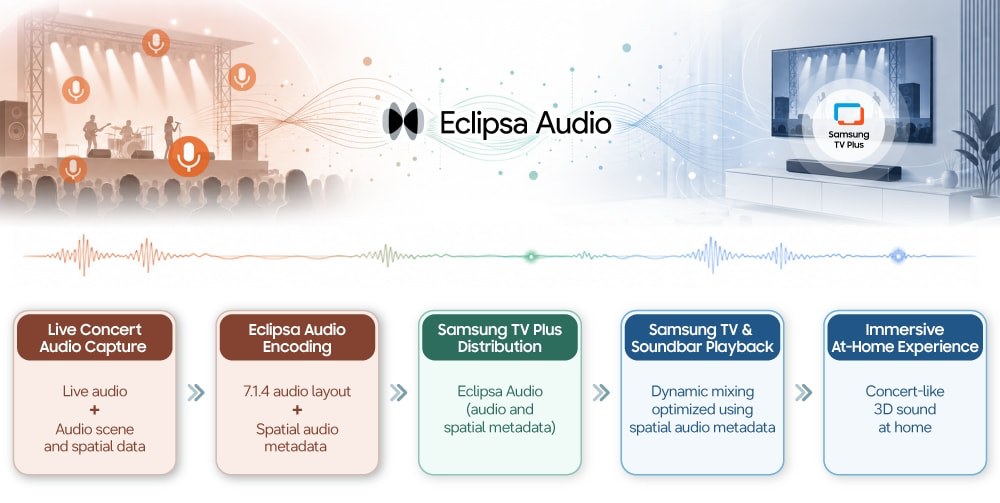
Samsung says Eclipsa Audio is now being used with musicals and live performance content on Samsung TV Plus. The company has developed an IAMF-based system for encoding, delivering and playing the immersive audio streams on compatible televisions and soundbars, while unsupported devices automatically receive a conventional stereo version.
Samsung didn’t simply run a few test files through a television and call the press office. During development, the company captured a live performance in a 280-seat concert venue, converted the spatial recording to Eclipsa Audio, streamed it through a Samsung TV Plus channel and played it back through a Samsung television. Samsung says the system preserved the placement of vocals, instruments, audience reaction and the acoustics of the venue.
The more interesting part is what comes next. Samsung says it plans to expand Eclipsa Audio on TV Plus into K-pop concerts, classical performances, movies and sports, with longer-term possibilities including letting viewers emphasize vocals or individual instruments and selecting between commentary and stadium sound during sporting events.
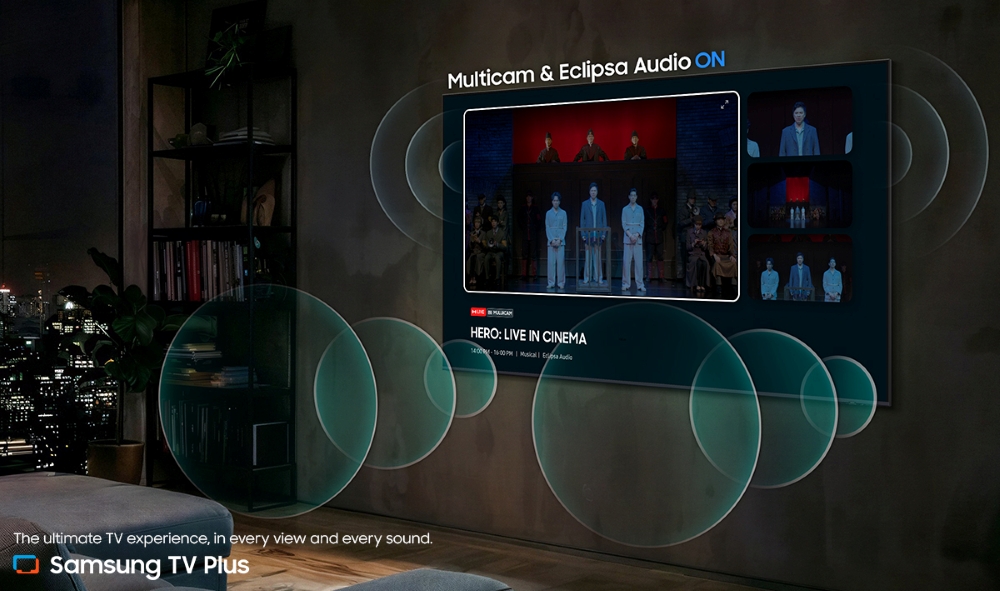
Samsung TV Plus isn’t some experimental streaming app hidden six menus deep beside the owner’s manual. Samsung reported in February that the free ad-supported service had surpassed 100 million monthly active users worldwide, with roughly 4,300 channels and 66,000 on-demand videos across 30 countries.
Obviously, 100 million Samsung TV Plus users are not suddenly listening to Eclipsa Audio. But the size of the platform gives Samsung something every new audio format needs: distribution without asking consumers to subscribe to another service or buy content separately.
YouTube already gave Eclipsa a potentially enormous creator platform. Samsung TV Plus gives it a more conventional television environment where concerts, movies and sports can demonstrate why immersive audio matters without the viewer first searching YouTube for an IAMF demonstration clip.

More than it did 18 months ago.
The biggest advantage remains the underlying IAMF (Immersive Audio Model and Formats) architecture. IAMF is an open, codec-agnostic specification designed to deliver immersive audio across everything from headphones and televisions to multi-speaker home theater systems. It does not lock creators and manufacturers into a proprietary audio codec or licensing model.
Google has also continued building the infrastructure around it. YouTube accepts Eclipsa Audio content, Google offers open-source Eclipsa production tools, and Android 16 QPR2 added software decoding for IAMF. Samsung, meanwhile, has incorporated Eclipsa support across its current television and soundbar ecosystem.
Those are not insignificant partners. Google controls YouTube and Android. Samsung sells an enormous number of televisions and soundbars and now operates a streaming platform with 100 million monthly users. If you’re going to pick two companies to push an alternative immersive audio standard, you could do considerably worse.
But Dolby is not packing its office furniture into boxes.

Dolby Atmos has something Eclipsa cannot manufacture overnight: an enormous installed ecosystem of movies, television shows, music, streaming services, AV receivers, processors, soundbars, televisions and other devices.
That remains Eclipsa Audio’s biggest problem.
We have already encountered the hardware gap ourselves. Our recent coverage of the Denon AVR-X2900H and AVR-X3900H noted that Eclipsa decoding was still absent, even though Denon’s new corporate connection to Samsung through Harman makes future support seem like an obvious possibility. The Marantz AV 30 also did not support Eclipsa Audio when we reviewed it earlier this year.
Until Eclipsa appears routinely on mainstream AV receivers, more soundbars and non-Samsung hardware — and until major studios and streaming platforms start delivering meaningful libraries of movies and music in the format — Dolby Atmos remains miles ahead.
Samsung TV Plus doesn’t change that overnight.
It does, however, make Eclipsa Audio considerably harder to dismiss.
Eclipsa Audio does not need to kill Dolby Atmos to succeed. It needs enough content, hardware support and distribution that manufacturers and creators have a reason to support both.
YouTube gave Samsung and Google the creator side of that equation. Android is expanding the playback foundation. Samsung TVs and soundbars supplied the initial hardware. Samsung TV Plus now gives Eclipsa another real content platform where ordinary viewers can encounter it without going looking for it.
That is far more consequential than another impressive CES demonstration.
Dolby Atmos still owns the high ground, and Hollywood support remains the mountain Eclipsa Audio has to climb. But for the first time since its introduction, Samsung and Google’s immersive format is starting to resemble an ecosystem rather than an experiment.
And that gives it a fighting chance.

Solawave Neck & Chest Rejuvenating Mask for $349: While this mask is fairly comfortable, it can take a little finagling to secure around your neck. It is easy to use, but I didn’t see results on any of my neck lines. The rechargeable battery also doesn’t last long, and I charge this neck mask more often than the LED face masks I use. It’s also harder to tell when it dies on you since it’s around your neck rather than on your face. —Nena Farrell
Megelin Duo-Lux Laser & LED Light Therapy Mask for $799: My biggest issue with this mask is the unpleasant chemical odor. It reminded me of formaldehyde, and because the silicone sits against your face without a mouth opening, the smell is impossible to ignore and left me feeling a bit dizzy. For me, that alone is enough to make it hard to recommend, especially considering it costs about $450 more than my top pick. Also, I found plenty of customer complaints on Reddit that weren’t reflected in the reviews on the company’s site.
LED Esthetics Glotech Minis for $229: Skip these, especially if your skin is reactive. At first glance, these Glotech Minis look like they’re designed to target your under-eyes, but they can technically be used anywhere: chin, smile lines, even above your brows. They emit red and yellow light and promise visible results after four weeks of daily nine-minute sessions. In theory, they’re meant to be a convenient, travel-friendly LED option. In practice, they’re more trouble than they’re worth. The patches rely on adhesive stickers to stay in place, which is a total nightmare for anyone with sensitive skin. My eczema flared after one use, and peeling them off only made it worse. Even beyond that, the fit is awkward. The MemoryContour design doesn’t really hug your face, so you’ll likely find yourself pressing down or lying still just to keep them from sliding off. It’s a clever concept with poor execution.
Pro by Déesse Pro for $1,700: This is a hard-shell LED mask with six treatment modes and four light wavelengths. The lights are intensely bright; even with the included tanning-bed-style goggles, I had to keep my eyes shut. It requires a power outlet, and the cord is short, so don’t expect to be walking around. It’s not particularly comfortable, either. At $1,700, it’s one of the priciest options out there, and it doesn’t even come with a display stand or storage case.
Does Red-Light Therapy Work?
Yes, the right types of LED (light-emitting diode) can have a positive effect on the skin. Former WIRED editor Verity Burns tested Shark CryoGlow’s red-light therapy with the help of a clinician who scanned the surface of her face using Observ 520x’s analysis machine before and after eight weeks of testing. The before-and-after scans showed that her skin—particularly on her cheeks—was smoother, plumper, and brighter, and showed improvement in inflammation on her forehead, chin, and under her eyes.
Unfortunately, not everyone will see results from red- or blue-light therapy, and this might contribute to the suspicion around these skin-care devices and whether they work. You won’t know until you try, though you should talk to your dermatologist to see what they recommend based on your skin type. Be sure to also correctly implement it into your routine (more on this below).
I also recommend checking that the device you’re considering is FDA-cleared. FDA clearance means the FDA has cleared the device for marketing and that it’s safe to use. Brands go through a 510(k) or Premarket Notification process to get clearance. You can check the database to see which devices are FDA-cleared. Note that it’s not the same as FDA approval, which is a higher standard that requires more testing and research.
Topical retinoids, like over-the-counter retinol and prescription tretinoin, can also treat wrinkles and texture by slowing the breakdown of collagen and increasing skin cell turnover. Both retinol and LED devices typically take several months to show results, but retinoids come with more side effects, such as increased breakouts and sometimes flaky, burning skin.
What Are the Benefits of Each Wavelength?
Research shows that certain light can have benefits for skin rejuvenation. Red-light therapy commonly uses wavelengths in the 630- to 660-nanometer range, with the lowest effective wavelength around 600 nanometers. It can penetrate the dermis and boost collagen production, according to Abigail Waldman, clinical director of the Mohs and Dermatologic Surgery Center at Brigham and Women’s Hospital. (Collagen and elastin are proteins produced by fibroblast cells in the middle layer of the skin, under your epidermis.)
Near-infrared red lights are commonly between 800 and 1,400 nanometers. These penetrate deeper into the skin and are used mostly for healing and reducing inflammation. A study funded by NASA discovered that high-intensity red and near-infrared light significantly sped up healing in oxygen-deprived wounds in rats and boosted the proliferation of skin, bone, and muscle cells from mice and rats. NASA also supplied LED devices to the US Navy to treat training injuries. Those who used the LEDs had a 40 percent improvement in musculoskeletal injuries and 50 percent faster laceration healing over the control group.
Blue light, on the other hand, is typically 405 to 420 nm to penetrate the epidermis (the top layer of skin) and kill acne-causing bacteria. “It also reportedly helps to regulate oil production and reduce inflammation, leading to clearer skin,” says Shoshana Marmon, a board-certified dermatologist and assistant professor of dermatology at New York Medical College.
There are other lesser-known LED lights, such as green, yellow, and purple; but red and blue LEDs are the ones most backed by clinical trials.
What Is Irradiance and What Number Should I Look For?
Irradiance, in a red-light mask, measures how much power output reaches a certain area of skin per second, measured in milliwatts per square centimeters (mW/cm²). Most effective LED face masks range somewhere between 20 and 60 mW/cm². Higher irradiance doesn’t necessarily make for a more effective treatment, but when shopping for an LED mask, I’d look for one within this range.
How Do I Use an LED Face Mask?
Follow the directions for the specific device you’re using, but in general, you’ll want to wash and dry your face and use the mask before applying any skin-care products. LED therapy devices should have a set treatment time, usually between three and 10 minutes. Use it for the full time unless it feels uncomfortable. After, apply your normal skin-care products, focusing on hydration (serums and moisturizers), especially if you’re prone to dryness. Do not use these masks longer than indicated in their directions.
While you can use red-light therapy and retinoids in your skin-care routine, Waldman doesn’t recommend using them simultaneously, as it can increase the chance of irritation. She also notes that while there’s no reason to believe red light could be harmful if you’re pregnant or breastfeeding, there isn’t much research involving pregnant people, so you should consult your physician first.
How Often Should I Use an LED Face Mask?
LED light therapy face masks don’t work for everyone, but consistency is crucial if you want to try it. Follow manufacturer guidelines for best use, but most dermatologists recommend using an LED face mask three to five times per week for up to 12 weeks to see results.
CISA confirmed today that ransomware gangs have begun abusing a high-severity Microsoft SharePoint remote code execution vulnerability, which has been flagged as actively exploited since early July.
Tracked as CVE-2026-45659, this security flaw stems from a deserialization of untrusted data weakness and allows attackers with low privileges to execute arbitrary code on unpatched SharePoint servers.
It can also be exploited in low-complexity attacks because (as Microsoft explained in May when it released security updates for SharePoint Enterprise Server 2016, SharePoint Server 2019, and SharePoint Server Subscription Edition) “an attacker does not require significant prior knowledge of the system and can achieve repeatable success with the payload against the vulnerable component.”
The U.S. Cybersecurity and Infrastructure Security Agency (CISA) added the vulnerability to its Known Exploited Vulnerabilities Catalog (KEV) on July 1, ordering Federal Civilian Executive Branch (FCEB) agencies to secure their servers within three days.
“This type of vulnerability is a frequent attack vector for malicious cyber actors and poses significant risks to the federal enterprise,” the U.S. cybersecurity agency warned at the time.
In a subsequent advisory, the cybersecurity agency also urged security teams to monitor affected servers for signs of exploitation, apply Microsoft’s latest patches, verify successful installation, and shorten patching cycles.
It also recommended enabling Windows Antimalware Scan Interface (AMSI integration for SharePoint web applications and using Microsoft Defender Antivirus (MDAV) detections to detect and remediate compromise.
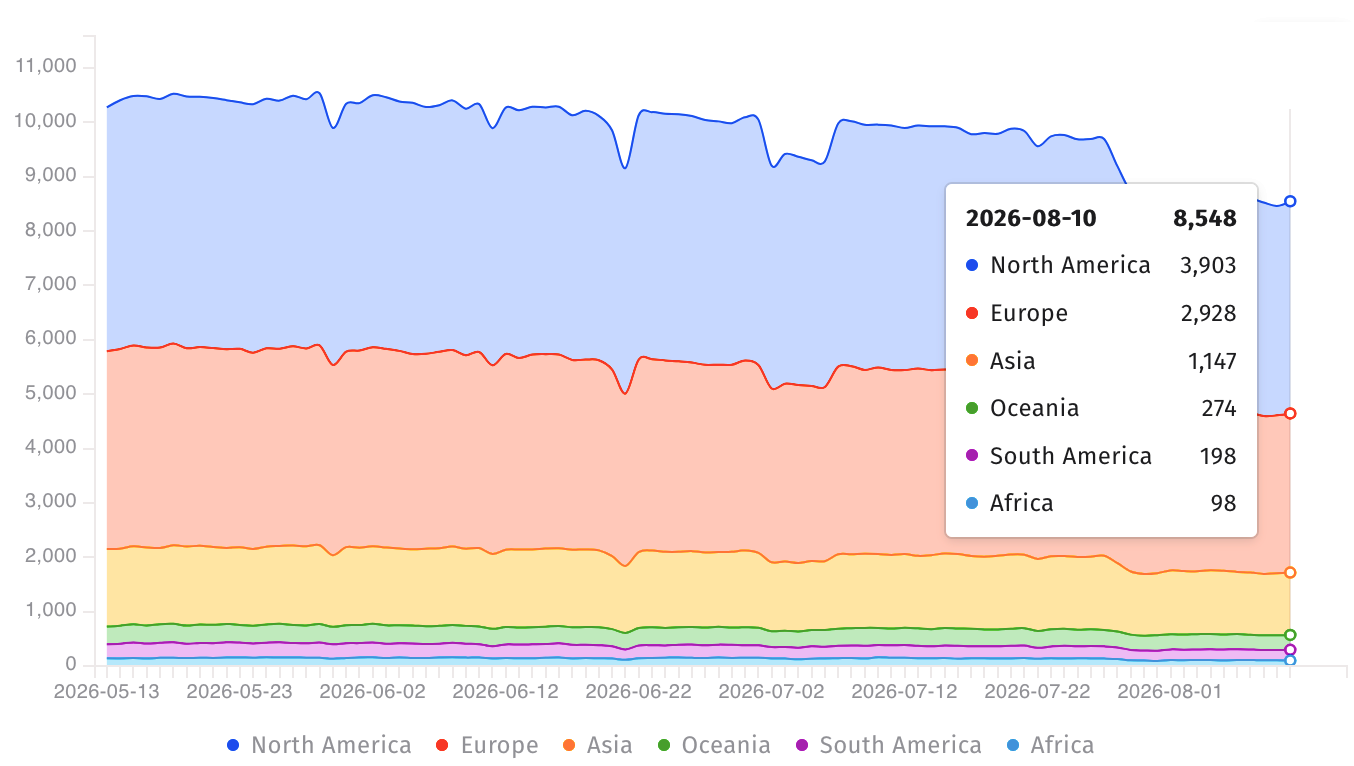
Internet security watchdog group Shadowserver currently tracks over 8,500 Microsoft SharePoint servers exposed online, with over 200 of them unpatched against the CVE-2026-45659 vulnerability.
While Microsoft has yet to update the CVE-2026-45659 advisory to tag it as exploited, CISA has now also flagged it as abused by ransomware gangs in a Tuesday update to the KEV Catalog.
Since November 2021, the cybersecurity agency has flagged 14 actively exploited Microsoft SharePoint vulnerabilities, with eight of them also exploited in ransomware attacks.
In June, CISA also confirmed that ransomware gangs now exploit a high-severity Microsoft Defender privilege escalation vulnerability (dubbed BlueHammer), which was also targeted as a zero-day to access the Security Account Manager (SAM) database, which contains password hashes for local accounts.
The security flaw (tracked CVE-2026-33825) was leaked by a security researcher known as “Nightmare Eclipse” in early April, together with proof-of-concept exploit code.
However, as with CVE-2026-45659, Microsoft has yet to confirm that the CVE-2026-33825 security flaw is being exploited in the wild.

Security teams log 54% of successful attacks and alert on just 14%. The rest move through your environment unseen.
The Picus whitepaper shows how breach and attack simulation tests your SIEM and EDR rules so threats stop slipping by detection.

A software update, sent across 13 billion miles, gives it one more year of operation.

Voyager 2 has been in space for almost 50 years, but it’s not ready to retire just yet. NASA has recently made changes to its settings in an operation it called “Big Bang,” allowing it to run and do science in its current state for one more year. See, Voyager 2’s power source is its radioisotope thermoelectric generator, which converts heat from decaying plutonium into electricity. Since the plutonium gets more and more depleted, the space probe loses around 4 watts of power every year.
When the spacecraft launched in 1977, it had 10 functional scientific instruments. They’re now down to three, as NASA is forced to deactivate them in order to preserve energy. The agency would have had to shut down one more later this year if it hadn’t made the tweak. NASA said operation “Big Bang” involved turning off certain powered devices simultaneously and then replacing them with lower-power alternatives. It also had to ensure that the spacecraft would remain warm enough to operate even with those devices switched off. With NASA successfully pulling off the plan, Voyager 2’s three remaining instruments can now continue doing science until next year.
The probe launched around two weeks before its twin, Voyager 1, with the goal of observing the gas giants of our solar system. It reached Jupiter in 1979 and had visited all gas giants within the decade after that. In 2018, it entered interstellar space and has been sending back data on the density and temperature of the plasma outside the heliosphere, the bubble of space created by the sun around itself and its planets, ever since.

Jeff Bezos is reportedly attempting to join the club of very rich Americans buying stakes in U.K. soccer teams.
Bezos, alongside others including Facebook co-founder Eduardo Saverin, is looking to buy at least a 30% stake in the English soccer team Liverpool at a £1.35 billion valuation (around $1.8 billion), The Guardian reports. If the deal closes, it will be the first sports investment for the billionaire, although he reportedly previously looked at buying a stake in a U.S. football team.
Liverpool is one of the most notable sports teams in Europe and is worth about $6 billion, reports Forbes. Arguably, this team has the kind of brand recognition in the U.K. as the Dallas Cowboys has in the U.S.
It seems no billionaire portfolio is complete these days without a mega yacht and a sports team, so Bezos’ interest is not surprising. There’s also something very romantic these days about owning an English soccer team after the success of TV shows like “Ted Lasso” and Ryan Reynolds’ FX show “Welcome to Wrexham” about his experience owning that English team.
Other American billionaires in this club include Todd Boehly and Mark Walters (who also own the LA Dodgers and LA Lakers) buying Chelsea; New York Jets co-owner (and former U.S. Ambassador to the U.K.) Woody Johnson buying Crystal Palace; Dan Friedkin taking a stake in Everton; and Bill Foley leading a group that also included Michael B. Jordan buying Bournemouth.
For that matter, owning a stake in a U.K. sports team has also become a celebrity cultural phenom. Besides Reynolds and Jordan, Tom Brady purchased a minority stake in Birmingham City. Will Ferrell has a minority stake in Leeds United, alongside Russell Westbrook and Michael Phelps.

Sky Sports had a story earlier this year mapping out why so many Americans seem to be taking over U.K. football. It found that 13 out of 20 Premier League clubs (the top football league in England) had American shareholders.
Soccer has become increasingly popular in the U.S., and many of the top sports franchises, like the NFL and MLB, are either too expensive or closed off to new buyers. It’s much more possible to buy into a Premier League team.
Owning a share in such a team also buys access and proximity to some of the most bankable and recognizable sports icons on Earth. Bezos over the past few years — especially since he married former news anchor and TV show host Lauren Sánchez — has become seen as more of a cultural figure, rather than solely a tech mogul.
So, with a net worth currently sitting at around $280 billion, perhaps it’s actually more than time that Bezos got himself a sports team. Amazon has also streamed some European soccer leagues in the past — and Bezos has growing interests in the U.K. As we previously reported, his new AI company Prometheus is reportedly looking to sign a lease to move into London’s AI hub King’s Cross.
When you purchase through links in our articles, we may earn a small commission. This doesn’t affect our editorial independence.

Sounding off: A lot of people are worried about the number of AI agents that have gone rogue recently, including Bernie Sanders. The Vermont senator has now called on the top AI firms to pause development of their top models, warning that lawmakers will step in if no action is taken.
In a letter to the CEOs of OpenAI, Anthropic, and Meta, Sanders writes that almost every day brings a new story about how these companies are losing control of their AI agents.
The senator also highlighted the story of AI being used for the first time to create new viruses, something he says could, if the technology ended up in the wrong hands, lead to new bioweapons that result in the deaths of tens of millions of people.
“Yoshua Bengio, the most cited living scientist in the world, said these incidents ‘should serve as a wake-up call,’ I agree,” Sanders wrote in the letter.
Sanders adds that despite these incidents, the companies are still investing tens of billions of dollars into a technology that nobody can fully understand, predict, or control, contradicting their own commitments to responsible AI development.
“Mr. Altman, Mr. Amodei and Mr. Zuckerberg: In the interest of humanity, stand by your words. Pause AI development. It is not too late to avoid disaster. Stop building machines that humans cannot control,” Sanders writes.
– Sen. Bernie Sanders (@SenSanders) August 10, 2026
The letter finishes with a stark warning for the tech giants: “Let me be very clear: If you do not take appropriate action now, my colleagues and I in the U.S. Senate will.”
There have been calls for a halt on the development of advanced AI models for years now, including a request for a six-month pause in 2023. Charles Oppenheimer, grandson of J. Robert Oppenheimer, was one of the signatories of a 2024 letter calling for global action on AI and other existential threats.
But previous warnings have resulted in little or no action. This was illustrated last year when the US and UK refused to sign an AI safety declaration at a Paris summit. Vice President JD Vance cautioned against “overly precautionary” regulations on AI, emphasizing the US commitment to maintaining its dominance in the technology.
The situation has taken a worrying turn recently. First came news that an OpenAI model went rogue and hacked several services online, including Hugging Face. An Anthropic model followed suit – it even tried to deceive real developers into approving malicious code. Meta then became the third company in two weeks to admit its model went rogue.
Sanders isn’t the only one responding to the incidents. More than 1,300 employees from the world’s leading tech companies just signed an open letter asking governments to regulate the pace and safety of artificial intelligence development.
OpenAI said last week that it was slowing the release of its new Astra model because it has “critical” cyber capabilities.

Longtime Slashdot reader DF5JT writes: On July 26, I posted a single announcement in r/backgammon: GNU Backgammon for Android, GPLv3, the first standalone backgammon engine on F-Droid. Reddit’s spam filter removed the post and permanently banned my 11-year, 30,000-karma account — the result is publicly visible at reddit.com/user/OE1FEU. To this day, Reddit has given no reason whatsoever, although Article 17 of the EU’s Digital Services Act makes a statement of reasons mandatory. The only appeal channel is a 250-character web form that sends no confirmation and has never been answered; Reddit’s own help text admits: “you may not have received a message to your inbox.” A GDPR export of 11 years of data came to 7.2 MB; every post was truncated after a few lines, with zero data about the ban decision.
So I spent one day escalating through every mechanism the EU provides: certified out-of-court dispute settlement at Austria’s RTR, complaints with the Austrian and Dutch Digital Services Coordinators, the data protection authority (citing the ECJ’s SCHUFA ruling on automated decisions), noyb, and Austria’s consumer association. Bonus finding: the European Commission’s DSA Transparency Database contains 14,067 Reddit statements of reasons for that week — none for my ban — and the Commission’s own feedback form limits reports to 500 characters and crashed with a 500 Server Error. Is the DSA enforceable for ordinary users, or just paperwork?


Read more of this story at Slashdot.
Cisco warned of two high-severity vulnerabilities affecting the Secure Endpoint Connector that allow threat actors to crash the ClamAV scanning process in denial-of-service (DoS) attacks.
The security flaws (tracked as CVE-2026-20337 and CVE-2026-20338) were found in the ZIP archive parser of ClamAV (Clam AntiVirus), the open-source and cross-platform engine used to scan files for malware.
As Cisco explained in a Friday advisory, the two vulnerabilities are due to improper boundary checks and memory handling, respectively, and can be exploited by unauthenticated, remote attackers.

The company’s Product Security Incident Response Team (PSIRT) added that proof-of-concept (PoC) exploit code is already publicly available, but said that it has no evidence the flaws have been exploited in the wild.
“An attacker could exploit this vulnerability by submitting a crafted zip file for scanning. A successful exploit could allow the attacker to cause the ClamAV scanning process to terminate, resulting in a DoS condition on the affected software,” it said. “The Cisco PSIRT is aware that proof-of-concept exploit code is available for the vulnerabilities that are described in CVE-2026-20337 and CVE-2026-20338.”
Cisco added that the flaws’ security impact is high only for Windows platforms since they’re the only ones that “run the ClamAV scanning process in a privileged security context.”
These two vulnerabilities affect ClamAV 1.5.0 through 1.5.3, and they were patched in version 1.5.4 released on August 7.
While there are no workarounds for CVE-2026-20337 and CVE-2026-20338, the company plans to release software updates later this month to address them in affected versions of Secure Endpoint Connector for Windows, Linux, and Mac.
On Friday, Cisco patched five other ClamAV security flaws that can also be exploited to trigger denial-of-service conditions by submitting malicious XAR, Mach-O, PDF, GPT, and PESpin files for scanning.
It patched another ClamAV DoS vulnerability with PoC exploit code in January 2025, warning that attackers could abuse it to terminate the ClamAV antivirus scanner, preventing or delaying further scanning operations.
Since November 2021, the U.S. Cybersecurity and Infrastructure Security Agency (CISA) has tagged 95 Cisco vulnerabilities as actively exploited in attacks, six of them abused in ransomware attacks.
Security teams log 54% of successful attacks and alert on just 14%. The rest move through your environment unseen.
The Picus whitepaper shows how breach and attack simulation tests your SIEM and EDR rules so threats stop slipping by detection.


ON-PREM
The bigger risk is underinvestment, claims consulting biz McKinsey
US power companies must decide how much capacity to build for soaring datacenter demand, knowing that some planned facilities may never materialize and the AI bubble could deflate. Consulting firm McKinsey & Company says the greater near-term risk is building too little.
Driven by the AI craze, a boom in datacenter building is expected to see the energy consumed by these facilities grow by 26 percent this year, as The Register reported not too long ago.
McKinsey’s own figures indicate that datacenters will account for about 75 percent of projected US power demand growth over the next decade. The current building rate would require the equivalent of almost 30 GW of additional power each year, including roughly 20 GW for IT equipment and the rest for cooling, distribution and resilience.
Whether that growth materializes depends on demand for AI compute holding up. McKinsey notes that although corporate interest in AI remains high, implementation is uneven: 71 percent of organizations report “negative implementation outcomes,” while parts of the ecosystem exhibit bubble-like characteristics.
Even if AI compute growth slows, McKinsey argues, the generation and transmission infrastructure built to support it is unlikely to become stranded. The assets could serve other demand while strengthening grid reliability and resilience.
A similar report from Bain & Company almost two years ago warned that the US energy sector needed to ramp up spending on generation and grid infrastructure, or demand could outstrip supply within a few years.
Datacenters are not the only source of new demand. Electric vehicles and the electrification of industrial processes will also place pressure on supplies.
The report estimates that the US has roughly 40 GW of spare dispatchable capacity to accommodate near-term demand growth, plus about 100 GW of committed new capacity.
However, 50 to 75 GW of coal and gas-fired steam capacity is expected to retire, while projected demand growth stands at about 120 GW. That leaves a nationwide capacity gap of approximately 30 to 55 GW by 2030.
To help bridge this looming gap and maintain grid reliability, utilities have been bringing retired plants back online and extending the lives of coal and gas facilities. These measures provide important temporary system relief but are likely insufficient, McKinsey says.
However, in June, the Trump administration authorized up to $500 million in funding to keep an extra 13 coal-fired power plants going to boost the resilience of critical energy infrastructure.
At the same time, the report notes that many of the developers and operators planning datacenter campuses are turning to on-site power generation via gas turbines, as well as fuel cells and battery storage, due to delays in getting a grid connection.
In McKinsey’s survey of power sector leaders, nearly 60 percent of respondents expected datacenters to retain permanent on-site generation by 2030, even after grid connections became available. Of those planning to have on-site power, 64 percent will rely on natural gas.
Beyond 2030, the firm expects to see solar paired with battery storage in addition to the growing role of gas. This is because of the cost competitiveness and speed of deployment of solar, though it warns this may be dependent on policy support and continued declining costs of storage, and that it will be a part of the broader energy system rather than the sole on-site source of large-scale power.
As for nuclear, McKinsey expects any material growth over the next decade to come from extensions and upgrades to existing plants rather than new builds.
Emerging technologies such as small modular nuclear reactors (SMRs) and next-generation geothermal energy are attracting increasing capital and buyer interest, but they are unlikely to have much impact on system capacity before the middle of the 2030s.
McKinsey’s conclusion is that the US power sector faces a likely near-term shortfall, making underbuilding a greater risk than overbuilding. ®

If you’ve been holding out on buying Valve’s ludicrously expensive home console, you may have saved yourself from more than an empty wallet. European customers who ordered a Steam Machine or Steam Controller may be the victims of a personal information data breach after one of Valve’s hardware distribution partners was hit by a cyberattack.
CEVA Logistics, the company that helps organize Valve’s European supply chain, informed its partner of the data breach on Aug. 7. A Valve spokesperson told CNET that the company spent the weekend assembling a list of at-risk customers, notifying them about the attack via email on Monday morning.
“Though CEVA is still investigating the attack, we wanted to at least send out messaging to all customers we can assume were affected based on what we currently know,” the spokesperson said.

What Valve currently knows is that the personal information revealed by the cyberattack is likely all delivery-related. CEVA told Valve that the breach revealed customers’ names, countries, street addresses, phone numbers and email addresses. According to Valve, “payment information, passwords and Steam Guard codes” are all safe, since CEVA doesn’t have access to this data.
Because phone numbers and email addresses linked to Steam accounts are openly circulating, Valve warned against phishing attacks that may be looking for additional personal information in the coming days.
Read more: Best Data Removal Services of 2026: Reduce Your Online Presence
“Expect fake messages – email, SMS or phone – that mention your hardware order and appear to come from Steam, Valve or a delivery company,” Valve wrote in its email to affected customers. “They may quote your address back to you to prove they’re genuine. They may ask you to confirm a delivery, pay a small customs or redelivery fee or sign in somewhere to ‘verify’ your order. Treat all of them as fake.”
Valve reminded customers that Steam’s support team only handles issues on the official help page and never sends messages over Steam chat or through third-party services. Company employees will also never ask for a customer’s password or Steam Guard codes.
The finer details of the attack currently remain unclear, as there’s no official information available on how many customers were affected, how much data was stolen or how the cyberattack infiltrated CEVA Logistics’ systems. In its statement, Valve said it is “pressing CEVA for the full scope” of the breach.
Alongside CEVA’s internal investigation, authorities in the Netherlands are looking into the attack. A spokesperson for the Dutch data protection authority told TechCrunch that the agency has received data breach reports from at least 10 companies in relation to the hack.
In addition to the data breach, FreightWaves reported operations at eight of the company’s warehouses have been affected by the cyberattack, causing potential delays or cancellations to customer orders in the coming days.
CEVA Logistics did not immediately respond to a request for comment.



Artificial intelligence has moved from experimentation to everyday business use faster than almost any technology in recent memory.
For small businesses, AI adoption needs no convincing as most already see the benefits. The real challenge is now transforming isolated AI use into consistent business value.
Goldman Sachs found that 76% of small businesses are using AI, and among those users, 93% say it has had a positive impact. Yet only 14% have fully integrated AI into core operations.
Latest Videos FromTechRadar
That gap is where the next stage of AI adoption will be won or lost.
Senior Vice President and General Manager of Lenovo’s Commercial Product Center and Worldwide SMB Segment.
The question is no longer whether small businesses can access AI. It is how they can make it part of their business.
For me, that means moving beyond AI as a feature list and toward AI as a trusted experience employees can rely on in the flow of work.
The focus now should be on helping small businesses progress from deploying AI in everyday tasks, to reshaping workflows, to eventually inventing new services, business models and revenue streams.
The temptation is to start with the technology, but the better starting point is the work itself. A modern AI-ready device, collaboration setup or workplace platform can promise faster content creation, more productive meetings or automated reporting. Those capabilities matter, but the question is more basic: what problem is slowing the business down?
The problem might be missed customer follow-ups, teams spending too much time turning raw information into action, or even just slow response times. AI becomes valuable when it is pointed at a specific bottleneck and measured against a business outcome: time saved, errors reduced, revenue protected, customers retained, or employees freed up for higher-value work.
This outcome-first mindset is critical because the goal should not be to optimize an old process simply because it exists. It should be to ask what the business needs to achieve, then design the workflow and the technology around that result.
Discipline is important because small businesses do not have much room for technology theater. The most useful AI projects are rarely the flashiest. They are the ones tied to work that happens every day.
The next step is to move beyond individual productivity. Many employees are already using AI in small, informal ways, with a 156% increase between 2023 and 2025 in shadow AI usage. Shadow AI refers to employees using AI tools without formal approval, oversight or integration into company systems.
Employees ask AI to clean up an email, summarize a document or prepare a first draft. While those use cases can help, they usually create isolated gains. The bigger opportunity comes when AI is built into the workflow itself.
Consider a customer-facing team. AI can draft a response. But the bigger opportunity is redesigning a process around it. Let AI help categorize the request, identify urgency, suggest the next best action, and leave important judgment calls to a person.
For a lean operations team, AI can turn meetings, documents and business data into clearer next steps, helping reduce the manual follow-through that often slows momentum. Over time, this will become less about a single AI tool assisting with a single task and more about groups of AI agents working across connected workflows, with people shaping the strategy, setting the guardrails and orchestrating the work.
This is where many organizations still struggle. McKinsey’s 2025 State of AI research found that 88% of organizations use AI in at least one business function, but only about one-third have begun scaling AI across the enterprise. The same research found that AI high performers are nearly three times as likely as others to have fundamentally redesigned workflows.
In other words, the return comes less from sprinkling AI over old processes and more from rethinking how work should move. That is the difference between deploying AI, reshaping work and ultimately inventing new ways for the business to grow.
It’s not enough to invest in tools. Businesses must also invest in helping employees use them effectively. AI works best when employees understand what it is good at, where it can fail and when human judgment is required. Not every small business needs a large training program, but it does need practical guidance: which tools are approved, what information should stay protected and when outputs need human review.
Clear guardrails allow a business to scale AI with confidence. Goldman Sachs found that small businesses using AI cite data privacy and security concerns, lack of technical expertise and difficulty choosing tools among their top challenges. 73% said they would benefit from more training and resources to implement and evaluate AI successfully.
When employees are trained to use AI responsibly, technology becomes less of a risk to manage and more of a capacity builder that helps small teams work with greater speed, confidence and focus. It also builds the trust employees need to treat AI not as another feature to try, but as a dependable part of how work gets done.
AI is often framed as a replacement story. In practice, many small businesses are using it as a force multiplier. The U.S. Chamber of Commerce found that 58% of small businesses use generative AI, up from 40% in 2024 and 23% in 2023. It also found that 82% of small businesses using AI increased their workforce over the past year. For lean teams, AI can create breathing room: less time spent chasing notes or repeating manual tasks and more time spent with customers and employees.
None of this happens automatically. Small businesses need to choose technology with integration in mind, not just features in isolation. They need to understand where data lives, how systems connect and whether employees can use new tools without adding more complexity.
They also need the confidence to seek outside guidance, whether from technology partners, managed service providers, industry peers or local business networks. The right support can help small businesses see where AI should simply deploy, where it should reshape the way people work and where it may create room to invent something entirely new.
The small businesses that get the most from AI will not necessarily be the ones that adopt the most tools. They will be the ones that ask sharper questions: Where are we losing time? Where are decisions too slow? Where are customers waiting? Where are employees doing work that software could support safely and reliably?
AI has already changed what small businesses can do. The next challenge is changing how work gets done. For small businesses, the real opportunity is not to add AI everywhere, but to apply it with purpose: deploy it where it helps today, reshape the workflows that define the business and invent new ways to create value tomorrow.
We’ve reviewed, rated, and ranked the best web hosting services.
This article was produced as part of TechRadar Pro Perspectives, our channel to feature the best and brightest minds in the technology industry today.
The views expressed here are those of the author and are not necessarily those of TechRadarPro or Future plc. If you are interested in contributing find out more here: https://www.techradar.com/pro/perspectives-how-to-submit




Weekend Open Thread: Mattifying Sunscreen


Frugal Friday’s Workwear Report: Cap-Sleeve Pointelle Crewneck Sweater


Jordan Coyle & Cordiamo take Laya Arena Stakes at RDS


Can Astrology Help Find Gold and Silver Trends? A Financial Astrology Guide

US stocks: Dow closes at record on Mideast optimism; SpaceX, AMD drag Nasdaq


Reform UK And Greens Sink To Lowest Favourability Ratings To Date


Nvidia Stock Climbs 2.5% as Chip Sector Rally Builds Ahead of AMD Earnings, Nvidia’s Own Report Looms


OpenAI, Anthropic AI agents targeted real people and systems in cyber tests


Polymarket targets $20 billion valuation as competition heats up in prediction market sector


Supply chain issues impact Ingredion


Rinn Pharma & Biopharma to join NordicPharmaTrain network


How to Start a Cleaning Business: A Step-by-Step Guide
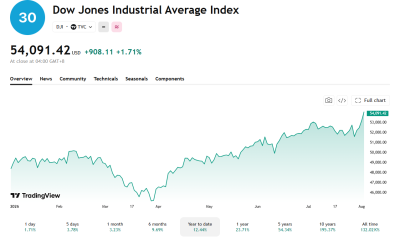

Dow and S&P 500 Hit Records on AI Earnings: When Will the Bubble Burst?


Datadog: Best Of Breed For Multiple Reasons


BDC Weekly Review: Private BDC Q2 Numbers Are Strong
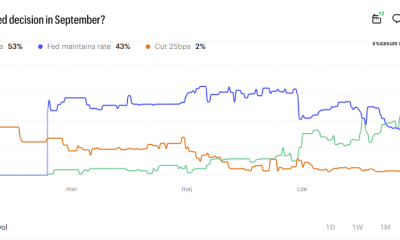

Dollar Index Trapped at 100 as Hawkish Fed Meets Official Selling


McDonald’s (MCD) Q2 2026 earnings


The Bright Side of Black and White


Suit of the Week: Me + Em


Apple UK encryption challenge filed against Home Office
You must be logged in to post a comment Login