The AR7E-2026 project aims to generate new insights into the links between ocean circulation, climate, carbon cycling and marine ecosystems.
An international team of researchers has set off aboard the Marine Institute’s RV Celtic Explorer vessel on an expedition to track chemical and biological changes in the ocean.
The RV Celtic Explorer will be used by the team for the AR7E-2026 project, which will conduct hydrographic (meaning measurements and descriptions relating to the ocean’s physical features) and biological observations along a stretch of ocean used for scientific analysis, known as a transect, from Ireland to Cape Farewell at the southern shore of Greenland.
The project aims to build on hydrographic transects that have provided climate quality measurements across the Atlantic Ocean for decades.
Advertisement
By extending these long-term observations, the AR7E-2026 project aims to generate new insights into the links between ocean circulation, climate, carbon cycling and marine ecosystems.
“The AR7E-2026 expedition demonstrates the importance of international collaboration and sustained ocean observation in addressing global challenges such as climate change, biodiversity loss and ocean health,” said Michael Gillooly, director of ocean, climate and information services at the Marine Institute.
“We are delighted to see RV Celtic Explorer supporting this world-class research effort, generating vital scientific evidence that will deepen our understanding of the North Atlantic and inform sustainable ocean management both nationally and internationally.”
AR7E-2026 is led by Dr Yvonne Firing from the UK’s National Oceanography Centre, and comprises a team of scientists from institutions based in the UK, Norway, Belgium, Portugal, Switzerland and Greece.
Advertisement
The project is the first Marine Institute research vessel survey to receive funding through the Aquarius project, a four-year Horizon Europe-funded programme led by the Marine Institute that aims to provide access to research infrastructure to aid projects focused on marine and freshwater ecosystem sustainability.
The Marine Institute noted that the expedition is “particularly timely” as it contributes scientific knowledge from areas beyond national jurisdiction, meaning the vast regions of ocean lying outside any country’s exclusive economic zone.
“As the international community begins implementing the landmark UN High Seas Treaty on Biodiversity Beyond National Jurisdiction, high-quality observations from these waters will play an increasingly important role in understanding, conserving and sustainably managing marine biodiversity,” said the organisation. “Such research provides the scientific evidence needed to support international cooperation in protecting the global ocean.”
The expedition also sets off after the world’s oceans recorded the hottest June on record, with the average sea surface temperature reaching just under 21°C across the world’s tropical and temperate oceans.
Advertisement
In other climate news, yesterday (23 July) EU environment ministers met in Dublin for an “informal” session discussing the climate and environmental challenges impacting the bloc.
Don’t miss out on the knowledge you need to succeed. Sign up for the Daily Brief, Silicon Republic’s digest of need-to-know sci-tech news.
A new law set to go into effect next year bars grocery stores in New Jersey from setting prices based on any given shopper’s personal data.
The Fair Price Protection Act seeks to outlaw surveillance pricing that discriminates against individual customers by using personal information like their purchasing history or online activity.
“New Jersey families are already feeling the pressure of higher costs,” Gov. Mikie Sherrill said in a statement. “The last thing they need is companies secretly using their personal data to charge them more than someone else for the exact same product.”
Penalties for retailers could include fines of up to $10,000 for a first offense, $20,000 for subsequent violations and the potential for cease and desist orders and the assessment of punitive damages.
Advertisement
The law also includes a provision that pauses new electronic shelf labels for a year while the state studies their effect on surveillance pricing.
Two other states, Maryland and Connecticut, have recently enacted laws meant to protect consumer privacy, particularly when it comes to grocery prices. Other states including New York and California are considering similar new laws. Last year, the state of New York set rules requiring businesses to disclose to customers when they are setting prices based on algorithms.
What constitutes surveillance pricing
Some state laws have focused on algorithmic pricing, which could include companies using AI to coordinate on price-fixing, which is the subject of a lawsuit in California over gas prices. That’s closer in line to what people know to be surge pricing, where a company such as Uber might raise prices when roadways are busy and demand is high for its services.
Surveillance pricing, however, typically means that a retailer has personal information from its customers, say through a loyalty or discount shopping program, that it uses to set different prices for different shoppers.
Advertisement
According to the Electronic Privacy Information Center, personal data and market data are being used by retailers to determine the highest price a customer is willing to pay, leading to higher prices.
“This undermines consumer expectations of fairness and can amount to violations of state consumer protection law,” EPIC said on its website. “The price differences may also be discriminatory on the basis of protected characteristics, such as race and gender.”
The Federal Trade Commission has been investigating these types of practices. In a report on surveillance pricing last year, the FTC found that companies may be picking and choosing which customers have access to discounts in order to incentivize infrequent buyers to make purchases.
Separately, Consumer Reports found that AI price experimentation can result in hundreds or thousands of dollars in higher grocery bills for customers using services such as Instacart.
Advertisement
In a statement about the New Jersey law, EPIC applauded the action but pointed to more that needs to be done, including “expanding the law’s scope beyond the grocery store context, narrowing the law’s exemption for loyalty programs, and clarifying some key definitions.”
Climate change has now become a problem for the whole solar system. On Friday, wildfires in Spain overran one of three observatories the US National Aeronautics and Space Administration uses to connect with spacecraft, including Voyager 1, the James Webb Space Telescope, and the recently completed Artemis mission around the Moon.
Spain declared a wildfire emergency as multiple blazes burned out of control near Madrid, with evacuation orders in place for 60,000 people. The affected area includes Robledo de Chavela, a municipality near the Deep Space Communications Complex run by NASA.
Dramatic images captured by news photographers showed the radio telescopes surrounded by smoke and fire. A NASA spokesperson said in an email to WIRED that the agency successfully evacuated all personnel.
They added that while the fire has now passed through the observatory complex, it remains unclear what impact the flames may have had on the sensitive equipment inside. “Any potential damage will be assessed when it is safe to do so,” the spokesperson said. They add that if conditions allow, a site assessment could happen as soon as Saturday.
Advertisement
For now, NASA said it has “seamlessly transitioned support for mission operations to the Goldstone Deep Space Communications Complex in California, ensuring continuity of service and uninterrupted support for spacecraft communications.”
The facility in Spain, along with the others in Canberra, Australia, and Goldstone, California, make up what NASA calls the “largest and most sensitive scientific telecommunications system in the world.” The network allows NASA to transmit information from Earth to spacecraft, including the most distant human-made object in our solar system, Voyager 1. It’s also used to transfer data from the James Webb Space Telescope and send commands to other space vehicles. Oh, and the sites also contribute to radio astronomy observations. Suffice to say, it’s a very important collection of instruments for understanding the solar system.
Spain is far from the only country facing a wildfire crisis. Blazes are also burning out of control in France, where beachgoers saw skies turn orange and waves of ash washing ashore as firefighters worked to stop flames from spreading into the eponymous capital of the Bordeaux wine region.
“We learned in the middle of the afternoon that, following the wind shift, it had become a large, self-sustaining fire that is extremely difficult to bring under control,” French interior minister Laurent Nunez told national television channel Tf1. “It is now moving east, toward the Bordeaux metropolitan area. We are going to reorganize our response so we can fight it from the ground and prevent it from advancing.”
Advertisement
Roughly 200,000 people have been told to evacuate across the two countries.
Europe has seen record high temperatures this summer, driven by repeated heat domes camping over the continent and the UK, as well as climate change. Hot weather can dry out vegetation, priming forests to burn when hit by an errant spark. Similar stories have played out in other parts of the world recently, from Ontario, Canada, to the US Pacific Northwest.
Cooler weather is expected to arrive in the Mediterranean over the weekend, which should help firefighters get a handle on the blazes. But the respite will be short: Temperatures are expected to shoot up again on Monday and keep climbing throughout the week, eventually reaching up to 10 degrees Celsius (18 degrees Fahrenheit) above normal. That could worsen any wildfires in Spain or France that may still be burning—or help spark new ones.
That distinction matters most if you ever touch development work, IT administration or anything at all that leans on enterprise-grade tools alongside the everyday Windows experience most people already know well from their own PC.
Advertisement
BitLocker device encryption comes standard here, locking down your entire disk so a lost laptop or a stolen drive doesn’t quietly turn into a costly data breach layered on top of an already stressful inconvenience.
Hyper-V and Windows Sandbox let you spin up virtual machines or test unfamiliar apps in a fully isolated environment, keeping anything untrusted well away from the files and programs you actually rely on every day.
Advertisement
None of that comes at the expense of the everyday Windows 11 experience, since Snap layouts, DirectX 12 Ultimate for gaming, biometric sign-in and Copilot built directly into the taskbar are all included as standard.
It’s worth checking your PC’s compatibility with Microsoft’s free PC Health Check app before buying, since this license is meant for machines that need a fresh Windows license rather than ones already eligible for a free upgrade.
Redemption is instant, with a code delivered by email straight after purchase, though it only covers a single PC and needs to be claimed within 30 days, so this genuinely isn’t one to sit on.
At $9.97 instead of $199, paying just once for Windows 11 Pro and never having to pay again is about as close to a genuinely no-catch software deal as you’re likely to find right now.
DOJ charges two VW engineers with insider trading for buying Rivian stock before the joint venture announcement
Federal prosecutors on Friday arrested two Volkswagen engineers in San Jose, California, and charged them with insider trading for buying Rivian stock before VW’s multibillion-dollar joint venture with the electric vehicle maker was publicly announced. Michael Stamp and Marcus Plank, both based at VW’s US operations, each face one count of federal securities fraud carrying a maximum sentence of 25 years in prison. The indictment, filed by the US Attorney’s office for the Southern District of New York, alleges the two men used confidential knowledge of the partnership, internally codenamed Project Climb, to purchase Rivian shares in the weeks before the deal was revealed on June 25, 2024.
Stamp allegedly made approximately $250,000 in profits from his trades, while Plank netted roughly $50,000, according to the indictment. A family member of Plank also purchased Rivian shares and made about $12,000, prosecutors said. Rivian’s stock rose 23 percent on the day the joint venture was announced, rewarding anyone who had bought shares in advance.
The indictment includes details that suggest the defendants were aware of the legal risks. Stamp allegedly searched “statute of limitations insider trading” on Google eight days before the joint venture was announced, according to prosecutors. A family member of Plank searched the same phrase in German, the indictment states.
Advertisement
The joint venture at the centre of the case has since grown into one of the most consequential partnerships in the automotive industry. Originally valued at five billion dollars, it has expanded to nearly six billion dollars and is focused on developing software-defined vehicle architecture for VW’s next-generation cars, even as Rivian pushes into the mass market with its R2 SUV. VW overtook Amazon as Rivian’s largest shareholder in May with a stake of nearly 16 percent after a one billion dollar share purchase tied to a software milestone.
The 💜 of EU tech
The latest rumblings from the EU tech scene, a story from our wise ol’ founder Boris, and some questionable AI art. It’s free, every week, in your inbox. Sign up now!
The case is being prosecuted by the same SDNY office that charged a Google engineer with insider trading on Polymarket in May, part of a broader federal push to pursue corporate insiders who exploit non-public information in the technology and automotive sectors. Both defendants were arrested in San Jose and are expected to appear before Judge Katherine Polk Failla in the Southern District of New York. The case was announced by US Attorney Jay Clayton, who has made insider trading enforcement a priority for the office.
Bose’s best immersive audio soundbar so far, the Lifestyle Ultra Soundbar delivers a clear, punchy, energy sound with a good bass performance. It’s not exactly targeted at home cinema enthusiasts though, and it’s up against some tough competition.
Punchy, energetic and clear delivery
Spacious sound
Lovely looks
Good dialogue delivery
No DTS support
No HDMI pass-through
Audio could stand to be taller and wider from the get-go
Key Features
Advertisement
Review Price:
£999.95
QuietPort
Advertisement
Bose’s technology to increase bass without causing distoriton
Wi-Fi streaming
Advertisement
Play music from the likes of Spotify and Tidal over Wi-Fi
Adjustable EQ
Advertisement
Adjust the width and height of the soundbar’s performance
Introduction
We’ve had a look at several soundbars from Bose over the years, and while they’ve been solid, they’ve not quite had that… edge to push them over into ‘very good’ territory.
Like previous efforts, the Lifestyle Ultra Soundbar is a single-box immersive bar, but this is one that truly wants to be the only ‘one-box’ system you’ll ever need, one that’s good at dialogue, spatial audio and bass.
Advertisement
As part of the Lifestyle Collection, this soundbar, along with the Ultra Speaker and Subwoofer, marks a new start for Bose in the home audio realm. I liked the Lifestyle Ultra Speaker. Same again for the Lifestyle Ultra Soundbar?
Advertisement
Design
‘Lifestyle’ looks
QuietPort for bass
Choice of black or white
It’s not necessarily a change for the Lifestyle Ultra Soundbar, but the aesthetics are different from before. Previous efforts from Bose were all sleek, contoured lines, metal grilles and glass surfaces – good looking, but boxy and industrial-looking. The Lifestyle Ultra Soundbar is softer, curved and a bit more living room friendly.
Image Credit (Trusted Reviews)
It does have a glass top surface, which lends itself to getting a few marks but nothing yet that can be wiped off, and none of which are visible from a distance. The glass surface is, of course, reflective; so it may reflect what’s on the screen depending on what you’re watching. I like the look of it though.
The majority of the bar is taken up by a fabric (personally, the white version stands out more than the black); and there’s no display with a sole LED light that, quite frankly, you’ll barely notice the blinks of if you weren’t looking for it.
Image Credit (Trusted Reviews)
Advertisement
Like the Lifestyle Ultra Speaker, you can control it physically (there’s no remote, as such) through a panel on its right-hand side. To raise or lower volume, you can swipe your finger around the circle – an elegant way of control, though will you really get up from your couch to perform that motion? Other physical controls include playback, Bluetooth pairing, turning the built-in microphone off and bringing up the voice assistant.
Advertisement
At 67mm high it can duck beneath a TV without issue. Around the back you’ll find a recessed area for the connections, plus two bass ports (Bose’s QuietPort technology). With upfiring speakers at either side, you’ll want to put the Lifestyle Ultra Soundbar in a clear place without obstructions. If you’re thinking of wall-mounting, the soundbar supports that, but requires the Bose Soundbar Wall Bracket, which is sold separately.
Image Credit (Trusted Reviews)
Connectivity
No HDMI pass-through
Can add a wired subwoofer
Wi-Fi and Bluetooth streaming
Connectivity is HDMI eARC and there’s no HDMI pass-through, similar to the Sonos Arc Ultra, though the similarly priced Samsung HW-Q950H does have HDMI pass-through.
Image Credit (Trusted Reviews)
Advertisement
There’s no optical input and the USB-C input is service-only. There’s a ‘Data’ input and I’m checking with Bose as to what that is, and there’s an input should you want to add a wired subwoofer, though this soundbar does support Bose’s Lifestyle Ultra Subwoofer (which is wireless). You can add the Lifestyle Ultra Speaker through the app too, to create a 7.1.2 surround system.
First off, there’s no DTS support, so fans of physical media won’t be so much disappointed as resigned to the fact that Dolby Audio is the direction of travel for home cinema.
You do, of course, get Dolby Atmos; and the Lifestyle Ultra Soundbar features a 5.1.2 configuration with an array of left, centre, right channels; two upfiring speakers for height, with the .1 representing the bass channel.
Advertisement
Image Credit (Trusted Reviews)
Advertisement
Operation of the soundbar is done through the Bose app, which has received something of a re-do beneath the surface even though it looks much the same as it did before this soundbar launched. Like many Bose products, it’s not burdened with a huge amount of features, but the app obviously covers everything that Bose wants it to.
The app looks the same but Bose says it’s had a significant revision under the surface. There are far fewer quirks this time around – devices will auto-update at night rather than prompt you – and you can adjust certain features, whether it’s the EQ (bass, treble, midrange) or both height and width, switch sources (mainly from TV to Bluetooth) and set up wireless connectivity.
Image Credit (Trusted Reviews)
You can add the Bose Lifestyle Ultra Subwoofer and the Lifestyle Ultra Speakers if you want to create a surround sound system, and the process for adding the subwoofer is one I found to be super-duper easy and quick. It’s worth noting that while Google Cast is supported, you need to enable it through the app; otherwise, the likes of Tidal Connect and Qobuz Connect won’t show up when you’re trying to stream.
There’s also no more need to add a headset in the manner of X-Men’s Charles Xavier for the soundbar to optimise itself to your living space. The AdaptIQ is gone, and replaced by Bose’s CustomTune, though it has to be done manually, and I must admit, I’ve struggled to get it working.
Image Credit (Trusted Reviews)
Advertisement
Setting the soundbar initially proved tricky as it would not connect to the Wi-Fi (it took another smartphone for it to work); but getting the CustomTune going has been arduous. Several attempts – some taking as long as twenty minutes – and it’s failed each and every time.
Advertisement
Bose’s CustomTune initially requires that you place your smartphone on the soundbar to connect, then it measures the sound from three positions in the room while you’re holding the smartphone.
Sometimes it would think I’ve been in the same position twice, other times it seemed sensitive to a little noise (the hum of fridge freezer in our testing space), and other times it’s failed without giving a reason. It’s not been plain sailing for me, but others have managed to get it going without issue.
The SpeechClarity feature aims to make dialogue in films and TV series clearer without amping up background noise. Alexa is supported for voice control too.
Image Credit (Trusted Reviews)
Sound Quality
Adjustable height and width
Surprisingly good bass
Clear dialogue
Advertisement
Big bass from a soundbar without distortion has always been a tricky feat to pull off. Soundbars are compact; there’s not much space for a bass drive unit, especially alongside other drive units. In most cases, the recommendation would be to get an external subwoofer, but not everyone has the space or the environment to let loose with the low frequencies.
Advertisement
Bose’s solution to this conundrum is its QuietPort technology, which channels the flow of air out of the speaker, minimising turbulence and (hopefully) reducing distortion. It’s a technology that has been present on other Bose devices, but, and I’m happy to be wrong on this, we’ve not seen it on a soundbar before.
Image Credit (Trusted Reviews)
To test out this low-frequency performance, I turn to Dune: Part One and right from the off, there’s good strength and weight to the bass with a decent amount of power and extension. For a single-bar effort, it’s a promising start.
The sound of a thumper as it punches into the ground; the low doesn’t extend quite as deep, but the bass delivery is clean and clear. There’s a hint of distortion creeping in in the scene where Lady Jessica is commanded by Paul to give the water, and in Steven Spielberg’s West Side Story when the volume is cranked up, there’s some distortion, but across several films and TV series (Succession, Game of Thrones), the moments of distortion have been few.
Image Credit (Trusted Reviews)
Advertisement
Switching to Alien: Romulus, there’s genuine weight to the bass performance throughout the film, and the same is true with a watch of Blade Runner 2049 and The Housemaid. It’s not comparable to an external subwoofer in terms of size and scale, but there’s a good, warm, and firm presence to the lows.
Adding the Lifestyle Ultra Subwoofer steps up the performance – the integration with the soundbar is good, but despite all the power the Subwoofer has to offer, it never goes over the top and has been surprisingly balanced. It adds weight and punch where necessary but hasn’t exaggerated the low frequencies. The size of the sub is best for larger spaces, so consider that if you’re thinking of adding it.
Advertisement
Image Credit (Trusted Reviews)
Elsewhere, dialogue is delivered naturally and clearly, and the focus on dialogue has always been good enough that I’ve not felt the need to use the SpeechClarity feature. I did give it a go with an episode of Miss Maisel on Prime Video and it works well. It doesn’t make dialogue sound unnatural (just slightly sharp) and doesn’t highlight background noise either. It’s been the same performance in other films (it has zero problems with the Litany of Fear speech in Dune) and TV series, so if you feel you can’t hear dialogue well, use it with confidence.
Highs are clear, detailed and well defined – the soundbar as a whole sounds very natural and doesn’t seem to colour the sound. It offers punch and energy, as well as dynamism that ensures the jump scares in Alien: Romulus and The Housemaid have the intended effect.
Image Credit (Trusted Reviews)
Advertisement
If there’s an area where I’m not as confident, it’s the height and width of the soundstage. Out of the box, it’s fine but the height channels don’t really extend too far and width is the same as the TV (a 65-inch and 48-inch), that I’m watching on. Don’t get me wrong, the Lifestyle Ultra Soundbar is an open and spacious effort, but it doesn’t feel ‘big’.
Turn to the TrueSpatial feature, and that’s where you can ‘enlarge’ the soundstage. The placement of the spinner as it descends on Black Runner 2049 is taller and a bit more noticeable, the width extends from the sides of the TV – it’s the size of soundstage I’d have hoped was possible from the get-go; with the TrueSpatial simply adding more ‘dimension’ to that, though the further it stretches, the slightly less detailed and thin it becomes, like butter spread over too much bread.
Image Credit (Trusted Reviews)
I’d start playing with these settings as soon as the soundbar is set up, though CustomTune may also play a part in opening up the sound (CustomTune didn’t work properly for me).
The performance with games is the same as with film and TV, and its approach to music is similar to the Lifestyle Ultra Speaker. Highs and vocals are clear, bass is balanced, and midrange is smooth and detailed.
Advertisement
It’s perhaps not the most exciting delivery, and with Dolby Atmos tracks on Tidal, the same caveat applies as it does to films and TV series in that it’d be nice if the width and height were taller and wider from the get-go.
Advertisement
Bluetooth music performance is not far off Wi-Fi – just more detailed and clearer, but the overall tone is the same. The Lifestyle Ultra Soundbar is solid for music, though something like the Marshall Heston 120 delivers more punch and energy.
Image Credit (Trusted Reviews)
Should you buy it?
Clear, punchy, energetic sound
Advertisement
This soundbar brings soundtracks to life with admirable clarity, detail and energy – and the bass performance is distinguished for a single bar model.
Advertisement
It’s not without competition
The Lifestyle Ultra Soundbar doesn’t have the field to itself. As good as it is, there’s plenty of competition, some of it going for less money than the Bose.
Advertisement
Final Thoughts
The Bose Lifestyle Ultra Soundbar is a well-conceived, consistently strong performer within the competitive immersive soundbar market. It covers the bases for those after a streaming soundbar. It looks great in a room, and features adjustable height and width, with a bass performance that impresses for a single-bar.
Yes, home cinema fans miss out on DTS support and HDMI pass-through, but this soundbar isn’t aimed at that audience. The only real ding for me was CustomTune, which I could not get working no matter how many times I tried.
Anthropic released Claude Opus 5 on Friday, a model the company says delivers nearly all the intelligence of its top-of-the-line Claude Fable 5 at half the cost — a launch that signals how the AI race is shifting from raw capability to the economics of daily use.
The model, available immediately on all of Anthropic’s platforms, is priced at $5 per million input tokens and $25 per million output tokens, unchanged from its predecessor, Opus 4.8. It becomes the new default model on Claude Max, Anthropic’s premium consumer tier, and the strongest model available on Claude Pro.
The positioning is deliberate. Anthropic is not claiming Opus 5 is its smartest model — that distinction still belongs to Fable 5, and rival systems retain an edge in certain domains. Instead, the company is making a subtler argument that may matter more to enterprise buyers: that the most economically important AI work happens in a middle band of difficulty, where near-frontier intelligence delivered efficiently and cheaply beats frontier intelligence delivered expensively.
“Opus 5 as your daily driver, the model you hand complex work to and review when it’s done,” an Anthropic spokesperson said in an interview with VentureBeat, describing how the company’s lineup now stratifies. “Fable 5 for your most ambitious work, the days-long autonomous projects nothing could take on before… Sonnet 5 for work you run at scale, where speed and cost per call decide what ships. Haiku 4.5 for subagents and instant answers.”
Advertisement
How Claude Opus 5 benchmark results stack up against Fable 5 and rival AI models
On paper, the results are striking. Anthropic says Opus 5 sets new state-of-the-art marks on coding and knowledge-work evaluations including Frontier-Bench and GDPval-AA. On Frontier-Bench v0.1, an agentic terminal coding benchmark, Opus 5 scores 43.3 percent — more than double Opus 4.8’s 18.7 percent and well ahead of Fable 5’s 33.7 percent — at a lower cost per task, according to the company. On ARC-AGI 3, an evaluation of novel problem-solving, Anthropic reports Opus 5 scored three times as high as the next best model. On OSWorld 2.0, a computer-use benchmark, the company says the model surpasses Fable 5’s best result at just over a third of the cost.
The numbers come with honest caveats that are themselves notable in an industry prone to superlatives. Anthropic acknowledges Opus 5 remains behind Mythos 5, a competing model, on cybersecurity tasks and biology research, and an OpenAI-family model still leads on one agentic coding benchmark.
The more revealing caveat came from Anthropic itself, when asked where Opus 5 still falls short of Fable 5. The spokesperson’s answer amounted to a candid admission about what benchmarks do and don’t capture.
“The evals where Opus 5 wins are bounded tasks with a specific outcome, which is where it’s strongest. What those evals don’t measure is duration,” the spokesperson told VentureBeat. “One way to put it: Opus 5 is the best tool for the jobs benchmarks can see, and Fable 5 is what you reach for when the job outruns the benchmark.”
Advertisement
Fable 5, by contrast, “is for the longest, most autonomous jobs, where the model has to stay coherent across many connected steps over hours or days with dense source material,” the spokesperson said, advising customers to “run both on a representative workload, one bounded task and one long-horizon job.” That framing — bounded tasks versus long-horizon autonomy — may become the defining axis of model differentiation in 2026, as benchmarks saturate and the hardest remaining problems involve sustained, multi-day agentic work rather than discrete puzzles.
Why token efficiency is becoming the real battleground for enterprise AI spending
Threaded through the launch is a theme Anthropic clearly wants buyers to absorb: Opus 5 doesn’t just score well, it scores well per dollar. The model ships with an adjustable “effort” setting that lets customers trade intelligence for speed and token savings, and Anthropic’s charts emphasize performance at a given cost rather than peak performance alone.
Early customers echoed the point with unusual specificity. Harvey, the legal AI company, said Opus 5 achieved similar performance to Opus 4.8’s maximum-reasoning mode “while generating 26% fewer tokens on average,” according to Niko Grupen, its head of applied research. Richard Pham of Fundamental Research Lab said that on hard financial-modeling tasks, the model averaged nine percentage points higher accuracy “while using roughly one-third fewer turns and tool calls and 60% less time.”
Wade Foster, chief executive of Zapier, said Opus 5 topped his company’s AutomationBench leaderboard “without spending more tokens than prior Claude models,” running a full churn-prevention workflow from start to finish. “Previous models didn’t pass; Opus 5 hit 100%,” he said. Scott Wu, chief executive of Cognition, the company behind the Devin coding agent, said that on FrontierCode 1.1, “Claude Opus 5 approaches Fable-level performance at half the cost,” with particular strength in debugging and root-cause analysis.
Advertisement
The efficiency emphasis reflects commercial reality. Enterprise AI spending is no longer experimental, and inference costs — the price of actually running these models at scale — have become a board-level line item.
Anthropic’s business skews heavily toward API and enterprise usage; according to a February 2026 analysis by Contrary Research, Claude held roughly 40 percent of the enterprise large language model market by usage as of late 2025, and Claude Code alone had reached about $1 billion in annualized revenue. For a company whose customers pay by the token, a model that does more with fewer tokens is not a nice-to-have. It is the product.
Self-verifying AI agents and what they mean for the hidden costs of automation
Beyond the numbers, Anthropic is selling a behavioral story: that Opus 5 verifies its work and iterates until it succeeds. The company offered several examples from testing that read like small parables of machine stubbornness.
In one Frontier-Bench task, the model was asked to reconstruct a machine part as a 3D CAD model from a drawing it was intentionally given no way to view. Rather than fail, Anthropic says, Opus 5 wrote its own computer vision pipeline to extract the geometry from raw pixels — and did so repeatedly, while no competing model solved the task in five attempts. In another case, given a real bug in a popular open-source package manager, the model found the root cause and fixed an edge case the community’s own patch had missed; a competing model patched only the symptom and declared victory. An engineer at a trading firm, the company says, used Opus 5 to build a market data feed for a new exchange in a single session and, finding no live feed to validate against, watched the model build its own test harness to check its parsing code.
Advertisement
Customers described similar behavior in the wild. Cristian Rivera, a staff software engineer at Stripe, said he gave the model “a chief-of-staff role over my dev environments” for a weekend: “it built its own monitor, drove each box, and pulled me in only for the judgment calls.”
This is the capability enterprises actually care about, and it is worth dwelling on why. The gap between a model that produces plausible output and one that verifies its output is the gap between a demo and a deployable system. Most of the hidden cost of enterprise AI today is human review — engineers checking the machine’s work. A model that reliably checks its own work compresses that cost, which is precisely why customers keep citing fewer turns, fewer passes, and less time rather than higher raw scores.
Inside Anthropic’s safety strategy: capability gaps, classifiers, and model fallbacks
The launch also showcases Anthropic’s increasingly intricate approach to safety — one that now involves deliberately not teaching its models certain skills. The company says its automated behavioral audit found Opus 5 to be its most aligned model to date, scoring 2.3 on overall misaligned behavior, lower than Opus 4.8, Sonnet 5, or Fable 5, with the lowest rates of deceptive behavior and the least susceptibility to being tricked into misuse.
On the capability side, Anthropic says it intentionally avoided training Opus 5 on cyber tasks, as it did with Opus 4.8. The model improved on them anyway — a side effect of general capability gains — and now nearly matches Mythos 5 at finding software vulnerabilities. But it remains far behind at exploiting them: on Anthropic’s OSS-Fuzz evaluation, Opus 5 identified vulnerabilities at a 79.4 percent rate, close to Mythos 5’s 80 percent, but succeeded at developing exploits in only 4 challenges versus Mythos 5’s 13. That asymmetry — strong at defense-relevant discovery, weak at offense-relevant exploitation — appears to be by design, and the safeguards follow the same logic. Anthropic expects Opus 5’s cyber classifiers to intervene about 85 percent less often than Fable 5’s.
Advertisement
When a classifier does trigger, requests in Claude.ai, Claude Code, and Claude Cowork fall back to Opus 4.8 by default — raising an obvious question: if a request is too risky for one model, why is it acceptable for another? “The model it falls back to has lower capability levels making the risk of harmful use lower as well,” the spokesperson said, adding that “there is a message that lets the user know when this occurs and is visible in the chat.”
The logic is defensible, but it reveals how AI safety actually works in 2026: risk is not a property of the question alone, but of the question multiplied by the capability of the system answering it. On biology, the calculus runs the other way. Opus 5 is now Anthropic’s most capable generally available model for scientific research — scoring 10.2 percentage points higher than Opus 4.8 on the company’s internal chemistry benchmark — though the spokesperson acknowledged that “Mythos 5 remains the stronger model for long-horizon, open-ended work like autonomous drug design campaigns.”
The business stakes behind the launch: a $380 billion valuation and massive compute bets
The launch lands at a moment of extraordinary commercial momentum — and extraordinary obligations — for Anthropic. Reuters reported in February that the company was valued at roughly $380 billion in its latest funding round, following a period in which, per Contrary Research’s analysis, its annualized revenue climbed from about $1 billion at the end of 2024 to a projected $9 billion by the end of 2025, with internal targets reportedly reaching $20 to $26 billion for 2026. Those targets are underwritten by enormous infrastructure commitments, including a reported $30 billion Azure compute deal alongside arrangements with Google Cloud and Nvidia — spending that only pencils out if enterprises keep expanding usage.
That is the context in which Opus 5’s pricing strategy makes sense. Holding the price at Opus 4.8 levels while roughly doubling performance on key agentic benchmarks is effectively a steep price cut per unit of capability, designed to widen the funnel of workloads that are economical to automate. Every task that was marginal at Opus 4.8’s cost-per-success becomes viable at Opus 5’s — and every viable task is recurring token revenue.
Advertisement
The regulatory backdrop has grown more complex as well. A U.S. judge gave final approval this week to Anthropic’s $1.5 billion copyright settlement with book authors, Reuters reported, closing a chapter of litigation over the company’s early training data. And in June, Reuters, citing Axios, reported that the U.S. government had moved to block foreign access to Anthropic’s most advanced models — a reminder that frontier AI is now entangled with export policy in ways that shape which customers can buy what.
Also shipping Friday: a Fast mode running at roughly 2.5 times default speed at twice the base price, automatic fallback routing on the API, and mid-conversation tool changes that no longer invalidate the prompt cache — a small feature that agent developers may appreciate more than any benchmark. Consistent with prior Opus models, Opus 5 carries no data retention requirements for general access, a point the spokesperson flagged unprompted for customers with “a hard zero data retention requirement.” Developers can access the model as claude-opus-5 on the Claude API starting today.
Two questions will determine whether the bet pays off: whether Opus 5’s efficiency claims survive contact with production workloads at scale, and whether enterprises embrace a world where safety classifiers, not users, sometimes decide which model answers. But the deeper message of Friday’s launch is that the AI industry’s center of gravity has moved. For three years, the labs competed on what their best model could do on its best day. With Opus 5, Anthropic is competing on something less glamorous and far more lucrative: what a very good model can do every day, for half the price. In a market where the frontier keeps moving, Anthropic is wagering that the real fortune lies just behind it.
Some of the best series on Apple TV have earned great reviews, yet none of them get talked about nearly as much as they deserve. That’s why I have included three different genres in this weekend’s binge list, which is based on a bestselling sci-fi novel, a beloved wine manga, and a true-crime memoir. The best part is that each one of these shows manages to outdo its source material’s reputation on the screen.
Physicist Jason Dessen (Joel Edgerton) is walking home one night in Chicago when he’s abducted and wakes up in an entirely different version of his own life, one where he made a very different choice at a critical fork in the road years earlier. Desperate to get back to his real wife Daniela (Jennifer Connelly) and son Charlie (Oakes Fegley), Jason has to navigate a disorienting maze of alternate realities, all while facing off against the most dangerous version of himself imaginable.
Based on Blake Crouch’s bestselling novel, the show blends a mind-bending sci-fi premise with emotions at its core. Edgerton carries the weight of playing multiple versions of the same man without ever losing the thread of who Jason really is. Season two premieres August 28, so this is the perfect weekend to catch up before it returns.
When legendary wine critic Alexandre Leger dies, his estranged daughter Camille (Fleur Geffrier) learns she stands to inherit his extraordinary collection, but only if she can outduel his star protege Issei (Tomohisa Yamashita) in a brutal series of blind wine-tasting tests. The catch is that Camille has spent years physically unable to drink alcohol due to a traumatic childhood memory she’s never fully confronted.
Spanning France and Japan, the show turns the notoriously stuffy world of wine expertise into something genuinely tense and cinematic. It earned high score on both Rotten Tomatoes and IMDB for its first season, and season two pushes both leads into an even bigger mystery, tracking down the origin of the greatest wine ever made. It’s a hidden gem that rewards patience with real emotional payoff.
Jimmy Keene (Taron Egerton) is a former high school football star turned convicted drug dealer facing a full decade behind bars, until the FBI offers him an impossible deal. Transfer to a maximum-security prison for the criminally insane, befriend suspected serial killer Larry Hall (Paul Walter Hauser), and get him to confess to the murders of as many as eighteen young women before his appeal goes through.
Written by novelist Dennis Lehane, this six-episode limited series turns a real-life story into a slow-building psychological standoff between two very different kinds of dangerous men. Hauser’s performance as Hall is surreal, and the late Ray Liotta delivers one of his final on-screen performances as Jimmy’s ailing father. It’s tense, true, and easy to finish in a single weekend.
The phone rings. There’s a sense of dread. Friend or foe? Scam or no? NordVPN — known more for encrypting internet traffic and hiding IP addresses — has launched an Android app named HangUp that screens incoming calls for potential scammers and telemarketers. The app is free to everyone. You don’t need a paid NordVPN account.
HangUp uses call protection technology from Hiya, which has its own mobile app to block spam and fraud calls and detect AI deepfakes. HangUp also can scan incoming text messages by incorporating NordVPN’s Message Protection, which the company launched in June. HangUp app customers can choose to use only call screening if they wish.
Flagging calls might be a new feature for a VPN that CNET deems the fastest, but scam screening is already available via many cellphone service providers as well as devices themselves. AT&T, T-Mobile, Verizon, iPhones, Google Pixel and Samsung phones can identify and block unwanted calls, as can major landline services.
HangUp is currently available only for Android and can be downloaded in the Google Play Store. After downloading the app, you’ll need to sign in with your NordVPN account or create a free one on its website. Finally, you’ll need to give permission to the app to identify caller ID and spam.
Nearly 80% of Americans got at least one scam call in the past year, and 40% report feeling unsafe because of scam calls, according to a NordVPN survey. Hiya research found that Americans receive an average of 10 unwanted calls per week and that 30 million people lost money — at an average of $682 apiece — to a phone scam in the past year.
NordVPN’s survey said the most common scam in the US is fake telemarketers or sales agents (43%), followed by fake healthcare providers (20%) and fake government or tax officials (18%).
“What these numbers reflect is a deeper anxiety about not being able to trust a call,” NordVPN Product Director Domininkas Virbickas said in a statement.
How HangUp works
When a call comes in, HangUp checks the number and warns you if it could be a scam, spam or telemarketing attempt before you answer the call. The app is able to do this by using caller reputation data that Hiya uses for its own service.
You can’t block individual phone numbers with the app, but instead, you can block categories — for instance if you want to stop all calls that are categorized as telemarketers.
Advertisement
You can also employ HangUp to scan incoming text messages. The app says it can detect scams, fraud, malicious messages and deceptive content. The app says it “may analyze message content, including links, sender information, and other relevant signals, to assess potential risks.”
If you’re worried that this is another way of getting your data, NordVPN says it will not record or listen to calls, nor will it store any text message content.
NordVPN has another disclaimer about HangUp. It says the app is only an “informational assistance tool” and can’t guarantee that it will be able to identify and block all unwanted calls. HangUp users can’t “rely exclusively” on the app and are “solely responsible” for calls and texts that they get.
So be sure you know the warning signs of scam calls and the steps you can take. The Federal Communications Commission lists them out, including not answering calls from numbers you don’t know and hanging up immediately if someone asks for money or personal information.
Advertisement
Ever since being admittedly fascinated by the Cambridge coffee webcam from the 1990s, I’ve written about VPNs, the NFL, smartphones, living wages, over/unders and everything in between.
See full bio
[This is a press release by the National Technology & Innovation Sandbox (NTIS).]
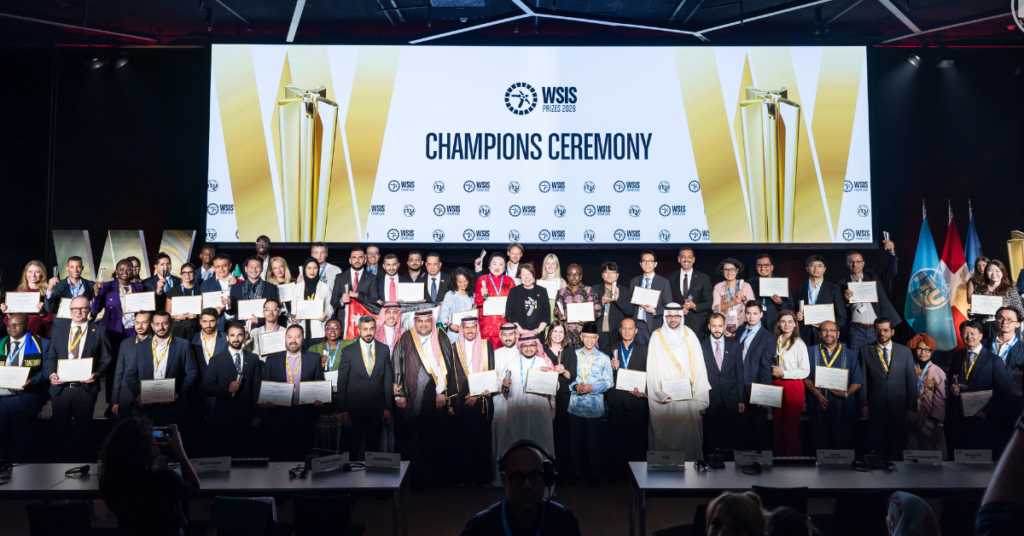
The National Technology and Innovation Sandbox (NTIS) has been named a Champion at the World Summit on the Information Society (WSIS) Prizes 2026 in Geneva, under Category 14: Action Line 7: E-science.
An annual global awards programme, WSIS Prizes celebrates outstanding digital and ICT-based initiatives that advance the UN Sustainable Development Goals (SDGs). The contest is organised by the International Telecommunication Union (ITU) and highlight success stories from government, private sectors, civil society, and academia.
Category 14: Action Line 7: E-science, focuses on leveraging information and communication technologies (ICTs) to advance scientific research, facilitate open data sharing, and foster global collaboration to achieve SDGs.
Advertisement
This win reinforces Malaysia’s position as a regional innovation leader and marks the nation’s strategic shift towards a dynamic “living lab” model, bridging the gap between innovation and market readiness.
Image Credit: MRANTI
Spearheaded by the Ministry of Science, Technology and Innovation (MOSTI) with MRANTI as lead secretariat, NTIS has evolved since 2020 from a pilot initiative into a cornerstone of Malaysia’s innovation ecosystem.
The initiative provides a structured platform for researchers and startups to validate high-growth technologies, ensuring they are regulatory-compliant and commercially viable. Building upon the foundational achievements of the 12th Malaysia Plan (RMK-12), the NTIS programme continues to accelerate its momentum well into the 13th Malaysia Plan (RMK-13).
Since 2020, NTIS has facilitated over RM171.8 million in commercialisation value, approved RM147 million in funding to 147 projects, catalysed 388 high-income jobs, generated RM122.8 million in export value, and secured 39 new Intellectual Properties.
Reflecting on the achievement, YBhg. Dato’ Ts. Dr. Nagulendran Kangayatkarasu, Secretary General of MOSTI said, “This achievement reflects our commitment to elevating the competitiveness of homegrown technology companies. NTIS will continue to serve as a vital platform, addressing challenges faced by local startups and increasing the volume of commercialised innovations, thereby reducing dependency on foreign technology and strengthening local capabilities.”
Advertisement
Echoing this sentiment is Mr. Ashran Dato’ Ghazi, CEO of MRANTI, “Recognition as a WSIS Champion validates Malaysia’s progress through NTIS. We have demonstrated that with the right ecosystem, regulatory support, and partnerships, promising technologies can move from research to real-world deployment. This success belongs to the entire ecosystem of innovators, partners, and agencies that made this model possible.”
Image Credit: MRANTIImage Credit: MRANTI
The programme’s success is underpinned by a collaborative multi-agency framework led by MRANTI as the lead secretariat, together with co-lead MTDC, and other secretariats MIMOS and Futurise.
Together, these organisations play complementary roles in strengthening regulatory readiness, technology validation, commercialisation and ecosystem coordination, enabling Malaysian innovations to progress more effectively from development to market.
Building on this strong foundation, NTIS is now entering its next phase through the Global Testbed & Sandbox Alliance (GTSA), expanding its focus beyond national deployment towards greater international collaboration.
The initiative strengthens cross-border partnerships and regulatory harmonisation, enabling Malaysian innovators to scale solutions across ASEAN and global markets while engaging directly with UN bodies, international policymakers and leading innovation ecosystems.
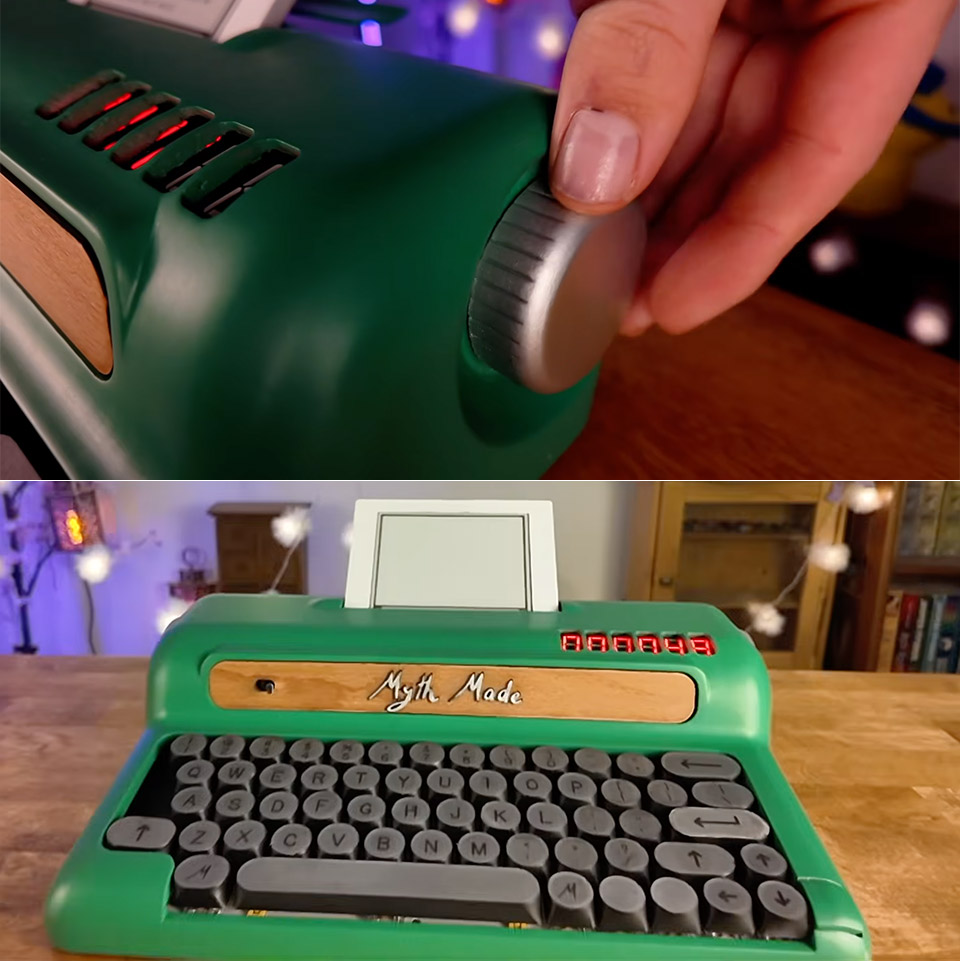
Jamie wanted a machine that would make her write. Not a laptop full of open tabs and alerts. Not a phone that vibrates every few minutes. She wanted something that felt like it belonged on a desk from another decade, yet still saved every word without paper or ink ribbons. So she spent weeks designing and building one herself. The result sits somewhere between a classic typewriter and a modern writing deck, finished in green paint with rounded keys and a screen that rises on command.
She began with a keyboard, which was a small mechanical board sporting a built-in circuit and switches. The original square keycaps were removed and replaced with ones she produced herself; however, these ones had a rounded top and looked more like the keys on an old typewriter. Labeling them was simple; simply color the tops with some paint markers, then run them through a laser engraver while the paint is still wet, and the laser will burn the ink into the plastic, ensuring it lasts. Any extra paint easily wipes away, leaving some lovely sharp letters.
All overseas models purchased through official channels – both past sold and current for sale– have not and do not restrict users from installing…
Pocket-Size Mini eReader for Reading Anywhere: Ultra-light at just 0.23 inch and only 2.72 oz, Xteink X4 is designed for true portability. Slip it…
4.3″ Paper-Like E-Ink Display: The 4.3-inch E-Ink screen delivers a natural paper-like reading experience that’s gentle on the eyes. Enjoy clear…
The body of the machine took a little longer to complete, as Jamie created a true full typewriter shell in CAD and began working on the shape and dimensions until it felt just perfect. Then she printed it in sections. Once they were out of the printer, she connected them all together with ABS and acetone, a unique compound that chemically welds the plastic together. Then she slathered on a second coat of the mix to fill in the lines left by the printer, followed by some sanding, priming, and one coat of green paint, and it began to resemble a true typewriter rather than a kitbash of printed pieces.
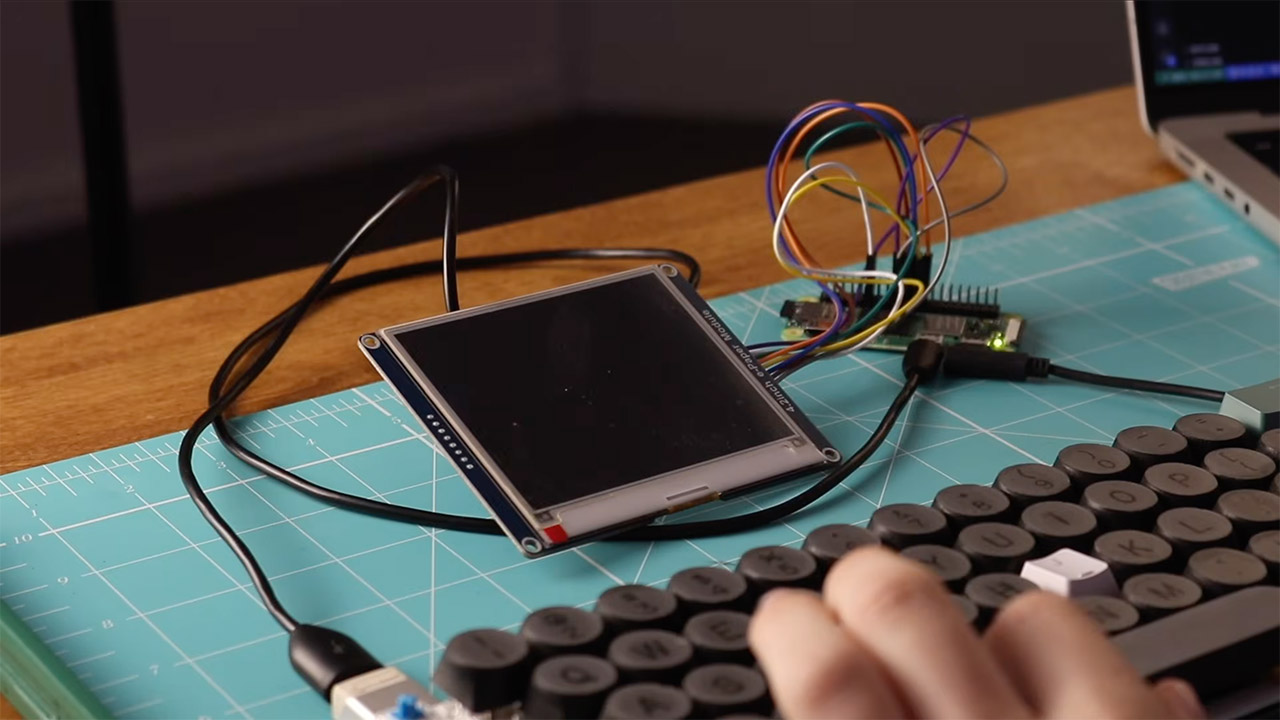
The Raspberry Pi Zero 2 W is powered by a rechargeable lithium battery, while the display is an e-paper screen from Waveshare, which is quite sleek to. say the least. The software is simply a customized version of the open Zerowriter project, which is used by the majority of other distraction-free writing machines. Jamie poked at the code to get the cursor moving with the arrow keys and copy and paste working, which just transforms it from a pure draftsman’s tool to something you can use for actual writing on the fly.
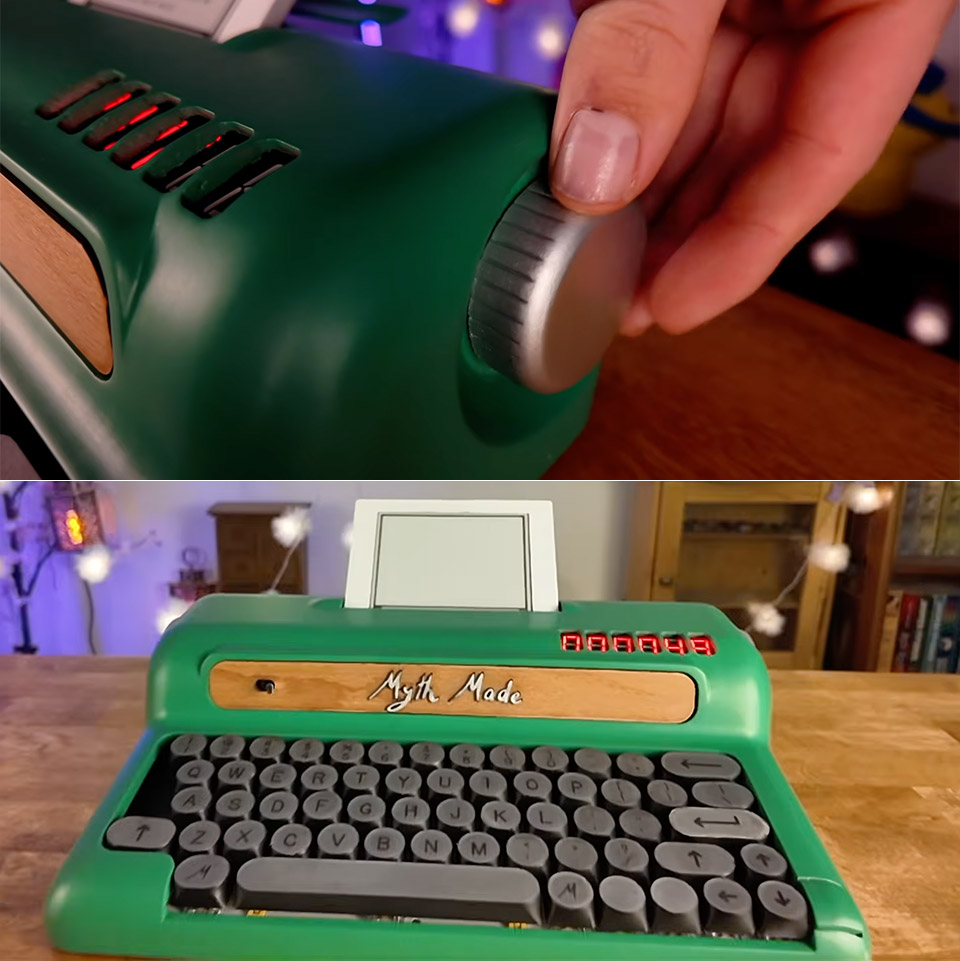
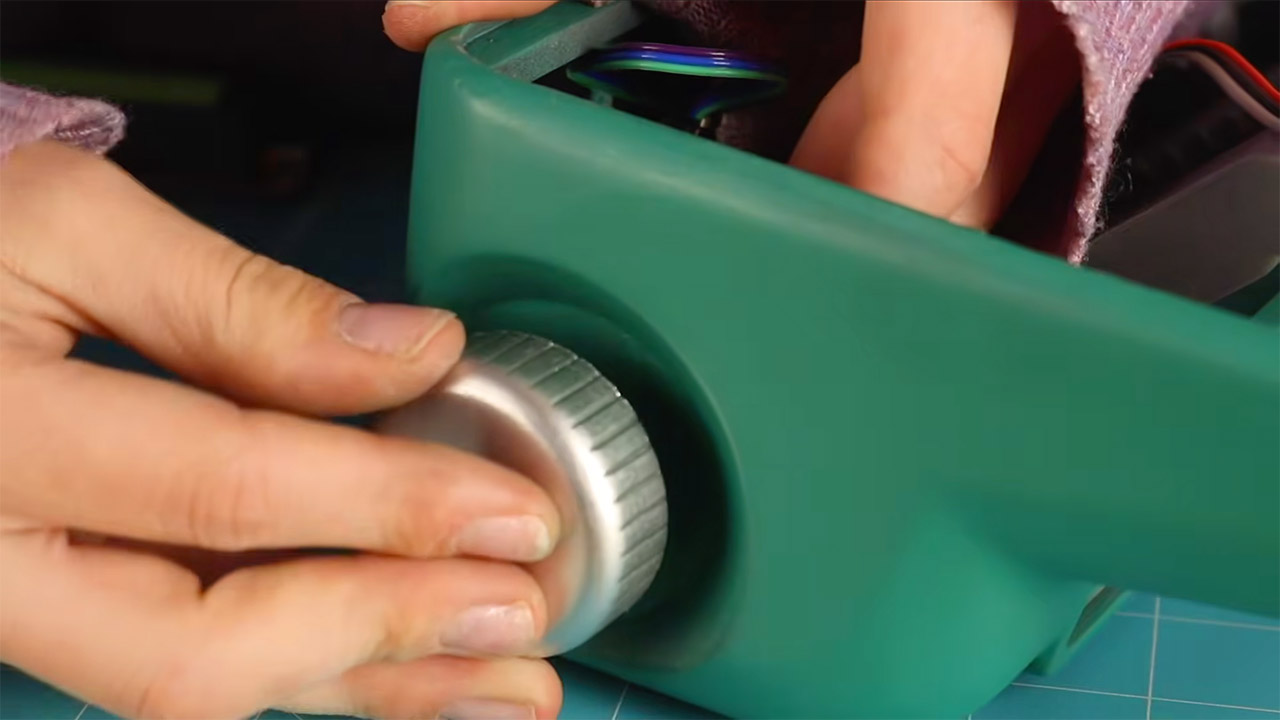
The two mechanical bits give this machine its typewriter feel. One side has a handwheel that can be turned to raise and lower the e-ink screen, similar to how a sheet of paper would pop up from a real typewriter. It’s quite pleasant to use. On the other side, there is a rotary encoder wheel, which you may use to open the menu and scroll through your content. Right next to that is a small seven-segment display that shows how many words you’ve written thus far. When you press a key, the word count refreshes.
The machine does exactly what she intended to build. It sits on a desk, accepts keystrokes, displays clear text on a paper-like surface, maintains a running word count, and asks for almost nothing else. For those who prefer the ritual of a typewriter without the ribbons, carbon paper, or permanent commitment of ink on a page, the green writing deck provides that experience while still saving every document. [Source]































































You must be logged in to post a comment Login