Tech
SoftBank plans record $6.3bn retail bond sale in Japan

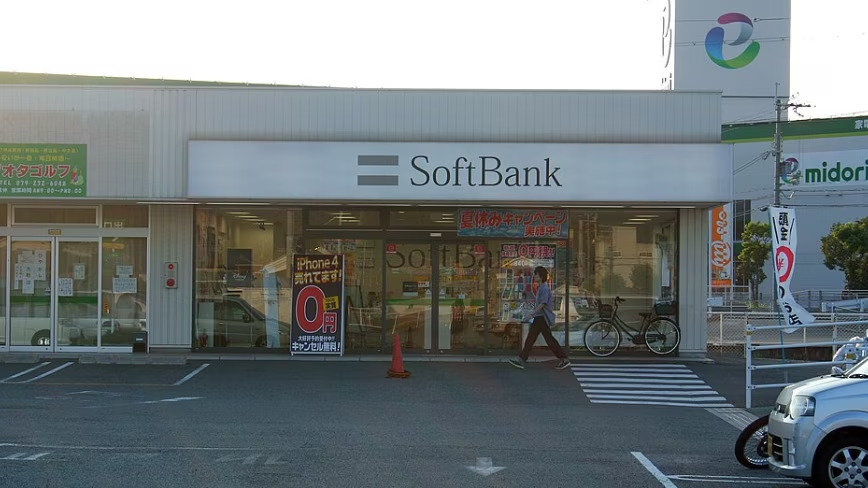

SoftBank plans a record 1 trillion yen retail bond sale, about $6.3bn, the largest by any issuer in Japan, to fund investment commitments to OpenAI. Analysts say banks were reluctant to take the risk, leaving the deal dependent on retail investors.
SoftBank has found a lender of last resort for its AI bet, and it is Japanese households. The group plans a record ¥1 trillion retail bond sale, about $6.3bn and the largest by any issuer in Japan, to fund its investment commitments to OpenAI.
The terms are built to be tempting. The seven-year bonds are expected to price on 4 September with an indicative coupon of 4.3% to 4.9%, and SoftBank says it expects an A rating from Japan Credit Rating Agency.
International raters see it differently. S&P has SoftBank at BB+, one notch below investment grade, having revised its outlook to stable from negative in July.
The reason it is going to retail is not enthusiasm. “Banks are finding it difficult to take on the risk given weak deposit growth, the credit rating and the seven-year duration, leaving the deal more reliant on retail investors,” said Yuuki Fukumoto of NLI Research Institute, in a pattern that has already forced Oracle to find anchors outside the banking system.
It is also becoming routine. This is SoftBank’s third retail bond of the year, after raising ¥418bn in April and ¥260bn in June.
Even ¥1 trillion does not close the gap. Bloomberg Intelligence’s Sharon Chen says a shortfall above $20bn remains after this issue, making offshore issuance likely in the near term.
The commitments behind it are enormous. SoftBank has pledged more than $60bn to OpenAI and has separately sought a $10bn margin loan secured against its stake in the company.
Everyone is raising at once. Alphabet, Meta, Microsoft and Amazon have committed nearly $2.4tn to AI-related spending, and Alibaba raised about $10bn in Hong Kong on Monday for chips and data centres.
A European issuer could not do this the same way. Bond prospectuses across the EEA routinely carry a prohibition on sales to retail investors, because the PRIIPs rules require a key information document that most issuers decline to produce.
That sits awkwardly with what Brussels says it wants. The Savings and Investments Union, adopted in March 2025, exists to move some of the €10tn European households hold, roughly 70% of it sitting in bank deposits, into capital markets, at a moment when Masayoshi Son calls bubble talk absurd.
Japan has now shown what mobilised savings look like in practice. A retail saver funding a seven-year bet on a company that does not yet know how the technology will pay.
You must be logged in to post a comment Login