Sony wants to use your phone as a secondary input for a PlayStation controller, and it might actually change how we play games.
Gaming controllers have come a long way, but let’s be honest, they haven’t changed that much at all. Sure, we got haptic feedback, adaptive triggers, and TMR sensors, but the core design and gameplay have remained the same for decades. Sony might be about to change that, and the solution is your phone.
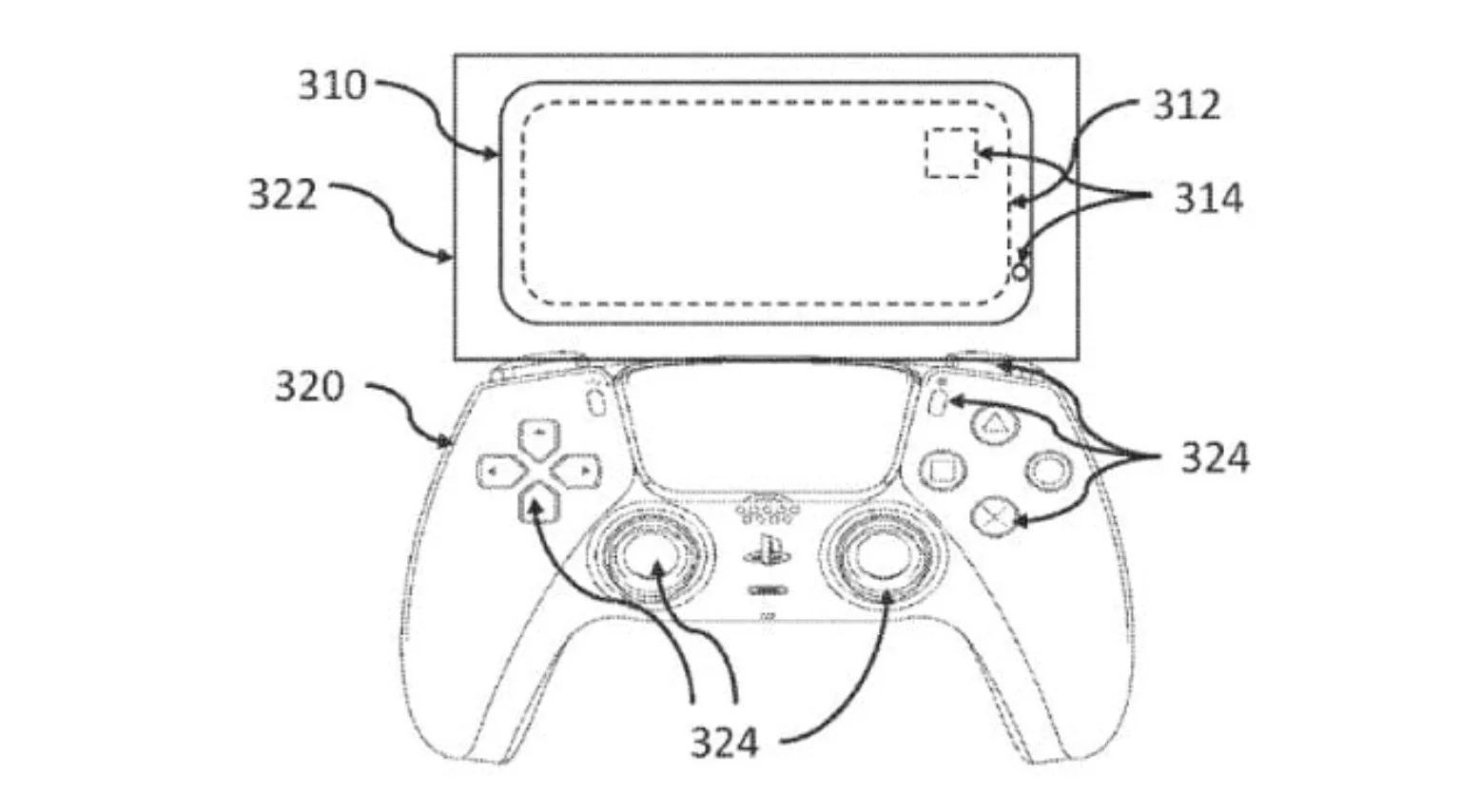
As reported by CheatHappens, a newly discovered Sony patent describes a hybrid input system that attaches your smartphone to a PlayStation controller using a magnetic attachment unit.
CheatHappens
The phone essentially becomes a second controller, giving developers access to its cameras, gyroscope, touchscreen, and other sensors to create entirely new gameplay experiences.
What’s the need for this patent?
The patent makes an interesting argument. Traditional controllers are excellent for certain game genres, such as racing titles, where physical buttons and triggers shine, but they’re not ideal for first-person shooters.
Advertisement
By mounting a phone onto the controller, developers get access to a much wider variety of inputs, making the hybrid system more versatile across all game genres.
CheatHappens
The possibilities are exciting. Developers could use the phone’s camera for in-game avatar customization, leverage motion sensors for spatial awareness, or display extra gameplay data directly on the phone.
Is this just a concept or could it become a reality?
That’s the big question. Sony has filed several unconventional patents in recent years, and most of them haven’t seen the next stage. It’s not just Sony; on average, only 2–5% of patents that are filed actually materialize into a real product, so the probabilities are not in favor.
However, this patent has several advantages that could help it reach the market. It doesn’t require new hardware, the attachment mechanism should be straightforward, and the potential benefits for gamers are real.
If Sony can make this work, it could genuinely add more depth to console gaming without asking players to buy an extra accessory.
Harvey’s platform uses AI agents to reduce manual effort for lawyers by running complete workflows for high-volume and increasingly complex tasks.
AI legal-tech start-up Harvey has raised $200m at a valuation of $11bn.
The new funds will be used to further develop the company’s AI agents for legal firms and in-house legal departments, and grow the engineering teams that support them.
The funding round was co-led by returning investors GIC and Sequoia, with participation from existing investors Andreessen Horowitz, Coatue, Conviction Partners, Elad Gil, Evantic and Kleiner Perkins.
Advertisement
Harvey’s platform uses AI agents to reduce manual effort for lawyers by running complete workflows for high-volume and increasingly complex tasks, according to the company, which has now raised more than $1bn to date.
“AI isn’t just assisting lawyers. It’s becoming the system through which legal work gets done,” said Winston Weinberg, CEO and co-founder of Harvey.
“The law firms and in-house teams leading the way are building agents that execute complex workflows so lawyers can focus on judgement, strategy and outcomes.”
The company said it runs more than 25,000 custom agents executing work in fields such as contracts, compliance, litigation, due diligence, and mergers and acquisitions.
Advertisement
“Harvey has become the platform on which legal work runs,” said Pat Grady, partner at Sequoia.
“More than 100,000 lawyers around the world run their most critical work on Harvey, and we believe it’s positioned to become one of the most important companies of the next decade.”
Harvey was founded in 2022 and is based in San Francisco. It claims more than 1,300 customers – including “global law firms and Fortune 500 enterprises” – in more than 60 countries around the world.
In January, Harvey began hiring for roles at a new Dublin office. At the end of last year, the company was valued at $8bn.
Advertisement
The legal-tech start-up sector is a lively one at the moment.
Two weeks ago, Swedish player Legora announced a Series D raise of $550m, bringing the company’s valuation to $5.55bn.
Last November, Canadian company Clio closed a $500m Series G funding round, taking it to a $5bn valuation, and also unveiled its plans for an office in Dublin.
Norwegian software company Newcode will also open a Dublin office after raising more than $6.5m this week, adding to its existing locations in the US and Europe.
Advertisement
And last November, Ireland and UK-based company TrialView secured $4.1m in a growth funding round led by Elkstone Ventures.
Don’t miss out on the knowledge you need to succeed. Sign up for the Daily Brief, Silicon Republic’s digest of need-to-know sci-tech news.
In a unanimous judgment for Cox Communications, the Court ruled that an ISP is contributorily liable for user infringement “only if it intended that the provided service be used for infringement,” and that intent can be shown “only if the party induced the infringement or the provided service is tailored… Read Entire Article Source link
Reddit is rolling out human-verification checks for accounts that show signs of bot-like behavior, while also labeling approved automated accounts that provide useful services. The social media company stressed that these checks will only happen if something appears “fishy,” and that it is “not conducting sitewide human verification.” TechCrunch reports: To identify potential bots, Reddit is using specialized tooling that looks at account-level signals and other factors — like how quickly the account is attempting to write or post content. Using AI to write posts or comments, however, is not against its policies (though community moderators may set their own rules).
To verify an account is human, Reddit will leverage third-party tools like passkeys from Apple, Google, YubiKey, and other third-party biometric services, like Face ID or even Sam Altman’s World ID — or, in some countries, the use of government IDs. Reddit notes this last category may be required in some countries like the U.K. and Australia and some U.S. states, because of local regulations on age verification, but it’s not the company’s preferred method. “If we need to verify an account is human, we’ll do it in a privacy-first way,” Reddit co-founder and CEO Steve Huffman wrote in the announcement Wednesday. “Our aim is to confirm there is a person behind the account, not who that person is. The goal is to increase transparency of what is what on Reddit while preserving the anonymity that makes Reddit unique. You shouldn’t have to sacrifice one for the other.”
Just this week, Meta was found to be enabling social media addiction, and endangering children on its platforms.
Meta has begun laying off several hundred employees globally, as the company continues to redirect priorities towards AI.
Some news publications have placed the total number of layoffs globally at 700. According to reports, affected departments include Reality Labs, Facebook, global operations, recruiting and sales.
The tech giant employs nearly 79,000 globally, with around 1,800 in Ireland spread across 80 teams. SiliconRepublic.com understands that around 15 jobs were impacted in Ireland, with no roles in Reality Labs affected – which, The Information reports, is expected to be hit hard globally.
Advertisement
“Teams across Meta regularly restructure or implement changes to ensure they’re in the best position to achieve their goals,” a Meta spokesperson told SiliconRepublic.com. “Where possible, we are finding other opportunities for employees whose positions may be impacted.”
Meanwhile, as the company lays off hundreds, a stock option for its key leaders announced on 24 March could see some of them increase their compensation by more than $900m over the next five years.
Earlier this month, Reuters reported that Meta was planning to cut 20pc or more of the company’s global workforce. Meta called this a “speculative report about theoretical approaches.” It is understood that the latest organisational changes are unrelated to Reuters’ story.
The layoffs highlight a strong shift in how Big Tech companies are approaching work and productivity. In January, Meta CEO Mark Zuckerberg said that 2026 might be the year “AI starts to dramatically change the way that we work.
“We’re starting to see projects that used to require big teams now be accomplished by a single very talented person,” he said.
Meta’s not alone in this – Atlassian, Amazon and Block have all laid off thousands in recent months as slimmer teams and AI tools take the industry by storm. Oracle could also cut thousands of jobs to funnel funds into its AI data centre expansion efforts.
The Instagram, WhatsApp and Facebook parent lost two landmark lawsuits this past week, with critics hailing this as Big Tech’s ‘Big Tobacco moment’.
Advertisement
Earlier this week, a New Mexico jury found that Meta endangered children by misleading users about the safety of its platforms, while yesterday, a Los Angeles jury found that Instagram and YouTube design their platforms to addict young users.
However, the $1.5trn company is only facing penalties of less than $380m for both the lawsuits combined.
Don’t miss out on the knowledge you need to succeed. Sign up for the Daily Brief, Silicon Republic’s digest of need-to-know sci-tech news.
Sony seems to have moved on from the PlayStation Vita, but its influence clearly hasn’t gone anywhere.
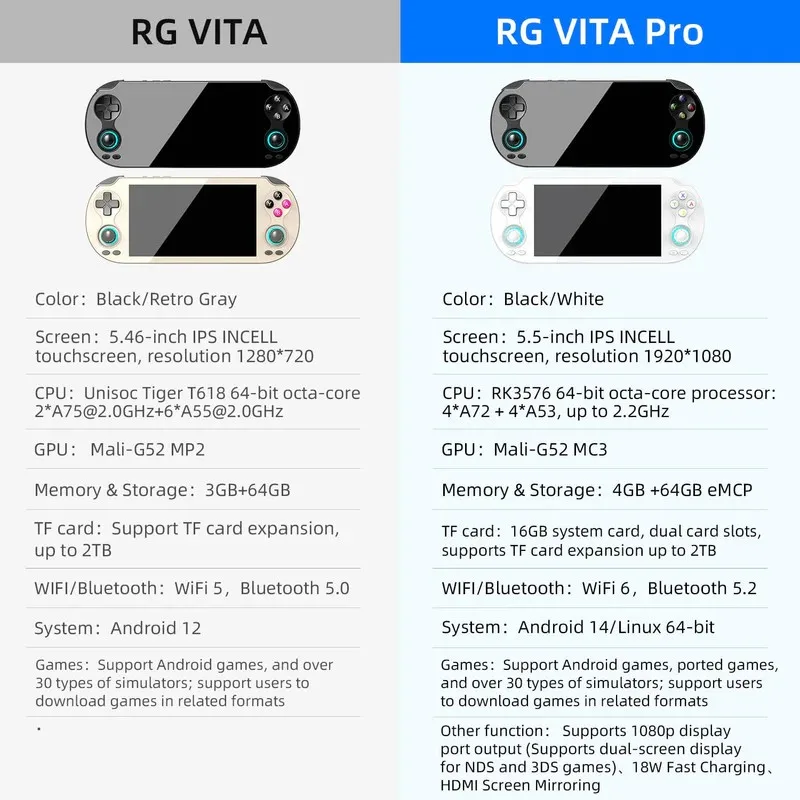
Anbernic has just unveiled the new RG Vita and RG Vite Pro, which are two handheld gaming consoles that feature a design inspired by the PS Vita. From the wide layout to the button placement and overall aesthetic, these pay homage to Sony’s last true portable console.
But these aren’t a one-on-one copy, and rather serve as a modern take on the Vita idea.
Everything you need to know about the Vitas
RG Vita and Vita Pro SpecsAnbernic
The lineup consists of two variants, namely the RG Vita and RG Vita Pro.
The standard Vita is a more affordable option that featurse a 5.46-inch IPS display with 720p resolution, powered by a Unisoc T618 chipset, paired with 3GB of RAM and 64GB of storage. On the other hand, the RG Vita Pro steps things with a slightly taller 1080p IPS display, a more capable Rockchip RK3576 processor, 4GB RAM, and the same expandable storage support via microSD.
Advertisement
Both models are powered by a 5,000mAh batteries that promise to offer several hours of gameplay.
Built for retro, but doesn’t stick to the past
Anbernic RG Vita ProAnbernic
Anbernic’s new RG Vita series is a throwback to a great age in game, but it isn’t just about nostalgia.
The consoles supports Android (and Linux on the Pro), which allows it to run Android games and the emulators for consoles like PS2, PSP, GameCube, and more. So it is a lot more versatile than its original inspiration. Anbernic is even adding modern touches like WiFi, Bluetooth, USB-C output, and even AI-based features like real-time translate and in-game assistance tools.
That said, this isn’t aiming to be a true successor to the PS Vita. Performane is aimed more at emulation and casual Android gaming rather than running modern AAA titles.
Anbernic has yet to confirm the official pricing, but the devices are expected to land in the budget to mid-range handheld category.
One might think that [Da_Rius]’s mostly 3D printed wire stripper would count its insulation-shearing blades among the small number of metal parts required, but that turns out to not be the case. The blades are actually printed in PLA, seem to work just fine for this purpose. (We imagine they need somewhat frequent replacement, but still.)
Proper wire strippers are one of the most useful tools for a budding electronics enthusiast, because stripping hookup wire is a common task and purpose-built strippers make for quick and consistent results.
As far as tools go they are neither particularly expensive nor difficult to source, but making one’s own has a certain appeal to it. The process of assembling the tool is doubtless a rewarding one, and it looks like it results in a pretty good conversation starter if nothing else.
As mentioned, the tool is mostly 3D printed and does require some metal parts: fasteners, heat-set inserts, and a couple springs. Metal nuts and heat-set inserts are easy enough to obtain, but springs of particular size and shape are a bit trickier.
It is perfectly possible to make custom springs, and as it happens [Da_Rius] already has that covered with a separate project for using a hex key and printed jig to make exactly the right shapes and sizes from pre-tempered spring wire.
Mate Rimac, the founder of Croatian electric vehicle maker Rimac Group, started working on electric robotaxis seven years ago. Now, part of his vision is coming to fruition through a strategic partnership between Uber, Chinese autonomous vehicle company Pony.ai, and his own robotaxi startup Verne.
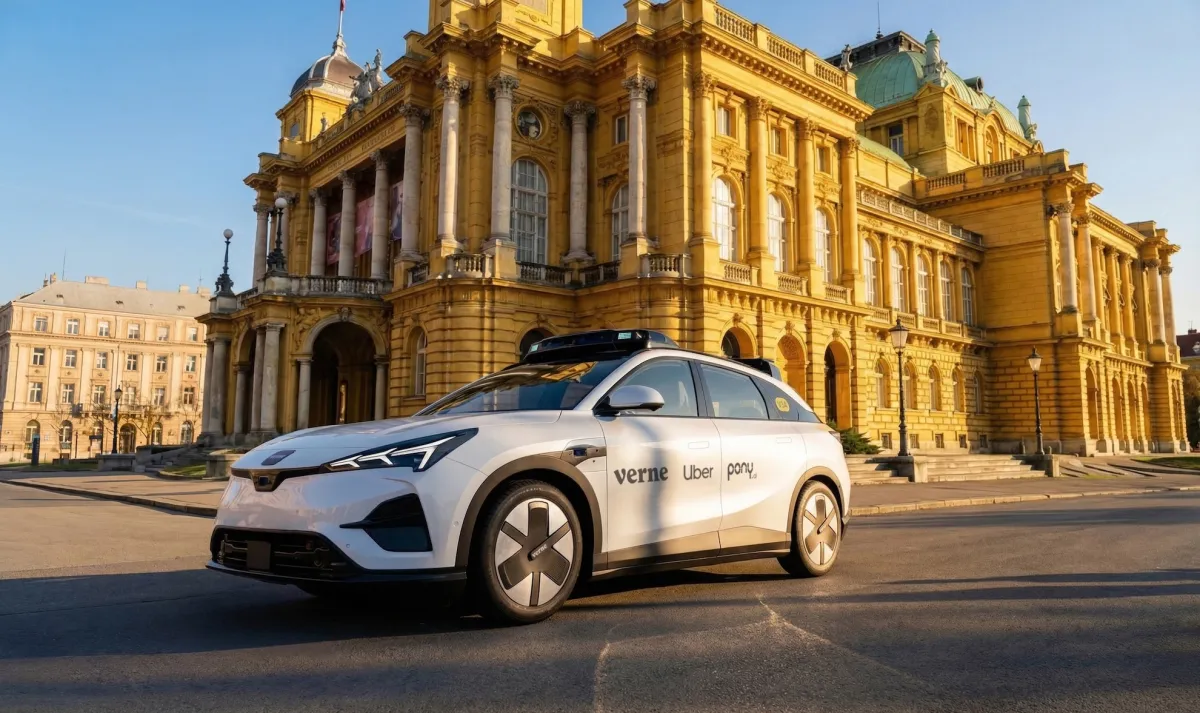
The three companies announced plans Thursday to launch a commercial robotaxi service in Europe, starting in Zagreb, Croatia. Pony.ai will supply the autonomous driving system and a robotaxi called the Arcfox Alpha T5 that was developed with Chinese automaker BAIC. Verne will own and operate the fleet, and Uber will provide its vast ride-hailing network.
The ride-hailing giant also indicated it intends to invest an undisclosed amount into Verne and support future expansion as a strategic partner.
The companies didn’t provide a specific launch date for the commercial service, though on-road testing in Zagreb — where Rimac Group is based — is already underway.
Advertisement
Verne doesn’t have the same name recognition as Waymo or Tesla — at least not in the United States. But it has the same outsized ambitions.
Verne started in 2019 as a project called Project 3 Mobility (or P3) within Rimac Group, a growing ecosystem of companies that includes hypercar maker Rimac Bugatti, Rimac Energy, and Rimac Technology. Mate Rimac holds a 23% stake in the group.
There were occasional updates about the project, but it wasn’t until July 2024 — when Verne launched with 100 million euros in funding — that the public got a more detailed look at its plans.
Techcrunch event
Advertisement
San Francisco, CA | October 13-15, 2026
Rimac’s vision has always been for Verne to operate an urban robotaxi service with purpose-built two-seater electric vehicles. That might sound like an odd mission for the person behind the Nevera, an electric hypercar that starts around $2.2 million. But as he explained to this reporter a couple of years ago, Rimac was never interested in making a high-volume EV that humans would drive — precisely because he believes that autonomous vehicle technology will make that business obsolete.
Advertisement
“It will take a while, but it’s coming; I’m sure about that,” he’d told me at the time.
Verne isn’t developing its own self-driving system. Instead, the company is focused on the urban electric vehicle, the ride-hailing app, and the back-end infrastructure to manage the fleet, including cleaning and maintenance.
Verne plans to produce its robotaxi EVs at a new factory in Lučko, Croatia, expected to begin operations later this year.
Verne hasn’t launched the two seaters yet, nor did it provide an update on the vehicles in its announcement with Uber and Pony.ai. The company said in November that it had produced and tested 60 verification prototypes.
Advertisement
For now, the Verne robotaxi service will use the Pony.ai-BAIC vehicle, the Arcfox Alpha T5. Users will be able to hail one via Uber as well as through Verne’s own app.
Verne is starting small with its commercial launch, but it has plans to scale to a “fleet of thousands of robotaxis over the next few years,” according to Thursday’s announcement. And its aspirations go far beyond the borders of Zagreb, the capital of Croatia and home to Rimac Group.
“Europe needs autonomous mobility that can move from testing to a real service,” said Verne CEO Marko Pejkovic, in a statement. “At Verne, we are bringing together the technology, platform, and operational capabilities required to make this a reality, starting in Zagreb before expanding to new markets.”
The approach of a new school year conjures images of teachers preparing their classrooms and principals greeting students as they walk through the doors on the first day of classes.
But federal data shows that the education jobs that will see the most growth over a decade are supporting roles like substitute teachers, therapists and technologists.
The findings are bracketed by changes in student enrollment and the ending of federal school emergency funds, which are reshaping school districts’ staffing outlooks. School districts across the country continue to grapple with millions in budget deficits, leading to hundreds of job cuts in some cases.
Recent reports show that schools are likely to struggle to fill the most in-demand roles.
Highest-Growth Areas
Looking at 10 education roles that will gain the most net jobs by 2034, short-term substitute teachers top the overall rankings with an increase of more than 10,000.
Advertisement
Malia Hite says that Utah is among the states that will see an increase in jobs for teacher assistants and paraeducators, who will specifically support student behavior and early literacy, thanks to an infusion of state and federal funds. Hite serves as the Utah State Board of Education’s executive coordinator of education licensing.
“However, I will say that those positions, because those positions are typically an entry-level position with a low wage or part-time, they’re hard positions to fill,” Hite says. “Even in the current job market, [where] it’s hard to find positions, we’re still seeing openings in our paraeducator job market statewide. Some of them are making $9 an hour, so why would I do that when I can go somewhere else and make $15 in an entry-level position?”
Hite is cautious when talking about education growth overall because it’s not equal among sectors. Increased demand is expected for non-teacher and non-administrator staff like speech language pathologists, social workers and occupational therapists, she says.
Advertisement
“This is now our second year that we’ve seen a decrease of student enrollment, and so that means we need fewer teachers, there’s less funding, and so we’re seeing a lot of things like schools close,” she explains. “So in that way, there’s no way that education jobs are going to grow.”
A report from the Consortium for School Networking, a professional organization for K-12 tech leaders, found that schools struggle to retain IT staff across all specialities and levels. Among school leaders that it polled, 16 percent said they were in danger of losing IT staff due to the winding down of federal relief money that was allocated to schools during the pandemic.
Health Workers In Demand
The rest of the list, however, is filled by health therapy roles and technology roles. A recent analysis by staffing company ProTherapy predicts physical therapist assistants, speech-language pathologists and physical therapists will be the most in-demand education jobs of 2026 and continue to see double-digit percentage growth.
Schools employ physical therapists and assistants to ensure that students with disabilities can participate in school activities to the fullest extent, while speech language pathologists help students with communication disorders.
Advertisement
Dakota Long, who headed ProTherapy’s 2026 School Workforce Demand Index, says these jobs are growing in demand because schools are aiming to identify students with disabilities and set up interventions as early as possible, as early as age 3 in some schools.
But another factor in the demand for these specialists – physical therapist assistants, in particular – is the job market they are graduating into.
While teacher graduates are overwhelmingly likely to work in the classroom, newly minted health care workers can be wooed by jobs in hospitals, clinics and home health agencies in addition to schools.
“From my perspective in working with schools, they’re wanting to identify those things early on,” Long says, “that way they can provide the best services for these kiddos before it gets to age 7, 8, and then they realize, ‘Oh gosh, we could have been supplying these services earlier.’ So you have early intervention, more kiddos needing these services, but then employees that could be taking on these roles have a lot of different options, as well.”
Advertisement
Hite says that while non-teacher jobs are expected to increase in Utah, though realistically not by as much as ProTherapy’s projections, some nuance is required when looking at what the growth rates mean.
“If I look at the subsector of audiologist, we had two [full-time employees] six years ago, and now we have 11,” she says, an increase of more than five-fold. “We’re talking about 10 people.”
It’s somewhat stunning to realize that the United States has been operating with Surgeon Generals that are merely “acting” in the role or “performing the duties of” since January 20th of 2025. The last Senate-confirmed SG was Dr. Vivek Murthy. The current nominee from the Trump/Kennedy team is Dr. Casey Means. This nomination has been languishing since May of last year. There has been plenty of pushback on her, due largely to her current profession as “wellness influencer” and the fact that she didn’t complete her residency and doesn’t have a license to practice in any of our 50 states.
She recently went before the Senate for her confirmation hearing and it, um, didn’t go all that well. As a result, it appears her nomination is very much in trouble. There are several GOP senators who are publicly expressing doubts about her, perhaps none more important then Bill Cassidy.
Senators Bill Cassidy (R-La.), Susan Collins (R-Maine), Lisa Murkowski (R-Alaska), and Thom Tillis (R-N.C.) all expressed concern in a confirmation hearing last month about her potential role and appear to remain doubtful. Just one of those senators may be enough to block her nomination from advancing beyond the Senate Health Committee.
Afterward, Senators Collins and Murkowski both said they still had questions. Murkowski also said she had “strong reservations” about Means’ nomination and that, as of last week, that opinion hadn’t changed, according to the Post.
So why did the confirmation hearing go so poorly? For some reasons you’d expect, and some you probably didn’t. Means mostly ducked questions about vaccines, giving interested senators no idea where she actually lands on the issue. There were also perfectly reasonable questions about her qualifications, given that she is not currently a practicing doctor of any kind. In her influencer career, she has mirrored much of what RFK Jr. has claimed about diet and exercise being the cure to most health issues, all while hocking your stereotypical supplements and magic potions.
Advertisement
But then there are the drugs and the lunar-worship.
A book that she co-authored with her brother, titled Good Energy, considered by some to be the “MAHA bible,” contains a chapter titled, “Trust Yourself, Not Your Doctor.” She has also drawn criticism for writing about taking magic mushrooms, consulting a “spiritual medium,” and participating in “full moon ceremonies.”
I won’t say I’m against the use of psychedelics generally, but I typically don’t love hearing about how great they are from my doctor.
As we’ve talked about before, it has become very clear that Kennedy simply lied a whole bunch in his own confirmation hearings as to what he would do as Secretary at HHS, particularly when it comes to vaccines. The thing about lying to people like Bill Cassidy, though, is now Kennedy needs him to confirm his hand-picked ally for Surgeon General.
And unless Cassidy is far stupider than I think he is, you have to believe he isn’t going to let Lucy pull the football away at the last moment for a second time.
Samsung is expanding its dominance in the premium TV category with the official reveal of its 2026 Neo QLED 4K TV lineup, alongside a broader Mini LED TV range aimed at hitting more price points. The new Neo QLED series builds on Samsung’s Mini LED backlighting platform with updated AI-powered picture processing, refined local dimming, and an expanded smart TV ecosystem designed to compete directly with OLED and high-end LED rivals.
For 2026, Samsung is clearly doubling down on Neo QLED as its flagship 4K TV technology, positioning these models as the sweet spot between performance and price. With confirmed pricing, upgraded AI features, and deeper integration of its smart platform, the new lineup is engineered to appeal to both home theater buyers and mainstream shoppers who want high brightness, strong HDR performance, and a feature set that doesn’t feel stripped down.
What Is Samsung Neo QLED and Mini LED Technology
Samsung’s Neo QLED TVs are LCD-based displays that combine Mini LED full array backlighting with Quantum Dot technology. Quantum Dots enhance color range and accuracy, while Mini LED backlighting enables more precise light control, especially when rendering bright objects against dark backgrounds. When paired with HDR formats like Samsung’s HDR10+, this combination improves both color volume and overall dynamic range.
Samsung 2026 Neo QLED 4K TV Lineup
For 2026, Samsung is offering two Neo QLED series, the QN80H and QN70H. Both feature 4K UHD resolution, the Tizen smart TV platform, expanded gaming support, and Samsung’s Vision AI Companion.
Advertisement
QN80H
Screen sizes for the QN80H series range from 55 to 100 inches, while the QN70H series spans 43 to 85 inches. Between the two, there’s a size that fits just about any room and viewing distance without forcing you into a compromise.
QN70H
Key Features
Both series are built to deliver a cinematic 4K UHD experience, using AI upscaling to enhance everything you watch with scene-by-scene clarity. The QN80H is powered by Samsung’s NQ4 AI Gen2 Processor, while the QN70H uses the NQ4 AI Processor, both designed to refine detail, contrast, and overall image precision.
Features like Real Depth Enhancer help separate foreground elements for a more three-dimensional look, improving focus on the main subject. AI Customization Mode takes things a step further, allowing users to select preferred picture settings by genre during setup, with the TV automatically adjusting image quality in real time based on detected content.
For speech clarity, the Samsung Neo QLED 4K TVs incorporate the Active Voice Amplifier. This boosts dialogue or key sound effects. Also, the QN80H series incorporates Dolby Atmos, which provides more sound immersion.
Also, with Q Symphony, the QN80H and QN70H can be combined with compatible Samsung soundbars and Wi-Fi speakers to operate as a single, coordinated sound system rather than isolated components.
Gaming support is extensive with Samsung’s Gaming Hub, AI Auto Game Mode, Cloud Gaming, and Motion Xceleration on both series.
Advertisement
Samsung’s Vision AI experience, anchored by the Perplexity TV App, takes AI on TVs beyond simple voice commands or video enhancements by combining AI audio/video processing, Bixby voice control, Tizen Smart TV integration, and Knox Security into a single, seamless ecosystem.
Advertisement. Scroll to continue reading.
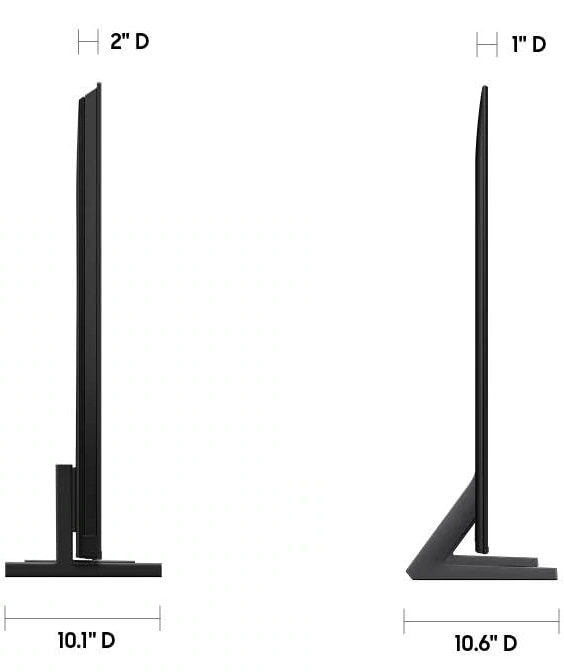
QN80H (left) vs. QN70H (right)
Comparison
Keep in mind that while the QN80H and QN70H share many core features, there are some key differences. We’ve included a detailed comparison chart below to make those distinctions easier to see.
2-channel Speaker System 30 Watts Output Object Tracking Sound Lite (OTS) Q-Symphony Active Voice Amplifier (AVA) Adaptive Sound Pro Karaoke Mic Galaxy Earbuds Auto Switch Dolby Atmos 360 Audio
2-channel Speaker System 20 Watts Output Object Tracking Sound Lite (OTS) Q-Symphony Active Voice Amplifier (AVA) Adaptive Sound Pro Karaoke Mic Galaxy Earbuds Auto Switch
Multi-Control
Yes
Yes
Storage Share
Yes
Yes
TV Design
Solidity
AirSlim
Bezel Type
3 Bezel-less
3 Bezel-less
Front Color
Titan Black
Black
Stand Type
Round Feet
Aero Linear
Stand Color
Black
Titan Gray
Adjustable Stand:
Yes
Yes
Security
Knox Vault: N/A Knox Security: Yes
Knox Vault: N/A Knox Security: Yes
Remote Control
BT Simple Remote TM2280A with batteries
BT Simple Remote TM2280A with batteries
The Bottom Line
Samsung’s 2026 Neo QLED 4K lineup makes a very clear statement: 4K is the priority, not 8K. With improved AI processing, Mini LED backlighting, and Quantum Dot color, these models focus on delivering higher brightness, better contrast control, and more consistent real-world performance across a wide range of screen sizes. Add in strong gaming support and a mature smart platform, and you’re looking at TVs that cover both home theater and everyday streaming without feeling compromised.
What’s missing? No 8K options in this tier, and if you want Samsung’s absolute best display tech, you’ll need to step up to Micro RGB LED or MicroLED—and pay accordingly. On the flip side, if these stretch your budget, Samsung’s Mini LED models offer a more affordable alternative with fewer refinements. The Neo QLED range sits right in the middle: ideal for buyers who want premium performance, large-screen flexibility up to 100 inches, and modern features without venturing into ultra-luxury pricing.
Advertisement
Availability & Pricing
Samsung’s 2026 Neo QLED 4K TVs are available now at the following prices:




















![BREAKING! Did Trump Fake Iran Peace Talks? [Bitcoin Already Reacting]](https://wordupnews.com/wp-content/uploads/2026/03/1774524428_maxresdefault-80x80.jpg)





































You must be logged in to post a comment Login