Connect with us

Tech

Sony WH-1000XM4C leak hints at a cheaper take on the iconic XM4, and it’s coming soon

Published

on

Sony may not be done with the WH-1000XM4 just yet. According to a fresh leak via Billbil-kun, the company is preparing to launch the Sony WH-1000XM4C, a more affordable version of its hugely popular noise-canceling headphones. The upcoming model is expected to arrive in early September, with pricing reportedly set at €249.99 in Europe and £219.99 in the UK, making it significantly cheaper than the flagship WH-1000XM6.

A familiar design with a lower price

The biggest surprise isn’t the name — it’s the design. Unlike the newer XM5, which dropped the foldable hinge, the leaked WH-1000XM4C reportedly sticks closely to the original XM4’s compact, foldable form factor. That could be welcome news for users who preferred the older design, especially after Sony only brought back folding hinges with last year’s XM6.

The headphones are tipped to launch in Black, Silver, and Lavender color options while retaining many of the features that made the XM4 a fan favorite. According to the leak, buyers can expect active noise cancellation powered by Sony’s QN1 processor, Hi-Res Audio support, Spatial Audio, and the familiar touch-sensitive earcup controls for playback and volume adjustments.

The trade-off appears to be battery life. While the original WH-1000XM4 offered up to 38 hours of playback with ANC turned off (or 30 hours with ANC enabled), the WH-1000XM4C is expected to deliver 34 hours without ANC and 27 hours with noise cancellation switched on. Everything else, however, appears to remain largely in line with the original formula.

A smart move for Sony?

To be fair, this positioning makes sense. Sony’s headphone lineup has steadily moved upmarket over the years, with the WH-1000XM6 launching at a much higher price than previous generations. The WH-1000XM4C could fill the gap for buyers who want Sony’s flagship-grade noise cancellation and audio features without paying flagship prices.

Advertisement

Nothing has been officially confirmed by Sony yet, so the pricing and launch window should be treated as a leak for now. Still, the rumored strategy is an interesting one. Rather than replacing the XM6, the WH-1000XM4C appears to revive one of Sony’s most popular headphone designs at a lower price point. If the leak proves accurate, it could end up becoming the sweet spot in Sony’s lineup for users who care more about value and portability than having the company’s absolute latest hardware.

Source link

Continue Reading
Click to comment

You must be logged in to post a comment Login

Leave a Reply

Tech

6 Home Improvement Projects That Pay Off Long-Term

Published

on

The home improvement projects that pay off best long-term are small, targeted upgrades, not full renovations. A minor kitchen remodel, siding replacement, and a bathroom refresh each tend to return most or all of what you spend, while a full gut renovation often returns far less.

You don’t need a huge budget to get real results. The projects below were picked because they cost less than a full renovation, they show results fast, and they hold up well over time. Each one also has a lower-cost DIY version, so you can scale the work to what you can actually afford right now.

Quick Take

If you only have time to read three sections, start here. A minor kitchen remodel is usually the single highest-return project on this list, since it can add more resale value than it costs. Siding replacement is close behind and has one of the biggest “you’ll notice this the moment you pull into the driveway” effects. Bathroom hardware swaps are the cheapest entry point if your budget is tight this month.

Project Typical Cost Level Reported ROI Range DIY-Friendly?
Minor kitchen remodel Moderate ~96%-113% Partly (cabinet hardware, paint)
Siding replacement Moderate-High ~70%-114% Limited (some panel types)
Bathroom hardware/fixture refresh Low-Moderate ~65%-71% Yes, for small fixtures
Energy-efficient upgrades Low-High (varies) Varies by upgrade Yes, for thermostats/sealing
Garden and landscaping upkeep Low Up to ~217% on routine care Yes
Smart home features Low-Moderate Value lift, not always ROI % Yes

These figures are national averages pulled from 2026 industry reports, cited below each project. Your actual return depends on your home’s price point, your local market, and how well the work is done, so treat them as a planning guide, not a guarantee.

Advertisement

1. Bathroom Improvements

Bathrooms get used every single day, but they rarely get much attention. Making yours more practical and pleasant to be in is one of the lower-cost projects on this list.

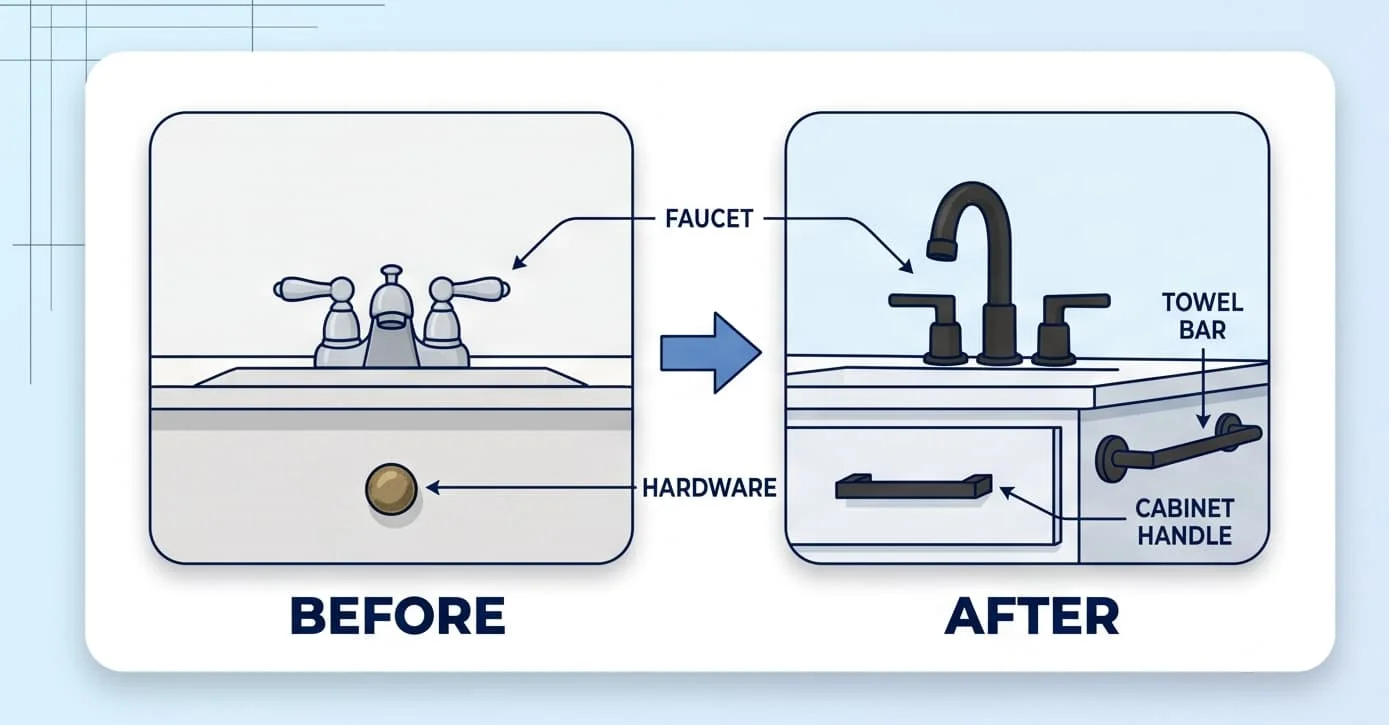
You don’t have to replace the whole bathtub to make a difference. Smaller upgrades can add real value too, like swapping out old faucets, towel bars, and cabinet hardware. You can do most of this yourself, which keeps the cost down even further.

A minor bathroom update, meaning new fixtures, a fresh coat of paint, and updated hardware, typically returns about 65% to 71% of its cost at resale. Leave plumbing and electrical work to a licensed professional. Getting those wrong can cause water damage or safety hazards that cost far more to fix later.

Close-up before/after of a bathroom faucet and cabinet hardware swap - readers need to see what "hardware" means here (handles, faucets, towel bars) since it's easy to confuse with a full remodel

2. Garden and Landscaping Upkeep

If your garden has been neglected for a while, this is one of the most affordable projects on the list. A tidy yard improves how your home looks from the street, and it gives you a place to relax outside.

Advertisement

Basic, routine lawn care, like mowing, weeding, and fertilizing, can return more than double what you spend on it. Well-kept landscaping overall can add roughly 5% to nearly 13% in perceived home value, based on university extension studies cited in that same report.

Getting started doesn’t take much. A leaf blower, a decent lawn mower, and a set of hedge trimmers cover most of what a small-to-medium yard needs. It takes some regular effort, but even a small yard can look dramatically better with consistent care.

If you’re not sure where to start, our beginner’s guide to DIY landscaping walks through the order of operations, so you’re not guessing which task to tackle first.

3. Siding Replacement

Siding takes a beating over the years, especially from weather. Pressure washing helps for a while, but eventually it stops being enough to make the house look good.

Advertisement

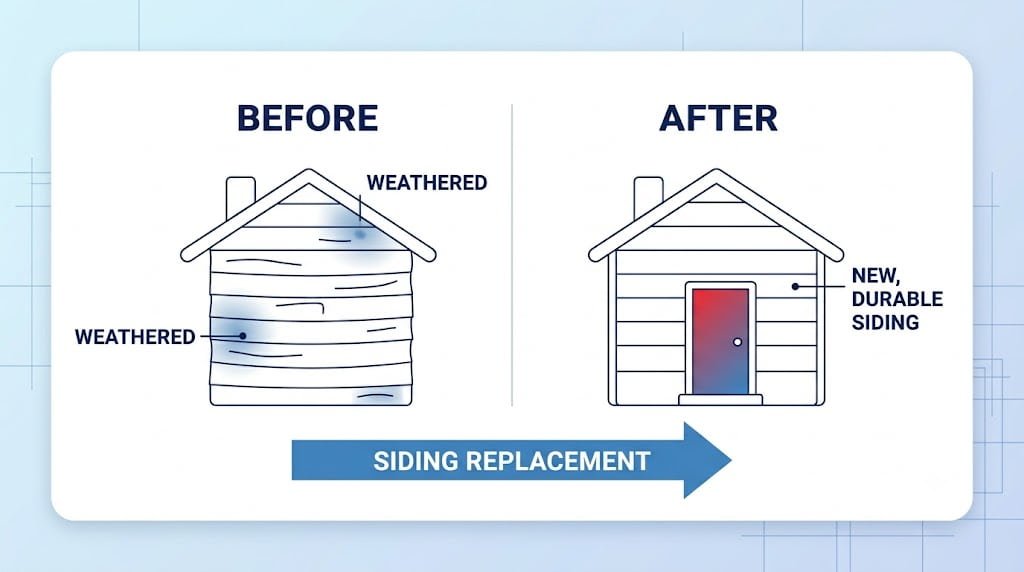
Replacing worn siding is one of the most noticeable upgrades you can make. It’s visible from the street the moment it’s done. Homeowners typically recoup between 70% and 114% of the cost at resale, depending on the material, with fiber-cement siding generally landing at the higher end.

Vinyl siding costs less upfront and is easier to install yourself in sections, while fiber-cement lasts longer but usually needs a professional crew. If you’re deciding between the two, our siding material comparison guide breaks down the trade-offs in plain terms.

A diagram illustrating a home's exterior wall with old, weathered line-art siding labeled 'BEFORE' and new, smooth line-art siding labeled 'AFTER'.

4. Energy-Efficient Upgrades

Your home’s energy use has a direct effect on your monthly bills. Energy-efficient upgrades tend to pay for themselves over time, and some of the cheapest options make the biggest difference per dollar spent.

A smart thermostat is one of the lowest-cost entry points. ENERGY STAR-certified models save households an average of about 8% on heating and cooling costs. That’s a modest number, but it comes at almost no upfront cost if you’re already replacing an old thermostat.

Advertisement

Bigger projects, like insulating your home or replacing old doors and windows, cost more but have a bigger long-term payoff. Some utility companies and local governments offer rebates or grants for these upgrades, so it’s worth checking your utility provider’s website before you budget the full cost yourself. Our home energy audit checklist can help you figure out which upgrade will save you the most before you spend anything.

5. Smart Home Features

Smart home features have grown a lot more popular in the last few years, and they keep getting cheaper. They add convenience, help you keep an eye on your home remotely, and can make day-to-day life noticeably easier.

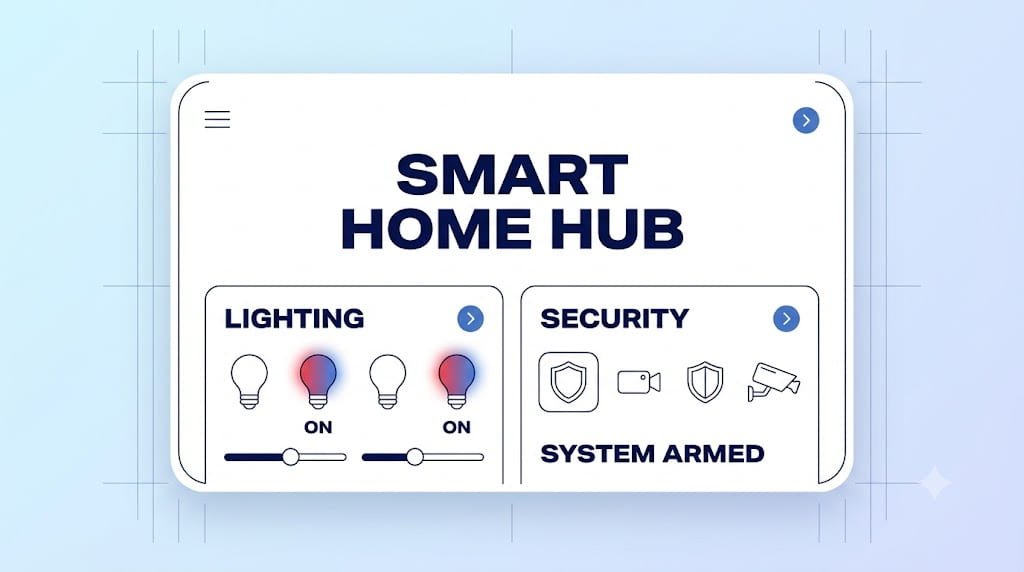
Automated lighting and smart security systems are two of the most common starting points. Many real estate agents report that homes with well-integrated smart features sell faster and command a modest price premium, though the exact dollar amount varies a lot by market and by how much of the home is actually connected, so it’s worth treating any specific figure you see as a rough range rather than a guarantee.

If your budget is tight, you don’t need to buy the expensive flagship version of every device. Plenty of budget-friendly smart home hubs and security cameras perform nearly as well as pricier options, which makes this an easy project to start small and expand later.

Advertisement

A diagram illustrating a smart home app screen with controls for automated lighting (bulbs, sliders) and smart security (shield, camera) labeled 'SMART HOME HUB'.

6. Minor Kitchen Remodel

The kitchen is where most people spend the most active time in the house, cooking, cleaning up, and often eating too. It’s worth keeping functional, even if you’re not ready for a full renovation.

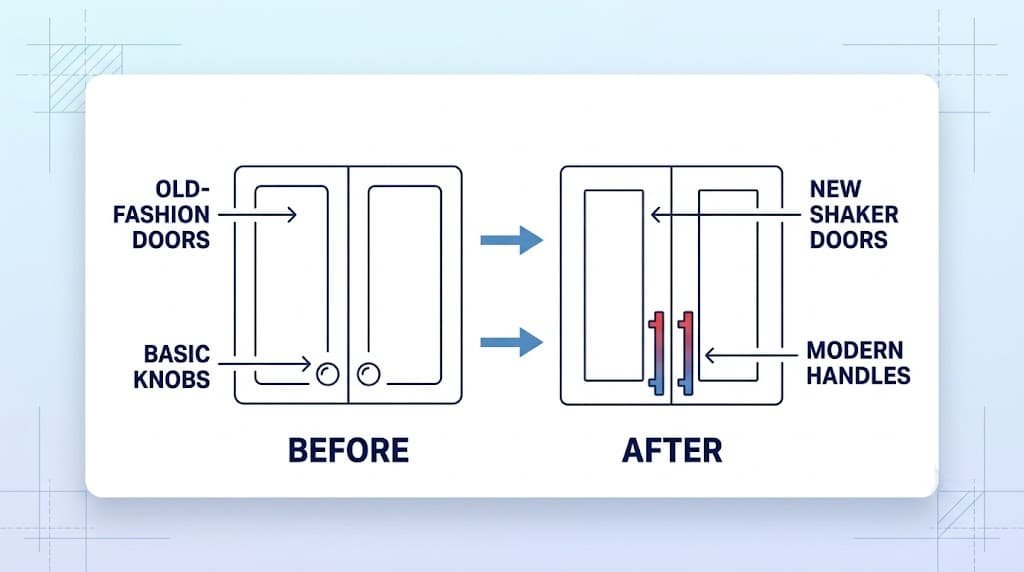
You don’t need to gut the room to get a real return. A minor kitchen remodel, meaning new cabinet fronts and hardware, updated counters, and mid-range appliances without moving any walls, typically returns 96% to 113% of its cost at resale. That’s a notably better return than a major kitchen renovation, which often recoups less than half of what it costs.

New cabinet doors and hardware are the easiest place to start, and you can do a lot of that work yourself if you’re comfortable with basic tools. Our cabinet refacing guide covers what’s realistic to DIY versus what’s worth hiring out.
A diagram comparing old line-art kitchen cabinet doors and knobs labeled 'BEFORE' to new modern shaker doors and bar handles labeled 'AFTER'

How to Choose Which Project First

Pick based on your budget and your timeline, not just what looks most exciting. If your budget is under a few hundred dollars, start with garden upkeep or bathroom hardware. Both are DIY-friendly and show results within a weekend.

If you’re planning to sell within the next year or two, prioritize the minor kitchen remodel and siding. Both tend to show up clearly in a home appraisal and in how buyers react during a showing. If you’re staying put for years, energy-efficient upgrades and smart home features make more sense, since their payoff comes from lower bills and daily convenience rather than a resale bump.

Advertisement

One more thing worth planning around: don’t start two major projects, like siding and a kitchen remodel, at the same time unless you have a clear budget and contractor schedule for both. Overlapping big projects is one of the most common ways homeowners blow past their budget and timeline.

Key Takeaways

Small, targeted upgrades tend to outperform full renovations on return. A minor kitchen remodel and siding replacement are usually the strongest financial picks on this list, while bathroom hardware and garden upkeep are the easiest ways to get started on a tight budget. Energy-efficient upgrades and smart home features pay off more gradually, through lower bills and added convenience, rather than an immediate resale bump. Whichever project you pick, get quotes for anything involving plumbing, electrical, or structural work instead of tackling it yourself.

FAQ

Do I need a permit for any of these projects?

It depends on your city and the specific project. Siding replacement and any work that touches electrical or plumbing often need a permit, while cosmetic swaps like cabinet hardware or garden tools generally don’t. Check with your local building department before you start, since requirements vary by location.

How long does it typically take to see a return on these projects?

For projects tied to resale value, like siding or a kitchen remodel, the return shows up when you sell or refinance and the home is appraised. For energy-efficient upgrades, the return builds gradually through lower monthly bills, often over one to three years depending on the upgrade.

Advertisement
Do these return-on-investment numbers apply the same way in every city?

No. The percentages in this article are national averages, and actual returns shift based on your local housing market, your home’s price point, and how competitive buyers are in your area. A project that returns 100% in one region might return noticeably less in another. Before you budget around a specific number, it’s worth checking a local real estate agent or a recent comparable sale in your neighborhood.

Source link

Continue Reading

Tech

T-Mobile Just Quietly Killed Its Better Value Phone Plan After Less Than a Year

Published

on

T-Mobile launched new mobile plans this week by announcing “Nothing,” referring to the new EIP Flex 36 installment plan, with which you can get a new device for zero money down, not even taxes on the phone.

But nothing is also what’s available if you wanted to sign up for T-Mobile’s recent Better Value plan, which the company rolled out in January and just removed on Tuesday when it launched its “2.0” plans.

From the start, Better Value was listed as a limited-time offer, but T-Mobile never provided an end date. It was last available on T-Mobile’s site on Monday, as shown by the Internet Archive.

“Our Better Value plan was a limited-time offer for eligible customers,” a T-Mobile spokesperson said. “Nothing changes for current customers on the plan. With the launch of our new plans, that offer is no longer available to new customers.”

Advertisement

Those currently on the Better Value plan won’t see any change unless they choose to switch to a different plan, such as the similar Experience More 2.0 plan, if they want to take advantage of the new 36-month financing options.

The Better Value plan was very close to the existing Experience More plan, including the price at $140 for three lines, for example. They both included unlimited high-speed 5G data and T-Mobile’s five-year price guarantee.

But a few other features of Better Value were superior to Experience More. You got 250GB of high-speed mobile hotspot data, compared to 60GB. T-Mobile’s highest tier plan, Experience Beyond 2.0, includes unlimited high-speed hotspot data.

When traveling to Canada and Mexico, the amount of high-speed data was a more generous 30GB versus the 15GB of Experience More. Better Value also had T-Satellite service included, whereas that’s a $10 add-on with Experience More.

Advertisement

However, Better Value also had a few serious requirements that seemed designed to pull customer groups from other carriers.

For people switching, it required signing up for three or more lines, two of which had to be eligible numbers ported to the new plan. Existing T-Mobile customers could sign up for Better Value, but they had to have been on a T-Mobile postpaid plan for at least five years.

Source link

Continue Reading

Tech

2nm A20 chip, C2 modem, more

Published

on

Apple’s iPhone 18 Pro is right around the corner, and the rumor mill started earlier than normal. Here’s what you need to know.

In 2025, Apple gave its high-end iPhone a major redesign, with the iPhone 17 Pro featuring a distinct pill-shaped camera plateau, an aluminum frame, and a bright orange color option. Inside, the A19 Pro chip bumped up the RAM to 12GB, and the phone even gained a vapor chamber cooling system.

With the iPhone 18 Pro, meanwhile, Apple is expected to deliver a more incremental upgrade, with the only noticeable change likely to be on the front of the device. Smaller Dynamic Island aside, it’ll be more of the same design-wise.

However, a new chip production process for the A20 Pro is expected to deliver significant performance improvements. Apple’s in-house modems might finally see use in the “Pro” iPhone, and multiple sources suggest a major camera upgrade is in the works as well.

Advertisement

Leakers and analysts alike have made countless claims about the iPhone 18 Pro. Here’s everything that’s been rumored so far.

iPhone 18 Pro release date rumors

While the rumor mill thinks the base iPhone 18 will arrive in early 2027, the iPhone 18 Pro is expected to arrive in September 2026. To be more specific, an August 2026 rumor claims Apple might announce the iPhone 18 Pro during an in-person event on Wednesday, September 9, 2026.

Silver iPhone lying face down on a dark wooden surface, showing a raised triple camera module, side buttons, and the faint Apple logo on the back

September 2026 is when we’ll likely see the iPhone 18 Pro.

Apple’s U.S. retail employees were allegedly invited to enter a lottery to help organize the event. The choice of an in-person event marks a departure from previous prerecorded product reveals, but the alleged timing is in line with a typical September iPhone event.

Advertisement

In February 2026, it was rumored that the iPhone 18 Pro had entered test production. Based on this alleged testing schedule, and rumors from January 2026 and March 2026, a September 2026 launch date seems almost beyond question.

There have been no rumors of a 2027 release for the iPhone 18 Pro, or any other major deviation from the usual September debut for the Pro models. The consensus among different leakers and analysts is that the iPhone 18 Pro will arrive in September 2026.

Design-wise, the iPhone 18 Pro is expected to offer only a few refinements, relative to the iPhone 17 Pro.

iPhone 18 Pro colors, design, weight rumors

In November 2025, a source with a good track record claimed the iPhone 18 Pro would have a more uniform appearance at the back, compared to the iPhone 17 Pro. Apple allegedly wanted to eliminate the two-tone effect by making changes to the processing of iPhone backplates.

Advertisement
Three modern smartphones shown from the back in dark brown, burgundy, and deep navy colors, each with two large camera lenses in the upper left corner and Apple logo centered

Early rumors claimed Apple was testing three colors for the iPhone 18 Pro.

This updated production process is allegedly meant to greatly reduce the color difference between the glass section and metal frame. This should ultimately result in a more seamless appearance on the back of the iPhone 18 Pro.

Also in November 2025, three possible color options for the iPhone 18 Pro were detailed: a coffee color, purple, and burgundy. The leaker, also the same source behind the backplate rumor, said that only one of these colors would make it to production. They said the iPhone 18 Pro would not be offered in black, a claim which resurfaced in April 2026.

However, a February 2026 report from a generally reliable source claimed that the three colors Apple was testing were actually different variants of red. Apple allegedly chose stronger colors for the iPhone 18 Pro, partly because the cosmic orange iPhone 17 Pro was popular in China.

Advertisement

In April 2026, another leaker, albeit with a mixed track record, jumped on the crimson red iPhone 18 Pro bandwagon. The same month, a tech news website claimed it had received a list of all iPhone 18 Pro color options. The list consisted of the following colors: Dark Cherry, Light Blue, Dark Gray, and Silver.

Also in April 2026, leaker Ice Universe shared an image of iPhone 18 Pro camera plateau protectors in the same rumored colors. Similar images were posted in May 2026 by an anonymous account impersonating a now-inactive leaker.

The same month, leaker Sonny Dickson shared photos of iPhone 18 Pro dummy units. Again, the dummy phones point to the same four color options mentioned previously, including Dark Cherry. Sometime later, in June 2026, AI-manipulated images of third-party iPhone cases were shared as part of a sketchy iPhone 18 Pro rumor.

Overall, the rumor mill believes the iPhone 18 Pro will be available in dark red, light blue, silver, and dark gray. However, a June 2026 rumor says the iPhone 18 Pro will inherit the color-changing issue the orange iPhone 17 Pro is known for.

Advertisement
Four modern smartphones fanned out, showing rear triple camera lenses and glossy backs in black, light blue, sky blue, and pink against a white background

The four colors now said to be for the iPhone 18 Pro. Image credit: Sonny Dickson.

In terms of design, the iPhone 18 Pro will maintain the aesthetic of the preceding iPhone 17 Pro. This is per an October 2025 post from the same leaker behind the November 2025 color and backplate rumors. Reports from December 2025 and January 2026 reiterated this claim, while a February 2026 rumor said Apple wasn’t changing the design because the iPhone 17 Pro was a hit.

The source behind the February 2026 claim, a Weibo leaker with a mixed track record, then added yet another detail. In July 2026, they said the camera plateau of the iPhone 18 Pro would be 2mm thicker than that of the iPhone 17 Pro. They also said Apple would continue to use aluminum for the casing of the iPhone 18 Pro.

This aligns with what analyst Jeff Pu claimed in January 2026: that the iPhone 18 Pro would feature an aluminum frame, and the same 6.3-inch display size as the current iPhone 17 Pro. In May 2026, however, one leaker suggested Apple was exploring a return to titanium for its high-end iPhone models, while another disputed this claim.

Advertisement

The rumor mill is not in agreement about the iPhone 18 Pro backplate design, either. While a November 2025 rumor said Apple wanted to reduce the two-tone effect, one tipster, with a relatively poor track record, claimed Apple would make the glass backplate stand out even more.

A September 2025 Weibo rumor strangely suggested that Apple would use “slightly transparent” back glass in the iPhone 18 Pro. If implemented, this would have offered a clear view of the MagSafe charging coil, but the design choice has always been an unlikely option.

Images of alleged MagSafe-equipped iPhone 18 Pro cases were shared in May 2026. Supposedly, Apple plans to revert to its earlier case design, meaning iPhone 18 Pro cases will feature a MagSafe ring rather than a solid rectangle on the back. These could very well be third-party accessories, though, so it’s unclear if Apple altered the iPhone 18 Pro case and backplate designs.

As for weight, one Weibo leaker says the iPhone 18 Pro will be the heaviest iPhone ever. In November 2025, the tipster suggested the iPhone 18 Pro may be 10g heavier than the iPhone 17 Pro. This would place the iPhone 18 Pro Max weight at approximately 243g (8.57 ounces).

Advertisement

If this rumor is true, the iPhone 18 Pro Max might be the heaviest model ever made. The current heavyweight is the iPhone 14 Pro Max at 240g, while the iPhone 17 Pro Max weighs slightly less at 233g.

Though the iPhone 18 Pro has a chance of weighing more, it might actually offer a reduced version of an existing hardware feature. According to an August 2025 rumor, Apple has simplified the Camera Control on the iPhone 18 Pro to save on production costs.

Meanwhile, an earlier report from the same month, though from a leaker with a less-than-stellar track record, said that Apple would remove the Camera Control entirely from its 2026 iPhone lineup.

It’s possible that Apple tested iPhone 18 Pro configurations with and without a Camera Control button. The company did exactly that with the iPhone 16 range, and this prototyping approach would explain the seemingly contradictory rumors.

Advertisement

Though we’ll have to wait and see what Apple has in store for the Camera Control, multiple leakers agree that a major change is coming to the front of the iPhone 18 Pro.

iPhone 18 Pro to have punch-hole camera & under-display Face ID

If the rumor mill is to be believed, Apple has been experimenting with the idea of under-display Face ID for years. In January 2023, it was rumored that the technology would be available with the iPhone 16 Pro, echoing April 2022 and April 2021 claims made by analyst Ming-Chi Kuo.

Sidebyside closeups of smartphone front panels showing pillshaped and circular cutouts for cameras and sensors on glossy screens, with reflections and a fingertip visible on the right.

Images supposedly showing a smaller Dynamic Island on the iPhone 18 Pro. Image Credit: Early Apple Leaks/Ice Universe

However, the expected timeline for under-display Face ID shifted in March 2023, when DSCC analyst Ross Young said that the technology would not arrive until at least 2025, due to “sensor issues.” Meanwhile, a December 2023 report from a different publication said the hardware was actually delayed until 2026.

Advertisement

In May 2024, Ross Young corroborated the rumor of an apparent delay to 2026, reiterating the idea a year later as well. The same month, May 2025, saw the resurgence of under-display Face ID rumors for the iPhone 18 Pro, this time from a Weibo leaker, who reiterated their claims shortly thereafter.

This tipster then went on to repeat the under-display Face ID rumor in June 2025, September 2025, October 2025, and November 2025. Mere days later, however, the Weibo leaker behind the repeated under-display Face ID claims said Apple had delayed the hardware to 2027.

A month later, a completely unknown leaker challenged this alleged 2027 debut date. Tipster “Smart Pikachu” claimed in December 2025 that the iPhone 18 Pro would feature an under-display Face ID system after all.

The same month, a different publication explained it was also expecting the iPhone 18 Pro to debut with Face ID sensors under the display. Apple allegedly wants to “eliminate” Dynamic Island, which the publication calls an “unsightly black oval.” Per the report, Canadian company OTI Lumionics will supply the necessary components.

Advertisement

In January 2026, Jeff Pu said he expects the iPhone 18 Pro to offer a smaller Dynamic Island, with Face ID still present. Pu also believes the iPhone 18 Pro will offer an 18MP front-facing camera and a 6.3-inch display. A Weibo leaker said the same thing in January 2026.

The same month, however, YouTuber Jon Prosser added confusion to the mix. He claimed that, with the iPhone 18 Pro, the Dynamic Island would move to the top left side of the screen. This was then disputed in January 2026 by a Weibo leaker with a mixed track record.

Meanwhile, also in January 2026, leaker Ice Universe shared the alleged dimensions of the Dynamic Island on the iPhone 18 Pro Max. Per the leaker, Apple plans to reduce the Dynamic Island by 35% from 20.76mm to 13.49mm on the iPhone 18 Pro Max.

In February 2026, a generally reliable source explained they also expect the iPhone 18 Pro to feature a smaller Dynamic Island. However, a source with a mixed track record claimed in March 2026 that Apple would only decrease the size of the Dynamic Island with the iPhone 19 Pro.

Advertisement

Even so, March 2026 is when the first images of the purported smaller Dynamic Island began popping up. Ice Universe and a relatively unknown leaker, who goes by “Easy Apple Leaks,” both shared alleged photos of the iPhone 18 Pro Dynamic Island.

The latter of the two leakers would then go on to share alleged CAD images of the iPhone 18 Pro Dynamic Island in May 2026. All of the images shared so far show the Dynamic Island at the top of the screen, in the center, rather than on the left.

Also in May 2026, a Weibo leaker with a questionable track record said the iPhone 18 Pro would not get a tandem OLED display. Apple will likely continue to use 6.3-inch LTPO OLED panels with ProMotion support for the iPhone 18 Pro.

Given the number of rumors we’ve seen regarding under-display Face ID, and the frequency with which they appear, there’s a decent chance the technology will arrive with the iPhone 18 Pro. It looks as though Apple will indeed shrink the Dynamic Island as well.

Advertisement

If Apple moves forward with the new design, it would increase screen real estate to nearly 98%. Still, a smaller Dynamic Island was rumored to appear with the iPhone 17 Pro in February 2025 and July 2025, but that obviously never happened.

Rumors are still rumors, after all, but the iPhone 18 Pro has a higher chance of receiving Dynamic Island and Face ID modifications. Still, Under-display Face ID is not the only camera-related change rumored for the iPhone 18 Pro.

iPhone 18 Pro could have a variable aperture camera

As with the smaller Dynamic Island, a variable-aperture camera system was expected to debut with the iPhone 17 range, per a July 2024 rumor. However, in November and December of the same year, Ming-Chi Kuo suggested the technology would, instead, debut with the iPhone 18 lineup.

Two modern smartphones, one black and one white, shown from the back, each featuring three large rear cameras with metallic rings on a clean, light gray background

The iPhone 18 Pro could debut with a variable aperture camera system.

Advertisement

Variable aperture system claims appeared again in an October 2025 report. It listed LG Innotek and Foxconn as the component manufacturers, with an actuator to drive the aperture movement supplied from Luxshare ICT and Sunny Optical.

A Weibo leaker corroborated the rumor the same month. They added, however, that the iPhone 18 Pro’s 48MP Telephoto lens, which uses a periscope lens system, will also gain a larger aperture.

In December 2025, another report claimed the iPhone 18 Pro would gain a new aperture system, though it was referred to as a “mechanical aperture” in the text.

Relatively obscure leaker “Smart Pikachu” claimed in January 2026 that the iPhone 18 Pro would feature a variable camera system. They also said Apple was planning to introduce a DSLR-like teleconverter, increasing the focal length and zoom of the iPhone 18 Pro camera system

Advertisement

In February 2026, it was again rumored that the iPhone 18 Pro would gain a variable-aperture main camera, with a larger aperture for the Telephoto lens as well.

According to a supply chain report, production for the iPhone 18 Pro’s variable aperture components began in April 2026. The report claimed that China’s Sunny Optical and Luxshare ICT would make the actuators, with LG Innotech also being part of the camera production process.

Rumors of a variable aperture camera system continued through April 2026. The addition of a variable aperture might allow for better night-time photography, while preventing washed-out colors on daytime photos.

Variable aperture cameras have other benefits as well. There are multiple reasons why Apple might use a mechanical, variable aperture system rather than a fixed one.

Advertisement

Smartphone cameras typically feature a fixed aperture, which is the hole that lets light through between the lenses and the sensor. This is the case because a variable aperture would require more physical space for the mechanism and motor.

When aperture size is increased or decreased, this affects the amount of light that hits the sensor. It also impacts the exposure triangle, the principle that changes to the aperture, shutter speed, and sensitivity of the sensor can influence how a shot is taken.

A wider aperture allows for a shallower depth of field, keeping the subject in focus while blurring the background and foreground. A smaller aperture, meanwhile, facilitates a larger depth of field effect, with more elements in the picture being sharp and in focus rather than blurry.

Apple’s current workaround for the fixed aperture limitation is to use multiple camera views and computational photography effects to create a blurry background, known as bokeh, for portraits. However, adjusting the aperture would result in creating a naturally focused image without any computational photography.

Advertisement

Overall, it’s practically guaranteed that the iPhone 18 Pro will feature a variable camera aperture system, unless you take into consideration earlier rumors related to the iPhone 17 Pro, which doesn’t feature the hardware.

As for other camera components, a July 2024 rumor suggested that Samsung would provide image sensors, instead of the usual supplier, Sony. January 2025 saw the resurgence of this claim, though from a different leaker who added more detail.

Samsung allegedly wanted to make a stacked image sensor consisting of three layers: a photodiode, a transfer layer, and a logic layer.

In essence, the sensor would come with a processor directly mounted to it. This would reduce the time necessary to get image data to the processor, ultimately improving the camera’s responsiveness in the process.

Advertisement

In August 2025, Apple announced it aimed to spend $100 billion on manufacturing facilities within its U.S. supply chain. Among the beneficiaries was Samsung.

A report in December 2025 then said Samsung was gearing up to install manufacturing equipment at its Taylor, Texas, factory. This is allegedly where the CMOS image sensors (CIS) used in the iPhone 18 range will be made.

However, there’s evidence that Apple won’t exclusively use Samsung-made image sensors in the iPhone 18 Pro.

In June 2026, AppleInsider analyzed more than 630GB of internal files taken from Apple supplier Tata in a cyberattack on its factory in India. Our findings suggest that the Wide sensor, or the main rear camera of the iPhone 18 Pro, will switch from the Sony IMX-903 to the IMX-905.

Advertisement

It looks as though Sony will still produce image sensors for the iPhone 18 Pro, though this does not contradict the prior variable aperture system rumors.

As for the front-facing camera of the iPhone 18 Pro, a February 2026 rumor from the obscure leaker “Apple Club” says a 24MP image sensor is planned. Earlier, in January 2024, Ming-Chi Kuo similarly said the iPhone 17 range would feature a 24MP front camera.

These two rumors can be explained away by Apple’s use of pixel binning for the front camera. Pixel binning involves averaging the light values of pixels based on the pixels nearby. In essence, the iPhone considers groups of pixels as a virtual “superpixel” of sorts.

Ultimately, Apple’s iPhone 17 range delivers 18MP images with the front-facing camera, and this will likely continue with the iPhone 18 lineup.

Advertisement

Potential camera-related improvements aside, the iPhone 18 Pro will almost certainly deliver a performance boost, thanks to Apple’s A20 Pro chip.

iPhone 18 Pro performance: 2nm A20 chip, WMCM chip packaging process

In September 2024, Ming-Chi Kuo said that the iPhone 18 Pro would be the only device in the iPhone 18 lineup equipped with a 2nm chip. Back in June 2022, TSMC revealed it would launch its 2nm chip process in 2025, so it makes sense for Apple to go with it for the iPhone 18 Pro.

Close-up of an Apple A20 processor chip mounted on a dark circuit board, showing detailed metallic traces and components around the central square chip

Apple’s A20 Pro chip will most likely use a new packaging process.

Kuo, however, changed his expectations for the iPhone 18 range in March 2025, suggesting that 2nm chips would be used across the iPhone 18 line. This idea aligns with an earlier July 2024 report.

Advertisement

One source suggested, in April 2025, that 2nm chips would lead to a price increase for the 2026 iPhones, with Apple passing the costs on to end consumers. Months later, a November 2025 rumor from a separate Weibo leaker raised similar concerns.

A January 2026 supply chain rumor said the A20 Pro may cost as much as $280 per unit, approximately 80% more than the previous generation. In July 2026, it was similarly alleged that TSMC had increased its base prices by 10%, again hinting at an iPhone price hike.

Prices were already raised across the Mac and iPad lines in June 2026, but the iPhone was left untouched, for now. Jeff Pu said in July 2026 that the iPhone 18 Pro might cost users $250 to $300 more than the iPhone 17 Pro, after previously saying in February 2026 that there would be no price increase with the model. Counterpoint Research similarly suggested a $200 price increase in July 2026.

In any case, while a price hike appears to be right around the corner, performance improvements will arrive with it, in the form of 2nm chips. The A20 Pro system-on-chip is expected to offer a performance boost of between 10% and 15%, relative to the current iPhone 17 range, according to an October 2024 report.

Advertisement

Per the report, the A20 Pro chip utilizes a new packaging method known as WMCM, rather than Apple’s current packaging technique, InFo.

Chip packaging represents a process applied to the die of a chip, setting it up to communicate and work with other components on a circuit board.

With the A19 Pro chips, the InFo process gives Apple a way of integrating components within a chip package. Essentially, elements like memory can be added to the chip package directly, rather than being an externally accessed component.

This lets Apple make the overall chip package quite small. Still, it is a technique that’s used with a single die. New CPU and GPU combinations require new dies with this method, which could become expensive for Apple.

Advertisement

WMCM, short for Wafer-level Multi-Chip Module, is a different packaging technique that works well with multiple dies. It can fit together separate dies, such as a CPU and GPU, while still keeping the overall package extremely small.

Switching to WMCM would give Apple more freedom to create multiple packaging designs by incorporating different dies, and it wouldn’t massively raise the cost of making the dies themselves. Using WMCM wouldn’t have a massive impact on performance, but it would reduce reliance on chip binning for different product tiers.

Apple’s alleged plans to use WMCM have been mentioned by multiple sources, and our own findings also suggest next-generation iPhone chips will use this packaging process.

Jeff Pu revealed in June 2025 that he also believes the iPhone 18 range will use a 2nm chip with the WMCM process. He reiterated these claims in January 2026. According to Pu, the process the A20 Pro will use is referred to as N2 and is a first-generation process.

Advertisement
Close-up of colorful silicon wafers covered in tiny square microchips, forming overlapping circular patterns with rainbow reflections and a grid-like texture

Silicon chip wafers. Image Credit: TSMC

The smaller die has the potential to make the A20 Pro chip approximately 15% faster than the A19 Pro. It might also be more efficient, with a 30% reduction in power consumption. Apple’s use of the WMCM packaging process was also suggested in a December 2025 report.

Additionally, an April 2025 rumor claimed that the iPhone 18 line would feature 6-channel LPDDR5X memory. This would ultimately allow for improved memory bandwidth, thereby enhancing performance. The use of LPDDR5X memory was corroborated in an October 2025 report, which added that it would be sourced from Samsung, though SK Hynix and Micron were reportedly in talks with Apple as well.

Per a similar December 2024 report, meanwhile, Apple worked with Samsung to change how RAM is packaged, also in an attempt to increase bandwidth.

Advertisement

Additionally, iPhone 18 Pro board schematics seen by AppleInsider in June 2026 suggest the system-on-chip will move closer to the outer edge of the dual-layer board. The storage of the device will seemingly sit deeper between the two board layers, which could impact repairability and performance.

The same month, leaker Ice Universe spotted a detail about the A20 Pro Neural Processing Unit or Neural Engine. This area of the chip is seemingly much larger than that of the A19 Pro Neural Engine, suggesting Apple will prioritize additional on-device processing for Apple Intelligence and Siri.

While every iPhone 18 Pro will feature the A20 Pro chip, Apple might take a different approach with the phone’s cellular hardware.

iPhone 18 Pro modem configurations and battery rumors

In June 2026, AppleInsider exclusively revealed that Apple had developed two logic board variants for the iPhone 18 Pro. One of them features a Qualcomm modem and supports mmWave; the other is equipped with Apple’s C2 modem.

Advertisement
Close-up of two smartphones on a dark surface, one dark blue with three rear cameras and one white with a single rear camera, both showing minimalist modern designs

The iPhone Air already uses an Apple modem, so it makes sense for the C2 to arrive with the iPhone 18 Pro.

In short, our findings suggest that iPhone 18 Pro units sold in the United States will use a Qualcomm modem, while devices sold elsewhere will use the Apple C2 modem.

Jeff Pu also claimed in January 2026 that the C2 would be used in the iPhone 18 Pro. Identifiers for the C2 modem were also discovered in July 2025, within an early build of iOS 18, while a February 2025 rumor claimed new Apple modems were in the works.

The same month, Apple’s SVP of hardware technologies, Johny Srouji, referred to the C1 modem as “a platform for generations.” Ultimately, it’s not surprising that Apple has plans for the C2 modem.

Advertisement

We believe the iPhone 18 Pro will offer region-based configurations, with some users getting the C2, and Qualcomm modems being available for U.S. buyers, due to mmWave compatibility.

As for battery life, a February 2026 rumor says the iPhone 18 Pro battery capacity will only be slightly larger than that of the iPhone 17 Pro. Then in June 2026 and July 2026, it was claimed the iPhone 18 Pro battery would have a 4,288mAh battery in the United States, and a 4,056 mAh battery in China.

For reference, the U.S. version of the iPhone 17 Pro has a 4,252 mAh battery, while the model for the Chinese market has a battery capacity of 3,988 mAh. Models sold in China have a lower capacity because the physical SIM card slot takes up space in the phone, which is not the case with the eSIM-only U.S. models.

If the February 2026 numbers are correct, the iPhone 18 Pro sold in the United States will offer a battery capacity increase of only 0.85%. The China-specific physical SIM model would offer a similarly meager 1.71% improvement over the iPhone 17 Pro.

Advertisement

Battery enhancements aside, one thing we won’t see with the iPhone 18 Pro is MagSafe replacing USB-C entirely, as TikToks in February 2026 strangely suggested. The iPhone 18 Pro will obviously continue to feature MagSafe and USB-C, as dummy units posted in April 2026 clearly indicate.

What to expect with the iPhone 18 Pro

In essence, the iPhone 18 Pro could deliver the following enhancements and changes over the preceding iPhone 17 Pro:

  • Under-display Face ID
  • Punch-hole front camera
  • Variable aperture system for rear cameras
  • 15% faster, 2nm A20 Pro chip with improved memory bandwidth
  • New red, blue, silver, and gray colors with a unified color scheme
  • A $200 to $300 price increase

Apple’s iPhone 18 Pro is expected to arrive in September 2026, likely alongside the long-rumored iPhone Fold.

Source link

Advertisement
Continue Reading

Tech

The Chinese Philosopher Americans Can’t Stop Fighting About

Published

on

Yiyang Zhuge learned last week that when you go extremely viral, the people you have been following for years suddenly start following you back. Zhuge logged onto X and found that a string of famous professors and scholars were in her list of new followers. A PhD candidate in political philosophy at Boston College, Zhuge had previously only lurked on X to keep up with the latest debates and gossip in academia. The vast majority of her social media activity happens on the Chinese internet, where she goes by the alias Zhong Shu and hosts a popular podcast with hundreds of thousands of loyal listeners.

Late last month, Zhuge, who is in her late twenties, interviewed Christopher Nolan, one of the most influential directors in Hollywood, who was in Beijing promoting The Odyssey. Rather than asking about celebrities or Hollywood, Zhuge posed a series of deeply philosophical questions to Nolan about the Christianization of Greek philosophy and how to portray heroes in films. The first thing she asked: “Are you a bard for a civilization at dusk?”

Nolan was visibly impressed by Zhuge. After the interview was published in China, Geoff Keighley, a video game journalist and the son of Nolan’s longtime friend David Keighley, shared the interview on X, calling it “a great listen.” Keighley’s video has been watched over 18 million times, and when Zhuge later posted the interview on her own X account, it racked up another 6.9 million views.

For the first time, Zhuge had become the main character of the English-speaking internet. She was being praised, mocked, criticized, and defended all at the same time. Many people said it was the best interview Nolan has done for The Odyssey, while the National Review called it a “CCP hostage video.” But everyone ultimately wanted to know the same thing: Who was this young Chinese woman with a bob haircut talking about the decline of civilizations?

Advertisement

While almost no one in the West knows her name, Zhuge is already one of the most prominent young intellectuals in China and has been interviewed by many of the country’s cultural elite. She was featured in Vogue China as an example of a successful woman in her twenties and frequently shares yoga and fitness tips to her 360,000 fans on the Chinese social media platform Xiaohongshu.

When I spoke to Zhuge this week, she framed her success as being born out of personal tragedy. “I was going through an adulterous divorce in which my ex-husband sued me and I accumulated a lot of legal debt,” she says. “I felt discouraged in the English-speaking academia because of certain personal experiences related to that personal tragedy, so I turned my attention back to the Chinese-speaking world to build a career there and pay off my debt.”

When I started digging into Zhuge’s career, I was shocked by her level of productivity. Aside from publishing philosophy translations and writing articles for Chinese media outlets, she has recorded more than 360 episodes of her podcast Monologues of a Committed Observer in just the last three years. That’s an average of one new episode every three days. Most of the time, she just monologues about political science concepts for a half an hour, seemingly unscripted. On XiaoyuzhouFM, the most popular podcast streaming platform in China, she has over 940,000 subscribers.

But despite her prolific posting, Zhuge claims she isn’t interested in being famous. “I have no attachment to fame and no desire to preserve it for its own sake,” she tells me. “What I want is enough freedom and time to build a life centered on thought. That life requires some money, but not very much.”

Advertisement

View From America

When Zhuge asked Nolan if he saw himself as “a bard for a civilization at dusk,” she says she didn’t have a particular civilization in mind.

She views the question instead as part of the long philosophical tradition of pondering the demise of value systems. “I was not primarily attempting to issue a verdict on the contemporary United States,” she says, but “people are free to interpret the phrase through current debates about American or Western decline.”

Source link

Advertisement
Continue Reading

Tech

After Rippling blew millions on AI in months, it built an employee ROI tool

Published

on

HR software provider Rippling this week unveiled AI Spend Console, an anti-tokenmaxxing product that helps a company track and contain its AI spending. One of the most interesting features is that it maps how much individual employees, teams, and roles are spending and if they are genuinely more productive, or generally producing more AI slop.

The company promises the tool will show “which engineers have high AI spend whose peers frequently ask them to redo work in code reviews,” the company says in its blog post.

The tool was born after Rippling went all in on tokenmaxxing at the start of the year — as so many did — only to discover employees were wildly burning cash. Chief Product Officer Matt MacInnis still recalls the executive team meeting in March when CFO Adam Swiecicki presented a number that shocked them.

Rippling was on track to burn 40% of its R&D headcount budget on AI tokens, meaning it was spending as much on tokens as 40% of all the compensation it paid employees in that unit. Millions of dollars. (The R&D org is home to engineering at most tech companies.)

Advertisement

Spending was growing by 80% month-over-month, and if that trend continued, the next year it would spend almost as much on AI tokens — 90% — as it spent on its high-paid R&D unit employees.

“We were incredulous,” MacInnis told TechCrunch.

Management immediately undertook an “urgent” project to understand the spending and what they were getting for that money, he said. In fact, the launch ad for this new product features Swiecicki sitting on a stool while employees are picking up wads of cash and dumping them into a paper shredder.

When Rippling conducted an analysis, it discovered facts like “roughly 10–15% of our employees were driving about 60% of total AI spend. One engineer was spending $50,000 a month,” its blog post shared.

Advertisement

Rippling didn’t want to stop AI usage, just rein it in — a lot. It started by negotiating a max spending cap with each of the tools its company used: Cursor, OpenAI, and Anthropic. It immediately found an obvious issue: Employees defaulted to using the most recent, and most expensive, frontier models for all tasks.

“The truth is that the inference providers, like Anthropic and OpenAI, have absolutely no incentives to help you control your spend. They have every incentive for it to be a runaway expense, and that’s exactly what they do. They don’t provide you with great usage insight, and they don’t collaborate with one another,” MacInnis said.

That was a common early-2026 problem. Now, eight months into the year, enterprises have figured out a couple of things. First, they know they need multiple models from multiple AI labs at various price points, including a frontier open weight option, perhaps of Chinese origin.

Rippling founder and CEO Parker Conrad noted last month that when his company conducted its own benchmarks for its own internal uses, it discovered SpaceX’s Grok was the all-around leader but that “GLM 5.2 is 85% cheaper but [had] nearly identical performance” to the frontier models. (SpaceX now owns Cursor, which offers access to Grok and dozens of other models.) Z.ai’s GLM 5.2 has become a particular favorite Chinese model for coding tasks among tech companies these days. Databricks has also been championing it.

Advertisement

Second, enterprises now know they need an AI gateway that routes prompts to the best, most cost-effective model for the task. Rippling came to that conclusion too. So it built its own AI gateway that is also part of this product. MacInnis says it is possible for enterprises that already use another gateway to still use the AI Spend Console product, though if they want the features that govern spending, they would need to use Rippling’s gateway.

AI Spend Console produces dashboards (once known as leaderboards in the tokenmaxxing days) that score attributes such as prompts per day combined with work output (lines of code/pull requests) and spend.

With this tool in place, Rippling said it dropped its token spend from 40% of its headcount budget to about 15%. But it didn’t curtail AI usage. The company spent a peak of 605 billion tokens the month the CFO issued his warning, MacInnis shared. In July, internal usage hit 600 billion tokens again, yet “the cost of July’s token spend was 37% of the cost of April’s token spend,” he said.

“That’s just because now we’re routing to the more effective models,” he said, joking that “we’re not letting the sales team do grammar updates using Fable.”

Advertisement

But technology solutions aren’t enough, Rippling notes. The company found people using AI effectively and made them “AI captains” tasked with assisting the rest of the company.

Still, such efforts to use AI beyond engineering are a work in progress, MacInnis says, as software engineers have been the primary users so far. But Rippling is, for example, working on it for customer onboarding teams to automate some mailing data and data-reconciliation tasks. The dashboard will then measure productivity in terms of onboarding more customers.

“We have to be able to link token consumption in G&A functions and in customer-facing functions back to productivity. If we can’t do that, all bets are off on any of this stuff being available to the broader employee base,” MacInnis says.

So, if Rippling is an example, tokenmaxxing may have swung so far the other direction that employee AI access may no longer be like Slack or email. If the company can’t measure productivity, then all employees might not have access.

Advertisement

As for the product, AI Spend Console is included for Rippling’s HR subscribers, though there are additional AI usage-based costs. It can also be purchased as a stand-alone product and integrated with another HR system of record, MacInnis says.

When you purchase through links in our articles, we may earn a small commission. This doesn’t affect our editorial independence.

Source link

Advertisement
Continue Reading

Tech

CRM Strategy for Modern Business Needs: A Practical Guide

Published

on

A CRM strategy is a written plan for how your business collects customer data, uses it across sales and marketing, and turns first-time buyers into repeat customers. Without that plan, a CRM tool is just an expensive contact list.

Quick Take

A working CRM strategy does three things: it maps how customers actually move through their journey with you, it sets up your CRM system to support that journey, and it puts clear rules in place for how customer data gets used and protected. Get those three right, and the software becomes a growth engine instead of a filing cabinet. Skip any one of them, and you end up with a database nobody trusts.

What a CRM Strategy Actually Is

Customer Relationship Management, or CRM, is the practice of tracking and managing every interaction a business has with its customers and leads. A CRM strategy is the plan behind that practice. It decides what data you collect, who can see it, and how your team uses it to serve customers better.

Many businesses buy CRM software first and figure out the strategy later. This usually backfires. The software fills up with messy, inconsistent data, and nobody trusts it enough to use it for real decisions. Building the strategy first — even a simple one — gives the software a clear job to do from day one.

Advertisement

Map the Customer Journey Before You Touch Any Software

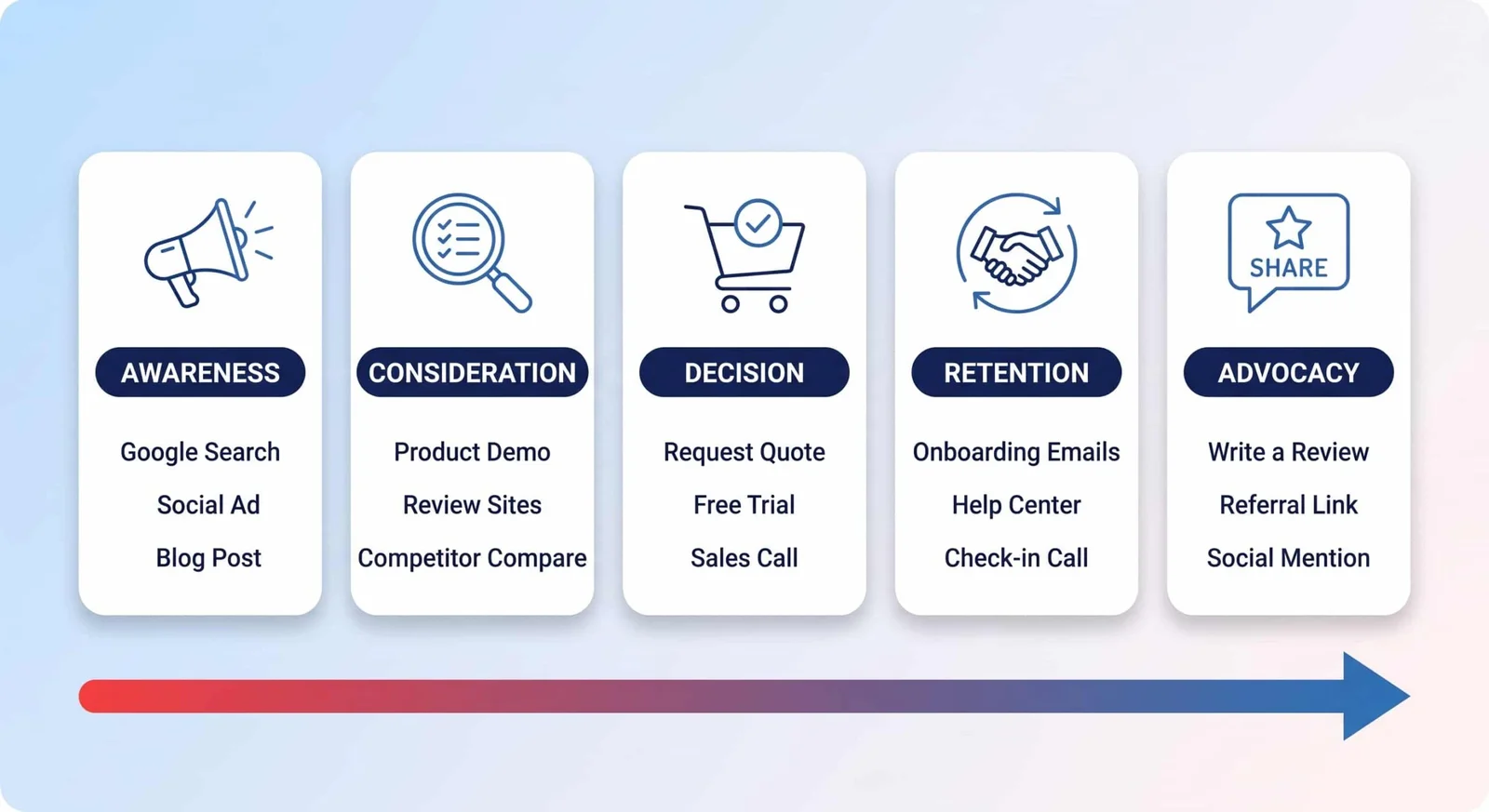
Before you can manage a relationship, you need to understand it. That starts with mapping the customer journey: the path someone takes from first hearing about your business to becoming a repeat customer who refers others.

A customer journey map is a visual picture of that path. It shows the stages a customer moves through and the touchpoints where they interact with your brand, such as your website, a social media ad, an email, or a phone call with support. IBM’s guide to customer journey mapping describes it as a tool for seeing the full path a customer takes, not just the moment they buy.

To build a useful map, ask what your customer is thinking and feeling at each stage:

  • Awareness: How do people find out about you? Search, social media, or a friend’s recommendation?
  • Consideration: What do they check before buying? Reviews, comparisons, or a free demo?
  • Decision: What actually gets them to buy? A discount, an easy checkout, or a helpful sales call?
  • Retention: What keeps them after the sale? Onboarding emails, support, or a check-in call?
  • Advocacy: What makes them tell other people about you?

Each answer becomes a job for your CRM. If most customers read reviews before buying, your CRM should track which review sites send you traffic. If a support call often saves a shaky customer, your CRM should flag customers who haven’t logged in for a while, so support can reach out first.

A five-stage horizontal journey map: Awareness, Consideration, Decision, Retention, Advocacy, each listing specific digital touchpoints.

Choosing and Structuring Your CRM Architecture

Once you understand the journey, you can design a CRM system that supports it. This is more than picking software. It means planning how the system will grow as your business grows, without breaking or slowing down.

Advertisement

A small business might get by with a simple setup at first. But if you plan for growth from the start, you avoid a painful rebuild later. According to Forbes Advisor’s guide to CRM strategy, a strong plan defines clear, measurable goals before you pick software, so the tool serves the goal instead of the other way around.

Four things to plan before you commit to a platform:

  • Platform fit: HubSpot, Salesforce, and Zoho are three common choices, and they are built for different priorities. A side-by-side comparison of HubSpot and Zoho shows the kind of trade-offs to expect between marketing-heavy platforms and all-in-one options, and the same kind of comparison is worth doing for Salesforce before you choose.
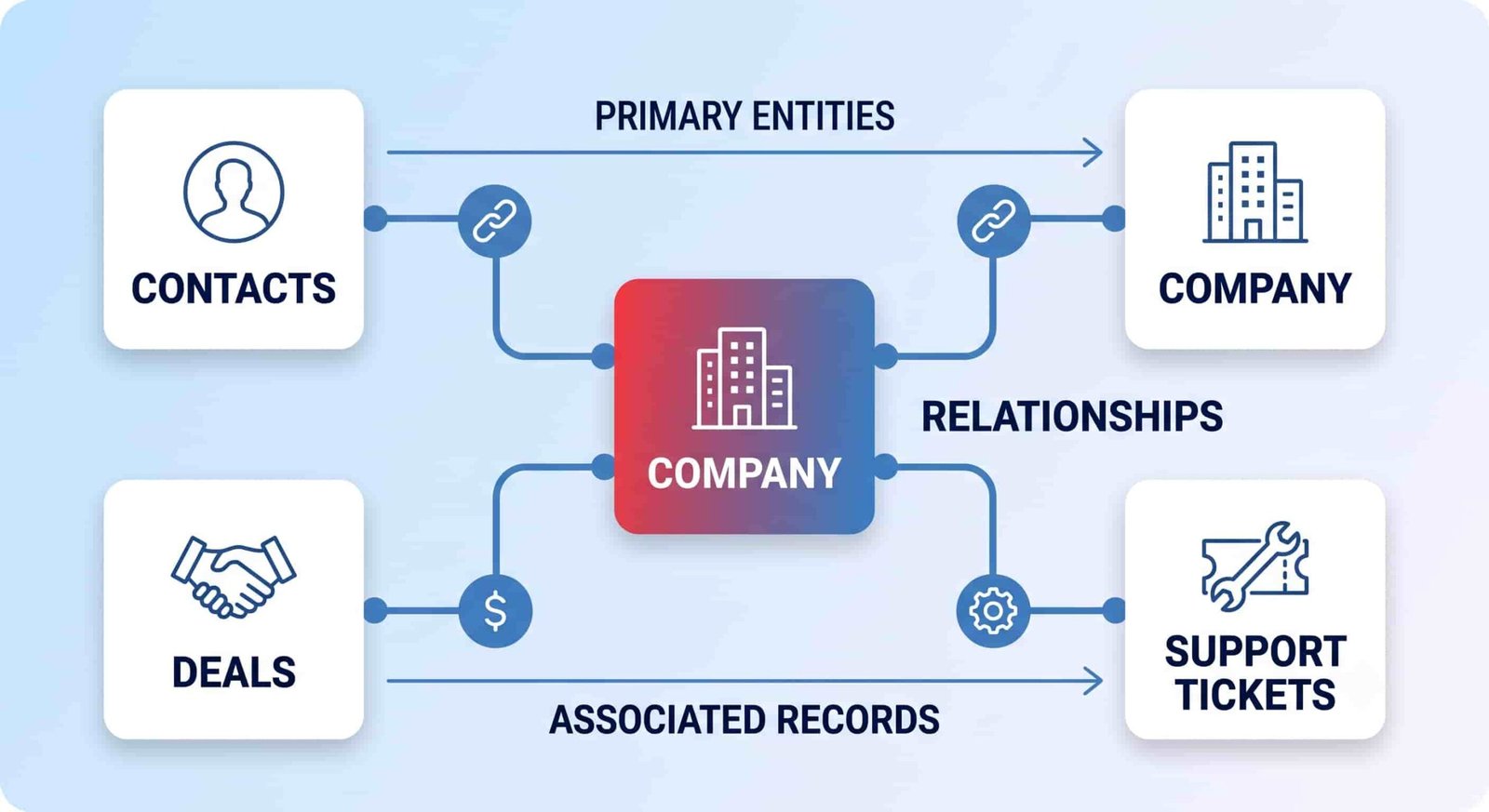
  • Data structure: Decide how you’ll organize contacts, companies, and any custom records your business needs, such as subscriptions or ongoing projects.
  • Integrations: Your CRM should connect to your email platform, accounting software, and online store, so all your customer data lives in one place instead of scattered across tools.
  • Configuration vs. custom code: Most needs can be met by adjusting settings inside the CRM. Custom code should be a last resort, since it makes future updates harder and slower.

Getting this architecture right from the start saves real time and money later. Many businesses bring in an experienced HubSpot consultant, or a specialist in whichever platform they’ve chosen, to design a system built for both today’s needs and next year’s growth.

A simple diagram showing CRM data connections: Contacts, Companies, and related Deals and Support Tickets.

Using CRM Data to Align Sales and Marketing

A well-set-up CRM gives your sales and marketing teams a shared, accurate view of every customer. That shared view stops the common problem of marketing generating leads that sales can’t actually close.

For marketing, a CRM makes it possible to:

Advertisement
  • Group customers by behavior. You can send a special offer to people who haven’t bought in six months, instead of blasting your whole list.
  • Automate follow-up emails. A new lead can get a welcome sequence automatically, without anyone remembering to send it manually.
  • See which campaigns actually lead to sales, not just clicks or opens.

For sales, a CRM makes it possible to:

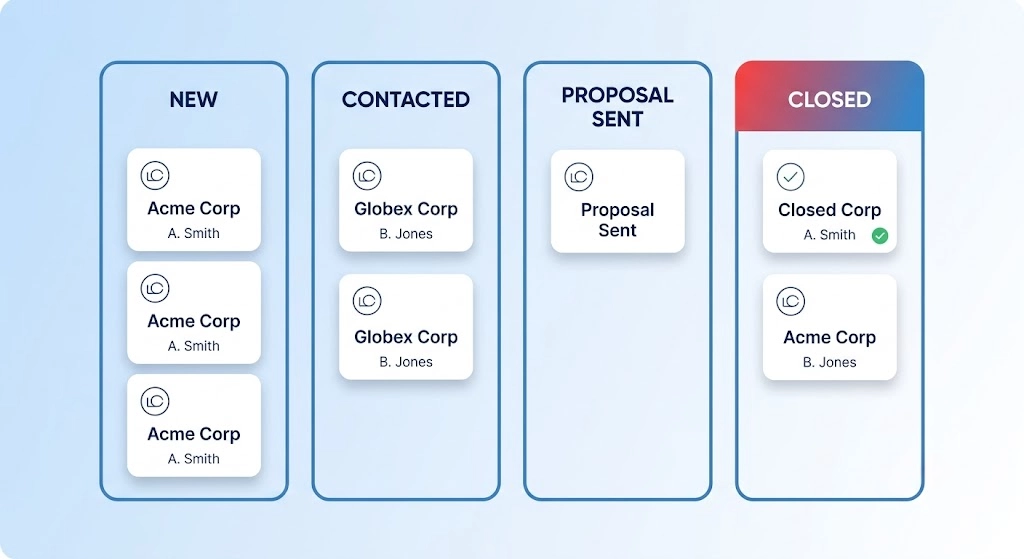
  • See the whole pipeline at once, so reps know where each deal stands and what’s stuck.
  • Rank leads by how engaged and how good a fit they are, so reps spend time on the leads most likely to buy.
  • Predict future sales using real pipeline data instead of guesswork.

This kind of alignment is one piece of a bigger picture. A CRM strategy works best inside a wider plan for growing the business, which is why it’s worth reading a broader guide to business development strategy alongside your CRM planning, not instead of it.

A simple sales pipeline diagram showing four stages: New, Contacted, Proposal Sent, and Closed, with example deals in each.

Protecting Customer Data: Privacy Rules Your CRM Strategy Must Cover

Your CRM holds personal information about real people. How you handle that data affects your legal exposure and your customers’ trust in you. Two major laws set the bar most businesses need to know about.

The General Data Protection Regulation (GDPR) applies to any business that handles personal data belonging to people in the European Union, even if the business itself is based elsewhere. The California Consumer Privacy Act (CCPA) gives California residents specific rights over the personal data businesses collect about them, including the right to know what’s collected and the right to ask for it to be deleted.

Five practices that keep your CRM strategy on the right side of both laws:

  • Track consent. Record when someone agrees to marketing emails, and make it just as easy for them to opt out.
  • Collect less. Only ask for the data you actually need. Extra fields on a form are extra risk with no upside.
  • Limit access by role. Not every employee needs to see every customer record. Set up your CRM so people only see the data relevant to their job.
  • Clean your data regularly. Old, duplicate, or wrong records aren’t just clutter — they’re a liability if something goes wrong.
  • Train your team. Most data breaches trace back to human error, not hacking. A short, regular training session closes that gap.

These aren’t optional extras bolted onto a CRM strategy. They’re part of the strategy itself, the same way a documented data privacy checklist is part of any serious data-handling plan. Real estate teams face this same challenge with sensitive client financial details, which is one reason CRM tools built for property sales put so much emphasis on controlled access to client records.

Common Mistakes That Sink a CRM Strategy

Most CRM strategies don’t fail because of bad software. They fail for a few repeatable reasons.

Advertisement

Buying the tool before writing the plan. This is the single most common mistake. Teams pick a platform based on a demo, then try to force their process to fit it. Write down your customer journey and your goals first, then choose software that fits them.

Letting data go stale. A CRM full of outdated contact info and duplicate records quickly loses everyone’s trust. Once a team stops trusting the data, they stop using the system, and the whole strategy collapses quietly, without anyone officially deciding to abandon it.

Skipping pipeline management setup. A CRM with no defined pipeline stages just becomes a list of names. Reps end up tracking deals in spreadsheets on the side, which defeats the purpose of having the CRM at all.

Over-customizing early. Heavy custom code makes sense for a mature, well-understood process. For a new CRM strategy, it usually just makes every future update slower and more expensive. Start with configuration. Add custom code only when configuration genuinely can’t do the job.

Advertisement

None of these mistakes show up on day one. They show up three to six months in, when the initial excitement fades and nobody has been assigned to keep the system clean. Assign that ownership before you launch, not after adoption drops.

Key Takeaways

  • A CRM strategy is a plan for how you collect, use, and protect customer data — the software is just the tool that carries it out.
  • Map your customer’s real journey first. Let that map decide what your CRM needs to track and automate.
  • Plan your CRM’s data structure and integrations for where your business is headed, not just where it is today.
  • Sales and marketing alignment inside a CRM comes from shared data, not shared meetings.
  • Data privacy rules like GDPR and CCPA aren’t separate from your CRM strategy. Build them in from the start.
  • Most CRM strategies fail from neglect, not bad software — stale data and skipped ownership are the real culprits.

FAQ

How is a CRM strategy different from CRM software?

CRM software is the tool. A CRM strategy is the plan that decides what the tool should do — what data to collect, how teams use it, and how it fits your customer journey. You can own CRM software with no strategy behind it, and it will still function poorly.

How long does it take to build a CRM strategy?

It depends on your business size and how much you already know about your customer journey, so there’s no single fixed timeline. A small business with a clear journey map can draft a working strategy in a few weeks. A larger organization with multiple departments and legacy data usually needs longer, since alignment across teams takes real coordination, not just planning time.

Do I need a CRM strategy if I’m a very small business?

Yes, though it can be much simpler than a large company’s. Even a one-person business benefits from deciding, in writing, what customer information to track and how to follow up consistently. The size of the strategy should match the size of the business, not skip the planning step entirely.

What’s the biggest sign a CRM strategy isn’t working?

Your team stops trusting the data and starts keeping their own spreadsheets or notes on the side. That’s a clearer warning sign than low login counts, because it means people have quietly decided the CRM isn’t reliable enough to depend on.

Advertisement

Source link

Continue Reading

Tech

ChatGPT could soon become your next WhatsApp sticker maker

Published

on

Creating custom WhatsApp stickers could soon become much simpler, especially if ChatGPT is already part of the workflow. A new APK teardown suggests OpenAI is developing a feature that would allow users to generate custom stickers inside ChatGPT and export them directly to WhatsApp. While the functionality isn’t live yet, hidden code discovered in the latest Android app points to native WhatsApp integration, potentially eliminating the need to save images and manually convert them into stickers first.

What the leak reveals

According to the APK teardown by Android Authority, the upcoming feature would let users create an image through ChatGPT and then choose “Add to WhatsApp” from the sharing menu. Instead of sending the image as a regular picture, ChatGPT would prepare it in WhatsApp’s sticker format before handing it off to the messaging app. That means users could create personalized reaction stickers, memes, or illustrations from a simple text prompt and add them to their sticker collection in just a few taps.

The code also suggests the integration is being built directly into ChatGPT rather than relying on a separate sticker-making app. Today, creating custom WhatsApp stickers often involves generating an image, removing its background if necessary, saving it locally, and then importing it into a third-party sticker tool. This new workflow would streamline the entire process into a single experience.

It makes sense, but don’t get too excited just yet

The feature feels like a natural next step for ChatGPT’s growing image-generation capabilities. As users increasingly create AI-generated memes, emojis, profile pictures, and illustrations, being able to turn those creations directly into WhatsApp stickers would make them much easier to share. More broadly, it also reflects OpenAI’s push to make ChatGPT more than just a chatbot by adding practical tools and integrations that let users take AI-generated content beyond the app itself.

Since the feature was uncovered through an APK teardown, there’s no guarantee it will ever be released, and OpenAI hasn’t officially announced it. However, if it does arrive, it could make creating custom WhatsApp stickers far more seamless by letting users generate and export them directly from ChatGPT without relying on third-party apps or manual conversions.

Advertisement

Source link

Continue Reading

Tech

A Closer Look Inside the 1996 Popular Mechanics Car Guide CD-ROM Reveals Woodgrain Vipers and Invoice Prices

Published

on

1996 Popular Mechanics Car Guide CD-ROM
Clint from LGR Blerbs loaded up a mid-90s Popular Mechanics Car Guide disc on a Windows 3.1 machine and spent over twenty minutes poking around its menus, photos, and videos. The software, released around 1995-1996 for PCs that could handle Video for Windows, promised buyers a way to research new and used vehicles without leaving the house. It delivered pricing data, specifications, magazine articles, still images, and full-motion clips for thousands of cars, trucks, SUVs, and vans. A disc image sits on the Internet Archive now if anyone wants to try it themselves.


When you start the program, you’ll see a fairly simple interface that has been designed to take advantage of the hardware available at the time. Users can search for a car based on whether it is new or old, its body design, its price, or some of its features and safety equipment, such as dual airbags. Search results appear as lists, which direct you to detailed pages for specific models. Each listing provides a detailed look at the dealer’s invoice price as well as the suggested sticker price, which can be extremely useful if you intend to negotiate a decent bargain. Next to the standard equipment list, you’ll see the optional packages they provide, with prices that update in real time so you can get a decent indication of what you’re looking at.

Sale


LEGO Technic Ferrari FXX K Toy Car – Building Toy for Girls & Boys, Ages 10+ – Cool Birthday Gift for…
  • LEGO FERRARI MODEL CAR KIT – Builders ages 10+ can create the legendary Technic Ferrari FXX K with authentic details and working mechanical features
  • AUTHENTIC RACE CAR DETAILS – This supercar building set features working butterfly doors, opening hood, and an engine cover that reveals the…
  • CAR MODEL KIT – Young engineers explore real automotive concepts with this educational learning toy as they build the working differential and watch…

1996 Popular Mechanics Car Guide CD-ROM
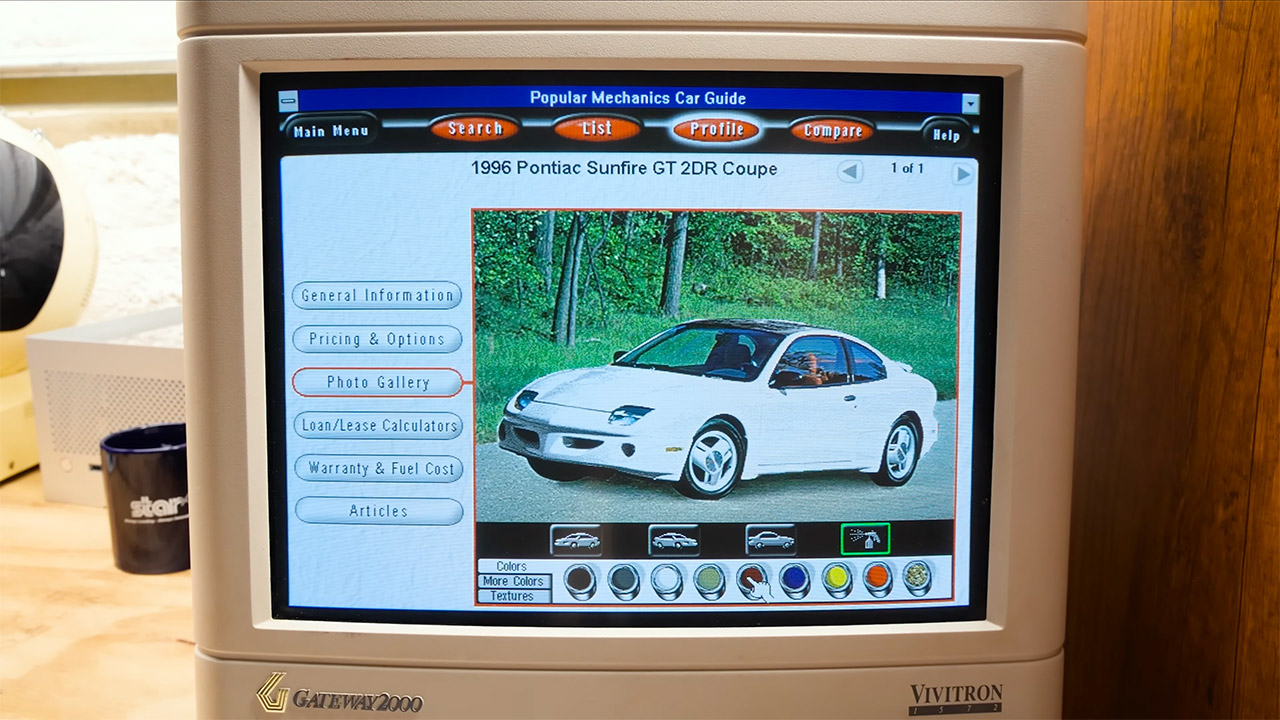
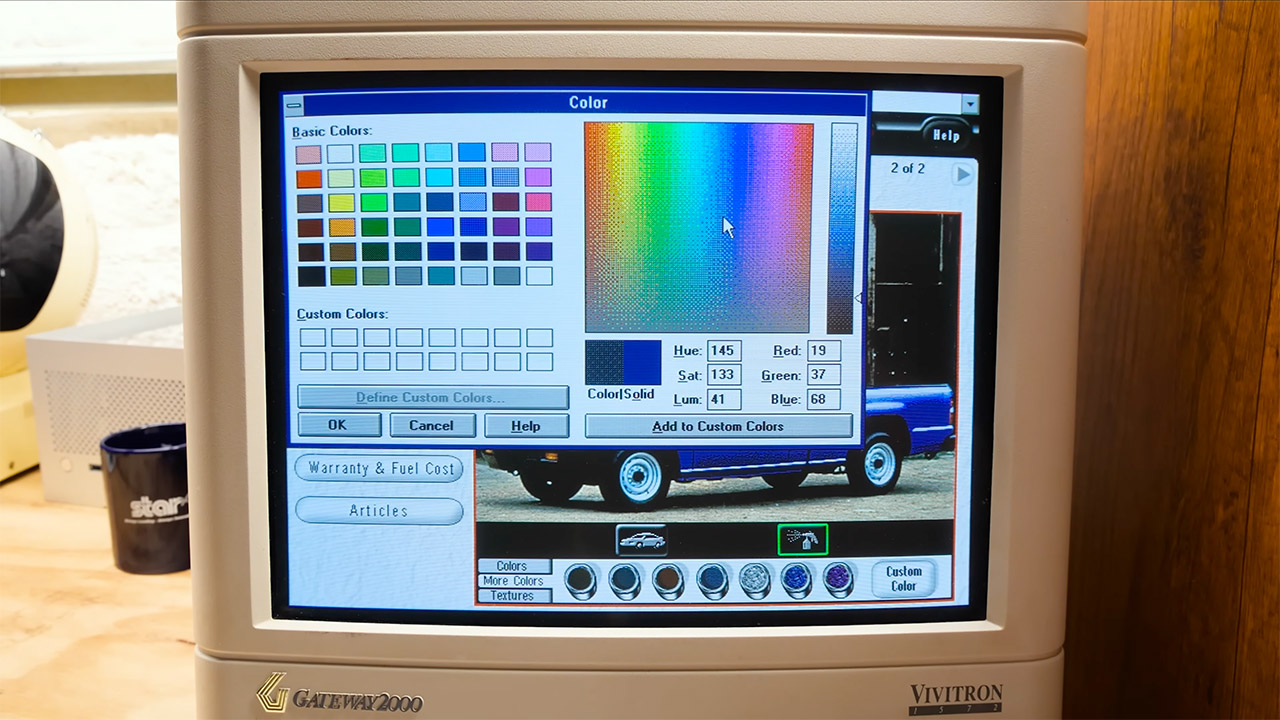
The screen is packed with photographs of the car from various angles on the outside, as well as some of its interior components such as the dashboard, console, and seats. One fun feature allows you to recolor the car just for fun. You can choose from the factory paint colors that came with it or utilize a far broader color pallet that includes metallic flakes and, yes, even wood grain designs. So, if you want to envision a Pontiac Sunfire GT or a Ferrari F355 with a bright pink metallic paint or a wooden dashboard, you can, and the end result is the type of wacky result that’s so typical of a CD-ROM from the 1990s.

1996 Popular Mechanics Car Guide CD-ROM
The transition between pages is very smooth, thanks to some sliding effects and simple morphing, and if you want some background noise, there’s even a loop of some fairly pleasant, albeit cheesy, music playing in the background. Many of the cars on the disk feature full-motion video clips. Some work well, displaying cars like a Buick Park Avenue or a Mazda RX-7 traveling along the road or sitting in a showroom. Others can be difficult to find or get operating, which is due to the way video compression used to work in the past.

1996 Popular Mechanics Car Guide CD-ROM
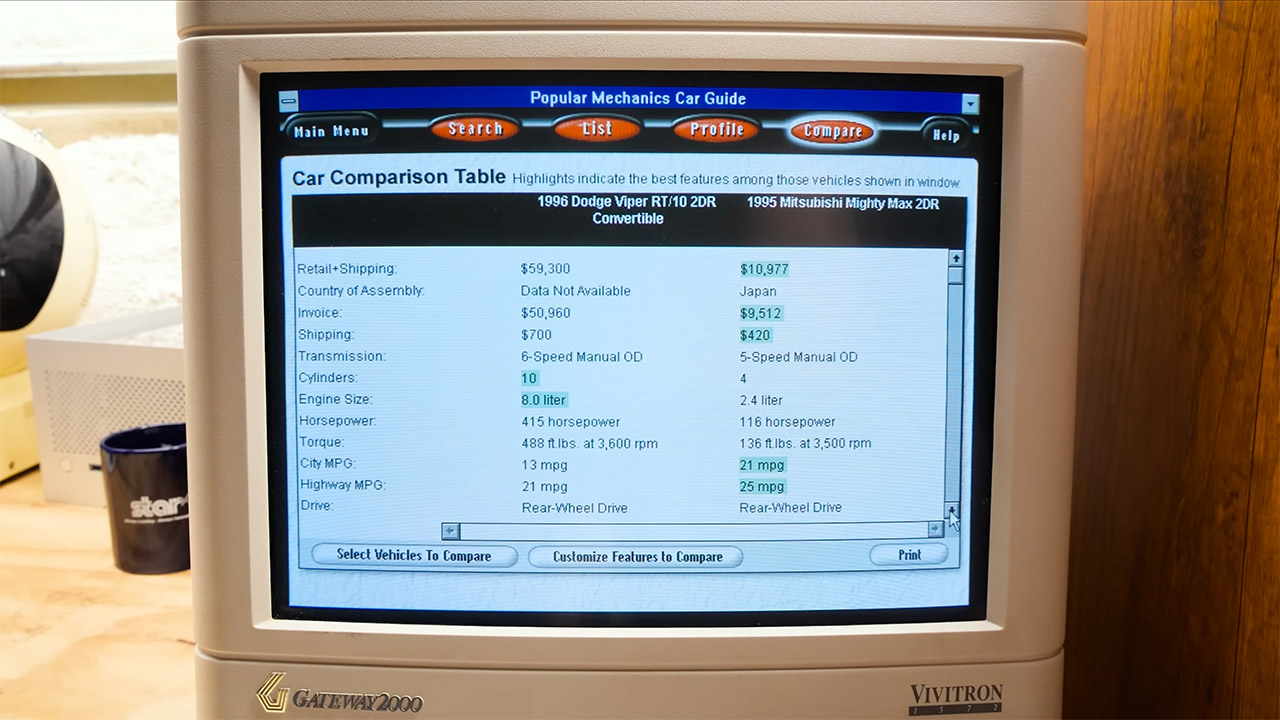
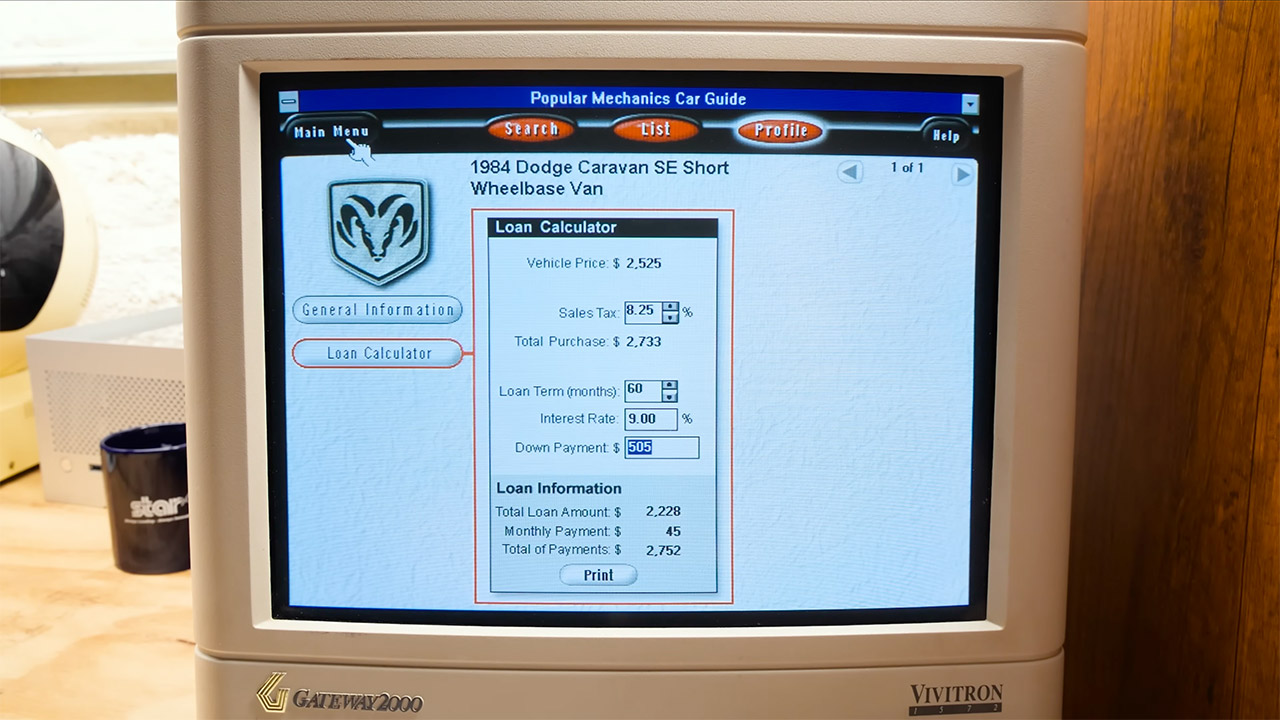
So, if you want to see how various cars compare to one another, utilize the comparison tools to place two models side by side. Putting a Dodge Viper next to a Mitsubishi Mighty Max emphasizes how different the two vehicles are, as it’s not only about the statistics, but also how the presentation works. Other features include calculators for determining how much a car will cost to buy or lease, as well as information on how to sell a car when you’re done with it. You may even locate phone directories with a variety of important information, such as where to obtain components or who to contact for an insurance quote.

1996 Popular Mechanics Car Guide CD-ROM
If you already have a working Windows 3.1 setup or are using an emulator to get that ancient system up and running again, you can download the disk image and test everything out for yourself. What you’ll see is far less smooth than what you’d get in a current app, but much more akin to what automobile purchasers had to deal with back when CD-ROM drives were the thing to have in your computer.

Advertisement

Source link

Continue Reading

Tech

Rinn Pharma & Biopharma to join NordicPharmaTrain network

Published

on

The partnership could significantly strengthen Ireland’s position within the European pharmaceutical research and innovation space.

Research Ireland’s Rinn Pharma & Biopharma, Ireland’s national centre for research and innovation in the manufacturing of medicines, has today (7 August) announced its inclusion in the NordicPharmaTrain (NPT) network. 

NPT is a European research and training network that connects academic and industry partners with the aim of advancing pharmaceutical innovation. The network supports collaborative research, researcher mobility and interdisciplinary training, as a means of developing the next generation of scientists and strengthening Europe’s pharmaceutical research ecosystem.

Rinn Pharma & Biopharma’s inclusion aims to enhance NPT’s network of research institutions and industry collaborators, strengthening cross-border collaboration and accelerating scientific progress within the larger pharmaceutical sector.

Advertisement

As part of the collaboration, Rinn Pharma & Biopharma will host visiting researchers and PhD students, providing them with access to state-of-the-art laboratories, infrastructure and training, with the aim of supporting skills development, as well as academic and industry engagement.

Commenting on the announcement, Prof Damien Thompson, the director of Rinn Pharma & Biopharma, said, “By joining NordicPharmaTrain, we are accelerating Ireland’s role in delivering innovative pharmaceutical solutions. 

“This partnership enables us to collaborate internationally on advanced manufacturing, formulation and digital technologies, areas that are critical to the competitiveness and sustainability of Ireland’s life sciences sector.”

Dr Sarah Hayes, Rinn Pharma & Biopharma’s COO, added, “This partnership is mutually beneficial, providing access to a dynamic collaborative ecosystem with expanded opportunities for joint research, shared expertise and participation in European funding initiatives.

Advertisement

“It also enhances visibility within the Nordic and wider European research community, and broadens access to talented researchers and PhD candidates.”

In late July, it was announced that Rinn Pharma & Biopharma and Cork-based biotech spin-out ArrayPatch would collaborate on developing a novel skin cancer treatment using a patented dissolvable microneedle platform. The project aims to improve the effectiveness of treatments and minimise side effects by using microneedles to deliver drugs with increased precision.

Don’t miss out on the knowledge you need to succeed. Sign up for the Daily Brief, Silicon Republic’s digest of need-to-know sci-tech news.

Advertisement

Source link

Continue Reading

Tech

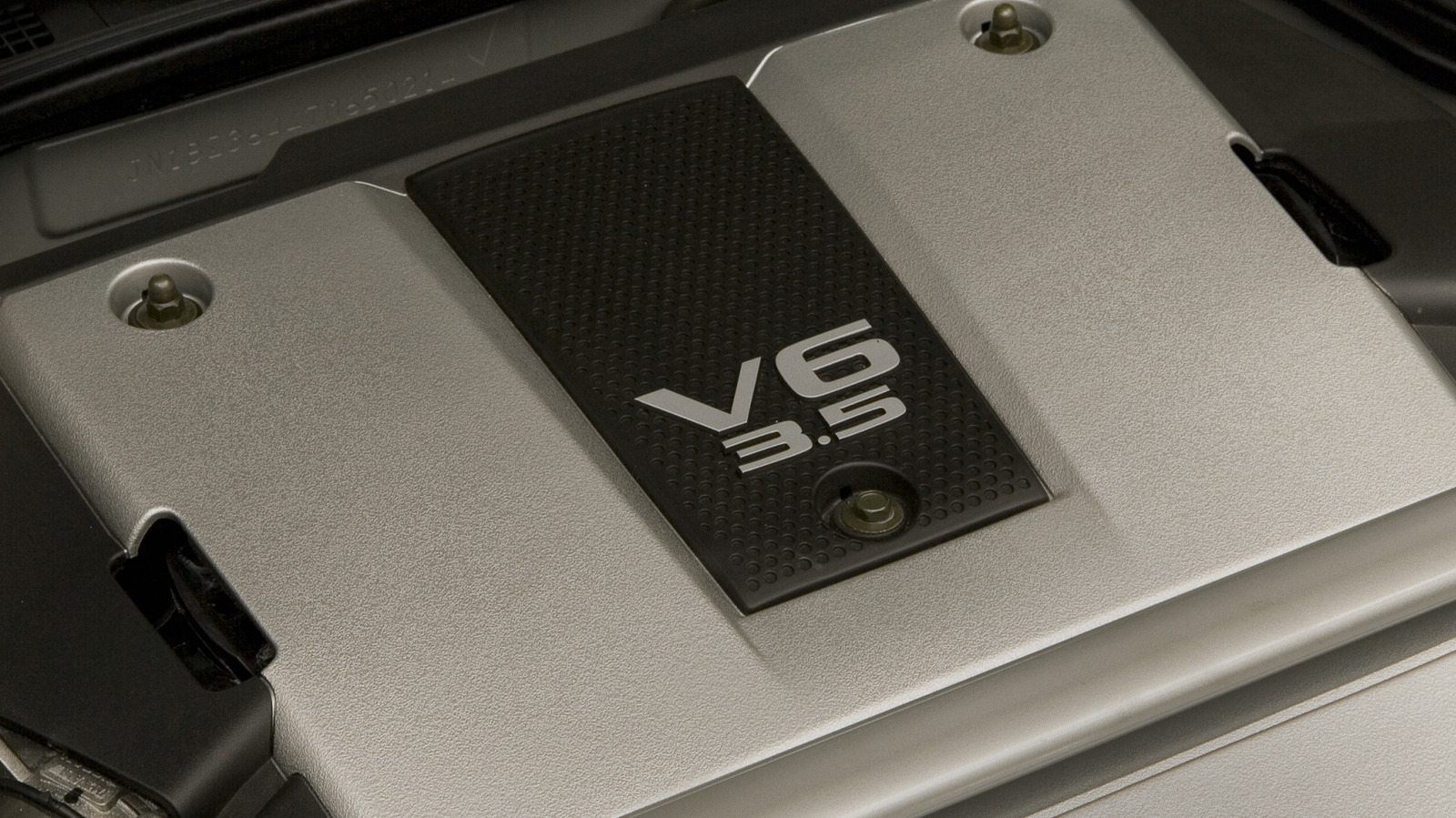
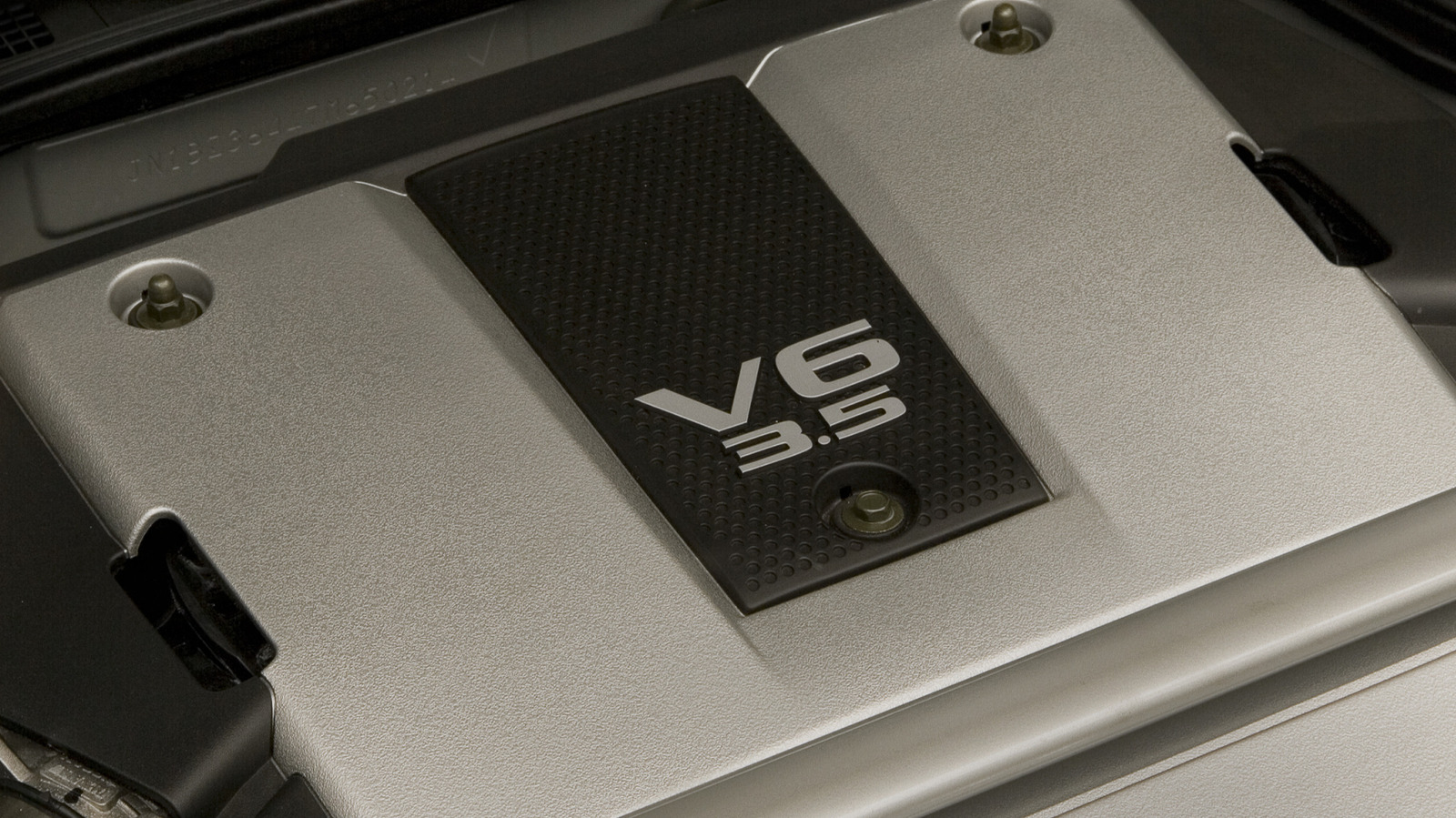
This Brand’s V6 Has Been On Wards’ Best Engines List The Most

Published

on


Is it possible that an engine can be both iconic and under-appreciated at the same time? That might somehow be the case with Nissan’s VQ-series V6 engine. On one hand, both the VQ engine and the cars it’s powered — like the Nissan 350Z and Infiniti G35 — are well known to both enthusiasts and the general public, and even the VQ’s distinctive sound has a bit of notoriety to it. 

What’s not talked about as much, though, are all the industry accolades that the VQ has received over its lifespan. Among these accomplishments, this Nissan engine has earned especially high marks from Wards Auto, which annually puts out its list of the 10 best engines (with electric propulsion systems recently being added to the rankings alongside internal combustion engines).

Advertisement

During the 20 years between 1995 and 2015, the VQ received a record 16 Wards Best Engine awards, with the run including 14 consecutive wins from 1995 to 2008. While the VQ’s award-winning reputation might be unexpected to some, those familiar with the background of this legendary V6 engine shouldn’t find it a surprise. Additionally, while the VQ isn’t nearly as prevalent today as it was back in the 2000s and 2010s, Nissan is still making VQ engines today, more than 30 years after the V6 made its original debut, which, is a feat in itself. 

Advertisement

From sports cars to pickup trucks

The Nissan VQ engine was originally born in the mid-1990s and made its American debut as a 3.0-liter unit under the hood of the 1995 Nissan Maxima and Infiniti I30 sedans. The new VQ made the 1995 Wards Best Engine list right off the bat, but it wasn’t until the early 2000s that the engine really began to propel the Nissan and Infiniti brands into a new generation. This was the era of high-profile new releases like the Nissan 350Z and Infiniti G35,  but the VQ also made its way under the hood of mainstream vehicles like the Altima sedan and Pathfinder SUV. Nissan would continuously update the VQ, eventually making versions as large as 4.0 liters –and the awards kept coming. 

How does a motor make the Wards Best Engine list? Engines are graded in categories like horsepower, torque, NVH, and technical innovation, with those numbers combined into an aggregate score to get the overall winners.  Although the Wards Best Engine designation doesn’t specifically select for long-term reliability or ease of maintenance, the VQ has generally backed up its strong out-of-the-box performance with above-average reliability. 

What’s especially impressive about the Nissan VQ engine, though, isn’t just its power potential or mechanical durability; it’s the truly vast range of vehicles that used it. Far from just a performance car engine, the VQ family has been used all across Nissan’s lineup, powering everything from the aforementioned Z sports car to family minivans and pickup trucks.

Advertisement

The Nissan V6 is alive and well

Starting in the 2010s, the V6 engine, particularly in its naturally aspirated form, has become increasingly rare in the modern auto industry, with many carmakers switching to smaller-displacement, turbocharged four-cylinder engines. Even so, the Nissan VQ has endured. 

In Nissan and Infiniti’s performance car applications, the VQ was phased out in favor of the turbocharged VR-series turbo V6 engines. However, the company still builds a direct-injected, naturally aspirated 3.8-liter VQ38DD engine for use in the Nissan Frontier pickup. This old-school engine is one of the things that makes the Frontier stand out in a segment where its competitors have moved to turbocharged four-cylinders.

Advertisement

Recently, however, there’s been one negative about the VQ engine that actually has nothing to do with the motor’s performance or reliability at all. With Nissan and Infiniti using this engine in so many rear-drive sports cars and sports sedans over the years, the inexpensive, used versions of those cars have gotten quite popular among a new generation of younger owners. Due to the anti-social actions of some of them, some car shows have had to ban VQ-powered cars in an effort to stop dangerous and disruptive behavior caused by some of these bad apples.


Advertisement

Source link

Continue Reading

Trending

Copyright © 2025