If you bought a digital game on the PlayStation Store between April 2019 and December 2023, you may soon receive some store credit in your account. A federal judge in San Francisco granted preliminary approval of a proposed $7.85 million settlement for a class action lawsuit that accused Sony of eliminating competition and monopolizing the market for its digital games through the PlayStation Store.
The lawsuit was first filed in May 2021 and claims that Sony’s alleged anticompetitive conduct caused gamers to “pay more than they otherwise would have paid for certain digital games.” The legal action comes after Sony eliminated “game-specific vouchers” sold by third-party companies in April 2019, which the lawsuit argued could have resulted in lower prices on the PlayStation Store if customers had alternative options through other retailers like Best Buy, GameStop and others.
The law firm representing affected users posted a list of eligible games, which includes The Last of Us, NBA 2K18 and Need for Speed Rivals, and said there are more than 4.4 million eligible PlayStation Network accounts. For anyone who qualifies as part of the class action settlement, you’ll see your PSN account credited once the final approvals are in. The court will have a Fairness Hearing on October 15, which will see the final judgement and the plan for allocating the millions of dollars to eligible accounts.
Advertisement
Notably, this lawsuit is separate from another similar legal action that was filed in the UK. Also a class action lawsuit, the case accuses Sony of “unfairly charging its UK customers too much for digital games and in-game content purchased through the PlayStation Store.” Unlike this recent settlement, Sony could pay up to $2.7 billion to UK residents as a result of alleged antitrust actions.
Apple has set its sights on India’s antitrust watchdog, questioning the legality of a request for its financial data as part of an ongoing battle over its App Store policies.
India’s competition body wants the information so it can calculate what penalty Apple should face. This comes after a 2024 investigation found that Apple had abused its dominant position in the market.
Reutersreports that Apple could be on the hook for a whopping $38 billion penalty. However, in court documents seen by the news outlet, Apple has pushed back on India’s request for financial data. The company doesn’t believe that the antitrust body has exceeded its powers as part of its request for financial data.
Apple had previously been given until May 21, 2026, to submit the data required to calculate the penalty. Now, it’s gone on the offensive and chosen to challenge India’s entire antitrust penalty system via a New Delhi court.
Advertisement
The court will convene on May 15 to discuss the matter.
A recurring theme for Apple
India remains a key market for Apple, with iPhones making up almost 10% of the smartphone market. That’s double the 4% figure from just two years ago, the report notes.
For its part, Apple argues that it is still small fry compared to Google’s Android. Android makes up the vast majority of the Indian smartphone market.
India is far from the first country to consider Apple in breach of local antitrust laws. The company has been embroiled in a legal battle with the European Union for years.
Advertisement
Antitrust bodies around the globe believe that Apple is abusing its market position by preventing third-party iPhone app stores. The EU successfully forced Apple to allow such stores in the bloc, and others are working to follow suit.
Educational tech giant Instructure has confirmed that data was stolen in a cyberattack, with the ShinyHunters extortion gang claiming responsibility.
Instructure is a U.S.-based education technology company best known for developing Canvas, a widely used learning management system that helps schools, universities, and organizations manage coursework, assignments, and online learning.
On Friday, Instructure disclosed that it suffered a cybersecurity incident and is working with third-party cybersecurity experts and law enforcement to investigate it.
On Saturday, the company issued an update stating that the personal information of users was exposed in the breach.
Advertisement
“While we continue actively investigating, thus far, indications are that the information involved consists of certain identifying information of users at affected institutions, such as names, email addresses, and student ID numbers, as well as messages among users,” reads the updated statement.
“At this time, we have found no evidence that passwords, dates of birth, government identifiers, or financial information were involved. If that changes, we will notify any impacted institutions.”
As part of the response, Instructure has deployed patches, increased monitoring, and rotated application keys as a precautionary step.
Customers are required to re-authorize access to Instructure’s API for new application keys to be issued.
Advertisement
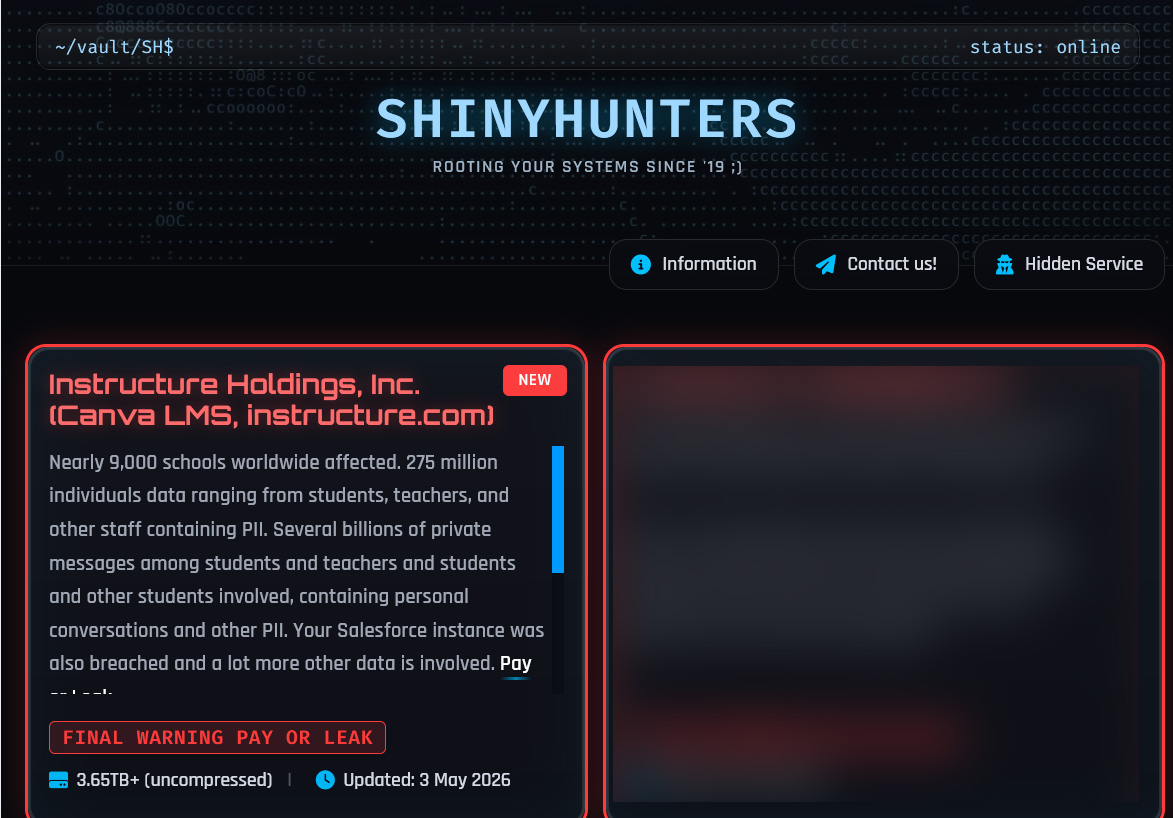
While Instructure has not responded to BleepingComputer’s questions about when the breach occurred and whether they were being extorted, the ShinyHunters extortion gang has now listed the company on its data leak site.
“Nearly 9,000 schools worldwide affected. 275 million individuals data ranging from students, teachers, and other staff containing PII,” reads the data leak site.
“Several billions of private messages among students and teachers and students and other students involved, containing personal conversations and other PII. Your Salesforce instance was also breached and a lot more other data is involved.”
Instructure listed on ShinyHunters data extortion site
ShinyHunters claimed that the data was stolen from Instructure via a vulnerability in their systems, which has now been patched.
This data allegedly consists of over 240 million records tied to students, teachers, and staff. The threat actor says the data contains students’ names, email addresses, enrolled courses, and private messages to teachers.
Advertisement
Data shared by the threat actor indicates that the alleged dataset spans almost 15,000 institutions hosted across multiple geographic regions, including North America, Europe, and Asia-Pacific.
BleepingComputer has not been able to independently confirm which schools or how many individuals were impacted and has contacted Instructure with additional questions about the threat actor’s claims.
AI chained four zero-days into one exploit that bypassed both renderer and OS sandboxes. A wave of new exploits is coming.
At the Autonomous Validation Summit (May 12 & 14), see how autonomous, context-rich validation finds what’s exploitable, proves controls hold, and closes the remediation loop.
There is a $100 price difference between the Artisan Plus and Artisan models. However, the Artisan Plus’s features are small but mighty, and make the cost difference seem like a bargain, especially in higher-stakes recipe scenarios. This upgraded model has a more powerful 350-watt motor compared to the Artisan series model’s 325 watts. With the Artisan Plus’s increased intensity also comes the new precision speed control. Twist the knob of the Artisan Plus and you engage half-speed settings, so you can move between two and 2.5, all the way up to 11. Previous generations capped out at 10 speeds.
The Artisan Plus’s “Soft Start” feature gently transitions between speeds. Coupled with the LED light situated above the mixing bowl, it makes managing the most delicate of recipes exact. While I compared the Artisan Plus and Artisan series models, I found that the addition of the bowl light and precision mixing speeds alone made it worth the slightly higher price point. I’d often stop mixing to visually check progress with my Artisan series stand mixer, while the Artisan Plus could chug right along without breaking its stride thanks to its light.
Mix-and-Match
Taking a glance at the KitchenAid attachments of yesteryear, it’s evident that the Artisan Plus is an upgrade. Its whire whip, dough hook, flat beater, and new double-edge beater attachment are all stainless steel, sleek, and heavy. Apart from what I had on hand for the ’64 mixer (most attachments were lost to time), the older mixers had a combination of aluminum and powder-coated attachments to work with. All attachments, regardless of mixer generation, are designed to be top-rack dishwasher-safe; that’s still the case with the Artisan Plus’s extras, too.
Advertisement
1964 KitchenAid
Photograph: Julia Forbes
1990 KitchenAid
Photograph: Julia Forbes
2017 KitchenAid
Photograph: Julia Forbes
I set up each mixer side by side and had them all make the same recipe at the same time. While my pseudo test kitchen was chaotic, it was insightful to see the generational differences in action and even the slight design changes over time. The Artisan Plus’s footprint did not take up any more space compared to previous generations. It also doesn’t look fundamentally different from the KitchenAid Artisan stand mixer, or even the 1990s model.
Razer is back with a new Blade 16 refresh. The company has introduced new high-end configurations, and they push the laptop firmly into “no compromises” territory.
What’s actually new with the Razer Blade 16 (2026)?
The Blade 16 (2026) was already announced earlier, but Razer has now rolled out new SKUs featuring 64GB of LPDDR5X memory, paired with its top-tier GPUs. These new configurations sit above the previously announced 32GB variants and are clearly aimed at users who need more than just gaming performance.
Razer
The updated lineup now includes options with RTX 5080 and RTX 5090 Laptop GPUs alongside 64GB RAM, making this one of the most loaded portable systems available right now. The pricing reflects that jump. The RTX 5080 model with 64GB RAM is priced at $4,699, while the fully maxed-out RTX 5090 version goes up to $5,599. Both are available globally through Razer’s official store and select retail locations.
Is the Blade 16 now a gaming laptop or a workstation?
Razer is clearly positioning the Blade 16 as a hybrid performance machine, one that can handle heavy multitasking, content creation, and even AI workloads alongside gaming. With modern workflows becoming more demanding, especially in areas like video editing, 3D work, and AI-assisted tools, higher memory configurations are starting to make more sense. It also aligns with the rest of the hardware.
Razer
With Intel’s Panther Lake CPU and RTX 50-series GPUs already pushing serious performance, adding more memory ensures the system does not become bottlenecked in more demanding scenarios. At the same time, Razer has not changed its core formula. You still get the same sleek chassis, high-refresh OLED display, and premium build that define the Blade lineup. The difference is that now, the internal specs are catching up to that premium positioning more than ever.
Razer is not just chasing gamers anymore. It is chasing power users who want one device that can do everything. And with these new configurations, the Blade 16 is getting very close to that goal.
In this week’s “Sunday Reboot,” Apple drives on with F1 in Miami, Q2 was a financial spectacular, and ‘Ted Lasso’ season 4 can’t arrive fast enough.
Formula 1, Apple’s financials, and Apple TV
Sunday Reboot is a weekly column covering some of the lighter stories within the Apple reality distortion field from the past seven days. All to get the next week underway with a good first step. This week, there were rumors the Apple Vision Pro hardware team was breaking up, Adobe’s Firefly AI Assistant showed just why it was still in beta, the Towson Apple Store employee union complained about the store closure, and Apple has to face the Circuit Court and the Supreme Court at the same time over its ongoing saga with Epic Games. Continue Reading on AppleInsider | Discuss on our Forums
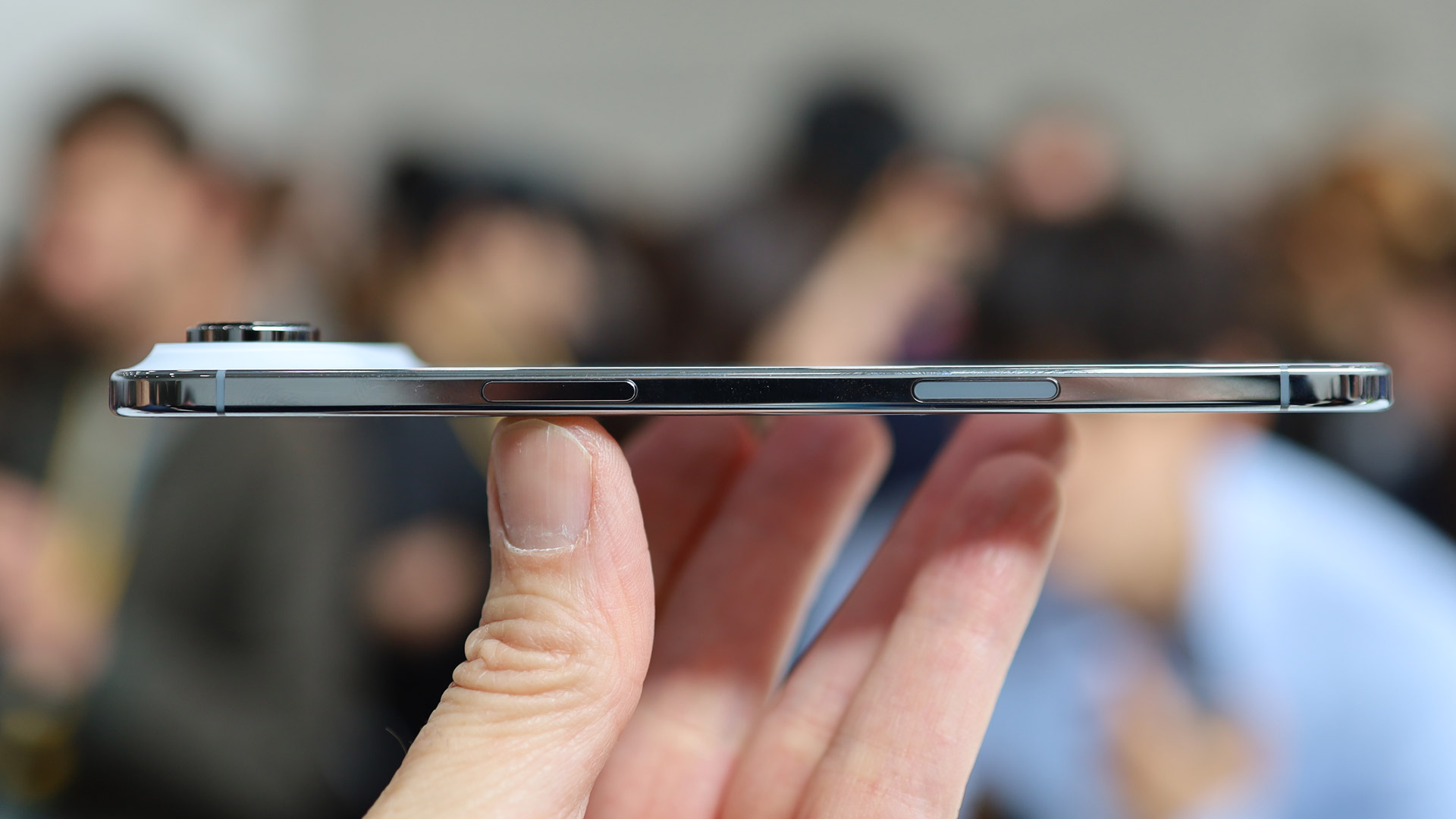
Starting with his thoughts on the latest Apple phones, Wozniak mentioned also loving his iPhone 17 Pro Max — though he calls the orange color model the Trump phone, given it shares the US president’s complexion — but for him, as he waved the iPhone Air he pulled from his jacket pocket to the crowd, the improbably slim device wins out.
Because “it invokes an emotion” with its unique aesthetics that feel infused with human passion.
Article continues below
Advertisement
(Image credit: Lance Ulanoff / Future)
For Wozniak, this human element is what matters most: “Human beings are more important than the technology.”
And the only way for a company to focus on this human element over all else, in Wozniak’s mind, is if engineers — the people who possess the know-how and passion to conjure designs that people want to use, and to love — are leading the charge at the highest levels.
Advertisement
While he didn’t directly mention Apple’s current situation beyond the iPhone Air endorsement, I couldn’t help but feel his constant references to the importance of engineers in leadership positions was an endorsement of the incoming Apple CEO, John Ternus.
An instrumental figure in Apple’s hardware for the past couple of decades, even heading up its hardware engineering division, Ternus could bring the engineer’s ability to “lead design with their hearts” that Wozniak lauded.
Sign up for breaking news, reviews, opinion, top tech deals, and more.
(Image credit: Dreame)
Advertisement
“It doesn’t have a heart”
As you might expect, the Apple co-founder was therefore less than ecstatic about AI, calling his relationship with the tech “a complicated one.”
“Every time computer technology increases it allows the human user to do more than they did before,” he discussed, “It can give me some good ideas, but I do not like the mistakes it makes because it’s too easy to believe the fake stuff.”
AI talks with such confidence that its errors are sometimes easy to ignore, and it also lacks the human flair that only a real emotional person can deliver — “AI can do valuable things, but it doesn’t have a heart.”
(Image credit: Dreame)
Wozniak admitted that AGI — artificial general intelligence that’s as smart as a human — could theoretically have that heart and emotion, but as he put it: “I don’t believe we’ll hit AGI.”
He explained that when he went back to college to finally get a degree after dropping out a decade earlier we majored in psychology. He worked with people attempting to model the human brain and saw how they struggled to understand even small sections of it. “Engineers worked out the only way to build a human brain takes nine months” — a line the hosts didn’t immediately clock was a gag.
In case he’s wrong about AGI, and the technology overthrows us as the dominant force on the planet and takes us on as pets, Wozniak also jokingly said he’s started to feed his dogs fillet steaks — “That’s how I’d want to be treated,” he said.
Advertisement
The death of PCs? Not likely
(Image credit: Apple)
Looking ahead to what is next, if it isn’t AGI, Steve Wozniak admitted that it’s impossible to be certain, but he expects the next decade to hold more of the same — but better.
That means better phones, better computers, better tech, but not one product cannibalizing another — pushing back on the Dreame Next host’s ponderings that smartphones will finally replace PCs, saying, “I don’t really believe that.”
“Look at cars, once we hit a good plateau it can kinda stay the same for a very long time,” he said. Wozniak added that phones and PCs have plateaued in their respective niches, and he doesn’t expect one to start cannibalizing the other, especially because phones get better, so do PCs at an equal rate.
That doesn’t mean we should get complacent, though. “You’ve got to believe you can improve the technology of the day,” that’s how Apple got started and keeps growing, “Look at what you have got today. How can you make it better? Improve it, improve it, keep taking steps towards the eventual great future.”
Music aficionados are always looking for dependable over-ear headphones, and when comparing options from various brands and pricing points, the Beats Studio Pro, priced at $169.95 (was $350), stands out as an economical option. The reason for this model’s exceptional performance is a whole new set of drivers that do an excellent job with audio, precision, and so on. You can feel right immediately that the distortion levels are significantly lower than the previous generation due to improved internal components and larger magnets, which ensures that the sound remains pure regardless of volume.
The battery life allows for 40 hours of continuous play without using the noise reduction feature. When you turn it on, you get 24 hours, which is more than enough time to cover a full day. A 10-minute charge provides four hours of playback, which is quite useful when you go to bed and forget to charge your headphones all night.
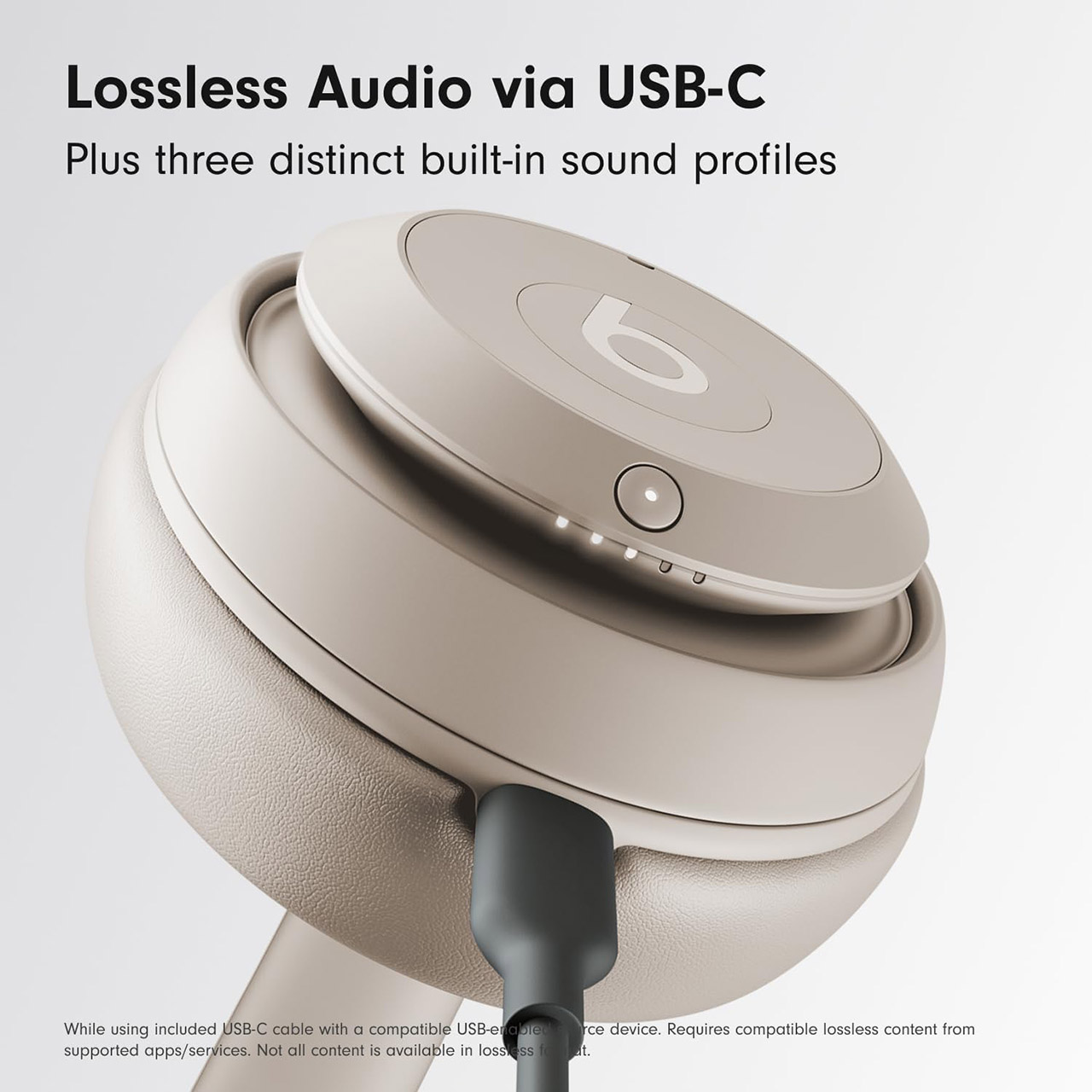
Pairing these headphones with your phone is simple, whether you have an iPhone or an Android, and the controls are identical to those on your device. Spatial audio allows you to enjoy supported sounds while feeling a sense of space around them, and you may even employ natural head movements to enhance the experience. If you’re using a computer or phone, you can connect them via USB-C to get lossless audio playing without any of the compression that comes with wireless, allowing you to hear the music with the clarity it was intended to have.
Noise reduction is always adapting to the environment you’re in, whether it’s a noisy train or a talkative office. There is also a transparency mode, which allows you to hear exterior sounds as needed. You can move from entirely blocking out distractions to hearing your surroundings with no effort, which is ideal if you’re on a noisy airline or running on the treadmill.
Value appears clearly when daily use reveals how these features combine into one practical package. Extended playtime, clean sound, and flexible connectivity add up to headphones that handle real routines without constant recharging or awkward trade-offs. For anyone who logs hours with audio on the go, the Studio Pro models turn routine listening into something that simply keeps working session after session.
LongchampLarge Le Pliage Tote for $180: This bestseller is the equivalent of a classic white tee: timeless, versatile, and built to be passed down for generations. Inspired by origami, Le Pliage folds down small when you need to pack it, but it’s also roomy enough to double as your personal item. I can fit all the essentials in here—laptop, Kindle, my airport toiletries, snacks, and then some. With its minimalist design and zipper closure for valuables, it’s also the ideal work bag for business trips. My one gripe with this travel tote bag is the lack of internal compartments (besides two impractical flat pockets), but if you’re someone who has little pouches and tech organizers for your gear, you might not miss it.
Cincha the Vegan Leather Go-Tote for $130: This vegan leather bag is deceptively huge. The base is 7.5 inches deep, so while it doesn’t look that big in pictures, it holds an astonishing amount of stuff. I’ve packed enough clothes in it for a full weekend trip. I usually have concerns about vegan leather cracking and breaking with use, but Cincha’s soft pebbled fabric does not look or feel obviously plastic. This is the tote bag I took on a multi-week trip to the Philippines, and the leather stood up to rain and being kicked around airport lounges, ferries, and train depots. However, it is more than 2 pounds heavier than a Longchamp Le Pliage, so this is strictly for when you can sling it on top of your carry-on. —Adrienne So
Advertisement
Mission Workshop Drift Laptop Tote for $345: The Drift is my favorite travel tote. It’s burly but with styling that’s refined and classy, and the rolled handles and removable strap make it comfortable to carry by hand or over the shoulder. But the best thing about it is the smartly organized storage pockets inside and out. It feels designed especially for people like me who always carry an army of gadgets. The Drift is kind of a beast, though. It’s too huge to slide under the seat in front of you on an airplane, but it fits into the overhead baggage compartment. —Michael Calore
Vera Bradley Original Duffel for $105: If there were ever a product I would refer to as “ol’ reliable,” it’s undoubtedly the Vera Bradley bag. The bright pattern, durable materials, and washable cotton structure have held up remarkably well for over a decade’s worth of travels. Even when I’ve completely overpacked and lugged it with me on planes, trains, and car travels, I don’t detect strain on the handle stitching. There are no internal pockets, but you do have four exterior ones located around the sides of the bag for easy access (or last-minute additions to your planned outfits). —Julia Forbes
Advertisement
BaubleBar Large Custom Icon Tote for $98: What sets BaubleBar apart is its playful personalization. Your chosen icons (up to six, depending on the size) are embroidered directly onto the canvas tote. The process is super user-friendly, with predesignated spots to help you visualize your picks. Choose from zodiac signs, cutesy foods, initials, and more. Just note that it’s a final sale, so be sure of your design before ordering. The large size fits everything you need for a beach day trip, and the medium and small options are better for light shopping or city exploring. It closes with just a snap button, which isn’t the most secure for crowded areas.
Aer Simple Tote for $139: Have you ever hefted a nylon or leather tote in your hand and realized that slinging it over your shoulder would give you immediate scoliosis? Then you want Aer’s ultra-lightweight, simple sailcloth tote, which weighs less than a pound. Its 15 liters felt surprisingly capacious. I fit two jackets inside on a walk with my kids, and the 3-inch-wide bag tucked neatly under my arm. The two exterior drop pockets fit my Nalgene and Kinto mug, and my phone fits neatly in the exterior zipper pocket. This is a great upgrade if you are getting tired of carrying everything in your canvas tote from Umami Mart and want a bag that’s not going to get soaked in something questionable if you put it down in the wrong place on the subway. It is a little more expensive, though. —Adrienne So
Advertisement
Cuyana System Tote 16-Inch for $378: The Cuyana System Tote is a modular gear-hauler that shape-shifts with your itinerary. Designed to outlast the churn of fast fashion, this travel tote starts minimal, but the genius lies in its add-ons. A laptop sleeve or insert organizer creates a structure on the go, with dedicated slots for your computer, water bottle, and other work essentials. A System Flap Bag insert doubles as a clutch or in-bag organizer, and a detachable, adjustable crossbody strap (also available in a wide model) converts the tote, perfect for hands-free airport sprints if you’re unintentionally trying out airport theory. Instead of stitched-on straps prone to failure, the System Tote’s handles are cut directly from its leather body, minimizing points of wear. The main compartment snaps shut rather than zips, something to know if you’re the spill-averse type.
Avoid This Tote
Calpak Diaper Tote Bag with Laptop Sleeve for $195: This bag was really puffy, but felt bulky, and space was lost to give the puffiness to the bag’s layers. It was somehow too big for everyday use, but not big enough when I needed a lot of stuff brought along for a day trip or long outings. It also didn’t really feel that diaper bag-centric; the only thing “diaper” about it was the baby wipe compartment on the outside, but I would have preferred an exterior pocket to store actual diapers along with it. You could stuff a couple of diapers in the flat front pocket, but it’s not as ideal as other designs I’ve tried. The insulated bottle pockets are handy if you travel with bottles, but feel useless after your baby graduates from bottles (which they graduate much earlier than diapers!) It’s not a bad bag, but I’d recommend a different design for parents and travelers alike. —Nena Farrell
To determine the best travel tote, I put each bag through real-world travel scenarios to see how it performs. That means packing it with laptops, chargers, clothes, and toiletries, testing comfort when worn over the shoulder or carried by hand. I’ll overstuff the totes to check durability, organization, and accessibility. I’ll evaluate how it fits under airplane seats, protects tech gear, and resists wear and weather. If it’s supposedly water-resistant, I’ll take it out in the rain to determine whether it survives without soaking its contents.
Advertisement
I scrutinize every pocket, compartment, and zipper for usability. When it comes to design, I pay attention to the details: interior fabric choices that make contents easy to see, convenient pocket placement, and hardware choices like zippers and zipper pulls. I also like to take note of the key design elements, such as the handle length and overall structure.
I prioritize quality and sustainability, and I include eco-friendly brands for environmentally conscious consumers. I also made sure to include an array of fabrics for stylistic variability. Lastly, I consider how each bag stacked up against its price point, ensuring that the quality justified the cost.
Marshals, a new Yellowstone spinoff starring Luke Grimes as Kayce Dutton, is airing on CBS right now. You can also tune in with Paramount Plus. The Yellowstone sequel series sees Grimes’ former Navy SEAL join an elite unit of US Marshals to bring range justice to Montana, according to a synopsis from CBS.
The show includes Yellowstone actors Gil Birmingham as Thomas Rainwater, Mo Brings Plenty as Mo and Brecken Merrill as Tate. Spencer Hudnut is the showrunner of Marshals — formerly known as Y: Marshals — and Taylor Sheridan is an executive producer.
Advertisement
When to watch new Marshals episodes on Paramount Plus
Episode 10 of Marshals airs on CBS on Sunday, May 3. Viewing options for Paramount Plus customers vary by subscription tier. You can watch the episode live if you have Paramount Plus Premium, which includes your local CBS station. If you subscribe to Paramount Plus Essential, you can watch the installment on demand the following Monday, but not live on Sunday.
Here’s a release schedule for the next four episodes of Marshals.
Episode 10, Playing with Fire: Premieres on CBS/Paramount Plus Premium on May 3 at 8 p.m. ET/8 p.m. PT/7 p.m. CT. Streams on Paramount Plus Essential on May 4.
Episode 11, On Thin Ice: Premieres on CBS/Paramount Plus Premium on May 10 at 8 p.m. ET/8 p.m. PT/7 p.m. CT. Streams on Paramount Plus Essential on May 11.
Episode 12, The Devil at Home: Premieres on CBS/Paramount Plus Premium on May 17 at 8 p.m. ET/8 p.m. PT/7 p.m. CT. Streams on Paramount Plus Essential on May 18.
Episode 13, Wolves at the Door: Premieres on CBS/Paramount Plus Premium on May 24 at 8 p.m. ET/8 p.m. PT/7 p.m. CT. Streams on Paramount Plus Essential on May 25.
You can also watch CBS and the tenth episode of Marshals without cable with a live TV streaming service such as YouTube TV, Hulu Plus Live TV or the DirecTV MyNews skinny bundle. In addition to offering a lower-cost option, Paramount Plus lets you watch the other two Yellowstone spinoffs: the prequels 1883 and 1923.
After a price increase in early 2026, the ad-supported Essential version runs $9 per month or $90 per year. The ad-free Premium version runs $14 per month or $140 per year. Paying more for Premium gives you downloads, the ability to watch more Showtime programming than Essential and access to your live, local CBS station.
If you’re into vibe coding, OpenAI just made it a lot more adorable. The company has rolled out Codex Pets, a brand-new feature for its Codex desktop app that adds animated companions to your screen while you work. Codex is OpenAI’s agentic coding tool that handles tasks on your behalf. It runs in the background and gets things done, and now it has a tiny mascot to go with it.
So, what exactly is a Codex Pet?
A Codex Pet is an optional animated companion that floats as an overlay on top of your screen, even when the Codex app itself is minimized. It shows you what Codex is currently working on through small message bubbles and alerts you when a task wraps up or when it needs your input.
If your pet pops up mid-task, you can click on it to send a reply directly to the agent. It is a passive status indicator that doubles as a lightweight two-way channel. Eight built-in pets are available right out of the box, all designed in a cute pixel-art style.
How to get a Codex Pet?
ScreenshotOpenAI
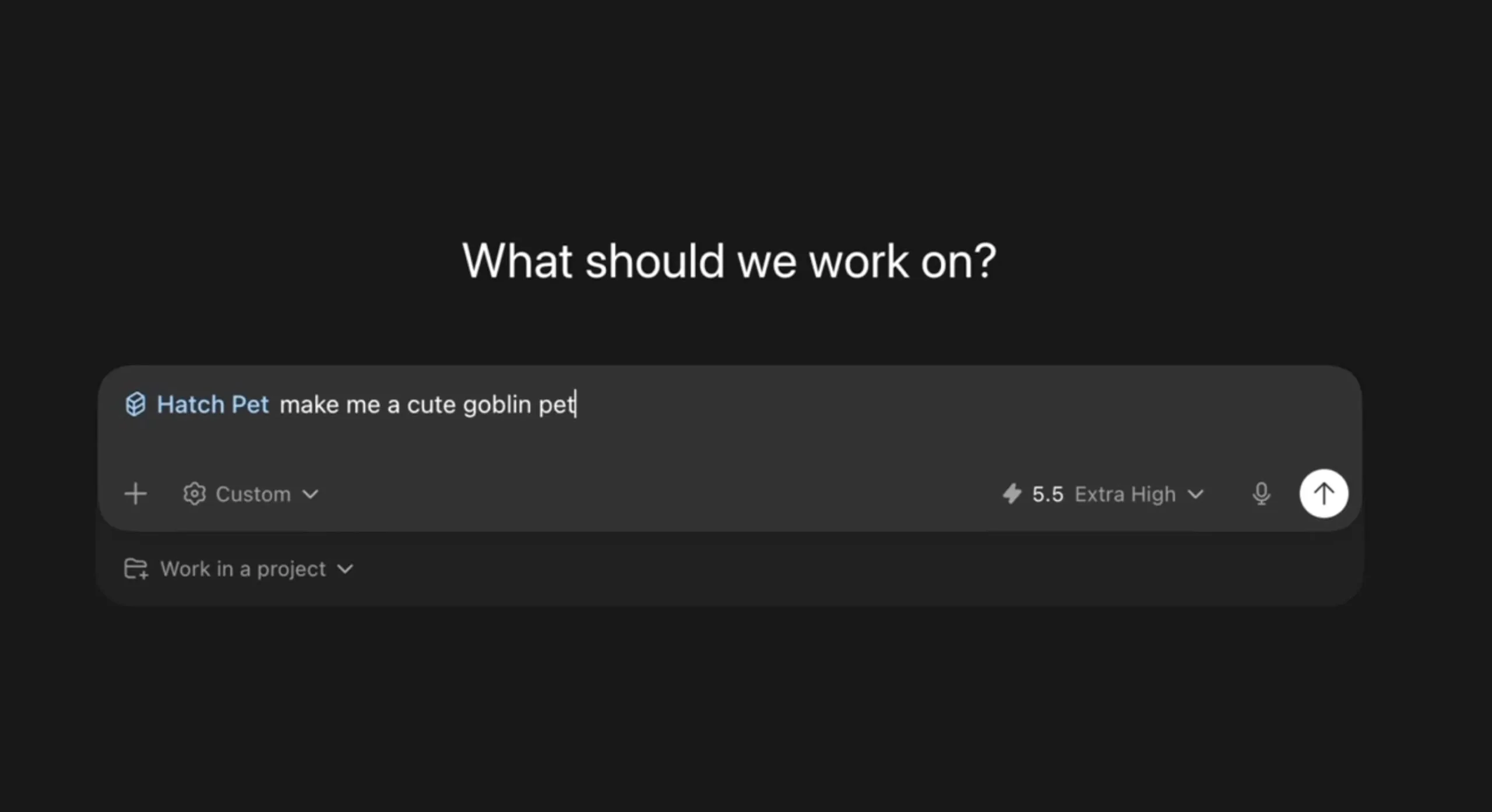
Getting a Codex Pet is simple. Just open the Codex app and type “/pet” to summon or dismiss your companion. If you want something more personal, use the “/hatch” command. Hatch is a bundled tool that takes any image you upload and turns it into a fully animated pet, saved locally in your Codex home folder so you can share it with others.
The community has already taken to it, and fan-made sharing sites have appeared online within hours of the launch. OpenAI is even running a limited-time contest where 10 of their favorite custom pets win their creators 30 days of ChatGPT Pro.
Advertisement
Beyond the pets, the same update also introduced config auto-import, which allows Codex to detect and pull in settings from other coding agents, such as Claude Code. There is also a new dictation dictionary in Settings, where you can save abbreviations and phrases so voice input stops getting them wrong.































































You must be logged in to post a comment Login