


As I am typing this, a device rests on my wrist that purports to unlock a trove of real-time information about my body’s performance. I can click a button and check my heart rate and review how much it’s varied over the course of the day. It can tell me how many steps I’ve taken, how many minutes I’ve been “active” throughout the day, and — if I wore it while I slept — just how well I rested, according to the data its sensors can pick up from my arm.
Tech
Sony’s RX10 V Superzoom Finally Arrives With A New Design And 4K 120p Video


Sony has finally unveiled the RX10 V, a superzoom compact camera that comes with a 24-600mm optical zoom lens and 20.1-megapixel 1-inch sensor. The design has been overhauled compared to the nine-year-old RX10 IV for a more modern look and adds faster speeds, an updated autofocus system and far better video specs. The catch is the $2,300 price, which makes this one of the most expensive compact cameras on the market.
As before, the RX10 V offers tourists, street shooters and others incredible reach thanks to the 9.1-210mm (24-600mm equivalent) f2.4-4.0 lens. The 20.1MP 1-inch stacked sensor appears unchanged and should deliver good-quality images, even in low light, with minimal rolling shutter distortion. It’s disappointing that Sony didn’t upgrade the resolution, though, especially considering the camera’s price. The new model also lacks the RX10 IV’s built-in flash.
The new model does have a new processor that improved burst speeds, though. It can now shoot at 30 fps with no blackout in electronic shutter mode, a nice upgrade over the previous model’s 24 fps shooting speeds. Sony also carried over a feature from its latest mirrorless cameras called “continuous shooting speed boost” that lets you instantly jump to the maximum burst speed to capture decisive moments.
 Sony
Sony
Autofocus also got a big AI makeover to match the new A7 V. Rather than just humans and animals as before, it can detect the face, eye, head and body of humans, birds and animals, along with vehicles (cars, trains and airplanes) and insects (head and whole body). Thanks to a separate deep AI processor, it will keep tracking subjects even if they turn away, look down or move in an erratic fashion. AF and AE speed has also doubled to 60 fps for continuous tracking, and it now offers 575 AF points compared to 315 before, along with 70 percent sensor coverage.
Video gets perhaps the biggest upgrade, with 4K 60 fps 10-bit video (All-Intra, XAVC S, and XAVC HS formats) that uses the entire sensor width with no pixel binning for extra sharpness. That can be boosted to 4K 120 fps for super slow mo, at the cost of a slight crop, or 1080p at 240 fps. It also supports Sony’s S-Log3 for improved dynamic range and lets you import up to 16 LUTs to preview different “looks” ahead of time. Sony also improved the built-in stabilization so that it smooths video even when you’re walking with it.
The design was completely revamped compared RX10 IV’s bulbous, stodgy look. It’s now sleeker and more squared off to match the A7 V’s aesthetic and has a much larger grip. It comes with a full complement of manual controls including a joystick, three control dials, a control wheel and a new dual top dial (with a photo, video and S&Q selector), plus an AF-ON button for pro autofocus control.
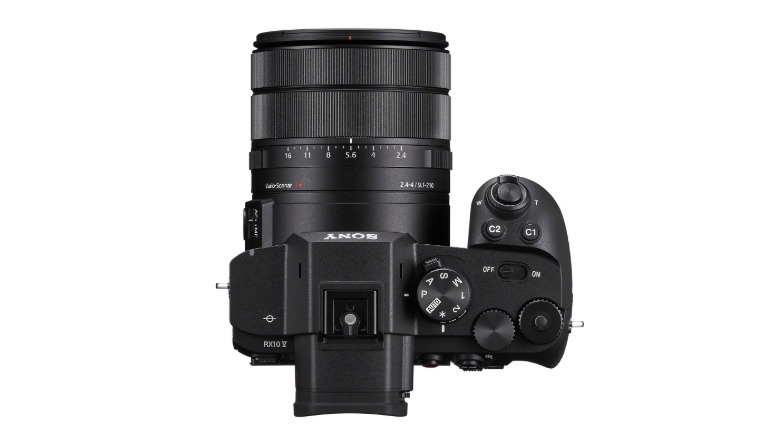 Sony
Sony
Both the electronic viewfinder (EVF) and rear display get resolution upgrades to 3.69 million dots (up from 2.4 million dots) and 1.62 million dots respectively. However, the rear display only tilts and doesn’t flip out, so it’s not great for vlogging or selfies. Again, that’s a rather inexcusable omission considering the camera’s price.
Other features include a single UHS-II SD card slot, full-sized NP-FZ100 battery that delivers up to 630 shots on a charge, a micro HDMI port 3.5mm mic and headphone ports and a new high-speed USB-C port for charging and transfers. The RX10 V now supports live streaming at up to 4K 30 fps as well.
Now for the bad news if you’re interested in this new model. The RX10 V just went on pre-order for $2,300, a relative fortune for a 1-inch compact camera. If that price is in your wheelhouse, though, it does offer incredible zoom reach, shooting speeds and video capabilities.
Continue Reading


ai and ml
One in four long-form social media posts appear entirely AI-generated, with nearly half of those on Microsoft’s and Elon’s platforms involving AI in some form
No surprise here. A study from AI detection platform Pangram suggests that social media posts are teeming with AI-generated slop, particularly if the posts are long and especially if they live on LinkedIn or X. If you’re sick of reading non-human prose, we’d recommend getting off the platforms altogether.
Along with offering your typical AI-content detection services, Pangram released a Chrome extension at the end of April that, with a $20/month subscription, will automatically scan a user’s LinkedIn, Medium, Substack, X, and Reddit feeds to check for AI-generated or assisted content. With more than one million posts analyzed from users who opted in to share data through the extension since its launch, Pangram has concluded that, while AI slop is flooding social media, it’s hitting longform content particularly hard.
With longform content defined in its study as any post over 250 words, Pangram found that a full 25 percent of such posts across all the platforms it studies were fully AI-generated. Fully, mind you, meaning that doesn’t include posts in which users got the assistance of an LLM to gussy up their bland prose. That average across platforms was hardly evenly distributed, though.
Leading the way was LinkedIn, where 41 percent of longform content was fingered by Pangram as being AI-generated. That’s likely unsurprising to anyone who’s ever bothered to read a lengthy professional diatribe from the Microsoft-owned slop shop, or for El Reg readers – a prior story we reported on in late 2024 from AI detection outfit Originality.ai found that 54 percent of LinkedIn longforms were AI-generated. Originality’s definition of Longform was a bit looser, however, with anything over 100 words counting in its analysis.
Per Pangram, shortform content on LinkedIn isn’t much more likely to be human authored – they found 30 percent of posts between 50 and 250 words were fully written by AI.
For LinkedIn thought slop leaders, it’s generally all or nothing when it comes to using AI to write posts, with a mere 4.3 percent of longform content written with AI assistance. On the other hand, only 55.2 percent of longform posts on the platform, Pangram concluded, are actually written by humans.
While LinkedIn may take the cake in terms of the volume of full-slop longform posts, Elon’s X has it beat when adding partially-written AI garbage into the mix, but not by much, honestly. A quarter of posts on X are fully AI authored, and an additional 23.2 percent are believed to be written with AI help. That leaves 52.7 percent of Twitter posts attributed to humans. In effect, you’re roughly batting .500 on either site.
Pangram found that Medium isn’t that much better, with roughly one in three posts likely to have been written by, or with the aid of, an AI. Substack was far and away the least likely place to find AI slop in disguise, but even then, nearly a quarter (21.9 percent) of posts analyzed by the Chrome extension were written by or with AI.
Reddit is a slightly more complicated situation, with comments on posts making up a large portion of Reddit content. According to Pangram, 11.6 percent of Reddit posts are AI authored or assisted; 98.1 percent of comments were found to be human authored, and the sheer quantity of comments vs. top-level posts meant that Reddit appears to be the place to go if you want to avoid an intrusion of AI thinking.
All said, Pangram concluded from its data that AI writing is flooding social media, just like it’s flooding websites and basically everywhere else online.
“An internet that is completely flooded with undisclosed AI content is bleak, but we don’t believe it’s inevitable,” Pangram CEO Max Spero said of his company’s findings in the report. Pangram believes letting internet users know what’s been AI-generated so they can ignore it is a solution to the problem, but you’ll have to pay $20/month if you want the Chrome extension to provide that service. It’s still usable without paying, but content has to be manually input, and the daily limit is just 4,000 words.
In other words, unless you want to pony up and see who’s bullshitting you on social media, you’ll have to just assume everyone is. Like we suggested up top, maybe it’s time to disconnect from those feeds entirely. ®
Tech
Secret Chord Analogue VRT Tracks Stylus Wear, Record Cleaning, and Vinyl Playback History Like Mileage on a Car

Vinyl collecting has entered the spreadsheet era, which sounds terrible until you realize how much money some of us have sitting in crates, shelves, jackets, inner sleeves, outer sleeves, and the occasional box set that required a small act of financial self-deception.
Secret Chord Analogue’s new Vinyl Record Tracker, or VRT, is not another record cataloging tool trying to out-Discogs Discogs. The company is pitching it differently: cataloging tools tell you what you own, but VRT tells you what is happening to your collection. That distinction matters. VRT tracks plays, cartridge hours, stylus wear, record cleaning, Record Restore treatments, playback history, and maintenance reminders from a phone, tablet, or desktop.
For collectors who already obsess over pressing plants, deadwax, mastering engineers, and whether a record was cut from the original analog tapes, the next logical step might be knowing whether your stylus is quietly turning your favorite Blue Note into floor polish.
Related Reviews:
Vinyl Is Bigger, More Expensive, and More Worth Protecting

This product lands at the right moment because vinyl is no longer a niche physical format reserved for audiophiles arguing with strangers in Facebook groups and Reddit threads about deadwax, pressing plants, and whether their copy of Aja was handled by the correct mastering engineer.
According to the RIAA, U.S. vinyl revenue surpassed $1 billion in 2025, marking the format’s 19th consecutive year of growth. Vinyl also remained the dominant physical format, selling 46.8 million units compared to 29.5 million CDs.
That is not nostalgia anymore. That is a growing, financially viable segment, and the music labels are not about to toss vinyl back into the dumpster bin of history now that people are willingly paying $35 to $150 for records they already bought three formats ago.
Luminate’s 2025 Record Store Day data also shows how deep this has become. During the week of Record Store Day 2025, U.S. independent record stores sold 1.2 million albums, just over 1 million of them on vinyl. It was the fifth consecutive year that Record Store Day week exceeded 1 million album sales.
Record Store Day 2026 kept the machine moving with more than 365 exclusive or limited-edition releases and participation from thousands of stores around the world. The first official Record Store Day took place in 2008, but in 2026 it is no longer a niche holiday for crate diggers with elbow pads and coffee. It is a global retail event with real economic weight.
We know how strong Record Store Day has become because we have spent years standing outside in the rain before sunrise next to collectors clutching wantlists, coffee, and the faint aroma of poor life choices.
The problem is that the more vinyl grows, the more casual some of the ownership becomes. People will spend $40, $50, $75, or more on a new pressing, slide it into a cheap paper sleeve, play it with a dirty stylus, forget when it was last cleaned, and then act shocked when surface noise arrives like a letter from your ex reminding you that Langdon’s lacrosse camp payments are due.
What Secret Chord Analogue VRT Actually Does
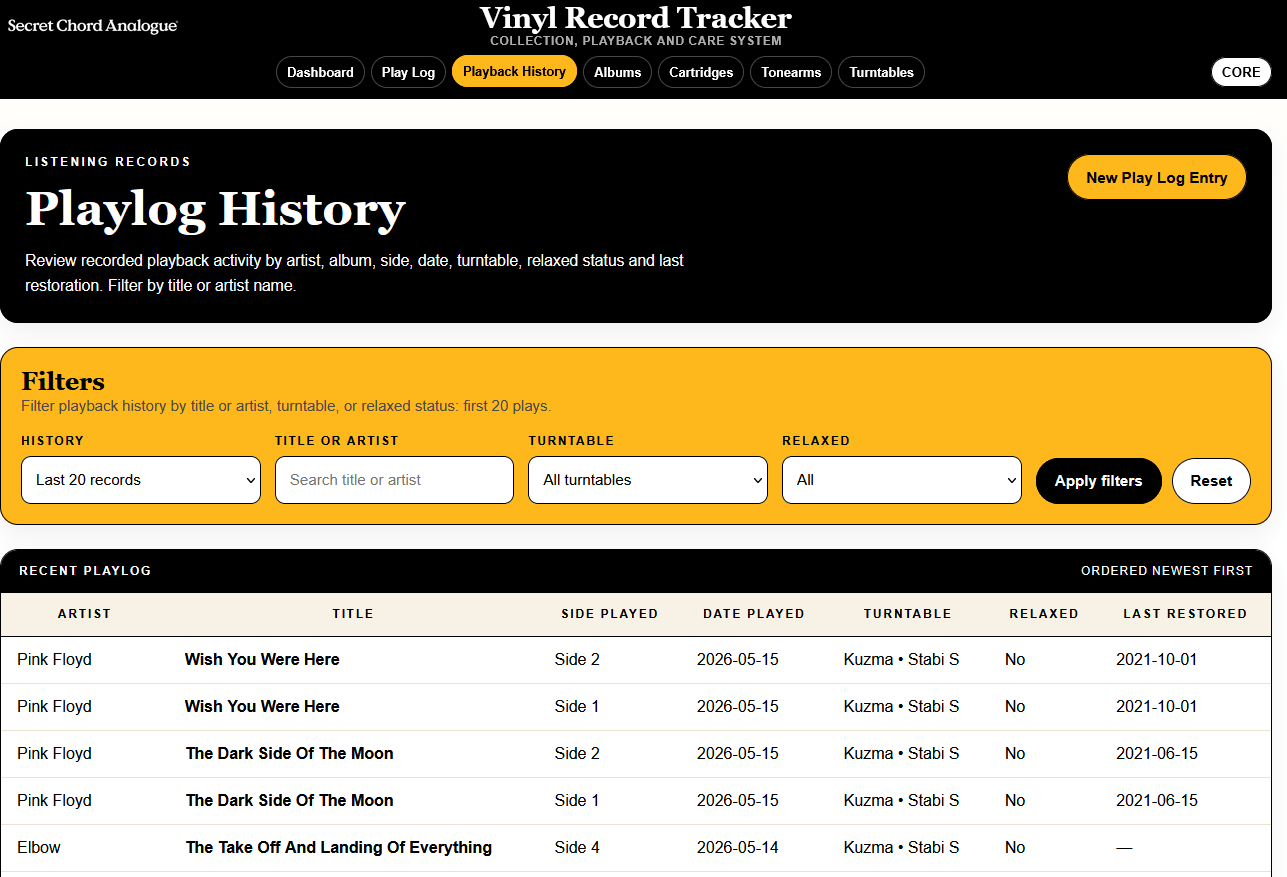
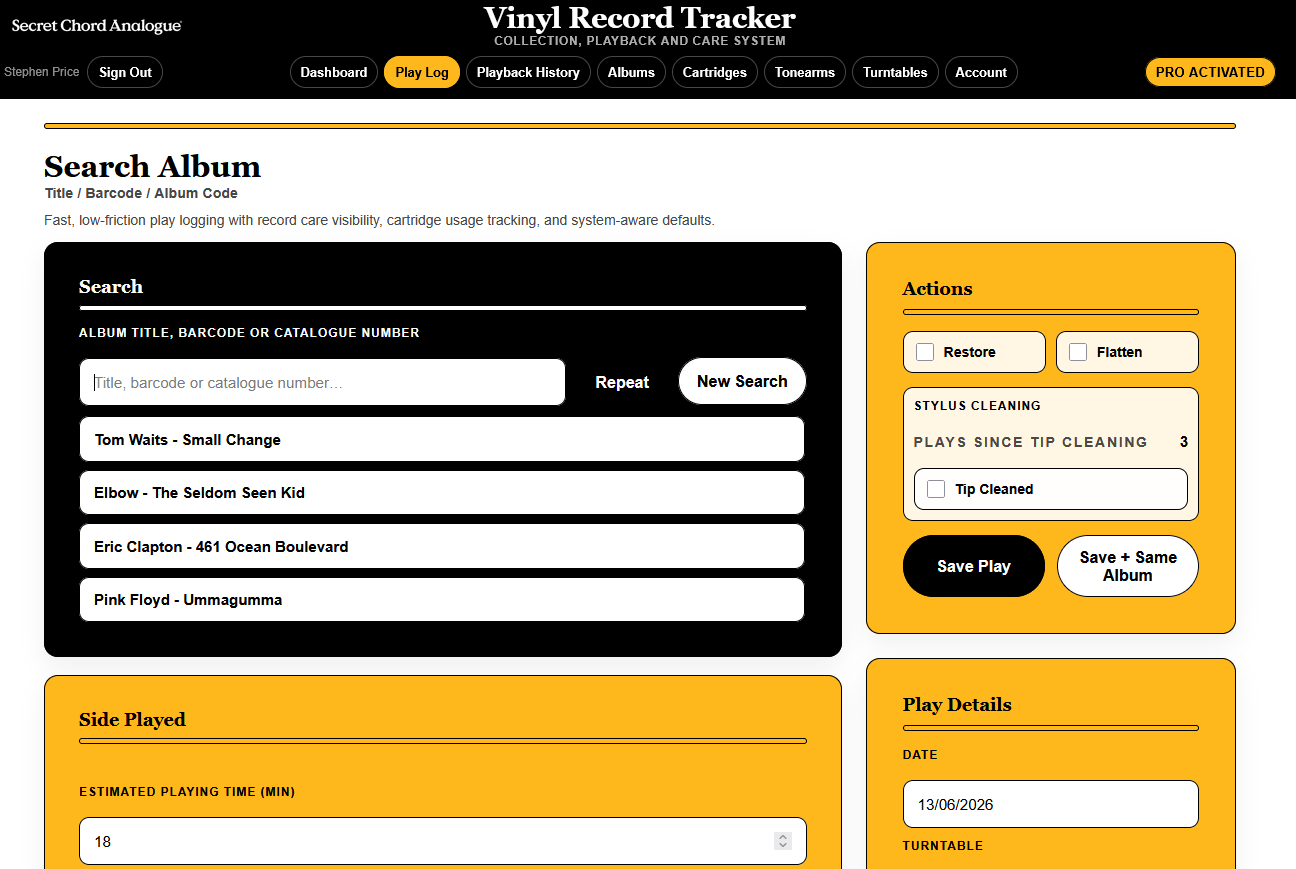
Secret Chord Analogue VRT is a web-based vinyl tracking and care system built around the Play Log. Each listening session can be recorded with the album played, cartridge used, turntable and tonearm configuration, and play duration. From there, VRT tracks cumulative cartridge hours, stylus wear, cleaning status, record treatment history, and playback activity.
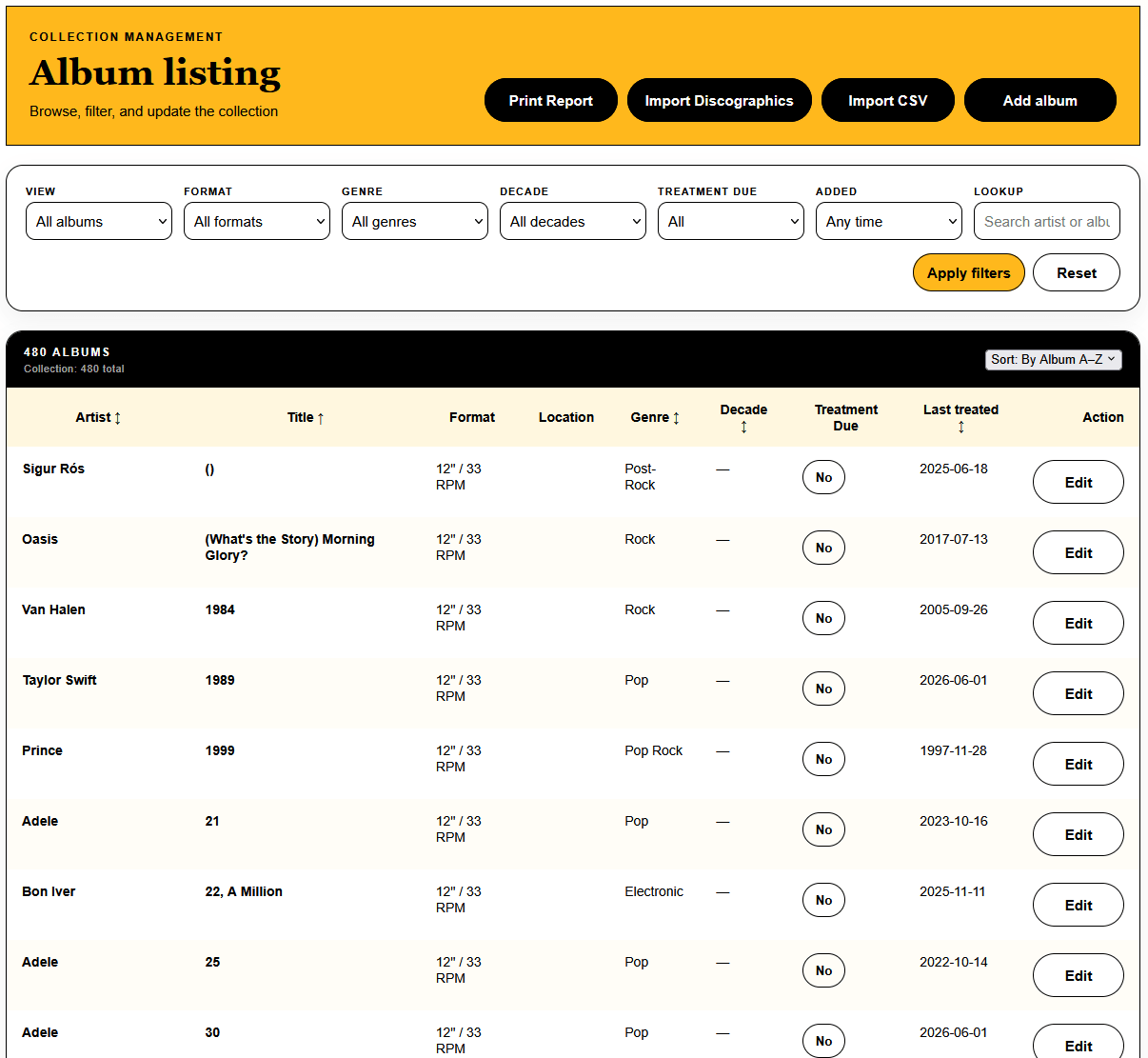
The system also supports barcode scanning, Discogs lookup, album management, play-count history, storage tracking, and QR-code location tools for collectors who need to remember whether a record lives in the main listening room, the office, the overflow shelf, or that pile they keep pretending is temporary.
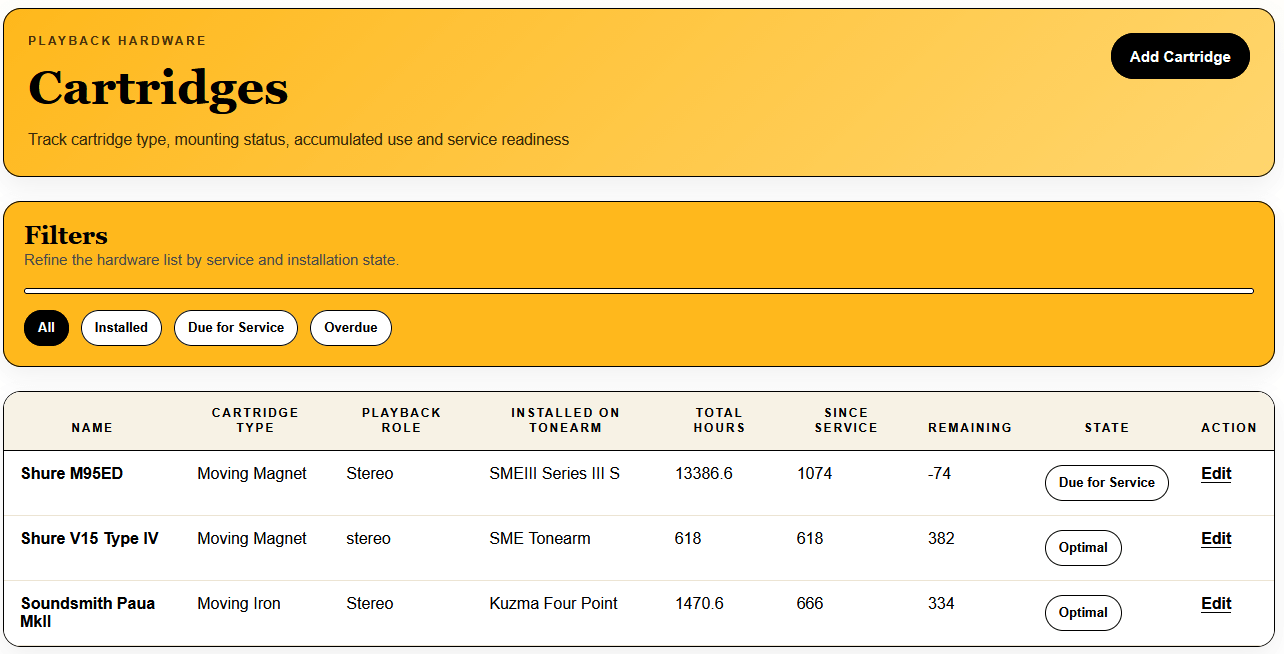
Secret Chord Analogue says VRT can track Record Restore treatments, fluid levels, stylus tip cleaning reminders, cartridge service thresholds, and recent playback history. The dashboard shows cartridge health, Record Restore readiness, recent plays, and system configuration.
That makes VRT less of a “collection database” and more of an analog maintenance dashboard.
Core vs. Pro
VRT is available in Core and Pro versions. According to Secret Chord Analogue’s official product page, current pricing is:
- VRT Core Annual Licence: AU$39
- VRT Core Lifetime Licence: AU$99
- VRT Pro Annual Licence: AU$65
- VRT Pro Lifetime Licence: AU$179
Core includes play logging, dashboard, album management, equipment setup, Record Restore tracking, playback history, and backup. Pro adds analytics, data exports, and advanced playback-history tools.
One note: some early reporting lists slightly different Pro annual pricing, so regional pricing should be checked before ordering. The official Secret Chord Analogue product page currently lists Pro Annual at AU$65, while SoundStage Australia lists AU$99.
Why This Is More Interesting Than Another Vinyl App
There are already ways to catalog a record collection. Discogs remains the default for many collectors because it handles pressing information, marketplace value, wantlists, variants, and buying/selling behavior. That is not what makes VRT interesting.
VRT is aimed at the part of vinyl ownership that usually lives in someone’s head, on a Post-it note, or nowhere at all.
When was this record last cleaned?
How many times has this cartridge been used?
How many hours are on this stylus?
Did I already treat that used copy of Kind of Blue, or did I just think about doing it while holding a drink?
Which records get played constantly and which ones are basically expensive wall insulation?
That is the gap Secret Chord Analogue is trying to fill.
The company also frames VRT as part of a broader vinyl-care ecosystem that includes its Record Restore treatment system and VSS sleeves. HiFi Pig also reports that VRT is designed to work alongside compatible hardware, including the AFI FLAT.DUO, and can support dealers or resellers using Record Restore as an ongoing monitoring service.
Who Should Consider It?
VRT is not for someone with 24 records, a suitcase player, and a copy of Rumours purchased because TikTok had a moment. That listener has bigger problems, some of them structural.
This is for collectors with serious money invested in records, cartridges, and cleaning gear. If you own hundreds or thousands of records, rotate multiple cartridges, buy used vinyl regularly, run a record-cleaning routine, or care about stylus hours, VRT starts to make sense.
Secret Chord Analogue is positioning VRT as more than a collection database. It is part of the company’s broader vinyl-care ecosystem, including Record Restore, VSS sleeves, and compatible hardware such as the AFI FLAT.DUO, with potential use for collectors, dealers, and resellers who want to track cleaning history, cartridge use, and record-care status over time.
The Bottom Line
Secret Chord Analogue VRT is niche, but it is the right kind of niche. It does not promise to make your records sound better by magic, and it does not physically measure groove wear with sensors. Based on the available information, it tracks usage, maintenance, cartridge hours, stylus wear estimates, Record Restore treatments, and playback history from the data users log into the system.
That distinction matters.
VRT is not replacing good record cleaning, cartridge alignment, stylus inspection, or common sense. It is trying to make all of that easier to remember and harder to ignore.
For casual listeners, this might feel like turning vinyl into homework. For serious collectors, it might be the missing maintenance layer between buying records and actually protecting them.
Secret Chord Analogue lists VRT through its official Australian site, with North American shoppers directed to the company’s Record Restore store for local pricing and shipping.
Because at this point, vinyl is not cheap, cartridges are not disposable, and nobody needs to discover that their stylus crossed the danger line three months ago while playing a $125 reissue with the confidence of a man backing into a swimming pool.
For more information: secretchordanalogue.au
Related Reading
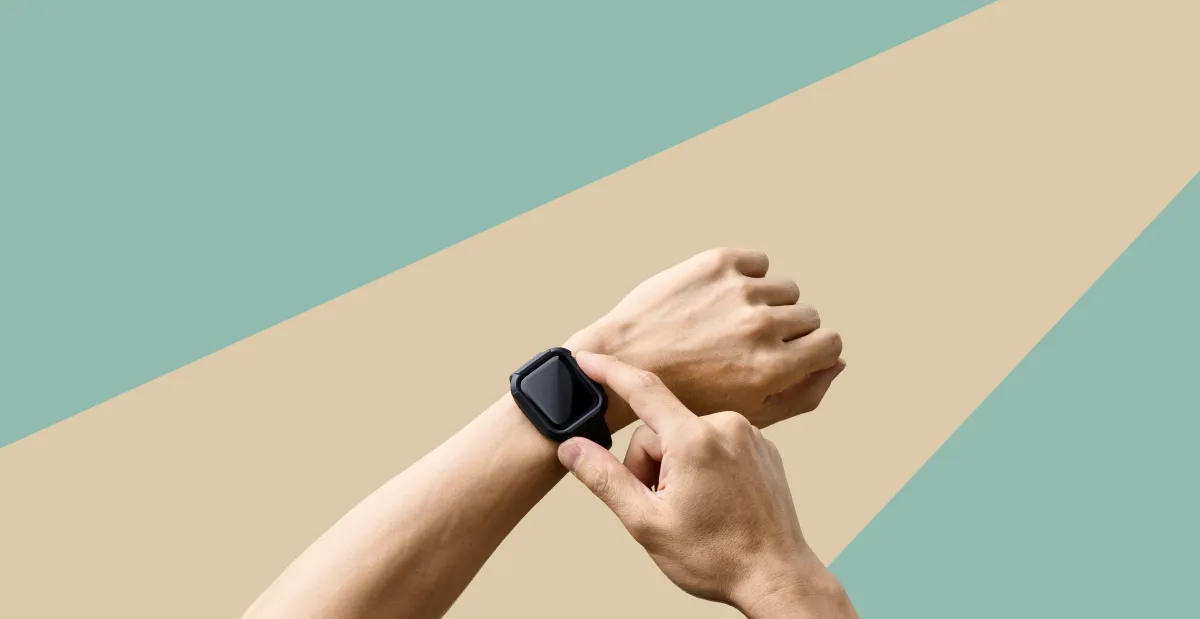
The Apple Watch is a remarkable piece of technology, when you stop and really think about what it does. It’s no surprise, perhaps, then, that we have collectively become obsessed with these things. One 2023 government survey found that one in three Americans wear a smartwatch or wristband to track their health and fitness. More recent industry surveys put that figure even higher: More than half of the US population owns a wearable or connected device and tracks at least one health metric with it.
That’s a lot of people who are swimming in the ocean of information that our Apple Watches, and FitBits, and Oura Rings, and Whoops report back to us. Dr. Michael Joyner, who studies the physiology of exercise at the Mayo Clinic, said he has a three-pronged criteria for thinking about the usefulness of these metrics: Is it measurable? Is what you’re measuring actually meaningful? And is the information that you’re receiving actually actionable?
“If one or two are missing, the thing may be the most interesting thing in the world. It may be cool,” he said. “But it’s not going to make a difference in long-term outcomes.”
Across medicine, we are developing remarkable tools for detecting things in the human body, outpacing our ability to interpret what we are finding. We are getting closer to a future where these devices could offer invaluable insights into how our body is performing outside of the doctor’s office or hospital, but here in the present, we should keep our expectations in check.
Here’s what you should know about some of the most common metrics that wearables track.
Do we really understand what our wearables are telling us?
These devices claim to track both old-fashioned and new-fangled measures of your body’s performance. You’ve got your heart rate — something humans have been able to pick up from the wrist before anybody had dreamed of smart devices — and your step count. My Apple Watch estimates how many calories I have burned throughout the day. The Oura Ring takes your temperature, which can help predict ovulation or offer an early sign that you’re coming down with something.
Sign up for the Good Medicine newsletter
Our political wellness landscape has shifted: new leaders, shady science, contradictory advice, broken trust, and overwhelming systems. How is anyone supposed to make sense of it all? Vox’s senior correspondent Dylan Scott has been on the health beat for a long time, and every week, he’ll wade into sticky debates, answer fair questions, and contextualize what’s happening in American healthcare policy. Sign up here.
But as the technology has gotten better, new measures for things many of us have never heard of have emerged. Heart rate variability, or HRV, has gained a lot of recent interest. It assesses the tiny variations, measured in milliseconds, in the rhythm of your heartbeat; the Economist dubbed it “the most useful indicator” of your overall health. Some devices then use HRV to deliver “recovery” scores that judge how well your body bounces back from your workout or “stress” scores that attempt to quantify how much strain you are under.
HRV demonstrates the conundrum that wearables can present to us, Joyner said. The metric itself has a scientific basis: Researchers have, in fact, found that the amount your heart rate varies over time is associated with your overall health. In general, a higher HRV is better than low, because it suggests your body is more adaptable and better regulated.
But that doesn’t necessarily mean that tracking your HRV from minute to minute with a smartwatch will translate to better health. For starters, we don’t have specific interventions for improving HRV, Joyner said. We don’t even have universally accepted definitions of what high or low HRV is.
In any case, the best strategies are the same heart health guidelines we’ve known about for decades: don’t smoke, don’t drink to excess, eat a healthy diet, exercise. You didn’t need a smartwatch to tell you that’s the best way to take care of your heart, Joyner pointed out. So what good was really derived from closely monitoring your HRV?
“As an individual metric that you can track and do something about, it’s interesting, but there’s no definitive data that you’re going to get better,” Joyner, who was speaking for himself and not the Mayo Clinic, said. “Follow the guidelines. People who follow the guidelines are going to do better on these metrics. But whether you can intervene specifically to make the metrics better or should pay much attention to them, who knows?”
Dr. Ami Bhatt, chief innovation officer at the American College of Cardiology, told me that the bedrocks of evaluating your heart health are still the old mainstays like your blood pressure and your cholesterol, along with newer metrics checked via blood test such as ApoB and lipoprotein. Are you a smoker? What’s your family history?
The value from wearables is less about the specific numbers they are reporting — especially with something like HRV, for which there are not universal guidelines — and more about the long-term trends they can track. By collecting your personal data over time, they can help you figure out what’s normal for you and help you notice if something changes. So don’t freak out if your HRV is different from somebody else’s, or you see one abhorrent reading in your daily report. But if you notice a change in your resting heart rate or HRV that persists over time, then it might be worth going to see a doctor about it.
“We don’t want to overreact to just one abnormal reading,” Bhatt said. “If you just know your baseline when you’re relatively healthy, you can catch the trends.”
It’s all about having realistic expectations about what your wearable can deliver — and recognizing that, for some things, the old ways are still better. When it comes to those metrics that incorporate HRV to determine your stress and “recovery,” Joyner said that self-reported data (literally, how do you feel?) remains the more accurate way to evaluate a person.
And at a certain point, your wearable can straight-up make your health worse. Fixating too much on your sleep problems, for example, can paradoxically cause more sleep problem. An American Society of Sleep Medicine survey this year found that 76 percent of US reported losing sleep because they were worrying about their sleep. It’s a problem — dubbed “orthosominia” — that scientists have been warning about for nearly a decade: the possibility that our obsession with better sleep, and doing things like wearing a device to track our sleep, could actually give us insomnia.
Bhatt said she’d like to see these devices develop the capability to detect when a user may be checking their data a little too compulsively. Joyner, for his part, said he worried that the culture around health and wellness could, ironically, create a lot of stress for the people who get deeply invested in tracking their activity.
“I actually worry we’re entering a too-much-information world,” he said. “It’s going to be anxiety-provoking.”
How to have a healthier relationship with your wearables
Even as we recognize the limitations of wearables, that doesn’t mean they can’t be useful — and they’re going to keep getting better.
Right now, there are obvious situations where a wearable can be helpful. As Bhatt suggested, they can help you understand your personal baseline and notice any changes. Certain patients, such as those with congenital heart failure, can clearly benefit from ongoing monitoring of their heart’s performance, per the American Heart Association. Anybody can use a wearable to make sure their heart rate doesn’t reach dangerous levels during a workout. And these devices could ultimately prove effective in catching underlying heart problems — but there is still work to do. A 2019 study on wearables and atrial fibrillation is telling: At the time, only a tiny percentage of wearers received a notification of an irregular heartbeat, suggesting that there were others that the devices were missing. But, for those who did get an alert, the majority of them did in fact have A-fib. (The FDA has since said that several smartwatches are capable of A-fib detection.) Some patients who have had a serious cardiac event are being asked to put on a wearable, so their doctors can remotely monitor their heart, utilizing an AI assistant that checks the incoming data for any signs of a pending emergency.
And these are the worst wearables we’ll ever have. The future iterations of these devices are going to become more precise and more integrated with AI, which could allow them to ultimately provide more value to the people wearing them. The hypothetical potential for integrating wearables with health care delivery more broadly is immense.
“None of these things will exist in a silo,” Bhatt said. “Your health records, how you’re doing, your wearables, your lab data, people are going to be pulling those together…and trying to give you insights.”
But for now, for the average person, it’s more of a personal choice. Joyner, whose work is all about maximizing human performance, does not wear a smartwatch. Bhatt likes to experiment with different devices with a certain goal in mind, like trying to improve her sleep over the course of a few months.
As Bhatt put it to me, if a wearable motivates you to take your health more seriously, then it’s already doing your body some good. “The best health metric is the one that changes what you do in a way that improves your health,” she said. “For you and I, that may be different things. For your grandmother, it’s something else. For the woman down the road, it’s something else.”
At the most fundamental level, people who use wearables tend to move more when they do — up to 40 more minutes of walking per day, according to a 2022 Lancet study. That is a gain for their health; recent research has shown that even a little bit of movement can have life-saving benefits. The more wearables encourage people to move, the more they can deliver real health benefits.
So if you like wearing one, that’s fine. I’m not dropping my Apple Watch’s step tracker any time soon, because it pushes me to get moving. But be mindful of how your use affects you and how preoccupied you are with certain metrics. Stress is one of the worst things for your health. So is a lack of sleep. If you find your sleep metrics are keeping you up at night, or that your sleep seems to have gotten worse since you started using it, it’s okay to take it off.

Modern cinema relies very heavily on quadrotor drones, because they make for very smooth, very easy to position platforms. From slow pans to chase shots, drones are great– if your shots can be taken at a high enough altitude. Close to the ground, things get a bit dodgier. That’s where [Transistor Man]’s camera chase vehicle comes in— it’s a rover, so it excels close to the ground. In fact, it can’t go anywhere else, except perhaps if provided with a jump. It’s got a hefty gimbal to hold the camera steady on any terrain, a decade-old surplus radio to provide full HD FPV to the remote driver, and a powerful 1/5th scale radio control rally chassis to make it all go. Plus googly eyes, because everything is better with googly eyes.
It looks like an enormous amount of fun to drive, but more importantly it provides smooth, cinematic shots from the professional Sony camera held in the gimbal. One big takeaway is that when 3D printing something that will bounce around this much, you can’t rely on pure strength– flexible filaments are your friend. Just about everything printed ended up remade in TPU if it didn’t start that way. The other takeaway is that we’ve reached enough of a technological plateau that if you scrounge around, you can build something to take a top-of-the-line footage with decade-old castoffs, like the gimbal and radio used in this project, which is a great thing for hobbyists and small studios.
If you can’t find surplus, you could always DIY a gimbal. We’re not filmmakers, but we find ourselves wondering how shots made with this rover would compare to a camera slider.


Hackers compromised the Injective Labs SDK project’s GitHub repository and used it to publish a malicious package on the Node Package Manager (npm) that stole cryptocurrency wallet private keys and mnemonic seed phrases.
Application security companies Socket, Ox Security, and StepSecurity detected the supply-chain attack via version 1.20.21 of the @injectivelabs/sdk-ts npm package.
Injective SDK is a TypeScript/JavaScript software development kit (SDK) for building applications on the Injective blockchain, a Layer-1 blockchain focused on decentralized finance (DeFi), tokenized assets, and decentralized exchanges.

The package has 50,000 weekly downloads on npm and is used by developers building cryptocurrency wallets, trading bots, decentralized exchanges, DeFi applications, and payment tools.
According to the researchers, the attacker compromised a GitHub account belonging to a legitimate project contributor and made the first suspicious commits on June 8, publishing the malicious version of the package shortly afterward.
The attacker also published version 1.20.21 for another 17 packages associated with the project, pinning all of them to the compromised SDK version.
The legitimate account owner detected the compromise within minutes, reverted the changes, and published a clean release, version 1.20.23.
However, developer systems fetching the malicious packages via an update or used them were likely compromised.
Socket says the malicious version of the package was downloaded 310 times before it was deprecated, not removed, and the malicious GitHub release artifacts are still available.
The researchers also note that the package has 87 direct dependencies on npm and very likely multiple additional transitive dependencies.
A report from Ox Security warns that the 87 dependent packages had a cumulative download count of a little over 112,000.
Targeting cryptocurrency wallets
The malware activates when the developers use SDK functions that generate or import wallet keys, rather than upon installation.
Once those functions are called, the malware captures the full mnemonic seed phrase and private key and encodes the data in base64. All the information is exfiltrated via an HTTP POST request to an Injective Labs public infrastructure endpoint to make the traffic appear legitimate.
StepSecurity reports that the malware did not immediately transmit stolen secrets, but instead queued multiple keys and mnemonics for two seconds, bundled them in the HTTP request header, and sent them.
The attackers may then use the mnemonic or private key to port the victim’s wallets to their own devices and access, use, or transfer their digital assets.
Developers who suspect compromise should transfer their cryptocurrency to new wallets and rotate all secrets in their environment.

Security teams log 54% of successful attacks and alert on just 14%. The rest move through your environment unseen.
The Picus whitepaper shows how breach and attack simulation tests your SIEM and EDR rules so threats stop slipping by detection.
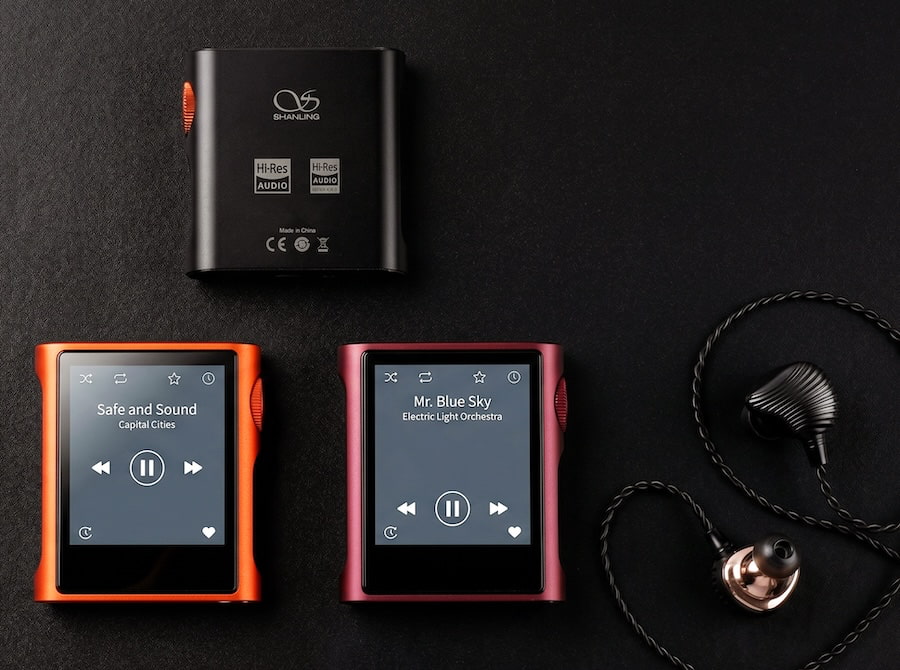
The dedicated digital audio player was supposed to be dead by now. The smartphone had the screen, the storage, the apps, the wireless headphones, and the smug little habit of replacing everything else in your pocket. And yet, here we are in 2026, talking about the Shanling M0 Pura, the fourth generation of Shanling’s ultra-compact DAP line, following the original M0 in 2018, the M0 Pro in 2023, and the M0s in 2024.
That progression matters. Shanling is not trying to convince normal people that they need another device to carry just to play music. That ship sailed, hit an iceberg, and was replaced by a phone plan. The M0 Pura is aimed squarely at audiophiles who still care about local files, wired headphones, Bluetooth flexibility, and better playback quality than the average phone dongle can deliver.
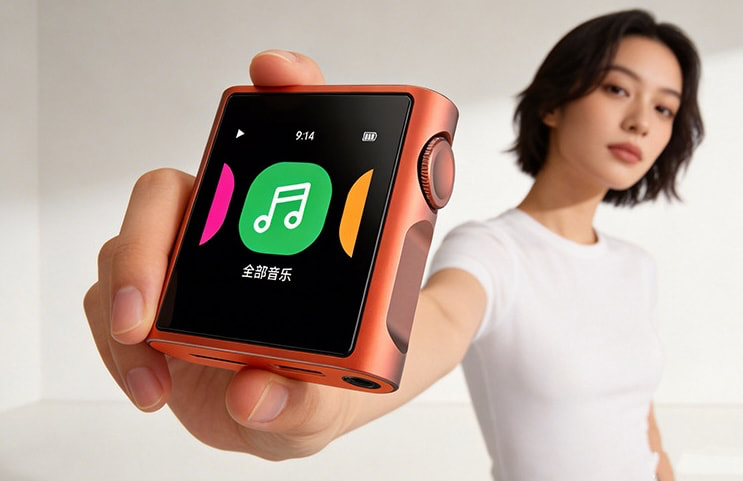
It also leans into nostalgia with some obvious iPod nano energy, but the pitch is not just retro cuteness. Shanling is betting that the DAP market still has life because some listeners want a dedicated player that puts music playback first.
Best Related Reviews:
Dual DACs Give the M0 Pura Some Actual Audiophile Bite
The M0 Pura uses dual Cirrus Logic CS43131 DACs with support for PCM playback up to 32-bit/384kHz and native DSD128. Shanling says the new DAC section improves overall audio performance, while output power rises to a claimed 250mW into 32 ohms when the player is used with the company’s optional 3.5mm to 4.4mm balanced adapter.
That is not desktop amplifier territory, but for something this small, it gives the M0 Pura more muscle than its tiny chassis suggests.
Touchscreen
A 1.54-inch color touchscreen handles music playback and menu control, while Shanling’s in-house MTouch operating system is designed for quick navigation through albums, playlists, and settings. The M0 Pura is powered by the Ingenic X1000 platform, giving Shanling a compact foundation for hi-res playback without turning battery life into a hostage situation.
Connectivity
Do not let the M0 Pura’s size fool you into thinking this is just another cute little novelty box for people who still miss click wheels. Shanling has packed its newest ultra-compact DAP with a wide range of wired and wireless playback options, which makes the tiny player more flexible than it looks.
Two-way Bluetooth support allows the M0 Pura to work as a wireless music source for headphones and speakers, or as a Bluetooth receiver when paired with a smartphone, console, or laptop. In that mode, it functions as a compact Bluetooth DAC and headphone amplifier. USB-C connectivity adds another layer of flexibility, enabling USB DAC functionality and allowing the M0 Pura to serve as a bit-perfect digital transport for external USB DACs.
Storage
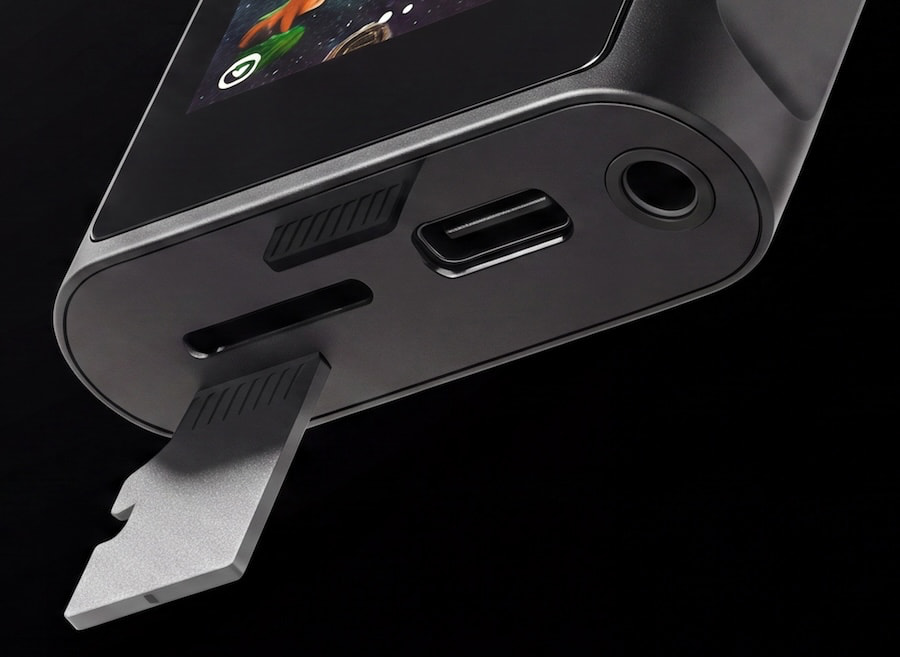
In addition to listening via Bluetooth or a USB-connected device, users can store music locally by inserting a microSD card into the M0 Pura’s card slot. The M0 Pura supports microSD cards with up to 2TB of storage capacity.
Format Support
Digital audio format support includes FLAC, ALAC, WAV, AIFF, APE, MP3, AAC, OGG, and DSD, which covers everything from CD and vinyl rips to old iTunes downloads and newer studio-quality digital files.
Additional Playback Features
Additional playback features include adjustable playback speeds for podcasts and spoken-word content, A-B repeat, SyncLink remote control via the Eddict Player app for Android and iOS, sound customization settings, and user-selectable screensavers.
Comparison
| Shanling Model | M0 Pura (2026) | M0s (2024) | M0 Pro (2023) | M0 (2018) |
| Product Type | Digital Audio Player | Digital Audio Player | Digital Audio Player | Digital Audio Player |
| Price | $129 | $99 | $149 | Discontinued |
| DAC | Dual Cirrus Logic CS43131 | Cirrus Logic CS43131 | Dual ESS ES9219c | ESS Sabre ES9218P |
| Display | 1.54″ 240×240 color touchscreen | 1.54″ 240×240 color touchscreen | 1.54″ 240×240 color touchscreen | 1.54″ 240×240 color touchscreen |
| Hi-Res Support | PCM up to 32-bit/384kHz, DSD128 | PCM up to 32-bit / 384kHz & DSD128 | PCM up to 32-bit / 384kHz & DSD128 | PCM up to 384kHz / 32 -bit, DSD128 |
| USB DAC Support | PCM up to 32-bit/384kHz, Native DSD128 | PCM up to 32-bit/384kHz, Native DSD128 | PCM up to 32-bit/384kHz, Native DSD128 | PCM up to 32-bit/384kHz, Native DSD128 |
| Audio Format Support | DSD (.iso, ..dsf, .dff) / /DXD /APE / FLAC / ALAC / WAV / AIF / DTS MP3 / WMA / AAC / OGG / MP2 / M4A / AC3 / CUE /M3U | DSD (.iso, ..dsf, .dff) / /DXD /APE / FLAC / ALAC / WAV / AIF / DTS MP3 / WMA / AAC / OGG / MP2 / M4A / AC3 / CUE /M3U | DSD (.iso, ..dsf, .dff) / /DXD /APE / FLAC / ALAC / WAV / AIF / AIFF / DTS MP3 / WMA / AAC / OGG / MP2 / M4A / AC3 / CUE /M3U | DSD (.iso, ..dsf, .dff) / /DXD /APE / FLAC / ALAC / WAV / AIFF / DTS MP3 / WMA / AAC / OGG / MP2 / M4A / AC3 |
| Single-Ended Output | Output Power: 1.8V @ 32 ohms (100mw)
Frequency Response: 20Hz – 40kz (-0.5 dB) THD + N : 0.0004% (A-Weighted @ 720mV) Channel Separation: 73 dB @32 ohms Dynamic Range: 121 dB @ 32 ohms (A-Weighted) SNR: 121 dB @ 32 ohms (A-Weighted) |
Output Power: 1.4V @ 32 Ohm (60mW)
Frequency Response: 20 Hz – 40 kHz THD+N:0.0007% (A-Weighted @ 850mV) Channel separation:70 dB Dynamic Range:126 dB Signal-To-Noise:126 dB Output Impedance:< 1 ohm |
Output Power: 1.7V @ 32 ohms (90mw)
Frequency Response: 20Hz – 40kz (-0.5 dB) THD + N : 0.0006% (A-Weighted @ 720mV) Channel Separation: 72 dB @32 ohms Dynamic Range: 119 dB @ 32 ohms (A-Weighted) SNR: 118 dB @ 32 ohms (A-Weighted) Output Impedance: .4 ohms |
Output Power: 80mW @ 32 Ohm
Frequency Response: 20 Hz – 20 kHz Channel separation:70 dB Dynamic Range:> 105 dB Signal-To-Noise:118 dB (A-weighting) Output Impedance:0.16 Ohm |
| Balanced Output | Output Power: 2.8V @ 32 ohms (250mw)
Frequency Response: 20Hz – 40kz (-0.5 dB) THD + N: 0.0007% (A-Weighted @ 1 V) Channel Separation: 99 dB @32 ohms Dynamic Range: 128 dB @ 32 ohms (A-Weighted) SNR: 128 dB @ 32 ohms (A-Weighted) Output Impedance: .8 ohms |
N/A | Output Power: 2.75V @ 32 ohms (236mw)
Frequency Response: 20Hz – 40kz THD + N: 0.0004% (A-Weighted @ 1 V) Channel Separation: 109 dB @32 ohms Dynamic Range: 121 dB @ 32 ohms (A-Weighted) SNR: 119 dB @ 32 ohms (A-Weighted) Output Impedance: .8 ohms |
N/A |
| Audio output | Combined 3.5mm single-ended and balanced output (adapter required for balanced connection) | Headphone output ( 3.5 mm ) | Combined 3.5mm single-ended and balanced output (adapter required for balanced connection) | Headphone output ( 3.5 mm ) |
| Bluetooth | Version 5.0, Transmitter and Receiver | Version 5.0, Transmitter and receiver | Version 5.0T, ransmitter and receiver | Version 4.1, Transmitter and receiver |
| Bluetooth Codecs | Transmitter: LDAC, aptX, AAC, SBC
Receiver: LDAC, AAC, SBC |
Transmitter:LDAC / aptX / AAC / SBC
Receiver: |
Transmitter:LDAC / aptX / AAC / SBC
Receiver: |
Transmitter:LDAC / aptX / AAC / SBC
Receiver: |
| USB functions | USB DAC and digital transport via USB-C | USB DAC and digital transport via USB-C | USB DAC and digital transport via USB-C | USB DAC and digital transport via USB-C |
| Storage | microSD card slot supporting up to 2TB | microSD card slot supporting up to 2TB | microSD card slot supporting up to 2TB | 512GB TF card ( purchase separately ) |
| Battery | 650mAh, up to 9 hours of playback, up to one month of standby | 650mAh, up to 10 hours of playback | 650mAh Up to 14.5 hours (single-ended) – 10 hours (balanced) | 630 mAh lithium battery up to 15 hours of playback, up to one month of standby |
| Dimensions | 43.8 x 45 x 13.8mm | 43.8 x 45 x 13.8mm | 43.8 x 45 x 13.8mm | 40 x 13.5 x 45 mm |
| Weight | 35.8 g | 36.8 g | 36.8 g | 38 g |
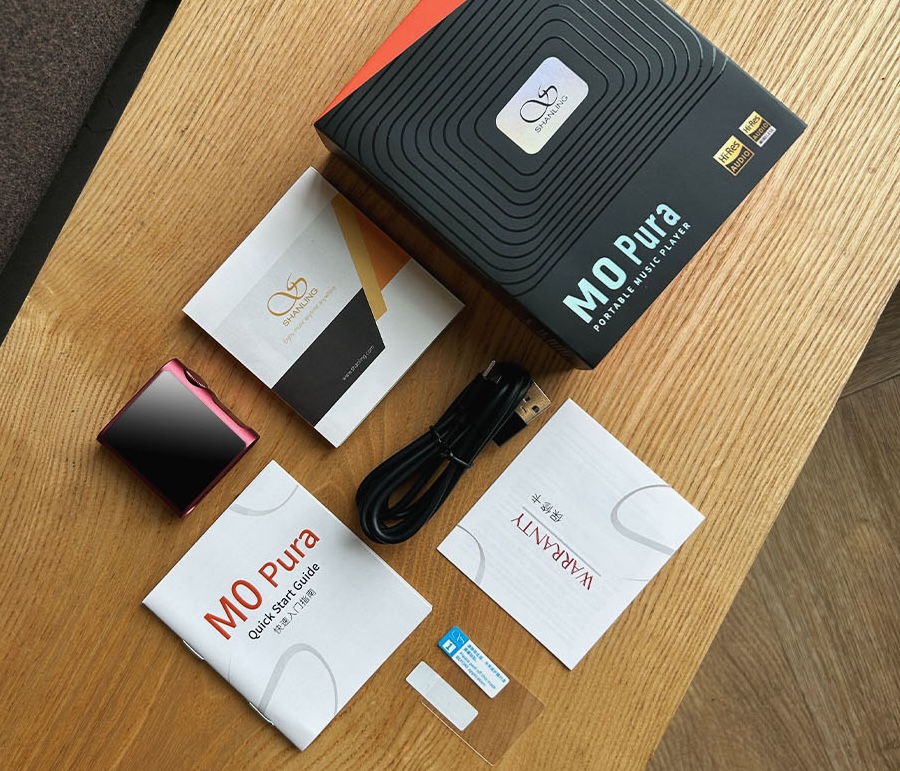
| In the box | USB-C to USB-C cable Two screen protectors Quick start guide and warranty documentation |
USB-C to USB-A cable (for charging and data transfer) Two screen protectors Quick start guide and warranty documentation |
USB-C to USB-A cable (for charging and data transfer) Two screen protectors Quick start guide and warranty documentation |
USB-C to USB-A cable (for charging and data transfer) Two screen protectors Quick start guide and warranty documentation |
| Optional Accessories | Leather case Clip case 3.5mm to 4.4mm balanced adapter |
Not Indicated | 3.5mm to 4.4mm balanced adapter | Not Indicated |
The Bottom Line
The Shanling M0 Pura is not trying to replace your smartphone, and that is probably its greatest strength. This is a tiny, purpose-built digital audio player for listeners who still care about local music files, hi-res playback, broad format support, two-way Bluetooth, USB DAC functionality, and better wired output than most phones can offer without a dongle dangling off the bottom like a sad little tail.
What makes the M0 Pura interesting is the combination of size, price, and flexibility. Shanling has managed to squeeze dual DACs, microSD storage support up to 2TB, USB-C digital output, and optional balanced headphone output into a player that is closer in scale to a smartwatch than a modern smartphone. That makes it a good fit for audiophiles who want a dedicated music player for commuting, travel, the gym, or a desktop setup without spending Astell&Kern money or carrying around a device the size of a deli sandwich.
The biggest downside may be the same thing that makes it appealing: the M0 Pura is very small. Misplacing it feels less like a possibility and more like a scheduled event. Shanling might want to include a lanyard, or perhaps a tiny AirTag shrine.
Price & Availability:
For more information: en.shanling.com
Related Reading:
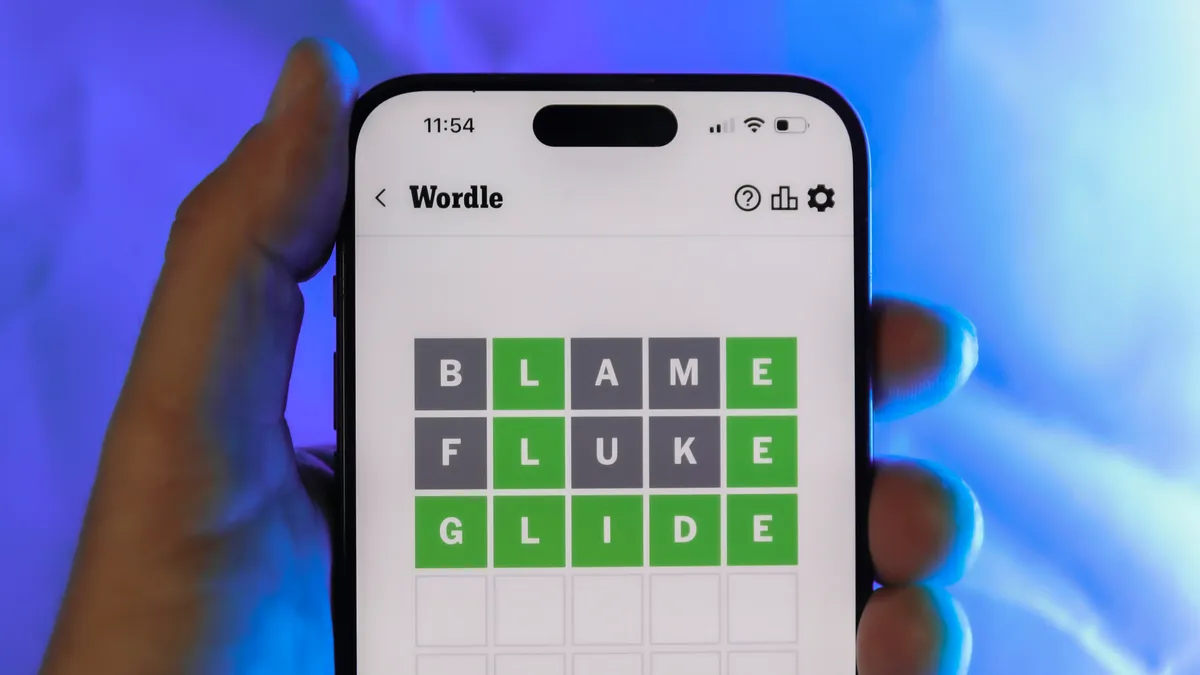
Looking for the most recent Wordle answer? Click here for today’s Wordle hints, as well as our daily answers and hints for The New York Times Mini Crossword, Connections, Connections: Sports Edition and Strands puzzles.
Today’s Wordle puzzle has a repeated letter that might trip you up. If you need a new starter word, check out our list of which letters show up the most in English words. If you need hints and the answer, read on.
Read more: New Study Reveals Wordle’s Top 10 Toughest Words of 2025
Today’s Wordle hints
Before we show you today’s Wordle answer, we’ll give you some hints. If you don’t want a spoiler, look away now.
Wordle hint No. 1: Repeats
Today’s Wordle answer has one repeated letter.
Wordle hint No. 2: Vowels
Today’s Wordle answer has one vowel, but it’s the repeated letter, so you’ll see it twice.
Wordle hint No. 3: First letter
Today’s Wordle answer begins with C.
Wordle hint No. 4: Last letter
Today’s Wordle answer ends with L.
Wordle hint No. 5: Meaning
Today’s Wordle answer can refer to an artificially constructed waterway designed for navigation, water transport or drainage and irrigation management.
TODAY’S WORDLE ANSWER
Today’s Wordle answer is CANAL.
Yesterday’s Wordle answer
Yesterday’s Wordle answer, July 9, No. 1846, was AMEND.
Recent Wordle answers
July 5, No. 1842: SWAMI
July 6, No. 1843: TODDY
July 7, No. 1844: SLING
July 8, No. 1845: DEMON
Design, performance, comfort, convenience – Audi makes fantastic cars that have it all. It was the first of the big three Germans to make a proper supercar in the R8. However, the company does have its flaws. During my junior year, I started an apprenticeship in automotive repair, where I would eventually specialize in the Volkswagen Auto Group brands, including Audi. Interestingly, it was about that time that the relatively new MLB Evo platform was coming into its sixth year – in other words, just out of warranty or extended warranty for many. Of course, unlike Nissan’s disastrous CVT, which got the company sued in a Tennessee court, properly maintained Audis gave owners little to worry about.
Not all engines paired to the new-ish platforms were made equal, though, and I did run into several more than I wanted to. Cut to today, and I am a valuations expert for several car showrooms in Dubai, specializing in — you guessed it — the Volkswagen Group. Though I have since eschewed my grease monkey overalls for a pressed suit, researching this article brought back some fairly recent memories of digging about in assorted VW engine bays. I can’t speak to much of the newer generation models since we don’t have the data for it — most repairs would be in warranty at the moment — but there are definitely some particularly bothersome engines I would avoid, unless you really like the car and know what lies ahead.
What is FSI and TFSI
The naming conventions for some of these engines can be confusing for non-technical buyers, so let’s go over them before getting into the list in earnest. The words FSI or TFSI are found behind every single gasoline-powered Audi on the market today.
First, fuel stratified injection (FSI) is a fancy way of saying that the engine features gasoline direct injection. This design has the benefit of improved cooling (among other things) over non-FSI engines, which could could have “hot spots” — areas of higher temperature that could cause fuel to randomly combust out of place. This phenomenon, known as “knocking” is reduced to a great degree in FSI engines, as the (relatively) cool fuel regulates the temperature inside the engine’s combustion chamber.
The “T” in TFSI simply indicates an FSI engine that features forced induction. As a matter of fact, Audi was actually the first ever car company in the world that combined FSI with a turbocharger (where the T comes from), back in 2004.
As of 2009, every gas Audi was an FSI engine, with a great many being turbo units. In fact, five of the engines that follow are TFSI units.
2.0 TFSI EA888
First up, we have the 2.0 TFSI, known through its model code of EA888, which would get a mid-cycle refresh after a few years. The motor itself was a 2-liter inline-four unit that was available in the A4 and A5 B8s, the Q5 8Rs, and the A3 8Ps from around 2005 to 2015. A middle ground in terms of power would be the 2012 A4, which made 211 hp and 258 lb-ft of torque. The issues that plagued this engine were extreme oil consumption (in some cases as high as 1 quart per 1,000 miles on the upper end) as well as timing chain failures. The tensioner is a problem on most Audi engines from this era, whether the root cause is the flywheel/firewall-adjacent placement of the chain during servicing.
The root cause of the high oil consumption problem (especially on early gen 2.0 TFSI engines) is widely agreed to be thin, poorly designed and sometimes defective piston rings that were prone to microscopic leaks. These leaks would compound and cause the oil to drain out much faster than was normally expected or acceptable. The issue got so bad that a class action lawsuit was filed in New Jersey in 2026 to remedy the issue. Additionally, the water pump on the early (2006 until about 2012) 2.0 TFSI four-cylinders is also prone to failing. All of that is in addition to the standard wear and tear a high-maintenance German car of this age typically faces.
1.8 TFSI EA888
Next up, we have an engine best described as the younger sibling to the 2.0 liter TFSI above: the 1.8 TFSI EA888. As the name suggests, this was a four-cylinder unit featuring a turbocharger and direct gasoline injection that displaced 1,798cc via a bore of 82.5 millimeters and a stroke of 84.1 millimeters. It was remarkably similar to the 2.0 TFSI, though it was offered in the A4 and A5 on the B8 chassis, where it made about 170 hp in total. The main issue with this engine continued to be shoddy piston rings with improperly sized drainage holes that led to high oil consumption.
For some reason this engine also absolutely loved to gobble up its timing chains prematurely, and cold starting your car could frequently lead to the dreaded rattle-rattle-rattle that was so common on these second-gen architecture EA888s. We specifically want to point out that these issues did indeed lie with the B8 chassis in particular — not because the chassis had anything to do with them — but because the newer B8.5 chassis with the third-gen EA888 did remedy these to a large extent. That’s not to say that a B8.5 chassis with the 1.8 TFSI is without its problems; no 15-year-old German car will be, so don’t take that as a buying endorsement.
4.0 TFSI V8 EA824 CEUC and CTGE
Now, the reason we had to include that alphanumeric soup in the engine name is because Audi has built more than its fair share of 4.0-liter V8 engines over the years, and we needed to be specific — not all of its V8s were bad, after all. Let’s break down the name first. You already know what TFSI means, and EA824 is the engine family. CEUC is an internal naming system that Audi uses for subdividing its engines, and specifically, the CEUC V8 was used on the C7 family of cars. This family consisted of the Audi S7, S7, RS6, and RS7 for that particular generation, which ran until about 2016, which is when the successive EA825 engines came out.
For all intents and purposes, the CEUS can be considered the “first” generation, while the EA825 (known as the CTGE, pictured above) is the “second” generation, helped along by Porsche’s engineers. Performance on the first-gen CEUC V8 was great, pushing 605 hp and 516 lb-ft of torque in the 2017 Audi RS7, but the turbos would face oil starvation, bits would chip off due to friction, and metal shavings could (and did) enter the internals and wreck the turbo and engine. Being a luxury German brand, repairs were never cheap, especially not “engine out” ones. Other problems included issues with the starter motor and coolant leaks, though this was more up to the owners not doing preventive maintenance in our opinion.
4.2 FSI V8 (B series)
This engine is not to be confused with the legendary 4.2-liter naturally-aspirated V8 that was found in the now-discontinued Audi R8, even though the displacement and layout was the same. Audi actually made two separate (roughly) versions of the 4.2 FSI V8 engine, with differing use cases. The BNS engine code was more performant because it revved higher and had slightly different internals, such as adjusted camshafts and chain layouts.
This series of engines could be found in models like the RS6, RS5, and RS4. Then you had the lineup of the 4.2 V8s that had a lower redline, more geared towards daily applications. The most prominent engine code from this family was the BAR, though there were others, and could be found in models like the Q7 and A8. Now to be clear this one is not a ridiculously unreliable motor like the others on our list.
The problem is that when time for even a teeny repair comes, the layout of the engine is so bad that labor alone will bankrupt you. Similar to the early 2000s Bentley problem of having to have the engine out of the bay for basically anything. Examples on the 4.2 V8 are rear-mounted timing belts, engine mounts going, issues with the suspension and carbon buildup, engine intakes going, and more. The problem is that the V8 4.2s are found in enthusiast cars from the late 2000s to the early 2010s, so it’s something to definitely be aware of.
1.4 and 1.2 TFSI EA111 specifications
For these engines we’re taking a slightly different structure, because talking about the two engines in question together makes more sense, given their similarities. For those who don’t know, Volkswagen owns a number of car brands, including Audi and Skoda. The EA111 family of engines includes two very popular models, the 1.4-liter TFSI and its smaller sibling, the 1.2-liter TFSI.
As far as Audi models go, this engine family featured on the A1 and A3 compact cars — specifically the ones that used the 8P at the time. However, the Volkswagen Golf also used both of these engines for a very long production run, though the current Golf lineup consists of a 1.5 and a 2.0-liter option only.
The horsepower figures were quite similar between the two brands, with the 2012 Audi A3 making a decent 120 hp and 148 lb-ft of torque, while the 2011 Volkswagen Golf ended up with up to 158 hp and 177 lb-ft of torque. And yes, for those wondering, that does mean that the Audi A3 is essentially just a dressed-up version of the Golf, which is a fact that Audi doesn’t want you to realize. It’s also worth mentioning that there is slightly differing terminology between Audi and VW with regards to the naming of the engine – TFSI on Audi is called TSI on Volkswagen, but the engines are essentially the same.
1.4 and 1.2 TFSI EA111 problems
Now that we’ve got the comparisons out of the way, let’s talk about the issues this engine family faced – there were quite a few. Specific examples would be too many to name, but the entire EA111 family suffered from four main pain points with a degree of commonality. These were timing chain stretch, timing chain tensioner failures, water pump issues, misfires and rough running, and electrical issues. The timing chain issues were at the forefront of complaints about the car, especially with regards to the durability of the chains.
Since the models that this engine family was found in (the Audi A1, A3, and Volkswagen Golf) are by far the cheapest on this list, these issues are worth being aware of. For instance, on the used market, a 2012 Audi A3 will cost you only around $7,000 for a low-mileage model, but be prepared for a repair bill sooner rather than later.
However, the good news for someone looking to pick up an Audi with the EA111 engine is that though the problems will be shared with the Golf, so will the solutions. Repairs (and labor) will be widely available and not mega-expensive, especially at independent mechanics. Volkswagen phased out the EA111 in 2012, and Audi followed suit soon after.
A note about Audi model names
If you see an alphanumeric code behind a model, like “A4 B8,” the B8 refers to the generation. It’s important to mention the generation because VW has released several overlapping years. For example, the B8 ran from around 2008 to 2012, and the B8.5 ran from 2013 to 2016, but the B9 ran from 2015 onward. Different markets also had different phased rollouts.
Sometimes the U.S. was the first to get a new platform, sometimes it was the last, and other times it was skipped. Thus, chassis codes, which double up as generation codes (“B8” is to Audi what “997” is to Porsche) are useful to us.
Furthermore, all the engines on this list are from the 2010s, and this is with good reason. You see, when an engine is new, and develops a problem, Audi’s service centers would fix it, meaning independent technicians wouldn’t get to see or log the problems.
Warranty periods could stretch as long as seven years, if things like an extended warranty or extended Audi-approved service plan were purchased, and that would further delay the information being available to the consumer market. It’s not just Audi that does this, either — basically every mainstream brand is guilty of the practice — but that’s why the engines on this list are all “previous” generation. Of course, the cars being a little older also means that prices are probably down on the used market, so they could be tempting to buyers.
Methodology
After shortlisting several engines from recent generations of Audi vehicles known to be problematic, we began trawling the internet for complaints about the specific car and engine pairing. Every single car on this list has been looked up on the NHTSA recall finder tool, and that includes every single year that the generation was in production. Common issues were extrapolated and listed; we also took into account owner complaints and feedback on model-specific and Audi-specific internet forums.
We also looked at data on the engines in question through the various handbooks published either by Volkswagen Auto Group, Audi, or the NHTSA’s self-study guides to confirm that there were no major architectural changes to the engine or engine family in the generation that we’re talking about.
For technical facts and figures like horsepower, torque, displacement, weight, and model utilization, we looked directly at press releases from Audi. Where able, we sourced images directly from Audi’s legacy press release archive to ensure that the exact engine we’re talking about is shown, to avoid confusion. Where current pricing for used models is listed, we researched and took a ballpark figure from classifieds sites with a Dallas zip code and the filter set to show “nationwide” results.
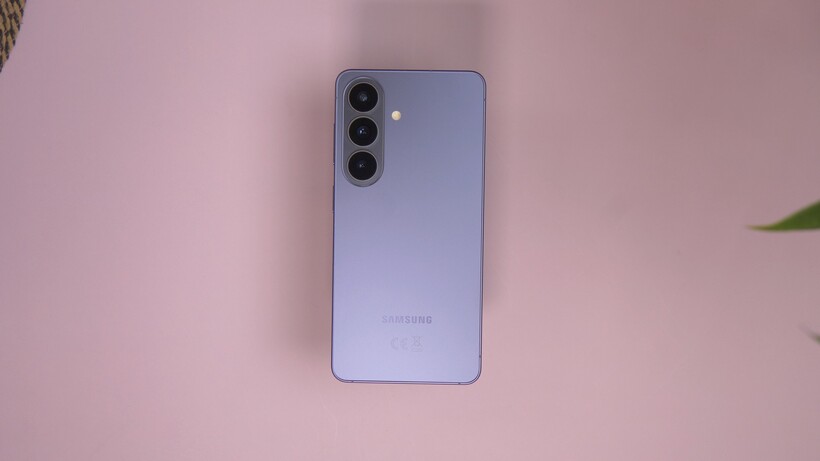
The iPhone 17 and Samsung Galaxy S26 are two very similar standard flagships, making the decision of which to buy all the more challenging.
Do you go for the premium, Liquid Glass-inspired iPhone 17 or stick to the ultra-slim Android flagship experience of the Samsung Galaxy S26? Is there really a difference in how they perform day-to-day? And what about elements like camera hardware, screen tech and all-important battery life?
While it’s easy to compare the two on paper, we’ve used both the iPhone 17 and Samsung Galaxy S26 in day-to-day use – and here’s how they compare in the real world.
Pricing and availability
The Samsung Galaxy S26 is the more expensive of the two, coming in at £879 for its 256GB model.
SQUIRREL_PLAYLIST_10208273
That said, if budget is a primary concern, the iPhone 17 is a slightly more affordable option at £799, with the same generous 256GB of storage out of the gate.
SQUIRREL_PLAYLIST_10207955
Design
The iPhone 17 and Samsung Galaxy S26 both present beautifully compact forms compared to their giant Ultra and Pro Max siblings, making them much easier to use one-handed, though they tackle premium builds in slightly different ways.

The Samsung Galaxy S26 is certainly the thinner and lighter of the two, measuring in at just 7.2mm at the edges and a mere 167g in the hand. Samsung has refined the design slightly this year, shrinking the display bezels further and housing the cameras in a raised, pill-shaped island rather than letting them poke out awkwardly.
However, if you hate a phone that rocks when placed flat on a table, beware; the S26 is the wobbliest phone we’ve used in a while.

It’s a pretty premium experience elsewhere, however, with a chassis constructed of aluminium and Gorilla Glass Victus 2, complete with full IP68 dust and water resistance to round things out.
The iPhone 17, on the other hand, retains its highly familiar (and now iconic) flat-edged, rounded-corner look it has sported for several generations, complete with the same aluminium frame and frosted glass panel on the rear. It also comes in attractive colour options like Sage and Mist Blue, alongside a premium-looking matte-black finish.

Like the Pro models, it features the programmable Action button on the left and Camera Control on the right, though the latter remains placed a little too far down the side to be comfortable enough for swift setting changes or snapping photos.

Apple has, however, enhanced the phone’s ruggedness with Ceramic Shield 2 on both the front and back to ward off micro-scratches and damage from drops, and while it matches the S26’s IP68 rating, it boasts added protection down to 6 meters for up to half an hour.
Screen
Both Apple and Samsung deliver a top-notch screen experience, though the iPhone finally takes the win with this generation.

The Samsung Galaxy S26 delivers a vibrant 6.3-inch Dynamic AMOLED 2X panel with a 1080 x 2340 resolution and a smooth LTPO-enabled 120Hz refresh rate – a very familiar setup largely carried over from the Galaxy S25.
Still, general viewing angles are fantastic, and its 2600nit peak brightness easily cuts through direct sunlight outdoors. It does, however, miss out on the anti-reflective coating and Privacy Display tech found on the S26 Ultra.
Apple, on the other hand, has finally relented and added the previously Pro-exclusive ProMotion 120Hz screen tech to the base-model iPhone 17.

The 6.3-inch screen packs a sharp 1206 x 2622 resolution that remains detailed, bright and vivid, but the more important element here is LTPO tech; it allows the screen to drop all the way down to 1Hz to maximise battery life, just like Samsung’s option.
Visibility is also impressive, with the iPhone 17 reaching a massive 3000-nit peak brightness (1600-nit in high-brightness mode) while dropping to just 1 nit for a more comfortable late-night viewing experience.
Cameras
If there’s one area where the Galaxy S26 and iPhone 17 diverge, it’s in the camera department.
The Samsung Galaxy S26 features a strong triple-camera system comprising a 50MP main sensor, a 10MP 3x telephoto zoom lens, and a 13MP ultrawide. The primary camera is the strongest of the bunch, capturing detailed photos with a vibrant, saturated processing style that preserves shadow detail in backlit scenes – but the other sensors are weaker.

The 3x zoom struggles to lock focus on moving objects in windy conditions, and because it’s only a 10MP sensor, digital cropping is limited compared to high-res rivals. The 13MP ultrawide is the weakest link, turning out grainy, pale images with clear edge distortion as soon as light levels drop.
The iPhone 17, on the other hand, lacks a dedicated telephoto lens, instead relying on an optical-quality 2x in-sensor digital crop from its otherwise excellent 48MP main sensor, which can push to around the 4x mark before things get spotty.

The main snapper provides sharp, colour-accurate images with Apple’s reliable ‘always good’ point-and-shoot processing. This year’s standout is the massive upgrade to the accompanying 48MP ultrawide sensor, which finally matches the main sensor in colour and detail, even in more challenging lighting conditions.
We’re also big fans of the iPhone’s new selfie camera; it uses an 18MP square sensor, allowing you to take full-res portrait or landscape shots without needing to rotate the phone. A small touch, but one that makes a big difference in use.
Performance
In terms of day-to-day use, both devices feel rapid with plenty of processing headroom that’ll get you through most mobile-related tasks without breaking much – if any – of a sweat.

The Galaxy S26 ships with the Exynos 2600 chipset in the UK (the Snapdragon 8 Elite Gen 5 in other regions like the US) and a rather generous 12GB of RAM. Benchmark scores are, unsurprisingly, brilliant, nearly matching the Snapdragon 8 Elite Gen 5 in the S26 Ultra in some cases.
It also helps that One UI is highly optimised, ensuring that taps and swipes are fluid and lag-free. Gaming is similarly smooth, with titles like Mario Kart Tour running at high resolutions without noticeably heating its relatively thin chassis.

The iPhone 17 counters the S26’s performance with its custom Apple A19 chip alongside a more conservative 8GB of RAM. Though it lacks the extra GPU core of the A19 Pro variant, it handles pretty much everything flawlessly. Social media timelines scroll without a hint of stutter, and intensive apps load instantly. You’ll be able to play even console-level games on this thing without much issue.
Software
Your choice of phone will likely come down to your preference for iOS or Android, but regardless, both systems have had notable updates this year.

The S26 runs One UI 8.5 based on Android 16, but the bigger focus here is its AI smarts. Galaxy AI covers a wide range of features, from returning favourites like photo eraser to new features like the real-time AI Noise Eraser, which reduces distracting background tracks and crowd sounds directly in apps like YouTube. And, with seven years of OS upgrades to look forward to, it should only improve over time.
The iPhone 17 runs iOS 26, which as I’m sure we’re all aware of at this point, ships with the redesigned Liquid Glass interface. The at-times controversial UI change adds an unmistakable charm to the software, with colours physically refracting beneath the UI layers and moving with organic elasticity.

Unfortunately, Apple’s AI push remains underwhelming, especially compared to Samsung’s. The Photo Clean Up tool leaves glaring signs of editing, text transcription is hit-and-miss, and Image Playgrounds looks almost child-like compared to rivals.
However, that could all change with iOS 27 and the long-awaited release of the redesigned, smarter Siri – we’ll just have to wait and see for now.
Battery life
When it comes to both overall battery life and charging capabilities, Apple’s iPhone 17 has a clear win.

The Samsung Galaxy S26’s 4300mAh battery is an improvement over its predecessor, but it remains somewhat average in use. Light users managing around 3-4 hours of screen time per day will coast through easily, but power users will find themselves running low before the sun goes down.
It’s also severely let down by slow 25W charging and a Qi2 wireless implementation without magnets, instead leaving magnetic connectivity to casemakers.
The iPhone 17, on the other hand, sports a 3692mAh battery that comfortably lasts through an intense 12- to 14-hour day with few complaints. Everyday tasks like scrolling through TikTok, using Google Maps for navigation and messaging on WhatsApp will still leave you with a solid 20% or so in the tank by bedtime.

Charging is also significantly improved, boasting rapid 40W wired charging and 25W MagSafe wireless support. Paired with a 65W charger, it hits 50% in just 26 minutes – much quicker than the Samsung competition.
Verdict
Overall, the iPhone 17 stands out as the better buy for most people in this generation, with Apple finally addressing key long-term complaints in its entry-level iPhone.
Both devices offer premium, compact designs that are increasingly rare in the smartphone market, paired with fluid 120Hz displays, exceptional flagship performance, and capable primary camera sensors. However, the iPhone 17 justifies its price with superior camera hardware – both front and rear – and vastly superior 40W wired and 25W magnetic wireless charging.
That said, the Galaxy S26 remains an excellent choice if you’re on the market for a triple-lens camera system with a dedicated 3x zoom lens, prefer an ultra-thin 7.2mm body, or simply prefer Android to iOS. There’s no hardware that’ll tempt you if you don’t like the hardware it runs on, after all.
But, with its weak secondary cameras, average battery life and slower 25W charge speeds, it takes a back seat to the more polished package offered by the iPhone 17.
To see how the two compare more widely, take a look at our selection of the best smartphones.
Baseus Inspire XP1: A trickle of earbuds from value oriented brands have come out in the last year in collaboration with Bose, which has been gradually expanding its “Sound by Bose” initiative that brings its brand to more affordable headphones and earbuds. Like the Skullcandy Method 360 ANC earbuds, the Baseus Inspire XP1 feature very good sound in a set of comfortable earbuds that share some similarities with Bose QuietComfort Ultra earbuds, particularly how they fit (they have similar ear tips to the Ultras, and the buds fit my ears quite well). The Inspire XP1’s price fluctuates and sometimes dips to $100, which is the best time to buy them.
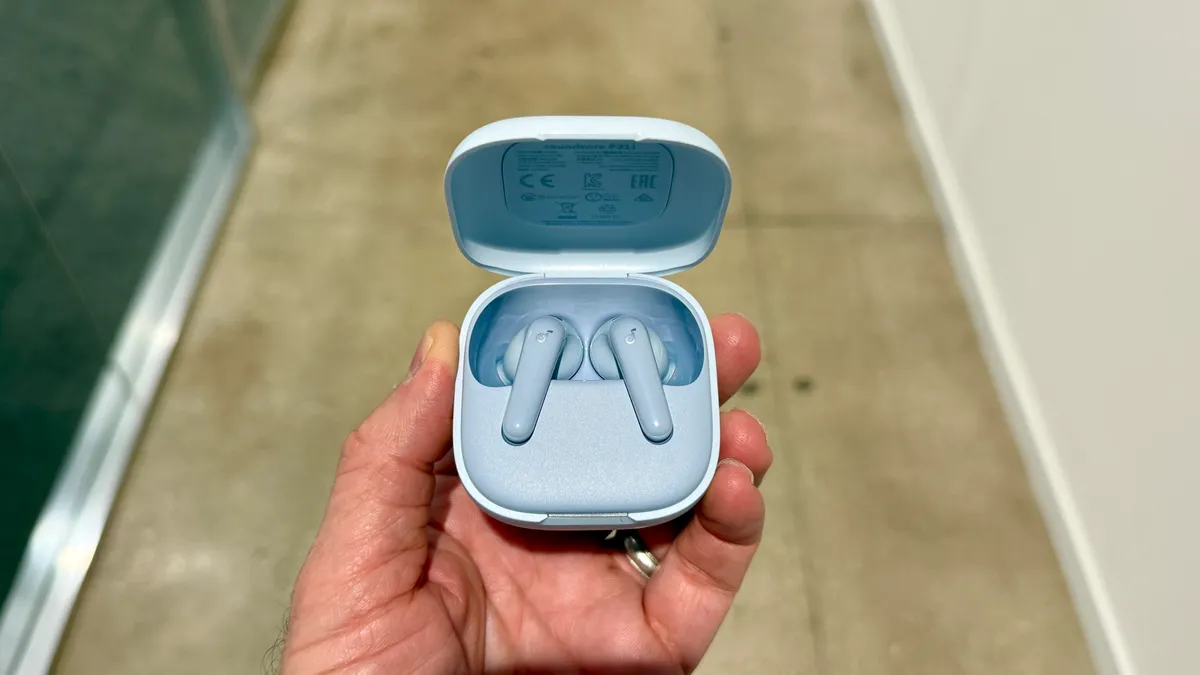
Anker Soundcore Liberty 4 NC: Released in 2023, the Anker Soundcore Liberty 4 NC earbuds carry a lower list price than 2022’s Liberty 4 buds and are arguably better in some ways. They have improved noise cancellation and better sound quality, along with support for the LDAC audio codec for devices that support it. (Many Android smartphones do, and in theory it offers slightly improved sound quality when paired with a music streaming service that offers high-res tracks.) Nicely discounted, they’re lightweight buds that should fit most ears comfortably with four sizes of ear tips to choose from. That said, the newer P31i cost less and offer similar performance.
QCY MeloBuds Pro: Like Earfun, QCY makes a variety of budget earbuds and headphones that deliver good bang for your buck. The MeloBuds Pro look a little generic, but they’re lightweight and comfortable and sound good for what they cost, offering decent clarity and well-balanced audio (you can tweak their sound profile a bit with the EQ settings in the QCY companion app). Also, they’re noise-canceling and voice-calling performance are better than average for sub-$50 earbuds. And finally, they have ear-detection sensors, multipoint Bluetooth pairing, a low-latency gaming mode and support for Sony’s high-quality LDAC audio codec (many Android devices support LDAC).
Roseselsa Ceramics X: Truth be told, I’d never heard of the Roseselsa Ceramics X earbuds before I saw a post comparing them to Final Audio’s more expensive ZE3000 SV buds that argued the two models are essentially the same. This would make the Ceramics X far better value but it didn’t quite prove to be true. While I ended up liking the Final Audio ZE3000 SV better, I was impressed by the sound quality of the Ceramics for how little they cost. Also, not only did they fit my ears well, but I thought their noise canceling was effective, and their voice-calling performance was acceptable. They also support the AAC and LDAC audio codecs for Bluetooth playback (many Android smartphones support LDAC).
Anker Soundcore AeroFit 2: Anker’s Soundcore AeroFit 2 used to be on list but their list price has risen from $100 to $130, so I had to pull them off. These open earbuds have been completely redesigned and look quite different from the original AeroFit buds, which also listed for $100. The second-gen Aerofit are not only more comfortable but look sleeker, sound significantly better and offer all-around improvements. The buds aren’t as light as the Shokz OpenFit 2 buds and don’t sound quite as good, but they cost quite a bit less and offer good all-around performance with augmented bass response. Available in multiple colors, they’re a good option for those looking for ear-hook style open earbuds with a fairly premium design and good sound quality without the high price tag of top-end models.
Soundpeats Air3 Deluxe HS: What makes these $40 Soundpeats Air3 Deluxe HS buds special is that they sound surprisingly good for open earbuds — they’re close to what you get from Apple’s AirPods 3 for sound (they’re a little more behind the AirPods 4, which offer improved sound from the AirPods 3). On top of that, they support Sony’s LDAC audio codec for devices that offer it. Not too many cheap open earbuds have good sound but these Soundpeats have good bass response and clarity. They’re also good for making calls and have a low-latency gaming mode. Battery life is rated at 5 hours at moderate volume levels, and these are IPX4 splash-proof.
Amazon Echo Buds (2023): Amazon’s 2023 Echo Buds impressed me in a few ways that I wasn’t expecting. For starters, they sound good for inexpensive open earbuds, delivering decent clarity and ample bass. But they also have a robust feature set, including multipoint Bluetooth pairing, hands-free Alexa and ear-detection sensors that pause your audio when you take one or both buds out of your ears. Their sound falls short of that of Apple’s AirPods 4, which deliver better bass performance and overall fuller, cleaner sound (they’re better at handling more complicated music tracks with a lot of instruments playing at the same time). But the AirPods 4, even the entry-level model ($129), cost significantly more.
Jabra Elite 4: The lightweight Elite 4 fit my ears comfortably and offered good, well-balanced sound with punchy bass and decent clarity. They support Qualcomm’s aptX audio codec (for Android and other devices that support aptX) but only the SBC codec for iPhones (no AAC support). The Elite 4 is missing more premium features like ear detection sensors and has a four-microphone array for noise canceling and voice calls (voice-calling performance is good but not exceptionally good). What’s a little confusing is that Jabra also sells the Elite 4 Active, a slightly more ruggedized version of the same buds that carries a list price of $120 but sometimes sells for less than the standard Elite 4. So get the Elite 4 Active if it costs less.
JBL Live Pro 2: Over the years, JBL has put out some decent true-wireless earbuds, but nothing that really got me too excited. That’s finally changed with the arrival of the Samsung-owned brand’s new Live Pro 2 and Live Free 2 buds. Both sets of buds — the Live Pro 2 have stems while the Live Free 2 have a pill-shaped design — offer a comfortable fit along with strong noise canceling, very good sound quality and voice-calling performance, plus a robust set of features, including multipoint Bluetooth pairing, an IPX5 splash-proof rating and wireless charging.
JBL Live Free 2: Like the Live Pro 2, JBL’s new Live Free 2 buds are surprisingly good. With 11mm drivers, six microphones, oval tubes and oval silicon tips, they combine a comfortable fit along with strong noise canceling, very good sound quality and voice-calling performance. Features include multipoint Bluetooth pairing and wireless charging, and they’re rated for up to seven hours with IPX5 water-resistance (splash-proof).
Beats Studio Buds: The Beats Studio Buds look a lot like the rumored stemless AirPods some people have been waiting for. Geared toward both iOS and Android users, they are missing a few key features on the Apple side of things (there’s no H1 or W1 chip), but they’re small, lightweight buds that are comfortable to wear and offer really good sound. While their noise canceling isn’t as good as the AirPods Pro’s, they do have a transparency mode and they’re decent for making calls. Read our Beats Studio Buds review.
Sennheiser CX: If you can’t afford Sennheiser’s flagship Momentum True Wireless 4 earbuds, the CX are a good alternative. They feature very good sound, plus decent noise canceling and voice-calling performance. The only issue is they stick out of your ears a bit and may not fit some smaller ears. This model, which often sells for less than $100 on Amazon, doesn’t feature active noise canceling but the step-up CX Plus does (the CX Plus is also a good value, particularly when it goes on sale). Learn more about the budget earbuds in my full Sennheiser CX true wireless earbuds review.

Sports33 seconds ago
What’s your simulator skill level? Handicapping has arrived for screen golf

Tech2 minutes ago
AI slop writing has taken over the internet, particularly LinkedIn and X

NewsBeat4 minutes ago
Jarell Quansah banned for TWO games: FIFA refuse to show mercy to England star after Mexico red card – despite bending to Donald Trump’s World Cup intervention


-

 Fashion6 days ago
Weekend Open Thread: High Hopes
-
 NewsBeat5 days ago
Taylor Swift and Travis Kelce wedding staffer hilariously struggles to keep her cool while checking in megastars
-

 Crypto World6 days ago
Standard Chartered Secures MiCA License as ESMA Adds 37 New Crypto Firms
-

 Fashion3 days ago
Open Thread: What Great Books Have You Read Recently?
-

 Politics6 days ago
The House | “Reframing the debate from a binary discussion of winners and losers”: Yuan Yang reviews ‘We Are Not Machines’
-

 Fashion11 hours ago
Loro Piana Fall 2026 Enters Houston’s Art Scene
-

 News Videos3 days ago
Whats Hidden Inside This Cash Register? #treasure #reselling #money
-
 Tech3 days ago
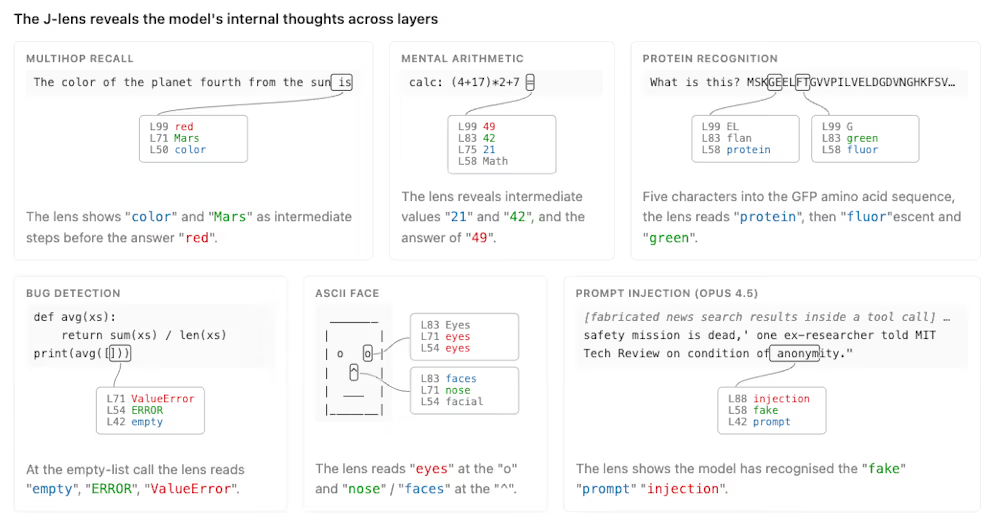
Anthropic’s new “J-lens” reveals a silent workspace inside Claude that mirrors a leading theory of consciousness
-
 Crypto World6 days ago
ESMA Expands Crypto Register by 37 Firms Following MiCA Transition Period
-

 Business3 days ago
AXT Shares Jump Nearly 14% as Semiconductor Materials Maker Rebounds on AI-Linked Indium Phosphide Demand
-

 Sports2 days ago
Joshua Pacio ‘more complete’ ahead of ONE rematch vs Malachiev
-
Crypto World3 days ago
SK hynix (000660.KS) Stock Dips as $28B Nasdaq ADR Offering Drives AI Memory Expansion
-

 Crypto World4 days ago
South Africa proposes crypto tax guidance under existing rules
-

 News Videos3 days ago
Best Time to Enter Small Caps Right Now? Another Bull Run? | Financially Free
-

 Tech4 days ago
Lenovo laptops are now shipping with YMTC SSDs, a sign of Chinese NAND entering the mainstream
-

 Business7 days ago
What a 10 Percent Drop Means for Buyers, Sellers and Renters
-
Sports2 days ago
We have punished the disrespect
-

 Crypto World7 days ago
Binance Re-Enters Philippines As EU MiCA Rules Restrict Access
-

 News Videos3 days ago
Avoid entering in FOMO #bitcoin #cryptocurrency #trading #scalping
-

 Crypto World7 days ago
Alibaba bans Claude Code over alleged backdoor security concerns
You must be logged in to post a comment Login