





With the Earth’s atmosphere being effectively just a less dense fluid than the oceans around us, it’s reasonable to ask why we got wind turbines and wind mills quite literally everywhere across the globe to harvest the power in the wind, whereas ocean waves and currents aren’t being exploited quite as much. In a recent video by [Giordano Scarciotti] this issue with wave power is addressed, in particular the massive engineering challenges involved.
One of the main problems is simply one of cost, with wind energy having converged on a single design involving effectively the same three-bladed rotor, gondola and tower design that has been optimized for decades now. For wave energy there’s no such one-design-fits-all solution, with each attempted design having its own advantages and disadvantages that may prevent it from working in various sites, or incur high maintenance costs in the highly abusive marine environment.
Having more energy in waves than in wind is also both a benefit and a curse, as wave turbines have to work with the waves and not get demolished every time there’s a storm. Even wind turbines regularly fail in windy weather when e.g. the brakes fail, under conditions that would be considered mild in a marine context.
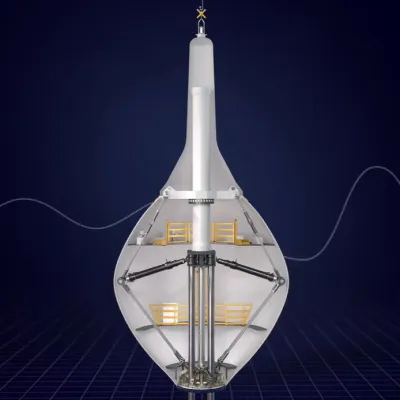
Also covered in the video is a new contender, in the form of CorPower Ocean’s new buoy-like design that bobs up and down on the surface. Here you need to carefully tune the turbine mechanism to work with the wave motion to extract the most energy. Their current design is be 19 meters tall, 9 meters wide and claimed to be capable of being installed in >40 meter deep water, producing power with a 40-60% capacity factor at 300 kW.
As yet another attempt at making wave energy turbines work, the most exciting aspect of it will be to see whether it can survive adverse weather, when careful tuning gets tossed out of the window and chaotic waves pummel what is essentially a very big hollow buoy. The single prototype has so far survived bad weather off the coast of Portugal during a year of testing, but the real test is long-term survival, as losing half your wave turbine farm to a really bad storm every five-odd years would quickly scuttle the project like it has previous commercial contesters.
Although not addressed in the video, the commercial challenge here is also not so much making the power generated over its lifetime (LCoE) economically attractive, but also its system integration cost in terms of required transmission lines, grid-level energy storage and backup power generators like baseload and standby power plants. Without equipping these wave power farms with grid-forming converters as TSOs are asking, dealing with reactive power to absorb and generate it, any resulting grid oscillations exacerbated by grid-following converters risk causing another expensive blackout as recently on the Iberian peninsula.


















































You must be logged in to post a comment Login