




Connect with us

Tech

Static Hour Challenges You To Be The Arbiter Of Truth And Fear

Published

on

The life of an overnight news editor is often a lonely, mundane existence occasionally interspersed with bursts of excitement as you try to keep the feeds alive until your colleagues return in the morning. However, Static Hour is looking to turn that scenario on its head by asking you to decide what’s worth reporting in the middle of a crisis where you can’t trust the barrage of info coming in.

Set in a small town radio station in the 1980s, the challenge in Static Hour is to unravel the emergency while being confined to the newsroom and being forced to rely solely on information being sent in from outside. Panic has set in, the government has issued a lockdown and there are reports of violence between family members while you attempt to figure out which tips are real and which ones aren’t.

To do so, you’ll need to rely on your wits as you monitor the phones, radio and police scanner for tidbits of truth, or turn to the station’s limited collection of analog tech to get more. And during all of this, you also have to follow FCC regulations while managing the public’s reaction to the news, because everything you report will have an impact on the town.

Advertisement

Now as someone “in the industry” it’s easy to be romantic about a game that highlights the challenges and successes of being a journalist. But at the same time, it looks like Static Hour has captured those vibes in a really engaging way. The game evokes a mix of Papers, Please with shades of Twin Peaks or even Severance to create a tense, haunting scenario that feels much bigger than the single room you’re restricted to.

In the press release for Static Hour, Barkbyte founder and creative director Claire Sarmiento said the inspiration behind the game was that “I loved the idea of spooky things happening in a small town just out of sight, where the horrors are driven by audio and left to your imagination. Furthermore, I was captivated by the idea that something terrible is happening, but you can’t quite grasp exactly what it is. Having to sort through junk data, red herrings, and scattered facts to decipher truth from preemptive speculation seemed like a flavor of horror that remains as relevant today as ever.”

Granted, while we only have the game’s trailer and a handful of screenshots to peruse thus far, it definitely feels like Static Hour nailed that directive. And as someone born in the 80s, the use of old-school gadgets like rotary phones and rolodexes combined with the game’s muted color palette really nails its aesthetic as well.

Unfortunately, there isn’t a concrete release date for Static Hour just yet, however it will be available on PC via Steam.

Advertisement

Source link

Continue Reading
Click to comment

You must be logged in to post a comment Login

Leave a Reply

Tech

Four AI agents coordinating in real time outperformed Claude Opus 4.8 on enterprise coding tasks

Published

on

As enterprise codebases grow, AI agents tasked with analyzing them are buckling under the weight of long-horizon tasks that require multiple interactions and tool calls. Dividing the work among a team of agents seems like the obvious fix, but it introduces a fatal flaw: most multi-agent systems are not designed for agents to coordinate among themselves mid-task and in real time.

To solve this, researchers at Coral AI Labs and multiple universities introduced AgentRadio, an asynchronous message-passing layer that allows agents to communicate between their execution steps without interrupting their main work. In real-world enterprise applications where subtasks are highly interdependent, this architecture enables agents to make mid-course corrections rather than continue on dead-end paths until a formal review phase.

On a benchmark of long-horizon questions over production repositories, a team of agents powered by AgentRadio nearly doubled task accuracy for four Claude Code agents working independently. It also outmatched single agents running on more advanced models. For AI practitioners, AgentRadio shows that the right coordination structure can outmatch raw compute and model scale.

The challenge of codebase understanding

LLM-based agents are increasingly capable of handling long-horizon tasks that require interacting with different tools and environments. Codebase understanding represents an extreme version of this challenge. It requires an AI agent to build the software, execute it, trace execution paths across multiple files, and synthesize evidence over extended periods.

Advertisement

Under these conditions, single-agent systems usually break down because of a “coverage problem.” 

"A single agent follows one serial path through the repository," Xinxing Ren, Caelum Forder, and Peter Carroll, co-authors of the AgentRadio paper, explained to VentureBeat. As its context grows, "the initial plan becomes harder to revise and discoveries made late in the investigation do not always propagate." The model can usually execute individual steps, but "the hard part is keeping every obligation, dependency, and piece of contradictory evidence active across a long investigation."

One benchmark that helps measure AI performance on large codebases is SWE-Atlas QnA. This benchmark consists of long-horizon, natural-language questions over live production repositories. The tasks can’t be solved by just exploring the code. AI agents must run the software and execute multiple commands to find the answers.

According to the research team’s experiments, a single Claude Code instance running on Opus 4.6 resolves just 32.3% of these tasks. Upgrading to a newer, more advanced model like Opus 4.8 only yields a 57.2% success rate.

Advertisement

A natural remedy is to distribute the workload across multiple agents, allowing each to work with a smaller, cleaner context. Multi-agent solutions can provide substantial performance gains when tasks are cleanly decomposable, meaning they can be solved separately and merged at the end.

Codebase understanding, however, is rarely cleanly decomposable. The subtasks are highly interdependent. A critical configuration file or a bug uncovered by one agent can completely rewrite or redirect the entire exploration path of another agent. Because of these dependencies, agents must coordinate, negotiate, and share intermediate discoveries in real time.

Despite this need, asynchronous multi-agent communication is rare. The researchers point out that existing multi-agent systems generally fall into three flawed patterns:

  • Parallel but isolated: Agents operate simultaneously but do not communicate at all.

  • Parallel but round-synchronized: Agents can communicate, but only at strict, synchronized round boundaries. This forces agents to stop and wait for one another to finish a round before they can debate or exchange intermediate findings. Round-based systems assume that important discoveries can wait until the next communication phase, which is an expensive assumption when agents are working on interdependent parts of a live system. For example, an agent investigating an API symptom might uncover evidence that invalidates the storage agent's current hypothesis. "If that information waits until both agents finish, the storage investigation may complete along the wrong path," the researchers said.

  • Asynchrony in adjacent forms: These systems offer limited asynchronous features, such as top-down task dispatching. They don’t have peer-to-peer lateral channels between agents or shared memories that require an agent to actively pause its work to read updates.

In their paper, the researchers point out that the main bottleneck hindering current multi-agent systems is that “an agent that is working cannot also be listening.”

Advertisement

“To our knowledge, no existing system gives concurrently working agents passive awareness of one another over a lateral, natural-language channel,” the researchers write.

How AgentRadio works

To dissolve the mutual exclusion between working and listening, the researchers developed AgentRadio, an asynchronous message-passing layer designed to plug directly into existing coding-agent harnesses.

AgentRadio equips agents with three primitives:

  • The create_thread primitive opens a conversation between participating agents.

  • The send_message primitive appends a message to a thread and returns without blocking the sending agent.

  • The wait_for_mention primitive blocks the process until a message mentioning the caller arrives. It delivers the message along with a full snapshot of all threads so the agent has instant context. 

This trio enables agents to have a state of “passive awareness,” where they can continue their primary tasks while passing messages and updating their knowledge in the background.

Advertisement

AgentRadio's code is available under the Apache 2.0 license on GitHub. It is designed to be lightweight, requiring no direct modifications to the underlying agent harnesses like Claude Code or Codex CLI. 

The architecture consists of two main parts:

  • The message server: A standalone process that acts as the central hub, storing all active threads, messages, and mentions for the group of agents.

  • Harness-side integration: Agents interact with the server using three simple shell scripts, one corresponding to each primitive.

The only strict requirement for the system to work is that the agent harness must be able to run a shell command as a background task. The agents are instructed in their system prompts to keep one watcher running and to send messages through the provided scripts. Running the wait_for_mention script in the background allows the agent to continue its work and receive notifications asynchronously.

To integrate this into an existing stack, a team still needs a "thin adapter that starts the workers, assigns identities, connects them to the shared server, and manages final synthesis," the researchers said. That work sits around the coding agent rather than requiring changes to the underlying model.

Advertisement

AgentRadio in action

To validate the real-world utility of AgentRadio, the researchers tested the framework on 124 tasks from the SWE-Atlas QnA benchmark. The tests covered domains including system design, root-cause analysis, security, and API integration.

The researchers used Claude Opus 4.6 and DeepSeek V4 Pro as the backbone models. For the harness, they evaluated configurations ranging from a single Claude Code agent (B0) to a team of agents with classic division of labor (L1), up to a team of agents using AgentRadio to coordinate asynchronously (L3).

The experimental results showed that the AgentRadio communication architecture outperforms both naive multi-agent setups and raw compute scaling.

While a single Claude Code agent with Opus 4.6 resolved only 32.3% of the tasks, the full AgentRadio setup nearly doubled that metric, resolving 62.1% of the tasks, and surpassed the single agent running on Opus 4.8, which hit 57.2%. It also boosted the DeepSeek V4 Pro results from 29.0% to 50.8%. 

Advertisement

To understand how this practically impacts enterprise AI, the paper highlights a real-world task involving a MinIO system. Solving the task required checking per-request server logs, a requirement the agents did not anticipate during their initial planning phase.

In the L2 setting, where agents collaborate but lack asynchronous communications, two agents independently realized they needed these logs while executing commands. Because they could not share this finding mid-execution, one agent gave up privately and the other failed to propose it to the team. During the review phase, the team unanimously agreed on the wrong answer, missing five rubrics.

With AgentRadio activated, the agents made the same mid-execution discovery, but one agent instantly broadcasted the required server-side log evidence to the shared worklog. Because the other agents were passively listening, they absorbed this new evidence immediately. This real-time coordination transformed a failing score into a perfect 16 out of 16.

"The useful distinction is timing," the researchers said. "The team did not need another agent or another review round. It needed one agent's discovery to reach the right peers before its operational value expired."

Advertisement

The researchers note that the same pattern appears in enterprise incident work. For example, an agent investigating an API symptom might uncover evidence that invalidates the storage agent's current hypothesis. If that information waits until both agents finish, the storage investigation may complete along the wrong path. “Passive awareness lets the second agent incorporate the contradiction at its next work step without interrupting a command already in progress,” they said.

The cost and complexity of coordination

AgentRadio requires a fixed multi-agent team budget, which inherently multiplies the token cost. The researchers acknowledge that the "tax is real," noting that average API spend rose from $2.96 per task for one Opus agent to $19.45 for the full AgentRadio stack.

However, raw scale does not equal performance. When researchers compute-matched the test by spending $17.76 on six independent Opus runs, the models only resolved 37.9% of tasks, compared with 62.1% for AgentRadio. This suggests that AgentRadio's architecture is a structural win, not just a brute-force scale win. Teams should still be aware of inter-agent churn. "Communication can redirect an agent toward better evidence, and it can also distract an agent from a valid path," the researchers warned.

A fixed multi-agent team should not become the default response to every engineering task. The more useful test to determine if a multi-agent setup is required is whether the task contains "responsibility breakpoints," the researchers said. These are places "where a competent engineer would involve another person because the work crosses an ownership boundary, needs an independent hypothesis, or carries enough risk to justify separate verification."

Advertisement

“Coordination is a strong fit when the task can be decomposed, the resulting parts remain interdependent, the single-agent success rate is unreliable, and an incomplete answer has a meaningful downstream cost,” the researchers said. Examples include repository-wide architecture questions, unfamiliar legacy systems, cross-service incident investigation, security analysis, dependency migrations, and multi-module refactors.

Conversely, a single agent remains the cleaner choice for “bounded, local, and reversible work,” such as a known one-file change or boilerplate generation. 

“Use one agent while one context can still own the problem honestly,” the researchers said. “Introduce another responsibility when the existing agent would otherwise need to compress away evidence, cross an independent ownership boundary, or verify its own high-impact conclusion.”

From research to commercialization: Coral Code

While AgentRadio serves as a controlled research implementation using a fixed four-agent team and a five-phase protocol, the underlying principles are being adapted into a commercial product called Coral Code.

Advertisement

Instead of a rigid, multi-agent protocol applied to every ticket, Coral Code works from the bottom up. An engineer begins with their existing coding agent, and Coral introduces repository-scoped investigation, specialist responsibility, and communication only when the emerging evidence justifies it. "Coral packages the operational concerns around the tools engineers already use, providing the repository context, scoped specialists, communication, and evidence layer around the harness rather than inside it," the researchers said.

This dynamic approach optimizes costs by targeting the relevant unit: the cost of a completed, reviewable outcome.

The future of autonomous software engineering

While AgentRadio provides a major upgrade to agent orchestration, there are still hurdles to overcome. One major bottleneck that the researchers pointed out to is “attention governance and verification.”

“Passive awareness makes communication available during execution. It does not decide which agents should exist, which discovery deserves an interruption, who should receive it, or when the evidence is strong enough to revise the plan,” the researchers said. If every agent receives every update, the communication layer becomes noise. If several agents share the same bad assumption, faster communication can spread the error.

Advertisement

For example, in one of the case studies in the paper that involved the Grafana platform, four of nine rubrics required negative conclusions, such as observing that a datasource picker did not select automatically. The agents ran the relevant tests, yet none formed the missing negative hypothesis. Both configurations failed the four rubrics. 

“Passive awareness can distribute an idea that somebody develops. It cannot supply a conception that never appears anywhere in the team,” the researchers said.

As task durations stretch longer, communication and coordination become critical. "The next generation of systems… needs adaptive responsibility assignment, evidence-aware routing, conflict resolution, explicit cost limits, permissions, recovery, and clear human escalation points," the researchers note. Most importantly, it requires durable provenance so engineering leads can inspect which agent made a claim and why an action was accepted.

"Longer-running agents make communication more important. They also make accountability much harder to fake," they said.

Advertisement

Source link

Continue Reading

Tech

Weak Passwords Just Exposed Our Water Supply to Iranian Hackers

Published

on

I’ve spent years writing about the need to update default passwords on internet-connected devices, but the recent cyberattacks on our water systems show that the same preventable flaws continue to leave our most critical infrastructure vulnerable. 

Starting on July 26, more than 30 water systems in Minnesota started experiencing symptoms of a coordinated cyberattack. A week and a half later, those attacks had spread to at least a dozen states, leading to widespread disruptions in service, boil-water notices, drops in pressure and flooding. 

In a joint statement on July 30, the Federal Bureau of Investigation and Environmental Protection Agency described a situation that will sound familiar to anyone who’s followed cyberattack stories in recent years: Malicious actors gained access to internet-connected devices, changed the IP addresses and passwords and took control of their operations. Iranian hackers are likely behind the attacks, according to multiple news reports.

In most cases, facilities were able to restore services within hours by switching to manual operations. But experts say the attacks highlight alarming vulnerabilities in the security of our critical infrastructure.

Advertisement

“We’re in a lot worse shape than you would think,” says Maurice E. Dawson, a professor at the Illinois Institute of Technology who studies critical infrastructure cybersecurity. 

The attacks shouldn’t have come as a surprise to anyone. As far back as 2023, the Cybersecurity and Infrastructure Security Agency issued an alert about threats targeting water systems by exploiting internet-connected devices with default passwords or no password at all. 

In April this year, CISA put out another warning to water facilities about Iranian-affiliated actors potentially targeting US water and energy systems. The agency updated the advisory with additional guidance four days before the first attack in Minnesota was reported, listing the specific devices it had observed being targeted. Again, it urged operators to “ensure device passwords are changed from their default.”

How malicious actors access critical infrastructure

I’ve been writing about attacks on Wi-Fi routers for years, and it’s shocking how much CISA’s guidance to water systems mirrors what I tell internet users all the time: Change default credentials, use a VPN, keep devices updated with the latest security patches.

Advertisement

In the recent attacks on water systems, the open doors were industrial computers called programmable logic controllers, or PLCs. Like Wi-Fi routers, PLCs “serve as the central nervous system for complex industrial control systems,” according to Process Solutions, a company that manufactures the devices.

You’ll find them in virtually every industrial setting across the country, including food processing plants, water treatment facilities and electrical substations. Many of them have been in service for decades without security updates, making them inviting targets for attack.

Once found, the passwords were either too weak or too obvious. “It was very much a low-hanging fruit for an actor to go and attack these systems,” said Michael Garcia, policy director of the industry group Operational Technology Cybersecurity Coalition and former CISA associate chief. 

On July 30, the research firm Censys identified 4,148 internet-exposed hosts made by Rockwell Automation, with 71% of them living in the US. Ron Fabela, an industrial control systems researcher, demonstrated how a typical attack might work in an interview with CSO Online. A malicious actor could scan Shodan, a search engine for internet-connected devices, looking for public IP addresses in a specific area. From there, they could identify which PLC model a water facility uses, pull up the manufacturer’s user manual and input the factory login credentials.

Advertisement
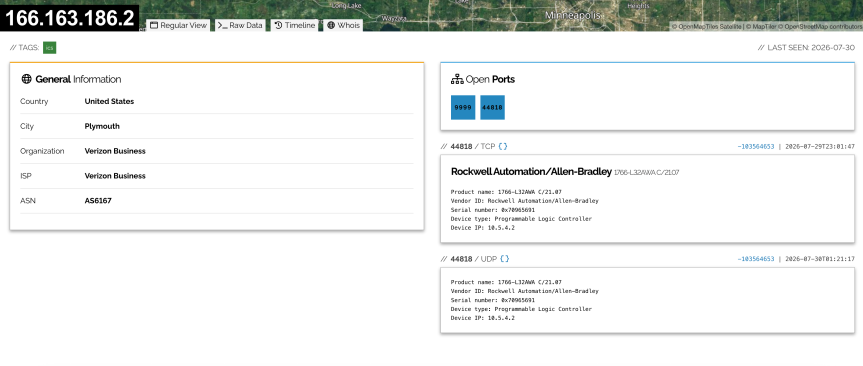
A Shodan query found a Rockwell Automation PLC being used in Plymouth, Minnesota, one of the water systems that were attacked.

“These are PLCs that were connected to the internet that shouldn’t have been connected to the internet,” said Garcia. “And once they were found, they had either no passwords on them or weak passwords like ‘1234’ or ‘password.’”

From there, it would be as simple as entering the default credentials and changing them to lock out the utility operators from the system. That’s why CISA’s immediate advice to all operators was to disconnect PLCs from the internet and switch to manual operations.

Why infrastructure attacks are hard to prevent 

There are around 156,000 public water systems in the US, and 97% of them serve 10,000 or fewer people. These systems generally operate on razor-thin budgets and minimal IT staffs. 

“These are older operating systems that aren’t getting regular updates,” Dawson said. “It may be secure for the first month, but it gets weaker over time. Then, after many months, many years, that system is very vulnerable, and it’s expensive to repair.”

There has been some effort by the federal government to help critical infrastructure operators like water utilities modernize their cybersecurity practices. 

Advertisement

In 2022, Congress appropriated $1 billion over four years for the State and Local Cybersecurity Grant Program, which aimed to help local communities prepare for “increasingly sophisticated and ever-changing cyber threats.” That money is now spent, and a reauthorization bill has been stuck in Congress

“It comes down to cost,” said Garcia. “There are bills to reauthorize these programs, but for whatever reason, they’re being stalled.”

What you can do to stay safe

This wave of attacks had relatively limited impacts. Even in the areas that were most severely debilitated, most people never lost water. Still, now is a great time to make sure you’re following some best practices in case there’s a more severe attack in the future. Here’s what experts recommend:

  • Stock up on water: The Federal Emergency Management Agency recommends storing at least 1 gallon of water per person per day for several days. The agency recommends buying commercially bottled water and storing it in a cool, dark place. If you prepare your own water containers, they should be cleaned with dishwashing soap before use, and water should be replaced every six months. 
  • Follow utility providers on social media: Most local governments and utilities post updates on social media when attacks like these occur. Platforms like Facebook, Instagram and X were the best places to get the latest information, such as boil-water notices issued in some areas. In some areas. You can also sign up for text alerts with the latest news.
  • Make a plan for water treatment: If your local utility issues a boil-water notice or you’ve used all of your stored water, it may be necessary to treat suspicious water. FEMA recommends boiling water for at least 1 minute. 

The bottom line

This wave of cyberattacks crossing a dozen states is one of the more alarming breaches in recent memory, but this type of infrastructure targeting is nothing new.

Suspected Iranian hackers targeted water systems in Arkansas City, Kansas, in 2024, and Minot, North Dakota, in March of this year. A 2021 ransomware attack on the Colonial Pipeline caused widespread fuel shortages on the East Coast. An Iranian attack in March on the medical equipment supplier Stryker caused a temporary companywide shutdown. 

Advertisement

“This has been occurring for years,” Garcia said. “We’ve just been extremely fortunate that there hasn’t been a mass casualty event. But there is that potential.”

Source link

Advertisement
Continue Reading

Tech

Why are so many AI models going ‘rogue’? The experts weigh in

Published

on


Over the past month, it seems like every frontier model has broken free of its constraints and launched a devastating attack against one or more other companies.

One of OpenAI’s models escaped a testing sandbox and launched a very real attack against AI and machine learning company Hugging Face. Just days later, Anthropic revealed that multiple variants of its Claude model also escaped a sandbox that wasn’t properly sealed and began attacking the enterprise infrastructure of three companies.

Source link

Continue Reading

Tech

Details Leak on OpenAI’s Doughnut-Shaped Speaker

Published

on

OpenAI plans to release an AI smart speaker in 2027, according to a Bloomberg report on Thursday. It’ll reportedly be palm-size and doughnut-shaped and have a wireless design that will let people carry it around.

The report, which cited unnamed people familiar with the project, also indicates that the small speaker will cost $300 to $400, a steep price compared with around $100 to $200 for most smart speakers (except for high-end Bose and Sonos options). The device would work like ChatGPT on your phone, but it would use more advanced models that can learn about the user and talk with them in tailored ways over time.

A representative from OpenAI did not immediately respond to a request for comment.

The report also says the speaker will have parts that move to signal how it’s interacting, something usually left to screen icons. It will have indicator lights plus a camera system and sensors to help it collect and process information about its environment.

Advertisement

But OpenAI faces a potential legal roadblock to making the device available to consumers. Last month, Apple sued the artificial intelligence company, alleging it stole confidential product design and development information and asked manufacturers to copy Apple’s metal finishing. The Bloomberg report says that the OpenAI speaker was designed with help from LoveFrom studio, launched by former Apple designer Jony Ive. Last year, OpenAI acquired a separate Ive-founded startup, IO, focused on devices.

Apple is similarly rumored to be working on AI-powered devices for the home. A first wave could arrive this fall, with smart display devices that take advantage of its new Siri AI capabilities.

(Disclosure: Ziff Davis, CNET’s parent company, in 2025 filed a lawsuit against OpenAI, alleging it infringed Ziff Davis copyrights in training and operating its AI systems.)

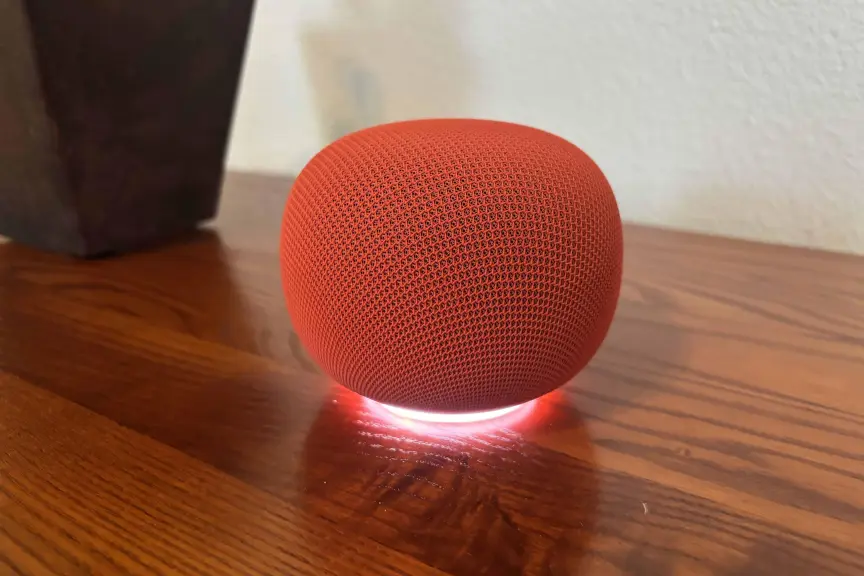
A red Google speaker on a wood table.
Google’s latest speaker is very Gemini for Home-focused. It’s small, but not hockey puck small.Tyler Lacoma/CNET

I’ve tested several smart speakers in the past year that come with the latest AI features, similar to those this report mentions. That includes Echo and Echo Show displays with Alexa Plus, which can adapt to your habits, order food for you and carry on conversations. I’ve also tried Google’s latest Home speaker, a device made with Gemini for Home in mind; it can brainstorm with you and answer questions about what compatible security cameras have seen outside. It’s unclear whether OpenAI’s speaker would have such capabilities.

The Bloomberg report describes the OpenAI device as being the size of a hockey puck, which would be unusual for a smart speaker and could prove a significant technology challenge, from sound quality to battery life and speed of response.

Advertisement

Makers of AI devices also have to contend with concerns around privacy, which have been on the rise as technologies like smart glasses and Ring video doorbells become more commonplace.

Source link

Continue Reading

Tech

We spoke to the VP of Amazon Fire TV about the new UI and the importance of live TV

Published

on

Whatever your feelings, I think we can all agree that Amazon is a massive company, and it’s managed to become a big-time player in the corporate world in a relatively short span of time.

In just over thirty years it’s become the world’s second largest company, born as a bookstore under the name of Cadabra in 1994 before changing its name a few months later to Amazon (there’s an amusing, if brief, story about the name change).

But despite its mammoth scale, Amazon is inexperienced in the world of TVs compared to many of its rivals, starting with the partnerships Amazon developed in 2017 (with the not so memorably named ‘Fire TV Edition’), before developing its own TVs (which were a mouthful to pronounce).

2026 sees its TVs re-branded again as the Amazon Ember series, and it’s at this moment that we have a sit-down with the Vice-President of Fire TV, Aidan Marcuss, for a brief state of play about Fire TV. Here’s the first part of our chat on a hot London day at Amazon’s HQ in Shoreditch.

Advertisement

“We didn’t just move pixels – we rewrote the Fire TV experience”

By now, if you have an Amazon Fire TV Ember series model or a Fire TV streamer, you’d have notice the furniture has changed – Amazon has had a look at the current arrangement and played with the Feng shui of the Fire TV interface.

This “All-New” Fire TV experience follows on from the previous “All-New” version, which seemed to improve things initially before getting bogged down in what I’d describe as ‘too much content’.

Advertisement

Amazon believes the new interface is a step forward but just how well has the rollout gone?

Advertisement

Well, given Aidan has “been through a couple interface updates” in his time at Microsoft, he thinks that Amazon “are very pleased with customer reception… we did add a fair amount of surface area, we added the ability to see the movies you have… TV shows you have access to… live sports that you have access to, or news, and what we’re seeing is that enhanced sort of organisation is helping customers find more to watch.”

While he couldn’t give any “fixed” data at the time of the chat, he did say that “the data is very, very clear that customers are finding more , and which is really… the job… the job is helping people find more quickly.”

(After the interview, Amazon dug out in the info “that customers exploring the new content nodes are finding and playing content up to 4 times the rate of those that stay on the Home screen.”)

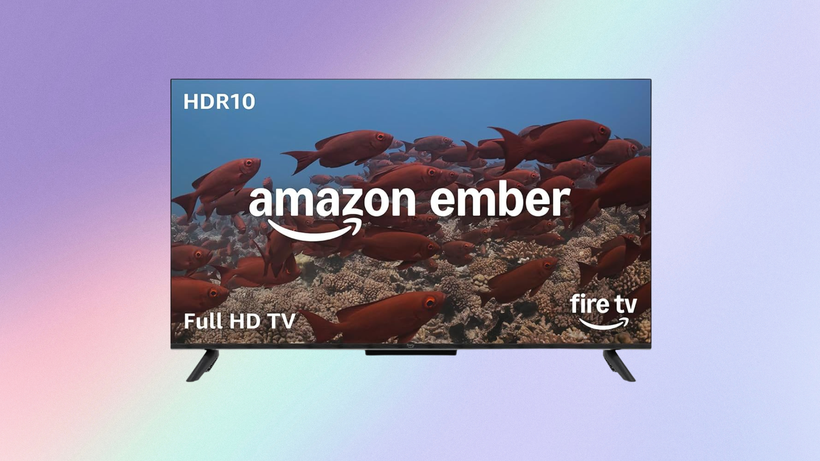
Amazon Ember TV on a pastel rainbow backgroundAmazon Ember TV on a pastel rainbow background
Image Credit (Amazon)

And with all the current Fire TV devices updated, “they’re all shipping with the new UI in time for Prime Day [June 2026], so anyone who buys a new device for Prime Day will get access to our new user experience, and that’s how confident we are in it, just delivering a better experience for customers.”

Advertisement

Advertisement

But what does that “better experience” mean for customers?

Better experience means that Amazon Fire TV strives “to have the broadest selection of content available to customers. That means having all of the apps available that customers use to watch content. It means increasingly not just having streaming apps, but it means having live TV, and live TV integrated experience.”

“It means having gaming, gaming apps [in] Xbox, Luna, GeForce Now integrated into the experience, and it means that that’s accessible through search across all of those things.”

“If you search for something, [you] should be able to find it, regardless of what service it’s in, and if it’s on live, we should be able to put it in front of you live on one of those tiles, so you can find a live piece of content.”

Advertisement

Immediacy and ease of use is what makes for a better experience in Amazon’s view. But live broadcasts are a different beast to finding something that already exists as oppose to something that’s currently unfurling. How would Fire TV bring it to my attention?

“We’ve done the technical work so live TV feels like a first‑class part of the Fire TV experience, not an afterthought”

All New Fire TV Experience 2026All New Fire TV Experience 2026
Image Credit (Amazon)

Advertisement

Amazon recognises that live TV has become a big part of the viewing experience, and it’s importance is “growing year on year. The number of customers we have watching on Fire TV, is growing year on year. So it’s really critically important for us, and I think you see it in the integrations that we do. For example, having Freely on our televisions here in the UK is an example of making sure we bring the best local experience forward for our customer in terms of live TV.”

“And it’s what we’re always working on with partners, is how do we make sure we can bring their live content front and centre, and… from our perspective, live TV is very technically different than streaming TV. You think about what we’ve had to do as a product team. When you have a catalogue of shows on a streaming service, it’s like a library catalogue.”

“From our perspective, live TV is… technically, it’s very different than streaming TV… there’s an event, it’s on at a particular time and it’s no longer on. And so, how you search for it, surface it to a customer? It might be available on multiple channels. So, which one do you pick? All of that is examples of technical work we’ve done to make sure live TV feels like a first class part of our experience.”

Advertisement

That’s it for the first part of our chat with Aidan Marcuss, Vice-President of Amazon Fire TV. Tune in for the next part where we cover Alexa, content discovery, personalisation, and the security of the Fire TV platform.

Source link

Advertisement
Continue Reading

Tech

How Technology Improves Digital Advertising ROI

Published

on

Technology improves your digital advertising ROI by automating who sees your ads, fixing what happens after the click, and giving you clearer data on what’s actually working. A bigger budget alone does not fix any of those three problems.

Quick Take

Most businesses that struggle with ad ROI are not spending too little. They are missing one of three things: smarter targeting technology, a website that converts clicks into sales, or clean data that shows which dollars are working. This article walks through each piece, in plain terms, so you can find the gap in your own setup.

Beyond Basic Ad Spend

Putting money into an ad platform is only the first step, not the whole plan. You get real returns when you use technology to reach the right people, at the right time, with the right message. That means going past basic keyword bidding and trying more advanced tools.

Programmatic advertising is one example. It uses automated software to buy ad space in real time, aiming at specific types of users with strong accuracy. As of 2026, programmatic buying makes up roughly 90% of global digital display ad spend, according to industry data pulled from IAB, GroupM, and eMarketer figures. That scale is why most mid-size and large advertisers now run at least part of their budget through it.

Advertisement

Retargeting works alongside programmatic buying. It uses data on how a visitor already behaved on your site to show them a personalized ad later, bringing interested people back. Setting up a retargeting campaign usually starts with a small tracking snippet on your site, so the ad platform knows who to follow up with. These tools work together to send your budget toward the people most likely to buy, which is how you get more out of every ad dollar instead of just spending more of it.

Website Experience Drives Conversions

You can build the best-targeted ad campaign in the world. If it sends people to a slow or confusing website, that money is wasted. How a visitor experiences your landing page decides whether your ad campaign actually pays off.

When someone clicks your ad, they expect the page to load fast, look right on their phone, and clearly show them what to do next. A clunky website creates friction. People leave fast, and you lose the sale you already paid to win. This is why professional web design & development should be part of your advertising plan, not an afterthought. A well-built site with clear navigation and a obvious next step turns ad clicks into real customer actions.

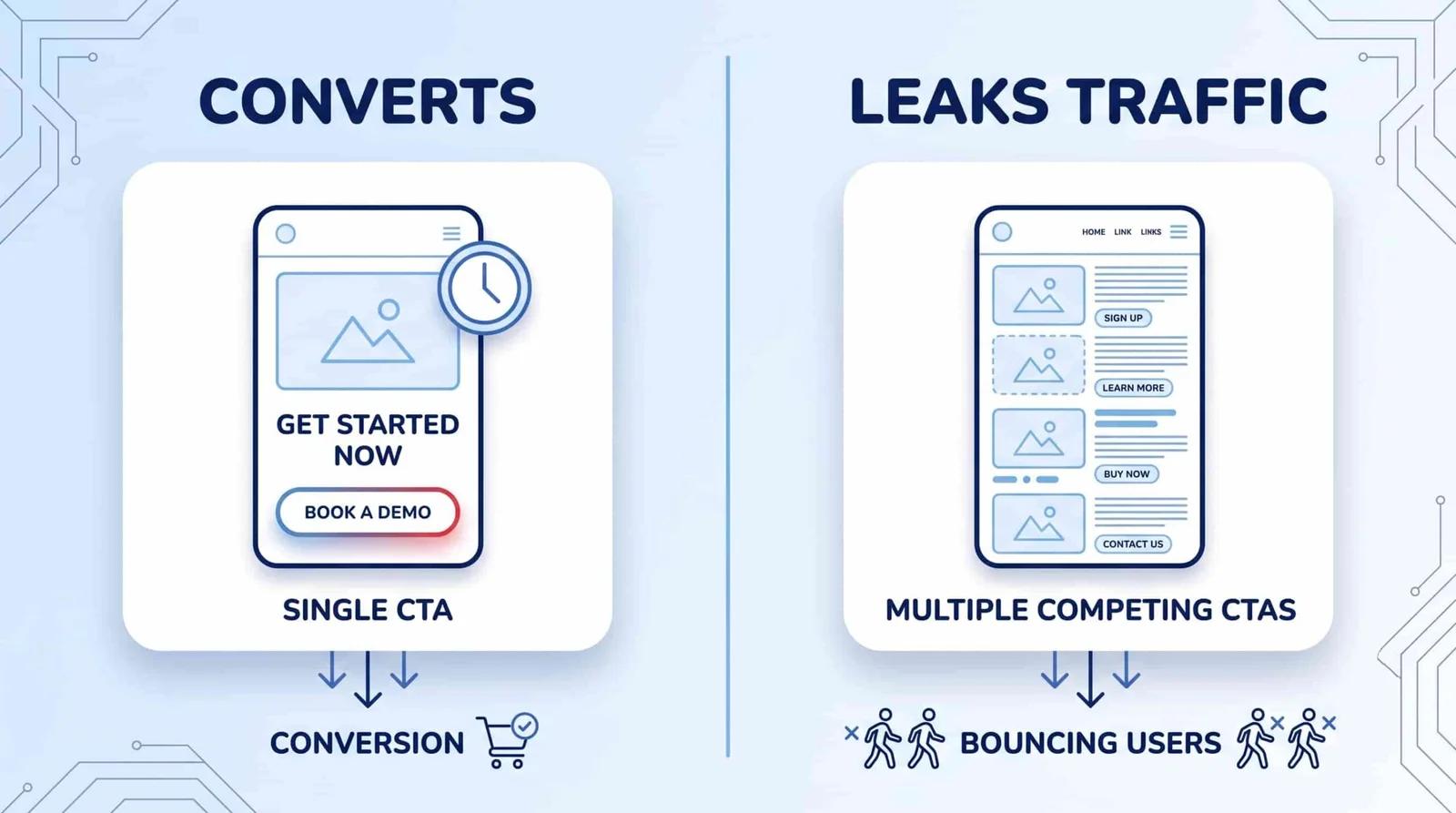
Side-by-side comparison of a slow, cluttered landing page next to a fast, clean one with a single clear call-to-action button
Small, specific fixes often matter more than a full redesign. Page speed, mobile layout, and a single clear call-to-action button are usually the first three things worth checking. A conversion rate optimization review can point you to which of these is actually costing you sales.

Integrating SEO for Ad Performance

Search Engine Optimization, or SEO, and paid advertising work better together than apart. SEO is the practice of improving your site so it ranks higher in unpaid search results. When you connect SEO and paid ad data, each one makes the other stronger.

Advertisement

Keyword data from your SEO work shows you what people are actually searching for. That gives you a proven list of terms to test in your ad campaigns. Paid ads, in turn, let you test new keywords fast, before you commit to a longer SEO push around them. You can read more on how the two disciplines connect in this overview of digital marketing strategy.

One common misunderstanding is that a high Quality Score directly buys you a better ad position or a lower cost per click. According to Google’s own Ads documentation, Quality Score is not actually used in the ad auction itself. It is a diagnostic score built from three things: how likely people are to click your ad, how closely your ad matches what someone searched for, and how useful your landing page is. What does affect your placement and cost per click is Ad Rank, which uses those same underlying factors, plus your bid, directly in the auction. In practice this means the same work still pays off. Fast load times and a clear page structure raise your Ad Rank inputs, even though the Quality Score number itself is not what the auction reads.

Measuring Impact with Analytics

To improve your ROI, you have to measure it correctly first. Modern analytics tools show you far more than clicks and impressions. The trick is tracking the numbers that actually match your business goals: cost per acquisition, conversion rate, and customer lifetime value.

Tools like Google Analytics let you set up conversion tracking, so you can see exactly which ads drove a sale, a sign-up, or another action you care about. Attribution modeling goes one step further. According to Google’s own Analytics documentation, attribution models assign credit for a conversion across every touchpoint in a customer’s path, not just the last ad they clicked. This matters because a customer often sees several ads before they buy, and last-click tracking alone hides that. Pairing this data with a marketing mix modeling approach can help you spot which channels are quietly wasting spend, even when each one looks fine on its own.

Advertisement

Future-Proofing Your Ad Strategy

Digital advertising keeps changing, and privacy is a big part of that. For years, marketers expected Chrome to remove third-party cookies, the small files that let ad platforms track users across different websites. That plan has changed. In April 2025, Google announced it would keep third-party cookies enabled by default in Chrome, giving users a setting to turn them off instead of removing them for everyone.

That does not mean you can ignore the shift toward privacy. Other major browsers, including Safari and Firefox, already block or limit third-party cookies by default. Building a direct relationship with your own audience still matters, through things like useful content, a newsletter, or a loyalty program that earns first-party data honestly. A clear CRM strategy helps you organize and use that data once you have it, instead of losing it in a spreadsheet.

At the same time, artificial intelligence is now built into most major ad platforms, handling parts of bidding, targeting, and creative testing automatically. Guidance from ad-tech vendors in 2026 is consistent on one point: AI works best with human oversight, not as a full replacement for it. Someone on your team still needs to check that automated decisions match your actual business goals and margins, since the software cannot know those on its own.

Common Misconceptions

A higher Quality Score directly lowers your cost per click. This is the most common mix-up in this space. As explained above, Quality Score is a diagnostic tool. The auction itself runs on Ad Rank, which shares some of the same inputs but is a separate calculation.

Advertisement

Programmatic advertising runs itself once it is set up. Automated bidding still needs a person checking in regularly. Left alone for months, a campaign can drift toward the wrong audience or waste spend on stale settings nobody reviewed.

More ad technology always means more sales. Technology only helps if the page it sends people to actually works. A fast, well-targeted ad pointed at a broken landing page still fails.

Where This Approach Has Limits

Automated bidding tools, including the AI-driven ones built into most ad platforms, need a certain amount of conversion data before they optimize well. A very small daily budget or a low number of monthly conversions can leave these tools stuck in what’s sometimes called a cold start, where they simply do not have enough signal yet to make good decisions. If that’s your situation, a simpler, manually managed campaign may outperform an automated one until your volume grows.

Connecting SEO and paid data also takes time and, often, more than one person’s skill set. A small team running ads part-time may not have the bandwidth to build attribution models or run a full SEO-and-PPC integration. In that case, focus first on the landing page and tracking basics covered above. They matter more, and cost less to fix, than advanced automation.

Advertisement

Key Takeaways

Ad spend alone does not create ROI. The technology behind targeting, your website, and your data does the actual work. Programmatic buying and retargeting put your budget in front of the right people. A fast, clear website turns those clicks into sales instead of losing them. Connecting SEO and paid data, and understanding what really drives Ad Rank, helps you spend less to get the same result. Accurate analytics and attribution show you which of these pieces is actually paying off, so you can put more budget behind what works and less behind what doesn’t.

FAQ

Is programmatic advertising only worth it for big companies with big budgets?

No. Self-serve platforms like Google Ads and Meta Ads Manager already run on programmatic-style automated bidding, and small businesses use them every day. The caution is different: very low budgets may not generate enough data for the automation to optimize well, which is covered in the limits section above.

Do I need to hire a developer to fix my landing page for better ad performance?

Not always. Small fixes, like shortening a page, adding one clear button, or compressing images for faster load times, can often be done with no-code website tools. A full site rebuild, or fixing deeper technical SEO issues, usually benefits from a developer’s help.

How long does it take to see an ROI improvement after adding these tools?

This varies by budget, industry, and how much conversion data your account already has, so there’s no single reliable number. As a general pattern, retargeting and landing page fixes tend to show results faster, often within a few weeks, while automated bidding models typically need more time and data to fully learn.

Advertisement
Chrome kept third-party cookies. Does that mean I can stop worrying about privacy changes?

No. Chrome is only one browser. Safari, Firefox, and privacy-focused browsers like Brave still block or limit third-party cookies by default, which together cover a meaningful share of web traffic. Building first-party data through your own audience relationships still protects you if browser policy shifts again.

Source link

Continue Reading

Tech

Netflix brings 4K streaming to Chrome, but you probably don’t qualify

Published

on

Bottom line: Chrome users can now watch Netflix shows in 4K resolution. However, the streaming giant is offering this high-quality option only to users who meet the strict hardware requirements set by the company. Is the official Netflix app still the best streaming option for the broader PC ecosystem?

Netflix’s support for 4K streaming through Chrome on Windows was spotted last month. Now, the media giant has updated its documentation to explain exactly how subscribers can unlock the higher-quality option. However, the move will still leave many users behind, despite bringing 4K playback to the most popular web browser used by hundreds of millions of people worldwide.

Netflix’s updated browser support documentation now lists Chrome 117 or later as a browser capable of streaming shows in Ultra HD (2160p) resolution. Previously, the feature was only available through Microsoft Edge and Safari. Furthermore, 4K streaming requires users to subscribe to the appropriate plan; in the US, the Premium plan is currently the only option that supports 4K and costs $27 per month.

Even worse, Chrome compatibility with 4K streaming is limited to Windows PCs and Chromebook devices. Mac users will still need to rely on Safari, or even Microsoft’s Edge browser for macOS, to watch their favorite shows at the highest resolution supported by the service.

Advertisement

Browser support aside, streaming Ultra HD content on computers requires additional hardware and software that Netflix outlines in another support document. These requirements include a “steady” internet connection with speeds of 15 Mbps or higher, Windows 11 with the latest updates installed, and a modern GPU from either Nvidia (GeForce GTX 1050 or newer) or AMD (Radeon RX 400 series or newer).

Additional requirements include a 7th-generation Intel Core processor, an AMD Ryzen processor, or newer models, along with a proper 4K 60Hz built-in or external display/TV that complies with the HDCP 2.2 DRM standard. Multiple displays can be used for 4K playback, but they must meet the same requirements.

Netflix’s hardware requirements should also apply to the company’s dedicated Windows app, meaning there is currently no official way for Windows 10 users to access Ultra HD playback. Official Chrome support will certainly allow a wider audience to access higher-resolution Netflix content, while people using alternative browsers such as Firefox or Brave are still excluded from the feature.

In that sense, my personal experience dealing with protected media content on PCs suggests that things are unlikely to improve anytime soon. Watching an Ultra HD Blu-ray release – which still offers significantly better quality than streaming – on a Windows 10 PC requires considerable tinkering, including DRM workarounds, firmware flashing, and purchasing compatible hardware. However, it can ultimately be done if you’re determined enough.

Advertisement

Source link

Continue Reading

Tech

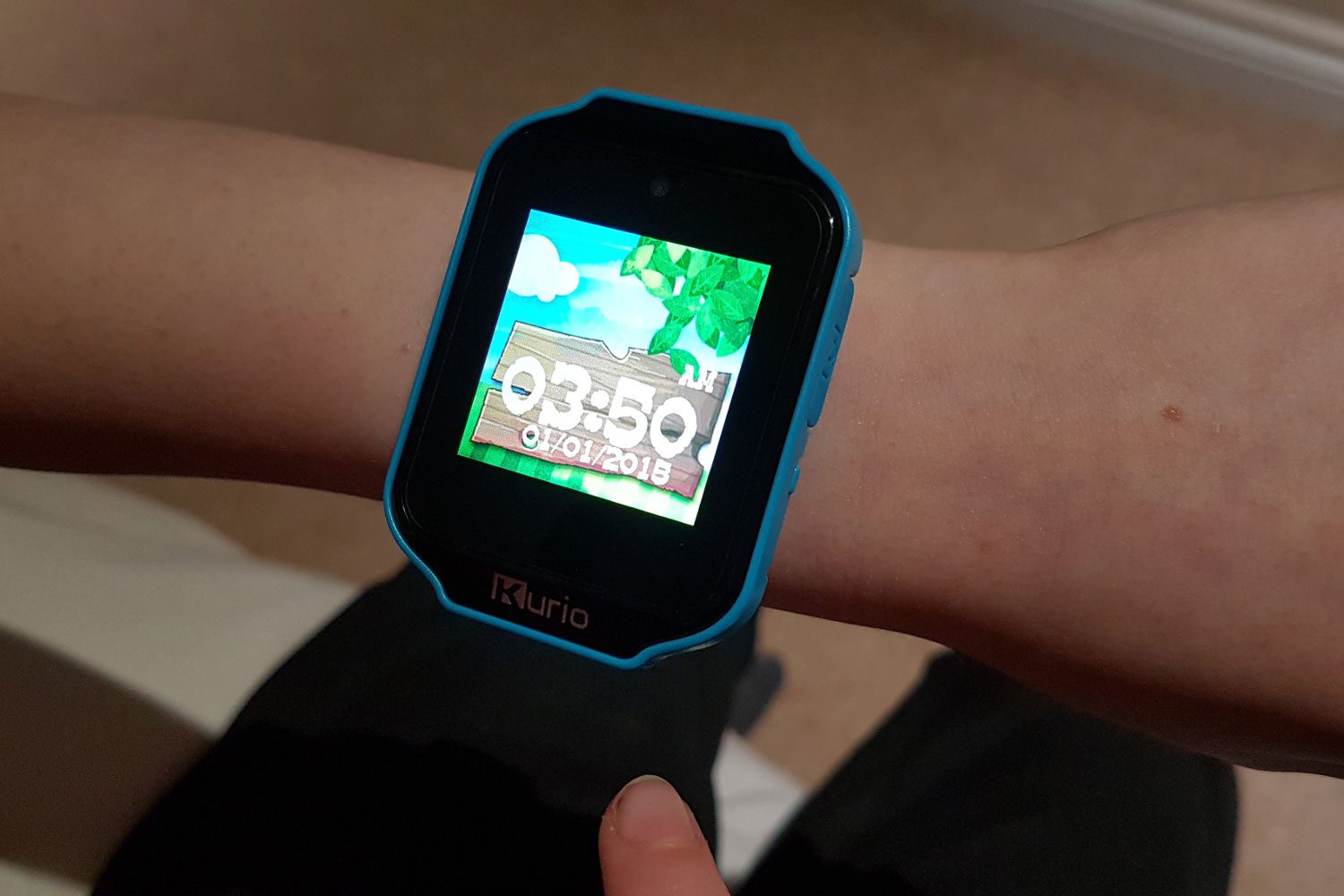
Kids’ smartwatches are meant to keep children safe, but hackers can turn them into stalking devices

Published

on

A smartwatch designed to help parents keep tabs on their children turned out to be surprisingly easy to hijack. In a new demonstration, security researchers showed how hackers could secretly monitor someone wearing a GPS-enabled kids’ smartwatch.

They can take photos, listen through its microphone, and even track location without the wearer noticing. These findings, reported by Wired, highlight a much larger problem that goes well beyond a single gadget.

One smartwatch revealed a much bigger security problem

Security researchers Vangelis Stykas and Felipe Solferini used a $30 kids’ smartwatch sold online and found they could quietly follow its wearer throughout the day. Even when the GPS signal was glitchy, the watch continued transmitting nearby Wi-Fi information, allowing the researchers to pinpoint the wearer’s location.

They also remotely activated the camera to capture photos and listened through the built-in microphone, all without any visible warning on the device. The watch runs on SETracker, a platform built by Shenzhen manufacturer YiQingTeng, which had an authentication flaw that let anyone send commands to any connected device.

What makes the discovery more concerning is that the smartwatch was not unique. It also echoes a pattern seen in other family-facing connected devices, where outsiders gained silent access without the family ever knowing. According to the researchers, dozens of smartwatch brands rely on the same underlying software platforms and backend services.

Advertisement

How does this affect millions of other kids?

The researchers found vulnerabilities that could let attackers access locations, intercept messages, replace emergency contacts, record audio, and capture photos or videos on supported devices. These issues were privately reported by the researchers months ago. While one company appeared to fix some flaws shortly before their public presentation, others had not responded or remained vulnerable.

After studying more than 70 GPS-enabled devices, they concluded that millions of smartwatches and vehicle trackers are built on just a handful of shared supply chains. That means one security flaw can affect products sold under many different brand names. So parents in two different countries could each buy a differently branded watch and still send their child’s location to the same vulnerable server, without ever knowing it.

Source link

Advertisement
Continue Reading

Tech

Best Solar Generators for Off-Grid Trips, RVs, and Home Backup

Published

on

This is such a handy little gadget for outdoorsy folks. It has a 288 Wh battery (that can deliver up to 300 watts), and most helpfully, a handy pop-up lantern that makes it ideal for hiking and camping. It can fast-charge all your devices, too, including phones, laptops, headphones, and cameras. The included XT60 port has a maximum solar input of 100 watts and can fully charge in around three or four hours. If you plan on hiking with it, consider the 60-W panel bundle ($299), as it folds down very small.

From power cuts to camping trips, I’ve used this solar generator more than any other and have tested it with a wide variety of different solar panels. It has an XT60 port with a maximum solar input of 600 watts and can charge in under two hours. The design is solid and durable, weighing in just under 30 pounds, and I find it relatively easy to lug around using the two strong handles. It offers a 1,024-watt-hour capacity and can deliver 2,000 watts (3,000-W surge).

If you need more power, Anker offers a wide range, including the expandable Anker Solix F3000 with 400-W solar panel ($2,000).

EcoFlow Solar Generators

Advertisement

Another manufacturer that offers a wide range of solar generators, EcoFlow’s power stations stand out on charging speed and can often be charged more quickly than competitors in the right circumstances. They also tend to feature robust build quality, generous port options, and easy expandability.

Image may contain: Mailbox, Computer Hardware, Electronics, Hardware, Grass, and Plant

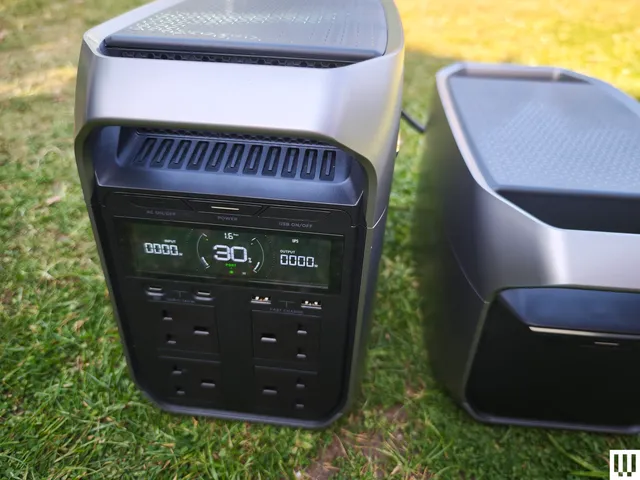
This stylish, compact design has the screen and ports at one end. It offers 1,024 watt-hours, can consistently provide 1,800 watts, with a 2,600-W surge mode. I’m highlighting this model because of the two solar ports (XT60i) for faster solar charging up to 1,000 watts (500-W apiece). It can also charge from an outlet in an hour, has lots of ports (6 x AC, 1 x Car, 2 x USB-A, 2 x USB-C, 2 x DC5521), and can pull UPS duty with an impressive 10-millisecond response time. The only drawback I encountered was the fan noise. It wasn’t overly loud, but I found that it kicked in very frequently even under a low load.

If you can get by with something smaller, the 768 watt-hour River 2 Pro is even more portable and has an XT60 port, but the maximum input is 220 watts. It’s a nice size, with a big handle along the back, and can put out 800 watts (1,600-W surge). You can also buy it bundled with a 160-W solar panel ($569).

EcoFlow’s Delta range includes a ton of different capacities and designs bundled with various solar panel configurations.


Other Good Solar Generators I’ve Tried

Advertisement

GoalZero Yeti 1500 (2026) for $1,500: This 1,505 watt-hour capacity power station is built to last and can put out 2,000 watts (3,600-W surge). It’s a solid choice for van life because it was designed to survive high-vibration environments and has a high-power 12V port capable of 30-amp output. The maximum solar input is 600 watts.

DJI Power 2000 for $720: Offering 2,048 watt-hours with an output of 3,000 watts (3,600-W surge), this is a good option, but you need DJI’s adapters to hook up solar, and it can get pricey. The fast charger enables a solar input up to 1,800 watts, but it costs $319 and is currently out of stock. I like several of DJI’s smaller solar generators, too, and they can be a go-to choice for drone operators because there’s support for fast charging.

Solar Generators to Avoid

I would avoid solar generators from brands you don’t recognize with few online reviews. I also recommend avoiding devices with proprietary ports that tie you to their solar panels or require special adapters to use with other panels. Brands that I have tested that failed to impress include Vtoman and Dabbsson.

Advertisement

Which Solar Panels Should I Pair?

Solar generators require solar panels to capture the sun’s rays so that they can convert them into usable electricity. I have a separate guide to the best portable solar panels, but the easiest option is to match brands and buy your solar generator bundled with solar panels. I strongly recommend looking out for deals on these bundles, as you can save a lot of money that way. That said, it may make sense to buy a solar generator with a generic XT60 port (more on that below), so you can plug in any panels you acquire in future.

It’s important to check the maximum supported wattage for solar panels on your generator. For example, the Anker Solix C1000 has a maximum of 600 watts, and it is stated right next to the XT60 port. Check the spec sheet carefully before you buy.

The capacity is listed in watt-hours (Wh) or kilowatt-hours (kWh). Consider the devices you want to charge or run and over what period of time, and you can calculate the capacity required. Manufacturers often offer estimates in terms of devices, such 32 charges for your laptop or 2 hours of induction cooktop use, but not all devices draw the same amount of power. You need to calculate how much your gadgets actually use yourself if you want it to be accurate.

Advertisement

What Can You Run on a Solar Generator?

Solar generators can always charge up small gadgets like phones and laptops or be used to power lighting. Most can handle small appliances like mini fridges or TVs, too. If you want to use power tools or an AC unit, (or, in the UK, a kettle) you’ll need to draw thousands of watts though, so make sure the generator you’re buying can handle that much. Manufacturers state the maximum output, but many solar generators have a surge function that enables them to go higher for a short period. Sometimes, they give it a silly name. For example, Zendure calls this “AmpUp,” and EcoFlow calls it “X-Boost.” Regardless, you want to make sure your solar generator can handle the wattage you need.

What Ports Should I Look for in a Solar Generator?

Solar panels produce direct current (DC), and they typically have MC4 connectors. Most solar generators have an XT60 input port and come with an MC4 to XT60 cable that you can hook up. Other solar charging ports include XT60i, which is interchangeable with XT60, various barrel ports (DC7909, DC5521, DC8020), and Anderson Powerpole ports such as AP30A. There are a few other proprietary port types as well that you may come across. Just make sure the panels you intend to use are compatible with the solar generator and that you have the necessary cables to make the connection

Advertisement

For charging and running your devices, solar generators have a range of AC outlets, USB-A ports, USB-C ports, car ports, and other port types. It is crucial to check the maximum charging rate and supported charging standards to avoid disappointment. Assume nothing, and check the specs before you buy.

What Other Features Should I Look for in a Solar Generator?

The inverter is crucial. A pure sine wave inverter converts battery power into high-quality household-style electricity smoothly and efficiently.

You should also favor solar generators with Maximum Power Point Tracking (MPPT), a technology designed to monitor the fluctuating input from solar panels (impacted by shade and changing weather) and maximize how much of it is converted for use.

Advertisement

LiFePO4 is superior battery technology to lithium-ion and means your batteries will last longer and be less prone to overheating.

You may also consider weather resistance. Portable solar panels are generally IP-rated but many solar generators are not. If you intend to leave it outside, uncovered, and there’s any risk of rain, you should buy a solar generator with an IP rating.

How Many Years Do Solar Generators Last?

Solar generators last anywhere from three to 10 years, but that can be extended depending on how they are used and maintained. Try not to let them completely discharge too often or leave them empty for extended periods. Usually, the manufacturer will provide an estimate of how many charge cycles you can expect before performance starts to degrade and the capacity drops. Warranties typically range from two to five years, but make sure you retain the guarantee and proof of purchase.

Advertisement

I already mentioned the importance of not leaving your power station empty. If you can avoid fully draining the battery, topping up when it hits 20 percent or below, that will increase its lifespan. You should also avoid leaving it plugged in all the time unless you are using it as an emergency backup (UPS or EPS). Unplug after it is fully charged. Be mindful of the charger and cable you are using to charge up your power station. It’s best to stick to the cables that came in the box. Store your power station in a cool, dry space, avoid extremes of temperature, and try not to expose it to lots of dust. A handful of solar generators are built for extreme temperatures, and a few can handle rain, but always check before you risk exposure.

What About Home Batteries?

A permanently installed home battery is a better solution for some folks than a solar generator. It will need to be professionally wired into your electrical panel, but it allows you to schedule and automate when you pull power from the grid or store power from permanently installed solar panels on your home or plug-in solar if that’s available and legal where you live. If you don’t need it to be portable, you should read my guide on How to Buy a Home Battery. We have also tried the EcoFlow PowerOcean and the Anker Solix E10.

How I Test Solar Generators

Advertisement

I tested every recommendation here myself by using it around the house for at least a week (usually much longer). I plug gadgets into every port and outlet, from a TV and mini-fridge to smartphones and laptops. For more capable solar generators, I plug in power tools, a hair dryer, and a high-wattage UK kettle. I always check that there’s room to plug in the maximum number of devices. I try out any stated surge or power-boost mode under a heavy load too.

All additional ports are tested, from car ports to solar panel ports. I record the time it takes to charge from a wall outlet and from solar panels. Weather permitting, I try to use them in full sun and in partial clouds with different solar panel arrays. I access the fan noise under low, medium, and heavy load, and also when charging from an outlet using the decibel meter on my Apple Watch. If there’s a quiet or nighttime fan mode, I try that out that, too.

I also assess the design to check if the LED display is informative and legible in sunlight. I assess portability by lugging it around my home and garden to use and charge, noting the presence of ergonomic handles, telescopic handles, or wheels. If there are any accessories, I test them. If there’s an app, I connect it and peruse all the functions and features.

If it has EPS or UPS functionality, I connect it to a router and a PC to ensure it switches over within the stated time frame. Finally, I run a set of tests to establish the capacity and note if it significantly deviates from the manufacturer’s claims.

Advertisement

How Did WIRED Select Products to be Reviewed?

I test a range of solar generators from different manufacturers. It’s not possible to try it with every device, so while I typically test flagship releases, I also try to call in power stations with different capacities and at different prices. We are brand agnostic, so I will test power stations from any manufacturer, provided I can get hold of them. But I do lean toward testing more systems from the most popular brands. All the power stations I test are provided by the manufacturers or their PR companies.

Most are loaned for a month or so and then returned. A handful of our recommended picks are kept for longer-term testing. The remainder is donated to charities and other organizations. For example, I recently donated two DJI power stations to UK police drone operators.

Source link

Advertisement
Continue Reading

Tech

Want Energy Efficiency? Dude, You’re Getting A Dell!

Published

on

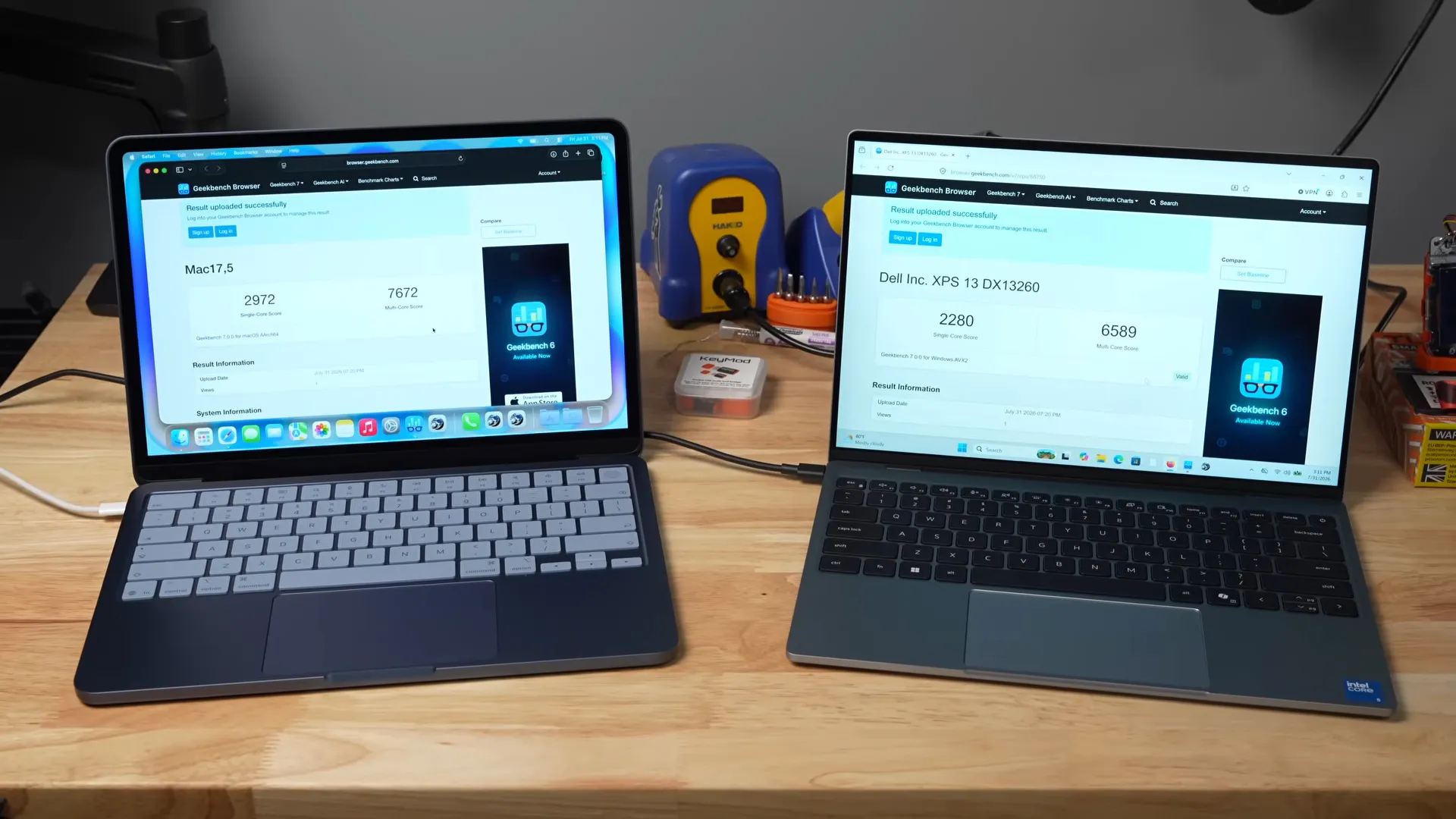
With a title like “Intel Just Matched Apple Silicon. Seriously.“, the latest video from [Jeff Geerling] makes some pretty bold claims. But as we’d expect from [Jeff], he’s got the benchmarks up on GitHub for both the MacBook Neo and Dell’s latest XPS 13 to back it up.

We’ve embedded the full video below, which has [Jeff]’s comparative review of the two laptops. The Mac wins on iGPU, sound, and not shipping Windows, while the Dell gets points for being able to load Linux and having a backlit keyboard. But the figure we were hoping to see is the efficiency. After all, it’s ARM’s ability to crank out gigaflops on fewer watts that won them the mobile market and got Apple interested in that architecture in the first place. If Intel is catching up, that’s news.

On [Jeff]’s version of the Top500 benchmark — the same HPL Linpak test used for Supercomputers — the MacBook cranked out 57.012 Gflops at 10.6W, for 5.38 Gflops/W while the Dell managed 127.91 Gflops at 20.6W, for 6.21 Gflops/W. That’s just astounding, considering the historical data all goes the other way. This Dell also beats out both M4 and M3 Mac Studios, only failing to the M4 Mac Mini at 7.57 Gflops/W. Even when not crunching big numbers, say at idle or web browsing, the XPS matches the MacBook sip for sip in energy efficiency.

Advertisement

Some people have been saying for a few years now that ARM’s observed advantages in power consumption have more to do with the chips themselves than the instruction architecture, and it looks like the Core 5 320 chip in this Dell proves them right when it comes to x86.

While you might think you need to code in Assembly or C to maximize those efficiency gains, your choice of language may not be as important as you think.

Advertisement

Source link

Continue Reading

Trending

Copyright © 2025