In this week’s “Sunday Reboot,” Alicia Keys takes over an Apple Store, Apple goes off-piste with its TikTok videos, and someone finds out that flight attendants hold the power while on a plane.
Sunday Reboot: AVP, Alicia Keys, and Ads on TikTok
Sunday Reboot is a weekly column covering some of the lighter stories within the Apple reality distortion field from the past seven days. All to get the next week underway with a good first step. This week, Apple had a new App Tracking Transparency on its hands thanks to publishers in Germany, a new hack can trick victims into running Terminal commands to bypass macOS security, and an Apple server outage prevented developers from verifying apps. Some fun stories happened too, alongside the inevitable onslaught of initial hardware reviews and opinions. Continue Reading on AppleInsider | Discuss on our Forums
Instead of raising prices again, Netflix may have to lower its subscription costs in Italy. A court in Rome recently ruled that Netflix owed its Italian users a refund for price hikes between 2017 and January 2024 and a reduction to previous subscription costs. On top of the refunds, Netflix Italia would have to inform its affected subscribers of their right to a refund.
The lawsuit was originally filed by Movimento Consumatori, a consumer rights organization based in Rome. The group’s president, Alessandro Mostaccio, said in a press release that more than 25,000 Netflix users have complained to Movimento Consumatori that they’re not satisfied with the price increases over the years. According to the lawyers representing the consumers, Premium subscribers are entitled to a refund of roughly 500 euros, while Standard tier customers should get back about 250 euros.
Mostaccio also said that if Netflix doesn’t immediately reduce prices and refund its customers, the consumer rights organization would pursue a class action lawsuit to recover funds. A Netflix spokesperson told Reuters that it would appeal the Italian court’s ruling, adding that the company takes “consumer rights very seriously and believe our terms have always complied with Italian laws and practice.” On the other side of the world, Netflix again raised prices for its US customers, this time across all of its subscription tiers.
Microsoft wants to offer the ‘most complete AI and app agent factory’.
Microsoft has released three new AI foundational models, created in-house, in a move that places the company in direct competition with enterprise AI rivals, despite its deep ties with OpenAI.
The new foundational models target three of the most commercially viable modalities: transcription, voice and images. The models are already powering Microsoft’s products, including Copilot, Bing and Azure Speech, the company said, and will be available in a preview via the Microsoft Foundry and MAI Playground.
With this, Microsoft is furthering its goals of delivering “the most complete AI and app agent factory”, it said.
Advertisement
‘MAI-Transcribe-1’ is a first-generation speech recognition model expected to deliver “enterprise-grade accuracy” across 25 languages at around 50pc lower GPU costs than its alternatives. The model scores lower than 4pc average ‘word error rate’ on accuracy benchmarks, while GPT-Transcribe is at 4.2pc and Gemini 3.1 Flash is at 4.9pc.
‘MAI-Voice-1’ is a speech generation model that, according to Microsoft, can produce 60 seconds of expressive audio in under one second on a single GPU.
Together, the two models are meant to deliver an audio AI stack capable of assisting in call-centre workflows and other voice-driven services, such as providing live captioning, automatic subtitling and converting interactions into structured data for research.
Microsoft’s second-generation image model, ‘MAI-Image-2’, is expected to offer artists a way to “explore” different visual directions. The model is created in “close collaboration” with artists, the company said, and is meant to help enterprises create branding and communication material.
Microsoft, valued at $2.7trn, already offers several AI-embedded apps and platform services. Its Copilot Studio lets users build agents, while the Foundry services offer a place to train and scale models.
In short:Anthropic has blocked Claude Pro and Max subscribers from using their flat-rate plans with third-party AI agent frameworks, starting with OpenClaw. The move, which took effect on 4 April 2026, shifts the cost of running autonomous agents onto users through a pay-as-you-go billing tier. The creator of OpenClaw, who joined OpenAI in February, called the decision a betrayal of open-source developers. Thousands of users now face cost increases of up to 50 times their previous monthly outlay.
Anthropic has ended a quiet subsidy that made its Claude models the engine of choice for the open-source AI agent community. Starting on 4 April 2026, users of Claude’s Pro and Max subscription tiers can no longer pipe their plan’s usage limits through third-party frameworks such as OpenClaw. If they want to keep using those tools with Claude, they must pay separately under a new “extra usage” billing system. Anthropic says it will extend the restriction to all third-party harnesses in the coming weeks.
The announcement landed as a jolt for thousands of developers who had structured their personal AI setups around the assumption that a flat monthly subscription was enough. For many of them, it no longer is.
The economics that broke the model
The logic behind the change is straightforward even if the timing was not. Claude’s subscription plans were designed around conversational use: a human opens a chat window, types a query, and reads a response. Agentic frameworks operate on a fundamentally different model. A single OpenClaw instance running autonomously for a full day, browsing the web, managing calendars, responding to messages, executing code, can consume the equivalent of $1,000 to $5,000 in API costs, depending on the task load. Under a $200-per-month Max subscription, that is an unsustainable transfer of compute costs from the user to Anthropic.
Advertisement
“Anthropic’s subscriptions weren’t built for the usage patterns of these third-party tools,” said Boris Cherny, Head of Claude Code at Anthropic. “Capacity is a resource we manage thoughtfully and we are prioritising our customers using our products and API.”
The scale of the problem was significant. More than 135,000 OpenClaw instances were estimated to be running at the time of the announcement, and industry analysts had noted a price gap of more than five times between what heavy agentic users paid under flat subscriptions and what equivalent usage would cost at API rates. Anthropic’s subscription business was, in effect, quietly cross-subsidising a class of usage it had not priced for.
What OpenClaw is, and why this matters
OpenClaw is an open-source AI agent framework created by Austrian developer Peter Steinberger. Originally released in November 2025 under the name Clawdbot, it was a side project: Steinberger wanted to see what would happen if you gave a large language model persistent memory, tool access, and the ability to communicate through messaging apps such as WhatsApp and Telegram. The answer, it turned out, was that an enormous number of people wanted exactly that.
The project was renamed twice in three days in late January 2026: first to Moltbot, after Anthropic raised trademark concerns about the phonetic similarity to “Claude,” and then to OpenClaw three days later. By 2 March 2026, the repository had accumulated 247,000 GitHub stars and 47,700 forks. It had become what many observers were calling the fastest-growing GitHub project in history, reaching 100,000 stars in under 48 hours at its peak. The framework supports more than 50 integrations and works across Claude, GPT-4o, Gemini, and DeepSeek.Tencent built an enterprise platform directly on top of it, demonstrating that OpenClaw’s influence had already extended well beyond individual hobbyists.
A convenient timing problem
The restriction becomes more pointed given what happened in February. On 14 February 2026, Steinberger announced he was leaving his own project to join OpenAI. Sam Altman posted publicly that Steinberger would “drive the next generation of personal agents” at the company, and that OpenClaw would be moved to an open-source foundation with OpenAI’s continued support. Steinberger wrote in a blog post that “teaming up with OpenAI is the fastest way to bring this to everyone.”
Advertisement
Anthropic’s restrictions were announced and enforced within weeks of that move, a timeline that has not escaped notice. Steinberger and fellow investor Dave Morin attempted to negotiate a softer landing, approaching Anthropic directly, but by their account only managed to delay enforcement by a single week.
“First they copy some popular features into their closed harness, then they lock out open source,” Steinberger wrote in response to the ban.
Whether the timing reflects competitive calculation or coincidence, the effect is the same. The most popular open-source agent framework, now loosely affiliated with OpenAI, has been effectively priced off Claude’s subscription tier.
The cost shock for users
For developers accustomed to unlimited agentic runs under a flat plan, the new billing structure is a significant disruption. Under pay-as-you-go extra usage, per-interaction costs are estimated at $0.50 to $2.00 per task, which makes heavy agentic use expensive in ways that a fixed monthly plan obscured. Some users report facing cost increases of 10 to 50 times their previous outlay. Hobbyist developers and solo practitioners, the cohort that built OpenClaw’s early adoption, are most exposed.
Advertisement
Anthropic has offered two concessions to smooth the transition. Subscribers receive a one-time credit equal to their monthly plan cost, redeemable until 17 April. Users who pre-purchase extra usage bundles can receive discounts of up to 30%.
Users who want to continue running OpenClaw with Claude can do so either through those extra usage bundles or by supplying a separate Claude API key, which bypasses subscription limits but charges at full API rates: $3 per million input tokens and $15 per million output tokens for Claude Sonnet 4.6, and $15 and $75 respectively for Claude Opus 4.6.
Anthropic’s closing ecosystem
The decision fits a broader pattern.Anthropic committed $100 million to its Claude Partner Network in March 2026, formalising a web of enterprise consulting and integration relationships built around its own products. Separately,the company has launched a marketplace for Claude-powered software, allowing enterprise customers to purchase third-party applications without Anthropic taking a commission, but through channels Anthropic controls. The pattern is consistent: Anthropic wants the revenue, the data, and the governance that comes with owning the customer relationship, and it is making it incrementally less attractive to route that relationship through tools it did not build.
Claude Code, Anthropic’s own developer environment, is included in Pro and Max subscription plans and is not subject to the new restrictions. The message to developers is implicit but legible: build inside Anthropic’s ecosystem, or pay API rates to build outside it.
Advertisement
Anthropic’s $3 billion raise in early 2026was accompanied by language about building “artificial super-intelligence for science” and expanding its research infrastructure. What it also reflects is the commercial pressure of running one of the most computationally intensive products in the world at scale. Compute costs do not flatten because users prefer flat subscription pricing. Foran AI industry that spent 2025 racing to acquire users, 2026 is increasingly about working out who actually pays for them, and how much.
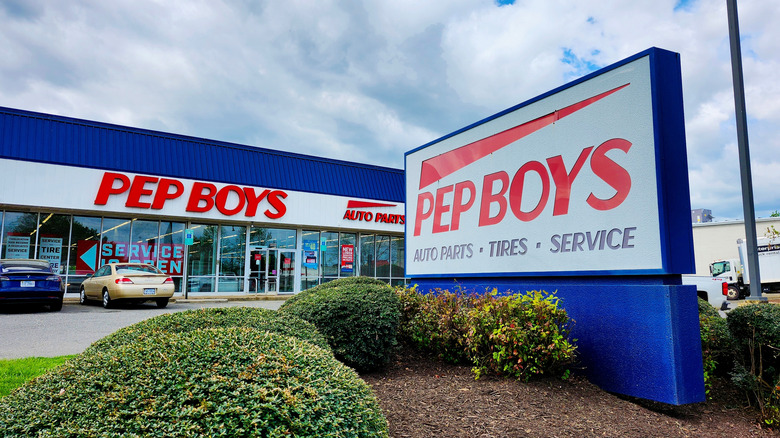
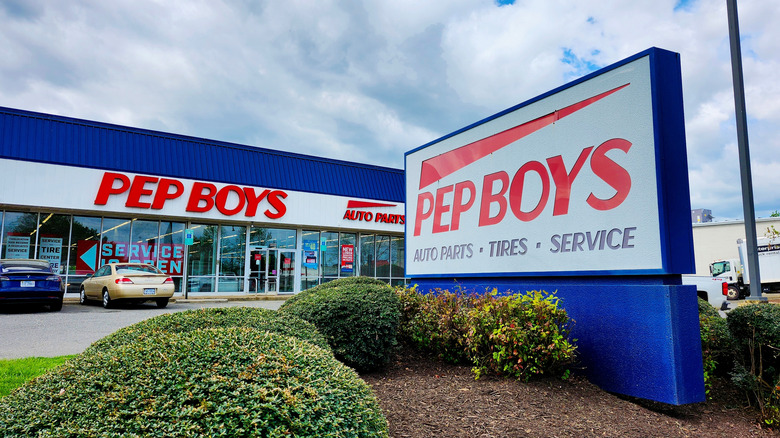
Sometimes you can go into a bit of a panic when your car isn’t working and find yourself rushing to the nearest mechanic with an opening. However, it can sometimes pay off to take a deep breath, take out your phone, and use Google. That’s what one TikToker realized after his brake switch broke and he got a quote from Pep Boys for $280 — $80 for the part, $200 for labor.
“About $300 to get my car functional again? I thought, ‘I guess that’s pretty worth it,” TikTok user @joseroselloaesthetics said. “But you know what? Let me shop around a little bit.” And after a short Google search at home, he found out that the broken part was available on Amazon for just under $11. At this point, he figured he should see what it would take to fix himself. He found a seven-minute YouTube video with step-by-step instructions, which showed that the broken part was located underneath the dashboard and didn’t even need a tool to swap out.
I went to Pep Boys for a repair and was quoted $280 — $80 for the part and $200 for labor. After doing my own research, I found the same part online for $10.88. The fix required no tools and took less than 10 minutes. This is why it’s important to always double check mechanic quotes, look up parts online, and understand basic DIY car repairs. You can save hundreds of dollars by doing simple fixes yourself. Not all mechanics are bad, but being informed can protect you from overpaying. . #pepboys#carrepair#mechanic#diycarrepair#savemoney
The repair went from $280 to $11. All he could say was “Wow.”
Advertisement
Is Pep Boys scamming customers?
Koldo Studio/Getty Images
Pep Boys was not setting out to scam @joseroselloaesthetics, nor are most mechanics — although some locations are rated better than others. In general, auto parts will be cheaper online or at an auto parts retailer than from a repair shop for a number of reasons beyond the mechanic hoping to make an easy profit.
First, mechanics order parts at wholesale prices, meaning buying parts in bulk. They will then charge you a marked-up rate of 25% to 50% above what they paid to make some money back. Second, mechanics often charge extra to cover the costs of running their business, including paying for garage liability insurance and certified repair technicians. Shops also take time training employees.
There are plenty of simple repairs you can learn to do yourself, but if you find yourself needing a mechanic for a trickier repair, you can always buy the part ahead of time and bring it to the shop. The price you pay will depend on where you buy the part and where you live, as well as whether you get original equipment manufacturers (OEM) car parts or aftermarket parts.
Prove said the roles would be across product, software engineering, research and development, and data science, supporting global product development and growth.
Digital identity verification platform Prove is to create 50 Irish jobs with a $5m investment in its Ireland-based operations.
The company said it sees Ireland as a central hub for the company’s product development, culture and international growth, having set up in the country in 2022 and increased Dublin headcount by 50pc in the past six months.
Prove said the new “high-value” roles would be across product, software engineering, research and development, and data science – with “many” to be available this year – and would support global product development and growth.
Advertisement
It credited its existing Irish operations with playing “a critical role in the rapid acceleration of innovation” over the past year across several product and feature launches.
“The growth of our Ireland team has been an important chapter in Prove’s journey,” said Laura Brittingham, its senior vice-president of people.
“The talent we’ve found there brings deep technical expertise and a collaborative, innovative and dependable spirit that has led to an outsized impact at Prove. There is no version of Prove’s future that doesn’t include Ireland at its centre.”
Prove’s identity verification and authentication tools aim to “streamline onboarding, prevent fraud and deliver seamless customer experiences across channels”, according to the company, by “verifying real people, businesses and agents in real time without friction or guesswork”.
Advertisement
Its customers are in areas such as banking, fintech, crypto, gaming, commerce, insurance and healthcare, and include Visa, Starbucks, Uber and DocuSign.
Prove’s expansion in Ireland is supported by the Irish Government through IDA Ireland.
Its CEO Michael Lohan said: “Prove’s decision to expand its R&D and innovation footprint here highlights Ireland’s strength as a global hub for advanced digital identity, data, and technology development.
“This expansion underscores Ireland’s ability to support companies as they scale internationally, innovate at pace and serve global markets.”
Advertisement
Prove was founded in 2008 as Payfone and rebranded in 2020. It employs more than 400 people globally – across hubs in the US, UK, Ireland and Brazil – and claims to verify 30bn transactions annually and own more than 200 patents in areas around identity and authentication.
Minister for Enterprise, Tourism and Employment Peter Burke, TD said: “This significant investment and the creation of 50 new high-value roles reflect great confidence in Ireland’s talented workforce and in our strong environment for RD&I.
“Ireland is well-positioned to support companies like Prove at the forefront of digital transformation.”
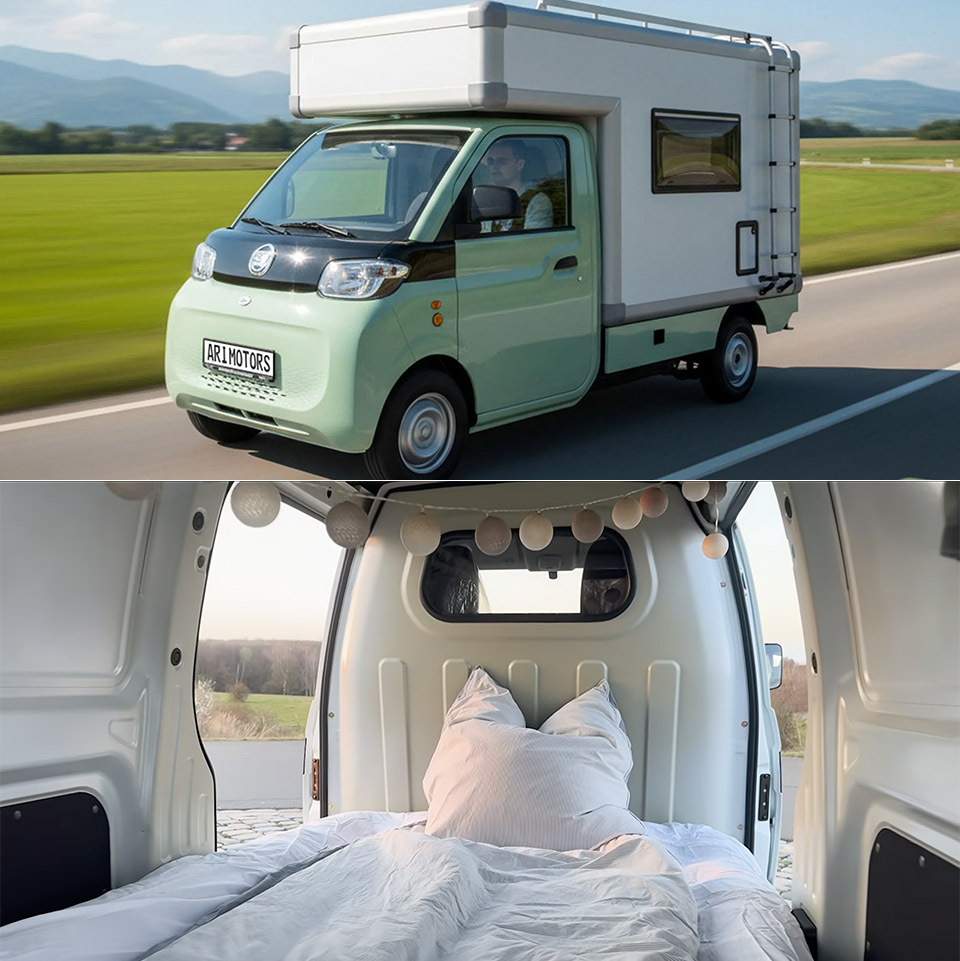
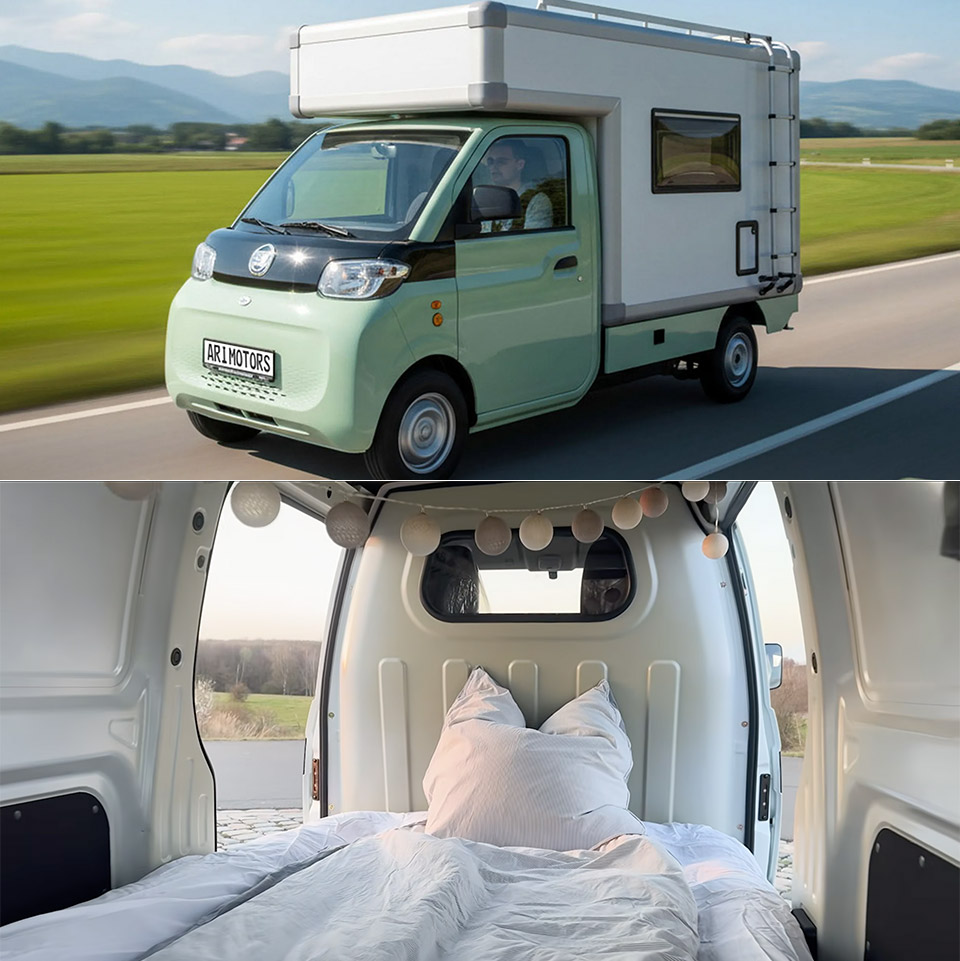
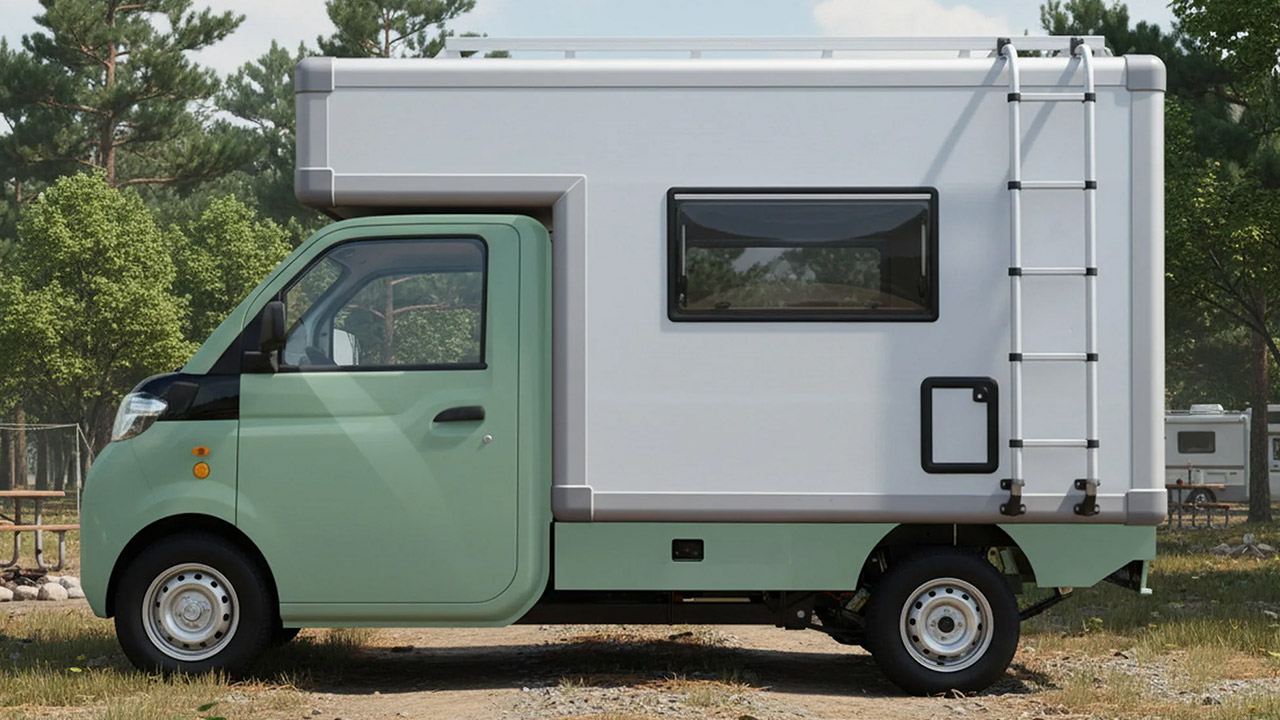
Ari Motors’ engineers have been working on the Ari 458 Pro, a compact electric camper that is redefining people’s perceptions about short vacations. At only 12.5 feet long and 4.9 feet wide, this vehicle fits into a conventional parking place and can even fit into narrow roadways where larger motorhomes cannot. You can park it almost anywhere and yet have enough room to make a spontaneous stop at a lake or a forest clear-cut, without having to worry about hookups and whatnot.
It’s based on a delivery truck platform, but an insulated box added to the back transforms the entire structure into useful living space. Inside, you have around 6 feet of headroom and approximately 30 square feet of area. Ari ships the item very much bare, so you may customize it however you like. They do the wiring for you, so you’ll have electricity outlets, solar panels on your roof, and water hookups ready to go. Simply add your own bed, table, kitchenette, and other necessities, or choose for an ultra minimalist factory conversion in Saxony.
CAMPER VAN BUILDING SET – Kids can enjoy vacations every day with this LEGO City Holiday Adventure Camper Van building set
TOY FIGURES & CAMPER PLAYSET – This vehicle set includes everything kids need to build a camper van with a detailed living space, plus a campfire…
FUN FEATURES – The camper van opens up for full access to an interior living space with a kitchen, toilet, 2 bunk beds, a crib and a removable…
The power comes from a single 15-kilowatt electric motor that produces around 20 horsepower. The top speed is a rather relaxed 43 mph, which is ideal for backroad cruising rather than highway driving. You may select between a 15kWh battery, which will carry you 75 to 112 miles, and a larger 23.5kWh pack, which can get you up to 143 miles. And the greatest thing is that electricity expenses are really inexpensive – approximately 4 Euro per 100 kilometers.
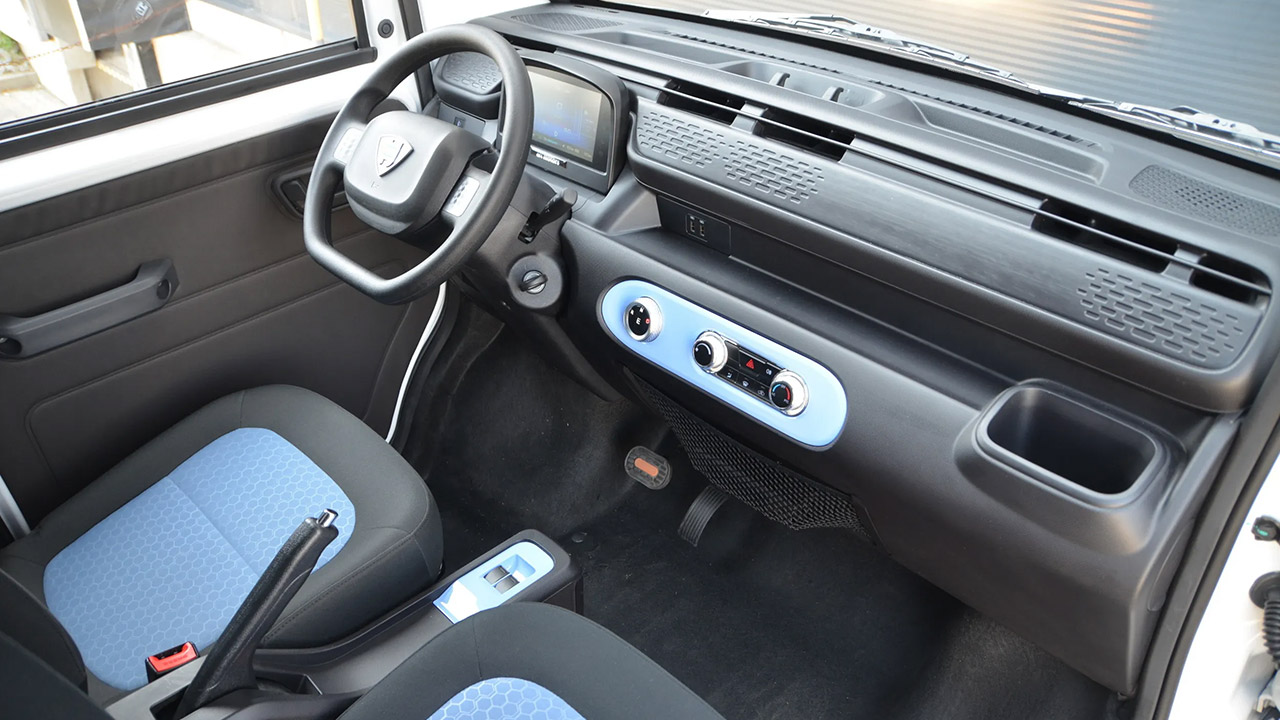
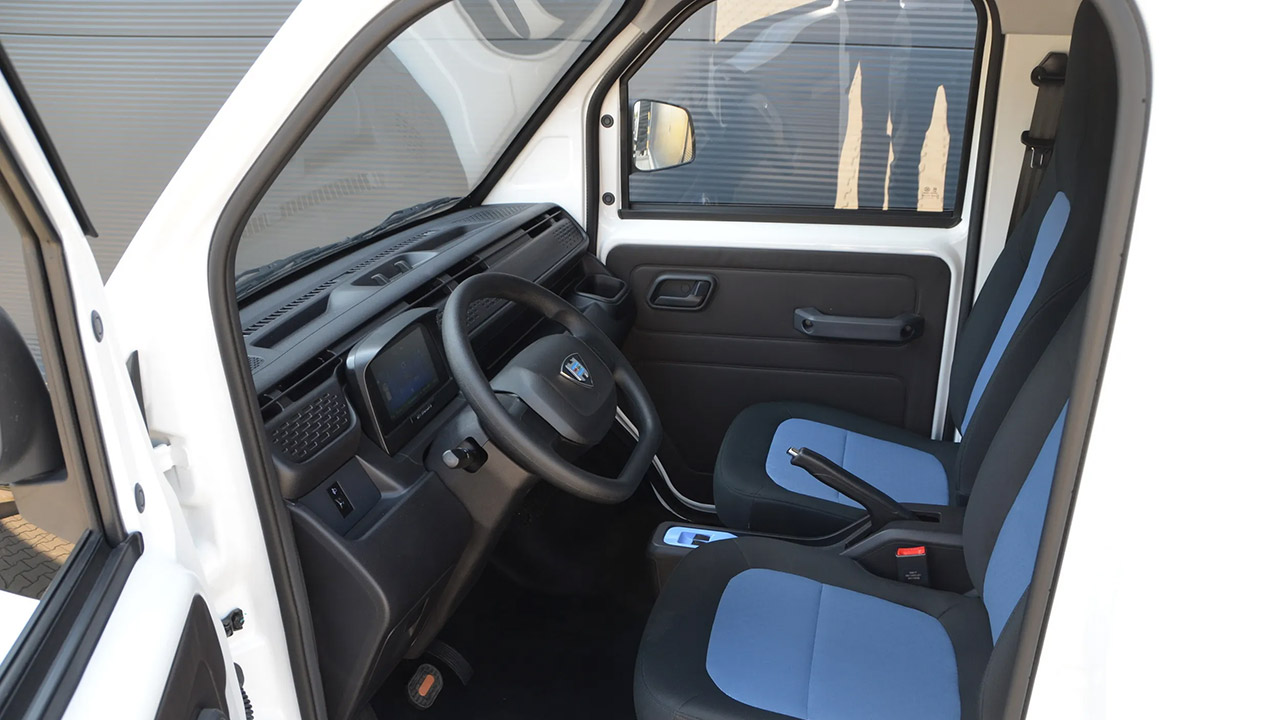
The front side features a modest interior with two seats, power windows, central locking, a digital display, a reversing camera, and Bluetooth. There’s even one cup holder thrown in for good measure. If you want to add air conditioning or a trailer to tow some light gear, that’s an option; don’t worry, it’s all L7e compatible, so it’s small and light while being safe for regular usage.
The Ari 458 Pro costs little over 30,000 euros including tax in Germany, making it much more accessible to anyone who want to get into camping. They even have a base delivery model that is slightly less expensive, but the camper setup includes all of the necessary accessories straight out of the box. Production takes place in Borna, just outside of Leipzig, with orders beginning in May. If you enjoy basic travel, you’ll appreciate how this thing is all about freedom rather than squandering your wallet on frivolous luxuries. [Source]
The controversy around Delve appears to have cost the compliance startup its relationship with accelerator Y Combinator.
Delve is no longer listed among YC’s directory of portfolio companies, and the Delve page seems to have been removed from the YC website. In addition, the startup’s COO Selin Kocalar posted on X that “YC and Delve have parted ways.”
“I still remember the day we took our YC interview at MIT,” Kocalar said. “We’re so grateful to the community and every founder friend we’ve made.”
YC isn’t the first investor to distance themselves from Delve. Insight Partners also appears to have deleted posts about its investment in the company, although its primary blog post was later restored.
Advertisement
Meanwhile, Delve continues to push back against anonymous claims that it misled clients by telling them they were compliant with privacy and security regulations while allegedly skipping important requirements and auto-generating reports for “certification mills that rubber stamp reports.”
Those claims were first published in an anonymous Substack post attributed to “DeepDelver,” who described themselves as a former Delve customer who became suspicious after receiving leaked data about the startup’s clients.
Meanwhile, Delve became part of a related controversy when malware was discovered in an open source project developed by Delve customer LiteLLM.
Advertisement
In the company’s latest blog post, Delve’s COO Kocalar and CEO Karun Kaushik declared their intention to set “the record straight on anonymous attacks.” Among other things, they claimed that the company has hired a cybersecurity firm “to help us understand what happened,” and said the “evidence points to a malicious attack rather than a genuine whistleblower.”
“It appears that an attacker purchased Delve under false pretenses, maliciously exfiltrated data, including Delve’s internal company data, and used it to launch a coordinated smear campaign against us,” they said. The blog post also includes a screenshot that they said “shows the attacker exfiltrating our audit tracking spreadsheet via file.io.”
Beyond this accusation, Delve also described DeepDelver’s criticism as “a mix of fabricated claims, cherry-picked screenshots, and data taken out of context.” For example, they said DeepDelver “dismisses our AI while acknowledging it automated 70% of a security questionnaire.”
On the question of using open source tools, Delve said it “built on an Apache 2.0 open-source repository, which explicitly permits commercial use, and significantly rebuilt it for compliance use cases.”
Advertisement
However, the executives also said they’ve been taking steps to ensure customers “feel confident in our platform and compliance outcomes.”
Those steps supposedly include cleaning up the company’s network to remove auditing firms “that don’t meet our standards,” “offering complimentary re-audits and penetration tests to all active customers,” and making it “unambiguously clear” that Delve’s templates for things like board meeting notes “are designed to be starting points only.”
In a post on X, Kaushik made many of the same points but also said, “[W]e grew too fast and fell short of our own standard. To our customers, we deeply apologize for the inconveniences caused.”
TechCrunch has reached out to Y Combinator and DeepDelver for any response to Delve’s comments.
For the uninitiated or anyone who thinks “portable audio” means a waterproof pill clipped to a backpack, the boomboxes that ruled the streets were the original mobile music weapons. Born in the late 1960s and peaking in the late ’70s and ’80s, these weren’t just stereos you carried around; they were cultural battering rams. Think Fab 5 Freddy on your TV, Yo! MTV Raps in full rotation, the Beastie Boys causing trouble in a Brooklyn alley, and breakdancers turning flattened cardboard into battlegrounds.
Boomboxes transformed sidewalks into dance floors and backseats into clubs. These weren’t gadgets. They were attitude, wrapped in metal and plastic, blasting identity at unsafe volume levels.
Back then, a ghetto blaster wasn’t a polite lifestyle accessory with Bluetooth and passive-aggressive EQ presets. It was a war chest with woofers; loud, heavy, unapologetic. Models like the JVC RC-M90, Lasonic TRC-931, Sharp GF-777, and Panasonic RX-5600 didn’t just play music; they announced your presence and dared anyone nearby to argue with your taste. And nobody embodied that energy more than Radio Raheem, hauling his box like a sonic manifesto in Do the Right Thing.
Advertisement
Before playlists were swiped, skipped, and forgotten, there were mixtapes—built in real time, often straight off the radio, finger hovering over the pause button like it mattered. Because it did. A mixtape was intent. Sequencing was personal. A Maxell XLII-S with Sharpie handwriting wasn’t nostalgia; it was proof you cared enough to get it right. Boomboxes carried those tapes into the streets, and for a while, they made the world listen.
What Is a Boombox? The Original Portable Stereo Explained
A boombox is a large, portable, battery-powered audio system with built-in speakers, a radio, and a cassette player and recorder. First appearing in the late 1960s, the format hit its peak in the 1980s and early 1990s. Later versions added CD players and, much more recently, Bluetooth and USB connectivity, but the basic idea never changed. A big box, a solid handle, and enough output to make sure your music was heard whether anyone asked for it or not.
The name boombox came from its integrated stereo speakers and their ability to deliver loud, booming sound. The nickname ghetto blaster came later, born on the streets rather than in a marketing meeting. These things were not polite. They were heavy, power-hungry battery pigs that chewed through D-cells like candy, and carrying one any real distance counted as arm day. Portability was relative. You could move it, but you were going to feel it.
While the ghetto blaster became closely associated with early rap and the rise of hip-hop culture, it was never limited to a single genre. Boomboxes powered block parties, fueled breakdancing battles, and blasted everything from rap and R&B to funk, reggae, pop, and rock. For teens and twenty-somethings, the boombox was more than a way to listen to music. It was a status symbol, a social magnet, and a public declaration of taste delivered at full volume.
Advertisement
Let’s take a look at some of the most notable boomboxes from the era when they ruled the streets.
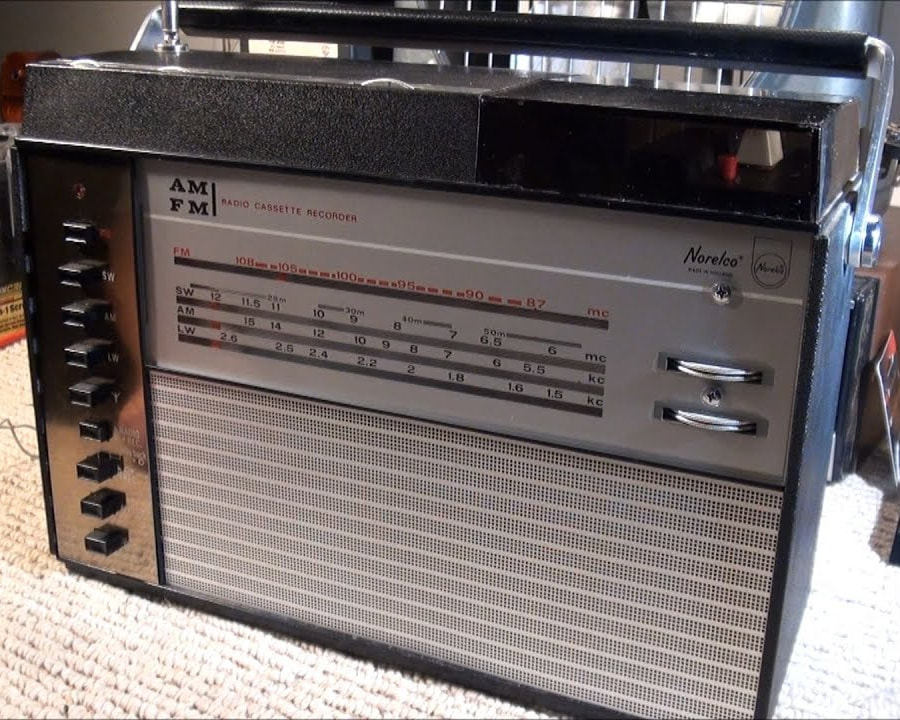
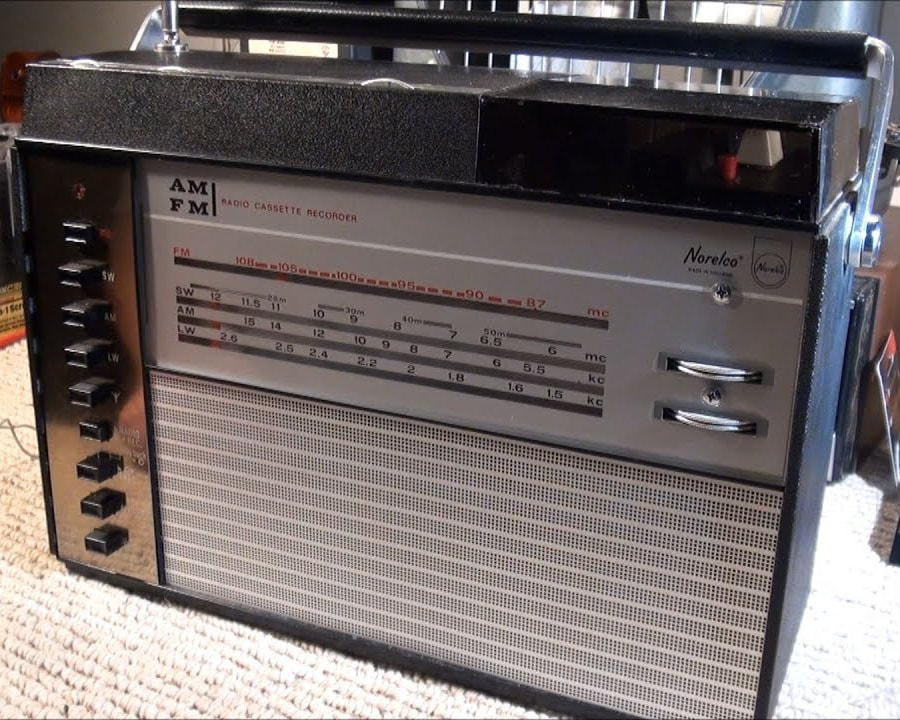
Norelco 22RL962
The Norelco 22RL962, made by Netherlands-based Philips (the same company that invented the compact audio cassette), is widely credited as the first true boombox. Introduced in the late 1960s, the 22RL962 established the core formula: portability, battery operation, a built-in speaker, and a single box that combined radio and tape playback.
Equipped with a carrying handle, AM/FM radio, and a compact cassette player and recorder, the 22RL962 delivered a modest 1 watt of output through its integrated speaker. Crucially, it was the first consumer audio product that allowed users to record radio broadcasts directly to cassette tape for later listening, a feature that would become central to mixtape culture in the decades that followed.
Additional connections included inputs for an external power supply, external loudspeaker or earphones, a microphone, and even a wired remote control. None of this came lightly. The 22RL962 weighed nearly 9 pounds, making it a serious haul by today’s standards and a reminder that early portability came with muscle strain included.
Advertisement. Scroll to continue reading.
Advertisement
The original U.S. price was approximately $500, listed at 5,995 Austrian schillings at the time. Today, value depends heavily on condition, originality, and whether the unit still functions, but demand remains strong among collectors who recognize it as the box that started it all.
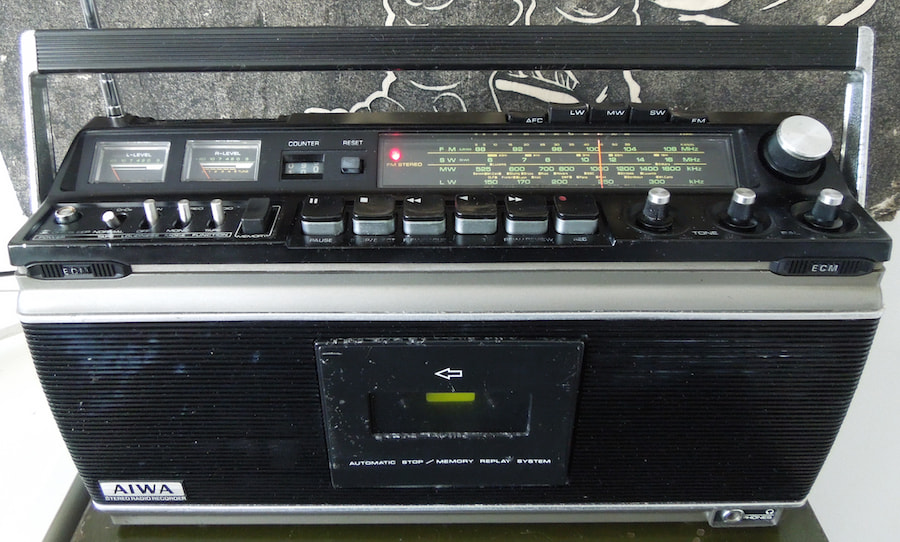
AIWA was one of the most respected audio brands of the last quarter of the 20th century, and in 1974 it entered the emerging boombox market with the TPR-930. Built like a small appliance rather than a toy, the TPR-930 reflected AIWA’s reputation for serious engineering at a time when portability still meant compromise.
Packed with 40 transistors, an integrated circuit, and a four-speaker system, the TPR-930 delivered sound quality that still earns it respect among collectors. Its heavy-duty construction came at a cost. With batteries installed, it tipped the scales at roughly 13.75 pounds, making it a true battery pig and a reminder that early boombox portability required commitment.
The TPR-930 featured a wide-band radio tuner covering SW1, SW2, AM, and FM, along with a single cassette deck. Supporting features included AIWA’s Matrix Sound System, Loudness control, AFC for more accurate radio tuning, Automatic Stop, and a Memory Replay System. It also supported CrO₂ tapes, included a three-digit analog tape counter and a built-in condenser microphone, and offered connections for external 4-ohm speakers.
Advertisement
Originally priced between $150 and $200 during its production run, the TPR-930 reportedly still trades in that same range today depending on condition. For collectors looking for a historically important boombox with legitimate sound quality, it remains one of the better bargains in the category.
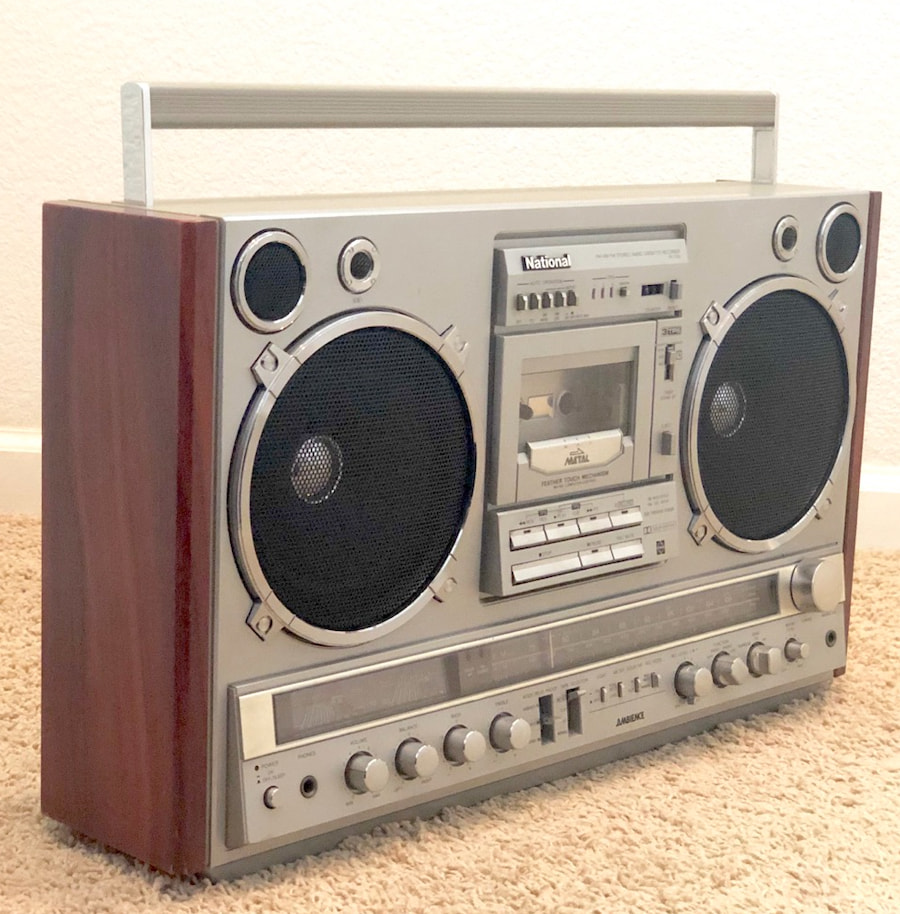
First released in the 1977-1978 timeframe, the National Panasonic Ambience RX-7000 was conceived as a high-end boombox equally comfortable anchoring a living room or making a very loud statement outside. This was not a casual portable. It was Panasonic aiming straight at the top of the category.
At its core, the RX-7000 combined an AM/FM radio with a single cassette deck, but the deck itself was unusually sophisticated for the era. Features included a tape counter, Dolby B noise reduction, Panasonic’s “3 TPS” Tape Program Sensor, a Feather Touch mechanism, microcomputer control, play and record timers, cue and review functions, manual or automatic record level control, support for Normal, FeCr, CrO₂, and Metal tapes, and a Dolby LED indicator.
Supporting features were equally comprehensive. The front panel included VU, tuning, and battery meters, mono, stereo, and Ambience (stereo-wide) listening modes, balance, bass, and treble controls, an FM stereo indicator, and a terminal for a wired remote control. Inputs were generous, with dual microphone jacks featuring mixing level control, an RCA phono input with ground terminal, and a headphone output.
Advertisement
One standout capability was amplification. In addition to its built-in speaker system, the RX-7000’s amplifier delivered 2 x 11 watts RMS and could power modest external speakers via dedicated terminals. The internal speaker array consisted of two 2-inch tweeters and two 6-inch woofers, reinforcing its ambitions as more than a street box.
All of that capability came with mass. The RX-7000 weighed approximately 17.6 pounds, firmly placing it in the “battery pig” category. Original pricing reflected its premium positioning, landing between $850 and $900 at launch. Today, depending on condition and completeness, demand pricing typically ranges from around $500 to well over $1,300, making it one of the most serious and collectible boomboxes of its era.
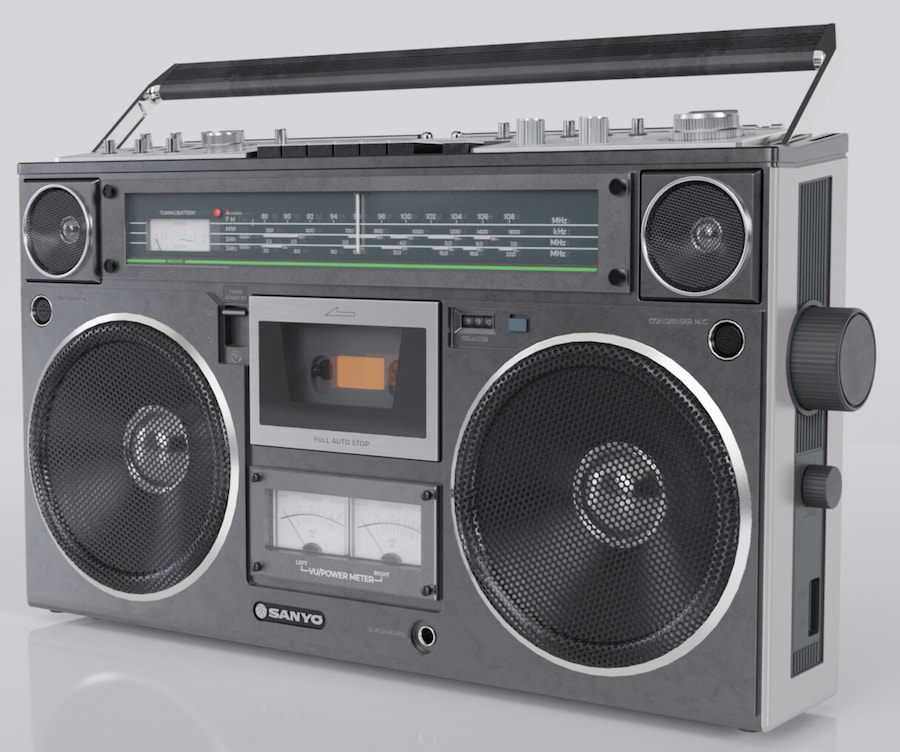
Released in 1978, the Sanyo M-9994 carved out its place in boombox culture by delivering serious sound in a relatively disciplined package. Rated at 2 x 5 watts of output power, it featured a capable speaker system with 6.3-inch woofers and 2-inch cone tweeters. Notably, the tweeters were rotatable, allowing users to improve high-frequency directionality depending on placement and listening position.
Sanyo marketed the M-9994 as a “professional edition,” and it leaned into that claim with included external handheld microphones complete with plastic desk stands. Supporting features included an Input Volume control that allowed attenuation of incoming signals from line-level or phono sources, along with a dedicated headphone output for private listening.
Originally priced between $300 and $350, the Sanyo M-9994 has appreciated significantly over time. Today, demand pricing can reach as high as $1,500 for pristine, fully functional examples, reflecting its reputation as one of Sanyo’s most desirable classic boombox designs.
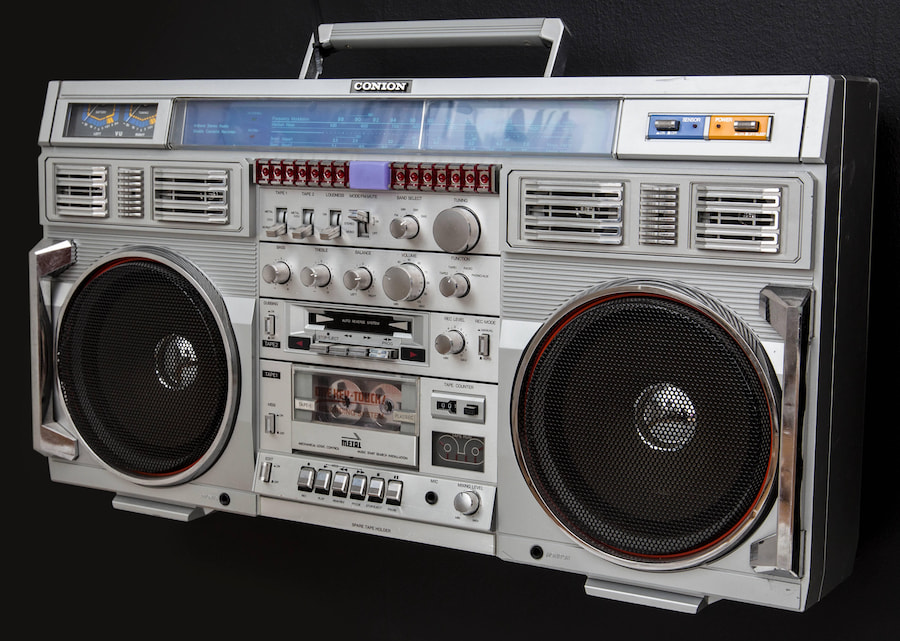
Released around 1984, the Conion C-100F is pure boombox legend and remains one of the most aggressively sought models among collectors. Oversized, overbuilt, and unapologetically loud, this was a statement piece even in an era defined by excess.
Pro Tip: The Conion brand was part of Onkyo, which helps explain why this box leaned harder into features and spectacle than restraint.
Advertisement
The C-100F came loaded. It featured a dual cassette deck configuration with one front-loading deck and one slot-loading deck, a four-band radio covering SW1, SW2, FM, and AM, dual VU meters, twin LED level displays, and two headphone jacks. One standout party trick was a built-in motion sensor that could be activated to trigger a security alarm if the unit was moved, a very on-brand feature for a boombox of this size and value.
The speaker array was equally ambitious, consisting of two woofers, two midrange drivers, and two tweeters. Output power was rated at 30 watts RMS at 10 percent THD, a figure that tells you everything you need to know about how hard this thing was meant to be pushed at its limits.
All of this hardware lived inside a massive 30-inch-wide chassis weighing just over 26 pounds. Portability was theoretical. Running the C-100F off batteries required ten D-cells, firmly placing it in battery-pig territory and guaranteeing that shoulder fatigue was part of the experience.
Depending on the market, the same design was also sold as the Helix HX-4365 and the Clairtone 7980. Original pricing for the Conion C-100F landed between approximately $450 and $475 in the U.S. Today, demand pricing typically ranges from around $750 to as much as $2,000, depending on condition, originality, and whether the alarm still scares the neighbors.
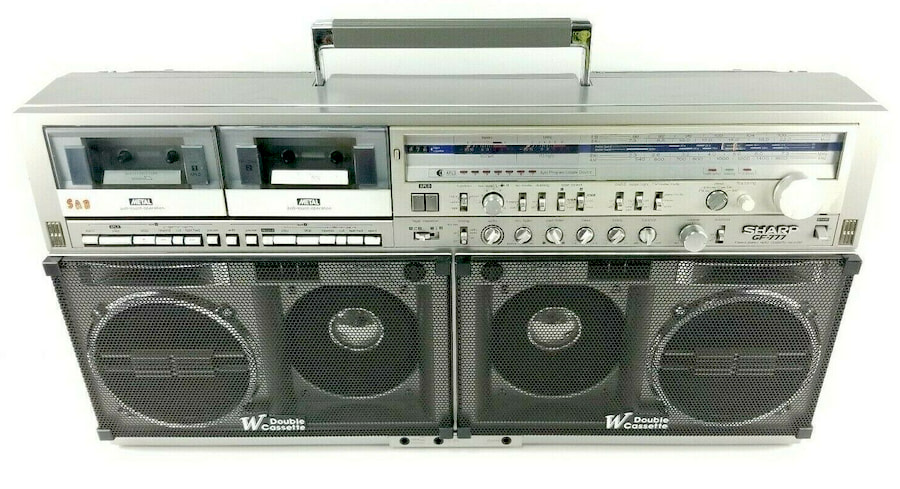
Another highly prized boombox among collectors is the Sharp GF-777, also sold in Japan as the GF-909. This model sits firmly in the heavyweight division, both in reputation and in physical presence.
The GF-777 featured a six-speaker array consisting of two woofers, two dedicated “sub” woofers, and two horn-type tweeters. Output power was rated at approximately 2 x 12 watts RMS, giving it the kind of authority that made it impossible to ignore once the play button was pressed.
Size and weight were part of the appeal. The GF-777 stretched roughly 30 inches wide and tipped the scales at about 27 pounds before batteries were added. Running it as a true portable required ten D-cell batteries, though it could also be operated on AC power for less shoulder strain and fewer trips to the battery aisle.
Advertisement
Originally priced at around $800, the Sharp GF-777 remains surprisingly attainable today. Depending on condition, completeness, and functionality, current demand pricing typically falls between $500 and $700, with exceptional examples commanding higher figures from collectors who know exactly what they are looking at.
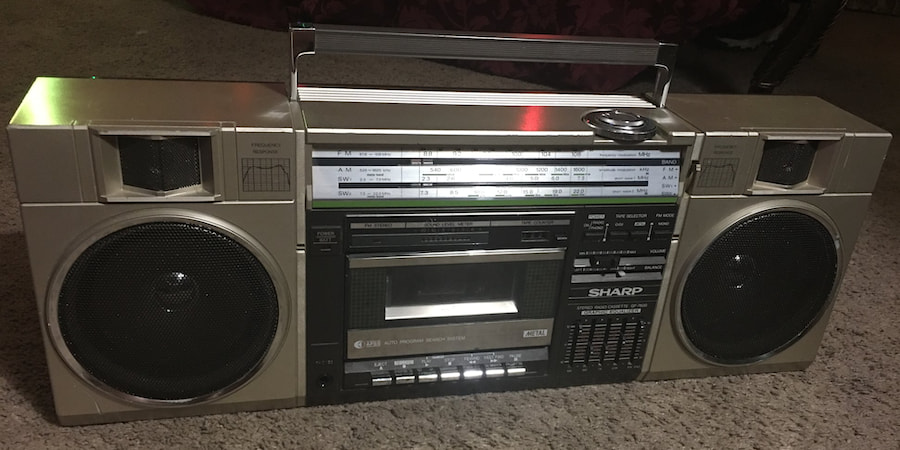
The Sharp GF-7600 is not the biggest, loudest, or most technically ambitious boombox of the 1980s, but it may be the most culturally significant. Released in 1983, it achieved permanent pop-culture status thanks to its starring role in the 1989 film Say Anything. Pity John Cusack didn’t drop it on his head.
Despite its more manageable size, the GF-7600 was surprisingly well equipped. It featured a four-band radio covering SW1, SW2, AM, and FM, a single cassette deck, a five-band graphic equalizer, an LED VU meter, line-in and line-out connections, and external microphone inputs. This was a serious feature set for a box that looked almost polite by Sharp’s usual standards.
The cassette deck supported metal tape, included full auto-stop and APSS track search, and offered a frequency response rated from 50 Hz to 16,000 Hz. Speaker duties were handled by a pair of 4.7-inch woofers and horn tweeters, while output power is generally estimated at around 5 to 6 watts per channel. Not a brute, but loud enough to make a statement—and immortal once held aloft over a rain-soaked lawn.
Advertisement
Original pricing varied by retailer. Today, demand pricing typically ranges from approximately $125 to $500, depending on condition, completeness, and functionality.
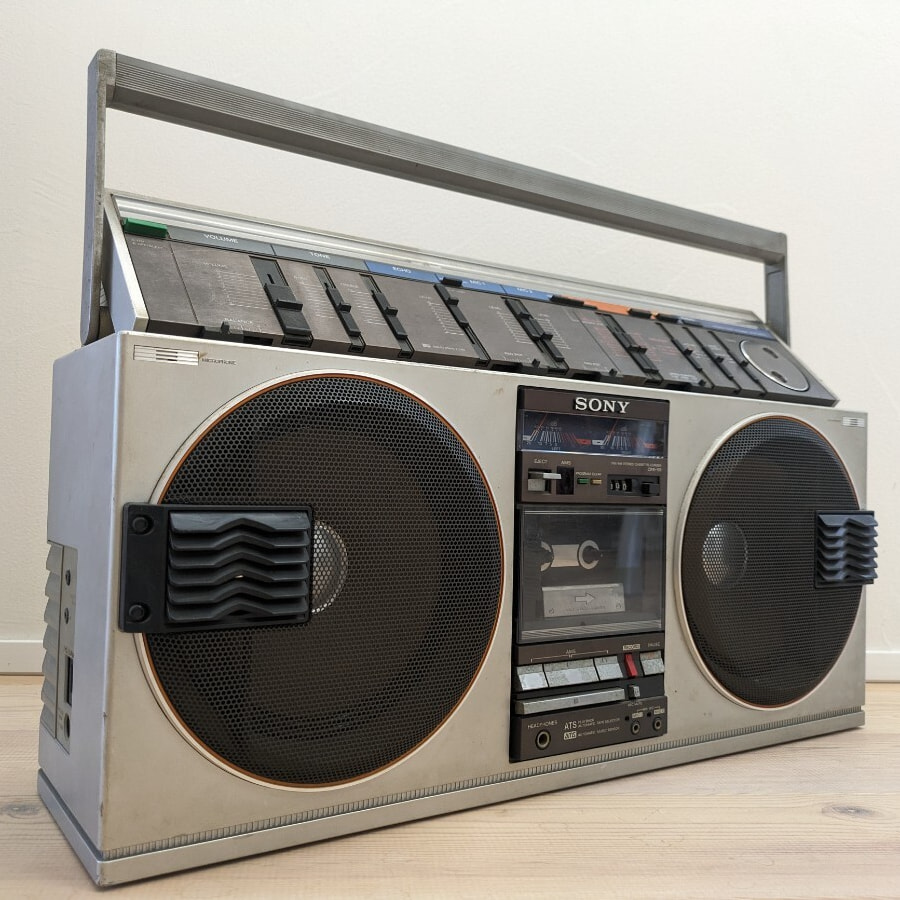
Before Sony upended personal audio with the Walkman, it was already deeply embedded in boombox culture. One of its standout entries was the Sony CFS-99, also known as the Energy 99, released in 1981. Big, loud, and unmistakably ’80s in both sound and styling, the CFS-99 paired a rugged build with serious output. It also weighed in at a back-testing 23 pounds, firmly earning its place in the heavyweight class.
Core features included an AM/FM radio and a cassette deck, with certain variants adding an LED track indicator along with dual microphone inputs featuring pan control and echo effects. Connectivity was unusually flexible for the time, offering RCA line-level inputs and outputs, while some versions also included banana speaker terminals for driving external speakers.
Advertisement
Advertisement. Scroll to continue reading.
The original retail price is no longer well documented. Today, demand pricing typically starts around $500 and can climb higher depending on condition, originality, and whether the unit has been modified to add Bluetooth connectivity.
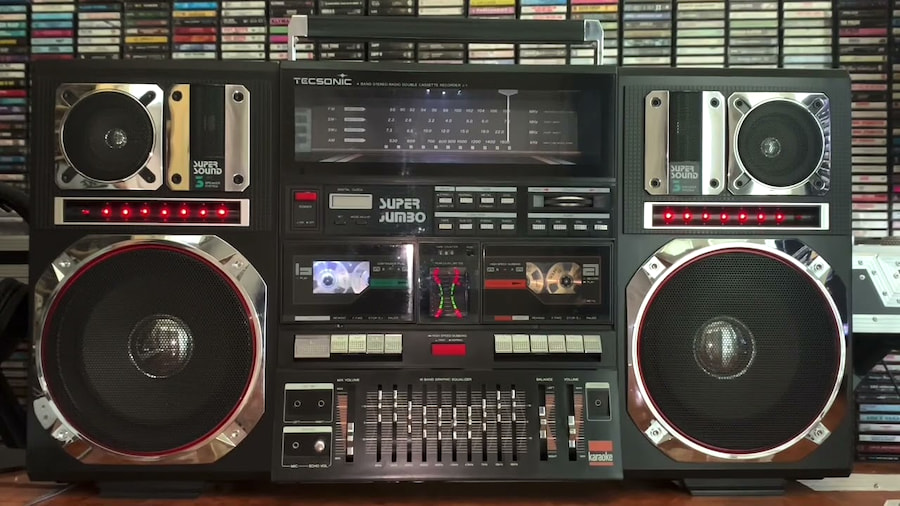
The Tecsonic J-1 Super Jumbo is another culturally significant boombox, cemented in history by its appearance in Do the Right Thing. Released in the 1987-1988 timeframe and manufactured in South Korea, the Super Jumbo wasn’t subtle. It didn’t need to be. This was a box built to be seen, heard, and remembered. Fight the Power.
The J-1 Super Jumbo featured an imposing speaker array with dual 8-inch woofers, a pair of midrange drivers, and twin tweeters. Feature-wise, it came loaded: dual cassette decks, AM/FM radio, karaoke sing-along functions, a 10-band equalizer, balance control, mixing volume, left and right front microphone inputs, a dedicated mix microphone input, phono jack, auxiliary/CD input, peak level meter, high-speed dubbing, tape counter, A/B continuous play, and an LED clock. Excess was the point.
Advertisement
Physically, the J-1 lived up to its name. It measured roughly 31 inches wide and 16.5 inches tall, and weighed in at around 25 pounds. Reported output power is approximately 2 x 20 watts, more than enough to back up its visual presence with real authority.
Original pricing for the Tecsonic J-1 Super Jumbo is no longer well documented. Today, demand pricing typically hovers around $1,000, depending on condition, completeness, and whether it still looks ready to be hoisted over someone’s head as a very loud act of defiance.
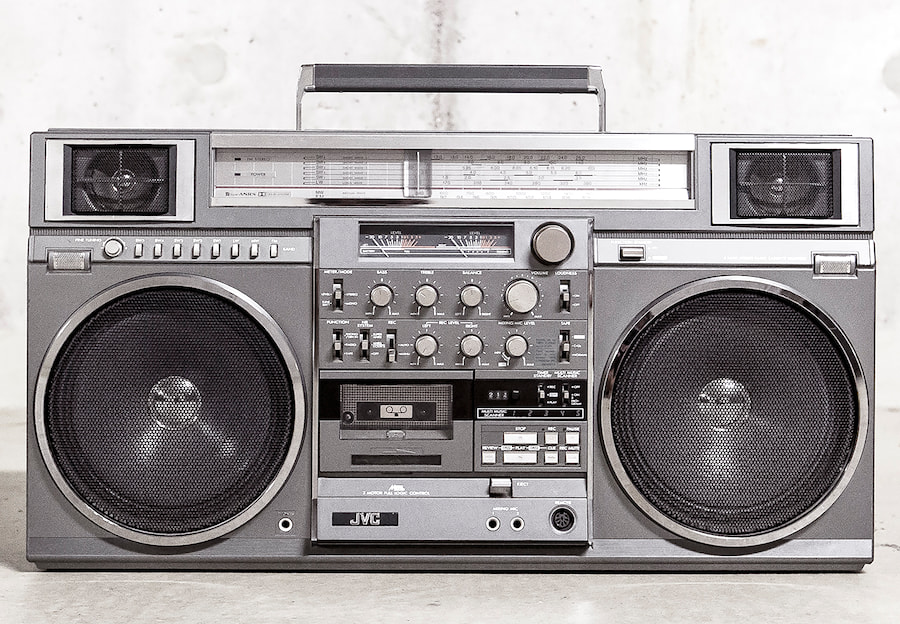
Some regard the JVC RC-M90 as the “King of Boomboxes,” and it’s not an argument without merit. Released in 1981, this was a no-compromise design that combined brute force with an unusually deep feature set.
The built-in speaker system used a two-way, four-speaker layout consisting of dual 8-inch woofers and two 2.5-inch tweeters, driven by amplification rated at approximately 2 x 20 watts. It was designed to move real air, not just make noise.
Advertisement
Operational features were extensive. The RC-M90 included an eight-band tuner with AM and FM coverage plus six shortwave bands, all supported by fine tuning. The cassette deck featured a tape counter, dual-motor full-logic transport, Normal, CrO₂, and Metal tape bias and EQ, JVC’s Multi Music Scanner, record and playback timers, and Dolby NR or Super ANRS noise reduction. With metal tape, cassette frequency response was rated at roughly 30 Hz to 17,000 Hz, impressive for a portable system.
Additional features included two built-in microphones, independent left and right recording level controls, microphone mixing level control, dual meters for VU, battery, and tuning, bass, treble, and balance controls, a loudness switch, and mono or stereo selection. Nothing about this box was casual.
Original pricing is documented at approximately £333 in the UK, with U.S. pricing from 1981 remaining elusive. Today, demand pricing for the JVC RC-M90 routinely exceeds $1,000, with top-condition examples commanding significantly more. For many collectors, this is the mountain every other boombox is measured against.
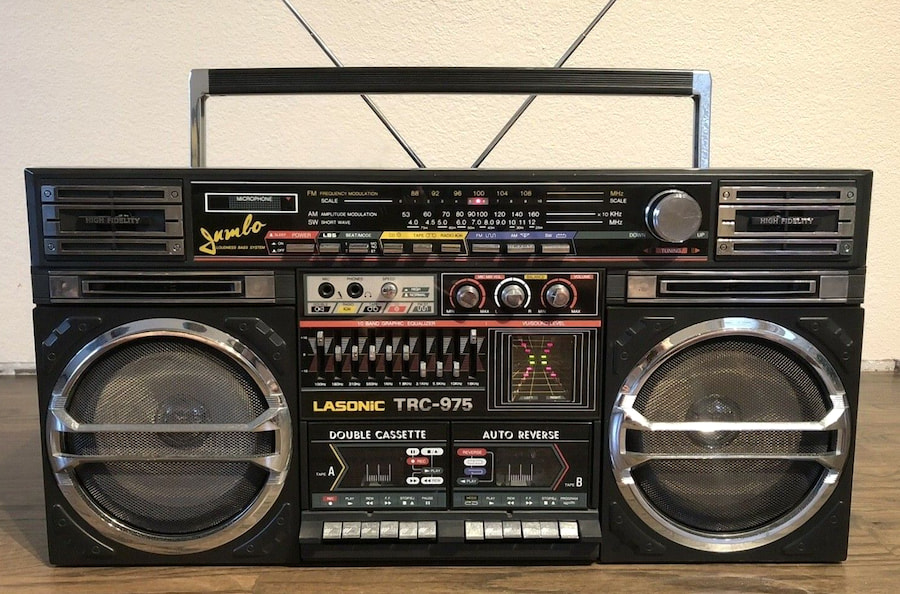
Jumping ahead to 1993, the Lasonic TRC-975 arrived as a genuine value play, originally selling for around $179. While the decade had shifted, its design was pure late-’80s muscle, and the sound followed suit. The TRC-975 earned a reputation for serious output thanks to its “Jumbo” Extra Bass system and a 10-band graphic equalizer that encouraged aggressive tweaking rather than restraint.
The speaker system consisted of dual 8-inch woofers paired with two 2-inch tweeters, a configuration aimed squarely at loud, physical sound. Feature-wise, the TRC-975 included dual cassette decks for recording and dubbing, AM/FM/SW radio, auto-reverse playback, and both normal- and high-speed dubbing. Connectivity was basic but practical, with an auxiliary input for external sources.
Some units on the secondary market have since been modified to add Bluetooth or MP3 playback, though purists tend to prefer unaltered examples. Closely associated with hip-hop culture, the Lasonic TRC-975 has become one of the most aggressively sought boomboxes of the 1990s era. Current demand pricing typically ranges from around $700 to as high as $2,300 for pristine, original-condition units, while modified versions with Bluetooth often trade closer to the lower end of that range.
Just as CDs were beginning to reshape how people listened to music in the early 1980s, Sharp responded with one of the strangest boombox designs ever put into production: the VZ-2000, released around 1982-1983.
What made the VZ-2000 truly weird was its ambition. In addition to a radio and cassette deck, it incorporated a vertical turntable capable of playing both sides of a record at 33 or 45 rpm without flipping. To pull that off, Sharp employed dual linear-tracking tonearms controlled by a microcomputer, enabling fully automatic playback. Each arm was fitted with a Sharp 118 phono cartridge and STY-118 stylus, turning this boombox into a portable record player in the most literal sense of the word.
Beyond the vinyl trickery, the VZ-2000 featured a two-way speaker system, easy-touch controls, an auto program pause system, and metal tape compatibility for the cassette deck. On paper, it checked an absurd number of boxes for a single portable unit.
Portability, however, was relative. The VZ-2000 weighed over 35 pounds, which severely limited how far anyone was realistically carrying it. Original pricing was approximately $550, and today a fully operational example typically commands between $1,000 and $1,500 or more, depending on condition. It remains one of the clearest examples of early-’80s audio excess, when engineers still believed anything was portable if you added a handle.
These 12 boomboxes barely scratch the surface of what flooded streets, stoops, and backseats throughout the 1970s and 1980s, when portable audio was as much about presence as playback. Today’s Bluetooth speakers and smartphones are lighter, cleaner, and infinitely more convenient, but they’ve traded shared experience for private consumption. Boomboxes weren’t just how people listened to music. They were how music forced its way into the room—and made everyone deal with it together.
There are many factors to consider when buying a vehicle, whether new or used. Not only are there vital questions to ask oneself before committing to any new car, but there’s also the seemingly endless parade of vehicles to choose from, be they practical crossovers or svelte, two-seater performance cars.
One of the main ways that manufacturers differentiate their cars from one another, at least on paper, is through the specs. Some, like fuel efficiency and cargo room, are pretty mundane, while others, like the performance numbers that sportier cars often lead with, can be quite eye-catching. The thing is, though, not all of the latter are all that useful — at least, not for the general driver.
Advertisement
Figures like peak horsepower, 0-60 mph times, and lateral g are nice if you’re bench racing, but they aren’t the be-all-end-all of cars. This isn’t to say that they’re wholly unimportant for everyone, mind you; someone looking for a car to take to weekend track days should, of course, pay a lot of attention to a car’s horsepower and acceleration numbers. However, if you’re mostly driving on public roads, you really don’t need to stress out about these when you’re trying to whittle down your shortlist to a handful of vehicles.
Advertisement
Horsepower
Toa55/Getty Images
A car’s horsepower is often one of the most emphasized numbers when marketing a vehicle, especially for performance cars. After all, more horsepower supposedly equals better. And while having 717 hp on tap does make cars like the 2025 BMW M5 we reviewed a hoot to drive, there’s more to a vehicle’s driving experience than its horsepower.
Peak engine horsepower is one of the most common ways to express an engine’s capabilities, but regardless of how you measure it, horsepower is undeniably essential for racers seeking to eke out the best lap (or quarter-mile) times possible. But how often is the average driver wringing every last bit of juice out of an engine on a long straightaway? Not very, we’d imagine — unless, of course, they’re blessed enough to have access to the unrestricted sections of Germany’s infamous Autobahn. Even then, they’ll still have to deal with start-stop city traffic and low-speed driving, where even all the horsepower in the world won’t matter as much as having a responsive, torquey engine.
Now, we’re not trying to say that one should always prioritize torque over horsepower, especially since you can’t really have one without the other. Besides, many modern high-horsepower engines will also make more than enough torque to feel responsive at low speeds, offering the best of both worlds. However, if you’re primarily driving around town and rarely, if ever, get into situations where you can stretch your car’s legs, horsepower is one number that should take a backseat to other, more practical considerations.
Advertisement
0-60 times
A car’s 0-60 mph time is often held up as a key metric to indicate its performance. And it’s not entirely baseless. All other things being equal, a car with a lower 0-60 mph time will indeed accelerate better and be objectively quicker from a standstill (well, kind of — more on this later). However, therein lies the rub: Realistically, how often will you be making high-rpm launches from standing starts on the road?
An amazing 0-60 mph time, on its own, won’t matter that much if you rarely find yourself in that sort of a situation … and we’d venture that most people won’t. This isn’t to say that acceleration is entirely pointless, though; it’s essential when pulling out to overtake cars — the quicker you can do that, the better. However, in those situations, numbers like 30-50 mph acceleration times — which some reviewers test for — are more important, as they better represent a car’s midrange power and responsiveness.
Beyond that, 0-60 mph times are often fraught with caveats that make them less definitive than you might expect. Many U.S.-based car reviewers publish 0-60 mph times that omit a 1-foot rollout — leading to arguably misleading figures. Similarly, these numbers don’t always reflect real-world situations, either. Journalists are known for treating cars roughly to get the best possible times, while manufacturers aren’t above stacking things in their favor, either. Some headline-grabbing 0-60 mph times, like the 1,250-hp Corvette ZR1X’s crazy 1.68 seconds, were recorded on prepared surfaces that do not reflect typical public road conditions.
Advertisement
Engine displacement
There’s no replacement for displacement, as the saying goes — or is there? Well, that depends entirely on who you ask and what their interests are, but we’d suggest the average driver really doesn’t need to care much about how big their engine is these days. Unless you need massive grunt for towing heavy loads — or just drive a big car, which is why so many American vehicles still have big engines — then many drivers will be fine with a smaller, turbocharged, four- or six-cylinder engine instead.
Advertisement
But even in those situations, bigger may not always be better. Case in point: Ram reintroduced the 5.7-liter HEMI V8 into the 2026 Ram 1500, which, if one were to go solely by displacement, would be the best engine for the truck. However, as we found out when we reviewed a 2026 Ram 1500, the 5.7-liter V8 makes less horsepower and torque than the 3.0-liter Hurricane inline-six and actually feels slower in the real world, too. On top of that, it’s less economical and doesn’t tow as much as the inline-six.
Smaller engines reduce a car’s weight, which, in turn, allows for better fuel economy. And you don’t necessarily have to give up raw performance, either. Thanks to forced induction, there are even four-cylinder engines that make more power than a traditional V8. Now, that won’t apply to all engines, but it’s a great example of how you can’t solely go by displacement to determine a vehicle’s worthiness — or lack thereof.
Advertisement
Top speed
JustPhotos22/Shutterstock
Ah, top speed. Is there a performance number that more readily evokes the thrills of high-end motoring? Probably not. And yet, for the average driver who sticks to public roads, top speed is a mostly pointless number — as are, arguably, ultra-high-end hypercars like the Rimac Nevera R and its many equally pointless records.
This isn’t to say that the Nevera R isn’t an impressive feat of engineering, or that we don’t respect the amount of work that it takes to get a car like the Koenigsegg Regera to hit its top speed. However, we imagine that even owners of those cars won’t be taking them to the limit regularly, if ever. Scale that down to the much more mundane lives most of us lead, and top speed is almost silly to even pay any attention to — and that’s even without taking into account the risk of falling foul of laws such as Florida’s harsh new “super speeder” law.
Some modern cars have speed limiters anyway, with German automakers like BMW, for example, restricting cars to 155 mph, rendering the spec meaningless. Two cars may have wildly different performance profiles but look the same on paper if one were to go solely by the top speed figure, rendering it a useless point of comparison.
Advertisement
Skidpad lateral gs
Jbromley/Getty Images
Numbers like horsepower, 0-60 mph times, and top speed generally focus on a car’s straight-line performance, but conventional cars don’t go only in a straight line. A car’s ability in the corners is often just as important, and there’s a stat that supposedly covers that, too: G-forces measure the forces acting on objects when accelerating or decelerating.
Now, this usually isn’t a spec that automakers publish; instead, you’ll most often find it in third-party reviews from the likes of Motor Trend and Car and Driver, both of which will include a skidpad lateral g figure in their reviews. The latter calls it “roadholding,” and the idea, then, is that a car with good roadholding (and higher skidpad G-force numbers) will be able to stick to the road and maintain its direction of travel better. More gs equals more grip, generally speaking, and a bigger number will represent how hard a car can take corners.
However, while it can be a useful number, it’s not the be-all and end-all of car handling. For one, even Motor Trend itself had to admit that cars can perform significantly differently on track than the numbers might suggest, depending on various factors. One might uncharitably suggest that makes the number entirely meaningless, then, although we won’t go that far. Beyond that, there’s also the question of how often the majority of drivers will be pushing their cars’ limits and carving up corners at high speeds in their daily lives anyway, and the phrase that comes to mind is “almost never.”
There’s finally a release date for the Spaceballs sequel — but before you get too excited, it’s a whole year away. As first reported by Deadline, Amazon MGM Studios announced on Friday night that the upcoming Spaceballs movie will hit theaters on April 23, 2027, right around the 40th anniversary of the first film. Several members of the original cast will be reprising their roles, according to Deadline, including Mel Brooks, Rick Moranis, Bill Pullman, George Wynder and Daphne Zuniga.
Whispers of a potential Spaceballs 2 go back a couple of years, but Brooks officially confirmed in an extremely on-brand announcement video last summer that the movie is actually happening. Following Deadline‘s latest report, Amazon MGM Studios posted a screenshot of the article on X, along with the words, “Spaceballs: The Release Date. April 23, 2027.” The movie is being directed by Josh Greenbaum and written by Josh Gad, Dan Hernandez and Benji Samit, according to Deadline. Along with the returning cast members, it will star Gad, Keke Palmer (!!), Lewis Pullman and Anthony Carrigan.






















































You must be logged in to post a comment Login