

Crypto World
Tether May Delay Fundraising If Demand Falls Short at $500B Valuation

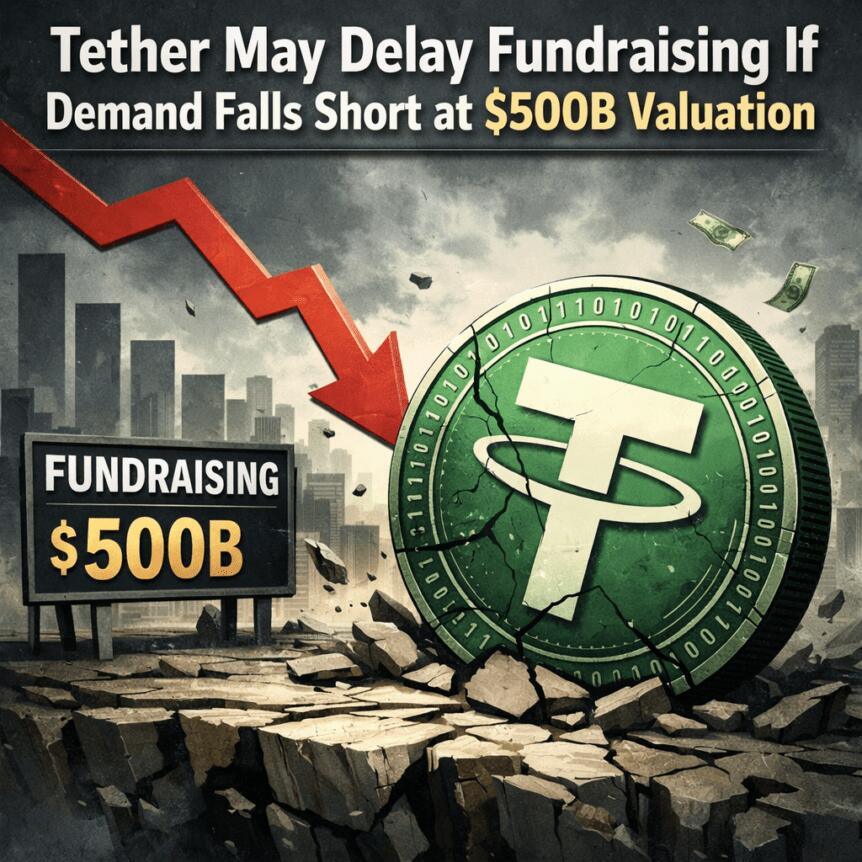
Tether is accelerating a private fundraising push, aiming to secure fresh capital at a stated valuation near $500 billion within a short window. People familiar with the matter say the round could close within roughly two weeks, but management has signaled it may push back the timeline if investor demand falls short of expectations.
The Information reported last Friday that Tether has been seeking new investment since late last year, with the $500 billion target circulating as the implied valuation behind a potential raise. The report notes that if commitments don’t meet expectations, the company is likely to delay the round. The scaled ambition would position Tether among the world’s largest financial firms by market value, far eclipsing most traditional banks outside of JPMorgan Chase, should the round proceed as planned.
According to The Information, the fundraising plan could amount to up to $20 billion in private placements, representing roughly a 3% stake in the company. Cantor Fitzgerald was cited as the lead adviser for the deal. If completed, the round would mark a notable shift for the stablecoin issuer, extending Tether’s reach beyond plain-vanilla stablecoins into broader financial and commodity-related ventures as it frames a multi-line expansion strategy.
Valuation context helps frame the scale. JPMorgan Chase, often cited as the largest bank by market capitalization, sits around $795 billion, with Bank of America at about $353 billion. Tether’s USDt stablecoin — the world’s largest stablecoin by market cap — was around $184 billion at the time of reporting, illustrating the gap between a private fundraising target and the actual on-chain liquidity footprint. Beyond USDt, Tether’s product line includes Tether Gold (XAUt) and Tether EURt (EURt), pegged to gold and the euro respectively, underscoring a broader asset management and distribution strategy alongside its core stablecoin business.
Key takeaways
- The fundraising round aims for a $500 billion implied valuation, with commitments due within about two weeks and a potential delay if demand falters.
- The plan reportedly envisions raising up to $20 billion for roughly a 3% stake, positioning Tether as a major new investor in its own enterprise expansion.
- The Information cites unnamed sources; Cantor Fitzgerald is said to be the lead adviser on the deal.
- Past statements by Tether executives have fluctuated between discussing hypothetical scenarios and signaling active fundraising, with public comments differing from earlier reports.
- Separately, Tether is moving toward a formal audit of USDt, signaling a governance shift as it seeks broader external validation of its reserves and internal controls.
Tether’s fundraising push and the valuation calculus
The Information’s reporting situates Tether’s private fundraising as a strategic attempt to accelerate growth across existing and new business lines — including stablecoins, distribution ubiquity, and potential ventures into AI, commodity trading, energy, and media — by several orders of magnitude, according to statements attributed to the company’s management on X. The publication notes that in September of last year, Bloomberg reported Tether was exploring a raise of up to $20 billion that could value the company around $500 billion, with plans for a private placement that would imply roughly a 3% stake. Cantor Fitzgerald was named as the lead adviser in that report, underscoring the seriousness of the capital-formation effort at a scale rarely seen in the crypto‑fintech space.
Publicly available comments from Tether’s leadership have been nuanced. In February, Paolo Ardoino, Tether’s chief executive, told Cointelegraph that earlier discussions about a $20 billion fundraising scenario were hypothetical rather than an active plan. He argued that the valuation framing reflected the company’s earnings power by comparing it with AI-driven platforms in terms of potential profitability, yet stopped short of articulating a concrete timetable or commitment to raising a specific amount. The company did not respond to Cointelegraph’s requests for comment before publication, leaving investors with a varying degree of clarity about the path forward.
For investors assessing the deal, the implied $500 billion valuation invites comparisons with traditional financial institutions. JPMorgan Chase remains the benchmark large-cap bank by market capitalization, while Bank of America sits notably smaller. USDT’s role in the crypto ecosystem — as the largest stablecoin by market cap at roughly $184 billion — amplifies questions about how a private round and expanded business lines could influence reserve management, liquidity provisioning, and regulatory scrutiny in the months ahead. The market cap figures provide rough scale but do not translate directly into the credit or solvency profile of a private fundraising round; nonetheless, they underscore the magnitude of the ambition behind such a round for a crypto infrastructure firm with a global footprint.
Audits and governance: a shift toward external validation
Beyond fundraising chatter, Tether has moved to bolster governance through formal auditing. The Financial Times reported that Tether has engaged KPMG to conduct its first full audit of USDt’s financial statements, with PwC assisting in preparing internal systems. This marks a shift away from relying solely on reserve attestations from BDO Italia toward a comprehensive audit that would scrutinize assets, liabilities, and internal controls across Tether’s balance sheet. While a reserve attestation provides a snapshot of reserve backing, a full audit promises a more complete view of financial health and governance practices — a development that could affect how market participants perceive USDt’s resilience during stress scenarios.
The push toward external audit coverage aligns with growing calls in the industry for greater transparency around stablecoin reserves and liquidity risk. If successful, the KPMG-led audit could set a new benchmark for the sector and influence conversations with regulators and potential counterparties seeking deeper assurance about stablecoin inventories and treasury management. Tether’s current stablecoin business remains dominant, but how the audit findings are interpreted will likely hinge on the scope, timing, and exact audit opinions delivered by the Big Four firm, alongside any remediation measures the company implements in response to findings.
Related coverage and discussions have emphasized the importance of credible audits to reduce counterparty risk and to bolster confidence among users and institutions that rely on USDt for liquidity, payments, and cross-border transfers. Meanwhile, Tether’s broader product suite — including XAUt and EURt — continues to position the issuer as a diversified, though still crypto-centric, financial services provider. The outcome of the audit process could influence not just USDt’s perceived safety but also investor appetite for any future fundraising rounds and strategic investments tied to the company’s growth plan.
What to watch next in the evolving stablecoin landscape
Several factors will shape the trajectory of Tether’s fundraising, governance initiatives, and broader market impact. First, investor appetite for a multi-hundred-billion-dollar implied valuation hinges on the perceived durability of USDt’s reserves and the credibility of a full audit. Market participants will look for clear outcomes from the KPMG-led audit, including a transparent accounting of assets, liabilities, and internal controls, as well as any findings that could affect reserve adequacy or liquidity management.
Second, regulatory developments across major jurisdictions will influence both the feasibility and timing of large-scale fundraising by a crypto infrastructure firm with a global footprint. While the exact regulatory status of stablecoins remains unsettled in several markets, a demonstrated commitment to external audits can help ease some concerns, though it does not guarantee regulatory approvals or blanket acceptance.
Third, the strategic rationale behind a $500 billion valuation deserves scrutiny. If the fundraising proceeds, investors will want a clear articulation of how proceeds would be deployed to accelerate growth across existing and new business lines, how this expansion would affect the stability and liquidity of USDt, and what governance reforms might accompany scaled operations. The contrast between historical statements that framed funding rounds as hypothetical and the current push toward a defined private placement underscores the need for clarity on governance, risk, and long-term value creation for holders of USDt and related products.
Finally, observers should monitor how market dynamics respond to such a bold capital raise in a sector that already features intense competition among stablecoins, evolving custody and settlement infrastructure, and a continually shifting regulatory climate. The upcoming weeks and months will be telling as Tether balances fundraising ambitions with ongoing governance improvements and broader market sentiment around stablecoins’ role in decentralized finance, cross-border payments, and the broader crypto economy.
In the near term, investors and users will want to see whether the fundraising timing aligns with demand signals, how the 500 billion valuation is justified by growth prospects, and how the audit findings translate into practical steps for risk management and transparency. As Tether elevates its governance and corporate-financial objectives, the broader market will be watching to determine if the company can sustain its leadership role while addressing the scrutiny that accompanies such an ambitious expansion.
The unfolding narrative around USDt — from fundraising ambitions to audit commitments — will likely shape conversations about stablecoin resilience, regulatory expectations, and the path to broader financial integration for crypto-native infrastructure players. Readers should stay tuned for updates on the audit progress, the fundraising milestones, and any formal responses from Tether as it navigates investor feedback and external oversight.
Sources and additional context: The Information reported on the fundraising push and $500 billion valuation plan; September Bloomberg reporting on a potential $20 billion raise with Cantor Fitzgerald as adviser; public statements from Paolo Ardoino on X regarding the fundraising discussions; Cointelegraph coverage of Ardoino’s February comments; Financial Times reporting on Tether engaging KPMG for USDt’s first full audit, with PwC assisting; reserve attestations previously provided by BDO Italia; USDt market capitalization data from CoinMarketCap.
Related coverage: Stablecoin supply dynamics and comparative positioning among major tokens continue to evolve as centralized issuers seek greater transparency and scale.

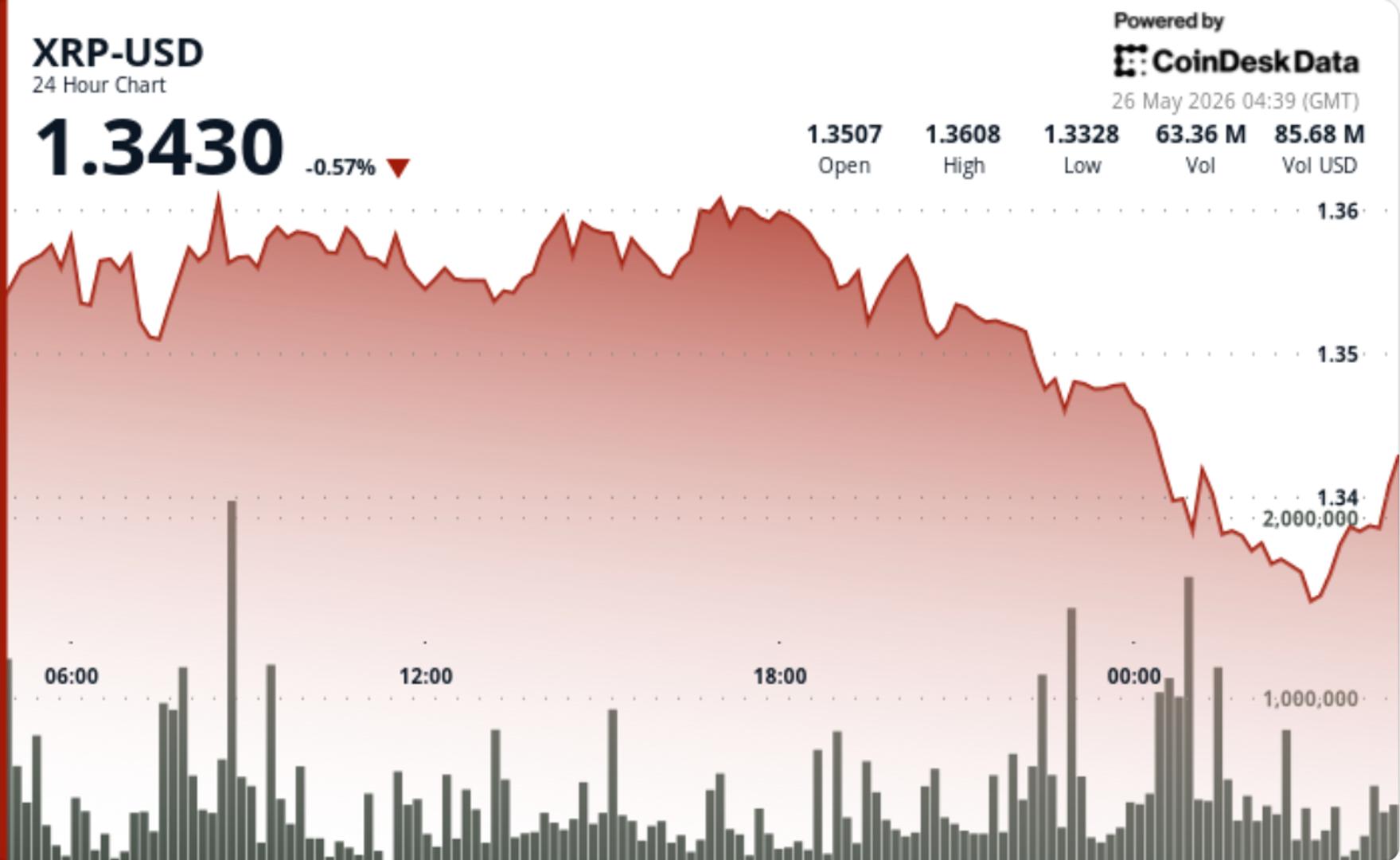
XRP spent weeks tightening into a narrow range, but the market finally started leaning lower after another failed push above resistance near $1.36. The move matters because repeated tests of support tend to weaken buyers over time, and XRP is now drifting back toward the same $1.30 area traders have treated as the line between consolidation and broader breakdown risk.
News Background
• Analysts remain split on XRP’s structure, with some calling the latest move a confirmed triangle breakdown while others still frame it as late-stage compression before a larger breakout.
• CME Group is preparing to launch 24/7 XRP-linked futures trading later this month, adding another layer of institutional exposure to the token.
• Whale activity also cooled sharply during the period, with large transaction counts falling more than 57% over nine days.
Price Action Summary
• XRP fell from $1.3457 to $1.3366 during the 24-hour session while trading inside a relatively tight 1.9% range.
• The largest move came after a failed breakout attempt near $1.3620, where elevated volume quickly reversed into selling pressure.
• XRP later broke below the $1.35 level and consolidated near session lows around $1.336 into the close.
Technical Analysis
• The breakdown below $1.35 reinforced short-term bearish momentum after weeks of tightening price action.
• XRP is now trading beneath several key moving averages, while resistance near $1.36 continues to reject upside attempts.
• Some analysts view the recent move as a confirmed symmetrical triangle breakdown with downside risk toward $1.14.
• Others still argue the broader structure resembles compression rather than outright collapse, especially while XRP remains above the critical $1.30 support area.
What traders should watch
• $1.30-$1.31 is now the key support zone. Losing it would likely accelerate downside momentum.
• $1.35 becomes the immediate resistance area XRP needs to reclaim to stabilize near-term structure.
• CME’s upcoming XRP futures launch could increase volatility and improve liquidity once trading begins later this month.
Crypto World
HYPE briefly overtakes Dogecoin, privacy tokens slide as US strikes on Iran rattle markets


Privacy tokens gave back the loudest share of the gains crypto markets had been holding onto.
Zcash (ZEC) dropped 5.2% over 24 hours to $619, the biggest pullback among the top 20 by market cap, though the token is still up 8.2% over the past seven days, per CoinDesk data. Monero (XMR) fell 4% to $378.
Both have been among the strongest performers across crypto over the past several weeks, with ZEC drawing institutional attention after Multicoin Capital’s stake disclosure earlier this month and the broader narrative around privacy tokens.
A 5% drop after that kind of run reads as profit-taking rather than fresh selling, since the structural buyers in privacy tokens have been adding through the rally, not distributing into it.
Hyperliquid’s HYPE token traded above Dogecoin’s market cap during Asian hours before pulling back, with HYPE down 4% to $59 and off 0.8% to $0.1009. HYPE is still up 23.6% over the past seven days on the back of last week’s SpaceX pre-IPO perpetual launch on Hyperliquid.
Tron (TRX) was the lone gainer among the top 10, up 2.6% to $0.3739 and 4.8% over the past seven days. Bitcoin held near $76,500, ether sat at $2,087, and Solana traded at $83.97, all in tight ranges with no major move in either direction.
The macro backdrop drove the cautious tone. US Central Command confirmed strikes on missile launch sites in Iran and boats attempting to place mines in the Strait of Hormuz, describing the action as defensive.
Brent crude rose almost 2% to $98 a barrel, bouncing back from Monday’s 7% slump when London and New York were closed for holidays. The dollar strengthened against all G-10 peers, gold pulled back 0.6% to $4,545, and S&P 500 futures held a 0.6% gain after Monday’s US market closure.


BitMine Immersion Technologies has appeared on the preliminary list for Russell 1000 inclusion, according to Fundstrat’s Tom Lee.
Summary
- BitMine made Russell 1000 preliminary list, raising passive-flow hopes for Ethereum treasury-linked BMNR shares now.
- Crypto.news reported BitMine holds 5.28 million ETH after adding 71,672 tokens in one week recently.
- FTSE Russell says reconstituted indexes take effect after market close on June 26, 2026 officially.
The move has drawn attention because BMNR is one of the largest public Ethereum treasury plays.
Lee said FTSE Russell published its preliminary index additions and deletions on May 23. He added that BitMine’s market value was above the roughly $5.7 billion minimum for large-cap inclusion. Current market data places BMNR’s market capitalization near $8.58 billion.
BitMine enters Russell 1000 watch
FTSE Russell started its June 2026 semi-annual Russell U.S. Indexes Reconstitution by publishing preliminary lists of companies expected to enter or exit the Russell 3000 and Russell Microcap indexes. The changes will take effect after U.S. markets close on June 26.
The Russell 1000 cutoff has also moved higher this year. LSEG data shows the smallest Russell 1000 company had a market capitalization of $5.7 billion as of April 30, 2026.
Lee said many active managers only buy stocks inside the Russell 1000. He also said passive index funds and ETFs often hold an estimated 20% to 25% of a company’s market cap.
Passive funds may add BMNR exposure
Index inclusion can matter because funds that track Russell indexes may need to adjust holdings after the reconstitution becomes final. FTSE Russell said preliminary lists are updated through May and June before the new indexes take effect after the market close on June 26.
That timeline makes BMNR a stock to watch through the final reconstitution window. The listing is not only a stock market event. It also brings attention to BitMine’s Ethereum-heavy balance sheet.
Crypto Banter framed the setup as a possible “hated rally” trade because Ethereum sentiment remains weak. The comment refers to a market where bearish sentiment is high, but positioning or forced flows can still support a rebound.
BitMine holds 5.28 million Ethereum
Crypto.news reported that BitMine added 71,672 ETH in one week, raising its holdings to 5.28 million ETH. The position represented about 4.37% of Ethereum’s total supply at the time of the report.
The same report said BitMine had staked 4.71 million ETH, creating estimated annualized staking revenue of $289 million. The company has continued adding ETH even as the market has traded below stronger resistance levels.
Meanwhile, the Russell update comes as Ethereum faces pressure from weak price action, ETF outflows, and doubts around large ETH treasury positions. Crypto.news reported that ETH was struggling to reclaim $2,150 while leverage clusters sat near $2,000 and $2,150.
At the same time, Ethereum’s network activity remains part of the bullish case. Arbitrum’s 2025 transparency report showed more than 2.1 billion cumulative transactions, about $20 billion in total value locked, and nearly $10 billion in stablecoins.
Vitalik Buterin’s latest comments also added to the Ethereum treasury debate. Crypto.news reported that Buterin said the Ethereum Foundation will sell less ETH and focus its remaining resources on long-term survival, privacy, security, and protocol goals.
Buterin also said the foundation holds only about 0.16% of ETH supply, while nearly 90% of his own net worth remains in ETH.


Strategy added no Bitcoin between May 18 and May 24, according to Lookonchain’s weekly report.
Summary
- Strategy bought no Bitcoin last week as Michael Saylor’s firm focused on bonds instead.
- BitMine also added no Ethereum after slowing purchases near its major ETH treasury target.
- Four public firms still bought 612 Bitcoin despite weaker stablecoin liquidity and DEX volumes.
The pause came during a week when stablecoin liquidity fell by $687 million and spot and perpetual trading volume on decentralized exchanges also declined.
The update followed a separate report that Strategy bought bonds instead of Bitcoin during the same period. Michael Saylor said on X that the company bought bonds, not Bitcoin, while crypto.news reported that Strategy moved to repurchase nearly $1.5 billion in convertible notes.
Strategy still remains the largest public Bitcoin treasury company. crypto.news reported that the firm held 843,738 BTC, worth more than $65 billion, after years of steady accumulation.
The latest pause does not erase its long-term buying record. However, it shows that the company used last week to focus on debt and capital management instead of adding more Bitcoin.
BitMine adds no Ethereum
BitMine also made no new Ethereum purchase during the same week, according to the Lookonchain report. The pause followed a period of rapid ETH accumulation by the Tom Lee-linked company.
Earlier reports showed that BitMine had already slowed its Ethereum buying pace. crypto.news reported on May 12 that the firm bought 26,659 ETH in the prior week, down from more than 100,000 ETH in each of the three earlier weekly periods.
BitMine’s slowdown came after the firm built one of the largest Ethereum treasuries among public companies. The company had amassed more than 5.2 million ETH, equal to about 4.31% of Ethereum’s circulating supply.
The company also staked more than 4.7 million ETH, making staking rewards part of its treasury model. The latest weekly pause therefore appears tied to a slower buying phase rather than a new sale.
Four public firms still buy Bitcoin
While Strategy and BitMine paused, four public companies added 612 BTC worth about $47.5 million. The buyers were Strive, The Smarter Web Company PLC, DDC Enterprise Limited, and Hyperscale Data.
The four firms together held 21,525 BTC, valued at about $1.67 billion, after the purchases. The data shows that corporate Bitcoin buying did not stop, even as the two most-watched treasury names stayed quiet.
Strive has also drawn attention in recent Bitcoin treasury coverage. A separate crypto.news report said Strive’s SATA raised enough capital to buy 537 BTC in one week, showing how smaller treasury vehicles are using capital markets to build Bitcoin exposure.
That shift matters for market watchers because treasury demand is no longer limited to Strategy. Smaller public firms are still adding Bitcoin, even when the largest buyer pauses.
Stablecoin liquidity weakens
Lookonchain’s weekly report also showed that stablecoin market cap fell by $687 million. The same report said DEX spot and perpetual trading volumes declined during the May 18 to May 24 period.
The weaker liquidity backdrop came as Bitcoin and Ethereum traded lower on crypto.news price pages. Bitcoin was near $76,559, while Ethereum was near $2,089 at the time of writing.


BlackRock has recorded more than $1 billion in Bitcoin sales over the past week as U.S. spot Bitcoin ETFs posted their largest weekly outflow of 2026.
Summary
- Arkham Intelligence data showed BlackRock-linked Bitcoin sales reached nearly $1.01 billion last week, coinciding with $1.26 billion in total U.S. spot Bitcoin ETF outflows.
- Bitcoin briefly fell below key support levels during the sell-off before recovering to around $77,443, while institutional investors reportedly reduced exposure amid rising market uncertainty.
- Despite ETF outflows, BlackRock recently filed a second Securitize-powered tokenized fund with the SEC after BUIDL grew to roughly $2.3 billion in assets.
According to data shared by Arkham Intelligence on Monday, BlackRock sold Bitcoin every trading day last week, bringing its total weekly disposal to nearly $1.01 billion. The withdrawals came during a sharp downturn across crypto markets, with Bitcoin and major altcoins remaining under pressure for most of the week.
Arkham Intelligence data showed the outflow was BlackRock’s biggest weekly Bitcoin reduction since November 2025. At the same time, the entire U.S. spot Bitcoin ETF market recorded combined weekly outflows of roughly $1.26 billion, suggesting BlackRock accounted for most of the capital leaving the sector.
The sell-off unfolded as market volatility intensified following renewed weakness in crypto prices and fading appetite for risk assets. Bitcoin briefly slipped below key support levels during the week before staging a modest rebound heading into Monday trading.
Why are institutions pulling money from Bitcoin ETFs?
Several analysts and market trackers linked the ETF withdrawals to defensive positioning by institutional investors as uncertainty continued to weigh on digital assets.
According to the original market data referenced by Arkham Intelligence, institutions appear to be reducing exposure amid concerns that bearish momentum in Bitcoin could deepen if macroeconomic conditions worsen. Bitcoin (BTC) was trading near $77,230 at press time, relatively neutral over the previous 24 hours, though still well below levels seen earlier this month.
Meanwhile, the decline in ETF demand comes after months of strong inflows that helped push Bitcoin toward new highs earlier this year. As reported earlier by crypto.news, spot Bitcoin ETFs had previously attracted steady institutional allocations during periods of easing inflation expectations and improving market sentiment.
Recent outflows now indicate that some large investors are choosing to rotate capital away from crypto-linked products while waiting for clearer market direction. Data from CoinGlass and SoSoValue over the past several weeks has also shown weakening momentum across derivatives markets, including softer open interest and fluctuating funding rates during major price swings.
How does BlackRock’s crypto strategy continue beyond Bitcoin ETFs?
Even as BlackRock trims Bitcoin exposure through its ETF operations, the asset manager continues expanding into blockchain-based financial products elsewhere.
BlackRock recently filed a second tokenized fund application with the U.S. Securities and Exchange Commission using infrastructure developed by Securitize. The filing follows the rapid growth of BUIDL, BlackRock’s tokenized U.S. Treasury fund launched with Securitize in March 2024.
BUIDL has grown to around $2.3 billion in assets and currently stands as the largest tokenized Treasury fund globally. Securitize, which operates as both an SEC-registered transfer agent and broker-dealer, provides the compliance and tokenization framework supporting the fund.
The new filing signals that BlackRock is continuing to develop blockchain-based investment products even while institutional demand for spot Bitcoin ETFs weakens. At the same time, firms including Franklin Templeton, Fidelity, and State Street are also exploring tokenized asset products as competition in the real-world asset sector accelerates.
The filing also comes as the CLARITY Act moves toward a full Senate vote after clearing the Senate Banking Committee in a bipartisan vote earlier this month.


Ondo Finance said its founder, Nathan Allman, has died unexpectedly, creating a sudden leadership change at one of the best-known names in tokenized real-world assets.
Summary
- Ondo Finance confirmed Nathan Allman’s death and named longtime President Ian De Bode as new CEO.
- The company said De Bode has led strategy, product, and daily operations for two years.
- Related reports show Ondo expanded across tokenized stocks, ETFs, Treasuries, and major crypto wallet integrations.
The company announced the news on May 25 and said its thoughts were with Allman’s family and loved ones.
In its public statement, Ondo said “Nate’s brilliance, humility, and drive shaped every part of what Ondo is today.” The company did not disclose further details about the cause of death. Allman founded Ondo in 2021 after working on Goldman Sachs’ digital assets team.
Ian De Bode takes over as Ondo CEO
Ondo Finance named longtime President Ian De Bode as CEO. The company said De Bode had been leading strategy, product, and daily operations for more than two years and had the confidence of the leadership team.
De Bode also said the company’s direction would not change. In a statement, he said “The mission of Ondo, Nate’s mission, has not changed.” He added that Allman would have wanted the team to keep executing with care and discipline.
The appointment gives Ondo an internal successor at a time when users, partners, and investors are likely to look for clear communication. De Bode had already been involved in the work that shaped Ondo’s product roadmap and market expansion.
Ondo’s RWA business remains in focus
The leadership change comes as Ondo remains a major player in the tokenized real-world asset market. Its products include OUSG, USDY, and Ondo Global Markets, which links crypto wallets and apps to tokenized U.S. stocks, bonds, and ETFs.
Related market coverage shows Ondo has been expanding quickly. A May 19 report said Ondo Finance’s total value locked had moved above $4 billion, up from about $1.95 billion at the start of the year, while Ondo Global Markets had passed $1 billion in TVL.
Ondo also built a wider distribution base through wallet and exchange integrations. Earlier reports said MetaMask added access to more than 200 tokenized U.S. stocks and ETFs through Ondo, expanding access for eligible users in supported regions.
Wider tokenization growth
Separate reports also show why Ondo’s next steps remain central to the RWA market. crypto.news recently reported that tokenized real-world assets had reached about $31 billion to $34 billion by May 2026, with U.S. Treasuries and Ethereum-based products leading the sector.
Ondo has also expanded into tokenized stocks and ETFs through several partnerships and integrations. Recent coverage said the platform brought 35 tokenized assets to Hyperliquid’s HyperEVM, while earlier reports noted Franklin Templeton’s tokenized ETF partnership with Ondo.
Ondo said it would continue building what Allman started. For the company, the near-term focus now shifts to leadership continuity, product execution, and maintaining trust across its RWA ecosystem.


Bitcoin hovered near $76,500 mid-day Hong Kong time, according to CoinDesk market data, holding a narrow range as trading remains muted after a long weekend in the U.S.
Prediction market traders on Polymarket see BTC as likely to hold above $74,000 this week, with a 60% chance it finishes the trading week above $76,000. In a note to CoinDesk, Singapore-based market maker Enflux wrote that the “bid is there” but no one is adding size.
A Glassnode weekly report adds the same split: buying and selling pressure is becoming more balanced, but weaker trading activity points to a cautious market waiting for the next macro catalyst.
Traders are not positioning for a sharp breakdown, but they are equally unconvinced that a breakout is imminent.
Enflux argues the current range says as much about what bitcoin has not done as what it has. Despite recent macro shocks, including Moody’s downgrade of U.S. sovereign debt and retailer Walmart warning that geopolitical fuel costs and weaker consumer spending are hitting margins, BTC has barely moved.
For some traders, that kind of muted response could signal resilience. Enflux sees something closer to exhaustion.
The missing ingredient is fresh institutional demand.
After pulling in $2.44 billion in April, U.S. spot bitcoin ETF inflows have cooled, and exchange reserves remain near decade-low levels at roughly 2.3 million BTC, suggesting the structural supply backdrop remains supportive. But tight supply alone does not push prices higher if buyers are not stepping in.
Next week’s Personal Consumption Expenditures inflation report, the Federal Reserve’s preferred inflation gauge, could reshape expectations for U.S. interest rates. A hotter-than-expected reading could reinforce the higher-for-longer rates narrative, lifting the dollar and Treasury yields while pressuring bitcoin.
A softer print could do the opposite, reviving hopes for easier monetary policy and bringing institutional buyers back into crypto exposure.
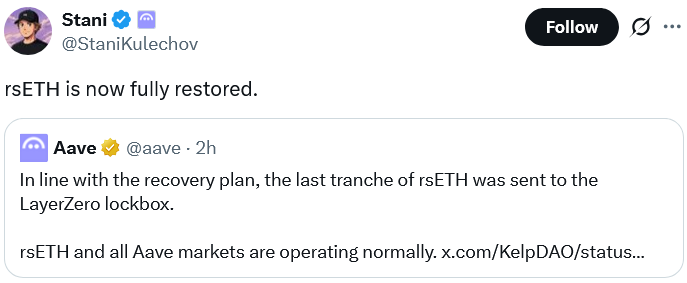
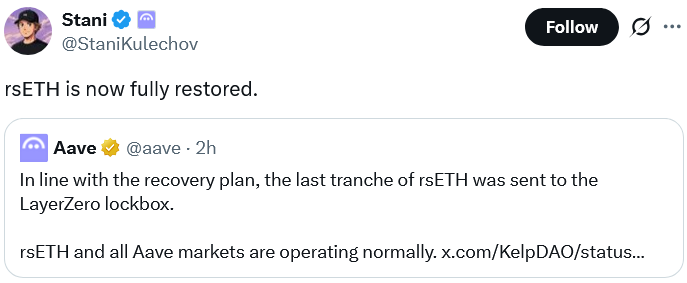
Ethereum liquid staking protocol Kelp DAO says its restaked Ether token has been restored with a five-week recovery effort after the protocol suffered a $293 million exploit by North Korea’s Lazarus Group on April 18.
Kelp DAO posted to X on Monday that the final tranche of 20,373.7 Kelp DAO restaked ETH (rsETH) tokens was sent to the LayerZero smart contract responsible for locking, minting, burning and releasing rsETH during cross-chain transfers.
“This closes the operational part of the rsETH recovery plan,” Kelp said. Several crypto protocols contributed funds to help restore rsETH’s backing under the DeFi United initiative.
Source: Stani Kulechov
The Kelp DAO hack in April caused a ripple effect throughout the crypto lending market that disrupted billions of dollars in liquidity and resurfaced concerns about the interconnectedness of decentralized finance protocols.
Aave was one of the hardest hit as the Kelp DAO attacker put a large portion of the stolen 116,500 rsETH up as collateral on its lending platform to borrow wrapped Ether, leaving $190 million in bad debt and triggering a wave of withdrawals.
The Kelp DAO hack was one of 25 crypto hacks in April, which saw a combined $630 million worth of losses, the worst month since February 2025, when crypto exchange Bybit was hacked for a record $1.5 billion.
The first tranche of 25,000 rsETH was transferred on May 13, allowing rsETH bridging between the Ethereum mainnet and the blockchain’s layer 2 networks to reopen.
Kelp reopened withdrawals for rsETH the following day and said on Tuesday that rsETH mints, redemptions and rewards operations “have been running normally.”.
Aave’s TVL bleed stops, but has not recovered
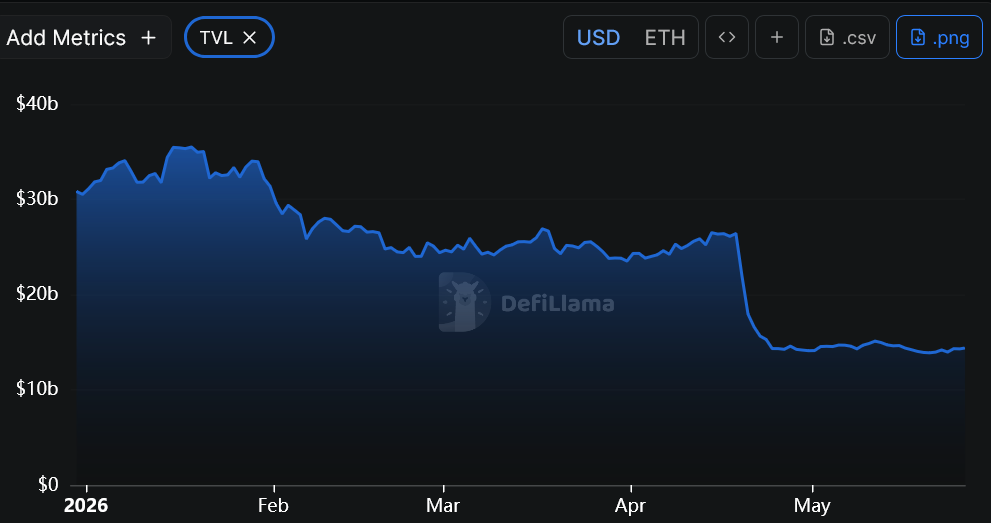
The Kelp DAO exploit contributed to Aave’s total value locked falling from $26.4 billion to below $14 billion, losing its long-held position as the largest DeFi protocol by TVL.
Related: Crypto hackers stole $17B over past 10 years: DefiLlama
DefiLlama data shows that net outflows from Aave’s lending markets have eased over the past month.
However, Aave’s TVL has shown no signs of recovery, hovering between the $13.9 billion and $15.1 billion mark since about a week after the incident took place.
Source: Aave’s change in TVL in 2026. Source: DefiLlama
Magazine: The legal battle over who can claim DeFi’s stolen millions
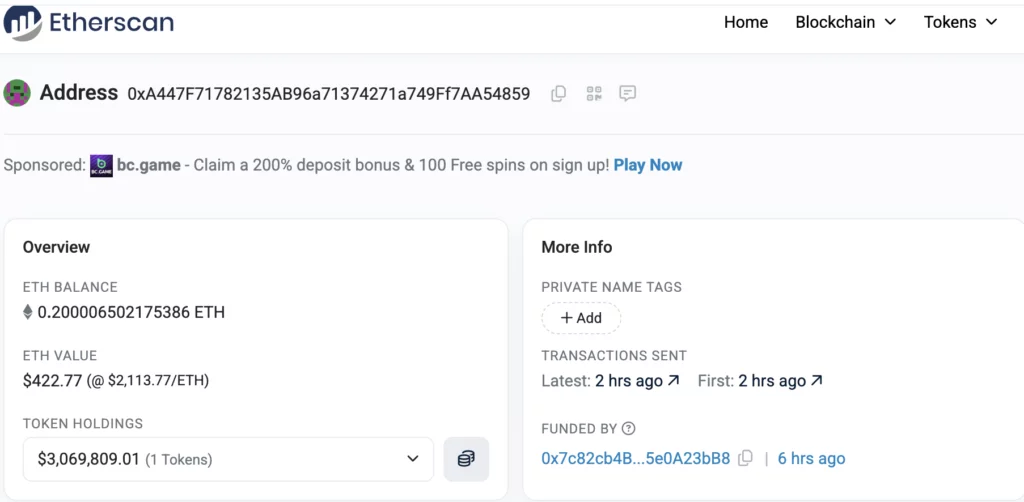
Blockaid said it detected an active exploit targeting the SquidRouterModule on Ethereum and Base, with 86 Gnosis Safes drained for about $3 million in roughly two hours.
Summary
- Blockaid said 86 Gnosis Safes were drained for about $3 million within roughly two hours.
- The attacker swapped stolen assets into DAI through attacker-controlled Uniswap V3 pools, Blockaid said.
- Related crypto.news coverage shows May has brought repeated DeFi exploits across wallets, bridges, and stablecoins.
The blockchain security firm said the stolen tokens were swapped into DAI through attacker-controlled Uniswap V3 pools. The alert listed an exploiter address, a consolidation wallet, and one example drain transaction.
According to Blockaid’s X thread, the exploit targeted Gnosis Safes linked to the SquidRouterModule. The firm said the attack moved quickly, draining dozens of Safes before the stolen assets were converted.
The alert identified the exploiter address as 0x9bdc730183821b6bb2b51be30b77c964fa645b91. Etherscan data shows that address was funded by Tornado Cash and recorded 52 transactions, with activity listed on May 25.
Blockaid also pointed to a consolidation wallet holding the proceeds. Etherscan data for that wallet showed about 3.07 million DAI, worth roughly $3.07 million, alongside a small ETH balance.
Stolen tokens move through Uniswap V3
The example transaction shared by Blockaid succeeded at 06:25:23 UTC on May 25. Etherscan shows the transaction came from the exploiter address and interacted with another address tied to the reported flow.
The same transaction page shows swaps involving USDC, ENA, and USDT through Uniswap V3 pools. These details match Blockaid’s claim that stolen assets were routed through decentralized exchange pools before being consolidated.
In response, Squid later said the incident was unrelated to its core protocol and contracts. The team said all Squid users and integrators were unaffected and no action was needed. According to Squid, the exploited contract was a third-party Gnosis Safe module verified on Basescan as “SquidRouterModule,” but it was not built, deployed, or operated by Squid.
Squid said the exploit came from a faulty third-party smart-wallet module that victims had added as a trusted Safe Module. The team added that its official router contract was architecturally different and was not touched.
May exploit wave keeps security teams active
The SquidRouterModule incident comes during an active month for onchain security teams. Crypto.news reported one day earlier that StablR’s EURR and USDR stablecoins lost their pegs after a suspected private key compromise let an attacker take control of minting permissions and extract about $2.8 million.
That report said Blockaid traced the StablR incident to a compromised multisig owner. The attacker reportedly minted 12.85 million tokens and converted thin DEX liquidity into 1,115 ETH in proceeds.
Crypto.news also reported earlier in May that Blockaid flagged an active smart contract exploit involving ShapeShift’s FOX Colony on Arbitrum. That incident drained $132,700 at first, before a related exploit pushed total losses to about $182,700.
DeFi infrastructure risks remain in focus
Recent exploit coverage shows attackers keep targeting weak points around smart contracts, proxies, bridges, wallets, and key management. Crypto.news reported in April that DefiLlama had logged 518 crypto hacks over 10 years, with total losses above $17 billion.
The same report said recent incidents show attackers increasingly target private keys, signing systems, bridges, and wallets, not only smart contract code. That pattern makes module permissions and Safe integrations an important area for teams to review.
Crypto.news also reported that TrustedVolumes lost roughly $6.7 million in an exploit tied to a custom RFQ swap proxy. Blockaid and other firms said about $5.87 million was drained from the protocol’s Ethereum resolver.
The latest SquidRouterModule alert adds another case where connected DeFi infrastructure became the attack surface.


NEAR Protocol surged about 50% this week to roughly $2.34, outpacing most large cap tokens as traders rotated into Arthur Hayes’s “holy trinity” of NEAR, HYPE and ZEC.
Summary
- NEAR (NEAR) jumped about 50% in seven days, hitting a six month high near $2.34 as capital rotated into select altcoins.
- CoinMarketCap shows NEAR trading around $2.40 with roughly $689 million in daily volume and a multi billion dollar market cap.
- Arthur Hayes called NEAR, Hyperliquid and Zcash the “holy trinity of altcoins,” and all three outperformed Bitcoin this week.
NEAR Protocol has become one of the clearest large cap momentum trades after its price climbed roughly 50 percent in a week to hit a six month high around $2.34, even as the broader market barely moved.
CoinMarketCap lists the live NEAR Protocol price at about $2.40, with 24 hour trading volume above $689 million and a market capitalization in the low single digit billions, placing it around the top 30 crypto assets by size.
Why is NEAR outperforming other large cap altcoins
According to Changelly, NEAR is currently priced near $2.38 with an estimated market cap of roughly $3.08 billion and circulating supply of about 1.3 billion tokens, after logging around 14.4 percent volatility over the past month.
Fresh data from CoinMarketCap’s AI driven price analysis tool noted that NEAR recently jumped 13.26 percent in 24 hours to about $2.47, massively outperforming a wider market that edged up just over 1 percent during the same window.
MEXC framed the move more starkly, writing in a recent market note that “thanks to a 25.78% price increase, NEAR Protocol was the biggest gainer of the day among the top 200 cryptocurrencies by market cap” as it traded around $2.20.
Another MEXC report added that NEAR’s price “surged 50% in seven days, hitting six month highs at $2.34” and gaining about 34 percent in one day alone, highlighting the speed with which traders have piled into the token.
That acceleration came as the total crypto market cap slipped about 0.42 percent to $2.58 trillion and roughly 78 percent of listed coins lost value on the day, suggesting NEAR’s rally is a focused rotation rather than a rising tide.
In earlier coverage on crypto market leadership, NEAR had already begun to appear alongside other high conviction trades that pulled in liquidity while the rest of the market chopped sideways.
How does NEAR fit into Arthur Hayes’s “holy trinity” narrative
The renewed interest in NEAR is tightly bound to a narrative from BitMEX co founder Arthur Hayes, who recently called NEAR, Hyperliquid and Zcash “the holy trinity of altcoins” in a comment widely circulated on social media.
In an article summarizing his thesis, Stocktwits reported that “Arthur Hayes’ ‘Holy Trinity’ Outperforms Bitcoin – HYPE’s Price Hits All-Time High, While ZEC, NEAR Surge To 6-Month Peaks This Week,” underscoring that all three tokens hit notable milestones at roughly the same time.
Hyperliquid, which is tracked on CoinMarketCap as HYPE, has posted its own aggressive move to an all time high this month, while privacy focused Zcash has rallied to multi month highs on the back of what one crypto.news report described as a “privacy rotation” and fresh ecosystem funding.
The narrative has spilled over into trading commentary on X as well, with market watchers pointing out that NEAR, HYPE and ZEC have all logged sharper percentage gains than Bitcoin in recent sessions, even as the benchmark asset remains near the center of attention.
One MEXC dispatch explicitly linked the three assets, noting that NEAR’s 50 percent weekly surge coincided with strong performance in HYPE and ZEC and concluding that NEAR “was the biggest gainer of the day among the top 200 cryptocurrencies by market cap.”
For NEAR specifically, the backdrop is an evolving story around the protocol’s effort to brand itself as “the blockchain for AI,” with CoinMarketCap describing it as “a high performance, AI native platform built to power the next generation of decentralized applications and intelligent agents” in its project overview.
The token’s recent outperformance follows a long stretch of underperformance from its 2021 peak, but current data from CoinCodex suggests models still see NEAR trading near $2.30 at year end 2026, only slightly below current levels, which implies the market is now trying to decide whether this latest burst is a new secular leg higher or just another sharp countertrend move.
In earlier analysis on altcoin cycles, NEAR had already been flagged as one of the top gaining assets during a broader market rebound, reinforcing the idea that this week’s rally is part of a sustained period of relative strength rather than an isolated spike.

Man City are back: the inside story of Pep Guardiola’s final season

XRP slips below $1.35 after triangle breakdown puts focus on $1.30 support

Sam Levinson Reveals Inspiration for Shocking Euphoria Death

US brings back mandatory military draft registration

Steven Gerrard disagrees with Gary Neville over ‘shock’ Chelsea and Arsenal claim | Football

Register Renaming | Hackaday

Forza Horizon 6 – 100% COLOSSUS AFK MONEY/XP! | Crash & Controller FIX!

XRP PRICE DROPS WHERE’S THE BOTTOM? – RIPPLE MAKES CNBC DISRUPTOR LIST! – $589 NO LONGER A DREAM?

Ripple , China Russia Bypassing SWIFT & XRP Scarcity Shockwave
-

 Crypto World4 days ago
Blockchain.com files with SEC for U.S. IPO
-

 Fashion3 days ago
Holiday Weekend Open Thread – Corporette.com
-

 Business4 days ago
Dell Technologies DELL Stock Surges 15% on AI Server Momentum and Analyst Upgrades in 2026
-

 Crypto World4 days ago
Bitcoin Accumulation Weakens as BTC Realized Losses Hit $600M
-

 Crypto World4 days ago
Space X IPO Is ‘Bad News’ for Tech Stocks: But What About Bitcoin?
-

 Politics3 days ago
Makerfield: a tale of two social-media histories
-

 Crypto World3 days ago
Robinhood crypto COO Tanya Denisova exits
-
 Crypto World4 days ago
MicroStrategy’s Saylor Says Miners No Longer Set Bitcoin Price, Another Force Has Taken Over
-

 Business1 day ago
NYT Strands Answers May 24 2026 Revealed for Puzzle No. 812 Theme Summer Essentials
-
 Tech4 days ago
A 0.12% parameter add-on gives AI agents the working memory RAG can’t
-

 Crypto World4 days ago
AI infrastructure race heats up as IREN pitches full-stack strategy, WhiteFiber lands $160M deal
-

 Tech4 days ago
WhatsApp ads could make Irish debut after discussions with DPC
-

 Tech4 days ago
You Can Now Add ChatGPT To PowerPoint
-

 Business4 days ago
Trump Invests $1M-$5M in Kura Sushi USA Chain With 27 California Locations
-
 NewsBeat5 days ago
Charity run by Reform leader Malcolm Offord accused of ‘law breaking’ over Scottish registration
-

 Crypto World5 days ago
Exa Labs raises $250 million in funding led by a16z
-

 Sports4 days ago
2026 CJ Cup Byron Nelson leaderboard: Brooks Koepka finds putting stroke in Round 1
-
Business4 days ago
Goldman Sachs reinstates Ageas stock coverage with neutral rating
-

 Crypto World4 days ago
Trump Media’s Bitcoin Stash Shrinks Again as 2,650 BTC Lands on Crypto.com
-
 Business4 days ago
Marine engineering firm Avantis eyeing expansion on equity boost
You must be logged in to post a comment Login