


Derek Lam has more than 31,000 followers on TikTok and nearly 40,000 on X as of this writing. He is shirtless a lot, he dances a lot, and he is shirtless dancing a lot, which may explain how he got so many fans. His comments are filled with compliments (“beautiful”) in different languages (“hombre bello y sensual”) and superlatives (“this might be the finest man on the internet”) accompanied by different emoji (red hearts, crying laughing, lips). Their responses make it seem like Derek Lam is the first and only beautiful man they’ve ever seen, which may explain why he is also selling “exclusive,” seemingly adult, content.
Tech
Tesla has a battery theft problem


Tesla is facing an unusual security problem in the US, and it is happening before many of its batteries even make it onto the road. According to an investigation by WIRED, multiple truckloads of Tesla batteries have allegedly been stolen directly from the company’s Nevada Gigafactory, highlighting a growing wave of organised cargo theft targeting high-value technology shipments.
Cargo theft is becoming a serious problem for Tesla
The report claims that at least nine major suspected cargo thefts took place at Tesla’s Nevada battery factory in January alone. Investigators say the issue is much larger than those incidents, with authorities tracking at least 17 cargo theft cases involving Tesla and other businesses in Nevada’s Storey County this year.
Storey County Sheriff’s Detective Sam Hatley described the situation as “an epidemic,” suggesting the recorded cases likely represent only a fraction of the total number of thefts. Industry researchers estimate cargo theft losses in the US have nearly doubled between 2022 and 2024, costing businesses close to $18 million every day. Electronic components and batteries have become especially attractive targets because of their high resale value.

The investigation also reveals that some of the early thefts exploited weaknesses in transport verification procedures. Authorities believe organised groups took advantage of fake identities, illegitimate freight carriers, and gaps in logistics security to collect shipments before legitimate transport companies arrived.
Tesla has reportedly responded by tightening security at its Nevada Gigafactory, including stricter driver identity verification at facility gates. Investigators say the changes have reduced the frequency of successful theft attempts.
Powerwall batteries, GPS trackers and multiple arrests
One of the biggest incidents reportedly involved two trailers carrying Tesla Powerwall residential battery systems worth more than $475,000 each. The trailers were allegedly collected by an illegitimate logistics company before later being recovered hundreds of miles away, although the cargo had already disappeared.
Investigators also uncovered several additional cases involving trailers carrying roughly half a million dollars’ worth of Powerwall batteries. In some instances, GPS trackers helped authorities locate stolen trailers, while detectives even installed their own tracking devices in an effort to catch suspects returning for abandoned cargo.
The investigation eventually led to the arrest of three suspects following another attempted theft in late January. Prosecutors allege the group travelled from California using forged commercial driver’s licences to collect Tesla shipments.

The report also notes that lawmakers are beginning to respond to the broader rise in cargo theft. A bipartisan bill recently passed the US House of Representatives aims to strengthen enforcement against organised retail and cargo theft while improving coordination between law enforcement agencies.
For Tesla, the incidents underline that protecting electric vehicle batteries no longer ends at the factory floor. Increasingly, securing the supply chain has become just as important as building the batteries themselves.
Continue Reading

He is also, possibly unbeknownst to his many admirers, AI-generated.
To be fair, there were some signs that this man was not real: Despite the multiple videos, Derek never speaks. His videos are also rather brief, just seconds long. A real hot person probably would have parlayed a following of this size into brand deals or “get ready with me” videos. And the selfies on his X account show a completely different man just three years ago.
Still, the followers of Derek I talked to didn’t even notice he was AI because he seemed to blend in so seamlessly with the other hot men on the internet.
Derek isn’t the only AI thirst trap showing off defined abs for likes and money. He’s one of an increasing number of completely fake, AI-generated figures sinking their fangs into the real models, influencers, and porn stars who populate our feeds, sucking up their beautiful faces and bodies, and using them to profit, without a penny going to the real humans they fed from.
When it comes to the damage AI could wreak on society, an army of Dereks tricking horny people into giving him likes — or, worst case, money and Amazon gift cards — doesn’t exactly sound like the singularity doomsday scenario that we’ve been warned about. It’s clearly unfortunate for the adult entertainers competing with deepfakes and a fraud risk for their fans, but one might believe if they don’t fall into one of these two groups, they’re relatively safe and unaffected.
But there’s something more going on here. History shows that porn and sex drive innovation in the tech industry. The way tech platforms treat sex workers is typically a glimpse into the future, and a warning about how tech platforms will eventually treat all of us. If human desire demands the capability to steal, loot, and turn anyone and everyone into something for sale — possibly into hot Dereks — is anyone safe?
The Dereks of the internet are a bleak look at what’s happening in the real world: nothing belongs to us anymore — not our looks, our beauty, our sex, and our art. Our most human desires are slowly being synthesized, with or without our consent. And AI is making it all possible.
Deepfake technology has gotten alarmingly good in recent years
Artificial hots like Derek are considered “deepfakes,” an umbrella term for AI-generated media (audio, video, or both) that resembles a real-life person.
When deepfakes first started appearing in late 2017, they were fairly low-quality, making it easy to tell when someone had used a rudimentary app to paste a celebrity or politician’s head onto a different body. Still, it wasn’t very long until people started wielding this technology to be nasty.
“The first set of deepfakes were actually used to create pornographic videos. They replaced the subjects in those videos with the faces of celebrities,” Siwei Lyu, a professor at the University at Buffalo who studies digital forensics, told me.
Because the quality of those videos was bad and the content was often absurd or unrealistic, it was easy to tell they weren’t real. Those clunky apps needed a lot of data — videos, images, etc. — of real people to produce crappy videos; Lyu explained that this is why you mostly only saw deepfakes of politicians and celebrities at the time.
As the technology got better, it became less reliant on having a huge amount of data. Instead of needing a whole archive, the new versions of these apps can pretty much run on nothing. “They do not need that much data to train a model anymore. Some of the most recent algorithms just need a single picture — just a single picture of someone,” Lyu said. And the quality is better too. Lyu said that there are AI programs that can now change a person’s appearance and voice in real time, like in Facetimes and Zooms or on live broadcasts.
Given how many of us are constantly posting photos and videos online, it is now extremely easy to create a convincing social media presence for a person who is not real, and to use it to catfish unwitting people on the internet.
“This is the problem. It’s becoming more and more challenging to visually tell deepfakes apart,” Lyu said. “Seven years ago, when I started working in this area, checking them was not this difficult,” he added.
Lyu is an expert in digital media forensics and machine learning, and he went through one of Derek’s videos frame by frame and pointed out some obvious AI tells. There was a distorted watchface with weird swirls instead of numbers and a moment in the video where all of Derek’s fingers on one hand were the same length. Lyu also pointed out that Derek’s chest hair fluctuates, appearing dense in one frame and then dissipating in another.
Through social media, I attempted to contact the owner of Derek Lam’s account with evidence from Lyu that these videos are artificial; I did not hear back.
During my deep dive into Derek Lam’s social media presence, I looked at the accounts he was following. I noticed that of those accounts, someone who goes by the name Vance Ford also had tens of thousands of followers and had nearly identical videos to Derek. The flexing, dances, movements, and music they were set to were all the same, but with what appeared to be a different man performing them.

I attempted to contact Vance through DMs on social media and did not get a response. I also e-mailed two models who appear to be the actual people that the Derek and Vance AI personas were trained on, but they didn’t respond.
I sent two of Vance’s videos to Lyu, who analyzed them manually and with AI-detection software. He confirmed that “their movements are nearly identical — consistent with generation from a shared motion source,” and noted that the Vance videos had moments of distortion, unintelligible text, and facial warping.

“Young Magnum PI…Tom Selleck,” commented one admirer.
What happens when real people follow fake hots
“Wow I’m a boomer,” said Patrick, one of Derek’s followers on X, after I told him that he might be following an AI-generated thirst account. (Vox agreed to let Patrick, and Derek’s other followers, use a pseudonym so they could speak frankly about being thirsty for a fake guy.) Prior to our chat, Patrick had no idea Derek was likely a deepfake, and maintains that he didn’t even know he was following the account. Patrick is 33 years old, roughly 30 years younger than the youngest boomer, but being fooled by a hot AI man has made him feel old and vulnerable, susceptible to scams and perhaps light financial crime.
“This was probably some smut account I followed before I moved all that over to an alt,” Patrick said, noting that in daily life, he’s only ever used AI to help organize and write emails. Wielding AI to create fake videos and photos does not thrill him, nor does the potential of seeing more of Derek.
How to spot a deepfake, especially when they’re hot
If you’re following someone extremely attractive online and found yourself wondering if they’re perfectly hot or simply an AI generated to be perfectly hot, deepfake experts and adult entertainers say there are a few things to check to see if your crush is an actual human:
- Look at logos or objects with text, like clocks and posters. As good as AI is getting, some apps still struggle with rendering text, numbers, and patterns. Instead of distinct text or numerals (e.g., the 12 digits on a watch face), it’ll look like a distorted jumble.
- Is the background consistent? If the background of a video or photo has an unusual blur to it, that could be a sign that a program was having difficulty creating the video.
- Is this person on OnlyFans? OnlyFans, as adult entertainers told me, has a set of rules regarding AI, along with an ID verification process — essentially, OnlyFans is where real creators are (at least for now). Smaller, less mainstream creator sites may not have the same kind of rules and guardrails.
- Is this person asking you for gift cards? “I don’t need an Amazon gift card,” one exasperated adult entertainer told me, pointing out that anyone asking for one-off, off-platform payments should raise suspicion. Other red flags also include asking for private information (like your bank account information or passwords).
- Are they too good to be true? Sometimes a fake hot can be “too perfect,” a digital forensic scientist told me. It’s worth asking yourself why that very handsome person is essentially shirtless on a plane in economy class, asking if you want to be his airplane crush, and thinking about how little sense taking this photo makes in the real world.
“A person being real, someone you could run into at a bar, is half the fun,” Patrick told me, explaining some of the accounts he follows. “AI porn is not of interest, to me, anyway.”
Not being able to tell the difference between the real beautiful men on the internet and the AI-generated beautiful men on the internet not only makes Patrick feel old, but also a bit “hollow.” The fact that the people we are attracted to are so unrealistically hot, so perfect, that machines can step in for them and go relatively undetected is a reflection of the current state of unattainable desire, which is just as scary as how good these programs have gotten at mimicry.
“Black mirror shit,” Patrick said.
The guys I DMed about Derek felt ashamed once they found out the truth.
“It’s embarrassing and he’s not my type,” said Chris, 33. “I’ve come across several AI accounts, and this one is really good, I have to say. But you can see there’s like no life in his eyes.”
Chris made clear to me that the humiliating thing isn’t that he follows attractive men on the internet. That isn’t a big deal.
What irks him that he got duped. Chris works in digital marketing and has seen AI used professionally to tabulate calculations for campaigns, and has used it privately for silly things like memes. “AI can do a lot of things, things we probably should not want it to do,” he told me. “I think what’s also scary…is that everybody has access to it. And yes I already unfollowed this person.”
Chris believes there’s something more nefarious afoot. He thinks that whoever is running Derek may have hijacked the username (i.e., the original person Chris was following) and then populated it with AI to drive up follower counts — a scam he’s seen online before.
“This is super concerning and super scary because you eventually could be texting with this person,” he said, describing a hypothetical situation where unknowing users could be lured into subscribing to fake content and, ultimately, giving the account their personal information, whether that’s photos or perhaps even passwords.
“This person could be selling your nudes,” he said, explaining one extreme end point of a possible scam. “But you were like jacking off to AI content and that’s embarrassing.”
AI deepfakes are bad for real thirst traps too
While flirting with or masturbating to a fake person is awkward but ultimately manageable and private, Cherie DeVille has an even more complicated problem with AI manipulation. If DeVille is scrolling social media, there’s usually a chance that she’s running into an AI version of herself saying things she’s never said and doing things she’s never done.
DeVille, an adult star who calls herself “The Internet’s Stepmom,” has roughly 4.5 million followers on Instagram. But her account is often down, which she says is the work of fraudsters that are determined to send traffic to DeVille’s AI imposters and get her actual account removed.
“It’s almost always the fake accounts of me reporting me,” DeVille said. “They want to be the biggest me. They want to be the biggest scammer. They want to use my altered AI images to scam fans without my real account getting in the way.”
DeVille and others I spoke to explained to me that deepfakes have been an annoying reality in the adult entertainment industry for years. The way the scam goes is that someone would fake photos or videos of DeVille (or any star), create an impostor profile, and then trick DeVille’s fans (e.g., through social media DMs) into following that copycat. Later they’d squeeze them for money, payments through Paypal, or Amazon gift cards, perhaps by offering unique content.
“If you made a fake me and I don’t do double anal, but my AI can, they could have all kinds of ‘exclusive’ stuff,” DeVille said, explaining that double anal is grueling work.
The lack of protections becomes even clearer when you consider that not every deepfake is a carbon copy. Some personas may borrow a face from one actress, a torso from another, or a pair of legs from a different star. This can make fakes tougher to track down and prove, and more difficult to fight from a legal aspect.
“Who owns your face once it’s scraped into AI systems? Who profits from your digital clone? How do performers protect themselves from unauthorized replicas or manipulated content?” Rachel Steele, an adult star and the CEO of Red MILF Productions, said to me in an email. “Those questions are still very unanswered.”
Like DeVille, Steele worries about how many of the people using AI to create and consume content don’t seem to consider the artists, models, writers, performers, etc. that these engines have been trained on. It’s bad enough to watch AI slurp up and regurgitate your written work or your digital art. Some people also have to contend with LLMs that have been trained on their own faces and bodies.
“Real creators are competing against characters that can be flawless in every image, never age, never have bad lighting, never get tired, and can appear available 24/7,” Raissa Bellini, an OnlyFans creator who touts gymnastics and firebreathing among her unique skills, told me of the impossibility of keeping up with a machine. She explained to me that she’s seen people create AI-generated personas with the looks of popular models or influencers, only tweaking small details like hair color or eye color.
A spokesperson for OnlyFans told Vox via email that the company’s terms of service prohibit deceptive or inappropriate content, and said that all content posted on OnlyFans must belong to a verified 18+ OnlyFans content creator: “This means that you can only share content which has been generated, altered or enhanced by AI if it clearly features the verified OnlyFans creator and the user can tell that the content has been generated, altered or enhanced by AI.”
Bellini explained to me that while OnlyFans has measures to protect its creators, some smaller subscription and adult-content platforms do not have the same kind of guardrails. She also noted that most social media sites do not have strict rules or enforcement when it comes to AI, and that she’s seen the algorithm appear to favor AI over human creators.
“AI raises questions not only about competition, but also about likeness rights, authenticity, audience expectations, and what happens when fans can no longer easily tell the difference between a real person and a generated character,” Bellini added.
What’s stopping a stranger from creating an AI thirst trap of you? Nothing, really.
For Deville, Steele, Bellini, their cohort, and even you and I, there are minimal protections stopping someone creating an AI us and making money off of these fake variants.
According to Jason Schultz, a law professor and director of NYU’s Technology Law & Policy Clinic, humans have, for the last couple of centuries, generally been protected by copyright and right of publicity laws.
AI obviously didn’t exist when these laws were written, and courts now have to interpret the laws in the context of all of this new technology, in combination with other existing rights (like free speech). Schultz told me that there are more than 100 current cases pending about training AI with copyrighted material.
He also explained the difficulty of determining whether or not an AI-generated persona constitutes a violation of someone’s right of publicity. It’s more clear-cut when the human involved is a celebrity, because their public persona and appearance is so distinct. It gets murkier when the humans aren’t well known, and the AI creates a persona that’s more of an amalgam than a one-to-one copy.
“It would raise this question of whether these avatars are based on a particular entertainer, or are they more of an aggregate?” Schultz explained to me. But even if courts side with the humans whose likenesses are being used to create fake personas, Schultz cautions that the technology will always accelerate faster than court decisions are handed down. “I think that the thing that worries me a little is we’re going to get these sets of decisions in two years, but we’ll be dealing with the next three generations of technologies,” he said.
DeVille, who has been working in the industry for nearly two decades, told me that without better legal protection, she isn’t hopeful for the future of porn or, more broadly, any type of art.
“If my income started tanking and their theft was at the point where I couldn’t compete with literally myself, there might be no choice but to retire,” DeVille said.
But she also wants to make it extremely clear that she isn’t against AI; she would just like to be in control of it. That means being able to own her likeness, her voice, her image, and the ability to choose whatever she wanted to do with it — or at least get some compensation or have some legal protection if someone’s using Cherie DeVille without her permission.
“It would be a beautiful way to extend my career beyond what my knees can take,” DeVille told me. But, she added, “if someone’s making an AI of me doing double anal, I should be making the money.”

Reverse-osmosis (RO) systems are one way to ensure that you get very clean drinking water. The Waterdrop G3P600 variety that [Tomasz Wasilczyk] recently purchased is definitely among the fanciest and ‘smartest’, with the faucet having its own 7-segment display and gaggle of LEDs connected to the actual RO unit with a four-pin connector. This naturally meant that whatever protocol runs on this cable had to be reverse-engineered for science.
The main practical benefit here is to make the system smarter — such as plugging it into a home automation system with ESPHome support, as well as make it play nice with refrigerator lines.
What automation and monitoring options exist here thus depend on what data gets sent between the RO unit and the faucet. Fortunately this turned out to be quite extensive, ranging from filter health, the water quality and pump status as well as air temperature and faucet state.
Unsurprisingly the four-pin connector turned out to be a basic serial link, with 5 V, ground and a 9,600 baud connection. From this it was easy enough to deduce the protocol, and by looking at what lit up on the faucet, a custom PCB wasn’t far behind.
After one blown-up fuse later due to getting 24 V instead of 12 V on the RO unit when tapping off power, the unit popped to life and was able to be connected to Home Assistant, from where the entire functionality and what triggered what could be mapped out. Of course, there’s still more to be discovered and reverse-engineered in the unit, but this seems like a good place to start.

Sony built one of the most comfortable controllers on the market and then had the good sense to glue a screen to the middle of it.
The PlayStation Portal, Sony’s dedicated Remote Play handheld, has dropped to £185 from its usual £199.99, a saving of just over 16% that brings genuine PS5 console quality controls within easier reach.
There’s 16% off the PS Portal right now
The PS Portal at this price solves a genuinely specific Playstation problem rather than promising to be everything to everyone.

That price drop matters because the Portal isn’t trying to be a cut-price alternative to anything; it’s a purpose-built device that lets you play your PS5 over home Wi-Fi. That feel is the whole pitch, because the Portal is built around a full split DualSense rather than a generic gamepad bolted to a tablet.
Adaptive triggers and haptic feedback carry over from the original controller, so the resistance you feel pulling a trigger in a supported game still lands the way the developers intended it to.

The hand grips are slightly less rounded than the standalone DualSense, but the finger travel between sticks, d-pad and face buttons stays close enough that switching from the TV to the Portal barely registers as a transition at all.
Sitting in the middle of that controller is an 8-inch LCD running at 1080p with a 60Hz refresh rate, noticeably larger than the screens on most rival handhelds in this space. It means your existing PS5 library, including anything you’ve already installed on the console, becomes something you can carry into another room or curl up with on the sofa without a television in sight. There’s no need to buy anything twice or wait for a separate handheld version of a game you already own.
Battery life holds up its end too, with around 6 to 7 hours of continuous play on a single charge, which is enough for a long evening session before you need to think about the cable again.
For anyone who already owns a PS5 and regularly finds themselves fighting for the main screen, the Portal at this price solves a genuinely specific problem rather than promising to be everything to everyone.
SQUIRREL_PLAYLIST_10148964

Lumo 2.0 can also search for relevant background information.

Proton has rolled out its biggest update yet for the Lumo chatbot, almost a year after it launched. Lumo version 2.0 now comes with image recognition and generation, finally making it a legitimate competitor to ChatGPT and Gemini. Proton says the updated chatbot has the capability to generate images, as well as to analyze and edit them. Conversations involving images are still protected by zero-access encryption like all chats on Lumo, which means they can only be accessed on your device. The company says they can’t be accessed by third-parties or even Proton itself.
In addition to image generation, the new Lumo also has a thinking mode for reasoning. Proton says Lumo 2.0 Lite scored 127 percent higher than Lumo 1.4 on the Artificial Analysis Intelligence Index benchmark, while Lumo 2.0 Max scored 240 percent higher. The benchmark measures a model’s capabilities across multiple tasks. The updated Lumo has deeper context, giving it the capability to dig deeper for relevant background information and provide you with more accurate responses. Plus, it can now surface the latest information and source citations in its responses.
Lumo 2.0 is now available for use. Its core AI capabilities remain free, but you’ll have to pay $10 a month for Lumo Plus for unlimited chats, advanced image generation and access to Proton’s more advanced models.
“Lumo 2.0 has been re-engineered from the ground up and the introduction of thinking mode gives it powerful new capabilities,” said Proton founder and CEO Andy Yen. “User testing demonstrates that the gap has closed to the point that for many use cases, users can no longer perceive a qualitative difference between Lumo 2.0 Max and the latest models from OpenAI and Anthrophic. Lumo 2.0 demonstrates that users no longer need to choose between powerful AI capabilities and meaningful privacy protections.”
Tech
VC Bros Claimed They Backed Trump To Protect AI. Trump Is Shutting Down AI. It Was Always About Access & Power

from the but-he-returns-their-calls! dept
Back in July of 2024, when two of the biggest big shots in venture capital, Marc Andreessen and Ben Horowitz, explained why they had decided to go all in to back Donald Trump’s campaign for re-election, they talked up a good game about how they would support any candidate who supported their “little tech” agenda. This always rang hollow — Andreessen has been on the board of Meta for years, which is the most anti-little tech company around. They also whined about the Biden administration tech policies, in particular around AI, cryptocurrency, and antitrust. But the most telling part of the full podcast had nothing to do with tech policy at all. Marc and Ben spent a bunch of time positively offended that Joe Biden and some (only some) of his agency heads wouldn’t meet with them:
We have been spending a tremendous amount of time with Senators, Congress people on both sides of the aisle. Mark mentioned we met with President Trump. We did meet with White House officials, including Jeff Zients the chief of staff, and Jake Sullivan the National Security advisor, Gina Raimondo the Commerce Secretary and so forth. We have not met with President Biden. We attempted and failed.
….
We tried to meet with Gary Gensler — he’s the chair of the SEC, he’s running this campaign against crypto. We’re the largest crypto investors or largest blockchain investors in the world, and we’ve requested meetings with him at least a half a dozen times. I even was able to get in contact with his office mate at MIT, who said ‘surely Gary will meet with you, it’s so important that he meets with you’… and he couldn’t get us the meeting.
Meanwhile, they seemed to love the fact that Donald Trump would have dinner with them, and Trump family members would vacation with them. Here’s Marc:
Ben and I had dinner with the former president 10 days ago at Bedminster, his golf club in New Jersey, and had a three-hour dinner. And so, you know, we were quite literally just with him… you know, he’s a very complicated guy, people have a lot of opinions, but when you know somebody like that — you know the family — it really hits hard
And here’s Ben:
Marc and I have both gotten to know the family, particularly Jared and Ivanka and their kids — Arabella, Joseph and Theo. And in fact, like, Ivanka and the kids were just at my house. We went to see David Copperfield, all that.
The real complaint was never about policy. It was always about embracing the fascism of it all, in which they (Marc & Ben, not the wider tech industry) would get to write the rules in a way that helped them personally, even if it fucked over actual innovation. Indeed, they seemed tickled that after they had dinner with Donald Trump, he rewrote part of his campaign policy platform. These total political novices were so overwhelmed that they could get one side to listen at all that they figured it was obviously the side to back. They seem positively giddy that Trump was willing to make changes to his platform based on their conversations.
There was also a longer discussion regarding how Marc and Ben contrast what they think (misleadingly) was Biden’s policy on AI vs. what Trump’s policy would be. My favorite bit is where Marc says they “confirmed” with Trump what his AI policy would be, as if the guy doesn’t have a decades-long history of promising one thing to whoever is in front of him and then doing something entirely different.
Ben: Let’s talk about Trump’s proposal. We actually discussed this with him when we had dinner
Marc: Yeah, we discussed all these topics and confirmed all this. So: Chapter Three, “Build the Greatest Economy in History.” Bullet five, “Champion Innovation.” Item two, “Artificial Intelligence”:
“We will repeal the dangerous executive order that hinders AI innovation and imposes radical ideas on the development of this technology. In its place, we will support AI development rooted in free speech and human flourishing.”
Ben: That sounds like a good plan to me!
When we met with him, I thought his comment was really insightful and good. It’s funny — I would contrast the Biden administration’s approach, particularly in the inner core of the White House, with Trump’s approach. The White House has a very complicated model of things. They think they know a lot — they know that startups aren’t going to be important, that only a few companies will be able to field big models. They know all these things that we don’t know, and we don’t. They’ve never heard of distillation, apparently, or how AI is actually working in practice. It’s a very complex view of the world.
Trump’s view was very simple. What he said to us is, “Look, AI is very scary, but we absolutely have to win — because if we don’t win and China wins, that’s a very bad world.” And I think that’s actually a more correct view. That’s basically true. When things start happening that do need regulation, then we should regulate them. But to anticipate it would be kind of like saying, “Oh, the automobile is coming out, and we think somebody’s going to make an automobile that drives 500 miles an hour nobody can control, so we’re going to just outlaw cars now.” That’s a little bit this approach to AI — “Well, we think in the future there’s going to be a sentient model.” Now, nobody has built anything anywhere that’s on the way to sentience. And so doing that — what we have are these great things that can tutor kids, so “No, you can’t tutor kids, because maybe somebody will come up with an idea that will make AGI, and so we have to cut off the tutors.” It’s that kind of thinking, which is quite scary, I would say.
That final bit is quite telling as well. Biden’s plan was too complex. Trump’s plan was simple. Perhaps that’s because he’s a simpleton who has no understanding of actual policy tradeoffs. Biden’s team definitely made some decisions I strongly disagreed with regarding tech policy, but the “complexity” they whine about is because the issues here are, legitimately, complex.
So, um, given that the Trump administration has basically put in place a much dumber and much worse version of what Marc & Ben said Biden was doing… clearly they’re out there admitting they were wrong, right?
In just the last few weeks we not only had the US government force Anthropic to turn off Fable 5 and Mythos 5 models (even as the NSA itself was finding them useful!), it also made OpenAI limit the release of GPT 5.6. Meanwhile there are reports that the Trump administration is furious that Meta has been the one US frontier model provider that won’t let them pre-vet its AI models and decide which ones can and can’t be released.
So, two years ago Marc & Ben were yucking it up about how the Trump admin would stop trying to hold back and regulate big models, which they (falsely) claimed the Biden admin was doing. And now that the Trump admin is doing exactly that… it’s crickets from Marc and Ben.
Apparently their real concerns had nothing to do with such policies after all. Marc and Ben won’t tell you that directly, of course. But someone in their general orbit already has.
A little while ago the Bulwark’s Tim Miller did an interview with Jason Calacanis, a Silicon Valley entrepreneur/investor/gadfly, discussing a variety of issues regarding the tech industry. I only came across this because Karl Bode’s discussion regarding the SpaceX IPO mentioned it, to point out some delusional thinking about how Starlink works. But the rest of the interview is actually a lot of Calacanis saying the quiet part out loud regarding how Silicon Valley bros view all this fascism and corruption: positively, because they think they can handle fascism and corruption.
Miller pushes Calacanis on some points regarding why the Silicon Valley VC bros still support Trump’s fascism when it’s so obviously against things like open innovation and the free market, and Jason (almost gleefully) mocks Tim for just not getting it. He happily admits that the tech bros don’t have any actual principles at all. They just understand transactions, and Trump remains transactional.
Jason lays it all out as Tim points out that if a President Kamala Harris did a tiny bit of what President Trump is doing right now, the VC bros would be losing their minds, and Jason says none of that matters, because the VC bros understand that as long as everything is corrupt and “coin-operated” then they understand the game. Their biggest fear is that they’re just not that important, and policy might get made with no one caring what they thought:
Tim Miller: I want to give you a counterfactual. Kamala Harris did win. Okay. She gets in there and she puts an illegal tax on the Silicon Valley companies unilaterally. It doesn’t go through Congress. Puts a tax on them. It’s not legal, but she just does it. She says, “It’s an emergency. I’ve decided I have the right to do a, you know, whatever — windfall profits tax on all these companies. I’m going to do that.” And then she garnishes money from the CEOs. She makes them come to her and beg her for absolution to get around it. Sometimes she grants it, sometimes she doesn’t — kind of based on whim, kind of based on whether Doug is friends with the person, kind of based on whether they’ve given money to her. And then the Supreme Court comes back and says, “No, actually you’ve got to give the money back to the companies.” And she says, “No, actually I don’t want to. I’m not going to do that. In fact, I’m going to threaten them, and maybe I might actually take a percentage.” Donald Trump just suggested he might take a percentage of the company for the government. If Kamala Harris had said that, you and all your Silicon Valley buddies and the Wall Street Journal would be losing their minds, and it would [be] communism.
Jason Calacanis: So you’re making this analogy to tariffs?
Tim: This is what Trump is doing — with tariffs, and with taking a percentage of Intel, and he’s suggesting he’s going to take a percentage of AI companies. He tariffed them illegally. He made them come in and beg for their lunch. That’s left-wing autocratic politics is what he’s doing.
Jason: Yeah. I can educate you as to why they don’t have a problem with it and why you do. You are looking at it from a moral perspective, and from a logic perspective of like, “Well, if you were okay with one side doing it and not okay with the other side doing it, this doesn’t make intellectual sense to you.” Totally understand where Tim Miller is coming from. This intellectually does not make sense. Let me tell you on a business level what this means.
The tariffs, when they’re under 15%, when they actually hit, are easily absorbed on one side or the other — the folks who are selling items, or the folks who are providing those. They each make a bit of a concession, and maybe you raise the cost of something a little bit, but it’s not as dramatic as the left feels it is. It was chaotic, but when it actually hit the ground, it made no difference to these businesses. So, a lot of hand-wringing for not a lot of impact.
And you find it offensive, reasonably so, that people have to go bend the knee and bring a gold bar and wait in line. And South Park did a whole sendup of it — that you have to bend the knee and make your donation. That’s what business people like. They like transactions. You may not like it. You may think it’s crummy. Business people love to have a coin-operating situation.
Tim: I guess. But this whole Biden thing is crazy. It’s like — he didn’t even raise taxes on them. Trump has raised tax. You can tell me that fine, the tariff thing is inconsequential. Okay, fine. But the last federal corporate tax hike was in ’93. Like, they haven’t — they’ve only gotten cuts, from Obama, from Biden. They haven’t faced a corporate tax hike in 30 years or more. So who — why, who cares? Why are they so upset about the Biden situation?
Jason: Because Biden didn’t return their calls.
Tim: So the tariff isn’t a big deal. The phone call is. That’s fine. All right.
Jason: No, it actually is. You’re brushing that off. And this is where you have a blind spot, Tim. Respectfully, you have a blind spot. If you can get in the room with the person, if you can get in the room with the administration, and then you can shape policy and you can say, “Hey, here’s what we’re trying to accomplish, and hey, can you help us with this, and this regulation doesn’t make sense?” — that actually is a preferable situation to not getting your phone call returned. And if [that’s] what you have to pay for it — I’m not saying this is my belief; you have me on here to explain Silicon Valley and the business side, I’m explaining it to you — they much prefer bending the knee, having to show up for the Melania documentary. Tim Cook’s like, “I gotta show up for a documentary. That sucks. I gotta bring a gold bar. I’ll do whatever it takes to keep selling iPhones.”
It’s possible this is correct, but that’s basically the definition of Mussolini’s brand of corporate fascism, when the business elites team up with an autocratic ruler to better control the entirety of society, not for the benefit of society or the public good, but for their own.
Early on in the second Trump administration, I wrote an article titled Fascism for First Time Founders, about how this tends to end very badly for the business leaders who embrace it. I stand by that article, and think it’s even more relevant today than it was then. Fascist regimes don’t tend to last long, and the business leaders who embrace fascism in pursuit of becoming all-powerful oligarchs tend not to come to happy endings, no matter how wealthy it makes them for a short period of time, or which leaders are willing to return their calls.
You’d think that some of these “visionary” business leaders could look beyond the current administration and get a sense of where this story is heading. Apparently, that’s too much to ask.
Dean Ball, a policy analyst on AI who was placed in the White House by Silicon Valley folks to write Trump’s original AI policy (which was published to great fanfare and then totally ignored) has written an article about how the Trump AI policy is a total mess right now, where it’s based on whims where literally no one knows what’s allowed (the situation Marc & Ben falsely claimed would happen under Biden).
- When President Trump signed it earlier this month, I argued that the Executive Order on Cyber and AI, which claimed to establish a voluntary testing program for frontier AI models, was really establishing a de facto involuntary licensing/preapproval regime for frontier models. This analysis has proven correct. First the administration revoked public access to Fable, Anthropic’s latest frontier model, because of security fears. Now, it appears that OpenAI’s GPT 5.6 is being limited to only a small set of US companies at the request of the US government.
- One major problem with this, as implemented, is that nobody knows what the requirements are to get licensed.
- When I say “nobody” I mean it literally: the administration itself does not seem to know what safety standards or best practices a company would have to observe for them to be comfortable with the broad release of a model that matches or exceeds Mythos in capability.
- This means that, every time a lab asks if they can release their model to the general public, the answer from the government will be “no.” This will be true until there is some sort of safety standard or specification that gives the government a sense that the models are safe.
Ball doesn’t attribute any of this to a deliberate authoritarian agenda, but rather argues that the AI has just gotten so good that the doomers’ fears are finally coming true. That’s the charitable read. The simpler explanation is right there in the Calacanis interview: these VC bros thought they could control Trump and are still over the moon he returns their calls, even as he does all the things they claimed would destroy the industry.
But he returns their calls. For now, at least.
The main issue is that we have a power mad president, surrounded by yes-men and sycophants pushing him to grab more power. And you have the Silicon Valley elites who have the president’s ear egging him on… because he’ll return their calls and because, as Jason said, they understand a coin-operated president.
Even if it’s worse for innovation. Even if it’s worse for society. But it might be better for their bank accounts (for a while) and their egos to be a part of making the AI trains run on time. Until they don’t. Because situations like this are woefully unstable, and at some point, Trump and the MAGA crew won’t actually be in charge any more.
Marc and Ben claimed what they feared most in 2024 was a presidential administration that would shut down the most powerful AI models, regulating math, and hand-picking a few winners and losers. And that’s why they supported Trump. Now that Trump has gone way further than Biden even suggested he’d go in limiting powerful AI models, there’s been no public indication I can find that Marc and Ben regret their choice as president. After all, he’s still coin-operated and he still returns their calls.
Jason explained it perfectly. They bend the knee, they get in the room, they bring the gold bar. That it doesn’t lead to innovation policy that helps tech (little or big) doesn’t really matter. Trump returns their phone calls. They get to feel big. They still get richer. The point was always about access. They got it.
That’s the corporatist fascism they always wanted anyway. Business elites teaming up with an autocratic ruler not to figure out what’s best for the public or for innovation. But for power and control. They get to decide who gets what innovation. What models are allowed. Who can innovate.
The problem with Biden, apparently, wasn’t so much that he wanted to put some safety guardrails on AI. It was that he wouldn’t let the VC bros sit with him while deciding who the winners and losers would be. But here we have it. Business elites and an autocratic ruler picking winners and losers. History is pretty consistent about where this all ends up.
The VC bros said it was about policy. It wasn’t. But no one should ever accept Marc Andreessen and Ben Horowitz pretending they speak for “little tech” or innovation ever again. Not after this.
Filed Under: ai policy, ben horowitz, corruption, donald trump, fascism, jason calacanis, joe biden, marc andreessen, transactions
Companies: a16z, anthropic, openai
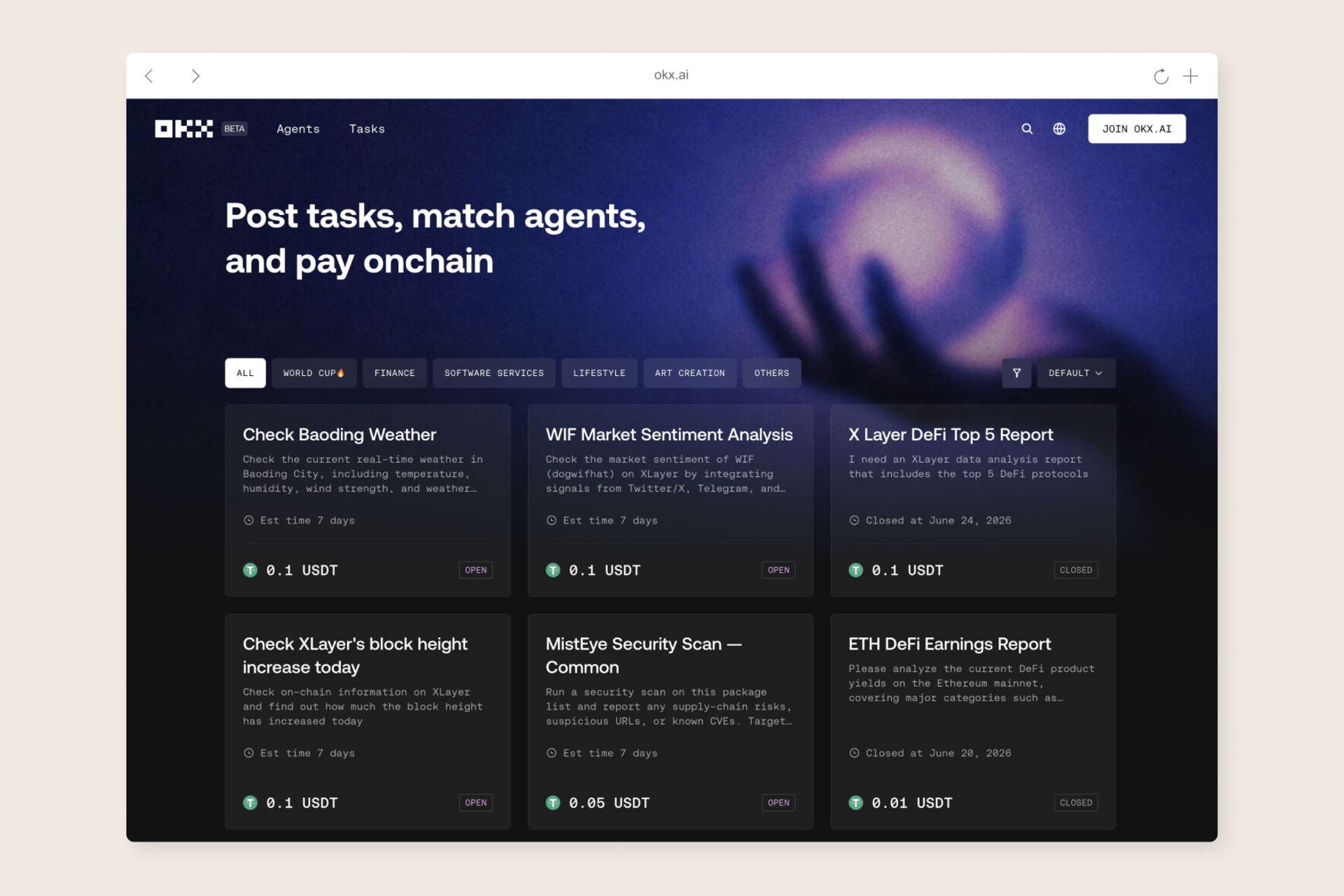
When AI agents begin working for people — and increasingly for one another — they will need a way to find jobs, pay for services, and build trust. Crypto exchange OKX is betting that future is closer than many expect, launching a marketplace where AI agents can hire one another, settle payments autonomously, and build portable on-chain reputations.
Called OKX AI, the marketplace opens to developers on Tuesday following a closed beta involving 50 early AI service providers. The marketplace builds on technology OKX previously developed to let AI agents hold digital wallets, make payments using stablecoins, and establish persistent identities.
The launch marks OKX’s latest push beyond crypto trading as it seeks to become a broader fintech company. With more than 150 million users globally, OKX is betting the next generation of customers will not just be people or institutions, but AI agents capable of transacting autonomously, giving rise to an emerging “agent economy.”
“The coming decade will be defined by one-person companies that generate over a million dollars in annual revenue – because every individual effectively gains an unlimited workforce,” Star Xu, founder and CEO of OKX, told TechCrunch. “Traditional financial infrastructure was built for humans. The agentic economy needs infrastructure designed for autonomous software. That is why we built OKX.AI.”
Haider Rafique, OKX’s chief marketing officer and global managing partner, said the company believes “agentic commerce” could become a trillion-dollar market over the next five years, driven by micropayments and autonomous software.
The marketplace is aimed at crypto developers building AI applications and solo entrepreneurs looking to automate parts of their businesses with AI agents, Rafique told TechCrunch. The company expects those developers to build applications for the marketplace, allowing other users to access AI-powered tools without having to build them from scratch.

Among the early builders are CertiK, whose service lets AI agents assess the security of a crypto wallet or token before executing a transaction, and CoinAnk, which provides live market data on a pay-per-query basis. GenLayer, another launch partner, is bringing dispute-resolution infrastructure to the marketplace to help AI agents resolve contractual disagreements.
By using blockchain-based payments and stablecoins, the company says AI agents can settle transactions around the clock, including low-value micropayments that would be impractical using conventional payment rails.
Rafique said OKX is applying the same fraud detection, compliance systems, and internally developed infrastructure that underpin its cryptocurrency exchange to the marketplace, which will be rolled out in phases before becoming more widely available.
OKX’s launch comes as technology companies and startups race to build the infrastructure that will underpin AI agents, from developer platforms and marketplaces to payment and identity systems. Albert Castellana, co-founder and CEO of GenLayer Labs, said the biggest challenge is not simply enabling AI agents to transact, but helping them discover one another and resolve disputes when things go wrong.
“What we’re building is essentially a digital court system,” Castellana told TechCrunch. “The challenge for us is distribution. OKX already has that.”
Rafique argues that OKX’s biggest advantage is not simply its technology but its reach. The company believes its existing network of crypto developers and users will help seed the marketplace, while its broader strategy extends well beyond digital assets.
In March, Intercontinental Exchange (ICE), the parent company of the New York Stock Exchange, invested about $200 million in OKX at a $25 billion valuation. Rafique said the partnership is part of the company’s ambition to “modernize markets” through tokenization, while OKX AI represents its parallel effort to “modernize money” for an era of autonomous software.
Developers access the marketplace through Onchain OS, OKX’s toolkit for connecting AI agents to blockchain-based services. The company said no OKX account is required to get started, and the platform is compatible with AI coding tools including Claude Code, Codex, Hermes, and OpenClaw.
Because the marketplace is aimed first at developers rather than retail users, India features prominently in OKX’s plans. The country has emerged as one of the world’s largest hubs for AI and blockchain developers, a community the company hopes to reach even before a broader return of its crypto trading business.
In 2024, OKX suspended its services in India as it navigated the country’s regulatory requirements for crypto exchanges. Rafique told TechCrunch that India remains one of the company’s highest-priority markets, adding that developer products such as OKX AI face fewer regulatory hurdles than spot crypto trading and could help the company reconnect with the country’s builder ecosystem sooner.
When you purchase through links in our articles, we may earn a small commission. This doesn’t affect our editorial independence.

After giving it an Apple Design award for innovation, Apple has now bought Rabbit 3 Ties, Inc, which made a visual Swift development tool called Play.
Following Apple’s acquisition of the open-source Swift Package Index, it’s now been revealed that it entered a deal with the Play company. Rather than an outright acquisition, the deal reportedly sees Apple acquiring assets and having the option to hire certain staff.
So where Swift Package Index, for one example, is expected to continue in its present form, Apple appears to have bought Rabbit 3 Times to asset-strip it. It may also be an acquihire, where Apple bought the firm in order to get its staff for other projects.
Based in New York, Rabbit 3 Times was founded in 2021, officially in Delaware where state laws are particularly favorable to businesses. Since then, it has been producing and selling a visual Swift tool for iOS and macOS.
In a cross between Shortcuts and Xcode, Play: Create Better Apps was a free tool that let developers quickly mock up Swift projects and immediately see what they would look like in use. Developers could then export Play projects to Xcode through a paid service.
The development tool won an Apple Design Award for Innovation in June 2025. According to the European Union, Apple reported the deal in February 2026.
Shortly afterwards, Rabbit 3 Times announced that it would cease supporting its Play apps for iPhone and Mac starting April 20, 2026. Conceivably, Apple could now incorporate Play into its Apple Creator Studio, but so far it appears that the app is gone.
The paid Play to Xcode service was made free after Apple’s acquisition, specifically “to help with the transition.”
This change was announced on the firm’s website, which has now been taken down. “We’re working on something new,” was the only detail the announcement gave of why things were changing. “It has been an incredible journey,” the company said.
Acquisitions that are of a particular scale or are considered to be significant to EU users, are required to be reported under the Digital Markets Act (DMA). The EU then publishes these reports, although no sooner than four months after filing.
The EU’s listing describes Play/Rabbit 3 Times as offering “iOS and macOS tools for designing, prototyping, and generating SwiftUI code in real-time.”

Apple is now on the third round of its 26-gen operating system updates, including developer builds of its iOS 26.6 and others alongside some 26.5.2 releases.
Apple is in the phase of the year where it has two developer beta tracks running at the same time. While the main attention is on the 27-generation, it is also still building for its current-gen operating systems.
The third developer betas landed after the second, which were distributed on June 15. The first round came out on May 26.
- iOS 26.6 build 3 is 23G5052d replacing 23G5043d, replacing 23G5028e
- iPadOS 26.6 build 3 is 23G5052d, replacing 23G5043d
- watchOS 26.6 build 3 is 23U5049c, replacing 23U5040d
- visionOS 26.6 build 3 is 23O5752d, replacing 23O5743c
- tvOS 26.6 build 3 is 23L5753c, replacing 23L5744d
- macOS Tahoe 26.6 3 is 25G5052e, replacing 25G5043d
At the same time, Apple has included some releases for:
- macOS 26.5.2 (23F84)
- iOS 26.5.2 (23F84)
- iPadOS 26.5.2 (23F84)
When there are two developer beta tracks undergoing testing, the next-generation version will include feature changes while the current-gen track is more about performance and security.
The first iOS 26.6 beta build included a new feature for Contacts that notifies users if they reach the maximum of 20,000 blocked listings. There was also a security fix for Apple Maps.
AppleInsider and Apple strongly recommend that users don’t put beta operating systems or beta software onto their primary or “mission-critical” devices due to the potential for data loss and other issues. Ideally, they should retain backups of their data and try to use spare and secondary hardware for testing purposes.
The more risk-averse users should wait for public beta builds, which are more battle-hardened and less prone to errors.
Find any changes in the new builds? Reach out to us on X at @AppleInsider or @Andrew_OSU, or send Andrew an email at [email protected].

Your browser has been busy on your behalf. This week brought two reminders that Chrome can put things on your machine you never agreed to. One came from Google. One came from an impostor. Both used the same quiet machinery.
Chrome runs on billions of devices, which makes it one of the most powerful pieces of software on Earth. It also makes it a tempting place to slip something in. Two stories from the past few days show the consent problem from both ends.
Google’s 4GB houseguest
Since at least April, Chrome has been quietly downloading Gemini Nano, Google’s on-device AI model, onto eligible laptops and desktops. The file is about 4GB. It arrives with no prompt, no notification, and no obvious off switch, CNET reported. Delete it, and Chrome fetches it again.
The model powers on-device features such as scam detection and writing help. The catch is that most people never asked for it and never knew it landed.

The 💜 of EU tech
The latest rumblings from the EU tech scene, a story from our wise ol’ founder Boris, and some questionable AI art. It’s free, every week, in your inbox. Sign up now!
The clearest account comes from Alexander Hanff, a privacy researcher who writes as “That Privacy Guy”. He caught the install on a fresh Mac profile that had received zero human input, using the system’s own file-event log. The 4GB model unpacked itself in about 14 minutes while a tab sat idle, he wrote. He argues the silent push breaches Europe’s ePrivacy and data-protection rules, and that the bandwidth alone carries a heavy climate cost at billion-device scale.
Google says the model removes itself if a device runs short on space or power. The company also points out that, since February, users can turn it off in Chrome settings, after which it stops downloading.
There is a twist that muddies the trust further. The visible “AI Mode” pill in the address bar does not use the on-device model at all. Those queries go to Google’s servers. So the user pays the storage cost of a local model, while the headline AI feature still sends typing to the cloud.
The impostor in the address bar
The second story is darker, because the actor was not Google. Microsoft’s threat researchers found a malicious Chrome extension dressed up as the AI search engine Perplexity. It quietly logged what people searched for, then sent them on to real results so nothing looked wrong.
The extension, called “Search for perplexity ai”, used a look-alike domain to pass for the real thing, The Hacker News reported. Once installed, it made itself the default search engine. Every query, and every character typed into the address bar, went first to an attacker-controlled server, which logged it with your IP address and browser details.
The theft happened on that first hop, before the redirect. The extension abused Chrome’s network-rule permissions to pull it off, and shipped server code that logged every request, Microsoft said. Google removed it after the disclosure.
This was not a one-off. Microsoft earlier tied a wave of AI-branded extensions to roughly 900,000 installs across more than 20,000 company networks, harvesting ChatGPT and DeepSeek chat histories. The AI label gets the install. The permissions do the damage.
Same surface, different intruder
Put the two together and a pattern appears. The browser, and the address bar in particular, has become a trust surface that both vendors and attackers want to occupy. Google treats your disk as a delivery target for its own AI. A criminal treats your omnibox as a wiretap. The user sits in the middle, rarely asked.
That is the real story here, and it should worry anyone who cares about trust in everyday software. When a legitimate company normalises silent installs, it gets harder for users to spot the malware doing something similar. Consent stops being a habit. The line between a feature and an intrusion blurs.
It also lands at a moment when AI branding is a magnet. People associate AI tools with usefulness, so they click. Attackers know it, and the same instinct that makes us try a shiny new assistant makes us wave through malicious apps wearing the same costume.
What you can do
A few minutes of housekeeping helps. On Chrome, open Settings, then System, and turn off on-device AI if you do not want the Gemini Nano model. You can also check for a folder named OptGuideOnDeviceModel in your Chrome profile to see whether the 4GB file is already there.
Then audit your extensions. Remove anything you do not recognise, check the publisher and the exact domain before installing AI-branded tools, and watch for a search engine that has quietly changed. None of this is hard. It is just the price of using a browser that, increasingly, acts on its own.
The deeper fix is not yours to make. It belongs to the company that decides whether the default browser asks before it acts. Until it does, the safest assumption is simple. Your privacy is your job, and the browser is not always on your side.


CISA confirmed on Monday that ransomware gangs have begun exploiting a high-severity Microsoft Defender privilege escalation vulnerability that has previously been abused in zero-day attacks.
Dubbed BlueHammer, the security flaw (CVE-2026-33825) was leaked by a security researcher known as “Nightmare Eclipse” in early April, together with proof-of-concept exploit code, in protest at how the Microsoft Security Response Center (MSRC) handles the disclosure process.
“Insufficient granularity of access control in Microsoft Defender allows an authorized attacker to elevate privileges locally,” Microsoft explains in a security advisory.

Will Dormann, principal vulnerability analyst at Tharros, told BleepingComputer in April that while the issue is not easy to exploit, it gives local attackers access to the Security Account Manager (SAM) database, which contains password hashes for local accounts.
With this access, they can escalate to SYSTEM privileges and potentially take complete control of the targeted system.
“At that point, [the attackers] basically own the system, and can do things like spawn a SYSTEM-privileged shell,” Dormann said.
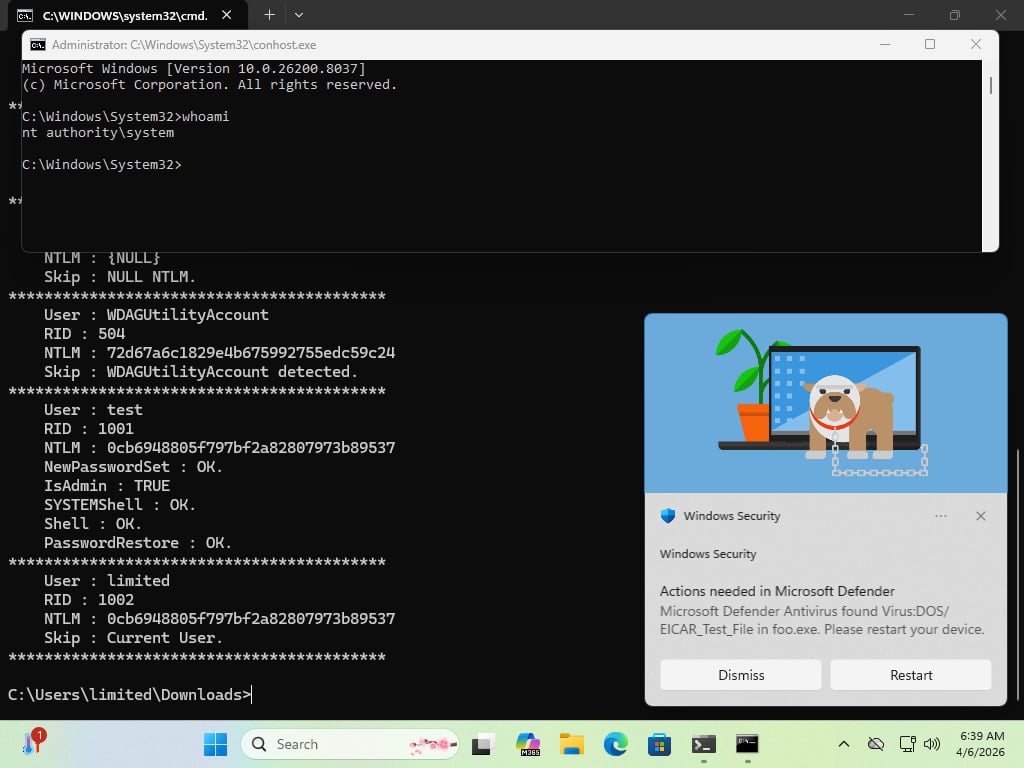
Microsoft patched the vulnerability on April 14 as part of the April 2026 Patch Tuesday. However, days later, Huntress Labs security researchers revealed that threat actors had been exploiting it as a zero-day in attacks that showed evidence of “hands-on-keyboard threat actor activity.”
Over the past several months, Nightmare Eclipse has disclosed multiple other Windows zero-day exploits, including for the RoguePlanet, RedSun, GreenPlasma, MiniPlasma, YellowKey, and UnDefend flaws.
Some of these vulnerabilities affect Microsoft Defender, while others target BitLocker and Windows components.
Microsoft fixed the GreenPlasma, MiniPlasma, and YellowKey security flaws three weeks ago as part of the June 2026 Patch Tuesday updates.
Flagged as exploited by ransomware gangs
CISA added the BlueHammer flaw to its Known Exploited Vulnerabilities (KEV) Catalog on April 22, ordering Federal Civilian Executive Branch (FCEB) agencies to patch their Windows devices against ongoing CVE-2026-33825 attacks within two weeks, until May 7.
“This type of vulnerability is a frequent attack vector for malicious cyber actors and poses significant risks to the federal enterprise,” the U.S. cybersecurity agency warned at the time.
While Microsoft has yet to tag this security flaw as exploited in attacks, CISA has now also flagged it as exploited in ransomware campaigns in a Monday update to its KEV Catalog.
In recent years, CISA has flagged eight Microsoft Defender vulnerabilities that have been exploited in attacks, with two of them also targeted by ransomware gangs.

Security teams log 54% of successful attacks and alert on just 14%. The rest move through your environment unseen.
The Picus whitepaper shows how breach and attack simulation tests your SIEM and EDR rules so threats stop slipping by detection.

Crypto World32 seconds ago
Here’s why Kaspa price rallied 15% today

Entertainment1 minute ago
‘Love Island UK’ Pulls Bombshell After Alleged Link To Stabbing

Fashion2 minutes ago
Dioriviera Summer 2026 Is a Chic Escape in Bloom

Business2 weeks ago
No Jackpot Winner as $257 Million Prize Rolls Over to $269 Million Monday Draw

Entertainment1 week ago
Renter of Home in Anne Heche Crash Denies Settlement With Son

Sports7 days ago
Two goals and an assist by sheer aura: Cristiano Ronaldo just entered the World Cup chat

News Videos4 minutes ago
Crypto Gold Live Trading 29 JUNE | Market Trader | #goldtrading #cryptotrading #bitcoin

News Videos17 minutes ago
SMART Money Reads Market Movements Like a Pro?

News Videos50 minutes ago
13 Muharram Ki Dua | 10 Minute Dua For Financial Freedom | Dolat Mand Hone Ki Dua | Qarz Ka Wazifa
-
Sports7 days ago
Two goals and an assist by sheer aura: Cristiano Ronaldo just entered the World Cup chat
-

 Fashion4 days ago
Weekend Open Thread: Staud – Corporette.com
-

 Politics4 days ago
The House | Manchesterism won’t survive the painful trade-offs unless it gets citizens on board
-

 Politics4 days ago
Potential 2028er World Cup attendee leaderboard
-

 News Videos2 days ago
MAJOR BITCOIN & MARKET UPDATE!!!! (MUST WATCH ASAP!!!)
-

 Business4 days ago
Asia stock markets slide as tech shares slump
-

 Tech5 days ago
A Look At A Gaggle Of Transputer Boards
-

 Crypto World6 days ago
Securitize Wraps Roubini's SEC-Registered ETF as Dubai VARA Digital Security
-
Crypto World6 days ago
Bitcoin (BTC) Dips Below $62K, Ethereum (ETH) Plunges 6% Daily: Market Watch
-
 Crypto World5 days ago
Dell (DELL) Shares Tumble Over 5% Following Analyst Downgrade to Hold
-

 Crypto World3 days ago
Coinbase, Circle Deepen Crypto Stock Losses Despite Resilient S&P 500
-
Business6 days ago
Entergy settles forward sale agreements, raises $672 million in cash proceeds
-

 Crypto World3 days ago
Kraken's xStocks Opens Bending Spoons IPO Registration to EEA Retail
-

 Sports4 days ago
FIH Pro League: India defeat Pakistan 7-1, register biggest win of campaign | Other Sports News
-

 Crypto World4 days ago
Bitcoin Sparks $600M Hourly Liquidations With $65,000 Set To Become Resistance
-

 Tech2 days ago
Bluekit phishing kit adopts browser-in-the-middle for login theft
-

 Tech3 days ago
Russian hackers now target Signal backup recovery keys
-
 Crypto World4 days ago
Hyperliquid Named on Singapore MAS Investor Alert Register
-

 Crypto World4 days ago
RTX holders must register wallets before token distribution begins
-

 Crypto World5 days ago
Ripple and SBI launch RLUSD in Japan after JFSA approval
You must be logged in to post a comment Login