
TL;DR
BYD denies environmental breaches at its Szeged factory as Hungarian police probe toxic soil claims and the company scouts a second European plant.




I first learned about Pura from a friend whose house always smelled like a high-end boutique under every circumstance. Cooking project, water leak … no matter what was going on in her house at the time, I only ever smelled berries. I have two cats and a multi-sports-playing teen—I knew I needed this. Now, after having owned multiple Puras for over two years, I have some thoughts.
While my Pura journey began with the now-discontinued Pura 3, I have also since tested the Pura 4 and large-room Pura Plus, both of which have dual bays for two of Pura’s proprietary oil cartridges, as well as the Pura Mini. The Pura 4 and Mini both plug into an outlet and can only be controlled through the accompanying app (or Alexa or Google Home). This is convenient for setting schedules and timers, switching fragrances (or using the handy new auto-alternate feature), and changing the color of the optional night-light, but there have also been numerous occasions where I’ve wanted to stop or start or change a schedule but have been unable to because I forgot my password or the diffuser couldn’t connect to Wi-Fi. In the moment, it was infuriating. Mercifully, the stand-alone, cylindrical Pura Plus has on/off manual control buttons on the front. The smaller Pura 4 and Mini are best for enclosed spaces, like a long entryway for the former or a small bedroom for the latter (note that all Puras only work with 2.4-Ghz Wi-Fi). If you have high ceilings or any kind of open floor plan, you’ll get better results from the Pura Plus. Just note that, unlike the silent Pura 4 and Mini, the Plus emits an audible whooshing sound—32 decibels, about as loud as a fan on low.
Perhaps the best feature of the Puras, however, is the brand’s extensive library of scents from companies like Anthropologie, Nest, Capri Blue, and more. (Including luxe seasonal releases—spring offerings include Studio McGee Violet Fig, Brooklyn Candle Studio Tulum, and Otherland Chandelier, among many, many others.) The quality and duration can vary quite widely, and they’re not cheap—$11 all the way up to $34, for 0.33 ounces—but most of them smell better than cartridges from any other diffuser brand I’ve tried, and all come with a 30-day money-back guarantee. Because of the small size and price of the cartridges, Pura might not be the best choice if you want to smell diffuser all day, every day, as you’ll end up spending a small fortune. However, if you love unique luxury scents and only need them occasionally and/or on demand, Pura is the way to go. —Kat Merck
| Type | Nebulizer |
| Additional Features | Smart features (requires 2.4-GHz Wi-Fi), night-light |
| Oil Type | Proprietary |
| Remote? | No |
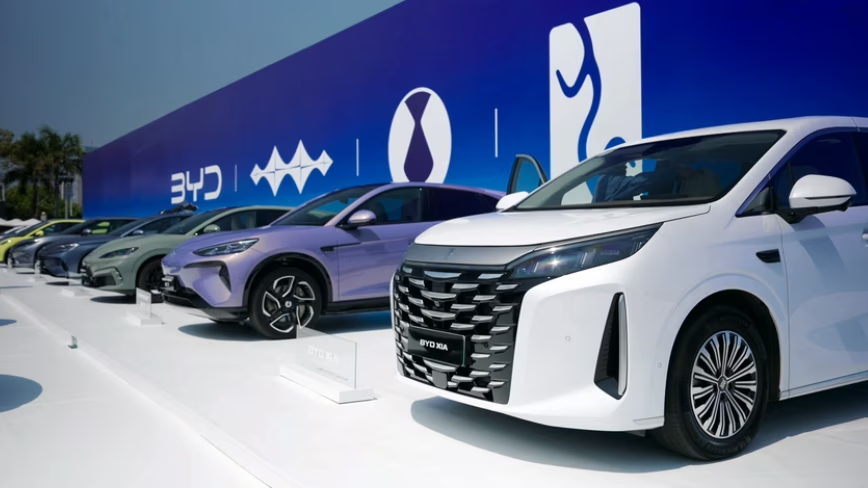
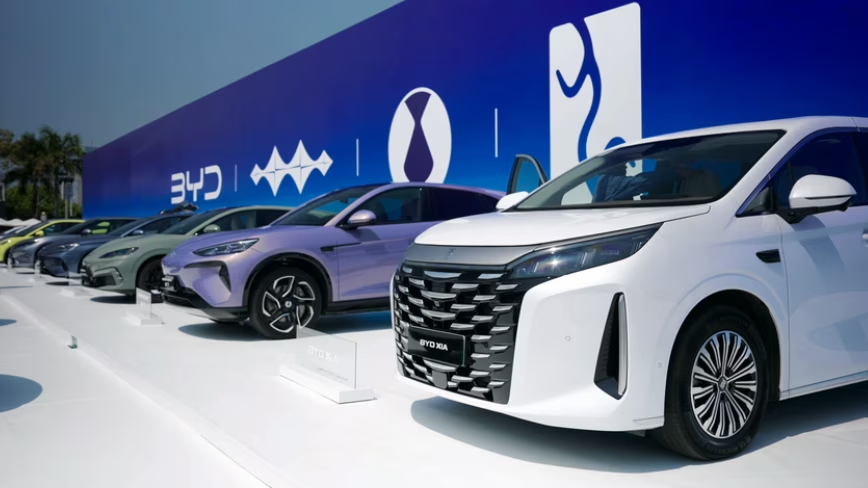
BYD denies environmental breaches at its Szeged factory as Hungarian police probe toxic soil claims and the company scouts a second European plant.
BYD executive vice president Stella Li said the Chinese automaker has complied with all environmental regulations at its Szeged factory in Hungary, pushing back against allegations that the company violated its obligations during construction. Li made the comments at a press conference in Belgrade on Friday, where she met with Serbian President Aleksandar Vucic to discuss a potential second European production site.
The denial comes after Hungary’s environment minister said in May that BYD had “seriously violated” its environmental obligations at the Szeged site, where Hungarian police are investigating whether toxic soil was improperly handled during construction work. The government imposed a fine of 10 million forints, roughly $27,000, on the company over the incident.
BYD began trial production at the Szeged plant in early 2026 and plans to start full assembly operations in the fourth quarter. The factory is the first major Chinese automaker production facility in Europe, a milestone that has drawn both investment interest and political scrutiny. Hungary positioned itself as China’s gateway into the EU under former Prime Minister Viktor Orban, capturing 44% of all Chinese foreign direct investment into Europe in 2023.
The political landscape has since shifted. Peter Magyar, who replaced Orban earlier this year, has taken a harder line on environmental and labour standards at Chinese-backed projects. The scrutiny of BYD’s Szeged site is part of a broader review that has also targeted battery manufacturers CATL and Samsung SDI, both of which operate or are building large facilities in Hungary.
However, subsequent testing has complicated the initial allegations. According to Hungary Today, later soil tests on surrounding farmlands found no contamination above regulatory limits. The distinction matters: the police investigation centres on whether soil from the construction site itself was improperly disposed of, not whether the factory is actively polluting surrounding land.
Li’s appearance in Belgrade served a dual purpose. Beyond addressing the environmental controversy, she was there to discuss BYD’s search for a second European plant. Bloomberg reported that BYD is open to buying an existing facility, partnering with another manufacturer, or building from scratch.
Vucic offered Serbia as a production site during the meeting, pitching the country’s lower labour costs and proximity to EU markets.
The second-plant search has also involved conversations with Stellantis, according to Bloomberg. The Franco-Italian automaker has excess factory capacity across Europe, and a deal would give BYD immediate production infrastructure without the multi-year timeline of a greenfield build. European EV demand has surged in 2026, with battery-electric registrations jumping 51% in March alone, creating urgency for Chinese manufacturers to localise production and avoid EU import tariffs.
The Szeged controversy sits within an even broader pattern of scrutiny. China Labor Watch and other organisations have raised separate allegations of forced labour practices at the construction site, claims that BYD has denied. The European Parliament has also flagged labour conditions at Chinese-backed projects in Hungary, adding another dimension to the political pressure on Magyar’s government to demonstrate tighter oversight.
For BYD, the stakes extend well beyond a $27,000 fine. The company overtook Tesla as the world’s largest seller of battery-electric vehicles in 2025 and is racing alongside other Chinese automakers to establish European manufacturing before tariff walls rise further. Any sustained regulatory friction in Hungary could complicate its expansion plans at a moment when the European market is its fastest-growing opportunity.
Li told reporters in Belgrade that BYD will continue to invest in Hungary and cooperate fully with the investigation. Whether that cooperation satisfies Magyar’s government, which has political incentives to distance itself from Orban’s permissive approach to Chinese investment, remains the open question.
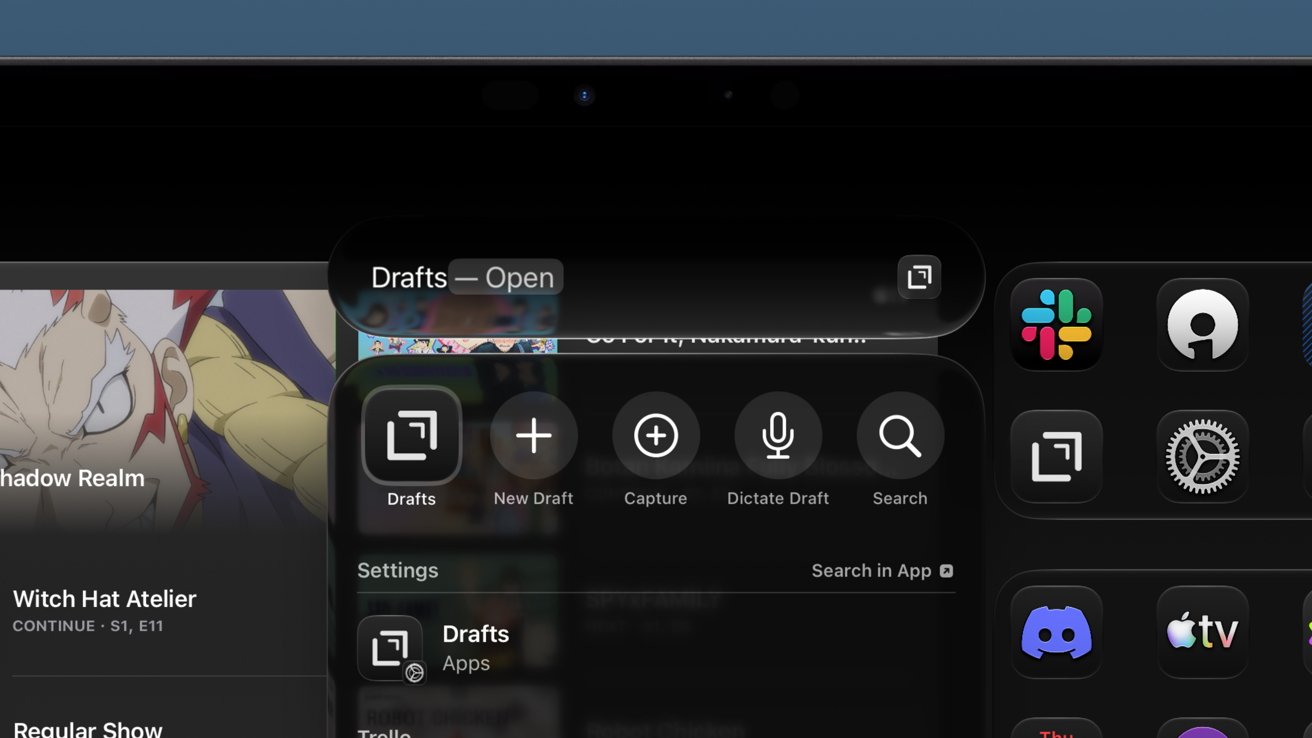
Siri AI and system optimizations are the focus of iPadOS 27, but that’s enough for iPad’s usual in-between year. Power users will notice the changes the most.
The iPad operating system has been on a predictable tick-tock upgrade cycle where one year is significant and the other minimal. Apple focused on Siri AI for its OS 27 releases, but iPadOS 27 still has a few new and useful upgrades.
As an iPad-first user, I’m most interested in how iPadOS might affect my workflows each year. I do have a Mac mini for recording a video podcast, and my Apple Vision Pro is still used regularly for focused work, but the iPad is where I live.
Of those three platforms, funny enough, the Apple Vision Pro saw the most new feature upgrades overall.
That isn’t to say what’s new in iPadOS 27 won’t affect me or my work. There are some interesting new automation and windowing features that may prove useful.
Plus, the merging of Spotlight and Siri saved the search tool from being a broken mess.
If you’re an iPad user who’s mainly using the iPad as a tablet, there’s a chance you won’t notice much new beyond Siri AI. Power users definitely got the most focus this year thanks to system optimizations, design changes, and a couple of new features.
Let’s get into it.
Apple’s WWDC keynote didn’t split up features by OS due to a focus on optimizations and child safety features. I’m not getting into the child safety stuff in this early review since it doesn’t affect me.
There are many small changes across every operating system, but when you break down exactly what’s in each, it feels small versus previous years. That’s likely because of Apple’s stability and optimization focus this year, and how nearly all the truly new features are tied to AI.
Spotlight search is vastly improved thanks to a completely rethought indexing system. Everything stored on your device, from Contacts to Journal entries, is crawled after installing iPadOS 27.

iPadOS 27 review: Spotlight is finally instant again
The process can take up to a week, depending on how much data you have saved locally. The improvements are immediately noticeable because you can actually use Spotlight without waiting for results to populate.
There’s word that the new indexing is being added in iPadOS 26.6 so people upgrading to iPadOS 27 in the fall will already have everything done day one. However, while that indexing will be done, it won’t be used until the fall releases.
That’s important because the new Siri AI relies heavily on that newly indexed data. Some queries flat out didn’t work when indexing was still going on, so keep that in mind.
While the Spotlight interface has integrated Siri AI, they are still distinct entities. If you search for an app name, hit enter, and it launches, that’s Spotlight.
In my use this past week I can say that Apple accomplished its goal. Spotlight is instant.
Quality-of-life improvements aren’t always the most exciting, especially when discussed during a keynote. However, they are felt in everything you do when implemented properly.

iPadOS 27 review: paste suggestions are helpful
One feature everyone will notice almost immediately is the new paste option in the typing suggestions. On iPad, that shows up whether you’re using the virtual keyboard or a physical one.
Not only is it convenient when using the touch interface, it’s great for verifying what is in your clipboard before pasting. So, even if you’re on a physical keyboard, there is some benefit.
Apple says that windowing actions are faster in iPadOS 27. I’m not sure if I notice faster, but they certainly feel more fluid and responsive.
Transferring files in the Files app to an external drive is five times faster. While I didn’t pull out a stopwatch, it certainly seems to be true.
I need to get photos from my camera’s SD card to my iPad, then from my iPad to an SSD later for backup, and both can be quite annoying when in progress.

iPadOS 27 review: Files app transfers to external drives are now up to 5 times faster
Family photoshoots can take ages to transfer, especially when you’re trying to transfer photos while on the move. That 5-minute transfer turning into 1 minute is a huge workflow improvement.
6GB took around 20 seconds to transfer to my external SSD I keep attached to my Studio Display. While I don’t have a good way to compare, it’s certainly faster.
The iPad menu bar is also changed, and I think for the better. Whatever your active app is, wherever it is on the display, the name is shown in the top left corner.
Hovering over that name with a cursor, or tapping with a finger, opens the menu bar items for that app. The window controls appear there too in full-screen mode, but otherwise stick with the window.
Siri AI is here and it’s deeply ingrained in Apple’s operating systems. However, I stand by the idea that the AI side of Apple is still ignorable if that’s what you want.

iPadOS 27 review: Siri AI has a home in the new Siri app
I understand the anti-AI sentiments, but I do think we shouldn’t be throwing a blanket over all AI. It’s a dumb term that applies to too many technologies.
Many of these implementations are bad, yes.
Apple’s use of AI, arguably, is one of the few that feels right. It is private and secure with a focus on local operation, though there are powerful cloud models when needed.
There are five new third-generation Apple Foundation Models.
Users don’t really need to worry about the specifics of this. And while the new Apple Foundation Models were built thanks to a partnership with Google, the Gemini Assistant and Google Search are nowhere to be found.
It’s Apple AI all the way down.
I’m conflicted on what I should talk about here in regard to an iPadOS review. The Siri AI and new Apple Intelligence features are available across Apple’s ecosystem.
The new live proofreading feature is a nice addition. If I make a silly grammatical mistake, a blue line appears in my text.
Writing Tools vanished in beta 1 a day after I installed it. However, those grammar suggestions still work, so that’s a good in-between until the Writing Tools Proofread function returns in a later beta.
I don’t generate images, text, or anything for work and don’t plan to start. Spotlight and Siri AI are useful in that it’s easier than ever to uncover an old email.
The new Photo editing tools like extend and reframe are interesting, but I don’t think this is the place to discuss them. I’ll be examining those more closely in the future.

iPadOS 27 review: world knowledge helps get things answered without using Google
I’m sure some workflows might emerge from this new Apple Intelligence, but I didn’t use AI before either. I have considered that the Siri app might be a good search alternative.
The idea would be to ask Siri if there are any gaps in my longform pieces and have it present me with some results. I’d reference the included sourcing and verify if that information indeed was missing and learn what I needed to add from there.
I can say that I will never take a Siri text response as the default answer or paste in a response into my text as fact. The results of some queries are interesting though, as Siri generally doesn’t summarize what it is sharing.
Instead, Siri shares giant clumps of data from various sources. Since the text is verbatim from the source, it can even include typos. Apple is doing this to prevent hallucinations in the output, which actually works quite well.

iPadOS 27 review: Siri is always available via Spotlight
That said, it is still AI, and I do catch it in a hallucination from time to time. So, since I know I can’t catch every bit of wrong information, I just default to it as a reference and open the link to verify.
As we said in US Navy nuclear power operations when checking each other’s work: trust, but verify.
I believe this is a great starting point for Siri AI and Apple Intelligence. Apple delivered on everything it promised in 2024, and took things even further with its new models.
I believe Apple is the only player on the market with an entire ecosystem of products and data with an AI built in at this scale. Google Gemini has some of this on Pixel, Samsung Galaxy, and a few others, but not to the depth of Apple’s AI integrations.
It can only improve from here. I’m especially excited for third-party developer support.
Shortcuts is quite the powerful tool that I’m not sure many Apple users actually know about. That, or they’ve stumbled into it and got intimidated and never came back.

iPadOS 27 review: Shortcuts are easier to generate
Either way, iPadOS 27 and the other new releases make Shortcuts much easier to use. You simply hit the plus button and type in what you want a shortcut to do, and if it’s reasonable and within the app’s abilities, it generates that shortcut.
That’s it, you’re done. Now, you’re not going to generate a 200-step shortcut using this method, but you can massage out a task with a few commands to refine what you’d like to do.
I’ll remind everyone that is experimenting with Shortcuts: simple is better. Instead of making a giant and complex shortcut with a million actions, break each section of actions out into their own shortcuts.
Then, once you’ve got your various separate tasks, you can combine the shortcuts into one action using the Run Shortcut option. But of course, that’s a bit more manual.
Now you can just voice your shortcut into being.
It is limited to Apple apps at the moment, so you won’t be making Shortcuts with third-party actions just yet. That should become available once developers can add support outside of the beta.
iPadOS 27 users got one new action that could come in handy. You can now have a shortcut run when removing or attaching a keyboard.
So, toggle between full-screen apps for tablet mode and multitasking for keyboard mode. It’s a simple automation that helps lean into iPad’s ability to be a naked robotic core and transform into the device you need in the moment.
The refinements and optimization paired with Siri AI make the 2027 release feel like it’s good enough. Had Apple ignored the platform entirely beyond the new Siri, we’d be having a very different discussion.

iPadOS 27 review: iPad continues to be whatever you need it to be thanks to a strong OS base
There’s also the chance iPadOS could see more changes through the beta and through the OS 27 cycle. Never count Apple out of introducing some big paradigm-shifting feature in iPadOS 27.3 or something.
I do wish more time could have been spent on some of the pain points, like the awkwardness of Slide Over and some windowing actions. Resizing my Safari window from the right shouldn’t reduce its size from the left too, especially when it was touching the left side before.
We’re all still waiting on features like clipboard history and system-wide extensions similar to those found on macOS. I do wonder with the continued attention on the menu bar if we won’t see menu bar apps in iPadOS eventually.
The iPad Pro continues to be my device and platform of choice. Apple Vision Pro is another great option, but there are several awkward areas there that make work a little slower versus the iPad.
My Mac mini is great for capturing our video version of the AppleInsider Podcast. I wonder if we’ll see a dedicated podcast recording and editing tool for Apple Creator Studio at some point.
Then, and only then, will I fully leave Mac behind. For now, Continuity Camera and multiple recording options are only available on Mac.
Oh, one last thing: bring Universal Control to iPad. Let me move my cursor from my iPad Pro to my iPad mini without a Mac present.
Anyway, this is an early review of iPadOS 27 conducted during the first developer beta. A lot could change in the coming months, and AppleInsider will be back to review the shipping version in the fall.
As far as in-between iPadOS years go, this is a strong offering. Siri AI is transformative to the entire ecosystem, including on iPad.
It is never a bad thing to take time to focus on optimization, speed, and design. More could have been done for multitasking and pro tools, but we’ll see what iPadOS 28 offers in that regard.

Apple’s latest explanation for Siri AI on Apple Watch identifies which models support the feature, but it still doesn’t explain why older watches are excluded despite requiring a nearby Apple Intelligence-enabled iPhone.
A June 19 interview with TechRadar offered Apple’s first public response to questions about the cutoff. Apple Watch and Health Product Marketing Manager Cait Dooley said Siri AI and other watchOS 27 features work best on newer hardware.
Apple specifically pointed to Apple Watch Series 9 and later models, Apple Watch Ultra 2 and later models, and Apple Watch SE 3.
WWDC 2026 introduced Siri AI as part of watchOS 27. The feature requires both a supported Apple Watch and a nearby Apple Intelligence-enabled iPhone, with support beginning on Apple Watch Series 9.
TechRadar asked Apple why older Apple Watch models don’t qualify. Dooley said Apple makes power and performance a priority with every software release and repeated that Siri AI works best on newer hardware.
Her answer clarified the compatibility list, but it stopped short of explaining the technical reason behind the cutoff.
Siri AI on watchOS 27 supports the following models.
Older models don’t make the cut.
Apple Watch Series 8 and the first-generation Apple Watch Ultra use the S8 chip, which includes a 2-core Neural Engine. Apple Watch Series 9 introduced the S9 system-in-package with a 4-core Neural Engine that handles machine learning tasks up to twice as fast as the S8.
 Siri AI requires both a supported Apple Watch and a nearby Apple Intelligence-enabled iPhone
The newer chip also brought on-device Siri processing and support for the double tap gesture. The hardware gap between supported and unsupported models provides one possible explanation for Apple’s compatibility cutoff.
After publishing Apple’s comments, TechRadar offered its own interpretation. The publication wrote that “it’s likely only Apple Watches running Apple’s powerful S9 and S10 chips can handle the technical demands of Siri AI.”
Apple didn’t make that claim.
The company’s explanation and TechRadar’s conclusion aren’t the same thing. Apple may have technical reasons for limiting Siri AI to newer watches, likely the on-device Siri processing, but its current public statements don’t identify what those reasons are.
Apple’s own requirements make the Siri AI cutoff harder to evaluate because the feature isn’t being presented as a standalone Apple Watch capability. A paired iPhone does the heavy lifting for computational needs.
Apple Watch owners now have a compatibility list and a broad performance explanation. A technical explanation for why Siri AI begins with the Apple Watch Series 9 generation hasn’t arrived yet.


The Chimelong Spaceship Theme Park in China’s Zhuhai region is a 750-meter-long structure that lies against green hills, like a vessel that just landed and stayed. The world’s largest indoor theme park is contained within its over 400,000-square-meter enclosed area. It began functioning in stages in late 2023 and quickly established seven Guinness World Records before most people outside the region were aware of it.
The structure itself sends a very clear message from the start, with its sleek, rounded form creating a stunning display at night thanks to the blue accent lights and blending in pretty well with the surrounding terrain during the day. The park was created by a Los Angeles company with great experience in huge marine projects at a cost of around $1.1 billion spread over more than ten years. It shares a border with an ocean-themed resort and a huge hotel, forming part of a major destination expected to attract millions of visitors each year.

However, when you enter, it becomes clear that this place is massive. The park combines a vast aquarium operation with rides, entertainment, and themed attractions spread across around 15 different zones. It’s not just big; it’s also home to over 150,000 marine animals of over 300 species. The total volume of water in all of the tanks is a staggering 75 million litres, setting yet another record. The largest single tank alone holds 56 million litres and incorporates an incredible wave system capable of producing waves as tall as 3.2 metres, gaining the Guinness World Record for the highest indoor artificial wave ever.
One of the most impressive marine attractions is the world’s largest living coral reef exhibit, spread across multiple specially designed tanks with a combined capacity that breaks all kinds of records. Visitors can walk through an environment filled with live coral, stunning fish, and well-lit displays underlining the value of reef ecosystems. There’s even a presentation that uses a giant animatronic coral monster to demonstrate reef importance in an engaging fashion, rather than just a boring lecture.
Rides are scattered throughout the park, mixing together with space themes and undersea excursions. One of the first things you’ll notice is a very gentle introduction to the park, a motion simulator called Spaceship Story in which you sit aboard a vessel that takes off, encounters a few challenges, and then returns, all using screens and movement to immerse you in the park’s story of exploration and discovery from the start.
The clear star of the show is below in the deep-sea section, where Bermuda Storm, the world’s largest seated motion simulator capacity, can accommodate 304 people on a single platform. Riders enter what appears to be a research vessel and face a giant curved projection screen that must be well over 1,600 square meters in size. The entire thing is overlaid with water effects, wind, actual set pieces, and even an animatronic character who interacts with what’s happening on screen. Many tourists believe that this is the ride that will stay with them the most at the park since it involves all of your senses at once and delivers a light and adventurous story that is never too intense.
Next to that is China’s first real underwater submarine experience. Riders enter a vessel that transports them through a genuine aquarium tank, with fish swimming straight past the windows and projections and stage pieces resulting in some very spectacular encounters with larger creatures, such as the gigantic squid scene. The entire journey unfolds at a very peaceful, observant pace, which contrasts perfectly with the high-adrenaline adventure next door.
You’d be hard pressed to find a tiny rectangle more versatile than the humble Raspberry Pi single-board computer. Since its inception in Cambridge in 2012, the Raspberry Pi has served as a springboard to an endless rabbit hole of DIY and maker projects. And while the Pi may have lost a bit of its edge over the years, to the point that we’d actually recommend a cheap mini-PC for certain Raspberry Pi projects, that doesn’t mean you can’t or shouldn’t use one.
There’s long been a central theme connecting a number of Raspberry Pi projects, and that’s how to employ them in a way that can save you a little bit of cash. The scope of this guide will lay out four self-hosted projects to replace your cloud storage, music streaming, Plex streaming, and one to help track price changes –- all in the name of saving money over the long term.
It’s worth noting that you’re going to be ahead of the game if you already own a Raspberry Pi that you can use. Maybe you have an old one sitting around that you’re not currently using or you just don’t want a mini-PC. Maybe you just love Raspberry Pi boards -– all fair. If not, consider picking up a used model to save some cash; just about any current Raspberry Pi model will work for these projects.
Plex has humble roots as a freeware port of XBMC (which would later go on to become Kodi). It quickly became the de facto self-hosted anti-Netflix: A way for users to break free of another monthly subscription and take control over their media library. You can say Plex has come full circle, as many of its users have begun looking for an alternative as the core Plex service has become unrecognizable. The slow intrusion of ads, pay walling once-free features, and rising subscription and license costs have alienated many of Plex’s power users. On the topic of costs, the platform is once again raising the price of its lifetime pass later this year –- an eye-watering $750 that is practically begging users to go elsewhere or submit to its monthly pricing.
Enter Jellyfin. This free and open source media platform is a fork of the Emby 3.5.2 codebase, and functions as a self-hosted and self-contained server. Jellyfin has a number of clients in addition to its official desktop version that you can run on a Raspberry Pi, enabling support for iOS, Android, Roku, webOS, Tizen, and others. Jellyfin also boasts a vibrant third-party development community, where you can find several supported plug-ins that add increased functionality. An example is FinAmp for music streaming on a Jellyfin server, meaning a you can use the platform as an alternative to Spotify or PlexAmp.
Between Jellyfin and its plug-ins, basic features that Plex locks behind a paywall –- like transcoding and remote access –- are covered. Jellyfin plus Tailscale is a popular combo for secure, remote access to a Jellyfin server, and another reason that Jellyfin is among a growing number of free apps that beat the expensive alternatives.
The rise of music streaming has given way to a number of ethical questions like what it really means to not own the media you’re listening to and how streaming impacts artists financially. None of these questions have an easy answer, and that says nothing of the dubious artist payment practices of companies like Spotify and others, or the deluge of AI-generated music that has infested streaming platforms. In the same way that Jellyfin serves as a money-saving alternative to Plex or services like Netflix, Navidrome can function as a self-hosted alternative to the big music streamers.
The open source music server is built on top of the Subsonic media streaming API, which means you can use any number of Subsonic compatible front end apps and players for a Navidrome server. Navidrome works out of the box behind a reverse proxy, which is recommended for accessing the server outside of your LAN, but using a gated VPN connection adds another layer of security –- again, Tailscale is a popular choice here, as is self-hosted WireGuard.
The catch here is that you need your own music collection, but that’s kind of the point. Whether it’s converting your existing CDs to FLAC or MP3 formats, or using a Spotify Premium alternative like Bandcamp or Qubuz to buy digital tracks, having your own music library on your Raspberry Pi means you’re not beholden to corporate whims or licensing agreements that could see your favorite music evaporate from a streaming service.
Using a Raspberry Pi to escape third-party, proprietary cloud ecosystems such as Google and Dropbox still remains only one of the most popular Pi projects. However, it’s also one of the most popular ways to save money with a Raspberry Pi. It’s a project that’s been done to death, so to speak, but for good reason –- it works. Aside from eliminating another subscription, you also gain control over your data and privacy, which is an important aspect of the data sovereignty discussion.
Categorically, NextCloud is the most popular choice for creating your own cloud storage. There are a number of ways you can configure NextCloud, but a hidden trick is to run DietPi, which is a lightweight Debian-based Linux distro for the Raspberry Pi. The best part about this is once you flash DietPi to your installation media, there are several apps that are already pre-configured for you, including NextCloud. DietPi can also install Syncthing for you, which is another popular and free tool for self-hosted cloud storage.
One of the best ways to save money is to spend less upfront by shopping smarter. There are a number of simple price checking tools you can use to keep an eye on things, or even Python scripts for the programmers among you. But ChangeDetection.io works particularly well on Raspberry Pi boards, and it can be used to track prices, re-stocks, and web page monitoring. Even better, it can be integrated into popular services like Discord and Slack via webhook to receive notifications, and it can also be paired with other projects on this list like Jellyfin and NextCloud.
ChangeDetection.io is a free open-source project that you can self-host on local hardware but also as a subscription service that will monitor URLs for you, though that runs counter to this guide. The easiest way to install the service is by setting up Docker, and then clone the github repository with something like Docker Compose. Beyond that, it’s then a matter of setting up filters, monitoring settings, and where notifications need to be sent.
Though self-hosting your own services takes some time and commitment, one of the best benefits is you are insulating yourself from subscription creep. This can become a serious problem; one CNET survey from 2025 found that the average adult spends as much as $1,080 per year on subscription services. And by self-hosting, you’re forced to be more judicious about what you actually need, as that same survey found that many adults are spending $200 or more on services they’re not using or forgot to cancel. Outside of saving money on recurring subscription fees, being able to track prices with a tool like ChangeDetectio.io goes a long way in making more discerning buying decisions. Those savings can definitely compound over time, depending on your shopping habits.
We can do some quick napkin math based on some popular subscriptions. Netflix is still the most popular video streaming service, and it costs a minimum of $107.88/year for the cheapest, ad-supported plan as of this writing. Tack on a couple more video streaming services, as most households have more than one, and that cost more than triples right there. Spotify’s cheapest premium (Individual) plan currently costs roughly $156 a year, and a popular cloud storage service like Google Drive will cost you $20-$100 annually, depending on how much storage you need. In this very basic example, you’d be saving between $284 and $364 every year by replacing your subscription services with open-source ones running on a Raspberry Pi.
The potential savings here will really only go up, as streaming services continue to increase their subscription costs over time. After all, when was the last time you saw a streaming service get cheaper?
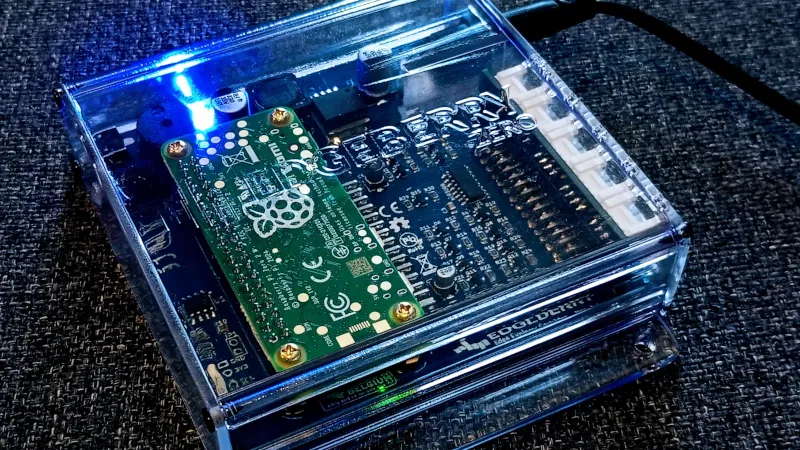
By now we’re all used to single board computers such as the Raspberry Pi Zero, but it’s likely we’ve all been frustrated at times by the number of support components required to use one. This becomes ever more annoying out in the field away from a handy HDMI, USB desktop, and power supply.
The Edgeberry Zero is an attempt to tackle this by mating a Raspberry Pi Zero with a PCB holding a robust power supply and interface connector, all together in a case. better still it comes with Edgeberry Hub, a software management interface.
It appears to be a commercially available product, but it’s Open Source Hardware Association (OSHWA) certified and everything is available in a GitHub repository. Looking at it from a Hackaday perspective it’s hardly the first power supply support board we’ve seen for a Pi, but its approach of making its own expansion module format is an interesting choice. To us they are reminiscent of Game Boy cartridges in the way they slide into a slot in the case.
We like the general idea behind the Edgeberry Zero, but whether it offers enough differentiation from packaging up a Zero with cables and duct tape is up to you.
Enterprise teams keep watching the same thing happen. An AI agent demos beautifully, goes to production, and stalls: it runs for a short stretch, then needs a human to top up its context and check its output, and the promised efficiency drains into supervision. The agent did the work; you did the watching. It’s one reason so many agent pilots never turn into production systems.
The pitch on the other side of that wall is the one every team wants to believe: an agent that runs a long job on its own, overnight if it has to, and leaves a person to validate only the last 10%. Whether that is achievable turns on a problem the orchestration conversation mostly skips. When AI firm Chroma tested 18 leading models, every one lost accuracy as its input grew, a property of how attention works, not a gap a stronger model closes. An agent fed more and more of your business as it runs does not get steadier. It gets shakier.
This is the layer beneath the orchestration race. Routing, durable execution and observability all assume each agent is already competent enough to coordinate in the first place. The deeper question is how long an agent can run before a human has to step in, and that comes down to where your company’s knowledge lives relative to the model. Both standard fixes leave a human in the loop.

Frontier models keep getting more capable, and the gap does not close, because it is not a capability problem. It is about where your knowledge sits relative to the model, and enterprises have had two ways to place it there.
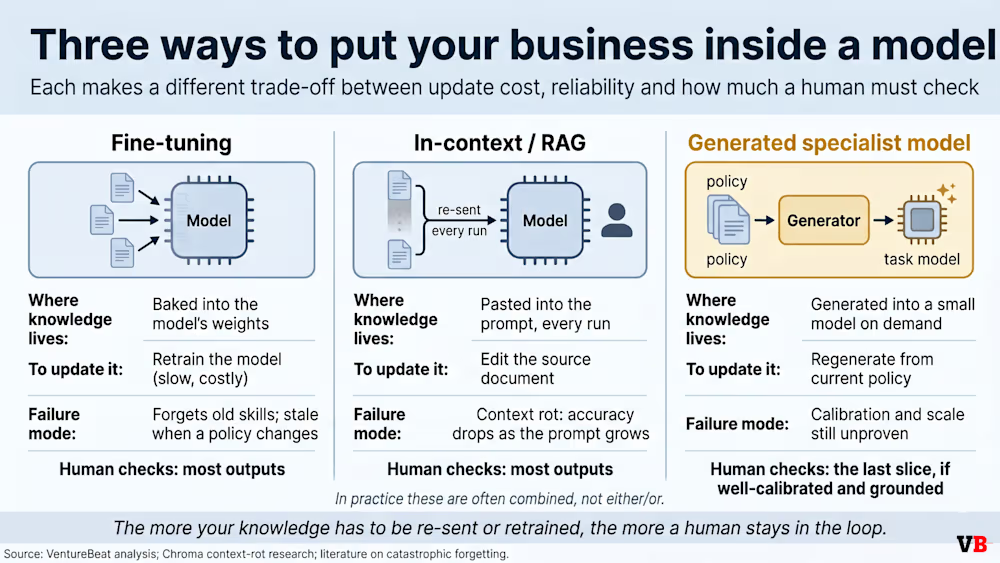
The first is fine-tuning, which bakes knowledge into the weights. It remains subject to catastrophic forgetting, a problem identified in the 1980s and still unresolved in 2026: teaching a model something new tends to erode what it already knew. Teams work around it by isolating each task in its own fine-tuned model or adapter, which produces a sprawling estate of models that raises cost and governance overhead. And a fine-tuned model is a snapshot, stale the day a policy changes, when the expensive, slow retraining cycle starts over.
The second is in-context learning, which skips retraining by placing the relevant policies in the prompt at run time. This is where context rot bites. Retrieval narrows what goes into the prompt, but a retrieval miss looks identical to a confident answer, and both cost and latency climb with every token added.
The two failures rhyme. With fine-tuning, the model can be confidently working from last quarter’s policy. With in-context learning, it can be confidently working from a detail it lost in the middle of a long prompt. Either way the output looks equally assured, so you cannot tell which parts are wrong without checking all of them. That is why the human never gets to leave. Some teams often run both at once, fine-tuning the stable knowledge and retrieving the rest. That softens each failure but removes neither: on any given output you still cannot be sure the model is both current and working from the right context, so you still check it.
A third approach is moving from research into early product. Instead of retraining one model or stuffing its prompt, a generator builds a small, task-specific model on demand from your policies, at inference time. The generator is a hypernetwork: a network whose output is the weights of another network.
The idea was named in 2016; applying it to produce specialist language models from text or documents is recent and active. Sakana AI’s Text-to-LoRA, presented at ICML 2025, generates a model adapter from a plain-language description in a single pass, and a 2026 system called SHINE calls hypernetwork adaptation a promising new frontier, precisely because it sidesteps both the retraining cost of fine-tuning and the context limits of prompting.
The point of generating adapters rather than training and storing them is to collapse a sprawling library of per-task LoRAs into one network that can produce them on demand, including for tasks it has not seen.
The elegant part is how this closes the loop on the problem above: the per-task adapter teams hand-build to dodge catastrophic forgetting is the same object a hypernetwork produces automatically. The model zoo stops being a governance headache and becomes a generated output.

The case for going small underneath all this was put most directly in a 2025 paper by Nvidia researchers: for the narrow, repetitive tasks that fill agent workflows, small models are capable enough and 10 to 30 times cheaper to run than frontier generalists. Nace.AI, a Palo Alto company that raised a $21.5 million seed round in May, is the clearest commercial instance. Its core technology, a generator it calls a MetaModel, produces parameter adaptations for a model at inference time from a company’s policies, pointed at regulated work: audit, compliance, risk assessment. The company says its agents handle the bulk of a workflow while human experts validate the result, a split it markets as 90/10.
|
Fine-tuning |
In-context / RAG |
Hypernetwork-generated model |
|
|
Where business knowledge lives |
In the model’s weights |
In the prompt, re-supplied each run |
In on-demand generated weights |
|
Cost to update on a policy change |
High: retrain |
Low: edit the source |
Low: regenerate |
|
Staleness |
High: a snapshot |
Low |
Low: regenerated from current policy |
|
Per-call cost and latency |
Low |
High, grows with context |
Low at run time |
|
Dominant failure mode |
Forgetting; model-zoo sprawl |
Context rot; silent retrieval misses |
Generator quality; calibration |
|
Who owns the improving asset |
Whoever trains the model |
Whoever holds the data store |
Depends where generator and feedback live |
A model that is narrow, current and small has a smaller surface on which to be wrong. Fewer errors, confined to a known domain, mean fewer outputs an agent has to escalate to a person, which is the real basis for any high-autonomy claim. It is also where a number like 90/10 comes from: not a dial set in advance, but an outcome of how little the system needs to hand back. Reported autonomy shares are best read as measurements of an architecture, not as settings.

Two design choices decide whether that autonomy is trustworthy or merely fast. The first is grounding: tying every output to its source so a reviewer can verify rather than redo. Research models built for exactly this, such as HalluGuard, label each claim as supported or not and cite the passage they relied on. Nace ships its agents with grounding models and reasoning traces for the same reason. A 10% review only means something if the human can confirm provenance in seconds.
The second is the feedback loop, and it forces a question every buyer should ask: when your experts validate the output, whose model improves, and where does it live? That decides whether the compounding asset belongs to the vendor or to you. Arrangements differ. Nace, for instance, uses an external network of certified experts for some engagements and, for direct enterprise deployments, the customer’s own staff, with the resulting model kept inside the customer’s cloud. Each choice routes the learning, and the ownership, somewhere different.
The approach is still early, and a few questions will decide how far it goes. Calibration is the linchpin: the value rests on the model knowing when it is unsure. And it is genuinely unsettled, recent work generating these adapters found they do not automatically improve calibration over ordinary fine-tuning, with gains appearing only under specific constraints.
The quality of the generated model also depends heavily on the policy data it is built from, which puts a premium on data curation. And scale is the open research frontier, the hypernetworks shown in published work so far have been small. This is where Nace’s own work gets interesting: in our interview, the company said it has scaled its generator well beyond those published sizes and derived a scaling law for how performance grows, results it has begun to share publicly and is now putting through peer review. If it holds up, it would help answer one of the central open questions in the field, and it is the paper worth watching.
Whichever approach wins, the work still ends at a human, and that handoff is its own design problem. When Deloitte Australia delivered a roughly A$440,000 government report, it shipped with fabricated citations and an invented court quote after passing senior review, because the reviewers checked the conclusions, which were sound, and not the provenance, which was not. Controlled research suggests the pattern is general: experts corrected an identical flawed recommendation less often when it was labeled AI-generated.
The EU AI Act’s Article 14 now names this automation bias. The lesson is not about any one vendor: a high autonomy share concentrates human attention into a thin, late slice of the work, so the value of that review depends entirely on whether the human can check provenance fast, which loops back to grounding.
The honest takeaway: what holds your agents back is usually not orchestration or model size, but whether the model knows your business well enough to be left alone, and the right fix depends on the job. To automate a long, repetitive, high-volume process end to end, run most of your internal audit overnight and have your own experts check the final slice, a hypernetwork generated model is the approach most likely to do it cheaply and run long enough to matter. For a short task that finishes in a few steps and never needed to run unattended, the gap between this and a well-prompted frontier model shrinks to almost nothing, and is not worth the integration cost.
When a vendor pitches autonomous or specialist agents, four questions cut through it.
Where does the business knowledge live: in the weights, the prompt, or generated on demand?
What does each output come with, so a reviewer can verify it instead of redoing it?
What decides which work gets escalated to a human?
And whose model improves from that feedback, and where does it run?
The answers, not the headline ratio, tell you what you are buying.
The hypernetwork approach is the most credible attempt yet at making a small model know a specific business without forgetting it and without re-explaining it on every run. It is also the least proven, and the parts that matter most, calibration and scale, are still in peer review. For the right job, pilot it now. For the wrong one, the integration cost buys you little that a well-prompted frontier model wouldn’t.

Looking for the most recent regular Connections answers? Click here for today’s Connections hints, as well as our daily answers and hints for The New York Times Mini Crossword, Wordle and Strands puzzles.
Today’s Connections: Sports Edition has some fun categories, though the green group was a stumper for me. If you’re struggling with the puzzle but still want to solve it, read on for hints and the answers.
Connections: Sports Edition is published by The Athletic, the subscription-based sports journalism site owned by The Times. It doesn’t appear in the NYT Games app, but it does in The Athletic’s own app. Or you can play it for free online.
Read more: NYT Connections: Sports Edition Puzzle Comes Out of Beta
Here are four hints for the groupings in today’s Connections: Sports Edition puzzle, ranked from the easiest yellow group to the tough (and sometimes bizarre) purple group.
Yellow group hint: Big Apple baseball.
Green group hint: Bike race clothing.
Blue group hint: Not the Big 10, but…
Purple group hint: Cowboys wear them.
Yellow group: New York Yankees, informally.
Green group: Tour de France jerseys.
Blue group: Locations of Big 12 schools.
Purple group: What “boot” might mean.
Read more: Wordle Cheat Sheet: Here Are the Most Popular Letters Used in English Words
The completed NYT Connections; Sports Edition puzzle for June 20, 2026.
The theme is New York Yankees, informally. The four answers are Bronx Bombers, Evil Empire, Pinstripes and Yanks.
The theme is Tour de France jerseys. The four answers are green, polka dot, white and yellow.
The theme is locations of Big 12 schools. The four answers are Boulder, Fort Worth, Manhattan and Waco.
The theme is what “boot” might mean. The four answers are cleat, eject, kick and mishandle.
According to TrendForce, a global market research and intelligence firm headquartered in Taipei, Taiwan, TCL CSOT, the display manufacturing arm of tech giant TCL, is aggressively promoting its IJP (Ink Jet Printed) OLED display technology as a means of entering the OLED monitor and notebook panel supply chain. The company’s existing Gen 5.5 IJP OLED production line has already reached volume production and has successfully commercialized OLED display panels for the medical industry, while validation programs for branded monitor and notebook products are currently underway. The company’s progress could potentially challenge the long-standing dominance of Korean panel makers LG Display and Samsung Display in the OLED industry.
TCL purchased the IJP OLED patents and actual manufacturing equipment from Japanese firm JOLED in 2023, after previously investing in that company. TCL CSOT moved the equipment to China in order to build its Gen 5.5 IJP OLED plant which became operational in late 2024.
TrendForce reports that TCL CSOT is initially testing market demand with a 27-inch UHD (Ultra High Definition) IJP OLED monitor produced on its Gen 5.5 line, targeting the professional monitor segment.
According to TrendForce, IJP OLED offers superior power efficiency in high-end business and creator-focused displays when compared with existing QD-OLED and WOLED technologies, making it increasingly attractive to brand vendors. The IJP method of manufacturing OLED screens also offers dramatically lower manufacturing costs, which could allow TCL to undercut its competition and gain market share quickly.

Monitor brands from China, Taiwan, and South Korea are reportedly evaluating IJP OLED panels to use in their computer monitors, and TCL CSOT is expected to begin mass production of IJP OLED monitor panels in the third quarter of 2026.
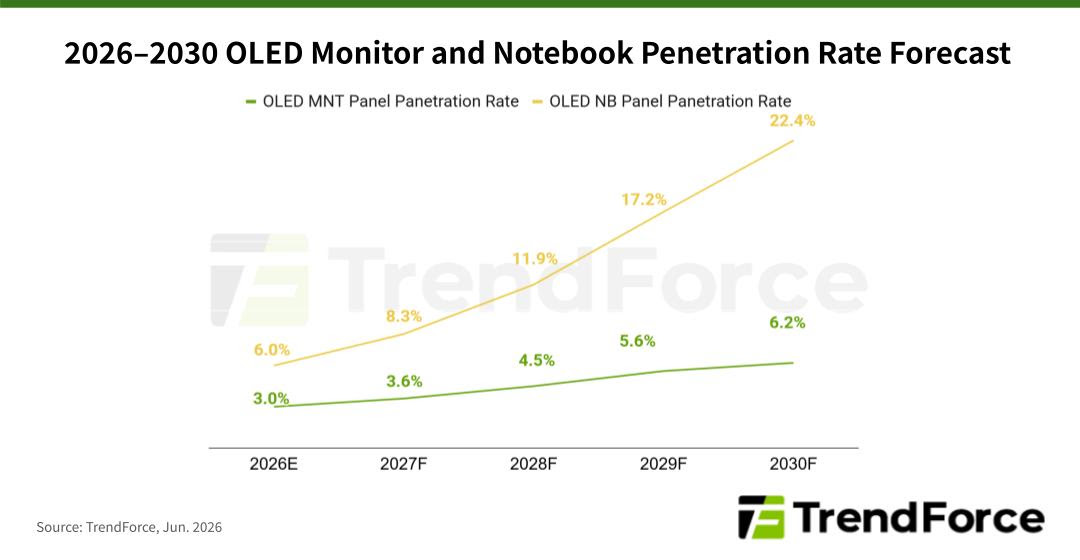
The OLED monitor panel market is currently dominated by Samsung Display and LG Display. Current costs associated with OLED screen manufacturing compared to the more common LCD-based panels has limited OLED’s penetration within the computer monitor market to approximately 3% in 2026. However, according to TrendForce with TCL CSOT investing heavily in its upcoming Gen 8.6 OLED fabrication plant, TrendForce expects OLED monitor penetration to double to 6.2% of the market by the end of this decade, and continue expanding thereafter.
Meanwhile, according to TrendForce, the manufacture of OLED screens for notebooks/laptops is becoming increasingly diversified. In addition to Samsung Display, TCL CSOT, BOE, and Visionox have all committed resources to Gen 8.6 OLED notebook panel production. As a result, adoption of OLED screens in laptops and notebook computers is expected to accelerate rapidly, with penetration projected to reach 22.4% by 2030.
IJP OLED uses large scale inkjet printers with soluble organic materials to print red, green and blue sub-pixels directly onto a substrate or “motherglass.” This promises lower production costs and far less material waste compared to the traditional vacuum evaporation methods used for W-OLED and QD-OLED panel manufacturing. Also, since IJP creates individual red, green and blue subpixels, the process avoids the need for color filters used on W-OLED displays and the need for Quantum Dot layers on QD-OLED displays. But current IJP OLED manufacturing facilities are limited in panel size and the current production IJP panels themselves are limited in overall brightness, which has kept the tech out of the consumer television business… for now.

The wildcard in this whole market is TCL CSOT’s Gen 8.6 OLED plant in Guangzhou, China, which is scheduled to begin production of IJP OLED panels in the third or fourth quarter of 2026. The new plant is expected to have the capability of manufacturing IJP OLED screens in much larger screen sizes than the current Gen 5.5 production line.
While initial production of the new plant will concentrate on smaller IJP OLED screens for the notebook and monitor market, the company could potentially begin churning out consumer TV-sized OLED screens in 65 and 77-inch screen sizes as early as next year (2027). Whether they actually pursue this path will depend on how things go with the smaller screen business and whether they can ramp up production and yield quickly enough to be able to reach competitive pricing on these larger screens after recovering the substantial R&D investment required in order to build the plant.
TV enthusiasts (like yours truly) love OLED TV for its perfect black levels and outstanding contrast. But the latest flagship TVs from the major TV brands (except LG) all feature LCD display panels, with improved backlighting units that use Mini LED backlighting or RGB backlighting to create bright bold images with wide color gamut reproduction.
While LG, Samsung and Sony continue to offer OLED TV models, the performance gap between LCD and OLED is definitely closing with each new model year as major manufacturers like Samsung and TCL pour billions of dollars into LCD display research, marketing and manufacturing. And with the inefficiencies inherent in current OLED panel manufacturing, it’s unclear how long the tech will be supported as OLED manufacturing costs remain high relative to LCD TV manufacturing.
The promise of cheaper OLED panels is something that could extend the life of the tech, and allow OLED TVs to compete with LCD TVs, even at budget-friendly price points.
With TCL and Sony entering a joint venture for TV manufacturing called BRAVIA, Inc., which is scheduled to begin its operations in April, 2027, and the new Gen 8.6 IJP OLED plant ramping up wide scale panel production at around the same time, we have to wonder whether things might just work out well for the future of OLED TV tech in general, and Sony/BRAVIA OLED TVs in particular.
BRAVIA 10, anyone?
The full report on TCL CSOT entering the notebook and monitor screen market with its IJP OLED screens is available directly from TrendForce on its Report Page,
Jean-Marie Reynaud has officially placed the AURALIS at the top of its loudspeaker range, and the new French flagship arrives with a clear message: musical scale does not have to come from a cabinet that looks as though it was designed to store military hardware.
Scheduled to launch in fall 2026 at €18,000 per pair, the AURALIS is the most ambitious loudspeaker yet from the Charente-based manufacturer. It combines a 2.5-way architecture, JMR’s proprietary tuned triangular transmission line, a large 120 mm AST tweeter, hand-wired crossovers, and a cabinet designed to deliver bass authority, tonal accuracy, image stability, and long-term listening satisfaction; this is not a speaker designed to impress for ten minutes in a dealer showroom before the listener starts looking for the exit.
I have some history with the brand, although not nearly as much as I would like.
Back in the 1990s in Toronto, a local hi-fi store in the East End carried Jean-Marie Reynaud loudspeakers, and I was able to spend time with most of the lineup. They were partnered with Audiomat electronics, another French brand with a very different approach to the usual North American power-and-machismo routine, along with some very serious Nottingham Analogue Studio turntables and Benz Micro cartridges.
The JMR speakers were never huge sounding in the conventional sense. They did not try to pin you against the back wall with bass fireworks or make every cymbal strike feel like it had been sharpened by a sommelier with anger-management issues. What they did exceptionally well was inner detail, clarity, tonal finesse, imaging, and treble that had air and delicacy without becoming etched or fatiguing.
They also looked different. Not weird for the sake of weird, which remains one of high-end audio’s more persistent crimes, but unmistakably French in the best possible way: thoughtful, elegant, slightly idiosyncratic, and very much their own thing.
Once I left Canada, JMR drifted off my radar. The brand was never as visible in the United States as Focal, Bowers & Wilkins, KEF, or Sonus faber, and that was probably America’s loss. But JMR is still here, still building loudspeakers in France, and AURALIS looks like the company’s most serious statement yet.
The French, for all of their gifts, have never been overly concerned with explaining themselves to everyone else. AURALIS feels very much in that spirit, and I would encourage U.S. and Canadian listeners to seek out a JMR dealer and hear these for themselves. This is a brand worth rediscovering.
AURALIS now sits at the top of the JMR range, above the Orféo Grande, joining a lineup that includes the Lunna MKII, Euterpe Jubilé, Cantabile Jubilé, Abscisse Jubilé, Orféo Jubilé, Orféo Grande, and the compact Voce Grande.
The new floorstander measures 115 cm high, 30 cm wide, and 42 cm deep, or 45.3 x 11.8 x 16.5 inches. Each speaker weighs 45 kg, or 99.2 pounds. That is serious mass, but it is not one of those absurdly oversized high-end monuments that require reinforced flooring, a forklift, and a second mortgage before the first needle drop.
JMR recommends a listening room between 20 and 60 square meters, or roughly 215 to 645 square feet. The speakers should be positioned between 2 and 4 meters apart, or approximately 6.5 to 13 feet center-to-center, with a minimum listening distance of 3 meters, or just under 10 feet. JMR also recommends at least 80 cm, or 31.5 inches, of clearance behind the speakers.
The front-firing port should make AURALIS more flexible than many rear-ported alternatives, but this is still a 99-pound French flagship with real bass energy. Trying to wedge a pair into a Manhattan one-bedroom beside a radiator, a dying ficus, and a framed photo of your ex-wife remains an act of cultural vandalism.

At the heart of the AURALIS is JMR’s tuned triangular transmission line, a proprietary acoustic loading system that has become one of the company’s most recognizable design signatures.
The goal is not simply to produce more bass. JMR says the tuned triangular transmission line progressively harnesses the rear energy of the drivers to create low frequencies that are spacious, articulate, naturally controlled, and properly integrated with the rest of the spectrum.
That matters because impressive bass and convincing bass are not always the same thing. JMR is aiming for a low end that can follow the music rather than simply announcing its presence every time a bass drum enters the room.
The cabinet itself uses HDF panels ranging from 25 mm to 40 mm thick, or roughly 1.0 to 1.6 inches, depending on where reinforcement is required. JMR uses minimal internal acoustic damping to preserve dynamics, liveliness, and a sense of freedom, while applying viscoelastic compounds at strategic points to control unwanted vibration.
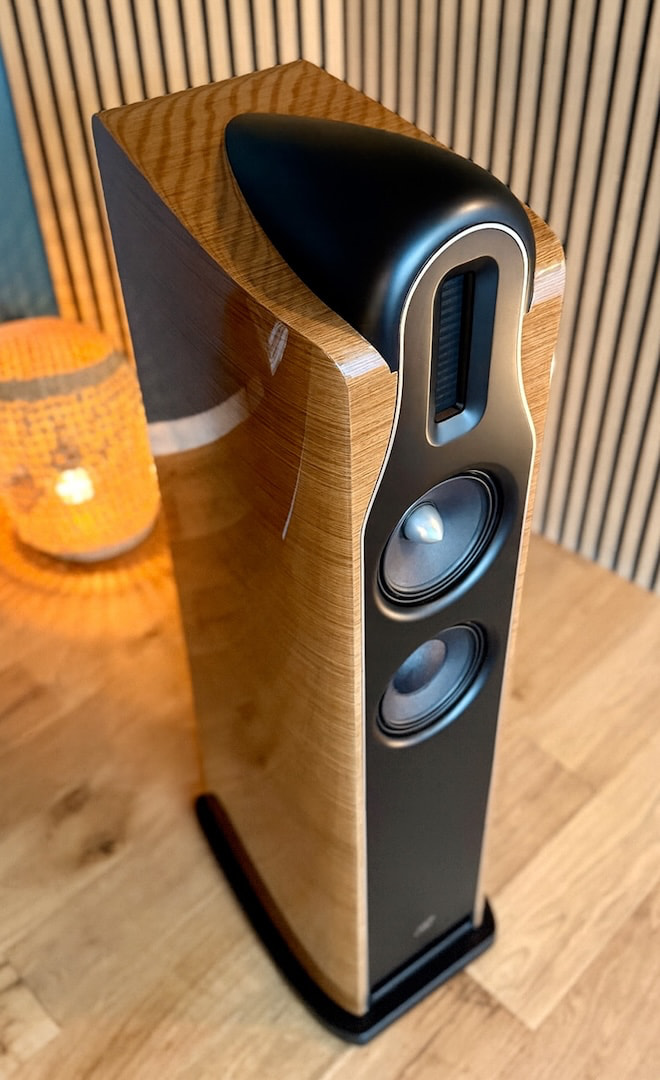
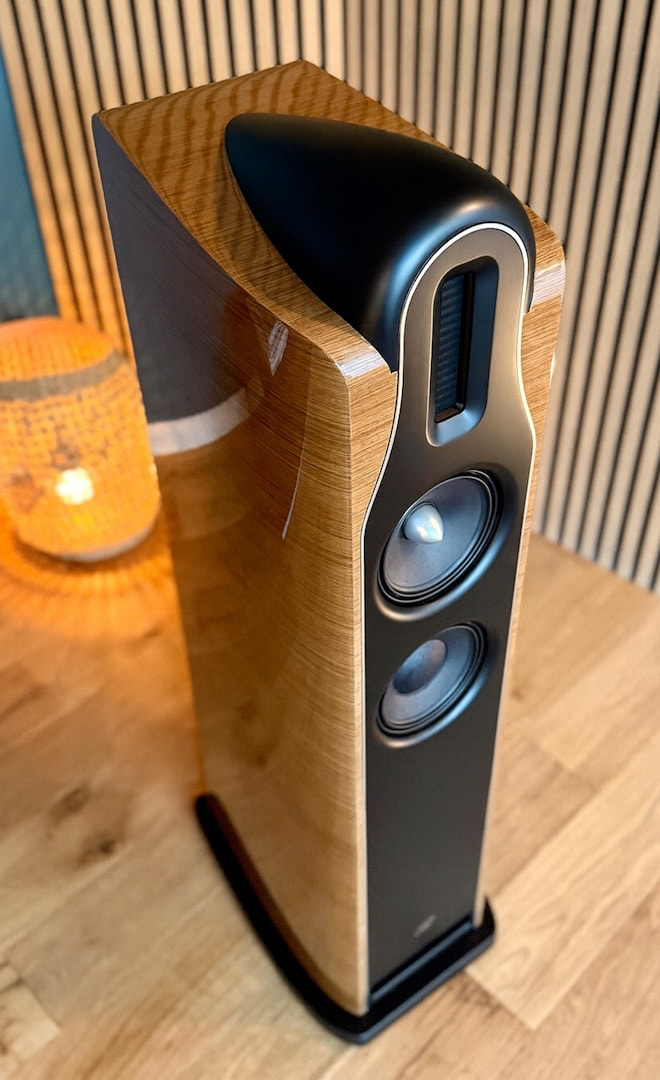
The upper tweeter pod is made from epoxy resin, chosen for its inertness and mechanical stability. It also gives AURALIS a more sculptural silhouette than the usual rectangular tower with a tweeter bolted on top as though someone remembered it five minutes before the design meeting ended.
AURALIS also uses a dedicated decoupled base with no direct mechanical coupling between the cabinet and the floor. Rather than relying on conventional spikes, JMR uses a polymer isolation element refined through listening tests, paired with Teflon pads.
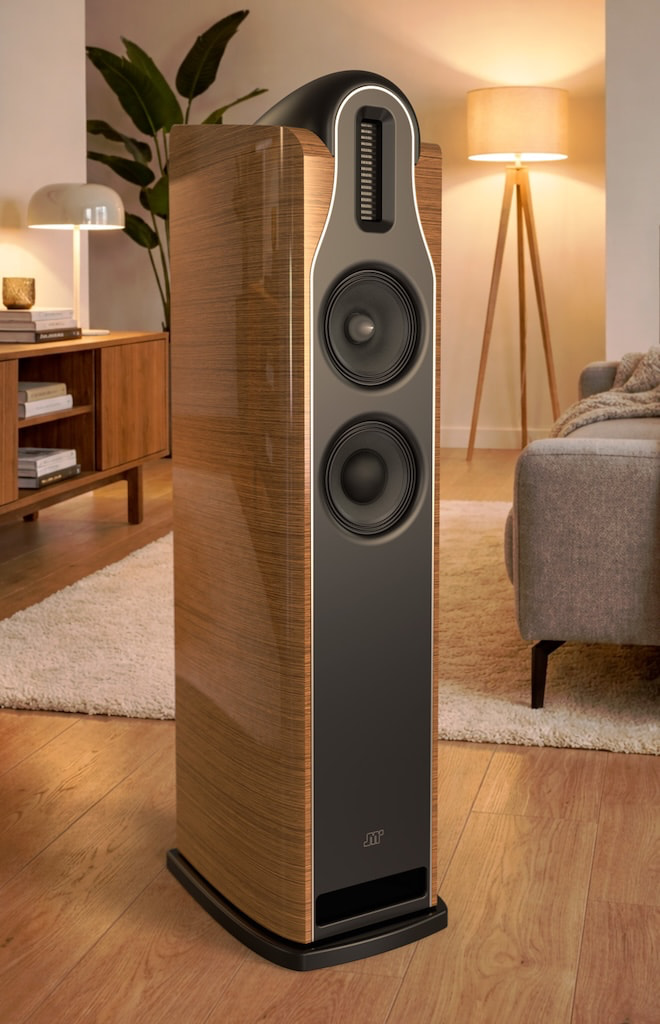
The AURALIS is a 2.5-way loudspeaker built around two new midbass drivers and a 120 mm AST tweeter.
The two midbass drivers operate together up to 220 Hz, effectively increasing radiating surface area and giving the speaker more energy and ease through the bass region. The upper midbass driver continues higher before handing off to the AST tweeter at 1.8 kHz.
That is a notably low crossover point for a tweeter and one of the more important technical aspects of the design. JMR uses a symmetrical 12 dB-per-octave filter at 1.8 kHz to take advantage of the AST tweeter’s speed, low distortion, dynamic capability, and broad natural presentation through the upper midrange and treble.
This is exactly where a loudspeaker either becomes convincing or starts sounding like a collection of expensive parts arguing in public. Vocals, piano, strings, brass, guitar harmonics, and the emotional wreckage of every audiophile all live in this region. There are therapists in Westchester who have financed fishing boats off this crowd.
JMR has long treated crossover design as part of the loudspeaker’s voice rather than a generic component board hidden in the bottom of the cabinet. The AURALIS continues that philosophy with a fully hand-wired crossover built without a printed circuit board.
The network uses a deliberately limited number of components to minimize losses, phase rotation, and audible distortion. The 2.5-way topology employs 6 dB and 12 dB-per-octave slopes, with the two midbass drivers working together to 220 Hz and the AST tweeter taking over at 1.8 kHz.
JMR specifies pure copper foil inductors wound on beechwood formers, ClarityCap PUR capacitors, and Path Audio resistors for tweeter attenuation.
The Path Audio resistors use a third grounding terminal and a copper tube intended to provide electromagnetic shielding, heat dissipation, and drainage of parasitic charges. That is the sort of detail that will either delight or irritate the people who believe every resistor sounds identical. Both sides will probably write 2,000 words about it online.
JMR rates the AURALIS at 89 dB/W/m sensitivity at 2.83V, with impedance compatible with amplifiers rated for 4 to 8 ohms. Minimum impedance is listed as 4.3 ohms.
The claimed frequency response is 30 Hz to 28 kHz within ±6 dB. Power handling is rated at 250 watts continuous and 400 watts peak, with recommended amplifier power between 40 and 300 watts. Claimed distortion is below 0.2 percent at an 85 dB listening level.
JMR says the AURALIS is compatible with both tube and solid-state amplification and that its impedance curve does not present particular setup challenges. That does not mean AURALIS should be paired with whatever integrated amplifier was rescued from the guest room after a remodel, a divorce, or an unfortunate encounter with a soundbar. Less will not be more here.
The Audiomat system I used to get to know JMR in the 1990s was already in the $20,000 range, including an integrated amplifier, CD transport, phono stage, and DAC. These speakers may not demand brute-force amplification, but they will reward a front end with real resolution, tonal color, and authority.
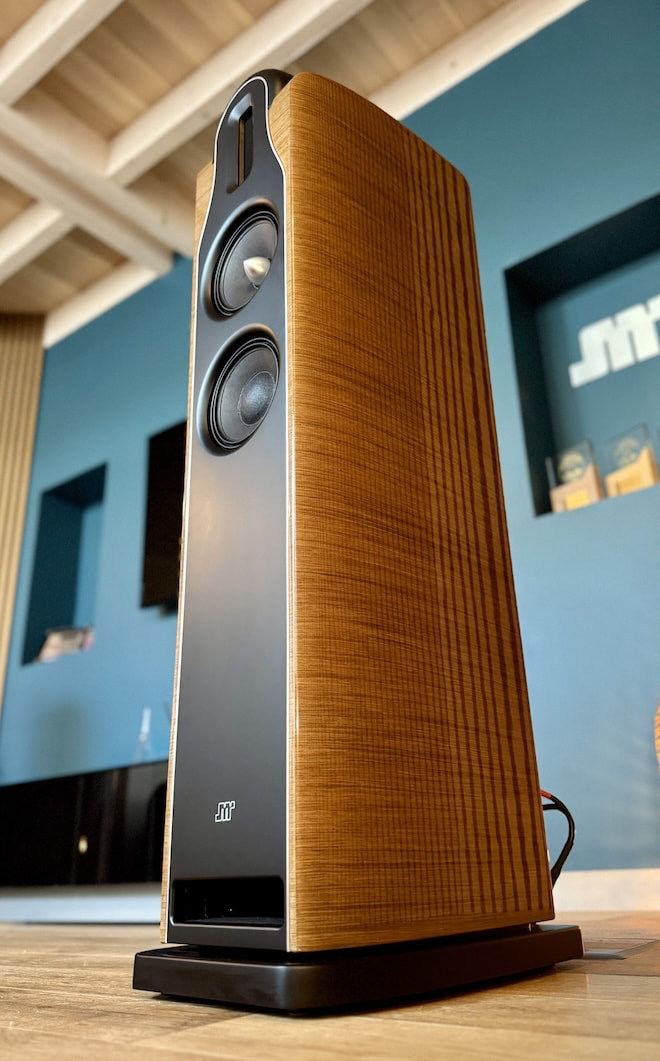
Visually, AURALIS introduces JMR’s Woodscore XO finish, which combines a seven-layer high-gloss polished treatment with real walnut veneer in a cognac tone, a black front baffle, and a solid machined-aluminum trim piece on the front sub-baffle.
The Woodscore XO finish gives AURALIS an elegant, architectural presence without overwhelming the room. Designed, assembled, quality-controlled, and fine-tuned in Charente, the speaker reflects JMR’s own approach to cabinet construction, acoustic loading, crossover design, and final voicing.
The Jean-Marie Reynaud AURALIS is not another expensive floorstander built to impress for 10 minutes with brute bass, a shiny cabinet, and enough aluminum to repair a small bridge. Its appeal is more specific: JMR’s tuned triangular transmission line, large AST tweeter, hand-wired crossover, front-firing port, and Charente-built cabinet are all aimed at tonal accuracy, bass articulation, coherence, and long-term musical satisfaction.
At €18,000 per pair in Europe, AURALIS enters a serious category that includes the Sonus faber Olympica Nova V, Focal Sopra N°2, Bowers & Wilkins 804 D4 and 803 D4, and Wilson Audio Sabrina V, depending on local pricing. JMR has not announced U.S. or Canadian pricing yet, so the final comparison will depend on where it lands in North America.
For listeners who value inner detail, natural timbre, and finesse over a loudspeaker that behaves like it is auditioning for a Marvel soundtrack, AURALIS looks like one of the more distinctive new arrivals in the high-end category.
For more information: jm-reynaud.com





No Jackpot Winner as $257 Million Prize Rolls Over to $269 Million Monday Draw

Zimbabwe Requires Crypto Businesses to Register Annually Under New FIU Regulations


Weekend Open Thread: Miami – Corporette.com

Matt Damon’s Viral Sci-Fi Thriller Has Taken Over HBO Max


As AI companies race to go public, who else is along for the ride?


Anthropic staff to meet White House officials next week, Axios reports

Bitcoin could crash to $48,000, if this historical pattern is triggered

what doctors are seeing in ebike crashes

Warning of disruption as Cardiff Crossrail works to start

Tributes to former deputy head teacher at Cambridge school among death and funeral notices


“Israel’s” ban on ICRC visits ruled illegal, but Knesset moves to stop them permanently


Deion Sanders Shares Powerful Post After Viral Advice To Deiondra


Financial Accounting | Last Day Revision Strategy and Booster | CMA Inter – June 2026

Kate Middleton Glare Goes Viral After Kids Booed At Royal Event


Over 400 Arch Linux packages compromised to push rootkit, infostealer


XRP ETFs Outperform As Bitcoin And Ethereum Funds Extend Outflow Trend


Invesco Quality Income Fund Q1 2026 Commentary

Market Preview: SpaceX (SPCX) IPO Record, Federal Reserve Meeting, and Iran Nuclear Agreement


Singer Oliver Tree dies aged 32 in helicopter crash in Brazil


Dick Advocaat’s Curacao scores first-ever World Cup goal against Germany


You must be logged in to post a comment Login