








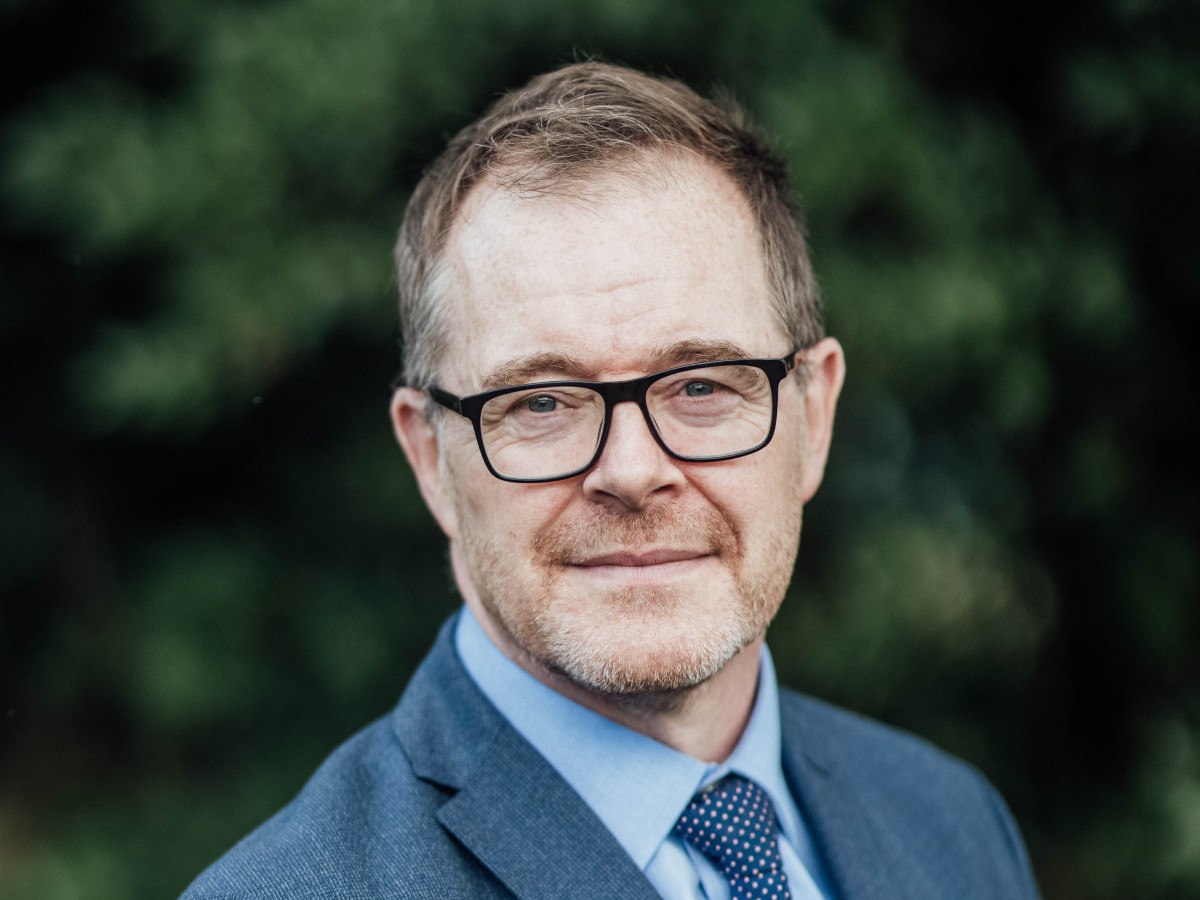

UL’s Prof Martin Hayes on his systems theory research, why ‘pi-shaped’ graduates are the future of engineering, and the importance of patience.
Prof Martin Hayes is a professor of digital technologies at University of Limerick (UL) who describes his research as sitting “within the space of systems theory for machine learning and AI”.
Hayes’ research looks at how to manage system resources intelligently when they’re subject to uncertainty or mixed messaging introduced by communication channels, sensors or human operators. A large part of his work focuses on the “robust” performance of AI in safety-critical environments.
“How do we correctly choose settings when an AI system’s outputs feed into decision-making by people, without getting that handoff wrong?” asks Hayes.
“Health is an obvious area where such solutions have to be correct 100pc of the time.
“The alternative has real consequences in terms of negative outcomes – so I’m asking how we can guarantee a health system that will exploit the benefits of AI while working optimally for every citizen every time.”
Hayes tells SiliconRepublic.com that as AI and machine learning technologies move from research labs into safety-critical, high-stakes settings, these systems “can’t simply be accurate on the average”, and that understanding how to build in basic levels of robustness allows technology to be deployed responsibly in regulated domains such as digital health.
“Professionals working in the health system, be they medics, engineers or administrators, need to understand not just how to use AI tools, but how to trust, interrogate, explain and govern them appropriately,” he says. “Without that grounding, adoption either stalls through excessive caution or accelerates without the safeguards that safety-critical settings demand.
“Translational research that provides a foundation for those who are already working in or who wish to participate in the new European Health Data Space is a key focus of my work.”
‘Pi-shaped graduates’
With his work spanning from systems theory to engineering and the real-world domains where these tools get deployed, Hayes says that the interdisciplinary nature of the research is actually a very rewarding part of the job.
In particular, he enjoys the collaborative side of it where he works directly with industry partners, clinicians and SMEs to “understand where the genuine skills gaps are and then translating that into education and research that actually closes them”.
However, according to Hayes the most satisfying part of the job is seeing graduates go on to responsibly deploying this understanding and thinking in the workplace.
“I believe strongly that the future of engineering education revolves around the growth of such ‘pi-shaped’ graduates who have the basic skills in AI-enabled data engineering but who also have the necessary allied health skills to be able to apply those solutions in a safe, human-centred fashion,” he says.
Hayes has worn and continues to wear many hats at UL, where he has worked since 1997.
He is the academic lead for the UL@Work Human Capital Initiative project, which aims to develop digital, industry 4.0 talent through flexible, innovative, technology-enabled, experiential learning. Hayes says his involvement in the UL@Work project has been “hugely insightful”.
“One key takeaway is that universities need to work together and collaborative programmes like Digital Europe are essential in enabling institutions to pool their resources so that they can offer students the bespoke learning that fits their individual needs.”
Hayes is also collaborating with various European universities as principal investigator for a number of Digital Europe projects – such as that of Sustainable Healthcare with Digital Health Data Competence (SUSA).
SUSA is a €12.4m Digital Europe-funded project led by the University of Oulu in Finland that aims to close the digital skills gap in European healthcare and support the EU’s Digital Decade and European Health Data Space ambitions.
The project aims to deliver revamped bachelor’s, master’s and standalone lifelong-learning modules, built around 20 shared SUSA learning objectives that have been benchmarked against frameworks such as the WHO Digital Health Competence Framework.
Hayes is UL’s principal investigator for SUSA, leading the ‘Workpackage’, which frames and co-designs SUSA activities in order to maximise impact.
“We lead in two specific tasks: investigating how to best deliver education on the optimal use of advanced digital technologies in health – particularly XR/AR and digital twin technology – and designing the SUSA employer framework that connects students with industry most efficiently,” he explains.
“UL’s contribution to the SUSA digital ecosystem draws on existing UL@Work advisory board models and Skillnet partnerships to keep the curriculum grounded in current workplace needs.”
Fundamentals and patience
As someone working in such a future-focused research area, we asked Hayes about what advice he might have for someone considering a career similar to his own.
First thing on the list? “Build a strong foundation in the fundamentals,” he says.
By fundamentals, he means systems theory, mathematics and statistics.
“These are what let you adapt, configure and ultimately deploy solutions as the technology moves on,” he explains.
Next, he advises newcomers to seek out interdisciplinary collaboration early and not to be “afraid to work at the boundary between engineering and the domains where it gets applied, whether that’s healthcare, manufacturing or elsewhere”.
“Get involved in industry-facing projects where you can; the most consistent feedback we get from our students is that they’ve always enjoyed it most when they’ve been exposed to real-world constraints either through UL’s co-op education programme or the in-house projects they complete during their studies,” Hayes adds.
“Ultimately this sharpens the R&D questions you ask and makes you a more valuable resource,” he says.
“Finally, be patient. Your career, much like a trustworthy AI system, is built over the long term and will inevitably require you to actively manage many uncertain situations.
“Embracing that challenge will give you the confidence to achieve your goals. Repetition builds competence!”
Don’t miss out on the knowledge you need to succeed. Sign up for the Daily Brief, Silicon Republic’s digest of need-to-know sci-tech news.






























































You must be logged in to post a comment Login