Before heading on a trip to Tahoe last weekend, GM offered me the use of the company’s 9,000-pound monument to excess – the new 2026 electric Escalade IQL (starting at $130,405) – for a week to test-drive. Before you continue, note that I’m not a professional car reviewer. TechCrunch has excellent transportation writers; I am not one of them. I do, however, drive an electric car.
I was immediately game. I’d first glimpsed one last summer at a car show, where some regional car dealers had stationed themselves at the end of a long field dotted with exquisite vintage automobiles. My immediate reaction was “Jesus, that’s enormous,” followed by a surprising admiration for its design, which, despite its enormous scale, shows restraint. For lack of a better word, I’m going to say it’s “strapping.” Its proportions just work.
My excitement waned pretty quickly when the car was dropped off at my house a day before our departure time. This thing is a monstrosity — at 228.5 inches long and 94.1 inches wide, it made our own cars look like toys. My first apartment in San Francisco was smaller. Trying to drive it up my driveway was a little harrowing, too; it’s so big, and its hood is so high, that if you’re ascending a road at a certain slope – we live midway down a hill; our mailbox is at the top of it – you can’t see whatever is directly in front of the car.
I thought about just leaving it in the driveway for the duration of the trip. The other alternative was doing what I could to grow more comfortable with the prospect of driving it 200 miles to Tahoe City, so I tooled around in it that night and the next day, picking up dinner, heading to an exercise class — just basic stuff around town. When I ran into a friend on the street, I volunteered as quickly as possible that this was not my new car, that I was going to possibly review it, and wasn’t its size ridiculous? It felt like a tank. I thought: other than hotels that use SUVs like the Escalade to ferry guests around, what kind of monster chooses a car like this?
Advertisement
Five days later, it turns out that I am that kind of monster.
Image Credits:Connie Loizos
Look, I don’t know how or when I fell for this car. If I’d written this review after two days, it would read very differently. Even now, I’m not so blind that I don’t see its shortcomings.
It was the Escalade’s performance in a terrible snowstorm that really won my heart, but let me walk you through the steps between “Ugh, this car is a tank” and “Yes! This car is a tank.”
Techcrunch event
Boston, MA | June 9, 2026
Advertisement
Just getting into it requires a little more exertion than would seem to make sense. I’m fairly athletic and I still found myself wondering if this thing shouldn’t come with an automated step stool.
Inside is where digital maximalism does its work. The dashboard opens with a 55-inch curved LED screen with 8K resolution that reads less like a car display and more like a situation room. Front passengers get their own screens. Second-row passengers also get 12.6-inch personal screens along with stowable tray tables, dual wireless chargers, and — with the most lavish version of the car — massage seats that will make them forget they’re in a vehicle at all. Google Maps handles navigation. And the polarized screen technology deserves its own praise: while one of my kids binge-watched Hulu in the front seat, not a frame of it leaked into my sightline from behind the wheel.
Advertisement
The cabin itself is built around the premise that no one inside should feel crowded, and it delivers. Front legroom stretches to 45.2 inches; the second row offers 41.3; even the third row manages 32.3 inches. Seven adults could share this machine for a long while without fraying each other’s nerves. Heated and ventilated leather seats with 14-way power adjustment come standard in the first two rows, and the whole operation runs on 5G Wi-Fi.
The car also comes standard with Super Cruise, GM’s hands-free driving system, which I’m not sure I quite figured out. True car reviewers seem to love it; when I tried it, the car felt like it was drifting to an alarming degree between the outer boundaries of the highway lane, and when that happens, it unleashes an escalating sequence of warnings. First, a red steering wheel icon materializes on-screen. Then your seat pulses haptic warnings against your rump. Ignore those and a chime — both reminder and reproach — fills the cabin. GM calls this impolite series a “driver takeover request.”
Did I mention the 38-speaker AKG Studio sound system? So good.
As for the exterior — this is a handsome giant, but it takes some getting used to. At first, I found the grille, which is just for show, almost comically imposing. This is definitely a car for people who are the boss, or want to be the boss, or want to look like the boss while privately dealing with existential crises. Pulling up to a glass-lined restaurant one night, I’m pretty sure I blinded half the patrons as I swung into a parking spot perpendicular to the building, the Escalade’s headlights flooding through the windows.
Advertisement
Then there is the light show the car launches whenever it detects you approaching via the key or the MyCadillac app. It’s as if it’s saying, “Hey, chief, where we headed?” before you’ve so much as touched a door handle. (In the vernacular of Cadillac, this is thanks to its “advanced, all-LED exterior lighting system,” highlighted by a “crystal shield” illuminated grille and crest, along with vertical LED headlamps and “choreography-capable tail lamps.”)
It is, objectively, a bit much. I loved it immediately.
Image Credits:Connie Loizos
Despite its size, the Escalade IQL is unexpectedly nimble. Not “sports car darting through traffic” nimble, but “I can’t quite believe something this colossal doesn’t handle like a battleship” nimble.
Now we arrive at the frustrations. The front trunk — or “frunk” in the lexicon of EV devotees — operates in mysterious and frustrating ways. Opening requires holding the button until completion. Release prematurely and it halts mid-ascent, frozen in automotive purgatory, forcing you to restart the entire sequence. Closing demands the same sustained pressure. The rear trunk, conversely, requires two distinct taps followed by immediate button abandonment. Hold too long and nothing happens.
Relatedly, twice, the vehicle refused to power down after I’d finished driving. The car simply sat there, running, even when shifted to park and opened the door (which tells the car to turn off). One clunky solution: open the frunk, close the frunk, shift into drive, then park, then exit entirely.
Advertisement
As for the software, it’s absolutely fine unless you’ve owned a Tesla, in which case, prepare for disappointment. This seems to be true across the board — everyone I know who owns both a Tesla and another EV, no matter how high end, says the same thing. Once you’ve internalized how effortlessly Tesla’s software dissolves barriers between intention and execution, every other automaker’s software feels like a compromise.
Which brings us to the nadir of the trip: charging in Tahoe during winter. For all its virtues, the Escalade IQL is, by any measure, a thirsty machine. The battery is a 205 kWh pack — enormous, and it needs to be, because the car burns through roughly 45 kWh per 100 miles, which is considerably more than comparable electric SUVs. Cadillac estimates 460 miles of range on a full charge, and in ideal conditions that holds up. Tahoe in winter, however, is not ideal conditions. We’d also arrived with less charge than we should have. A series of side trips on the way up, including an emergency detour to find shirts for a family member who had packed none, had eaten into the battery more than expected. By the time we needed to charge, we genuinely needed to charge.
We approached a Tesla Supercharger in Tahoe City that appeared on the MyCadillac app, but when we plugged in to the designated stall, nothing happened. We searched for answers, discovering that even Tesla stations that accept non-Tesla vehicles throttle energy to 6 kilowatts per hour anyway, but it was a frustrating experience. A nearby EVGo had shuttered a month prior. ChargePoint’s two units at the Tahoe City Public Utility lot were, respectively, broken and willing to connect but not to actually charge anything. We briefly contemplated a 35-mile drive to Incline Village, did the math on what stranded would actually look like, and decided against it. Then I discovered an Electrify America station 12 miles away. We drove through gathering snow, arrived shortly before 11 p.m., and it worked. We sat there for an hour fighting exhaustion before driving home.
The following morning revealed another issue via an app alert: tire pressure had dropped to 53 and 56 PSI in the front (recommended: 61) and 62 PSI in the rear (recommended: 68). I have no idea whether the car had been delivered that way or whether something else was going on — either way, it meant someone standing at a gas station filling tires while being pelted directly in the face with ice. (That someone was my husband.) The tires held steady after that, even as the week kept doing its worst. For a family trip, it was going great.
Advertisement
At this point, in fact, I would have told you that the Escalade IQL is unquestionably luxurious and ideal for families of four or more who value space and technology. I would tell you it came burdened by real tradeoffs: forward visibility obstructed by its commanding hood, parking challenges inherent to its dimensions, limited charging infrastructure for a machine this ravenous, and tires tasked with supporting 9,000 pounds. It’s a beautiful car, I would have said, but it’s not for me.
But the snow that had started to fall kept falling. Within two days, eight feet had accumulated, making it impossible to ski — the entire point of the trip — and terrifying to drive. Except I found that I wasn’t terrified because we had the Escalade, which, because of its weight, felt like driving a tank through the snow. What could have been harrowing felt serene. It was quiet, it was strong, it was taking charge in a bad situation.
I also adjusted to the size. By the end of this past week I had stopped mouthing “I’m sorry” to whoever who was waiting for me to figure out where to park it. I had stopped caring what it said about me that I was driving a car whose entire design philosophy is: the owner of this vehicle is not waiting in line. Eight feet of snow had fallen, we needed groceries, and I was the one with the tank, suckers! I could sense my husband falling for the car, too.
Image Credits:Connie Loizos
Then, as tends to happen in Tahoe, the snow stopped all at once and the sun came out, and the Escalade was just a very dirty car sitting in the driveway (sorry, GM!). It was in this moment that I realized: I still like it, and it’s not because of the emergency alone. I love riding high, with the speaker system flooding the car with a favorite soundtrack. That light show still gets me. The car’s long, curved LED screen is a marvel, among other features.
The frunk is still unhinged. I won’t soon forget the panic of not being able to charge the car where I thought I could. Parking this thing is truly an exercise in patience. I have strong opinions about unnecessary consumption. None of that has changed.
Advertisement
I just also, somehow, want this car, so when the GM middleman comes to collect it, I may hide it under a tarp — a very large tarp — and tell him he has the wrong address.
AI skeptics aren’t the only ones warning users not to unthinkingly trust models’ outputs — that’s what the AI companies say themselves in their terms of service.
“Copilot is for entertainment purposes only,” the company warned. “It can make mistakes, and it may not work as intended. Don’t rely on Copilot for important advice. Use Copilot at your own risk.”
A Microsoft spokesperson told PCMag that the company will be updating what they described as “legacy language.”
Advertisement
“As the product has evolved, that language is no longer reflective of how Copilot is used today and will be altered with our next update,” the spokesperson said.
Tom’s Hardware noted that Microsoft isn’t the only company using this kind of disclaimer for AI. For example, both OpenAI and xAI caution users that they should not rely on their output as “the truth” (to quote xAI) or as “a sole service of truth or factual information” (OpenAI).
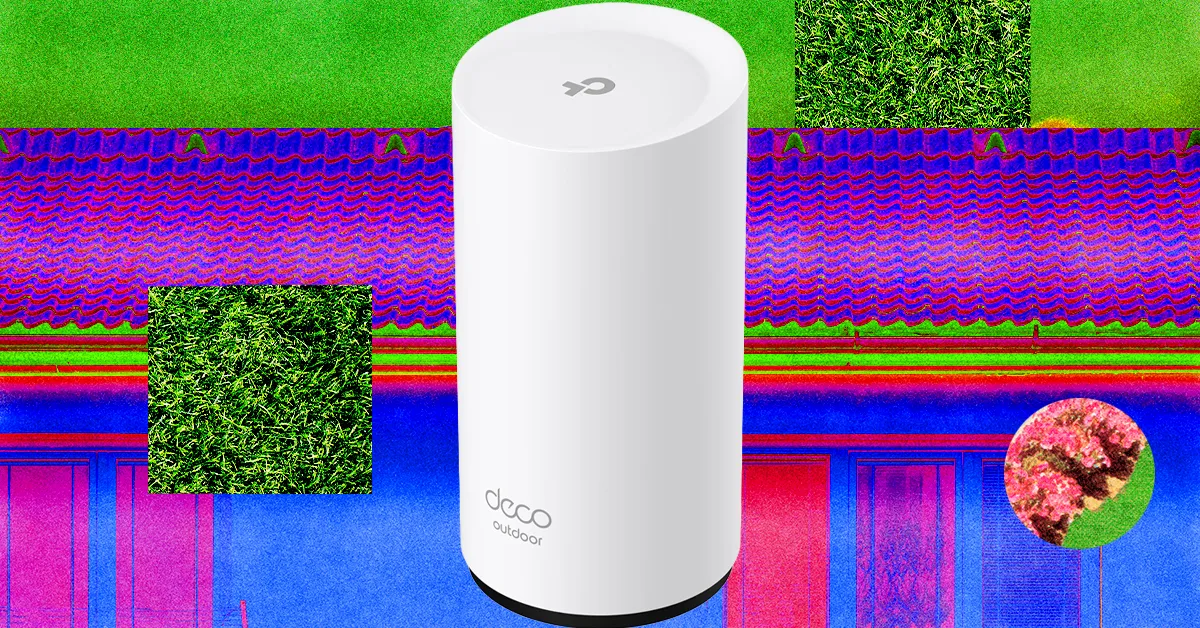
No one wants the tunes buffering when they have friends round for a barbecue or a stuttering podcast as they try to finish yard work. While the average router might fill your home with Wi-Fi, it doesn’t always extend to the patio or deck, much less the end of your backyard. But you can get great Wi-Fi coverage in your outdoor spaces, and I will show you the best options.
Before you think about spending any money, try adjusting or moving your wireless router. Routers send out Wi-Fi signals in a rough circle, so I always recommend placing your router in the center of your home. Moving it slightly closer to your backyard or wherever you want to extend Wi-Fi is the simplest option. Ensure it’s positioned high and in the open. You may need a longer Ethernet cable. If your router has adjustable antennas, I also strongly recommend moving them and testing the signal strength in your problem spot (this can make a surprising difference).
If you have a mesh system, try moving one of the nodes to the back windowsill of your home to extend Wi-Fi into the backyard. If you’re able, running an Ethernet cable between your main router and the node nearest your outside space for wired backhaul can also extend range and speed significantly. If you have an outbuilding, you could even consider running an armored Ethernet cable from your main router to a mesh node or access point out there.
Use Your Smartphone as a Hot Spot
If you get a decent cellular network signal on your phone in your garden and you have plenty of data, it might be worth using your phone as a hot spot, which enables other devices to piggyback on your mobile network connection. We have a full guide on how to use your smartphone as a hot spot, but it’s very easy to do. Here’s the quick version:
Advertisement
On an iPhone: Open Settings, Personal Hotspot, toggle on Allow Others to Join, and set a Wi-Fi Password.
On an Android: Open Settings, Network and Internet (or Connections on a Samsung phone), choose Hotspot and tethering, toggle Wi-Fi hotspot on, and pick a name and password.
The problem with this is that it will use up your data allowance, tie up your phone, and drain your battery fast. But it’s a good solution in a pinch.
Upgrade Your Setup
If the two options above don’t fix your Wi-Fi woes, it might be time to upgrade your hardware. We have guides to the best routers, best mesh systems, and best Wi-Fi extenders. If you’re currently using an old or ISP-provided router, simply snagging a new one could make a big difference to your range. Most routers have a rough estimate of the square-footage range, but the construction of your home and other factors will impact it.
Switching from a single router to a mesh system is a better upgrade if you need to extend that Wi-Fi coverage. I’m not keen on Wi-Fi extenders, but they can sometimes be the most cost-effective way to get Wi-Fi to a single trouble spot. If you recently upgraded or already have a mesh, there are still other options.
Get an Outdoor Router
Advertisement
Folks with a mesh system can often add an outdoor router or node easily. Outdoor routers are weatherproof and generally have an IP rating determining what kind of weather they can withstand. They often come with fixings to mount on an exterior wall, fence, or pole, but you must consider how to run a power cable to an outlet. The right outdoor router for you depends entirely on your mesh system.
Get caught up on the latest technology and startup news from the past week. Here are the most popular stories on GeekWire for the week of March 29, 2026.
Rec Room, the Seattle-based social gaming platform once valued at $3.5 billion, is shutting down on June 1, ending a decade-long run for one of the city’s most prominent startup unicorns. … Read More
In her debut column for GeekWire, longtime Microsoft watcher Mary Jo Foley digs into the recent wave of reorgs, hiring freezes, and leadership shakeups in Redmond, and asks whether it’s business as usual or something bigger. … Read More
Amazon has purchased 1,300 acres in Boardman, Ore., for a potential $12 billion “exascale” data center campus capable of housing up to 20 buildings, the Oregonian reports. … Read More
Snap has acquired select assets from Rec Room Inc., with some employees joining the Spectacles hardware subsidiary, as the Seattle-based social gaming company shuts down its platform on June 1. … Read More
The latest edition of commercial real estate firm JLL’s Innovation Geographies report reveals that while Seattle is outpacing traditional hubs like New York and London in talent migration, a shortage of “investment-grade” real estate is creating a bottleneck for the city’s next era of tech expansion. … Read More
All 11 U.S. aircraft carriers employ what is called a “Five-Mile Rule,” which is rarely broken. The rule is a 5 nautical mile (5.75-mile) exclusion zone established around aircraft carriers, and its purpose is essentially force protection. Aircraft carriers are huge machines that can be dangerous to get close to, as colliding with one will always end in the carrier’s favor. Additionally, the constant need for flight operations ensures the safety of both the pilots and crew. Essentially, a five-mile buffer serves to further protect the carrier from threats.
It’s almost unfathomable how large carriers like the Lincoln are, as it displaces over 100,000 tons of seawater. When moving, it can’t turn or stop on a dime, as its inertia is considerable. Getting too close means that a collision can be unavoidable, so the exclusion zone’s purpose is essentially all about safety. While you might see pictures showing tight formations with the Lincoln among the vessels that comprise its Carrier Strike Group, that’s not normal during combat and flight operations, as breaking the Five-Mile Rule is a big naval no-no … until it isn’t.
Advertisement
Violating the exclusion zone isn’t common, but it happens. Think of it more as a rule that’s allowed to be broken than an unwavering law because there are conditions that warrant its violation. Typically, an emergency, where someone falls overboard, an unforeseen issue that arises during combat or flight operation, or any emergent situation might compel an aircraft carrier’s captain to chuck the exclusion zone into the drink and move the carrier or another ship closer than normal. Everyone onboard is trained for these situations, but it’s nonetheless dangerous since exclusion zones are there for good reasons.
Advertisement
The Five-Mile Rule and why it’s necessary
First and foremost, all U.S. aircraft carriers have a five-mile rule, and it’s all for the same reason. In 2000, the USS Cole (DDG-67) was attacked by a small vessel, causing widespread damage to its hull while killing 17 sailors and wounding almost 40 additional personnel. Since then, the U.S. Navy has been wary of small vessels, and a five-mile buffer ensures that none can get close to the carrier, as the Cole bombing proved the danger that explosive-laden craft could pose in potentially sinking an aircraft carrier. Another reason is flight operations, which is dangerous in and of itself.
The danger is elevated when an approaching aircraft has problems with onboard weapon systems or fuel. This can endanger surrounding ships, so the buffer offers added protection. Also for flight operations, the carrier must turn into the wind, requiring a large turn radius, making it imperative that its surrounding waters are devoid of any vessels. Air operations also require a bubble of airspace for recovering aircraft low on fuel, which the exclusion zone provides. The rule is only violated when combat action requires it, but under normal conditions, breaking the buffer can be hazardous.
Another aspect of carrier operations results in high-powered radar and electronic warfare radio signals. These can disrupt communications and electronics, especially with commercial, civilian vessels. Keeping them away limits potential damage to their navigation and communications equipment. The carrier is further protected by a series of submarines, cruisers, and guided-missile destroyer escorts, ensuring that no vessels stray too close. This ensures that everyone on or around an aircraft carrier like the Lincoln remains safe and secure.
Are you using your Apple Watch to its full potential? Whether you’ve owned an Apple Watch for years, answering texts and counting steps with the small device on your wrist, or you’re new to wearing a smart watch, it’s likely that there’s a trove of hidden features and tools that you’ve never used.
Apple currently sells three versions of its popular watch: the Series 11, the SE 3, and the Ultra 3. Each version offers different features, display sizes, and battery life, but no matter which version you own, there are hidden tools that you aren’t utilizing.
It’s common knowledge that you can answer texts and phone calls, tap to pay, and track your daily exercise routine, but all models of Apple Watch offer much more. Before you get too involved in picking a fun watch face and comfortable or stylish band, take the time to learn about all the functions your watch offers. After all, it’s a big investment, especially if you opted for the high-end Ultra 3. Here are some Apple Watch features that may have flown under your radar.
Advertisement
Sleep apnea detection
PeopleImages/Shutterstock
If you or a loved one snores loudly or wakes up after hours of sleep still feeling tired, you may be showing symptoms of sleep apnea, a disorder that causes pauses in your breathing while you’re asleep. It affects about 30 million Americans, and the risk increases as you age. Untreated sleep apnea can lead to other issues with your health, such as high blood pressure and cardiac rhythm disturbances. If you suspect you have sleep apnea, you should make an appointment with a health care provider, but while you wait to be seen by a doctor, your Apple Watch can help look for breathing disturbances.
The Sleep Apnea Notifications feature is available on Apple Watch Series 9 or later, Apple Watch Ultra 2, or Apple Watch SE 3. Your phone must be updated to the latest version of iOS, and you must also turn on the Sleep Tracker feature, found in the Health app on your phone. Then, wear your watch when you sleep for a minimum of 10 nights over a 30-day period, and the data will be analyzed every 30 days.
Advertisement
To turn on sleep apnea notifications, open the Health app on your iPhone, tap Search, then tap Respiratory, and set up Sleep Apnea Notifications. If you receive a notification, you can export the report as a PDF to share with your health care provider.
Advertisement
Mute notifications with gestures
DenPhotos/Shutterstock
You’re in an important meeting, or mid-way through the first act of Hamilton, when you suddenly realize you forgot to silence notifications on your Apple Watch. The situation dictates stealth — you don’t want to interrupt your boss or draw attention to yourself in a dark theatre. Luckily, Apple offers several options that will allow you to quickly mute the notifications on your watch.
If you only remember that notifications are active because you receive an alert, such as an incoming phone call or text, you can quickly mute your that alert by covering your watch display with your hand for at least three seconds. You’ll feel a tap to notify you that you’ve successfully muted the notification. This option is typically on by default, but you can check by going to the Settings app on your watch and tapping Gestures.
You can also mute calls and dismiss notifications simply by quickly turning your wrist over and back again. Apple dubbed this the wrist flick gesture, and it’s supported on the SE 3, Series 9, Ultra 2, and later models. Again, this feature is turned on by default, and you can access it on the Settings app under Gestures.
Advertisement
Live Listen
Seremin/Getty Images
If you’re hard of hearing, you have a loved one that is struggling with their hearing, or you’re simply struggling to hear clearly in an especially noisy situation, you can turn an Apple Watch into an accessibility aid using Live Listen. This feature uses the microphone on your iPhone to stream sound to your AirPods or MFi hearing devices. When paired with your Apple Watch, a transcription of the conversation also appears on your watch’s screen in real time.
You must use headphones or a hearing device with this feature, and Live Captions is not available in all languages or regions. Apple also warns that the accuracy of the captions may vary, so you should not rely on the transcription in an emergency situation. Live Listen is available with watchOS 26, which requires an Apple Watch Series 6 or SE 2 or later. It’s available on all models of the Apple Watch Ultra.
If you want to keep Live Listen easily accessible, add it to your watch’s Control Center. Once you’ve done that, simply place your phone near the source you want to listen to, such as a speaker or a lecturer. Open the Control Center on your watch and tap the Hearing Controls button. Scroll down to Live Listen, then you can start a session, or rewind a current session, view the live transcription, and stop the session.
Advertisement
Music recognition
DenPhotos/Shutterstock
We’ve all been there: you’re enjoying coffee at a cafe or watching a movie with friends and you hear a catchy tune that you simply love. You don’t know the name or the artist, and the song is fleeting – once it’s over, you may wait months to hear it again! In the days before smart phones, you’d have to describe the song to a friend or family member, hoping someone would recognize it from your clumsy humming. Eventually, music recognition apps like Shazam appeared on the scene, but you’d have to get your phone out and get the app going before the song ended.
If you own an Apple Watch, you no longer have to hum for friends or even get your phone out of your pocket. Apple now owns Shazam and has built music recognition directly into your watch, with no additional app necessary. Simply open Music Recognition on your watch by tapping the icon (a blue circle with a white, S-shaped logo) and tap again to initiate listening. Once it identifies the song, your watch will display both the title and artist. You can then see the song in Apple Music, add it to your library or playlist, and even see additional details about the song, such as the album and release date, all without pulling out your phone. If you forget to take note of a song that you heard days or weeks earlier, open the Music Recognition app on your watch and scroll down to see a history of identified songs. This capability is available on all watches running watchOS26.
Advertisement
Live translation
Song_about_summer/Shutterstock
Only about 23% of Americans are bilingual, or able to speak more than one language. Though much of the world speaks English, this can still be a challenge, especially when we travel — only about 360 million out of more than eight billion people speak English as their first language. If you frequently travel internationally, you may want to consider investing in an Apple Watch rather than relying on a translation app on your phone.
Apple’s live translation app allows users to translate both text and voice into a long list of supported languages. You can also download new languages so you can use them without an internet connection. Offline translation is available on the Apple Watch SE 3, Series 9 and newer, and Ultra 2 and newer models.
To use live translation, first open the Translate app on your Apple watch. Tap the language you want to translate your text or speech into. If you require verbal translation, tap the microphone button and say a phrase. Your watch will translate as you type or speak and translation will appear on your watch display. To play the audio translation, tap the play button. To automatically hear translations, tap More, then Play Translations. If it’s a common phrase that you’ll likely repeat throughout your day, you can save the translation as a favorite for easy access in the future. If a word has several meanings, your Apple Watch allows you to select the one you want, and you can also select feminine or masculine translations for words.
A Democratic congressman had harsh criticism for Polymarket for allowing users to bet on the date the United States would confirm the rescue of Air Force service members shot down over Iran.
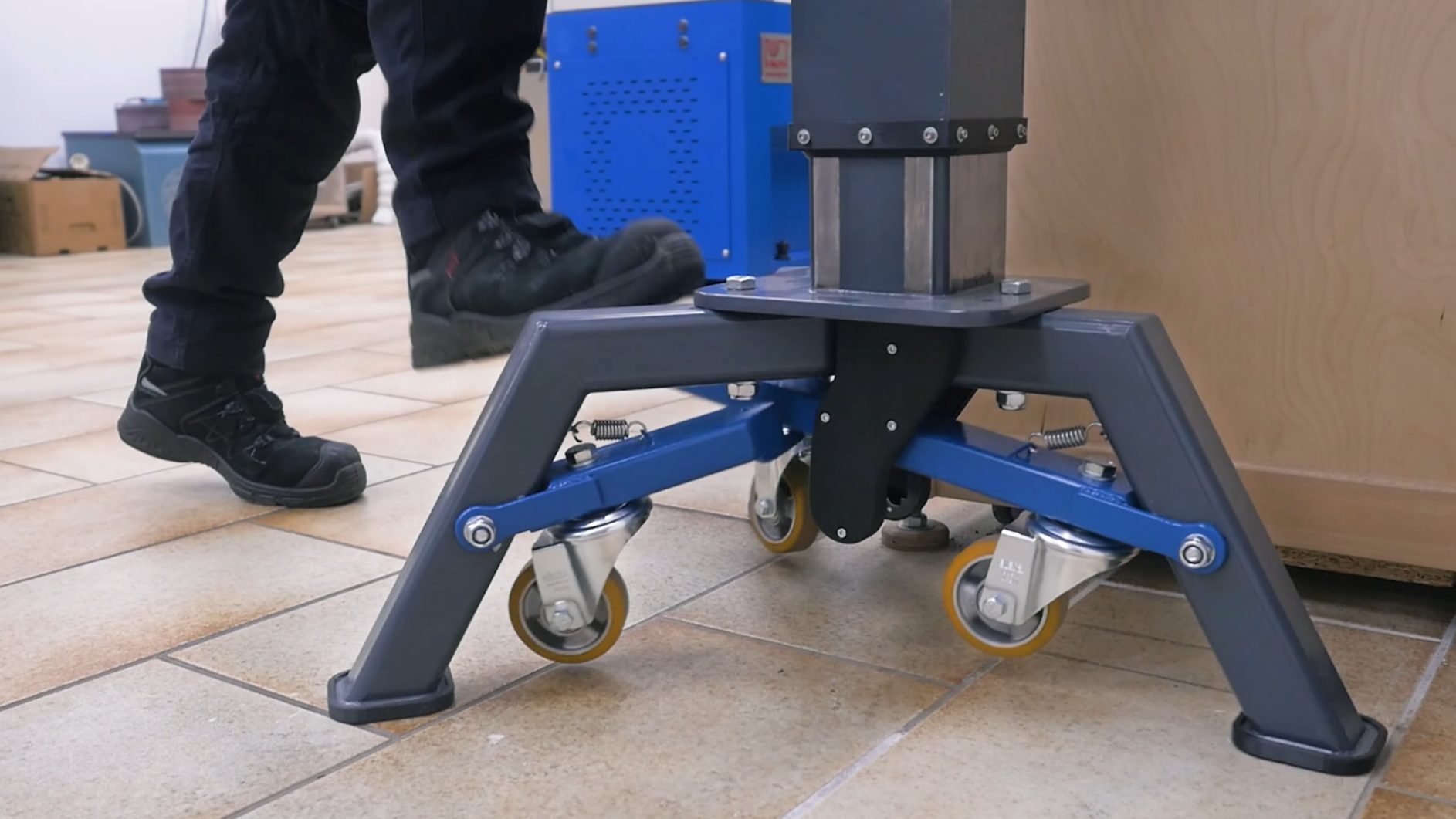
Old shop tools have a reputation for resilience and sturdiness, and though some of this is due to survivorship bias, some of it certainly comes down to an abundance of cast iron. The vise which [Marius Hornberger] recently restored is no exception, which made a good stand indispensable; it needed to be mobile for use throughout the shop, yet stay firmly in place under significant force. To do this, he built a stand with a pen-like locking mechanism to deploy and retract some caster wheels.
Most of the video goes over the construction of the rest of the stand, which is interesting in itself; the stand has an adjustable height, which required [Marius] to construct two interlocking center columns with a threaded adjustment mechanism. The three legs of the stand were welded out of square tubing, and the wheels are mounted on levers attached to the inside of the legs. One of the levers is longer and has a foot pedal that can be pressed down to extend all the casters and lock them in place. A second press on the pedal unlocks the levers, which are pulled up by springs. The locking mechanism is based on a cam that blocks or allows motion depending on its rotation; each press down rotates it a bit. This mechanism, like most parts of the stand, was laser-cut and laser-welded (if you want to skip ahead to its construction, it begins at about 29:00).
Unlike locking caster wheels, this provides significant grip when the wheels are retracted; considering the heft of the vise [Marius] restored, this must be helpful. If you’re more interested in building a vise than a stand, we’ve seen that too.
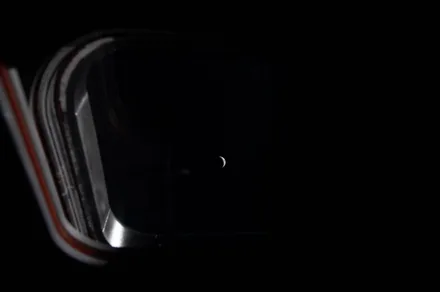
NASA has shared a stunning image (above) captured by the crew of the Artemis II mission as they head toward the moon. It shows a tiny Earth, mostly in darkness and surrounded by the inky blackness of space.
The photo was taken on day four of the Artemis II mission that will see four astronauts fly around the moon before returning to Earth. On Monday, the crew — NASA’s Victor Glover, Reid Wiseman, and Christina Koch, along with Jeremy Hansen of the Canadian Space Agency — will loop around our nearest neighbor, setting a new flight record in the process.
“One last look at Earth before we reach the moon,” NASA said in a post on X that shared the incredible photo.
“This view of the Earth was captured on April 5, the fourth day of the Artemis II mission, from inside the Orion spacecraft. The four astronauts will reach their closest approach of the moon tomorrow, April 6.”
Advertisement
One last look at Earth before we reach the Moon.
This view of the Earth was captured on April 5, the fourth day of the Artemis II mission, from inside the Orion spacecraft. The four astronauts will reach their closest approach of the Moon tomorrow, April 6. pic.twitter.com/z2NJUGWkKc
Tantalizingly for the crew, the Orion spacecraft is expected to pass within about 4,070 miles of the moon, giving astronauts their closest view of the cratered, rugged terrain in more than five decades.
But that’s not all. On Monday afternoon, shortly before 2 p.m. ET, the Artemis II crew will surpass the greatest distance from Earth ever reached by humans, set by the Apollo 13 crew in 1970 when it flew 248,655 miles from our planet. Then, about five hours later, the Artemis II astronauts will reach their farthest point from Earth, 252,760 miles, setting a new record.
Advertisement
The 10-day mission, which launched from the Kennedy Space Center in Florida on April 1, has so far been going mostly to plan. One hiccup, however, concerns the onboard toilet, which has been experiencing intermittent problems during the flight.
The latest issue has been caused by what engineers believe may be ice blocking a pipe that expels the astronauts’ urine into space. It means that for now, the crew members are having to use special bags to collect and store their liquid waste. Fortunately, the toilet still works for number-2 waste, which is dealt with differently.
Artemis II marks the first crewed flight of the Orion spacecraft and the second Orion flight overall. The mission is designed to test the spacecraft’s systems in preparation for more complex missions like Artemis IV, which will endeavor to return humans to the lunar surface after an absence of more than five decades.
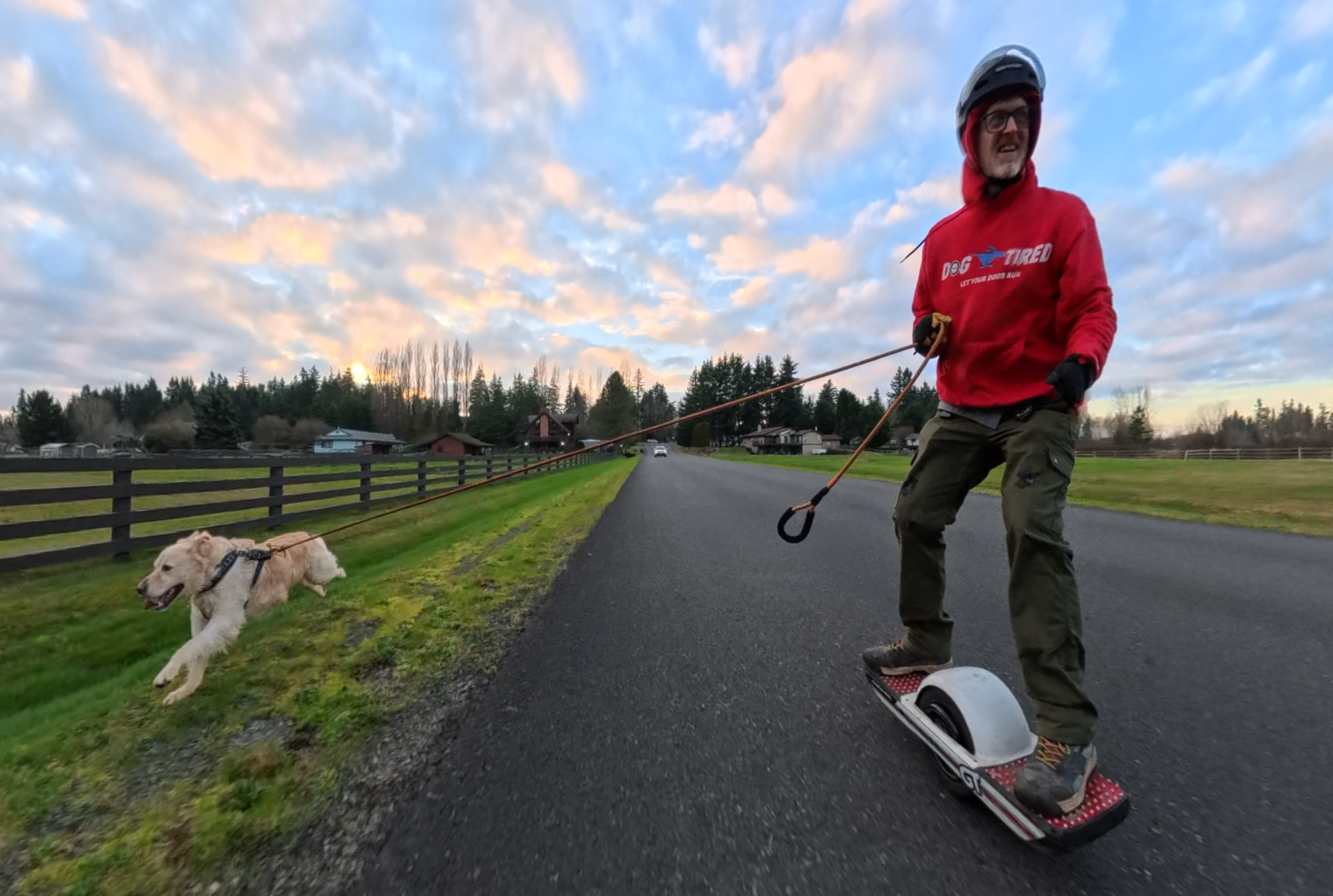
Eric Howard, founder of Dog Tired, rides his One Wheel while running Boone, a golden retriever, near Lake Tapps, Wash. (Photo courtesy of DogTired)
It’s tough to tell who has the bigger smile: the guy zipping by on the Onewheel, the dog running alongside him at full sprint, or the passersby lucky enough to witness it.
Howard is the founder and chief dog runner at Dog Tired, a dog-exercising service outside of Seattle that operates at a different speed. After stints in tech, including at data visualization company Tableau, Howard ditched the corporate leash for one he actually wanted to hold.
“I show up and I’m like the Beatles, and they’re like a teenage girl. They’re just excited to see me,” Howard said of his four-legged clients. “It’s hard to have a bad day when you go see eight dogs and they’re all just losing their mind, happy to see you.”
A longtime adventure seeker, Howard is a snowboarder and kiteboarder who fell in love the first time he stepped on a Onewheel — the self-balancing, single-wheeled electric board that riders control by shifting their weight.
Advertisement
He’s also a dog lover. When a relationship in Portland ended and the dog he’d shared with his girlfriend stayed behind, he got another one — a 15-pound poodle mix named Riley — and soon realized he was cut out for some sort of job in the pet industry.
The concept for Dog Tired came together when a friend had a high-energy rat terrier that was, in Howard’s words, bouncing off the walls. Howard tried running the dog alongside his Onewheel and it quickly became a daily — sometimes twice daily — ritual.
His friend noticed the difference immediately. The dog was more manageable and happy. And Howard saw an opportunity.
A nudge from dad
Howard graduated from the University of Washington with a degree in informatics at age 31 — a non-traditional path that he describes as a theme in his life. He joined Tableau as a senior tech support engineer when the company was still in what he considered a startup phase — long before it was acquired for $15.7 billion by San Francisco-based Salesforce in 2019.
Advertisement
He spent nearly five years across two separate stretches at Tableau, which he called the best employer he’s ever had. But as the startup atmosphere began to fade he lost his passion for data analysis, server engineering and managing a team. He needed a change.
“My dad really wanted me to do the Onewheel business. I really credit my dad with giving me that final nudge,” Howard said. “He was like, ‘You’ve got some money in your retirement and some money in savings. How long could you survive without making any money?’”
Howard figured he could make it six months or so.
“As soon as I started reaching out, spreading the word, it just caught fire,” he said. “People were just like, ‘This is a genius idea.’”
Advertisement
‘Bottomless demand’
Howard soon had 15 clients and a regular weekly routine. Within six months he was covering his bills. And five years later, Dog Tired has grown into a full-fledged operation. Howard does 50 runs a week and a part-time employee handles another dozen or more.
“I’ve got about 5,000 dog runs under my belt, about 17,000 miles total,” he said, adding that the business largely sells itself, with little turnover. “There’s a bottomless demand out there of dogs that are just waiting to get the exercise they need.”
Howard has a 100-pound-dog limit and he sticks to low-traffic areas. It helps him stay in control on the Onewheel when his clients want to chase squirrels or rabbits.
He said the work is really about relationship management, which is a lot of what he learned at Tableau. There’s plenty of troubleshooting, but in this case it’s dogs rather than computers.
Advertisement
“I’m not rich. I don’t make a fortune, but I feel very rich,” Howard said. “I look forward to every day. I get up early in the morning and the day can’t get started fast enough for me.”
The lowest price ever is in effect now on Apple’s M5 MacBook Air, with a weekend deal at Amazon slashing prices by $150 (and there are numerous 13-inch and 15-inch configurations to choose from).
Grab the lowest price ever on Apple’s new M5 MacBook Air.
Apple’s brand-new M5 MacBook Air, which was released in March 2026, is on sale at Amazon today, with multiple 13-inch and 15-inch configurations to choose from. Kicking off the sale is a $150 discount on the standard 13-inch MacBook Air with Apple’s M5 chip. Pick up the M5/16GB/512GB configuration for $949.99, the lowest price to date on the Sky Blue and Starlight models. Continue Reading on AppleInsider | Discuss on our Forums






















































You must be logged in to post a comment Login