Last year’s trip to CanJam London was something of a nightmare, with lengthy train delays and torrential rain pouring over the London Eye and Westminster Bridge.
This time, the journey into the heart of the city could not have been easier. There were no travel hiccups, and the sun managed to find its way through every available gap between the buildings, buses and cars.
Inside the Park Plaza Hotel, the air conditioning was working overtime, which was just as well. Attendance was clearly up compared with 2025, and there were noticeably more brands and exhibitors. So many, in fact, that I simply could not see everything on offer over the two days.
Following our recent coverage of CanJam NYC 2026, and with the eCoustics team heading to CanJam SoCal at the end of the summer, London offered another useful snapshot of where personal audio is heading. With my trusty Sendy Audio Egret in tow, I focused on the products that stood out most. We begin with my personal highlights among the DACs, headphone amplifiers and DAPs at CanJam London 2026.
Advertisement
Related Reading:
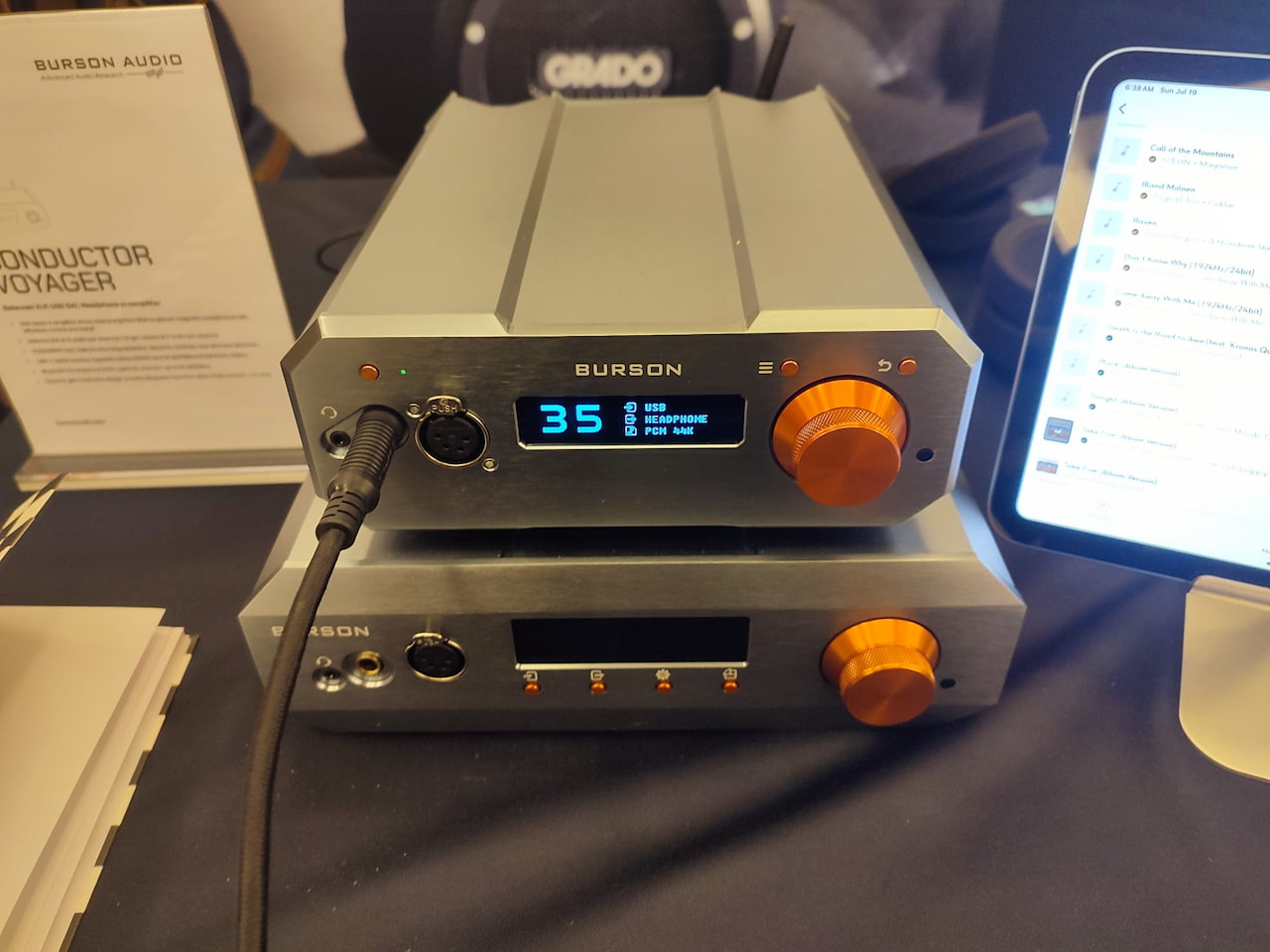
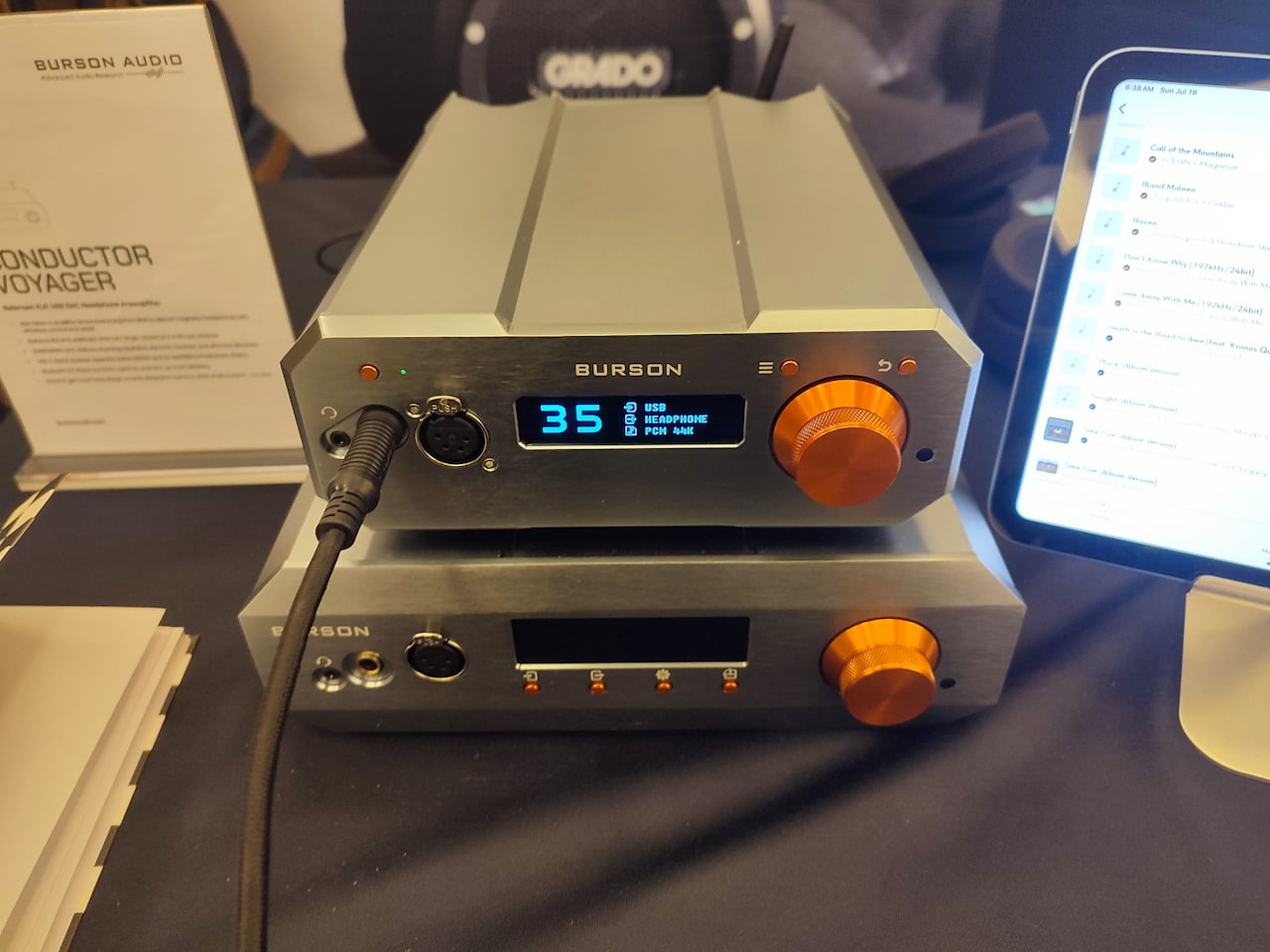
Burson Audio Conductor Stellar
Australian audio brand Burson has seemingly come out with a smaller, more compact Conductor Voyager that costs less and offers almost the same level of performance.
You get two watts less of Class A amplification, at eight watts rather than ten, but you won’t notice that unless you’re using a particularly difficult-to-drive pair of cans. What’s more, the Stellar has a dedicated IEM amplifier stage, so you can drive your sensitive in-ears with ease.
Despite being Class A, I found the Stellar to be wholly neutral, albeit with excellent dynamics and an impactful bass line. As a pure headphone listener, I’d go for this instead of the Voyager unless you need the extra I/O that the latter offers at the back.
Fosi Audio ZH1
I’ve always been a fan of Fosi Audio’s budget-conscious approach to personal audio, and its upcoming ZH1 certainly sticks to that philosophy.
Expected to arrive around September for approximately £130, the ZH1 is a compact desktop DAC and headphone amplifier built around a pair of Cirrus Logic CS43131 DAC chips and Fosi Audio’s own headphone amplifier circuit. Its unusual hexagonal chassis also helps it stand out from the endless procession of small black boxes competing for space on your desk.
That oversized volume knob definitely takes centre stage. It makes quick adjustments easy, while the lighting underneath can be changed to suit your setup. Some audiophiles will undoubtedly switch it off immediately, but I imagine the colourful presentation will make the ZH1 particularly popular with gamers and younger listeners.
Advertisement
This is not merely a piece of affordable desktop decoration, either. With more than one watt of output power available, the ZH1 should have enough muscle for a broad range of headphones rather than being limited to sensitive IEMs and easy-to-drive models. It certainly had no difficulty with my Sendy Audio Egret at the show.
Advertisement. Scroll to continue reading.
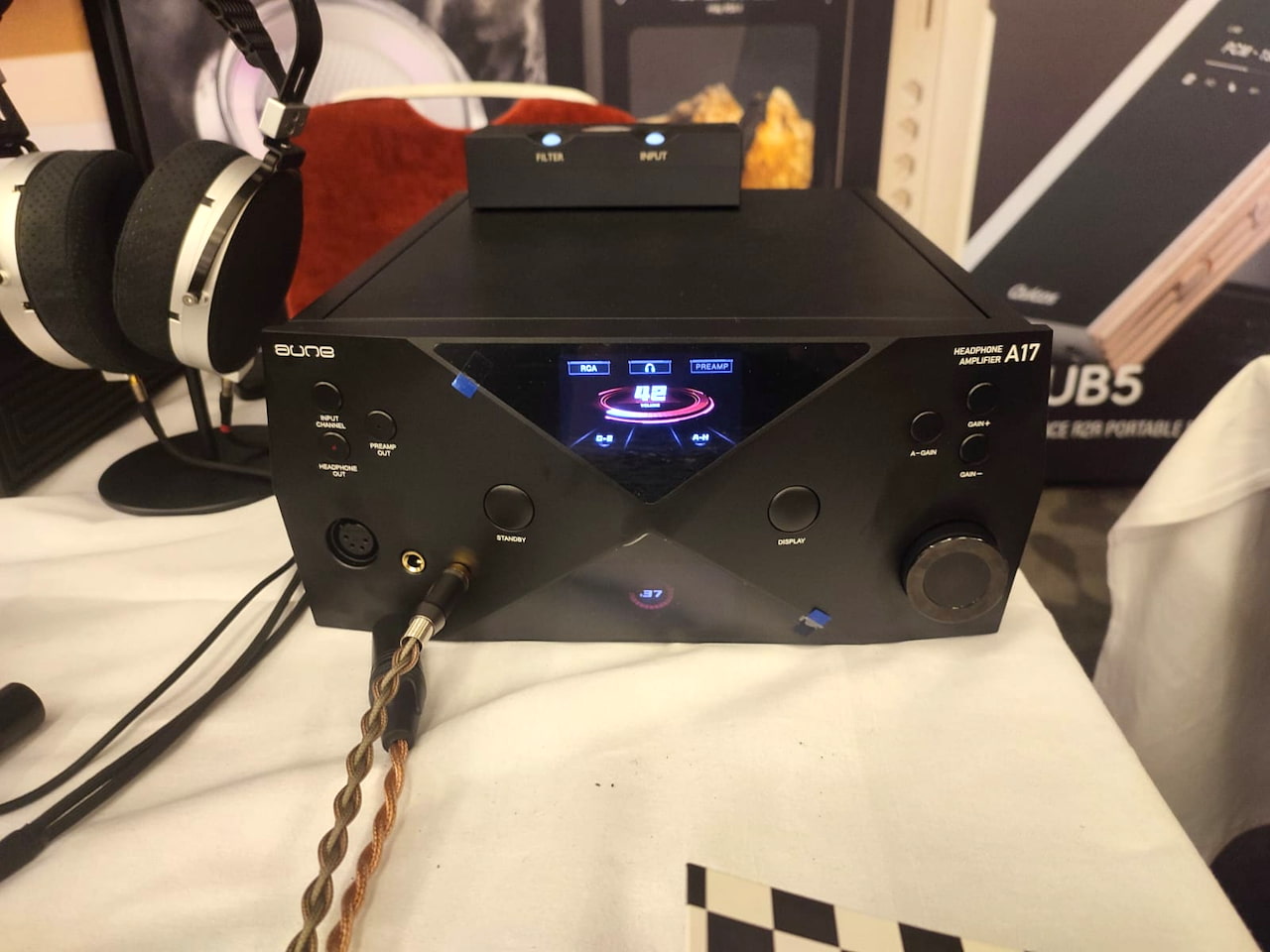
Aune A17
Next up is this absolute behemoth of an amplifier. I’ve reviewed a few of Aune’s products in the past, but nothing has come close to the sheer heft of this beast, which weighs an astonishing 18 kg.
It has the power to back up its size, too, delivering almost 12 watts from its balanced output. That translates rather directly into its sonic performance, as my main takeaway was the exceptionally high level of control it maintained across the entire audible spectrum.
It also costs upwards of £2,000 ($2,399 at Amazon), and while you certainly get a lot of material and componentry for the money, I found the design rather uninspiring and, dare I say it, slightly cheap-looking.
Advertisement
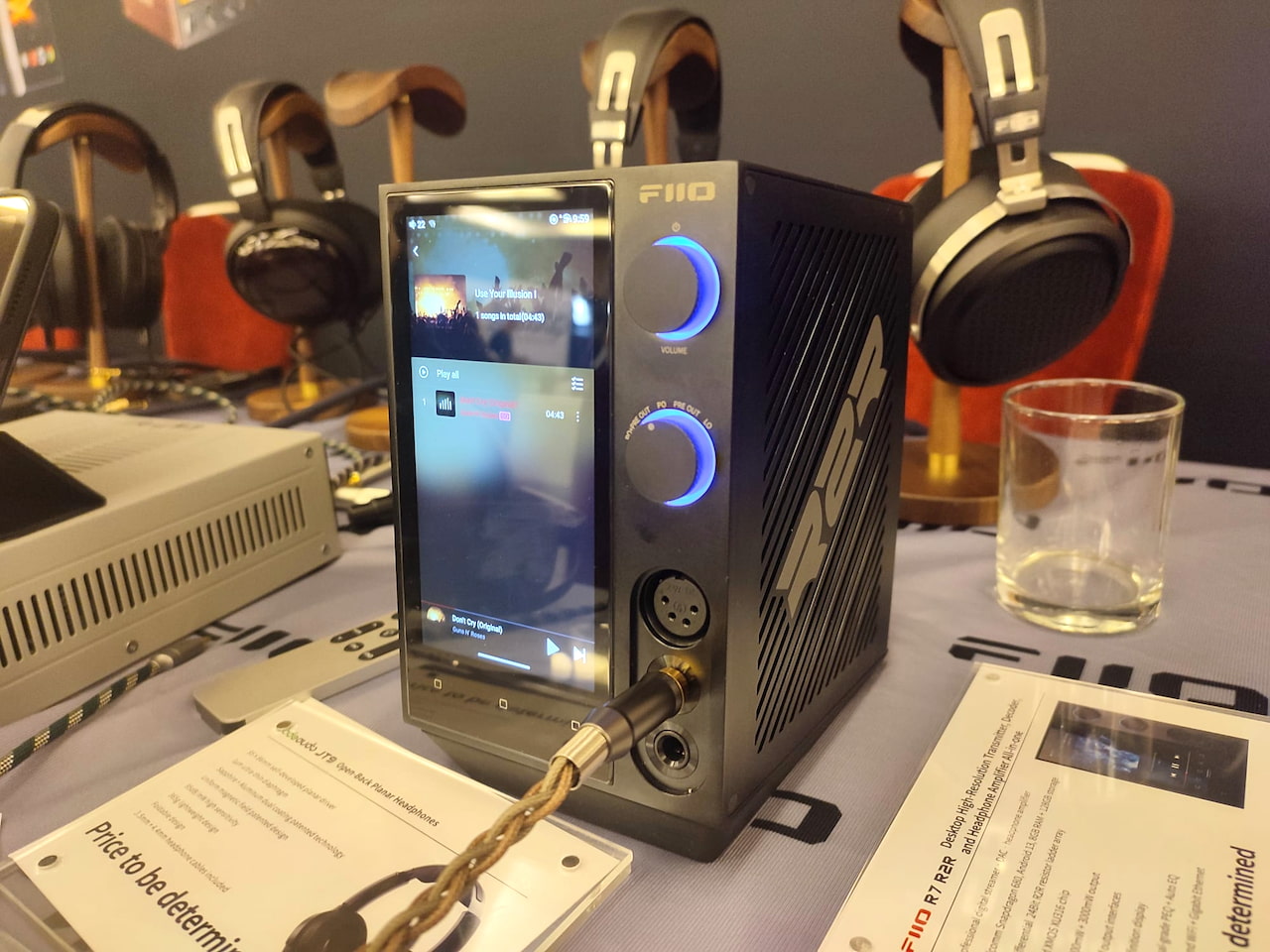
FiiO R7 R2R
The FiiO R7 R2R is expected to cost the same as its original sibling at around $700, but replaces the standard R7’s ESS ES9068AS delta-sigma DAC architecture with an R2R resistor-ladder conversion stage.
The rest of the formula remains familiar. It is still a compact, all-in-one desktop streamer, DAC, preamplifier and headphone amplifier, with a vertical touchscreen, Android-based access to streaming services and support for local playback. The standard R7 also offers Wi-Fi, Bluetooth, AirPlay and Roon Ready connectivity, alongside balanced 4.4 mm and four-pin XLR headphone outputs and a 6.35 mm single-ended connection.
To me, the move to R2R represents a clear upgrade. I noticed the difference immediately, with greater bass impact, more warmth and a fuller overall presentation than I heard from the standard R7.
I love that FiiO continues to refine and expand its range of all-in-one streamers, DACs and headphone amplifiers rather than abandoning successful products after a single generation. The R7 R2R does not reinvent the original, but it sounds like another worthwhile incremental improvement to one of FiiO’s most versatile desktop components.
FiiO Class A
Shuffling further down the FiiO booth, I spotted another as-yet-unreleased product: a dedicated headphone amplifier called the CLASS A. The name rather gives the game away.
This is a fully discrete, pure Class A design that delivers one watt per channel. That might not sound particularly dramatic on paper, but it sounded considerably more powerful than the figures suggested, driving my headphones with plenty of authority and control.
Advertisement
Inside is a custom 60-watt toroidal transformer and a discrete regulated power supply, while five selectable gain levels should make it suitable for a wide range of headphones. Outputs include 3.5 mm, balanced 4.4 mm and four-pin XLR connections, with both RCA and balanced XLR line-level connectivity also provided.
More importantly, it delivered the warmth and sweetness I tend to associate with Class A amplification without sounding overly soft or sluggish. I was also a fan of the physical bass and treble controls, which make it easy to fine-tune the sound without opening an app or disappearing into a menu. You do not see enough of those nowadays.
FiiO has yet to confirm the final international release date or pricing. I was quoted a provisional Chinese price of approximately 3,000 RMB, which converts to around $450, although taxes, distribution costs and regional pricing will inevitably have their say.
Advertisement. Scroll to continue reading.
Advertisement
Even allowing for that, the CLASS A looks like excellent value for money.
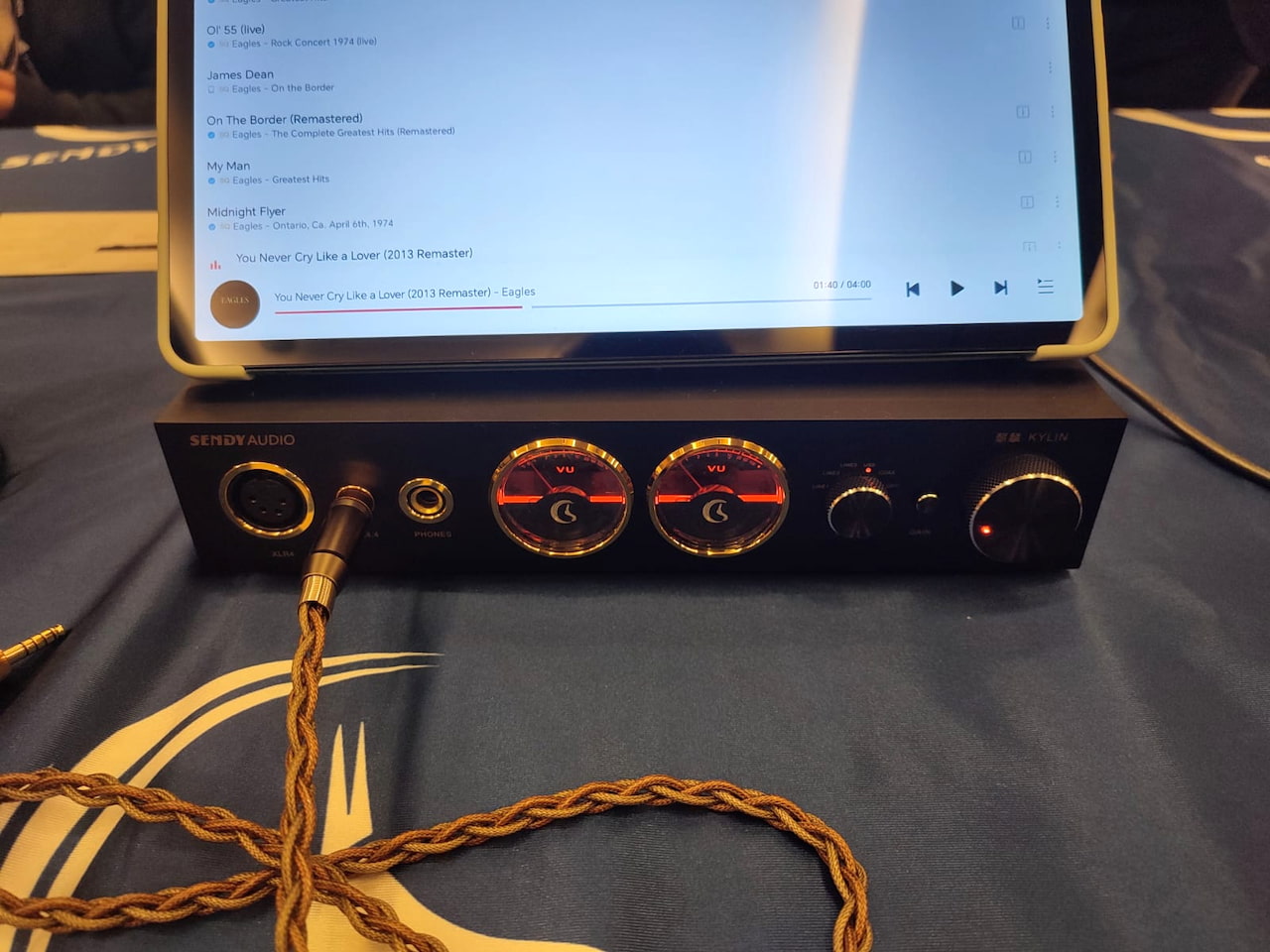
Sendy Audio Kylin
I listened to the Sendy Audio Kylin at last year’s show and was so impressed that I named it Best in Show in the midrange price category.
One year later, my impressions have not changed one jot. Some of its specifications might not look especially impressive on paper, particularly beside amplifiers boasting increasingly ridiculous power figures, but the Kylin sounds absolutely gorgeous.
Vocals and guitars were rich, full-bodied and wonderfully expressive, while the presentation remained spacious, punchy and highly dynamic. There was enough warmth to make everything sound inviting, but not so much that the music became soft or overly relaxed.
Under the bonnet, the Kylin combines an XMOS USB stage with an ESS ES9038Q2M DAC, native DSD512 decoding and a pure Class A headphone amplifier using matched Hitachi transistors. It also offers balanced 4.4 mm and four-pin XLR headphone outputs, alongside a 6.35 mm single-ended connection.
Advertisement
None of that fully explains why I enjoyed listening to it so much, which rather proves the point. Numbers are useful, but they are not everything in the world of audio.
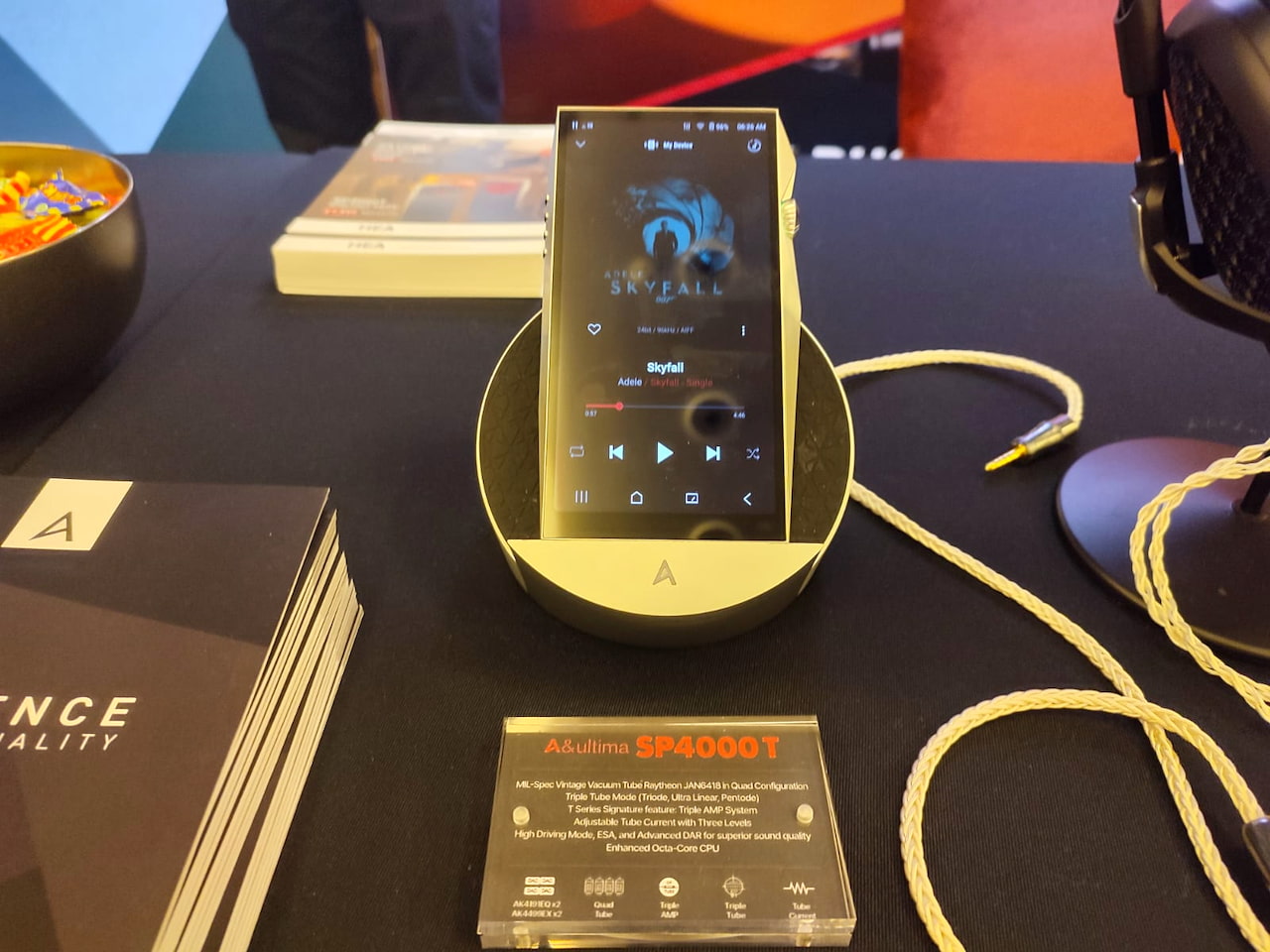
Astell&Kern A&Ultima SP4000T
The Astell&Kern SP4000T is, very loosely speaking, an SP4000 with four Raytheon JAN6418 vacuum tubes bolted on. There is rather more going on beneath the surface, but the description gets the general point across.
Those four military-specification tubes are arranged in a differential configuration, with two dedicated to each channel. The SP4000T also lets you choose between Triode, Ultra Linear and Pentode tube modes, along with OP AMP, Tube AMP and adjustable Hybrid amplification. Factor in three selectable tube-current settings, and there are plenty of ways to tailor its presentation.
It costs an eye-watering £3,200 and weighs an equally shocking 565 grams, making the word “portable” feel rather generous. You are not slipping this into the pocket of your jeans unless you would also like to explain the resulting wardrobe malfunction.
You do, however, get your money’s worth sonically. The SP4000T delivered a bombastic, commanding presentation that, to my ears, holds its own against many desktop DAC and headphone amplifier stacks costing similar money. There was plenty of scale and low-end authority, but it never sounded uncontrolled or clumsy.
Advertisement
The rest of the package feels suitably premium, with a smooth interface, responsive touchscreen and full Android support for direct access to streaming apps. Anyone seeking the best of the best in portable DAPs will undoubtedly consider it, although at 565 grams, they may also want to consider a stronger bag.
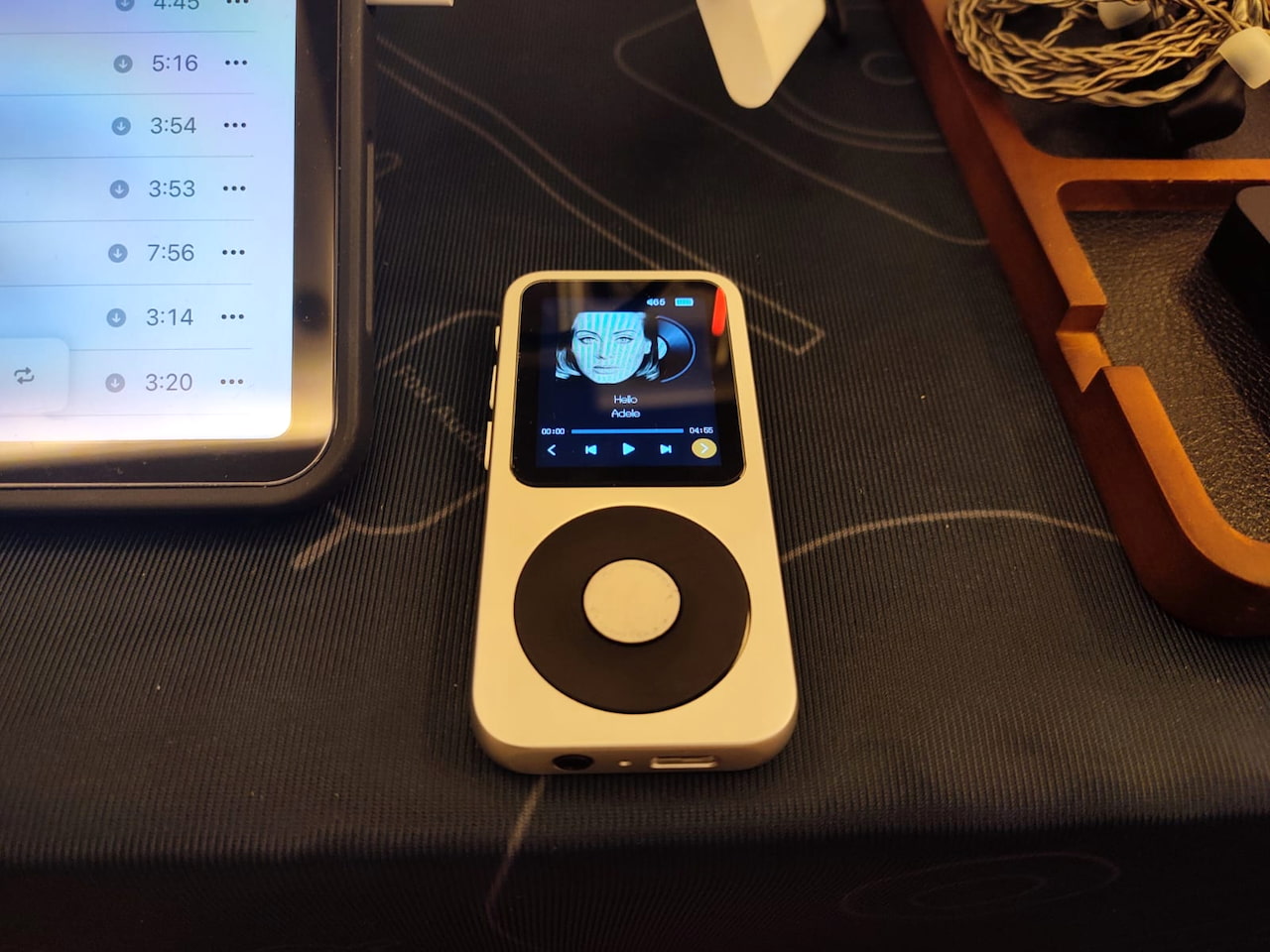
Fosi Audio DAP Neo
Back at the Fosi Audio booth, I was introduced to another prototype on display: the DAP Neo.
Advertisement. Scroll to continue reading.
This is a deliberately simple, offline digital audio player. It does not connect to the internet, which means no Spotify, Apple Music, TIDAL or other streaming services. You load your music onto the player and listen to it. That may sound rather old-fashioned in 2026, but sometimes removing notifications, apps and endless choices is exactly the point. It allows you to focus on the music and nothing else.
The compact design looks more than a little like one of Apple’s classic iPods, which is hardly the worst place to draw inspiration from. It felt straightforward to operate and refreshingly uncomplicated beside the increasingly large and expensive Android players found elsewhere at the show.
Advertisement
Fosi expects the DAP Neo to cost less than $100, although the final price and specifications have yet to be confirmed. It sounded solid during my brief demonstration and powered my Sendy Audio Egret comfortably, with enough weight and clarity to make listening enjoyable.
At this price, I am not asking for a desktop-class powerhouse or a miniature smartphone. Give me reliable local playback, a usable interface and enough power for a sensible pair of headphones, and there is not much more I could ask for.
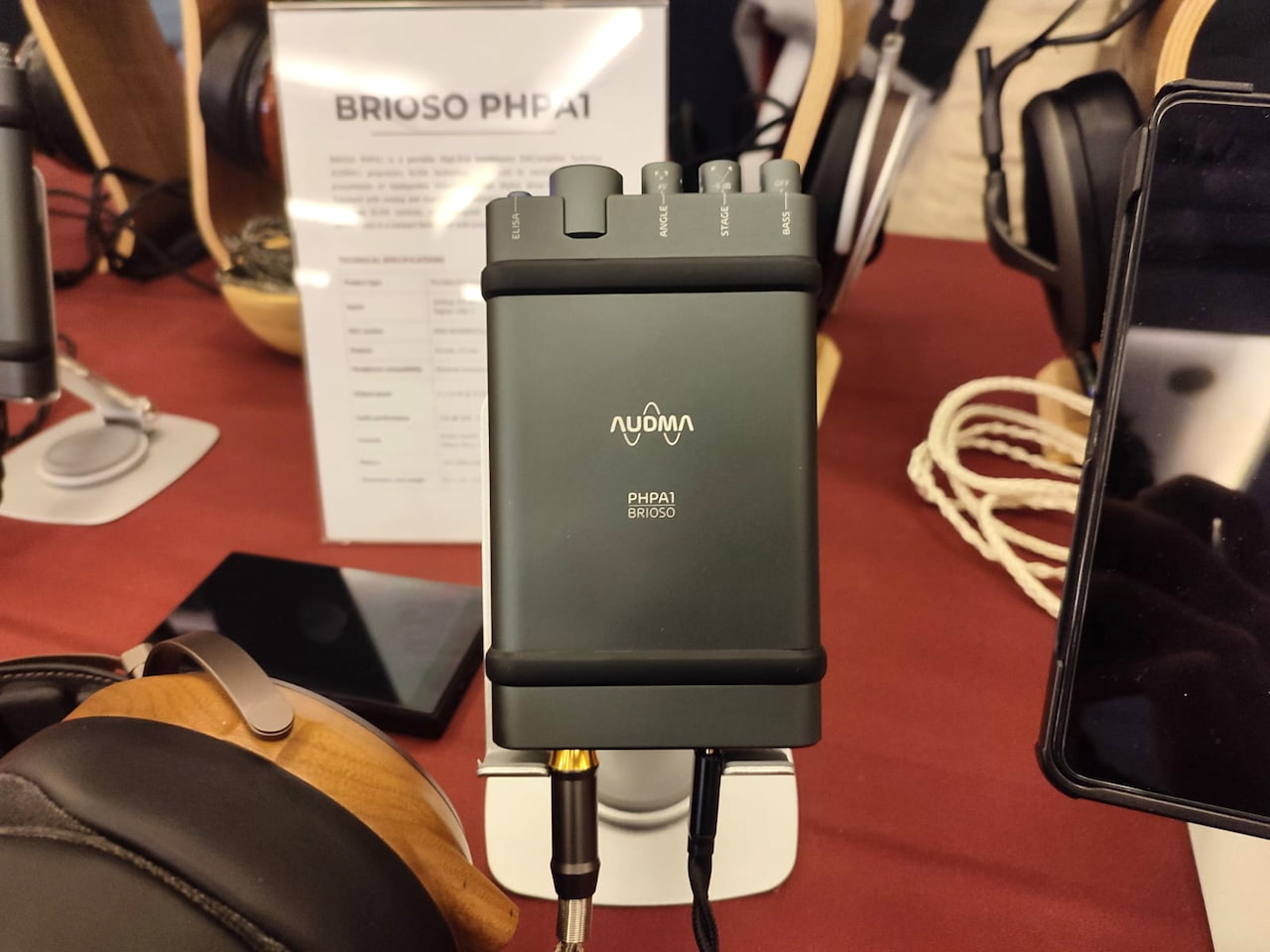
Best Portable DAC/Amp: Audma Brioso PHPA1
Admittedly, the Audma Brioso PHPA1 was the only portable DAC and headphone amplifier I listened to at CanJam London this year, but that does not make it any less deserving of our Best in Show award.
Audma is based in the same region of Italy that my father comes from, and the company is responsible for developing its patented ELISA circuitry. The technology is designed to recreate some of the spatial characteristics of listening to a pair of loudspeakers, including the small timing differences between the sound reaching each ear.
The Brioso lets you adjust the perceived distance and width of the presentation using its Stage and Angle controls. It is also a serious portable DAC and amplifier in its own right, using AKM’s flagship AK4499EXEQ DAC alongside the AK4191EQ digital filter and modulator. It supports USB-C digital playback, balanced and unbalanced analog inputs and up to five hours of battery-powered listening.
Advertisement
I tried the Brioso with ELISA switched both on and off, and the difference was immediately noticeable. With it engaged, the soundstage appeared to move in front of me rather than extending mainly to either side of my head. The effect was not subtle, and I still find it rather extraordinary that carefully controlled differences in timing and spatial information can change the presentation so convincingly.
The fact that Audma has managed to achieve this inside a genuinely portable device makes the Brioso even more impressive.
Mind you, it costs almost £4,400, so it probably should be.
Best DAP: FiiO M25 R2R
As we recently reported, FiiO brought two forthcoming DAPs to CanJam London: the M25 and M25 R2R. Positioned below the flagship M27 and above the more affordable M33 R2R and M21, the new models should help bridge what has become a rather substantial gap in FiiO’s portable player lineup.
The standard M25 uses AKM’s flagship separated-DAC architecture, combining an AK4191 digital filter with two AK4499EX DACs. The M25 R2R takes a very different approach, replacing those chips with the second generation of FiiO’s proprietary R2R PRO resistor-ladder technology.
Advertisement
Advertisement. Scroll to continue reading.
Both versions use Qualcomm’s Dragonwing QCS6490 processor, supported by 8GB of RAM and 128GB of internal storage. They also include a 31-band parametric equalizer, Auto EQ and FiiO’s Desktop Mode, which allows the player to draw power from an external supply rather than continually cycling the internal battery.
I listened to the resistor-ladder version, and it struck a fine balance between naturalness and sweetness without sacrificing clarity. Vocals and instruments had a fuller, more organic quality, but the presentation never became overly soft or syrupy.
My only minor gripe was the absence of a physical volume wheel. FiiO has opted for a conventional rocker instead, which works perfectly well, but perhaps I am simply one of those people who still prefers turning a proper dial.
Advertisement
Both M25 models remain unreleased, with final international pricing and availability yet to be confirmed.
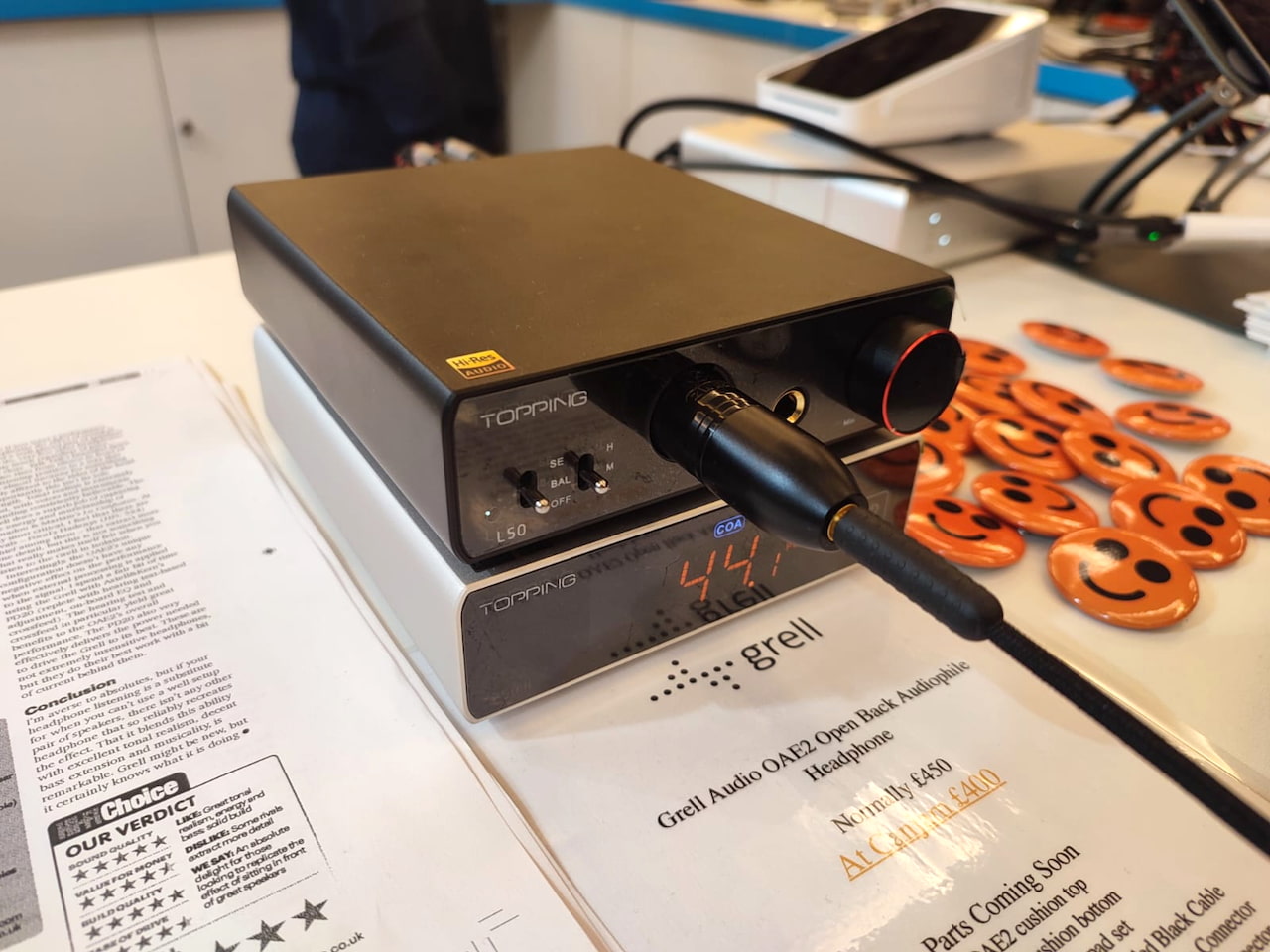
Best Budget DAC: Topping E50 II
At the Electromod booth was the Topping E50 II, the Chinese manufacturer’s revision of its well-regarded E50 DAC. Priced at $199 at Apos Audio and Amazon ( £199 or €199), depending on the market, I am astounded by how much functionality Topping has squeezed into such a small and affordable unit.
The E50 II uses AKM’s AK4497S DAC chip alongside an XMOS XU316 USB interface, with support for PCM playback up to 32-bit/768kHz and native DSD512. Inputs include USB-C, coaxial, optical and Bluetooth, with LDAC, aptX HD and aptX Adaptive support. It also offers RCA and balanced 6.35 mm TRS outputs, which can operate simultaneously, and can be used as either a fixed-output DAC or a digital preamplifier.
The star of the show is its parametric EQ, which can be configured through the Topping Home app and stored on the unit for offline use. That is a considerable amount of flexibility for a $199 DAC, particularly for listeners who want to correct a headphone’s tonal balance or make smaller adjustments to suit their system and personal preferences.
In terms of listening, the E50 II has a no-nonsense, neutral sound signature, but with just enough musicality to prevent it from sounding flat, sterile or boring. It does not attempt to impose much of its own personality, which is exactly what many listeners will want from an affordable desktop DAC.
Advertisement
For $199, what’s not to like?
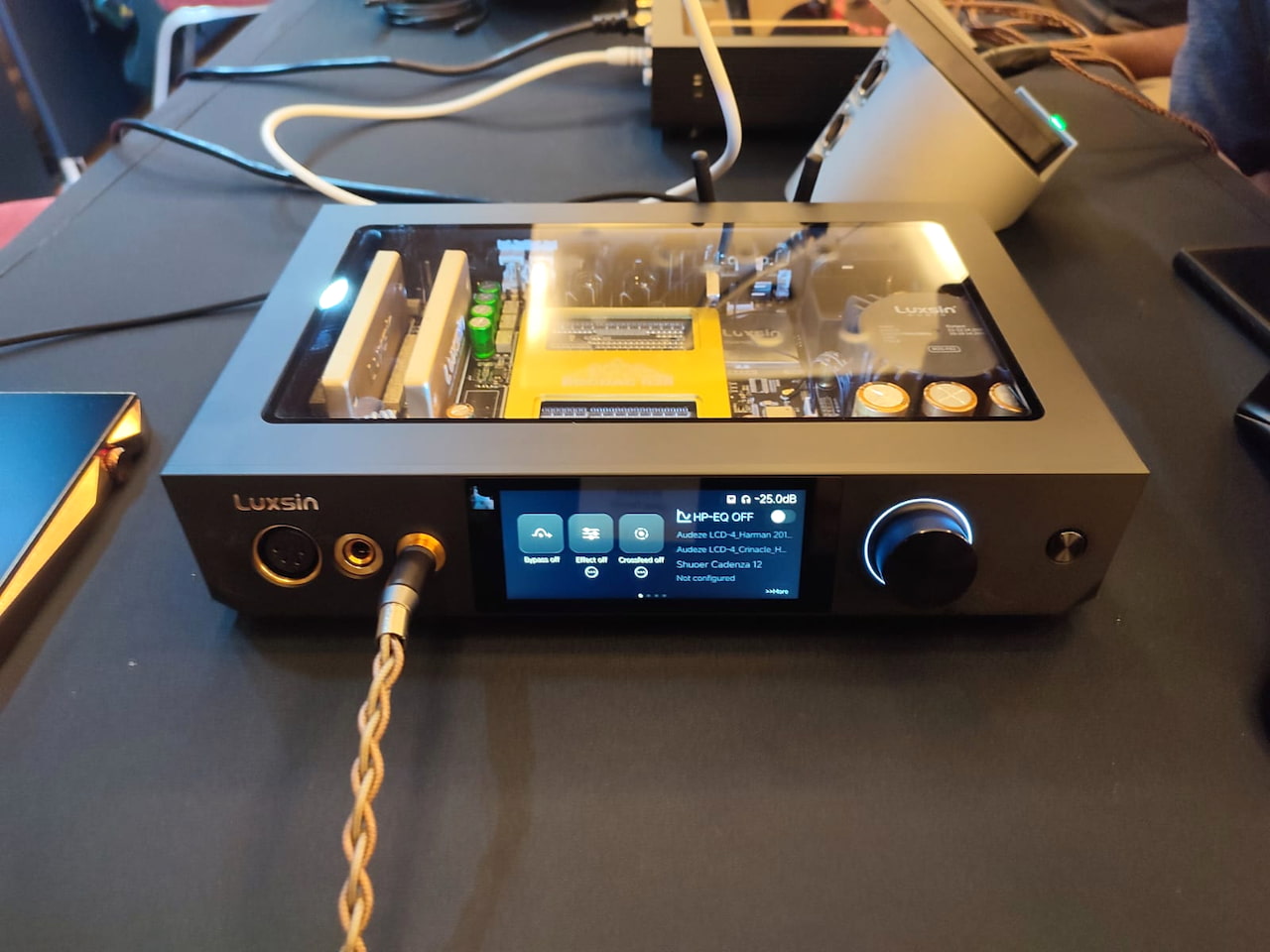
Best Midrange DAC/Amp: Luxsin B9
This was one product I was not expecting to see in London. For all intents and purposes, the Luxsin B9 is an R2R interpretation of the X9, although this was my first experience with any of the company’s products.
The engineering sample combines Luxsin’s proprietary discrete R2R DAC architecture with a headphone amplifier and preamplifier in a single desktop unit. Luxsin has not published the complete production specifications yet, but the B9 is expected to deliver up to six watts of headphone output power and cost around $1,500 when it is released.
The prototype also included some genuinely clever features. Luxsin’s HP-EQ system lets you select a correction profile for your headphones, adjust it to suit your own preferences and save the results. There is also a hearing compensation function that tests the sensitivity of each ear across different frequencies before creating separate correction curves for the left and right channels.
Advertisement. Scroll to continue reading.
Advertisement
I was not able to test either feature properly at the show, but the concept is far more useful than adding another digital filter that most owners will try once and never touch again.
The B9 is also beautifully designed, with sharply angled casework and a bright, vibrant touchscreen that makes most competing desktop DACs look rather ordinary. More importantly, its R2R presentation was exciting and expressive without becoming aggressive or fatiguing. It made a considerable impression on me during a relatively brief listen.
For a product I was not expecting to see, the Luxsin B9 became one of the more memorable electronics demonstrations of the weekend.
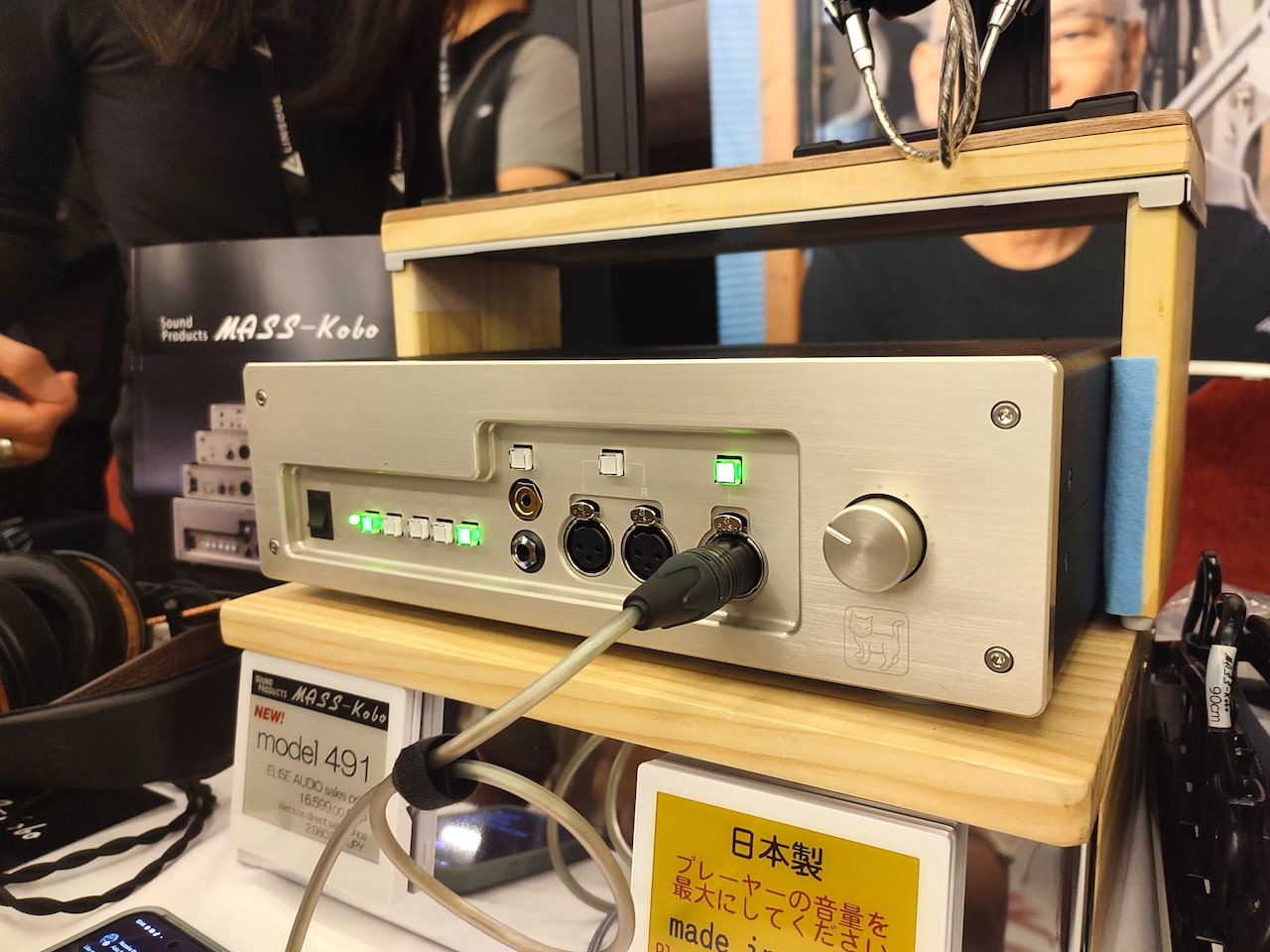
Best High-end Amp: MASS-Kobo Model 491
And finally, we come to MASS-Kobo, a Japanese audio brand whose amplifiers are hand-built and assembled to order in Shizuoka under the direction of Masuda-san. I was glad to spend a few minutes brushing up on my Japanese with him and the rest of the team at their booth.
The Model 491 ($20,000 USD) is the successor to the flagship Model 465 ($19,000 USD) and looks very similar at first glance, with the most obvious external change being the addition of a 4.4 mm balanced headphone output. It sits alongside four-pin XLR, separate three-pin XLR outputs for the left and right channels, and a 6.35 mm single-ended connection.
Advertisement
Inside, the 491 uses a twin-balanced monoblock design with four amplifier stages, two for each channel, and fully independent left and right power supplies. It delivers at least 3.5 watts per channel into 32 ohms through its balanced outputs, which should be enough for even the most stubborn planar magnetic headphones.
Being the flagship amplifier from a boutique high-end brand, it costs a barely believable £16,599 through Elise Audio. Most of that money is going into the circuit design, component selection and the highly trained ears of Mr. Masuda, rather than a touchscreen, app support or an unnecessarily complicated menu system. The amplifier itself is sturdily built, but it does not offer much in the way of bells and whistles.
And my goodness, does the 491 sound stunning.
I tend to prefer more neutral-sounding equipment, and the latest MASS-Kobo certainly falls into that category. However, it walks the line between analytical precision and musicality more successfully than almost any headphone amplifier I have heard. Sounds appeared to drift in and out of thin air, as though there were nothing standing between the music and my ears.
Advertisement
It came remarkably close to creating the impression of listening to a live performance rather than a pair of headphones. I arrived with very high expectations, yet the Model 491 managed to exceed them anyway.
The Bottom Line
CanJam London 2026 made one thing very clear: personal audio has never offered more choice. From sub-$100 offline DAPs and $200 DACs to £16,599 hand-built amplifiers, the show covered almost every conceivable use case and price point.
I could not hear everything, but the products above were the ones that made me stop, listen and return for another track. Roll on CanJam London 2027.
Recording artist, DJ and entrepreneur Diplo invested in Copper. Photo via BusinessWire
Seattle’s Copper has landed a high-profile new backer as it looks to accelerate growth of its consumer rewards platform, announcing Tuesday that Grammy-winning artist, DJ and entrepreneur Diplo has invested in the company.
Financial terms of the investment were not disclosed.
“I’m always looking for things that actually make sense for people,” Diplo said in a statement. “Copper’s one of those — you’re already on your phone, you’re already spending money, and this gives something back. That’s real.”
Copper says more than 4 million members use its platform to earn money through mobile games, cash-back offers and purchases.
Copper CEO Eddie Behringer, who previously co-founded Snap! Raise, said the company is building an alternative to consumer apps that monetize users’ attention.
Advertisement
“Most consumer apps are designed to take more from the user — more time, more money, more attention,” Behringer said in a LinkedIn post. “At Copper, we’re building the opposite.”
Founded in 2019, Copper originally launched as a banking app for teenagers. GeekWire covered the startup in 2022 after it raised $29 million in funding to expand into investing products, at a time when the company had nearly 1 million users.
The startup has since evolved into a broader consumer rewards platform. Copper has raised $42 million to date and recently ranked No. 2 among the Pacific Northwest’s fastest-growing companies in Deloitte’s Technology Fast 500 rankings, based on three-year revenue growth.
Diplo, whose real name is Thomas Wesley Pentz, has built a business portfolio that extends beyond music, investing in technology and consumer startups while launching ventures such as Diplo’s Run Club, a series of 5K races paired with music festivals.
Advertisement
He’s a three-time Grammy winner, and has collaborated with artists like Labrinth and Sia as part of the musical group LSD and worked with musician Mark Ronson on Silk City. He’s also the founder of record label Mad Decent.
In 2024, Copper discontinued its banking services following the collapse of fintech infrastructure provider Synapse, forcing the startup to pivot away from its original business. “Despite our prior planning, this event has forced us to close banking accounts much sooner than anticipated,” Behringer wrote at the time.
The company has since rebuilt around its rewards platform, which it says now serves millions of users.
Behringer said that the company’s mission was always about helping families improve their financial lives.
Advertisement
“As household costs rose, we saw an even bigger opportunity to help the person making everyday spending decisions earn more from the things they were already doing—from buying groceries to shopping in-store and spending time on their phone,” Behringer tells GeekWire via email. “Diplo’s investment is meaningful validation of how far that evolution has come.”
The company has partnered with Pangram for the new tools.
Substack
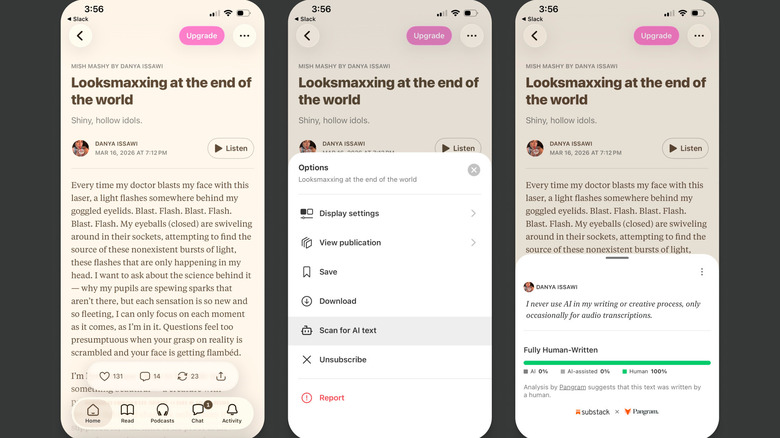
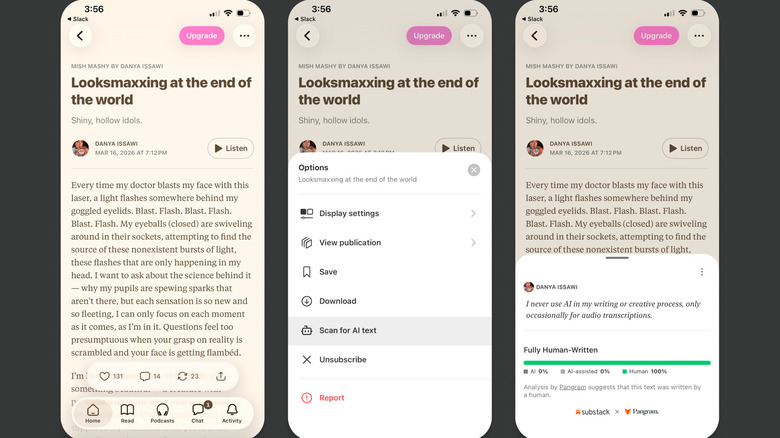
Substack has launched a new AI detection tool in partnership with Pangram. This will allow readers to scan Substack content for an assessment of how much of the material was written by AI. The tool can be used on text longer than 100 words that was published beginning today. Substack is also adding a new statement space for creators to explicitly share if and how they used AI for their content. The AI detection capabilities are available starting today on web and iOS, with Android support to come.
The blog post announcing the feature is surprisingly spicy. There’s a dig at LinkedIn about the presence of AI-generated content on that service and it dubs attempting to create feigned human connection with AI slop “Claudefishing.” Throwing shade is a risky maneuver here, because even the best tools for identifying gen-AI can’t guarantee a correct assessment. The Atlantic dug deeper into just how accurate AI detection tools, Pangram in particular, can be. Spoiler: they’re far from perfect.
Substack did acknowledge in the post that there are limits to what Pangram can detect and hinted at some other features it is considering around AI content and preferences. It emphasized that these new measures are aimed at setting expectations for readers, summing up its stance as “people should know what they’re getting.”
Google released three new AI models on Tuesday, all built on Gemini 3.5 Flash. The new models are more token-efficient, faster and more reliable across the board. The tech giant also provided an update on the much-anticipated Gemini 3.5 Pro and what’s to come after.
A new AI model from the likes of Google, Anthropic or OpenAI is released seemingly every week, with the latest, ChatGPT-5.6, released earlier this month. Google’s latest releases aren’t flagship models compared to what’s on the horizon, but each has its place, including a new model solely focused on cybersecurity.
Here’s what’s new in the latest Gemini models from today’s announcement.
Gemini 3.6 Flash
Google called 3.6 Flash its “workhorse” model that’s now better at coding, knowledge work and multimodal performance. It also promises reduced token usage by up to 17%, and at a lower cost per token versus its predecessor, 3.5.
Google says it built the model based on both developer and customer feedback. A series of benchmarks shows 3.6 Flash’s gains in performance and average tokens per task compared to its predecessor.
Advertisement
Gemini 3.5 Flash-Lite
Google’s fastest and most cost-effective model can deliver 350 output tokens per second and “significantly” outperforms previous generations when it comes to agentic workflows, according to the blog post.
Like 3.6 Flash, this model now supports computer use as a built-in tool to take on more agentic tasks.
Gemini 3.5 Flash Cyber
3.5 Flash Cyber is a specialty model that prioritizes cybersecurity workflows in order to find and fix vulnerabilities. It works alongside an infrastructure agent called CodeMender to help cybersecurity teams quickly identify and patch issues.
According to a separate article from Google DeepMind, the new model is already finding and fixing bugs in Google’s internal codebases in Android, Chrome and YouTube. This model will initially be limited to governments and trusted partners, but access will expand in the future.
Advertisement
Gemini 3.5 Pro is still on the way
While the three latest models are the primary focus for Tuesday’s announcements, Google gave a brief update to its upcoming flagship AI model, Gemini 3.5 Pro. The model is said to currently be in testing with partners, and it plans to make it available as soon as it’s ready. How long that will take is anyone’s guess, but Google’s also already looking ahead to the next generation of AI, too.
Google says it has already begun pretraining for Gemini 4, which will be released at an undetermined date.
Both Gemini 3.6 Flash and 3.5 Flash-Lite are available starting today for developers in the Gemini API via Google AI Studio and Android Studio and the Gemini app. 3.6 Flash is also available in Google Antigravity, and 3.5 Flash-Lite is rolling out to Google Search.
Blake has over a decade of experience writing for the web, with a focus on mobile phones, where he covered the smartphone boom of the 2010s and the broader tech scene. When he’s not in front of a keyboard, you’ll most likely find him playing video games or watching horror movies.
See full bio
Disclaimer: Unless otherwise stated, any opinions expressed below belong solely to the author.
Given the number of various support schemes provided by the government in Singapore, one might question whether there aren’t too many of them and if it wouldn’t be simpler to simply disburse one cash payment to every eligible person.
After all, it’s not like the government isn’t doing that already, depositing funds directly for GST Vouchers, Assurance Package payments and cost-of-living support, regularly appearing in recent years.
So why bother with CDC Vouchers, which require an entire digital infrastructure to allow their issuance and redemption? Wouldn’t a simple bank transfer be better?
Advertisement
Cash is not king
At least not for everybody, and certainly not for the government, which is using its power to direct the money to specific parts of the economy.
Cash is liquid, and you can do whatever you want with it, including going for a nice day trip to JB to spend it there instead of Singapore. You may also use it for online shopping on one of the many ecommerce platforms, with most of the funds being sent to sellers in China or other countries.
This sees Singapore dollars exiting the domestic economy, benefiting others instead.
More prudent Singaporeans could opt to save it instead, which isn’t terrible in itself, but does keep the funds out of circulation.
Advertisement
Finally, the more reckless consumers could simply waste it on more “sinful” pleasures, still ending up short of money for daily necessities.
The voucher format allows the government to set strict rules on their use: with 50% allocated to shopping in supermarkets and another half to hawkers and smaller, heartland merchants.
This ensures that this pool of money is spent in the most beneficial way and provides the authorities with data on how the money is spent and where.
There is, however, one other purpose they have served very well since their launch six years ago, which is not spoken of.
Advertisement
Going digital—and staying there
CDC Vouchers originated as a COVID-19-era relief scheme, originally issued on paper and directed to the poorest households.
With the pandemic dragging on throughout 2021, the scheme was ultimately expanded to all citizen households by the end of the year and went digital with the launch of the RedeemSG app. Merchants could use it to accept the vouchers by scanning digital QR codes on customers’ phones, instead of dealing with paper.
In parallel, the government launched the Hawkers Go Digital scheme in Jun 2020, with generous subsidies and transaction fee waivers, which were meant to help hawkers adopt digital payments and reduce the risk of spreading the virus.
It was also a good opportunity to prod them to adopt mobile payments, which have become a staple in many countries around the world (most notably China, through its giant superapp WeChat).
Advertisement
The final waiver of the 0.5% fees ended just recently on Jun 30, 2026, after several past extensions. This means that hawkers are now going to have to bear the cost themselves, which might mean that some of them may prefer to return to cash-only payments.
But this is where the CDC scheme comes in.
Throughout the push for digital payments, the critics lamented that many elderly sellers might be struggling with the transition, not being very tech-savvy. What’s more, a skill once developed needs to be kept in use before it falls out of favour. Old habits die hard, after all.
Well, while we might see some return to cash, there is no returning to paper for CDC vouchers.
Advertisement
And because of the scale of the program, currently exceeding S$1 billion annually, hawkers have a strong incentive to keep their RedeemSG app to accept voucher QR codes.
In other words: there’s no exit from the QR era.
Of course, using the CDC app doesn’t force merchants to accept all digital payments, but since they still have to deal with QR codes to accept the vouchers, it provides very useful stickiness, which is going to keep most of them on the digital train.
Read other articles we’ve written on Singaporean businesses here.
Nvidia is hyping up its new Vera Rubin chip system this week, revealing new performance benchmarks for the GPU and CPU combo ahead of rival AMD’s annual product event in San Francisco on Thursday.
During a lengthy technical workshop last week at the company’s headquarters in Santa Clara, California, Nvidia executives boasted to a small group of journalists about the chip system’s increased power and efficiency capabilities. The biggest takeaway: Nvidia, which has long specialized in making GPUs, is increasingly trying to position itself as a supplier of CPUs that can power AI agents.
While GPUs are still the main hardware that companies use to train and run their AI models, the industry’s shift toward more complex, agentic systems has increased demand for CPUs, which can orchestrate data flows, networking, and other software tasks. That’s likely one reason Nvidia has been eager to promote itself as a supplier of complete AI systems rather than just AI chips.
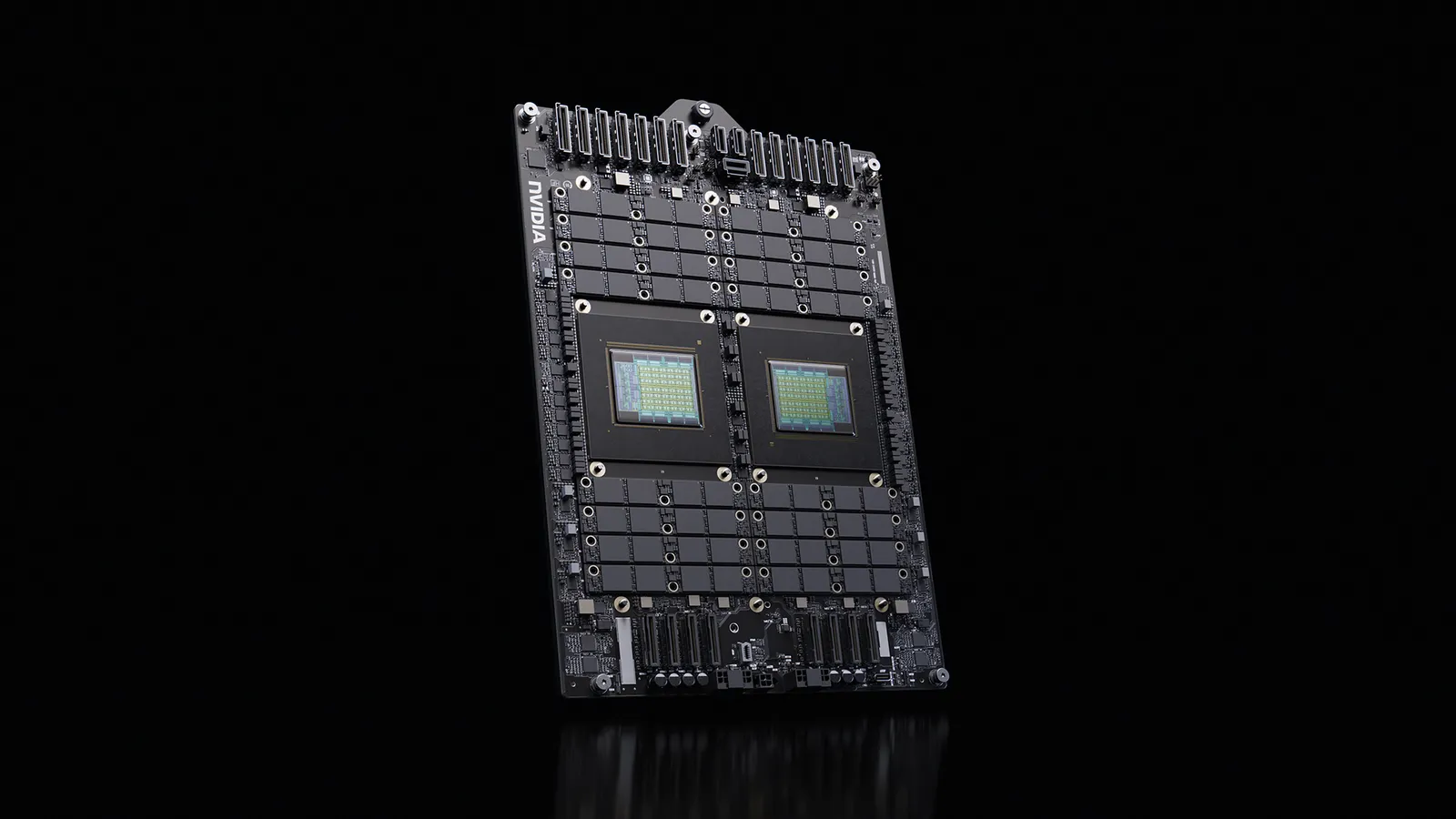
Vera Rubin is Nvidia’s successor to its hybrid superchip system Grace Blackwell and represents the linchpin of its near-term future powering the AI industry. It’s designed to offer one CPU for every two GPUs. In a single Vera Rubin NVL 72 super chip system, there are 36 Vera CPUs for every 72 Rubin GPUs. Nvidia is also selling the Vera CPU as a stand-alone product, and it has reportedly told Chinese customers these could be ready as soon as August.
Advertisement
The CPU chip Nvidia is using for its new Vera Rubin hardware system.
Courtesy of Nvidia
Nvidia executives emphasized that its new Vera Rubin NVL72 racks—a stack of chips packed into a single liquid-cooled platform—are much more “plug-and-play” than some of its earlier products. During a brief tour of a Nvidia data center lab in Silicon Valley, Nvidia executives shared that OpenAI already has one Vera Rubin rack in use.
Nvidia CEO Jensen Huang didn’t make an appearance at the workshop in Santa Clara last week; he was in Japan announcing the chipmaker’s new partnerships with a number of Japanese firms to develop AI for robotics. The briefings were instead led by Ian Buck, Nvidia’s longtime vice president of accelerated computing and the architect behind the company’s CUDA software.
“We’re on a road map to crank out new architectures, not just GPUs but CPUs,” Buck told reporters. “We’re going to keep innovating, because it’s do this or die in Silicon Valley.”
Advertisement
The meetings were held in Huang’s executive briefing center, where multiple desks nearby were piled with bags of Taiwanese snacks that the CEO brought back from his recent trip to Computex, a massive annual semiconductor trade show in Taipei, an Nvidia spokesperson told WIRED.
If you’re a fan of the Ford F-Series pickup trucks, then you’re likely familiar with their technology and design. For example, you may know about the automaker’s legendary Twin I-Beam front suspension. But you might not know that Ford chose to move away from this design on the F-150, not because it was flawed, but because trucks evolved to more modern solutions.
The Twin I-Beam initially gave Ford a way to improve ride comfort while also maintaining the rugged performance that truck buyers were accustomed to. But as pickups began to shift from being used primarily as utility vehicles to everyday drivers, customer expectations began to change. Ford redesigned the F-150, focusing more on precise handling, improved steering, and better control over the truck’s front end. Newer designs like dual A-arm suspension addressed those concerns, leading Ford to move the redesigned 1997 F-150 to a different front suspension design.
Even as the F-150 transitioned from the Twin I-Beam, the design remained one of Ford’s most well-known truck innovations and continues on the F-250 and F-350 trucks to this day. In fact, the Twin I-Beam setup was exclusive to Ford when it was introduced in 1965 and became closely associated with their most popular pickups. Vehicle axles are more complicated than you might think and as other companies used different suspensions for their trucks, Ford’s approach was more forward-thinking. It gave drivers a vehicle with independent front-wheel movement, while also maintaining durable performance.
Advertisement
The evolution of Ford truck suspension
Jetcityimage/Getty Images
As Ford was developing its innovative Twin I-Beam concept, the automaker introduced the Twin Traction Beam in 1980. This suspension was designed for four-wheel-drive trucks like the F-150 and Bronco, using the independent movement of Twin I-Beam while adding components for a driven front axle. Twin Traction helped reduce weight, improve ride quality, and lower the truck’s overall height. This design helped Ford modernize its 4WD lineup at the time of its production.
In the years since the development of the Twin I-Beam, Ford’s approach to truck suspension has continued to evolve. Instead of using a single design for every truck in the automaker’s lineup, the F-150 now features different suspension setups depending on its intended purpose. For example, the standard F-150 has a Hotchkiss-style suspension, with a solid rear axle and leaf springs for both towing and payload. In contrast, the F-150 Raptor features a five-link rear suspension with coil springs, and the all-electric F-150 Lightning uses a fully independent rear suspension.
Advertisement
This design evolution extends beyond the F-Series as well, with the 2025 Expedition getting a redesigned suspension influenced by the F-150. The Expedition may be one of Ford’s dinosaurs, but its new setup does include modified shocks, springs, and other components. These improvements function to match the Expedition’s combination of passenger comfort, towing capability, and off-road performance. This gives drivers the handling and towing ability they expect from a Ford vehicle.
Fall only took up the job three months ago in April 2026
The departure is likely to once again shake up the administration’s AI strategy
The head of the Trump administration’s Center for AI Standards and Innovation (CAISI) has resigned from his role, Axios has reported.
Chris Fall served in the role for just three months following his appointment in April 2026, and no reason has so far been given for his departure from the agency.
Arvind Raman, the current head of the Commerce Department office that oversees the AI testing institute is set to temporarily take up the mantle as head of CAISI until a permanent alternative is found.
Latest Videos From
Another Trump admin departure
Fall’s departure is just one in a string of Trump administration departures so far in 2026. Before resigning, Fall was responsible for working closely with leading US AI labs such as Anthropic, Google‘s DeepMind, OpenAI, Microsoft and Elon Musk’s xAI to test their frontier and unreleased models for vulnerabilities to prevent them from being maliciously abused.
Advertisement
Trump has placed a big focus on developing AI, with the technology now a key part of both the US economy and its security, with AI models being deployed across federal agencies, police, and the armed forces.
Despite interventions by the US, China has been rapidly closing the gap between its own models and those of US companies. Many Chinese models are cheaper than their US alternatives, making them attractive to US companies feeling the token-cost of US models.
The resignation will likely once again shake up the Trump administration’s AI strategy. The administration has taken a very hands on approach to AI technologies, requiring contractors to provide unrestricted access to their systems and allow the use of their technologies for any lawful purpose. When Anthropic rejected these demands, the company was designated a supply chain risk.
Advertisement
Sign up to the TechRadar Pro newsletter to get all the top news, opinion, features and guidance your business needs to succeed!
Trump has also called on AI companies to provide stakes in their companies in what Trump has said will “create almost a partnership with the American public”. Trump hasn’t revealed exactly how this partnership would benefit the American public.
Physical media collectors have three very different 4K restorations to keep on their radar: Michael Mann’s Manhunter, Hammer’s Dracula, and Criterion’s upcoming 4K edition of 12 Angry Men.
This is a weird trio, which is exactly why it works for me.
Manhunter is Michael Mann before everyone decided they had discovered Michael Mann. It is cold, controlled, stylish as hell, and still one of the most unsettling serial-killer films of the 1980s. It needs 4K because the color, lighting, architecture, and dead-eyed calm are the movie.
Dracula is Hammer at full strength: Christopher Lee, Peter Cushing, blood, capes, religious dread, and enough Gothic atmosphere to make modern horror look like it was assembled in a conference room. If the restored footage and color work are handled properly, this could be the Hammer release fans have been waiting for.
Advertisement
12 Angry Men is the outlier, but only on the surface. No monsters. No synth score. No blood. Just Henry Fonda, twelve men in a room, and a film that gets tighter and more suffocating by the minute. That is exactly the kind of black-and-white classic that can benefit from a serious 4K restoration because every face, bead of sweat, cigarette, shirt collar, and hard stare is what made this film interesting in the first place.
The important caveat: only 12 Angry Men currently has a fully confirmed 4K UHD release date, price, disc configuration, HDR format, audio format, and supplement list. Manhunter and Dracula are confirmed new 4K restorations with theatrical and home entertainment plans, but final 4K UHD disc specifications and pricing have not been fully announced yet.
Related Reviews:
Mann’s Neon Nightmare Needs the Right 4K Treatment
Michael Mann’s Manhunter is returning as Manhunter: The Final Cut, with StudioCanal celebrating the film’s 40th anniversary through a new 4K restoration. The film opens in select U.S. theaters through Rialto Pictures on July 24, 2026, followed by a StudioCanal UK theatrical release on September 25, 2026, with further international releases planned for the fall. 4K Blu-ray and Blu-ray release details are expected later this year.
Advertisement
That means buyers should not treat this as a finalized UHD preorder yet. There is no confirmed U.S. 4K disc price, HDR format, audio format, region coding, packaging, or supplement list at this stage.
What we do know is enough to make this one worth watching. Manhunter was shot by Dante Spinotti and remains one of Mann’s most visually controlled films. Its cold architecture, blues, greens, whites, glass surfaces, and nightmarish calm are central to the experience. A strong 4K restoration should preserve the film’s hard visual edge without scrubbing away the texture.
The cast also makes it more than a Mann completist title. William Petersen, Joan Allen, Dennis Farina, Tom Noonan, and Brian Cox give the film its unnerving edge. Cox’s Hannibal Lecktor, spelled that way in Manhunter rather than Thomas Harris’s original “Lecter,” is not the grand theatrical monster Anthony Hopkins later created. Hopkins is the more iconic nightmare. Cox is colder, quieter, and more clinical, which makes his version unsettling in a very different way.
Hammer’s Full Restoration Is the Collector Hook
Advertisement
Hammer’s Dracula from 1958, released in the U.S. as Horror of Dracula, is also receiving a major 4K restoration. Hammer has confirmed that Peter Cushing and Christopher Lee will return in 4K, with the film coming back to cinemas and making its worldwide home entertainment debut in 4K.
Advertisement. Scroll to continue reading.
This is not just another catalog cleanup. Hammer says the new restoration uses film materials supplied by Warner Bros. and restores the full version of the film as director Terence Fisher intended it before censorship cuts. Hammer also says the release will include the newly restored full-length version alongside the UK theatrical version and the U.S. Horror of Dracula version.
That is the real hook for collectors. Dracula has existed in several versions, and earlier releases have had to deal with incomplete or compromised Japanese elements. Hammer says Warner’s archive uncovered pristine reels of the Japanese version, allowing the restored material to be reintegrated properly.
Advertisement
A combo pack release of the 4K restoration is scheduled to arrive later this year, with theatrical screenings planned for early October in association with Warner Bros.
Pricing has not been confirmed. Final disc specs, HDR format, audio format, region coding, and complete extras have not been announced. Hammer has said this will be part of its Limited Collector’s Edition range, so expect collector packaging and supplements, but do not treat any price as final until Hammer posts the actual preorder.
Why should buyers care? Because Hammer horror lives or dies by color, contrast, and atmosphere. Jack Asher’s cinematography, the blood, the costumes, the candlelit interiors, and Lee’s physical menace all need careful handling. Bad compression and weak grading make Hammer look cheap.
Criterion Sends 12 Angry Men Back to the Jury Room in 4K
Criterion’s 12 Angry Men is the safest confirmed buy of the three because the details are already listed.
The 4K UHD plus Blu-ray special edition arrives September 8, 2026 for $49.95, along with standard Blu-ray at $39.95, and DVD version at $29.95.
The 4K edition includes a new 4K digital restoration, Dolby Vision HDR, and an uncompressed monaural soundtrack. The package includes one 4K UHD disc with the film and one Blu-ray with the film and special features.
Criterion also lists the 1954 television version directed by Franklin J. Schaffner for Studio One, archival Sidney Lumet interviews, production history material, interviews related to Reginald Rose and Boris Kaufman, Lumet and Rose’s 1956 teleplay Tragedy in a Temporary Town, the trailer, English SDH subtitles, and an essay by Thane Rosenbaum.
Technically, this is not a spectacle disc. It is black and white, 1.66:1, mono, and 96 minutes long. A good 4K restoration should improve texture, facial detail, sweat, cigarette smoke, white-shirt contrast, window light, and the claustrophobic feel of the jury room. If the transfer is done right, the walls should feel like they are moving inward.
Apple says it fixed a vulnerability that could expose real addresses behind Hide My Email on or around July 3, but we reproduced the flaw two weeks after the company’s claimed repair date.
The company told 404 Media that it deployed a patch on July 3, 2026, and fully resolved the vulnerability. AppleInsider successfully reproduced the behavior on July 17.
Our test found that a sender who possessed a specific Hide My Email alias could reveal the real address behind it with much technical knowledge.
We’ve reached out to Apple about the matter. We will update when we hear back from the company on the matter.
Advertisement
Apple spent roughly a year responding to the flaw
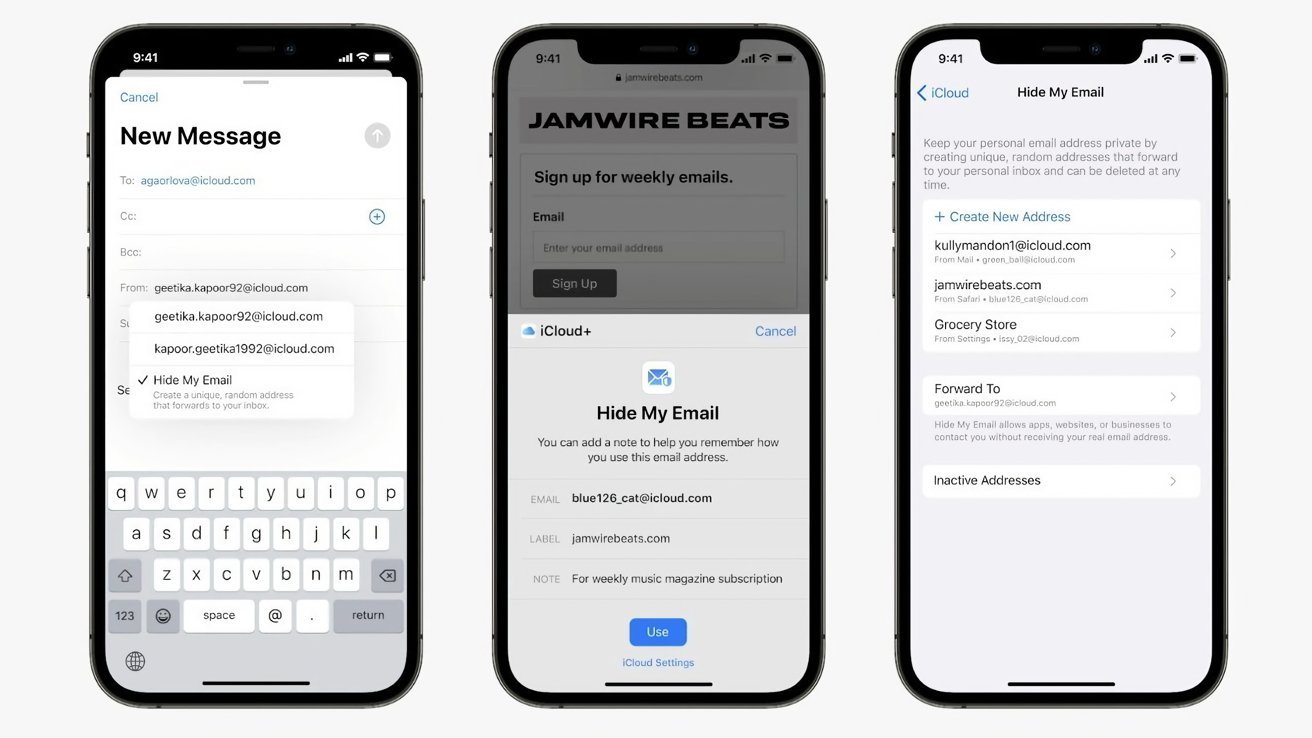
The vulnerability affected iCloud Hide My Email, which creates aliases that forward messages to a user’s real inbox. Users can provide a different alias to each website or service instead of sharing a permanent email address.
EasyOptOuts co-founder Tyler Murphy began reporting Hide My Email vulnerabilities to Apple in mid-2025. 404 Media says Murphy first alerted Apple in June 2025, while EasyOptOuts’ published timeline lists a related report on July 9.
Murphy and EasyOptOuts co-founder Ben Weiner exchanged reports and test results with Apple for roughly a year. EasyOptOuts says Apple declared the vulnerabilities fixed on March 3 and June 30, but the researchers reproduced the problems after both claims.
Murphy later contacted 404 Media, which reported the flaw on July 1 without publishing instructions that could help others exploit it.
Advertisement
Apple told 404 Media that a patch deployed on July 3 fully resolved the vulnerability. The company hasn’t said whether July 3 marked the start or completion of the deployment, but we expect it is the former.
AppleInsider reproduced the flaw on July 17
AppleInsidertested the flaw on July 17 and confirmed that the process could reveal the real address behind a Hide My Email alias.
The process required little technical knowledge once the sender possessed a specific alias, though each address had to be targeted individually. We withheld the instructions because publishing them while the vulnerability remained reproducible would have created unnecessary risk.
The test doesn’t prove the vulnerability remained active for every user or mail provider. It does show that July 3 can’t be treated as a definitive endpoint without further explanation from Apple.
Advertisement
Apple hasn’t explained whether the patch was deployed in stages, when the rollout finished or why the July 17 test succeeded. Without those details, the company’s claim of a complete July 3 resolution remains difficult to reconcile with independent testing.
The vulnerability was real, but its practical risk was limited
The flaw undermined the core promise of Hide My Email. A sender who possessed an alias could potentially discover the permanent address that the service was supposed to conceal.
EasyOptOuts said every address in its limited volunteer tests was vulnerable. Murphy and Weiner also said the vulnerability had been fixed, but warned that the privacy risk may continue after the patch.
Hide My Email on an iPhone
Murphy and Weiner told 404 Media that rejected messages may have exposed real addresses still retained in third-party logs. EasyOptOuts recommends treating addresses linked to aliases created before July 7 as potentially exposed.
EasyOptOuts’ warning doesn’t mean every Hide My Email user was affected. A sender first needed a specific alias, which limited the number of accounts that person could target, and there’s no public evidence of a coordinated exploitation campaign.
Advertisement
The vulnerability didn’t expose passwords, unlock Apple Accounts or grant access to inboxes. The demonstrated consequence was the loss of an alias’s privacy protection, which could allow a permanent address to be connected with leaked or publicly available information.
A proposed class action filed after the disclosure seeks repayment of subscription fees and other relief. The complaint doesn’t allege that the named plaintiff’s address was exposed or that anyone exploited the vulnerability against him.
Apple still needs to explain the conflicting dates
The available evidence supports calling the flaw a genuine privacy failure. It doesn’t show widespread exploitation or measurable harm to subscribers.
Apple says the vulnerability has been eliminated, and Murphy and Weiner also say the bug has been fixed. We can’t reproduce it today, after our July 17 testing.
Advertisement
The available evidence doesn’t show that users need to disable Hide My Email entirely. Users should nevertheless treat real addresses attached to older aliases as potentially disclosed and understand that deleting an alias won’t erase information already retained in another provider’s logs.
Earlier this year “Border Czar” Tom Homan, with an apparently straight face, told the media that if Democrats didn’t stop calling ICE murderers for the murders they committed, then they would have no choice but to murder more people. A few weeks later, when ICE did murder another person, he doubled down and blamed people for calling ICE murderers for the additional murder. So it’s little surprise that he’s at it again. He’s taking the fact that ICE has been on something of a killing spree over the last few weeks as… vindication for the batshit crazy statement he made earlier about how calling ICE murderers makes them only more likely to murder.
Homan: “I said this a year ago — if they hateful rhetoric doesn’t stop there will be bloodshed. And unfortunately I was right. And I’ll tell you something else — it’s not over yet … I’m afraid we’re gonna bury an ICE agent.”
This is classic psychopathic abuser language. “Baby look what you made me do.”
It should never be coming out of the mouth of a government official. It’s horrifying and disqualifying. No, calling ICE murderers for the murders they committed should have zero impact on future murders, and if (accurately) calling ICE murderers leads them to murder more people, then what the fuck are we doing here? Shut down ICE. Fire everyone associated with them, including Tom Homan.
Advertisement
Of course, Homan wasn’t just blaming people for calling murderers murderers. He also wanted to blame the people they murdered for not “complying.”
Homan on people getting killed by ICE: “It comes down to one simple fact — these people failed to comply with law enforcement … all they had to do is comply. If they did, they’d be alive today.”
Once again, saying shit like that should lead to an immediate firing and possibly an investigation. First of all, it’s clear from the videos released after some of the recent ICE shootings that it had nothing to do with people not complying, and appeared to be almost entirely about raging ICE agents who had no interest in de-escalating situations and seemed to be looking to cause harm.
But, more to the point, not complying with a law enforcement demand (especially a ridiculous one) should not result in your execution.
Advertisement
Tom Homan has been credibly accused of accepting $50,000 in a fast food bag to try to curry favor with President Trump. Does Tom Homan think it would have been okay for law enforcement to shoot Tom Homan dead in a Cava restaurant, claiming that he was clearly violating the law in accepting a bribe? Or does he only accept due process when it comes to himself and his friends?
And just as bad, Tom Homan, like so many MAGA leaders, absolutely positively refuses to take any responsibility at all for his own mistakes. First he claims that the mess in Minnesota he inherited didn’t involve any mistakes at all.
Of course it’s funny because in that clip he suggests that he was the one who refused to buy ICE body cams because of the government shutdown (which is a lie; ICE received a ton of money in the earlier budget bill, and Homan knows this. ICE can afford body cameras). But then a couple minutes later, when a reporter asks about the now-revealed anger issues and mental health problems of one of the ICE murderers from last week, suddenly Homan deflects and says to talk to someone at ICE instead.
REPORTER: Oo the ICE officer in Maine — is there any more clarity on how he got his job considering the vetting concerns his wife raised? Are there potential changes coming in vetting?HOMAN: That’s a question for ICE
Dude. Weren’t you just talking about how you were in charge of properly outfitting ICE.
It’s truly astounding how this MAGA administration appears to be fundamentally allergic to ever taking responsibility for anything. This seems like an impossibly short-term strategy. Or simply the product of a government run by people who are in way, way over their heads, but too vain to admit it.












.jpg)













































You must be logged in to post a comment Login