Connect with us
DAPA Banner
DAPA Coin
DAPA
COIN PAYMENT ASSET
PRIVACY · BLOCKDAG · HOMOMORPHIC ENCRYPTION · RUST
ElGamal Encrypted MINE DAPA
🚫 GENESIS SOLD OUT
DAPAPAY COMING

Tech

The Four Elevations of Effective Fraud Prevention

Published

on

Fraud elevation header

Effective fraud prevention programs call for monitoring across every customer touchpoint from account creation to checkout, login to customer service interactions. Once established, this practice provides ground-level insights on user engagement on an interaction-by-interaction basis.

While this is a necessary layer of visibility, appropriate collation of various data sets provides the context for the identification of advanced fraud methods and early detection of emerging trends.

Below, we provide one fraud case with examples of relevant data visibility across 4 levels necessary for establishing a competitive fraud program in this constantly evolving world. 

Fraud levels

Transaction Level: The individual interactions of users monitored and decisioned in siloes. 

Advertisement

Commonly, a fraud program will begin with pressure from chargebacks inciting action for monitoring transaction performance at the checkout page.

Fraudsters are persistent. When one door closes, they move to the window, the garage, and so on; Payment fraud attacks shift into Account Takeovers, deposits into transfers, Account Takeovers upstream to identity theft / synthetic ID Fraud and Mule Accounts. 

The shift happens in seconds and impacts our organizations in many ways. 

In response, practitioners deploy checks at each touchpoint. This is effective for many isolated fraud incidents but can result in increased false positives and false negatives. 

Advertisement

Account Level: The performance of the account over time. 

Device Intelligence, spending behaviors, geolocation, behavioral biometrics, step-up verification interactions, all help to identify evidence of account-level exploits like Account Takeovers (ATOs). 

The benefit of tracking this level of performance becomes especially clear when contrasting fraudster behavior against the historical performance of the account. Fraudsters cannot duplicate what has been defined as ‘trusted’ behavior and still get what they are after. 

They will seek to change payment information, bypass automated verifications, satisfy verifications after what can be deemed “a suspicious number of attempts”, associate new addresses / geographies, and more. 

Advertisement

When monitored appropriately, fraudster behaviors emerge clearly and afford practitioners increased confidence and accuracy.  

Platform Level: The performance of grouped accounts on a single platform. 

By successfully tracking performance of both ‘trusted’ and ‘confirmed fraud’ account performance, practitioners leverage these deeper insights resulting in less friction for trusted interactions, increasing customer satisfaction, and decreasing false positive rates. 

Additionally, fraud rings and multi-account attacks are quickly identified based on geolocation, device intelligence, IP resolution, and more, decreasing the time that multi-account exploits are active on the platform. 

Advertisement

Build an effective fraud program that addresses threats at every elevation without sacrificing your budget or customer experience.

Sign up for a free trial today for 1,000 free credits!

Schedule A Demo

Network Level: Partnerships with providers in the space, delivering data enrichment and decisioning based on insight across their network.  

Until this point, we have spoken about the rich data available to practitioners operating in isolation. By partnering with a solution provider, your fraud program leverages the performance of all of the other practitioners.

Advertisement

“First seen to you is not first seen to us.” 

Example Fraud Case: A fraudster is adamant about attacking a particular platform with stored value. For this example, we’ll use a bank. The fraudster is armed with typical information; payment information, Identity Information, and system knowledge. The majority of fraudsters have this access and deploy new methods at a moment’s notice. 

For this exercise, we will use a common fraud method wherein the fraudster sees that the target identity banks with ‘Bank X’. The fraudster accesses the account to do 3 things; Transfer funds into the account from other compromised funding accounts, request a card for an ‘Authorized User’ (the fraudster), transfer funds to a 3rd compromised account off-platform.

Transaction Level: Logging into the account is performed by contacting customer service; historically underserved, heavily reliant on knowledge-based verifications (KBVs). The fraudster is equipped with bureau information and is prepared to satisfy the verification process. 

Advertisement

The fraudster resets access information and orders an authorized card for a new authorized user for the account. Too rarely does this process receive the appropriate level of scrutiny. 

The fraudster reviews the spending behaviors of the account and mimics the dollar amounts for transfers into the account and withdraws from the account. Following the historic behavior seen in the transaction summaries, the fraudster follows the same behaviors.

From the transaction level, the fraudster is flying under the radar and triggers siloed verifications that they are prepared to satisfy. The clock ticks until the real account holder contacts customer service and files a report. The problem that started with customer service is finally identified at customer service. 

From an Account Perspective, this fraudster has exhibited many suspicious behaviors: 

Advertisement
  1. Calling customer service from a new phone number 

  2. Updating contact information

  3. The time to ordering a secondary card

  4. The relationship to the authorized user and the account holder

  5. Advertisement
  6. The timeline of transfers and withdrawals 

  7. The device used to interact with the platform and initiate these suspicious actions 
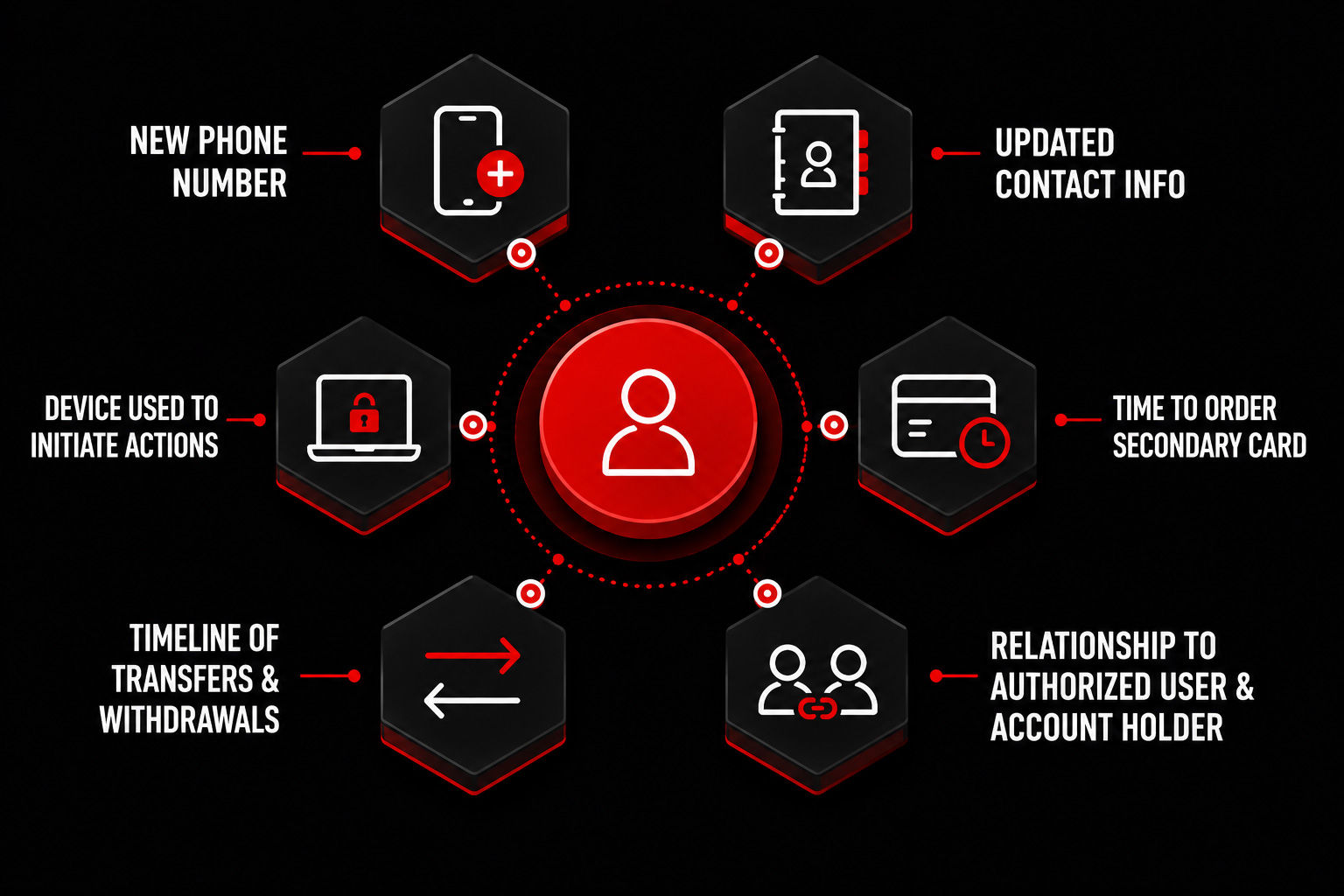
Suspicious characteristics

Any of these interactions can be monitored and tracked with associated verifications. Again, reinforcing the idea of accuracy is a key point, when viewing the storyline from this altitude, confidence should be high. 

From a Platform Perspective, it is unlikely that this storyline was the first of its kind. By tracking these events with automation, practitioners will identify the other occurrences and pick out regions, IPs, devices, and behaviors that transcend the performance of the single account. This, in turn, informs the decisioning downstream. 

This entire process takes a matter of hours to execute. As we know, fraudsters are not operating against one account at a time. It is likely that many other accounts are currently walking through this same scenario. Time to action is vital to avoid deep financial impact. 

Advertisement

Indicators include: 

  1. The shipping address for the “authorized card / user”. 

  2. Device Fingerprinting 

  3. Geolocation of the user 

  4. Advertisement
  5. Geolocation of the withdrawals 

  6. Dollar amounts (though crafty fraudsters follow the behaviors of the accounts, many will gradually increase amounts over time, which is a valuable indicator) 

  7. Funding institutions 

…..and more 

Looking at this from a Network Perspective empowers practitioners to automate against known suspicious data points such: 

Advertisement
  1. The phone number that call customer service, 

  2. The device used to interact with the platform 

  3. The shipping address used for the authorized card / user 

  4. The name of the authorized user 

….and more. 

Advertisement

By leveraging network information, practitioners are afforded the opportunity to leverage the insights provided by peers’ operations to make a decision in the moment and apply these findings downstream and across the entire platform. 

Schedule a consultation with one of IPQS Fraud Experts today!

Sponsored and written by IPQS.

Source link

Advertisement
Continue Reading
Click to comment

You must be logged in to post a comment Login

Leave a Reply

Tech

Today’s NYT Connections Hints, Answers for June 28 #1113

Published

on

Looking for the most recent Connections answers? Click here for today’s Connections hints, as well as our daily answers and hints for The New York Times Mini Crossword, Wordle, Connections: Sports Edition and Strands puzzles.


Today’s NYT Connections puzzle is a tough one, especially the purple category. Read on for clues and today’s Connections answers.

The Times has a Connections Bot, like the one for Wordle. Go there after you play to receive a numeric score and to have the program analyze your answers. Players who are registered with the Times Games section can now nerd out by following their progress, including the number of puzzles completed, win rate, number of times they nabbed a perfect score and their win streak.

Advertisement

Read more: Hints, Tips and Strategies to Help You Win at NYT Connections Every Time

Hints for today’s Connections groups

Here are four hints for the groupings in today’s Connections puzzle, ranked from the easiest yellow group to the tough (and sometimes bizarre) purple group.

Yellow group hint: Good stuff!

Advertisement

Green group hint: Now’s the time.

Blue group hint: Fender or Gibson.

Purple group hint: Think planks.

Answers for today’s Connections groups

Yellow group: High-quality.

Advertisement

Green group: Signals to commence.

Blue group: Accessories for a guitarist.

Purple group: They have boards.

Read more: Wordle Cheat Sheet: Here Are the Most Popular Letters Used in English Words

Advertisement

What are today’s Connections answers?

completed NYT Connections puzzle for June 28, 2026

The completed NYT Connections puzzle for June 28, 2026.

NYT/Screenshot by CNET

The yellow words in today’s Connections

The theme is high-quality. The four answers are choice, fine, prime and select.

The green words in today’s Connections

The theme is signals to commence. The four answers are begin, go, now and start.

Advertisement

The blue words in today’s Connections

The theme is accessories for a guitarist. The four answers are capo, pick, slide and strap.

The purple words in today’s Connections

The theme is they have boards. The four answers are chess, corporation, darts and surfer.

Source link

Advertisement
Continue Reading

Tech

What Is The Zipper Merge ‘Law’ And Why Do Most Drivers Do It Wrong?

Published

on


Data from Inrix.com found that American drivers in 2025 on average spent nearly 50 hours a year sitting bumper to bumper with other motorists, up from 44 hours in 2024. Something those residing in places like Chicago, and other U.S. cities that have the worst traffic know only too well. According to the U.S. Department of Transportation, other than severe weather, merging is the biggest enemy to the flow of traffic.

In an effort to reduce bottlenecks, several state level agencies have been promoting something called “zipper merging.” Essentially, vehicles in the merging lane should wait to get over until nearing the lanes end, with motorists in both the merging and open lane alternating turns. But there is a lot of confusion surrounding the practice. It requires motorists in the open lane to allow mergers in and is typically reserved for specific circumstances such as lane closures. Also, a consistent speed from the merging lane is crucial. Rushing forward then hitting the brakes at the merge point go against the zipper method.

To be clear, there is no national law mandating the practice. Some states ask drivers to implement it in certain conditions and included it in campaigns to educate the public. However, others such as Utah, do have a law (41.6a-903.1) that specifically names the “Zipper method.” It’s also mentioned in Illinois Rules of the Road publication and carries a potential fine if disregarded. You should verify your areas stance on zipper merging with your local DMV.

Advertisement

Why use zipper merging?

When two lanes merge into one, the zipper method asks motorists to use the entirety of the lane that’s coming to an end (rather than getting over immediately). This allows speeds to match across both lanes of traffic, improving efficiency. The slowdown affects everyone equally, which may reduce anger among drivers. Some figures, like a Minnesota study from 2013, reported by AAA.com, claim the practice can lessen traffic jams by as much as 40%. According to the Missouri Department of Transportation, congestion can see a reduction of up to 50%. Zipper merging isn’t the only way speed is used to manage traffic flow, as other methods such as a minimum speed limit sign helps reduce congestion by narrowing the disparity in speeds between motorists.

Advertisement

The concept isn’t new and has been in place for years in some European countries. Belgium made it a law back in 2014, and Germany included it among its motorist regulations in 2001. Some Canadian provinces have also been campaigning for its use, with examples like British Columbia, putting up signs encouraging the practice. 

Advertisement

Why zipper merging has struggled to gain traction among U.S. drivers

The zipper merge tends to go against certain unwritten rules many drivers have followed for years. Kevin Gutknecht of the Minnesota DOT summed up the problem in an interview with NewsChannel5.com, “From kindergarten on we’re told we need to stand in line and stay in place in line.” A motorist who successfully merges at the first opportunity, can feel slighted when another driver continues past them in the closing lane, because it can be interpreted as cutting ahead in line. 

The zipper method can create frustration from both early mergers and those who follow it correctly. A motorist following the zipper method can become increasingly upset that others aren’t willing to allow them to merge, trapping them in place. Situations like these can cause tempers to boil over, especially when motorists become more aggressive trying to force a merge. Surprisingly, Louisiana has the most road rage in America, according to Consumer Affairs.

Some states have taken a step back on the zipper merge idea, like Tennessee.  According to a Tennessee Department of Transportation statement published on Fox17.com, “It requires a significant amount of not only public education, but also public compliance. According to our traffic division, some states have had issues with getting the public to comply with the “take turns” direction.” Some law enforcement officials in Arizona have expressed their opinion that the zipper method would work well in an idyllic society, but reality is different.    

Advertisement


Source link

Continue Reading

Tech

Today’s NYT Mini Crossword Answers for June 28

Published

on

Looking for the most recent Mini Crossword answer? Click here for today’s Mini Crossword hints, as well as our daily answers and hints for The New York Times Wordle, Strands, Connections and Connections: Sports Edition puzzles.


Need some help with today’s Mini Crossword? The first two across clues are perfect for summer vacations. Read on for all the answers. And if you could use some hints and guidance for daily solving, check out our Mini Crossword tips.

If you’re looking for today’s Wordle, Connections, Connections: Sports Edition and Strands answers, you can visit CNET’s NYT puzzle hints page.

Advertisement

Read more: Tips and Tricks for Solving The New York Times Mini Crossword

Let’s get to those Mini Crossword clues and answers.

completed-nyt-mini-crossword-puzzle-for-june-28-2026.png

The completed NYT Mini Crossword puzzle for June 28, 2026.

Advertisement

NYT/Screenshot by CNET

Mini across clues and answers

1A clue: Sound of relaxation
Answer: AHH

4A clue: Summer vacation destination
Answer: BEACH

7A clue: “In some bad news …”
Answer: SADLY

Advertisement

8A clue: Extend, as a contract
Answer: REUP

9A clue: Flying squirrel’s landing point
Answer: TREE

Mini down clues and answers

1D clue: Muscles exercised by crunches
Answer: ABS

2D clue: What the Tin Man wants from the Wizard of Oz
Answer: HEART

Advertisement

3D clue: Bill of HBO’s “Barry”
Answer: HADER

5D clue: You’re reading one
Answer: CLUE

6D clue: Super-excited, in slang
Answer: HYPE

Advertisement

Source link

Continue Reading

Tech

Do Metal Roofs Turn A Bird House Into An Oven?

Published

on

Birdhouses can be a great way to help out nesting birds in your area, but they can be a bit intensive to make. As part of a 500 birdhouse marathon, [Of Human and Nature] decided to test whether a metal roof would be safe or turn the birdhouse into an oven.

Most DIY birdhouses are made of wood to encourage cavity nesting species that would naturally find a hole in a tree to use the house. Unfortunately, an unprotected chunk of wood will deteriorate much faster than a whole tree full of holes might. A metal roof reduces the exposure to the elements, but does it make the box too hot?

[Of Human and Nature] heeded concerns from commenters and actually tested his hypothesis with a simple set of thermocouples, a heat lamp, and an assembled birdhouse. While the metal roof was held at 70˚C for four hours, the inside of the house stayed in the mid 20˚C range thanks to the separation between the roof and the actual box which allows air to flow between the two.

Advertisement

Maybe a metal roof could help you house your homing pigeons as well? If you want to spread the mesh with your birdhouse instead, how about a solar panel roof with a LoRa node?

Advertisement

Source link

Continue Reading

Tech

IBM is Getting Ready to Scale Quantum Computing

Published

on

IBM spent a decade “building, testing and improving” quantum computing, reports the Wall Street Journal.

“This year, the company is laying the groundwork to turn that technology into a fully-fledged, scalable business from an expensive science project.”

IBM said last month it plans to form a new independent subsidiary called Anderon, a foundry to produce the silicon wafers needed to make quantum-computing processors. The venture is seeded by a $1 billion investment from the Trump administration and another $1 billion of IBM’s own cash.
Anderon will give the company a new line of business in selling wafers to other quantum-computing companies. It will also provide a steady stream of wafers to continue developing its own quantum technology, positioning IBM to capture part of what the Boston Consulting Group projects will be a $90 billion to $170 billion market for quantum-computing providers by 2040…

The company also plans to spend an additional $9 billion over five years to advance the final stages of its quest to build a quantum-mechanics-powered computer capable and reliable enough for widespread use, a goal known as fault tolerance. That computer, named Starling, is being targeted for 2029. With Anderon, IBM is thinking beyond Starling, or even a more powerful quantum computer planned for 2033.

Advertisement

Source link

Continue Reading

Tech

Today’s NYT Connections: Sports Edition Hints, Answers for June 28 #643

Published

on

Looking for the most recent regular Connections answers? Click here for today’s Connections hints, as well as our daily answers and hints for The New York Times Mini Crossword, Wordle and Strands puzzles.


The World Cup is swinging into the knockout round, and today’s Connections: Sports Edition includes a World Cup category. If you’re struggling with the puzzle but still want to solve it, read on for hints and the answers.

Connections: Sports Edition is published by The Athletic, the subscription-based sports journalism site owned by The Times. It doesn’t appear in the NYT Games app, but it does in The Athletic’s own app. Or you can play it for free online.

Advertisement

Read more: NYT Connections: Sports Edition Puzzle Comes Out of Beta

Hints for today’s Connections: Sports Edition groups

Here are four hints for the groupings in today’s Connections: Sports Edition puzzle, ranked from the easiest yellow group to the tough (and sometimes bizarre) purple group.

Yellow group hint: Very cool!

Advertisement

Green group hint: Hoops data.

Blue group hint: Allez les Bleus!

Purple group hint: Where the dunking happens.

Answers for today’s Connections: Sports Edition groups

Yellow group: Style.

Advertisement

Green group: Basketball stats, abbreviated.

Blue group: Members of France’s World Cup squad.

Purple group: NBA arenas.

Read more: Wordle Cheat Sheet: Here Are the Most Popular Letters Used in English Words

Advertisement

What are today’s Connections: Sports Edition answers?

completed NYT Connections: Sports Edition puzzle for June 28, 2026

The completed NYT Connections: Sports Edition puzzle for June 28, 2026.

NYT/Screenshot by CNET

The yellow words in today’s Connections

The theme is style. The four answers are flair, panache, pizzazz and swagger.

The green words in today’s Connections

The theme is basketball stats, abbreviated. The four answers are FG, FT, PF and TO.

Advertisement

The blue words in today’s Connections

The theme is members of France’s World Cup squad. The four answers are Barcola, Gusto, Mbappé and Olise.

The purple words in today’s Connections

The theme is  NBA arenas. The four answers are Barclays, Kia, Moda and TD.

Source link

Advertisement
Continue Reading

Tech

This budget iPad alternative has a 144Hz display and a healthy Prime Day discount

Published

on

If you want a capable tablet, but an iPad isn’t for you (or your wallet) take a look at this,

The Xiaomi Pad 8 Pro is available for £324, down from £381.65 with £57.65 off for Prime Day.

Deal XIAOMI Pad 8 ProDeal XIAOMI Pad 8 Pro

The Xiaomi Pad 11.2‑inch has a genuinely strong saving right now, but with Prime Day ending today, it’s your last chance to snap it up

The Xiaomi Pad 11.2‑inch is sitting at a great price, though with Prime Day ending today, you’ll need to move quickly.

Advertisement

View Deal

The Snapdragon 8 Elite chip underneath is the same silicon powering flagship smartphones in 2025, and on a tablet, it translates into multitasking, gaming, and document work that never asks you to wait for the hardware to catch up.

Advertisement

That performance lands on a 3.2K display running at up to 144Hz with Dolby Vision support, 12-bit colour depth, and 345 PPI, so whether you’re editing a presentation or watching something on a long journey, the screen is doing full justice to whatever’s on it.

The 11.2-inch size sits in a body just 5.75mm thick and weighing 485 grams, which means the Xiaomi Pad 8 Pro fits into a bag without thinking about it and stays comfortable through sessions that would make a heavier tablet feel like work.

Advertisement

The Whatsapp LogoThe Whatsapp Logo

Get Updates Straight to Your WhatsApp

Advertisement

Join Now

Battery life is rated at up to 18 hours of continuous video streaming from the 9200mAh cell, and 67W HyperCharge brings it back quickly when you do run it down, so the charging cable rarely needs to be a fixture on your desk.

Advertisement

The quad speaker setup with Dolby Atmos support means audio holds up without headphones, which matters more on an 11-inch screen than it ever does on a phone, and HyperOS 3 ties the software experience together with system-wide AI features across apps.

Not sure whether a tablet or a phone upgrade makes more sense right now? Our best smartphones 2026 guide and best Android phones 2026 roundup lay out the strongest options across both, so you can make the call with the full picture in front of you.

The Xiaomi Pad 8 Pro is a top 11-inch contender for those who would like a Samsung Galaxy Tab S11 or iPad Pro, but can’t stomach their price tags. It costs less, while providing similar real-world results. Its screen isn’t class-leading, with lesser contrast than the best, but it only stands out because the bar is so very high in 2026.

Advertisement
  • Powerful processor

  • (Optional) Neat hinged keyboard case

  • Long battery life

  • Stylus and keyboard are pricey

  • Non-OLED screen with just OK colour depth

  • Heat regulation can cause app closures

SQUIRREL_PLAYLIST_10148964

Advertisement

Advertisement

Source link

Continue Reading

Tech

A Standalone YouTube Streaming Rig

Published

on

YouTube streaming typically involves a camera with an HDMI output, a USB3 HDMI digitiser, and a suitably beefy PC to run it all. It’s quite a process, and for [Coreymillia], more complex than it needs to be. He’s come up with something simpler, a dedicated self-contained streaming rig using a Raspberry Pi 4.

As you might expect it uses the Raspberry Pi HQ camera at the optical end, but it’s the software surrounding it that transforms it from a mere camera into a streaming rig. There’s a web based user interface, but perhaps more interesting are the companion dashboard peripherals. A Raspberry Pi or an ESP32 Cheap Yellow Display can both serve as a small in-view dashboard and controller.

We know from experience that a stream can be a difficult thing to get right even with high-end hardware, and we’re interested to see this standalone device allowing , we hope, an easier way to do it. If you’re a streamer we’re guessing you’ll be taking a closer look. Even so, this is surprisingly, not the simplest Raspberry Pi based streaming device we’ve seen.

Advertisement

Source link

Advertisement
Continue Reading

Tech

OpenAI's GPT-5.6 gets staggered release after Trump administration cites national security concerns

Published

on


Sol, the flagship model in the GPT-5.6 lineup, is built with a robust safety stack with guardrails against higher-risk activities, sensitive cyber requests, and repeated misuse. Terra is designed for balanced reasoning and agentic workloads, with OpenAI claiming that it offers similar performance to GPT-5.5 while being 2x cheaper. Luna…
Read Entire Article
Source link

Continue Reading

Tech

Apple asks Trump to allow RAM imports from banned supplier

Published

on

Apple has petitioned the Trump administration to allow it to buy Mac RAM chips from a blacklisted Chinese supplier, to ease the price pressure caused by the global memory crisis.

The tech industry is continuing to struggle with keeping the cost of manufacturing low due to the ongoing demand for memory chips. While Apple is also affected and now passing down the costs to consumers, it’s still trying to find ways around the problem.

According to six people speaking to the Financial Times, Apple has reached out to the Trump administration. It wants permission to buy memory chips from the Chinese memory supplier CXMT.

The problem is that CXMT is a memory chip maker that is on the Chinese Military Company Blacklist, or 1260H list. It is a list of firms that the Pentagon believes have links to the People’s Liberation Army, and therefore could undermine the national security of the U.S.

Advertisement

Apple has reportedly reached out to the Commerce Department over a month ago, as well as the administration and others in Washington to try and get the green light.

The naughty list

The existence of CXMT on the Chinese Military Company Blacklist doesn’t stop Apple from buying chips from it. However, the existence on the list has repercussions that would affect Apple.

The Defense Department is not able to make agreements with companies on the list, nor use any products and services from third parties that use their components. That would mean Apple would suddenly lose sales from that arm of the U.S. government.

That’s not the only problem that Apple faces, because it’s not the only list to be concerned about. In 2025, the Department of Commerce indicated that CXMT was one of a number of Chinese companies it wanted to put on to the “Entity List.”

Advertisement

At the time, the White House told the Commerce Department to hold off from adding them to the Entity List, which would’ve blocked all trade with the company completely. The administration was negotiating with China at the time to try to end the trade war.

CXMT is not on the Entity List, but that can still change. While Apple can get permission to buy from CXMT, there’s no guarantee that it could later be added to the Entity List, disrupting supplies once again.

For the moment, Apple would have to deal with a reputational risk of being associated with CXMT, but it can always get worse.

Lawmaker worries

Aside from getting permission to get the chips, Apple will also have to deal with a backlash from other U.S. lawmakers.

Advertisement

To the Republican chair of the House China Committee, John Moolenaar, it would be a “grave mistake” for Apple to make a deal. Doing so would help China succeed in dominating critical supply chains, making the U.S. tech industry more dependent on China.

Apple previously felt pressure in 2022 when it thought about sourcing memory chips from YMTC, specifically for iPhones to be sold in China. Marco Rubio, the top Republican on the Senate Intelligence Committee at the time, said Apple was “playing with fire.”

Rubio added that Apple would face extreme scrutiny from the U.S. government, even though they were for memory chips to be sold in iPhones elsewhere.

Apple does have a duty to its customers and a fiscal responsibility to its shareholders to make sales without wasting funds. Securing another memory supplier is a natural thing for it to do in this case, especially when the world is jointly facing the same memory pressures.

Advertisement

The obstacle here isn’t one of price, but in keeping the United States government on-side. Under the current political climate, that’s going to be a very tough sell, even with current CEO Tim Cook‘s years of relationship groundwork.

It may well be a political price that’s just too high. Something that consumers will pay for either way.

Source link

Advertisement
Continue Reading

Trending

Copyright © 2025