Connect with us
DAPA Banner

Tech

The GMC Jimmy May Be Coming Back To Battle The Bronco

Published

on


According to a GM Authority report, the GMC Jimmy could be returning to production soon, most likely as a 2029 model. If that comes to pass, it appears that the Ford Bronco, as well as the Jeep Wrangler and Toyota 4Runner, may soon have a new rival.

GMC originally offered the Jimmy as a full-size SUV that was essentially an upscale version of its GM stablemate, the Chevrolet K5 Blazer. The first-gen Jimmy, made from 1970 through 1972, shared some of the K5 Blazer’s cool and unique features, including a removable roof that allowed owners to turn it into a convertible pickup truck. The second-generation Jimmy, which ran from 1973 through 1991, abandoned this feature, adding an integrated roof panel as well as fully-framed doors. GMC replaced the Jimmy with the Yukon for model year 1992.

According to April 2026 reports, the 2029 GMC Jimmy is likely to be based on the body-on-frame GMC Canyon. It is believed that GMC has yet to decide on the 2029 Jimmy’s aesthetic direction, with the brand open to both modern and retro styling. The engine selection is likely to include the Canyon’s 2.7-liter, 310-hp turbocharged four-cylinder engine, but a small-block V8 might also make an appearance. Motor Trend also believes that the Jimmy will receive a more advanced suspension to handle the increased rigors of off-roading. The outlet suggests that a coil-sprung, five-link setup at the rear would be ideal, providing better control than the Canyon’s leaf-spring arrangement.

Advertisement

The 2029 GMC Jimmy will enter a crowded market

GMC’s lineup, as of the mid-2020s, needs a midsize two-row SUV, so a new Jimmy would plug a hole in the brand’s lineup. Car and Driver estimates that the 2029 GMC Jimmy Elevation will have a base price of $50,000. Upper trims will include the AT4 at $55,000, the Denali at $60,000, and the Denali Ultimate at $65,000 — or thereabouts. These prices reflect the market for these body-on-frame midsize SUVs, which has seen steady growth from 2024 to 2025. Overall sales of the Wrangler, Bronco, and 4Runner increased by nearly 17% during this period, from 352,491 units in total to 412,134. 

Advertisement

In addition to the existing body-on-frame competitors that lie in wait for the 2029 GMC Jimmy upon its debut, there are other SUVs that the Jimmy may have to take on, chief of which is the Hyundai Boulder. While it’s a concept, Car and Driver believes that Hyundai’s futuristic take on the SUV may make it to the U.S. by 2028 – a year before the revived Jimmy is expected to enter production. Another entrant into this rapidly-crowding market will be Nissan’s Xterra, which is set to jump into the pool in late 2028 with a starting price under $40,000. Between the Jimmy, Xterra, and Boulder, it looks like the late 2020s will offer plenty of options for those in search of a rugged, off-road-capable SUV.


Advertisement

Source link

Continue Reading
Click to comment

You must be logged in to post a comment Login

Leave a Reply

Tech

New ASUS Zenbook and Vivobook Laptops Now Up for Sale in India

Published

on

The 2026 versions of the ASUS Zenbook and VivoBook laptops have recently been released in the Indian market. The latest range comprises high-end and budget-friendly models that boast enhanced processing capabilities, light weight, and advanced AI features. Users can purchase these laptops through various online and offline mediums.

Design, Performance, and AI Features

All the laptops in this range are powered by next-gen Intel Core Ultra Series 3 and Snapdragon X2 processors. With AI capabilities built into the chips, users get improved speed and performance, especially for modern tasks.

This results in faster switching between apps, better support for creative work, and longer battery life. Overall, the experience feels more responsive and reliable for daily use, whether for office work, learning, or streaming.

Another feature that stands out in this line of ASUS laptops is its design. This particular design uses Ceraluminum, a material used to create the laptop casing, making the laptops very durable yet lightweight. In other words, they look luxurious while being highly portable.

Advertisement

Complete Lineup and Pricing

The newly launched portfolio includes a wide range of models:

  • Zenbook S14 (UX5406AA) – starting at INR 1,79,990
  • Zenbook DUO (UX8407AA) – starting at INR 2,99,990
  • Zenbook A14 (UX3407NA) – starting at INR 1,85,990
  • Vivobook 14 (X1407AA) – starting at INR 98,990
  • Vivobook 16 (X1607AA) – starting at INR 1,01,990
  • Vivobook S14 (S3407AA) – starting at INR 1,28,990
  • Vivobook S16 (S3607AA) – starting at INR 1,31,990

Zenbook Series Highlights

ASUS Zenbook

The Zenbook series focuses on premium design and performance, with each model built for different needs. The Zenbook S14 is a lightweight laptop at around 1.2 kg, featuring a slim design and a 14-inch 3K OLED touch display, along with up to 27 hours of battery life, making it ideal for users who need portability.

Moreover, the Zenbook DUO is equipped with two 14-inch 3K OLED touchscreen displays that offer an improved multitasking environment, as well as a battery life of up to 32 hours. Conversely, the Zenbook A14 focuses more on its portability, as it weighs less than 1 kg and uses the Snapdragon X2 chipset, which highlights its AI performance and battery life.

Vivobook Series Highlights

image for Asus Vivobook

The main theme of the Vivobook laptops is to provide efficient performance but at an affordable price. The Vivobook 14 and 16 models are best suited for general use, and their functionality supports productivity and provides additional security. On the other hand, the Vivobook S14 and S16 models would be suitable for users with greater knowledge, as they offer excellent performance and longer battery life.

Availability Details

Both laptops are easily available throughout India, via both online and offline channels. They are available in ASUS Exclusive Stores, Hybrid Stores, ASUS E-shop, Flipkart, and Amazon. They are also sold through authorized retail partners across the country. The Zenbook A16 is expected to be available from June onwards.

Source link

Advertisement
Continue Reading

Tech

Apple’s Next CEO Has a Different Battle Ahead

Published

on

It’s a great time for a hardware guy to be running Apple. When John Ternus takes the helm in September as the company’s new CEO, analysts expect Apple to launch a whole new breed of device: a folding iPhone. There are also rumors that we may soon see Apple’s smart glasses and a smart home hub

It certainly won’t be a slow start for Ternus, who currently oversees all of Apple’s hardware engineering. But he also will be tasked with navigating new AI and manufacturing challenges, as I explore in this week’s One More Thing episode, embedded below. 

Advertisement

Watch this: The Biggest Battles Ahead for Apple’s Next CEO, John Ternus

CEO Tim Cook passes the baton after 15 years of building Apple into a tech behemoth. Cook was a supply chain and logistics wizard, but perhaps it will take a hardware mind like Ternus to grow Apple in the AI age. My colleagues this week also looked back on Cook’s influence, highlighting the biggest products launched during Cook’s tenure, and his legacy of turning Apple’s gadgets into status symbols

But Cook isn’t completely leaving Apple. His influence continues as he takes the role of executive chairman on Apple’s board of directors. You might see him continue to play the role of a Washington whisperer, as the company said Cook will be “engaging with policymakers around the world.”

That leaves Ternus free to focus his energy on new product launches. His first mission? Make sure that enhanced personalized Siri really works well on those fun new gadgets this fall. Because if that flops, it’s going to be a rough first year.

Advertisement

Watch this: What’s Next for Apple Without Tim Cook at the Helm

For more One More Thing, subscribe to our YouTube page to catch Bridget Carey breaking down the latest Apple news and issues every Friday.

Source link

Advertisement
Continue Reading

Tech

Spool Roller Gets Touch Screen

Published

on

If you have a desktop 3D printer, you probably want something to hang filament spools on. [LVTRC] has a spool roller that fits the bill. It also incorporates a scale and a round touch screen. (Google Translate)

We’ve seen those round screens before, and now we wonder why we didn’t think of this. The GC9A01 display shows a progress ring and lets you save settings or calibrations to EEPROM. An Arduino Nano provides the brain, and the load cell connects to an HX711. The project is made to fit a specific printer, but it should be little trouble to adapt it to a different printer or to mount it in an external mount.

One of the calibration steps, of course, is to program the weight of an empty spool to subtract from the total weight. The device can store up to five specific profiles.

Advertisement

Not the biggest spool holder we’ve seen. We keep thinking that we don’t know why we want a circular screen, and then someone always drops in to show us another thing we didn’t think about.

Source link

Advertisement
Continue Reading

Tech

Russia’s plan to tax VPN traffic faces delays as operators cite technical hurdles

Published

on


  • Russian telecom operators ask to delay the introduction of VPN traffic fees
  • Companies cite technical hurdles
  • VPN traffic fees are part of a wider plan to reduce VPN usage in the country

Russian telecom operators have called on the Ministry of Digital Development to postpone the introduction of new fees on VPN traffic.

According to the Moscow-based business daily Vedomost, providers claim technical limitations mean their systems will not be ready for the scheduled May 1 rollout.

Source link

Continue Reading

Tech

Nuclear startup X-energy raises $1B in data center-driven IPO

Published

on

Nuclear startup X-energy raised $1 billion in its initial public offering yesterday, selling 44.3 million shares for $23 each, a hefty premium above the $16 to $19 per share it was seeking. Initially, the company had hoped to raise around $800 million.

The stock is expected to begin trading on Friday on the Nasdaq Exchange under the ticker XE.

X-energy is building small modular reactors capable of generating electricity or delivering heat to industrial processes. The company has a deal with Dow to provide heat and power to a chemical plant in Texas and another with Amazon to sell as much as 5 gigawatts of nuclear power by 2039. Amazon’s Climate Pledge Fund led X-energy’s Series C-1 round.

Nuclear startups like X-energy have been buoyed by surging demand for electricity from data centers and other parts of the economy that have been electrifying.

Advertisement

The company says its reactors will generate 80 megawatts of electricity. Each Xe-100 reactor is cooled by helium gas, which flows over billiard ball-sized “pebbles” that are packed with BB-sized TRISO fuel pellets. TRISO fuel, which contains a kernel of uranium wrapped in carbon and silicon, was developed years ago to be safer than existing fuel designs, though it hasn’t been widely used. X-energy says its fuel can withstand higher temperatures, helping to keep the fuel contained and reduce the potential of a meltdown.

Source link

Continue Reading

Tech

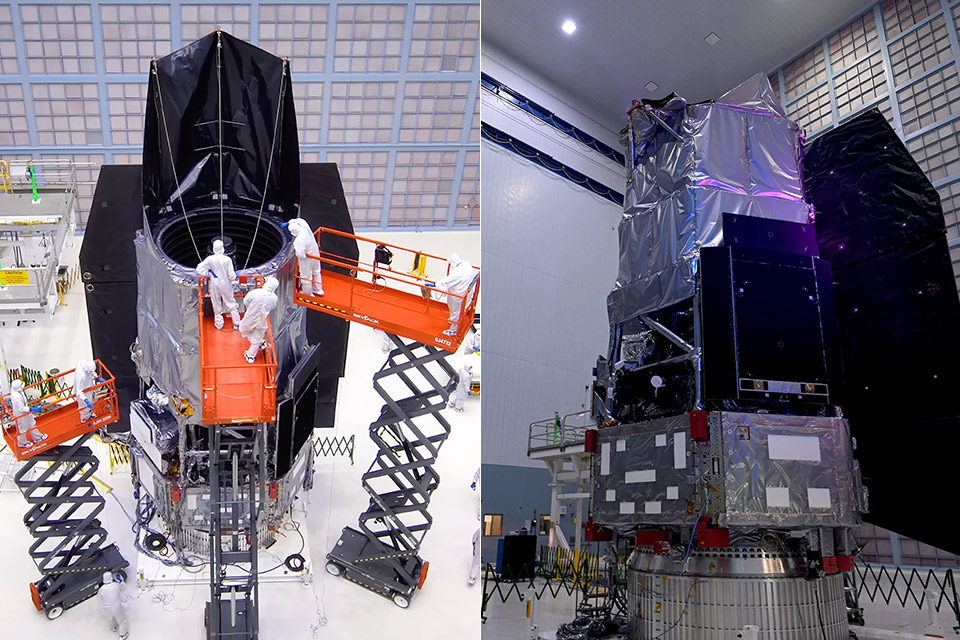
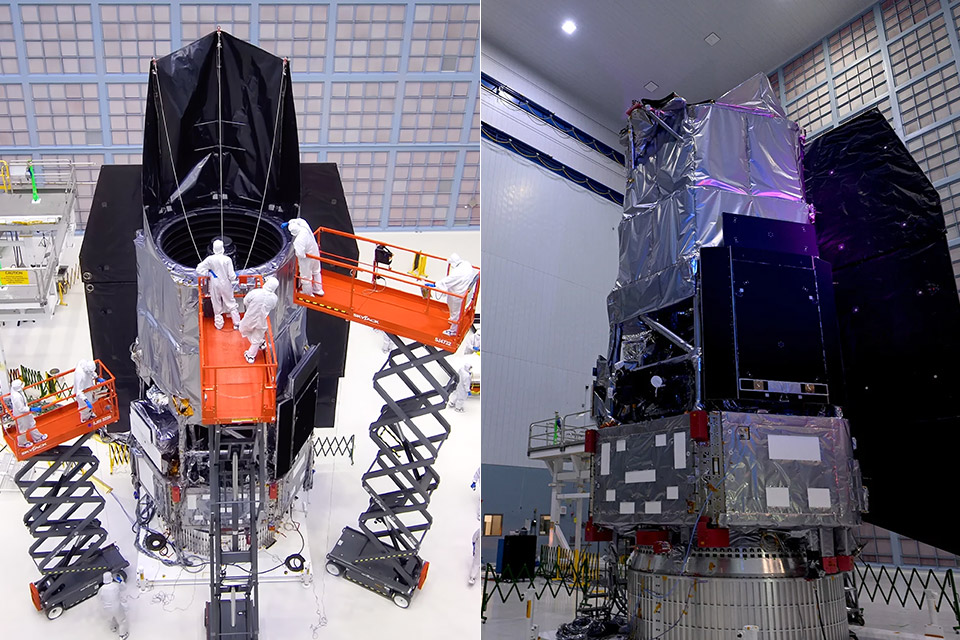
NASA’s Nancy Grace Roman Telescope Now Stands Complete and Ready for September Launch

Published

on

NASA Nancy Grace Roman Telescope Ready for Launch
Years of painstaking effort at NASA’s Goddard Space Flight Center have finally paid off, with the Nancy Grace Roman Space Telescope now fully completed. Last November, the engineers were able to connect the two main portions, and now that the observatory has been polished and tested, it is sitting pretty in the site’s largest clean room. Next up is shipping out to Florida’s Kennedy Space Center in June, where a SpaceX Falcon Heavy rocket will launch into space as early as September, an incredible 8 months ahead of schedule and under budget.


Nancy Grace Roman earned the nickname ‘Mother of Hubble’ for effectively directing the agency’s astronomy program during the 1960s and 1970s. The new telescope is a suitable tribute to her name, with the same 2.4-meter mirror as Hubble, but everything else has been dramatically increased up. The observatory’s Wide Field Instrument is a 300-megapixel camera made up of 18 custom-built detectors that work together. Each of these detectors is essentially made up of pixels that are tuned in to pick up both visible light and near-infrared wavelengths, allowing scientists to choose the level of detail they require by using a filter wheel to dial in the exact colors they want.

Sale


Gskyer Telescope, 70mm Aperture 400mm AZ Mount Astronomical Refracting Telescope for Kids Beginners…
  • Superior Optics: 400mm(f/5.7) focal length and 70mm aperture, fully coated optics glass lens with high transmission coatings creates stunning images…
  • Magnification: Come with two replaceable eyepieces and one 3x Barlow lens.3x Barlow lens trebles the magnifying power of each eyepiece. 5×24 finder…
  • Wireless Remote: This refractor telescope includes one smart phone adapter and one Wireless camera remote to explore the nature of the world easily…

The new camera on the Roman Telescope has a field of vision that is approximately 100 times larger than what Hubble could capture in a single picture. Because of the greater space available, a single exposure on the Roman Telescope may cover an area two hundred times larger than Hubble could. Where Hubble took decades to map a small piece of the sky, Roman will be able to cover vast areas in a matter of days. The reason it’s feasible is due to design decisions taken by NASA years ago, when they elected to employ a handful of surplus mirrors from the National Reconnaissance Office that had come their way, giving them the room they needed for a larger instrument package without having to start again.

Advertisement


The data flow will also be significant, with each day’s operations returning approximately 1.4 terabytes of data. And during the duration of its five-year primary mission, that will amount to thousands of gigabytes, all of which will be available for astronomers to explore and analyze. They’ll be able to see over a billion galaxies, get a close-up look at the Milky Way, and begin searching for tens of thousands of exoplanets. Some of those planets will be rogue objects that were flung out of their parent stars a long time ago, while others will appear as a result of gravitational microlensing, which occurs when the light from a distant star suddenly brightens because a planet passes in front of it. But the secret is that the Roman Telescope’s infrared vision can see through dust clouds that would typically obscure all of these objects from Earth’s perspective.

Dark energy and dark matter are at the very top of the scientific agenda. We still don’t know what these two unseen components are, despite the fact that they account for an astounding 95% of the cosmos. Roman will determine how much the expansion of space has altered over billions of years by analyzing the distribution of galaxies and harnessing weak echoes of sound waves that bounced about in the early universe. It will also be able to observe how dark matter gathers together and shapes the entire galaxy through its web of visible matter. At the same time, another equipment, a coronograph, will allow planets orbiting close stars to be observed in a previously unheard-of way, similar to how stars are blocked out by a shield. That object also functions as a trial ground for future expeditions that aim to take pictures of planets similar to Earth.


When the Falcon Heavy launches from Launch Pad 39A in September, the Roman Telescope will follow in the footsteps of numerous previous science missions. What’s interesting is that this cargo is bringing a much larger perspective than we’ve previously seen. In a single year, it will collect more data on the sky than Hubble did in almost thirty years in space. Astronomers from around the world have already submitted suggestions for the first batch of observations. The telescope will spend its time scanning, measuring, and recording what it discovers before beaming it back home, allowing researchers to begin piecing together previously unknown areas of the universe.
[Source]

Advertisement

Source link

Continue Reading

Tech

Meta to lay off 10pc of its workforce amid AI push

Published

on

The organisation has also called a halt to its plans to fill 6,000 open roles.

Meta has told staff that it will be laying off 10pc of its workforce – roughly 8,000 employees – as it reportedly seeks to mitigate the costs of heavy AI spending.

Bloomberg reported that in a memo issued to employees on Thursday (23 April), Meta explained that the layoffs are to come into effect towards the end of May. 

Bloomberg published the details of the memo, which was written by Meta’s chief people officer Janelle Gale, who said: “We’re doing this as part of our continued effort to run the company more efficiently and to allow us to offset the other investments we’re making.

Advertisement

“I know this is unwelcome news and confirming this puts everyone in an uneasy state, but we feel this is the best path forward, given the circumstances.”

Talk of layoffs at Meta was previously reported in March by Reuters. At the time, a company spokesperson told SiliconRepublic.com: “This is a speculative report about theoretical approaches.”

According to the memo, US-based employees who are losing their jobs will receive a severance package which will include 16 weeks of base pay and two weeks for every year of employment. Packages outside the US will be similar but will vary by country, as will local timelines and processes.

“For notifications, we will follow the same process we have before, on 20 May anyone who is impacted will receive an email to their work and personal accounts, please make sure your personal email is updated in Workday,” said Gale.

Advertisement

“I know this leaves everyone with nearly a month of ambiguity which is incredibly unsettling. We will try to answer your questions here in the comments but as we’re still working through the details we aren’t able to share much more until later in May.”

The organisation is also halting plans to recruit workers for 6,000 open roles.

When reached for comment, a Meta spokesperson directed SiliconRepublic.com to the company’s response to RTÉ, which confirmed the accuracy of Bloomberg’s article but did not provide any further details.

This latest round of layoffs follows recent cuts made by the Facebook parent including global layoffs of several hundred last month – which led to the loss of 15 jobs at its Irish location – and 600 roles cut at Meta’s Superintelligence Labs last October.

Advertisement

In recent times, Meta has prioritised investing heavily in artificial intelligence. Earlier this month, the organisation agreed to pay CoreWeave roughly $21bn to access the company’s AI cloud capacity until December 2032. The new agreement came after Meta signed a $14.2bn deal with the company in September, taking the total that CoreWeave has in Meta contracts to $35bn.

Meta isn’t the only high-profile tech company announcing significant layoffs. This week, Microsoft revealed plans to offer its US employees voluntary buyouts. Roughly 7pc of the company’s US employees will be eligible to apply and the plan will be available to workers at a senior director level and below whose years of employment and age add up to 70 or more. 

Updated, 12.52pm, 24 April 2026: This article was amended to add Meta’s response to SiliconRepublic.com.

Don’t miss out on the knowledge you need to succeed. Sign up for the Daily Brief, Silicon Republic’s digest of need-to-know sci-tech news.

Advertisement

Source link

Continue Reading

Tech

‘Apex’ Review: Charlize Theron Netflix Thriller Avoids Rock Bottom, but Barely

Published

on

Apex, a new survival thriller from director Baltasar Kormákur, debuts on Netflix Friday. The film stars Charlize Theron as Sasha, a grief-stricken woman who, after a rather predictable accident on a mountain, travels to Australia to find closure. Once there, she finds herself involved in a grueling cat-and-mouse game as she’s hunted by a ruthless local named Ben (played by Taron Egerton).  

There’s a lot the movie could’ve explored during its roughly 90-minute running time, particularly around loss and letting go. Alas, it’s all surface, no depth. It’s a bummer — but at least that surface looks cool.

Let’s back up a minute and discuss the movie’s opening moments. We’re quickly introduced to Sasha, who wakes up in a tent tied to the side of a mountain. This is normal life for her and her husband, Tommy (played by Eric Bana), and it’s understood that the couple does a lot of rock climbing. But Sasha comes to a rock side she just can’t climb over, and, in frustration, they stay on the side of the mountain a bit too long. 

Advertisement

All the while, a snowstorm closes in.

Perhaps I watch too many disaster movies, but the story panned out in a predictable manner from there. Due to a rockslide and bad weather conditions, Tommy gets knocked unconscious (or killed immediately) and Sasha must either let go of his rope or die with him. 

And that’s a wrap for Eric Bana.

Read more: 40 of the Best Movies on Netflix You Should Stream Now

Advertisement
A man in a red puffer jacket and blue helmet stands next to a rock wall.

Eric Bana stars in Apex.

Kane Skennar/Netflix

This opening sequence took place over mere minutes, which, in my opinion, was nowhere near enough time to establish the emotional connection between the two characters that would then inspire her to take a trip alone to the wild backlands of Australia. But we all process grief differently, I guess.

Needless to say, once there, Sasha finds herself in a situation that she wasn’t prepared for. Red flags abound in the form of the cluttered wall of missing persons posters in the local police station and a group of questionable men she soon meets while on her journey to go camping in the unfamiliar terrain.

Advertisement

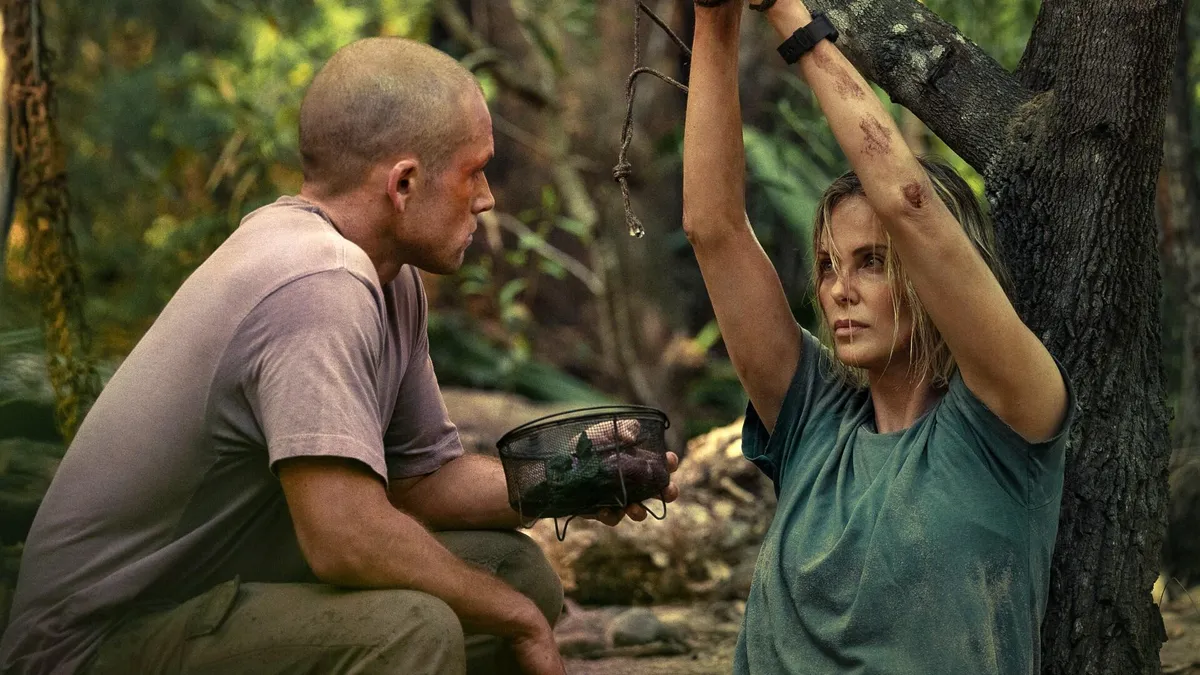
And this is where Egerton’s seemingly harmless Ben enters the picture. Soon, Apex transforms into something of a horror film, and Ben (along with his trusty crossbow) hunts the American deeper into the woods, because that’s what he does to pass the time.

This is all you really need to know about the story. I’m leaving out some heavy spoilers so you can discover the direction the film takes from there. 

A bald man and woman struggle in white water rapids.

Taron Egerton and Charlize Theron star in Apex.

Advertisement

Kane Skennar/Netflix

It brings me no joy to write a negative review. First off, I am fully aware of how challenging it is to make a movie. Not to mention, Apex was shot entirely on location; Theron and Egerton really ran through the Australian woods and battled in all sorts of terrain, from the side of a mountain to white water rapids. 

Theron did many of her own stunts and trained to believably portray a rock climber, and she definitely delivered on that front. That focus on realism in the field results in a slew of jaw-dropping visuals that beg to be seen on the big screen. But alas, Apex is a streaming release.

Still, this is all commendable, considering how many Netflix titles are produced entirely on sound stages in front of a blue screen, with digital effects added later to build out the story world. But I can’t help feeling that the focus on tactile detail here came at the expense of the emotional depth a story like this needs.

Apex leans heavily on the acting talents of its leads, and Theron and Egerton deliver the goods, no question. Without their strengths opposite each other, I don’t think Apex would be worth the time at all. This may be Theron’s movie, but Egerton steals the show. More on him in a second.

Advertisement
A blonde woman sits in a kayak in the middle of a river.

Charlize Theron stars in Apex.

Kane Skennar/Netflix

When you take a look at Theron’s IMDb page, it’s clear her acting career has been populated with varied roles. She can hold her own in an indie comedy, an arthouse drama, a Marvel blockbuster and even Arrested Development. She brings a haunted stillness to Sasha, which informs the character’s power without spoon-feeding the audience. 

All she needs to do is stand and stare at Egerton and her silence speaks volumes. Without much dialogue, she easily steps into the root-worthy entry point for the viewer to connect with.

Advertisement

Egerton, meanwhile, goes all-in on Ben’s atrociousness. He’s a backwoods Hannibal Lecter, complete with his own unique jerky recipe. It should be mentioned that Egerton is British, doing a semi-believable Australian accent, which is not an easy feat. There’s a grab bag of other terrifying quirks that make Ben frightening, on the same level, at times, as Norman Bates. You can tell Egerton is having a blast playing this character. I had a blast watching him.

Performances can only take things so far, though. Outside of the chemistry between Theron and Egerton, the striking visuals and strong camera work, Apex is pretty hollow. That’s a sad thing to type, considering the notion that this is a story about loss, grief and survival. 

I’m not going to say Apex isn’t worth your time. If you want some empty-calorie terror to get you through the weekend, you can find it here. Just don’t expect much more than that.

Advertisement

Source link

Continue Reading

Tech

15 companies you’ll see at NIBRT Careers in Biopharma 2026

Published

on

The event is designed to connect students and professionals with key employers, alongside providing industry insights and upskilling opportunities.

This coming Saturday (25 April), the National Institute for Bioprocessing Research and Training (NIBRT) will hold the 12th annual Careers in Biopharma event. 

Taking place in the O’Reilly Hall at University College Dublin (UCD), the event is an opportunity for students, graduates and jobseekers to expand their knowledge of the biopharma sector. Attendees can meet with key industry employers, sit in on lectures, engage with upskilling opportunities and expand their networks. 

Registration for the event is free and those interested in attending can register in advance. The following is a list of some of the STEM organisations and institutions that will be in attendance. 

Advertisement

AbbVie

US pharmaceutical company Abbvie was founded in 2013 and is headquartered in Chicago. The organisation has more than 80 global locations, including in Cork, Dublin, Sligo and Mayo. AbbVie focuses primarily on discovering, developing and delivering therapies and treatments for serious illnesses, in areas such as immunology, oncology and neuroscience. 

Alexion

Established in 1992 and headquartered in Boston, Massachusetts, Alexion has been operating in Ireland since 2013, when it opened its first Irish location in Blanchardstown. Between the Dublin and Athlone locations, Alexion employs more than 1300 people in Ireland. Acquired by AstraZeneca in 2020, Alexion focuses on creating therapies and solutions for complex and rare diseases. 

Amgen

Biopharmaceutical company Amgen was first established in 1980 and has its primary location in Thousand Oaks California. There are two locations in Dublin and the organisation’s mission involves discovering, developing, manufacturing and delivering innovative medicines to fight some of the world’s most serious conditions, such as heart disease, obesity-related conditions, rare illnesses, inflammatory conditions and cancer. In January of this year, Amgen announced the acquisition of cancer drug discovery platform Dark Blue Therapeutics in a deal valued at up to $840m. 

Bristol Myers Squibb

Bristol Myers Squibb (BMS) has been active in Ireland for 52 years, beginning operations in 1964 with an Active Pharmaceutical Ingredient Plant in Swords, Dublin. Currently, in Ireland, BMS runs a biologics drug-substance manufacturing facility in Cruiserath and external manufacturing divisions in Blanchardstown and Shannon. Roughly 1,000 people in Ireland are currently employed by BMS. 

Advertisement

Eli Lilly

US pharma giant Eli Lilly manufacturers treatments in areas such as Alzheimer’s, cancer and diabetes. The company has been operating in Ireland since 1978 and employs more than 3,700 people across three sites, in Limerick and Cork. In 2024, the multinational announced plans to invest $1bn into the expansion of its manufacturing site in Limerick, bringing total investment in the build to $2bn. Development on the site continues. 

Grifols

Established in Spain in 1909 global healthcare company Grifols has a premises in Dublin, where it offers a range of biopharma products and services. The Dublin location serves as the management center for Grifols Biopharma overseeing the treasury, risk management, supply and demand planning, regulatory, R&D and commercial functions. It is also a hub for labelling, packing, final conditioning, and distribution of finished plasma products. The organisation employs more than 25,000 across the globe, with a presence in more than 30 countries and regions. 

ISPE

Established in 1980 and headquartered in Maryland, the International Society for Pharmaceutical Engineering (ISPE) is a large non-profit that focuses on scientific, technical and regulatory advancements in the pharmaceutical lifecycle. The organisation has more than 23,000 employees who are involved in building solutions in the development and manufacturing of safe and effective pharmaceutical and biologic medicines and medical delivery devices. Members are dispersed across more than 90 countries around the world. 

Johnson and Johnson Innovative Medicine

Healthcare company Johnson and Johnson Innovative Medicine will also be in attendance at NIBRT’s event. The company employs roughly 140,000 people globally and aims to tackle complex diseases via prevention, treatments and cures. The organisation is particularly focused on the areas of oncology, immunology, cardiopulmonary and neuroscience. Johnson & Johnson’s connection with Ireland began in 1935, with more than 6,000 Irish people employed across its 10 locations in Cork, Dublin, Limerick, Galway and Mayo.

Advertisement

MSD

US multinational pharmaceutical company MSD has a strong presence in Ireland, with facilities in Dublin, Carlow, Cork, Louth, Meath and Tipperary. MSD carries out research and creates medicines and vaccines for some of the world’s most challenging diseases, including cancer, HIV, Ebola, emerging animal diseases and recently Covid-19.

OmniSpirant Therapeutics

Galway’s OmniSpirant Therapeutics was founded in 2016 by Gerry McCauley. It is an early stage therapeutics company working on the development of a novel technology that uses inhaled stem cell exosomes to treat cancer and respiratory diseases. 

Pfizer

Global pharmaceutical company Pfizer is a well-established name worldwide. Currently the organisation employs around 3,700 people across six sites in Ireland. The first Irish location was established in 1969 and since then, Pfizer has invested $8bn. In March Pfizer announced the launch of its 2026 Apprenticeship Programme which is open to both school leavers and those looking for a new career or educational achievement. The programme is available across Pfizer’s sites in Grange Castle, Dublin; Newbridge, Kildare; and Ringaskiddy, Cork.

ProPharma

Established in 2001, North Carolina headquartered ProPharma helps pharmaceutical, biotechnology, and medical device companies bring new therapies to the market. Their work covers the early development stages, all the way through to the clinical, regulatory approval and commercialisation phases. The organisation has a strong global presence across Europe, the US and the AsiaPacific reason. 

Advertisement

Sanofi

Paris-based pharmaceutical manufacturing company Sanofi produces drugs across a wide range of therapeutic disciplines, treating illnesses such as MS and diabetes. The R&D driven, AI-powered biopharma has a presence in more than 60 countries and currently has two Irish sites in Waterford and Dublin. 

Veolia 

Headquartered in France, Veolia employs more than 700 employees across Ireland. The organisation works with customers to manage scarce resources through their expertise in operations, engineering and technology. The aim is to reduce the environmental impact of public, business and industrial activities. This is achieved via a focus on three key areas, decarbonisation, reducing pollution and maximising resource efficiency.

WuXi Biologics

Headquartered in China, WuXi Biologics is an open-access biologics technology platform that offers end-to-end services in order to accelerate the development and manufacturing of biologics. WuXi employs more than 13,000 employees across China, the US, Ireland, Germany, and Singapore. A global team that includes experts and scientists in biologics R&D and manufacturing, technology innovation, and operations. Located on a 26-hectare site, WuXi has a location midway between Dublin and Belfast, in Dundalk, Louth. The site is one of the largest in the world utilising single-use bioreactor technology.

Don’t miss out on the knowledge you need to succeed. Sign up for the Daily Brief, Silicon Republic’s digest of need-to-know sci-tech news.

Advertisement

Source link

Continue Reading

Tech

How Anthropic’s Model Context Protocol Allows For Easy Remote Execution

Published

on

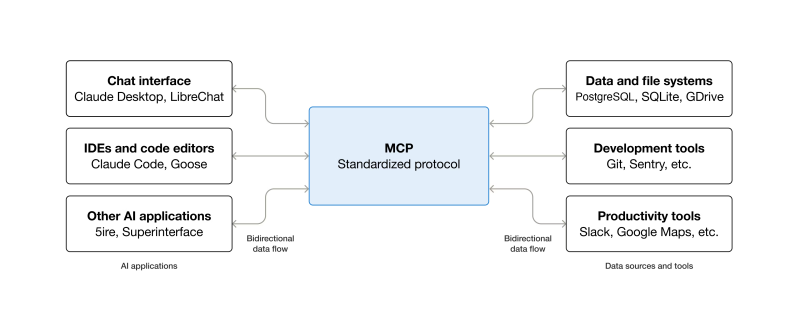
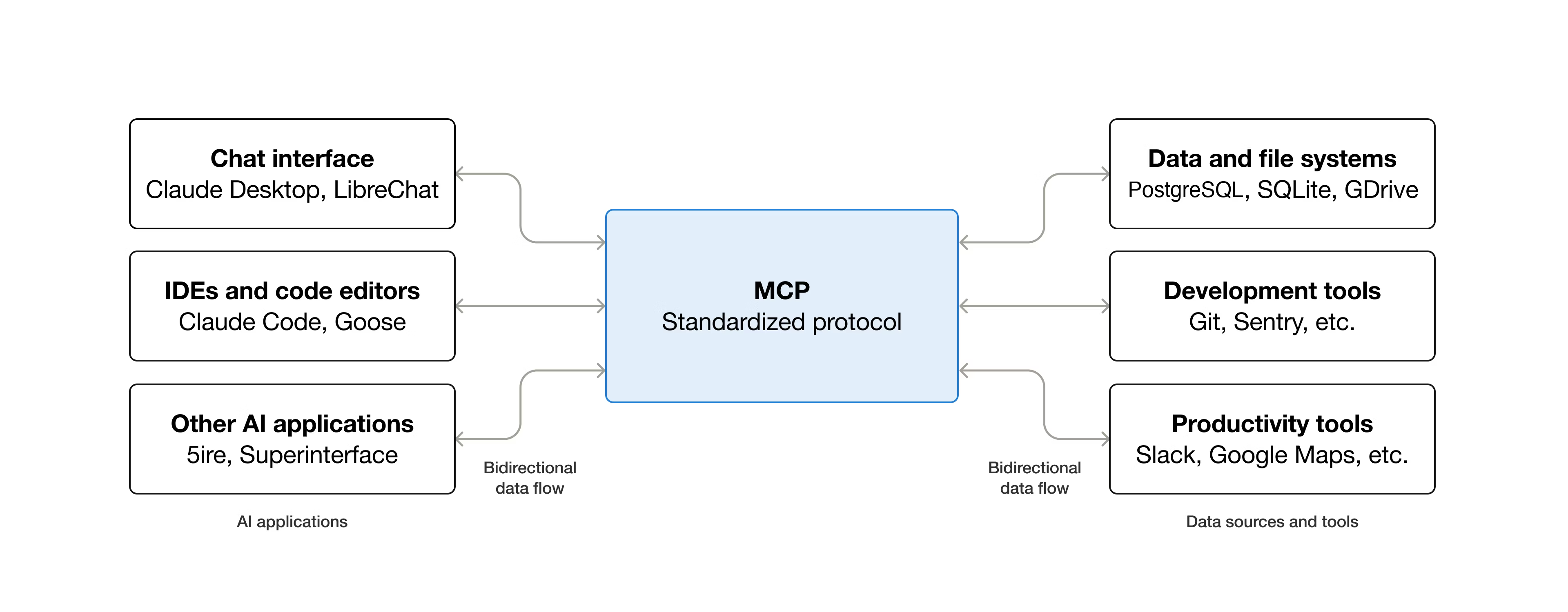
As part of the effort to push Large Language Model (LLM) ‘AI’ into more and more places, Anthropic’s Model Context Protocol (MCP) has been adopted as the standard to connect LLMs with various external tools and systems in a client-server model. A light oversight with the architecture of this protocol is that remote command execution (RCE) of arbitrary commands is effectively an essential part of its design, as covered in a recent article by [OX Security].

The details of this flaw are found in a detailed breakdown article, which applies to all implementations regardless of the programming language. Essentially the StdioServerParameters that are passed to the remote server to create a new local instance on said server can contain any command and arguments, which are executed in a server-side shell.

Essentially the issue is a lack of input sanitization, which is only the most common source of exploited CVEs. Across multiple real-world exploitation attempts on the software of LettaAI, LangFlow, Flowise and Windsurf it was possible to perform RCEs or perform local RCE in the case of the Windsurf IDE. Although Flowise had implemented some input sanitization by limiting allowed commands and the stripping of special characters, this was bypassed by using standard flags of the npx command.

Advertisement

After contacting Anthropic to inform them of these issues with MCP, the researchers were told that there was no design flaw and essentially had a ‘no-fix, works as designed’ hurled at them. According to Anthropic it’s the responsibility of the developer to perform input sanitization, which is interesting since they provide a range of implementations.

Source link

Advertisement
Continue Reading

Trending

Copyright © 2025