Connect with us

Tech

The Incredibles 3 Confirmed as Disney Kicks Off D23 Entertainment Showcase

Published

on

The superhero Parr family is coming back, with The Incredibles 3 confirmed during the Disney Entertainment Showcase on Friday night at the biennial fan convention D23 in Anaheim.

Pixar’s Pete Docter took to the stage to celebrate the 40th anniversary of Pixar, hinting at what’s to come in the third installment of the Incredibles franchise.

The Super Hero League is being launched in The Incredibles 3 now that superheroes are legal again, as of the end of the second movie. And the third movie will feature the Parr kids as the pivotal characters, Docter said.

“Violet and Dash are determined to step out on their own,” Docter said. “They’ve been sneaking out at night … and to make matters worse, they’ve been struggling to contain Jack-Jack.”

Advertisement

He also said a supervillain will be facing off against the supers in Incredibles 3.

The Incredibles 3 is being released in Summer 2028. For now, you can stream the first two Incredibles movies on Disney Plus.

Source link

Continue Reading
Click to comment

You must be logged in to post a comment Login

Leave a Reply

Tech

Inside Defcon, the Conference That Made Cybersecurity Noob-Friendly

Published

on

The first thing I learned at Defcon was that I apparently didn’t know what a badge was.

I already had one hanging around my neck: the press credential that got me through the door at the annual hacker convention in Las Vegas in early August. Yet everywhere I looked, people stood in long lines to buy more. When I asked what they were waiting for and heard “badges,” I glanced down at mine, confused.

I would soon learn that Defcon badges can be electronic puzzles, soldering projects, collectibles and signs of belonging to a culture I was experiencing for the first time. Those badges were my first indication of how much I had to learn.

Everyone else seemed to understand the schedule, the language and the unwritten rules. But me? I felt like I was back in high school and had somehow missed orientation.

Advertisement

Over the next few days, talking with professionals, hobbyists and other beginners made cybersecurity feel much more accessible. For the first time, I could see a path from playing around with hacking tools to actually understanding how they work.

I was a script kiddie before I knew what that meant

I wasn’t completely new to hacking. In college at UCLA, I spent more time than I probably should have in the library experimenting with Firesheep, a Firefox extension that demonstrated how exposed session cookies could be intercepted over shared Wi-Fi. Watching it work showed me how easily technology could be manipulated.

I didn’t build Firesheep or understand the code behind it. I knew how to install it and click around. In hacker terminology, that made me a script kiddie: someone who uses tools created by other people without fully understanding how they work.

Still, I loved testing technology’s limits and making it do things it wasn’t designed to do. I liked the feeling of opening a door everyone else assumed was locked. That curiosity stuck, even if my technical knowledge never caught up. 

Advertisement

Defcon was my chance to see whether it finally could.

Exploring Defcon

Defcon featured talks and scheduled events, but much of the convention was divided into villages dedicated to particular corners of hacking. There were villages for lock picking, artificial intelligence, aerospace, cars and even boats. Inside them, people were hacking devices, building things, competing in challenges or sitting around tables working on projects I couldn’t begin to identify.

Elsewhere, teams competed in capture the flag contests, or CTFs, where players solve cybersecurity puzzles to uncover hidden pieces of text known as flags. Some competitions were designed for experts. Others were specifically meant to help beginners learn. I wanted to try one, but never did. There was always another room to explore, another talk to catch or another unfamiliar object I needed someone to explain to me.

Mostly, I wandered.

Advertisement

That was how I ended up learning about Defcon badges. The official badge gets you into the convention, but villages, groups and independent creators also make their own. Many are small electronic devices with lights, screens, games or hidden puzzles. Some communicate with other badges. Others come as bare circuit boards that you have to assemble yourself. Collecting and hacking them is an entire subculture within Defcon.

Because I arrived late, many of the badges I heard people talking about had already sold out. But I managed to buy one from the Maritime Hacking Village, where hackers explore the technology used on boats and other maritime systems, as well as the Car Hacking Village.

I also sat down at a soldering station and made a small badge of my own.

I had always wanted to learn how to solder, but was intimidated by the idea of trying it alone. At Defcon, a young guy and a much older man — two people who seemed like complete opposites in almost every way — took turns guiding me through it.

Advertisement
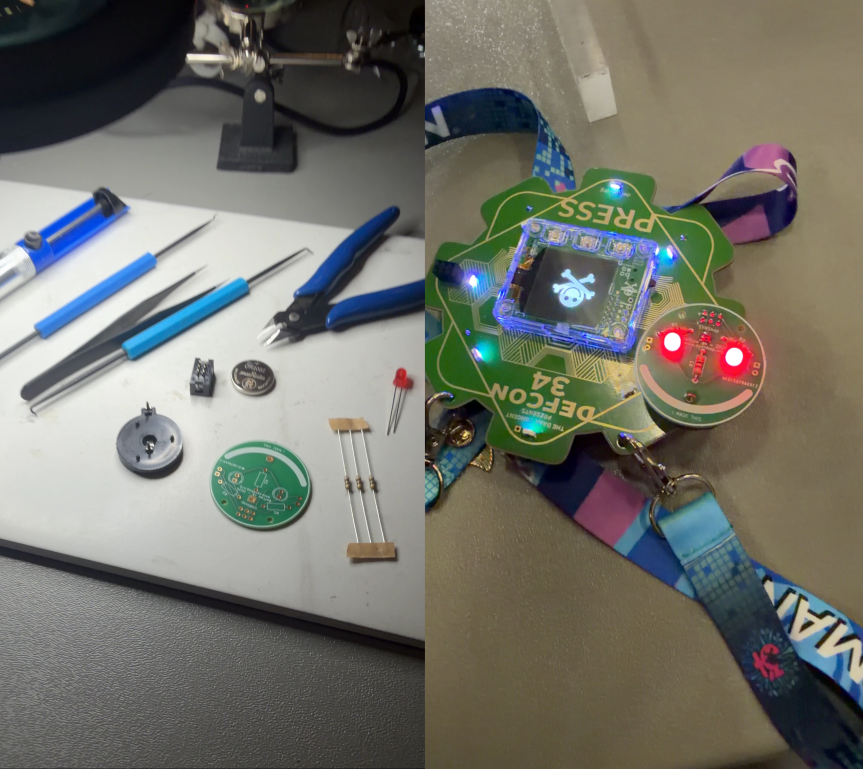
I learned to solder by assembling a small electronic badge, shown before and after, that lit up on my first try.Nelson Aguilar/CNET

They showed me how to heat each connection and apply just enough solder to hold the components in place. Once I got the hang of it, I was surprised by how naturally it came to me. When the badge lit up, I realized soldering had never been beyond me; I just needed someone to show me where to start.

A lot of it went over my head, obviously

The talks were a reminder of how much I don’t know. Speakers spoke through code and acronyms as if everyone in the room spoke the same language, which frustrated me at times. Sometimes I could follow the larger idea, but lost the technical details. Other times, I had almost no idea what was happening.

One project I could understand came from Billy Swearingen. He developed software that generates and tests visual patterns designed to confuse the AI systems used by surveillance cameras. His goal isn’t to make someone invisible, but rather to make it more difficult for a camera’s software to recognize a person or face.

Bill Swearingen demonstrates how a specially designed pattern can lower an AI camera’s confidence that it sees a person.Nelson Aguilar/CNET

A talk about cellular surveillance went the same way for me. I didn’t understand every detail about cellular networks, but I understood the problem. Police can use devices that pretend to be cellphone towers, and the people being monitored may never know. Rayhunter offered an inexpensive way to start looking for signs of that surveillance.

I quickly gave up on trying to understand every technical detail. I followed whatever interested me, bought a few devices to let me experiment in different areas of cybersecurity and filled my phone with terms to look up later. It was like a college curriculum I had given myself.

I found my village

Eventually, I wandered into Noob Village. For the first time all weekend, I knew immediately that I was in the right place.

Advertisement

Noob Village was built for people trying to enter cybersecurity without needing to understand everything. It offered beginner-focused talks, workshops, career advice and a place to ask basic questions without feeling stupid.

That was where I met Andrew Crotty, founder and president of the Ginger Hacker Initiative, a nonprofit that helps beginners, students, veterans and career changers find their way into cybersecurity through accessible education, mentorship and hands-on learning.

Crotty and I talked about my own attempt to move beyond using tools other people built and develop a more technical understanding of hacking. I told him that I grew up in a place where cybersecurity never felt accessible. Nobody around me talked about hacking as a skill you could learn or a career you could pursue. Even after I became interested in it, I didn’t know where to begin or who to ask for help.

After wandering through rooms organized around specialties I barely understood, I had finally found my village. Literally.

Advertisement

That didn’t mean I suddenly knew what I was doing. It meant I had found one place that catered to not knowing. I left with a better idea of where to begin, then walked back into the chaos to see what else Defcon had waiting for me.

Some of the best moments happened in line

One of the few things I had planned was getting a copy of The Cuckoo’s Egg signed by its author, Cliff Stoll. Jaron Bradley, director of Jamf Threat Labs, had recommended the book when I interviewed him at Black Hat as a good way for me to start learning about cybersecurity. I had never heard of Stoll, but at Defcon, his name carried a kind of celebrity.

Stoll was an astronomer working at Lawrence Berkeley National Laboratory in the 1980s when a 75-cent accounting discrepancy led him to discover a hacker inside the lab’s computer network. He spent the next year tracking the intruder, eventually uncovering an international espionage operation connected to the Soviet KGB. This story became The Cuckoo’s Egg, one of the foundational books of modern cybersecurity.

Cliff Stoll, author of the cybersecurity classic The Cuckoo’s Egg, was every bit as eccentric and energetic as I had been told.Nelson Aguilar/CNET

While I waited for Stoll, I started talking to the man in front of me. He had joined the military without a cybersecurity background, learned the technical skills and eventually turned them into a career in his 20s. We talked about where we came from, politics and the different paths that had brought us into the same line.

It wasn’t an interview. Neither of us was trying to impress the other or extract anything useful.

Advertisement

It was exactly the kind of unexpected conversation I had hoped to have when I came to Defcon alone: a chance to meet someone whose path into cybersecurity looked nothing like mine and to hear how he found his way in.

Then I met Stoll, who was every bit as strange, energetic and entertaining as his reputation suggested. He signed my book and shook my hand, wishing me luck on my journey in this strange new world.

The whole experience was another reminder of how wonderfully unpredictable Defcon could be.

Next year, I’m joining in

By the end of the weekend, I had learned to solder, solved a cryptography puzzle involving a Vigenère cipher and spent more money than expected on hacking tools. More importantly, the technical side of cybersecurity no longer felt as intimidating as it had when I arrived.

Advertisement

There was still plenty I didn’t try. I never attempted a CTF, even though several were designed for beginners. I had my laptop with me, but I mostly used it to take notes while watching other people hack. This year, I wanted to wander and understand what Defcon was. Next year, I want to participate.

I’ll have a better idea of which villages I want to visit, and I plan to commit to at least one beginner CTF — not because I think I’ll suddenly know what I’m doing, but because I’m no longer as afraid of not knowing.

One of my favorite things about Defcon was seeing how many parents had brought their children. They were being introduced to technology as something they could question and rebuild in their own vision. That gave me a little more courage.

I didn’t leave Defcon as a hacker, not that I was supposed to. I did leave with enough confidence to start figuring things out for myself.

Advertisement

At one point, I admitted to another attendee that I felt like I didn’t belong there. He told me something I kept thinking about for the rest of the weekend: “You don’t have to know what you’re doing most of the time,” he said. “You just have to want to find out.”

Source link

Advertisement
Continue Reading

Tech

ByteDance Agrees To Reel In Its AI Models To Protect Hollywood IPs

Published

on

TikTok’s parent company signed a memorandum of understanding with The Motion Picture Association.

Hollywood and ByteDance have seemingly squashed their beef revolving around AI models infringing on studios’ intellectual property. The Motion Picture Association (MPA) announced in a press release that it has signed a memorandum of understanding with TikTok’s parent company, which details a shared framework to protect against copyright infringement of the trade group’s members.

The MPA, whose members include Disney, Paramount and Warner Bros. Discovery, said that “this agreement represents significant cooperation between the two organizations.” The trade association even added that ByteDance’s latest release of Seedream 5.0 Pro and Seedance 2.5 reflect its “continued advances in IP protections.” According to the press release, this memorandum applies to all AI models from ByteDance, including those used on TikTok, TikTok USDS Joint Venture, CapCut and Dreamina. 

The memorandum comes after the MPA sent a cease-and-desist letter to ByteDance in February, accusing the company’s AI models of using copyrighted material without permission. Shortly after, ByteDance responded by pledging it would strengthen its safeguards around unauthorized use of intellectual property and likeness, even later reportedly suspending Seedance 2.0’s global rollout. Since then, MPA’s CEO and chair, Charles Rivkin, said the association has had “constructive engagement” with the ByteDance, adding that the Chinese company has implemented “meaningful guardrails” with its AI models. On the other hand, Hollywood studios are currently in court for a lawsuit against Midjourney, also accusing it of copyright infringement.

Advertisement

Source link

Advertisement
Continue Reading

Tech

Amazon Slashes M4 iPad Air Prices Up to $150 off This Week

Published

on

Amazon’s triple-digit discounts on the current M4 iPad Air range deliver the lowest prices of the season.

Steeper markdowns are in effect across Apple’s M4 iPad Air range this week, with Amazon knocking $100 to $150 off 11-inch and 13-inch models.

Save up to $150 on M4 iPad Air

Choose from the standard 11-inch 128GB Wi-Fi model for $649.99 after the $100 discount, or opt for a 13-inch 1TB Wi-Fi Cellular spec that’s $150 off. Nearly every model is on sale.

Advertisement

11-inch iPad Air M4 deals

13-inch iPad Air M4 discounts

Easily compare prices across the lineup in our 11-inch iPad Air M4 Price Guide and 13-inch iPad Air M4 Price Guide, both of which are updated throughout the day.

Source link

Continue Reading

Tech

Groq raises $350M to fuel its pivot from AI chips to neocloud

Published

on

Startup Groq has raised $350 million as it continues to pivot from an AI chipmaker to a neocloud company that provides powerful GPUs and AI infrastructure services. 

The new capital, led by investment firm Disruptive with planned participation from Nvidia, values the company at $3.5 billion. That’s down from the $6.9 billion Groq was valued at last September, just a few months before Nvidia hired the startup’s founder and CEO, Jonathan Ross, and other top talent as part of a licensing deal. 

A spokesperson for the company told TechCrunch that despite the difference in valuation, the company doesn’t see it as a down round, but rather as establishing a new valuation for the “post-Nvidia-lincensing-deal version of Groq.” 

Groq was focused on building its own chips, dubbed LPUs (language processing units), to compete with Nvidia on inference — the type of compute needed to run AI workloads in real time. After it lost its star team, Groq shifted from being a pure AI chipmaker into a cloud and data center provider that operates Nvidia systems, making the remaining Groq company an Nvidia customer. 

Advertisement

In June, Groq raised a $650 million round to kick off its pivot. The company intends to scale from 54 megawatts to more than 200 megawatts by 2027.

Today, Groq operates 13 data centers across North America, Europe, the Middle East, and Asia Pacific, serving more than 6 million developers, enterprises, and AI-native companies. Groq says the fresh funds will support “those seeking usage of medium and larger sized clusters of Nvidia accelerated computing for training and inference.” 

“We are building Groq into the world’s leading AI inference cloud,” Alex Davis, Groq’s chairman and CEO of Disruptive, said in a statement. “Inference will without a doubt become the largest and most critical layer of AI infrastructure.”

While inference is in high demand as enterprises scale AI workloads, it’s an open question whether neoclouds will be a profitable enough business to provide returns on their considerable investment in the long term. CoreWeave reported strong second-quarter revenue growth and recently landed major contracts, including with Meta and Anthropic. However, investors remained concerned about the company’s high capital expenditures, heavy reliance on debt, and exposure to rapidly depreciating hardware, and its ability to turn growth into free cash flow. 

Advertisement

Groq’s financials are still private for now, but its pivot puts the company directly inside Nvidia’s AI infrastructure ecosystem. That’s not exactly a unique relationship among neoclouds today. Nvidia supplies the GPUs powering clouds from CoreWeave, Lambda, and Nebius, while also investing billions into some of those companies as they race to build more capacity.

TechCrunch has reached out to Groq for more information.

When you purchase through links in our articles, we may earn a small commission. This doesn’t affect our editorial independence.

Source link

Advertisement
Continue Reading

Tech

How Heidi built production-ready AI for healthcare at global scale

Published

on

Presented by MongoDB


Building AI that is accurate, secure, and reliable is a major engineering feat for organizations subject to the compliance obligations that govern healthcare, financial services, and transportation. The challenge of delivering AI-driven products is compounded by the fact that technology in these industries has tended to lag behind other sectors because regulation requires organizations to move carefully — and slowly. Now, many are also confronting data infrastructure modernization projects as they try to catch up with today’s demand for AI.

Australian-founded AI Care Partner Heidi offers an example of successful modernization. Its flagship product, Heidi Scribe, now automates much of the administrative work that consumes clinicians’ days across more than 190 countries, supporting roughly 2.7 million patient interactions each week. That expansion rests on infrastructure decisions taken years before the company reached global scale, says Yu Liu, co-founder and chief technology officer at Heidi.

“In most industries, an AI feature that is wrong two percent of the time registers as an inconvenience, while in healthcare that same error rate becomes a clinical safety issue,” says Liu. “The architecture has to be built around the assumption that every output may be scrutinised, audited, and relied upon in a patient’s care.”

Advertisement

Why deploying production AI in healthcare is architecturally different

For Heidi, data residency is a precondition rather than a feature. A clinician in Sydney, London, Tokyo, or Denver is operating under different regulatory regimes, including the Australian Privacy Principles, GDPR, APPI, and HIPAA, and their patients’ data has to live in-region.

Heidi runs fully logically isolated production deployments across the world, so residency is enforced by architecture. Auditability also has to be built in from day one, because an organization needs to be able to answer what the model saw, what it produced, and what the clinician changed, for any session, months later, when called upon.

“The blast radius of change must be engineered down,” Liu says. “In less regulated industries you can ship fast and fix forward, but in healthcare we invest heavily in making change safe by default, with continuous integration gates on risky change classes, canary releases, and treating even database schema and index changes as code that goes through review. Our speed is a product of that safety rather than something we achieve in spite of it.”

Choosing a database to connect with AI workflows

Heidi handles a diverse set of medical data collected from multiple sources, including forms, referrals, and clinicians’ notes, all of which had to be consolidated into one consistent format and one location to connect seamlessly with AI workflows. Rigid rows and columns would have been ill-suited to that workload.

Advertisement

For Heidi, those requirements made a document database the natural choice.MongoDBgave the team the flexibility to accommodate rapidly changing AI data without constantly reshaping the underlying database.

“The model is maybe 20% of the system, and the data architecture is what determines whether the other 80% holds up under real clinical load,” Liu says.

An AI Scribe session isn’t a single piece of data. It’s a collection of transcripts, structured notes, templates, documents, patient context, EHR integration state, and dozens of other related artifacts that change from week to week. MongoDB lets a session’s data live together in shapes that match how clinicians actually work, and lets Heidi evolve those shapes without a migration freeze every time the product moves.

MongoDB Atlas stood out because it combined the power of the document model, which allows seamless scale, flexibility, and high performance, with built-in AI-ready features such as MongoDB Vector Search,” Liu says. “This means that Heidi does not need another bolt-on vector database to augment its existing platform.”

Advertisement

With more than 130 cloud regions globally alongside on-premises and hybrid options, MongoDB Atlas is the most widely available, globally distributed database platform, and its unified query API lets developers build full-text search, real-time analytics, and event-driven experiences without complicating their architecture.

“Heidi Scribe converts large volumes of medical documents into vector embeddings via LangChain in Atlas, enabling semantic search that connects transcribed medical terms directly to corresponding external knowledge,” Liu adds. “Migrating to Atlas reduced latency on key APIs by nearly 33%.”

What a trustworthy clinical RAG system requires

“Retrieval is a data architecture problem before it is an AI problem,” Liu says. “In consumer RAG, you retrieve from the open web and hope, whereas in healthcare what you retrieve from is the compliance surface.”

Heidi Evidence retrieves from licensed clinical knowledge bases, including partners like BMJ Best Practice, NICE CKS, and MIMS, and it is jurisdiction-aware, so a U.K. clinician gets U.K. guidance and an Australian clinician gets Australian formularies, because the right answer in one country can be the wrong answer in another.

Advertisement

Heidi’s embeddings and vector indexes live in MongoDB Vector Search, inside the same regionally isolated deployments as the rest of its data, which means retrieval physically cannot cross a residency boundary, and they are not operating a separate vector database with its own security and compliance story. Citations are a hard contract rather than a prompt suggestion, because the model only ever sees retrieved chunks that are already bound to source records.

Regional isolation enables global compliance and scale

“Each region is a full, isolated production deployment with its own MongoDB Atlas clusters, its own compute, and its own key,” Liu says.

“That is what lets us walk into a U.S. health system, an NHS trust, or an Australian hospital group and give a clean answer on residency, because it is enforced by infrastructure rather than promised by contract,” he explains. “Running multiple isolated regions with a lean team only works because the database layer is managed and consistent. We are also multi-cloud, meaning a new region can stand up another deployment on rails we have already built.”

That architecture has been most visible in the U.S., where Beth Israel Lahey Health, one of New England’s largest health systems, rolled out Heidi’s AI scribe following a pilot finding 74% of clinicians reported reduced after-hours documentation (“pajama time”), and where non-profit system MaineGeneral Health selected Heidi as a strategic partner in its rural healthcare work.

Advertisement

“Entering the U.S. market meant standing up another region on rails we had already built rather than re-engineering for HIPAA after the fact,” Liu says.

Lessons learned and the roadmap ahead

“Re-partitioning a large, hot, always-on collection is a serious engineering program, whereas choosing a shard key on day one is a design meeting,” Liu says. “We are doing that work now in partnership with MongoDB, but the lesson for anyone building a data-heavy AI product is that horizontal scale for your fastest-growing data is a founding decision, just like residency.”

Heidi is now extending beyond the consult note to support the full clinical workflow, from pre-visit context to post-visit documents, referrals, and workflow automation. The company is also exploring how MongoDB, large language models, and its own tooling can power an agentic ecosystem for clinical workflows.

“In healthcare AI, reliability engineering is trust engineering,” Liu says. “A clinician’s trust is lost just as fast by downtime, latency, or a data inconsistency as by a bad note, and some of our highest-leverage work is invisible, including canary releases with automatic rollback, CI gates on database changes, and cross-region consistency checks. Clinician trust is the product, and trust is architectural.”

Advertisement

Sponsored articles are content produced by a company that is either paying for the post or has a business relationship with VentureBeat, and they’re always clearly marked. For more information, contact sales@venturebeat.com.

Source link

Continue Reading

Tech

AME Agent Swarms Quietly Rewrite the Workflow

Published

on

The impact of AI on software development has been both profound and ever-evolving. Last year, I wrote about AMD’s plans to use AI not just for generating new lines of code, but also for other steps in the software development lifecycle (SDLC), such as triaging problems, debugging code, and testing the software. At the time, we were hoping for a 25 percent productivity boost from AI use over the course of two or three years.

But with each new release, the capabilities of Large Language Models (LLMs) improve dramatically—accelerating software development, increasing the quality of AI-generated code, and fundamentally reshaping how software is engineered. Now, just one year later, we have surpassed our productivity target, achieving a 30 percent overall productivity boost through AI. On top of that, we are rethinking not only how we use AI within the SDLC, but the structure of the SDLC itself.

We believe that the biggest AI revolution in software engineering is still ahead. So far, we have largely been teaching AI how we perform tasks and asking it to mimic existing workflows. In many ways, this constrains AI to human patterns of thinking. The next transformation will come from collaborative swarms of AI agents capable of discovering solutions independently.

Agents of today

AMD began developing AI systems for code generation, testing automation, bug analysis, and code review in 2024. At the time, our objective was to achieve 25 percent AI-generated production code by 2027 while gradually automating larger portions of the SDLC.

Advertisement

Measuring productivity is inherently challenging, but from the outset we have consistently tracked one objective metric: the percentage of source code generated by AI. Importantly, we count only code that passes all reviews and testing and is ultimately included in the final product. While AI-generated code is certainly not the only contributor to productivity gains, it is one of the few metrics that can be measured objectively and consistently.

By this metric, we have crossed the 20 percent mark at the beginning of this year and are now progressing toward 50 percent across entire codebase. In some software components, more than 80 percent of the code is now generated using AI.

Agentic AI has enabled us to include AI in every step of the lifecycle: For code analysis and triage, agents are trained to analyze problem reports, identify and group similar requests, and highlight which code snippets are likely to need modification. For debugging and code generation, agents are directed to analyze a bug request and implement required code changes. For testing, the agents generate unit tests, and if those are passed, identify necessary integration and product-level tests. And finally, for the approval and release stage, agents prepare architecture summary, code change review and full test results for engineers’ review and approval and if approved, integrate the changes into the next release.

Agents of tomorrow

Today, engineers create AI agents in their own image: they teach AI what they know about the system, how they would fix an issue, and how they would implement a change. This is already a major technological advancement. Engineers can create multiple “AI versions” of themselves, allowing these agents to work in parallel, scaling their expertise far beyond the limits of individual productivity. The limitation, however, is that these AI agents are still constrained by human thinking and human-defined approaches.

Advertisement

Person typing on a keyboard. Looming in front of them is a network of colorful AI agents surrounding a glowing central node. AMD

We believe the next major transformation in software engineering will occur when collaborative AI agent swarms can independently identify and develop solutions, guided by humans on what to solve rather than constrained by human assumptions about how the job should be done. Instead of providing detailed instructions on how to solve a problem, engineers will define the issue, the desired outcome and the quality, performance, and system constraints allowing AI agents to determine the optimal path to a solution.

A swarm of AI agents will then work in parallel to generate, evaluate, and refine multiple solution approaches. These agents will automatically validate correctness, measure performance, test trade-offs, and compare alternative implementations against defined success criteria. Finally, AI agents will prepare ranked solution options, along with validation results and performance metrics, for engineer review and approval. The agents won’t be enhancing each step of the SDLC—they will be rewriting the SLDC themselves.

To get to this point, we need to change how agents are trained. Today, improvement occurs one engineer and one agent at a time: an engineer reviews the output, refines the prompt, and repeats the process. To scale beyond this model, agents must continuously learn from one another, reuse successful strategies, and improve collaboratively across projects and teams.

We are already moving in this direction by using multi-agent workflows extensively through agentic harnesses, such as Codex and Claude Code, while simultaneously developing our own internal multi-agent systems to support the next generation of AI-driven software engineering.

Advertisement

A good example is our AI-driven effort to resolve issues in our Radeon Software eXperience (RSX). RSX is a user interface component that allows users to configure and monitor graphics driver behavior. In October 2025, we began using AI agents to automatically debug and fix reported RSX issues. Out-of-the-box AI tools delivered limited results, resolving only 6% of issues.

A bar chart labelled RSX-Agentic Resolution Rate shows large percentage increases from 6 in October 2025 to 75 in June 2026. The percentage of software issues fixed automatically by AI agents in AMD’s Radeon Software eXperience (RSX) has been growing steadily, reaching 75 percent in June 2026.

As we analyzed failures and identified ways to improve, we built a learning loop—initially a largely manual process—to understand where the agents were falling short and how to improve them. Rather than retraining the underlying models, we refined the objectives given to the agents, allowing them to iteratively explore multiple approaches, evaluate the results against defined success criteria, and converge on better solutions. At the same time, advances in models and agent runtimes further increased effectiveness. Together, these improvements significantly increased our resolution rate from 6 percent to more than 75 percent of RSX issues resolved by agentic loop.

To make agents and agent swarms truly productive, we need a continuous learning loop that feeds errors and human interventions back into future agent workflows. The opportunity is to engineer this loop around clear, measurable goals. Each cycle captures new insights, making the entire AI engineering workflow smarter and more effective. Over time, this self-reinforcing loop—not just the underlying model—will become a key driver of AI progress.

The evolving role of human engineers

At AMD, we view AI as a means of increasing productivity, improving quality, and enabling employees to focus on higher-value work. Our goal is to empower our workforce with AI, not to reduce headcount.

Advertisement

To support this transformation, we are investing heavily in AI education and training across the company. The way we work is evolving rapidly, and we want every AMD employee to be prepared to leverage AI confidently, responsibly, and effectively.

As AI agents continue to improve, engineers will spend less time manually implementing solutions, focusing more on defining specifications, validating outcomes, and making the strategic decisions that drive innovation.

From Your Site Articles

Related Articles Around the Web

Advertisement

Source link

Continue Reading

Tech

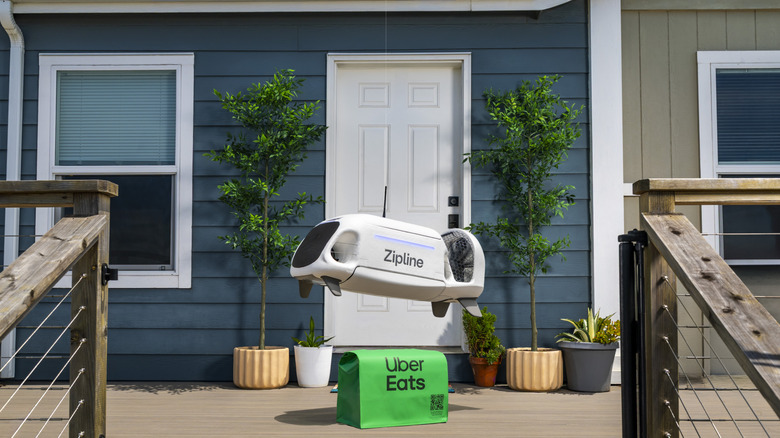
Uber Aims For 1 Million Daily Drone Deliveries With Zipline Partnership

Published

on

The first Zipline drone deliveries for Uber Eats orders will start later this year.

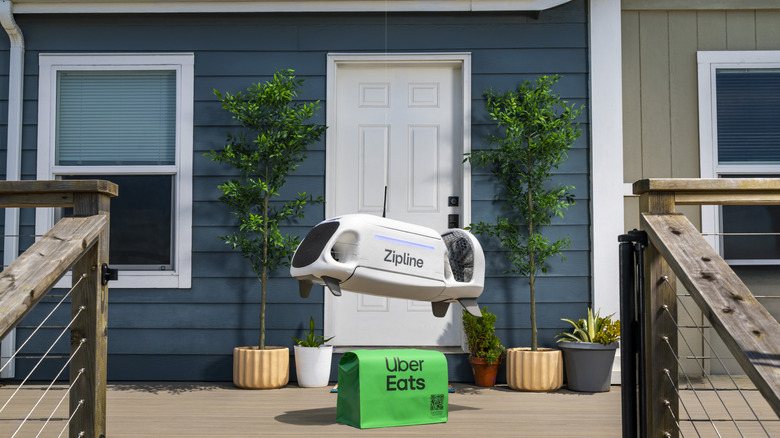
You could soon get your Uber Eats order delivered by a Zipline drone thanks to the latest partnership between the two companies. As detailed in an Uber press release, the company is targeting a goal of one million drone deliveries each day by end of 2029. The partnering companies also announced that the first deployments are scheduled for later this year, with drone deliveries first becoming available in Zipline’s existing US markets, including Pea Ridge, Ark. and the Dallas-Fort Worth metro, before expanding to dozens of more cities.

On top of the combination of Uber’s network and Zipline’s drone fleet, Uber made a strategic investment into Zipline but didn’t disclose the financial details. Before this partnership, Zipline teamed up with Walmart and Chipotle to make food and retail deliveries. On its own, Zipline has delivered more than 2.7 million deliveries ranging from healthcare products to food.

It’s not the first major investment Uber has made into drone deliveries, having partnered with Flytrex for Uber Eats in 2025. Beyond drones, Uber has partnered with companies Lucid and Momenta to offer robotaxis for autonomous ride-hailing services. However, Uber and Zipline will be directly competing with DoorDash and Wing, who kicked off their drone delivery partnership in 2022 and recently expanded their drone delivery service footprint to the metro Atlanta area.

Advertisement

Source link

Advertisement
Continue Reading

Tech

As enterprises confront AI agent sprawl, xpander wants them to own their own control and context layer

Published

on

Enterprise AI has a new infrastructure problem: companies are accumulating agents faster than they are developing systems to govern them.

Gartner estimates that the average global Fortune 500 company will have more than 150,000 AI agents in use by 2028, up from fewer than 15 in 2025. Yet only 13% of organizations believe they currently have the right AI agent governance in place, according to the research firm.

That widening gap is creating a market for infrastructure that sits above individual models and agents — handling execution, permissions, observability, memory, access to enterprise systems and lifecycle management without forcing developers to reconstruct those services for every new agent.

xpander.ai, a startup founded by three former AWS principal engineers, is the latest company trying to own that layer.

Advertisement

The company is making its enterprise AI agent platform generally available today, positioning it as a vendor-neutral control plane for building, running and governing agents across different models, agent frameworks and infrastructure environments.

In an exclusive interview with VentureBeat, xpander.ai CEO and co-founder David Twizer said the company increasingly hears three problems from enterprise customers: agents running locally without centralized governance, agent workflows remaining isolated to individual users, and infrastructure becoming tied to a single AI provider.

“The third issue is the most critical part: it’s being locked into one vendor,” Twizer told VentureBeat. “Everything that you do is actually owned by the company that you chose to work with — their tools, their roadmap, their political view of how agents should react to everything that you do.”

The caveat is that xpander’s vendor neutrality does not eliminate dependency; it moves the dependency up the stack. Enterprises can swap models, frameworks and infrastructure underneath xpander, but xpander’s proprietary Universal Harness and control plane become the layer coordinating execution, governance, identity, memory and auditability.

Advertisement

That could create a new form of lock-in if those configurations and operational state are difficult to migrate to another control plane. xpander’s public documentation does not yet explain how portable that layer is if a customer terminates its enterprise license.

The company is also announcing a $7.5 million seed round led by Pico Venture Partners, with participation from Emerge Ventures, Samsung Next and SeedIL.

But xpander is entering a market that has evolved considerably beyond a simple divide between proprietary hyperscaler platforms and neutral alternatives.

The battle is shifting above the model

Model portability is becoming increasingly common in agent infrastructure.

Advertisement

LangChain’s LangSmith Deployment, for example, provides infrastructure for deploying and governing production agents. Enterprises can run its control plane and agent servers entirely inside their own Kubernetes infrastructure, including for air-gapped and data-residency-sensitive environments. LangChain also offers hybrid deployments in which the customer operates agent servers while LangChain manages the control plane.

CrewAI is moving in much the same direction. Its enterprise offering includes centralized governance, SSO, role-based access controls, workload identity and policies, while supporting deployment in CrewAI’s cloud, a customer’s VPC or customer-owned infrastructure. CrewAI says its platform can work across models and clouds and lets customers retain and modify the code generated for their agents.

Temporal approaches the problem from another direction. Rather than offering an end-to-end agent management environment, it provides durable execution for long-running AI workflows, including crash recovery, retries, human approvals and state that can persist through failures. Its AI platform can orchestrate workflows across different models, tools and systems.

Meanwhile, the model and cloud vendors themselves are expanding upward into this infrastructure layer. OpenAI’s Frontier platform provides shared enterprise context, permissions, agent execution and management, while Google’s Gemini Enterprise Agent Platform combines managed runtime infrastructure with agent identity, centralized governance, memory, tracing and policy enforcement around agent-to-agent and agent-to-tool interactions.

Advertisement

In other words, xpander’s differentiator cannot simply be that enterprises can run agents outside one model provider’s cloud. Several competitors already offer versions of that flexibility.

Its bigger bet is that enterprises will want a framework-independent control plane sitting above an increasingly heterogeneous collection of models, agent frameworks and employee-facing AI interfaces.

Twizer’s argument draws partly on his seven years at AWS, where he watched enterprises wrestle with a previous generation of infrastructure lock-in.

“Our strategy was to bring the great thing called cloud computing and then try to create solutions that are serverless and, by definition, create vendor lock-in,” Twizer told VentureBeat. But, he said, enterprises ultimately demanded the ability to move workloads among providers.

Advertisement

“I think AI is no different,” he said. “Multi-cloud, multi-vendor is a must-have strategy.”

A runtime intended to survive model churn

At the center of xpander’s platform is what it calls a Universal Harness — a model-, framework- and cloud-agnostic runtime for executing agents as portable enterprise workloads.

Companies can use xpander’s hosted environment or, under its enterprise offering, self-deploy on Kubernetes or on-premises infrastructure. The company also explicitly lists AWS, Google Cloud, Microsoft Azure, private VPCs and fully air-gapped on-premises environments as supported deployment targets.

The framework claim is similarly broad: xpander says customers can bring agents built with frameworks including LangChain, Strands and Agno, as well as their existing prompts, rules and skills. It supports proprietary, open-weight and customer fine-tuned models.

Advertisement

For developers, xpander exposes three main integration routes: a language-agnostic REST API for control-plane operations, a Python SDK for building agents and workflows, and Model Context Protocol support that exposes agents and tools to MCP clients such as Claude Desktop and Cursor. The REST interface includes operations for managing and invoking agents, tasks and knowledge bases, while the SDK adds event handling and agent lifecycle abstractions.

“Think like a Kubernetes environment that runs inside your own premises, your private cloud or our xpander cloud,” Twizer told VentureBeat. “The harness that is agnostic can run any agent of any vendor.”

Twizer said the goal is eventually to make model selection more analogous to choosing compute underneath an application than committing an organization to an entire software ecosystem.

“You can go from Claude to ChatGPT to Kimi and to your own fine-tuned models,” he said. “All of them will be used in the same way that you use CPUs. You don’t really care who makes them. You just want your application running.”

Advertisement

That architecture is intended to let the underlying workloads change while the orchestration and operational layer remains relatively stable.

The distinction could become more important as enterprises use more than one AI supplier. OpenAI itself says enterprise AI is shifting from assistance toward delegated work performed by agents, with its latest enterprise data showing rapidly growing agentic usage across functions including legal, sales, recruiting and marketing.

At the same time, Google is adding centralized agent governance, identity and gateway controls specifically to manage interactions between agents and tools at scale. Those investments from much larger vendors reinforce xpander’s basic premise: managing the model is increasingly only one part of putting agents into production.

What ‘governance’ means in practice

Twizer argues that locally running agents make that operational problem particularly acute.

Advertisement

“You install Claude or ChatGPT or Codex or any other AI system that runs on the employee laptop, and you get a black box,” he told VentureBeat. “Nothing is governed, nothing is audited, and nothing is controlled.”

His concern is not simply that an agent can access local resources, but that AI products have rapidly moved from generating text to taking actions without enterprises necessarily building equivalent governance infrastructure around them.

“It happened overnight that the shift from, ‘Here is the chatbot that helps me write an email,’ became, ‘It is an AI agent that can control my machine and perform API calls,’” Twizer said.

xpander’s documentation provides a more concrete definition of what the company means by moving that activity into a governed environment.

Advertisement

The control plane can define who is allowed to run an agent, which resources the agent can reach and which actions require human approval. xpander says agents receive named identities and actions can be traced back to the human who invoked them. Tool calls, runs, traces, approvals and failures are logged, with spending attributable at the task level.

One particularly relevant architectural detail for security teams is credential handling. xpander says credentials are injected from a vault when a tool call executes, rather than being exposed directly to the model.

The company says it is SOC 2 Type II certified and GDPR compliant. Its enterprise tier also includes SSO and OIDC, a private model gateway and sub-organizations with per-team usage attribution.

Where xpander is trying to separate itself from products such as LangSmith and CrewAI is in treating the underlying agent framework itself as another replaceable component rather than making its own framework the primary development environment.

Advertisement

The company says its runtime can operate xpander-native agents alongside custom agents built with other frameworks. That broader framework neutrality is a company claim and will need to prove itself in production; the overlap among these platforms is already substantial.

The cost of building the agent layer yourself

For enterprises that want centralized control without adopting another vendor’s infrastructure, the alternative is increasingly to assemble many of these components themselves.

Twizer argues that this is where the hidden cost of production agents emerges. Accessing a foundation model is comparatively straightforward; recreating the operational infrastructure surrounding a sophisticated managed agent is not.

“If you want to do something like the amazing [Anthropic] Claude Code in a way that is governed and secure, you need to build the entire harness,” Twizer told VentureBeat. “You need to build the sandbox and the authentication and the human in the loop and the storage and the session management and the memory layer.”

Advertisement

“It’s like investing two years of infrastructure just to run that agent in a secure way,” he added.

The company’s documentation says its harness handles long-horizon and multi-tool tasks, sandboxed code execution, persistent memory and recovery when tasks fail or drift. That is important context for Twizer’s argument: xpander isn’t merely offering a gateway that swaps one model API for another; it is attempting to package many of the runtime services enterprises otherwise have to operate alongside those APIs.

Twizer said xpander has heard from government organizations and financial institutions using its technology in production that this infrastructure burden was preventing them from deploying agents in a controlled way.

The company’s website separately displays logos for organizations including Lenovo, Intel, Workday, Siemens, Nvidia, Intuit, SAP, PagerDuty, Mozilla and Salesforce under the label “Used by teams at.”

Advertisement

The company’s answer is not that enterprises should abandon products from Anthropic, OpenAI or other AI providers. Twizer instead argues that companies should retain those models while moving permissions, monitoring and execution into an infrastructure layer they control.

“It’s not, ‘Don’t use Claude,’” he said. “It’s actually, ‘Use Claude, but in a way that you watch it, that you secure it, that you monitor it,’” with controls over authorized skills and who can access particular resources.

Making agents organizational rather than personal

xpander is also adding a collaboration layer it calls Multiplayer AI.

The premise is that enterprise agents increasingly need to outlive a single user’s chat session. A workflow might involve an agent collecting data, another system taking an action, an employee approving it and a different team resuming the process hours or days later.

Advertisement

Twizer argues that locally deployed assistants have another disadvantage: the expertise employees accumulate through their agents — prompts, skills, workflows and context — tends to stay with those individuals.

“You’re making the AI agents better, and you’re not making the company better,” he told VentureBeat. “All the data, all the prompts, all the workflows, all the skills that you are now investing in that ecosystem are being locked inside that vendor, and it’s very hard to share it with other colleagues.”

More complex enterprise work also rarely maps neatly onto a single chat session.

“Work is not single player. It’s multiplayer,” Twizer said. “It’s happening over the period of multiple days, even weeks. Workflows that are significant to enterprises are not chatbots.”

Advertisement

xpander’s shared conversations are designed to keep those interactions in persistent, permission-scoped threads. An agent can be published once for use across an organization, while employees can interact with agents through Slack, Teams, ChatGPT, Claude and xpander’s own interface.

The company’s documentation says downstream actions can identify as the human who invoked the agent through end-to-end authentication using OIDC — a potentially important distinction for organizations that need to preserve user-level identity and authorization as work moves through an agent.

The requirement for persistent execution is not unique to xpander. Temporal has made long-running, failure-resistant workflows the core of its AI pitch, while LangSmith supports persistent agent deployment and production observability.

What xpander is attempting to combine is that runtime infrastructure with enterprise collaboration and governance into a single, portable, flexible, vendor-neutral control plane.

Advertisement

Omni tests the harness thesis

The company is also making Omni, its prebuilt agent, generally available.

Calling Omni simply a general-purpose agent understates what xpander is now selling. Its documentation describes Omni as an AI forward-deployed engineer that turns a requested business outcome into what the company calls an “Agentic Application”: a backend agent coupled with a frontend experience that can include chat, interactive UI components, reports, dashboards and visualizations.

A user can describe the desired outcome, after which Omni is designed to help construct the application, connect its model, skills, tools and data, execute work as tracked tasks, and maintain files and reusable context in an Agent Workspace. The resulting application can then be shared with teammates.

For example, xpander’s documentation shows a user asking Omni to build a Redshift Analyzer. Omni is intended to gather the requirements, design the interface, construct the backend agent, attach appropriate connectors and tools, and generate the first live application surface.

Advertisement

The documentation also lists Slack, WhatsApp, Telegram and email as Omni channels, while xpander’s broader platform materials list Teams, Claude, ChatGPT, API, webhook, CLI and MCP among the ways work can reach agents. Because the company’s materials describe slightly different channel sets for Omni and the broader platform, enterprises should verify support for their particular interface and deployment configuration.
Omni can also function alongside desktop AI products rather than replacing them. Twizer said employees can continue using their preferred desktop agents while Omni acts as a skill exposing only enterprise-approved data and connectors. When background execution is needed, Omni can create a centrally controlled agent to perform the work.

xpander says Omni scored 90.9% on the GAIA benchmark, including strong performance on its most difficult tasks. The result is company-reported and should be viewed as evidence for xpander’s broader thesis rather than independent validation of the platform.

Twizer said the company deliberately tested the harness with a mixture of models rather than optimizing around a single proprietary system.

“We took Opus, we took Sonnet, we took Kimi, we took GPT, and on that benchmark we got a 90.9% score,” he told VentureBeat.

Advertisement

For Twizer, the result supports an argument that agent performance increasingly depends on the infrastructure surrounding the foundation model.

“It just proves that the value is in the harness layer and not in the model layer,” he said. “The value is in: How do you handle long-running tasks? How do you handle tool calling? How do you do sandboxing? How do you focus? How do you make the agents focused on the task?”

The benchmark results are publicly available, allowing others to examine the company’s methodology, but the broader conclusion remains xpander’s interpretation of its own results.

That thesis is increasingly shared across the industry. The disagreement is over who should control that layer.

Advertisement

OpenAI and Google are turning it into part of broader AI platforms. LangChain and CrewAI are extending their development ecosystems into enterprise runtimes. Temporal is attacking the execution problem as infrastructure.

xpander is betting enterprises will instead want that control plane to remain independent of all three choices: model, cloud and agent framework.

The company now has to demonstrate that the extra abstraction is valuable enough to justify another platform in an enterprise AI stack that is already becoming crowded.

Pricing and Availability

xpander’s platform and Omni are generally available now, with two substantially different commercial models for teams using xpander’s hosted service and enterprises running the platform on their own infrastructure.

Advertisement

The self-service Team offering has no seat charge and is priced in credits based on agent activity. xpander defines one credit as one cent, meaning $100 buys 10,000 credits. Each event or message that wakes an agent costs one credit for the entire turn, regardless of how long the turn runs, and each tool or API call costs another credit. Model tokens are billed separately in credits at configured rates for the selected model.

That makes the cost structure more granular than Twizer’s description of paying for agent “output” might suggest. Long-running execution itself does not appear to create a duration-based charge under the published pricing, but a workflow can accumulate costs through repeated invocations, tool calls and model-token consumption.

New accounts receive 1,000 free credits rather than a time-limited free trial, and customers can sign up with a credit card. The Team tier permits unlimited agents, workflows and seats, according to xpander.

Model usage can represent a significant portion of total cost, and the company publishes examples intended to make that expense calculable. Its pricing page lists different input and output token rates for individual models and says those model charges are incorporated into the credit system, eliminating a separate model-provider bill for hosted customers. Actual spending therefore depends heavily on the models selected, token volumes and number of tool calls.

Advertisement

Enterprises that self-host get a different arrangement. xpander’s Enterprise plan is an annual license starting at 50 agents and supports deployment on a customer’s Kubernetes infrastructure or on-premises environment. It includes SSO and OIDC, sub-organizations with pooled credits and per-team usage reporting, private model-gateway connectivity, onboarding and Tier 1 support. Customers can also bring their own model API keys and use their own negotiated model-provider rates.

xpander does not publish the dollar price of that annual enterprise license, so prospective customers cannot calculate the total cost of a private or air-gapped deployment from public information alone. The pricing materials also do not provide a public dollar figure for the 50-agent starting commitment. Those deployments require contacting xpander for custom pricing.

“You pay only for the work that the agent is doing,” Twizer told VentureBeat of the hosted model. “No subscription fee, no seat fee, no builder seat, nothing. You just pay for the actual output of the agents.”

For enterprise buyers, that distinction is important: xpander’s no-seat-fee claim applies most straightforwardly to its usage-based hosted offering. Organizations that need to own the deployment environment are instead evaluating an undisclosed annual license, infrastructure costs and their own model-provider spend.

Advertisement

That leaves xpander with a straightforward but increasingly contested pitch as enterprises confront agent sprawl: keep using whichever models, frameworks and interfaces employees find useful, but move the infrastructure controlling what those agents can do into a common layer the organization can govern.

Whether enterprises ultimately want that layer from an independent startup, an agent framework company or the same hyperscalers and model providers xpander wants to abstract away is now becoming another battleground in the enterprise AI stack.

How xpander compares with other agent infrastructure

The overlap becomes clearer when the products are compared directly. Several rivals now support multiple model providers, customer-controlled infrastructure or both. The differences increasingly concern how much of the agent stack each platform attempts to own — and whether it provides an agent development framework, a neutral runtime, durable workflow infrastructure or a collection of managed cloud services.

Solution

Advertisement

Deployment

Model / framework flexibility

Enterprise and runtime features

Public pricing

Advertisement

xpander.ai

Hosted service, plus an enterprise license for

self-deployment on Kubernetes or on-premises infrastructure

; xpander also advertises private VPC and air-gapped deployments.

Advertisement

xpander says its Universal Harness supports

multiple models and outside frameworks including LangChain, Strands and Agno

.

Central permissions and approvals, per-user identity, audit trails, tool-call logging, credential injection, long-running tasks, shared “Multiplayer” workflows and Omni.

Advertisement

The company says each action can be associated with the invoking human

.

Hosted service is usage based:

1 credit = $0.01, with 1 credit per agent wake and 1 per tool/API call, plus model-token charges

Advertisement

. New accounts receive 1,000 credits and seats are unlimited. Enterprise is custom-priced, annual and

starts at 50 agents

.

LangSmith

Advertisement

Cloud, hybrid or

fully self-hosted on Docker Compose or Kubernetes

; hybrid and self-hosted options require Enterprise.

LangChain describes LangSmith as a

Advertisement

framework-agnostic platform

for observing, evaluating and deploying agents.

Observability, evaluations and agent deployment; Enterprise adds

SSO, ABAC/RBAC and self-hosted or hybrid deployment

Advertisement

.

Plus is

$39 per seat per month, then pay-as-you-go

. Enterprise is custom priced plus usage charges.

Advertisement

CrewAI

SaaS, customer VPC or

customer-owned infrastructure

.

Advertisement

CrewAI centers on its own agents, crews and flows framework, but supports

multiple LLM providers

, including custom model integrations.

Agent building and orchestration, long-running flows, memory, observability and human-in-the-loop controls. Enterprise adds

Advertisement

SSO, RBAC, workload identity, PII redaction and policies

.

A

free tier is available

Advertisement

; Enterprise pricing is custom and includes a 45-day onboarding program.

Temporal

Temporal Cloud or the

self-hosted open-source Temporal Service

Advertisement

. Application workers continue to run in the customer’s environment when using Temporal Cloud.

Not an agent framework or model gateway. Temporal is model-agnostic because it provides durable workflow execution underneath application and agent code rather than selecting the model or agent framework.

Durable execution, persistent workflow state, retries, timers, signals and recovery — useful for agents that must survive failures or run for long periods. Cloud tiers add audit logging, roles and higher-tier SSO/SCIM.

Temporal Cloud Essentials

Advertisement

starts at $100/month

with 1 million Actions, 1 GB active storage and 40 GB retained storage. Business starts at $500/month; Enterprise is custom. Additional Actions start at $50 per million before volume discounts.

Amazon Bedrock AgentCore

Fully managed AWS infrastructure rather than a customer-operated control plane.

Advertisement

AgentCore Runtime explicitly supports

agents built with outside frameworks and custom code

, as well as

foundation models inside or outside Amazon Bedrock

Advertisement

.

Managed runtime isolation and scaling plus optional identity, memory, gateway, browser, code interpreter, observability and evaluation services. The runtime supplies infrastructure while

developers retain their own orchestration loop

.

Advertisement

Consumption based. Runtime currently lists

$0.0895 per vCPU-hour and $0.00945 per GB-hour

, with separate charges for services such as memory, gateway, web search and evaluations.

The comparison complicates a simple vendor-neutrality pitch. AWS AgentCore, for example, supports models outside Bedrock and frameworks including LangGraph, CrewAI and Google’s ADK, while LangSmith explicitly calls itself framework agnostic. CrewAI offers customer-controlled deployments and broad model choice. Temporal lets companies self-host the durable execution layer entirely, although it solves a narrower infrastructure problem rather than offering a complete agent control plane.

Advertisement

That makes xpander’s potential differentiation more specific. It is trying to combine framework and model portability with enterprise identity, governance, runtime infrastructure and an employee-facing collaboration layer, rather than competing only on the ability to swap models or deploy outside a vendor’s SaaS environment. xpander also prices its hosted platform around individual agent wakes and tool calls rather than seats, although enterprises requiring self-hosting face an undisclosed annual license beginning at 50 agents.

Source link

Continue Reading

Tech

Skylight Buddy Review (2026): Kid Routines Just Got Easy

Published

on

That excitement has stuck around for almost two weeks and counting. My son loves tapping the round corner checkbox to complete his routine items. I do have to remind him sometimes that he hasn’t yet completed something, which prompts him to uncheck the box and complete the task with me, like putting on pajamas, and then running to check it off again. His favorite part is clicking all the tasks as done and seeing a shower of emojis (which change each time) rain down as recognition of a job well done. He likes to activate that congratulatory feature before he actually finishes the tasks, just to see it. Then he un-clicks the unfinished tasks so that he can make the emojis rain again upon actually finishing his list. I get the appeal—I wish my laptop’s Notes app did this when I finish my long to-do list each day.

Image may contain Computer Electronics Computer Hardware Hardware Monitor and Screen

Photograph: Nena Farrell

Video: Nena Farrell

If you have a Skylight Calendar, it’s nice that the Buddy syncs to it. This capability lets your kid alternate between where they physically check off their tasks—and all changes are reflected on both devices. This is convenient if you have a multi-floor layout, as I do, because running upstairs to check off a morning task may become more of a hindrance than a help.

Speaking of the larger Skylight Calendar, if you have one in your home like I do, I recommend opting into the Skylight Plus subscription. This gets you the photo frame feature, plus other capabilities, like rewards and meal planning. With the Skylight Buddy, a subscription gets you rewards, timers, and nudges, though the company shares that more subscription features are coming soon. Rewards are definitely handy for older kids who can earn stars for tasks and chores, but I just want my 4-year-old to get excited about completing the tasks. So far, he hasn’t needed any extra features to stay engaged, and he suddenly likes brushing his teeth so he can check it off his daily list.

Advertisement

The Skylight Buddy also has its own subscription, Buddy Plus, for $39 a year if you want those extra features but don’t have a Skylight Calendar. It’s cheaper than the Skylight Plus. The Buddy itself is available for $120 when you buy it with a free month of the Plus Plan, or $140 for the device alone.


Power up with unlimited access to WIRED. Get best-in-class reporting and exclusive subscriber content that’s too important to ignore. Subscribe Today.

Source link

Advertisement
Continue Reading

Tech

Tipperary’s Jamie Palmer on Icarus Robotics and an industrialised orbit

Published

on

The two-year-old start-up will test its robot aboard the ISS early next year.

Jamie Palmer makes a simple argument; That demand for space-based innovations cannot be addressed with human labour alone. It’s a “no-brainer”, the 26-year-old says.

Globally, governments spent roughly €119bn into the space industry last year (defence budgets represent a significant portion of these figures), while private investments surged 60pc to €11.7bn, led primarily by US activity. And behind by a large margin – but still at second place – European space ventures raised €1.4bn in private capital in 2025.

Collectively, these investments have created a downstream market valued at around €490bn, largely made up of new-generation satellite communications, and Earth observation and Global Navigation Satellite System-related markets.

Advertisement

This relatively new commercial and scientific battleground – valued at around $1.8trn, according to the World Economic Forum – is propped up with thousands of Earth-based workers and only a handful of highly specialised astronauts, that each cost around $130,000 an hour “to keep alive [in space]”.

But working outside Earth requires this expensive labour to carry out extensive maintenance tasks every day – something NASA once called a “full-time job in itself”.

For example, astronauts aboard the International Space Station (ISS) need to carry and stow away roughly three and a half tonnes of cargo sent from Earth every 45 to 60 days. Palmer says astronauts he has spoken to say this is one of their biggest time sinks which keeps them from research work.

The Co Tipperary robotics expert and his co-founder Ethan Barajas are responding to this market need with their start-up Icarus Robotics, which has developed a free-flying mobile robot capable of carrying out a mix of tasks. “Essentially, logistics capabilit[ies] in space,” says the Trinity College Dublin and Columbia graduate.

Advertisement

The 2024-founded New York-based company raised $6.1m last year in a round led by Soma Capital and Xtal with the ultimate goal of creating an industrialised low Earth orbit by the end of this decade.

Two young men standing, smiling,

From left: Ethan Barajas and Jamie Palmer. Image: J Anders Urmacher/NYFrequency

Joy goes to space

Icarus’ flagship robot, called Joy, has two moving arms and uses fans to propel itself through microgravitational environments. The two-year-old start-up will test this model aboard the ISS early next year in its first-ever major partnership with space veteran Voyager Technologies.

As part of the test, one of these robots will be handed over to Voyager around the end of this year, with plans to fly aboard the SpaceX cargo resupply mission in early 2027. Voyager will be overseeing payload integration, safety certification, launch coordination, on-orbit operations planning and real-time mission execution support.

Advertisement

“For [Voyager Technologies] to be able to help us get our first payload to space…is a really, really big win for us,” Palmer says.

In its initial test, Icarus plans to tele-operate its robots inside the ISS. Palmer says that this would ensure safety, prove their thesis and allow them to collect data in microgravity to train their AI.

The start-up wants to make a gradual scale from one human operator per robot, to partial autonomy – with one person looking at multiple robots – to eventually, full autonomy. It says that one astronaut can supervise up to four robots from Earth, reducing costs by around 94pc.

But ultimately, Icarus wants to completely eliminate the need for teleoperation. “Companies can’t justify teleoperation because the margins are so expensive”, the co-founder says. His eventual hope is to have all Icarus robots working in a “hive mind” of sorts.

Advertisement

The start-up took inspiration for Joy from its space robot predecessors such as NASA’s Astrobee, the Airbus-made CIMON and the Japan Aerospace Exploration Agency’s INT Ball – developing its highly dexterous robot based on learnings from the older versions.

Infrastructure in space

An industrialised LEO is not complete without scalable infrastructure. “How can we actually put up infrastructure that can be maintained? How can we maintain it? How can we assemble infrastructure that’s bigger than our launch capacity?” Some of these questions are already being answered.

Companies such as Vast, Axiom and Starlab are developing commercial space stations with the hopes of stoking a competitive market in space. Vast’s Haven-1 is set to be the world’s first commercial space station set for launch early next year.

Other solutions, including the re-entry vehicle market is “absolutely huge” right now, Palmer says. Fortune Business Insights values the market at about $12bn this year, projecting it to grow to more than $32bn by 2034.

Advertisement

Meanwhile, orbital data centres are a seeing significant push led primarily by Elon Musk’s SpaceX, which recently filed for a constellation of up to 1m satellites. Jeff Bezos-owned Blue Origin, meanwhile, filed plans for 51,600 data-centre satellites in LEO.

“People are proving out their capabilities, and now they’re starting to sort of commercialise and spread, and I think that’s very exciting,” says Palmer.

The 26-year-old says he had been attempting to build a general purpose robotics company “for the longest time”. He met Barajas at the Entrepreneur First accelerator programme in 2024.

Ethan’s background is from NASA and Caltech. So he’s been kind of embedded in the space industry. And I had never looked at it before. So ultimately, we came together with sort of my level of general purpose robotics and Ethan’s love in space.”

Advertisement

During his time in Dublin, Palmer briefly worked at Akara, the Time Magazine-featured start-up behind the AI-powered robot Stevie designed to care for elderly people at care homes.

Developing robots for people unfamiliar with such technology gave the young graduate an “experience that not many robotics engineers ever get,” he says.

“Growing up in Tipperary – I always had like big ideas where I knew I wanted to do something like really huge.” Palmer was part of the 2020 cohort of Patch at Dogpatch Labs where he spent time with entrepreneurs ahead in their ideas while also getting to work on his own business.

Don’t miss out on the knowledge you need to succeed. Sign up for the Daily Brief, Silicon Republic’s digest of need-to-know sci-tech news.

Advertisement

Source link

Continue Reading

Trending

Copyright © 2025