We spend hours testing every product or service we review, so you can be sure you’re buying the best. Find out more about how we test.
Laifen T1 Pro: two-minute review
On first impressions, the Laifen T1 Pro wows. Open the box and you’re greeted with Apple-inspired packaging, while the shaver itself immediately looks the part. Its CNC-machined unibody aluminium body looks and feels genuinely premium and, if you’re used to cheaper shavers like the Philips OneBlade – my usual razor – it’s impossible not to grin at the magnetically attached shaving head, which somehow manages to feel genuinely futuristic.
Modern conveniences like USB-C charging, an aeroplane mode to stop the power button being pressed in your bag while travelling and IPX7 waterproofing all add to the premium feel. Based on the spec sheet and those first impressions, you’d be forgiven for thinking the Laifen T1 Pro was one of the best electric shavers on the market.
Advertisement
The problem is that, with a shaver, the only thing that really matters is the shave itself, and that’s where the Laifen T1 Po disappoints. I shave twice a week and have fairly coarse stubble, and despite repeated attempts the T1 Pro simply couldn’t deliver a comfortable shave and often snagged on my hairs, which was painful and left me with patchy stubble. You have to limit your expectations a bit with single-blade razors, but I’ve been getting an effective shave with my Philips OneBlade for years, and often I found myself reaching for it to finish up and get the hairs that survived the T1 Pro’s efforts.
Latest Videos From
This leaves the Laifen T1 Pro in an awkward position. It’s beautifully designed and genuinely pleasant to use in every respect until it comes to shaving, but if I have to reach for a second razor to finish the job, the premium build and thoughtful features become little more than a nice distraction. I’d love to see Laifen revisit the shaving head in a future model because the engineering elsewhere is genuinely impressive, but as it stands I can’t recommend the T1 Pro.
(Image credit: Future)
Laifen T1 Pro: price and availability
List price: $149 / £149 / AU$246
Launched: September 2025
The Laifen T1 Pro launched in September 2025. Listing prices vary but are consistent with other premium shavers. In the US it’s currently selling for around $129, in the UK it’s £149 and in Australia it’s $239. However, it doesn’t come with a case, cleaning materials or anything else so it may feel steep in comparison
Advertisement
Laifen T1 Pro: design
CNC-machined aluminum feels premium
Magnetic head feels futuristic and makes cleaning a breeze
USB-C means you’re just taking one cable away with you
The Laifen T1 Pro makes an excellent first impression. Unlike the plastic-bodied shavers that dominate the market, the T1 Pro is built around a CNC-machined unibody aluminium chassis that immediately feels more like a premium gadget than a bathroom appliance. The fit and finish are excellent, while the magnetically-attached shaving head snaps satisfyingly into place and makes cleaning refreshingly simple.
Laifen has also packed in plenty of thoughtful features. USB-C charging means one less proprietary cable to keep track of, an airplane mode prevents the power button from being accidentally pressed in your luggage, and the IPX7 waterproof rating means you can use the shaver wet or dry before simply rinsing it under the tap to clean it up.
Sign up for breaking news, reviews, opinion, top tech deals, and more.
(Image credit: Future)
The compact dimensions work in the T1 Pro’s favour. It’s comfortable to hold despite the lack of any rubberized grip, and the aluminum body never felt slippery during my testing, even during a heatwave when I was, perhaps a little sweatier than I’d like to admit. Its low weight, just 3.3oz / 93g, makes it easy to use precise movements in the tricky areas like the jawline and around the mouth — areas that can be difficult with larger, clunkier, shavers.
It’s a minor thing, but I found myself squeaking with joy each time I opened the little cap at the bottom of the razor to reveal the USB-C charging port. It’s a small thing, but the cap fits so neatly in and comes away so delicately it sparks joy every time I charged it.
Advertisement
In many ways, the T1 Pro feels like the product of a company obsessed with industrial design. From the premium materials to the magnetic shaving head and clean, minimalist aesthetic, there’s very little to criticize about the hardware itself.
Laifen T1 Pro: performance
Foil snags on coarse hair, which is painful
The shave is patchy and inconsistent
Long-lasting battery means you’ll only need to charge occasionally
Ultimately, the Laifen T1 Pro lives or dies by the quality of its shave, and that’s where it struggles. I have fairly coarse facial hair and typically shave twice a week, which proved to be a challenge the T1 Pro never really overcame.
Rather than cutting cleanly through my stubble, the shaver frequently pulled at beard hairs, making each shave less comfortable than it should have been. It also struggled to achieve an even finish. Even after several passes, I was often left with patches of missed stubble that required further attention. The trimmer head was more prone to this snagging, but the shaver head didn’t eliminate the problem and also left my skin irritated.
The T1 Pro’s light weight makes it easier to use, but its small size means covering your face takes longer than with a larger foil shaver. As a result, multiple passes quickly became the norm, and each additional pass increased the likelihood of the shaver snagging on thicker patches of hair.
Advertisement
(Image credit: Future)
I repeatedly found myself reaching for another razor to finish the job. Not only did it clean up the areas the T1 Pro had missed, but it also did so more comfortably. That’s difficult to overlook given the T1 Pro’s premium price.
The 120-minute battery life is excellent and should last most people several weeks between charges.
Unfortunately, The Laifen T1 Pro looks and feels like a premium electric shaver, but in my experience it simply doesn’t deliver the shave the design promises, which makes it impossible to travel with because I also have to toss a second razor into my bag.
Advertisement
Should you buy the Laifen T1 Pro?
Swipe to scroll horizontally
Laifen T1 Pro score card
Attribute
Notes
Score
Value
Advertisement
A disappointing shave that is often painful.
2/5
Design
Beautifully designed with some thoughtful choices.
Advertisement
4/5
Performance
A premium price backed up by the design but not the shave.
Despite significant external volatility, artificial intelligence continues to be a major driver of Ireland’s economy.
Ibec, the group representing Irish business, has today (16 July) published its latest Quarterly Economic Outlook report, which explores many of the issues impacting Ireland’s economy.
It found that despite significant pressures and global volatility affecting growth, AI-related investment, investment in public infrastructure and resilient consumer spending are all continuing to support the economy.
Gerard Brady, Ibec chief economist and head of national policy, explained that we are seeing early evidence of the impact artificial intelligence is having on the country’s economic figures. He said that total trade in AI-related goods to and from Ireland is on track to double across five years, reaching €56bn annually.
Advertisement
He explained that there has been a significant investment in ICT equipment and software, to the value of almost €6bn in the past year, which is a 50pc increase compared to 2025 and double the amount from 2024. He said that within business, the impact of AI on the competitive environment, investment, trade and the labour market is clear, that these figures will only grow over time.
Commenting on the report, Brady said, “Given that we are only at the foothills of understanding the impact of AI on our economy, the full picture has yet to emerge. We may not be at the forefront of developing new AI models, but early evidence suggests we have an opportunity to be a central node in AI-related supply chains.
“We also have a massive opportunity to be the country with the best-prepared workforce for the generational change in work and skills currently underway. However, our participation in lifelong learning hovers around the EU average, well below where we want to be for an open, global and sophisticated economy.”
He explained that Ireland’s current economic success is firmly rooted in its commitment to investing in a manner that enables the country to be at the forefront of new technological shifts in the global economy.
Advertisement
“We have a tangible opportunity to get ahead of other countries because we have a large training fund, in the form of the National Training Fund, paid for by employers, with a €2bn surplus. This cannot be left idle,” he said. “This fund must be deployed to support the workforce transition, prepare us for change and set Ireland up as a frontrunner in the emerging global economy.”
For Ireland, despite global pressures – such as the US-Iran ceasefire collapse, US tariffs and the uncertainty around the Strait of Hormuz – exports have remained relatively resilient. However, Ibec did find that it will be 2027 and beyond before we can fully understand the true impact of tariffs on Ireland’s exporting sectors.
Brady said, “We expect exports, which grew by around 7.5pc in 2025, to rise only marginally in 2026 as a consequence of this ‘whiplash’ effect. However, exports are projected to resume strong growth at 4pc in 2027. The story within the domestic economy is more prosaic. Consumer spending is holding up, but inflation will dent its trajectory.
“While the labour market is showing signs of softening, investment remains strong. Most of the levers to support long-term economic development, such as infrastructure delivery, skills development, regulation, and supporting innovation and digitalisation, remain firmly within our control.”
Advertisement
Ibec also recently issued a new report exploring the correlation between workplace AI and consistent learning strategies. The ‘Skills for all, skills for life’ report warned that unless there is a deliberate shift in the national approach to lifelong learning, Ireland will fail to capitalise on the long-term economic potential of AI.
Don’t miss out on the knowledge you need to succeed. Sign up for the Daily Brief, Silicon Republic’s digest of need-to-know sci-tech news.
We spend hours testing every product or service we review, so you can be sure you’re buying the best. Find out more about how we test.
Fluance RT87 Turntable review: two minute review
Nothing highlights the highs and lows of vinyl like a proper turn table such as the Fluance RT87. Maybe you’ve been using the same Audio Technica LP-60 or even Crossley or Victrola that proliferates the storefront of every record store you’ve ever been to. No shame, I’ve had each at some point.
But there’s something about a fully manual turntable from assembling and calibrating (and testing one’s patience) to cleaning a record every time you put a new one on. Convenient is not necessarily a word that I would use for this process. But it is a bit meditative. More importantly, the audio quality you get a step above with that analog warmth that the best turntables are known for, while not adding unnecessary distortion that may make your vinyl also sound a bit unintentionally lo-fi.
Advertisement
Of course, spending the $799.99 / £666.33 / AU$1,231.70 is not enough for that immersive listening experience. You should probably get a pair of the best stereo speakers you can afford. And if those speakers don’t have a built-in phono preamp, you’ll have to get one of those too. This turntable does not come with one.
Latest Videos From
Fluance RT87 Turntable review: price and release date
The Fluance RT87 is playing Kacey Musgraves. (Image credit: Future / James Holland)
How much does it cost? $799.99 (around £666 / AU$1,230)
When is it available? Available now (launched in June 2026)
Where can you get it? Available now in the US; UK and Australia coming soon
Newest among Fluance’s offerings with a mid-June 2026 release, the Fluance RT87 is available in the US and will (at the time of writing) be available in the UK,and Australia very soon. And whether you get it in Natural Walnut, Piano Black, or Piano White, the price goes for an only-cheap-to-audiophile price of $799.99 (around £666 / AU$1,230). And that price stays the same regardless of cartridge, of which you can choose from the Ortofon 2M Blue or Audio Technica AT-VM95ML.
Just be aware that the Fluance RT87 does not have a built-in phono preamp, so you’ll need to invest in one. Fluance does sell the PA10 Phono Preamp for $99.99 / £82.99 / AU$154 and can be bundled (though without a discount) on its site.
Advertisement
Fluance RT87 Turntable review: features
The Fluance RT87 has a speed selector, so no need to change the belt. (Image credit: Future / James Holland)
Very light on features and extra perks — the connoisseurs’ choice
No phono preamp or 45 RPM adapter
Does come with a bubble level
If the Fluance RT87 is more for the audio purist and I think that’s who the brand is targeting, then it makes sense that this turntable is pretty light on convenience-focused features. There is no built-in phono preamp — something you can find on much cheaper decks like the Audio-Technica AT-LP70XBT. And, of course, you won’t find Bluetooth connectivity or any other unique types of connectivity.
I don’t say this as a bad thing, either. After all, the Fluance RT87 is meant for someone ready to enter more serious vinyl listening and all those extra accoutrements take away from what’s important and that’s its performance and everything involved in making sure that it performs properly.
Sign up for breaking news, reviews, opinion, top tech deals, and more.
While I’ll cover most of those choices for performance in the next couple sections, it’s worth noting that the Fluance RT87 comes with the option of either the Ortofon 2M Blue or Audio Technica AT-VM95ML cartridge, either of which cost over $150 as just as part ($166.99 and $179.00, respectively). The configuration reviewed here is the Ortofon 2M Blue.
While there are plenty of opinions out there on both cartridges and how they affect the sound and I won’t parse out that whole conversation — people’s opinions of cartridges are as varied as they are on any other piece of audio equipment — other than to say that either cartridge marks an entry point into serious audio quality from more budget cartridges… just like the Fluance RT87 itself.
Advertisement
It’s also worth mentioning that this turntable can play 78, 45, and 33 RPM, via a selector on the lower left corner of the turntable so no need to adjust the belt like some turntables. Unfortunately, it doesn’t come with a 45 RPM adapter. Additionally, it has an Auto-Stop toggle on the back.
Features score: 3 / 5
Fluance RT87 Turntable review: sound quality
The Fluance RT87 being used in a somewhat treated room. (Image credit: Future / James Holland)
Has a sweet, slightly warm sound
Soundstage is immersive
No discernable inner groove distortion
I learned a lot about my records using the Fluance RT87 as my conduit. I learned that I didn’t like the way Fleetwood Mac’s Rumours is mixed. I learned that there’s way too much happening in Kamasi Washington’s Truth. Just to name a few.
You hear something that was there this whole time, but you noticed it on this last listen. And that’s not something that typically happens with entry-level gear. In short, I really enjoyed listening to the Fluance RT87. And while the turn table is a step or two up from entry-level gear (maybe beginner audiophile gear or first serious turntable level), the rest of the chain was more on the budget side — Fluance’s affordable PA10 phono amp and the company’s Ai41 speakers. Solid gear, but not transcendent.
Advertisement
One of the good things about using the Ai41 speakers is its Bluetooth connectivity. I could compare a record to a digital stream of the same music via HiFi through Deezer, which I did in a few cases. Rumours, for instance, got a play through vinyl as well as Kacey Musgrave’s Golden Hour. And the vinyl sounded just a little bit better. Maybe it’s the even-order harmonics. Maybe it’s using physical media over digital zeros and ones. To me, everything through the Fluance RT87 had this little bit of bloom to it. It just sounded a little bit sweeter.
Since I had done my best to properly set up my bookshelf speakers when I did my serious listening, I found the soundstage to be expansive and enveloping during listening sessions. I mentioned Kamasi Washington’s Truth, from his album Harmony of Difference before. When playing that song (really the whole record), not only could I hear his band to the outer reaches of where the speakers were projecting, but I could hear precise placement of various horn parts placed across the sound stage. In the same vein, Radiohead’s Pyramid Song sounded phenomenal on this setup.
As far as frequency response goes, I was pretty pleased. With the obvious caveat that the speakers are going to be the biggest bottleneck in a sound system (a bit of an oversimplification), I found the mid-range to be rich and full. Kacey Musgrave’s voice and guitar on Slow Burn, the opening track from Golden Hour, has weight to it. And the high-end has plenty of detail, while retaining some of the warmth of analog as it’s a tiny bit rolled off in a pleasing kind of way.
Now, the bass response is a bit tighter as opposed to big or woolly. It was still very present. Sure, it has a defined space on an older record like Rumours or Talking Heads’ Remain In The Light, but it’s easily placeable and doesn’t overpower the mix in something like FKA Twigs’ EP1.
Advertisement
Lastly, every record I played had a good amount of headroom so that the music came through clearly and without any real distortion (outside of those even order harmonics). And there wasn’t any discernable inner groove distortion either as the stylus would wind its way to the end of each side.
Sound quality: 5 / 5
Fluance RT87 Turntable review: design
Fluance RT87’s acrylic platter is hefty, weighing about four pounds. (Image credit: Future / James Holland)
Heavy-duty plinth and platter
Belt-driven
Removable cartridge
If you’re just getting into turntables, you might be wondering what puts the Fluance RT87 in a more expensive price bracket compared to a lot of the popular, feature-filled turntables out there, one of which you might be upgrading from.
Obviously the sound quality is a huge part of that, which we’ve already covered, but that sound quality is affected by the build of the Fluance RT87. Of course, it’s worth mentioning that it’s a classy-looking deck with a high-gloss finish, available in Natural Walnut (reviewed here), Piano White, and Piano Black. It is made from MDF, but that’s actually a positive, as it doesn’t create any resonance.
Advertisement
Getting back to that build, the plinth, aka the body or chassis of the turntable, is heavy — the whole thing weighs 21 lb (9.5 kg) — giving the turntable a durable feel. Also, the acrylic platter is hefty in and of itself at 4.1 lb (1.85 kg). Incidental bumping or closing of the dust cover, which is surprisingly easy to scratch, doesn’t skip or affect the sound. And unless your record is warped, it will rotate without any up or down motion.
This is a belt-driven turntable with an adjustable and rigid carbon fiber tonearm (you even get a little hex wrench to adjust it), complete with removable counterweight and tiny anti-skate weight, and replaceable cartridge. I’ve mentioned earlier the two types of cartridges to select from and the fact that the reviewed model here came with the Ortofon 2M Blue. It’s worth noting that this is a moving magnet cartridge with a nude elliptical stylus.
The feet, of which there are three, are adjustable to help level the Fluance RT87. They are basically large, mostly silicon silicon screws.
Control-wise, there’s just the speed selector on the front, left corner of the plinth and the auto-stop toggle on the back. The ports are about as Spartan — just stereo RCA inputs and a ground outlet.
Advertisement
As far as extras go, the turntable comes with a RCA cable, ground cable, hex wrench for adjusting the tone arm, and bubble level, so you can adjust the turntable’s angle accordingly before you end up butchering any records. Brushes and any extras will require an individual purchase.
Design score: 4.5 / 5
Fluance RT87 Turntable review: ease of use and setup
Putting it together takes ten minutes
Not plug-and-play
Fine tuning takes even longer
There’s a bit of assembly required with the Fluance RT87. (Image credit: Future / James Holland)
This should not be your first turntable. There’s ritual to setting up the Fluance RT87, as there is for a lot of turntables once you graduate beyond the three-to-four hundred dollar range. Because of that, it was equal parts frustrating and engaging. So, yes, there is some assembly required.
Advertisement
When first unboxing, I had to remove everything from its plastic wrapping and then spend probably five minutes just getting everything all together. I had to put the platter on the plinth, put the belt around the platter and then on the motor, put the Ortofon cartridge on one end of the tonearm followed by the counterweight on the other end, then on goes the anti-skate weight, and, lastly, I had to add the hinges to the dust cover and then attach it to the plinth.
But wait, we’re not ready to start playing any records. I had to turn the platter a few times with the belt on so that it’s evenly distributed. Since the platter doesn’t have a ridge or indentation for the belt, it has a habit of slipping off (and still does if I’m a bit clumsy removing a record after play) — something you don’t have to deal with on cheaper decks.
I also had to adjust the feet so that the turntable is completely level, making sure records lie flat during play. This takes a bit of time because you have to reach under and turn each foot clockwise to extend (counter-clockwise to shorten) until the bubble level shows its bubble directly in the center. This took me about ten minutes of adjusting initially, though to be fair, I was using a table that wasn’t very level. After moving the Fluance RT87 from the table I first had it set up on to a different, somewhat treated room where I had to put it on the floor, it required much less adjusting.
Adjusting the tonearm’s counterweight took quite a while as I had to be precise in getting it to balance flat instead of flying up and away from the turntable or digging into my records. While it’s par for the course, this probably also took me about ten minutes of adjusting, though that’s partially because I set it up according to the manual and found the tonearm to still not have enough weight from the counterweight.
Advertisement
Similarly, the anti-skate weight here is a bit finicky as well. It’s just a tiny ball on a thread thin enough to thread a needle with a loop on the other end to attach to the tonearm. The tonearm attachment is basically a lever with four notches on it to account for different anti-skate weight needs (for instance, the anti-skate should loop over a different rung when using the Ortofon cartridge versus the Audio-Technica one). Not only did it take some experimentation to find the right setting, but the loop kept slipping off its rung.
If you’re upgrading to your first big-boy or big-girl turntable and considering this one, just be ready to put in some time getting it right before actually using it. Also be aware that some of the required attention to detail during setup is not unique to this turntable, though anti-skate weights aren’t always a tiny ball on a tiny string.
Usability and setup score: 3.5 / 5
Advertisement
Fluance RT87 Turntable review: value
(Image credit: Future / James Holland)
Less features and automation than cheaper turntables
Better sound quality than those cheaper turntables
Some entry-to-premium decks may sound as good, but aren’t as sturdy
It’s interesting that the cheaper decks are the more convenient. It’s almost as if the more money you spend, the less features. Exhibit A, for instance, might be the FiiO TT13. This turntable costs a little over a quarter of the price of the Fluance RT87 ($249 / £239 / AU$249 if you need specifics), while adding in Bluetooth connectivity, a built-in phono amp, a fully automatic tonearm, and, frankly, due to its plug-n-play design requires none of the setup or fine tuning of the record player reviewed here. But I would hazard that the Fluance RT87 sounds quite a bit better since it has a bit more heft to its sound.
If you’ve been looking at upping your vinyl game, you might have already looked at the popular Rega Planar PL1, which at $595 / £299 / AU$645, is probably a more direct comparison. But, while the Rega also has a pretty spacious sound, it’s a bit more workmanlike in construction. It’s more utilitarian in looks and is much more light weight in construction. The Fluance RT87’s acrylic platter alone weighs about half of the Rega Planar PL1, making the Fluance more likely to absorb shocks and bumps without fuss.
Value score: 4 / 5
Should I buy the Fluance RT87 Turntable?
Swipe to scroll horizontally
Attributes
Advertisement
Notes
Rating
Features
While it’s to be expected on more serious turntables, this one is very light on features, though at least one can change from 33 to 45 rpm without having to adjust the belt.
Advertisement
3/5
Sound quality
The Fluance RT87 sounds really good, able to reproduce that analog warmth with body and spaciousness.
5/5
Advertisement
Design
From the removable but capable Ortofon Blue 2M (or AT-VM95ML) cartridge to the heavy acrylic platter and more, this turn table was built for durability and for quality.
4.5/5
ease of use and setup
Advertisement
There’s a lot of fine tuning required to set the RT87 up properly. And it’s probably going to take a little while. This part may exercise your patience.
3.5/5
Value
The Fluance RT87 is not a cheap turntable, but as a turntable for those ready to get serious about their listening experience, it’s appropriately priced.
Advertisement
4/5
Average Rating
Excellent sound, heavy duty build — there’s a lot to love. Too bad it doesn’t have a built-in phono preamp.
4.5/5
Advertisement
Buy it if…
Don’t buy it if…
Fluance RT87 Turntable review:: Also consider
Advertisement
How I tested the Fluance RT87 Turntable
Used regularly for a few weeks
Played through Fluance P10 Phono Preamp and Fluance Ai41
Played at various speeds and different size records
I used the Fluance RT87 for a few weeks, listening to as wide a variety of music from Rock to Jazz to Americana that I could. In so doing, I used the different speeds as well as seeing how it did with different size records. I also used the record player in a couple different rooms and with a couple different speakers, the Fluance Ai41 mentioned above and the Klipsch The Nines II.
I’ve tested a lot of tech gear over the years from laptops to keyboards and speakers, and so have been able to use my expertise towards giving an honest and fair opinion, not to mention a critical eye, to any product I test.
If there is a driving theme to The Java Story documentary, which debuted Friday on YouTube, it would be that even some of the most important and popular technologies come from humble beginnings. In this case, we’re talking about a language that started life as a failed attempt at set-top box dominance and required a massive rewrite just days before its big conference debut.
Today, Java consistently hovers near the top of the TIOBE programming language popularity index and remains widely used for large enterprise applications.
But at one point in 1994, Sun Microsystems was just about to abandon the effort. Tim Lindholm, who was hired to polish up a virtual machine runtime for what would become Java, told The Register,“I was one of the last people hired before the whole thing fell apart.”
Advertisement
It wouldn’t be the last time Java outlived its detractors.
Java chronicled
If the idea of a professionally produced documentary about a programming language sounds familiar, then you’ve probably seen the ones on C++, Python or React. These were the work of tech job site Honeypot.io, which funded the documentaries to build a user base.
In 2019, Honeypot was acquired by XING (which rebranded as New Work SE). However, founder Emma Tracey was more interested in the documentary side of things and bought the production shop back from New Work, reuniting the original gang and rebranding their efforts as Cult.Repo (short for Culture Repository). The Java Story is the first product of the newly liberated media company.
The documentary features many of Java’s prime movers, including creator James Gosling and senior Oracle Java architects Mark Reinhold and Brian Goetz.
Advertisement
While it may have taken a Hollywood-style effort to construct a Hero’s Journey around the plodding progress of Python, Java is a veritable Love Island of dramas, some of which were this documentary captured.
The project that almost wasn’t
Lindholm strayed into the computing field only as a result of the brutally cold winter of Minnesota, where he was living in a tent. He realized he would need someplace warmer and so scored an internship at Argonne National Laboratory in Illinois. There, he gained early experience with virtual machines thanks to the lab’s use of Prolog.
His goal was not to be a programmer, but a mathematician. “Computer science was for people who couldn’t be real mathematicians,” he said.
But he learned the craft of implementing Prolog.
Advertisement
“I learned to write to very high-quality virtual machines with things like garbage collection and embeddability,” he said. The VM experience led him to subsequent jobs at Xerox PARC and eventually Sun.
When Lindholm arrived 1994, it was to work for an experimental “spin-in” subsidiary called FirstPerson. At the time, Sun made bank selling high-end workstations to engineers, but it wanted to build software for devices outside the typical workstation and PC market.
FirstPerson’s chief concern was a bid from Time Warner to provide the interactive video-on-demand software for television set top boxes. Gosling wrote a language and runtime for the project, called Oak.
The contract ultimately went to late bidder Silicon Graphics – a Sun rival commonly known as SGI. In a lesson of not always getting what you want, the Time Warner project struggled for a few years before the plug was pulled in 1997, which didn’t do the already-struggling SGI any financial favors.
Advertisement
But at the time, Sun took the defeat hard, laying off most of the FirstPerson staff. Lindholm had been there for only a month and wasn’t overly invested in the set top box. “I’ll do whatever comes next,” he recalled.
Sun kept only 12 engineers to work on Oak, including Gosling and project manager Kim Polese. But for Lindholm, the future didn’t look promising.
“We were like refugees in a bombed-out bunker,” he said. Those who were laid off tossed their office gear out into the hallways. Lindholm felt like “dead meat” at the Sun office, just waiting to get laid off himself.
Pivot to the Web
It was purely serendipitous that the project moved to the then-nascent web. One of the surviving engineers had been playing with the recently released Mosaic browser and suggested the World Wide Web should be Oak’s next target. This was a year before Windows 95 brought the internet and web browsing to the masses.
Advertisement
The team built a Mosaic clone called WebRunner on Oak that would run animations. It would be the precursor to what would become Java applets.
After that, events moved quickly, Lindholm recalled. Oak was renamed Java in early 1995, supposedly as a nod to the engineering team’s coffee consumption. “It took off like a friggin’ rocket. It was just crazy. We were all stressed,” he said.
An early wave of web developers was rapidly discovering the limits of creating web pages using HTML, which, after all, is a markup language.
Lindholm said that his job, alongside , was
Advertisement
Gosling and the crew had assembled a rough prototype, but it fell to Lindholm, alongside fellow new hire and Lisp expert Frank Yellin “to make this thing actually work.” The pair were in charge of the commercial grade implementation, ensuring that the advanced concepts Gosling had outlined, such as threading and garbage collection, functioned in the real world. Lindholm and Yellin later co-authored the original JVM specification.
Threading at the time was particularly new. There were no libraries they could use to implement the idea, and Lindholm knew relatively little about the concept.
The company planned to introduce Java at the 1995 SunWorld convention, the precursor to JavaOne. But the runtime was crashing badly. After much sleuthing, Lindholm figured out Java’s threading model was “fundamentally broken. It was totally screwed up,” he said.
The problem was that system interrupts were being issued while the SPARC processor was executing an instruction. This proved disastrous because the system could not recover the state that had been flushed from memory and would therefore “die horribly.”
Advertisement
Lindholm realized you could only have the interrupts happen at certain points. So, three days before the conference, he rewrote the entire threads package. At the conference, when then Sun CEO Scott McNealy showed off Java, Lindholm sat in the audience dreading the worst. Thankfully, the rewrite worked.
Before open source
Lindholm was also in charge of the language’s first attempt at open source, years before Eric Raymond made the term common. The company offered the binary Java runtime as a free download, but the company gave away “the sources,” as Lindholm put it, to anyone who requested it. Thousands did.
The documentary retells a story that the Java Internet domain was getting so much traffic – more than Sun.com itself – that the Java team ran a pirate T3 line into the office. Such were the days before the cloud.
At the time, Lindholm viewed giving away the source as a good career move. Should he ever get the ax, perhaps some other company would pick up the code and run with it. They also found outsiders could fix bugs and even extend the software to other platforms.
Advertisement
The “source” program wasn’t formalized, however. Sun did have Richard Stallman come to talk, but he seemed “too radical” for the Sun execs, Lindholm recalled. Sun would not actually decide to officially release Java as open source for another decade.
Ironically enough, Java applets were only modestly adopted for the web, as other technologies such as ColdFusion and Netscape’s JavaScript project ended up doing the heavy lifting for Web programmers. But applets were a gateway to the real action, namely powering the back-end servers.
The evil empire
Then, Microsoft started paying attention. It saw the runtime as a potential threat to Windows itself, particularly for the fledgling Windows NT, which was starting to make headway into the enterprise.
For today’s younger generation of IT pros, it is hard to overstate how aggressive and hyper-competent Microsoft could be at that time. In 1996, the company licensed Java for Windows, but then added some additional APIs and declined to support a few others (Anyone remember Microsoft’s J++?). Sun alleged that Microsoft’s changes were intended to undermine Java’s cross-platform compatibility and steer developers toward Microsoft’s Windows-specific implementation.
Advertisement
The years-long court case zapped the development team’s energy, diverting resources away from Java.
“I spent days in deposition talking about this under oath,” Lindholm recalled. The disputes ended with Microsoft paying Sun nearly $2 billion through a series of settlements. “It was personal for us,” he said.
A wild ride
The documentary goes on to cover the following decades of the language’s growth through to the present day, including the over-engineered era of J2EE and Java EE 5, the glimmer of hope provided by the Spring framework, Sun’s implosion and subsequent acquisition by Oracle, and the flourishing of JVM languages following the release of OpenJDK.
Java continued to be a success for Sun, even as its chief business of selling SPARC-based Internet servers fizzled thanks to the influx of low-cost Linux x86 boxes. Lindholm noted that the Java team grew so large that it took over Sun’s headquarters and eventually had to move into the old Apple headquarters.
Advertisement
But Lindholm’s passion for Java evaporated by the early 2000s, swamped by the increasingly corporate environment, and so he left for Google, where he would spend the next 20 years until his retirement earlier this year.
Looking back to his early involvement, Lindholm admitted “it was kind of a random thing. You can never tell what parts of your life will end up being really significant for whatever reason.”
Others agreed that Java has been a wild ride.
As Java creator James Gosling said in the doc, “What excites me most about the future is the unknown. Lots of things happen, and mostly the interesting ones are the ones you could never predict.” ®
Public exploits have been released for the critical “wp2shell” remote code execution vulnerabilities affecting WordPress Core, making it imperative that administrators patch their sites immediately.
The wp2shell attack consists of two flaws, tracked as CVE-2026-63030 and CVE-2026-60137, that can be chained together to achieve pre-authentication remote code execution against WordPress installs running versions 6.9.x and 7.0.x.
The flaws were discovered by Adam Kues of Searchlight Cyber, which says an unauthenticated attacker can exploit them against a default WordPress installation.
“Searchlight Cyber’s security research team has discovered a pre-authentication RCE in WordPress Core,” explained Searchlight Cyber.
“The attack has no preconditions and can be exploited by an anonymous user in a stock install of WordPress with no plugins.”
Advertisement
Searchlight Cyber estimates that more than 500 million websites use WordPress, giving the vulnerability a potentially massive impact, especially now that public proof-of-concept exploits have been released.
Due to the severity of the vulnerabilities, the WordPress security team has enabled forced automatic security updates for supported installations running affected versions, urging site owners to update to WordPress 7.0.2 or 6.9.5 immediately.
“Because this is a security release, it is recommended that you update your sites immediately,” WordPress said in its security announcement.
“Due to the severity, the WordPress.org team have enabled forced updates via the auto-update system for sites running affected versions.”
Advertisement
The issue is not a single vulnerability but rather two independent flaws that can be combined into an unauthenticated remote code execution chain.
The first flaw, CVE-2026-63030, is a REST API batch-route confusion vulnerability introduced in WordPress 6.9. According to the GitHub advisory, the flaw can be combined with the SQL injection issue to achieve remote code execution.
The second vulnerability, CVE-2026-60137, is an SQL injection flaw in the ‘author__not_in‘ parameter of ‘WP_Query'. WordPress describes it as a high-severity SQL injection vulnerability affecting WordPress 6.8 and later.
According to the WordPress advisories, the complete RCE chain affects WordPress 6.9.0 through 6.9.4 and WordPress 7.0.0 through 7.0.1.
Advertisement
The SQL injection vulnerability also affects WordPress 6.8.0 through 6.8.5, but cannot be chained to remote code execution because the REST API batch-route confusion bug was added in WordPress 6.9.
The full wp2shell attack chain has been fixed in WordPress 6.9.5 and 7.0.2.
Searchlight Cyber is currently withholding technical details to give administrators time to patch, instead creating the wp2shell.com website, which allows admins to test whether their WordPress installations are vulnerable.
For organizations unable to immediately update, Searchlight Cyber recommends:
Advertisement
Installing a plugin that blocks anonymous access to the REST API entirely; or
Blocking /wp-json/batch/v1 and ?rest_route=/batch/v1 at a WAF level.
The company warns these mitigations should only be used as a temporary measure until systems can be updated.
Cloudflare also announced that it has deployed Web Application Firewall (WAF) protections for both vulnerabilities across all plans, including free accounts, that are proxied behind its platform.
According to Cloudflare, the rules block attempts to exploit both the SQL injection flaw (CVE-2026-60137) and the REST API batch-route confusion vulnerability (CVE-2026-63030).
“WAF protections reduce exposure while customers update, but they are not a substitute for patching,” Cloudflare said.
Public PoC exploits released
While Searchlight Cyber delayed releasing technical details to give administrators time to patch, multiple public proof-of-concept exploits have since been published on GitHub.
Advertisement
Some publicly available exploits combine the two vulnerabilities to extract WordPress password hashes via SQL injection, then crack an administrator password to log in, upload a malicious plugin, and execute commands.
However, other proof-of-concept exploits claim to achieve pre-authentication remote code execution without requiring administrator credentials, which is more in line with Searchlight Cyber’s description of the flaws.
BleepingComputer has contacted Searchlight Cyber to confirm that its attack chain does not require an administrator password.
Security firm watchTowr says it has already seen in-the-wild exploitation after the public exploits were released.
Advertisement
“WordPress gets a bad rap for security. But the reality is that a highly impactful, unauthenticated SQL injection or remote code execution vulnerability in WordPress core is actually fairly rare,” watchTowr CEO Benjamin Harris told BleepingComputer via email.
“That is exactly what makes this one different, and why everyone is scrambling to patch before widespread exploitation takes hold. The watchTowr team is already seeing PoC exploits in circulation, and we are beginning to see the first signs of in-the-wild exploitation.”
Given the availability of public proof-of-concept exploits and the first reported signs of in-the-wild exploitation, administrators should ensure their sites are updated to WordPress 7.0.2 or 6.9.5 as soon as possible.
Security teams log 54% of successful attacks and alert on just 14%. The rest move through your environment unseen.
The Picus whitepaper shows how breach and attack simulation tests your SIEM and EDR rules so threats stop slipping by detection.
It’s pretty clear that EVs and software defined vehicles (SDVs) go hand-in-hand these days, and while Tesla paved the way with the Model 3 back in 2017, Rivian, Lucid, and Chinese manufacturers quickly followed. The legacy car manufacturers are taking a while longer to get on board, but are finally catching up. Companies like Hyundai Motor Group, General Motors, BMW, and Mercedes-Benz are starting to launch full SDVs.
SDVs for the win
(Image credit: Myriam Joire)
SDVs are cars with functions and features that are primarily enabled through software and can improve over time via over-the-air (OTA) software updates. I’m not just talking about updating navigation or infotainment, here. Thanks to their zonal architecture, full SDVs use a holistic approach to software updates where every hardware module can be updated OTA, which enables diagnostics and even recalls without a dealer visit.
Advertisement
The cynical view is that SDVs allow greedy car manufacturers to extract revenue from customers via needless subscriptions, but that’s short-term thinking. When done right, there are many benefits to SDVs. Companies like Rivian and Tesla issue free monthly OTA updates to fix bugs and add new features to their EVs, to the delight of their customers, while only charging an optional subscription for higher data connectivity and ADAS tiers.
Latest Videos From
SDVs go beyond EVs
Image 1 of 2
(Image credit: Myriam Joire)
(Image credit: Myriam Joire)
What happens when you extend SDVs beyond EVs to hybrid and combustion vehicles? A few weeks back, I visited Mercedes’ factory near Tuscaloosa, AL, where the company manufactures most of its global SUVs, to get a first look at the refreshed GLE and GLS SUVs. Beyond more powerful engines and the usual mid-cycle cosmetic upgrades inside and out, these SUVs are Mercedes’ first hybrid and combustion SDVs. Well, almost.
Unlike their predecessors, the 2027 GLE and GLS run the company’s MB.OS across all four domains — infotainment, automated driving, body & comfort, and driving & charging — just like Mercedes’ first full SDVs, the all-electric CLA and GLC. Previously, MB.OS was only implemented for navigation and infotainment, like in the current E-Class sedan and wagon. As such, those cars weren’t SDVs. But there’s a catch.
Mercedes notes, however, that “while all of these vehicles leverage MB.OS principles and a domain-oriented software architecture, the underlying hardware, communication systems, software capabilities, and OTA deployment approaches vary by vehicle platform.” As such, the refreshed GLE and GLS, while only partial SDVs, are closer to full SDVs than any other hybrid or combustion car before them.
The 2027 GLE and GLS feature Mercedes’ pillar-to-pillar Superscreen as standard, which consists of three 12.3-inch displays (driver, center, and passenger) behind a single glass surface, and includes a selfie camera for video calls (when stopped) and for selfies, naturally. Video calls require apps like Zoom, which you can download from Mercedes’ own app store. A 3D instrument display and head-up display are available as an option.
Sign up for breaking news, reviews, opinion, top tech deals, and more.
Image 1 of 2
Advertisement
(Image credit: Myriam Joire)
(Image credit: Myriam Joire)
Like the all-electric CLA and GLC, the refreshed GLE and GLS feature a generative AI-powered voice assistant which uses OpenAI’s ChatGPT4o, Microsoft Bing Search, and Google Cloud’s Automotive AI Agent (for navigation) — depending on context. The MBUX Virtual Assistant can handle a whole range of natural language requests, from adjusting the climate and music to navigation and even general knowledge queries.
Mercedes’ MB.Drive Assist Pro, the company’s NVIDIA-powered point-to-point level 2+ advanced driver assistance system (ADAS), which launched on the all-electric CLA and GLC, is coming to the 2027 GLE and GLS, first in China, then in the US later this year. This ADAS is similar to Tesla’s ill-named full self-driving (FSD), but in addition to using ten cameras, it also uses five radar sensors and twelve ultrasonic sensors.
In all, the refreshed GLE and GLS show that drivetrain variations aside, it’s possible for all-electric, hybrid, and combustion vehicles to reach parity as SDVs when it comes to infotainment, navigation, comfort, and ADAS. Let’s hope that Mercedes fully embraces this exciting new technology and follows in Rivian and Tesla’s footsteps by releasing free monthly OTA updates to fix bugs and add new features to these new SDVs.
Advertisement
SDVs for all
Image 1 of 3
(Image credit: Myriam Joire)
(Image credit: Myriam Joire)
(Image credit: Myriam Joire)
What’s even more important is that SDVs are starting to extend beyond EVs and luxury cars. Manufacturers like Hyundai Motor Group are launching more affordable hybrid and combustion vehicles that are SDVs. The zonal architecture used by SDVs makes cars inherently less expensive to manufacture since it requires fewer hardware modules and much simpler wiring harnesses (less copper means less cost and less weight).
The South Korean Grandeur sedan and Europe-bound IONIQ 3 SUV are Hyundai’s first proper SDVs. Both cars run the company’s new Android Automotive-based Pleos Connect navigation and infotainment platform, and include Hyundai’s App Market and large language model (LLM)-powered Gleo AI voice assistant. Pleos Connect, the App Market, and Gleo AI will also be coming to Hyundai Motor Group’s future Kia and Genesis cars.
…while I believe that the future is all-electric, hybrid and combustion vehicles will be sticking around a little while longer
Right now, most of the affordable full SDVs being developed outside of China are EVs. Ford is working on its Universal Electric Vehicle (UEV) SDV platform which will initially underpin an all-electric small truck priced around $30,000. Volkswagen’s upcoming ID.1 city car, destined for Europe and priced below €20,000, is the company’s first SDV. Its zonal architecture and software stack are a direct result of VW’s partnership with Rivian.
Hopefully, these new EV-first platforms can also be adapted to manufacture more affordable hybrid and combustion SDVs. Because while I believe that the future is all-electric, hybrid and combustion vehicles will be sticking around a little while longer, at least here in the US. And considering the cost and feature benefits of SDVs, it would be a shame if manufacturers didn’t deploy this technology across all their upcoming vehicles.
Advertisement
My takeaway
Between 2018 and 2024, I owned two Tesla Model 3s, so I was able to enjoy the benefits of SDVs firsthand. There’s something utterly wonderful about finding an OTA software update waiting in your car every month, ready to deliver new functionality for free. Rivian aside, I have missed this on every other EV I’ve driven since, and because of this positive experience, I will forever associate SDVs with EVs.
But as Mercedes has shown with the refreshed GLE and GLS SUVs, the benefits of SDVs also extend to hybrid and combustion vehicles. SDVs allow the company to provide a consistent and modern user experience across its entire lineup, regardless of drivetrain. Not to mention, SDVs reduce costs and complexity for all manufacturers. As such, I’m looking forward to SDVs becoming the norm for more cars going forward.
Kini is very reliable. I tested it in a drawer and a cabinet, and it always alerted me when they were opened. It also keeps a log with times listed. While alerts go via the cloud, maker Kinisium says it doesn’t collect data, and you can turn off logging entirely if you prefer. Kini also has a Stasis mode, so you can reverse it and have it alert you when there has been no movement for a set period. This makes it a versatile monitoring device, and you could use this mode to ensure an elderly relative opens their medicine cabinet each day or check what time your dog walker opened a door. Kini is also compatible with IFTTT for automation, and there’s even a webhook integration that can send notifications to a custom URL.
More Motion Sensors
There are loads of other motion sensors that can alert you to motion or presence in an area or room and trigger lighting, but the right one for you depends on your current smart-home setup.
I really like the Eve Motion Sensor, but if you want it to trigger alerts, you need a smart-home hub, and you must set up an automation. It’s a reliable sensor that works indoors or out. I tested it with a Google Home system.
The Aqara FP2 Presence Sensor ($83) has many features, including zonal and multiple person detection, and is compatible with all the major smart-home ecosystems, though it’s not always very accurate at identifying the number of people in the room. The more affordable Aqara FP300 ($50) is a good enough presence detector for most folks and can also track light, temperature, and humidity.
Advertisement
The Switchbot Presence Sensor ($30) is the most affordable sensor I tested and has a similar feature set, but you will need a Switchbot hub if you want alerts, and there’s a lag between it detecting and alerting.
Philips Hue
Outdoor Motion Sensor
The Philips Hue Outdoor Motion Sensor is excellent, but only if you already have a Hue setup, because it needs a Hue Bridge to connect to. I installed the sensor in my backyard and tested it with the Bridge Pro. It reliably detects people with few false positives. I configured my outdoor sensor to turn on a backyard light strip (not Hue) after sunset and send me a notification when triggered between specific hours (midnight and 6 am) using Google Gemini.
Advertisement
There’s also a Philips Hue Indoor Motion Sensor and a Contact Sensor ($40) for doors and windows. Both are very reliable and can be configured to trigger alerts.
Smart Light Sensing
As an interesting alternative to dedicated motion sensors, you can also use some smart lights for detect presence and motion indoors.
Wiz SpaceSense
If you have a few Wiz lights, you can try SpaceSense, which uses Wi-Fi to detect motion in rooms. I wasn’t that impressed when I tried SpaceSense, but how effectively it works depends on how many Wiz lights you have and where they are located. I was also testing it as a way to automatically turn lights on, and there’s some lag that limits its usefulness on that score. But as a security alert that can tell you when there’s motion in your home when you’re away, it could be very useful. If you already have Wiz lights, you may as well try it, as it doesn’t require a subscription.
Advertisement
Philips Hue MotionAware
Signify is the parent company of Wiz and Philips Hue, and MotionAware is very similar to SpaceSense, but it uses Zigbee, rather than Wi-Fi. Again, how well it works depends on the number of Philips Hue lights you have and their layout. Unfortunately, it does require a subscription if you want to receive alerts. MotionAware can trigger lights at no extra cost, but if you want motion alerts, you must pay $1 per month or $10 for the year. It is also included in Hue Secure subscriptions from $4 per month.
More Security System Alternatives
SimpliSafe
8-Piece Wireless Home Security System
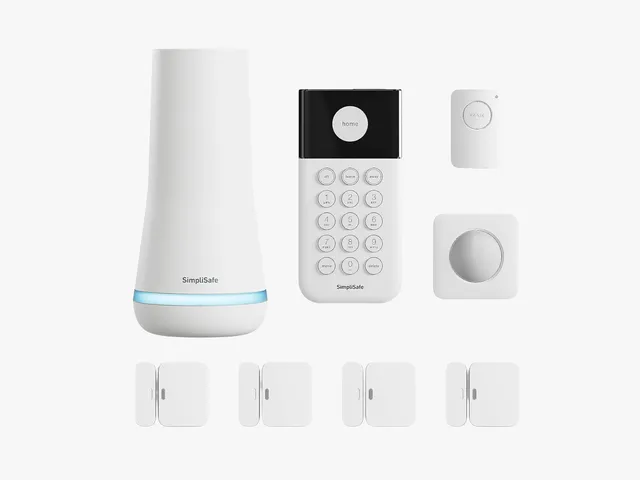
You might consider a modular security system. We like the Simplisafe system, which offers a base station, keypad, and a range of sensors. You can also find modular systems from security stalwarts like ADT and Vivint, and security camera makers like Eufy and Arlo.
The Department of Justice says that federal employees can now download TikTok on their government devices, according to Reuters.
A 2022 law banned federal employees from using the short-form video app on those devices, but the DOJ reportedly says the law no longer applies, thanks to a deal transferring ownership of TikTok’s U.S. operations to a joint venture backed by Oracle, Silver Lake, and MGX. (Oracle serves as the security partner for the new joint venture, while previous owner ByteDance retains a 19.9% stake.)
The DOJ memo reportedly says President Donald Trump has cleared “employees of Executive Branch agencies” to “download TikTok onto their official devices, subject to the agency’s discretion and consistent with all applicable workplace policies.”
Following the ban focused on government employees and devices, the app was banned more broadly across the United States. But just as the law took effect early last year, the app only went down briefly before Trump repeatedly delayed the move and urged service providers to restore access.
Kylian Mbappe is set to face Real Madrid team-mate Jude Bellingham as France take on England in the FIFA World Cup 2026 third place play-off in Miami — and you can live stream the game around the world for free.
Les Bleus were many people’s favourites to win the tournament, but a deeply disappointing 2-0 defeat by Spain in the semi-finals ended their hopes of lifting the World Cup for a third time. While a bronze medal would feel like scant consolation, France will nonetheless be motivated to triumph. Manager Didier Deschamps ends a hugely successful 14-year spell in charge of Les Bleus after this game and he will be keen to finish on a high, while captain Mbappe heads into the last weekend of the tournament level on eight goals with Lionel Messi in the race for the Golden Boot.
England’s semi-final defeat was even more crushing than their opponents’, as they conceded twice late on to lose 2-1 to bitter rivals Argentina. It means the Three Lions’ years of hurt will stretch beyond 60 after they fell short yet again, having reached at least the semi-finals in four of the past five major tournaments. England beat Norway in Miami in the quarter-finals seven days ago, and if they triumph here again it would represent their best showing at a World Cup other than when they lifted the trophy in 1966, having lost their previous two third-place games in 1990 and 2018.
Advertisement
So, read on as we show you exactly how to watch France vs England for free from anywhere in the FIFA World Cup 2026.
How to watch France vs England for free
France vs England is available to watch for free in multiple countries, including the UK, Australia, Brazil, Belgium, Ireland, Netherlands, Switzerland and Turkey.
Abroad? Can’t access your free stream? Unblock your free World Cup stream with Norton VPN — more on that below.
Advertisement
Use a VPN to watch France vs England live streams
It’s the World Cup, and if you’re traveling, you might discover your usual France vs England stream is suddenly unavailable due to geo-restrictions.
Don’t worry, that’s exactly where a VPN can help. A virtual private network lets you connect to servers around the world so you can securely access your usual World Cup coverage as if you were back home.
Those looking for a streaming service instead can watch France vs England on Fox One (3-day free trial). Telemundo is also available via Peacock ($10.99/month).
Advertisement
Visiting the US from the UK? You can still watch your World Cup stream for free thanks to Norton VPN (try for 60 days).
How to watch France vs England in the UK
UK customers are in luck as they can stream France vs England for free on BBC One. Live coverage is also available via BBC iPlayer.
You require a TV license and a valid UK postcode for an account (e.g. SE1 7PB).
Advertisement
Norton VPN can unlock your stream if you’re abroad today.
How to watch France vs England in Australia
(Image credit: free)
France vs England will be shown for free in Australia on SBS On Demand.
The streaming platform has every game of the tournament for free, making it the perfect place for your World Cup viewing.
Advertisement
Traveling for work or on holiday? A VPN like Norton VPN can help unlock your free stream.
How to watch France vs England in Canada
(Image credit: Other)
In Canada, TSN will be broadcasting France vs England.
You can live stream via the TSN+ streaming platform, which costs CA$8 per month or CA$80 per year.
Advertisement
Outside of Canada? Use Norton VPN whilst you’re traveling away from home to unlock your stream.
How to watch France vs England in New Zealand
(Image credit: Other)
In New Zealand, France vs England will be broadcast on TVNZ+.
While some World Cup games are free on TVNZ+, this match requires the tournament pass (NZ$44.95).
Advertisement
France vs England: Match Information
What time does France vs England start?
France vs England kicks off at 10pm BST / 5pm ET on Saturday, July 18. That’s 7am AEST on Sunday, July 19 in Australia.
What are the squads for France vs England?
France
Goalkeepers: Mike Maignan (AC Milan), Robin Risser (Lens), Brice Samba (Rennes).
Advertisement
Defenders: Lucas Digne (Aston Villa), Malo Gusto (Chelsea), Lucas Hernandez (Paris St-Germain), Theo Hernandez (Al Hilal), Ibrahima Konate (Liverpool), Maxence Lacroix (Crystal Palace), Jules Kounde (Barcelona), William Saliba (Arsenal), Dayot Upamenaco (Bayern Munich).
Midfielders: N’Golo Kante (Fenerbache), Manu Kone (Roma), Adrien Rabiot (AC Milan), Aurelien Tchouameni (Real Madrid), Warren Zaire-Emery (Paris St-Germain).
Goalkeepers: Dean Henderson (Crystal Palace), Jordan Pickford (Everton), James Trafford (Manchester City).
Defenders: Dan Burn (Newcastle United), Trevoh Chalobah (Chelsea), Marc Guehi (Manchester City), Reece James (Chelsea), Ezri Konsa (Aston Villa), Nico O’Reilly (Manchester City), Jarell Quansah (Bayer Leverkusen), Djed Spence (Tottenham Hotspur), John Stones (Manchester City).
Midfielders: Elliot Anderson (Nottingham Forest), Jude Bellingham (Real Madrid), Eberechi Eze (Arsenal), Jordan Henderson (Brentford), Kobbie Mainoo (Manchester United), Declan Rice (Arsenal), Morgan Rogers (Aston Villa).
Forwards: Anthony Gordon (Barcelona), Harry Kane (Bayern Munich), Noni Madueke (Arsenal), Marcus Rashford (Manchester United), Bukayo Saka (Arsenal), Ivan Toney (Al-Ahli), Ollie Watkins (Aston Villa).
Advertisement
Swipe to scroll horizontally
France vs England: Road to the third place play-off
Stage
France
England
Group stage
Advertisement
Group I: 1st, 9 points
Group L: 1st, 7 points
Last 32
Beat Sweden (3-0)
Advertisement
Beat DR Congo (2-1)
Last 16
Beat Paraguay (1-0)
Beat Mexico (3-2)
Advertisement
Quarter-finals
Beat Morocco (2-0)
Beat Norway (2-1 AET)
Semi-finals
Advertisement
Lost to Spain (2-0)
Lost to Argentina (2-1)
What is the weather for France vs England?
The temperature in Miami on Saturday is forecast to be around 86F (30C) at kick-off, although it is expected to feel like 88F (31C).
The humidity level is expected to range from 66-69 per cent during the game, which is considered high.
Advertisement
Can I watch France vs England on my mobile?
Of course, most broadcasters have streaming services that you can access through mobile apps or via your phone’s browser.
You can also stay up-to-date with all of the key World Cup moments on the official social media channels on X/Twitter (@FIFAWorldCup), Instagram (@FIFAWorldCup), TikTok (@FIFAWorldCup) and YouTube (@FIFA).
We test and review VPN services in the context of legal recreational uses. For example: 1. Accessing a service from another country (subject to the terms and conditions of that service). 2. Protecting your online security and strengthening your online privacy when abroad. We do not support or condone the illegal or malicious use of VPN services. Consuming pirated content that is paid-for is neither endorsed nor approved by Future Publishing.
Hours of San Francisco Police Department drone video footage exposed on the open web illustrates a new era of incredibly granular—and consequential—urban surveillance. Meanwhile, the San Francisco City Attorney’s Office sent cease-and-desist letters to Apple and Google this week demanding that the tech giants delete 13 AI nudifying “face-swap” apps from their app stores that are almost exclusively used to target women and girls.
Since WIRED first reported in June about Meta’s NameTag face-recognition system, company executives have made opaque and conflicting comments about whether the feature even exists. We took a step back to lay out both the claims and the facts about the very real system.
In a speech on Thursday, President Donald Trump continued to push unsubstantiated and thoroughly debunked claims about interference in the 2020 US election. He even promised massive revelations in a trove of documents posted to the White House website, but the files did not prove his assertions—and in some cases actually contradicted Trump’s claims.
As adoption of AI tools rapidly expands and their capabilities increase, the tech giant Anthropic continued a push to get US states to regulate AI. Speaking about AI transparency requirements in California and New York from last year, Anthropic’s head of US state and local government relations, Cesar Fernandez, told WIRED this week, “The transparency-focused safety bills of 2025 were a really important start, but as the capabilities of AI systems continue to advance quickly—the policy responses need to match.”
Advertisement
And there’s more. Each week, we round up the security and privacy news we didn’t cover in depth ourselves. Click the headlines to read the full stories. And stay safe out there.
The astrology-themed period tracker Stardust sends users’ reproductive health details—birth control type, pregnancy status, moods, and symptoms as specific as tender breasts and stomach cramps—to a data firm not named in its privacy policy, according to the BBC, which first reported a Mozilla Foundation audit of six popular trackers produced in partnership with Harvard’s Berkman Klein Center.
Stardust scored 2 out of 10, the worst of the group. Mozilla researcher Shoshana Wodinsky found the app pings third-party trackers from the moment it opens, before a user enters anything; the instant she logged a symptom, the details went to analytics firm RudderStack alongside a persistent user ID, with no in-app way to shut the sharing off. RudderStack is built to route data onward to destinations Mozilla couldn’t observe. Stardust also hands Facebook an ad identifier that ties in-app behavior to the platform’s existing profiles. The company told TechCrunch it has never received a legal demand for user data.
Euki, a nonprofit-run tracker, earned a perfect 10: no account required, health data never leaves the phone, and users can set a PIN, schedule automatic deletion, or pull up a decoy screen if someone forces the phone open. Its one soft spot is an in-app browser for educational pages that loads the usual web trackers, but it also resets identifiers between visits.
Advertisement
Russia’s FSB has long had a reputation for highly sophisticated cyberespionage, leaving disruptive cyberattacks to its fellow hackers in the country’s GRU military intelligence agency. But sanctions from the EU and UK this week, along with an advisory from the US Cybersecurity and Infrastructure Security Agency, the FBI, and the NSA, pinned a cyberattack against the Polish electric grid on Center 16 of the FSB, a rare example of the Kremlin agency carrying out a cyberattack that nearly caused outages in the country’s electric and water utilities. The attack, which the Polish government has said came “very close” to causing a blackout, was initially attributed by cybersecurity firms Dragos and ESET to Sandworm, also known as Unit 74455 of the GRU, a more usual suspect in infrastructure hacking given its active role in Russia’s long-running cyberwar against Ukraine. But the Polish computer emergency response team at the time disputed that finding and tied the attack to the FSB, a conclusion now supported by a wide consensus of Western governments. The incident suggests that the FSB may be taking on some of the reckless, highly aggressive tendencies—and targeting—of its GRU coworkers.
For years, the Russian cybersecurity firm Kaspersky has been alleged to have ties to the Russian government, including by US officials who banned use of the company’s products within the US government and eventually by all American customers. Yet overt evidence of those connections has been scarce. Now Reuters reports that Denis Obrezko, a Russian man facing hacking charges in Boston and an alleged member of a hacker group known as Void Blizzard or Laundry Bear, spent two years working at Kaspersky. His stint at the company took place just before he joined another cybersecurity company, Yutek-NN, where he allegedly took part in the group’s hacking campaign that stole data and communications from numerous NATO governments and at least 11 US companies, according to US prosecutors. Prior to Kaspersky, Obrevko also allegedly worked at the FSB, neatly bookending his time at the company with apparent work for Russia’s intelligence services.
Obrevko has pleaded not guilty to the hacking charges. Kaspersky responded in a statement to Reuters that “the offenses charged cannot be related to the individual’s role or responsibilities during the employment at Kaspersky.”
In an incident that will induce anxiety in anyone responsible for assessing suspicious network activity, DHS officials ruled—twice—that signs of a hacker breach in its data-sharing Homeland Security Information Network platform were false positives when they were, in fact, signs of a very real intrusion. HSIN, used for sharing unclassified data between state, local, and federal agencies, as well as foreign partners, was breached by hackers two months ago, according to reporting from Nextgov/FCW. Analysts at the Federal Emergency Management Agency spotted signs of hacker activity in mid-May—altering files and code, hijacking a legitimate web server, and deleting logs of their behavior—but the findings were dismissed as a false positive.
Advertisement
In the weeks that followed, the hackers returned, were again detected, and were again dismissed as a mirage. It’s not clear why the signs of the breach were misjudged, but the incidents may represent federal analysts’ increasing challenges in detecting “living off the land” hacking techniques that use legitimate features of networks to access target assets on a network rather than planting more easily spotted malware. While the HSIN houses only unclassified data, the information is “highly sensitive,” Senate Intelligence Committee vice chair Mark Warner said in a statement following the report of the breach, and “its exposure risks national security.”
The AI music startup Suno scraped millions of songs, lyrics, and podcasts from YouTube Music, Deezer, Genius, and a string of stock-audio libraries to train its models, according to 404 Media, which reviewed internal data provided by a hacker who breached the company. The intrusion also exposed account information for hundreds of thousands of customers, including emails, phone numbers, and Stripe payment records.
Dataset notes in source code apparently from 2023 and 2024 tally 113,879 hours of YouTube Music audio alone, plus tens of thousands more from Pond5, Deezer, and other libraries—decades of music in total. Other files show Suno routing its YouTube scraping through Bright Data proxies and using PodcastIndex to target roughly 1 million hours of podcasts. The hacker, who goes by ellie.191, says they broke in by compromising an employee with the Shai-Hulud worm.
The files seemingly corroborate the record industry’s central allegation that Suno pulled songs directly from YouTube. The company, which argues that its training qualifies as fair use and settled with Warner Music Group last November, said the breach involved outdated code and no sensitive personal information—though customers whose data appeared in a sample shared with 404 Media said they were never notified.
The original lawsuit was filed in 2023 and claimed Twitter hosted thousands of cases of copyright infringement.
Donny Hery/Shutterstock
A three-years-long legal battle between X and major music publishers has quietly come to an end. In court documents filed by both X and a group of music publishers, both sides opted to dismiss their opposing lawsuits while not disclosing the terms of the settlement (via Reuters).
The feud began in 2023 when a group of music publishers led by the National Music Publishers Association (NMPA) sued the social media platform, which was still known as Twitter at the time. The $250 million lawsuit claimed that Twitter allowed for rampant cases of copyright infringement from its users, while also not doing anything to stop it. Notably, Twitter was one of the only major social media platforms that didn’t have a licensing agreement with music publishers.
In response, Twitter, now known as X, countered with its own lawsuit nearly three years later, claiming that these music publishers engaged in anticompetitive practices that would force the platform to license their songs for higher rates. Even before the latest agreement to dismiss both suits, X requested as recently as last month that the court dismiss the case claiming it shouldn’t be held responsible for user piracy.
Advertisement
So far, neither side has offered any explanation for the dismissals. However, court documents show that X and the music publishers requested to dismiss both suits “with prejudice,” so that they’re permanently dismissed and won’t be refiled. We’ve reached out to NMPA for comment and will update the story if we hear back.







































































You must be logged in to post a comment Login