
It’s been just over a week since TikTok — in the United States — transferred into the hands of new owners. And it’s been a mess ever since.
Tech
The messy truth about TikTok’s Trump-aligned takeover

At the government’s urging, TikTok’s parent company ByteDance sold the app to a mostly American group of investors, including the software business giant Oracle (founded by Trump ally Larry Ellison), MGX (an Abu Dhabi-based company also involved in Trump crypto ventures) and the private equity firm Silver Lake.
But since the new owners took control, the app has seen major outages and malfunctions, claims of censorship and uproar over its updated terms of service.
Today, Explained guest host Jonquilyn Hill sat down with David Pierce, editor-at-large at The Verge, to break down people’s concerns about TikTok’s new owners and what this may mean for people’s experiences on the social media app in the future. Below is an excerpt of their conversation, edited for length and clarity. There’s much more in the full podcast, so listen to Today, Explained wherever you get podcasts, including Apple Podcasts, Pandora, and Spotify.
American TikTok has new owners now, and almost immediately after they took over, people started reporting issues with the app. I wanna start with the big one. People said that they were being censored. What’s going on there, and what are the complaints?
That is the big one. It’s also the most complicated one to sort through because fundamentally, it’s about feelings. So a thing to understand is that everybody has always believed they’re being censored on social media. Since time immemorial, this is the story of social media. What’s happening on TikTok is at this particular moment I believe less about censorship and more about normal internet problems.
There were a lot of people reporting that they would upload videos around what was happening in Minneapolis and those videos would get no views or those videos would actually not upload properly. There were people who were saying that if you DM’d the word “Epstein” to somebody else that that wouldn’t go through. All of this is more easily and just as successfully explained by normal corporate ineptitude.
TikTok’s new data center provider, Oracle, had a huge outage. What we think we know is that it was a big data center in Virginia that had what they called a weather-related issue. They’ve had big issues at the data center and that seems to be the actual culprit here.
There are lots of good reasons to be worried about censorship. There are lots of potential censorship problems coming to TikTok, but rationally speaking, the likelihood that this new group would have taken over TikTok and immediately smash a big red “censorship” button is pretty unlikely.
Is there a way for us to actually know? I mean, people are pretty skeptical of TikTok right now.
I think one useful analog here is when Elon Musk bought and took over Twitter. And when Elon Musk took over Twitter, he just said out loud all of the changes he was intending to make, right? And this was after years of conservatives, in particular, saying that they were being censored by Twitter’s existing leadership.
So, Elon Musk comes in and essentially says, I’m going to reverse that. And then does a bunch of very obvious things. So, I think there is a version of this that feels very obvious. It’s just that for right now, there are better, simpler sort of Occam’s Razor-y explanations for what’s going on.
What about the new terms of service that folks had to agree to?
This is a tricky one because one of the very funny things about terms of service on apps like these is that they’re always terrifying, and they’re often terrifying for totally non-terrifying reasons.
What happened in this case is there are some new things in the terms of service. The new TikTok US is going to collect more precise location data if you allow it. It also gives TikTok permission to collect a bunch of data around kind of nebulous AI things that make it clear they’re gonna do a lot of sort of gen AI stuff inside of TikTok, and that’s data they can collect.
But, actually, that has been in TikTok’s terms of service for some time. Still, I think it is reasonable to be alarmed that this data is going to be collected by a new group of people.
All of this is the business side; but will my experience on the app change now?
The one thing that actually no other platform has done a good job of replicating [is TikTok’s algorithm]. But now, one of the stipulations of this deal is that there has to be some meaningful separation of that algorithm from Chinese control. The new owners are going to “retrain, test, and update” the algorithm. That is a very vague phrase, but it means in some way the algorithm is going to change. But that we’re going to not see [how] for a while.

Continue Reading

There were two questions I was looking to answer as I fired up MLB The Show 26. First, how much does the game cater to a baseball newbie like me? Second, will it keep me hooked enough to keep playing after my first few games?
I think it’s important to share some personal context. I have very limited experience with baseball. I have been to one MLB game, which was on my first visit to Canada as a teen. The lead-off Toronto Blue Jays hitter scored a home run on his first at-bat. Fireworks went off and everyone was going wild. Fun!
But that was the only score of the whole game. My dad and I (both lifelong soccer fans, for what it’s worth) were bored lifeless for the rest of the three hours.
An incredible run of a dog playing a baseball game at Games Done Quick aside, I had no real interest in the sport for the next couple of decades until the Blue Jays made a deep run into the 2025 playoffs. This time, now as a Canadian citizen, I bought into the excitement and watched all of the World Series last year. I was enthralled.
I slowly started to appreciate the nuances of pitching, the skill of trying to make every pitch look identical at the time the ball is thrown to hopefully hoodwink the batter. Friends who are in-the-know tolerated my most basic of questions about how everything works as the postseason wore on. Now, I’m planning to watch a lot more games this year and MLB The Show 26 arrived at just the right time to get me ready for the new season.
Sony’s San Diego Studio seemed to be speaking to me, personally, when the first thing the game asked me to do was select my preferred playstyle. The Competitive track was definitely out for now. The Simulation option offers an “authentic MLB experience that plays true to player and team ratings.” I wasn’t quite feeling that either. As a newcomer to all of this, I had to select the Casual style. That’s billed as “an easier, fun, pick up and play experience with an emphasis on learning the game.” Exactly what I needed.
I was immediately impressed with how deeply you can customize the gameplay, even if the vast array of batting and pitching options in particular felt a little overwhelming. Using both a thumbstick to aim and button to swing at the ball seemed too much for someone who has no idea as yet how to read pitches.
Dipping my toes in slowly was surely going to help me avoid getting too frustrated too quickly and uninstalling the game, so I chose to keep everything as simple as possible. I’m not switching off options like automated bullpen warm ups for a long time, if ever.
Finally, after about 20 minutes of fine-tuning some settings in the tutorial, it was game time.
The Dodgers didn’t know what hit ’em as I won my first game 38-0. I thought this Shohei guy was supposed to be good? Pffft, he didn’t even register a hit. His team only got a measly two players on base, while I had 46 hits. That blowout was a fun intro to MLB The Show 26, but I had to bump up the difficulty and make it a little more challenging if there was any chance of me sticking with it.
Instead of jumping into the Road to the Show career mode, an online match or another exhibition game to get my feet a tad wetter, I next tried the Storylines feature. This is what really drew me into MLB The Show 26.
San Diego Studio has been sharing the stories of several notable players from the Negro Leagues in the last few editions of the series. I know very little about baseball history outside of household names. So I was fascinated to learn about the likes of Roy Campanella, who debuted in the league as a 15-year-old catcher, and Mamie “Peanut” Johnson, the league’s first female pitcher.
The developers did a fantastic job of connecting these athletes’ stories to playable moments from their playing careers. Cutscene insights from Bob Kendrick, the president of the Negro Leagues Baseball Museum, tied everything together quite beautifully. Great stories are such an effective way to pull you into a sport and to start learning about it. Stories connect us more than just about anything else.
The default difficulty in the Storylines mode was much higher than I dealt with in my first washout game. Still, that gave me a chance to practice the Competitive playstyle without having to play a full game or the stop-start nature of the tutorial.
My pitching was less accurate, so figuring out how to compensate for that made for an interesting challenge. Batting was a lot tougher too, with balls travelling faster and pitchers trying to trick me. At first, I was swinging at every ball, but that clearly was the wrong idea. I tried to be more judicious and wait to see if a ball was breaking, but that meant I was swinging too late and fouling or giving the fielders an easy catch. That’s a tricky conundrum to solve, and I’ll need a lot more practice before I dream of playing online. I’m not even going to get started on how woeful I am at catching.
And yet all of this deepened my appreciation for baseball. There’s so much more nuance and complexity to the sport than I realized until a few months ago. And even as someone who doesn’t typically enjoy turn-based games, I found myself getting into the swing of it… so to speak.
I’m never going to care about Diamond Dynasty, MLB The Show’s take on Ultimate Team modes in EA Sports games. I can’t see myself diving into the team management-focused Franchise mode, in large part because I don’t yet have a strong enough understanding of stats to have a decent handle on what makes a specific player great in their role. And as much as I like the idea of the Road to the Show career mode — in which you can stick with a player from their high school days all the way to a Hall of Fame induction — I don’t think I can invest enough time into that to make it worth the effort.
I did find the answers to the two main questions I had about MLB The Show 26. It does a bang-up job of easing a baseball newbie like me into the fray. I’m eager to keep playing as well. I don’t think MLB The Show has quite enough pull to keep me away from my actual forever game, Overwatch, for too long. But I can absolutely see myself playing it on a second screen while streaming some MLB games this season. After all, I’m always on the lookout for a great story.
MLB The Show 26 is out now on PS5, Xbox Series X/S and Nintendo Switch.
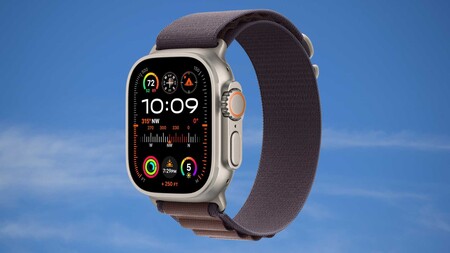
If you’re a fitness fanatic or someone who craves adventure, then this awesome Apple Watch Ultra 2 deal is for you.
You can bag the feature-packed Apple Watch Ultra 2 49mm (GPS + Cellular) with the rugged titanium case and the indigo Alpine Loop for only $499.
This is a massive $300 saving on the device, making it far more affordable for most people.
Apple’s Watch Ultra 2 is now at its lowest price yet in the Amazon Big Spring Sale
Amazon’s Big Spring Sale has pushed the Apple Watch Ultra 2 to its lowest price so far, marking one of the standout wearable deals of the season.

At its core, the 4.5-star-reviewed Apple Watch Ultra 2 is the perfect companion for avid adventurers and fitness buffs, which is why its robust 49mm case is, despite being made of corrosion-resistant titanium, surprisingly lightweight and instantly comfortable on the wrist.
With the included GPS and cellular capabilities, the device can keep track of your location in more remote areas where a smartphone may not be able to work.
When you do have internet access, either through cellular or a nearby smartphone, the Ultra 2 can keep up with all of your important notifications and message replies, but it also uses that connectivity to interact with a ton of supported apps, such as navigating with Apple Maps.
Out in the wild, you can make use of the included dual-frequency GPS to get a more accurate fix on your location, in turn helping you navigate back to your starting point and also figure out precisely how far you’ve gone.
The action button on the side of the Ultra 2 can be customised for different tasks, giving you more immediate access to the tools that you may need.
While the Indigo Alpine Loop is made with high-strength yarns taken from a single continuous strand of material, looped until it gives you a secure hold that doesn’t come undone when put under duress.
Much has been made of the Ultra 2’s longevity, with some users managing to ring up to 80-hours of use from the device, but what’s more important is that, under normal use, the device can be charged every other day, which still frees you up from having to worry about topping up every night.
There are tons more that we could say about the Apple Watch Ultra 2, but if you want all of those features in a super sturdy wearable device, nothing quite comes close as of yet, making this an easy win for anyone who can afford it.
It’s even taken pride of place in our best smartwatch buying guide, as the best rugged smartwatch.
SQUIRREL_PLAYLIST_10148964
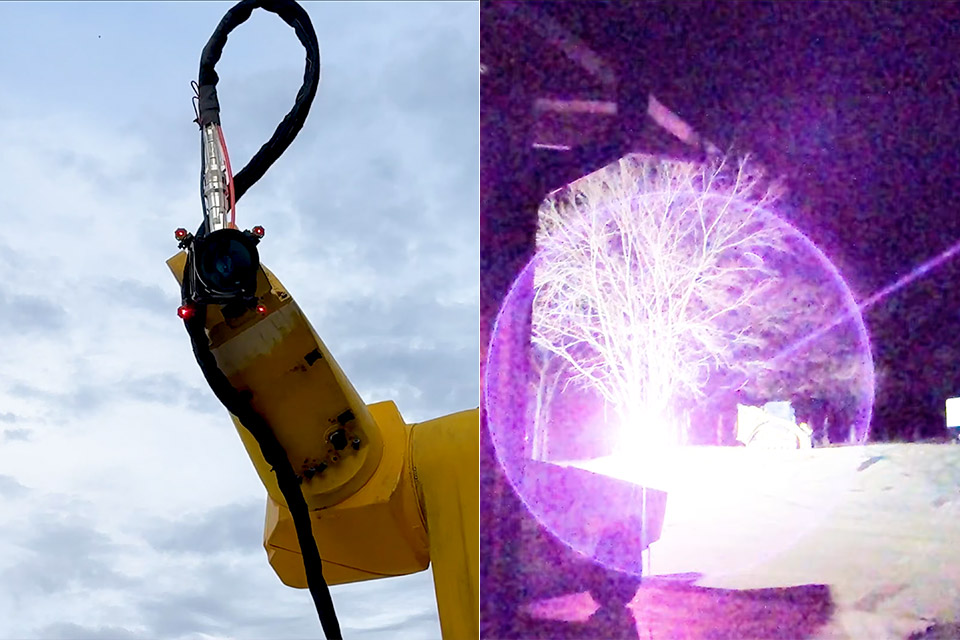
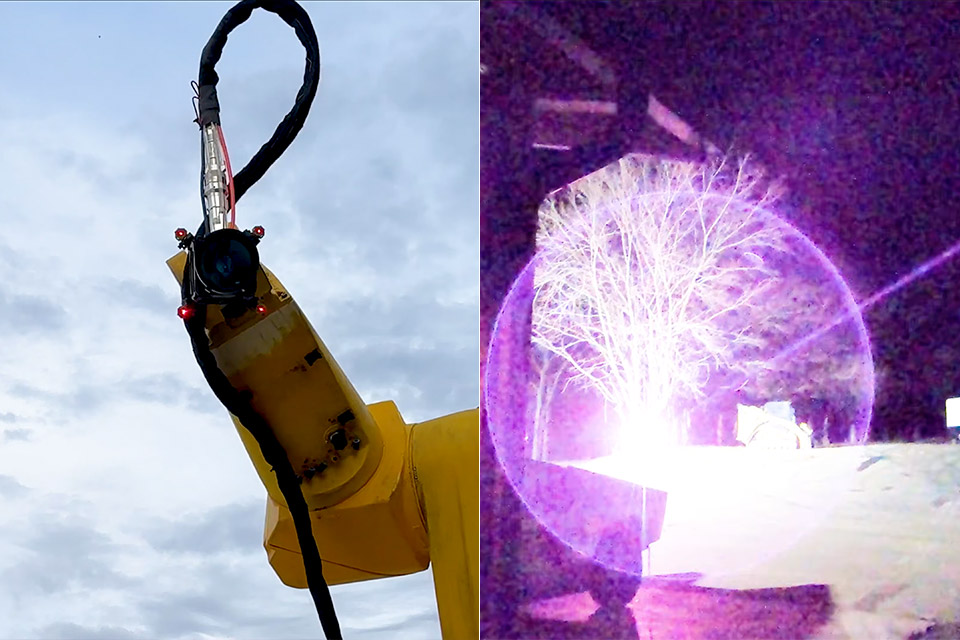
Stabi extends its arm from the shadows with a large barrel mounted to its wrist, and what is inside that barrel is not subtle. A kilowatt class laser capable of cutting through wood at a distance or turning stone into a glowing, molten mess sits at the heart of the setup, mounted in the back of a truck and pointed at a series of test targets. The whole rig was built by Prop Department to explore how high energy laser systems might be put to work in future productions.
They started by using an ancient six-axis industrial robot arm that had been working in factories for years. They next installed some special steel mounts and protective windows, which they had laser-cut from a batch of precision parts ordered online. The actual problem was getting the programming just right so the arm could travel smoothly over a target without any abrupt jerks that could scatter the beam.
Sale

Squad Hero Rechargeable Laser Tag 360° Sensors + LCDs – Set of 4 – Easter Gift Ideas for Kids Teens and…
- The most innovative laser tag set yet: Lock ’n load for a fight for domination! Strap on your vest, grab a gun, check your ammo, and transform your…
- Rechargeable gear: You never have to stop the game action to change a few dozen batteries. The guns and vests are fully rechargeable! The set includes…
- 360° Combat: 3 target zones (chest, back, and the gun) gives your opponent no escape. Herosync & LCD HUD technologies – Trying to remember the…

Four tiny targeting lasers sit at the corners of the main barrel, creating a visual outline of where the invisible main beam will hit once the system is turned on. There’s a regular camera on top and an infrared camera down below, which detects heat signatures that the human eye cannot see. To be extra safe, the team installed three safety interlocks to prevent accidental firing, and the operator is required to remove the power plug from the barrel at any stage of setup to ensure that nothing fires until everything is in the proper position.
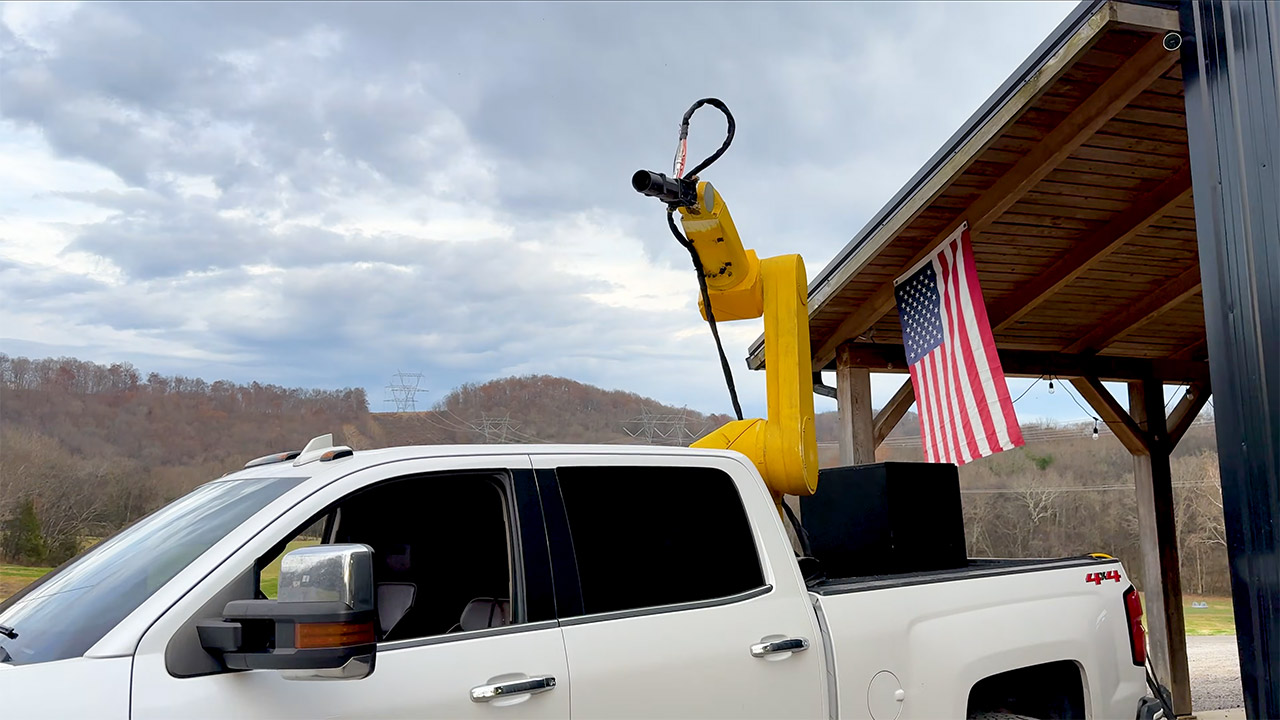
Power comes from a source hidden in the truck bed. The beam itself delivers a continuous punch equivalent to a thousand watts focused down to a small area. Dark materials absorb energy quickly and heat up, whereas reflective surfaces bounce it back, explaining why certain objects endure longer than others. Every test takes place at night, when no one is around, and the operator is wearing two layers of eye protection.
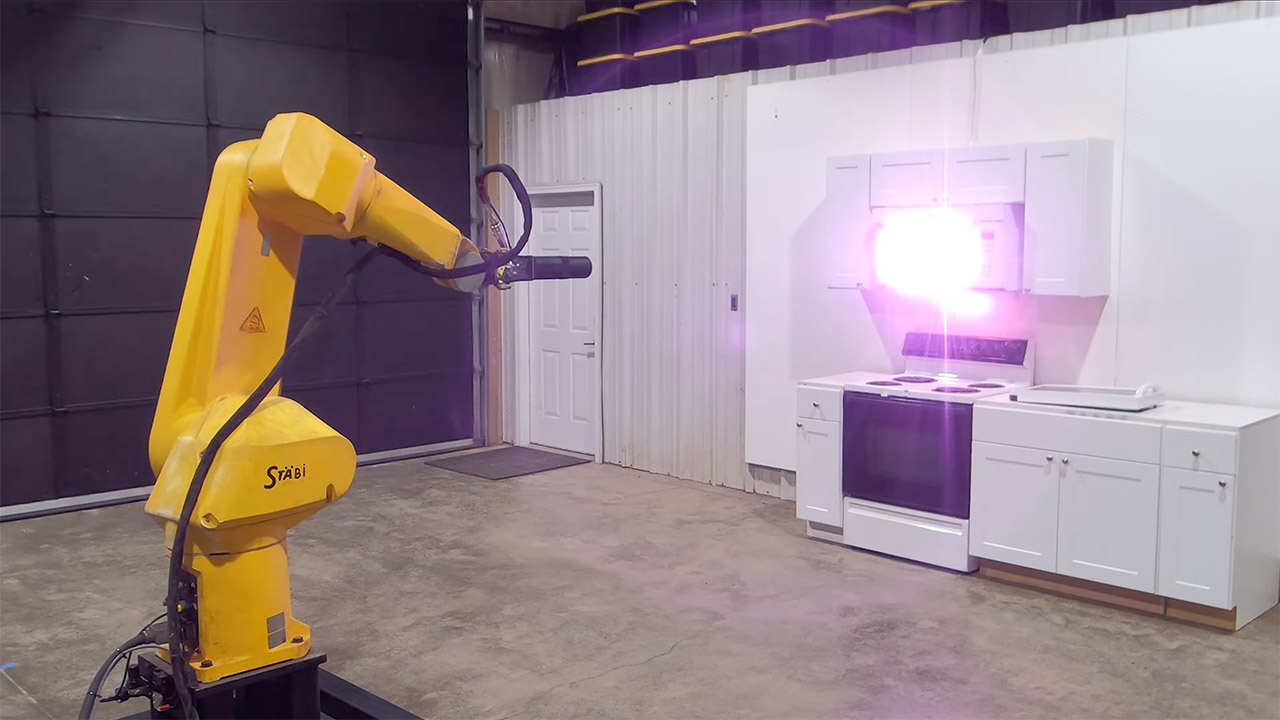
Early tests started with everyday objects to get a feel for how the laser behaved. An old iPhone held up for a few seconds before the beam carved deep grooves into it, leaving the device looking like it had been through something much worse than a bad drop. A metal can was gone in a second, a clean hole punched straight through. Glass proved more interesting, with a tomato inside a jar heating and steaming before the beam eventually broke through, though the jar itself refused to shatter cleanly.

Coconuts caught fire almost on contact, the outer shell blackening and bursting into flame as the laser continued driving energy into the center. Eggs were a different story entirely. After 15 seconds of direct exposure the shell remained intact and the contents barely warm, a reminder that smooth, light colored surfaces can reflect a surprising amount of incoming energy.
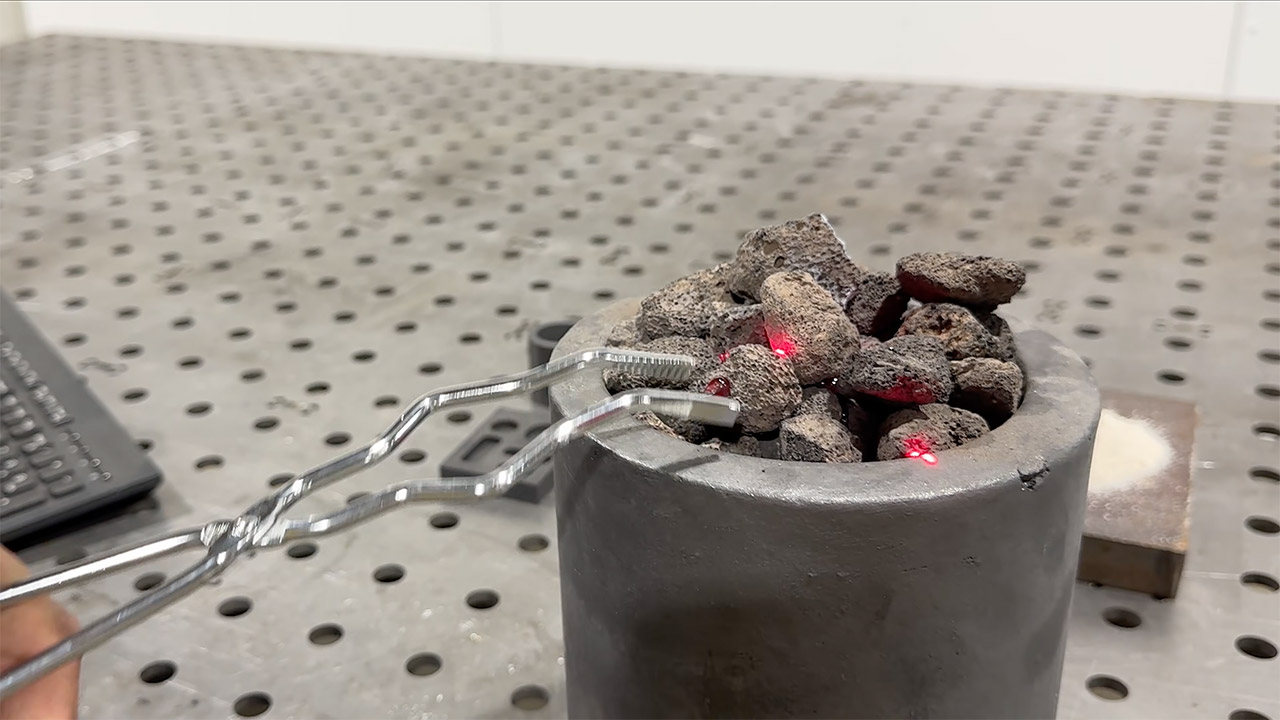
As the tests scaled up, so did the results. Chunks of imported lava rock glowed brilliant orange and began to melt under sustained exposure, while a small piece of sterling silver softened and pooled slightly without ever reaching a full melt, highlighting the difference between an intense focused burst and the steady high temperatures needed to break down denser metals. One particularly interesting result came from a solar panel positioned at a distance across the test area, which registered a slight voltage increase when the beam struck it, suggesting that the same energy can still be harvested as usable power even after traveling through open air.

The final test brought everything together. A small tree stood at the far end of the test area looking completely unassuming right up until the robot arm swung into position and locked onto the trunk. Smoke came first, then a clean line began to form in the wood as the beam burned steadily through. Within seconds the top half toppled and hit the ground with a thud. For all the raw power involved, the cut it left behind looked almost surgical.

The court has granted Anthropic’s request for a preliminary injunction, preventing the government from banning its products for federal use and from formally labeling it as a “supply chain risk,” at least for now. If you’ll recall, things turned sour between the company and the Trump administration when Anthropic refused to change the terms of its contract that would allow the government to use its technology for mass surveillance and the development of autonomous weapons.
In response to Anthropic’s refusal, the president ordered federal agencies to stop using Claude and the company’s other services. The Defense Department also officially labeled it as a supply chain risk, which is typically reserved for entities typically based in US adversaries like China that threaten national security. In addition, department secretary Pete Hegseth warned companies that if they want to work with the government, they must sever ties with Anthropic. The AI company challenged the designation in court, calling it unlawful and in violation of free speech and its rights to due process. It asked the court to put a pause on the ban while the lawsuit is ongoing, as well.
In a court filing, the Defense Department said giving Anthropic continued access to its warfighting infrastructure would “introduce unacceptable risk” to its supply chains. But Judge Rita F. Lin of the District Court for the Northern District of California said the measures the government took “appear designed to punish Anthropic.”
Lin wrote in her decision that it seems Anthropic is being punished for criticizing the government in the press. “Punishing Anthropic for bringing public scrutiny to the government’s contracting position is classic illegal First Amendment retaliation,” she continued. The judge also said that the supply chain risk designation is contrary to law, arbitrary and capricious. She added that the government argued that Anthropic showed its subversive tendencies by “questioning” the use of its technology. “Nothing in the governing statute supports the Orwellian notion that an American company may be branded a potential adversary and saboteur of the US for expressing disagreement with the government,” she wrote.
Anthropic told The New York Times that it’s “grateful to the court for moving swiftly” and that it’s now focused on “working productively with the government to ensure all Americans benefit from safe, reliable AI.” The company’s lawsuit is still ongoing, and the court has yet to issue its final decision. Judge Lin said, however, that Anthropic “has shown a likelihood of success on its First Amendment claim.”


The Alliance for Creativity and Entertainment (ACE) announced the shutdown of AnimePlay, a major anime streaming platform with over 5 million users.
Backed by more than 50 major television networks and film studios, including Disney, Paramount, Sony Pictures, Warner Bros, Netflix, and Universal Pictures, ACE focuses on taking down illegal streaming services through civil litigation, criminal referrals, and cease-and-desist operations.
In recent years, ACE targeted and dismantled a long string of other large-scale illegal streaming networks in joint operations with law enforcement. Most recently, in November 2025, it shut down Photocall, a massive TV piracy streaming platform with over 26 million users annually.
In its latest action, the anti-piracy coalition shut down the AnimePlay anime streaming platform, which hosted more than 60 terabytes of anime TV shows and movies and had amassed over 5 million registered users, most of them from Indonesia.
ACE took control of the AnimePlay app and dismantled the operation by taking all infrastructure offline, including hosting servers and web domains.
“ACE secured control of not just the application, but also its underlying infrastructure, including 15 associated domains, source code, hosting environment, and related digital assets, all of which have now been taken offline,” the anti-piracy organization said in a Thursday statement. “In so doing, ACE has effectively dismantled the operation and restricted the operator’s ability to rebuild or relaunch the service.”
The developer and admin of the piracy service also surrendered control of the backend ecosystem powering AnimePlay to ACE, including backend servers, associated databases, advertising tools, and 29 GitHub repositories containing full source code.
“We will continue working with our partners across the Asia Pacific region and globally to dismantle criminal operations like this and safeguard the integrity of the creative economy,” added Larissa Knapp, Chief Content Protection Officer and Executive Vice President for the Motion Picture Association (MPA).

Malware is getting smarter. The Red Report 2026 reveals how new threats use math to detect sandboxes and hide in plain sight.
Download our analysis of 1.1 million malicious samples to uncover the top 10 techniques and see if your security stack is blinded.

from the benched-by-the-bench dept
This judge ain’t fucking around. Earlier this month, we covered New Jersey federal judge Zahid Qurashi’s response to the actions of Trump’s DOJ, which begins with lots of illegal appointments of prosecutors and runs right through these prosecutors’ inability to defend the administration’s actions.
To wit:
The Government’s handling of Petitioner’s detention is emblematic of its approach to immigration enforcement in this state. On the merits, its detentions are illegal. The Government knows this. Its reliance on Section 1225 has been roundly rejected.
And:
Sadly, the well-deserved credibility once attached to that distinguished Office is now a presumption that “has been sadly eroded.” The Government’s continued actions after being called to task can now only be deemed intentional.
Courts have been flooded with immigration cases and vindictive prosecutions targeting Trump’s enemies. They’re fighting back, but even a massive consensus seems incapable of slowing Trump’s roll.
This case — brought to our attention by Owen Barcala — involves the sort of serious crimes the administration has put on the back burner so it can flood the immigration enforcement zone. While the administration focuses on ejecting all non-white foreigners from this country while claiming they’re simply seeking out the “worst of worst,” the (alleged) worst of the worst are pretty much being ignored.
Thanks to the massive amount of turnover at the DOJ, there are not a whole lot of qualified prosecutors left to do the government’s (increasingly) dirty work. In New Jersey, (illegal) appointee Alina Habba (a former Trump PAC spokesperson/advisor) has already voluntarily stepped down, proving she’s more capable of reading the writing on the wall than her former employer.
In her place, Mark Coyne (in a made-up position meant to shield him from being booted for being illegally appointed) has stepped up to wrap up a child pornography prosecution. It’s not going well for Coyne, as the New York Times reports:
A federal judge threw a top prosecutor from the New Jersey U.S. attorney’s office out of his courtroom during a sentencing hearing this week and demanded that the office’s leadership testify about who had authority over their actions, according to court documents.
The rapid sequence of events on Monday in the courtroom of Judge Zahid N. Quraishi was the latest indication of growing tensions between the Justice Department and the federal judiciary in New Jersey. It came during the scheduled sentencing of a man who last year agreed to plead guilty to possession of child pornography.
The hearing did not go as prosecutors had planned. Judge Quraishi grew frustrated with the office’s head of appeals, Mark Coyne, who had not formally disclosed that he would appear, and fiercely interrogated a more junior prosecutor about whether the former interim U.S. attorney, Alina Habba, still had some role in operating the office.
Judge Qurashi referenced an order issued by federal judge Matthew Brann earlier this month, which declared the three-prosecutor hydra cobbled together by Pam Bondi to be a trio of unlawfully elevated prosecutors. That decision made the court’s displeasure explicit, using emphasis in the ruling to point out that the Trump administration cared more about who was running the New Jersey prosecutors’ office, rather than whether it was legally capable of running at all.
There are plenty of wonderfully quotable moments in the transcript of the hearing that ended with the government’s prosecutor being removed from the proceedings by the court.
It starts like this:
THE COURT: Mr. Coyne, did you file a notice of appearance in this case?
MR. COYNE: I did not.
THE COURT: Are you here for moral support? Because you’re not going to speak.
MR. COYNE: I would ask —
THE COURT: No.
MR. COYNE: — that the Court allow me to speak.
THE COURT: Nope. That’s not the representation made by the Government.
And then the court continues to riddle his body with bullets:
THE COURT: I’m not going to hear from you, Mr. Coyne. If you want to sit there for moral support or hand Mr. Rosenblum Post-its or whisper in his ear, I’ll let you do that as supervisor.
You’d think a corpse would keep its mouth shut. But Mr. Coyne apparently didn’t realize he was already dead.
The judge asked whether or not the three people Judge Brann had ruled were appointed unlawfully were still running the NJ US Attorney’s office. Mr. Rosenblum claimed he only knew what he’d been told by Mark Coyne, which apparently was nothing more than to shut up and claim ignorance. Unsatisfied with these non-answers and dodgy quasi-denials, Judge Quraishi pressed Rosenblum hard enough that Coyne — who had been directly ordered to sit this one out — felt compelled to respond:
THE COURT: What role does Alina Habba have currently in operating your office?
MR. ROSENBLUM: None that I’m aware of.
THE COURT: None that you’re aware of.
MR. ROSENBLUM: None.
THE COURT: All right. So she could be operating the office.
MR. COYNE: She is not.
MR. ROSENBLUM: She’s not.
MR. COYNE: She is not.
THE COURT: Sit down, Mr. Coyne. If you speak again, I’m going to have you removed. I already told you not to speak.
MR. COYNE: Your Honor —
THE COURT: You didn’t file a notice of appearance. You don’t get to blindside the Court and do whatever it is you guys want to do. So if you continue to speak, you can leave.
MR. COYNE: Your Honor —
THE COURT: Sit down.
MR. COYNE: — if —
THE COURT: Sit down.
MR. COYNE: If a notice of appeal–
THE COURT: Sit down.
MR. COYNE: -is entered–
THE COURT: I’m directing the court security officers to remove Mr. Coyne.
And with that, Mr. Coyne exits the court. Voluntarily, according to the transcript, but only voluntarily in the sense that court officers didn’t have to physically restrain him and remove him from the court.
But it’s not like the DOJ prosecutor left in the court room gets to skate by just by being less of an ass that Mark Coyne. Judge Quraishi refers to the order from Judge Brann from earlier in the month — one that specifically warned that if the DOJ kept the same “triumvirate” of illegally appointed US attorneys in that office, that it did so at its own peril.
The closing of the transcript says what so many federal judges think, but have also said in hearings and on the record in rulings and orders: the Trump DOJ has managed to completely destroy the reputation of the Department of Justice, despite having controlled it fully for barely over a year.
THE COURT: Here is your risk. This is your risk.
So your authority to operate is while [Judge Brann] has stayed the opinion, when he says literally on the last page, you don’t even have to go through all of this. All you have to do is turn to the back and it says “If the government chooses to leave the triumvirate in place, it does so at its own risk.”
What you’ve told me today, what your representation is, which I don’t believe by the way. I won’t believe it until you testify. That is what happened to the credibility of your office.Generations of U.S. Attorneys had built the goodwill of that office for your generation to destroy within a year.
This damnation isn’t unique. The DOJ is painting itself into a corner all over the nation. Hundreds of judges are no longer willing to take the government at its word. And that gives the government a handful of choices, none of which could be considered “wins.” The DOJ is going to have to dump prosecutions. Or it’s going to have to send its top prosecutors to testify under oath in court (which is way different than simply submitting sworn declarations). Or it’s going to have to go back to respecting the law, starting with the ousting of every illegally appointed US attorney.
The final option, however, isn’t generally considered viable, but it’s the one the administration is most likely to put in motion: ignoring every entity that opposes it while simultaneously telling Americans whose rights it’s trampling that this is the only way to make America great again.
Filed Under: alina habba, doj, mark coyne, new jersey, pam bondi, trump administration, zahid quraishi


The streaming giant’s new pricing pushes the Standard With Ads plan up by $1 to $8.99 per month. The ad-free Standard plan that allows viewing on two devices simultaneously is going up by $2, from $17.99/month to $19.99/month.
Read Entire Article
Source link


Manufacturing is at an inflection point. The industry’s workforce is ageing, and it has not yet cracked the code on attracting the next generation of workers.
At the same time, AI tools present a host of opportunities, including those that may help address the workforce challenge.
Article continues below
Practice Leader for Verizon Business’ Manufacturing, Energy and Utilities (MEU) team.
In my conversations with manufacturing leaders, I hear the same tension repeatedly: they recognize the potential, but they’re wary of the risks.
The manufacturers that will pull ahead in 2026 are those that jettison their assumptions and lean into the next-generation tools that have the power to optimize the factory floor – and attract the young workers needed to run it.
How Emerging Technologies Like Physical AI Are Transforming Manufacturing
Physical AI is ushering in an era of enhanced collaboration between humans and autonomous machines. Computer vision is transforming quality control by providing a real-time view of factory assets, anticipating and preventing collisions, spills, and other errors before they occur.
Combined with digital twins and sensors, this technology can identify and predict machine faults, enabling plant managers and engineers to intervene before minor issues escalate into breakdowns. The result: extended machine lifetimes, reduced downtime, and improved operational efficiency.
Of course, many manufacturers remain uncertain – not opposed to AI, but unsure where to direct their computing power for maximum impact. The advent of Industry 4.0 and IoT devices, which paved the way for Physical AI, also created new potential for cybersecurity risks, reinforcing that caution.
But this is where I see the most productive shift in mindset happening right now. Manufacturers are increasingly recognizing that AI can be the bulwark against cyberattacks, not the source of risk.
A good example of this is what is sometimes referred to as “AI shells” – AI layers that wrap around legacy systems, infer the types of security risks those devices and systems have been exposed to, and act as a protective barrier to prevent compromises.
This is especially critical given that many legacy manufacturing systems cannot easily be patched. While digital innovation can sometimes create new vectors for threat actors to exploit, AI can also provide levels of protection that were simply not possible before.
After years of cautious experimentation, innovations like these are finally moving “out of the drawer” and into real-world deployment.
How Visualization Will Modernize Factory Floors
Manufacturing floors are becoming more visual, an evolution that will only accelerate this year and beyond. Computer vision, digital twins, AR/VR headsets, and gamification are converging to create environments that look fundamentally different from the factory floors of even five years ago.
The practical benefits of visualization are immediate. Engineers can peer inside machines using digital overlays to identify faults, rather than having to physically open them up. But the workforce implications may be even more significant.
Enhanced visual aids – from 3D schematics to just-in-time training – are powerful educational tools. Younger workers tend to be visual learners, and these environments speak their language in a way that traditional manufacturing settings simply do not.
Software-Defined Automation Meets Wireless Connectivity
For years, the promise of connected worker technology has outpaced its delivery. In 2026, that gap is closing. Wireless-enabled tools, especially mobile devices, are beginning to deliver tangible results: improved safety, near real-time asset management, and genuine operational flexibility.
What makes this moment different is the role of automation software. Most automation today remains hardware-bound, meaning upgrades require replacing physical infrastructure – a prohibitively expensive proposition for manufacturers who have invested heavily in existing systems.
Software-defined automation changes this equation significantly, allowing manufacturers to modernize through updates and upgrades without extensive overhauls. When combined with wireless connectivity, it creates an environment where connected workers, visual technologies, and mobile equipment can operate together seamlessly.
The environmental case is equally compelling. Wireless technology eliminates copper cabling and reduces network power consumption. Through our work with manufacturers, we’ve seen that a single cellular antenna can typically displace between three and ten Wi-Fi access points – a reduction in cabling and energy consumption that, across large facilities, can add up significantly.
The Convergence Is Here
This is not just a shift from physical to digital. It is an evolution from rigid systems to adaptable ones. Many of these technologies have already been introduced in manufacturing individually, but what previously existed in pilot programs or siloed use cases is now coalescing into something far more impactful.
What I find most compelling is the synergy: visual-first environments, intelligent infrastructure like Physical AI, and wireless technologies are not just complementary – they are mutually reinforcing.
Manufacturers who embrace this convergence can significantly improve productivity and safety, and build the workplaces that the next generations actually want to join. That is perhaps the most consequential shift of all.
Check out our list of the best Enterprise Resource Planning (ERP) software.

Looking for the most recent regular Connections answers? Click here for today’s Connections hints, as well as our daily answers and hints for The New York Times Mini Crossword, Wordle and Strands puzzles.
You’re not s-s-s-seeing things. Every word in today’s Connections: Sports Edition begins with the letter S. If you’re struggling with today’s puzzle but still want to solve it, read on for hints and the answers.
Connections: Sports Edition is published by The Athletic, the subscription-based sports journalism site owned by The Times. It doesn’t appear in the NYT Games app, but it does in The Athletic’s own app. Or you can play it for free online.
Read more: NYT Connections: Sports Edition Puzzle Comes Out of Beta
Hints for today’s Connections: Sports Edition groups
Here are four hints for the groupings in today’s Connections: Sports Edition puzzle, ranked from the easiest yellow group to the tough (and sometimes bizarre) purple group.
Yellow group hint: Teams with the same first letter.
Green group hint: Relating to a sport played in gym, or on the beach.
Blue group hint: Carry the torch and light the cauldron.
Purple group hint: Simpsons reference.
Answers for today’s Connections: Sports Edition groups
Yellow group: Pro teams whose names start with S.
Green group: Volleyball terms.
Blue group: Olympic home cities.
Purple group: MLB players in “Homer at the Bat.”
Read more: Wordle Cheat Sheet: Here Are the Most Popular Letters Used in English Words
What are today’s Connections: Sports Edition answers?
The completed NYT Connections: Sports Edition puzzle for March 27, 2026.
The yellow words in today’s Connections
The theme is pro teams whose names start with S. The four answers are Seahawks, Senators, Sharks and Spurs.
The green words in today’s Connections
The theme is volleyball terms. The four answers are serve, setter, side out and spike.
The blue words in today’s Connections
The theme is Olympic home cities. The four answers are Sapporo, Sarajevo, Stockholm and Sydney.
The purple words in today’s Connections
The theme is MLB players in “Homer at the Bat.” The four answers are Sax, Scioscia, Smith and Strawberry.
Toughest Connections: Sports Edition categories
The Connections: Sports Edition puzzle can be tough, but it really depends on which sports you know the most about. My husband aces anything having to do with Formula 1, my best friend is a hockey buff, and I can answer any question about Minnesota teams.
That said, it’s hard to pick the toughest Connections categories, but here are some I found exceptionally mind-blowing.
#1: Serie A Clubs. Answers: Atalanta, Juventus, Lazio, Roma.
#2: WNBA MVPs. Answers: Catchings, Delle Donne, Fowles and Stewart.
#3: Premier League team nicknames. Answers: Bees, Cherries, Foxes and Hammers.
#4: Homophones of NBA player names. Answers: Barns, Connect, Heart and Hero.
from the ctrl-alt-speech dept
Ctrl-Alt-Speech is a weekly podcast about the latest news in online speech, from Mike Masnick and Everything in Moderation‘s Ben Whitelaw.
Subscribe now on Apple Podcasts, Overcast, Spotify, Pocket Casts, YouTube, or your podcast app of choice — or go straight to the RSS feed.
In this week’s round-up of the latest news in online speech, content moderation and internet regulation, Mike and Ben cover:
Don’t forget to listen along with Ctrl-Alt-Speech’s 2026 Bingo Card and drop us a line if you win or have ideas for new squares.
Filed Under: content moderation, social media, trust and safety
Companies: cox, google, meta, sony

Fashion26 seconds ago
Frugal Friday’s Workwear Report: Striped Short-Sleeve Maxi Shirtdress

News Videos2 minutes ago
IF YOU OWN XRP WATCH ASAP (OIL Skyrocketing, POWELL SOON)
Business4 minutes ago
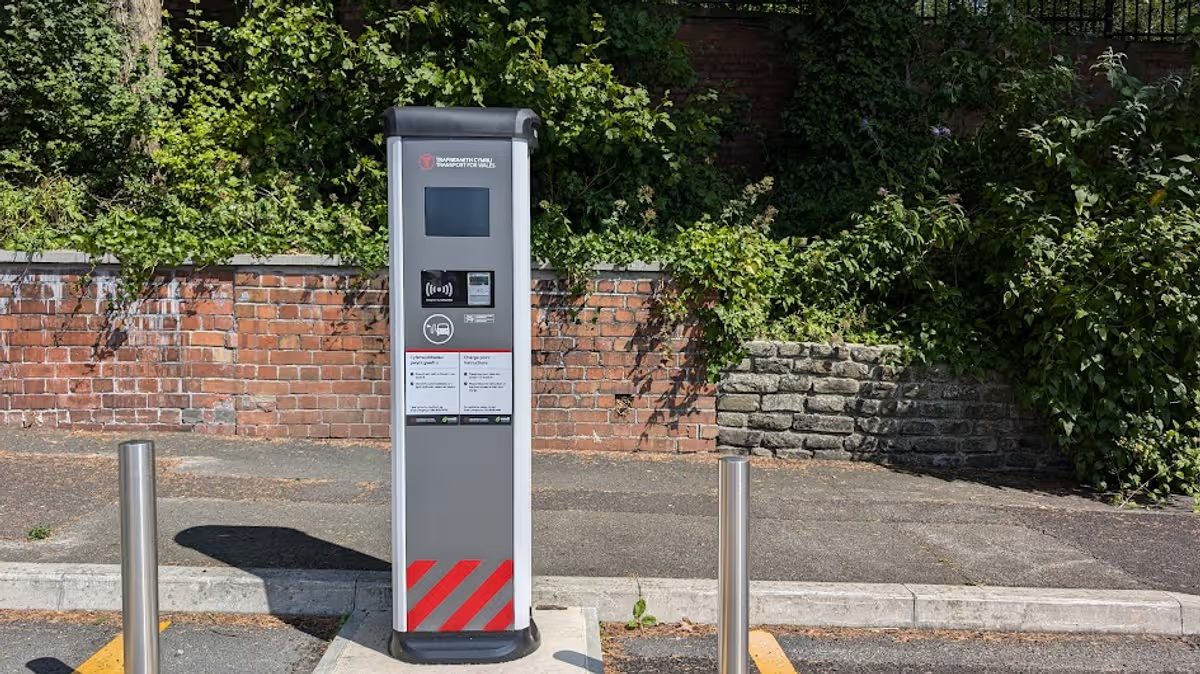
Transport for Wales support to local authorities to roll out electric vehicle charging


-
 Crypto World7 days ago
NIO (NIO) Stock Plunges 6.5% as Shelf Registration Sparks Dilution Worries
-
 NewsBeat2 days ago
Manchester United reach agreement with Casemiro over contract clause amid transfer speculation
-

 Fashion7 days ago
Weekend Open Thread: Adidas – Corporette.com
-

 Politics7 days ago
Jenni Murray, Long-Serving Woman’s Hour Presenter, Dies Aged 75
-

 Crypto World6 days ago
Best Crypto to Buy Now: Strategy Just Spent $1.57 Billion on Bitcoin During Fear While Early Investors Quietly Enter Pepeto for 150x Potential
-

 Crypto World6 days ago
Bitcoin Price News: Bhutan Sells $72 Million in BTC Under Fiscal Pressure, but the Smart Money Entering Pepeto Sees What the Market Does Not
-

 News Videos1 day ago
Parliament publishes latest register of MPs’ financial interests
-

 Sports4 days ago
Remo Stars and Kano Pillars Strengthen Survival Hopes in NPFL
-

 Sports4 days ago
Gary Kirsten Accuses Pakistan Cricket Board Of ‘Interference’, Mohsin Naqvi Responds
-

 Tech5 days ago
Give Your Phone a Huge (and Free) Upgrade by Switching to Another Keyboard
-

 Business5 days ago
No Winner in March 21 Drawing as Prize Rolls to $133 Million for Next
-

 Sports7 days ago
2026 Kentucky Derby horses, odds, futures, preview, date: Expert who nailed 12 Derby-Oaks Doubles enters picks
-

 Tech5 days ago
AI enters the chat: New Seattle dating app relies on tech to facilitate meaningful human connections
-

 News Videos4 days ago
Ch 9 Financial Management Part 1 | Detailed One Shot | Class 12 Business Studies Boards 2026
-
Business7 days ago
Columbia Sportswear enters $500 million credit agreement with JPMorgan Chase
-

 Tech5 days ago
Today’s NYT Connections Hints, Answers for March 22 #1015
-

 Business15 hours ago
Instagram, YouTube Found Responsible for Teen’s Mental Health Struggle in Historic Ruling
-
 Crypto World7 days ago
Small-cap Russell 2000 enters correction territory
-

 Business5 days ago
Will Duke Basketball Win It All? Duke Basketball Enters Second Round as Third Favorite to Claim NCAA Title
-

 Sports4 days ago
2026 Kentucky Derby horses, odds, futures, preview, date: Expert who hit 12 Derby-Oaks Doubles enters picks
You must be logged in to post a comment Login