Connect with us

Tech

The Requirements Of AI | Hackaday

Published

on

The media is full of breathless reports that AI can now code and human programmers are going to be put out to pasture. We aren’t convinced. In fact, we think the “AI revolution” is just a natural evolution that we’ve seen before. Consider, for example, radios. Early on, if you wanted to have a radio, you had to build it. You may have even had to fabricate some or all of the parts. Even today, winding custom coils for a radio isn’t that unusual.

But radios became more common. You can buy the parts you need. You can even buy entire radios on an IC. You can go to the store and buy a radio that is probably better than anything you’d cobble together yourself. Even with store-bought equipment, tuning a ham radio used to be a technically challenging task. Now, you punch a few numbers in on a keypad.

The Human Element

What this misses, though, is that there’s still a human somewhere in the process. Just not as many. Someone has to design that IC. Someone has to conceive of it to start with. We doubt, say, the ENIAC or EDSAC was hand-wired by its designers. They figured out what they wanted, and an army of technicians probably did the work. Few, if any, of them could have envisoned the machine, but they can build it.

Does that make the designers less? No. If you write your code with a C compiler, should assembly programmers look down on you as inferior? Of course, they probably do, but should they?

Advertisement

If you have ever done any programming for most parts of the government and certain large companies, you probably know that system engineering is extremely important in those environments. An architect or system engineer collects requirements that have very formal meanings. Those requirements are decomposed through several levels. At the end, any competent programmer should be able to write code to meet the requirements. The requirements also provide a good way to test the end product.

Anatomy of a Requirement
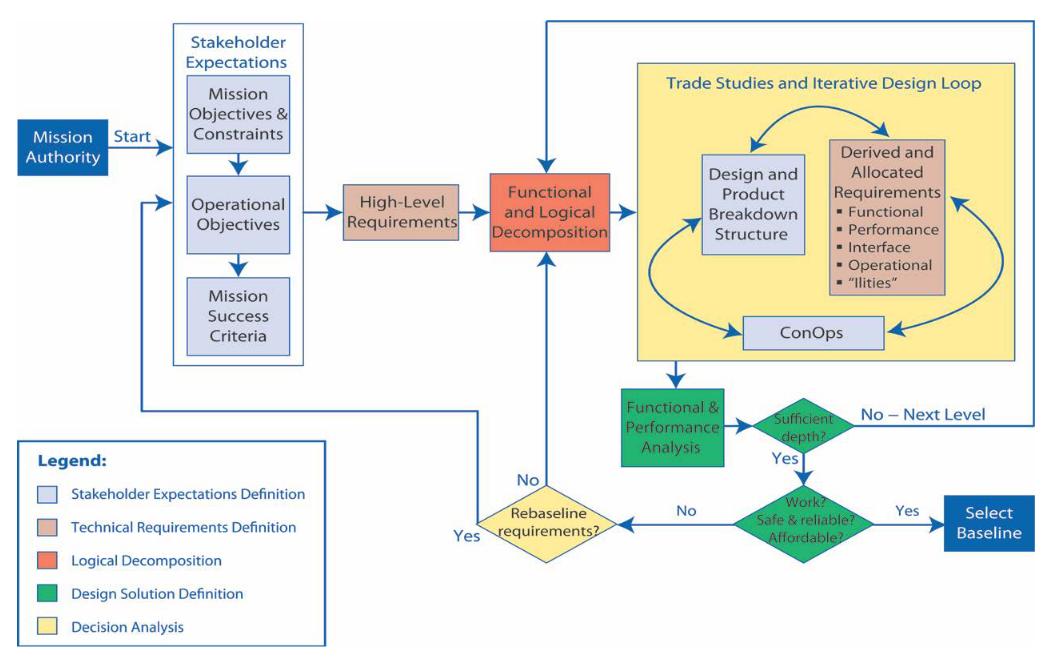
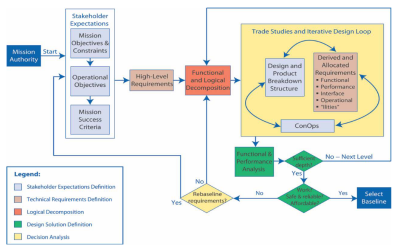
System Design Process (public domain – from MIT Open Course).

A good requirement will look like this: “The system shall…” That means that it must comply with the rest of the sentence. For example, “The system shall process at least 50 records per minute.” This is testable.

Bad requirements might be something like “The system shall process many records per minute.” Or, “The system shall not present numeric errors.” A classic bad example is “The system shall use aesthetically pleasing cabinets.”

The first bad example is too hazy. One person might think “many” is at least 1,000. Someone else might be happy with 50. Requirements shouldn’t be negative since it is difficult to prove a negative. You could rewrite it as “The system shall present errors in a human-readable form that explains the error cause in English.” The last one, of course, is completely subjective.

You usually want to have each requirement handle one thing to simplify testing. So “The system shall present errors in human-readable form that explain the error cause in English and keep a log for at least three days of all errors.” This should be two requirements or, at least, have two parts to it that can be tested separately.

Advertisement

In general, requirements shouldn’t tell you how to do something. “The system shall use a bubble sort,” is probably a poor requirement. However, it should also be feasible. “The system shall detect lifeforms” doesn’t tell you how to make that work, but it is suspicious because it isn’t clear how that could work. “The system shall operate forever with no external power” is calling for a perpetual motion machine, so even if that’s what you wish for, it is still a bad requirement.
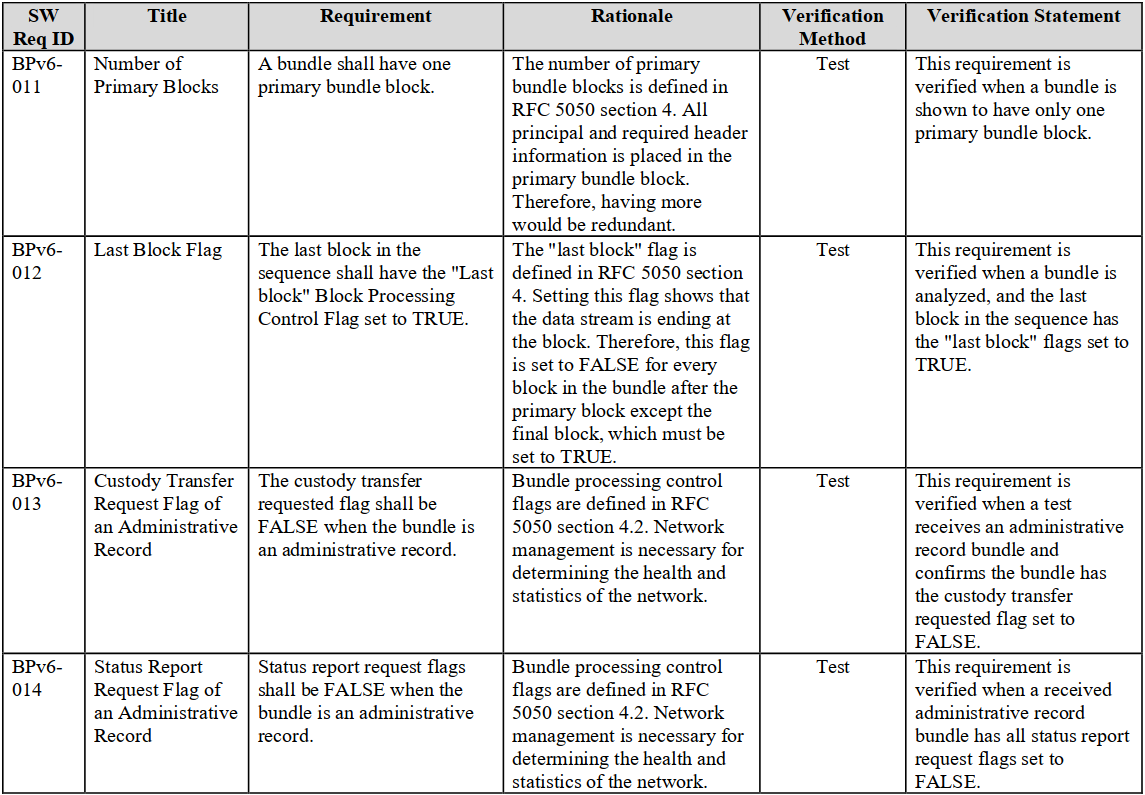
A portion of a typical NASA SRS requirements document

You sometimes see sentences with “should” instead of shall. These mark goals, and those are important, but not held to the same standard of rigor. For example, you might have “The system should work for as long as possible in the absence of external power.” That communicates the desire to work with no external power to the level that it is practical. If you actually want it to work at least for a certain period of time, then you are back to a solid and testable requirement, assuming such a time period is feasible.

You can find many NASA requirements documents, like this SRS (software requirements specification), for example. Note the table provides a unique ID for each requirement, a rationale, and notes about testing the requirement.

Requirement Decomposition

High-level requirements trace down to lower-level requirements and vice versa. For example, your top-level requirement might be: “The system shall allow underwater research at location X, which is 600 feet underwater.” This might decompose to: “The system shall support 8 researchers,” and “The system shall sustain the crew for up to three months without resupply.”

The next level might levy requirements based on what structure is needed to operate at 600 feet, how much oxygen, fresh water, food, power, and living space are required. Then an even lower level might break that down to even more detail.

Advertisement

Of course, a lower-level document for structures will be different from a lower-level requirement for, say, water management. In general, there will be more lower-level requirements than upper-level ones. But you get the idea. There may be many requirment documents at each level and, in general, the lower you go, the more specific the requirements.

And AI?

We suspect that if you could leap ahead a decade, a programmer’s life might be more like today’s system architect. Your value isn’t understanding printf or Python decorators. It is in visualizing useful solutions that can actually be done by a computer.

Then you generate requirements. Sure, AI might help improve your requirements, trace them, and catalog them. Eventually, AI can take the requirements and actually write code, or do mechanical design, or whatever. It could even help produce test plans.

The real question is, when can you stop and let the machine take over? If you can simply say “Design an underwater base,” then you would really have something. But the truth is, a human is probably more likely to understand exactly what all the unspoken assumptions are. Of course, an AI, or even a human expert, may ask clarifying questions: “How many people?” or “What’s the maximum depth?” But, in general, we think humans will retain an edge in both making assumptions and making creative design choices for the foreseeable future.

Advertisement

The End Result

There is more to teaching practical mathematics than drilling multiplication tables into students. You want them to learn how to attack complex problems and develop intuition from the underlying math. Perhaps programming isn’t about writing for loops any more than mathematics is about how to take a square root without a calculator. Sure, you should probably know how things work, but it is secondary to the real tools: creativity, reasoning, intuition, and the ability to pick from a bewildering number of alternatives to get a workable solution.

Our experience is that normal people are terrible about unambiguously expressing what they want a computer to do. In fact, many people don’t even understand what they want the computer to do beyond some fuzzy handwaving goal. It seems unlikely that the CEO of the future will simply tell an AI what it wants and a fully developed system will pop out.

Requirements are just one part of the systems engineering picture, but an important one. MITRE has a good introduction, especially the section on requirements engineering.

What do you think? Is AI coding a fad? The new normal? Or is it just a stepping stone to making human programmers obsolete? Let us know in the comments. Although they have improved, we still think the current crop of AI is around the level of a bad summer intern.

Advertisement

Source link

Continue Reading
Click to comment

Leave a Reply

Your email address will not be published. Required fields are marked *

Tech

Here are my favorite things from Toy Fair 2026

Published

on

Toy Fair 2026 just wrapped earlier this week and while I would have liked to spend even more time there, I have my own kids (and all their toys and trinkets) to look after. That said, there were a ton of cool new products on display at the Javits Center in New York City that set the stage for the rest of the year, so here’s a quick look at some of the most interesting releases from the largest toy show in the Western Hemisphere.

To celebrate the 40th anniversary of Transformers: The Movie, Hasbro is launching an apology tour to make up for traumatizing theatergoers with the death of the most beloved Autobot back in 1986. To kick things off, Hasbro is releasing a handful of new figures alongside re-releases for some popular bots including Astrotrain, Skywarp, Snarl and Shockwave. I want to give a special shout-out to the model for Kranix, which looks incredibly accurate, as if he just leapt off the movie screen. And even though his duck-billed spaceship alt-mode might look a bit awkward, I wouldn’t have it any other way.

The crown jewel of the line might be a near-life-size version of The Matrix of Leadership, which measures more than 15 inches wide and even plays Stan Bush’s iconic song “The Touch” with the push of a button. Unfortunately, the appeal of the Matrix is so powerful that it’s already sold out, including at third-party retailers like Big Bad Toy Store, which thankfully is still taking pre-orders for the rest of the lineup after the initial stock from Hasbro dried up.

A collection of some of the new F1 Hot Wheels cars for 2026.

A collection of some of the new F1 Hot Wheels cars for 2026. (Sam Rutherford for Engadget)

Hot Wheels has big plans for 2026 including a new line of Pantone-colored cars, Brick Shop models like the Elite Series Aston Martin (which comes with its own 1:64 scale car) and a Monster Truck Mutant Chaos set with actual slime. However, I’d argue the company’s new F1 offerings are the cream of the crop. Not only are there a bunch of incredibly detailed 1:64 scale racecars with metal bodies, real rubber tires and accurate livery for all the big teams, there’s also a new Downhill Circuit Race course that comes with three official vehicles (Mercedes, Haas and Ferrari) featuring multiple levels and the ability to overtake or crash into other cars. If you’re like a lot of Americans who have recently fallen down the F1 rabbit hole due to Netflix’s Drive to Survive, these new officially licensed miniatures are sure to hit the spot.

Advertisement

The first five-pack set of cars is available now, with more arriving later this spring before the Downhill Circuit Race course drives by sometime this fall.

Darth Vader's TIE fighter is an all-in-one set, which means it comes included with one of Lego's Smart Bricks, which isn't true for every kit.

Darth Vader’s TIE fighter is an all-in-one set, which means it comes included with one of Lego’s Smart Bricks, which isn’t true for every kit. (Lego)

We’ve been eagerly awaiting the first batch of playsets featuring Lego’s nifty Smart Brick after it debuted at CES. But now that the company has detailed eight new sets featuring its latest innovation, we’re even more intrigued. For me, the three standout kits are the Millennium Falcon, Luke’s Red Five X-Wing and Darth Vader’s TIE fighter because acting out the Death Star trench run complete with reactive lights and sounds will never get old. I also have a soft spot for the Ewok minifigs that come with the AT-ST set. Alternatively, the Mos Eisley Cantina kit seems like a great way to highlight the smart brick’s ability to play music or kick out some rowdy droids. The one thing to look out for, though, is the tag on the set that says whether it’s Smart Play compatible or if it’s an all-in-one set, because the former will need Smart Bricks from other kits to deliver Lego’s newfound interactivity.

Pre-orders for these are live now, with sets slated to ship on March 1.

All the new K-pop Demon Hunters toys

The HUNTR/X Battle Rumi Deluxe Fashion Doll (right) might be my favorite of the bunch.

The HUNTR/X Battle Rumi Deluxe Fashion Doll (right) might be my favorite of the bunch. (Sam Rutherford for Engadget)

Rumi, Mira and Zoey may have been the biggest breakout stars of 2025 and Mattel is looking to keep that momentum going with a ton of new toys and figures for everyone’s favorite demon hunters. There are three new singing dolls that can belt out the trio’s hit “Golden” at the touch of a button and a deluxe figure of Rumi complete with her Four Tiger Sword. There are also a ton of other dolls and miniatures showcasing HUNTR/X, the Saja Boys and more. The one downside is that these products aren’t coming out until the fall, so you’ll have to tide yourself over with other K-pop-themed products for now.

Advertisement
If Rosalina isn't careful, Yoshi will become the biggest draw of the new Mario movie.

If Rosalina isn’t careful, Yoshi will become the biggest draw of the new Mario movie. (Spin Masters)

Yoshi seems poised to steal the spotlight from Rosalina in the upcoming Super Mario Galaxy Movie and this release from Spin Masters is only reinforcing the lovable green dino’s aura. From inside his shell, Yoshi can burst out with his signature yell. After that, you can pat his nose to make his eyes light up or get him to rock when he’s really happy. But if you want one, you’re going to have to be vigilant. Pre-orders are already sold out, so you’ll need to keep a close eye on retailers like Walmart when he officially goes on sale on February 20.

Not only do the SolarFlowers look great, they're educational too.

Not only do the SolarFlowers look great, they’re educational too. (Thames & Kosmos)

Technically, these went on sale last month, but Thames & Kosmos’ SolarFlowers caught my eye again at Toy Fair due to their combination of art and science. Available in four different styles, each kit features a model that you can build yourself or with your kids (recommended age 8+) that turns into a lasting showpiece. After putting the kinetic sculpture together, you can connect the included solar panel to bring the whole kit to life (no batteries required) and make the flowers spin for perpetual entertainment.

Upcoming Masters of the Universe figures

Some upcoming figures from Mattel's line of Masters of the Universe figures.

Some upcoming figures from Mattel’s line of Masters of the Universe figures. (Sam Rutherford for Engadget)

As someone who grew up during the 80s and 90s, I’m trying to be optimistic about He-Man’s return to the big screen later this summer and Mattel’s new line of figures is certainly helping. To help prime people for the movie, there’s a big range of upcoming toys highlighting He-Man, Skeletor, Battle Cat and more, all of which I would have absolutely loved as a kid. Those will be available later this spring.

Just look how cute these are.

Just look how cute these are. (Sam Rutherford for Engadget)

It’s hard to gauge the excitement of toys aimed at one-year-olds when they can’t read or get into Toy Fair. But as the parent of a toddler, I adore the partnership between Fisher-Price and Nintendo that has resulted in a line of Mario-themed Little People. All the big names are here, including Peach, Luigi and Bowser and there’s even a couple of super cute playsets to go with them. But perhaps the best part is that a six-pack of figures and Bower’s Airship costs under $25, which means your kid could be in for hours of fun without you spending a ton of money.

Advertisement

Source link

Continue Reading

Tech

T-Mobile Bringing Live Translation to Phone Calls Using AI

Published

on

It’s currently possible to translate conversations in real time using your phone, without a human translator in the middle. The Google Translate app on an Android phone or Apple AirPods Pro 3 connected to an iPhone can help anyone overcome language barriers. 

Well, almost anyone. Not every person owns a phone that can support live translation, or has the time or bandwidth to install an app (and maybe commit to a subscription).

T-Mobile wants to remove any obstacles that stand in the way of you talking to someone on a phone call. It’s introduced an upcoming Live Translation call feature, which begins testing in the spring, that puts language translation at the network level. So even if you own a basic dumb phone, you can talk with someone who speaks one of over 50 languages with the help of T-Mobile’s network AI agent.

Advertisement

Registration is now open for a beta of Live Translation to subscribers of any post-paid T-Mobile plan, such as the Essentials, Experience More, Experience Beyond and Better Value plans.

“We want to make voice cool again,” said John Saw, T-Mobile president of technology and chief technology officer, citing that its customers make 6 billion international calls per year, and 40% of those people travel internationally. “Live translation is a real breakthrough in innovation by introducing the latest AI models into our voice network.”

Just as it did during the beta of what became the T-Satellite service, T-Mobile has not yet decided which plans will include the live translation calling feature. It also hasn’t decided what, if any, cost there will be. T-Satellite is currently included in the Experience Beyond and Better Value plans and available on other plans as a $10 add-on. It’s also open to customers of other providers for $10 a month.

I haven’t tried T-Mobile’s live translation but I look forward to testing it soon.

Advertisement

How live translation will work

A man talking on an iPhone

You have to dial *87* to turn on T-Mobile’s live translation calling tool.

Kevin Heinz/CNET

To turn on live translation during a call, the T-Mobile subscriber presses *87* (star-eight-seven-star), which activates the AI agent. Only one participant on the call needs to be a T-Mobile subscriber, and it will also work when the customer is roaming.

T-Mobile says there’s no setup, no voice training and no need to specify which languages to translate. The AI agent detects which languages are being spoken in real time and speaks the translation when a person stops speaking.

Advertisement
AI Atlas

The AI agent will also detect whether you’re calling from another country and select a language for the translation. If you call someone in Brazil, it might choose Portuguese, for example. If the person speaks a different language, such as Spanish instead of Brazilian Portuguese, the agent will switch immediately.

Also, the spoken translation will not sound like a robotic voice. “Our AI model can actually clone your voice in another language and preserve the intonation, the emotions and the rhythm as well,” all picked up on the fly, said Saw. He attributes the performance to the low latency inherent in T-Mobile’s 5G Advanced network.

Once activated, the feature doesn’t need to be turned off. If both speakers switch to the same language, the AI agent just stops working as the go-between.

The true test will be the quality of the translations. “We have done a lot of benchmarks for AI-powered translations,” Saw said, “and it matches the accuracy of all the established services.” He said the model is compliant with FCC 2027 captioning guidelines and meets all ADA accessibility standards.

Advertisement

When I asked Saw whether conversations are recorded, even during the beta period, he said that kind of fine-tuning is being done using millions of internal-only test calls. “We don’t listen to customers’ calls, and [the AI models] are not trained on customers’ data,” said Saw, noting that the service meets all FCC guidelines for privacy.

Exactly which AI translation models are being used, or which partner companies are providing them, is something Saw declined to share. He did confirm that T-Mobile is working with several AI companies, but “we’re not going to name them because we love them all the same.”

Saw noted that the way T-Mobile’s network is designed as a platform has the advantage of being able to plug in updated AI translation models, run an upgrade overnight and make it available to hundreds of millions of phones.

Live translation is just the first T-Mobile agentic AI feature

All major mobile providers are applying AI at various levels. AT&T recently announced AI tech for optimizing internet traffic at the home router level, for example, and Verizon is enlisting Google’s AI to improve its customer service experience. T-Mobile itself uses AI to automatically redirect cellular load among towers during emergencies.

Advertisement

Without pointing to specific upcoming strategies, Saw named a few other tasks that AI agents could handle in the future, such as an AI receptionist or AI concierge. Centering the AI technology in the network opens up those possibilities.

So why is the company choosing live translation as the first entry for AI-based, customer-facing network features?

“Live translation is not an easier solution to do,” Saw replied, “but it’s the right pain point to be solving today.”

Advertisement

Source link

Continue Reading

Tech

Meta patent allows AI simulation of deceased users, and it’s gone down as poorly as you’d expect

Published

on

Meta has secured a patent describing an AI system that could continue the social media presence of deceased or long-term inactive users. Let’s just say the reaction online has been swift.

Originally filed in 2023 and granted in late 2025, the patent outlines a system that would use a large language model to analyse a person’s past posts, messages, comments and interactions. From there, it could replicate their tone, writing style and communication patterns. Consequently, this would allow the account to continue posting and responding in a way designed to feel authentic.

The proposal doesn’t stop at text. According to the filing, the system could also simulate voice, video and even phone calls. Thus, it would effectively create a digital avatar capable of interacting independently.

While the patent covers scenarios involving extended inactivity — such as influencers taking a break but wanting to maintain audience engagement — much of the backlash has centred on its potential use after death.

Advertisement

Advertisement

Meta says it has no current plans to implement the system. As with many patents, the filing appears to be about protecting future possibilities rather than signalling an imminent product launch. Still, the idea has reignited concerns around digital identity and consent.

Key questions remain unresolved. Who would control AI-generated posts after someone’s death? How would personality rights be protected? And what are the psychological implications of interacting with a digital version of someone who has passed away?

On Reddit, users were quick to criticise the concept, describing it as “dystopian” and “immoral,” with several drawing comparisons to the Black Mirror episode Be Right Back, which explored a similar premise years ago. What once felt speculative now appears technically feasible. Nonetheless, it’s far from becoming mainstream.

Advertisement

Whether Meta ever turns this into a real feature is unclear. What is clear is that the conversation around digital legacy, AI replication and online identity isn’t slowing down anytime soon.

Source link

Advertisement
Continue Reading

Tech

DHS Opens a Billion-Dollar Tab With Palantir

Published

on

The Department of Homeland Security struck a $1 billion purchasing agreement with Palantir last week, further reinforcing the software company’s role in the federal agency that oversees the nation’s immigration enforcement.

According to contracting documents published last week, the blanket purchase agreement (BPA) awarded “is to provide Palantir commercial software licenses, maintenance, and implementation services department wide.” The agreement simplifies how DHS buys software from Palantir, allowing DHS agencies like Customs and Border Protection (CBP) and Immigration and Customs Enforcement (ICE) to essentially skip the competitive bidding process for new purchases of up to $1 billion in products and services from the company.

Palantir did not immediately respond to a request for comment.

Palantir announced the agreement internally on Friday. It comes as the company is struggling to address growing tensions among staff over its relationship with DHS and ICE. After Minneapolis nurse Alex Pretti was shot and killed in January, Palantir staffers flooded company Slack channels demanding information on how the tech they build empowers US immigration enforcement. Since then, the company has updated its internal wiki, offering few unreported details about its work with ICE, and Palantir CEO Alex Karp recorded a video for employees where he attempted to justify the company’s immigration work, as WIRED reported last week. Throughout a nearly hourlong conversation with Courtney Bowman, Palantir’s global director of privacy and civil liberties engineering, Karp failed to address direct questions about how the company’s tech powers ICE. Instead, he said workers could sign nondisclosure agreements for more detailed information.

Advertisement

Akash Jain, Palantir’s chief technology officer and president of Palantir US Government Partners, which works with US government agencies, acknowledged these concerns in the email announcing the company’s new agreement with DHS. “I recognize that this comes at a time of increased concern, both externally and internally, around our existing work with ICE,” Jain wrote. “While we don’t normally send out updates on new contract vehicles, in this moment it felt especially important to provide context to help inform your understanding of what this means—and what it doesn’t. There will be opportunities we run toward, and others we decline—that discipline is part of what has earned us DHS’s trust.”

In the Friday email, Jain suggests that the five-year agreement could allow the company to expand its reach across DHS into agencies like the US Secret Service (USSS), Federal Emergency Management Administration (FEMA), Transportation Security Administration (TSA), and the Cybersecurity and Infrastructure Security Agency (CISA).

Jain also argued that Palantir’s software could strengthen protections for US citizens. “These protections help enable accountability through strict controls and auditing capabilities, and support adherence to constitutional protections, especially the Fourth Amendment,” Jain wrote. (Palantir’s critics have argued that the company’s tools create a massive surveillance dragnet, which could ultimately harm civil liberties.)

Over the last year, Palantir’s work with ICE has grown tremendously. Last April, WIRED reported that ICE paid Palantir $30 million to build “ImmigrationOS,” which would provide “near real-time visibility” on immigrants self-deporting from the US. Since then, it’s been reported that the company has also developed a new tool called Enhanced Leads Identification & Targeting for Enforcement (ELITE) which creates maps of potential deportation targets, pulling data from DHS and the Department of Health and Human Services (HHS).

Advertisement

Closing his Friday email to staff, Jain suggested that staffers curious about the new DHS agreement come work on it themselves. “As Palantirians, the best way to understand the work is to engage on the work directly. If you are interested in helping shape and deliver the next chapter of Palantir’s work across DHS, please reach out,” Jain wrote to employees, who are sometimes referred to internally as fictional creatures from The Lord of the Rings. “There will be a massive need for committed hobbits to turn this momentum into mission outcomes.”

Source link

Continue Reading

Tech

Ring could be planning to expand Search Party feature beyond dogs

Published

on

Ring CEO Jamie Siminoff has indicated that the company’s controversial Search Party feature might not always be just for lost dogs, . A creepy surveillance tool being used to surveil. Who could ?

“I believe that the foundation we created with Search Party, first for finding dogs, will end up becoming one of the most important pieces of tech and innovation to truly unlock the impact of our mission,” Siminoff wrote in an email to staffers. “You can now see a future where we are able to zero out crime in neighborhoods. So many things to do to get there but for the first time ever we have the chance to fully complete what we started.”

The words “zero out crime in neighborhoods” are particularly troubling. It is, however, worth noting that this is just an email and doesn’t necessarily indicate a plan by the company. Siminoff wrote the email back in October when , which was months . He did end the thread by noting he couldn’t “wait to show everyone else all the exciting things we are building over the years to come.”

One of those things could be the recently-launched “Familiar Faces” tool, which uses facial recognition to identify people that wander into the frame of a Ring camera. It seems to me that a combination of the Search Party tech, which uses the combined might of connected Ring cameras, with the Familiar Faces tech could make for a very powerful surveillance tool that excels at finding specific individuals.

Advertisement

Siminoff also suggested in an earlier email to staffers that Ring technology could have been used to catch Charlie Kirk’s killer by leveraging the company’s Community Requests feature. This is a tool that allows cops to ask camera owners for footage, thanks to a partnership with the police tech company Axon.

Ring had via a partnership with a surveillance company called Flock Safety. The companies after a Super Bowl ad spotlighting the Search Party tool triggered public outcry. Ring didn’t cite public sentiment for this decision, rather saying the integration would require “significantly more time and resources than anticipated.”

Ring has responded to 404 Media’s reporting, saying in an email that Search Party “does not process human biometrics or track people” and that “sharing has always been the camera owner’s choice.” This response did not provide any information as to what the future will hold for the company’s toolset.

The organization has been . “Our mission to reduce crime in neighborhoods has been at the core of everything we do at Ring,” founding chief Jamie Siminoff said when Amazon back in 2018.

Advertisement

Source link

Continue Reading

Tech

YouTube is bringing the Gemini-powered ‘Ask’ button to TVs

Published

on

YouTube’s “Ask” button is making its way to the living room. The Gemini-powered feature is now rolling out as an experiment on smart TVs, gaming consoles and streaming devices. 9to5Google first spotted a Google support page announcing the change.

Like on mobile devices and desktop, the feature is essentially a Gemini chatbot trained on each video’s content. Selecting that “Ask” button will bring up a series of canned prompts related to the content. Alternatively, you can use your microphone to ask questions about it in your own words.

Screenshot of a Daily Show video on YouTube. The "Ask about this video" AI window is active to the right.

The “Ask about this video” feature on desktop (YouTube)

Google says your TV remote’s microphone button (if it has one) will also activate the “Ask” feature. The company listed sample questions in its announcement, such as “what ingredients are they using for this recipe?” and “what’s the story behind this song’s lyrics?”

The conversational AI tool is only launching for “a small group of users” at first. Google promises that it will “keep everyone up to speed on any future expansions.”

Advertisement

Source link

Continue Reading

Tech

Thermoforming Printed Parts With Hot Water

Published

on

Thermoforming is the process of softening a material enough so that it can be tweaked into a new shape, with the source of the thermal energy being not particularly relevant. Correspondingly, after [Zion Brock]’s recent video on his journey into thermoforming PLA with a mold and a heat gun, he got many comments suggesting that he should use hot water instead.

We covered his previous video as well, in which he goes through the design steps of making these grilles for a retro-styled, 3D printed radio. The thermoforming method enables him to shape the curvy grille with a heat gun and two-piece mold in a matter of minutes, rather than spending hours more time printing and removing many supports.

Theoretically using hot water instead of hot air would provide a more equal application of heat, but putting your hands into 70°C water does require some more precautions. There’s also the issue that PLA is very hygroscopic, so the part requires drying afterwards to prevent accelerated hydrolysis. Due to the more even heating, the edge of the PLA that clamped into the mold also softened significantly, causing it to pop out of the mold and requiring a small design modification to prevent this.

Advertisement

Basically, aqua-thermoforming like this has many advantages, as its slower and more consistent, but it’s less straightforward to use than hot air. This makes both a useful tool when you’re looking at doing thermoforming.

Advertisement

Source link

Continue Reading

Tech

These are the 8 editor-approved laptops I’d buy this week from $199

Published

on

Even though it’s a quiet time of the year when it comes to sales events, there is always a significant number of laptop deals available each week. So, I’m here to use my years of bargain-hunting experience and uncover the top offers that are worth buying right now, with prices starting at $199.

I’ve selected a range of options to suit different budgets and needs: whether you need a budget-friendly device for light use, a great value option for everyday use and work, or a performance powerhouse for more demanding creative or productivity tasks.

You can find my 8 top picks below, including laptops available at Amazon, Best Buy, and Dell — three retailers where I often find the best deals. Just a heads up: some are leftovers from the recent Presidents’ Day sales, so they may not be around much longer.

Source link

Continue Reading

Tech

How Many Fighter Jets Can The Newest Aircraft Carrier Hold?

Published

on


While there are many United States warships, those that are likely the best known are called “Enterprise.” The U.S. Navy has been commissioning ships with that name since the first Enterprise defended American supply routes from the British in May 1775. The trend continues with the new USS Enterprise (CVN-80), the third Gerald R. Ford-class nuclear-powered aircraft carrier and the eighth ship to be thus named. The USS Enterprise was expected to launch in 2025, but it was delayed and is now expected to launch in 2030.

Because of the ship’s name and the fact that Gerald R. Ford-class aircraft carriers are the largest warships ever constructed, there’s a great deal of public fascination surrounding it. The aircraft carrier is massive, and once it launches, The Enterprise will be able to carry a variety of aircraft, including fighter jets, helicopters, and various drones. In terms of combat aircraft capacity, the Enterprise should be able to accommodate between 70 and 90 aircraft, but this depends on a variety of factors, including the type of fighter jets it employs.

Advertisement

The USS Gerald R. Ford (CVN-78) carries 75 aircraft, operated by the Carrier Air Wing Eight . It consists of three squadrons of F/A-18E Super Hornets. These are being replaced over time as more F-35C Lightning IIs (the U.S. Navy carrier variant) are brought onboard. Because the Enterprise is the same model and because it won’t be ready until 2030, it’s likely that its Carrier Air Wing will consist of the same number of squadrons, though with more F-35Cs than its predecessors.

Advertisement

The aircraft of the USS Enterprise (CVN-80)

The number of fighter jets that a U.S. aircraft carrier can hold is dependent on several factors. Nimitz-class carriers, which are being replaced by Gerald R. Ford-class ships, carry around 56 fighter jets and other aircraft. The USS Enterprise will likely have the capacity to hold 90 aircraft, though not all of them will be fighter jets. In addition to the F-35C, the Enterprise could also be home to several F/A-18A/C and F/A-18E/F Super Hornets, which are highly capable multirole fighters employed throughout the U.S. Navy’s 11 active aircraft carriers.

When the USS Gerald R. Ford was launched, it paved the way for the vessels that followed, but there were issues with several of its systems. The lessons learned from the Ford helped guide changes to the Enterprise’s design, accommodating the F-35C and its upgraded Enterprise Air Surveillance Radar. As a result, the two ships are different in some aspects, though they’re fundamentally similar. The F-35C differs from the A and B models, as it’s designed to utilize the Enterprise’s Catapult-Assisted Take-Off Barrier-Arrested Recovery (CATOBAR) system.

The F-35C features larger wings with foldable wingtips. This makes it possible for the Enterprise to hold more F-35Cs than other models, as foldable wingtips allow for a smaller storage footprint. While the U.S. Navy isn’t in the habit of detailing the specifics of its Carrier Air Wing composition and capacities, given the size and attributes of the USS Enterprise and the F-35C, it will likely carry a minimum of 75 fighter jets. Some estimates indicate the number could be as high as 90, but this is unlikely, as room must be made for non-combat aircraft as well.

Advertisement


Source link

Advertisement
Continue Reading

Tech

Suddenly Toto's most valuable business isn't toilets, but chipmaking ceramics

Published

on


Behind the investor interest is a highly specialized component: electrostatic chucks, or ESCs, used in semiconductor etch tools to hold wafers flat, clean, and thermally stable while they are bombarded with plasma.
Read Entire Article
Source link

Continue Reading

Trending

Copyright © 2025