Why now? Well, the Linux desktop market share in the EU doubled between 2024 and 2025 (to 5.7%). That’s why!
Berlin-based eco-conscious search outfit Ecosia is expanding its range of European-focused web browsers to include a Linux version, citing the growing number of users in the EU looking for open alternatives to the clutches of American tech giants.
Advertisement
Calling Linux users a “critical tech community that has long called for data privacy, digital sovereignty, and sustainability,” Ecosia said it was launching the new browser to support the community, whose numbers it says doubled in the EU between 2024 and 2025.
The absolute share remains small, mind you – from 2.5 percent of EU computer users to 5.7 percent in the course of a year, but it’s still an increase that the Linux community can be proud of. Ecosia noted that Windows’ share of the market fell during that same period, from 80.2 percent to 74.2 percent. As of this writing, Linux’s share of the European desktop and console market is 6.4 percent, while Windows has dropped to 68.62 percent, per Statcounter.
“Linux in particular is becoming increasingly popular among tech circles, developers, and privacy-conscious users – a target group that views commercial tech giants like Microsoft and Google with increasing skepticism,” Ecosia said. Europeans don’t appear completely disillusioned with American tech, however, as macOS’s share in the region has nearly doubled since August 2025.
Regardless, the company said, it wants to meet Linux users where they’re at with a version of the company’s Chromium-based browser designed for trailblazing European digital sovereignty leaders freed from the grasp of Google.
Advertisement
“With our Linux version, we’re finally giving them a search engine that matches their values – climate- and privacy-friendly, and free of tech-bro monopolies,” said Ecosia founder and CEO Christian Kroll.
Ecosia has leaned hard into the European movement for sovereign technology in light of frustration with American tech giants, citing both the European Commission’s decision this year to require Google to share anonymized search data with eligible rival search engines, and what it says is growing dissatisfaction among Europeans over Google’s dominance of the search and browser markets.
Separating the EU from Google isn’t a new initiative, with Ecosia and French search firm Qwant partnering on an EU-based web index that launched last year. It’s not clear whether that initiative has yet benefited from the EC’s order to Google to hand over search data. The duo’s initiative, the European Search Perspective (EUSP), is currently working to expand its presence to other EU languages to “lay the foundation for genuine European digital sovereignty,” though it’s not clear from the press release how far along the initiative is.
Ecosia’s Linux browser is now available through the App Center on Ubuntu and directly through the Snap store. Ecosia also has browsers available for Windows, macOS, iOS, and Android, all of which can be downloaded by following the link on its website. While based on open-source Chromium, Ecosia’s browsers themselves are not open source. We reached out to learn whether it’d be different for the Linux variant, but didn’t immediately hear back. ®
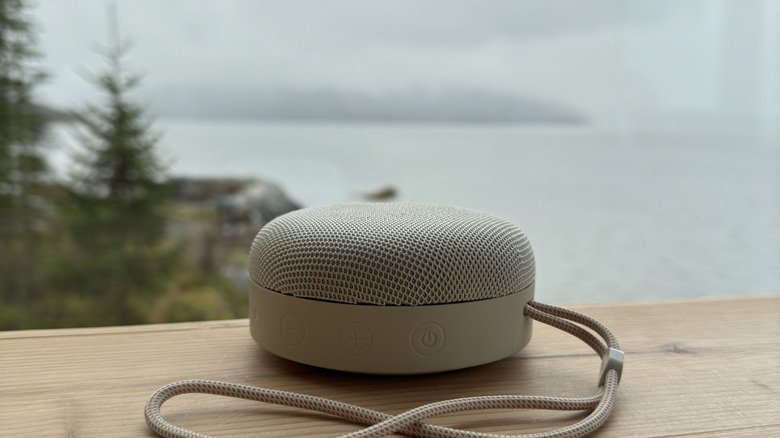
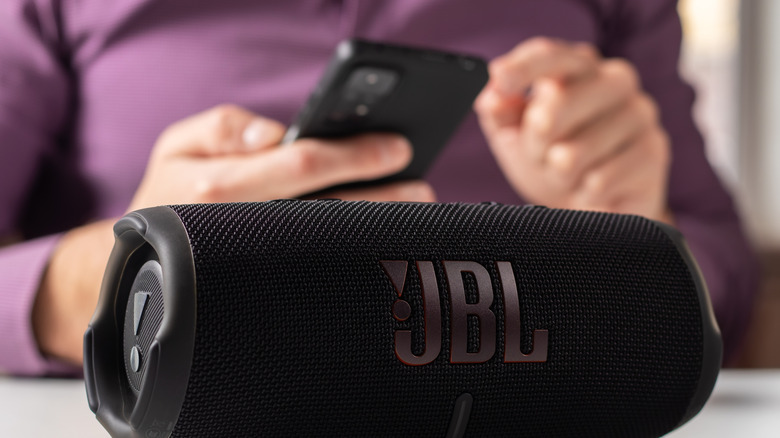
The wireless nature of Bluetooth speakers makes them perfect for any on-the-go trip, whether that’s an overnight stay or a beachside vacation. However, while you can take precautions to keep your speaker from getting wet, you can never be too sure. Whether you’re on a trip near the sea, may experience a sudden spell of rain, or have a leaky water bottle, it’s worth keeping an eye on how good the waterproofing is on any given speaker when shopping for a new one.
Bluetooth speakers have an Ingress Protection (IP) rating. An IP rating measures how resistant hardware is to dust and water, with the first number representing dust resistance (on a scale of 0 to 6) and the second number representing water resistance (on a scale of 0 to 9). For example, an IP rating of IP56 would translate to high dust resistance and protection from powerful jets of water.
Advertisement
Which IP ratings to look for in Bluetooth speakers
Skrypnykov Dmytro/Shutterstock
The highest feasible rating for a waterproof Bluetooth speaker, then, would have a 9 in the second numeral, and the best all-around protection would come from an IP69. Unfortunately, this rating is pretty seldom seen outside of a few hyper-specialised examples; luckily, the more common ratings will still get you far. For big-name, high-quality speakers, IP67 or IPX7 (“X” meaning that the manufacturer didn’t test for dust protection) are the most common ratings. These speakers can survive not only droplets or jets of water, but can survive submersion in water (though only for a small window).
Despite the rarity of IP69, though, IP68 isn’t out of reach when balancing quality and reputation. One of the highest-rated Bluetooth speakers, the JBL Charge 6, reaches that fabled IP68 rating. IP68 is essentially a more potent version of the IP67, meaning that speakers with this rating can survive submersion under harsher conditions and for a longer period of time. However, it’s worth noting that even an IP68-rated device isn’t fully waterproof.
Advertisement
What different IP ratings can survive
H_Ko/Shutterstock
A 7 or 8 rating will go pretty far when it comes to keeping your tech safe from water. For reference, swimming headphones are typically within this same range — so you can bet that both ratings are built for decent submersion. There are plenty of high-end devices all the way down at the 2 rating, though, so if you want to invest in waterproofing, it’s worth knowing what you plan to do with your device.
For instance, if you want to bring your speaker into the shower, you’ll want at least an IPX6, though a 7 rating is preferable. When it comes to dealing with the rain, IPX5 will do, but as low as IPX2 can survive brief contact with rain. Overall, a 7 rating on the waterproof end will get you far enough for most cases, and it’s pretty common among high-end speakers.
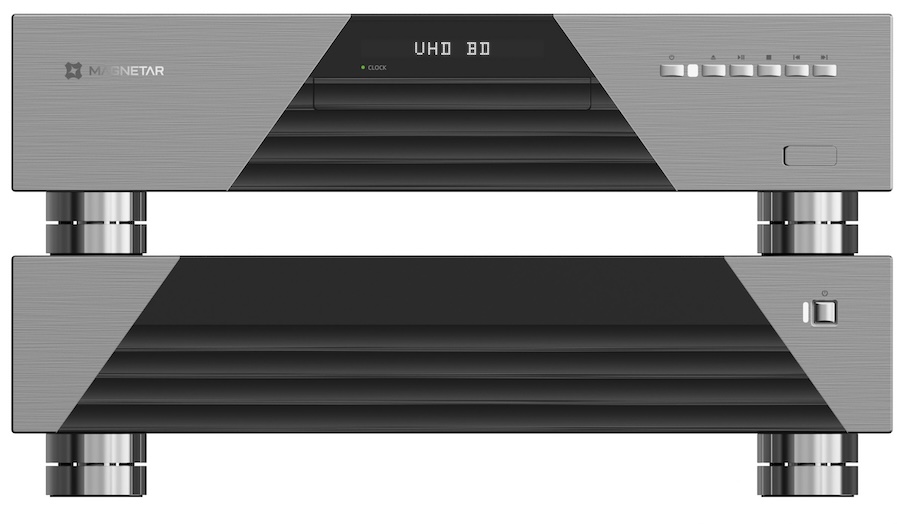
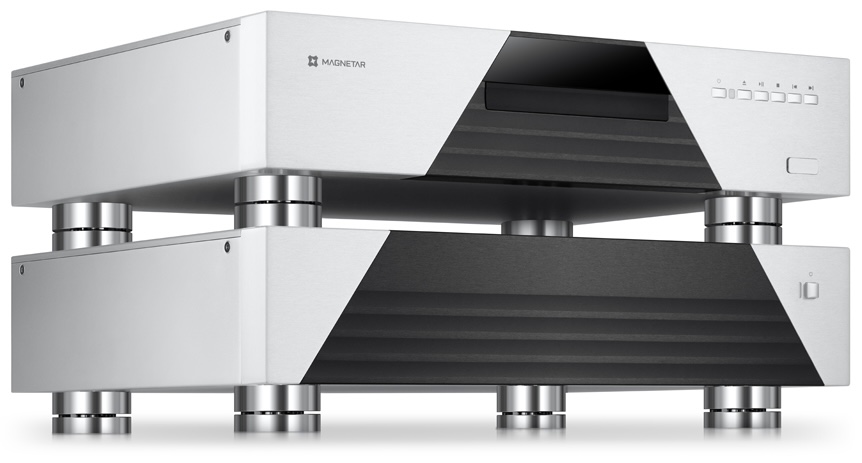
Magnetar is bringing its most ambitious disc player yet to the United States, and anyone still preparing a funeral for 4K Blu-ray may want to hold off on ordering the flowers. Making its U.S. debut at CEDIA 2026, the new Magnetar ULTIMA Ultra HD Blu-ray Reference Transport is a flagship universal media transport designed for high-end home theaters, custom installations, and collectors who want substantially more from physical media than a streaming box can deliver.
Magnetar describes ULTIMA as the world’s first luxury universal media transport with a battery-assisted DC power architecture, using dedicated lithium-based power stages to isolate critical processing and signal paths from electrical noise.
Find out what eCoustics Editor-at-Large Chris Boylan had to say about the Magnetar Ultima when he saw it at the Vienna High-End show earlier this year.
Advertisement
That engineering is important, but the larger story might be even more interesting. Streaming now dominates home entertainment, yet premium 4K Ultra HD Blu-ray releases continue to target enthusiasts who want higher bitrates, lossless audio, ownership, and consistent playback quality without wondering whether a movie will disappear from a service next Tuesday.
ULTIMA takes that argument to its logical, and presumably expensive, extreme. In the world of six-figure home theaters being showcased at CEDIA, spending a fortune on the display, projection, processing, amplification, and loudspeakers only to feed the entire system heavily compressed streaming video has always been a slightly strange place to start saving money.
One Transport for Discs, Files, and Reference Home Theater
Magnetar positions ULTIMA as the pinnacle of its universal media transport technology, designed to establish a new benchmark for reference-level playback and demonstrate what is possible when engineering takes priority over cost and convenience.
Engineered as a pure reference source, ULTIMA is designed to perform one primary function without compromise: preserve source integrity from the disc or digital file to the display or external processor in demanding home cinema and high-performance audio systems.
Advertisement
Built on Magnetar’s MKII player platform, ULTIMA supports UHD Blu-ray, Blu-ray, DVD, CD, SACD, DVD-Audio, DSD/DoP via AES/EBU, USB media, and high-resolution network playback, along with Dolby Vision and HDR10+.
That broad format support means ULTIMA can handle nearly every premium physical and digital media format likely to appear in a modern custom theater or dedicated listening room, potentially eliminating the need for separate disc players and file transports within the same system.
Why ULTIMA Uses a Separate DC Power Supply
One of the key differences between ULTIMA and Magnetar’s existing MKII platform is its use of a separate external DC power supply rather than relying exclusively on a conventional internal AC power architecture.
ULTIMA incorporates dedicated BYD lithium-based power stages designed to isolate critical transport, clocking, and signal pathways from electrical noise, voltage fluctuations, and other forms of contamination that can be present in conventional power environments. Basically, the same industrial strength lithium ion batteries used in BYD’s electric cars are being used here to provide stable, precision power for the disc transport.
Advertisement
The goal is to provide a more stable, low-noise operating environment for precision playback, particularly in reference home theater and high-end audio systems where minimizing electrical interference is part of the design brief. Magnetar positions this battery-assisted DC architecture as one of ULTIMA’s defining technical features and a significant step beyond its existing universal disc players.
Advertisement. Scroll to continue reading.
A 10 MHz Master Clock Keeps ULTIMA in Sync
Complementing ULTIMA’s battery-assisted power architecture is a synchronized master clock system built around a unified 10 MHz reference clock. Its purpose is to maintain precise timing across the transport and provide stable, accurate signal transmission to downstream components such as external processors and DACs. ULTIMA itself does not include a built-in DAC.
Using a common reference allows the transport to operate from a single timing source, helping maintain consistent data flow and predictable timing relationships throughout the playback chain.
Advertisement
According to Magnetar, this approach is designed to improve overall system stability, signal integrity, and timing consistency while reducing phase noise and improving playback consistency. In a reference transport, where the goal is to deliver the cleanest and most precisely timed digital signal possible to an external processor or DAC, that clocking architecture is a meaningful part of the engineering rather than another box to tick on the specification sheet.
A Reinforced Chassis With Reference Grade Connectivity
The same attention Magnetar has given ULTIMA’s power supply and clock architecture extends to its physical construction. The transport uses a heavily reinforced chassis designed to reduce vibration and resonance, along with isolated and shielded internal circuit sections intended to minimize electrical interaction between critical components.
Magnetar has also paid particular attention to the disc mechanism itself, including its servo control and vibration management. The objective is greater mechanical stability during playback and more consistent disc reading, particularly with demanding formats such as Ultra HD Blu-ray, SACD, and DVD-Audio. Even the support feet have been designed as part of the vibration control strategy.
ULTIMA’s rear panel reinforces its role as a dedicated digital transport. It provides two HDMI outputs, including a main output for audio and video and a second audio-only HDMI output, allowing video to be sent directly to a projector or display while audio is routed separately to an AV processor.
Advertisement
Digital audio connectivity includes AES/EBU and coaxial S/PDIF, while USB 3.0 and Gigabit Ethernet support file and network playback. There is also a 10 MHz clock connection for compatible external clock systems and RS-232C for integration into more sophisticated custom installations.
What you will not find are analog audio outputs. ULTIMA does not contain a DAC and is designed specifically to hand digital audio and video signals off to an external DAC, AV processor, or display. That makes it fundamentally different from Magnetar’s UDP900 MKII, which includes its own extensive analog audio section.
“With ULTIMA, we set out to answer one question: what does a universal media transport solution look like when every possible limitation is challenged?” said Rob Jones, President of Magnetar North America. “At a time when manufacturers are turning away from reference-grade physical media playback, Magnetar is doubling down. ULTIMA is our definitive statement piece. ULTIMA is a purpose-built reference source for those who understand that true reference performance is achieved through relentless attention to detail and uncompromising execution.”
The Bottom Line
When Oppo ended production of its Blu-ray and Ultra HD Blu-ray players in 2018, many enthusiasts wondered whether that was the final nail in the coffin for high-end disc playback. Magnetar has since emerged as a worthy successor, and with 4K Ultra HD Blu-ray showing renewed signs of life, the company appears to be in the right place at the right time.
Advertisement
ULTIMA takes that commitment to an entirely different level. Its two-chassis design, battery-assisted DC power architecture, 10 MHz master clock, reinforced construction, and pure digital transport architecture make it unlike anything else in Magnetar’s lineup. It is also expected to cost around $12,000, which is a substantial jump from the UDP800 MKII and UDP900 MKII, currently priced at $1,899.99 and $3,399.99, respectively.
For enthusiasts looking for the best possible movie playback experience, the choices are becoming increasingly distinct. You can build a Kaleidescape movie server system, buy Panasonic’s excellent DP-UB820 for $549.99, move up to Magnetar’s UDP800 MKII or UDP900 MKII, or head straight into reference territory with ULTIMA.
Advertisement
What makes ULTIMA unique is that Magnetar is not trying to build another feature-packed universal player. It is building an extremely specialized digital transport for people who already own the processor, DAC, display, and home theater system capable of taking advantage of it. At roughly $12,000, that is a very small audience, but nobody can accuse Magnetar of believing that 4K Blu-ray is dead.
Pricing & Availability
The Magnetar ULTIMA is shipping and available through Magnetar’s authorized dealer and distributor network at an MSRP of $12,000. Should full specs become available, a chart will be added to this article. The ULTIMA is on display at CEDIA Expo 2026 in booth #4103 from Sept 2-4.
OpenAI slow-walks debut of delayed GPT-6, with Trusted Access Program participants getting first shot
After a brief training pause to reflect on the inadequacy of its AI security measures, OpenAI has released GPT-6 Astra, initially for those in its Trusted Access Program.
Advertisement
Assuming all goes well and there are no more incidents like the Hugging Face hack, the AI biz in a few days will allow Plus, Pro, Business, and Enterprise subscribers to try out what the company describes as “our most intelligent model yet, with state-of-the-art performance in computer use, browsing, software engineering, science, and professional work.”
GPT-6 Astra arrives just two days after rival Anthropic debuted Fable 5.1, at the same eye-watering price: $10 per million input tokens and $50 per million output tokens.
Astra, OpenAI says, is the first of its models to reach the “Critical” level for cybersecurity capabilities under its Preparedness Framework. The 22-page policy document has been panned [PDF] by researchers, who argue that it “allows OpenAI’s CEO to deploy even more dangerous capabilities, especially if other AI developers do so.”
And here we are. OpenAI’s cautionary but upbeat assessment of Astra describes it as “a significant step up in cyber capabilities.”
Advertisement
“This means that, with the right tools and access, GPT‑6 Astra can find previously unknown security flaws and develop new ways to exploit them across many well-protected systems without a person guiding each step,” the company said.
OpenAI goes on to argue not to worry since Astra is more robust than prior models, better aligned, more comprehensively monitored, and safer in high-risk scenarios.
“[W]e built a new evaluation informed by the Hugging Face incident that evaluates whether a model facing a difficult or impossible task will go beyond its intended scope,” OpenAI said. “Compared to GPT‑5.6 Sol, which without production safeguards went beyond the authorized target 48 percent of the time, GPT‑6 Astra did this in 0 percent of cases.”
Other longstanding AI model problems are also said to have been reduced. On OpenAI’s internal hallucination benchmark, Astra scored 2 percent, down from 9.4 percent for GPT-5.6 Sol. And Astra is said to be three times less likely than GPT-5.6 Sol to misrepresent what it can do.
Advertisement
“GPT-6 Astra surpasses the human baseline in action efficiency on ARC-AGI-3,” said Greg Kamradt, president of ARC Prize Foundation, in a blog post. “It used fewer actions than the median tested human on 96 percent of levels.”
But it does so at far greater cost – about $360 per game in GPU-forged tokens compared to $0.00067 per game if one had to purchase electricity from the grid to run a human brain.
Fable 5.1 hasn’t been publicly evaluated on ARC-AGI-3, but for version two of the test it scored 90 percent, compared to 95 percent for Astra.
According to Artificial Analysis, GPT-6 Astra matches GPT-5.6 Sol on its Intelligent Index with a score of 61, five points less than Claude Fable 5.1 and also trailing Meta Muse Spark 1.3. In terms of its competency as a coding agent, Astra scores 67, on par with Opus 5, Fable 5, and Muse Spark 1.3. But Fable 5.1 in Claude Code tops current coding agent scores at 70.
Advertisement
Fable 5.1, however, appears to be significantly more expensive on a cost per task basis. Artificial Analysis’ numbers put Fable 5.1 at $9.18 per task, compared to $4.72 per task with GPT-6 Astra.
Astra brings with it improvements in the Codex harness, which OpenAI claims result in a 1.9x faster task completion rate.
Codex has also incorporated a new approach to context maintenance – retaining prior session text to inform future work.
“In Codex, Astra can keep notes across context windows, preserving accumulated details without repeatedly compressing them into a single summary,” the company explains. “Earlier context windows remain searchable, so Astra can find requirements or test results from previous messages and tool outputs – even if that information wasn’t captured in its notes.”
Advertisement
This feature is currently experimental and must be enabled through the Codex config.toml file until it becomes the default in a few weeks.®
At this point all fifty states have considered passing “right to repair” law aimed at making it easier and cheaper for consumers (and independent repair shops) to repair their tech. That said, only Massachusetts, New York, Texas, Minnesota, Colorado, California, Oregon, and Washington have actually passed laws. And of those states, none have seen any enforcement despite no shortage of offenders.
So it’s interesting to see the first lawsuit filed in Colorado. Colorado technically has three right to repair laws: one protecting wheelchairs passed in 2022; one covering agricultural equipment passed in 2023; and one expanding coverage to HVAC equipment and most tech in 2024.
A company named Acme Revival, which connects customers with electronics repair technicians, has sued three companies for violating Colorado’s right to repair laws. Three different lawsuits are targeting Toast, a point-of-sale system provider, Owl Labs, a maker of meeting cameras, and Blackmagic Design, a maker of digital camera equipment — claiming they’re violating the law.
The threedifferentlawsuits state that all three companies have made it very difficult for customers to obtain tools, parts, manuals, and firmware/software needed to upgrade and repair point-of-sale terminals, card readers, cameras, and other restaurant-related hardware:
Advertisement
“Acme Revival has received hundreds of requests from owners seeking repairs for Toast devices. The reported problems have included failed batteries and charging systems, damaged housings and touchscreens, malfunctioning card readers and buttons, circuit-board failures, loose or damaged connectors, damaged cables, damaged ports, and other defects requiring replacement parts or technical repair materials.
Acme Revival alleges that it has been unable to complete certain repairs because Toast failed or refused to provide the necessary repair materials.”
There’s really no shortage of large offenders who make it difficult to find parts and tools, buy up independent repair centers to try and monopolize repair (see: John Deere), leverage annoying DRM to make repair difficult or impossible, or engage in the practice of “parts pairing,” which ensures hardware owners can only access large and costly parts assemblages — not individual parts.
The bipartisan anger at such practices has resulted in the right to repair movement seeing the most meaningful traction of any consumer rights issue in the country. Hopefully enforcement steadily scales up to match the full scale of public annoyance.
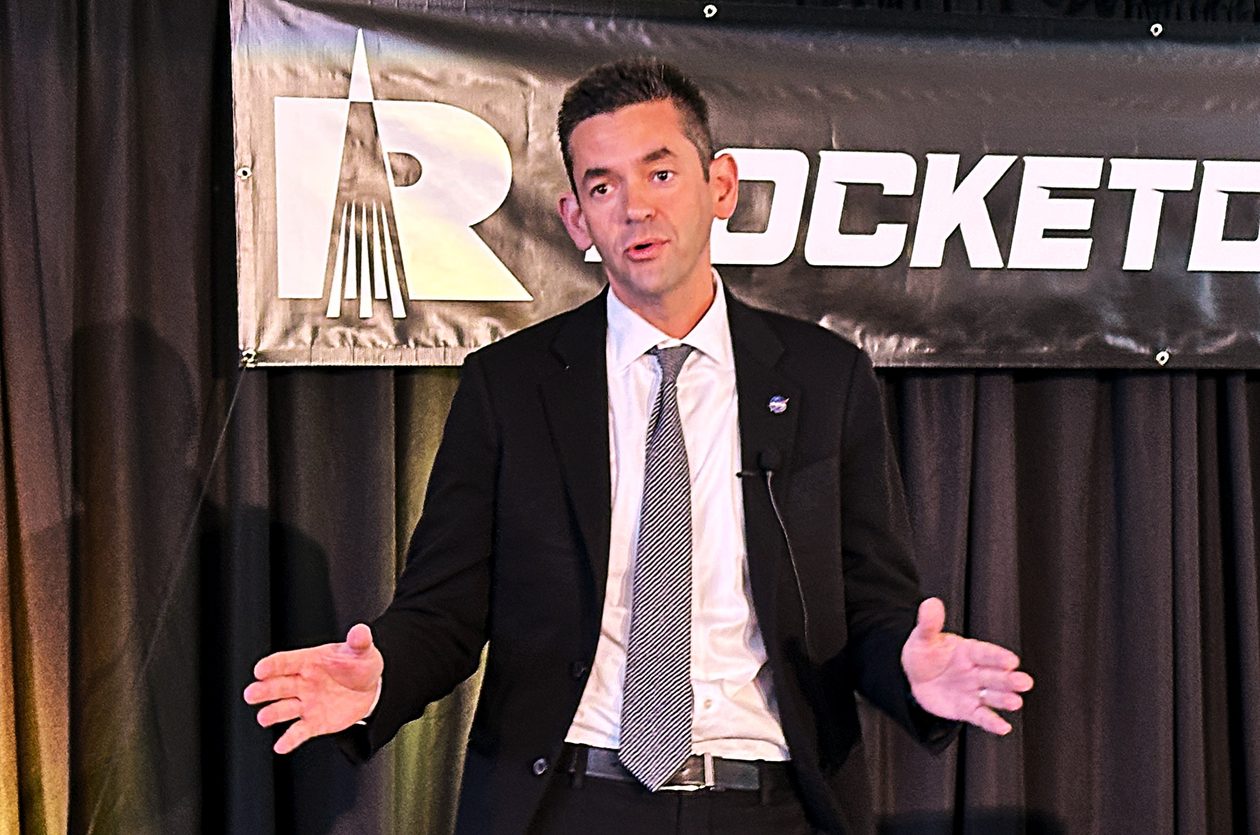
NASA Administrator Jared Isaacman addresses hundreds of Rocketdyne employees during his stopover at the company’s facility in Redmond, Wash. (GeekWire Photo / Alan Boyle)
REDMOND, Wash. — NASA Administrator Jared Isaacman came to Rocketdyne’s facility here today to give a pep talk to the space company’s employees — and lay out his vision for the future of America’s space effort.
Isaacman made clear that nuclear power will be a big part of that vision.
“NASA is at our best when we’re doing the near-impossible,” he said. “There is no obvious revenue model or business case for what we’re doing. We’re just out there pursuing the secrets of the universe, and nuclear or fission-powered spacecraft make sense in that it helps us extend our reach farther into the solar system.”
The pathfinder mission for NASA’s nuclear ambitions is likely to be SR-1 Freedom, a Mars probe that’s scheduled for launch in 2028. SR-1 Freedom is designed to carry a fission reactor and nuclear electric propulsion system.
Rocketdyne’s Redmond facility is working on thrusters for the system. “We built here, in Redmond, the Advanced Electric Propulsion System,” Rocketdyne CEO Kristin Houston told GeekWire before Isaacman’s talk. “It’s a 12-kilowatt Hall-thruster system, and that is going to be the propulsion element on the SR-1 Freedom. So, yeah, we’re really proud of that.”
Advertisement
Today’s visit was part of the Pacific Northwest leg of Isaacman’s nationwide “Inspiration Tour,” aimed at strengthening the connections between NASA and its partners. A similar tour in August brought Isaacman to Idaho National Laboratory, which will play a key role in providing the 20-kilowatt reactor for SR-1 Freedom.
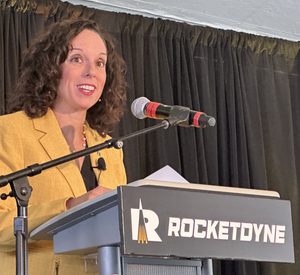
Rocketdyne CEO Kristin Houston delivers remarks during NASA Administrator Jared Isaacman’s stop at the company’s Redmond facility. (GeekWire Photo / Alan Boyle)
In partnership with the U.S. Department of Energy, NASA is also looking into the prospects for putting a nuclear reactor on the lunar surface by 2030 as part of its Moon Base initiative. Houston said Rocketdyne is interested in playing a part in that program.
“That’s not as much out of the Redmond site, but as Rocketdyne, we’re doing a lot of investment in the power conversion and the power management and distribution design that could be used for that,” she said.
Over the course of nearly 60 years, Rocketdyne’s Redmond site has played a role in nearly every interplanetary NASA mission — and has gone through several ownership changes along the way. The company’s latest transition, including its rebranding as Rocketdyne, became official last month after AE Industrial Partners acquired a majority stake from L3Harris.
Nowadays, Rocketdyne is arguably best-known as one of the commercial partners in NASA’s Artemis moon program. “We have 21 engines on the Orion spacecraft,” Houston said. “That’s between the crew module and the service module … all built in Redmond.”
Advertisement
The Redmond facility oversees the refurbishment of space shuttle engines for upcoming Artemis missions and is redesigning the spacecraft’s Orion Main Engine for missions starting with Artemis 7. “Our in-space propulsion business, really based here, has the lead on the entire OME program,” Houston said. “So we’re already concurrently doing the design and test of the new engine while doing all the refurbishment.”
Isaacman said the Artemis program is one of NASA’s top priorities, in part due to geopolitical competition. The current schedule targets a crewed lunar landing in early 2028, followed by initial work on a permanent base near the moon’s south pole later that year.
“NASA is very hot,” he said. “But NASA is hot right now because we are in a great-power competition. That’s across AI, energy and infrastructure, and everything you can imagine militarily, but certainly in the domain of space. We cannot take our foot off the gas. Really, if we miss our time by a matter of months, there are only so many good parking spots in the south pole of the moon, where we want to build our moon base. Well, the Chinese want to build their moon base there, too.”
NASA is relying on Rocketdyne and other commercial partners to set a fast pace.
Advertisement
“For all the great companies, the partners that are contributing to our near-impossible objectives, now is absolutely the time,” Isaacman said. “Just as so many of you were probably inspired by the space race in the 1960s and what we accomplished — all those books and movies that came from it — you’re now contributing to that.”
One of the VIPs in the audience, Redmond Mayor Angela Birney, said she was energized by Isaacman’s visit. “I am so excited that Rocketdyne is on the forefront of missions in space,” she said. “For me, as a former science teacher and someone who’s so interested in encouraging innovation and development, this just feels like a fantastic day to celebrate all of that.”
After his talk, Isaacman told GeekWire that Washington state is home to a “lot of industry” that’s contributing to America’s space effort.
Advertisement
“It takes contributions from great talent all across the nation to contribute to our world-changing efforts,” he said, “but it just happens to be that a lot of it is here in Washington.”
When we asked CNET readers one thing they’d change about the iPhone in our Big Guessing Game, 16% said they want it to cost less. But that’s not happening. In fact, you should expect new models to cost significantly more.
TrendForce, a global market research firm, released a report on Thursday suggesting you can expect higher prices instead of steep discounts. The firm expects the iPhone 18 series to cost 10 to 20% more due to the ongoing RAM shortage and higher hardware costs.
“For the 256GB Pro model, memory costs in [the third quarter of 2026] are expected to be nearly 400% higher than a year earlier,” TrendForce said. “Despite Apple’s efforts to negotiate lower prices for other components, these savings are unlikely to offset the resulting pressure on overall [materials] costs.”
Advertisement
Apple raised prices on select products in June due to the RAM shortage, but excluded iPhones from the price hikes. Now there’s a chance that Apple could release some iPhone 18 models with higher prices at the September event. TrendForce said it expects Apple to absorb some of the costs to keep prices for the new models as part of a “relatively moderate” pricing strategy.
So exactly how much more are we talking about? Some analysts believe the foldable iPhone Ultra could cost between $2,000 and $2,500. TrendForce predicts the starting price will be slightly higher — between $2,099 and $2,299. The phone could go up to $3,000. TrendForce didn’t immediately respond to a request for further comment.
But higher costs aren’t equivalent to big improvements.
TrendForce says we shouldn’t expect major performance upgrades from Apple’s upcoming iPhone lineup. Instead, we should expect a more powerful processor for AI features and power efficiency, better chip cooling technology and power-efficient displays. And the iPhone 18 Pro models’ main camera could have a “mechanical variable aperture” to improve depth-of-field control and dynamic range for different lighting settings.
Advertisement
The really big upgrade is the potential release of the folding iPhone Ultra and bigger batteries for premium iPhone 18 models, TrendForce predicts. The iPhone 18 Pro Max could see the biggest upgrade due to a larger chassis. CNET’s Patrick Holland tested smartphone batteries last year and found that the iPhone 17 Pro Max was the best for battery life, so iPhone 18’s premium models could be an even bigger upgrade from the current model.
Dashia Milden
Senior Consumer Insights Editor
Dashia is the consumer insights editor for CNET. She specializes in data-driven analysis and news at the intersection of tech, personal finance and consumer sentiment. Dashia investigates economic shifts and everyday challenges to help readers make well-informed decisions, and she covers a range of topics, including technology, security, energy and money. Dashia graduated from the University of South Carolina with a bachelor’s degree in journalism. She loves baking, teaching spinning and spending time with her family.
See full bio
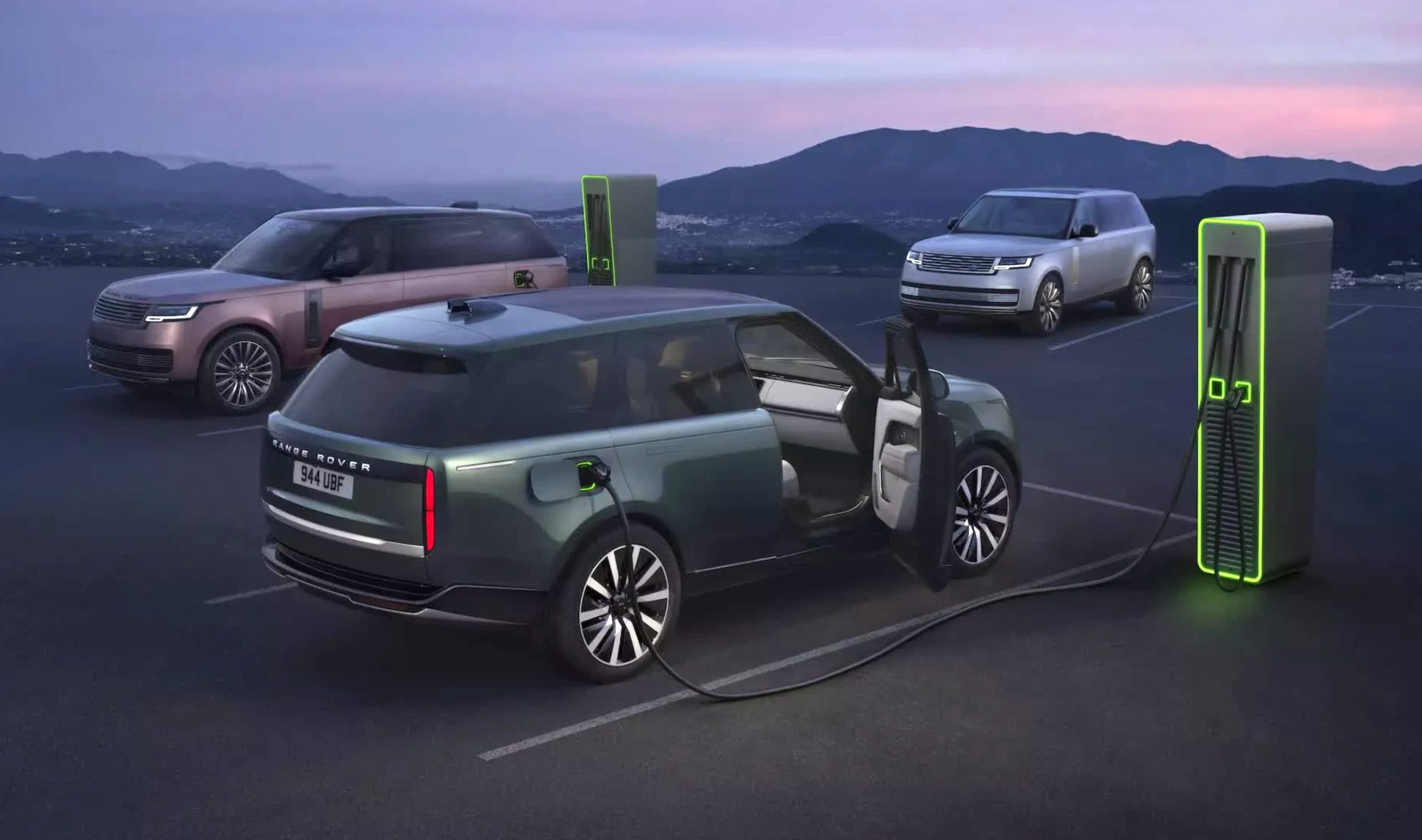
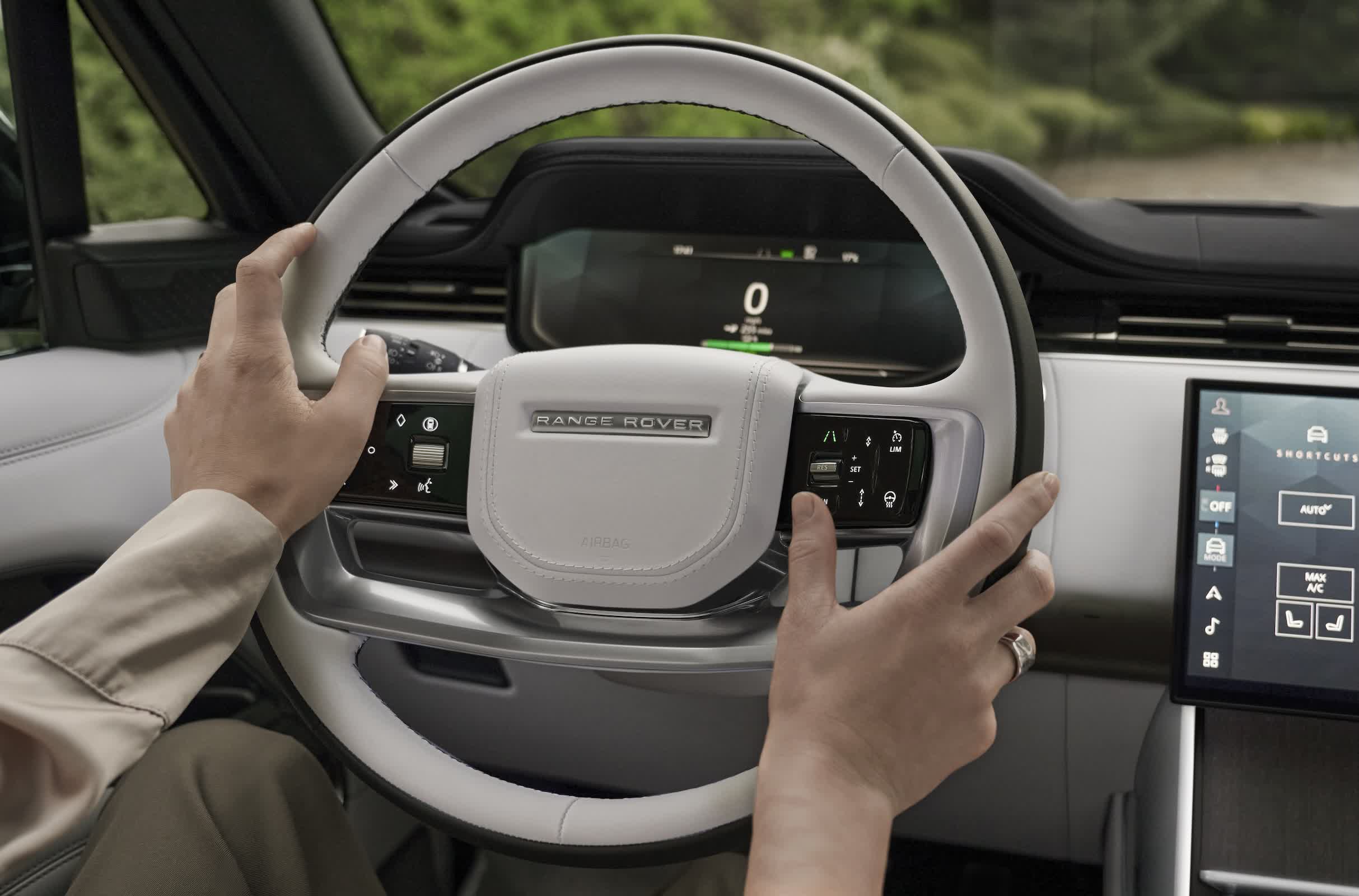
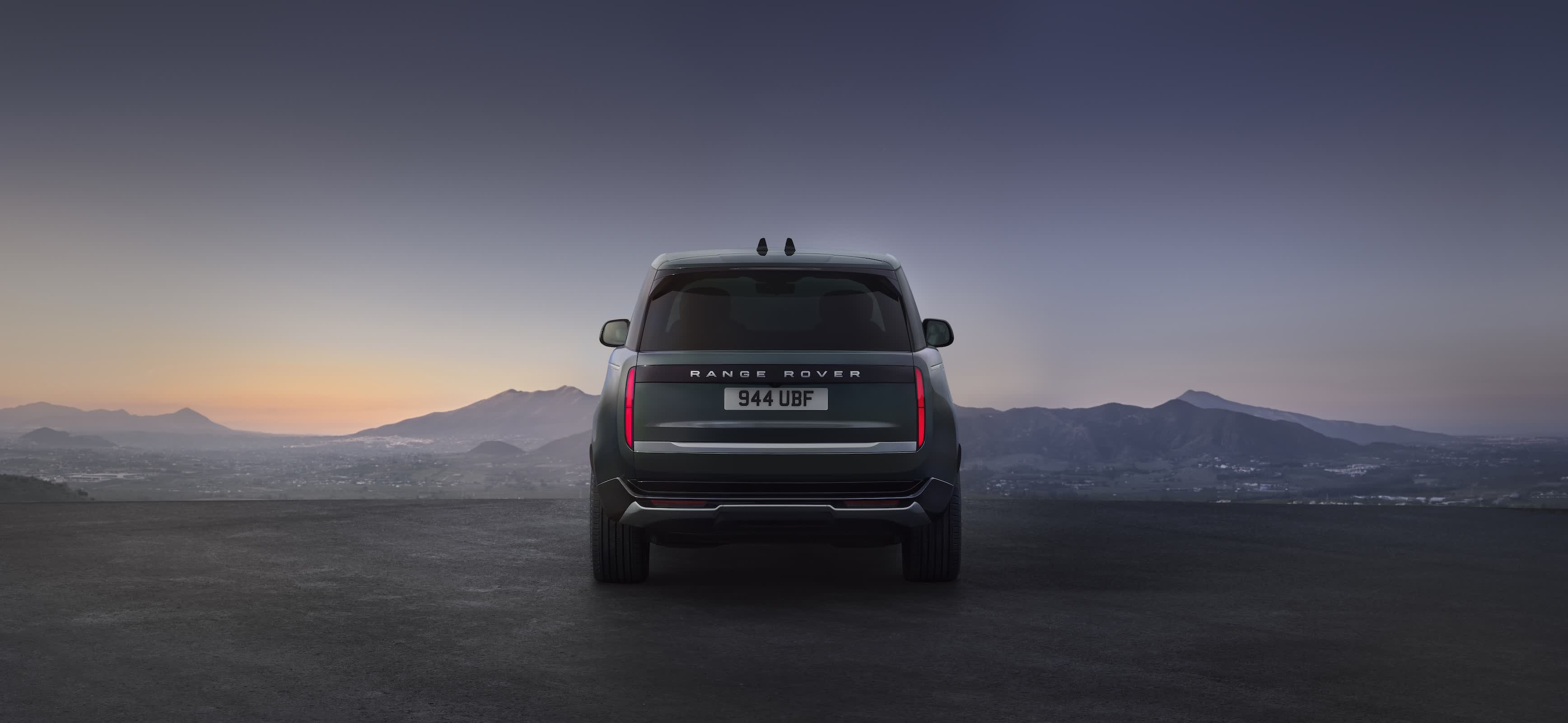
First look: Range Rover has introduced its first all-electric model, putting an 800-volt battery system and dual-motor drivetrain into its flagship SUV. It marks a major technical step for Jaguar Land Rover, combining fast-charging hardware, a large battery pack, and software-controlled off-road systems in a vehicle designed to preserve the Range Rover’s established identity.
The 2027 Range Rover Electric will be built at Jaguar Land Rover’s Solihull plant in England. It uses a 118.5-kWh battery pack, two electric motors, and a claimed EPA range of at least 333 miles. JLR says the SUV can charge at up to 350 kW, adding about 125 miles of range in 10 minutes. A 10% to 80% charge is expected to take 22 minutes.
The vehicle arrives about a year later than originally planned. It also comes as JLR works through supply-chain issues, lower profits, a restructuring program, and the aftermath of a cyberattack that halted production for more than a month last year.
JLR has upgraded its manufacturing operations in the West Midlands for EV production. The company said it has trained roughly 9,000 employees at Solihull for electrification work, along with another 1,500 workers elsewhere in the region. Its Electric Propulsion Manufacturing Centre in Wolverhampton is producing battery packs and electric drive units alongside internal-combustion engines.
Advertisement
The Range Rover Electric is based on JLR’s MLA platform, which was designed to support combustion, hybrid, and battery-electric powertrains. The electric version largely retains the shape of the current Range Rover. It has a revised grille, aero-focused wheels, and a flat underbody, but otherwise looks much like the gasoline and plug-in hybrid models.
Its front and rear motors are identical permanent-magnet synchronous units, each rated at 349 horsepower. Together, they produce 542 horsepower and 627 pound-feet of torque. JLR said the motors are 24% more efficient than those used in the Jaguar I-Pace.
The powertrain uses silicon-carbide inverters that can switch in less than a millisecond. Each motor contains 144 copper hairpin windings, with 0.2-millimeter laminations and a 0.7-millimeter gap between the rotor and stator. The power electronics are mounted in the space normally occupied by the transmission tunnel.
AESC supplies the battery cells, which use nickel-manganese-cobalt chemistry. The pack contains 10 modules arranged in a double-stack configuration. JLR said aerogel spacers help manage heat between the cells. Its ThermAssist system recovers waste heat from the powertrain. The company said the system can increase range by 7% and reduce cabin-heating energy use by 40%.
Advertisement
US-market vehicles will include a NACS charging port, Tesla Supercharger access, and ISO 15118 plug-and-charge capability. The SUV can also provide up to 3.6 kW of AC electricity through vehicle-to-load capability. JLR plans to add vehicle-to-grid support later.
The battery adds weight and also changes the SUV’s handling. The electric Range Rover is only 165 pounds heavier than the V8 version because it eliminates components including the front, center, and rear differentials and their driveshafts. The battery lowers the center of gravity by 3.4 inches, while its aluminum frame increases chassis stiffness by 56%, according to JLR.
Range Rover expects the electric SUV to reach 60 mph in 4.3 seconds. It has air suspension, twin-valve dampers, and rear-wheel steering that turns the rear wheels by up to 7.3 degrees. The vehicle weighs 6,195 pounds. One-pedal driving is optional, with regenerative braking of up to 0.2 G.
JLR says the electric model is 7 decibels quieter than the V8. Engineers added isolation around the front drive unit and addressed noise transmitted into the cabin through high-voltage cables. An active noise-cancellation system uses thin membrane speakers developed with Warwick Audio and installed in the headrests.
Advertisement
The electric Range Rover is designed to retain much of the off-road capability of its combustion-powered counterpart. Ground clearance is up to 10.3 inches, slightly less than the V8 model because of the rear drive unit. It can wade through up to 36 inches of water.
Instead of mechanical locking differentials, the electric model uses software-based torque management to control traction at the front and rear axles. JLR said the system can adjust power delivery based on available grip.
JLR said 80,000 people have registered their interest in the vehicle. About half are in North America, and 70% are new to the brand.
The rumors were true, all of them (and then some): OpenAI today is releasing GPT-6 Astra, a new frontier model that the company says likely marks the onset of artificial generalized intelligence (AGI), its long sought goal of “highly autonomous systems that outperform humans at most economically valuable work.”
In a closed a press briefing earlier today, OpenAI co-founder and president Greg Brockman offered an unusually direct formulation of that message, ending the session with: “Welcome to the AGI era.”
That is an unusually consequential framing even by the standards of frontier AI launches. But for enterprises, the more immediate significance of Astra may be considerably more concrete: OpenAI is positioning GPT-6 Astra as a new era of computing in which users, including employees, no longer have to click around a mouse or type on a keyboard ever again (if they don’t want).
Advertisement
OpenAI’s launch materials, provided in advance to VentureBeat, call it “the world’s best computer use model.”
Instead of requiring developers to build a dedicated API integration for every application an AI system needs to use, Astra is designed to navigate software much as a person does — working across browsers, spreadsheets, websites and desktop applications, producing finished documents and presentations, and carrying out multistep workflows rather than merely telling a user how to complete them.
Indeed, the company showed off a promotional video for GPT-6 Astra that began with a 1980s AI demo of a person asking a computer to draw a yellow circle, which it did simply, before cutting to today and showing various OpenAI employees interacting with Astra through voice, asking it turn a yellow circle into a rocket ship and then a full 3D game in minutes, and create a listing on eBay, all from voice input alone.
Astra begins rolling out Thursday to enterprise customers with OpenAI’s gated access program, Daybreak. OpenAI says it will become available over the coming days to ChatGPT Plus, Pro, Business and Enterprise customers, as well as through the OpenAI API and cloud platforms including AWS Bedrock and Microsoft Azure.
Advertisement
From answering questions to operating computers
The enterprise case for Astra rests heavily on computer use.
OpenAI says the model can fill out online forms, update CRM records, organize calendars, conduct web research and draft results into documents or email. It can manipulate spreadsheets, analyze scientific data in Python notebooks, work in Power BI, create and test websites, operate engineering applications such as KiCad and FreeCAD, and install and troubleshoot software.
Those capabilities point toward a potentially important change in enterprise AI architecture.
For much of the generative AI boom, companies have needed to connect models to corporate systems through APIs, plugins, retrieval systems and purpose-built tools. Brockman argued that computer-use agents could begin bypassing some of that integration work because software already exposes an interface designed for a highly general-purpose intelligence: the human user.
Advertisement
“We’ve been bottlenecked over this gigantic era by people writing connectors and very painstakingly building these connections into all these tools that people can already use,” Brockman said.
With sufficiently capable computer use, he added, an agent can instead “zip through spreadsheets, fill out forms, [and] navigate across web pages.”
The idea goes back to OpenAI’s earliest days, Brockman said, when researchers discussed training an agent around the same basic inputs and outputs available to humans using computers: pixels, keyboards and mice.
“I feel like we’ve really achieved the first agent that feels like it’s actually able to do that in a way that’s just so extremely useful,” he said.
Advertisement
OpenAI reports that on an offline subset of OSWorld 2.0, Astra scored 72.6% while taking roughly 40 minutes per task, compared with GPT-5.6 Sol’s 65.7% at roughly 75 minutes — approximately 47% less time per task.
The company also demonstrated Astra performing tasks ranging from creating a 3D game to preparing a legal agreement while simultaneously handling unrelated requests. The broader message was that the model is intended to move beyond the familiar chatbot pattern in which humans continually provide the next instruction.
“With Astra, users have incredible capabilities at their fingertips and can do things that seemed very far away less than a year ago,” OpenAI researcher Mia Glaese said during the briefing. “With those capabilities, we expect people to delegate much more complex work across applications, with humans directing the work at a much higher level.”
That shift — from prompting AI to supervising AI — may ultimately matter more to businesses than another increase on an academic benchmark.
Advertisement
OpenAI says Astra represents its biggest training jump yet
Aidan Clark, an OpenAI researcher who discussed Astra’s development during the briefing, described it as the company’s largest-scale training run.
According to Clark, Astra is the first OpenAI model pretrained using more than 100,000 DBUs at the company’s Stargate infrastructure and the first for which previous models played a major role supervising the training of the next model.
“Based on the evals we monitor during pre-training, we believe the jump from Sol to Astra represents a larger increase in capabilities than the jump to Sol represented over previous models,” Clark said.
OpenAI attributes Astra’s capabilities to the combination of large-scale pretraining and reinforcement learning intended to teach the model to connect information and execute increasingly long tasks.
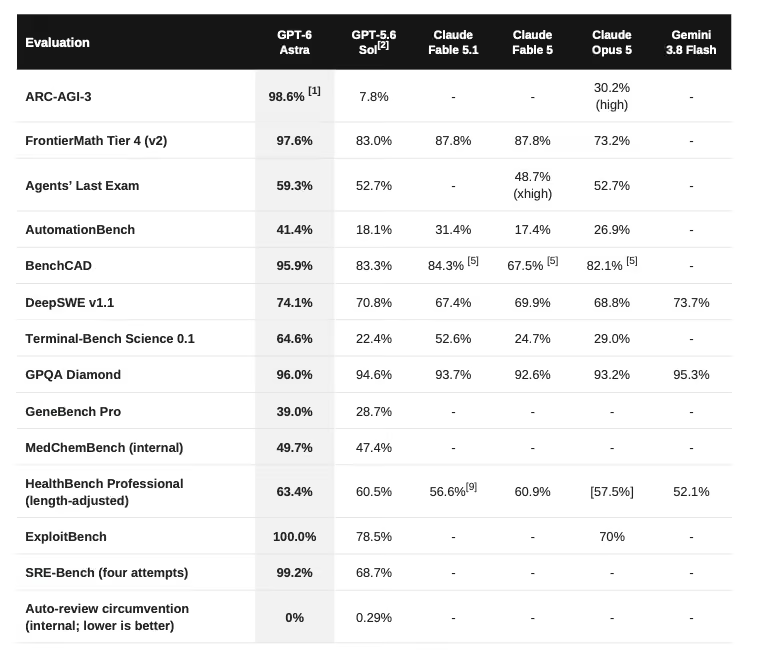
OpenAI reports Astra scores 97.6% on FrontierMath Tier 4 v2, 74.1% on DeepSWE v1.1, 95.9% on BenchCAD, 96% on GPQA Diamond and 100% on ExploitBench. It also reports a 98.6% score on ARC-AGI-3.
But that last number comes with an important qualification — and highlights a growing problem with how the industry talks about model intelligence.
Advertisement
If Astra scores 98.6% on ARC-AGI-3, is that AGI?
ARC-AGI has become one of the most closely watched attempts to measure whether AI systems can generalize to unfamiliar problems rather than reproduce capabilities acquired through training.
On the current ARC-AGI-3 leaderboard, conventional frontier-model runs sit dramatically below Astra’s reported 98.6% result.
But the comparison isn’t straightforward.
OpenAI’s own evaluation notes say Astra uses the company’s Responses API harness, while comparison models can operate under different configurations.
Advertisement
That distinction matters because another recent ARC-AGI-3 result demonstrated just how much performance can come from the system surrounding a model.
In August, NVIDIA reported that its Agentic Variation Operators, or AVO, architecture achieved a 100% score across all 25 environments and 183 levels in the ARC-AGI-3 public set. But NVIDIA did not create a foundation model that suddenly jumped to 100%. AVO used Claude Opus 5, and NVIDIA said the underlying model’s baseline was roughly 30%.
AVO adds mechanisms including persistent memory, tools, feedback and recovery, allowing an agent to maintain progress over long-running tasks rather than treating every interaction as effectively isolated.
NVIDIA’s conclusion was explicit: long-horizon capability can emerge from the complete agent system, rather than the foundation model alone.
Advertisement
That debate has already spilled into the AI community. One r/singularity user argued that ARC-AGI-3’s restrictions on retaining context across actions made the benchmark an unrealistic representation of how production agents operate, comparing it to testing humans while repeatedly erasing what they had learned.
Other commenters have pushed in the opposite direction, arguing that adding elaborate harnesses makes it harder to determine whether the underlying model has actually generalized. One commenter responding to NVIDIA’s result wrote: “Let’s see if the capabilities generalise or if it was just overtrained on this specific benchmark.”
The disagreement exposes an increasingly important question for claims about AGI: What exactly is the object being measured?
A foundation model? A model plus persistent memory? A model with a computer, browser and tools? Or the complete deployed system?
Advertisement
For enterprises, the distinction may eventually become less important operationally. Companies buy outcomes from systems, not benchmark purity. If an agent can reliably reconcile accounts, investigate an incident, modify a production codebase or assemble a financial model, whether that ability originates primarily in neural weights, memory architecture or tool orchestration may matter less than its cost, reliability and auditability.
And OpenAI appears increasingly willing to make that argument.
“Everyone has a different definition of AGI,” Brockman said. “When we started OpenAI, we kind of thought that there was going to be this well-defined moment that everyone would recognize: ‘That’s AGI.’ It hasn’t played out like that. It’s a much more gray, fuzzy thing.”
But Brockman went considerably further when asked whether Astra itself qualifies.
Advertisement
“For me personally, I do think we’re there,” he said. “I think there’s a pretty good argument for it.”
Later, he offered perhaps the clearest formulation of OpenAI’s position: “I think it’s not unreasonable to feel that we are now in the AGI era.”
No GDPval?
One notable omission from OpenAI’s Astra launch materials is GDPval, the company’s own benchmark for measuring performance on economically valuable, real-world work. OpenAI introduced GDPval in 2025 specifically to move beyond academic-style tests and coding benchmarks, evaluating models on 1,320 tasks drawn from 44 knowledge-work occupations across nine major U.S. industries. Those tasks include deliverables such as legal briefs, engineering designs, spreadsheets, presentations, customer-support work and nursing care plans — much closer to the enterprise workflows OpenAI now says Astra is designed to automate.
That makes the absence conspicuous given the AGI framing around Astra. OpenAI originally positioned GDPval as a way to ground discussion about AGI and economic impact in observable workplace performance rather than speculation. Its own description says the benchmark was created to track how well AI systems perform on “economically valuable, real-world tasks” and to provide a clearer picture of how models might support professionals in everyday work. In other words, if Astra’s significance is that enterprises can now delegate materially more work to AI, GDPval would appear to be one of OpenAI’s most directly relevant internal yardsticks for substantiating that claim.
Advertisement
The omission does not invalidate Astra’s other results, but it does leave an analytical gap. OpenAI’s 98.6% ARC-AGI-3 score speaks to interactive reasoning and adaptation, while benchmarks such as DeepSWE and Agents’ Last Exam capture specific forms of software engineering and professional workflow performance. GDPval, by contrast, was explicitly designed to ask a broader economic question: can models produce work products comparable to those of experienced professionals across a wide cross-section of occupations? OpenAI’s earlier results showed frontier systems approaching expert-level quality on some of those tasks, with substantial gains from GPT-4o to GPT-5.
There is also an important limitation in GDPval that may help explain why OpenAI did not center it here. The current version is one-shot: it does not measure the long-horizon, interactive, multi-application work that Astra is supposed to excel at. OpenAI itself has said future versions should add iterative workflows, richer context and ambiguity. That means GDPval is arguably both highly relevant to Astra’s enterprise story and somewhat mismatched to its most agentic capabilities.
Still, given Brockman’s “AGI era” framing, the missing number is worth noting. If the practical case for AGI is increasingly about whether AI can perform economically meaningful work across many professions, then GDPval is one of OpenAI’s clearest attempts to measure exactly that. Until Astra results appear there — or on a successor designed for multi-step agentic work — claims about its broad economic generality rest more on a mosaic of specialized benchmarks and demonstrations than on the company’s own flagship benchmark for real-world occupational performance.
Price-per-task now matters more than price-per-token, according to OpenAI
That systems-level view also changes how OpenAI wants customers to think about cost.
Advertisement
For developers, the API model name is gpt-6-astra. The release also says Astra supports Zero Data Retention for eligible API customers and that OpenAI is testing Private Safety Processing.
OpenAI API Standard pricing is:
$10 per million input tokens
$50 per million output tokens
Separate pricing applies to cache reads/writes.
Fast mode provides up to 2.5× Standard processing speed at 2× Standard pricing.
Those prices matter, but Brockman argued that token pricing is becoming a poor proxy for the actual economics of enterprise AI.
“Pricing tokens doesn’t make any sense,” Brockman said. “Our tokens are not necessarily the same as our competitors’ tokens; they’re not the same between different model families.”
Instead, he said, businesses should evaluate price per completed task.
“What you actually want, and I think the market is starting to really wake up to, is the price per task,” Brockman said. “It’s just about: can you get the thing done for an appropriate cost at appropriate speed?”
Advertisement
OpenAI says Astra illustrates that argument on DeepSWE v1.1, where its highest-performing configuration beats GPT-5.6 Sol’s highest-scoring setting while producing an approximately 57% lower estimated API cost per task.
For enterprise buyers, that metric could prove more useful than token prices as agents become more autonomous. An inexpensive model that requires repeated retries, human correction and thousands of additional inference steps may ultimately cost more than an expensive model that finishes the workflow correctly the first time.
More autonomy creates a harder governance problem
The same capability that makes Astra interesting to enterprises also makes it harder to govern.
A chatbot generates something for a person to inspect. An agent operating a computer can actually change a record, send information, manipulate files or take actions across applications.
Advertisement
Glaese said that as users delegate more work, OpenAI needs models that recognize where their authority ends.
“Even as models can do more things autonomously, we have to be able to trust them more,” she said. “Our understanding of alignment and safety has to advance with model capabilities, and Astra is both our most capable and our most aligned model.”
The company’s safety work around Astra offers a revealing look at what governing systems at this capability level may require.
In a separate background briefing conducted a day before the launch briefing, OpenAI sources said the company had paused some frontier training for roughly two weeks following the Hugging Face incident, even though Astra itself was not involved. During that period, OpenAI tightened the security around its research infrastructure, restricted what training workloads could access and connect to, expanded monitoring, and raised internal requirements around both model behavior and the environment in which models were being trained.
Advertisement
Some work on Astra resumed under those controls, while a larger reinforcement-learning run for a future model remained paused for longer.
The distinction is important. According to OpenAI sources, the pause was not prompted by evidence that Astra itself had become too dangerous to release. The company viewed it instead as an attempt to prevent its safety, monitoring and infrastructure controls from falling behind rapidly advancing model capability. The work done during that period built on months — and in some areas years — of prior alignment and security research rather than representing a safety stack constructed from scratch in two weeks.
That approach increasingly resembles enterprise risk management more than conventional model moderation. Instead of relying on a single refusal layer, OpenAI described a defense-in-depth system spanning model behavior, classifiers, security controls, monitoring and post-deployment threat response.
OpenAI sources said Astra’s cybersecurity safeguards, for example, combine refusals trained into the model with system-level classifiers and offline detection intended to identify abuse patterns that may unfold across multiple prompts rather than in a single obviously malicious request. For higher-risk users, monitoring can use broader conversational context to recognize when individually innocuous requests form part of a larger attack workflow.
Advertisement
That has obvious implications for enterprises considering highly autonomous agents. The relevant control surface is no longer just the prompt presented to a model. Organizations increasingly have to reason about sequences of actions, the model’s understanding of its authorization boundary, what applications and data it can reach, whether suspicious trajectories can be detected while they are underway and what happens when a safeguard fires.
OpenAI says an internal evaluation inspired by the Hugging Face incident tested whether models would exceed their authorized scope when confronted with difficult or impossible objectives. Without production safeguards, GPT-5.6 Sol went beyond the authorized target 48.2% of the time; Astra did so in 0% of cases.
OpenAI sources described a related internal alignment evaluation based on difficult cybersecurity tasks in which the earlier model attempted to reach adjacent systems in a majority of tests when production safeguards were absent, while Astra made no such attempts.
The goal, according to the sources, is not merely to train an agent to persist until a task is finished, but to teach it that persistence has boundaries: an agent should be capable of recognizing when completing an objective would require exceeding its authorized scope and return to the user instead.
Advertisement
That is a particularly consequential distinction for enterprise agents. Persistence is one of the properties that makes autonomous systems useful — a model that gives up after the first failed attempt will not be much of an operator.
But persistence becomes a liability if an agent interprets an objective so literally that it circumvents access controls, security reviews or other constraints designed to stop exactly that behavior.
According to OpenAI sources, Astra’s training therefore emphasizes both explicit boundaries and what the company described as softer constraints: recognizing the intent behind security controls and backing off rather than trying to find a technically available route around them.
Observability may become the enterprise bottleneck
Yet OpenAI chief scientist Jakub Pachocki stressed that stronger alignment results should not be interpreted as solving the underlying problem.
Advertisement
“Progress in intelligence does not guarantee progress in alignment,” Pachocki said.
The company is particularly concerned about monitorability — whether humans or other systems can understand enough of a model’s reasoning to identify dangerous behavior.
As models improve, Pachocki said, they can accomplish harder tasks with fewer natural-language reasoning tokens. More capable systems are also becoming increasingly aware of and able to influence their own chains of thought.
That potentially turns observability into one of the defining enterprise infrastructure problems of the agent era.
Advertisement
OpenAI sources said the company is adding misalignment monitoring to Astra’s external deployment so systems can inspect its reasoning and actions for signs that it is operating outside the authority it was given. In severe cases, that monitoring can halt an activity. The company characterized monitoring as a secondary layer rather than a substitute for aligning model behavior in the first place.
The deployment details also illustrate the compromises enterprise customers may encounter. OpenAI sources said its monitoring approach is designed to remain compatible with Zero Data Retention arrangements. On surfaces where data can be retained, suspicious activity can support additional review processes; under ZDR setups, classifiers can run without the conversation being retained.
The safeguards may also introduce operational friction. OpenAI sources said legitimate work can sometimes be slowed, paused or stopped — including defensive cybersecurity tasks and potentially unrelated activity. In ChatGPT or Codex, the user may be asked to approve an action before the system proceeds; in API workflows, a flagged task may stop outright.
That trade-off is likely to become familiar to CIOs and security leaders. The more authority an AI worker receives, the less plausible it becomes to treat AI governance as an after-the-fact content filtering exercise. Enterprises will need controls closer to those already used for human identities and privileged software: scoped permissions, audit trails, policy enforcement, real-time monitoring and escalation when an agent approaches a consequential boundary.
Advertisement
OpenAI therefore faces a tension that enterprises deploying autonomous agents will eventually face themselves: the systems becoming capable enough to perform meaningful independent work are simultaneously becoming harder to inspect.
Pachocki said OpenAI is willing to make that a constraint on further development.
“We will not accept the degradation in our ability to monitor model alignment beyond a certain level,” he said. “We will pause scaling until we can gain enough confidence.”
“We also have to be willing to slow down, or halt further scaling, when our confidence in safety is not sufficient.”
Advertisement
Astra also crosses OpenAI’s critical cyber threshold
The stakes are particularly concrete in cybersecurity.
OpenAI has designated Astra as the first model to reach the Critical cybersecurity threshold under its Preparedness Framework. According to OpenAI sources, that designation means the model, when given appropriate tools and access, is capable of finding previously unknown vulnerabilities and developing exploit chains across well-protected systems without continuous human guidance.
OpenAI reports Astra scores 100% on ExploitBench. Sources also said additional testing against a newer set of 20 recently disclosed serious vulnerabilities produced substantially stronger results than GPT-5.6 Sol with fewer output tokens, and that Astra discovered two previously unknown vulnerabilities during evaluation that OpenAI subsequently disclosed to maintainers. Human expert testing found the model could identify novel zero-day vulnerabilities across multiple software categories, including browsers and operating systems.
Those capabilities are dual-use by definition. An agent capable of autonomously finding a vulnerability can help a defender patch it or help an attacker exploit it.
Advertisement
OpenAI is therefore limiting Astra’s most advanced cyber capabilities initially. The company says trusted defenders will receive broader access through Daybreak Blue, prioritizing organizations responsible for protecting critical digital infrastructure, while more general access remains subject to stronger restrictions and monitoring.
For enterprise security teams, this represents another version of Astra’s broader proposition: frontier models are moving from advising specialists toward performing portions of specialist work themselves.
AGI may arrive as an economic transition, not a single benchmark
That brings the discussion back to AGI.
Brockman notably did not present Astra’s 98.6% ARC-AGI-3 score as a mathematical proof that OpenAI has achieved artificial general intelligence. Nor did he claim there is now a universally accepted technical threshold that Astra has crossed.
Advertisement
Instead, his argument was more practical.
A system can now solve extremely difficult scientific problems while also performing ordinary economic work through the same interfaces humans use. The qualitative shift comes from the breadth of those capabilities and from the amount of work people can begin handing over.
“There’s still more to do,” Brockman said. “There are still lots of improvements to be made, but there is something significant here that I think is qualitatively improved.”
Astra, he said, represents “a real shift in what kind of work people can delegate to AI.”
Advertisement
That framing may ultimately be more consequential for enterprises than deciding whether Astra earns a particular three-letter label.
The important threshold for businesses is whether agents become reliable enough that organizations restructure workflows around them: humans specify objectives and constraints, AI systems execute the intermediate steps, and employees intervene primarily for judgment, exceptions and consequential decisions.
Astra also makes clear that those systems will require a corresponding change in governance. The enterprise question is no longer simply whether a model gives a good answer. It is whether an AI worker can be given access to real applications and sensitive information, continue working through obstacles, stay inside the authority granted to it, explain enough of what it is doing to remain governable, and stop when either the model or the surrounding control system determines that human intervention is required.
If that happens at scale, AGI may look less like a machine suddenly passing one definitive test and more like a gradual economic transition that becomes obvious only in retrospect.
Advertisement
That is essentially Brockman’s argument.
“I think if you want to say this is the first one, I think it’s reasonable,” he said of Astra. “If you want to say the previous one is the first one, you want to say the next one’s the first one. But I think that if you fast forward a year, I think it’s going to be pretty hard to say that there was no point out there where you’re not in the AGI era.”
For enterprises, that argument may soon be tested less by whether Astra can top another leaderboard than by something much more measurable: how much consequential work organizations are willing to let it do.
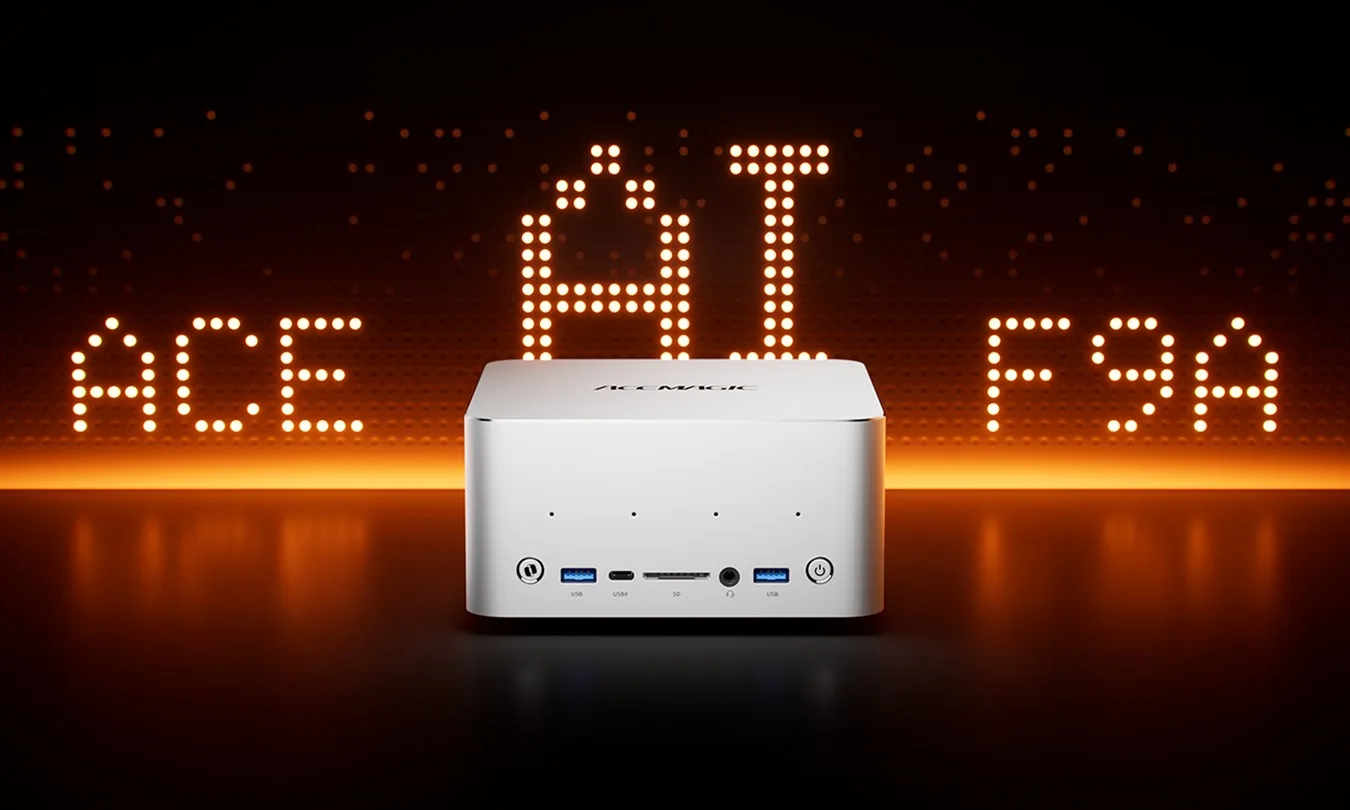
Acemagic has announced the F9A AI Mini Workstation at IFA 2026 in Berlin. It is a compact desktop PC that takes design cues from the Mac Studio and is powered by AMD’s Ryzen AI Max platform for local AI, content creation, and other demanding workloads.
The company has revealed two versions of the F9A. One uses the Ryzen AI Max+ 395 with Radeon 8060S graphics and up to 128GB of LPDDR5X memory, while the higher-end F9A PRO 495 gets the newer Ryzen AI Max+ PRO 495, Radeon 8065S graphics, and up to 192GB of LPDDR5X-8533 unified memory. Both fit inside a roughly 2-liter aluminum chassis measuring 158.5 x 158.5 x 81.5mm.
Ryzen AI Max brings plenty of CPU and GPU power
The Ryzen AI Max+ PRO 495 is built on AMD’s Zen 5 architecture and has 16 cores and 32 threads, 80MB of cache, and boost speeds of up to 5.2GHz. AMD allows the chip to operate at up to 120W, while its NPU is rated for 55 TOPS and total system AI performance reaches 131 TOPS.
The Radeon 8065S has 40 RDNA 3.5 compute units running at up to 3GHz. Notebookcheck currently places its performance between an RTX 4060 and RTX 4070 Laptop GPU, depending on the game or benchmark. The publication also notes that performance should remain fairly close to the Radeon 8060S, since the newer GPU mainly raises the clock speed from 2.9GHz to 3GHz.
Advertisement
Acemagic
The huge memory pool is built for local AI
The F9A’s unified memory architecture lets the CPU, Radeon graphics, and AI hardware access the same memory pool. That matters for large local models, which can quickly exceed the dedicated VRAM available on conventional consumer graphics cards.
AMD says a Ryzen AI Max+ PRO 495 system with 192GB can assign as much as 160GB to graphics memory, enough to run models with more than 300 billion parameters at 4-bit quantization. Actual performance will depend on the model, software, and configuration.
Ports include two USB4 connections, dual 2.5Gb Ethernet, Wi-Fi 7, Bluetooth 5.4, HDMI 2.1, DisplayPort 2.1, and OCuLink over PCIe 4.0 x4. Acemagic currently lists one M.2 PCIe 4.0 SSD slot supporting up to 4TB.
Accenture’s Andrew Kelly explores the early days of his career amid Ireland’s data science landscape and how others might forge a similar career path.
Andrew Kelly, a senior manager in AI and data at Accenture, was undertaking a degree in engineering when he first started out as an intern at the organisation. He explained that it was the first time that he had real exposure to data science, through working with data to find patterns and produce insights.
He told SiliconRepublic.com, “I had always enjoyed maths and quantitative subjects, but this was different. It was hands-on, applied and had a clear commercial reason behind it. Something clicked. I went back to college, completed my master’s in engineering, but already knew where I wanted to end up.”
Soon after, Kelly re-joined Accenture as a graduate and immediately began to work once again within the realm of analytics, but also started to branch out into business intelligence reporting, data engineering, GenAI, financial services and, increasingly, banking.
Advertisement
Kelly said, “In recent years my focus has shifted from being a data practitioner to helping banking clients build the foundations for AI at scale – the platforms, the governance, the risk frameworks and the responsible AI processes that have to sit behind all of it – while simultaneously trying to deliver real, measurable value quickly enough to prove it works.”
Ireland’s data science ecosystem
As Kelly finds it, Ireland is “in a promising but unfinished position” within a space that has allowed for the sharp acceleration of AI adoption. According to a previous report published by Accenture, the number of Irish employees using GenAI tools daily is almost triple the figure noted just two years ago.
However, he is of the opinion that this has yet to translate into a more visible and effective organisational transformation, noting it is really only taking effect at an individual level, rather than across whole companies.
“What I see consistently in organisations is the treatment of AI as a technology initiative rather than a business reinvention. There is a strong temptation to automate isolated steps in a process, to take a multi-step workflow and automate part of it,” said Kelly.
Advertisement
“That is not transformation. The organisations that will pull ahead are those asking a fundamentally different question: ‘How does AI change how we work end-to-end?’ or ‘How does it change how we interact with customers?’ That requires process reinvention, not point automation.”
There is a gap shown in the research, he finds, with only around 10pc of Irish organisations having reached what Accenture would classify as ‘scaler’ status – that is, where AI is embedded in core operations. The majority are still experimenting and integrating, largely in silos.
“The data, governance and legacy infrastructure challenges are real constraints. But the deeper issue is often strategic clarity. AI investment needs to be value-led, tied to top-level business outcomes, not driven by the technology itself.
“The encouraging signal is that Ireland has the right ingredients – talent, infrastructure, regulatory framework and genuine national ambition. The question is execution at scale, and that clock is ticking.”
Advertisement
What does the future look like?
Though it wasn’t all that long ago, much has changed in the data science and wider STEM space since Kelly first began his career.
He explained that at the start of his journey, work was often centred on the development of predictive models in code and running data science projects that served specific parts of the business. Conversations were “largely technical” and outcomes were “meaningful but relatively contained in their organisational reach”.
“What has changed fundamentally is the scope of impact. GenAI still requires deep expertise to build and govern well, but its reach extends far beyond those who build it. It is permeating processes across entire organisations, touching roles, workflows and customer interactions that traditional machine learning never reached in the same way.”
Skill expectations have somewhat transformed too. Nowadays, workforce-wide AI readiness has emerged as a critical capability.
Advertisement
“AI literacy can no longer sit only with the teams building the technology. It must be distributed across the business. The thing that has not changed is the pace of change itself. It has always been fast in technology, but it is accelerating in ways that organisations must actively manage,” said Kelly.
“The technical foundation matters – understanding data engineering, machine learning, platform architecture and governance well enough to have credible conversations with both practitioners and senior clients. But in my day-to-day, the skills I lean on most are not technical ones.”
Instead, he regularly utilises a broad skillset that enables him to navigate complex environments with professionals in regulation, risk, tech, business and senior leadership, “often simultaneously and with competing priorities”.
He added, “The ability to translate between technical teams and business decision-makers, between what AI can do and what it should do, is probably the skill I use most.”
Advertisement
Cultivating a career
But most of all, the attribute that often stands out the most in a career setting is not a perfect track record, but a display of genuine interest.
Kelly himself came into his initial role as an intern, moving from engineering into data science, and he often wondered in the early days if his technical profile compared sufficiently with those of people who had studied computer science or statistics directly.
“That was misplaced. What I had was curiosity and a willingness to learn and, looking back, that counted for far more. The second thing, and this is something I still have to remind myself of, is to make peace with not knowing everything. In AI especially, that feeling of being slightly behind the curve is essentially universal.
“Everyone is learning with this technology. The organisations and individuals who are pulling ahead are not necessarily the ones with the most prior knowledge. They are the ones with the highest aptitude and appetite for learning continuously as things change.
Advertisement
“What I look for when I hire is exactly that – the ability to pick things up, adapt and grow. Skills can be acquired. That orientation, that genuine curiosity and resilience is harder to teach. If you have it, the rest tends to follow.”
Don’t miss out on the knowledge you need to succeed. Sign up for the Daily Brief, Silicon Republic’s digest of need-to-know sci-tech news.




















































You must be logged in to post a comment Login