Tech
The Toyota RAV4 Plug-In Is Quicker Than These 4 Sports Cars

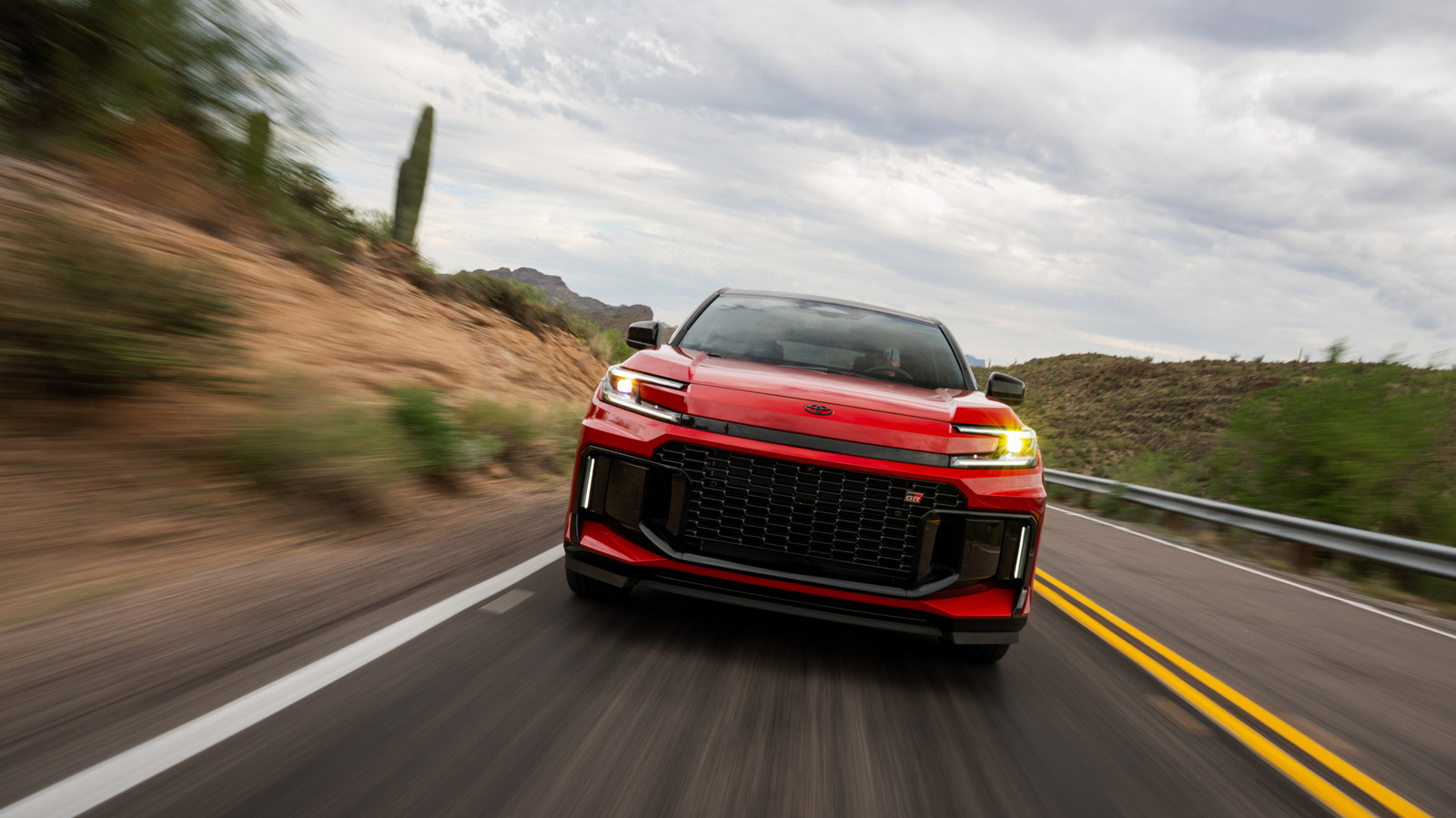

The Toyota Rav4 Plug-In Hybrid is very definitely not a sports car, not by any stretch. It’s a competent crossover plug-in hybrid SUV that just so happens to be remarkably quick. Through the electric motor and its 2.4-liter four-banger it generates a total of 324 horsepower, which is surprisingly powerful for the average mom-mobile. As a result, it has a 0-60 time of 5.4 seconds.
Just under five and a half seconds puts the Rav4 Plug-In above a number of different sports cars from the past and present. Now, it’s not going to dust any contemporary Lamborghinis or Ferraris on the drag strip, but it can certainly hold its own in the acceleration department against some entry level sporty cars and quite a few cars from decades past.
Defining the terms, a bit “quicker” will be referring strictly to acceleration times. There’s no doubt your average sports car would have a faster lap time in racing just due to weights, suspension setups, and the fact that the Rav4 is very much not set up for racing, but that 0-60 sprint time still means something.
Toyota GR86
Looking at Toyota’s lineup, the Rav4 PHEV’s acceleration time puts it quicker than the fundamental ideal of a sports car, the GR86, which can reach 60 miles per hour in 6.1 seconds. Now, which one is more fun to drive? That’s a different question altogether.
The GR86 loses in a drag race as it’s only rear-wheel drive compared to the Rav4 PHEV, which is all-wheel drive. It’s not a hard and fast rule, but all-wheel drive cars have a bit of an advantage off the line as all the wheels are assisting in grip, pushing and pulling the vehicle forward. The GR86 also comes standard with a six-speed manual transmission. That makes it more fun to drive, but slower to accelerate compared to the Rav4 Plug-In’s electronically controlled CVT.
There’s also a power disparity. The GR86 puts out just 228 horsepower, almost 100 less than the Rav4. The Plug-In has clear mechanical advantages, resulting in the better acceleration that leaves the GR86 in the dust — at least in the race to 60 mph.
Ferrari Testarossa
Yes, you read that correctly. A new Rav4 Plug-In is quicker than a 1984 Ferrari Testarossa off the starting line. The ‘Rari does have a lot going for it though. It’s powered by a 4.9-liter flat-12 with four valves per cylinder, putting it somewhere north of a Swiss watch in terms of mechanical complexity. It’s also a mid-engine Ferrari with a top speed of 180 miles per hour. It’s not exactly a grocery getter like the Rav4 Plug-In. However (and this is a big “however”), the Testarossa has a 0-60 time of 5.8 seconds, according to Ferrari.
Now, there’s also a huge difference between “quickest” and “most desirable.” If you want to buy a Testarossa, you’re going to be spending in the neighborhood of $200,000, and oftentimes significantly more. You will also likely win every local car show. The 2026 Toyota Rav4 PHEV, on the other hand, retails for $41,500 and your local Toyota dealer probably has several dozen in stock.
Aston Martin DB7
The Aston Martin DB7 came at a vitally important time for the automaker. According to the automaker, both the DB7 and the new company ownership by Ford could be credited for keeping the company alive. The resulting car had a wacky engine and quite respectable performance specifications for the 1990s. It had a 3.2-liter inline-six with a supercharger that made a healthy 355 horsepower. That all translated to a top speed of over 160 miles per hour. It helped that the car looked great, too.
But, just by the virtue of being on this list, you can already see the bad news. With a 0-60 speed of 5.8 seconds, it might be touch faster than the aforementioned GR86, but it is slower than a new Rav4 PHEV. Of course, if you pull up to the grocery store in a classic Aston Martin, you’ll likely get swarmed by people wanting to take a picture. That is definitively not the case with a Rav4 Plug-In, even if it is a little quicker off the line.
C4 Chevrolet Corvette
The fourth generation Chevrolet Corvette looks like its going the speed of sound when it’s sitting still. Chevy’s marketing from the time called it one of the most advanced cars ever made, and the styling certainly looked the part. The electronics were modernized for the 1980s and the cockpit was given a fighter jet look. But under the big fiberglass hood was classic Chevy. It was powered by a 5.7-liter V8 that put out a somewhat pokey 205 horsepower when it first launched for the 1984 model year.
Car and Driver tested one when it came out and found that it had a 0-60 time of a pretty sad 6.7 seconds. So the victory in the quickness department very much goes to the Rav4. Really though, in which car would you rather listen to Van Halen’s “Panama” at an irresponsible volume? A 1984 Chevy Corvette with enough angles in the bodywork to make a geometry major have night terrors, or a Rav4 Plug-In?
Methodology
For this list, we picked four performance cars that have slower acceleration times than the current Toyota Rav4 Plug-In Hybrid. For 0-60 metrics, we used times provided by the manufacturer and compared it to those listed on Toyota’s website. For the fourth generation Chevy Corvette, we used a 0-60 time gathered by Car and Driver during a review from the era.
You must be logged in to post a comment Login