The UFC 326 live stream features Max Holloway vs Charles Oliveira 2 for the BMF belt, a one-off symbolic title that has taken on a life of its own over the past six years and this could be the best contest yet.
Holloway is the only fighter to have successfully defended the crown, and he’s putting it on the line again on Saturday, in a rematch against former lightweight kingpin Oliveira. Holloway won the original bout 11 years ago after Do Bronxs had to retire in the opening round with a self-inflicted neck issue.
And here’s the knockout blow: Walmart+ members get Paramount+ free, and new subscribers to Walmart+ get 30 days’ access for just $1, which means you can watch the UFC 326 full fight live for next to nothing in the United States.
Advertisement
It’s a deal worthy of the BMF title. Details below…
How to watch UFC 326 for $1
Use a VPN to access UFC 326 from anywhere
NordVPN is the best VPN we’ve tested. Our in-house expert Mike rates it above all others thanks to its streaming capabilities, security and price.
Advertisement
Nothing works as well as Nord when it comes to unblocking streaming platforms.
The sign-up process only takes a minute – and NordVPN costs less than $3/£2.50 a month with our mega-deal below.
If you’re determined to watch UFC 326 for next to nothing but you’re away from the US when it’s on, combine the Walmart/Paramount free trial with the Surfshark free trial below! Don’t forget to cancel before the free trials end.
2. Connect to a server based in USA (e.g. New York).
Advertisement
3. Fire up Paramount Plus or Walmart+. Pro tip: try it in Chrome’s Incognito mode and it should be plain-sailing.
4. Sign up to to Paramount ($8.99) or Walmart ($1 trial) to catch UFC 326. Use a Paramount Plus gift card if you don’t have a credit card.
5. Watch UFC 326.
Advertisement
🥊 UFC 326 card and start times
📍 Location: T-Mobile Arena, Las Vegas, Nevada 📅 This Saturday
⏰ Start Times (ET / PT) Early Prelims: 5 p.m. ET / 2 p.m. PT Prelims: 7 p.m. ET / 4 p.m. PT Main Card: 9 p.m. ET / 6 p.m. PT
📋 Main Card Max Holloway (c) vs Charles Oliveira – Lightweight BMF Title (Rematch) Caio Borralho vs Reinier de Ridder – Middleweight Rob Font vs Raul Rosas Jr. – Bantamweight Drew Dober vs Michael Johnson – Lightweight Gregory Rodrigues vs Brunno Ferreira – Middleweight
🔥 Prelims Cody Garbrandt vs Xiao Long – Bantamweight Donte Johnson vs Cody Brundage – Middleweight Ricky Turcios vs Alberto Montes – Featherweight Cody Durden vs Nyamjargal Tumendemberel – Flyweight
Advertisement
🥋 Early Prelims Su Mudaerji vs Jesús Santos Aguilar – Flyweight Rafael Tobias vs Diyar Nurgozhay – Light Heavyweight Lee Jeong-yeong vs Gaston Bolaños – Featherweight Luke Fernandez vs Rodolfo Bellato – Light Heavyweight
All fights are streaming live on Paramount Plus in the US and through local providers internationally. Watch Paramount Plus for $1 with the Walmart+ 30-day trial.
Conclusion
UFC 326 is here, and thanks to Walmart+ including Paramount Plus with its $1 trial, you can stream every fight live in the US for next to nothing. Traveling outside the country? A strong VPN lets you access Paramount Plus and watch Holloway vs Oliveira 2 legally. Don’t miss this legal, low-cost way to watch UFC 326 live, from prelims to the main event.
Advertisement
You may also be interested in…
We test and review VPN services in the context of legal recreational uses. For example: 1. Accessing a service from another country (subject to the terms and conditions of that service). 2. Protecting your online security and strengthening your online privacy when abroad. We do not support or condone the illegal or malicious use of VPN services. Consuming pirated content that is paid-for is neither endorsed nor approved by Future Publishing.
Microsoft Office 2021 Professional is the perfect choice for any professional who needs to handle data and documents. It comes with many new features that will make you more productive in every stage of development, whether it’s processing paperwork or creating presentations from scratch – whatever your needs are. Office Pro comes with MS Word, Excel, PowerPoint, Outlook, Teams, OneNote, Publisher, and Access. Microsoft Windows 11 Pro is exactly that. This operating system is designed with the modern professional in mind. Whether you are a developer who needs a secure platform, an artist seeking a seamless experience, or an entrepreneur needing to stay connected effortlessly, Windows 11 Pro is your solution. The Ultimate Microsoft Office Professional 2021 for Windows + Windows 11 Pro Bundle is on sale for $49.97 for a limited time.
Note: The Techdirt Deals Store is powered and curated by StackCommerce. A portion of all sales from Techdirt Deals helps support Techdirt. The products featured do not reflect endorsements by our editorial team.
The United States and Israel launched a war in Iran last week that has already killed more than 1,200 Iranians and spilled out across the Middle East. There are many unknowns about US president Donald Trump’s goals as the conflict enters its second week and the situation seems poised to trigger an energy crisis with reverberations around the world.
Trump ousted Department of Homeland Security secretary Kristi Noem this week. Her tenure was marked by aggressive anti-immigration tactics and ICE and CBP’s killing of two US protesters. A highly sophisticated iPhone hacking tool kit that was likely originally built for the US government is in the hands of multiple other nations as well as scammers who have likely used the tools to infect tens of thousands of phones or more. Some US lawmakers are calling for an investigation into the threat of the decades-old side-channel hacking technique. And WIRED went inside how music streaming CEO Elie Habib built the open-source global threat map World Monitor in his spare time.
Advertisement
And there’s more. Each week, we round up the security and privacy news we didn’t cover in depth ourselves. Click the headlines to read the full stories. And stay safe out there.
United States Customs and Border Protection has, for the first time, admitted it purchased phone location data from the sprawling, surveillance-heavy online advertising industry. The agency’s acknowledgement was included in a document, called a Privacy Threshold Analysis, obtained by 404 Media through a Freedom of Information Act request. The document relates to a trial that CBP ran between 2019 and 2021.
The publication reports that CBP purchased data linked to real-time bidding processes. When you see ads online or in apps, they have often been shown to you after automated, instantaneous, auctions take place where advertisers bid to show you that specific ad. The murkiest parts of the advertising industry can collect data from your device, including your phone’s identifying details and location data; this is then repackaged and sold to companies and entities. The data has been called a “gold mine” for tracking people’s daily activities.
CBP did not respond to 404 Media’s request for comment on whether it is still buying the data; however, ICE has reportedly planned to purchase access to another system, called Webloc, that allows whole neighborhoods to be monitored for mobile phone movements.
Advertisement
The FBI was able to identify a protester in Atlanta after ultimately obtaining information from Swiss encrypted email service Proton Mail, court documents have revealed this week. A court document reviewed by 404 Media shows that payment information linked to a Proton email address was provided to US law enforcement by Swiss authorities after a request was made under an Mutual Legal Assistance Treaty (MLAT), which allows agencies to share data internationally.
Swiss officials made a request for the data under Swiss laws to Proton for payment information linked to the email address defendtheatlantaforest@protonmail.com, which was associated with protests in Atlanta. This information was then provided to US law enforcement officials under the international agreements, and they were able to identify an individual linked to the account.
Threat actors are employing a new variation of the ClickFix social engineering technique called InstallFix to convince users into running malicious commands under the pretext of installing legitimate command-line interface (CLI) tools.
The new trick exploits the common practice among developers these days of downloading and executing scripts through ‘curl-to-bash’ commands from online sources without closely inspecting the assets first.
Researchers at Push Security, a browser threat detection and response company, found that attackers use the new InstallFix technique with cloned pages for popular CLI tools that serve malicious install commands.
Since the current security model “boils down to ‘trust the domain’,” and more non-technical users are now working with tools previously reserved for developers, InstallFix may become a larger threat, the researchers say.
Advertisement
In a report today, Push Security highlights a cloned installation page for Claude Code, Anthropic’s CLI coding assistant, that features the same layout, branding, and documentation sidebar as the legitimate source.
The difference is in the installation instructions for macOS and Windows (PowerShell and Command Prompt), which deliver malware from an attacker-controlled endpoint.
Legitimate (top) and malicious page (bottom) Source: Push Security
The researchers say that apart from the installation instructions, all links on the fake page redirect to the legitimate Anthropic site.
“So a victim that lands on the page and follows the fake instructions could continue normally without realizing anything had gone wrong,” Push Security notes in the report.
The attackers promote these pages through malvertising campaigns on Google Ads, causing malicious ads to appear in search results for queries such as “Claude Code install” and “Claude Code CLI.”
Advertisement
BleepingComputer could confirm that the malicious websites are still being promoted through Google-sponsored search results. When looking for the query “install claude code,” the first result was a Squarespace URL (claude-code-cmd.squarespace[.]com) pointing to a perfect clone of the official Claude Code documentation.
Sponsored Google search pushing fake Claude install sites source: BleepingComputer
Amatera infections
Based on Push Security’s analysis, the payload delivered through these InstallFix attacks is the Amatera Stealer, a piece of malware designed to steal sensitive data (cryptocurrency wallets, credentials) from compromised systems.
The malicious InstallFix commands for macOS contain base64-encoded instructions for downloading and executing a binary from a domain controlled by the attacker. In one case, BleepingComputer found that the threat actor used the domain wriconsult[.]com, which is currently down.
For Windows users, the malicious command uses the legitimate utility ‘mshta.exe’ to retrieve the malware and triggers additional processes like ‘conhost.exe’ to support the execution of the final payload, Amatera information stealer.
Cloned Claude install guide with malicious commands source: BleepingComputer.com
Amatera is a fairly new malware family, believed to be based on the ACR Stealer, sold as a subscription service (MaaS) to cybercriminals.
The malware was recently observed distributed in separate ClickFix attacks that abused Windows App-V scripts for payload delivery. It can steal passwords, cookies, and session tokens stored in web browsers and collect system information while evading detection by security tools.
Advertisement
Push Security reports that the attacks are particularly evasive, also because the malicious sites are hosted on legitimate platforms such as Cloudflare Pages, Squarespace, and Tencent EdgeOne.
The researchers also published a video showing how the InstallFix attack works, from the search query to copying a malicious command.
In a campaign last week, threat actors used the InstallFix technique with fake OpenClaw installers hosted in GitHub repositories that were promoted by Bing’s AI-enhanced search results.
Advertisement
Users looking for Claude Code must ensure they get installation instructions from official websites, block or skip all promoted Google Search results, and bookmark software download portals for tools they need to re-download frequently.
The researchers provide indicators of compromise that include the domains for serving the cloned guides, for hosting the malicious payloads, and the InstallFix commands.
Malware is getting smarter. The Red Report 2026 reveals how new threats use math to detect sandboxes and hide in plain sight.
Download our analysis of 1.1 million malicious samples to uncover the top 10 techniques and see if your security stack is blinded.
The recently unveiled 32X3A is a 31.5-inch display that can switch between 4K at 240Hz and 480Hz at a lower resolution, likely 1080p, with a grayscale response time of 0.03 milliseconds. According to ITHome, the OLED display covers 99% of the sRGB and DCI-P3 color gamuts. Anti-glare and anti-reflective coating… Read Entire Article Source link
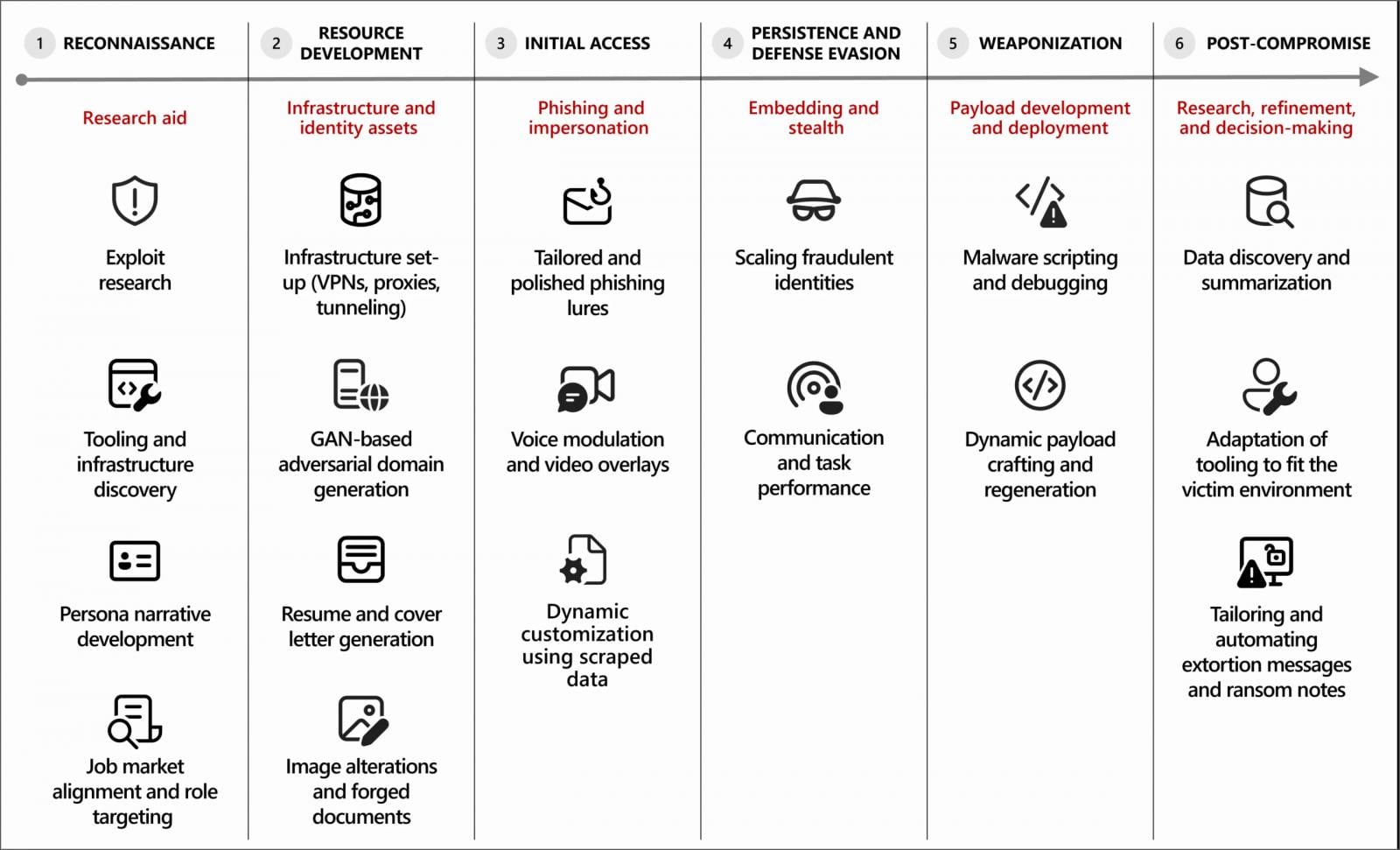
Microsoft says threat actors are increasingly using artificial intelligence in their operations to accelerate attacks, scale malicious activity, and lower technical barriers across all aspects of a cyberattack.
According to a new Microsoft Threat Intelligence report, attackers are using generative AI tools for a wide range of tasks, including reconnaissance, phishing, infrastructure development, malware creation, and post-compromise activity.
In many cases, AI is used to draft phishing emails, translate content, summarize stolen data, debug malware, and assist with scripting or infrastructure configuration.
“Microsoft Threat Intelligence has observed that most malicious use of AI today centers on using language models for producing text, code, or media. Threat actors use generative AI to draft phishing lures, translate content, summarize stolen data, generate or debug malware, and scaffold scripts or infrastructure,” warns Microsoft.
Advertisement
“For these uses, AI functions as a force multiplier that reduces technical friction and accelerates execution, while human operators retain control over objectives, targeting, and deployment decisions.”
Threat actor use of AI across the cyberattack lifecycle Source: Microsoft
AI used to power cyberattacks
Microsoft has observed multiple threat groups incorporating AI into their cyberattacks, including North Korean actors tracked as Jasper Sleet (Storm-0287) and Coral Sleet (Storm-1877), who use the technology as part of remote IT worker schemes.
In these operations, AI tools help generate realistic identities, resumes, and communications to gain employment at Western companies and maintain access once hired.
Jasper Sleet leverages generative AI platforms to streamline the development of fraudulent digital personas. For example, Jasper Sleet actors have prompted AI platforms to generate culturally appropriate name lists and email address formats to match specific identity profiles. For example, threat actors might use the following types of prompts to leverage AI in this scenario:
Example prompt 1: “Create a list of 100 Greek names.”
Advertisement
Example prompt 2: “Create a list of email address formats using the name Jane Doe.“
Jasper Sleet also uses generative AI to review job postings for software development and IT-related roles on professional platforms, prompting the tools to extract and summarize required skills. These outputs are then used to tailor fake identities to specific roles.
❖ Microsoft Threat Intelligence
The report also describes how AI is being used to assist with malware development and infrastructure creation, with threat actors using AI coding tools to generate and refine malicious code, troubleshoot errors, or port malware components to different programming languages.
Advertisement
Some malware experiments show signs of AI-enabled malware that dynamically generate scripts or modify behavior at runtime.
Microsoft also observed Coral Sleet using AI to quickly generate fake company sites, provision infrastructure, and test and troubleshoot their deployments.
When AI safeguards attempt to prevent the use of AI in these tasks, Microsoft says threat actors are using jailbreaking techniques to trick LLMs into generating malicious code or content.
In addition to generative AI use, Microsoft researchers have begun to see threat actors experiment with agentic AI to perform tasks autonomously and adapt to results.
Advertisement
However, Microsoft says AI is currently used primarily for decision-making rather than for autonomous attacks.
Because many IT worker campaigns rely on the abuse of legitimate access, Microsoft advises organizations to treat these schemes and similar activity as insider risks.
Furthermore, as these AI-powered attacks mirror conventional cyberattacks, defenders should focus on detecting abnormal credential use, hardening identity systems against phishing, and securing AI systems that may become targets in future attacks.
Microsoft is not alone in seeing threat actors increasingly using artificial intelligence to power attacks and lower barriers to entry.
Advertisement
Google recently reported that threat actors are abusing Gemini AI across all stages of cyberattacks, mirroring what Amazon observed in this campaign.
Amazon and the Cyber and Ramen security blog also recently reported on a threat actor using multiple generative AI services as part of a campaign that breached more than 600 FortiGate firewalls.
Malware is getting smarter. The Red Report 2026 reveals how new threats use math to detect sandboxes and hide in plain sight.
Download our analysis of 1.1 million malicious samples to uncover the top 10 techniques and see if your security stack is blinded.
During the 1990s the Chornobyl Nuclear Power Plant – formerly the Chernobyl NPP – continued operating with its remaining three RBMK reactors, but of course the 1970s-era automation with its very limited SKALA computer required some serious modernization. What was interesting here is that instead of just replacing this entire Soviet-era mainframe with a brand-new 1990s one, the engineers responsible opted to build a new system – called DIIS – around it. This is detailed in a recent video by the [Chornobyl Family] on YouTube.
This SKALA industrial control system was previously detailed in a video, covering this 24-bit mainframe computer and its many limitations. It wasn’t quite a real-time control system, but it basically did what it was designed to do. Since at the time it was not clear for how long these three RBMKs would be kept running, they didn’t want to go overboard with investments either.
Ultimately Unit 2 only was active until 1991 due to a turbine fire, Unit 1 until 1996 and Unit 3 was shutdown for the last time in 2000, so this a sensible decision. During those years, an auxiliary information-measurement system (DIIS) was the big upgrade, which got bridged into SKALA via a Ukrainian-made SM-1210 minicomputer, with the latter connected to an 80386 PC which itself was connected to an ARCnet hub.
Advertisement
Best part of this DIIS upgrade was that it made it possible to run modeling algorithms for the reactor core based on measurements, without having to send data all the way over to the central control office in Moscow. Now reactor parameters could be visualized in real-time, and adjustments made via the same PRIZMA program’s magnetic tapes of the SKALA system as before.
Although the result was a bit of an odd mixture of 1970s Soviet mainframe design, 1980s-derived Ukrainian mainframe design and 1990s Intel computing power, it worked well enough to bring the ChNPP to the very doorstep of the 21st century with no issues worthy of note. Definitely a testament to the engineers who hacked this upgrade together and made it work so smoothly.
Looking for the most recent Wordle answer? Click here for today’s Wordle hints, as well as our daily answers and hints for The New York Times Mini Crossword, Connections, Connections: Sports Edition and Strands puzzles.
Meze Audio has unveiled a new high-end pair of in-ear monitors aimed squarely at serious listeners.
Called the ASTRU, the new earphones promise flagship-level sound performance. However, they stick to a surprisingly simple design: just a single dynamic driver.
That approach is a bit unusual at this level. Many premium IEMs rely on multiple drivers to achieve greater detail and separation. However, Meze says the ASTRU is engineered to deliver similar layering and resolution using a single 10mm dynamic driver.
The secret lies in its unusual diaphragm design. The driver uses a multilayer composite structure with more than 80 ultra-thin layers of gold, applied through a 48-hour vacuum sputtering process.
Advertisement
Furthermore, that dome is bonded to a titanium layer and mounted on a PEEK base. This combination, Meze says, helps balance fast transient response with the warmth and physical punch dynamic drivers are known for. The result, at least on paper, should be a sound profile that’s detailed but still full-bodied.
Advertisement
The build quality is just as ambitious. Each ASTRU shell is CNC-machined from a single block of pure titanium, then finished with a multi-stage electroplating process to create a satin texture.
Image Credit (Meze Audio)
According to Meze, producing each matched pair takes up to seven days of precision processing. This is a sign the company is leaning heavily into its usual craftsmanship-focused design philosophy.
The earphones ship as a complete portable listening setup. In the box you’ll find a premium balanced cable with a 4.4mm termination, CNC-anodised aluminium hardware, and a 4.4mm-to-3.5mm adapter for broader device compatibility. Five ear tip sizes (XS to XL) are included. Additionally, there is a protective pouch and a soft PU leather carry envelope.
Advertisement
On the spec sheet, the ASTRU features a 10mm dynamic driver, a 5Hz–35kHz frequency range, 32-ohm impedance, and 111dB sensitivity. Total harmonic distortion is listed below 0.1% at 1kHz.
The ASTRU will make its public debut at CanJam New York on March 7. Afterwards, it will go on sale worldwide from March 20, 2026 via Meze’s website and selected retailers.
Advertisement
Pricing is set at £819 / $899 / €899, positioning the ASTRU firmly in the premium IEM space. Though it is still short of the four-figure prices many flagship earphones now command.
Platform reviewed: PS5 (on PS5 Pro and PlayStation Portal) Available on: PS5 Release date: February 12, 2026
Advertisement
But before a collective “Boy!” could be bellowed in celebration of all this news, we also got word that a new series’ spin-off game is rumored to be in the works. Given that you’d need a Leviathan Axe to cut through all these recent reveals and rumors, you could be excused for overlooking God of War Sons of Sparta, a brand-new prequel entry that was shadow-dropped shortly after the Greek trilogy remake reveal.
A retro-flavored 2D action-platformer starring a teenage Kratos, Sons of Sparta is a far cry from what the franchise has previously delivered. Borrowing heavily from the Metroidvania genre, the smaller-scale game has also earned the ire of some players – including series’ creator David Jaffe – who’ve been less than impressed by this fresh direction for the franchise.
Advertisement
But while the game never reaches the epic highs of its predecessors, I’ve mostly had a good time stabbing, puzzle-solving, and exploring the would-be god-slayer’s early stomping grounds, especially when braving its land of Laconia on my PlayStation Portal.
Admittedly, Sons of Sparta doesn’t make a fantastic first impression. Its action is slow to start, and its early environments sport a muted tone that can come off a bit drab on a large display, like the 65″ 4K TV I started my journey on.
The game’s combat and world didn’t immediately grab me, but its characters and narrative did.A collaboration between Sony Santa Monica Studio, who penned the story, and Mega Cat Studios, Sons of Sparta is cleverly framed as a tale adult Kratos – voiced by the protagonist’s first performer, TC Carson – tells his young daughter Calliope.
Advertisement
Narration from the older Kratos, as well as some fun exchanges between him and his little girl, are peppered throughout the lengthy campaign. But the bulk of the storytelling is delivered by young Kratos and his brother Deimos. The siblings, who are enduring the agoge in hopes of becoming Spartan soldiers, are richly realized with top-notch writing and quality voice acting.
Sign up for breaking news, reviews, opinion, top tech deals, and more.
In fact, it’s the brothers’ engaging, evolving dynamic that drew me to revisit the game on my PlayStation Portal after all but abandoning it following a short session on my PS5 Pro. And I’m so glad I returned to it, as Sons of Sparta is not only a perfect fit for the portable platform, but investing more time in it allowed me to appreciate what it had to offer after its subpar start.
The game’s combat, which feels a bit plodding in the opening hours, really finds its footing a few hours in. Kratos can’t do a whole lot with his equipped sword and shield initially, but it’s not long before your inventory is brimming with abilities, upgrades, and skills. The franchise’s familiar red orbs, as well as other collected resources, can be invested in a variety of offensive and defensive skills, while a number of weapon attachments can be acquired and upgraded.
The gods also get in on the action, gifting Kratos with a number of cool tools – like a fire-spewing tree branch – that can combat baddies, assist with puzzle-solving, and open previously obstructed parts of the map.
Speaking of the game’s sprawling navigational interface, viewing and using the tool on the Portal’s 8-inch, rectangular display immediately struck me with a satisfying sense of nostalgia. Having spent my youth studying maps in Metroid and Castlevania entries – as well as other classic side-scrollers – on Nintendo’s many handhelds and Sony’s own PlayStation Portable and Vita, it was a blast witnessing Sons of Sparta‘s map blossom in all directions on the more diminutive screen.
But playing on the Portal did more than recall my favorite map-navigating memories. The prequel’s painterly, hand-drawn pixel art style really pops on the portable hardware’s 1080p HD display. Where the game felt a bit small and swallowed up by my TV’s 65″ screen, its varied, vibrant environments arguably presented much better on the smaller LED screen.
Of course, the innate intimacy of playing on a portable platform also deserves credit for putting the game in its best light; I was able to appreciate far more detail playing Sons of Sparta a few inches from my face rather than squinting at it from across my living room.
It also doesn’t hurt that the Portal’s handgrips deliver the same immersion-ratcheting features as the PS5‘s DualSense Wireless Controller. From feeling the rhythmic cadence of Kratos readying his Solar Sling – another fun gift from the gods – to the intense, sustained pulse that builds when opening a treasure chest, the handheld’s haptic feedback and adaptive triggers are easily on par with the standard DualSense controller.
And speaking again to that more intimate portable experience, seeing Sons of Sparta’s action unfold directly between those rumbling, vibrating handgrips adds a level of immersion and immediacy that playing on a console just can’t match.
I further complemented my time behind Kratos’ spear and shield by pairing Sony’s PlayStation Pulse Elite headset with the Portal. As expected, this allowed me to absorb every detail of the game’s dynamic soundscape, from ear-rattling boss encounters to the nuanced echo of water dripping in the game’s atmospheric Grand Cistern environment.
Sons of Sparta is undoubtedly a smaller-scale entry in a series known for making big, bold, blood-soaked splashes with each release. But while the stakes of its story are lower, and it lacks some of the epic set pieces, cinema-rivaling effects, and adrenaline-pumping action of its predecessors, it still delivers a solid, albeit quite different, God of War action-adventure.
If you’re expecting a 2D take on Kratos’ previous god-slaying exploits, Sons of Sparta will likely disappoint. But if you’re craving a fresh, canon story supported by a serviceable metroidvania structure, deep combat, and plenty of fan-pleasing call-outs to the larger franchise, this unconventional prequel’s got you covered…especially when enjoyed on the PlayStation Portal.
Advertisement
Should you play God of War Sons of Sparta?
Play it if…
Don’t play it if…
Advertisement
Accessibility features
God of War Sons of Sparta includes an impressive suite of accessibility features, from various audio adjustments and visuals assists – including options for customizing color filters, text sizes, and blood and gore effects – to motion reduction aids and gameplay settings for decreasing difficulty.
In addition to including a number of presets for accessibility features, the game also offers plenty of individual selections for a more tailored experience.
I played a few hours of God of War Sons of Sparta on my PlayStation 5 Pro, on my 65″ 4K display, before fully committing to it – and enjoying it much more – on my PlayStation Portal, streamed from the Pro.
Advertisement
I tested Sons of Sparta‘s audio with both the PlayStation Pulse Explore earbuds and PlayStation Pulse Elite headset, with the bulk of my 25-hour playtime using the latter. I paid particular attention to how the game looked and played on the portable device versus the console, and noted the various ways it incorporated the handheld’s DualSense features.