Tech
This British Car Combined Two Aircraft Engines For Nearly 1000 HP In The ’20s

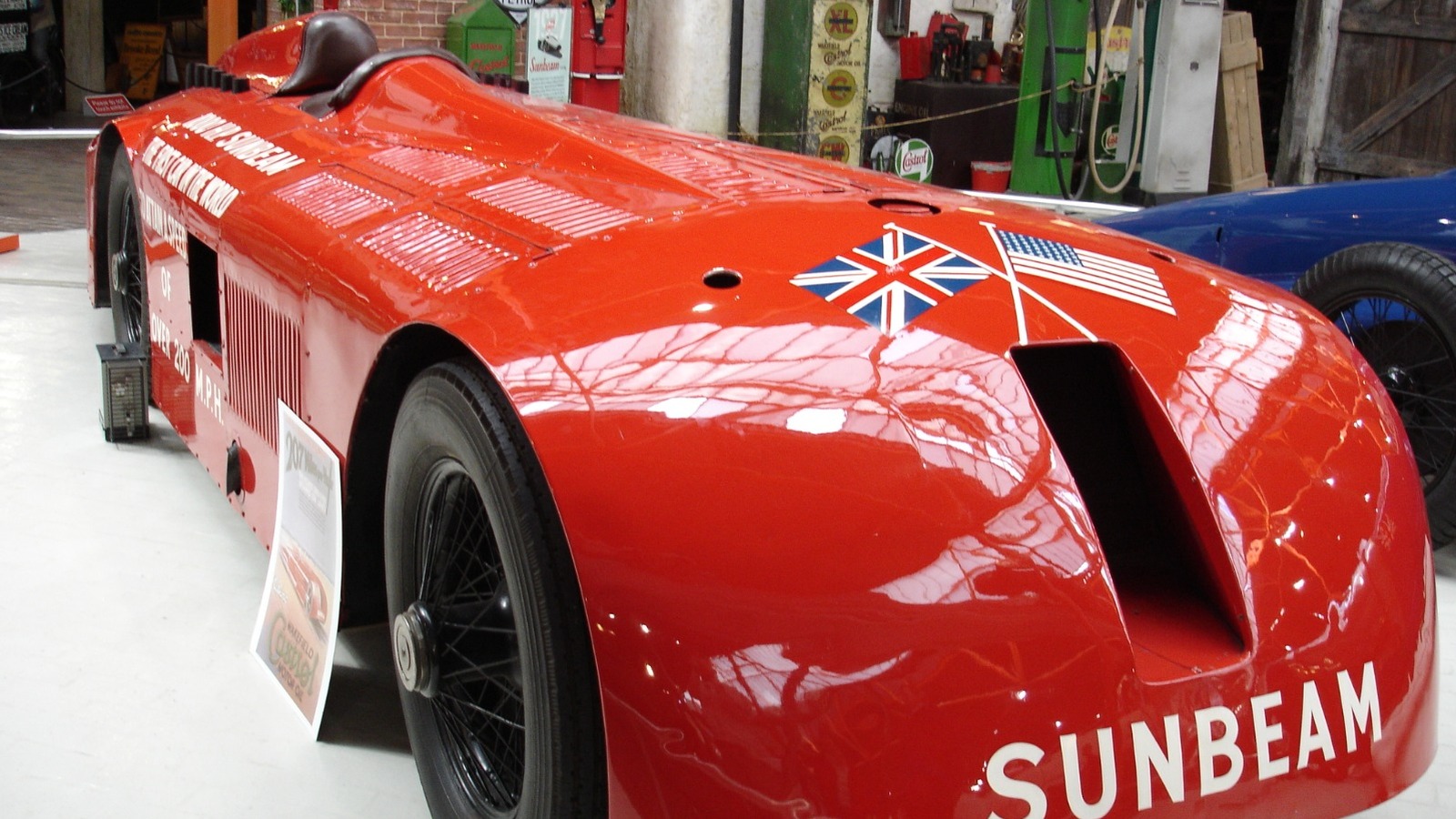

Carl Benz patented his squat, three-wheeled Benz Patent Motor Car (Model no. 1) in 1886, and it didn’t take long for humanity’s obsession with automobiles to take hold. In 40 short years, we went from a German one-cylinder four-stroke engine producing just 0.75 hp to a four-wheeled, British-made bullet powered by two 22.4-liter V12 Matabele airplane engines each producing 435 hp. The combo isn’t a big deal now, admittedly, with half a dozen production cars packing 1,000 horses or more, but it was certainly impressive for the 1920s.
This behemoth, known as the Sunbeam 1,000 HP, was nearly 24 feet long and weighed 4 tons, yet it was the first car to go faster than 200 mph — exactly what it was made to do. Henry Segrave was at the wheel of the Sunbeam, sometimes referred to as “The Slug” or “Mystery,” when he broke that 200-mph barrier on March 29, 1927. Seagrave and The Slug achieved that milestone on the hard white sands of Daytona Beach, Florida, which had seen 30 years of record-breaking speed trials since racing began there in 1902, including Segrave’s successful attempt.
The Sunbeam’s achievement came about 20 years after the first-ever 100-mph run, which took place on July 21, 1904. That year, Frenchman Louis Emile Rigolly hit 103.561 mph on a beach in Ostend, Belgium.
This was not your ordinary Slug
Sunbeam driver Henry Segrave had previously set a Land Speed Record almost exactly a year earlier, hitting 152.33 mph while driving a 4.0-liter Sunbeam Tiger, so he was very familiar with the need for speed. This new, more powerful Sunbeam 1000 was the brainchild of chief engineer and designer Louis Coatalen, who decided to place the two Matabele airplane engines in line.
Both of the massive V12s had double overhead camshafts and 48 valves. The one sitting up front was mated to a custom-built three-speed gearbox, while the rear engine was connected to the back wheels via chain sprockets. Segrave was nestled tightly in between the beast’s metallic hearts, which had a wild past all of their own.

Both Matabele engines were built in 1918 and destined for World War I airplanes, but were never used. Two years later, they (along with two other engines) were dropped into a 39-foot single-step hydroplane (the Maple Leaf V) and used for powerboat racing. The following year, they were transferred to the 34-foot Maple Leaf VII and used again, although the boat sank on its first run. Both engines were recovered and sent back to the U.K., where they sat around until being used in the Sunbeam.
Ironically, the slug-like body of the Sunbeam actually resembled an upside-down boat in many ways, an intentional decision to improve aerodynamics. Additionally, it had a flat underbelly, with the idea that it would help the car slide along the beach if it lost a wheel, thus avoiding a major catastrophe.
The British beast comes back to life
Louis Coatalen developed the engine placement and internal workings, while Captain JA “Jack” Irving built the Mystery using a chassis from John Thompson Motor Pressings, steel forgings from Vickers, a set of special Hartford shock absorbers, and a braking system from Dewandre Vacuum. When driver Henry Segrave heard the beast roar for the first time, the car reportedly shook the Sunbeam Moorfield facility in Wolverhampton so hard that it convinced Segrave it couldn’t be driven. But drive the monster he did, achieving an average speed of 203.79 mph at Daytona Beach.
Records are made to be broken, and this one fell less than a year later when Malcolm Campbell drove another Sunbeam, known as the Blue Bird, to 206.956 mph at Daytona on February 19, 1928, becoming one of the many cars to hold the title of fastest in the world over the years. With its glory faded, the Sunbeam 1000 was parked and nearly forgotten for a time. Once rediscovered, it bounced around until it was eventually purchased by the Montagu Motor Museum in the United Kingdom (the forerunner to the National Motor Museum) in 1970.
A total refurbishment began in 2024, aiming to finish by March 2027, so it could be sent to Daytona Beach for the 100th anniversary of its land speed record. The fully rebuilt rear engine was fired up for the first time in 90 years in front of onlookers at the National Motor Museum in September 2025. Only time will tell whether the team behind the restoration can cross the finish line in Daytona in 2027.