The two companies operate 10 fitness and yoga outlets across Singapore
True Fitness and True Yoga are set to shut their Singapore operations, as parent company Kontafarma China Holdings moves to liquidate the businesses amid mounting financial losses.
The Hong Kong-listed company said in a bourse filing on Thursday (Sep 10) that the directors of True Fitness and True Yoga had resolved that the companies could no longer continue operating due to their liabilities, CNA reported.
Insolvency practitioners Goh Wee Teck and Lin Yueh Hung of RSM SG Corporate Advisory have since been provisionally appointed.
Extraordinary general meetings for both companies are scheduled for Oct 7, where resolutions for creditors’ voluntary winding-up will be proposed. Meetings with creditors will follow.
Advertisement
The two companies, collectively known as the True Singapore Group, operate 10 fitness and yoga outlets across Singapore under three brands: True Fitness, TFX and Yoga Edition.
The centres are expected to cease operations as the liquidation process gets underway.
True Singapore’s struggles
The Singapore business has been struggling financially despite continuing to generate significant revenue.
For the year ended Dec 31, 2025, the True Singapore Group recorded about HK$181.2 million (S$30 million) in revenue, but posted a loss of about HK$34.3 million (S$5.7 million).
Advertisement
At the end of 2025, the group had total assets of around HK$149.7 million (S$24.2 million), compared with liabilities of HK$555.5 million (S$89.8 million).
The situation worsened in the first eight months of 2026.
According to unaudited management accounts, the Singapore business generated about HK$118.4 million (S$19.1 million) in revenue during the period, but recorded another HK$19.1 million (S$3 million) loss.
As of Aug 31, its assets stood at about HK$204.5 million, while total liabilities had risen to HK$633.8 million. This left the business with net liabilities of about HK$429.3 million (S$72 million).
Advertisement
The True Singapore Group also owed about HK$309.7 million (S$50 million) to the wider Kontafarma group as of Aug 31.
Kontafarma said the Singapore fitness business had been facing “unprecedented” challenges, including increasingly fierce competition and rising costs associated with attracting customers.
The company pointed to the growing popularity of boutique gyms, as well as gyms located within condominiums and residential developments, which have reduced some consumers’ need for external gym memberships.
Competition is also coming from outside the traditional gym industry.
Advertisement
Online training programmes, mobile apps, video platforms and virtual coaching have made it easier for consumers to exercise at home or outdoors, further intensifying pressure on traditional fitness operators.
At the same time, the business has continued to face high operating costs and tight cash flow.
Kontafarma said that despite efforts to control costs and improve operational efficiency, the Singapore fitness business had become extremely difficult to sustain.
The parent company had also provided cash funding to support the Singapore operations, but said the businesses continued to underperform and face significant liquidity pressure.
Advertisement
Kontafarma shifts focus to pharmaceuticals
Once the provisional liquidators take control, they will assume responsibility for the affairs, businesses and property of True Fitness and True Yoga.
The powers of the companies’ directors will cease, while operations at the fitness and yoga centres are expected to stop as the provisional liquidation begins.
The creditors’ voluntary liquidation will formally commence after the special resolutions are passed at the Oct 7 extraordinary general meetings.
Kontafarma said the liquidation would allow it to redirect resources towards its pharmaceutical business.
Advertisement
The company said it does not expect the move to have any other material adverse impact on the financial performance or operations of its existing businesses.
Its pharmaceutical segment accounted for 76.7% of group revenue in the first half of 2026 and 78.5% of its total assets as of Jun 30.
There is also a separate debt exposure involving True Fitness.
Kontafarma has guaranteed a bank loan taken by the company, with about S$2.3 million outstanding as of the date of its announcement.
Advertisement
The parent company said the final amount owed by the Singapore businesses will be determined by the liquidators, while any recovery will depend on the assets realised and the statutory order of priority for creditors under Singapore law.
For Kontafarma, the closure marks a retreat from a loss-making fitness business as it shifts its focus towards pharmaceuticals.
Read other articles we’ve written on Singaporean businesses here.
Kosmic spent another long session mapping leftover oddities in Versus Super Mario Bros., the 1986 arcade cabinet that copies most of the original NES game while changing a few rules, timers, and memory habits. Growing a vine in the wrong place after a death still queues an extra plant for the next screen. Near the top of any vine Mario loses control and auto-climbs; that state leaves a flag set so the next transition (death works best) sprouts a second vine wherever the surviving player happens to stand.
Two player mode transforms the flag into a delivery system, similar to a ticking time bomb. One player enters a land level like 5-2, snatches a hammer from a Hammer Brother who is barreling toward them, and then immediately meets their doom. Then the control switches, and boy, does the residual vine cause havoc. It decides to grow in whatever water stage the second player is in, whether it’s 2-2, 7-2, or even the dreaded Minus World. Water stages are where things get a little messy because the game starts spitting out a lot of bubbles. Now the game is attempting to initialize them in a tiny array intended solely for sprite slots 0 through 2, but the extra vine in slot 5 interferes, overwriting the low byte of the reference that informs the game where to look for enemy spawn data.
HERE WE GO! – Speed down Rainbow Road with the LEGO Super Mario: Mario Kart – Mario & Standard Kart (72037) collectible building set for adults…
DYNAMIC DISPLAY STAND – Position Mario at dramatic racing angles to recreate that perfect drift moment or high-speed action from your favorite Mario…
POSEABLE MARIO FIGURE – The brick-built Mario features movable head and arms, letting you customize his racing pose for the ultimate display
That’s when all hell breaks loose, since tile data from a previous globe is suddenly interpreted as an enemy list. So in 2-2, you’ll find bouncing Cheep-Cheeps everyplace, enormous fire bars, platforms that delete water tiles as they move, invisible items, and even Spinys that fly away at warp speed as soon as that scroll-stop object disappears. 7-2 is where you’ll discover the Lakitu that shoot fireworks, extra fire bars, and things that hide just beneath the water’s surface. Meanwhile, in the Minus world, you’ll find Koopas and fire bars that wouldn’t ordinarily exist.
One of the objects in 2-2 has an ID that essentially confuses the processor and causes it to tamper with the PPU registers. What’s strange is that it’s difficult to achieve a consistent result. Emulators and the Switch Arcade Archives port will continuously produce chaos: scores over 36 million, and parts of new geography never seen before, replete with adversaries and flagpoles never drawn by the original creators. Then there are instances when it simply reboots. Real arcade boards, on the other hand, prefer to hold leftover values in unused RAM rather than just filling it with zeros, so the same series of button presses can result in a variety of issues, such as confused graphics, a warp to 4-1, or even a full refusal to play.
100th_Coin identified the exact sequence of register crashes that resulted in the disaster, but Kosmic then mapped the same sequence onto original hardware, flashcarts, and official re-releases to see how far the corruption traveled. Then there’s Versus Super Mario Bros., which had years ago tweaked the timers to run faster and clamped down on some of those pesky warps, but the vine still finds the unused enemy initialization code and unused memory pages that its 1986 creators never imagined anyone would ever reach. Forty years later, the same small vine that previously only led to Coin Heaven is now writing new levels all over an original cabinet that was never designed to handle them.
Apple has unveiled its latest iPhone 18 Pro, and we’re keen to see how its specs compare to the Pixel 11 Pro.
Although we’re currently yet to get our hands on the iPhone 18 Pro, we’ve compared its specs against the four-star Pixel 11 Pro and highlighted the key differences between the two smartphones.
Read on to see what really separates the iPhone 18 Pro from the Pixel 11 Pro, and decide whether you think the new iPhone will join our best smartphones round-up.
The iPhone 18 Pro, alongside the larger Pro Max, will be available for pre-order from September 12th ahead of the official launch from September 18th. Available in a choice of four colours including Deep Black, Silver, Glacier and Burgundy, the iPhone 18 Pro has a starting RRP of £1199/$1199.
SQUIRREL_PLAYLIST_10208764
In comparison, the Google Pixel 11 Pro is readily available to buy now and starts at a cheaper £1079/$1099. Like the iPhone 18 Pro, it also comes in a choice between four colours including Canyon, Olive, Fog and Obsidian.
Advertisement
SQUIRREL_PLAYLIST_10208683
A20 Pro vs Tensor G6
Both phones run on chips made by their respective manufacturers. That means the iPhone 18 Pro runs on Apple’s own A20 Pro while the Pixel 11 Pro is powered by Google’s Tensor G6 processor.
Google never priorities speed and power with its Tensor chips and favours AI prowess instead. That means although the Pixel 11 Pro saw pretty low scores in our benchmark tests, it performs well in everyday use – though it does struggle with gaming.
Advertisement
Advertisement
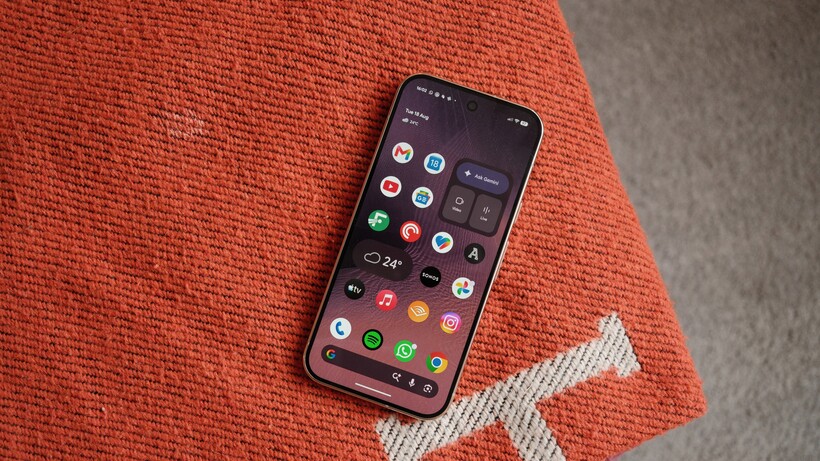
Pixel 11 Pro. Image Credit (Trusted Reviews)
Apple has introduced its A20 Pro chip within both the iPhone 18 Pro and 18 Pro Max, alongside the iPhone Duo which is the company’s first foldable. Hailed as Apple’s fastest ever iPhone chip, the processor sports a 6-core CPU that’s deemed the fastest of any smartphone, a 7-core GPU that promises 40% faster graphics compared to last year’s A19 Pro and a new Dual 16-core neural engine for running on-device AI models.
With all of this in mind, Apple promises the A20 Pro is a “powerhouse” for everything from on-device AI workloads and demanding games too. While we’re yet to review the chip ourselves, its specs certainly seem like a more promising choice for those who want more power. Of course, we’ll be sure to update this versus once we review the iPhone 18 Pro.
Pixel 11 Pro introduces the HiLight feature
There’s no getting around the fact that smartphones are incredibly distracting devices. You’ll unlock your phone to reply to one message, but then see all your other notifications across multiple apps vying for your attention. That’s where Google’s new HiLight tool comes in.
HiLight is essentially coloured LED lights that are built around the Pixel 11 Pro’s flash, that’ll glow when you receive a phone call or when you start speaking to Gemini. It’s not dissimilar to Nothing Phones, which get you to keep your phone face down but uses its Glyph lights to keep you updated with important notifications.
Advertisement
HiLight Image Credit (Trusted Reviews)
While right now HiLight seems somewhat basic, Google has promised that we’ll see new features added to HiLight over time, including message notifications.
Pixel 11 Pro has a 50MP main lens, but the iPhone 18 Pro has an industry-first main lens with variable aperture
Pixel Pro and iPhone Pro handsets usually find their way onto our best camera phones list, as both Google and Apple offer excellent hardware and image processing capabilities.
Advertisement
Both handsets are equipped with three rear cameras, including a main, ultrawide and dedicated telephoto sensors, but they differ with their exact offerings. The Pixel 11 Pro sports a 50MP main alongside a 48MP ultrawide and 48MP telephoto, and overall we found the phone to be a reliable shooter – even at night when the lighting drops.
Pixel 11 Pro. Image Credit (Trusted Reviews)
Hardware aside, where the Pixel 11 Pro shines best is with its Gemini-infused software which includes tools like Camera Coach to advise you on how to improve your picture and Magic Capture that analyses 400 frames of the same shot to capture the best possible image.
Advertisement
In comparison, the iPhone 18 Pro is fitted with three 48MP lenses – though the headline camera is undoubtedly its main. Hailed as Apple’s most advanced camera ever, the 48MP Fusion main camera is fitted with a variable aperture that automatically adjusts for lighting and depth of field.
There are also Pro controls that allow you to customise your shooting experience, from manually adjusting the aperture or shutter speed to changing the photographic styles too.
Advertisement
Apple Intelligence or Gemini Intelligence
Since its inception back in 2024, Apple Intelligence hasn’t taken off like we thought it would. In fact, two years on, the AI-powered toolkit still feels like an afterthought. However with iOS 27 Apple promises Apple Intelligence will see much-needed improvements and tweaks, from its photo editing tools to its writing assistance. Perhaps the headline update here is Siri AI, which promises to be a complete overhaul of Apple’s voice assistant, for a more conversational and reliable experience.
In comparison, Google’s Gemini Intelligence is easily one of the most reliable AI toolkits found in a smartphone. Sure, it shouldn’t be the reason you choose the Pixel 11 Pro, but there’s so many Google AI tools that can genuinely come in handy. For example, there’s Circle to Search which now allows you to make multiple searches at once, Google’s photo editing suite and, of course, access to the voice assistant Gemini.
Image Credit (Trusted Reviews)
Advertisement
Both roughly promise the same amount of battery
Battery life has never been a selling point of either iPhone or Pixel phones, especially when compared to phones like the Xiaomi 17 Ultra which has a 6000mAh cell. Even so, Apple promises that the iPhone 18 Pro will see up to 23 hours of typical use – though we’ll have to wait and see for ourselves.
We found that on days with around five or six hours of screen time, the Pixel 11 Pro’s battery would be depleted by 10pm, while other days would need a top-up in the evening to get through. Fortunately it supports PixelSnap which means you can conveniently top the phone up on the go.
Early Verdict
Realistically, choosing between the iPhone 18 Pro and Pixel 11 Pro will boil down to your existing ecosystem. For example, if you own AirPods, an Apple Watch or even a Mac, then the iPhone makes much more sense than the Pixel 11 Pro.
Advertisement
If you do have more flexibility, then choosing between the two will come down to your own preferences. So, if you want more power, a phone that promises to cope with demanding games and a camera with variable aperture, then the iPhone 18 Pro seems a brilliant choice. On the other hand, if you favour AI smarts and want one of the confirmed best camera phones on the market, then the Pixel 11 Pro is an easy recommendation.
We’ll update this versus once we review the iPhone 18 Pro.
FIRST LOOK Dell’s UltraSharp 52 display is a joyously enormous head-turner, but probably too much monitor for most users.
Dell debuted the display at the CES show earlier this year. It’s now on sale for $3,000.
Sadly, I lack a PC capable of driving the screen at its full 6144 x 2560 resolution and 120 Hz refresh rate. Even at a miserly 3840 x 2160, however, I often marveled at how much it could display. Consider the screenshot below, which shows 50 columns and 89 rows of a single Excel spreadsheet – 4,450 cells in total.
Here’s another look at the monitor in full flight: a screen grab of Zwift, the virtual cycling metaverse I visit regularly as part of my exercise routine. At that size, Zwift felt more immersive and enjoyable than it does on a smaller screen. The display also handled motion smoothly during Zwift. other games, and streamed video.
Advertisement
ZWIFT on the Dell UltraSharp 52
Getting used to it
It took me a while to appreciate the monitor. When I first plugged it in, my occasionally-stiff middle-aged neck strained as I swiveled to view content at the edges and corners, while wielding my mouse to move its pointer between the screen’s extremities felt like flapping my arms.
My eyes didn’t enjoy the experience at first either. I wear mild reading glasses while working, and found myself repeatedly refocusing as I looked across the curved display.
For the first few days I spent with the screen, I therefore practiced “pillarboxing” – running the display at 3840 x 2160 and only using the center of the monitor while pixels on the edges remained dark. That didn’t feel odd or distracting, perhaps because I often use “letterboxing” while watching video on my TV or tablet – leaving pixels at the top and bottom of the screen unused.
As I grew accustomed to the enormo-monitor, I began using its entire area. Getting there was not straightforward: each of the three PCs I used with the monitor (one at a time, not together) required manual adjustment before I found a resolution that did not distort text and images.
Advertisement
Dell’s companion app was no help. It was slow to install, ran as if stuck in digital treacle, and is little more than a glorified front end for the Windows System/Display control panel.
The HDMI connection to my desktop – an Acemagic mini-PC – repeatedly dropped out, forcing me to reseat the cable every day. The same PC and cable work reliably with my everyday monitor. I tried another cable and the problem persisted. I reached out to Dell, who suggested my two different cables were to blame.
I connected my laptop – a Dell Inspiron Plus 7441 – over Thunderbolt and experienced some flickering that went away without needing to reseat the cable. A ten-year-old ThinkPad Carbon X1 connected fine over HDMI, but had even more trouble finding appropriate settings.
But once I got the machine going and got used to its colossal size, my initial fatigue vanished. I realized I was squinting a little less than I do with my everyday display, a seven-year-old 32-inch Samsung that lacks the HDR feature the Dell machine includes.
Advertisement
I sometimes use my lunch breaks to watch some rugby highlights, and the display handled those with ease. The easily observable nuances of small ads on team shirts would doubtless please sponsors.
I was also pleasantly surprised by the display’s speakers, which rendered my favorite tunes brightly and crisply. My current high rotation tunes include guitar feedback legends The Jesus and Mary Chain, spiky garage pop from Welsh outfit The Bug Club, and mumbly “power disco” by Getdown Services. JAMC’s trademark fuzz was warm and deep, I felt like I could hear new strings on The Bug Club’s guitars, and Getdown Services’ beats thumped meatily.
The speakers’ location at the rear of the monitor led to a few “Where’s that sound coming from?” moments, but those quickly became tolerable.
Weighty issues
I was impressed by Dell’s packaging, which places the cables and included stand in clearly marked cardboard compartments within the shell protecting the screen. That matters because the box is a whopper that would be difficult to lug out of an IKEA and into a small car. Easy access to the assembly parts means a little less wrestling.
Advertisement
At 12.95 kg (28.5 lbs), the monitor isn’t problematically heavy – but is maybe too weighty for Dell’s stand, as it never sat perfectly level, and I could find no way to straighten it. The screen is also unwieldy: I recommend connecting any cables you plan to use in advance, because shifting and lifting it to access its ports is not easy, especially in constricted spaces behind a desk.
Tucked under the monitor’s bottom-left edge is a forward-facing USB hub with two USB-C ports and one USB-A port. Making one of them a Thunderbolt port would have made it easier to connect a laptop without rummaging behind the beast.
The Dell UltraSharp 52
I finished my time with this giant display convinced that it is a lovely machine, but not one I need, as my work consists mostly of writing and editing text and browsing the web. Those who work with visual material may adore its size and the immersion created by its gentle curve. Many of Dell’s promotional images show the device displaying multiple financial data feeds. The company pitches it as a replacement for four smaller monitors, requiring only one power cable and dispensing with a complex collection of stands.
That seems like a more sensible use of the screen than everyday knowledge work.
Advertisement
To finish, here’s one more photo. I started working from home in 2002 but had no room to dedicate to an office. I therefore splurged about $700 – big bucks at the time – on a 15-inch, 1024 x 768 Dell 1503FP LCD monitor so that a CRT did not dominate my lounge room.
It still works, although when the time came to take this snap, I couldn’t find the HDMI-to-VGA adapter I use to fire it up.
Here it is anyway, posed in front of its giant descendant to offer some historical perspective on how monitors have grown. ®
On Wednesday, investigative reporter Daniel Boguslaw detailed how security officials at Anthropic, the creator of Claude AI, are engaging in monitoring and surveillance, including reporting AI activists to police for potential future crimes.
The report, published in The American Prospect, comes amid the well-known Anthropic-Pentagon standoff, in which the AI company has feuded over how the military deploys mass-surveillance tools and fully autonomous weapons. Anthropic lost several lucrative government contracts in the process. Last week, after US Secretary of Commerce Howard Lutnick said Anthropic is “back on the right side,” a Pentagon official disputed the claim and said the company remains a “supply chain risk.”
Anthropic told CNET via email that it disagreed with Boguslaw’s piece, saying the headline and framing were inaccurate. “Anthropic is not — and has never said it is — ‘building a predictive surveillance system to monitor activists.’ This is a physical-security function focused on keeping our employees safe, the same as any large company with a global workforce.”
Drawing from postings and interviews with senior security officials at Anthropic, Boguslaw’s report lays out how the AI company is tracking activists who oppose the rapid development of AI near “physical Anthropic assets.” In July, the AI company also told The Wall Street Journal that it made routine reports to police departments about threats against employees, and monitored behavior in an effort to “catch escalation patterns early.”
Advertisement
It all ties together with a recent Anthropic job posting for an “enterprise intelligence specialist,” which describes the role as identifying, tracking and investigating “global threats including geopolitical instability, terrorism, crime, activism, nation-state targeting of the AI sector, and emerging security trends.”
Anthropic did not dispute the wording of the job posting, but said the inclusion of “activism” in the list was just “one of many threat categories a security team monitors for employee-safety purposes.”
Anthropic appears to be casting a wide net to monitor alleged threats.Weiquan Lin/Getty Images
As the backlash over AI ramps up — especially around data centers and automated license plate readers like Flock — the trend of predictive policing also continues to grow. Dubbed “precrime” in sci-fi movies like Minority Report, this kind of crime forecasting has become increasingly integrated into police departments. Algorithmic software and AI tools analyze historical crime data, arrest records and individual “risk scores” to preemptively target criminal activity.
In Anthropic’s case, the company has access to vast amounts of data through its Claude AI chatbot and other intelligence-gathering tools, leading it to report individuals to the police while refusing to share proof of threats or wrongdoing, according to The San Francisco Standard. Also, as Reddit users quickly noticed, Anthropic updated its privacy policy this summer to make it easier to share conversation data with police on its own determination, rather than waiting for a court order.
These reports allege that Anthropic could be bypassing standard legal protocols, not only by reporting “precrimes” without due process but also by withholding evidence from law enforcement.
Advertisement
‘Precogs are never wrong, but occasionally they do disagree’
Precrime’s problem is simple — what happens if someone is innocent?Fox/Getty Images
While today’s AI companies don’t have telepaths in a vat (we don’t think), they do have something similar to rely on — powerful AI agents that can glean personal details in the blink of an eye. Because artificial intelligence models process vast streams of user inputs, it’s virtually impossible for us to know how much of our personal data is harvested. And that’s not the only worrying part. Once that information enters the system, we lose control over where it ends up and who ultimately consumes it.
The question is over how much access Anthropic’s AI has to social media, forums and similar platforms. Current versions of Claude appear unable to gather data from private accounts, though they can from publicly available social profiles. Likewise, if an email account is directly connected to Claude with opt-in permissions, Anthropic could scrape that data for training and other purposes. Couldn’t that info theoretically be used to track activists and dissidents?
Anthropic’s latest September 2026 threat intelligence report shows how it monitors Claude to detect “malicious activity” like “influence operations, surveillance, scams and fraud.” The company says it has an obligation to disclose such risks to make AI models safer.
But the company’s interactions with law enforcement and the findings in Boguslaw’s report raise questions about where Anthropic, a private company, will draw the line between malicious activity and mere anti-AI activism.
Advertisement
Tyler Lacoma
Editor / Home Security and Smart Home
Tyler has worked on, lived with and tested all types of smart home and security technology for over a dozen years, explaining the latest features, privacy tricks, and top recommendations.
With degrees in Business Management, Literature and Technical Writing, Tyler takes every opportunity to play with the latest AI technology, push smart devices to their limits and occasionally throw cameras off his roof, all to find the best devices to trust in your life. He always checks with the renters (and pets) in his life to see what smart products can work for everyone, in every living situation.
Living in beautiful Bend, Oregon gives Tyler plenty of opportunities to test the latest tech in every kind of weather and temperature. But when not at work, he can be found hiking the trails, trying out a new food recipe for his loved ones, keeping up on his favorite reading, or gaming with good friends.
See full bio
Rockstar Games’ best-sellingGrand Theft Auto series wasn’t often accused of political sensitivity during its legendary run from the late 1990s through the early 2010s.
In fact, parents and activists denounced the franchise for exposing children to a seedy world of sex, violence, crude humor, and wanton crime. Elon Musk even claimed that he couldn’t get into the last installment, GTA V, because he was mortified to play as a character who shoots police officers.
But times (and moral panics) change. In the 13 years that fans have waited for Grand Theft Auto VI—finally out on November 19—the American right-wing grievance machine has drifted from fears of impressionable kids turning to a life of larceny to concerns that they will grow up “woke.” And despite knowing very little about the forthcoming game, the agitators of the latter movement have decided it must amount to a stealth campaign to poison the youth with depictions of gender equality, LGBTQ acceptance, and racial diversity. (Rockstar did not immediately return a request for comment.)
Since the height of Gamergate in 2014, an angst-ridden subset of male gamers have maintained a paranoid vigil against what they see as the creeping influence of women and LGBTQ developers in the gaming world. Between the feverish anticipation for GTA VI and the various delays of its release date, they’ve had ample opportunity to foment a preemptive backlash to what is sure to be a massive hit, not unlike the failed furor over supposedly “woke” elements of Christopher Nolan’s The Odyssey.
Advertisement
“GTA 6 is a humiliation ritual for all male gamers,” an X user with the handle @Wokenessisevil complained on Tuesday, sharing a clip of the game’s two lead characters, Lucia Caminos and Jason Duval, who are in a relationship that evolves based on the player’s choices. In the scene, Lucia, the series’ first mandatory female protagonist, asks Jason to pick an outfit for her and expresses mild annoyance when he seems more or less indifferent to the options she presents.
It’s an exchange that could have been lifted from any sitcom of the past 50 years, yet it seems to have fueled a reactionary narrative about the game’s male protagonist being subjugated to a nefarious feminist agenda. Another X user recently claimed, contrary to the clip’s bog-standard depiction of a heterosexual couple, that Jason has a “gay vibe,” since no straight man would know what sequins are or use the word “cocktails,” as he does in the clip.
“The script is definitely written by a woman who has no clue what a man thinks or how he talks,” they wrote. “Jason is written as a caricature, much like what a delusional woman thinks a ‘man’ should be.”
Similarly, a gaming YouTuber seethed that Rockstar was appealing to women and gay men by showing Jason shirtless in another scene. “Gone are the days of edgy based masculine GTA games,” he wrote on X. “I could be wrong but right now it’s looking like it will be a woke fest.”
Advertisement
While multiple leaks and a 27-minute “extended look” preview on Netflix have revealed key details of the game, and Rockstar creatives declared their intent to realistically portray the diversity of the Miami-inspired setting and bring a fleshed-out female character into the spotlight, would-be detractors are still straining a bit for reasons to pronounce it dead on arrival. One YouTuber has convinced himself that it will subliminally brainwash players with “bisexual lighting.”
Last week, Google announced that it managed to produce a detailed 3D reconstruction of an adult male fruit fly’s brain and central nervous system. A few days later a software engineer at Coinbase said the fly brain was being trained to play the original Doom. “Each Doom frame stimulates sensory neurons,” says Alex Wormuth. “Neural activity is mapped to game controls. Damage triggers a stimulus to two PPL101 dopamine cells as reinforcement.” Since then, the digital brain model has been repurposed to control other games like Beat Saber and Super Mario 64. PC Gamer reports: You can even watch the fruit fly play in real time via Wormuth’s website, and it not only shows the point of view in Doom, but can also show a third-person render of the fly going around Doom maps. As of the time of writing, the fly is on round 6385 and, well, it’s not very good. Sorry, fly.
But modders aren’t done here. They have also somehow managed to make the fruit fly play Beat Saber, and play it pretty well. Lyra Bubbles on X has used the brain and replays of a song in Beat Saber to teach the fruit fly where to hit and why, via Reinforcement Learning. That does mean it’s not organically reacting to the notes popping up on screen, but it is receiving input and responding to stimuli. Lyra says, “Further training is to reduce reliance on external signals and allow it to play fully reactively with no input data.”
And, after “pivoting to fly engineering in 2026”, Jessica Paquette also shared on X their experience running the digital fly brain through Super Mario 64. If you think that is all the game’s modders made the fruit fly play, think again, as YouTuber Ro0oney even put it in Minecraft. But this time, Ro0oney used Flywire.AI, a similar project made in collaboration with Princeton University. The number of neurons are different (160,000+ vs 139,255), and Google analyzed a male brain whilst Flywire analyzed a female brain, but the basic idea is the same.
BORK!BORK!BORK! We still don’t know what caused the air traffic control mayhem in the UK in early September, but one information board at Luton Airport appears to have gone out in sympathy.
Spotted by Register reader Mark, the digital sign usually shows passenger information. Today, however, it looks like either the system clock is wrong or someone has forgotten to renew a server certificate.
Advertisement
It’s not the usual “DNS. It’s always DNS,” but not far off.
Yes, we have no information
For those blissfully unaware, the UK’s air traffic control system has had a bad week. A glitch in National Air Traffic Services (NATS) resulted in thousands of flight cancellations and travel disruption for around 330,000 passengers. And it appears whoever is running this information board at Luton has done the computing equivalent of “anything you can do I can do better.”
Luton Airport is a base for the likes of Ryanair and easyJet. Its logo looks like someone was playing Tetris when they were asked to dream up the branding, and it celebrated 5.5 million passengers passing through over the summer.
The airport was not spared the chaos, along with many others, but the good news is that our reader’s flight departed on time, and a delicious, cold adult beverage was waiting at the destination.
Advertisement
For others wondering what has become of their flight, it’s good to see that the information boards are already in another time zone, or whoever is responsible for keeping the server certificate valid has taken a well-earned vacation.
Nobody really needed that information anyhow, did they? ®
The education technology company will rebrand to Eduvolve as part of a major investment of €2.5m and an acquisition by Grafton Education.
PC Peripherals, an Irish technology company that works with schools and businesses to provide technology services and solutions, will create up to 20 new jobs in Galway and Dublin “over the coming years” across technical services, engineering, operations, customer experience, sales and education technology.
The company is also undergoing a rebrand to Eduvolve as part of an investment of €2.5m and acquisition by Grafton Education.
The acquisition, investment and jobs creation are accompanied by a change in leadership; Ian Gaughran has been appointed CEO and Fintan Costello is stepping into the role of technical director.
Advertisement
“I’m honoured to take on the role of CEO at such an exciting time for the business,” said Gaughran. “This investment allows us to build on three decades of trusted relationships with schools and businesses across Ireland, while accelerating our vision for the future.
“We’re proud of where we’ve come from as PC Peripherals, and excited about where Eduvolve is headed. My relationship with PC Peripherals goes back more than a decade, so I know first-hand the quality of the people behind this business and the trust it has built with schools and customers across Ireland.”
Erik Jentetics, the founder of Grafton Education, added, “This is much more than an acquisition or a change of name. We are investing approximately €2.5m into the acquisition, capitalisation and growth of the business because we believe there is an opportunity to build something genuinely different in Irish education.
“Technology had a significant impact on my own education and ultimately on my decision to build a career and businesses in technology. That experience has stayed with me. I believe schools should be able to access great technology without having to navigate a fragmented network of different suppliers and support providers.”
Advertisement
Also this week, Irish cybersecurity and compliance company ZeroRisk raised $10m in a Series A funding round led by MiddleGame Ventures with participation from existing investor Elkstone.
The new funding will be used to support expansion globally, further product development and increase operational capacity to deploy the platform across large merchant portfolios of major payment providers.
Don’t miss out on the knowledge you need to succeed. Sign up for the Daily Brief, Silicon Republic’s digest of need-to-know sci-tech news.
AMD has added two new six-core processors to its desktop lineup. The Ryzen 5 5500F brings six Zen 3 cores and 12 threads to the older AM4 platform for around $99, while the Ryzen 5 7500 moves to Zen 4 and AM5 for around $189, complete with integrated Radeon graphics.
The Ryzen 5 5500F arrives at an interesting time for budget PC builders. Putting together a current-generation system, or moving an existing PC to one, can get expensive quickly. An AM5 build requires a compatible motherboard and DDR5 memory, and RAM prices have risen sharply. For someone already running an AM4 system, the 5500F offers an inexpensive processor option without requiring a platform-wide replacement.
The Ryzen 5 5500F keeps the cost of AM4 builds down
The Ryzen 5 5500F has a 3GHz base clock and can boost up to 4.4GHz. It also gets 16MB of L3 cache, PCIe 4.0 support, DDR4-3200 memory support, and a 65W TDP. AMD includes a Wraith Stealth cooler in the box, though a discrete graphics card is required because the processor has no integrated GPU.
AMD has previously explained why it continues to support AM4 so long after the arrival of AM5. In an interview with Digital Trends, AMD product management lead Sourabh Dhir said AM4 still serves lower price bands and gives value-conscious users the option to improve a PC without replacing the motherboard and memory at the same time.
Advertisement
AMD
The Ryzen 5 7500 has a useful graphics fallback
The Ryzen 5 7500 uses six Zen 4 cores and 12 threads, with a 3.7GHz base clock and boost speeds up to 5GHz. It also comes with 32MB of L3 cache, PCIe 5.0 support, DDR5-5200 memory support, and a 65W TDP.
Its integrated Radeon graphics could be particularly useful for builders who have not settled on a graphics card yet. The two graphics cores run at up to 2.2GHz, which is not enough to replace a proper gaming GPU, but the PC can still output a display and remain usable without one. The same fallback can also prove useful if a discrete graphics card fails or needs troubleshooting.
On Friday, the Fifth Circuit Court of Appeals affirmed the dismissal of a lawsuit against the city of Jackson, Mississippi, which alleged the city knowingly let residents drink lead-contaminated water.
The lawsuit, first filed in 2022, says the contamination violated Jacksonians’ constitutional right to bodily integrity. Donald Trump–appointed judge Kurt Engelhardt disagreed. “The Constitution does not provide redress for every governmental wrongdoing,” Engelhardt said. “Defendants’ actions allegedly deprived Plaintiffs of clean water and guileless information. These deprivations, while grievous, do not infringe upon any deeply rooted constitutional right.”
That may be true in Mississippi—but on the state level in at least nine US states, and in more than a dozen other countries, clean drinking water is in fact a protected right. In countries including Uruguay and South Africa, a right to clean water is enshrined in the constitution. New York’s state constitution, as of a 2021 amendment, states that “each person shall have a right to clean air and water, and a healthful environment.” So too in Massachusetts, where “the right to clean air and water” has been constitutionally protected since 1972.
Advertisement
But according to the Fifth Circuit ruling, the US constitution is too narrow for such a claim. The Jackson plaintiffs alleged that their city government deliberately withheld information about the water’s toxicity and exacerbated the problem through a series of boil-water notices—a practice that can eliminate some bacterial contamination, but also concentrates lead in water. Engelhardt stated there is no “constitutional right to truthful information from officials during a public health crisis.”
Jackson is more than 80 percent Black and has a poverty rate that is more than double the national average. The city’s water system has long been in dire need of upgrades. In 2015, officials from the Mississippi State Department of Health found elevated lead levels in the water supply. Instead of immediately informing citizens, they remained silent about the issue for six months, according to reporting from Grist, while residents continued drinking toxic water.
EPA officials ran a series of tests in 2020 and found “persistent and concerning violations” of water safety policy, including leaks, corrosion, and high lead levels throughout the system.
But no city, state, or federal agency fixed the problem. Meanwhile, people, including Jackson plaintiff Priscilla Sterling, continued drinking water with unsafe levels of lead. According to the 2022 lawsuit, several of Sterling’s children have since been diagnosed with lead poisoning, which can cause permanent brain damage. A quarter of Jackson’s residents are children, who are particularly vulnerable to the lifelong effects of lead poisoning.
Advertisement
The Fifth Circuit ruling comes as the Trump administration moves to weaken clean-water-related protections. Also on Friday, Trump’s EPA released a supplemental rule to further dilute the Clean Water Act, quickly condemned by environmental watchdogs.
“The administration is clearly struggling to craft a rule that will hold up in court while satisfying their donors’ desire to effectively scrap these protections wherever possible,” said Jim Murphy of the National Wildlife Federation. “One thing is clear: If we don’t protect our streams and wetlands, the cost of dirtier drinking water and increased flooding will flow downstream to households at a time when most Americans are living paycheck to paycheck.”









































You must be logged in to post a comment Login