
TL;DR
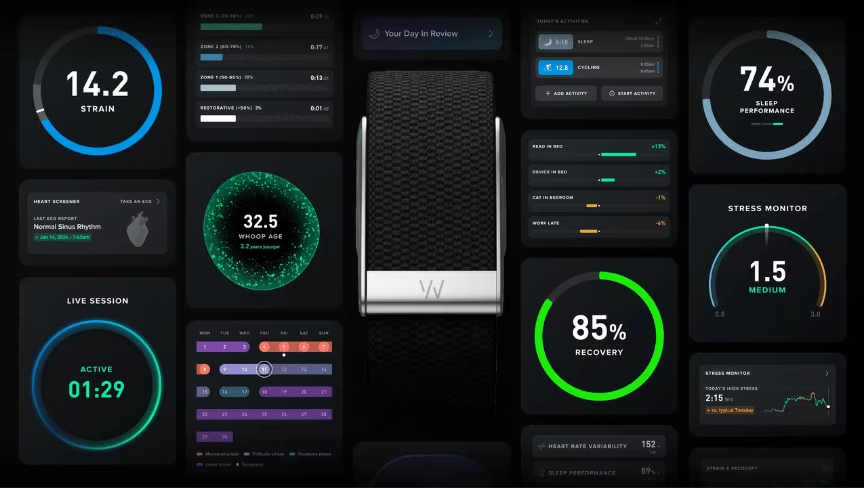
Google launched the 99 dollar screenless Fitbit Air and a 9.99 dollar per month Gemini-powered AI health coach. One day later, Whoop responded by adding on-demand video consultations with licensed clinicians to its app.





Trump Media & Technology Group reported a $405.9 million net loss for the first quarter of 2026, the company said on Friday, almost all of it driven by unrealised losses on the cryptocurrency holdings it has spent the past nine months building.
Operating cash flow was a positive $17.9 million; total financial assets stood at $2.1 billion, roughly triple the same point a year earlier.
The numbers below the headline are unusually small. Truth Social and the company’s adjacent media properties produced about $871,000 of revenue, up about 6% on the same quarter last year.
Truth.Fi, the financial-services brand built around exchange-traded funds and managed accounts, contributed $61,100 in management fees. Together, the operating businesses ran a small profit on a cash basis. The reported loss is almost entirely a balance-sheet event.
That balance sheet now contains 9,542 bitcoin, purchased starting in July 2025 at an average cost of $108,519 per coin, and 756 million CRO, the token associated with the Crypto.com exchange.
With bitcoin trading sharply below the entry mark and CRO down further, the digital-asset book stood at about $821.9 million against a $1.24 billion cost basis, an unrealised loss of roughly $423 million.
Most of the rest of the quarter’s $405.9 million loss came from a separate $108.2 million markdown on equity investments.
The combination explains why an underlying business that generates positive operating cash flow can publish a loss number that is several hundred times the size of its revenue.
CEO Devin Nunes has described the crypto treasury strategy as a balance-sheet diversification choice, comparable to the playbooks adopted by Strategy (formerly MicroStrategy) and a growing list of public companies that have moved cash reserves into bitcoin.
The mechanics differ. Strategy issues debt to buy bitcoin in size; Trump Media has used cash raised from a 2025 stock-and-convertible-note placement of about $2.3 billion to acquire its position outright.
The company has framed the strategy as long-term, meaning the unrealised losses are being held for an eventual recovery rather than crystallised.
How that plays in the equity narrative depends on which company the market thinks DJT now is. As a media business, the loss reads as catastrophic against $871,000 of revenue.
As a crypto-treasury vehicle, it reads as a normal quarterly mark-to-market in an asset class that moves 30% in either direction over the course of a few months.
Some analysts have started referring to DJT as a bitcoin proxy with a small media business attached, the same framing analysts apply to Strategy. The premium to net asset value DJT has historically traded at suggests retail investors are pricing it that way, too.
There are reasons the analogy is imperfect. The Trump family ownership and the political halo that defines the brand are factors that a pure crypto-treasury structure does not carry.
Truth Social’s user base, monetisation and regulatory posture are all dependent on the political cycle in a way that Bitcoin’s balance is not. And the equity-investment line that contributed the additional $108 million markdown is opaque on a cost-basis level, making the underlying portfolio harder to value.
The operational figures that are not balance-sheet noise are slightly more encouraging. Fourth consecutive quarter of positive operating cash flow. Total assets up to about $2.2 billion.
Truth.Fi has begun signing up institutional customers for its ETF and managed-account products. None of those is a story that would justify the company’s market capitalisation independently, but each gives Nunes more time to argue that the underlying business is real.
The harder question for the next quarter is what the crypto holdings do. Bitcoin has stabilised around levels well below the cost basis; CRO has not.
If digital-asset prices recover before the second-quarter close in early August, the unrealised loss reverses, and DJT books a paper gain that would dwarf media revenue in the opposite direction.
If they do not, Trump Media will have to either explain a second large loss or restructure the position. The company has so far not indicated that it intends to do the second.


Arjan Brussee, best known as a co-founder of Guerrilla Games and a former global director of product management for Unreal Engine at Epic Games, says he’s developing a new platform called The Immense Engine. The idea, as he describes it, is to create an alternative to the dominant engines that…
Read Entire Article
Source link
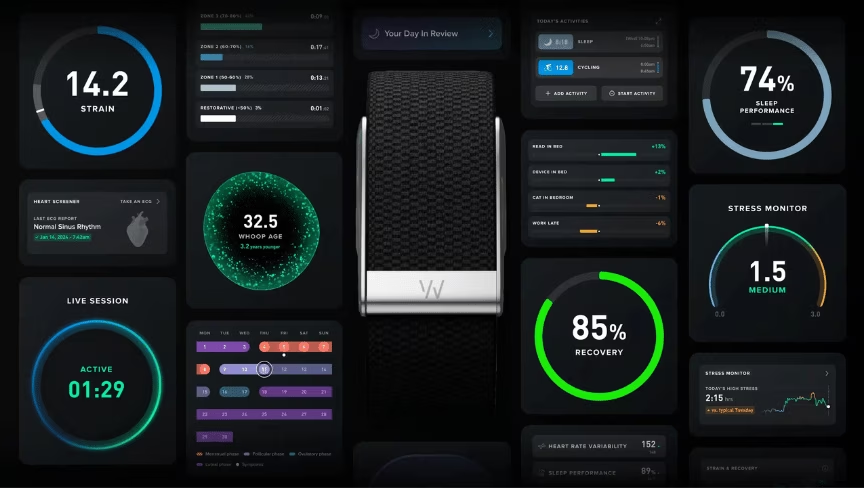
Google launched the 99 dollar screenless Fitbit Air and a 9.99 dollar per month Gemini-powered AI health coach. One day later, Whoop responded by adding on-demand video consultations with licensed clinicians to its app.
TL;DR
Google launched a 99 dollar screenless fitness tracker and a 9.99 dollar per month AI health coach powered by Gemini. One day later, Whoop announced that it would add on-demand video consultations with licensed clinicians to its app. Google is betting that artificial intelligence can interpret your health data. Whoop is betting that you still need a doctor. The US Food and Drug Administration, which relaxed its oversight of both AI health tools and consumer wearables in January, is betting that neither needs much regulation.
The sequence is not a coincidence. It is a philosophical split in the wearable health industry, articulated in product announcements issued 24 hours apart. The question both companies are answering is the same: what should happen after the sensor on your wrist collects the data? Google’s answer is an AI chatbot. Whoop’s answer is a human with a medical licence. The market will decide which one people trust with their bodies.
The Fitbit Air is a screenless band that costs 99 dollars. It is the smallest Fitbit ever made. It tracks heart rate, heart rate variability, SpO2, sleep stages, and activity continuously, with a battery life of approximately one week. It has no display. All data is accessed through the new Google Health app, which replaces the Fitbit app on 19 May.
The device ships on 26 May with a three-month free trial of Google Health Premium, which costs 9.99 dollars per month or 99 dollars per year. The premium tier includes the Google Health Coach, an AI assistant built on Gemini that generates personalised workout plans, interprets sleep trends, summarises health records, and answers questions about a user’s fitness and medical data.
Google’s strategy is not to sell hardware. It is to sell the AI layer on top of the data. The Google Health app is designed to be wearable-agnostic, with planned support for Apple Watch, Oura, and Garmin devices later this year. The Fitbit Air is the entry point, not the destination. Google wants to be the intelligence that sits between every wearable sensor and every health decision, regardless of which device collected the data.
Whoop’s announcement arrived on 8 May, exactly one day after Google’s. The company will offer on-demand video consultations with licensed clinicians through its app for users in the United States, launching this summer. The consultations begin with a review of the user’s continuous biometric data collected by the Whoop band. If the user has synced blood work or medical history through HealthEx, an electronic health records integration that Whoop is also launching, that information is included.
The distinction from Google’s approach is deliberate. A clinician can ask follow-up questions, identify patterns that require context a chatbot does not have, and carry the professional accountability that comes with a medical licence. An AI coach can tell you your heart rate variability is trending down. A doctor can tell you why.
Blossom Health raised 20 million dollars to put AI copilots alongside psychiatrists, a model that treats AI as support for clinicians rather than a replacement for them. Whoop is applying the same logic to wearable health data: the AI processes the numbers, but a human makes the call.
Will Ahmed, Whoop’s founder and chief executive, posted an image on X of a Whoop circuit board with the words “Don’t bother copying us, we will win” engraved on it. The message was originally aimed at Amazon, which launched and subsequently killed the Halo fitness band. It now reads as a response to a company with considerably more resources than Amazon’s wearables division.
Whoop raised 575 million dollars in March 2026 at a valuation of 10.1 billion dollars, with investors including the Qatar Investment Authority, Mubadala, Abbott, and the Mayo Clinic. The company reported 1.1 billion dollars in annualised revenue in 2025, up 103 per cent year over year, and said it was cash-flow positive. It has more than 2.5 million members.
Whoop’s subscription costs between 199 and 359 dollars per year depending on the tier. Google Health Premium costs 99 dollars per year. The Fitbit Air costs 99 dollars. A year of Fitbit Air plus Google Health Premium costs less than a year of Whoop’s cheapest plan. The clinician consultations that Whoop is adding will cost extra, with pricing not yet announced.
The price gap frames the competitive question. Google is offering AI health coaching at a price point that undercuts Whoop’s subscription by more than half. Whoop is offering human medical consultations at a price that will push its total cost higher. One company is driving the cost of health guidance toward zero. The other is arguing that the value of a human clinician justifies a premium. Both positions are coherent. Neither has been tested at scale in the wearable market.
ChatGPT Health launched in January 2026, connecting Apple Health data to OpenAI’s models. Microsoft followed a week later with Copilot Health. Perplexity launched Perplexity Health, pulling together electronic health records, wearable data, and lab results into a single AI-powered dashboard. Amazon opened its Health AI to all US customers, backed by its One Medical clinical network and pharmacy.
Every major AI platform now has a health product. The wearable data that Fitbit, Whoop, Apple Watch, and Oura collect has become the input for a competition between AI models, each promising to turn continuous biometric monitoring into personalised health advice. The differentiation is not in the data. Heart rate, sleep stages, and SpO2 are measured by every device on the market. The differentiation is in what happens next.
Corti’s Symphony AI outperformed models from OpenAI and Anthropic on medical coding benchmarks, demonstrating that specialised health AI can exceed general-purpose models on clinical tasks. The implication for the wearable market is that the AI interpreting your health data may matter more than the sensor collecting it. Google is building that AI into a consumer subscription. Whoop is routing around it to a human.
In January 2026, the FDA updated two guidance documents that collectively loosened oversight of both consumer wearables and AI-enabled health tools. The General Wellness Guidance clarified that low-risk wellness devices using optical sensing to estimate physiological parameters, which describes every screenless fitness tracker on the market, can be sold without premarket review as long as they make wellness claims rather than clinical ones. The Clinical Decision Support Guidance softened the agency’s approach to AI tools that help users navigate diagnoses and health decisions.
The regulatory shift creates space for both Google and Whoop. Google’s AI health coach can offer personalised guidance without triggering medical device classification, provided it frames its outputs as wellness advice. Whoop’s clinician consultations operate under existing telemedicine frameworks. The FDA’s position is that neither the AI chatbot nor the wearable sensor requires the level of scrutiny applied to medical devices, as long as neither claims to diagnose or treat disease.
The gap between what these products do and what they claim to do is where the regulatory question lives. An AI coach that tells a user their recovery score suggests they should rest is wellness advice. An AI coach that tells a user their heart rate variability pattern is consistent with early atrial fibrillation is a clinical claim. The line between the two is a sentence, and the incentive to cross it increases with every subscription dollar at stake.
Google built a 99 dollar tracker and a 9.99 dollar AI coach. Whoop is adding doctors to an app attached to a 10 billion dollar company. The FDA says both are fine. The user strapping a screenless band to their wrist and asking what their data means will not be choosing between two products. They will be choosing between two theories of what health data is for: a prompt for an algorithm, or a conversation with a person who went to medical school.


A 34-year-old Virginia man was found guilty of conspiring to destroy dozens of government databases after getting fired from his job as a federal contractor.
In 2016, Sohaib Akhter and his twin brother and co-defendant Muneeb Akhter were also sentenced to several years in prison after pleading guilty to accessing U.S. State Department systems without authorization and stealing the personal information of dozens of co-workers and a federal law enforcement agent who was investigating their crimes.
After serving their sentences, the two brothers were rehired as government contractors by a company that worked with more than 45 federal agencies and hosted government data on servers in Ashburn.
“When the company discovered Sohaib Akhter’s felony conviction, it terminated both brothers’ employment during an online remote meeting on Feb. 18, 2025,” the Justice Department said. “Immediately after being fired during this meeting, the brothers sought to harm their employer and its U.S. government customers by accessing computers without authorization, write-protecting databases, deleting databases, and destroying evidence of their unlawful activities.”
In November 2025, Muneeb and Sohaib were again charged with destruction of records, aggravated identity theft, computer fraud, and theft of government information.
According to court documents, the two brothers wiped roughly 96 government databases within several hours in February 2025, including sensitive investigative documents from multiple federal agencies and Freedom of Information Act records. Additionally, immediately after deleting a Department of Homeland Security database, they also allegedly asked an artificial intelligence assistant how to clear system logs.
Prosecutors added that they allegedly ran commands to prevent others from modifying the targeted databases before deletion, and destroyed evidence of their activities. The men also discussed cleaning out their house in anticipation of a potential law enforcement search and wiped company laptops before returning them to their employer.
“As proven at trial, Akhter participated in the unauthorized access of protected computer systems, the theft of credentials, and the destruction of government data affecting numerous federal agencies,” said Inspector General Jennifer L. Fain of FDIC-OIG.
“The deliberate deletion of databases containing sensitive government information and the subsequent attempts to conceal that criminal activity demonstrated a blatant disregard for the security and integrity of federal information systems.”
Sohaib Akhter will be sentenced on September 9, 2026, and is facing a maximum penalty of 21 years in prison.
His brother, Muneeb Akhter, also faces a maximum of 45 years for two counts of computer fraud, conspiring to commit computer fraud and destroy records, two counts of aggravated identity theft, and theft of U.S. government records.

AI chained four zero-days into one exploit that bypassed both renderer and OS sandboxes. A wave of new exploits is coming.
At the Autonomous Validation Summit (May 12 & 14), see how autonomous, context-rich validation finds what’s exploitable, proves controls hold, and closes the remediation loop.

By now you likely have caught wind of GameStop, the video game and collectables retailer, announcing a bid to buy eBay. Perhaps you heard of this, as I did, because of GameStop’s CEO, Ryan Cohen, showing up to CNBC’s Squawk Box program where he pulled off one of the strangest interviews about business I’ve ever seen.
In a six-minute interview with CNBC‘s Andrew Ross Sorkin, Cohen gave a series of mostly incoherent responses to the most basic questions, unable to provide any decipherable reasons why a flailing video game retail chain that’s relied on meme stocks and Pokémon cards for its recent survival would even think of trying to buy a massively larger, international e-commerce company. When asked by CNBC, “So you’ve built up a stake in this company already, you’ve had conversations with the company? You’ve tried? What’s happening here?” there’s a deeply awkward pause before Cohen, in his mid-life-crisis black leather jacket, says “…No.” Then after another glacial pause, “We’re just starting,” followed by a very peculiar smirk.
It got stranger and more passive aggressive from there. Cohen indicated that through a stock issuance the company would directly put up $20 billion for the purchase, along with another $20 billion from investors. The problem is that the eBay purchase would require roughly $56 billion. It doesn’t take a professor in advanced mathematics to see the issue here.
Cohen seemed to approach the entire interview with an affected air of disgust and disdain, as if it’s just so beneath him to even have to answer questions based on his announcements. The mini-Musk rolls his eyes and glibly dismisses reasonable questions, which was going badly enough until Sorkin asked the most obvious question of all: “How does the math math?” How does around $20 billion from GameStop and $20 billion from an investor get close to $56 billion? “Half cash, half stock” Cohen replies, after more eye rolling and disdain. And then he appears to get stuck in a loop, like a rubbish sleepy robot.
Watch the entire interview if you like, but it’s pretty hard to get through it, honestly.
Going along with that very bizarre interview was the sudden appearance of all kinds of video game memorabilia, with some of it appearing to come directly from the “vault” that had been kept by GameStop’s Game Informer magazine, before Cohen shuttered it.
The stunt follows criticisms that the executive doesn’t have enough cash to actually make that acquisition. But it appears that at least some of the items being auctioned could be remnants looted from the legendary Game Informer Vault, where the long-running publication housed decades of video game history before GameStop shut down the publication in 2024.
Sources close to the situation who spoke under the condition of anonymity told Kotaku that while some of the products in Cohen’s eBay listings, such as the baseball cards, weren’t from the Game Informer Vault, other items, including some rare retro games, likely were. Some details like the sticky tab on the front of the sealed copy of Dracula for the NES and the sealed casings on copies of Yoshi’s Cookie and F1 Pole Position match photos and descriptions from the Vault verified by Kotaku.
Now, the Kotaku article suggests that Cohen is selling these items as an effort to raise money for the eBay bid. That’s a very silly thing to suggest. We’re talking about a $16 billion shortfall, unless Cohen plans to seriously dilute the stock value of current shareholders. Historical gaming items like we’re talking about, while certainly of import and value, aren’t going to net you $16 billion.
But it’s worth noting how cavalier Cohen is being here with very real gaming history and culture. It’s not surprise that the Video Game History Foundation and others are pointing out how an eBay auction like this is going to scatter all of this cultural history to the wind, and what a shame that is.
Video Game History Foundation founder Frank Cifaldi posted on Bluesky accusing Cohen of selling off items from the Vault. Though Game Informer has since returned as a print publication after the outlet was acquired and revived by Gunzilla Games in 2025, the Vault and all the contents found inside remained GameStop property.
“I’m very happy Game Informer is out from under GameStop, but choices like these remind people of the brutal closure of the magazine in 2024,” MinnMax founder and ex-Game Informer video producer Ben Hanson said in a statement to Kotaku. “Game Informer‘s history belongs in a museum, not some schmuck’s eBay listings. Show some love to the current Game Informer crew, subscribe to the physical magazine, and please try to ignore Ryan Cohen’s pleas for attention.”
Will GameStop actually buy eBay? I very much doubt it. I don’t think the company can pull off this kind of leverage while maintaining a credit rating post-acquisition that would satisfy the banking investment requirements as outlined in Cohen’s own financing letter. Moody’s doesn’t seem to think so, either.
Somewhat hilariously, Cohen’s own eBay account was also suspended shortly after he began auctioning these items off. But if he really wants to sell off the Game Informer vault, he’ll find a way. And that is a damned shame from a gaming preservation standpoint.
Filed Under: ryan cohen, wtf
Companies: ebay, gamestop


Last month, NASA astronaut Chris Williams floated aboard the Crew Dragon Freedom, pointing his camera out the window. What he photographed shows our planet enveloped in a delicate ribbon of light, called airglow, with the Milky Way arching overhead like a faint road through the stars. The photograph, shot on April 13 while the spacecraft was docked to the International Space Station, provides a clear view of something that occurs high above us every night.
Earth softly curves over the bottom of the frame, with brown and reddish land extending out next to patches of deep blue ocean, all speckled with beautiful white clouds. A thin, consistent ribbon of green and yellow hugs the edge of the atmosphere, where the planet meets empty space. Above that ribbon, the sky becomes absolutely dark, with thousands of sharp stars. The Milky Way traces a wide, hazy path across the top, with dense star fields and dark dust lanes easily visible.
Sale

Williams captured the image from the zenith docking port on the night side of the orbit. The window frame and a bit of the station’s solar array emerge at the borders, reminding viewers that this sight came from a small spacecraft hundreds of miles high. The camera was pointed at the horizon, where the glow is greatest, so no city lights appear. Instead, the attention is on the natural light that surrounds the entire globe.

That light is known as airglow, since sunlight penetrates the upper atmosphere during the day and provides energy to the atoms and molecules that float there. After sunset, such particles gradually release their additional energy as weak photons. The procedure creates the colored layers that Williams recorded. Green and yellow tones are most common because oxygen and nitrogen react in different ways at different heights. The effect is similar to the soft brightness inside a glow stick after snapping it, but on a planetary scale and driven by ordinary daylight rather than chemicals.
People occasionally mix airglow with the brighter curtains of an aurora. Both include charged particles emitting light, while airglow relies on consistent solar energy that arrives each day. Auroras require bursts of solar wind to light up. Airglow is always present, but it is too dim for most ground viewers to see unless the sky are very black and the camera exposure is long.

Williams later explained that the night side of the orbit is comparable to standing in one of Earth’s most isolated dark-sky locations. The station’s path allows him to observe stars in both the northern and southern sky at the same time. In his words, the view of the galactic plane is clear because nothing in the thin air above obscures the distant stars. This single frame combines those details: the planet’s curve, the luminous atmosphere shell, and the galaxy beyond.
[Source]

Man on Fire is a story that first hit my radar, like many of you, when Denzel Washington stepped into the role of former CIA operative John Creasy in Tony Scott’s 2004 action film. The story of that film, like Netflix‘s new thriller, draws inspiration from A. J. Quinnell’s book of the same name — which is the first entry in the five-book series.
For all intents and purposes, the 2004 film is a solid adaptation, and thanks to the performances of Washington (who plays Creasy) and a young Dakota Fanning, it has stood the test of time and remains a quality actioner to dig into.
Also, potentially like many of you, I’m shocked to say that Netflix’s episodic adaptation of Quinnell’s work is far superior.
If you’ve paid attention to the numbers, you already know that Man on Fire hit the top of Netflix’s streaming charts with a whopping 11 million views in the show’s first four days on the platform. It was this news that nudged me to give the show a try — and I was immediately hooked.
Read more: 40 of the Best Movies on Netflix You Should Stream Now
Netflix’s Man on Fire isn’t a retread of the 2004 movie because the series loosely adapts the original material. Taking a note from shows of a similar ilk, like Reacher and Cross, Man on Fire takes its own creative liberties while using the books as a narrative foundation. And it works brilliantly.
This Man on Fire takes to the streets of Brazil, altering the conflict of the original story, while adhering to the basics of a weathered man doing anything and everything to protect a girl who’s being hunted by gangs and terrorists hell-bent on killing her. That’s just one piece to an intricate and violent puzzle.
If it sounds heavy, that’s because it is. But thanks to smart writing and the emotional resonance of the cast performances, the movie is as engaging and heartfelt as it is bloody.
You want to watch this beatdown man get lit on fire for this purpose — it’s Death Wish for a whole new generation.
Abdul-Mateen stars in Man on Fire on Netflix.
Abdul-Mateen stars as Creasy in this rendition, which shifts the character’s backstory from CIA officer to PTSD-stricken Special Forces operative, and from the get-go, the emotional stakes are viscerally there. They steadily ramp up through each episode, justifying Creasy’s Jack Bauer-style actions, all with the motivations of enforcing justice and eliminating every evildoer he crosses paths with.
Abdul-Mateen holds his own in the role, quickly eliminating the remnants of Washington’s performance two decades earlier. And that’s no easy undertaking. Yet, as we’ve seen with the roles the actor has taken, from Dr. Manhattan in HBO’s Watchmen to playing Candyman in the 2021 horror remake and Wonder Man earlier this year on Disney Plus, he’s got range and a top-tier skill of wearing his heart on his sleeve, no matter what his character must do on screen.
In short, you can’t help but root for Abdul-Mateen, which means it’s nearly impossible to not root for Creasy.
It doesn’t stop with him, though. Every actor that graces the screen in Man on Fire is legit (as the kids say) fire. Bobby Cannavale dips in for a hot second to remind everyone of how great he is. Alice Braga, as Valeria, serves as a supportive counterpoint to Creasy’s hotheaded actions.
It’s Billie Boullet as Poe, the teenage girl Creasy protects from every possible danger, who steals the show, though. She’s got the same sort of wide-eyed emotional resonance Fanning had opposite Washington, yet it hits different and better here. She’s notably older than Fanning was, and the character she’s playing is a departure from earlier portrayals. That only works to her benefit, allowing her to find her own emotional footholds in the character. Boullet paired with Abdul-Mateen is a perfect match, full stop.
Instead of taking place in Mexico City, where Washington unleashed hell in the Tony Scott movie, this rendition sends Creasy to Brazil. The Netflix series shows off the beautiful, tourist-friendly areas of the country, then flips it, shoving us deep into the favelas to explore an often misrepresented culture.
The entire time I watched the show, I found myself leaning in close to take in the surroundings of each scene. Was this shot in a studio in front of a blue screen or on location? I’m pleased to say it was shot in multiple urban landscapes, like Mexico City and Rio de Janeiro. That tactile authenticity brings the story to life in a necessary way, embracing its realness rather than re-creating it in post.
Oh, and did I mention how action-packed and violent the show is? I did, but it bears repeating.
This is Jason Bourne-style action, in the form of a TV show where each episode runs approximately 40 minutes. If ever there was a way to guarantee my attention and keep me glued to the screen for hours on end, everything I just mentioned — from the writing to the acting and the viscera in between — adds up to the perfect formula to do just that. If you’re anything like me and you’ve read this far (so I assume you are), you’ll feel the exact same way.

After three people died on a cruise ship struck by a hantavirus, authorities are actively tracking down 29 people who had left the ship. They’re trying to trace the spread of the virus. It’s a long, arduous, global process to find and notify people who might be at risk of infection.
Hey, wasn’t there supposed to be an app for that?
Contact-tracing apps were a global effort starting in 2020 during the Covid-19 pandemic. Enabled by phone companies like Apple and Google, contact tracing was designed to use Bluetooth connections to detect when people had come in contact with someone who had or would later test positive for Covid and report as much. It didn’t do much to solve the spread of the pandemic, but tracking the virus became more effective at least. The same process wouldn’t go well for the hantavirus problem.
“There is no use of apps for this hantavirus outbreak,” Emily Gurley, an epidemiologist at Johns Hopkins University, wrote in an email response to WIRED. “The number of cases are small, and it’s important to trace all contacts exactly to stop transmission.”
On a smaller scale of infection like this, officials have to start at the source (an infected individual), then go person-by-person, confirming where they went and who they might have come into contact with. Data collected by apps from a broad swath of devices would not be anywhere close to accurate enough to give a good idea of where the virus might have hitchhiked to next.
Contact tracing on a wider scale, like, say, a global pandemic, is less about tracking the individual infections and more about understanding what parts of the population might be affected, giving people the opportunity to self-quarantine after exposure. But that depends on how people choose to respond, and how the technology is utilized by public emergency systems. During the Covid pandemic, contact-tracing via apps tended to work better in more carefully managed European countries, but did not slow the spread in the US.
Making devices accessible to that kind of proximity information has also brought all sorts of concerns about privacy, given that the technology would require always-on access to work properly. Contact tracing also struggled to maintain accuracy, and in some cases could be providing false negatives or positives that don’t help further real information about the spread of the virus.
Especially in the case of something like the Hantavirus, where every person on that cruise ship can theoretically be directly tracked and contacted, it’s better to do that process the hard way.
“During small but highly fatal outbreaks, more precision is required,” Gurley wrote.

Today’s El Clasico live stream sees the La Liga title up for grabs at the Camp Nou, with Barcelona requiring only a point to seal the crown and Real Madrid needing nothing less than a victory.
While Barca have been rampant domestically over the last few weeks, Los Blancos have faltered. A shock loss at Mallorca was followed up by dropped points against Girona and Real Betis. Two goals from Vinícius Júnior at Espanyol last weekend kept them hanging on by a thread, but a very vocal row with star man Kylian Mbappe and an unceremonious dumping out of the Champions League by Bayern Munich mean that the 2025-26 season will go down as one to forget for Álvaro Arbeloa’s men.
Here’s where to watch Barcelona vs Real Madrid live streams in El Clasico online from anywhere.
Barcelona vs Real Madrid will be live streamed for free on Idman TV in Azerbaijan.
US residents can take advantage of free trials to Fubo or YouTube TV’s and access ESPN through those services. And in Australia, there’s a 7-day free trial available with beIN Sports.
Outside those countries right now? NordVPN can unlock your live streams from anywhere in the world – more on that below.
A VPN is a handy piece of software that can make your device appear as if it’s back in your home country, thereby letting you unlock your usual service. The best VPN right now? We recommend NordVPN – it does everything and comes with up to a 76% discount.
Using a VPN is incredibly simple:
1. Install the VPN of your choice. As we’ve said, NordVPN is our favorite.
2. Choose the location you wish to connect to in the VPN app. For instance, if you’re visiting the UK and want to view your usual US service, you’d select a United States server from the list.
3. Sit back and enjoy the action. Head to your usual local streaming service and watch the soccer.

The Barcelona vs Real Madrid live stream is being shown on ESPN (and ESPN Deportes) in the US.
ESPN is available through a variety of cable plans. Cord cutter? OTT service Sling TV is well-priced alternative. It includes ESPN with its $19.99 per month Essentials plan, or on Sling Orange from just $5 a day.
A costlier but even more thorough alternative is Fubo, which includes ESPN on all its plans. Prices start from $55.99 a month for its Sports + News package, but new users get a FREE Fubo trial. And YouTube TV is another ESPN-toting option that you can try for free for 21 days right now!
Or subscribe to the ESPN app. It costs from just $12.99 for a rolling monthly plan that includes live La Liga action.
On holiday overseas? A VPN will allow you to access your usual US subscription from abroad. We recommend NordVPN as the best overall streaming VPN.

Premier Sports is broadcasting the Barcelona vs Real Madrid La Liga encounter live in the UK.
Premier Sports costs £17.99 on a rolling monthly basis, or make a saving by going for an annual sub. You can also get access to Premier Sports by adding it to an existing Sky TV, Virgin Media or Prime Video plan.
Not in the UK for El Clasico? To access your usual streaming service from outside the UK, you’ll need to download a good VPN as detailed above.

In Canada you can watch El Clasico live on TSN2.
That means you can also watch online thanks to its TSN+ ($8 a month / $80 a year) streaming platform.
For fans travelling outside of Canada, use NordVPN to login to your TSN+ account from anywhere in the world.

Soccer fans in Australia can watch Barcelona vs Real Madrid on beIN Sports, with kick-off at 5am AEST on Monday morning.
beIN Sports costs $15.99 a month or you can save by going for a $160 annual plan. And if you’re new to the specialist sports streamer, you can take advantage of its free one-week trial.
Missing the game because you’re outside Australia? Use a VPN to login to your Stan Sport account.
This El Clasico between Barcelona vs Real Madrid kicks off at 9pm CEST in Spain on Sunday, May 10, which is 3pm ET / 12pm PT in the US and 8pm BST in the UK. That’s 5am AEST on Monday, May 11 for fans based in Australia.
Of course, most broadcasters have streaming services that you can access through mobile apps or via your phone’s browser. For example, ESPN, Premier Sports and beIN Sports all have apps that let you watch La Liga soccer on your mobile. You can also stay up-to-date with all key moments from on the official social media channels on X/Twitter (@LaLigaEN), Instagram (@LaLiga), TikTok (@LaLiga) and YouTube (@LaLiga).
When does El Clasico start?
Can I watch El Clasico 2025/26 on my mobile?
We test and review VPN services in the context of legal recreational uses. For example: 1. Accessing a service from another country (subject to the terms and conditions of that service). 2. Protecting your online security and strengthening your online privacy when abroad. We do not support or condone the illegal or malicious use of VPN services. Consuming pirated content that is paid-for is neither endorsed nor approved by Future Publishing.

This project is perhaps the single most passive-aggressive thing we’ve ever seen on this site: rather than tell someone directly to ‘shut up’, [Blytical]’s speech jammer lets you hack their brain from across the room to stop them from speaking. It’s also a bit of an object lesson in why you shouldn’t just copy reference implementations without careful study — by his own implementation, [Blytical] was forced to learn a lot more than he intended going into this project.
The brain hack behind it is called ‘delayed auditory feedback’: by feeding their speech back to the target with a short delay — only 50 to 200 ms — it creates a confounding effect that is apparently very difficult to speak through. The array of ultrasound transducers is used to accurately aim the audio by serving as an inaudible, low-spread carrier wave, as we saw in another project this year. A shotgun mike picks up the audio from the speaker you wish to harass, and an array of audio processing circuitry takes care of the rest.
That’s where problems happen, as [Blytical] admits he just tossed some reference implementations onto a PCB without bothering to think too hard about what he was doing. It’s the datasheet version of vibe coding, and it usually goes about as well — sometimes perfectly, but rarely without a lot of troubleshooting. That troubleshooting is really, really hard when you don’t quite understand why things were laid out the way they were on the datasheet. We don’t blame [Blytical], you can learn a lot when you bite off more than you can chew. The fact that he risked this failure mode rather than do the whole thing in software with a Pi says good things about how he’s conducting his education.
It’s a shame, though, because we’ve been waiting to see another one of these speech jammers in action for quite some time. Perhaps someone will try again; the ultrasonic array portion seems solved, so if the delay circuit was the problem, perhaps a tiny tape loop would suffice.

Marshals, a new Yellowstone spinoff starring Luke Grimes as Kayce Dutton, is airing on CBS right now. You can also tune in with Paramount Plus. The Yellowstone sequel series sees Grimes’ former Navy SEAL join an elite unit of US Marshals to bring range justice to Montana, according to a synopsis from CBS.
The show includes Yellowstone actors Gil Birmingham as Thomas Rainwater, Mo Brings Plenty as Mo and Brecken Merrill as Tate. Spencer Hudnut is the showrunner of Marshals — formerly known as Y: Marshals — and Taylor Sheridan is an executive producer.
Episode 11 of Marshals airs on CBS on Sunday, May 10. Viewing options for Paramount Plus customers vary by subscription tier. You can watch the episode live if you have Paramount Plus Premium, which includes your local CBS station. If you subscribe to Paramount Plus Essential, you can watch the installment on demand the following Monday, but not live on Sunday.
Here’s a release schedule for the next three episodes of Marshals.
You can also watch CBS and the eleventh episode of Marshals without cable with a live TV streaming service such as YouTube TV, Hulu Plus Live TV or the DirecTV MyNews skinny bundle. In addition to offering a lower-cost option, Paramount Plus lets you watch the other two Yellowstone spinoffs: the prequels 1883 and 1923.
After a price increase in early 2026, the ad-supported Essential version runs $9 per month or $90 per year. The ad-free Premium version runs $14 per month or $140 per year. Paying more for Premium gives you downloads, the ability to watch more Showtime programming than Essential and access to your live, local CBS station.






HarrisX Poll Found 52% of Registered Voters Support the CLARITY Act


Upbit adds B3 Korean won pair as Base token gains Korea access


Weekend Open Thread: Marianne Dress


Image AI models now drive app growth, beating chatbot upgrades

NCP car park operator enters administration putting 340 UK sites at risk of closure

Ignore market noise, India’s long-term story intact, say D-Street bulls Ramesh Damani and Sunil Singhania


Politics Home Article | Starmer Enters The Danger Zone


BlackRock Buys $284M In Bitcoin On May 1 As The Best Crypto To Invest In For 2026 Sits Below A Pending Binance Listing


Olivia Wilde Reacts To Viral ‘Corpse’ Comparison


Inter Milan Win Serie A Title After Victory Over Parma


La Liga: Vinicius Jr scores twice as Real Madrid win to keep Barcelona waiting for title

Every word of Arne Slot’s heated rant after Manchester United win vs Liverpool


UAE Free Zone Deploys Blockchain IDs to Verify Registered Firms


Other Bennet Sister Love Triangle Cast: Ella Bruccoleri, Donal Finn


Joel Embiid urges Sixers fans not to sell playoff tickets to Knicks fans

2026 NHL playoff picks: Second-round predictions, series odds, Stanley Cup bracket
Jennifer Lawrence’s Mary Jane Sneakers Are Spring’s It-Girl Shoe


Moroccan Reacts To Nick Cannon’s Dating Rules For His Sister
Kylie Jenner and Timothee Chalamet Hold Hands in NYC Outing


BlackRock CEO Larry Fink Discusses a New Asset Class


You must be logged in to post a comment Login