Vieu co-founders Simon Skaria (left) and Samir Manjure. (Vieu Photo)
Vieu, a Seattle startup aiming to replace cold outreach with warm introductions, launched what it calls the “Business Graph,” a live map of trusted relationships that drive business-to-business sales, marketing, recruiting and fundraising.
The 40-person company, which raised an $11 million seed round in October 2024, has grown to more than 100 enterprise customers including Rubrik, NetApp, and Amazon Web Services. Vieu competes with sales-intelligence tools like ZoomInfo and Outreach, and overlaps with LinkedIn’s Sales Navigator.
The company is led by CEO Samir Manjure and CTO Simon Skaria, both Microsoft alumni. Manjure went on to found KenSci, a healthcare AI startup acquired by Providence in 2021. Skaria has also founded and sold two other startups, Office365Mon and Albits.
The Business Graph, which launched Tuesday, maps relationships between people and companies based on observed signals — such as shared work history, co-authored research, board affiliations, and joint ventures — rather than the self-reported connections that populate LinkedIn.
Common use cases include finding someone who can make an introduction to a decision-maker at a target account, quietly checking references on a job candidate, and figuring out which LinkedIn connections a salesperson actually knows versus the ones they simply accepted a request from.
Advertisement
Vieu says the graph can be used inside its own app or queried directly by AI assistants like Anthropic’s Claude and Google’s Gemini, and it integrates with CRM, email, and Slack.
Manjure said Vieu still has the majority of its 2024 seed round in the bank and has not raised new funding. The company charges customers a platform fee for access to the Business Graph plus outcome-based pricing tied to specific use cases like sales, recruiting, and fundraising.
The nonprofit organisation said it aims to deepen its role as Ireland’s independent source of ecosystem data and help build the country’s leadership position in AI transformation.
Irish nonprofit organisation TechIreland has appointed Niall Norton as its new chief executive officer, replacing interim CEO John O’Dea.
TechIreland gathers and shares data intelligence around the Irish technology ecosystem by tracking more than 14,500 companies, including start-ups, scale-ups, investors, multinationals and support organisations.
It said the appointment comes at a time when the organisation is aiming to deepen its role as Ireland’s independent source of ecosystem data and help build the country’s leadership position in AI transformation.
Advertisement
“The technology ecosystem has multiple stakeholders, all of whom have a vested interest in its success: the start-up and scale-up companies themselves, the Government and State bodies, the investors, the multinational partners, the innovation hubs and the professional services firms,” said Norton.
“All successful technology ecosystems track measures, activity, health and performance of the ecosystem in order for stakeholders to work together effectively. The curation of transparent, reliable and available data in the service of all of these entities is a key element to promoting success.
“TechIreland has done a great job providing this essential curation service that is needed now more than ever. I look forward to working with our partners in the industry to promote Ireland as a location for valuable, sustainable jobs.”
Norton was previously chief financial officer at O2 Ireland and chief executive of Openet, a Dublin-headquartered telecoms software company that began as a start-up before being acquired by Amdocs in 2020.
Advertisement
Brian Caulfield, board director of TechIreland, said: “TechIreland is a crucial piece of national infrastructure for Ireland’s technology ecosystem. As such, it’s great to be able to welcome such a seasoned and successful leader as Niall as CEO. I look forward to working with Niall to continue and enhance the organisation’s mission.”
Norton is a fellow of the Institute of Chartered Accountants in Ireland, holds a certificate in management excellence from Harvard Business School, and has recently completed a programme in software development with the UCD Professional Academy.
At the end of May, TechIreland published its Irish Start-up Funding Review for 2026, a report covering start-up fundraising activity in Ireland in 2025.
Caulfield said at the time: “2025 was very much a curate’s egg. It was good in parts – mainly in Q1, when 69 Irish companies raised a total of €616m. That was the best quarter for fundraising in Ireland for 10 years.
Advertisement
“Unfortunately, the rest of the year saw a return to weakness, with just €376m raised by 250 companies across the rest of the year. Once again, just four outliers represented almost half of all funding (46pc). More widely, the pattern of Irish companies being underfunded relative to international competitors remains a worry.”
In March, the nonprofit released its Female Founder Funding Review 2026, which tracked investment into women-founded start-ups throughout 2025.
The report found that last year, 82 Irish start-ups led by women raised a total of €131m, representing the highest number of women-founded start-ups funded in any given year.
Don’t miss out on the knowledge you need to succeed. Sign up for the Daily Brief, Silicon Republic’s digest of need-to-know sci-tech news.
While Kylie Jenner serves as a human billboard for Meta’s AI glasses, pop star Lorde isn’t buying it.
During a set at the Mad Cool Festival in Madrid last week, Lorde had some choice words about the new technology, which many security experts have deemed a privacy nightmare.
“Increasingly in our world, it gets harder and harder to know what is real,” Lorde told the audience. “You don’t know if someone is wearing sunglasses, or if they’re wearing those f–ed up, f–ing [AI glasses]. Can I just say, for the record, f— the glasses. Don’t get the glasses. Not sexy.”
Lorde was possibly moved to comment on the latest trends in tech because Ray-Ban, a sponsor of the festival, partners with Meta to make AI glasses. Lorde also performed immediately before the singer Jennie, who is an ambassador for Ray-Ban x Meta’s smart glasses line.
“Increasingly in our world it gets harder and harder to know what is real. You don’t know if someone is wearing sunglasses or if they’re wearing those fucked up fucking.… Can I just say, for the record, ‘Fuck the Glasses’. Don’t get the glasses. Not sexy”
Lorde isn’t alone in raising concerns. Smart glasses, which come with cameras and AI features, have been used as tools for harassment and extortion. Meta, the most popular smart glasses maker, has said it takes privacy seriously and builds in safeguards like a visible recording light, but the company is facing many investigations and lawsuits alleging privacy violations. One lawsuit alleges that Kenyan contract workers were made to watch graphic videos obtained with the glasses to help train Meta’s AI. (Meta hasn’t publicly detailed its response to that specific claim.)
Advertisement
None of this has stopped the product from strong sales. EssilorLuxottica, the Ray-Ban maker, said it sold more than 7 million Meta AI glasses in 2025 — more than triple the roughly 2 million units it sold in 2023 and 2024 combined. Ray-Ban Meta glasses have been such a hit in the smart-glasses category that an emboldened Meta keeps expanding the lineup.
But hey, if privacy doesn’t make people think twice about the glasses, maybe vanity will. Lorde nails it pretty concisely with her declaration that they’re simply “not sexy.”
The here and now, she added, now that “is sexy.”
When you purchase through links in our articles, we may earn a small commission. This doesn’t affect our editorial independence.
While schools have made progress in technology adoption — from artificial intelligence guidelines to vetting education technology — they still struggle with the lack of resources, funding and expertise, according to a new report.
The annual State of EdTech report from the Consortium for School Networking polled roughly 600 chief technology officers for K-12 schools. One of the biggest takeaways, according to CoSN CEO Keith Krueger: AI adoption is higher than ever. According to the report, nearly three-quarters (79%) of school districts have AI guidelines in place, up from 57% in 2025.
“Given how many school districts we have, given how many small and rural ones there are, it’s shocking at how quickly at least the guidance around responsible use of AI is,” Krueger says. “As a foundational step, we’re seeing movement.”
But respondents repeatedly stated they are running into roadblocks of insufficient staffing and funding.
Advertisement
“There’s never going to be enough training, and we have to make sure the training is quality and meeting administrators with what they want and need,” Krueger says, adding it’s not just about training on a specific tool, but “helping them think in new ways how to use the tools.”
Most of the districts polled are in favor of AI guidelines, either set by the districts themselves or state education agencies, but do not want state or federal mandates. Typically, mandates are formed, then approved, by a board — something that is time-consuming and does not lend itself well in the fast-moving world of AI.
“This week, this month, this year is changing rapidly,” Krueger says. “It doesn’t mean we change fundamental beliefs of what’s cheating (with AI), for example, but things are moving rapidly. You don’t want to have too many solidly, board-approved things which can get locked in when you need to evolve.”
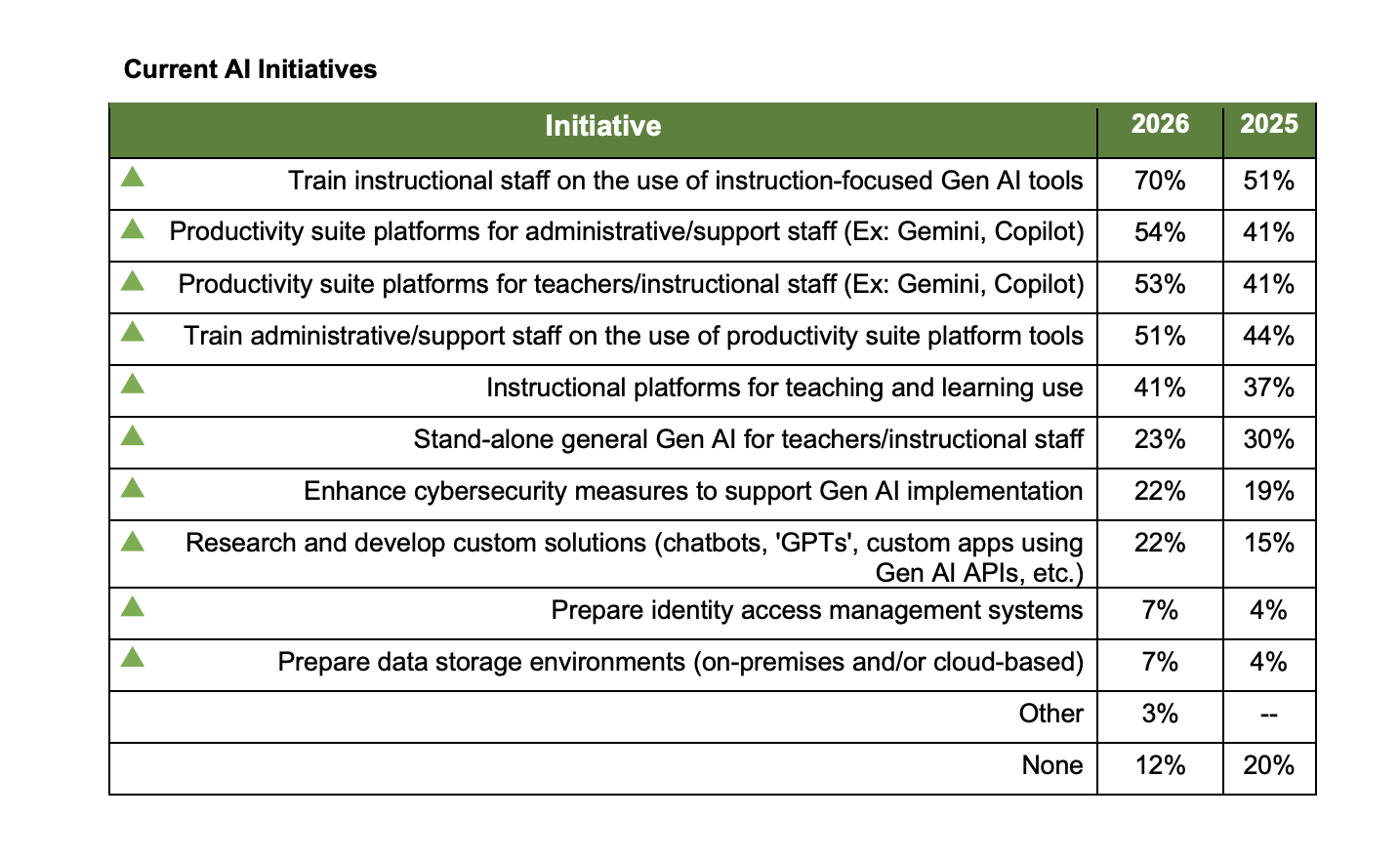
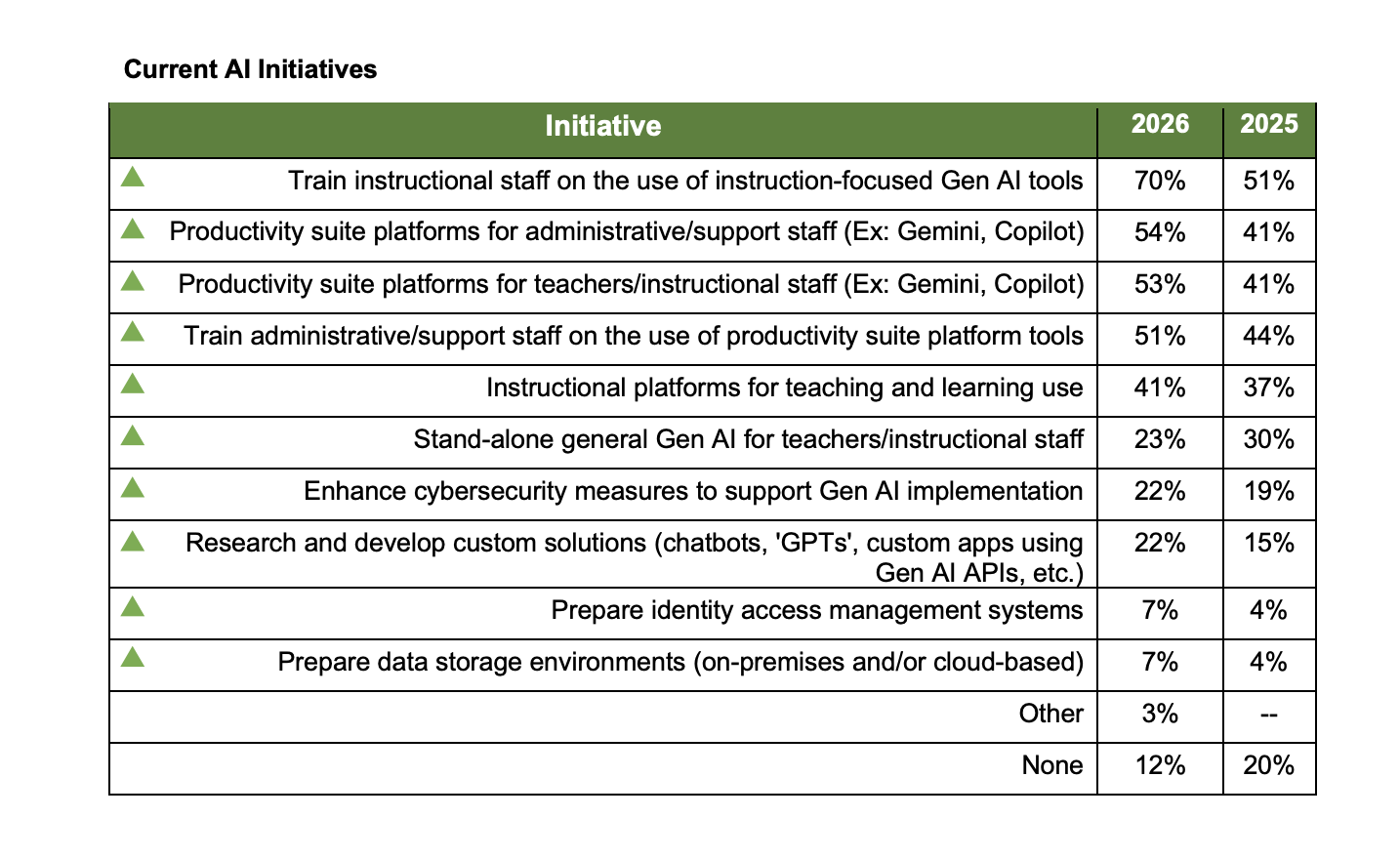
The most common AI initiative among districts is training staff on the use of instruction-focused generative AI tools, with 7 out of 10 respondents saying they do so. Productivity-focused measures focused on instructional staff and teachers followed, with 54% and 53%, respectively, deploying those initiatives. One of the largest jumps was the amount of districts having initiatives focused on AI’s operational purposes, from 37% in 2025, to 64% in 2026.
Advertisement
Less than half (41%) of initiatives focus on using AI for teaching and learning.
NEWSLETTERS
STAY AHEAD IN EDUCATION.
Sign up for EdSurge newsletters for timely news, insights and analysis.
“I would say the low hanging fruit is on the operational and teacher productivity side,” Krueger says. “We should continue to explore and think through the great uses that are in the classroom. But, overnight we shouldn’t just wildly go trying to do those things when it’s going to take time to figure out the instructional piece.”
Advertisement
The CoSN State of EdTech Report showcases districts’ AI initiatives.
Source: Consortium for School Networking
Cybersecurity
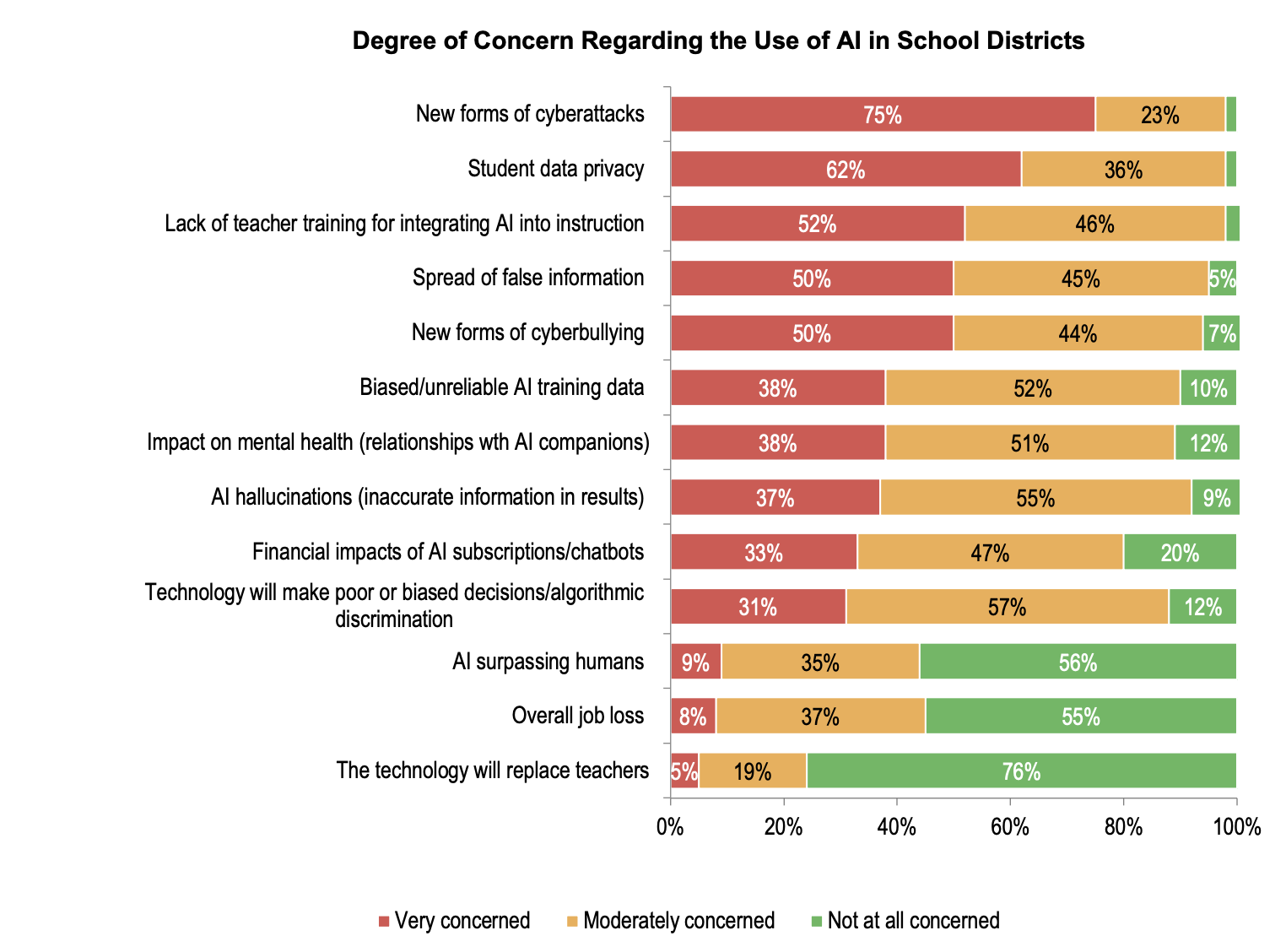
The largest concern about AI use: cybersecurity attacks. According to the report, nearly all respondents (98%) are concerned that AI can bring in new forms of cyber attacks, with just 2% stating they are “not at all concerned.” That same percentage also has concerns on student data and AI’s effect on its privacy.
The CoSN annual EdTech Report shows districts are concerned about AI fast-tracking more cyber attacks in coming years.
Source: Consortium for School Networking
While the concern over cybersecurity is strong, two-thirds of respondents state they have insufficient staffing and budget to address those challenges.
Advertisement
Cybersecurity concerns continue to cause schools woe, most recently with the Instructure attack in May that caused several schools to pay a ransom and shut down one of the world’s largest digital education platforms.
“The high visibility breaches and attacks that we’ve seen underscore the real cost to our school system by not investing in better cybersecurity,” Krueger says.
After 17 years of utilizing the State of EdTech report, Krueger says he believes a tipping point may have finally been reached on addressing cyber concerns.
“Certainly those in charge of technology have been yelling loudly that cybersecurity is a problem,” he says, adding the issue has become more well-known among superintendents and school board members. “I think they will start to say, ‘We can’t just have these broadband networks and not have them safe and secure.’ But it’s a huge challenge, given the lack of human capacity in schools for cybersecurity.”
Advertisement
EdTech
Another major finding from the report is an issue that has been bubbling beneath the surface in both tech evangelist and oppositional circles: vetting educational technology.
Edtech vetting has been under consideration amid the screen-time backlash in classrooms, with some states pushing for better review of the vetting process. Oftentimes, schools rely on the vendors’ own data and are unequipped to review the software themselves to ensure children’s safety.
“There is nobody right now that is confirming these products are safe, effective and legal,” Kim Whitman, co-lead for Smartphone Free Childhood US, said in a previous interview with EdSurge. “It should not fall on the district’s IT director; it would be impossible for them to do it. And the companies should not be tasked with doing it — that would be like nicotine companies vetting their own cigarettes.”
According to the report, most schools now have a process for vetting free edtech tools before they’re used in schools, either through IT or a list of approved vendors.
Advertisement
But that process still has some gaps: only 29 percent require information about if the product is inclusive and accessible for all learners. That is particularly worrisome for accessibility advocates who already fear they are being left out of the conversation.
“Parents with children who have a disability must have a seat at the table,” Sambhavi Chandrashekar, global accessibility lead for D2L, an online learning platform, said in a previous EdSurge interview. “Blanket rules that are blind to fundamental human differences will do more disservice than good to students at the margins.”
And while more than half (55%) of the edtech processes require vendors to provide information about safety, that leaves roughly 45% not addressing safety concerns.
“It’s a huge warning sign; there’s a whole lot of progress and work that has to happen in this area,” Krueger says.
Advertisement
He suggested reviewing the five quality indicators for edtech and AI products, with districts benchmarking their current status and set it as a priority to push forward.
“One of the biggest powers we have is procurement, so getting serious about how we buy them, and when,” Krueger says. “Whether or not we move forward will depend on if we set it as a priority and get serious about the awareness, the training and the policies.”
The central theme of Walled Culture the book (free digital versions available) is the growing incompatibility between traditional copyright law and the digital, online world. The culmination of that process was the EU Copyright Directive, passed in 2019. The Directive was supposed to be transposed into local laws by 2021, but a year after that deadline, many EU member states had failed to do so. Nor was that a case of mild slippage; a recent report from Communia provides an update on how the implementations are going. Here’s what it found for one of the most contentious areas of the Directive:
the introduction of the press publishers’ right under Article 15 has not been matched by consistent implementation of the mandatory limits intended to contain its scope. Despite the largely prescriptive nature of the Directive, a significant number of Member States have failed to fully implement these safeguards. In addition, some jurisdictions have chosen not to apply existing copyright exceptions to the new right, resulting in a broader scope of protection for press publishers than for other rightholders and further contributing to fragmentation across the internal market.
That fragmentation is deeply ironic, because one of the main justifications for a new copyright Directive was to bring consistency across the EU. As for the even more controversial upload filters, they have proved so difficult to implement that most governments have not even tried to lay down how they should be used:
Most Member States have limited themselves to restating the Directive’s requirement that lawful uploads must not be blocked, leaving the practical balancing of copyright enforcement and freedom of expression largely to platforms and courts. While a small number of jurisdictions have introduced stronger safeguards – such as ex ante protections against overblocking, transparency obligations, and mechanisms to address abusive claims – these remain the exception. As a result, the level of protection for lawful user expression continues to vary across Member States.
Again the much-vaunted consistency that the Directive would bring to EU copyright law is nowhere to be seen. If those failures underline that, as predicted, the EU Copyright Directive has turned out to be a bad law, badly implemented, arguably the arrival of generative AI has made many of its measures completely moot. As Walled Culture has reported, the idea that copyright is largely irrelevant in a world full of AI-generated material – something first suggested on this blog back in October 2022 – is now increasingly mainstream.
But things are still moving fast in the world of generative AI, with yet more profound implications for copyright. A recent post on the IPKat blog explores one of them: the rise of a powerful new generation of AI models that can be run on a personal computer – or even on a smartphone. Many of the latest models coming out of China are not just open source software, but open weight – that is, the models’ numerical values that get set when a model is trained are released, too, so that anyone can download, run, study, and modify them. As a good introduction to this new wave of Chinese AI innovation in Technology Review explains:
Advertisement
If these open-source AI models keep getting better, they will not just offer the cheapest options for people who want access to frontier AI capabilities; they will change where innovation happens and who sets the standards.
One big impact they are likely to have is on the enforcement of copyright, not least in the EU. The IPKat post notes:
The spectrum of engagement with [open source and open weight] models clearly challenges the copyright system. A system, in this Kat’s view, which, until recently, was oriented around individual acts of copying, with platforms cast as new points of interference to bridge technological enforcement gaps. However, [user-generated content] occurring on AI model marketplaces demands a shift in rhetoric and approach. Their ability to redistribute creative agency and control over the tools of cultural production should prompt us to reflect on how copyright law should respond to creativity that occurs through shared infrastructures.
The EU Copyright Directive’s core assumption that the main forums for sharing material would be a few, easily controllable online giants like Google and Facebook, no longer holds. Instead, people are moving to world where millions of people are using the latest generation of open source AI tools collaboratively to generate creations. Those may or may not be based on existing copyright material, but there is no easy way to police that. As the IPKat post points out:
For users running these [new open source and open weight] models locally, they no longer need to pay per request, nor is their data shared with AI companies, and by extension, rightsholders through Article 53(c) of the AI Act.
The world of generative AI is so complex, and moving so quickly, that it is no wonder that even the relatively recent EU AI Act, which entered into force two years ago, is being left behind by the latest developments. And the EU Copyright Directive, which was drawn up nearly a decade ago, is the digital equivalent of the UK’s 1865 Red Flag Act, which governed “self-propelled vehicles”, and required “a man with a red flag was to walk at least 60 yd (55 m) ahead of each vehicle”.
OpenAI’s first foray into hardware devices is reported to be a mobile smart speaker with integrated AI capabilities that can sync with ChatGPT and provide other home AI services.
Bloomberg reported Tuesday that the device — which is still currently under development — is designed to be screen-free and is being pitched internally as a “humanlike AI companion that lives in the home.”
OpenAI has long claimed that it wants to launch a hardware product — with some rumors being that it wants to launch its own phone, a move that would put it in competition with Apple.
OpenAI’s newly surfaced device sounds like something of a departure from traditional smart speakers — as sources described the device to Bloomberg as having a “personality” and being able to proactively learn about its owner over time, providing more personalized service. The machine would have access to a user’s digital life, drawing off things like emails, sources said.
Advertisement
The device is also weirdly described as involving “mechanical elements that can move on their own” and the Bloomberg report includes the detail that the device is designed to “feel like a companion and become a physical manifestation of OpenAI’s ChatGPT.”
The device was developed with help from many former Apple engineers who were instrumental in “creating products such as the iPhone and Mac,” Bloomberg writes. Indeed, OpenAI may be attempting to launch a new hardware line, but the company is currently up to its eyeballs in trouble over hardware-related legal problems.
Apple last week sued OpenAI, accusing the AI company of stealing its trade secrets. Apple further claimed that the allegations involved in the suit are merely“the tip of the iceberg” and that more misconduct will be revealed during the legal discovery process. OpenAI has denied wrongdoing.
Citing anonymous sources with knowledge of OpenAI’s plans, Bloomberg writes that the company feels its new product “veers significantly from anything Apple has on the market today” and that it is “unlikely that it violates trade secrets” belonging to Apple.
Advertisement
OpenAI’s push comes as the tech world grows more excited about consumer AI hardware more broadly. Hark, an AI lab founded by Brett Adcock, raised an oversubscribed $700 million Series A back in May at a $6 billion valuation to build what it calls “personal intelligence” — proprietary AI models paired with custom hardware designed as a “universal interface between humans and machines.”
The company hasn’t yet detailed its device’s form factor, underscoring how much capital is chasing this category even before products ship.
When you purchase through links in our articles, we may earn a small commission. This doesn’t affect our editorial independence.
Thira co-founder and executive chairman Sunny Gupta at a 2017 event. (GeekWire File Photo)
Sunny Gupta has led two prior enterprise tech companies with backing from venture capital firm Madrona in the past 20 years. iConclude sold to Opsware. Apptio sold to Vista Equity Partners, then to IBM for $4.6 billion.
Now they’re getting the band back together for the AI era. Madrona’s Matt McIlwain is calling it the biggest opportunity “by far.”
Thira co-founder Kurt Shintaffer was Apptio’s co-founder and CFO. (LinkedIn Photo)
Gupta is launching Thira, a Bellevue, Wash.-based enterprise AI startup, with Apptio co-founder Kurt Shintaffer, and leaders from companies such as Atlassian, Oracle, and Databricks. Thira announced Tuesday that it raised $21 million in seed funding led by Madrona, with participation from FUSE.
The idea: Thira is building AI to handle the behind-the-scenes tasks that keep big companies running, like setting up a new hire’s laptop, resetting a locked account, or approving a software purchase. The pitch is to enable a “back-office that runs itself,” according to the company.
It’s starting with IT support. The company is building software agents that can take an IT ticket, work it across the systems where the actual fixes happen — such as ServiceNow, Jira Service Management, Freshservice, and the identity and device-management tools that connect them — and close it out.
Finance and HR systems are also on the roadmap. Thira’s job listings describe agents built to “autonomously run the back-office work that consumes companies today, across IT, finance, HR, and beyond.”
Advertisement
Thira is entering a crowded market. ServiceNow closed its $2.85 billion acquisition of Moveworks last December to build autonomous IT ticket resolution into its service management platform. Startups including Aisera, Rezolve.ai, and Serval are pursuing similar territory.
Part of Thira’s bet is that Gupta and Shintaffer’s relationships with CIOs, which they built over many years at Apptio, will help to give it a foot in the door. Thira says it’s working with 10 companies as design partners ahead of a broader launch this fall.
In many ways, it’s a step beyond Apptio, which helps CIOs see where their companies spend money on technology. Thira is aiming to go past visibility to the “system of execution,” actually doing the work.
In a post on LinkedIn, Gupta said he began hearing from CIOs during Apptio tenure who wanted not only visibility into spending but also the ability to act on inefficiencies and automate work.
Advertisement
“In early 2026, I asked more than twenty CIO friends a simple question: has enough changed that what they’ve been asking for is finally buildable? The answer was yes, and bigger than I expected,” he wrote.
Thira’s team also includes:
Mudit Goel, previously SVP of engineering at Atlassian;
Grant Neuman, who was an AI engineer at Oracle Cloud Infrastructure;
Tarek Madkour, previously director of product management at Databricks;
Gupta has been Smartsheet’s executive chair since August 2025, when longtime CEO Mark Mader retired. He also served as acting CEO until Raj Singh was named CEO in October 2025. Shintaffer was Smartsheet’s CFO from July 2025 to May 2026.
McIlwain, the Madrona managing director, is joining Thira’s board of directors. FUSE founding partner Kellan Carter is a board observer.
In a statement, McIlwain said the founding team pairs Gupta and Shintaffer’s two decades of enterprise credibility at Apptio with what he calls “AI-native innovators.” He added, “This is my third time starting and building a company with Sunny and it is by far the largest opportunity we have pursued together.”
Back in 2021, Klipsch’s The Fives were the first powered speakers I’d encountered with an HDMI ARC connection, making them as friendly with your TV as they were with the rest of your components. When I first reviewed them, I called them the soundbar solution for people who don’t like soundbars. Klipsch raised the stakes with increasingly larger versions in The Sevens and The Nines, each of which helped usher in a new era of plug-and-play home theater speakers. While each pair has its place, The Sevens hit the sweet spot for me, delivering big, bold sound from a beefy footprint that still, just barely, fits on regular speaker stands.
Of course, HDMI-ready powered speakers are everywhere now, so The Sevens II really needed to up the ante to stand out. In that regard, Klipsch did not disappoint, upgrading its Goldilocks pair in nearly every way. The improvements range from an absolute smorgasbord of connection options and supported audio formats, including virtual Dolby Atmos, to the addition of the Wi-Fi and network connectivity missing from the original pair. There’s even a spare HDMI input for modern gaming consoles, a first among the powered speakers I’ve tested.
Unfortunately, I had real trouble connecting the speakers to my Wi-Fi network during setup, to the point that I eventually plugged in an Ethernet cable and called it a day. Otherwise, there’s not much The Sevens II don’t get right. They offer impressive immersion and clarity, fantastic bass response, and a wealth of extras in a nearly comprehensive take on the all-in-one speaker system.
Related Reviews:
Setup: Wi-Fi Woes
Let’s get the annoying part out of the way. While fishing these 15-inch-tall mega-cabinets from their housings is something of a chore, connecting to my network created the real headache. The biggest issue seemed to be that, while the speakers connected right away and were active in the Klipsch Controller app, they weren’t receiving network information, at least not fast enough for their mandated firmware update, which is apparently integral to functionality.
After five tries, multiple 30-to-45-minute waits, and at least two power cycles, I finally tried Ethernet, and the speakers seemed to jump at the chance to update. After around 10 minutes, they had the latest software, and I experienced no further network issues over two weeks of testing.
Advertisement
Ostensibly, the speakers can go wireless in multiple ways, allowing you to connect the primary speaker, which harbors the inputs and controls, to the secondary cabinet wirelessly. This limits resolution to 48 kHz, as opposed to 96 kHz with the included four-meter CAT6 cable, and besides, I wasn’t taking any more chances after my Wi-Fi issues.
To be fair, these aren’t the first speakers to have trouble on my network, and a colleague who reviewed The Nines II had no such issues. Still, the vast majority of devices I’ve tested connect seamlessly, so it’s something to note if your network is finicky and/or you don’t have a handy Ethernet connection.
Connecting The Sevens II to other components was as breezy as you’d expect from modern powered speakers, including a quick connection to the TCL QM7K TV I’m currently reviewing. This provides seamless control from your TV remote for power and volume, and unlike many premium speakers, there were no handshake issues or connection flubs.
Design and Features: Fully Connected
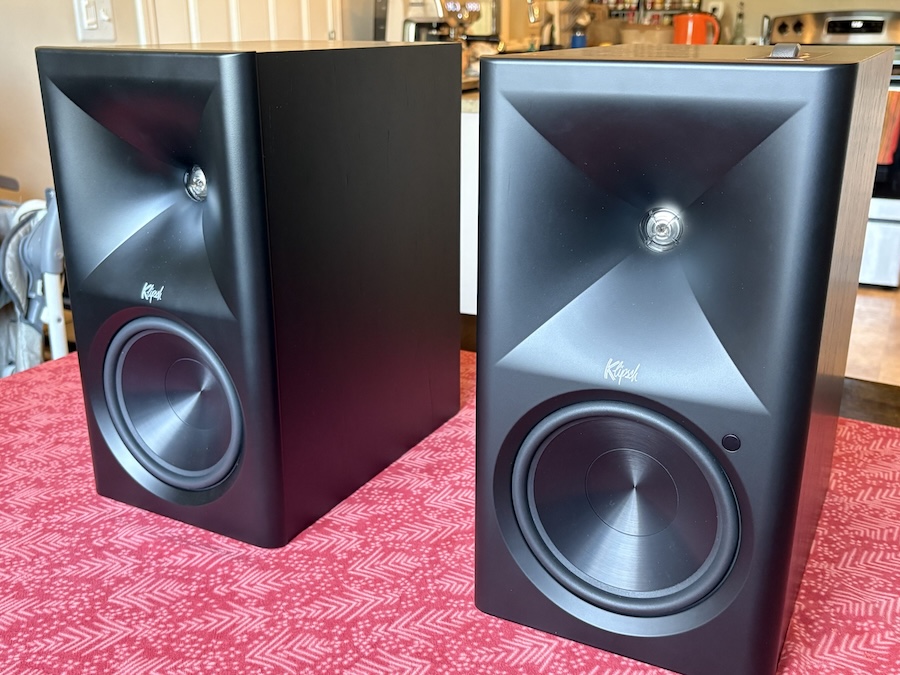
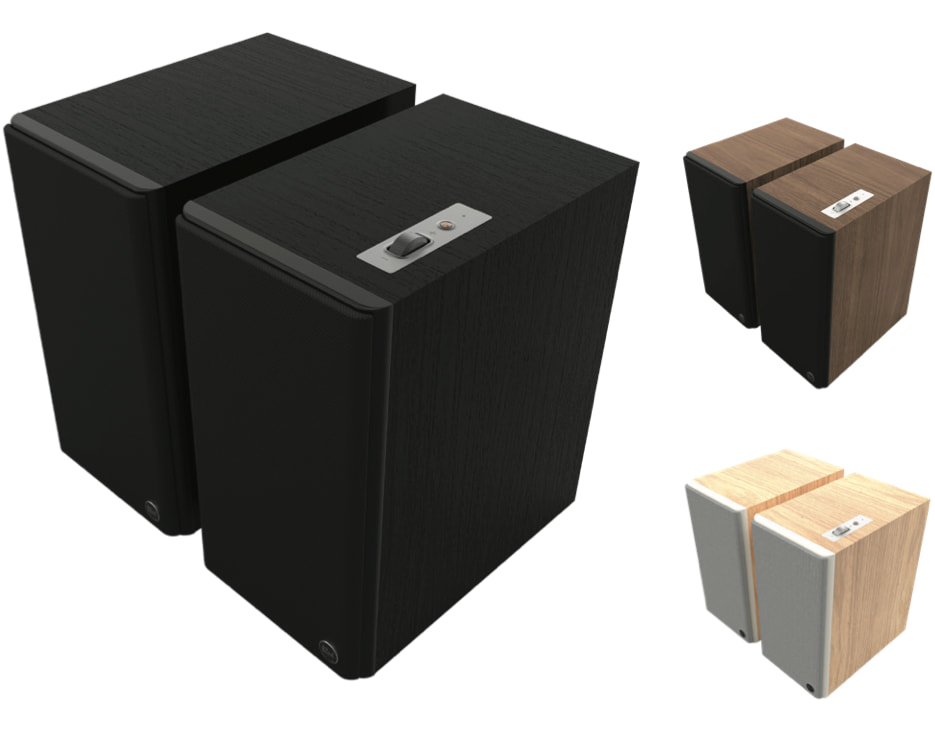
Even after my Wi-Fi frustrations, it was hard not to fall for The Sevens II’s chic yet brawny design, which perfectly matched my review TV’s 75-inch obsidian screen. Along with the Ebony MDF cabinets I reviewed, they come in Walnut and a tantalizing new Red Oak finish with a white front, each of which boasts “real wood” veneer. On top of the right speaker is the same tactile volume wheel found on the original pair, alongside a metallic input key, giving them a vintage vibe.
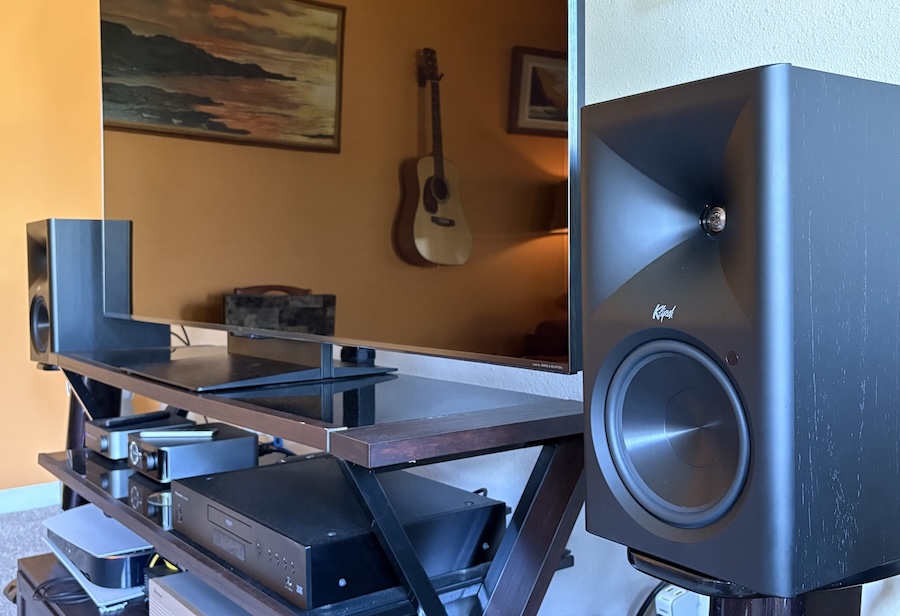
The package includes magnetic acoustic grilles for a more demure look, but unless you’ve got curious kids in the house, it’d be a shame to hide those drivers. The combination of Klipsch’s hefty “Jet Ceramic” 6.5-inch woofers and titanium LTS tweeters, set behind the brand’s signature Tractrix horns, really spruces up the room.
Advertisement
Other accessories include an HDMI cable, an omnidirectional microphone for calibration, and a simple backlit remote. The latter offers some helpful input keys, and it’s useful for pausing sound on the go, but the majority of controls and settings are handled by the app.
Advertisement. Scroll to continue reading.
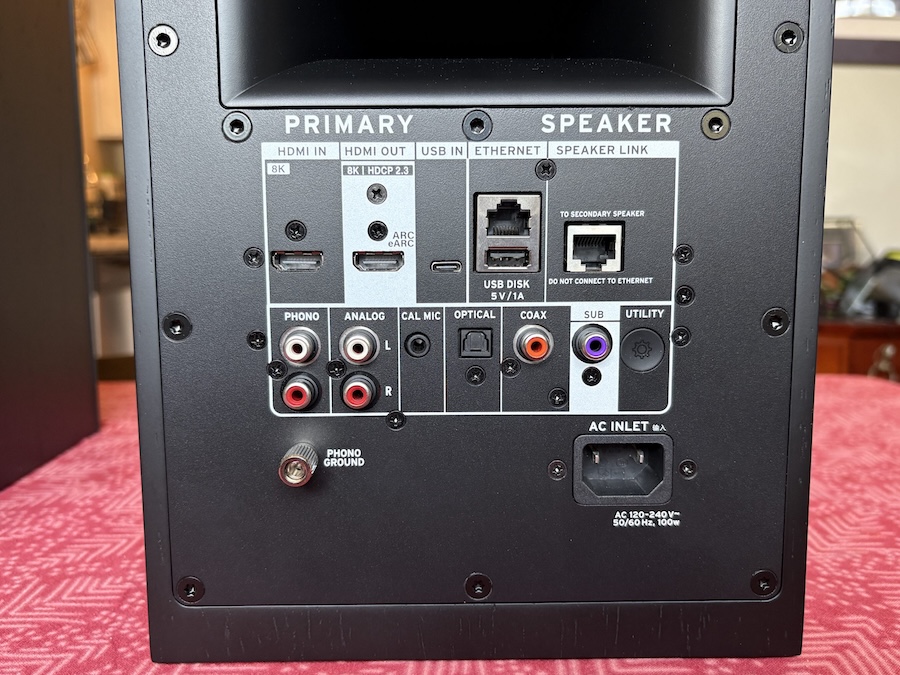
The input hub at the back of the main speaker, which can be placed on either the right or left for convenience, provides an embarrassment of riches. The digital coaxial input is especially useful for connecting a CD transport or CD player while relying on The Sevens II’s internal DAC and keeping the lone RCA analog input free for another source.
That’s joined by an optical digital port, RCA and MM phono analog inputs, and USB-C. Dual HDMI 2.1 ports, including HDMI eARC, provide high-bandwidth passthrough for 8K, HDR10+, and Dolby Vision video, as well as support for VRR (Variable Refresh Rate) and ALLM (Auto Low Latency Mode) with gaming consoles.
Advertisement
There’s also a subwoofer output to add more punch and clear up some space in the higher registers. It’s worth employing if you’ve got a spare subwoofer on hand, but part of the value proposition here is that The Sevens II have plenty of bass on tap, reaching down to a claimed 39 Hz and handling the upper-bass region around 50 to 60 Hz with relative authority.
On the audio side, Klipsch goes well beyond the limited PCM support found in most of the powered speakers I test, thanks to its use of Onkyo AVR circuitry. While DTS support is limited to The Nines II, The Sevens II get a loaded Dolby suite with support for Dolby TrueHD and even Dolby Atmos decoding, though without upfiring speakers, the effect is limited.
Streaming support is a major upgrade over the original pair’s Bluetooth-only system, supplementing Bluetooth 5.4 with support for Apple AirPlay, Google Cast, Spotify Connect, TIDAL Connect, and Qobuz Connect.
Dirac Live Room Correction calibration is also included to help adapt the sound to your room, though only for bass control up to 500 Hz by default. If you want to upgrade, you can do so through Dirac’s website for $100, which allows multiple “filters,” or calibration options across the frequency range, for different seating positions or room setups.
Advertisement
The app provides plenty of other ways to adjust the sound, including a five-band EQ and presets, along with extras such as Dynamic Bass, Dialogue Enhancement, and Night Mode. There are also three sound modes: Movie, which is on by default; Music; and Direct, for unfiltered sound.
Oddly, switching between modes creates a two- or three-second delay, accounting for the only real app trouble during my review. It’s especially frustrating because video tends to sound best in Movie Mode; otherwise, dialogue can sound boomy, while music is clearer and more open in Music or Direct Mode. Aside from that, the app was impressively stable and responsive, with only the occasional delay when connecting to Spotify.
Listening: Bold, Clear and Immersive
Though powered speakers like The Sevens II are generally designed as a music-first way to enhance your home theater, it will come as no surprise to those familiar with the original pair that their best use case is souping up your favorite TV shows and movies. That’s not to say they’re not excellent for music, but their large size and support for multiple home theater formats make them brilliant for TV sound.
Switching them on was an instant upgrade, not only over the reasonably capable TV speakers in the TCL QM7L I’m currently reviewing, but also over powered reference speakers such as the SVS Prime Wireless and even my beloved KEF LSX, especially with more cinematic fare. Their sheer size and acoustic design get much of the credit, using those large cabinets to produce an immersive soundstage marked by bold, powerful sound and plenty of foundational bass that rarely gets boomy.
Just as importantly, they’re very well attuned to subtle details. From the creak of a door or the click of a revolver’s hammer to pointedly soft dialogue or padded background noises, such as the din of printers and phones in The Office, everything feels elevated.
Advertisement
In one of my favorite test scenes from The Mandalorian episode “The Mines of Mandalore,” I was enamored with all the little moments: the dramatic punch of the ship as it breaks through the atmosphere; the metallic rattles placed deep in the soundstage; the purring of the ship’s engines; and even the tactile sound of his helmet light turning on. All of it was fantastically immersive, pulling me deeper into the moment.
Advertisement. Scroll to continue reading.
I’m not sure how much of this can be credited to The Sevens II’s virtual Dolby Atmos support. Without upfiring speakers, Atmos’ height element—the part that makes it feel spherical and encompassing—is obviously limited. Even so, the sound is dimensional and articulate, while preserving plenty of bombast for moments such as explosions or the thundering beat of a soundtrack. Even in stereo, it goes well beyond your average flagship soundbar.
Listening to lossless music over Spotify Connect was also impressive, especially when using the Music or Direct modes. While the upper midrange and lower treble can sometimes sound a little tight, they never become sharp, and there’s plenty of detail across the frequency range, with notably expansive sound in larger mixes.
Advertisement
The brass in Sinatra’s “Luck Be a Lady” has convincing weight and presence, while the saxophones retain plenty of texture without becoming strident. The percussion in Tom Petty’s “You Don’t Know How It Feels” snaps with convincing attack, pushing the song’s signature snare to the forefront while preserving the laid-back groove that drives the track.
Volume wheel on top of speaker.
Bass reaches deeper than expected, even for speakers this size. The Weeknd’s “Starboy” delivers solid low-frequency impact without overwhelming the mix, while Caroline Polachek’s “Welcome to My Island” showcases the speakers’ ability to separate layers of synthesizers and electronic effects across a wide, stable soundstage that occasionally extends beyond the cabinets. Polachek’s voice remains clean and expressive throughout, even as the arrangement becomes increasingly dense.
Moving to vinyl with my go-to test album, Dave Brubeck’s Time Out, The Sevens II did a convincing job with the piano’s body and attack, the soft cymbal work and brushed snare positioned to the left, and the saxophone anchored firmly in the center. I preferred the built-in phono preamp in my U-turn Audio Orbit Theory turntable to Klipsch’s, which sounded quieter and less immediate, though the difference was not substantial.
If there’s one area where the speakers could improve, it’s the separation between instruments in dense arrangements. Radiohead’s “Everything in Its Right Place” remained clear, but individual layers were not as sharply defined as they could have been. That’s where Dirac Live comes in.
Dirac Live: Better Separation, Recessed Vocals
One of the most respected third-party calibration systems available, Dirac Live is designed to address room-related frequency problems, improve bass response, and refine imaging and clarity. For the most part, that’s what it did.
Advertisement
On many tracks, Dirac created more space between instruments and widened the stereo image without making the presentation feel disconnected. Returning to Tom Petty’s “You Don’t Know How It Feels,” the individual instruments and backing vocals were easier to distinguish within the mix.
Bass response also became more prominent, sometimes excessively so in my small listening room. On bass-heavy tracks such as Too Short’s “Just Another Day,” the low end became overbearing, though reducing the 80 Hz band in the EQ brought it back under control.
The larger issue was that Dirac sometimes pushed vocals farther back in the mix. That was noticeable on Depeche Mode’s “Personal Jesus” and Nickel Creek’s “Reasons Why.” The latter stood out in particular because Sara Watkins’ voice is normally positioned firmly at the center, with clear diction and strong presence.
Because of that tradeoff, I generally preferred The Sevens II without Dirac Live enabled. Other listeners may reach a different conclusion, especially in square, reflective, or otherwise difficult rooms where acoustic treatment is impractical.
Advertisement
Klipsch The Sevens II are available in black, walnut and light oak finishes.
The Bottom Line
The Sevens II offer the best of both worlds, combining the format support of a soundbar with the connectivity, scale, and stereo presentation of a capable pair of powered speakers. In many ways, that makes them and their sibling models, The Fives II and The Nines II, an appealing solution for anyone who wants a plug-and-play system that works across multiple sources, including a TV.
Advertisement. Scroll to continue reading.
You’ll find greater clarity, precision, and stereo imaging from speakers such as KEF’s LS50 Wireless II, but The Sevens II counter with deeper bass, greater output, and more convincing handling of film and television content. That combination helps them stand out in a crowded market.
My Wi-Fi problems and smaller usability complaints, including the pause when switching sound modes, are the biggest marks against them. Even so, The Sevens II make a strong case for listeners who want one pair of speakers to handle music, movies, gaming, vinyl, and digital sources without adding an amplifier, streamer, or soundbar. For that buyer, their broad connectivity and powerful presentation help justify the substantial price.
Advertisement
Pros:
Big and bold sound with deep bass response
Articulate and immersive soundstage
Impressive Dolby support, including virtual Atmos
Class-leading connectivity options
Stylish design and good build quality
Solid accessories, including a backlit remote
Cons:
Finicky Wi-Fi setup and firmware update
Odd delay in audio when switching sound modes
Imaging and instrumental separation is good not great
SonicWall warns that threat actors have been exploiting two SMA1000 vulnerabilities, tracked as CVE-2026-15409 and CVE-2026-15410, in zero-day attacks and urges customers to install the newly released security updates.
CVE-2026-15409 is a critical (CVSS 10.0) server-side request forgery (SSRF) vulnerability in the SMA1000 Appliance Work Place interface that allows a remote, unauthenticated attacker to force an appliance to make requests to unintended locations.
CVE-2026-15410 is a high-severity (CVSS 7.2) post-authentication code injection flaw in the SMA1000 Appliance Management Console that could allow a remote authenticated administrator to execute arbitrary operating system commands.
While CVE-2026-15410 requires administrator privileges, SonicWall assigned the advisory an overall CVSS score of 10.0.
SonicWall says it investigated multiple incidents and confirmed that both vulnerabilities are being actively exploited.
Advertisement
“SonicWall PSIRT has investigated multiple cases indicating the active exploitation of the vulnerabilities described in this advisory,” SonicWall warned.
“Customers are strongly urged to upgrade to the hotfix release as soon as possible to remediate these vulnerabilities”
However, the company has not disclosed whether attackers are chaining them together. BleepingComputer has contacted SonicWall to clarify the attacks and will update this story if we receive a response.
The vulnerabilities affect SMA1000 models 6210, 7210, and 8200v running platform-hotfix releases 12.4.3-03245, 12.4.3-03387, 12.4.3-03434, 12.5.0-02283, 12.5.0-02624, and 12.5.0-02800. Fixes are available in platform-hotfix versions 12.4.3-03453 and 12.5.0-02835, and later releases.
Advertisement
SonicWall says the vulnerabilities do not impact SSL-VPN running on SonicWall firewalls or the SMA 100 Series product line.
The company also shared indicators of compromise (IOCs) that administrators can use to determine whether an appliance has been compromised:
if in extraweb_access.log are mentioned requests to /__api__/login or /__api__/logout with HTTP 200 status
if in extraweb_access.log are mentioned requests to /wsproxy with suspicious host parameters with 101 HTTP status
if in ctrl-service.log are mentioned hotfix rollbacks with path traversal names
if /var/lib/unit/conf.json contains routes for /__api__/login or /__api__/logout (these URIs do not exist in legitimate configuration)
SonicWall strongly recommends upgrading to the latest hotfix release and performing an analysis to determine if any of the above IOCs are present.
If a device is found to be compromised, the company advises administrators to re-image physical appliances or redeploy virtual appliances, change all user and administrator passwords, and reset TOTP tokens.
SonicWall also notes that there are no workarounds or mitigations for these flaws other than installing the hotfixes.
Advertisement
The U.S. Cybersecurity and Infrastructure Security Agency (CISA) has added both vulnerabilities to its Known Exploited Vulnerabilities (KEV) catalog, confirming they are being actively exploited in attacks.
Federal agencies have until July 17, 2026, to secure affected systems under Binding Operational Directive (BOD) 26-04 or discontinue use of the product if mitigations cannot be applied.
Security teams log 54% of successful attacks and alert on just 14%. The rest move through your environment unseen.
The Picus whitepaper shows how breach and attack simulation tests your SIEM and EDR rules so threats stop slipping by detection.
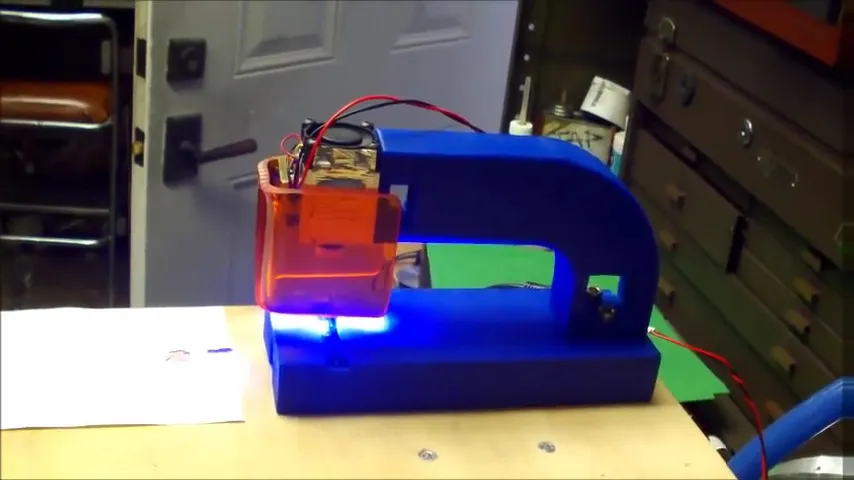
Can you call it a bandsaw if it has neither band nor saw? [WeldingRod1] does, with his entry in the laser contest — a manually-controlled laser cutter that he’s dubbed a Laser Bandsaw. Some might quibble that it’s not actually sawing with the beam, and others will inevitably find the safety implications rather frightening. We think it’s a fun project and that [WeldingRod1] can call it what he wants, as long as he follows his own advice and keeps his laser goggles firmly on his precious vision orbs.
He has actually put some thought into what started as the physical manifestation of a joke in a podcast. The blue diode laser — a NUBM44 diode rated at 7 W — got a custom-made copper heatsink. It’s also got a hefty beam dump in the form of a stack of box knife blades. That’s very necessary to keep the beam from reflecting where it shouldn’t, especially when you consider this operates like a regular band saw: you turn it on, and it’s ready to cut. With only 7 W of laser power it can’t cut that much, mind you, but apparently it’s great on balsa wood and blasts black paint off like nobody’s business.
Now if this was our shop we’d probably want to put the laser diode onto some kind of CNC platform, be it Cartesian or SCARA. But we’ve seen that done many, many times and if you’ve got the motor skills this might be just the tool for you. There’s a pinout and STLs for the 3D printed frame on the project page if you’re interested. If not, why are you still here? The article is finished. Go make something lase and send it in. The deadline for the 2026 Frikkin Laser Contest is fast approaching!
‘We are focusing our capacity where it matters most to customers’, a Thomson Reuters spokesperson said.
Thomson Reuters, the Canadian parent company behind Reuters News, is cutting up to 500 engineering jobs, joining a long list of technology providers shedding parts of their workforce in preference for AI.
Layoffs at the content and technology company could affect around 1.8pc of its global workforce of 27,100, and around 5.2pc of its 9,400-strong operations and technology unit, according to a Reuters New source.
These latest layoffs come as economists and technology leaders, in a fresh joint statement, warned against the negative effects of widespread and uncontrolled AI adoption on economies, including large-scale job displacement.
Advertisement
Similarly, the Economic and Social Research Institute, earlier this year, found that AI adoption in Ireland is likely to lead to “moderate increases in income inequality” in the short run.
“As customer expectations across legal, tax and regulatory workflows evolve, we are focusing our capacity where it matters most to customers,” a Thomson Reuters spokesperson told Reuters News yesterday (13 July).
The Toronto-based company announced revenue growth of 10pc in the quarter ending March, with its three biggest segments benefiting from its industry-specific AI products. The company also anticipates a better-than-expected outlook for 2026.
Advertisement
Technology leaders have been sounding the alarm on AI’s impact on jobs for a while – with many, including Mark Zuckerberg, praising slimmer teams, flatter management structures and cheaper AI agents.
Earlier this month, Microsoft announced plans to cut 4,800 jobs at the company, responding to changes to the industry’s landscape caused by the new technology. Meta reportedly cut as many as 350 Irish jobs in a recent round of layoffs that affected around 8,000 employees.
Other major companies including Block, Atlassian, Oracle and Amazon have also cut thousands of jobs.
According to Layoffs.fyi, tech companies have shed more than 120,900 workers so far this year – with the number fast approaching the roughly 123,000 that were laid off in the whole of 2025.
Advertisement
Don’t miss out on the knowledge you need to succeed. Sign up for the Daily Brief, Silicon Republic’s digest of need-to-know sci-tech news.



























































You must be logged in to post a comment Login