Tech
Why Are So Many New Cars Four Wheel Drive Now?


Today in the U.S., it’s mostly crossover vehicles shaped like the Honda CR-V and the Toyota RAV4 you’ll find parked in driveways. The numbers back this up, too, with EPA production data for 2024 noting crossovers account for roughly half of every new vehicle built for the American market. Most of them are four wheel drive, part of a long climb that saw AWD officially overtake front wheel drive as the most common layout in 2017.
A lot of the climb comes from plain demand. AutoPacific, which surveyed more than 18,000 Americans planning to buy a new vehicle in 2025, found that for a majority of AWD fans, it wasn’t just an option — it was a necessity. 63% of people surveyed said they would straight up refuse a car without it.
That said, demand is only part of the equation, because a lot of it also has to do with regulation. The thing is, every carmaker has to hit an average fuel economy figure across its entire fleet that it sells in America. Under these same rules, no individual vehicle has to be efficient. What gets measured is the average across everything a company sells, and that average is tallied into two separate pools. One pool holds the cars. The other holds the trucks, though the problem is that the rules are less strict for them since they’re kind of ancient, written back when trucks truly were workhorses. Trucks just have a lower bar to clear, which is why automakers favor them.
Why automakers are incentivized to go with AWD
However, this doesn’t directly explain why most of these cars are AWD since those same cars can also be FWDs. The thing is, if a crossover is driven with two wheels, it gets filed with the cars – the same category as sedans. Give that same crossover four driven wheels and some extra ground clearance, and it gets filed with pickups instead, where, as already mentioned, the bar is lower. The automaker is able to clear the fuel economy rules much more easily.
To give a better idea about how irresistible flagging any car as a truck is to automakers, researchers at the Union of Concerned Scientists worked some numbers out. It’s a known fact that driving all four wheels hurts fuel efficiency – for a small SUV, it raises the CO2 emissions by roughly 14.2 grams per mile. However, count that same SUV as a truck (by upgrading it to AWD), and it suddenly wins an additional allowance of 39.8 grams per mile. The automaker then doesn’t need to touch the engine to bring emissions down, and adding a driveshaft is simply a lot cheaper than shrinking a motor. This pattern was already well established by the middle of the last decade and it’s not gone away. In fact, by the 2024 model year, 77% of the lightest SUVs on sale qualified as trucks.
Shoppers love AWDs, too
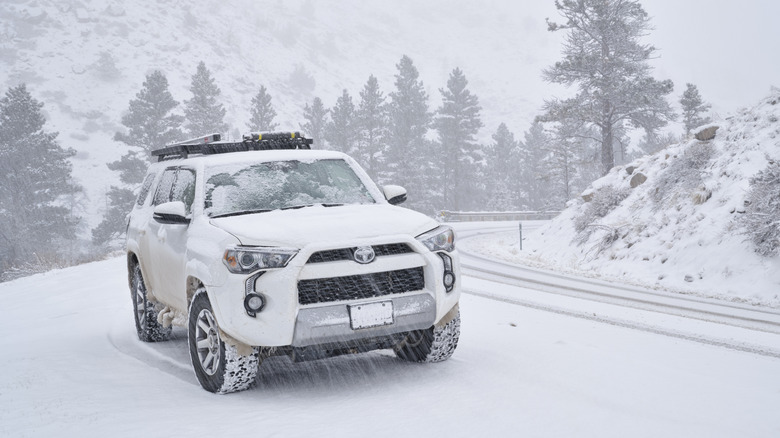
Regulate all you want, but the demand won’t flow if it doesn’t come from the shoppers themselves. One of the reasons why buyers keep going for AWDs is because winters frighten them, and justifiably so, given the crash figures: Snow, sleet, ice, and slush account for 41% of weather-related crashes on American roads. Automakers have spent decades convincing consumers that four wheel driven cars are the solution, and according to Consumer Reports, it’s one big reason why crossovers have become so popular. Trouble is, AWD does nothing to shorten your stopping distance, making it one of the winter driving myths you need to stop believing. Winter tires are still more reliable than any layout, which is why an AWD car still needs proper snow tires.
At the same time, ticking the AWD box has gotten cheaper, too. The Union of Concerned Scientists tracked comparable trims over the years and found that four wheel drive averaged $1,700 as an extra in 2010. Five years later, it fell to $1,490.
Another factor leading to the rise of AWDs is the growth in EV sales over the years, a lot of which come fitted with AWDs. It’s easier for an electric car to gain AWD functionality versus a gas car, as the latter requires a driveshaft running the length of the floor and a transfer case to split the drive. Meanwhile, all an electric car needs is a second motor. Sure, cheaper electric cars still have one motor driving two wheels, but according to InsideEVs, 75% of the 300-odd electric configurations on sale drive all four wheels.
You must be logged in to post a comment Login