For the past few years, our nation has been flooded with headlines declaring the demise of the college degree. This trend was exacerbated by COVID-19, which accelerated a decline in college interest.
I understand, really, I do. Tuition costs are rising. Student debt is real.
Artificial intelligence (AI) is also reshaping white-collar work by automating routine cognitive tasks, changing hiring patterns and increasing the use of AI tools in professional occupations. A 2025 Gallup survey found that AI use at work among U.S. employees nearly doubled from 21% in 2023 to 40% in 2025.
This is drawing many to a simple conclusion: a four-year college degree is no longer worth the time or money.
But the data, and the broader reality of how careers and life actually unfold, tell a different story.
Advertisement
Yes, the labor market for recent graduates has become more competitive. Yet college graduates still consistently outperform non-graduates in employment, earnings and long-term career resilience, according to new national data from the College Board Education Pays 2026 report.
But more importantly, a degree from a competitive college with a high graduation rate cultivates the ultimate asset in a rapidly changing economy: the ability to think critically. This includes being able to understand AI, as those who do will be better positioned to shape how it’s used ethically and responsibly.
That matters now more than ever.
Recent analysis from the Federal Reserve and labor economists shows that while the wage gap between graduates and non-graduates has narrowed, college graduates still maintain lower unemployment rates overall and stronger long-term job stability. A 2025 analysis from the St. Louis Fed found that from 2000 to 2025, workers with only a high school diploma consistently faced unemployment rates at least 2.3 percentage points higher than workers with bachelor’s degrees.
Advertisement
Even amid a softer hiring market, the advantage remains clear. Data cited by Goldman Sachs and other labor researchers showed unemployment for young non-college workers hovering around 7% in 2025, compared with roughly 4.6% for recent college graduates.
That is not a meaningless difference. In a large economy, a few percentage points represent millions of jobs.
Critics often focus narrowly on whether college guarantees a job immediately after graduation. That framing misrepresents the real purpose of higher education. College is not merely vocational training. It is preparation for a lifetime of economic and intellectual change.
The modern workforce is evolving too quickly for any technical skill to remain permanent. Entire industries now transform within a decade. Many students entering college today will eventually work in jobs that do not yet exist. In this environment, being able to think critically becomes the ultimate career skill.
Advertisement
A strong college education teaches students how to analyze information, communicate clearly, solve unfamiliar problems, conduct research, collaborate with different kinds of people, and learn independently. Those capacities transfer across different industries and technologies.
Ironically, the rise of AI may make these human skills even more important. Employers increasingly value workers who can think critically, interpret nuance and make judgments machines cannot easily replicate, according to Western Governors University, which surveyed more than 3,000 employers. Technical skills may evolve every few years; the ability to learn and think critically endures. According to McKinsey, “Human skills will matter more in the age of AI.”
The ability to think and process information is also why college graduates tend to weather recessions better over the course of their careers. Historically, workers with higher educational attainment have experienced lower unemployment during recessions and often recover faster in labor market recoveries, though this advantage varies by industry, age, and economic cycle. In 2024, unemployment for bachelor’s degree holders was 2.5%, compared with 4.3% for high school graduates and 6.1% for people without a diploma, according to the U.S. Bureau of Labor Statistics.
Of course, higher education must confront legitimate concerns about affordability and workforce alignment. There’s nothing wrong with questioning college directly after high school if a student is interested in pursuing a low-demand degree with high debt or if the student has yet to define a clear career goal.
Advertisement
But seeing college as only a trade school, in my opinion, is the wrong way to look at it. There are tremendous educations available where financial aid is available to help those who need it to meet the demands of higher education costs. There are wonderful State Schools and City Schools that are great choices for students.
This is an endorsement of a 4-year college degree, at a competitive school, to learn how to think critically, for a lifelong ability to learn new things. One thing we do know about the future is that we will need a population that has the ability to synthesize information quickly and accurately.
The real question is not whether college guarantees success. Nothing does.
The question is whether developing analytical ability, communication skills, flexibility, and intellectual independence still matters in an uncertain economy.
Advertisement
I am here to say they do. Perhaps more than ever.
The future will belong not simply to people who know things, but to people who can keep learning new things. College, at its best, remains one of the strongest environments for building that habit.
A college degree and a stable career can benefit generations. Earning a college degree is linked to longer, healthier lives, higher incomes, greater civic participation and better career alignment. While economic benefits are substantial, the lifestyle advantages extend to health, social engagement and personal fulfillment.
Watching email marketers obsessively monitor their sender IP, checking it daily, warming it carefully, treating it like a rare orchid, is not only relatable, it’s a reminder of how much conventional wisdom can leave you completely exposed.
Because the blacklist that’s killing your campaigns in 2026 probably has nothing to do with your IP at all. It has to do with what’s inside your email. Specifically, the links.
That’s the uncomfortable premise behind SURBL, the Spam URI Realtime Blocklist, and once you understand how it works, a lot of “mystery” delivery failures stop being mysterious. Warmy.io’s research team has published a full breakdown of what causes a listing, how to detect it, and how to recover, details we draw on throughout this piece.
The list that checks your links, not your IP
SURBL doesn’t care where your email comes from. It cares where it’s going. While traditional blocklists like Spamhaus or Barracuda evaluate the sender, SURBL evaluates the message, every URL buried in your body copy, every social icon, every tracking pixel.
This distinction changes everything. A clean sending IP offers zero protection if a link inside your email points to a flagged domain. Your message arrives in the inbox. The links are silently disabled. Your click-through rate quietly collapses, and you have no idea why. For a deeper technical breakdown of how the system works, the SURBL blacklist report from Warmy.io is the most thorough public resource currently available.
Advertisement
Five lists, five different problems
SURBL isn’t actually one list. It’s five, each targeting a different category of threat, and each requiring a different fix if you land on one.
MW (Malware): Sites hosting or distributing spyware, viruses, or ransomware.
CR (Cracked Sites): Legitimate websites that have been quietly compromised and repurposed by spammers, without the owner ever knowing.
Advertisement
AB (AbuseButler): Domains flagged through high-volume sending and automated spam pattern analysis.
Multi: A combined super-list that lets mail servers query all four in a single DNS lookup.
The CR list is the one that keeps legitimate business owners up at night. Your site can look completely normal, loading fine, taking orders, passing every visual check, while hidden redirect scripts installed by attackers are triggering SURBL flags behind the scenes.
How you end up on the list without doing anything wrong
Here’s the part nobody likes to hear: you don’t have to send spam to get listed on SURBL. That’s what makes it different from almost every other blacklist, and what makes it so disorienting when it happens.
Advertisement
A hacked WordPress install can plant redirect scripts invisible to you but obvious to SURBL scanners. An affiliate link carries the reputation history of every sender who ever used it, including the ones who spammed it to death before you. An insecure contact form on your website is an open door for spammers to push their own links through your domain. And linking to any domain registered in the last 72 hours is, on its own, one of SURBL’s strongest triggers. New domain, no history, no trust.
The warning signs hiding in plain sight
SURBL failures tend to be silent, which is what makes them dangerous. The signals are there, they just don’t look like a blacklisting at first glance.
Watch for SMTP 554 bounce codes on a clean sending IP (almost always a URI block), a sudden unexplained drop in click-through rates (Gmail and Outlook use SURBL data to disable links in delivered messages), or “too many hops” notifications where a receiving server hit its limit trying to scan your URLs. Any complaint spike tied to a specific URL rather than your sending domain is also worth isolating immediately. Warmy’s deliverability monitoring flags these signals automatically, before they escalate into a full listing.
Getting off: the sequence matters as much as the fix
Removal from SURBL is not a form you fill out and wait. The sequence is non-negotiable: identify the root cause, fix it completely, then submit. Sending a removal request before the underlying issue is resolved doesn’t just fail, it actively slows you down, as vague submissions without technical documentation get deprioritised.
Advertisement
Start at surbl.org/lookup to confirm which sub-list you’re on. That determines your remediation path. CR listing? Clean your site with Sucuri or a Cloudflare WAF and document what you found. AB listing? Identify and stop the high-volume behaviour that triggered spam trap hits. Then file a detailed removal request, specific causes, specific steps taken, nothing vague. The full step-by-step remediation framework is available in Warmy.io’s SURBL report, including sub-list breakdowns built for technical teams.
Prevention costs less than a crisis
A few habits dramatically reduce SURBL exposure before it becomes a problem. Audit every link in your email templates, including the ones you forget are there: social icons, tracking pixels, footer links. Use a dedicated sending domain so a listing never touches your primary brand. And don’t link to anything registered in the last 72 hours. No exceptions.
For new domains or those recovering from a previous listing, Warmy.io’s AI-powered email warmup builds sender reputation gradually, reducing the behavioural signals that trigger AB-type listings before they start.
From silent link-disabling to cracked CMS sites, SURBL is proving something the email industry is still slow to absorb: reputation isn’t just about where your email comes from. It’s about everywhere it tries to go.
Trend Micro found criminals abusing Claude’s “Shared Chats” feature to spread infostealers via ClickFix and malvertising
Fake Apple Support chats on claude.ai, promoted through Google Ads, tricked macOS developers into pasting malicious commands
Anthropic banned the accounts and disabled malicious conversations, promising further abuse mitigations
Security researchers Trend Micro have detected criminals abusing a legitimate feature in Claude AI to trick software developers into downloading malware. The campaign also includes malvertising, as well as the tried-and-true ClickFix method.
The goal of the campaign is to infect software developers – primarily those building AI tools on macOS environment – with infostealers.
Targets from Russian-speaking countries are spared, it seems, while the majority of the victims are located in Taiwan (30% of all traffic). This country is followed by Japan, Singapore, and the US.
Latest Videos From
Scam accounts banned
At the center of the attack is a feature called “Shared Claude Chats”, which allows users to create clickable links of previous conversations they’ve had with the AI. These chats can then be shared with other people via a public URL. Crooks created conversations showing fake Apple Support instructing the user how to install Claude Code (a command-line coding assistant).
Advertisement
However, the instructions are nothing but the standard ClickFix scam – they tell the user to bring up the Terminal and paste a command, which triggers a chain reaction resulting in an infostealer infection.
The second step is to advertise these URLs to the right target audience, which was being done via Google Ads. The miscreants were able to buy ads on Google’s network and set them up so that anyone searching for “Claude Code on Mac” (or similar keywords) would be shown these URLs as the first result.
Since the sites are hosted on the claude.ai domain, there was nothing seemingly suspicious about the links.
Advertisement
Sign up to the TechRadar Pro newsletter to get all the top news, opinion, features and guidance your business needs to succeed!
Trend Micro is not the first company to warn about this campaign. In mid-May this year, security researcher Berk Albayrak posted a new warning on LinkedIn, detailing almost an identical campaign. Same approach, same targets and most importantly – same exclusions.
The researchers are saying Anthropic investigated and banned the accounts responsible and disabled the malicious shared conversations. The AI company is allegedly “implementing additional abuse mitigations”.
Nintendo of America has confirmed to BleepingComputer that threat actors stole survey data from the third-party TinyPulse service used internally, but its systems were not compromised.
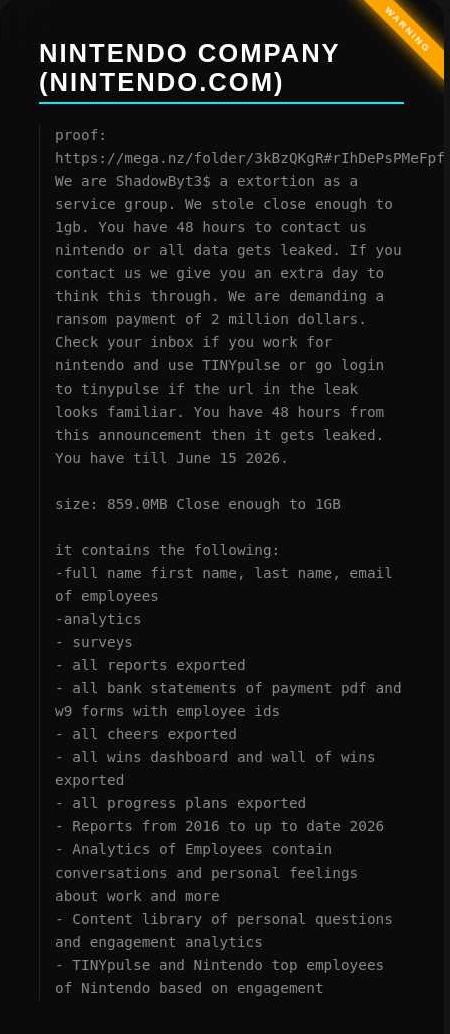
The company’s statement comes after claims from the Shadowbyt3$ “extortion-as-a-service” threat group that they exfiltrated sensitive data related to Nintendo of America employees.
“We are aware of an issue involving TinyPulse, a third-party service used for internal employee surveys at Nintendo of America,” stated Nintendo.
“Nintendo’s systems have not been compromised, and no personal customer or financial data has been accessed. Nintendo’s systems have not been compromised, and no personal customer or financial data has been accessed.”
“The data involved is limited to internal survey content comprising a small subset of our employees, and most of the information dates back several years,” the company told BleepingComputer.
Advertisement
Nintendo of America is a subsidiary of the Japanese game company, responsible for operations in the United States, Canada, and parts of Latin America.
TinyPulse is an employee engagement and feedback platform used for anonymous employee surveys, engagement analytics, feedback collection, and workplace culture assessments.
The gaming firm said it is “working with the service provider to address the issue.”
BleepingComputer contacted WebMD Health Services, the owner of the TinyPulse platform, for more information about the incident and its impact, but we did not receive a response by publishing time.
Advertisement
Shadowbyt3$ demands $2 million ransom
While Nintendo states that the incident only exposed survey information, Shadowbyt3$ claims that the stolen information includes employee personal details.
In an initial message, the threat actor said that they stole close to 1GB of data from Nintendo and gave the company 48 hours to engage in negotiations before leaking the information.
According to the threat actor, the stolen data contains full names, email addresses, analytics and survey data, bank statements, and W-9 forms with employee IDs, progress plans, and reports between 2016 and 2026.
“If you contact us we give you an extra day to think this through. We are demanding a ransom payment of 2 million dollars,” reads the Shadowbyt3$ post.
Advertisement
Shadowbyt3$’s asking Nintendo to start communication source: Kela
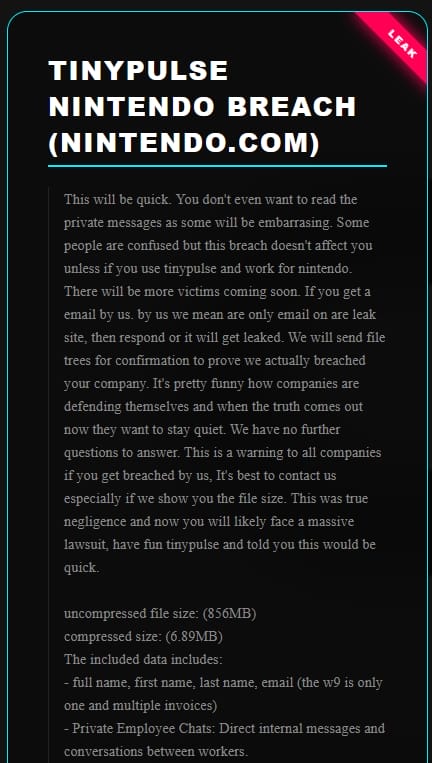
In a second message, the threat actor clarified that the “breach doesn’t affect nintendo gaming” but “a small amount of employees that work for nintendo and have used tinypulse.”
Another post from Shadowbyt3$ warned that there will be more victims and provided a link to leaked data allegedly including direct messages and conversations between employees, suggesting that Nintendo did not agree to pay a ransom.
Source: BleepingComputer
BleepingComputer did not download the leaked data and could not confirm its authenticity. Even if the information is valid, Nintendo customer information remained unaffected by this breach, and account holders do not need to take any action.
ShadowByt3$ is a relatively new threat actor describing itself as an “extortion as a service group” operating since October 2025. The gang is leaking data stolen from victim companies that do not pay a ransom and says that in the case of a settlement, all data “will be Deleted Permanently and you will not hear from us again.”
However, law enforcement strongly discourages paying the hackers because it incentivizes future attacks. Furthermore, there is no guarantee that the threat actor will not privately sell the information.
Security teams log 54% of successful attacks and alert on just 14%. The rest move through your environment unseen.
The Picus whitepaper shows how breach and attack simulation tests your SIEM and EDR rules so threats stop slipping by detection.
For years, the scarce resource in AI was chips. Now it is power.
Verse Enterprises wants to unblock that bottleneck. The San Francisco startup has raised an oversubscribed $54mn Series B. Bessemer Venture Partners led the round. GV, Nvidia and Norrsken VC also took part.
The race to AI is now a race to power
Data centres are scaling faster than grids can handle. In many regions, developers wait years just to plug in. Generation shortages, transmission bottlenecks and long interconnection queues all slow them down.
The strain is everywhere. Denmark recently paused new grid connections after AI data centres overwhelmed its system. The EU has even asked households to cut power use at peak times. Verse says hundreds of data centres sit stuck in utility queues, which it claims leaves $500bn in annual revenue on the table.
Advertisement
Skipping the line with batteries
The 💜 of EU tech
The latest rumblings from the EU tech scene, a story from our wise ol’ founder Boris, and some questionable AI art. It’s free, every week, in your inbox. Sign up now!
Verse’s answer is to jump the queue. Its new product, Dispatch Intelligence, manages on-site batteries and solar in real time. The grid then sees a flexible load instead of a constant one. Crucially, the data centre never throttles its compute.
For the hardware, Verse has teamed up with battery developer Calibrant Energy. Calibrant brings the on-site storage and solar; Verse runs the software. It is the same behind-the-meter logic now pulling money toward clean-energy-as-a-service startups. Together, the company says, they can bring new capacity online up to three years faster.
Advertisement
“Clean energy is actually the economic and feasible solution, because the speed of deployment is fast,” said Verse co-founder and chief executive Seyed Madaeni.
Will utilities play along?
The model is not a sure thing. Allison Weis, global head of storage at Wood Mackenzie, says flexibility can lower the barriers to connecting, but guarantees nothing. Utilities have not set standards for what data centres must do to get online faster. Nor have they confirmed that batteries or on-site power will count.
“There’s no uniform framework,” Weis said. That may soon change. US federal regulators are due to publish guidance on speeding up data-centre connections. The open question is who pays: the hyperscalers, through their own generation, or everyone else, through grid upgrades.
What the money is for
Verse is not alone in this race. Nvidia has also backed Emerald AI, which builds similar software, and Verse is now wiring Dispatch Intelligence into Nvidia’s DSX AI Factory design for gigascale sites. The chipmaker has good reason to help: every data centre stuck in a queue is one that cannot buy its chips.
Advertisement
The startup plans to move fast. It wants to manage more than 100 sites within a year. For Verse, clean power is no longer the slow option. It is the shortcut.
Aside from Apple, everybody seems to be doing clip-on earbuds these days, including Sennheiser. The company just announced its Accentum Clip buds, set to ship on July 23 in black or white. But the only rub is they won’t be coming to the US on that date, and it’s unclear when they’ll hit US retailers. However, Sennheiser says Canadians will be able to pick them up for $270 Canadian (roughly $190).
I am curious to hear how they sound compared to other leading clip-on buds, which are not only becoming more comfortable and better designed, but are delivering better performance compared to early clip-on models. The Sennheiser Clip are equipped with 12-millimeter drivers, Bluetooth 6.0, have support for the LDAC audio codec for Android users (along with AAC for Apple users) and are rated for 9 hours of battery life on a single charge with an additional 27 hours in the charging case. They’re splashproof and dust-resistant with an IP54 rating and weigh 6.8 grams per bud.
Advertisement
The Sennheiser buds in black.
Sennheiser/CNET
Sennheiser says the Accentum Clip are “tuned for clarity and punchy bass with smooth treble” and the earbuds use dynamic EQ for “seamless compensation of tonal shifts” when playback volume is raised and lowered “to maintain balance while preventing unpleasant distortion.”
If the Canadian price is any indication, I suspect the Accentum Clip will cost around $200 when they final make it stateside. That’s toward the premium end of the clip-on earbuds spectrum, with Sony’s LinkBuds Clip and Shokz OpenDots One in a similar price range. Bose’s Ultra Open Buds, which list for $300, are currently being discounted to $200.
Advertisement
They fit like other clip-on buds.
Sennheiser
If you’re looking for value clip-on options, Baseus sells its new Bowie MC2 buds for around $60 on Amazon. I like them a lot for what they cost. The Baseus Inspire XC1 buds, which feature Sound by Bose, are also a decent value at $110.
Check out my list of the best clip-on earbuds for other options in this nascent earbuds subcategory. Maybe these new Sennheiser Accentum Clip buds make the list once I get a chance to test them. Hopefully, that’ll happen in the not-so-distant future and not require a trip abroad.
As TVs and projectors have evolved over the years, detail or “native resolution” was one spec that drove the market forward. 480i analog CRT TVs were replaced by 720P and 1080i digital HDTVs, which soon were replaced by 1080p HDTVs as the standard in around 2005. Just under 10 years later, 4K TVs were introduced to the consumer market, leading to a new wave of upgrades. More pixels meant more detail, and more detail meant a sharper picture, particularly as screen sizes grew from 27 inches to 55 inches to 85 inches to over 100 inches. FOMO on the highest resolution TVs drove a lot of TV owners to upgrade to the latest, greatest, biggest, most pixel-packed new models.
Just How Many Ks Do You Need?
But a funny thing happened on the road to “more Ks.” As 4K TVs became more common, and increased competition lowered the profit margins, TV makers tried their hands at the resolution upgrade game again with the introduction of 8K TVs. To put things in perspective, 4K TVs (3840×2160 pixels) have four times the detail of 1080p TVs (1920×1080 pixels). And 8K TVs (7680×4320 pixels) have four times the detail of 4K TVs. But it turns out that consumers were quite happy with 4K resolution and most were not willing to pay the premium for an 8K TV, particularly with no native 8K content to play on them.
Consumers started to notice that other picture quality elements – like contrast, black levels, color saturation and color gamut – mattered more than resolution for overall picture quality, even on massive 100+ inch screens. So most TV and projector makers, pulled back on 8K support, focusing instead on other differentiating factors like Quantum Dots, Local Dimming, Micro LED backlighting and RGB backlighting for LCD TVs and, of course, OLED and QD-OLED technology for pixel perfect black levels. Projector makers mostly switched from lamp-based illumination to laser lighting engines, which not only improves peak brightness and contrast, but also lasts much longer than traditional bulbs.
Putting the HIGH in High Dynamic Range
With the introduction of 4K/UHD standards, another important element of picture quality was improved, called “Dynamic Range.” This is the difference between the darkest black and the brightest white or color that can be encoded into the movie or TV show. Standard Definition movies and High Definition movies, even those on physical media such as Blu-ray Disc, are significantly limited in their dynamic range, with most movies encoded and mastered for a a peak brightness of only 100 nits. This means the picture can only get so bright, limited by the content itself.
Advertisement
Meanwhile 4K/UHD content supports a much higher range of values between deepest black and peak brightness. This is known as HDR (High Dynamic Range) and it allows 4K movies and TV shows to be much more dynamic, with fine details visible on screen in both the dark shadows and in the brightest areas of the screen. 4K/HDR titles are frequently mastered for a peak brightness of 1,000 nits or 4,000 nits. There are even some HDR titles mastered for 10,000 nits of peak brightness.
Today, TV manufacturers’ support for 8K resolution has virtually disappeared, at least in North America. There are still some displays that support native 8K resolution but they’re few and far between. On the flat panel side, Samsung still has a few TVs that offer native 8K resolution. On the projector side, select home theater projectors from JVC also support native 8K video, displaying it in 8K resolution via pixel shifting technology on their native 4K projectors with 8K eShift.
But there is still apparently some support for 8K from within the industry itself, manifesting itself in the shape of an industry trade group, formed in 2019, known as the “8K Association.” The “8KA” is dedicated to establishing standards and increasing adoption of 8K resolution in all aspects of the video reproduction chain, from the software itself to media players to display devices including TVs and projectors.
Not Just 8K, But Better 4K
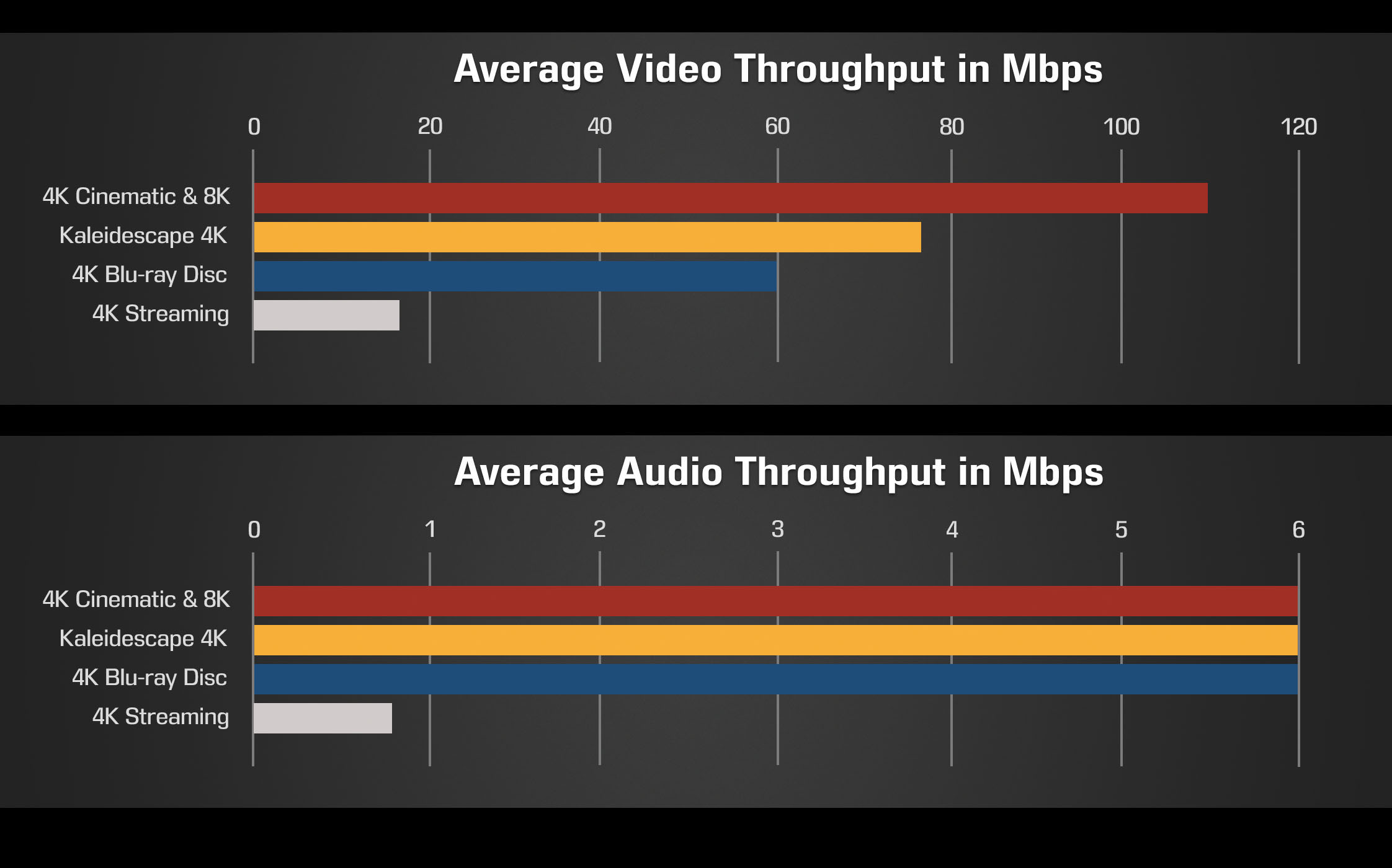
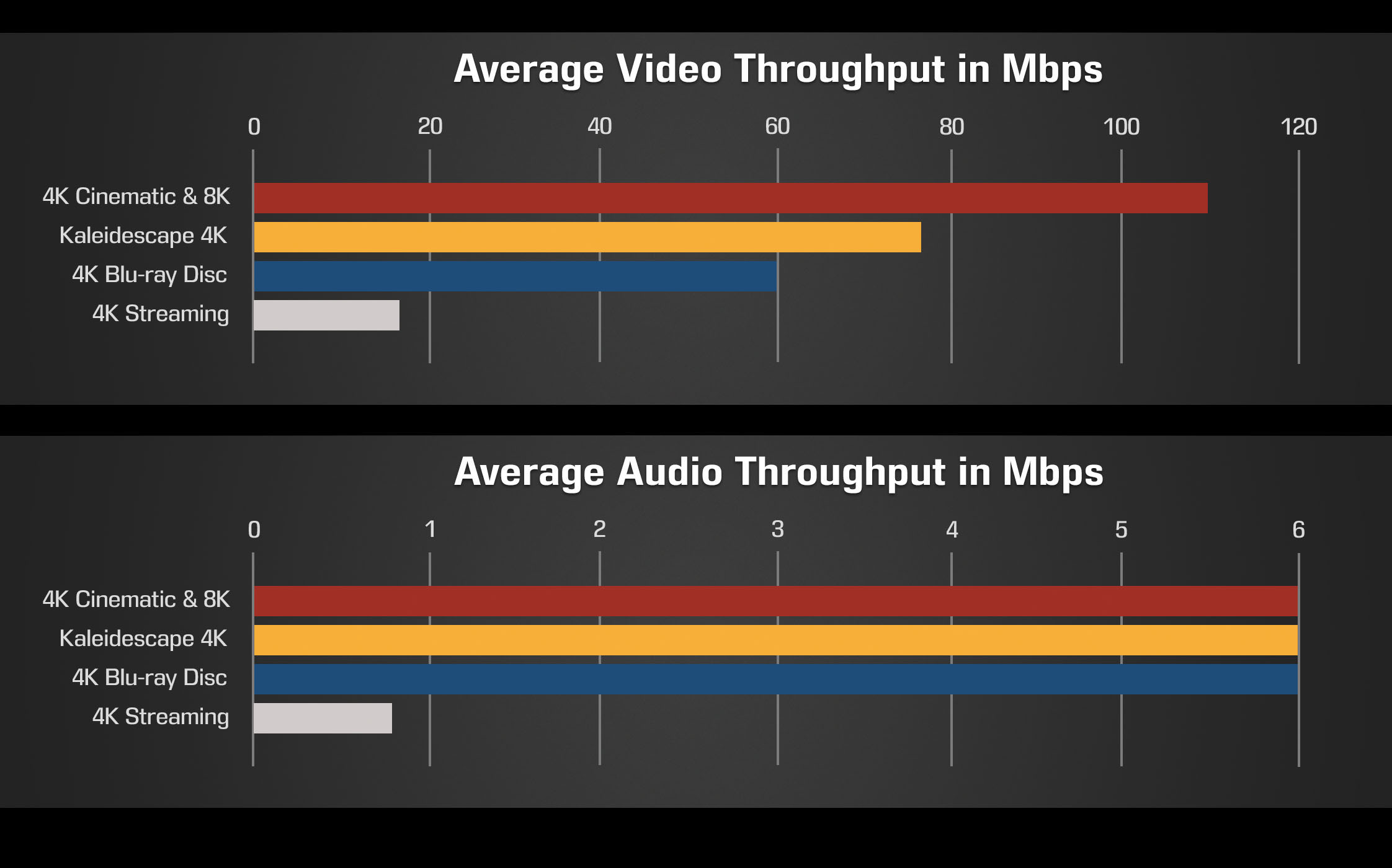
Today, Kaleidescape, provider of premium media players and its own digital movie ecosystem, has just announced its first 8K-capable media player, the Strato K ($4,995). The Strato K is not only the first Kaleidescape player to support native 8K movies and TV shows, but it also supports a new higher fidelity 4K media format, called “4K Cinematic.” 4K Cinematic mode offers full 4:4:4 chroma encoding, and much higher bitrates, even compared to Kaleidescape’s current 4K UHD offerings. 4:4:4 chroma encoding and higher bitrates lead to better color detail, crisper images and fewer of the egregious video artifacts that plague low quality streaming sources.
Advertisement
8K and 4K Cinematic titles on Kaleidescape support bit rates up to about 110 Mbps, over 5 times what we normally see on 4K streaming services.
The new Kaleidescape Strato K is the first movie player certified by the 8K Association that meets the performance and interoperability requirements developed by the Association’s Technical Working Group. In addition to Kaleidescape, 8KA members include leading companies such as Panasonic, Samsung and Xperi, along with other contributors to the 8K ecosystem.
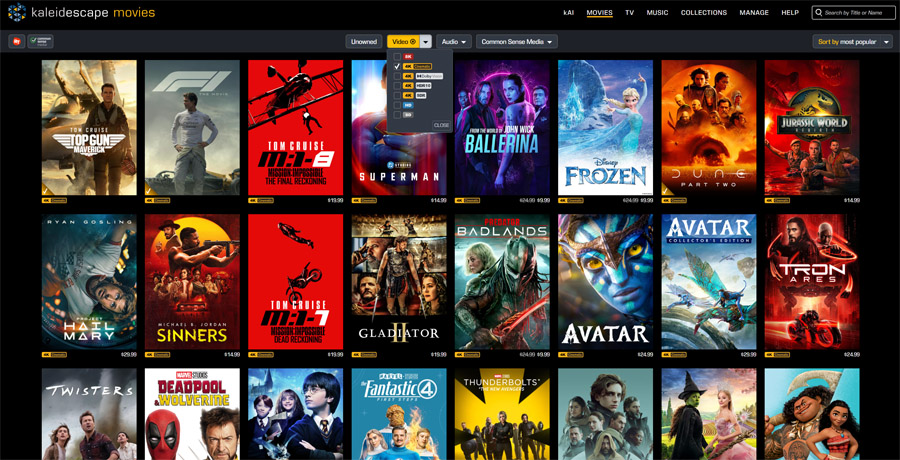
According to Kaleidescape, there are already over 150 titles available in the Kaleidescape movie store in 4K Cinematic format. 8K content licensing is also in the works, but 8K title selection is very limited at this time.
If you visit the Kaleidescape store and filter video for “4K Cinematic” you’ll see a list of titles currently available in the format.
In Kaleidescape CEO Tayloe Stansbury’s words, “Kaleidescape’s Strato K is the world’s highest-fidelity movie player. It brings movie lovers closer to the filmmaker’s intent, with cleaner detail, true-to-life color, and a more natural presentation that dramatically improves the viewing experience of any display.”
Advertisement. Scroll to continue reading.
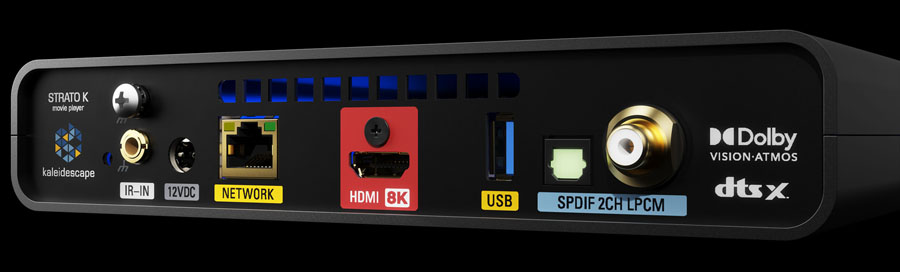
Similar to the Strato V in design, the new Strato K player supports dedicated fiberoptic and coax digital audio outputs, plus the new 8K-capable HDMI output.
Strato K is available now for pre-order, at $4,995 US MSRP. In addition, with Strato K’s release, the current flagship Strato V player’s price has been lowered from $4.495 to $3,995 (US MSRP).
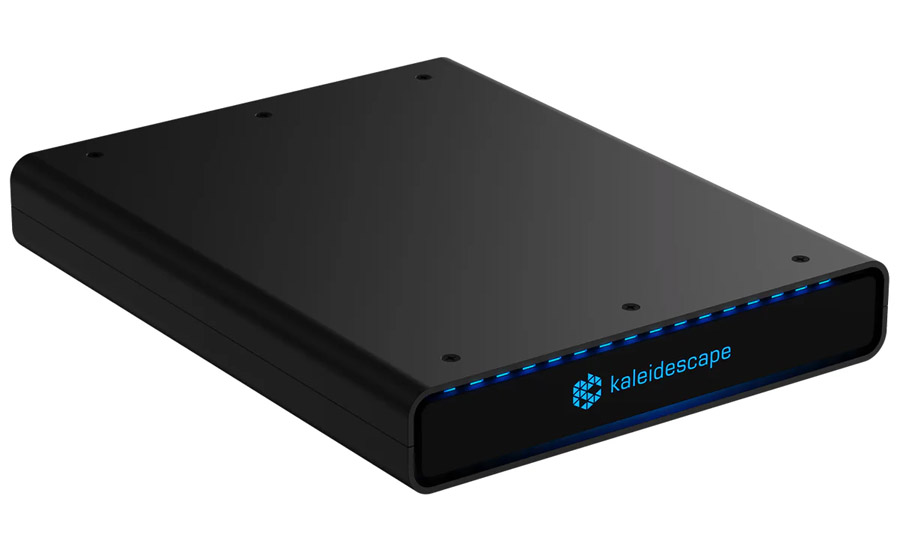
The Strato K features a compact form factor, similar in size and general design to the Strato V, but not quite as compact as the Strato E and Strato M. Like the other recently introduced players, the Strato K can operate as a standalone player. Its internal one terabyte (1 TB) solid state drive can store a handful of movies in 4K, 4K Cinematic or 8K formats. For more dedicated movie lovers and collectors, Strato K can be grouped with one or more Kaleidescape Terra movie servers to add movie storage and provide whole-home entertainment.
Like the Strato V, the Strato K supports Dolby Vision dynamic HDR as well as HDR10. Movies and TV shows are available in the Kaleidescape movie store in 8K, 4K Cinematic, 4K, and 2K with lossless multichannel and object-based audio, including Dolby Atmos and DTS:X.
The Kaleidescape Strato K player will make its public debut later today (June 18, 2026) at a special event hosted by the SMPTE Hollywood Section and the 8K Association in the Amazon Culver Theater’s 8K screening room.
PCM (up to 7.1ch, 96kHz/24-bit)PCM (up to 7.1ch, 96kHz/24-bit
Dolby Atmos
Dolby TrueHD
Dolby Digital Plus
Advertisement
Dolby Digital
Dolby MAT PCM
DTS:X
DTS-HD Master Audio
DTS-HD High Resolution Audio
Advertisement
DTS Digital Surround
PCM (up to 7.1ch, 96kHz/24-bit)PCM (up to 7.1ch, 96kHz/24-bit
Dolby Atmos
Dolby TrueHD
Advertisement
Dolby Digital Plus
Dolby Digital
Dolby MAT PCM
DTS:X
Advertisement
DTS-HD Master Audio
DTS-HD High-Resolution Audio
DTS Digital Surround
PCM (up to 7.1ch, 96kHz/24-bit)
Advertisement
Dolby Atmos
Dolby TrueHD
Dolby Digital Plus
Dolby Digital
Advertisement
Dolby MAT PCM
DTS:X
DTS-HD Master Audio
DTS-HD High-Resolution Audio
Advertisement
DTS Digital Surround
PCM (up to 7.1ch, 96kHz/24-bit)
Audio Format Support via Digital Coaxial/Digital Optical
–
–
Dolby Digital DTS Digital Surround
PCM (2ch, up to 96kHz/24-bit)
Advertisement
Dolby Digital DTS Digital Surround
PCM (2ch, up to 96kHz/24-bit)
Control Support
Kaleidescape remote (not included)
Front-panel IR receiver window
Advertisement
IR input (1/8in mini plug)
Kaleidescape control protocol over Ethernet (supported by Josh.ai, Crestron, AMX, Control4, Savant, the Kaleidescape apps, and other apps & control systems) Lutron RA3 and HomeWorks control over Ethernet
Kaleidescape remote (not included)
Front-panel IR receiver window
Advertisement
IR input (1/8in mini plug)
Kaleidescape control protocol over Ethernet (supported by Josh.ai, Crestron, AMX, Control4, Savant, the Kaleidescape apps, and other apps & control systems) Lutron RA3 and HomeWorks control over Ethernet
Kaleidescape remote (not included)
Front-panel IR receiver window
Advertisement
IR input (1/8in mini plug)
Kaleidescape control protocol over Ethernet (supported by Josh.ai, Crestron, AMX, Control4, Savant, the Kaleidescape apps, and other apps & control systems) Lutron RA3 and HomeWorks control over Ethernet
Kaleidescape remote (not included)
Front-panel IR receiver window
Advertisement
IR input (1/8in mini plug)
Kaleidescape control protocol over Ethernet (supported by Josh.ai, Crestron, AMX, Control4, Savant, the Kaleidescape apps, and other apps & control systems) Lutron RA3 and HomeWorks control over Ethernet
Dimensions (WHD)
6.4 x 1.1 x 6.4 inches
6.4 x 1.1 x 6.4 inches
7.87 x 1.52 x 10 inches
7.87 x 1.52 x 10 inches
Weight
1.6 lbs
1.6 lbs
4.2 lbs
4.2 lbs
Kaleidescape’s user interface makes finding related movies easy with a few clicks on your remote.
The Bottom Line
While interest and excitement around 8K resolution has waned (perhaps for good reasons), we’re happy to see Kaleidescape pushing the quality of media toward to its current limits. With support for both 8K resolution and for higher quality “4K Cinematic” content, and with bit rates and color reproduction that exceed even the highest quality physical media, the Strato K looks like an impressive addition to the line. If you’re looking for a high quality movie player with an eye toward the future, the Strato K is worth checking out.
The new updates will give developers additional options to distribute iOS apps to Brazilian users via alternative app marketplaces, Apple said. Third-party app stores will need to be approved by Apple first, and will need to meet “ongoing requirements to serve developers and users”.
Advertisement
Additionally, Apple will also allow developers to include alternative payment processing methods in their apps or guide consumers to external sites to complete transactions.
These new payment options will appear alongside Apple’s own in-app purchasing. However, purchase history and subscription management will not reflect payments made using third-party methods, the company clarified.
Apple said it will also not provide refunds for transactions conducted outside its ecosystem, and will have less ability to support customers encountering issues, scams or fraud.
In 2025, Brazil’s regulator, Conselho Administrativo de Defesa Econômica (CADE), found Apple to be guilty of anticompetitive conduct within its iOS ecosystem.
Its investigation revealed that Apple prohibited the sale of services from third parties, and required developers to exclusively use the iOS payment system for transactions with customers.
The watchdog found that these practices created “artificial entry barriers” for competitors selling apps and other tools to iOS users.
Later that year, Apple and CADE entered into an agreement to implement anticompetitive measures. The agreement’s requirements are set to last for three years from when Apple announces changes to iOS in Brazil.
Advertisement
The agreement also reduces the commission Apple charges to sell apps on the App Store from 30pc to 10pc for members of the Small Business programme, Video Partner programme, Mini Apps Partner programme, and for subscriptions following their first year – and 21pc for the rest. Apple says a “vast majority” of developers will pay the lower fee.
Some of the developers steering transactions to websites outside iOS will pay a commission of 15pc, while iOS apps being distributed outside the App Store in Brazil will be charged a 5pc commission.
Apple also highlighted a number of cybersecurity issues emerging from opening up iOS to third-party markets and payment platforms.
The company said that it has worked with CADE to introduce new protections against potential malware, fraud or scam threats from third-party services, including an authorisation process for app marketplaces and baseline reviews for all iOS apps.
Advertisement
Don’t miss out on the knowledge you need to succeed. Sign up for the Daily Brief, Silicon Republic’s digest of need-to-know sci-tech news.
Apple TV has a treat for Formula 1 fans. The platform is streaming the Austrian Grand Prix, with all sessions available to watch. This includes practice rounds, qualifiers and the race itself. Even better? It’s free and I don’t mean “free for subscribers.” Anyone can pop open the app and watch, subscription or not.
Events start on June 26 at 7:30AM ET with the first practice round. There’s another practice round later that day at 11AM ET. The qualifying round begins on June 27 at 10AM ET and the race starts at 9AM ET on June 28.
REMINDER ‼️
Apple TV will make the entire Formula 1 Austrian Grand Prix race weekend available FREE to viewers in the U.S., with live coverage from June 26–28. pic.twitter.com/uJ4b1Xp4wP
The company is also dipping its toes into other sports. It streamed a Major League Soccer game captured entirely with iPhones and now airs Major League Baseball doubleheaders on Friday evenings.
Apple is bringing alternative app marketplaces and payment options to iPhone users in Brazil under an agreement with the country’s antitrust regulator, extending App Store changes that were previously limited to the European Union.
The changes reflect an agreement with Brazil’s competition regulator, the Conselho Administrativo de Defesa Economica, known as CADE, and will arrive as part of iOS 26.5. Developers can begin integrating the new capabilities immediately.
Developers in Brazil will be able to distribute iPhone apps through marketplaces outside the App Store. Marketplace operators must receive authorization from Apple and comply with ongoing requirements.
Apple will also require apps distributed through alternative marketplaces to pass a notarization process. The company said the review combines automated checks and human oversight designed to identify malware and other known security threats.
Advertisement
Apple is also introducing a revised business model for developers in Brazil. The new structure applies to App Store distribution, alternative payments, and app distribution outside the App Store.
Developers with iOS apps on the App Store in Brazil will pay a reduced commission of either 10% or 21% on sales of digital goods and services, depending on eligibility. Those who continue using Apple In-App Purchase will also pay an additional 5% payment processing fee.
Apple will charge a 15% Store Services Commission on purchases completed through developer websites linked from apps, with some developers qualifying for a reduced 10% rate. Apps distributed outside the App Store will face a 5% Core Technology Commission on sales of digital goods and services.
Developers who sell digital goods and services in Brazil will pay the same amount or less than they do today under the new business terms. Apple will require alternative payment options to appear alongside its own payment system.
Advertisement
The company said the requirement will help users distinguish between purchases processed by Apple and those handled by third parties.
Users who continue using Apple In-App Purchase will retain access to subscription management, refund requests, payment history, and fraud reporting tools. Purchases completed through alternative payment systems or external websites won’t receive the same support features.
Apple will have less ability to assist customers who encounter scams, fraud, or payment disputes involving third-party payment systems. Users may also need to share payment information with additional companies.
Brazil adopts changes similar to Apple’s European framework
Many of the changes mirror Apple’s response to the European Union’s Digital Markets Act. Alternative app marketplaces, app notarization, and external payment options already exist under the company’s EU rules.
Advertisement
Many of the changes mirror Apple’s response to the European Union’s Digital Markets Act
Apple first built much of the underlying framework to comply with European regulations. Brazil is the first major market outside Europe to receive a similar set of marketplace and payment changes.
The company also drew a sharp distinction between Brazil’s agreement and the European Union’s Digital Markets Act. CADE and Japan’s Mobile Software Competition Act allowed safeguards around parental controls, payment choices, and marketplace authorization to remain in place.
Those protections, Apple argued, weren’t possible under the EU framework. One example is Brazil’s requirement that app distribution flow through authorized marketplace operators.
Another is the decision to keep Apple In-App Purchase available alongside alternative payment systems. Together, those measures help address some of the security and fraud risks associated with alternative app distribution and payments, according to Apple.
The U.S. has taken a different approach. Litigation involving Epic Games focused largely on payment steering and restrictions on directing users to outside purchasing options.
Advertisement
The Justice Department’s antitrust case challenges broader questions about competition within the iPhone ecosystem. Neither effort has produced nationwide requirements for alternative app marketplaces.
Apple emphasizes security, child safety, and fees
Apple devoted much of its announcement to security, fraud, and child safety concerns tied to alternative app distribution and payment systems. Apps distributed outside the App Store don’t go through the same review process as App Store apps.
Alternative distribution and payment systems can increase exposure to scams, fraud, malware, and objectionable content. Apple also pointed to pornography apps that became available after similar regulatory changes in Europe and Japan.
Apple preserved several safeguards for younger users in Brazil. Apps in the Kids category can’t use external payment links, and alternative payment systems must include parental gates for users under 18.
Advertisement
Users under 18 also won’t be able to access web-based payment flows from App Store apps. Apple is developing APIs that would allow parents to monitor and approve purchases completed outside Apple In-App Purchase.
Apple is pairing the new marketplace and payment options with alternative fees and commissions. The company used a similar approach in Europe when it introduced marketplace distribution and external payment options.
Security researcher Justin O’Leary says Google initially accepted his Config Connector privilege-escalation report as a high-priority, high-severity bug, then denied a bounty by declaring the behavior “working as intended.” “Google initially rated the bug high priority and high severity, with a rep telling O’Leary ‘Nice Catch!’ Then, the cloud giant changed course and told O’Leary […] that there’s no vulnerability, so no fix and no reward payout,” reports The Register. “The bug report, however, is still marked high-priority and accepted.” The alleged flaw, dubbed ConfigConfusion, could let a Kubernetes namespace user exploit an overprivileged service account to become a GCP organization owner with only a few lines of YAML and little apparent audit visibility. O’Leary details the incident in a blog post. The Register reports: According to O’Leary, Config Connector doesn’t perform an authorization check, and this allows any Config Connector service account with org-level permissions to bypass Identity and Access Management (IAM) authorization and gain the highest level of control (roles/owner) to an entire GCP Organization — the root node of all of a company’s resources within Google Cloud. On March 27, a Google security engineer accepted O’Leary’s report and told him: “Nice catch!” The employee said that they filed a bug based on O’Leary’s report with the relevant product team and assured him the Chocolate Factory’s security squad would work with relevant Google Cloud people to fix the flaw. “We’ll work with the product team to ensure this issue is address. We’ll let you know when the issue was fixed,” the engineer said. “In the meantime, review the payment option selected in your bughunters.google.com profile.”
Google assigned the bug P1 priority and S1 severity, signifying a flaw worthy of urgent repair because it affects a large percentage of users and can disrupt core organizational functions. “I figured that was the end of that,” O’Leary said in a phone interview with The Register. Eleven days later, on April 7, he received a new message from a Google Security Bot reversing the earlier decision. The Reg viewed the email, and O’Leary included a screenshot in his Thursday writeup. The message said that the Cloud Vulnerability Reward Program panel decided that the “security impact of this issue does not meet the criteria to qualify for a reward.”
After reviewing the bug report, Google determined the software “is working as intended,” the message continued. It also noted that the program’s decision not to pay a bounty “does not mean that the product team won’t fix the issue.” Nearly three months later, the case remains P1/S1 with the status “in progress (accepted).” Google hasn’t assigned a CVE or issued a fix. O’Leary didn’t receive any reward for his research. […] “This is a pattern,” O’Leary told [The Register]. “This is just how these trillion-dollar companies deal with people like me. In my day job, we use GKE, and it’s incredibly frustrating on my end, when I find a critical vulnerability in the system that’s being widely used, and I can’t even get the vendor to patch their own stuff.” A Google spokesperson told The Register: “The issue reported does not qualify for a reward because the GCP IAM authorization bypass is only exploitable if an attacker has access to a Config Connector Service Account that’s been granted the Organization Admin role by the organization (i.e., it is privileged). Additionally, an attacker would first need to gain entry to an organization’s environment (e.g., an exposed container) in order to leverage the privileged Config Connector instance and execute commands with administrative authority, such as the IAM bypass. Granting this level of access to the Config Connector Service Account goes against Google Cloud’s publicly shared best practices and the principle of least privilege.”






















































You must be logged in to post a comment Login