Most striking is that the loan is unsecured and has a 12-month term, meaning it must be repaid or refinanced by next year. This could be a signal that the lenders believe OpenAI’s highly anticipated public listing will indeed come later this year, as some outlets, like CNBC, have reported. The loan is provided by JPMorgan Chase, Goldman Sachs, and four Japanese banks.
Since OpenAI’s IPO is bound to be one of the largest listings ever, if it does happen this year, that would presumably give SoftBank the liquidity to settle the debt in such a short time span. SoftBank’s new $30 billion investment in OpenAI brings its total bet on ChatGPT’s maker to over $60 billion.
from the more-things-change-the-more-they-stay-the-same dept
In 2018, the Supreme Court ruled that warrants were needed to obtain cell site location info (CSLI). That decision dealt with law enforcement’s warrantless acquisition of 127 days of location data from a cell service provider. As the court saw it, the government was leveraging access to this data to turn cell phones (which has been given heightened protections with the 2014 Riley decision) into government tracking devices, all without having to bother with warrants or deploying government-crafted tracking tech.
The rationale for this 4th Amendment bypass was this: location data slurped up by websites and downloaded apps wasn’t exactly the same thing as cell tower location data. Therefore, it could be had without a warrant. In fact, it could be had without bothering the courts at all with a subpoena or any other lighter-weight legal paperwork. The government could just buy this data and sort through it to find what it was looking for. Some third parties were even willing to do the sorting for the right price, freeing the government up to pursue other rights violations.
This option obviously experienced a jump in popularity following the Supreme Court’s Carpenter ruling. While the spokespeople constantly stated the agencies they represented (which was pretty much all of them when it came to buying data from data brokers) were super-interested in respecting constitutional rights, they never took the time to explain their “respect” meant constantly testing (or breaking!) the boundaries until court precedent forced them to do otherwise.
In 2023, anti-encryption zealot Christopher Wray was heading the FBI. During the last years of his tenure, he admitted to Congress (or, more specifically, privacy hawk Senator Ron Wyden) that the FBI was — like CBP, ICE, US Secret Service, IRS, and federal prisons — buying up as much location data as it could purchase. Wray insisted this process was “court-authorized,” but somehow couldn’t find any court documents laying around that would support his claims of authorization.
Advertisement
The government is still buying this data. And it’s even more problematic than it was a few years ago, when federal agencies weren’t being run by MAGA loyalists and outright racists. Now there’s a new wrinkle: the government is delving into ad markets to siphon off RTB (real-time bidding) data that’s capable of tying location data to specific devices, even if those hawking the data pretend it’s been anonymized.
When asked by U.S. Senator Ron Wyden, Democrat of Oregon, if the FBI would commit to not buying Americans’ location data, Patel said that the agency “uses all tools … to do our mission.”
“We do purchase commercially available information that is consistent with the Constitution and the laws under the Electronic Communications Privacy Act — and it has led to some valuable intelligence for us,” Patel testified Wednesday.
First, there’s the obviously false insistence that this is all very constitutional. Buying location data from data brokers doesn’t just violate the spirit of the Supreme Court’s Carpenter decision, it’s only a letter or three off from violating the letter of the law. When the only difference is where you’re obtaining long-term location tracking data, you’re just exploiting loopholes rather than actually trying to be “consistent with the Constitution.”
Advertisement
The second part is even stupider. When you claim that legally-questionable efforts have “led to some valuable intelligence,” you’re just saying that the ends justify the means. And if that’s the low bar you’ve set for yourself, you’re going to be violating rights regularly because you prefer harvesting data to respecting rights.
This sums up the government’s stance concisely:
The FBI claims it does not need a warrant to use this information for federal investigations; though this legal theory has not yet been tested in court.
The government — especially this one — will never err on the side of restraint. It would rather explore the outer edges of legal theory, sacrificing our rights in exchange for more government power. At some point, this legal theory will be tested. But until it is, the government is going to continue to pretend the implications of Carpenter don’t apply to anything that hasn’t been specifically ruled unconstitutional.
A hacking group called Handala has gained access to FBI Director Kash Patel’s email account, Reuters reports. The group published content from Patel’s email on their website as proof, including photos of Patel “sniffing and smoking cigars” and “making a face while taking a picture of himself in the mirror with a large bottle of rum.”
TechCrunch was able to independently confirm that at least some of the emails Handala stole were from Patel’s account by checking information used by mail delivery systems that’s stored in an email’s header. Several stolen emails included a cryptographic signature that linked them to Patel’s account. The FBI has also separately confirmed that the Director’s account was hacked. “The FBI is aware of malicious actors targeting Director Patel’s personal email information, and we have taken all necessary steps to mitigate potential risks associated with this activity,” the Bureau told TechCrunch. “The information in question is historical in nature and involves no government information.”
The FBI is offering up to $10 million in rewards for more information about the hackers who targeted Patel’s account. Handala presents as a pro-Palestinian hacking group online, but is believed to be one of several aliases used by cyberintelligence units working for the Iranian government, Reuters writes. Groups affiliated with Iran have targeted officials in the US before. In August 2024, the FBI shared that a separate group, APT42, was trying to gain access to both the Trump and Harris campaigns. Three men associated with APT42 were later charged that September.
Handala has appeared to become more active during the current conflict between the US, Israel and Iran. According to Reuters, the group claimed to be behind a cyber attack on Stryker, a medical devices company, earlier in March. Handala also said it accessed and published personal data from Lockheed Martin employees stationed in the Middle East.
The roles will be available in areas such as engineering, research and development, and customer service.
Data management and cloud data platform provider Qumulo officially launched its new European software R&D hub in Cork today (27 March), amid a plan for expansion that will also create 50 new jobs in the area over the next three years.
The project is supported by IDA Ireland and aims to address challenges for data management at scale and scope.
New roles will include opportunities in engineering, R&D and customer service, and the Cork-based team will be responsible for researching and developing solutions to enable the secure, frictionless and instantaneous transfer of “exabyte-scale” workloads globally, the company said.
Advertisement
Established in 2012, US company Qumulo is headquartered in Seattle, Washington and has a significant global presence across the US, the Middle East and Europe.
Qumulo’s CTO Kiran Bhageshpur explained Cork was chosen as the location for its second R&D centre in part because of the access to “stellar third-level institutions in the south-west” and a “deep talent pool in Cork”.
He added, “Additionally, the excellent support infrastructure for companies like Qumulo provided by IDA Ireland made Cork the obvious choice for us to build a team focused on leveraging AI to help businesses manage global-scale data infrastructure.”
Minister for Enterprise, Tourism and Employment Peter Burke, TD said, “Qumulo’s decision to establish a new European software R&D hub in Cork is a strong endorsement of Cork as a location where cutting-edge engineering and global ambition meet.
Advertisement
“It highlights the depth of talent emerging from our universities, the strength of the region’s technology ecosystem and Ireland’s ability to support companies delivering pioneering innovation on a global scale.”
Cork’s R&D ecosystem has experienced a boost as of late, with global semiconductor, power systems and IoT company Infineon Technologies also officially opening a new Cork-based R&D centre earlier this month. The new location focuses on Infineon’s innovations in the automotive and consumer microelectronics space, in areas such as battery management, motor control and touchscreens.
Don’t miss out on the knowledge you need to succeed. Sign up for the Daily Brief, Silicon Republic’s digest of need-to-know sci-tech news.
Apple has snatched up Lilian Rincon, a nearly decade-long Google veteran, as it continues to retool its Apple Intelligence team.
Apple Intelligence continues to undergo changes
Before working at Apple, Rincon served as Vice President of Product Management at Google since 2024. However, before that she held various product management roles in the company since 2017. According to9to5Mac, Rincon will lead product marketing and product management for its AI platforms, including Apple Intelligence and Siri. In the role, she’ll report directly to Greg Joswiak, Apple’s senior vice president of worldwide marketing. Continue Reading on AppleInsider | Discuss on our Forums
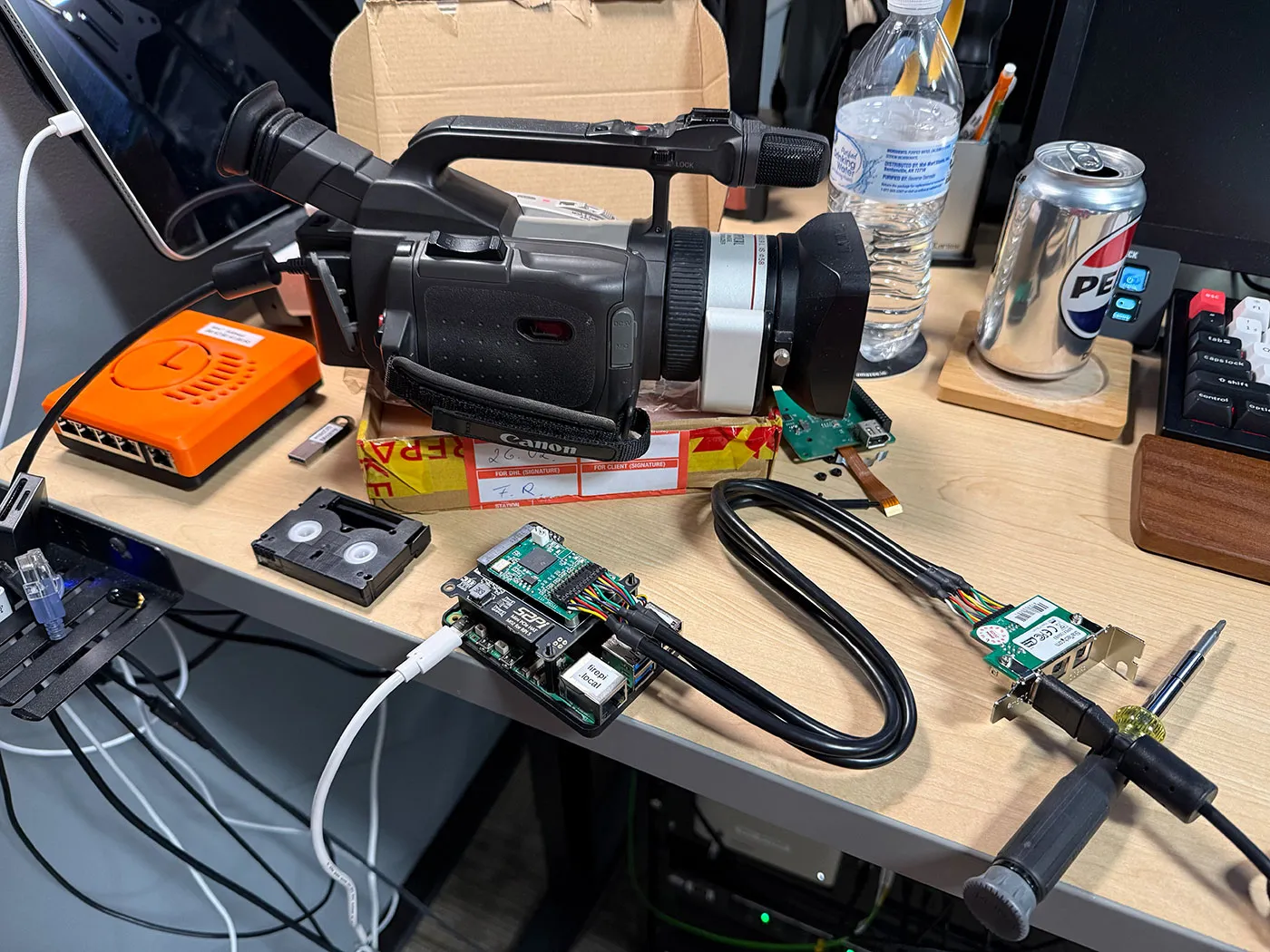
Once the premium option for data transfers and remote control for high-end audiovisual and other devices, FireWire (IEEE 1394) has been dying a slow death ever since Apple and Sony switched over to USB. Recently Apple correspondingly dropped support for it in MacOS 26, and Linux will follow in 2029. The bright side of this when you’re someone like [Jeff Geerling] is that this means three more years of Linux support for one’s FireWire gear, including on the Raspberry Pi with prosumer gear from 1999.
If you’re not concerned about running the latest and greatest – and supported – software, then using an old or modern Mac or PC is of course an option, but with Linux support still available [Jeff] really wanted to get it working on Linux. Particularly on a Raspberry Pi in order to stay on brand.
Adding a FireWire port to a Raspberry Pi SBC is easy enough with an RPi 5 board as you can put a Mini PCIe HAT on it into which you slot a mini PCIe to Firewire adapter. At this point lspci shows the new device, but to use it you need to recompile the Linux kernel with Firewire support. On the Raspberry Pi you then also need to enable it in the device tree overlay, as shown in the article.
With this you now have FireWire 400 support right off the bat, but to use the FireWire 800 port you need to also connect external power to the adapter, which [Jeff]’s Canon GL1 video camera with its FW400 port does not require, so he didn’t bother with that.
Advertisement
Capturing the video from the GL1 via FW400 was done using the DVgrab utility, with a subsequent capture attempt successful. This means that at least until 2029 [Jeff] will be happily using his GL1 camera this way.
Meanwhile over on the Dark Side, you can still happily install FireWire drivers made for older Windows versions on Windows 10 and 11, which is great news for e.g. people who have expensive DAW gear kicking around. Perhaps the demise of FireWire is still a long while off as long as you’re not too picky about the OS you’re running.
Looking for an all-in-one soundbar that sounds as big as it looks? Sennheiser’s Ambeo Max uses its oversized body to produce beefy, enveloping sound, and right now you can grab it for just $2,000 at Best Buy, a sizable $1,000 markdown from the usual list price. It’s one of our favorite stand-alone premium soundbars, particularly if you don’t want to deal with an exterior subwoofer but still want bigger bass than you’re likely to find on smaller options.
While it might be a bit larger than your average soundbar, Sennheiser uses the space well, packing a ton of functionality and drivers into the less-than-compact body. There are both full-range and 1-inch tweeters combined in every conceivable direction, and the result is an impressive reproduction of true spatial audio, something few other stand-alone bars can claim. As a result, it also has an impressive low-end, with bass that doesn’t rival dedicated subwoofers, but comes really close for how much simpler the setup process will be.
The larger footprint also allows for a huge number of inputs, more than you’re likely to find on those tiny soundbars that slide under your screen. In addition to an HDMI 2.1 output with eARC, you’ll get three HDMI inputs with 4K pass-through at 60Hz, USB, Ethernet, and optical audio. There are even RCA ports in case you want to hook this up to your turntable. There’s also a dedicated subwoofer output, in case you decide you want to add one to your setup down the road, giving you a ton of options should you decide to put the Ambeo Max at the center of your home audio setup.
We’ve been talking a lot of about the use of artificial intelligence lately, for obvious reasons. Many of those conversations have revolved around the video game industry and I’ve been fairly vocal about pushing back against the “all AI is bad everywhere forever” dogma that I see far too often. There are plenty of folks in our community that don’t agree with me on that, and that’s fine. But if the picture you’re getting is that I’m an AI evangelist, that’s simply not true. There are potentially good uses of AI in my view, as well as a whole lot of potential negative outcomes of its use. I’m not blind to that.
And, in the video game industry specifically, one bit of pushback that seems to be sorely needed is on game developers that use generative AI in their games, fail to say so, and then excuse its use as accidental after the fact. That is becoming as common a refrain from game developers as the laughable excuse in trademark instances that is, “Well, I have to be an aggressive jerk about my trademarks or else I lose them.” Neither is true.
The most recent version of this concerns the recent hit launch of Crimson Desert. In what is becoming something analogous to the antiquated process by which people who watch golf tournaments on TV looking for missed rules violations could then send into the PGA, which I’ve coined as McPromptism, new game releases get put under a microscope by people looking to find AI uses within them. Crimson Desert went through this process and, wouldn’t you know it, people found clear uses of AI-generated assets in the game.
The game’s extremely high fidelity and impressive graphics are a big part of the sales pitch, which made it all the more disappointing when players began to come across what appeared to be AI-generated artwork littered throughout the game. In light of the disappointment, developer Pearl Abyss has apologized for including the slop in their game, promising to remove and replace all of it.
“We also acknowledge that we should have clearly disclosed our use of AI,” the Crimson Desert account posted on X. “We are currently conducting a comprehensive audit of all in-game assets and are taking steps to replace any affected content. Updated assets will be rolled out in upcoming patches. In parallel, we are reviewing and strengthening our internal processes to ensure greater transparency and consistency in how we communicate with players moving forward.”
Advertisement
Like I said above, this excuse is getting old. Very old. Game developers and publishers will be more than aware at this point that a sizable percentage of the gaming public is very allergic to the use of AI in games, particularly when that use is not acknowledged at the forefront. If placeholder assets generated by AI are to be used at all in the development of a game, it is inexcusable for a developer to not have a process to remove them in place of human-created art before the game is published. That’s sloppy at best, and a lie of an excuse at worst.
Especially because it’s not like there aren’t other options that have nothing to do with AI.
The practice is becoming more common in AAA developer spaces, but critics argue that setting aside the use of AI in your game, it’s pretty foolish to use temporary assets that don’t call obvious attention to themselves. In games of such massive scale, BRAT-green blocks that scream “DO NOT USE” are much easier to flag than something approximating the final product.
I’m struggling to come up with a counter-argument to that.
I’m still in a place where I think there are valid uses of AI in gaming development. If a dev or publisher wants to explore those uses and, importantly, is upfront about it, there may be a place for that.
Advertisement
But the excuse of laziness when it comes to stripping AI assets out when their use was not intended is lame and needs to go away.
In today’s technological landscape, the only constant is the rate of obsolescence. As engineers move deeper into the eras of 6G, ubiquitous artificial intelligence, and hyper-miniaturized electronics, a traditional degree is only a starting point.
To remain competitive in today’s job market, technical specialists must evolve into future-ready professionals by cultivating more than just niche expertise. Success now demands a high degree of adaptive intelligence and strategic communication, allowing specialists to translate complex data into actionable business decisions as industry shifts accelerate.
To bridge the gap between technical proficiency and organizational leadership, the IEEE Professional Development Suite offers training on programs designed to build the strategic competencies required to navigate today’s complex landscape. The suite provides deep technical dives into domains such as telecommunications connectivity and microelectronics reliability. Organizations can stay ahead of the curve through informed decision-making and a future-ready workforce.
Mastery of electrostatic discharge and 5G networks
IEEE’s targeted training—the online Practical ESD Protection Design certificate program—equips teams with technical protocols to mitigate the risks and ensure long-term hardware reliability. Specialized ESD training has become essential for chip designers and manufacturing professionals seeking to improve discharge control.
As 5G network capabilities expand globally, so does the demand for engineers who can master the protocols and procedures required to manage complex telecommunications systems. The IEEE 5G/6G Essential Protocols and Procedures Training and Innovation Testbed, in partnership with Wray Castle, takes a deep dive into the 5G network function framework, registration processes, and packet data unit session establishment. The program is designed for system engineers, integrators, and technical professionals responsible for 5G signaling. Stakeholders such as network operators, equipment vendors, regulators, and handset manufacturers could find the program to be beneficial as well.
“The IEEE Professional Development Suite ensures that learners are not just keeping pace with change but helping to drive it.”
Advertisement
To bridge the gap between theory and practice, the course includes three months of free access to the IEEE 5G/6G Innovation Testbed. The secure, cloud-based platform offers a private, end-to-end 5G network environment where individuals and teams can gain hands-on experience with critical system signaling and troubleshooting.
Leadership training programs
Technical knowledge alone is not enough to climb the corporate ladder. To thrive today, engineering leaders must have a strategic vision and people-centric leadership skills.
The IEEE Leading Technical Teams training program focuses on the challenges of managing engineers in R&D environments and fostering creative problem-solving through an immersive learning experience. It’s designed for professionals who have been in a leadership position for at least six months. Participants can gain self-awareness.
The program includes a 360-degree assessment that gathers feedback about the individual from peers and direct reports to build a personalized development plan. The goal is to help technical professionals transition from high-performing individual contributors into leaders who drive innovation by inspiring their teams rather than just managing tasks.
Advertisement
Organizations can enroll groups of 10 or more to learn as a cohort—which can ensure that everyone stays on the same page while setting a training schedule that fits the team’s deadlines.
In collaboration with the Rutgers Business School, IEEE offers two mini MBA programs to bridge the gap between technical expertise and executive leadership. The programs offer flexibility to fit the demanding schedules of senior professionals. The online format lets participants engage with content as their time permits, while live virtual office hours with faculty provide opportunities for real-time interaction.
During the mini MBA for engineers 12-week curriculum, technical professionals master core competencies such as financial analysis, business strategy, and negotiation to effectively transition into management roles.
The mini MBA in artificial intelligence embeds AI literacy directly into business strategy rather than treating the technology as a standalone subject. Participants learn to evaluate AI through financial modeling and governance frameworks, gaining a practical foundation to lead initiatives that incorporate the technology.
Advertisement
The programs are offered to individuals as well as to organizations interested in training groups of 10 employees or more.
Earning credits that count
All the programs within the IEEE Professional Development Suite offer continuing education units and professional development hours.
Earning globally recognized credits provides a professional advantage, signaling a commitment to growth that often serves as a prerequisite for advancing into senior, lead, or principal roles. Additionally, the credits satisfy annual professional engineering license renewal requirements, ensuring practitioners remain compliant while expanding their capabilities.
Why curated content matters
Developed by IEEE Educational Activities, the training programs are peer-reviewed and built to align with industry needs. By focusing on upskilling (improving current skills) and reskilling (learning new ones), the IEEE Professional Development Suite ensures that learners are not just keeping pace with change but helping to drive it.
Disclaimer: Unless otherwise stated, any opinions expressed below belong solely to the author.
Since last year, Singapore’s Ministry of Manpower has been trying to help fresh graduates in their job search by periodically publishing a list of entry-level vacancies available in the country, and what the expected pay brackets are for each job.
While this list lags the market by about three months, with Dec figures only published in Mar, it still serves as a good indicator of where the openings appear, what jobs are worth looking at and how much they pay—both at the bottom and top end.
This data is collected from companies employing at least 25 people—so not micro businesses—and the figures are rounded up to the nearest 10.
Advertisement
Here are the latest findings:
List of entry-level PMET job opportunities for fresh graduates (Dec 2025)
Industry
Job Title
Vacancies
Median Min. Salary ($)
Median Max Salary ($)
Transportation & Storage
Computer engineer
20
S$5,000
S$10,000
Arts, Entertainment & Recreation
Sports coach
10
S$4,250
S$8,250
Financial & Insurance Services
Financial/Investment adviser
70
S$5,000
S$8,000
Financial & Insurance Services
Operations officer
30
S$4,000
S$8,000
Public Admin & Education
Research and development manager
190
S$4,500
S$7,000
Public Admin & Education
Secondary school teacher
40
S$4,000
S$7,000
Information & Communications
Software developer
240
S$4,500
S$6,550
Manufacturing
Process engineer
70
S$4,000
S$6,000
Manufacturing
Mechanical engineer
60
S$3,800
S$6,000
Wholesale Trade
Sales manager
30
S$3,800
S$6,000
Financial & Insurance Services
Financial compliance officer/Risk analyst
50
S$4,000
S$6,000
Public Admin & Education
Research officer
220
S$4,000
S$6,000
Arts, Entertainment & Recreation
Film, stage and related directors and producers
10
S$4,200
S$6,000
Professional Services
Resident technical officer
70
S$4,800
S$5,800
Construction
Building construction engineer
280
S$3,500
S$5,500
Information & Communications
Systems designer/analyst
110
S$4,000
S$5,500
Real Estate Services
Premises and facilities maintenance manager
50
S$4,000
S$5,200
Construction
Quantity surveyor
340
S$3,500
S$5,000
Construction
Civil/Structural engineering draughtsman
140
S$3,500
S$5,000
Professional Services
Auditor
80
S$4,000
S$5,000
Health & Social Services
Registered nurse and other nursing professionals
200
S$3,000
S$5,000
Manufacturing
Quality control/assurance engineer
70
S$3,500
S$4,800
Wholesale Trade
Electrical engineer
10
S$3,500
S$4,800
Transportation & Storage
Assistant mechanical engineer
10
S$2,400
S$4,800
Accommodation
Sales manager
30
S$4,000
S$4,800
Retail Trade
Retail manager
30
S$3,500
S$4,550
Transportation & Storage
Logistics/production planner
40
S$3,000
S$4,500
Real Estate Services
Quantity surveyor
20
S$3,500
S$4,500
Administrative & Support Services
Management executive
60
S$2,800
S$4,500
Administrative & Support Services
After sales adviser/Client account service executive
40
S$3,500
S$4,500
Health & Social Services
Social worker
180
S$3,820
S$4,500
Health & Social Services
Pre-primary education teacher
120
S$3,000
S$4,500
Food & Beverage Services
Food and beverage operations manager
40
S$3,150
S$4,350
Food & Beverage Services
Retail manager
10
S$3,100
S$4,150
Accommodation
Hotel operations/Lodging services manager
30
S$3,500
S$4,100
Accommodation
Customer service manager
10
S$3,450
S$4,000
Real Estate Services
Premises and facilities maintenance officer
90
S$3,100
S$4,000
Information & Communications
IT support technician
120
S$2,800
S$3,800
Administrative & Support Services
Business development executive
30
S$2,900
S$3,800
Arts, Entertainment & Recreation
Exhibition/Conference/Event planner
10
S$3,200
S$3,800
Food & Beverage Services
Management executive
60
S$2,800
S$3,700
Wholesale Trade
IT support technician
20
S$2,800
S$3,500
Retail Trade
Merchandising/Category executive
30
S$2,800
S$3,500
Retail Trade
IT support technician
20
S$2,800
S$3,300
Professional Services
IT support technician
80
S$2,600
S$3,200
Right off the bat, you can see a surprising entry at the very top of the list—a computer engineer—not in the IT industry but in Transportation & Storage.
This could be a good tip, since most computer science graduates may be looking for a job in tech when there might be a more attractive position available in a different sector.
In second place, we have another unexpected profession: a sports coach. Unfortunately, MOM doesn’t say specifically what kind of “sport” we’re talking about here and what the expectations are, but it is still quite informative that fresh entrants could see offers paying over S$8,000 per month.
Advertisement
Further down the list, we have more predictable vacancies in Finance, but, as it turns out, S$7,000 could be earned in Public Administration jobs under Research & Development and as a Secondary School Teacher.
Then, at the very bottom, we have IT support technicians in non-tech industries and other support roles.
When it comes to the quantity of openings, by far the most are still in construction, with a few hundred Quantity Surveyors and Construction Engineers needed. There are also shortages in Nursing, Teaching, Social Work, and, despite murmurs of a crisis, Software Development.
Youth unemployment in Singapore among the lowest in the world
The vacancy list coincided with the release of a MOM report dedicated to the employment situation of Singapore youths (that is, people aged 15 to 24). While most in this age bracket still pursue education, the ones who have already completed it and joined the labour force have mostly found employment.
Advertisement
While the unemployment rate among them is 6.6%—so, a bit more than twice the 3.0% for the entire country—it is considerably below the 14.3% average reported by OECD, and would place Singapore among the best performing countries:
Source: Youths in the Labour Market 2025/ Singapore Ministry of Manpower
This figure has largely stayed at the same level over the years, with the exception of the pandemic period:
Source: Youths in the Labour Market 2025 / Singapore Ministry of Manpower
What’s more, Singapore also does very well in long-term unemployment statistics, as only 1.1% of local youths looking for work are out of a job for six months or longer.
Source: Youths in the Labour Market 2025 / Singapore Ministry of Manpower
The labour market may be becoming more competitive as companies invest in AI and offload unnecessary workers, but compared to other developed economies, Singapore still seems to be doing very well.
Read other articles we’ve written on Singapore’s current affairs here.
Featured Image Credit: kandal stock/ Shutterstock.com
For more than 40 days and 40 nights, the US Congress failed to come to a deal that would restart paychecks for many Department of Homeland Security employees. The evidence is all over the country’s airports, in the form of hours-long waits to go through security.
Workers with the Transportation Security Administration have been forced to call out as they struggle to pay for gas, rent, childcare, and groceries, according to officials from the American Federation of Government Employees, which represents some 47,000 TSA agents. Nearly 12 percent of agents called out on Thursday, compared to a usual average of 4 percent.
On Friday, President Donald Trump signed an executive order directing DHS to pay TSA workers; the department said employees could see paychecks “as early as Monday,” though union representatives said it could take longer than a week for agents to receive back pay. (Congress still hasn’t voted to fund the department and fully reopen the government.) But it’s unclear whether airports can avert disaster over the upcoming spring holiday weekend. Record-setting long lines still snake around some of the nation’s largest airports.
So if you’re flying, show up early and be prepared to wait. Emphasis on “prepare.” WIRED’s got some especially WIRED-y ideas to pass the time.
Advertisement
Consider TSA PreCheck
Photograph: The Washington Post/Getty Images
Think of a line as a sort of ritual liminal space, a threshold specially made for contemplation. Ponder, perhaps, your mistakes. Top of the list: Not signing up for TSA PreCheck. If you’re already in line, it’s too late right now, but it need not always be so. Those who can swing the $80 fee—good for five years—get expedited boarding, and therefore the right to stand in the security lines that seem to be moving the quickest right now. The online sign-up process takes just a few minutes. What a great way to kill some time!
Applicants then have to sign up for (or walk into) 10-minute in-person document check meetings at local Enrollment Centers, which are located everywhere from airports to local Office Depot and Staples locations. After that, actual enrollment can take anywhere from three to 60 days, the TSA says.
Read WIRED
You’re here already! Nose around. Check out our latest magazine package, The War Machine, which examines how technology has changed how the world fights and then tries to recover. Or head to the Gear homepage to read about the latest in gadgets and gadget trends. If you’re feeling more nostalgic, check out this list of some of WIRED’s best stories from the past 30 years.
Breathe Easy
Just because you’re nice and calm right now doesn’t mean that everyone around you is acting the same way. Escape with some deep breathing, your headphones, and, perhaps, a meditation app. Some options are right here.
Advertisement
While You’ve Got Those Headphones Out
Turn on a podcast! WIRED just updated its list of top ones. Best tech- and science-related recommendations include Flesh and Code, about the dark side of AI love; Your Undivided Attention, a pod hosted by tech-industry veterans about the downsides to living online and how we might make it better; and Ologies, which delights in taking listeners down various scientific rabbit holes. Oh, and Uncanny Valley, WIRED’s insider look at the people, power, and influence of Silicon Valley.
Organize Your Photos
Is your photos folder a hellscape? Us, too. What a great time to tackle the task of deleting what no longer serves you. Going through pictures one-by-one is always an option, but WIRED has also tested—and liked!—two apps to help phone users declutter. Rodeo organizes screenshots by location, and helps you organize reminders and lists to share with friends and family. Swipewipe is the Tinder for photos: Just swipe left to remove images from your phone forever ever.
Finally Figure Out How to Solve a Rubik’s Cube
Photograph: Getty Images
This one requires some forethought, but a Rubik’s Cube might be the perfect line-waiting companion. No flailing limbs, loud noises, or even screens. It’s just you, your fingers, and sheer geometric logic. Here’s our step-by-step guide.
Belatedly Hear the Gospel of Horizon Worlds (on Mobile!)
Meta’s Horizon Worlds is going through some weirdness, as the tech giant shifts away from its (titular) metaverse and VR bets to focus on AI. After announcing Horizon Worlds would be sunset in virtual reality, Meta reversed course just a day later. Whatever: It’s definitely around on mobile! Visit a comedy club! Make some friends! Avoid the children (unless you yourself are a child)!
Advertisement
Ski (Digitally)
There are plenty of mobile gaming options. WIRED senior writer Jeremy White especially loves Grand Mountain Adventure and Grand Mountain Adventure 2 (Android, iOS), open-world skiing and snowboarding games that take you to the most beautiful mountains and ski resorts to cliff hop, slalom, or even cruise the backcountry. We have more mobile game recs here.
Ponder the Line
Photograph: Vital Pictures/Getty Images
If you’d rather spend your time contemplating the world in front of you, there has perhaps never been a better time to learn about the theory behind perfect queues. There’s a whole cottage industry of crowd-science consultants and scientists working out the math and psychology behind the most efficient way to get a bunch of people from here to there. Learn about them here, then consider how your own airport could be doing this better.
Disavow Airport Theory
Last year, TikTokers fell for “airport theory,” the idea that life could be better (?) and more relaxing (??) if flyers arrived at the airport as late as possible, rolling right through security to the boarding line. This gives us angina, and—look around!—feels like an especially bad idea right now. Here are other airport hacks to consider on your next trip, hopefully after Congress has decided to pay federal employees for their work.


























































You must be logged in to post a comment Login