
Canada Hires 48 Scholars Away From Top US Universities


Canada is recruiting 64 researchers to universities across the country (source paywalled; alternative source), including 48 from U.S. institutions such as Harvard, Yale, and MIT. The hires are backed by more than $364 million in government funding and are part of a broader effort to attract researchers in fields such as AI, climate science, and medicine. The New York Times reports: While scientists often shy away from political discourse, some are saying the Trump administration’s assault on science is behind their departure. “I used to live in the country that I thought was the most enthusiastic about the prospects for science improving the human condition, of any country in the world,” said Phillip Zamore, the chair of RNA Therapeutics Institute at the University of Massachusetts. “And I woke up one day and that wasn’t true anymore.” He has been recruited to McGill University in Montreal, which has also hired five other researchers, and will join the medical faculty. “If scientists don’t stand up for truth, no one will,” Dr. Zamore said.
The Canada-bound brain drain from U.S. institutions began last year as the Trump administration put forward policies that targeted foreign students, academic freedom and funding for equity-related programs. Kevin Hall, a nutrition scientist who left the U.S. National Institutes of Health last year, accusing federal officials of censoring his research on ultraprocessed foods, has been hired at the University of Ottawa. “While certain countries are cutting research and turning their back on academic freedom, we’re doubling down on science,” Melanie Joly, Canada’s industry minister, told reporters at the announcement, in Vancouver, of the new university hiring. She billed it as the world’s “largest talent attraction” project. The European Union has made a similar push. “Years from now, we will look back at today’s announcement, and we will be able to seize the lasting impact of our choices,” Ms. Joly said.
Unpredictable decisions about funding prompted Seth Guikema, a professor in civil and environmental engineering, who has specialized in natural hazards modeling at the University of Michigan, to look elsewhere. His work focuses on how climate hazards inequitably affect communities, and that work has become harder to fund, he said. “Every country sets its priorities in terms of what is going to get funded, and I think Canada has done a very good job of supporting research in areas that really matter to society,” said Dr. Guikema, who will start at Western University in London, Ontario in January.


Read more of this story at Slashdot.

Continue Reading
Sports
India women bow out of Hockey World Cup after goalless draw with Australia | Other Sports News

The Indian women’s hockey team succumbed to the pressure of a must-win match and were knocked out of semi-final contention after playing out a goalless draw against Australia here on Saturday.
India needed a win to advance to the last four while a draw was enough for the Aussies to make it to the last four on the basis of more number of goals scored.
The goal difference for both teams stood identical at minus two but Australia had three strikes compared to India’s two. Both teams had drawn their opening Pool D match against China.
The Indian team, which had performed brilliantly before losing to the Netherlands by two goals in the first match of the second leg, looked out of rhythm on the day.
They missed several chances and struggled to retain possession against Australia, ranked just one place above them.
Chief coach Sjoerd Marijne even substituted goalkeeper Bichu Devi in the final five minutes trying to throw the kitchen sink at the opposition but to no avail.
Having finished third in the group, India will now play a classification match, while the Netherlands and Australia have advanced to the semi-finals from Pool E.
The Indian players lacked the agility and co-ordination they had shown so far in the tournament in the first half.
There were plenty of miss passes, and they repeatedly lost control in the midfield.
Australia started aggressively in the first quarter and appeared to have taken the lead in the second minute with a close-range shot, but India took a referral and the TV umpire disallowed the goal, ruling it dangerous.
In the fourth minute, Baljeet Kaur passed the ball to Ishika, but she lost possession inside the circle.
Australia came close to scoring again in the 10th minute when Amy Lawton attempted a reverse shot from the right, but veteran custodian Savita made a brilliant save.
In the 13th minute, Neha lost possession in midfield as Australia dominated the opening 15 minutes, although neither side managed to score.
In the very first minute of the second quarter, Australia earned a penalty corner, but the injection was poor. The ball still found the net after deflecting off an Indian defender’s stick.
Two minutes later, Grace Young attempted a reverse shot from inside the circle, which Bichu parried diving right.
Midfielder Ishika was injured in the 26th minute, while two minutes later Lalremsiami was hurt while attempting to snatch the ball from an Australian player.
She was struck on the knee at close range and received attention from the physio and umpire. She later returned to the field.
India received a penalty corner just before halftime when Salima Tete stepped forward, but the ball hit an Australian defender’s foot.
Deepika was not on the field at the time. India tried a variation and, instead of a direct slap hit.
Navneet played a square pass to Nikki, who was clumsy in execution as the ball bounced off her foot.
After a barren first-half, Australia had a golden opportunity in the 37th minute when Stephanie Kershaw took a powerful shot from in front of the goal after receiving a cross from the left, but the ball hit the side netting.
Two minutes later, Australia earned a penalty corner when Alice Arnott’s shot hit Sakshi. Kershaw’s shot was deflected into the penalty corner, and the Australian players began celebrating, but the ball bounced in the air and hit Shilpi’s body. The umpire ruled it a dangerous ball.
India had a chance to score in the final minute of the third quarter when Navneet passed the ball from the circle line to Baljeet on the right, who in turn sent a cross to Deepika, who failed to control the assist.
Australia earned their third penalty corner in the 46th minute when Neha lost the ball in midfield and an Australian player’s shot hit Sushila’s foot.
Claire Colwill’s drag-flick was blocked by the Indian defence. Australia earned a second consecutive penalty corner, but Salima took a referral, which determined that the ball had hit her stick.
India had another golden opportunity in the 48th minute when Salima made a brilliant run from the right and passed the ball to Navneet, but a misunderstanding between Navneet and Lalremsiami led to the ball slipping away.
Australia wasted a penalty corner in the 54th minute. Marijne removed the goalkeeper in the final five minutes, giving India an extra player. Australia’s penalty corner in the 59th minute was denied by Salima’s brilliant rushing out but by then India’s hopes were dashed.


AI AND ML
Britain’s market watchdog criticized for not creating the conditions for competition to thrive
UK businesses say the market power of Big Tech is stifling competition, and will hinder the UK’s ability to reap the benefits from AI, a key part of the government’s plans for economic recovery.
A report [PDF] from the Institute for Public Policy Research (IPPR) points out that a handful of companies hold almost total control over the digital infrastructure relied on in Blighty, and warns that we risk letting AI become monopolized in the same way unless more pro-competitive measures are introduced.
A survey conducted for the report found 79 percent of UK businesses relying on digital platforms are concerned about Big Tech using their dominance to limit competition. They rank this as a bigger constraint on their growth than access to finance or talent, according to the IPPR.
So we are in no doubt about which tech giants are being referred to, the report points out that Google handles more than 90 percent of UK internet searches, Microsoft and AWS each control 30 to 40 percent of customer spending on cloud services (Google takes another 5 to 10 percent), and Microsoft is also being investigated for its dominance in business software.
The report is highly critical of the UK’s official market regulator, the Competition and Markets Authority (CMA), almost accusing it of allowing the global tech giants to maintain their dominant position in Britain’s technology market.
“Over the past two years, senior officials have resigned or been sacked from the CMA, and in interviews they describe a collapse in ministerial support for their work. In 2025, the government explicitly asked the regulator to prioritise inward investment (DBT 2025), which was widely interpreted as a call to go easy on ‘big tech’. And subsequently, multiple investigations have led to voluntary commitments rather than binding rules, despite evidence of harm,” it states.
As The Register reported earlier this year, the chair of the CMA’s cloud inquiry quit, citing the glacial pace of implementing reforms and saying the independence of the agency was at risk. This came just weeks after the CMA appointed Doug Gurr, a former Amazon veteran, as permanent Chairman at the agency.
In fact, the IPPR recommends the government develops an updated strategic steer for the CMA, to encourage it to be more proactive, rapid and bold in its enforcement. Greater emphasis is needed on interventions that genuinely boost growth, it claims, saying the CMA has so far done little to create conditions where competitors thrive, even though these conditions may deliver growth and sovereignty.
Over the past two years, senior officials have resigned or been sacked from the CMA, and in interviews they describe a collapse in ministerial support for their work
The report warns the stakes are becoming even higher with the rapid growth of AI. The technology is central to the government’s plans for future growth, as laid out in the AI Opportunities Action Plan, introduced at the start of last year.
But UK investment in home-grown AI firms risks being undermined when they depend excessively on infrastructure controlled by overseas technology giants, the IPPR says.
The AI industry is already highly concentrated, with Nvidia dominating the accelerator market, and the hyperscalers largely controlling access to AI infrastructure via their cloud platforms.
Microsoft, Google and Amazon have collectively invested in excess of $20 billion in the major AI developers, causing the CMA and the US Federal Trade Commission to flag these partnerships as a risk.
If AI ends up becoming a monopoly (or oligopoly), the UK’s leverage will likely be tiny and its financial returns constrained, the IPPR says.
“Big tech dominance is holding back British businesses, limiting competition and making it harder for new firms to innovate and grow,” claims IPPR senior research fellow and report author Roa Powell.
“The CMA has the expertise and the tools to improve competition, what it needs now is clear political backing from government to act boldly,” she added.
Alas, MPs have already warned Parliament that the UK has no “coherent strategy” for creating sovereign capabilities across a range of technologies, including AI, space, and quantum computing. And as The Register reported last year, experts believe it is now close to impossible for European firms to escape the clutches of the US cloud giants.
In response to the IPPR claims, a CMA spokesperson told us: “The CMA has not waited to act. Since the digital markets regime came into force 20 months ago, we have made 3 strategic market status designations, implemented targeted, impactful interventions in Google search and secured meaningful improvements to Google and Apple’s mobile ecosystems.
“We continue to progress interventions in both search and mobile ecosystems. We also have an investigation into Microsoft’s business software ecosystem underway – which includes cloud licensing practices and AI-enabled products – at a time where these are becoming critical for the UK.
“Our interventions are already opening up opportunities for thousands of UK businesses, giving them greater choice, fairer access to customers and a stronger ability to compete and innovate in markets that have long been controlled by a small number of powerful global firms, and there is more to come.” ®

As rescue efforts continue, details of the missing are slowly emerging.
Fishtail Tours and Travels confirmed Leena Bector, from Slough, was among 27 travellers linked to the tour company who remain unaccounted for.
Her husband, Bhupesh Bector, told The Times: “I know that she’s in Nepal for sure, so even if they find her today or tomorrow, I need to be there.”
Essex nurse Rajendra Pudasaini said his relatives were “swept away” by the floods.
“My wife’s auntie and uncle, and their granddaughter and her husband are missing, and my godson as well,” he told PA Media.
“They’re gone. The speed the water came, they couldn’t be saved, they were just swept away.”
Sarada Simkhada, a senior nurse at Darent Valley Hospital in Kent, is also among the missing, according to a local councillor.
The Times said Simkhada was “following in the footsteps of thousands of Hindus this month in making the spiritual journey to Mount Kailash”.
Tatajana Phillips, from Folkestone in Kent, told the BBC she has not been able to contact her sister who was near the Nepal-Tibet border when devastating flash flooding hit.
She said the last known location of her sister Julija Jakovicka was in the border area an hour before the flash floods struck.
“Then there is no more news,” she told the BBC.
Phillips said her sister, a mother-of-two living in Germany, was in the country for a yoga and meditation retreat.
“We are terribly worried,” added Phillips’ husband Ben. “We just know where they were and that’s really tough.”

Since ChatGPT’s launch in 2022, public uptake of AI chatbots has been staggering. Over 987 million people and half of US adults reportedly use the technology.
But the first wave of AI development is now over. Gone are the days when LLM’s alone dominated the AI discussion. AI’s new wave is being driven by startups you have not heard of and is increasingly diverse, ranging from agents and infrastructure to specialist professional services tools and robotics.
Rotem Farkash on why AI startups matter
Serial startup founder and AI expert Rotem Farkash sees startups as integral to the AI boom. He explained, “The Big AI players matter. Their infrastructure, research and technology got us to where we are now.”
Farkash continued, “But, the names you recognize such as Meta, Microsoft, and OpenAI, cannot do everything. Newer and more nimble companies with fresh ideas are often where true innovation lies.”
Infrastructure powering the AI economy
As AI has boomed, companies have sprung up to develop the extensive infrastructure needed to service the next wave.
Founded in 2022, Together AI is one of these startups. Together AI is a full-stack AI platform which enables companies to train and run AI tasks on open models such as DeepSeek, MiniMax and Kimi at lower costs than closed systems.
By making leading models easier and cheaper to train and deploy, its platform gives customers the foundations to build new AI products and tools, helping drive wider adoption.
Founded in 2018, Crusoe’s rapid rise has demonstrated the growing need for infrastructure to power AI’s growing energy and compute needs.
The company looks for innovative energy sources, builds and manages hyperscale AI factories, and offers a scalable AI cloud platform. This helped Crusoe earn a place on Fast Company’s list of the most innovative companies of 2026.
Specialist AI tools are transforming professions
AI tools are already changing professions, and Anysphere Inc., founded in 2022 by four MIT graduates, is a leading example of a company that has done just that.
Anysphere made Cursor, an AI-driven code editor that can analyze a programmer’s actions and suggest the next few lines. Cursor also offers a chatbot that users can ask code-related questions. The tool has completely changed the day-to-day work of any programmer that uses it.
Describing his company’s own product, Anysphere President Oskar Schulz said, “It just makes a thing that you do every day better and faster.” Big tech has taken notice of Cursor, and in June 2026, SpaceX announced a formal agreement to buy the company for $60 billion worth of stock.
Another company revolutionizing its industry is Harvey, a law focused AI firm, which was founded in 2022 by Winston Weinberg, a former securities and antitrust litigator, and Gabriel Pereyra, a former research scientist at Google DeepMind and Meta.
Its AI solutions help to streamline workflows in areas including contract analysis, due diligence, compliance, and litigation to drive efficiency and value. Over 75% of AmLaw 100 firms employ Harvey, demonstrating that its tools are being adopted extensively by the legal industry.
AI video-generation startup Synthesia has also seen major uptake, and is employed by 70% of FTSE 100 companies.
Its AI avatars are particularly used for training, enablement, onboarding, and internal communication, and the company had a $4 billion valuation after a $200 million Series E raise in January 2026.
AI is entering physical world
Figure AI is the next frontier. Founded in 2022 by serial entrepreneur Brett Adcock, Figure AI develops AI-powered, bipedal humanoid robots, such as Figure 01, designed to perform physical tasks in environments like warehouses and homes.
When AI is not just on your computer or phone, but behaving almost like a human at work or in a house, the future will have truly arrived.
Wooju Ryu: AI is a “transformative force”
Prolific inventor Wooju Ryu said, “AI is not just a tool; it’s a transformative force that will redefine how we interact with the world and each other.”
None of the six companies named in this article existed when OpenAI was founded in 2015. Yet today, they are at the forefront of their niches within AI and are major players in a technological revolution that is changing the world.
From robotics to AI agents, to coding tools to AI-video generators, each company listed here is charting the path to an AI future.


Crypto platforms lost $3.63 billion across 245 documented security incidents between January 2025 and July 2026, according to CoinGecko’s State of Crypto Security Report published on Aug. 27.
Summary
- Crypto platforms lost $3.63 billion across 245 documented incidents between January 2025 and July 2026.
- Ten largest attacks accounted for more than 72.5% of all recorded stolen funds combined worldwide.
- Audited platforms represented 147 incidents and 88.44% of reported losses during the study period overall.
- Only 11% of incidents involved vulnerabilities covered by routine smart-contract audit scopes, CoinGecko reported publicly.
- Active onchain insurance coverage fell 20.2% to $130.2 million while five protocols exited or pivoted.
Losses were heavily concentrated. The ten largest attacks accounted for more than 72.5% of the total stolen value, while infrastructure and supply-chain compromises caused more than $1.8 billion in losses.
CoinGecko identified private-key compromise as the leading risk for centralized exchanges. Decentralized applications lost approximately $546 million through smart-contract exploits, while both platform categories also faced oracle manipulation and internal-mechanism failures.
The figures represent CoinGecko’s incident dataset. The published summary does not clearly state whether every recovered or frozen asset was deducted, so the $3.63 billion should be treated as its reported loss estimate rather than a final net-loss total.
Crypto security losses were concentrated in major attacks
The February 2025 Bybit breach was the largest incident included, accounting for approximately $1.44 billion. The attack involved compromised transaction-signing infrastructure rather than a defect in an exchange smart contract.
Other major incidents included the $292 million KelpDAO breach, the $285 million Drift Protocol attack and the $223 million Cetus exploit. Their different methods show why one security control cannot cover the industry’s complete attack surface.
Infrastructure attacks can target private keys, employee devices, front-end interfaces, software dependencies and bridge operators. These components often sit outside the smart contracts reviewed during conventional audits.
State-backed groups have also adopted longer and more complex operations. As previously reported, two North Korea-linked attacks drained approximately $577 million through social engineering and bridge infrastructure compromises rather than ordinary contract flaws.
Audits covered only a minority of exploited weaknesses
CoinGecko found that 147 of the 245 affected platforms, or about 60%, had completed an independent security audit before they were attacked. Those platforms accounted for 88.44% of recorded losses.
That finding does not establish that auditors approved the vulnerable component. CoinGecko said only approximately 11% of incidents involved flaws that fell within the scope of routine smart-contract audits.
Those in-scope failures still caused about $396 million in losses. Most other incidents involved external infrastructure, unaudited software updates, compromised credentials or governance mechanisms that the audit did not assess.
An audit is also a snapshot of a particular code version. Changes made after the review may introduce new vulnerabilities. Its effectiveness depends on the scope, methodology, auditor experience and whether developers resolved the findings.
In related coverage, Ripple’s security review identified 96 issues before affected code reached users, showing that audits can prevent losses when findings arrive before activation. They cannot replace continuous monitoring and operational security.
Onchain insurance capacity fell as attacks increased
Active coverage across leading onchain insurance protocols declined 20.2%, from $163.2 million to $130.2 million. Cumulative payouts remained near $33 million, according to CoinGecko.
Five of the nine protocols tracked had become inactive or moved into other business areas by August 2026. CoinGecko attributed the retreat partly to elevated risk, expensive premiums and difficulty attracting capital providers.
The $130.2 million coverage figure should not be compared directly with $3.63 billion as a formal coverage ratio. The first is a point-in-time measure, while the second covers cumulative incidents across 19 months.
Policies also contain narrow definitions. Some cover verified smart-contract failures but exclude phishing, private-key theft, employee mistakes, market volatility and losses involving unsupported chains.
Exchanges increasingly rely on self-funded reserves
Centralized exchanges have increasingly established investor-protection funds instead of purchasing full external insurance. These reserves can provide faster reimbursement after a breach.
However, a protection fund is not automatically equivalent to regulated insurance. Coverage depends on the exchange’s terms, reserve custody, asset composition and discretion over qualifying events.
Proof-of-reserves attestations address another issue by showing that an exchange controls assets corresponding to customer balances. They do not establish secure key management or prove that all liabilities have been disclosed.
The report’s next test will be whether platforms expand audits beyond smart contracts into operational systems, bridges and software dependencies. Insurance providers must also determine whether broader protection can be offered without making premiums unaffordable.

Us Weekly has affiliate partnerships. We receive compensation when you click on a link and make a purchase. Learn more!
Katie Holmes wore knit ballet flats this spring, but I can’t stop thinking about how perfect this shoe is for fall. The soft, textured fabric practically looks borrowed from a chunky sweater, while the neutral shade makes them easy to wear with everything from jeans to trousers. Cozy shoes that still look polished? I’m sold.
Holmes’ exact knit ballet flats are Vivaia’s Square-Toe Margot V-Cut Flats, which feature a roomy toe box, cushioning and enhanced arch support for extra comfort. Here’s the catch — Holmes’ exact shoe is $129. If that’s out of your budget, I found five sweater-like flats that give me the same comfy fall vibes — for nearly $100 less.
5 Katie Holmes-Inspired Knit Ballet Flats
1. Our Favorite: Want to nail Holmes’ knit ballet flats without spending over $100? I recommend these two-tone flats. The neutral knit, rounded toe and Mary Jane straps make them feel cozy without looking too casual.
2. Pretty in Pink: Holmes went neutral with her knit flats, but this soft pink pair is a fun way to give the cozy look a little more personality. They have the same sweater-like texture, plus a soft sole and breathable construction for comfortable everyday wear.
3. Pattern Play: These colorblock knit flats take the sweater comparison even further with a design that looks straight off a cozy fall cardigan. The breathable upper and soft, foot-conforming construction sound comfortable enough for hours of wear, too.
4. Sleek and Polished: I’m always looking for flats I can actually walk around in, and these comfortable knit flats are designed with a soft, flexible feel. The sweater-like knit channels Holmes’ cozy pair without sacrificing that polished, wear-everywhere look.
5. Sweater Weather: These almond knit flats are exactly what I want to slip into once sweater season arrives. I love the soft, flexible-looking knit and roomy square toe, while the slim strap helps keep my foot securely in place.
UsNow Summer Sale Alert: These Chic Fashion Finds are over 30% off – Plus Free Shipping
Welcome to summer with our biggest sale of the year. This summer’s chicest dresses, tops and swimsuits are all over 30% + free shipping. Inventory is limited so hurry before they’re gone.

If you’re tired of choosing between style and comfort, I found the perfect pair of pointed ballet flats to solve the problem instantly. I tested the exact pair from Vivaia that’s been spotted on Katie Holmes, and they seriously held up through a full day on my feet. I’m talking travel, standing at a networking […]

XRP Holders The Elites Plan Is EXPOSED! They Don’t Want Us Getting Rich!
XRP Investing, Personal Finance, Crypto Portfolio, XRP Wealth, Crypto Strategy, Financial Planning
👉 Crypto Crusaders YouTube
https://www.youtube.com/@OfficialCryptoCrusaders
👉 Join 12,000+ Crypto Investors (FREE Discord):
https://whop.com/cryptocrusaders
💰 BUILD TAX-FREE CRYPTO WEALTH
Get $100 Bonus with iTrustCapital:
https://www.itrustcapital.com/go/ncash
iTrustCapital White Glove Representative: R.Rankin@itrustcapital.com
Hold XRP, HBAR, XLM & more in a Crypto Roth IRA and grow your portfolio tax-free.
💰 Kalshi Perpetuals ($50 BONUS!)
Sign up now: https://kalshi.com/p/NCash
🧢 OFFICIAL CRYPTO MERCH
👉 https://www.tokenizedthreads.com
🛠 TOOLS I USE
NordVPN: https://go.nordvpn.net/aff_c?offer_id=15&aff_id=98794&url_id=902
DCENT Wallets:
Single: https://tinyurl.com/3nkyr8y9
2-Pack: https://tinyurl.com/yk9kb5jx
📈 EXCHANGES
ByBit: https://partner.bybit.com/b/ncash
MEXC: https://bit.ly/3I4NsSG
Coinbase: https://bit.ly/3QXgU11
Uphold: https://bit.ly/3ONsmdu
📲 FOLLOW ME
Instagram: https://www.instagram.com/ncashofficial/
Twitter (X): https://x.com/NCashOfficial
TikTok: https://www.tiktok.com/@ncashofficial
⚠️ DISCLAIMER
This content is for educational purposes only and is not financial, legal, or tax advice. Always do your own research.
🔎 SEO TAGS
#xrp #crypto #ripple
source

The drop comes as new research commissioned found that over half of Brits (60%) say flipping to the cool side of the pillow is crucial for a decent night’s sleep
Ever flipped your pillow to the ‘cool side’ at night? If so, you’re not just chasing comfort – you’re following a biological impulse.
Ben & Jerry’s is taking the brain-cooling science of bedtime to a ridiculously freezer-fresh extreme with ‘Ice Dreams’: limited-edition, freezable pillowcases served straight out of an ice cream tub.
With yet another heatwave expected to hit the UK in early September, the drop comes as new research commissioned via OnePoll found that over half of Brits (60%) say flipping to the cool side of the pillow is crucial for a decent night’s sleep, with 56% agreeing that flipping to the cool side helps them fall asleep. Ben & Jerry’s also found that a further 42% admit they are already officially fed up with the summer heat – as 72% now desperately craving ‘cosy season’.
After cranium cooling became the new viral wellness trend of the summer, with searches for “head cooling” up 70% this month*, the playful pillowcases are designed to deliver targeted cooling capabilities straight from your freezer to your forehead to help you drift off faster – and are backed by science too**.
“When you cool the head and neck area directly, you’re doing more than simply making yourself comfortable, you’re tapping into one of the body’s key signals for sleep: temperature,” said Clinical Psychologist and Behavioural Sleep Medicine (BSM) Expert, Dr. Zoe Gotts.
“Cooling the head can help with heat dissipation and thermal comfort, particularly when you’re too warm to sleep, potentially making it easier to settle and stay asleep. Rather than forcing the brain to switch off, you’re creating the right thermal conditions for the body’s natural sleep system to take over. Think of it as helping your body press the sleep button!”
As long-time masters of the ultimate chill, Ben & Jerry’s is taking night time indulgence from the spoon straight to the snoozing position.
“We’ve spent decades mastering the art of the ultimate scoop, but we realised the ultimate late-night experience needed a two-pronged thermal approach,” says Seren Wilson, Ben & Jerry’s Director of Ice Dreams and Dough-ziness.
“A scoop of your favourite flavour, to cool you down from the inside out, and resting your head on a freezer-fit pillowcase to keep your head cool while you count sheep and drift off to sleep. It’s essentially giving your brain a giant, cooling but comforting hug, the best sleep hack to hit your freezer drawer!”
Packaged in bespoke Ice Dreams tubs, these limited-edition, all three “flavours” are made from ultra-soft 100% cotton pillowcases to offer the ultimate upgrade to flipping your pillow to the cool side.
Get It Before It Melts
These limited-run pillowcases won’t stay in the freezer forever. Sleep seekers can score theirs by entering to win in the online drop HERE starting today until the giveaway closes on Sunday 14 September at 11:59pm. PLUS, 10 lucky winners will also receive a years’ supply of Ben & Jerry’s ice cream!
Business
Sugar stocks rally continues: Balrampur Chini, Dhampur Sugar, Uttam Sugar Mills rally up to 4%. Two big triggers

Shares of sugar companies, including Balrampur Chini Mills, Dhampur Sugar, Dalmia Bharat, Shree Renuka, and EID Parry, rallied up to 4% as sugar prices have surged over the past month. According to Central government data, retail sugar prices rose from Rs 48.18 per kg on July 20 to Rs 55.70 per kg on August 20. Retail sugar prices are currently quoted at around Rs 70 per kg.
In today’s session, Balrampur Chini Mills gained over 2% to Rs 665 on the BSE, while Dhampur Sugar Mills gained 4% to Rs 178 per share. Uttam Sugar gained 3% to Rs 306 per share. Triveni Engineering shares rose 2% to Rs 288, while Eid Parry gained over 2% to Rs 815.
What’s behind the sharp rise?
1.) Festive period – India’s sugar demand usually surges from August to November as the country celebrates festivals like Ganesh Chaturthi, Dussehra and Diwali, which leads to heightened demand for sweets, biscuits and other confectionery items.
Also read: Sugar production hit by Red Rot disease, El Nino; govt taking measures: Pralhad Joshi
Last month, the government ordered dealers to hold stocks for no more than 30 days, in a bid to bolster supplies. Yet, sugar prices have jumped 10% over the past one month to record high levels, and analysts expect them to remain high for at least the next three months. In this background, patchy rains and dry weather conditions have hit sugarcane crop output, which typically requires copious amounts of water for irrigation, further boosting prices.

2.) Supply worries – A key trigger is the worsening supply outlook in Brazil, the world’s largest sugar producer. The country has warned of a delay in the harvest amid adverse weather conditions. Adding to uncertainty, Brazil has suspended its bi-weekly harvest and production reports, leaving investors with limited visibility on the supply situation.
The shift towards ethanol is further intensifying concerns over a potential sugar supply crunch. In June, 58% of Brazil’s cane juice was diverted towards ethanol, given that it is likely to be more profitable than sugar. Brazil has also raised its mandatory ethanol blending target to 32% in July from 30% in June, significantly higher than the 25-27% mix seen just months earlier.Supply concerns are not limited to Brazil. Intense heatwaves and El Nino conditions across the EU and the UK have added to fears of tighter supplies, with sugar output from the region trimmed to 14.98 million tonnes. In Asia, Thailand, the world’s third-largest sugar producer, has cut its projected output by 15.6% to 9.5 million tonnes. India, the world’s second-largest sugar producer after Brazil, is also projecting lower sugar production. Authorities are physically verifying mill volumes to enforce strict hoarding limits.
Global deficit estimates are also pointing towards a tighter market. Green Pool has projected a global sugar deficit of 3.3 million tonnes, while StoneX has estimated the shortfall at 1.7 million tonnes. The International Sugar Organisation has forecast a deficit of 0.26 million tonnes.
Read more: No ethanol link, decline in sugarcane production and stockpiling driving up sugar price: Experts
With production concerns mounting across major sugar-producing regions and global benchmark prices continuing to climb, the supply outlook has emerged as the key factor driving the sharp move in sugar prices.
Government’s bid to rescue the rise
The government has rejected a request from biscuit and bread makers seeking more time to liquidate the excess stock over the stock holding limit and mandated that the companies sell any excess stocks by August 31.
The limit, recently cut from 30 days, requires bulk sugar users to hold no more than 15 days of their normal requirement. At a meeting with the food secretary, some of the country’s largest companies warned that selling their stocks now and buying from the market later could push sugar prices sharply higher. They also raised concerns about meeting export orders if supplies tighten.
If this stock comes back to the market by August 31, it can substantially suppress sugar prices, said trade officials. The move follows allegations by the Indian Sugar & Bio-energy Manufacturers Association (ISMA) that bulk consumers had hoarded sugar. Consumers have rejected the charge.
(Disclaimer: Recommendations, suggestions, views and opinions given by the experts are their own. These do not represent the views of The Economic Times)

Circle (CRCL) and Coinbase (COIN) shares both fell more than 3% after reports that JPMorgan Chase and a consortium of major banks were moving toward issuing their own stablecoins following the advancement of the CLARITY Act. The news focused attention on the potential for traditional lenders to compete with crypto-native issuers such as Circle and Tether.
The selloff followed a Wall Street Journal report that U.S. banks are warming to stablecoins as nonbank issuers expand and executives worry the tokens could encroach on traditional banking. JPMorgan Chase has explored a potential stablecoin, though the discussions remain preliminary and no product is under development.
JUST IN: — Watcher.Guru (@WatcherGuru) August 26, 2026
 Bank of America, Wells Fargo, Santander & over a dozen major banks move forward with plans to launch a crypto stablecoin.
Separately, a consortium of more than a dozen banks, including Bank of America, Wells Fargo, and Santander, is advancing plans for a commercial-focused stablecoin. The consortium has discussed a stablecoin covering the U.S. dollar, the euro, and other Group of Seven currencies.
CRCL retail sentiment on Stocktwits slipped from the extremely bullish zone to the bullish zone as chatter stayed at high levels over the past day. COIN sentiment remained in the extremely bullish zone, while chatter also stayed at high levels.
Discover: The Best Crypto to Diversify Your Portfolio
BankChain Alliance Plans a Bank-Owned Network
The BankChain Alliance announced an industry-owned and industry-governed blockchain network intended to enable banks of all sizes to build modern payment rails. According to the Wall Street Journal, the organizations involved, modeled on the Federal Home Loan Bank system, represent about 3,283 institutions and $21.8 trillion in assets. The platform is anticipated to emerge in the first half of 2027.
Planned use cases include treasury management, supply-chain financing, cash management, tokenized deposits, stablecoins, smart payment tools, and automated settlement. The Alliance said it is seeking a technology partner and that the network would be interoperable with other networks and open to ownership by banks nationwide.
Kathy Kraninger, interim chair of the BankChain Alliance and president and CEO of the Florida Bankers Association, said the collaboration is intended to help banks of all sizes build their future and continue serving customers safely and efficiently across rural, urban, and regional communities.

The announcements point to banks exploring on-chain payment and settlement services alongside tokenized deposits and stablecoins. The reported plans remain preliminary in JPMorgan’s case, while the BankChain Alliance network is planned for 2027.
Visit and Trade Crypto With Kraken
CLARITY Act Uncertainty and Coinbase Push
Coinbase has become one of the most vocal industry supporters of the CLARITY Act, with CEO Brian Armstrong and senior executives repeatedly urging the Senate to advance the crypto market structure bill. The company has also backed industry lobbying efforts, including a June letter signed by more than 200 crypto organizations calling for a Senate floor vote.
— Coin Bureau (@coinbureau) August 28, 2026
 WATCH: Coinbase CEO Brian Armstrong says self-custodial wallets are "the ULTIMATE sovereignty."
Q: You can't get debanked from crypto right?
"Many people including the president himself and his kids got debanked in the United States.”
"If you have a self-custodial… pic.twitter.com/3ERrK095b1
More recently, Coinbase Vice Chair Ryan VanGrack publicly pushed for passage as lawmakers faced mounting pressure to act, while Coinbase backed advocacy group Stand With Crypto, which endorsed congressional candidates who previously supported the legislation.
For now, the bank news arrived as the Digital Asset Market Clarity Act, or CLARITY Act, had yet to pass the Senate, with the bill’s treatment of stablecoin yield among the remaining issues to be resolved.

Shay Boloor, a market strategist at Futurum Equities, said Circle stock was under pressure amid concern that a dollar stablecoin issued and distributed at scale by major banks could reduce the share of the market flowing through Circle and USDC.
Two developments remain in view. The BankChain Alliance network is anticipated for the first half of 2027, and the Alliance is still seeking a technology partner.
Meanwhile, the Senate’s handling of the CLARITY Act, including its treatment of stablecoin yield, remains unresolved. The progress of the bank initiatives and the legislation will remain central to the discussion around stablecoin competition.
Discover: The Best Token Presales
The post Bank Plans on CLARITY Act Send Circle and Coinbase Shares Lower appeared first on Cryptonews.

Sports46 seconds ago
India women bow out of Hockey World Cup after goalless draw with Australia | Other Sports News

Tech2 minutes ago
Big Tech market power will cause UK to lose AI race, think tank warns

NewsBeat4 minutes ago
Families fly to Nepal in search for 33 missing British nationals





-

 Fashion7 days ago
Weekend Open Thread: Madewell – Corporette.com
-

 Crypto World2 days ago
SpaceX stock could rise 75% to $240, JPMorgan says
-

 Business6 days ago
Musk’s Tesla, SpaceX Confirm $16.8 Billion ‘Terafab’ Chip Plant as World’s Largest Building in Texas
-

 Crypto World6 days ago
anatomy of crypto’s biggest liquidation event since 2021
-

 Crypto World3 days ago
A $30 Billion AI Fund Implodes, Now the SEC Is Investigating Wall Street’s Role
-

 Politics6 days ago
6 months on, Irish renters crushed by effects of government housing bill
-

 Crypto World2 days ago
Did Trump Just Move SpaceX Stock With One Truth Social Post?
-

 Crypto World2 days ago
Warsh Jackson Hole keynote puts financial innovation first
-

 Business5 days ago
Mystery AI Model ‘Ox Alpha’ Draws Developers With Free Access as Chinese Lab Origins Remain Debated
-
 NewsBeat6 days ago
The ‘Lucky Dip Gang’ causing carnage for clicks: After five thugs were killed speeding in the wrong direction on a motorway, GUY ADAMS investigates a sick new trend… and why police aren’t even allowed to pursue them
-
 Crypto World6 days ago
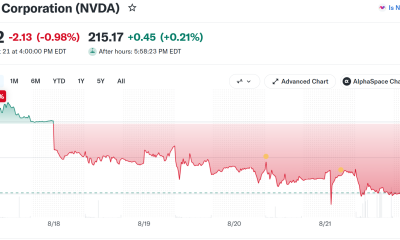
Nvidia Stock Suffers Longest Losing Streak Since 2022: Will Q2 Earnings End It?
-

 Business4 days ago
Moderna CEO warns China is pouring state money into mRNA technology
-

 Business2 days ago
Walmart takes aim at younger shoppers with new fashion brand
-

 Business3 days ago
NVIDIA Stock Drops Nearly 2 Percent to $210 on Seventh Losing Day Ahead of Critical AI Earnings
-

 Tech6 days ago
Unitree’s New Superman Robot Claims to Outjump and Outrun Every Human, Usain Bolt Included
-

 Business6 days ago
Will Tesla Stock Be Higher or Lower a Year From Now? Here’s What Wall Street Analysts Are Saying
-

 Business7 days ago
UK firms in critical financial distress rise 9% to 53,756
-

 Sports5 days ago
Deshaun Watson fires back at Browns fans after being booed: ‘It’s a disrespectful thing’
-

 Crypto World5 days ago
Google Gemini AI Predicts Ethereum Could Become the Trade Retail Misses in 2026
-

 Tech7 days ago
Faster chip in a familiar form factor
You must be logged in to post a comment Login