There’s no question Ohio State’sArvell Reese is one of the best overall players in this draft class. They don’t make many athletes with the size (6-foot-4, 241 pounds), speed (4.47-second 40-yard dash) and positional versatility Reese brings. He finished 2025 with 6.5 sacks and 69 total tackles.
However, the history of players with similar versatility traits isn’t exactly encouraging in the NFL. Isaiah Simmons is on his third team in six seasons, Zaven Collins hasn’t found his footing in Arizona, and plenty of others have struggled to fit at the next level.
While I think Reese is different from those players — there’s a difference between “positionless” and “versatile” — there are still questions about where he plays in the NFL.
Advertisement
More importantly, there’s the financial angle. The fifth-year options and franchise tags for EDGE and off-ball linebacker are the same, but the highest-paid EDGE (Micah Parsons) makes $46.5 million per year — more than the top two off-ball linebackers (Fred Warner and Roquan Smith) combined. Even average EDGE rushers carry more value financially, so if Reese wants to cash in, playing on the edge could be the way to go.
But does that best align with what he does on the field? Let’s dive into the film.
Advertisement
Reese’s power pops immediately on the edge
The first thing that stands out when Reese lines up on the edge is how violent he is with his hands. Players who walk down from off-ball linebacker typically don’t play as heavy-handed as Reese does. He packs serious power into his punches as both a run defender and pass rusher, generating a ton of force for someone who would be considered undersized on the edge.
You can’t block him with a tight end — he’ll obliterate them in the run game. He forklifts players on the edge, using strong pad level to close gaps and funnel backs into traffic. This Illinois tight end stood no chance, getting manhandled into the very gap the running back was attacking.
Watch the Miami tight end’s head snap back on contact. There’s playing with force, and then there’s what Reese showed in his final year at Ohio State. He wrecks the rep with pure power.
This rep against Penn State’s left tackle isn’t perfect, but the force jumps out. His head is down on contact, but his body angle is excellent. He’s in position to stack and shed because he’s attacking with leverage, generating force through his body into the tackle’s chest so he can make a play.
Advertisement
His pass-rush upside is both exciting — and incomplete
Where the rubber really meets the road is Reese’s potential as a pass rusher. Despite being undersized, he generates serious power. You’d expect an off-ball linebacker moving to the edge to win with speed and bend, but Reese’s go-to is converting speed to power and running through tackles.
This is what you would call getting dunked on in the football world:
Here, he faces fellow draft prospect Markel Bell (6-foot-9, 346 pounds) and still turns him with power, prying open the outside corner. The ball comes out before he arrives, but it’s a strong rep that shows what he can already do as a pass rusher.
Again, Reese displaces Illinois’ right tackle with power, knocking him off his feet. It’s not a perfect rep or finish, but it highlights how much force he generates in a 241-pound frame.
Advertisement
Reese also showcases the ability to counter with speed. His pass-rush repertoire is still limited, but the flashes of bend and acceleration are reminiscent of top NFL rushers. Ohio State even schemed one-on-one opportunities, where he would do this to opposing tackles:
While he gets the sack on that rep, another better illustrates his upside. He sells the bull rush, then dips around the outside shoulder and flattens to the quarterback. That’s the kind of nuance he needs to build on.
The issue right now is consistency. He doesn’t have many reliable counters, which makes sense given his background as an off-ball linebacker who also drops into coverage. If he transitions full-time to the edge, his development as a pass rusher may take time.
He could improve by using his hands more actively — swiping at tackles to create cleaner rush paths and turn more pass rush reps into pressures. Against Wisconsin, for example, the tackle sets to cut off the edge. Reese needs to either club the outside hand or counter inside, but he does neither and loses the rep. A more detailed pass-rush plan will be key going up against NFL tackles.
Advertisement
Another area for growth is stringing moves together when his initial rush stalls. That will come with reps and coaching. The upside is clear, but right now he’s a better run defender than pass rusher off the edge.
Reese might be more polished off the ball right now
As an off-ball linebacker, Reese’s violent hands and fluidity really stand out. Even in a defense loaded with megazord athletes, he consistently pops on tape. He simply puts guys on their butts when they try to block him. His explosiveness moving downhill is a delight to watch, and his hand placement and ability to forklift defenders immediately jump off the tape. Just ask this Penn State tight end:
OUCH. His ability to generate force allows him to lift blockers out of the way and stay square to the line of scrimmage while working through traffic. He’s comfortable operating in tight spaces and consistently finds the ball.
One rep against Michigan highlights his instincts. The Buckeyes are in a five-man front, with Reese aligned as the stack linebacker. The defensive lineman in front of him plays his primary gap with the ability to fall back into his secondary, and Reese has to mirror that from depth to keep everyone on a string. He fits into the primary gap, then recognizes the running back bounce to the secondary as the tight end tries to get hands on him. Reese slips underneath the block and closes to make the stop — a great example of his high-level processing and movement ability.
Advertisement
In the passing game, his ceiling is also high — especially as a blitzer. His power translates immediately, as shown when he drives a Texas right tackle back and forces Arch Manning out of the pocket.
Reese is a mismatch against running backs in pass protection and can be used as a penetrator on pass-rush games, using his size and speed to collide with offensive linemen and free up rushers. You can also design looks for him to play iso ball against RBs, where he can crush the pocket.
The main area for improvement off the ball is his spatial awareness in coverage. He has the range and athleticism, but his recognition once receivers enter his zone can improve. He recorded just two pass deflections in his career, rarely getting his hands on the football. Better angles could help — like on a near-play against Wisconsin that could have been an interception.
That said, there are reps where he shows potential. Against Penn State running a Dagger concept, he drops as the middle defender in Cover 2, carries the vertical route, then sinks to disrupt the dig and force a checkdown. That’s the upside.
Advertisement
The biggest question: Where does Reese actually fit in the NFL?
So what is Reese at the next level — linebacker or EDGE? The answer is both. He’s a true hybrid, but not in a way that leaves him without a position. He can be a skeleton key who answers many questions for a modern defense, allowing it to shift fronts and personnel without substituting. Think about what the Eagles do with Zack Baun and Jihaad Campbell — players with the size to play on the edge and the movement skills to stack without being liabilities in coverage. That kind of true versatility is becoming increasingly valuable in the NFL.
If you’re asking where he makes the most immediate impact, it’s probably as an off-ball linebacker. His coverage still needs refinement, but as a run defender and blitzer, he already fits what modern defenses want.
Still, he shouldn’t be boxed in. Let him dictate fronts and structures — that’s how he blossoms into the centerpiece of a modern NFL defense.
NYON, Switzerland — German referee Daniel Siebert was picked Monday by UEFA for the Champions League final after FIFA left him off its World Cup list.
The game between Arsenal and Paris Saint-Germain on May 30 at Puskas Arena in Budapest will be Siebert’s 10th in the Champions League this season — and the third straight round he will have worked an Arsenal match.
Siebert handled Arsenal’s 1-0 wins at Sporting Lisbon in the quarterfinals first leg, and at home to Atletico Madrid in the semifinals second leg.
He refereed PSG once this season, in a league phase game at Athletic Bilbao that ended 0-0.
Advertisement
In his nine Champions League games this season Siebert has shown two red cards and awarded just one penalty kick.
Players are not the only members of Ohio State football getting work done before the 2026 season.
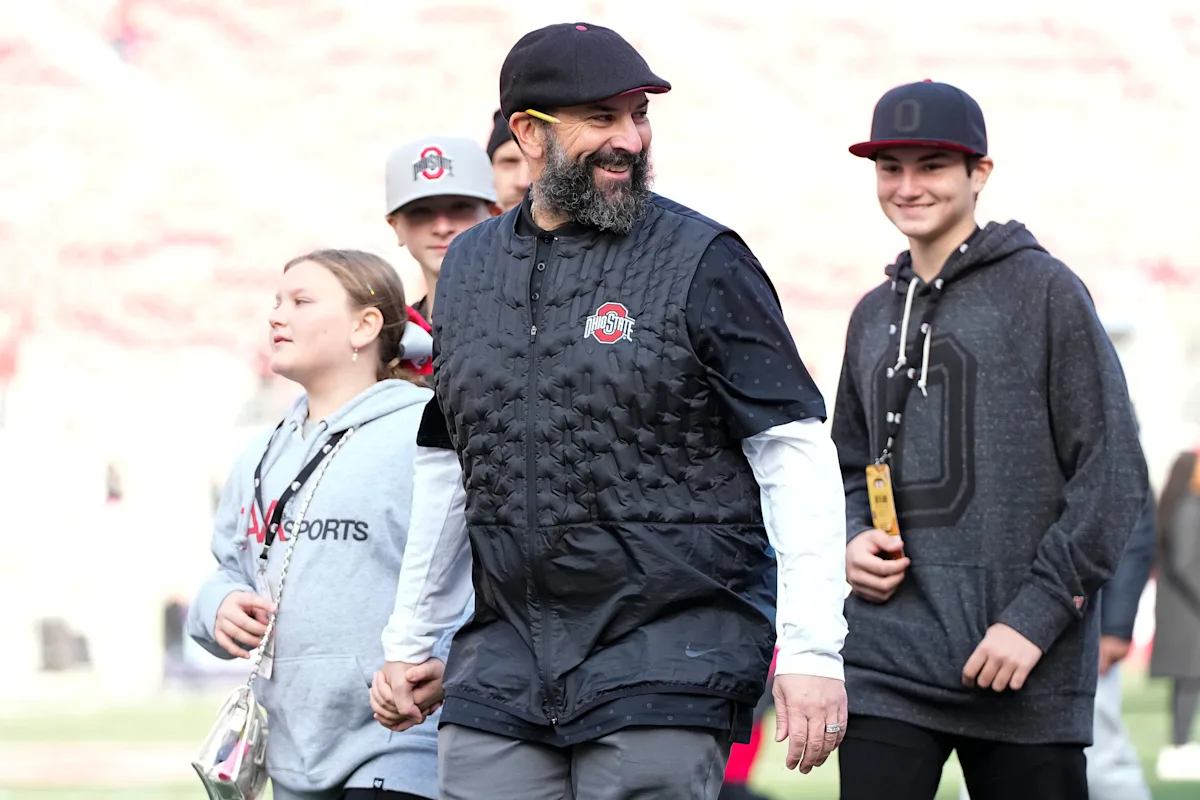
On May 9, Buckeyes defensive coordinator Matt Patricia posted a photo on Instagram in a neck brace and lying on a hospital bed, wearing his signature flat cap with a smile.
Advertisement
“Off-season repairs aren’t just for players. Massive thanks to Dr Viljoen and the Neurological Specialty Care team for taking care of me. Incredible group! So blessed and thankful for you,” Patricia wrote in the post.
Advertisement
Patricia did not reveal details. He thanked Dr. Stephanus Viljoen, an Ohio State neurosurgeon specializing in spinal surgeries and back pain, according to his OSU profile.
The German official has been appointed by the Uefa Referees Committee and will be tasked with officiating one of the biggest games in football at the Puskas Arena on Saturday, 30 May.
The 42-year-old has 11 years of experience since beginning his career in 2015 and brings experience from nine Uefa Champions League matches from this season alone.
Siebert was the referee in the quarter-final first leg between Sporting Lisbon and Arsenal, one of two games officiated this term with the Gunners, who ran out 1-0 winners on that night.
He was also in charge in the semi-final second leg between Arsenal and Atletico Madrid, another 1-0 win for the Gunners, which will appeal to Gunners fans ahead of the match.
Advertisement
Siebert is yet to show a yellow card to an Arsenal player, and has shown just three yellow cards across both matches. While he has also officiated one PSG match this season; the goalless draw at Athletic Bilbao in December, where he brandished four yellow cards.
Siebert averages more yellow cards on average overall, with 4.44 per game from nine games in the Champions League this term, according to Who Scored, and 0.22 red cards per game. That’s up from his Bundesliga average, from 15 games this term, with 3.20 yellow cards per game and 0.13 red cards per game.
Further experience comes from last year’s Uefa Europa League semi-final between Manchester United and Athletic Bilbao, and he also officiated two games at the Uefa Euro 2024 and three games at Uefa Euro 2020.
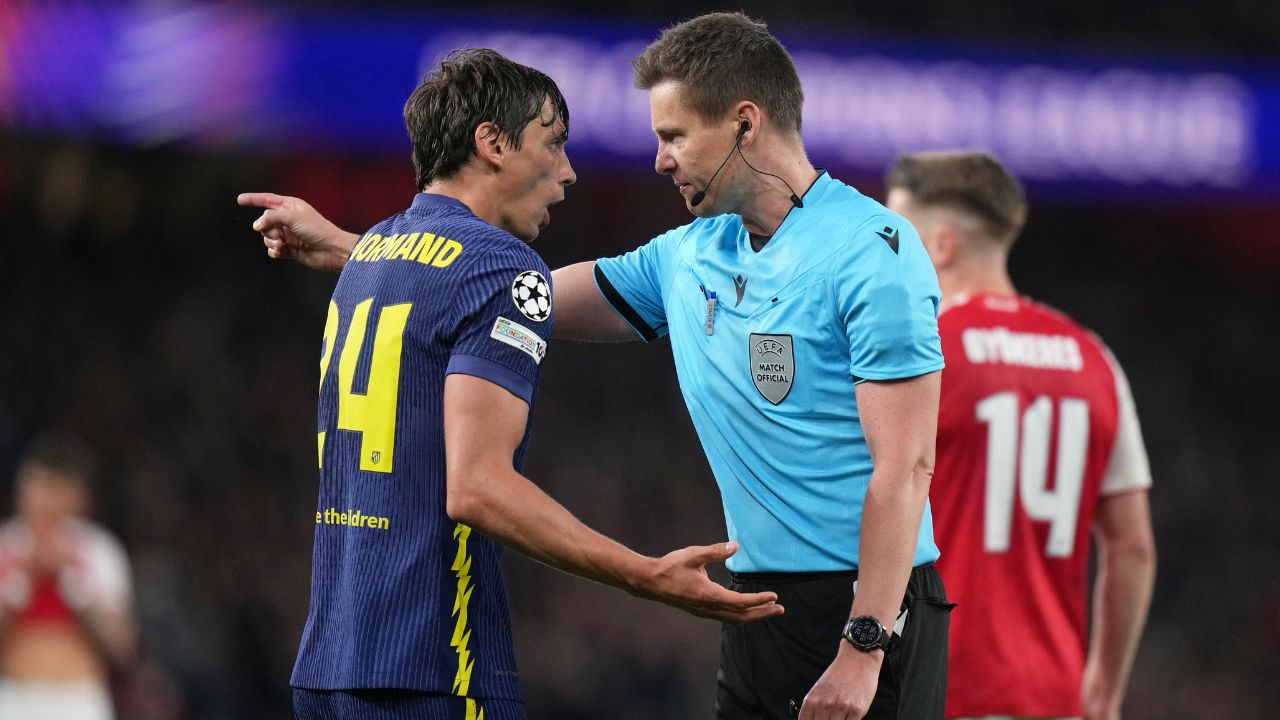
Atletico Madrid’s Robin Le Normand speaks to Referee Daniel Siebert (AP)
Following Arsenal’s victory over West Ham, and the high-profile VAR incident that ruled out Callum Wilson’s equaliser for the Hammers, Mikel Arteta has publicly confessed his admiration for the pressure officials operate under.
Notably Chris Kavanagh and how he observed 17 replays over four minutes and 17 seconds before deciding to rule out the goal due to Pablo’s arm impeding David Raya.
Advertisement
“When I had to be critical, I have been,” Arteta told Sky Sports. “Today I have to congratulate them [VAR]. You needed a lot of courage and bravery to stand out and give the opportunity to the referee to have a look at the action.
“When you see the picture, there is no question that it is a clear foul. They were very brave. The action deserved that. In my opinion, it is very clear. They are the rules and we ask for consistency.”
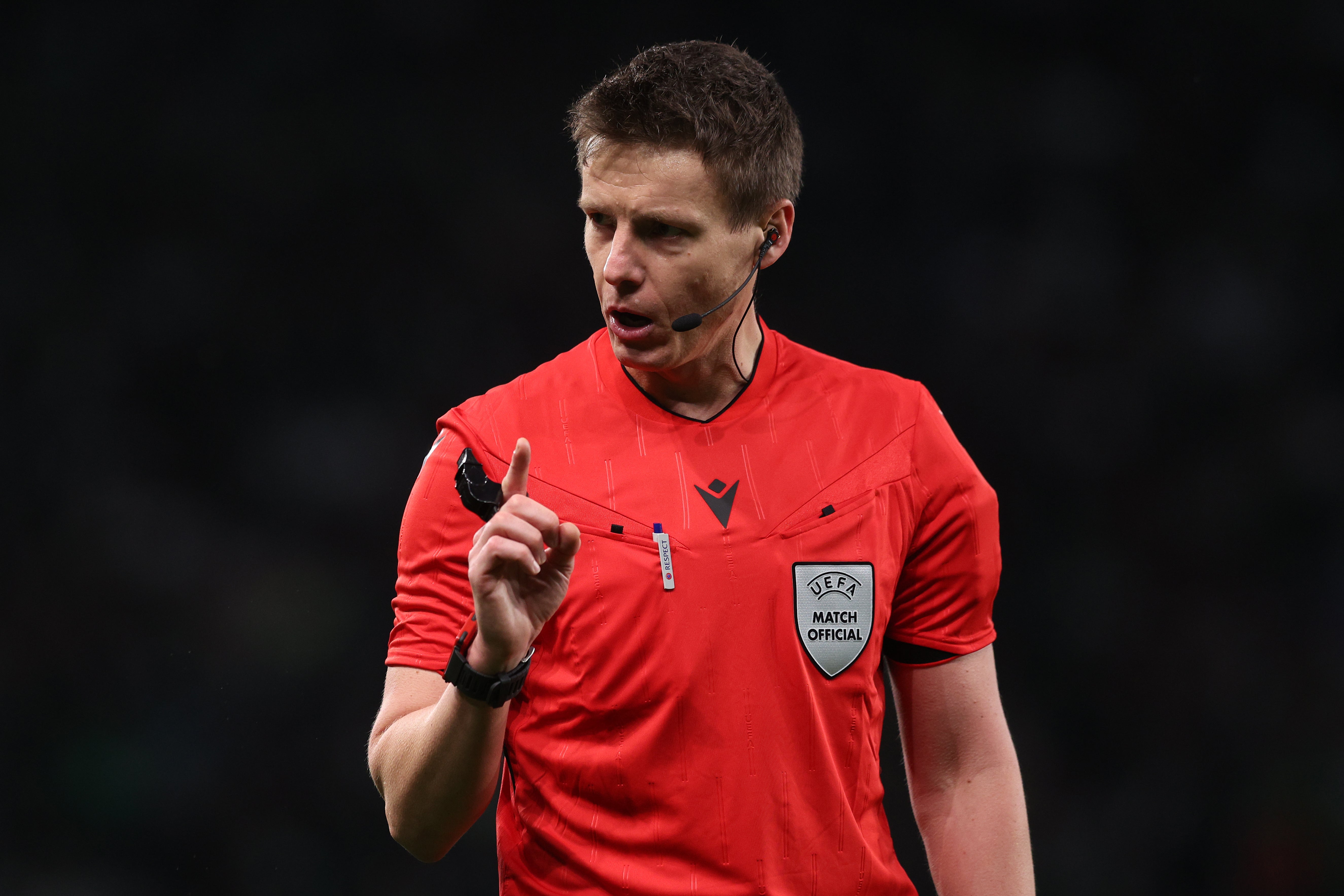
Referee Daniel Siebert gestures during Sporting v Arsenal in the Champions League quarter-finals (Getty Images)
Uefa Champions League final 2026 refereeing team
Referee: Daniel Siebert (Germany)
Assistants: Jan Seidel and Rafael Foltyn (both from Germany)
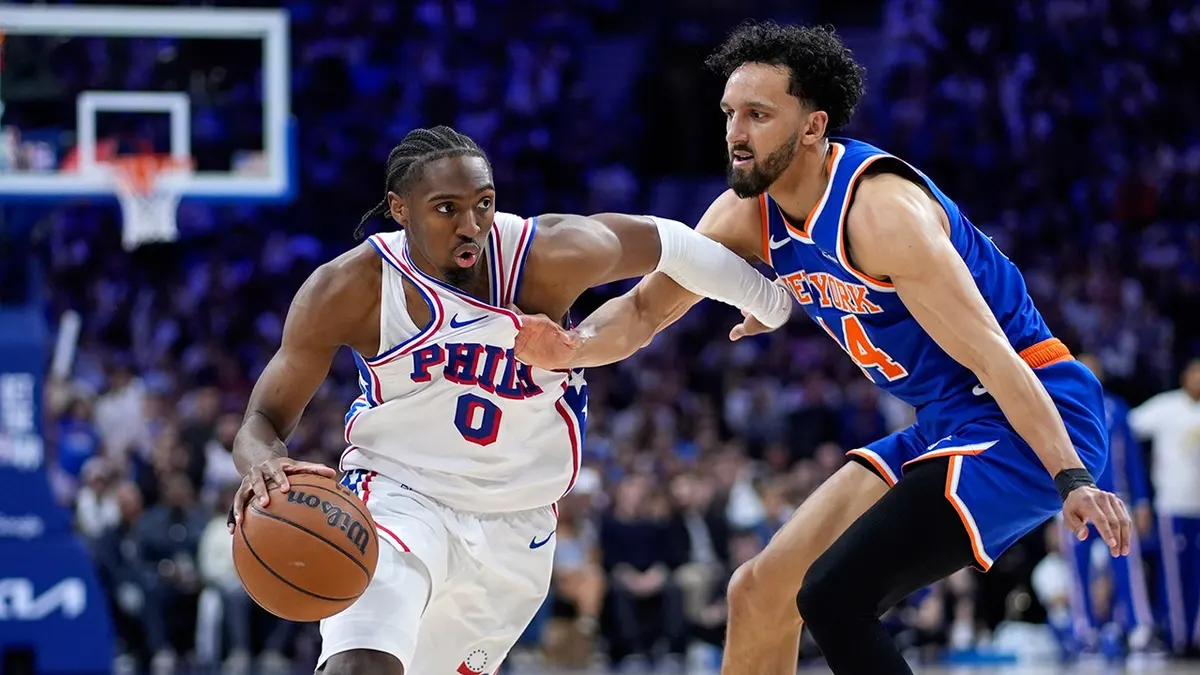
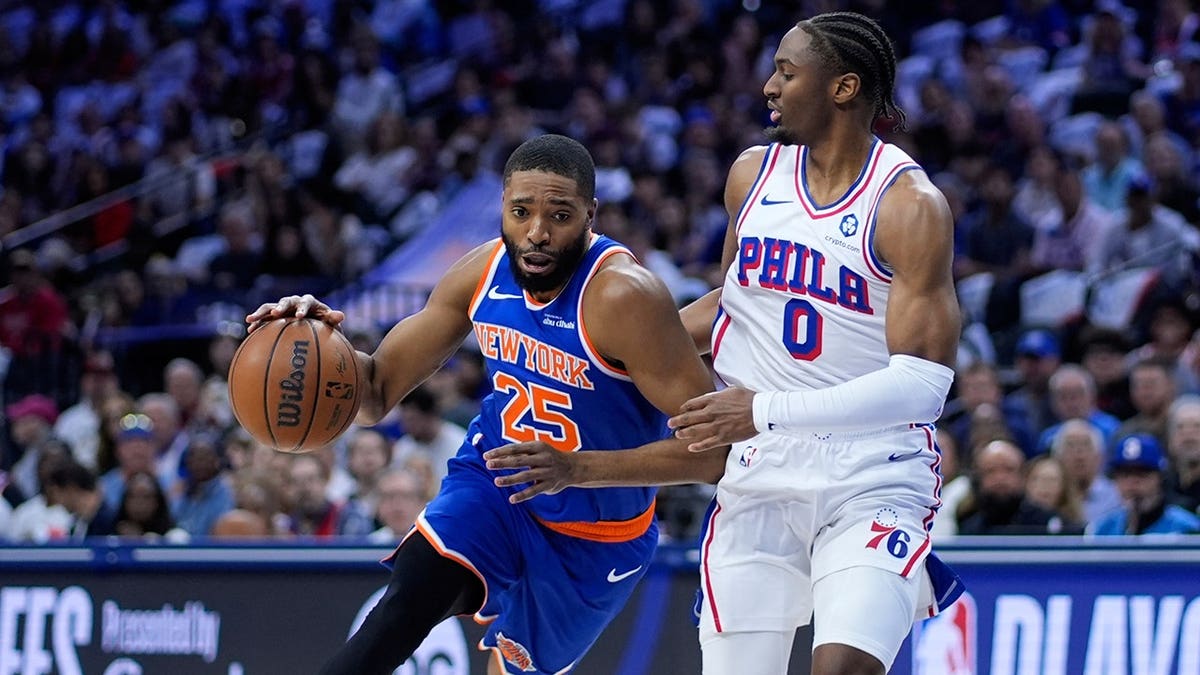
Philadelphia 76ers star Tyrese Maxey was downcast after falling to the New York Knicks in Game 4 on Sunday night, leading to an early second-round playoff exit.
Maxey appeared to be more upset with the fan support.
Philadelphia 76ers’ Tyrese Maxey tries to get past New York Knicks’ Landry Shamet during the second half of Game 3 in a second-round NBA playoff series in Philadelphia on May 8, 2026.(Matt Slocum/AP)
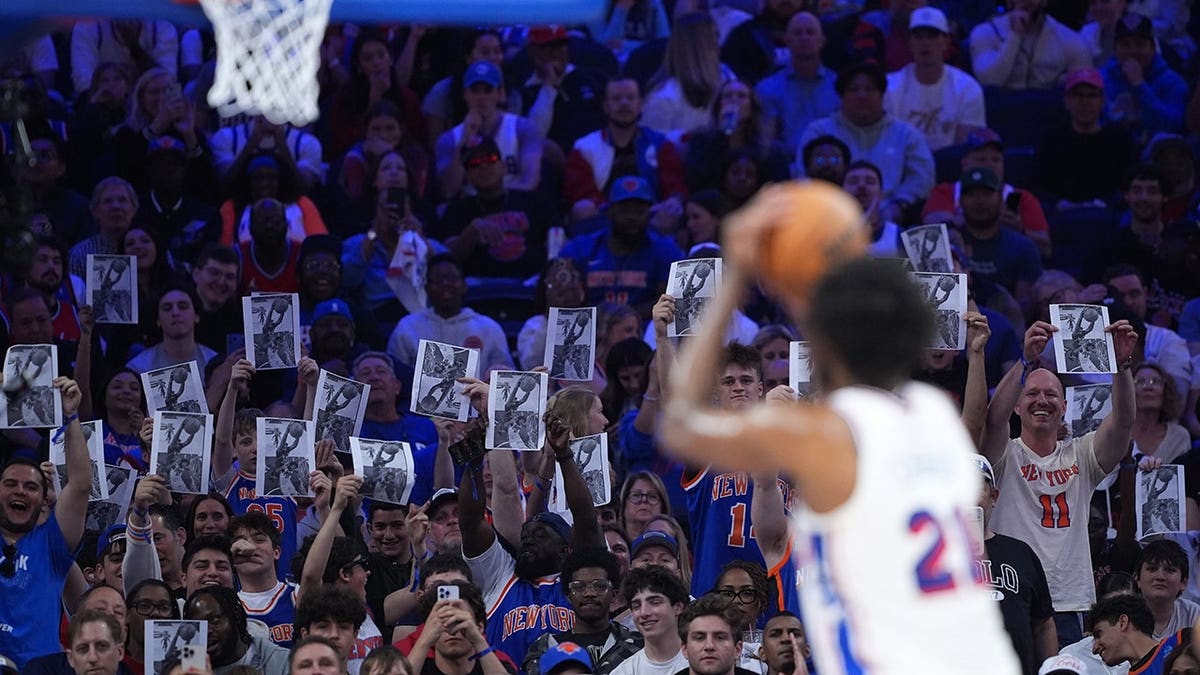
Knicks fans swarmed the Xfinity Mobile Arena in Philadelphia for both Games 3 and 4. They got a front-row seat to watch their team sweep their Atlantic Division rival. Knicks fans even went as far as infiltrating local news broadcasts in celebration.
Maxey spoke about the fans in his postgame press conference.
“It absolutely sucks, if I’m being honest. It just sucks,” he said, via SNY TV. “That’s really all I can say about it, man. It’s hard. It’s definitely difficult. It’s only one way to put a stop to it and it’s, we have to go out there and win these games.
Joel Embiid of the Philadelphia 76ers shoots a free throw during the first half of Game 4 against the New York Knicks in the second round of the NBA playoffs in Philadelphia on May 10, 2026.(Matt Slocum/AP)
“Just being completely honest, we were better when we played them in the Garden this entire season. I know we lost Game 2 and 1, but Game 2 was better. The regular season was better. I was telling them, it felt louder here for them than it did in the Garden.”
He said it was up to the team to drown out the noise.
“We got to put a stop to it as a team,” Maxey added. “Winning these games, that’s gonna make our fans louder than theirs or whatever. I don’t know how to keep them out. I don’t know the logistics of it, but it does suck. I can’t even lie. It definitely does suck.”
New York blew the doors off Philadelphia in Game 4 with a 144-114 win.
Advertisement
Tyrese Maxey of the Philadelphia 76ers defends Mikal Bridges of the New York Knicks during the first half of Game 4 in the second-round NBA playoffs in Philadelphia on May 10, 2026.(Matt Slocum/AP)
It was the eighth time in the last nine playoff appearances that the 76ers haven’t at least made it to the Eastern Conference Finals. Philadelphia hasn’t gotten that far in the postseason since making the 2001 NBA Finals.
Ryan Gaydos is a senior editor for Fox News Digital.
Vancouver Canucks legends Daniel and Henrik Sedin could be taking on a larger role with the team’s front office.
On the latest episode of the 32 Thoughts podcast published Monday, Sportsnet’s Elliotte Friedman provided the latest news on the Sedin twins.
“I think Monday could be a big day for the Canucks. Maybe not in terms of an announcement but in terms of an internal decision being made, and possibly an idea of how the structure is going to work,” Friedman said. “I do think the Canucks have asked the Sedins if they want to take more of a role, and how willing they would be in taking a greater role …
“I don’t know what the titles would be in Vancouver if this is accepted, but I do believe that (the Canucks) have talked to the Sedins about taking a larger role, and they were pondering the idea. … I think the Sedins’ role in this could be important if they decide to accept the mission as it’s been presented to them.
Advertisement
“So, I think we’re kind of awaiting two decisions here. No. 1, who the head of hockey operations will be. And, No. 2, are the Sedins willing to take a bigger role? And, you know what, now that they’ve seen how it might work in Toronto — you know, (Mats) Sundin had to move from Sweden to Ontario — the Sedins are already there. It’s not like they would be uprooting their families. So, I think it just comes down to time and how are they feeling. I think it would be a great thing for the Canucks if they get it. Obviously, it’s their decision.”
32 Thoughts: The Podcast
Hockey fans already know the name, but this is not the blog. From Sportsnet, 32 Thoughts: The Podcast with NHL Insider Elliotte Friedman and Kyle Bukauskas is a weekly deep dive into the biggest news and interviews from the hockey world.
The Sedins currently have roles in the Canucks’ player development department, but could look to move up in the organization with Jim Rutherford stepping down as president of hockey operations and Patrick Allvin having been fired as general manager.
The Sedins rank first and second on a number of all-time Vancouver stats lists, including games played, points and assists. They were taken back-to-back by the Canucks with the second and third picks in the 1999 NHL Draft and spent their entire careers in Vancouver.
History for Rashford, becoming the first Englishman to win LaLiga with Barca, and joining what remains a select group to triumph with anyone, alongside Laurie Cunningham, David Beckham, Kieran Trippier and Jude Bellingham. If the circumstances were different, it would surely prompt Barcelona to take up the €30m option to turn his loan into a transfer.
Although, were the circumstances different, Rashford may not have got the move to Camp Nou he seemed to covet when his relationship with United broke down; the Catalan club were also interested in the costlier Luis Diaz and Nico Williams last summer. Rashford seemed like Plan C, available without an immediate transfer fee in part because of United’s inability to sell him.
Marcus Rashford helped Barcelona wrap up the title in style (Reuters)
He has nevertheless been a success as a high-calibre squad player, his outings split almost equally between starts and substitute appearances. A tally of 14 goals in 47 games is decent, if unexceptional. More impressive, though, is that he also has 14 assists, giving him 28 goal contributions, an average of one every 87 minutes on the pitch. There is an argument that Rashford has been flattered by the figures and, unlike United, Barcelona have been in Europe, but he has as many goal involvements this season as Bruno Fernandes.
Which, in its own way, may offer an insight into what United are missing. Though arguably not missing too much, given that they have qualified for the Champions League and have taken the most points in the Premier League since Michael Carrick’s return to Old Trafford.
Yet that has been built on a small core. With European commitments next season, United require more players. It is also evident they need attacking reinforcements; it was clear even before Joshua Zirkzee laboured ineffectually in Saturday’s stalemate at Sunderland to show why he is not good enough.
Advertisement
Joshau Zirkzee was largely ineffective against Sunderland (PA Wire)
Their squad, reshaped by Ruben Amorim in his quest to play a 3-4-3 that didn’t suit Rashford – or virtually anyone else, for that matter – does not contain a natural left winger. Patrick Dorgu started Carrick’s reign there, acquitting himself well before getting injured, but it remains to be seen if that was a short-term gambit or a long-term strategy. Matheus Cunha has occupied the role more often, but is essentially a No 10. Fernandes and Bryan Mbeumo have taken turns there. Rashford would have the potential to be a regular.
Meanwhile, Benjamin Sesko is the only specialist No 9 in the squad and if Rashford probably would not describe himself as such, he is better qualified to fill the role than anyone else on United’s books, with the exception of Rasmus Hojlund, whose loan to Napoli is set to become a permanent deal.
As United’s recruitment drive last summer shows, when they spent around £200m on Cunha, Sesko and Mbeumo, they can end up paying at least £60m for forwards; the club would concede that they paid towards the upper end of their valuations for players who, in some cases, are less gifted than Rashford.
Rashford has impressed as a starter and a substitute for Barca (Reuters)
And selling him for €30m would represent a figure at the lower end of his valuation, even accounting for his sizeable wages and the fact he turns 29 in October. The numbers have significance when the summer spending has to be focused on the midfield, with what might be a £200m rebuild, with at least two signings required and preferably three. They may want other additions, too: perhaps a left-back, unless Dorgu is pencilled in for defensive duties.
Meanwhile, there is no guarantee that Barcelona, their funds ever tight, their preference for trying to get quality players on the cheap, their greatest need arguably for an out-and-out centre forward to replace Robert Lewandowski, would even try to buy Rashford anyway. They may prefer the brinkmanship of aiming to borrow him again.
The sense has been that Rashford feels his United career is over, even beyond the feeling his first choice is to be at Barcelona. Certainly, there may be some at Old Trafford and in the fanbase who do not want him to return. As things unravelled in the 18 months following his outstanding campaign in 2022-23, there were more incidents beyond those that got into the public domain.
Advertisement
Things fell apart for Rashford at Old Trafford (Getty)
But it was nevertheless true that he was exiled with remarkable speed by Amorim, whose United then scored very few goals. It was a damaging decision, but Amorim is gone. Carrick is a former teammate and coach; indeed, no player scored more goals or got more assists for Ole Gunnar Solskjaer’s United than Rashford.
Last month, United’s temporary manager said no decision had been made on Rashford. Nor on Carrick either, perhaps, though he is likely to get the job on a lengthier basis. And if he provided a non-answer last week, Rashford may yet be a logical answer for United.
Some bridges may have to be rebuilt, but he is a scorer of 138 United goals, a player good enough to excel for Barcelona. They are not obliged to give him to the new champions of Spain on the cheap. Especially not when he could fill in at least two gaps in United’s plans for next season.
She suffered a serious knee injury when she ruptured her anterior cruciate ligament in November 2022 and was forced to miss the 2023 World Cup in Australia and New Zealand.
Mead came on as a substitute in her side’s Champions League final against Barcelona last season and, in one of her “greatest highlights in an Arsenal shirt”, set up the winner for Stina Blackstenius as Arsenal won the title for the first time in 18 years.
This season, she has made 27 appearances in the WSL and Champions League, with 11 of those as a substitute, and scored five goals.
Advertisement
Arsenal have also announced Victoria Pelova, who joined them from Ajax in January 2023, will be leaving the club at the end of the season.
The midfielder has made 87 appearances for the Gunners, scoring six goals.
Peter Schmeichel has slammed the VAR decision to disallow West Ham’s last-gasp equaliser against Arsenal, accusing the Gunners of set-piece hypocrisy as they close in on the Premier League title
Leandro Trossard struck in the 83rd minute at the London Stadium to hand Arsenal a crucial advantage in their pursuit of the Premier League title. Drama then unfolded when Callum Wilson appeared to snatch a 95th-minute equaliser for the Hammers, who are desperately battling to avoid the drop.
Advertisement
West Ham’s celebrations were swiftly cut short as VAR scrutinised replays of the incident before recommending an on-field review. Pablo was spotted gripping Raya’s arm as he leapt for the ball, with referee Chris Kavanagh subsequently ruling the goal out.
Get MEN Premium now for just £1 HERE – or get involved in our City WhatsApp group by clicking HERE. You can also join our City Facebook page by clicking HERE and don’t miss out on our brilliant selection of newsletters HERE.
However, Schmeichel, the iconic former Manchester United goalkeeper who also played for Manchester City, argued that Arsenal — the Premier League’s most prolific side from set-pieces — would be nowhere near the summit of the table if such actions are to be considered a foul.
“That decision today, it’s just so wrong on so many levels,” the Dane told Viaplay. “What really makes me angry is that Arsenal would never be top of the league if that’s a free kick.
Advertisement
“That’s how they’ve scored so many goals by blocking people, holding people, doing all kind of things, and then we get to this point… it takes VAR five minutes.
“Darren England the VAR official, (it takes him) five minutes. He starts the replay over and over again. That in itself puts so much doubt into that decision. It cannot be a free kick, it cannot.”
Schmeichel added: “I think it’s so wrong, I just don’t understand why all of a sudden that’s a free kick, because it’s not been for any teams all the way throughout the season.
Advertisement
“All of this, it’s just crazy, and that decision today is just so wrong on so many levels.”
FA Cup final VIP tickets for Man City vs Chelsea
This article contains affiliate links, we will receive a commission on any sales we generate from it. Learn more
Seat Unique offers hospitality packages for Manchester City’s FA Cup final clash with Chelsea, including ‘premium’ seats at Wembley and complimentary food and drink.
Schmeichel wasn’t the only one challenging VAR’s intervention, with West Ham captain Jarrod Bowen expressing similar sentiments in his post-match remarks.
Mikel Arteta, however, commended the match officials for their courage in reaching such a significant decision. He said: “A call from the refs that I think is very brave, but very consistent with what they’ve been talking about all season.
“So when I have to be critical, I have been. And it is a free kick and the goal has to be disallowed. So congratulations because they made a big call in very, very difficult circumstances.”
TORONTO — After an encouraging start to the weekend, Sunday’s loss to the Angels raised at least two significant questions for the Toronto Blue Jays.
The health of their right fielder is now in doubt, and they continue to seek answers in their fifth rotation spot. With those challenges looming large, the Blue Jays must now navigate a three-game series against a Tampa Bay Rays team that swept them just last week.
As the Blue Jays prepare to host the Rays on Monday (Sportsnet, Sportsnet+, 6:30 p.m. ET / 3:30 p.m. PT) for three games at Rogers Centre, let’s take a closer look at a few of the bigger questions they’re now facing:
What’s Barger’s status?
Advertisement
Two hours before first pitch Sunday afternoon, the Blue Jays announced that Addison Barger would miss the game due to right elbow soreness. The 26-year-old woke up with reduced range of motion leading to an MRI Sunday afternoon.
“With how important he is to us, we wanted to be careful,” manager John Schneider said.
MLB on Sportsnet
Watch the Toronto Blue Jays, Blue Jays Central pre-game, marquee MLB matchups, Jays in 30, original documentaries, the wild card, divisional series, championship series and entire World Series on Sportsnet and Sportsnet+.
The absence impacts the team on a couple fronts. First, Barger can really slug, as we saw last year when he hit 21 home runs and 32 doubles. That power is needed within a lineup that ranks 21st in home runs among the 30 MLB teams.
And second, Barger’s throwing arm was a welcome addition to the outfield defence Saturday as he prevented Jorge Soler from scoring with a throw clocked at 101.2 m.p.h. His arm — and even the threat of his arm — changes the way opposing teams run the bases, and no one else on the Blue Jays’ roster offers comparable outfield arm strength.
Advertisement
If this was clearly a day-to-day issue, there would be no reason to send Barger for an MRI, but evidently other possibilities are in play. Either way, the Blue Jays will know more Monday.
Hustling toward an identity?
Elsewhere on the position player front, Daulton Varsho scored the Blue Jays’ lone run of the game Sunday after reaching on an infield hit in the first inning.
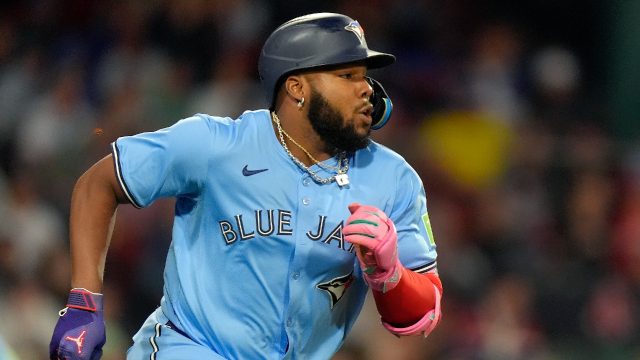
Without a full effort-run, he wouldn’t have reached base, but his hustle allowed him to reach and score. Later, in the eighth, Myles Straw and Varsho both reached on infield hits and while neither scored and Varsho jammed his heel a bit at first, the baserunning helped load the bases for Vladimir Guerrero Jr.
Advertisement
This is the kind of effort Schneider wants to see every day and he made a point of saying as much this weekend. It’ll be telling which players take the hint.
How to proceed with Lauer and Miles?
Along with Barger’s health, the other big question to emerge from the weekend was what the future holds for Eric Lauer, Spencer Miles and the fifth spot in the Blue Jays’ rotation.
Starting in the major leagues for the first time ever, Miles pitched three scoreless innings Sunday while allowing two hits and striking out two. His fastball averaged 96.5 m.p.h. as he built his way up to 38 pitches, his most since April 11.
Advertisement
Lauer, on the other hand, allowed six runs, including three home runs, in five innings, while striking out four. He threw 80 pitches — nearly a starter’s workload — while averaging 90.7 m.p.h. with his fastball.
Afterward, he acknowledged he has work to do, regardless of what role he fills from here.
“I don’t think by any means I’m a shoo-in for a rotation spot, that’s for sure,” Lauer said. “I know I want to help the team in the best way I possibly can.”
So, how to proceed? While Lauer was an essential part of the 2025 team, his velocity’s down by about 1 m.p.h. and his home run rate has spiked to 2.7 per nine innings. With an ERA of 6.69 after eight turns in the rotation, he’s been given a fair chance and it’s not working the way anyone would have hoped.
Advertisement
If Max Scherzer or Jose Berrios were healthy, they’d be in that spot. Under the current circumstances, the conversation remains open-ended — and must now include Miles.
Schneider said he believes Miles has some important building blocks needed for starting pitchers — that is, the pitch mix, quality of stuff and command needed to work through a lineup more than once. And when the manager told Miles about his assignment ahead of Sunday’s outing, he was careful with his wording.
“I told him he would start,” Schneider recalled. “I didn’t say he would open, (I said) he would start. We just wanted to see how he went.”
Even so, that doesn’t mean it’d be simple to turn the Rule 5 pick into a starting pitcher. His season high in pitches is 43. His career high in innings is 21 — as in the 21 he’s pitched this season. Ramping him up recklessly can’t be the answer here after two significant surgeries but he’s open to the idea of building his pitch count further.
Advertisement
Asked about starting, he said: “I definitely think I can still do it down the road.”
How far down the road? A week from now? A year? Miles sounds open-minded.
“I’m totally capable,” he said. “I mean, I’m just here to do whatever they ask. I’m a Blue Jay.”
There are no guarantees here, but a cautious, deliberate ramp-up is an intriguing possibility for a team with many injured starters.















































You must be logged in to post a comment Login