
Crypto World
Bitcoin (BTC) Eyes $80K Rally Despite Geopolitical Headwinds and Market Volatility

Key Highlights
- Bitcoin declined approximately 1%, hovering around $70,712, following reports that Trump privately informed advisors of his desire to conclude the US-Iran conflict within a four to six-week timeframe.
- Tehran dismissed American ceasefire proposals, introducing additional uncertainty into diplomatic negotiations and weighing on risk-sensitive assets.
- Approximately $16 billion worth of Bitcoin and Ethereum options contracts are approaching expiration this Friday, creating near-term market headwinds.
- Chart analysts are monitoring a possible advance toward $80,000, with critical resistance positioned at $71,500.
- Market observer Ali Charts highlighted that speculative investors have exited Bitcoin positions, with the realized cap for new holders reaching levels historically correlated with accumulation cycles.
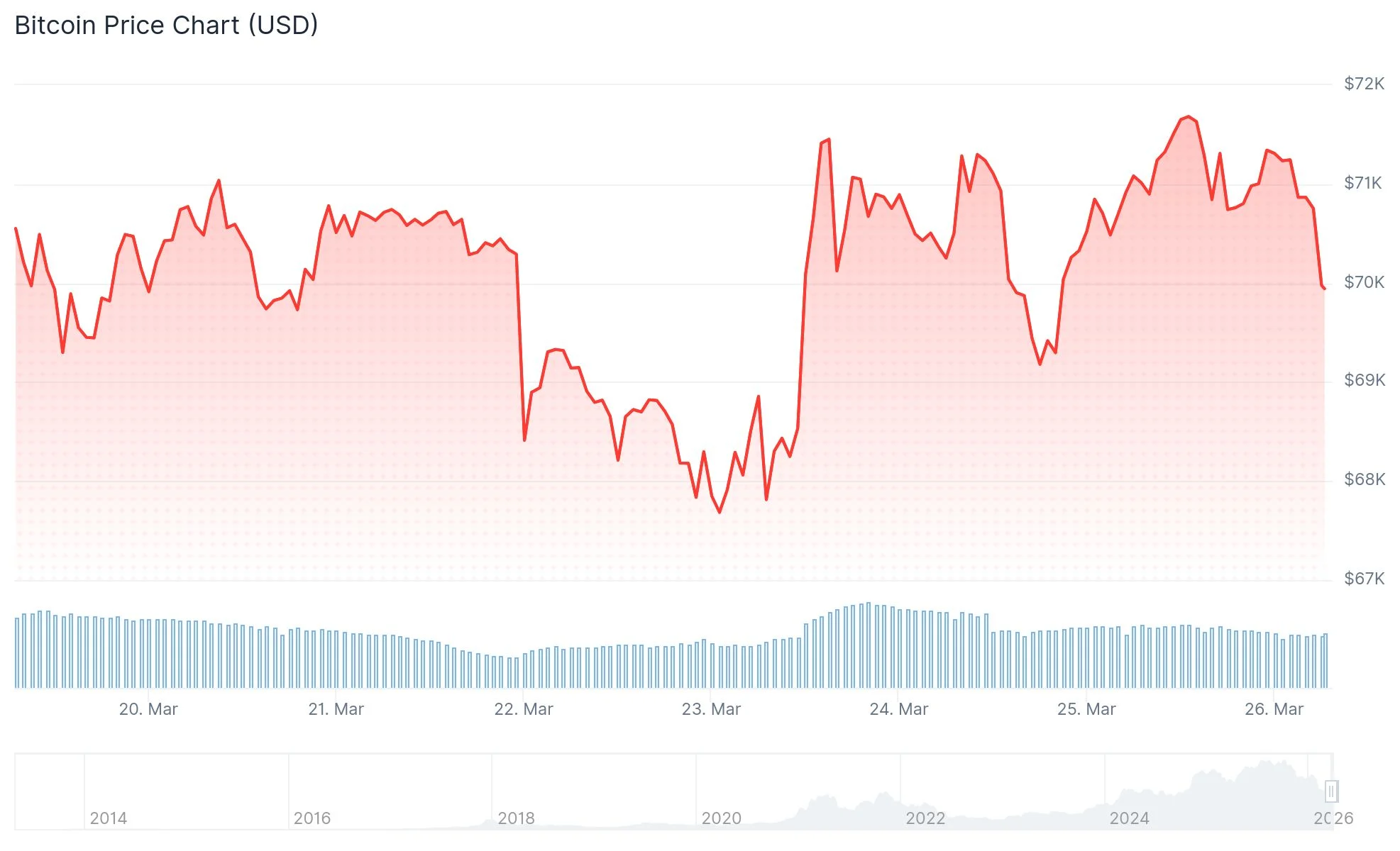
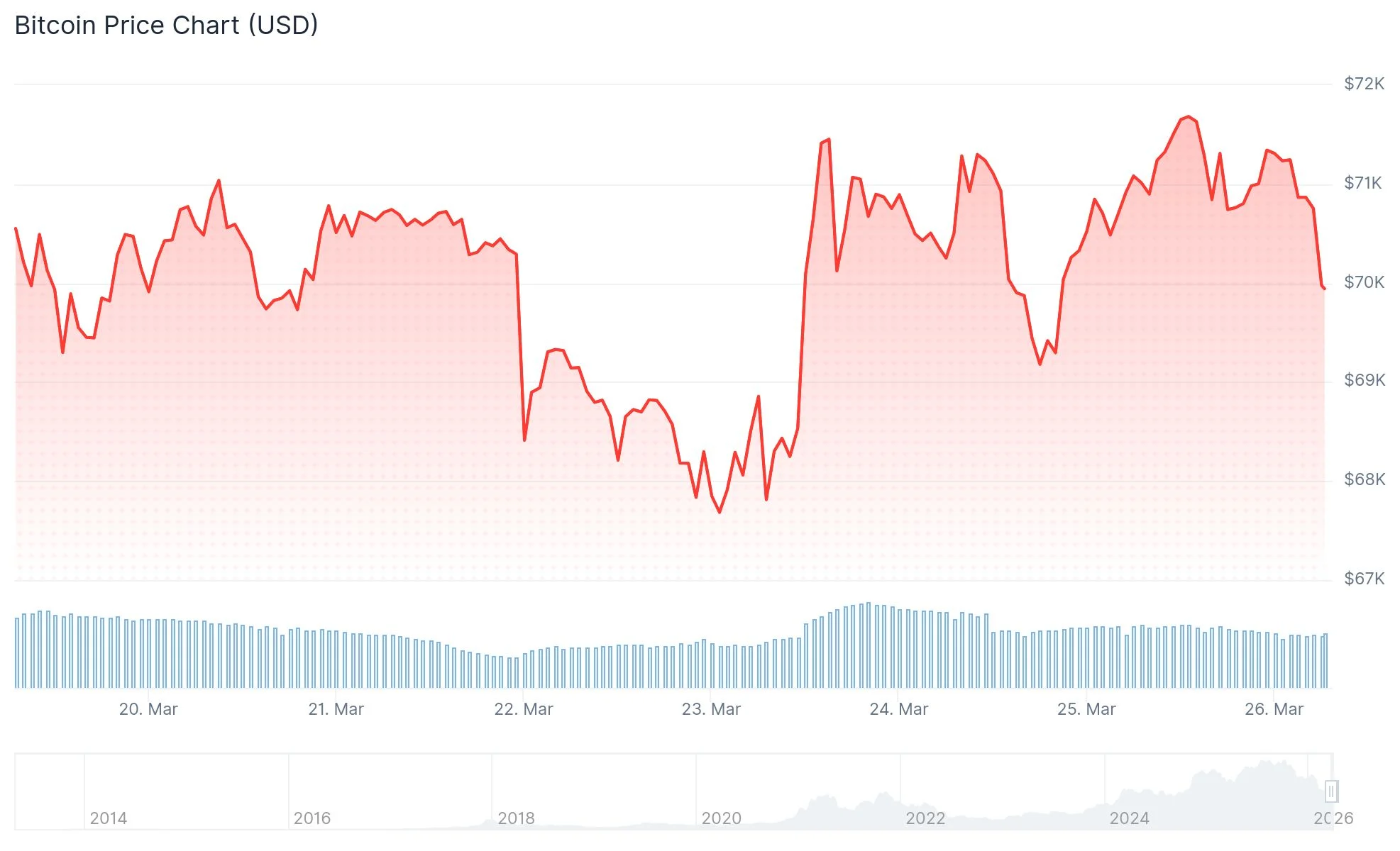
Bitcoin continues hovering around the $70,000 threshold as international political developments generate near-term volatility in cryptocurrency valuations.
According to reporting from The Wall Street Journal, President Donald Trump has privately communicated to his inner circle his intention to wrap up the ongoing US-Iran military engagement within a four to six-week window. Trump reportedly believes the confrontation is approaching its conclusion and seeks resolution ahead of a scheduled mid-May diplomatic meeting with Chinese President Xi Jinping in Beijing.
Initially scheduled for late March, Trump’s China visit was postponed to May. He reportedly expressed to confidants that the war is diverting his focus from domestic priorities, including preparations for upcoming midterm elections and advocacy for the Safeguard American Voter Eligibility (SAVE America) Act.
Following this development, Bitcoin experienced a roughly 1% decline on Thursday, settling at $70,712. The digital asset fluctuated within a 24-hour band spanning $70,558 to $71,985.
Tehran Dismisses American Peace Proposals
Iran rejected the ceasefire framework proposed by Washington, instead presenting its own requirements for conflict resolution. These stipulations encompass the elimination of all American economic sanctions, financial reparations for conflict-related damages, expanded authority over the Strait of Hormuz, continuation of its ballistic missile initiatives, and assurances preventing future US military intervention.
White House spokesperson Karoline Leavitt issued a forceful statement: “The U.S. will hit Iran harder than they have ever been hit before if Tehran doesn’t make an agreement to end the conflict.”
The diplomatic impasse intensified market ambiguity. Bitcoin had previously experienced upward momentum based on de-escalation expectations, but Iran’s refusal reversed investor sentiment.
Escalating crude oil valuations compounded market pressure, as energy economics have proven to be a significant factor influencing how cryptocurrency markets react to Middle Eastern geopolitical developments.
Derivatives Expiration and Trading Metrics
Over $16 billion in Bitcoin and Ethereum options contracts are scheduled to reach maturity on Friday, an event that has traditionally generated short-duration price fluctuations. Derivatives metrics indicated BTC open interest climbing by $500 million to reach $16.5 billion during the past 24-hour period, while funding rates shifted into positive territory at 0.03%.
Notwithstanding this activity, the recent price movement was predominantly futures-market driven. Spot exchange participation remained subdued, evidenced by a cumulative volume delta of negative $87 million and a declining Coinbase premium indicating weakened American investor demand.
Market analyst Skew characterized Bitcoin’s present situation as a “compression zone,” where contracting price movement could precipitate a significant directional breakthrough. To achieve a sustainable advance beyond $71,500, he emphasized the necessity for robust spot market demand, consistent accumulation patterns, and successful absorption of selling pressure.
A $60 million buy order was executed during the New York trading window, demonstrating some renewed purchasing interest, although analysts emphasize that sustained follow-through remains essential.
Analyst Ali Charts observed on X that Bitcoin’s realized capitalization for recent holders has declined to levels historically associated with the elimination of speculative participants, which in previous market cycles has foreshadowed accumulation periods.
BTC open interest currently registers at $16.5 billion, with the $71,500 threshold remaining the critical level market participants are monitoring.




Top trending stories this week were centered on politics, market stress, geopolitics, memecoin chatter, and yield-focused positioning.
Summary
- David Sacks moved to a broader advisory role as crypto traders tracked shifting Washington influence.
- Risk-off selling, Circle worries and oil gains kept traders focused on market positioning this week.
- Memescope Monday and cash-yield strategies showed traders balancing viral hype with capital preservation this weekend.
Santiment social data showed that traders entered the weekend watching David Sacks’ White House transition, a fresh risk-off selloff, new tech security fears, “Memescope Monday,” and a broader move toward cash and income strategies.
David Sacks transition draws early attention
Santiment listed the David Sacks transition as one of the main stories in crypto discussion. Sacks stepped down from his White House AI and crypto role after reaching the 130-day limit for special government employees.
Moreover, Sacks is moving into a broader advisory role as co-chair of the President’s Council of Advisors on Science and Technology. That shift moves him away from a direct crypto policy post and toward a wider technology brief.
Risk-off selling stays at the center of market talk
Santiment said traders spent Friday discussing another risk-off move across tech and crypto. Meta shares fell after jury verdicts raised concerns about new legal exposure, while separate market coverage showed ARK Invest using Kalshi prediction market data as a risk tool.
The same social theme also included worries around Circle and USDC after debate over stablecoin reward limits in the CLARITY Act. Recent market reporting said those concerns pushed Circle shares sharply lower earlier this week.
Geopolitics and AI security concerns widen the focus
Santiment said market nerves also rose as geopolitical tension and tech news collided. Oil prices rose on Friday as traders doubted the chances of a ceasefire in the Iran war, while social chatter tracked the effect on broader risk assets.
At the same time, concern around Anthropic’s “Claude Mythos” spread across markets. Leaked details described the model as Anthropic’s most powerful system so far, and market coverage showed cybersecurity stocks falling as investors reacted to those capabilities.
Memecoin hype and cash strategies round out the list
Santiment also said “Memescope Monday” became a viral social topic among traders looking for short-term momentum in memecoins and related protocols. The firm framed it as a retail-driven trend built on online attention rather than a formal policy or market event.
The final theme was “cash-and-yield.” Santiment said traders were discussing cash, stablecoins, options income, and tokenized yield as safer ways to manage uncertainty while war fears and rate pressure stayed in view.


XRP traded near $1.34 on March 28, with a 24-hour trading volume of about $2.24 billion and a market cap near $82.04 billion.
Summary
- XRP held near $1.34 as traders watched April seasonality and a key $1.80 resistance level.
- CryptoQuant data showed XRP returns still outpaced risk while Binance open interest climbed to 14.8%.
- Analysts said XRP must reclaim $1.80, while weaker structure could expose next support near $1.00.
Meanwhile, the token was down almost 1% on the day and 7% over the past week, leaving price action stuck in a narrow range as traders look toward April.
XRP’s slow price action has drawn attention because April has often been one of its stronger months. Recent market data cited by CryptoRank showed that XRP’s average April return stands at 24.8%, keeping seasonal expectations in focus even as the token enters the new month under pressure.
That backdrop has kept traders focused on whether XRP can repeat part of its earlier seasonal pattern. At the same time, current market data still shows weakness, with XRP underperforming the broader crypto market over the last seven days.
Market commentary around XRP remains split as price holds near support but fails to regain higher resistance. One analyst said, “Until $1.80 is reclaimed, every bounce is just a lower high,” while another recent market view described $1.80 as a key level that could shift momentum if buyers recover it on a sustained move.
On the downside, bearish scenarios still point to deeper support zones if the current structure fails. Recent market analysis has placed the next major downside area in the $1.00 to $1.20 range if selling pressure continues and XRP cannot rebuild strength above nearby resistance.
Binance data shows mixed signals
CryptoQuant data from analyst Arab Chain showed some improvement in XRP’s risk-adjusted returns on Binance. The 30-day average return was around 0.00063, while the Sharpe Ratio stood near 0.0267, a sign that returns were still outpacing risk, though only by a moderate margin.
That steadier reading came as leverage started to build again in the derivatives market. Separate CryptoQuant data cited by recent market coverage showed Binance open interest rising 15%, while repeated long liquidation events on March 18, March 21, and March 26 showed that bullish positioning remained fragile during volatility.
Disclosure: This article does not represent investment advice. The content and materials featured on this page are for educational purposes only.

TLDR:
- BTC lost 67K support and confirmed a bear flag continuation with $49K as the first clean downside target.
- Stablecoin dominance breakout above 75.67 could strengthen the path toward the projected $38K BTC zone.
- ETH dropped 9.32% in two days as downside technical structure opened a potential move toward $1,000.
- Nasdaq, VIX, DXY, and crypto all flashed aligned breakdown signals across correlated risk markets.
Bitcoin slipped below the closely watched $67,000 pivot low before rebounding from $65,618, reviving a bearish chart structure that now points to deeper downside.
The move coincided with renewed weakness across Ethereum, altcoins, and major equity futures, tightening correlations between crypto and traditional risk assets.
Stablecoin dominance and volatility indicators also strengthened, reinforcing defensive positioning across the market. The latest technical breakdown now places $49,000 and $38,555 as the next major Bitcoin price levels in focus.
Bitcoin Price Bear Flag Breakdown Revives $38K Target
The latest market update shared by Aaron Dishner, known online as MooninPapa, outlined a clean bear flag continuation after BTC lost the 67K pivot.
According to the posted chart levels, Bitcoin’s first downside objective now sits at $49,000. The larger measured move extends to $38,555.
The move mirrors the same 38.73% decline structure tracked from the March 17 local high. Momentum indicators continue to align with that bearish setup.
Relative strength index data printed a lower local low, which kept downside momentum intact rather than signaling reversal conditions.
On-balance volume also crossed below its moving average, adding another layer of confirmation to the BTC price weakness.
Ethereum tracked the broader decline and fell 9.32% over the past two days, based on the same market breakdown. The reported structure now places $1,000 as a possible support zone.
Stablecoin dominance, combining USDT.D and USDC.D, broke above its bull flag formation in the same dataset. The February 24 high at 75.67 now acts as a critical trigger level.
If stablecoin dominance clears that level, the signal historically aligns with deeper crypto capitulation, placing the $38,000 Bitcoin zone in focus.
Crypto Market Selloff Spreads to Altcoins, Stocks, and Commodities
The broader crypto market structure also weakened as TOTALES, TOTALE50, and TOTALE100 all broke key support zones.
Those indices failed to produce any TBO reset, while RSI continued making lower lows across the tracked timeframes.
Among large-cap altcoins, XRP showed weakness near TBO support, with the referenced fair value gap beginning near $0.50.
Solana also rejected from a bear flag pattern, keeping the $30 target active in the shared technical map.
Several tokens, including AAVE, NEAR, VET, ETHFi, TWT, and EIGEN, printed TBO breakdown clusters in the same update.
Outside crypto, the U.S. dollar index broke short-term resistance in a bull flag structure on Friday, extending pressure on risk markets.
That move pushed USDJPY to 160.247, its highest level in two years, according to the provided macro data.
The VIX closed at 31.04, above Monday’s high, while S&P futures and Nasdaq both printed fresh TBO breakdowns.
Gold and silver diverged from the broader weakness, with both metals holding support after confirmed RSI resets in the same market snapshot.
Crypto World
Bitcoin (BTC) Plunges 4% as Geopolitical Fears and Massive Options Expiry Shake Markets
Key Takeaways
- Seasoned analyst Peter Brandt identified a rising wedge pattern suggesting potential declines toward $60,000 or as low as $49,000.
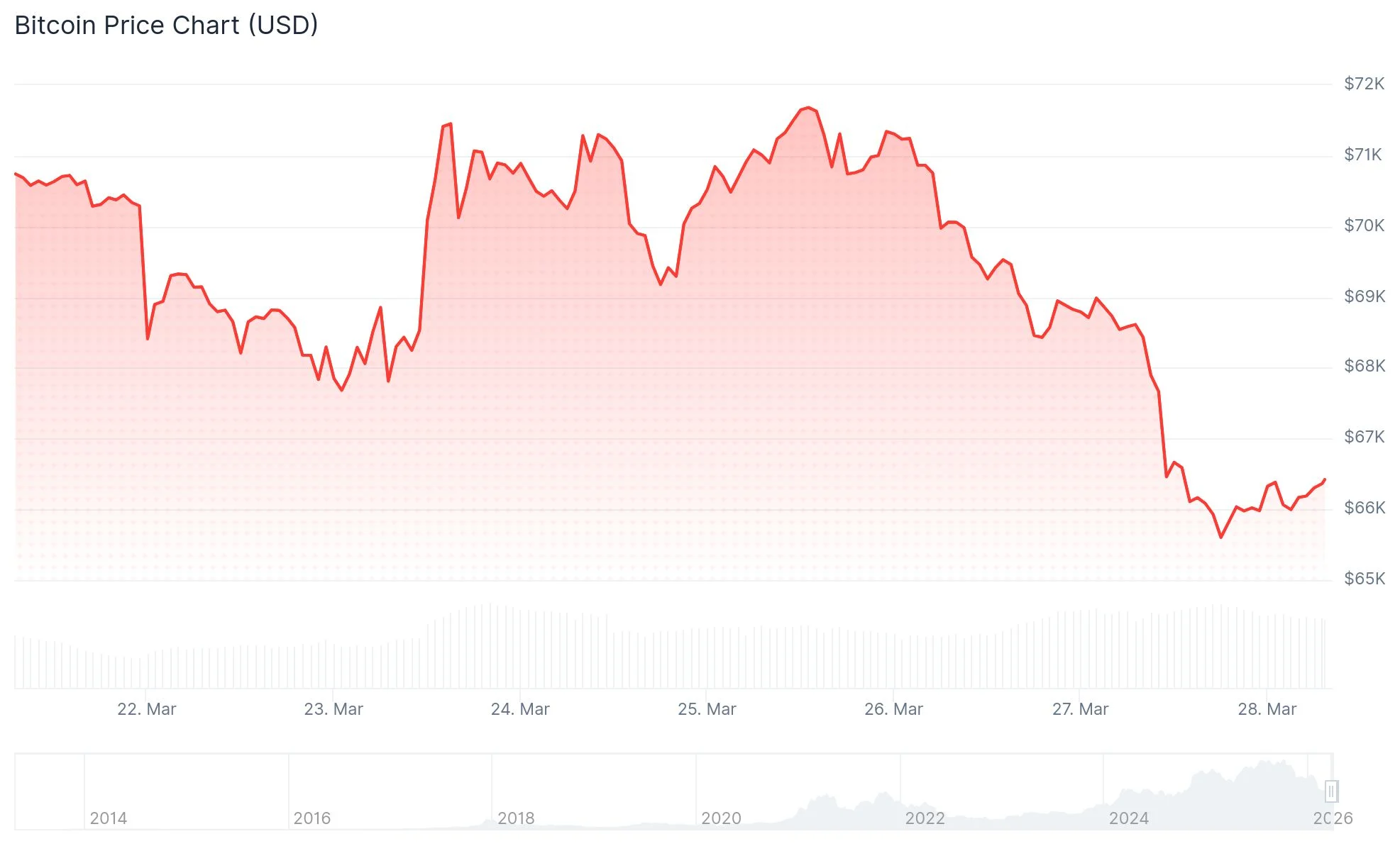
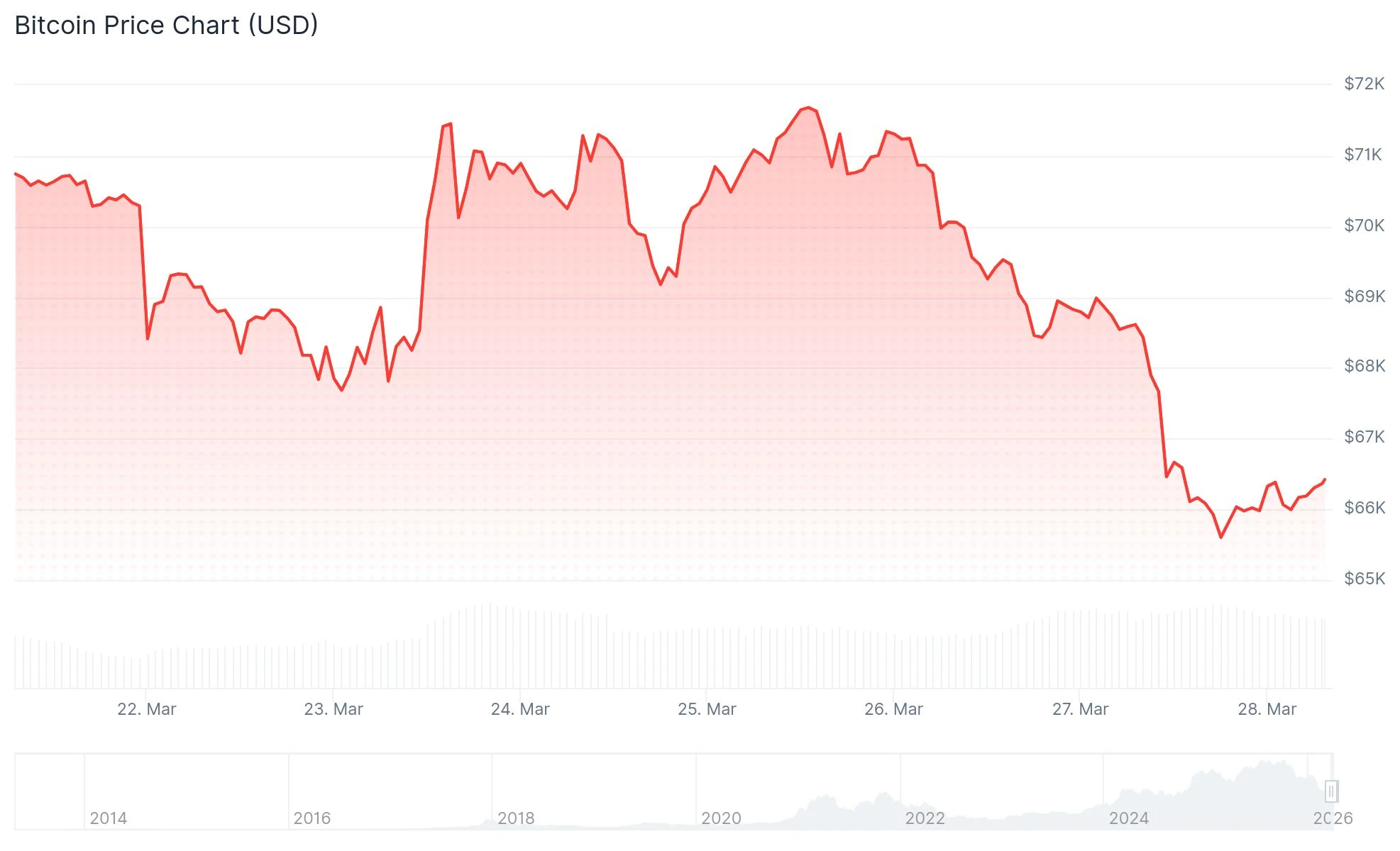
- BTC experienced a 4%+ decline on March 27, settling in the $65,720–$66,030 range.
- Deribit’s $14.16 billion options settlement eliminated 40% of outstanding contracts and sparked more than $115 million in leveraged long liquidations.
- Escalating Middle East tensions between the U.S., Israel, and Iran are pushing capital flows toward the dollar and away from risk assets including Bitcoin.
- Market experts from CEX.IO and Bitget Wallet anticipate additional downward pressure, highlighting $60,000 as a critical threshold.
Bitcoin experienced a significant pullback on March 27, shedding more than 4% of its value to hover near $65,720 as mounting geopolitical uncertainties converged with the largest quarterly options settlement on record.
The selloff intensified as ongoing hostilities involving the United States, Israel, and Iran prompted market participants to rotate into traditional safe-haven assets, particularly the U.S. dollar. Iran’s continued blockade of the Strait of Hormuz amplified market anxiety, despite conflicting reports from former President Trump suggesting limited oil tanker passage as a diplomatic concession.
Renowned market technician Peter Brandt shared analysis on X highlighting a developing rising wedge formation—a classic bearish reversal pattern. His technical projection identifies $60,000 as the immediate downside objective should the pattern complete.
In a follow-up post, Brandt presented an alternate scenario targeting $49,000 as a potential multi-month price floor for Bitcoin. He emphasized that BTC demonstrates stronger adherence to traditional technical analysis principles than most asset classes.
Brandt’s previous forecasts called for Bitcoin to breach the $50,000 level during the current market correction cycle. His recent commentary reinforces this bearish outlook.
Record Options Settlement Creates Market Turbulence
On March 27 at 08:00 UTC, leading derivatives exchange Deribit processed a massive $14.16 billion Bitcoin options expiration—the largest single settlement event in 2026. This represented approximately 40% of the platform’s total open interest being closed simultaneously.
The cascading effect triggered liquidations exceeding $115 million across leveraged long positions within just 60 minutes. Current data shows Bitcoin’s put-to-call ratio standing above 0.62, indicating a predominance of bearish positioning over bullish bets among derivatives traders.
Illia Otychenko, principal analyst at CEX.IO, characterized the current environment as bearish across both macroeconomic fundamentals and market sentiment. He cautioned that a breakdown below present channel support would likely catalyze a test of the $60,000 level.
Market Observers Anticipate Continued Volatility
Lacie Zhang, a research analyst with Bitget Wallet, noted that institutional players have systematically unwound bullish Bitcoin exposure throughout the quarter as part of yield-generation strategies. The expiration of these derivative positions removes a significant stabilizing force from the market structure.
Independent analyst Ted projects Bitcoin could breach $50,000 during Q2 2026 before potentially staging a sharp recovery toward $100,000 by year-end.
Zhang emphasized that Bitcoin must convincingly reclaim and sustain trading above $75,000 to restore positive momentum. Absent this development, she anticipates increasingly erratic price action with amplified volatility.
Surging crude oil valuations have driven the U.S. 10-year Treasury yield to its highest point since July 2025, further weighing on non-income-producing assets such as cryptocurrency.
Research analysts at Bernstein maintained their year-end Bitcoin price forecast of $150,000, pointing to historical patterns showing BTC outperformance relative to gold during periods of heightened global uncertainty.
The critical technical barrier for Bitcoin remains at $66,000. Technical analysts warn that a confirmed daily close beneath this support zone could accelerate downward momentum toward the $50,000 region.


Firelight said it is preparing an on-chain protection layer backed by staked XRP as DeFi projects face renewed security pressure.
Summary
- Firelight surpassed 50 million staked XRP after whale deposits and expanded capacity for FXRP vaults.
- The protocol plans a Q2 protection layer covering smart contracts, bridges, oracles, and economic failures.
- Firelight said exploit losses topped $137 million in Q1 as demand rose for on-chain protection.
The plan follows a new milestone for the protocol, which said staked XRP on Firelight has now passed 50 million on Flare.
According to a press release, Firelight crossed 50 million staked XRP after a series of large deposits. The report said several whale deposits were above 1 million XRP each, while the protocol also expanded capacity for FXRP deposits.
Firelight operates on Flare’s FAssets system, where users deposit XRP, mint FXRP, and stake it in Firelight’s vault in return for stXRP. Firelight said stXRP can then move across the Flare ecosystem for other DeFi uses.
Firelight said the current vault is designed to pool capital for its DeFi Cover engine. In a recent protocol update, the team said the cover product is planned for Q2 and would track “Total Value Covered,” a measure tied to protected capital rather than deposited capital alone.
The protocol said the protection layer is meant to cover risks tied to smart contract failures, oracle issues, bridge exploits, and other economic vulnerabilities. Firelight expects this second phase to let other protocols buy protection backed by the staked FXRP pool.
Security demand rises as exploit losses build
Firelight linked the rollout to the pace of recent DeFi losses. Thefts tied to DeFi exploits in the first quarter of 2026 passed $137 million, while Firelight pointed to a recent stablecoin exploit that produced $23 million in unbacked tokens after a private key leak.
In its latest protocol note, Firelight said its vaults were audited by OpenZeppelin and Coinspect, and that the FAssets bridge also went through audits. The same update said the first 25 million FXRP deposit ceiling filled within six hours, and the raised 65 million FXRP cap moved past the halfway mark soon after.
Firelight said it is building the protection layer with Sentora. Sentora is an institutional DeFi intelligence platform formed through the merger of IntoTheBlock and Trident Digital.
The partnership places Firelight’s next phase around risk management as much as staking. For XRP holders on Flare, the plan would tie staking activity to a protection market that targets DeFi security failures across multiple risk categories.
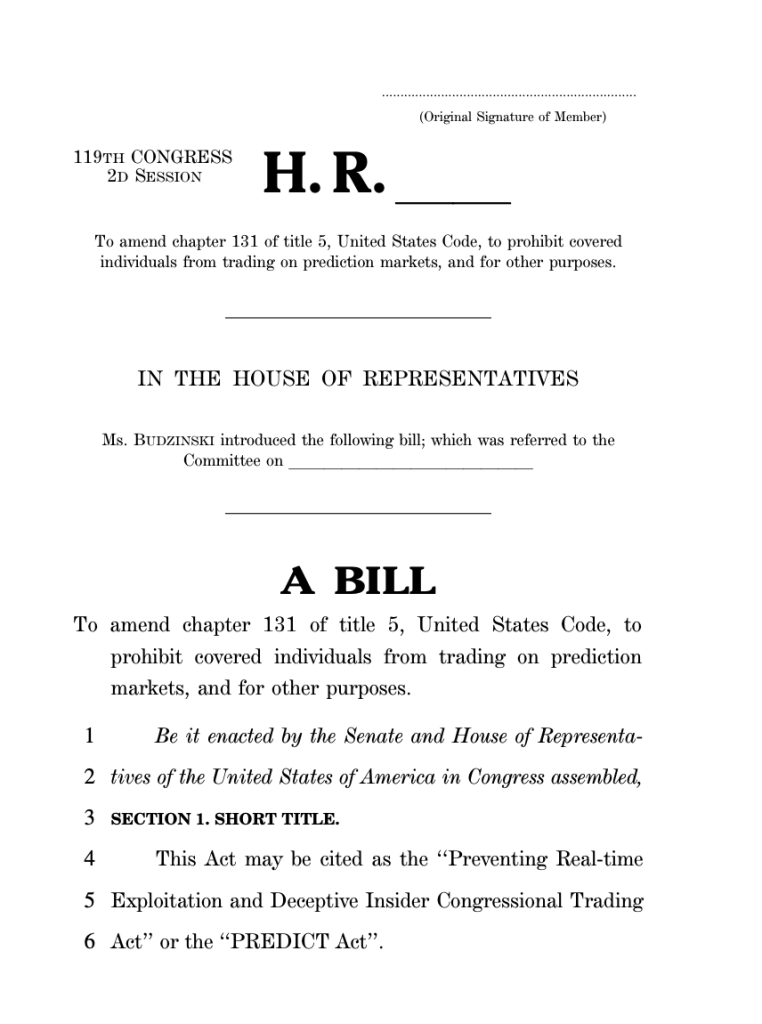
A bipartisan group of senators introduced the Public Integrity in Financial Prediction Markets Act of 2026 on Thursday, prohibiting government officials from using nonpublic information to trade prediction-market contracts and imposing fines equal to twice the profits earned. It is the second prediction market bill introduced this week alone. That cadence is not a coincidence. It is a coordinated legislative signal.
The bill covers the president, vice president, members of Congress, political appointees, and employees of executive and independent regulatory agencies. Any contract wager above $250 must be reported to a supervising ethics office within 30 days, with disclosure requirements that include price, position, platform name, and profit or loss.
Congress is drawing a line around prediction markets as a new vector for insider trading. Two bills in five days means this is no longer a fringe concern.
- Legislative Scope: The Public Integrity in Financial Prediction Markets Act covers the president, vice president, all members of Congress, political appointees, and federal agency employees — with mandatory reporting of any contract wager exceeding $250 within 30 days.
- Penalty Structure: Violations carry fines up to double the amount of profits earned, targeting financial incentives directly rather than imposing flat regulatory penalties.
- Market Implication: Platforms like Kalshi and Polymarket — which updated trading rules on March 23, 2026, to ban use of confidential information — now face potential CFTC scrutiny and mandatory compliance audits if either bill advances to markup.
Discover: The best crypto presales gaining institutional momentum right now
The Bill: What the Public Integrity Act Actually Prohibits
Senators Todd Young, Elissa Slotkin, John Curtis, and Adam Schiff introduced the bill in the second session of the 119th Congress. The legislation defines insider information as anything a “reasonable investor would consider important” in making a prediction market decision that is not publicly available — a standard deliberately broad enough to cover policy knowledge, regulatory decisions, and government actions before they are announced.
The reporting framework requires officials to disclose the number of contracts purchased, the price and timestamp of each transaction, the contract name, the position taken, the trading platform used, and any profit or loss. That level of granularity mirrors securities disclosure requirements, not casual wagering oversight.
Senator Slotkin framed the bill sharply: “No one should be profiting off the information and knowledge gained as a public servant, period.” She added the bill “has real teeth to ensure those who break these rules face real consequences.” The double-profit penalty structure is designed to eliminate any financial logic behind the violation.

This bill follows the PREDICT Act, introduced March 25, 2026, by Reps. Nikki Budzinski (D-IL) and Adrian Smith (R-NE), which imposes civil penalties of 10% of the transaction value plus full disgorgement of profits to the U.S. Treasury. The PREDICT Act extends trading bans to spouses, dependent children, and Executive Schedule positions — a broader personal scope than the Senate bill. Together, they cover nearly every category of federal official and their immediate households.
Rep. Adrian Smith summarized the bipartisan rationale: “Our commonsense, bipartisan bill will give Americans confidence that the decisions of their elected officials are guided by merit, not personal profit.” Both bills specifically target platforms, including Kalshi and Polymarket, which have emerged as the dominant U.S.-accessible prediction market venues.
The Curtis-Schiff Senate effort, introduced earlier this week, also introduced a companion measure targeting sports betting contracts on prediction platforms, a third legislative prong running parallel to the insider trading focus. That broader sweep suggests Congressional intent extends beyond political event markets into the full prediction market category.
Discover: The best crypto presales gaining institutional momentum right now
The post Lawmakers Introduce Second Bill Targeting Prediction Market Insider Trading appeared first on Cryptonews.


P2P.me said it traded on a Polymarket contract tied to its own fundraising round before the raise went live.
Summary
- P2P.me opened Polymarket positions before its fundraising launch and admitted the disclosure delay was wrong.
- The project raised $5.2 million, missed its $6 million target, and the market resolved no.
- US lawmakers and prediction platforms are tightening rules as insider trading concerns spread wider now.
The disclosure adds fresh attention to insider trading risks on prediction markets as US lawmakers and platforms move to tighten rules.
The team behind the decentralized trading platform said it opened positions on Polymarket 10 days before its capital raise launched. The market asked whether the project would reach its $6 million target. At that time, the team said it had only one “oral commitment” from Multicoin Capital for $3 million, with “no signed term sheets” and “no guaranteed allocations.”
The raise later closed at $5.2 million, below the target, and the market resolved to “no.” The team said it understands why some people may see the trade as a trust issue, even though it did not view the bet as trading on a completed deal.
P2P.me said any profits from the positions will go back to its MetaDAO treasury, which serves as the reserve for the DAO that governs the platform. The team also said it is liquidating all open Polymarket positions and putting in place a formal company policy on prediction market trading.
In its statement, the team said,
“Trading on an outcome you can influence erodes trust.” It added that “not disclosing at the time was a mistake we own.”
Those remarks came as the platform moved to address criticism around market conduct and transparency.
Prediction markets face wider policy pressure
The disclosure comes as scrutiny around prediction markets grows in Washington and beyond. On March 25, Representatives Nikki Budzinski and Adrian Smith introduced the PREDICT Act, a bipartisan bill aimed at stopping senior government officials from insider trading on prediction markets.
At the same time, Polymarket and Kalshi have both announced tighter insider trading rules. Polymarket now says users cannot trade on contracts when they hold confidential information or can influence an outcome, while California barred state officials from using insider knowledge to bet on platforms such as Polymarket and Kalshi.
A separate Senate bill would ban event contracts tied to elections, sports, government actions, and military moves.
Key Takeaways
- Mining a single Bitcoin cost approximately $80,000 during Q4 2025, creating a ~$19,000 loss per coin with BTC trading near $70,000
- Public mining companies have secured more than $70 billion in artificial intelligence and high-performance computing deals
- AI revenue could comprise as much as 70% of miner income by late 2026, up from approximately 30% currently
- Mining firms are liquidating Bitcoin holdings and accumulating billions in debt to finance their AI infrastructure pivot
- Network hashrate has declined from 1,160 EH/s to roughly 920 EH/s as operations shut down
The economics of Bitcoin mining have turned upside down. A recent CoinShares analysis reveals that publicly traded mining operations spent an average of $79,995 to produce each Bitcoin during the fourth quarter of 2025. With Bitcoin currently valued at approximately $70,000, these companies are hemorrhaging roughly $19,000 for every coin mined.
This crushing financial reality has triggered a dramatic industry transformation. Mining companies are rapidly repurposing their facilities into artificial intelligence and high-performance computing (HPC) infrastructure — and liquidating their Bitcoin reserves to finance the transition.
The scale of this shift is staggering. Public mining entities have collectively announced AI and HPC agreements exceeding $70 billion in value. CoreWeave’s partnership with Core Scientific represents a $10.2 billion commitment spanning 12 years. TeraWulf has locked in $12.8 billion in HPC revenue contracts. Hut 8 executed a $7 billion AI infrastructure lease. Cipher Digital secured a massive agreement with Google-backed Fluidstack worth billions.
Core Scientific is already deriving 39% of total revenue from AI colocation services. TeraWulf generates 27% from this segment. IREN sits at 9% but is expanding aggressively, constructing up to 200 megawatts of liquid-cooled GPU infrastructure.
According to CoinShares Head of Research James Butterfill, publicly listed miners could derive as much as 70% of revenue from AI operations by the close of 2026 — a dramatic increase from today’s 30% figure.
Financing the Infrastructure Transformation
Mining companies are funding this strategic pivot through two primary channels: leveraging debt and liquidating Bitcoin holdings.
IREN now shoulders $3.7 billion in convertible note obligations. TeraWulf carries $5.7 billion in aggregate debt. Cipher Digital issued $1.7 billion in senior secured notes during November, causing quarterly interest expenses to skyrocket from $3.2 million to $33.4 million in Q4 alone.
Simultaneously, public mining companies have collectively offloaded over 15,000 Bitcoin from peak treasury positions. Core Scientific liquidated approximately 1,900 BTC valued at $175 million in January. Bitdeer completely depleted its treasury reserves in February. Riot sold 1,818 BTC worth $162 million during December. Marathon, holding the largest public Bitcoin position at 53,822 BTC, amended its corporate policy in March to permit sales from its entire balance sheet reserve.
The financial incentives strongly favor AI infrastructure. Traditional Bitcoin mining facilities require roughly $700,000 to $1 million per megawatt in capital expenditure. AI data centers demand $8 million to $15 million per megawatt, but generate profit margins exceeding 85% with guaranteed long-term revenue contracts.
Impact on Bitcoin’s Network Security
The mining industry’s strategic realignment is manifesting in observable network metrics. [[LINK_START_2]]Bitcoin’s[[LINK_END_2]] hashrate reached a peak of 1,160 exahashes per second in October 2025. It has subsequently declined to approximately 920 EH/s, marked by three consecutive negative difficulty adjustments — the first such consecutive decline since July 2022.
On March 20, mining difficulty decreased 7.7%, representing one of the most significant single-period reductions recorded this year.
CoinShares forecasts hashrate could potentially recover to 1.8 zetahashes by year-end 2026 — but only under the condition that Bitcoin returns to $100,000 valuations. If prices remain beneath $80,000, the research firm anticipates additional miner capitulation.
Mining companies with secured AI contracts currently command valuations of 12.3 times forward sales. Pure Bitcoin mining operations trade at just 5.9 times. MARA was highlighted as among the few major miners maintaining focus on Bitcoin production and low-cost energy acquisition strategies.


The White House on Friday launched a smartphone app that gives users direct access to administration updates, social posts, photos and policy pages tied to President Donald Trump’s second term.
Summary
- White House app offers policy pages, curated news, social feeds, media tools and contact options.
- Users can send tips to ICE while viewing affordability claims and border-focused administration messaging sections.
- The app promised live video, but Trump’s Friday remarks were not streamed in real time.
The administration said the app would deliver information “straight from the source, no filter” after several teaser videos on official social media accounts pointed to a coming launch.
The White House said the app offers breaking news alerts, live video, a media library and direct feedback tools. In its release, the administration described the product as a way to keep users informed and engaged with the Trump administration through real-time updates and push notifications.
The rollout followed a short teaser campaign on social media that drew public attention before the launch. People reported that one video showed a woman asking whether something was “launching soon,” while a White House spokesperson later replied, “I wonder what’s launching soon!” before the app went live.
The app includes tabs for news, livestreams, social feeds and photo galleries. The Verge reported that much of the content mirrors existing White House web pages rather than adding a separate service built only for the app.
Coverage of the launch also said the app directs users to policy and achievements pages that were already live on the White House website. Daily Voice reported that the product also pulls in curated news coverage and material focused on Trump’s policy priorities and record in office.
A “Get in Touch” option in the social section includes a path for users to submit tips to U.S. Immigration and Customs Enforcement through the agency’s official form. The same menu also offers options to text the president, contact the White House and sign up for a newsletter.
The app also includes an affordability page built around selected consumer prices. Daily Voice reported that the section uses a limited set of grocery items and leaves out other goods and energy costs that have moved higher, while another border page states that “0 Illegals Released in Past 10 Months.”
Some promised features were not visible at launch
The White House release said users would be able to watch speeches and briefings as they happen. Yet Daily Voice reported that Trump’s Friday remarks to farmers at the White House were not available in real time on the app during the afternoon event.
The launch came as the administration continued to frame rising costs as temporary. Daily Voice reported that Treasury Secretary Scott Bessent described recent price pressure as “short-term volatility,” while the app itself focused on selected price declines and investment pledges from foreign governments and large companies.
TLDR:
- Coinbase now lets buyers use BTC or USDC as down payment collateral without selling crypto holdings first.
- Better services the crypto loan separately while the main mortgage stays within standard Fannie Mae rules.
- No margin calls apply if borrowers stay current, even during sharp Bitcoin price declines.
- Rising home costs make crypto-backed liquidity a new route for buyers locked out by cash requirements.
Coinbase is moving deeper into consumer finance with a new product that lets U.S. homebuyers use crypto as down payment collateral.
The company has partnered with Better Home & Finance to offer separate loans backed by Bitcoin or USDC held in Coinbase accounts. The structure allows buyers to keep their digital assets while securing funds for one of the costliest parts of a home purchase.
The rollout marks one of the clearest attempts yet to connect crypto wealth with the traditional mortgage market.
Coinbase Crypto-Backed Down Payments Enter Housing Finance
A buyer can now borrow against Bitcoin or USDC for a home down payment instead of liquidating holdings. Better will originate and service the loan, while the main mortgage remains separate.
The mortgage itself still follows the standard Fannie Mae-backed structure described in the Reuters report. That means the crypto-backed portion sits alongside, rather than inside, the primary home loan.
According to Reuters, the arrangement aims to preserve crypto exposure for buyers who expect long-term upside. It also allows them to delay taxable sale events tied to liquidating digital assets.
Coinbase said the product keeps the same legal protections as a conventional mortgage process. The company also noted that the mortgage rate itself does not change once the loan becomes active.
Reuters further reported that pledged crypto price swings will not trigger margin calls. As long as borrowers continue payments, falling Bitcoin prices alone will not force liquidation.
Crypto Utility Expands as Homeownership Costs Rise
The launch lands as homeownership remains difficult for first-time buyers. Reuters cited National Association of Realtors data showing the median first-time buyer age has climbed to 40 from 32 in 2000.
Higher rates, limited inventory, and elevated home prices have tightened access across the U.S. housing market. This backdrop gives crypto-rich buyers another way to unlock liquidity without leaving the market.
Coinbase framed the product as a practical use case for digital assets beyond trading and custody. Reuters noted the company sees it as a way to widen access for users whose wealth sits in crypto rather than bank accounts.
The policy backdrop also matters. Reuters linked the move to a more crypto-friendly U.S. regulatory environment that has recently lowered barriers around mainstream financial products.
The report also tied that shift to broader Washington efforts to expand alternative investments, including crypto, into retirement products. That easing has helped firms explore new bridges between digital assets and legacy finance.

RCB Players To Wear Black Armbands During IPL 2026 Opener Against SRH. Here’s Why

Samsung Frame Pro Review: A Good TV for a Pretty Living Room

The best value of the main mobile networks


-
 NewsBeat3 days ago
Manchester United reach agreement with Casemiro over contract clause amid transfer speculation
-

 News Videos2 days ago
Parliament publishes latest register of MPs’ financial interests
-

 Crypto World6 days ago
Best Crypto to Buy Now: Strategy Just Spent $1.57 Billion on Bitcoin During Fear While Early Investors Quietly Enter Pepeto for 150x Potential
-

 Crypto World7 days ago
Bitcoin Price News: Bhutan Sells $72 Million in BTC Under Fiscal Pressure, but the Smart Money Entering Pepeto Sees What the Market Does Not
-

 Sports5 days ago
Remo Stars and Kano Pillars Strengthen Survival Hopes in NPFL
-

 Sports5 days ago
Gary Kirsten Accuses Pakistan Cricket Board Of ‘Interference’, Mohsin Naqvi Responds
-

 Business6 days ago
No Winner in March 21 Drawing as Prize Rolls to $133 Million for Next
-

 Tech6 days ago
Give Your Phone a Huge (and Free) Upgrade by Switching to Another Keyboard
-

 Tech6 days ago
AI enters the chat: New Seattle dating app relies on tech to facilitate meaningful human connections
-

 News Videos5 days ago
Ch 9 Financial Management Part 1 | Detailed One Shot | Class 12 Business Studies Boards 2026
-

 Tech6 days ago
Today’s NYT Connections Hints, Answers for March 22 #1015
-

 Business2 days ago
Instagram, YouTube Found Responsible for Teen’s Mental Health Struggle in Historic Ruling
-

 Business6 days ago
Will Duke Basketball Win It All? Duke Basketball Enters Second Round as Third Favorite to Claim NCAA Title
-

 Sports5 days ago
2026 Kentucky Derby horses, odds, futures, preview, date: Expert who hit 12 Derby-Oaks Doubles enters picks
-

 NewsBeat13 hours ago
The Story hosts event on Durham’s historic registers
-
 NewsBeat6 days ago
Update on Wisbech river crash as search for teenage boy enters fifth day
-
 Entertainment5 days ago
Cynthia Bailey Dishes on ‘RHOA’ Season 17, Discusses Kandi
-

 Tech5 days ago
Samsung will soon let you control smart home devices from your car’s dashboard
-
 NewsBeat3 days ago
Tesco is selling new Cadbury Dairy Milk bar and people can’t wait to try it
-

 Tech6 days ago
SteamOS update adds support for Steam Machine and other non-Valve hardware
You must be logged in to post a comment Login