
Crypto World
Avalanche price holds near $9.70 as U.S. ‘digital commodity’ ruling meets subnet growth



Avalanche price is grinding around $9.70 as a U.S. “digital commodity” label, fee and subnet upgrades, and growing RWA and ETF activity push fundamentals ahead of AVAX’s stalled chart.
Summary
- Avalanche trades around $9.67 with a market cap near $3.8 billion and 24-hour volume above $220 million.
- AVAX is consolidating roughly 10–12% below key $10 resistance after a March ruling that classified it as a U.S. “digital commodity” and a series of scaling upgrades.
- Subnet expansion and rising real‑world asset activity contrast with subdued price action, mirroring a broader pause across large L1 tokens.
Avalanche (AVAX), the native token of the Avalanche Layer‑1 smart contract network, is trading at about $9.67 today, with 24-hour spot volume around $226.7 million and a market capitalization close to $3.88 billion. Yahoo Finance data show AVAX closing at $9.6793 on March 26, 2026, after opening near $9.67, continuing a tight range that has persisted for several sessions. CoinGecko lists daily trading volume near $1.01 billion when aggregating spot and derivatives, representing a 61.30% increase from the previous day, suggesting renewed activity even as price remains rangebound.
Price history from CoinMarketCap places Avalanche’s recent closes between $9.17 and $9.75 over the first week of March, with March 6 seeing an open at $9.3838 and close at $9.4534, underscoring how the token has spent much of the month pivoting around the $9–$10 zone. Investing.com’s historical series similarly shows AVAX closing at $8.99 on March 22 after trading between $8.93 and $9.34 that day, with 5.19 million AVAX changing hands. Put together, the tape shows a large‑cap L1 in consolidation rather than in a trending phase.
Beyond the chart, Avalanche has logged a string of structural developments in March. Phemex notes that Avalanche was formally described as a “digital commodity” by the U.S. SEC and CFTC on March 17, 2026, a designation that clarifies its status alongside assets like Bitcoin in certain regulatory contexts. In parallel, CoinMarketCap’s latest Avalanche update highlights a recent upgrade that implemented three proposals: ACP‑226, allowing validators to dynamically adjust minimum block times; ACP‑204, adding support for the secp256r1 cryptographic curve used in Apple’s FaceID and TouchID; and ACP‑181, which stabilizes the validator set for short periods to reduce gas costs and improve cross‑chain reliability. CoinMarketCap’s analysis notes that these changes are intended to make Avalanche faster, cheaper and more secure, particularly for mobile users and cross‑chain applications.
These improvements build on the earlier “Octane” hard fork in May 2025, which reduced subnet deployment costs by approximately 83%, cut the minimum base fee by 99.6% and introduced dynamic fee algorithms to prevent spam in periods of high demand. Together, the upgrades frame Avalanche as a high‑throughput L1 with a scaling strategy centered on subnets—custom, application‑specific blockchains that require AVAX for staking and fees.
Avalanche’s longer‑term growth thesis is increasingly tied to subnets and real‑world asset (RWA) tokenization. Yahoo Finance previously reported that the Avalanche Foundation committed 4 million AVAX—valued at around $290 million at the time—to attract gaming, DeFi and NFT projects to its subnet ecosystem, via the “Multiverse” incentive program. CoinMarketCap’s Avalanche updates also reference the Evergreen Subnet initiative for institutions and RWA partners such as BlackRock and Securitize, which are working on on‑chain products that would settle on Avalanche infrastructure. Binance’s recent deep dive points to more than 75 active subnets, a $40 million Retro9000 rewards program, and the launch of a Nasdaq‑listed AVAX treasury firm and spot AVAX ETF as signs of growing institutional involvement.
Despite these developments, WazirX’s March 2026 outlook characterizes AVAX as technically weak but fundamentally supported, identifying $10 as a key support‑turned‑resistance level and outlining a medium‑term consolidation band between $9 and $11. Within the broader L1 landscape, Avalanche’s sideways trading near $9.70 stands in contrast to the more explosive moves seen in smaller altcoins, but resembles a common pattern among major smart‑contract platforms where on‑chain fundamentals improve ahead of price. For real‑time data, readers can track AVAX on the crypto.news market‑cap dashboard via the Avalanche price page, and compare it against other large L1 tokens such as Ethereum and Solana on their respective price pages.



Tazapay has extended its Series B funding round and raised total capital to $36 million. The new funding comes as stablecoin-based payment infrastructure continues to attract backing from crypto and fintech investors focused on faster cross-border settlement.
Summary
- Tazapay raised $36 million to expand cross-border payment infrastructure and licensing across multiple global markets.
- Circle Ventures led the extension, with backing from Coinbase Ventures, Ripple, and CMT Digital.
- The company serves over 1,000 enterprises and fintechs across 30 countries with licensed operations.
Tazapay said Circle Ventures led the extension round. Coinbase Ventures, CMT Digital, Peak XV Partners, and Ripple also joined the funding.
The company said the new capital will support its digital settlement technology for cross-border payments. It also plans to use the funds to secure more licenses and expand operations in Asia, Latin America, the Middle East, and the Americas.
Tazapay said it now serves more than 1,000 enterprises and fintechs across 30 countries. The company also said it already holds licenses in Singapore, Canada, Australia, and the United States.
It added that license applications are active in the European Union, the United Arab Emirates, and Hong Kong. This part of the plan shows that the company is focusing on regulated markets as it expands its payment network.
Chief business officer Kanupriya Sharda said demand remains strong across several regions. She said,
“The demand we’re seeing from enterprises and fintechs across Asia, LATAM, and the Middle East is unmistakable; businesses want to move money faster, cheaper, and with full regulatory confidence.”
Tazapay also said part of the funding will go toward infrastructure for “agentic payments.” The company did not give full details in the announcement, but it placed that product area alongside its broader settlement and licensing strategy.
Stablecoin payment firms continue to draw investor support
The Tazapay round comes as more firms build stablecoin and fiat payment rails for banks, fintechs, and global businesses. Investors have continued to fund platforms that promise faster transfers and lower cross-border payment costs.
Earlier this month, Ripple said Ripple Payments had expanded into an end-to-end stablecoin and fiat platform. Ripple said the service is live in more than 60 markets and has processed over $100 billion in volume.
In May 2025, cross-border payments firm Conduit raised $36 million in a Series A round. The company said it would use the capital to scale its payment system and expand fiat and stablecoin offerings.
Conduit has promoted its network as an alternative to SWIFT for international money movement. Tazapay’s latest raise now places it among the firms building the next wave of cross-border payment infrastructure.
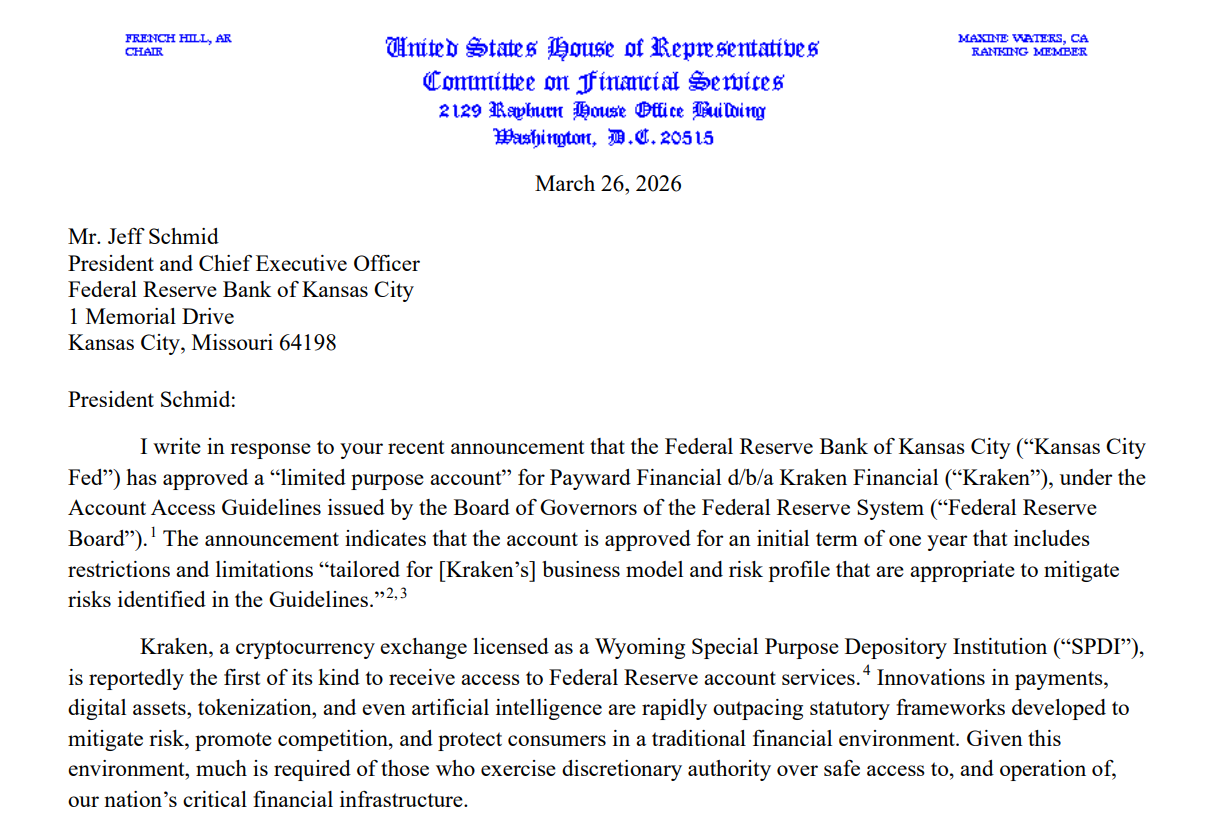
US Representative Maxine Waters, the ranking Democrat on the House Financial Services Committee, is demanding answers from the Federal Reserve Bank of Kansas City over the approval of Kraken Financial’s limited-purpose master account.
In a letter Thursday, Waters asked Kansas City Fed President Jeff Schmid to respond by April 10, outlining what Kraken’s approval means in practice; which Federal Reserve services it can access; the conditions or restrictions that apply and what anti-money laundering and consumer protection measures were considered.
Kraken’s banking unit was granted a limited-purpose master account by the Federal Reserve Bank of Kansas City earlier this month. It was seen as a milestone for the crypto industry as several crypto-linked US companies have been pursuing a master account with the Fed for years.
The account provides direct access to Fedwire, the Fed’s core payments system, potentially allowing Kraken to move money on the same rails used by banks and credit unions.
“The Kansas City Fed’s announcement does not disclose specific information about Kraken’s access to the range of Federal Reserve financial services due to the confidentiality of business information provided by applicants,” Waters wrote in the letter.

“Answers to these questions are critical to ensuring that the process of approving Federal Reserve Bank account access is conducted consistently with the law, with impartiality, and in a manner that continues to foster a safe and efficient payment system,” she added.
Full transparency required to mitigate risks, Waters argues
Waters also argued that Kraken’s access to the Federal Reserve’s payment system raises policy, regulatory and consumer protection concerns. As a result, she said full transparency and clear legal grounding are required to ensure any risks are properly managed.
“Innovations in payments, digital assets, tokenization, and even artificial intelligence are rapidly outpacing statutory frameworks developed to mitigate risk, promote competition, and protect consumers in a traditional financial environment,” Waters wrote.
“Given this environment, much is required of those who exercise discretionary authority over safe access to, and operation of, our nation’s critical financial infrastructure,” she added.
Related: SEC is no longer a ‘cop on the beat‘ on crypto, says US lawmaker
US crypto companies that have been pursuing Fed master accounts include Caitlin Long’s Custodia Bank, which filed a court petition in late 2025 to renew its bid.
Crypto platform Anchorage Digital Bank also applied for an account last year and Ripple has applied through its Standard Custody & Trust Company.
Waters is classed as “strongly against crypto” by advocacy group
Crypto advocacy group Stand With Crypto has a scorecard for US politicians on how supportive they are of crypto based on public statements and voting behavior.
Waters is listed by the group as “strongly against crypto,” based on five statements and six votes against crypto legislation, including the Digital Asset Market Clarity Act and the GENIUS Act.

She also called for a hearing with Securities and Exchange Commission Chair Paul Atkins last year, citing concerns about the agency’s dismissal of crypto enforcement cases.
Magazine: How crypto laws changed in 2025 — and how they’ll change in 2026


Bitcoin (BTC) whale activity has slowed to its weakest level since September 2023, adding to signs that large holders have turned cautious.
Summary
- Santiment said whale activity dropped as investors watched uncertainty and conflict in the Middle East.
- Transfers above $100,000 and $1 million fell as Bitcoin struggled to recover after price swings.
- Analysts said short-term holder losses and weaker speculation may mark a new Bitcoin accumulation phase.
Data from Santiment shows that transfers above $100,000 have dropped as Bitcoin trades below recent highs and investors watch policy updates and geopolitical risks.
Santiment said daily Bitcoin transactions above $100,000 fell to 6,417, the lowest reading since September 2023. Transfers above $1 million also dropped to 1,485, their lowest level since October 2024.
The firm said activity rose sharply during Bitcoin’s early February sell-off, when large holders moved funds during heavy volatility. Since then, that pace has faded as the market entered a consolidation period and failed to regain steady momentum.
Santiment said the decline does not confirm a bullish or bearish trend on its own. The firm said whale activity has become “historically quiet” while market participants wait for more clarity around the CLARITY Act and the conflict in the Middle East.
The firm added that “smart money is in the same boat as smaller retail holders at the moment, and have been reluctant to make moves with so much policy and global uncertainty at play.” That view places the current market in a wait-and-see phase rather than a clear trend.
Moreover, Bitcoin recently reached $76,000, its highest level in about six weeks, before sellers pushed it lower. The rejection sent the asset below $68,000, though it later rebounded toward $72,000 before slipping under $70,000 again.
The latest moves show that Bitcoin remains sensitive to external events as traders track war-related headlines and broader market signals. At the same time, the weak recovery in whale activity suggests that large holders have not yet returned with strong conviction.
Analysts point to washout among short-term holders
Ali Martinez said Bitcoin’s Realized Cap for new holders has hit a low level that often appears after speculative interest leaves the market. According to his view, the recent reset has removed many weak hands and left more committed holders in place.
Analyst Michaël van de Poppe also said short-term holders are sitting on heavy losses in what he described as capitulation. He said many traders bought during Bitcoin’s initial drop toward $80,000, only to see positions fall deeper into loss as the price moved below $70,000.
Disclosure: This article does not represent investment advice. The content and materials featured on this page are for educational purposes only.


Better Home & Finance and Coinbase are preparing a new mortgage product tied to Fannie Mae-backed loans, according to a Wall Street Journal report published on March 26.
Summary
- Better and Coinbase plan a mortgage product that lets homebuyers use crypto holdings as collateral.
- The reported structure would combine a standard mortgage with a separate loan backed by crypto.
- Current Fannie Mae rules require crypto conversion to dollars, making this product a policy shift.
The product would let some homebuyers use crypto as collateral instead of selling those holdings before closing.
The report said the new offer would allow buyers to “pledge their crypto holdings” when taking out a mortgage backed by Fannie Mae. Better Home & Finance would act as the lender, while Coinbase would support the crypto side of the product.
The structure would use two loans. One would be a standard Fannie Mae-backed mortgage, while the second would be backed by the borrower’s crypto assets.
Reports said Bitcoin and USDC are expected to be part of the program, but full eligibility details were not available at publication time. The report also said the pledged crypto could not be traded while it secures the loan.
Borrowers would not need to sell their digital assets for a down payment. Reports added that rates on the crypto-backed portion could run above standard mortgage pricing.
Fannie Mae’s current selling guide says virtual currency can count only after it is converted into U.S. dollars and placed in a regulated financial institution. That means this new structure would mark a change from the existing approach.
The move also follows a 2025 FHFA order that told Fannie Mae and Freddie Mac to consider crypto holdings in mortgage loan assessments. The new product would take that process further by linking crypto directly to mortgage collateral.
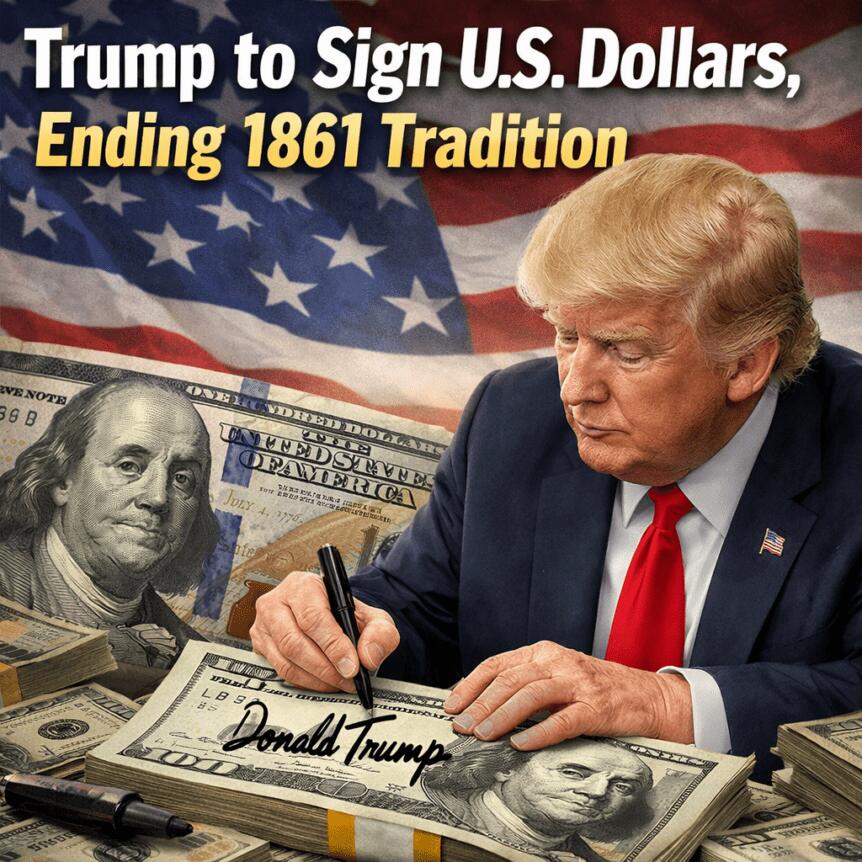
The idea of a sitting U.S. president lending his signature to the nation’s currency is an unprecedented moment in the ongoing relationship between state-backed money and cultural symbolism. According to Reuters, the U.S. Treasury disclosed that President Donald J. Trump’s signature would appear on future U.S. notes as part of a commemorative push tied to the United States’ Semiquincentennial.
The plan would mark the first time a sitting president’s signature appears on U.S. currency, shifting away from the long-standing convention of signatures from the treasurer and the Treasury secretary. Reuters reports that the initial print run of $100 bills bearing Trump’s signature alongside Treasury Secretary Scott Bessent’s is slated for June, with additional denominations to follow in the months after.
Beyond the currency, the U.S. Mint has reportedly considered issuing $1 coins showing the president’s likeness as part of the same 250th-anniversary effort. In late 2025, the Mint released proposed designs featuring Trump’s image and the motto “In God We Trust.”
Trump’s imprint has already threaded through popular culture in various forms, including into cryptocurrencies and collectibles. In crypto circles, a memecoin named after Trump has drawn attention, alongside multiple NFT projects, including the widely publicized Trump Digital Trading Cards.
The Treasury move comes with controversy. Some lawmakers have argued that altering the signatures on U.S. currency would require congressional authorization, casting doubt on the legality of moving ahead without legislative action. The broader cultural reshaping around Trump’s public persona has also spurred diverse reactions, including debates over the renaming of major U.S. landmarks. Reuters and other outlets documented discussions around the John F. Kennedy Center for the Performing Arts, where reports described a board dominated by Trump appointees voting to rename the venue to the “Donald J. Trump and the John F. Kennedy Memorial Center for the Performing Arts.”
In parallel coverage from crypto-focused outlets, Trump’s footprint in the space—through memes, cards, and other collectibles—highlights how political branding can spill into the digital asset ecosystem. While a currency signature may seem esoteric to traders, the episode underscores a broader trend: the fusion of political branding, national symbolism, and the evolving culture around crypto assets.
Key takeaways
- The Treasury’s plan would make Trump the first sitting U.S. president to have his signature appear on U.S. currency, tied to the nation’s Semiquincentennial celebration, according to Reuters.
- The first $100 bills bearing Trump and Treasury Secretary Scott Bessent’s signatures are slated for printing in June, with other denominations to follow later in the year.
- There is reported consideration of issuing $1 coins featuring the president’s likeness as part of the same commemorative initiative, supported by proposed 2025 designs.
- Trump’s presence in crypto culture—through a memecoin and NFT projects—illustrates how political branding intersects with digital assets and community storytelling.
- Lawmakers have raised questions about the legality of changing currency signatures without congressional authorization, reflecting governance and constitutional considerations.
Currency symbolism and the timing of a historic shift
By linking a sitting president’s signature to U.S. currency, the narrative expands beyond monetary mechanics into national symbolism. The Reuters coverage situates the move within a broader commemorative framework for the 250th anniversary of the United States, signaling a potential long-term shift in how currency can carry living political branding. The printing schedule for the initial notes—in June—provides a concrete timeline that will test traditional processes around currency design and circulation.
Commemorative design and potential coin additions
The Mint’s exploration of $1 coins featuring the president’s image indicates a multi-denomination approach to the same commemorative moment. The late-2025 designs had already showcased Trump’s likeness and the inscription “In God We Trust,” suggesting a planned, broad-based branding exercise rather than a narrow currency reform. How these designs would interact with existing patriotic and historic themes remains to be seen, particularly given the regulatory and procedural layers involved in issuing new coinage.
Crypto crosscurrents: branding, memes, and market psychology
The intersection of presidential symbolism with crypto culture is not new, but it continues to shape sentiment and participation in digital asset communities. Reports of a Trump-themed memecoin and related NFT ventures illustrate how political narratives can permeate meme economies and collectible markets, sometimes driving attention and liquidity into otherwise niche corners of the crypto ecosystem. This convergence raises questions for traders and builders about how political branding might influence perception, liquidity, and the cultural value of associated digital assets.
Governance questions and the legislative dimension
Amid the excitement, questions about authorization and legality have surged. Some lawmakers contend that altering currency signatures without congressional action could be unlawful or legally ambiguous, foregrounding a governance tension between executive actions and legislative necessity. Separately, the naming controversy surrounding a major cultural institution—spurred by Trump-aligned appointments—has fed a wider debate about presidential influence over public landmarks and the potential implications for fiscal and cultural policy.
The unfolding story sits at the crossroads of monetary history, national symbolism, and the evolving relationship between politics and crypto culture. As authorities prepare for the first run of Trump-signature notes and potential commemorative coins, market observers will be watching not only for the practical rollout but also for any regulatory clarifications and the way communities across crypto and traditional finance interpret this blend of state power and branding.
Readers should watch for official updates from the U.S. Treasury and the U.S. Mint about certification, design finals, and distribution timelines, as well as any legislative action clarifying the authorization requirements for signing changes on currency. The convergence of currency symbolism and crypto branding could set a precedent for how political narratives shape both fiat and digital-asset narratives in the months ahead.
Bitcoin (BTC) sellers resumed their activity on Thursday as the BTC price slipped below the $70,000 mark.
Analysts said that Bitcoin showed signs of a bear market in its last stages, due to extreme fear and elevated realized and unrealized losses.
Key takeaways:
-
Bitcoin enters the last stages of the bear market, characterized by extreme fear and most BTC supply in loss.
-
High unrealized losses and a 96% drop in realized profits suggest “demand exhaustion.”
-
$70,000 remains the main BTC level to watch for now, with $65,000-$60,000 support below.
Bitcoin holder losses increase
Bitcoin’s bear market has seen its price draw down by more than 44% from its $126,000 all-time high, reached on Oct. 6, 2025.
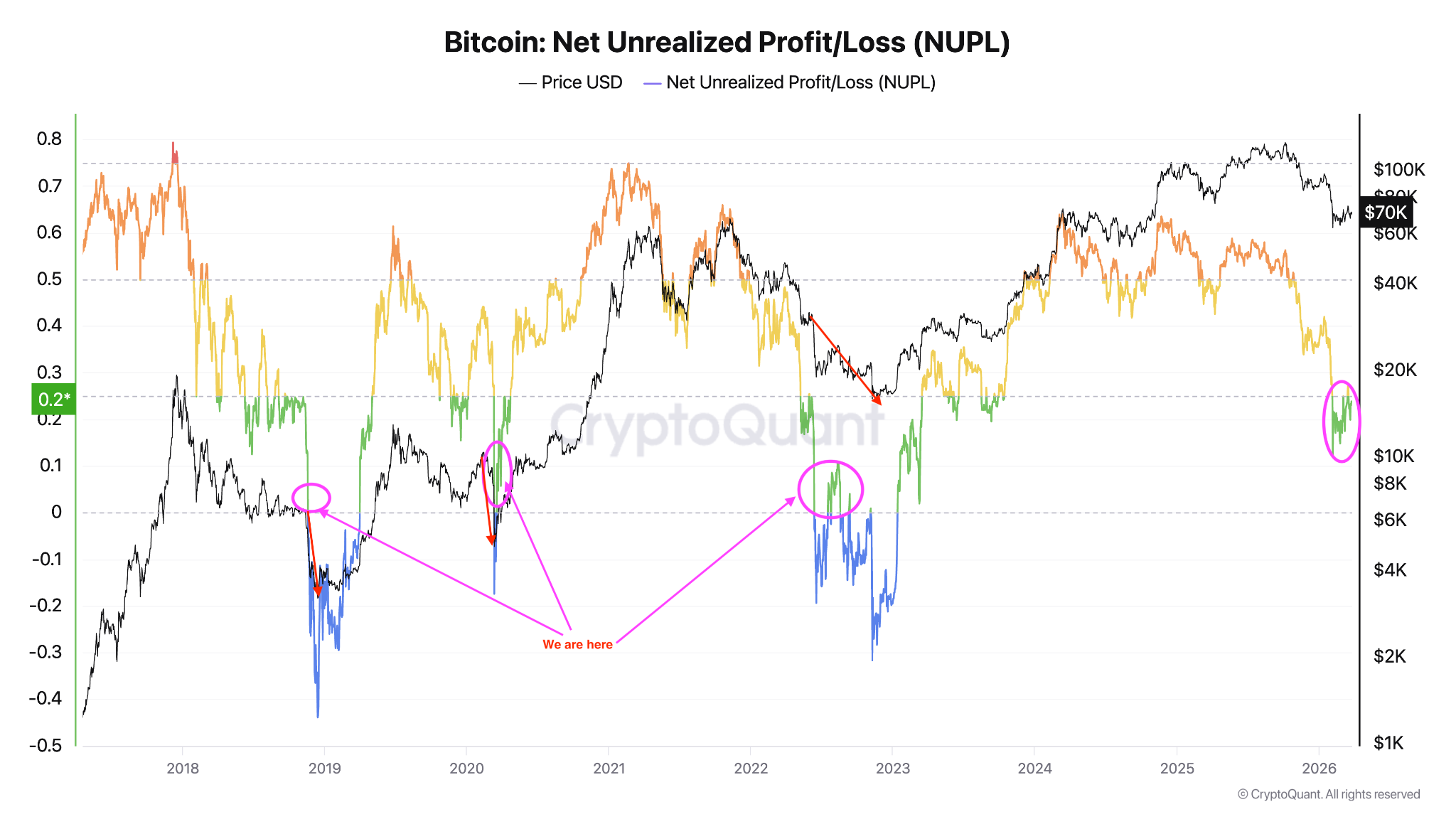
This has pushed its Net Unrealized Profit/Loss (NUPL), the difference between total profits and losses currently held by investors, below 0.25, placing it in the “hope/fear zone,” according to data from CryptoQuant.
Related: $18.6B in Bitcoin options expire Friday: Should traders prepare for $75K BTC?
This means, “roughly 40% of Bitcoin’s circulating supply is held at a loss,” CryptoQuant analyst The Enigma Trader said in a Quicktake note.
Coupled with the Fear and Greed Index in the “Extreme Fear” at 15, this “reflects pain and uncertainty,” the analyst said, adding:
“A NUPL recovery above 0.25 would mark a transition into the optimism zone, a shift that has historically aligned with strengthening price momentum.”

This structurally resembles conditions seen in previous bear markets, where the NUPL continued dropping to areas below 0 as Bitcoin found its bottom.
When analysing the volume of coins held at a loss as a fraction of total market capitalization, Glassnode found that the 7-day simple moving average (SMA) of relative unrealized losses has stabilized at 15%.
“This positions the current sentiment as one of elevated fear,” Glassnode said in its latest Week On-chain newsletter, adding:
“Historically, resolving this level of embedded loss requires either time, further price depression, or an extraordinary and sustained influx of fresh capital within a compressed timeframe.”

Bitcoin’s entity-adjusted realized profit has also dropped from a peak of $3 billion per day in July 2025 to below $0.1 billion today.
This is a more than 96% decline, “offering further evidence of demand exhaustion,” Glassnode said, adding:
“Contractions of this magnitude are a textbook characteristic of a bear market transitioning into its later stages, where the pool of profitable sellers has been largely depleted, and on-chain liquidity thins to cycle lows.”

Meanwhile, CryptoQuant analyst Crypto Dan said that while some indicators suggest BTC/USD bottomed at $60,000, “more consistent and decisive confirmation signals” are required to confirm a true bottom.

Watch these Bitcoin price levels next
Since recovering from multi-year lows below $60,000, the BTC/USD pair remains stuck in a range with $64,000 as support and $72,000 as resistance.
Bitcoin is now fighting to hold on to the 1w–1m cohort cost basis at $70,200, “marking the developing support floor,” Glassnode said.
However, the cost basis distribution heatmap shows a modest accumulation cluster at this level, making it “vulnerable.” Glassnode:
“A higher probability of a breakdown below this level cannot be dismissed until a more substantial base of committed buyers is established.”

Below that, the next major level to watch is Bitcoin’s realized price around $54,000. The 2022 bear market bottom was formed after Bitcoin dropped toward its realized price.
On the upside, Glassnode said that the 1m-3m cohort cost basis at $82,200 represented a key overhead resistance, coinciding with a heavy concentration of short-term holder supply above $84,000.
This is a “cohort that could amplify sell pressure whether price stages a recovery toward those levels or faces a renewed episode of market stress,” Glassnode added.
In an X post on Thursday, technical analyst CryptoPatel said Bitcoin’s recent surge to $76,000 was just a lower high, adding that the higher time frame structure points “lower from here,” with the next real area of interest sitting under $50,000.
“Even if $76K breaks, there is another bearish order block between $86,000 and $90,000 waiting right above.”

As Cointelegraph reported, a close below the 20-day exponential moving average at $70,303 could fuel BTC’s price drop toward the $62,500-$60,000 support zone.
This article does not contain investment advice or recommendations. Every investment and trading move involves risk, and readers should conduct their own research when making a decision. While we strive to provide accurate and timely information, Cointelegraph does not guarantee the accuracy, completeness, or reliability of any information in this article. This article may contain forward-looking statements that are subject to risks and uncertainties. Cointelegraph will not be liable for any loss or damage arising from your reliance on this information.


X has named Benji Taylor as head of design as the company moves closer to the public rollout of X Money.
Summary
- X hired Benji Taylor as design chief ahead of the wider X Money rollout next month.
- Taylor held product and design roles at Aave, Avara and Coinbase’s Base before joining X.
- X Money beta includes wallet services, peer payments and a debit card tied to accounts.
The hire brings in a product designer with experience in crypto wallets, DeFi, and consumer apps at a time when X is building out payments inside the platform.
Taylor said he was “honoured” to join X and said he would work closely with Elon Musk, Nikita Bier, and the rest of the team. Musk also welcomed him publicly after the announcement.
The move adds a designer with direct crypto product experience to X’s leadership team. Recent reports said Taylor will work across X and xAI, which places him inside a broader product push tied to social, AI, and payments.
Taylor founded Los Feliz Engineering, the company behind the self-custody wallet Family. His personal site says Aave Labs acquired that company in September 2023, and he then served as chief product officer there until October 2025.
His site also says he later became head of design at Base, Coinbase’s layer-2 network, before moving to X. That background gives X a design lead who has worked on both crypto infrastructure and user-facing products.
Earlier this month, Musk said X Money would enter early public access next month. Reuters reported that X Money is part of his plan to turn X into an “everything app” with payments added to its social platform.
X already has a payments partnership with Visa. Reuters reported in January 2025 that Visa would become the first partner for X Money, letting users fund an X wallet, connect debit cards, send peer-to-peer payments, and move funds to bank accounts.
Beta details point to broader financial features
Reports on the beta have shown more details about the product. Business Insider reported that early users have posted X Money debit cards and that Musk said the service would offer a 6% annual percentage yield on deposits.
Bier also used strong language when welcoming Taylor, saying X was building the “greatest design team in the industry.” That message links Taylor’s arrival to X’s next product phase as payments move closer to wider release.
The White House has cleared a Department of Labor proposal that could change how 401(k) fiduciaries assess alternative assets, including digital-asset exposure.
Summary
- White House completed review of a Labor proposal tied to crypto access in 401(k) plans.
- The rule follows Trump’s order to expand alternative assets in defined-contribution retirement plans nationwide.
- Indiana lawmakers also advanced a bill requiring crypto options in certain retirement savings plans.
The move brings the rule closer to publication and opens the next stage of the federal process.
The White House’s Office of Information and Regulatory Affairs completed its review of the Labor Department proposal on March 24. The action appeared on the OIRA website as “consistent with change” and carried an “economically significant” label.
That completed review removes an interagency step for the proposal. The Labor Department is now expected to publish the rule for a 60-day public comment period before it considers revisions and a final version.
The proposal follows President Donald Trump’s Aug. 7, 2025, executive order on alternative assets in 401(k) plans. The order told federal agencies to expand access to alternative investments, including digital assets through certain investment vehicles.
It also told the Labor Department to revisit limits on alternative assets in defined-contribution plans. The order named digital assets, private equity, and real estate, and it called for coordination with the Treasury Department and the Securities and Exchange Commission.
In addition, the new step follows an earlier federal policy shift. On May 28, 2025, the Labor Department withdrew its 2022 compliance release that had urged fiduciaries to be “extremely cautious” when considering crypto in 401(k) plans.
That change marked a different federal approach to retirement-plan exposure to digital assets. If the proposal advances, fiduciaries may get a wider path to review crypto-linked options alongside other alternative investments.
States also push crypto retirement access
State-level efforts are also moving forward. On Feb. 25, Indiana lawmakers passed a bill that would require certain state retirement and savings plans to offer a self-directed brokerage option with at least one crypto investment option by July 1, 2027.
The broader retirement market remains large as these policy changes develop. According to the Investment Company Institute, US retirement market assets reached a record $48.1 trillion on Sept. 30, 2025.


MemeCore spikes 40% to $2.31 as leverage and sector-wide memecoin rebound push its value above $3 billion.
Summary
- MemeCore is trading around $2.31, up nearly 40% in 24 hours, lifting its market cap above $3.0 billion.
- Spot and derivatives volume in MemeCore exceed $40 million over the last day, pointing to aggressive speculative interest in the BNB Chain‑aligned memecoin.
- The rally comes as the broader memecoin market cap jumps more than 20% in early 2026, extending a sector‑wide rebound from late‑2025 lows.
MemeCore (M), a high‑beta memecoin project focused on on‑chain speculation and community‑driven rewards, is trading at approximately $2.31 today, with a live market cap of about $3.01 billion and 24‑hour trading volume of $33.03 million. According to CoinMarketCap, M’s price has climbed 39.78% over the past 24 hours, with intraday lows and highs at $1.69 and $2.47 respectively as of March 26, 2026. Derivatives data from CoinGlass shows a further $2.21 million in spot volume and roughly $85.7 million in futures volume over the same period, underscoring a heavy speculative footprint in MemeCore’s order books.
CoinMarketCap lists M with a circulating supply near 1.3 billion tokens, a fully diluted valuation around $24.1 billion, and total supply capped at 10 billion M. Those tokenomics position MemeCore firmly within the memecoin vertical rather than as a DeFi, L1, or AI protocol, aligning it with other high‑risk assets like PEPE and BONK that have seen similar liquidity‑driven surges covered by outlets such as crypto.news. Earlier this month, MEXC reported MemeCore’s market cap crossing $3 billion on a 16.6% daily move from $1.47 to $1.72, with 24‑hour volume at just $12.9 million, highlighting thin liquidity relative to its valuation.
CoinGlass data indicate that MemeCore’s futures volume now outpaces spot by more than 38:1, with $85.7 million in futures changing hands versus roughly $2.21 million on spot markets in the last 24 hours. That skew suggests leveraged traders are driving much of the latest leg higher, rather than long‑only spot accumulation. At the same time, CoinGecko reports daily trading volume around $11.4 million and a 12.80% increase from one day ago, signalling a sharp pick‑up in activity alongside the price spike.
The MemeCore move sits inside a broader shift back into the memecoin trade at the start of 2026. MEXC notes that the CoinGecko GMCI Meme Index value recently climbed to about $33.8 billion in total sector market cap, with $5.9 billion traded in 24 hours, marking a 23% rise in memecoin capitalization as speculative appetite returned following a holiday lull. Gate.io’s March overview of “notable memecoins” highlights how names like SIREN and other BNB‑aligned memes have delivered triple‑digit monthly growth, reinforcing a rotation into high‑volatility tokens.
For readers tracking live prices, MemeCore’s latest quote and market cap can be followed on the crypto.news price page for MemeCore, while related profiles of other meme tokens such as PEPE and BONK are available on the same crypto.news market‑cap dashboard for cross‑comparison within the sector. In addition, recent crypto.news coverage of memecoin rallies, BNB Chain ecosystem flows, and speculative leverage in altcoins provides background on how MemeCore’s surge fits into this year’s risk‑on narrative across the meme segment.


Mochi founder Azeem Ahmed sold 550K CVX from a Curve-linked stash as on-chain probes allege over $8M in diverted rewards and $54M in DeFi losses.
Summary
- Mochi Finance founder Azeem Ahmed sold about 550,285 CVX for roughly $946,000, pushing the token down more than 10%.
- The CVX stack traces back to a 2021 Curve pool drain that left liquidity providers with an estimated $54 million in losses.
- Ahmed now faces years of on-chain fraud allegations spanning at least four DeFi projects, with diverted rewards and liquidity drains topping $8 million.
Azeem Ahmed, founder of Mochi Finance and GaiaDAO, has sold approximately 550,285 Convex Finance (CVX) tokens from wallets linked to a 2021 Curve Finance drain, netting around $946,000 and triggering a double‑digit intraday slide in CVX’s price. On March 19, the tokens were liquidated at an average price of about $1.72, sending CVX from roughly $1.88 to $1.68, a drop of more than 10% according to on-chain data reviewed by Crypto Daily. The proceeds were routed to a multisig associated with the Mochi protocol, which held about $864,858 in assets after the sale, while another 500,000 CVX remain locked on Convex Finance.
The CVX position itself originates from Mochi’s controversial November 2021 move to mint its USDM stablecoin against MOCHI and drain roughly $46 million in DAI-equivalent liquidity from the USDM/3CRV pool on Curve. At the time, Mochi used 10 billion MOCHI tokens—assigned a hard‑coded oracle price despite near‑zero market value—to mint 46 million USDM, convert the proceeds into 9,876 ETH, and purchase about 1,050,285 CVX, which were then locked on Convex Finance, according to certified crypto‑trace reports by forensics firm IFW Global. Curve’s Emergency DAO responded by killing Mochi’s gauge and blocking further emissions after characterizing the maneuver as a “clear governance attack,” a clash that became part of the broader “Curve Wars” over CVX and CRV voting power and emissions.
In the aftermath, Ahmed re-emerged through GaiaDAO with a Peg Rebalancing Module (PBM) pitched as a mechanism to distribute CVX staking rewards from the locked position to USDM holders and gradually restore the stablecoin’s peg. The PBM charged a 2% management fee and 20% performance fee payable to Ahmed, but according to Curve governance forum records, he unilaterally hiked the performance fee to 50% before community backlash forced him to reverse the change. By November 2025, reward distributions from the 1,050,285 vlCVX position had stopped entirely, and on-chain data indicates those rewards were rerouted to a wallet that also acts as a signer on the CVX multisig, with the value of diverted staking rewards alone estimated at more than $1.6 million.
Beyond staking flows, investigators allege that about 2,198 ETH—worth roughly $6.67 million at the time—and $471,429 in USDC were drained from Mochi/ETH liquidity pools and never returned to depositors, while airdrops from protocols including Prisma, CNC, VELO, LFT, and YB reportedly remained unclaimed or undistributed. Aggregate investor losses tied to the Mochi ecosystem and its associated pools are now estimated at over $54 million, according to IFW Global’s certified reports.
Ahmed’s track record stretches back to at least 2020 and spans Yieldfarming.insure (SAFE), Armor.fi, Mochi Finance, and GaiaDAO, with repeated accusations of misappropriating community funds. During the original Mochi‑Curve confrontation, Curve alleged that Mochi’s strategy amounted to a governance attack, while Ahmed insisted in an interview with Crypto Briefing that the team had simply taken a “bold approach to gaining voting power in the DAO” and argued that the “DeFi Cartel … feels threatened that a small player on the outskirts” could challenge incumbents. Robert Forster, Ahmed’s former co‑founder at Armor.fi, later accused him publicly of stealing “millions in LP tokens,” a charge Ahmed denied by claiming the funds were “returned in full” and counter‑alleging that Forster had taken money for personal use.
Legal pressure has also followed the on‑chain drama into courts. A prior lawsuit by an Armor.fi user in San Francisco Superior Court (Chen v. Ahmed, Case No. CGC‑21‑589609) ended in an out‑of‑court settlement after a temporary restraining order application, according to filings referenced in IFW Global’s reports. Attorneys now point to potential U.S. claims spanning securities fraud under Section 10(b), racketeering (RICO), common‑law fraud, conversion, and unjust enrichment, and affected investors have been directed to file complaints with the Securities and Exchange Commission, Commodity Futures Trading Commission, and the FBI’s IC3 portal.
Ahmed’s March 19 liquidation is the most aggressive on-chain move from Mochi‑linked wallets since the 2021 Curve incident and is being read by many affected investors as confirmation that the locked CVX will be used for exit liquidity rather than restitution. With roughly 500,000 CVX still locked on Convex Finance and controlled via the same governance structure, any further sales could become major liquidity events for CVX and reignite questions over how DeFi protocols respond when governance power is acquired through exploits rather than open‑market buying. Ahmed, described in IFW documentation as a UK citizen, has not publicly responded to the latest allegations, and his social media profiles have been inactive for months.

Permanent post office to open doors on Monday in Haxby

Trump names David Sacks co-chair of new tech advisory council

Circle, Coinbase and Ripple back Tazapay’s $36M raise


-
 Crypto World6 days ago
NIO (NIO) Stock Plunges 6.5% as Shelf Registration Sparks Dilution Worries
-
 NewsBeat2 days ago
Manchester United reach agreement with Casemiro over contract clause amid transfer speculation
-

 Fashion6 days ago
Weekend Open Thread: Adidas – Corporette.com
-

 Politics6 days ago
Jenni Murray, Long-Serving Woman’s Hour Presenter, Dies Aged 75
-

 Crypto World5 days ago
Best Crypto to Buy Now: Strategy Just Spent $1.57 Billion on Bitcoin During Fear While Early Investors Quietly Enter Pepeto for 150x Potential
-

 Crypto World5 days ago
Bitcoin Price News: Bhutan Sells $72 Million in BTC Under Fiscal Pressure, but the Smart Money Entering Pepeto Sees What the Market Does Not
-

 Tech7 days ago
inKONBINI Lets You Spend Summer Days Behind the Register
-

 News Videos1 day ago
Parliament publishes latest register of MPs’ financial interests
-

 Sports4 days ago
Remo Stars and Kano Pillars Strengthen Survival Hopes in NPFL
-

 Sports4 days ago
Gary Kirsten Accuses Pakistan Cricket Board Of ‘Interference’, Mohsin Naqvi Responds
-

 Tech4 days ago
Give Your Phone a Huge (and Free) Upgrade by Switching to Another Keyboard
-

 Business4 days ago
No Winner in March 21 Drawing as Prize Rolls to $133 Million for Next
-

 Sports6 days ago
2026 Kentucky Derby horses, odds, futures, preview, date: Expert who nailed 12 Derby-Oaks Doubles enters picks
-

 Tech4 days ago
AI enters the chat: New Seattle dating app relies on tech to facilitate meaningful human connections
-
Business6 days ago
Columbia Sportswear enters $500 million credit agreement with JPMorgan Chase
-

 Tech5 days ago
Today’s NYT Connections Hints, Answers for March 22 #1015
-

 News Videos4 days ago
Ch 9 Financial Management Part 1 | Detailed One Shot | Class 12 Business Studies Boards 2026
-

 Business6 hours ago
Instagram, YouTube Found Responsible for Teen’s Mental Health Struggle in Historic Ruling
-

 Business5 days ago
Will Duke Basketball Win It All? Duke Basketball Enters Second Round as Third Favorite to Claim NCAA Title
-

 Business7 days ago
(VIDEO) BTS Drops ‘ARIRANG’ Album Today, Marking Epic Post-Military Comeback With Live Concert
You must be logged in to post a comment Login