
Business
Is Claude AI Down? Current Status and Outages Hit Anthropic in March 2026 (Claude Outage)


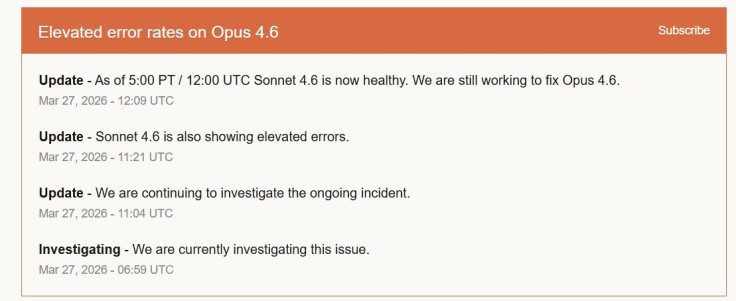
Anthropic’s popular AI assistant Claude experienced another round of service disruptions on Friday, March 27, 2026, with users reporting elevated errors particularly affecting the Opus 4.6 and Sonnet 4.6 models. As of midday UTC, the company’s official status page showed ongoing investigation into connection reset errors and degraded performance across claude.ai and related services, though some components showed signs of recovery.

Downdetector and other outage trackers recorded increased user reports starting around 4:03 AM EDT, with complaints centered on slow responses, failed generations, authentication issues and “service unavailable” messages. While not a complete global outage on the scale of earlier March incidents, the problems disrupted workflows for developers, students and professionals relying on Claude for coding, writing and analysis.
Anthropic’s status.claude.com page posted updates throughout the morning: an initial “Investigating” notice at 11:04 UTC, followed by confirmation of elevated errors on Claude Opus 4.6 and later Sonnet 4.6. By 12:09 UTC, engineers reported Sonnet 4.6 returning to healthy status, but work continued on Opus 4.6. Earlier in the day, elevated connection reset errors were flagged in the Cowork feature.
This latest hiccup adds to a pattern of instability for Claude in March 2026. Previous disruptions included a major outage on March 2 that affected login paths and claude.ai for several hours, another wave of elevated errors around March 11, and partial outages reported on March 25. Users have expressed growing frustration on platforms like Reddit, with some noting repeated impacts on paid Pro and Team subscribers who depend on reliable access for time-sensitive tasks.
What Users Are Experiencing
Affected individuals report a range of symptoms: chats failing to load new responses, models returning generic error messages, slower than usual performance, and occasional session timeouts. The Claude API appears less impacted in some reports, allowing developer integrations to continue functioning at reduced capacity, while the consumer web interface and mobile apps bore the brunt of complaints.
Free-tier users often face stricter rate limits during high-demand periods, exacerbating the sense of disruption. Enterprise and government users accessing Claude for Government have also noted intermittent issues. Social media posts and community forums filled with screenshots of error pages and questions about when service would fully restore.
Why Claude Faces Recurring Issues
Rapid growth in Claude’s user base has strained Anthropic’s infrastructure. The company has released increasingly powerful models, including Opus 4.6 touted for advanced coding and agentic capabilities, drawing heavy demand. High computational requirements for large language models, combined with traffic spikes, can lead to cascading failures in authentication, inference servers or load balancing.
Anthropic has acknowledged the challenges of scaling while maintaining the helpful, harmless and honest principles that define Claude. In statements during prior outages, the company expressed gratitude to users and emphasized efforts to match “incredible demand.” However, repeated incidents have sparked discussions about infrastructure resilience, multi-region redundancy and the trade-offs of pushing frontier AI capabilities.
Unlike some competitors with broader cloud partnerships, Anthropic’s focused approach on safety and constitutional AI may influence its scaling strategy, potentially contributing to occasional bottlenecks during peak loads or model updates.
How to Check Claude Status and Troubleshoot
When suspecting problems:
- Visit https://status.claude.com/ for official real-time updates and incident details.
- Check Downdetector.com/status/claude-ai for user-reported graphs and regional maps.
- Test across devices and networks — try the web version at claude.ai, desktop app or mobile clients.
- For API users, monitor api.anthropic.com status separately.
Basic troubleshooting steps include refreshing the page, logging out and back in, clearing browser cache, switching networks or waiting 15-30 minutes as many issues resolve through backend fixes. Paid users can sometimes access priority support channels during incidents.
Impact on Users and Businesses
For individuals, outages interrupt creative work, research and casual conversations. Developers building on Claude face delayed projects, while businesses using the AI for customer support, content generation or internal tools risk productivity losses. In education, students relying on Claude for tutoring or essay assistance encounter frustration during critical study periods.
Enterprise adoption of Claude has grown rapidly due to its strong performance in coding and reasoning tasks, making reliability a key concern for IT leaders evaluating long-term commitments. Some organizations have begun implementing fallback strategies, such as multi-model setups with alternatives like Grok or open-source options, to mitigate single-point failures.
The March 2026 cluster of disruptions has amplified calls for greater transparency and proactive capacity planning from Anthropic. Community feedback highlights the need for better communication during incidents and potential service credits for affected subscribers.
Broader Context for AI Reliability in 2026
Claude’s issues reflect wider challenges facing frontier AI companies as adoption surges. Major models from OpenAI, Google and others have faced similar outages amid explosive growth. The events underscore the gap between rapid capability advances and the operational maturity required for always-on services.
Anthropic continues investing in safety research and scalable infrastructure while expanding features like Cowork for collaborative tasks. The company’s focus on responsible scaling aims to balance innovation with dependability, but real-world demand often tests those boundaries.
As AI assistants become integral to daily workflows, expectations for near-100% uptime rise. Users increasingly demand not just powerful responses but consistent availability, prompting the industry to prioritize redundancy, monitoring and graceful degradation during stress.
Looking Ahead
As of late March 27, 2026, Anthropic engineers were actively addressing remaining issues with Opus 4.6 while confirming improvements in Sonnet 4.6. Most users should see gradual restoration, though full stability may take additional time. The company typically provides post-incident summaries to explain root causes and preventive measures.
In the meantime, alternatives remain available for those needing immediate AI assistance. Anthropic has not issued a detailed public statement beyond status page updates, consistent with its approach during prior events.
For the latest information, monitor the official status page directly, as situations can evolve quickly. While Claude has demonstrated impressive capabilities when operational, today’s disruptions serve as a reminder of the growing pains in scaling advanced AI systems to millions of users worldwide.
Anthropic’s track record shows quick recovery in most cases, and the team’s focus on safety suggests careful handling of underlying infrastructure. Still, frequent March outages may prompt users and enterprises to diversify their AI toolkit to ensure uninterrupted productivity.


Artificial Intelligence (AI) has significantly transformed the way machines interpret and interact with the visual world.
From autonomous vehicles and facial recognition to medical imaging and retail analytics, computer vision technologies are enabling machines to analyze images and videos with remarkable accuracy. At the center of many of these innovations lies Python—a programming language that has become the backbone of modern AI and computer vision development.
Organizations across industries are investing in intelligent visual systems to automate processes, improve decision-making, and unlock new data-driven insights. As these applications become more complex, businesses increasingly seek to hire Python developers and hire Computer Vision developers who can design scalable, high-performing visual AI solutions. Understanding why Python dominates this field provides insight into how modern computer vision systems are built and deployed.
The Rise of Computer Vision in Modern Applications
Computer vision is a field of artificial intelligence that focuses on enabling machines to interpret and analyze visual information from the world. By leveraging machine learning and deep learning algorithms, computer vision systems can identify patterns, detect objects, classify images, and even track motion in real time.
Some of the most common applications of computer vision include:
- Facial recognition and biometric authentication
- Autonomous driving and traffic monitoring
- Medical imaging analysis
- Industrial quality inspection
- Retail shelf analytics
- Augmented reality and virtual reality
- Security and surveillance systems
These applications require sophisticated algorithms capable of processing vast volumes of visual data. Python has emerged as the preferred language for building such solutions due to its simplicity, flexibility, and extensive ecosystem of libraries.
Why Python Is the Foundation of Computer Vision Development
Python’s popularity in the AI ecosystem is not accidental. Its design philosophy emphasizes readability and rapid development, making it ideal for complex experimentation and research-driven technologies like computer vision.
1. Rich Ecosystem of Libraries and Frameworks
One of the strongest advantages of Python is its vast ecosystem of libraries tailored for machine learning and image processing. Some of the most widely used frameworks include:
- OpenCV for image and video processing
- TensorFlow and PyTorch for deep learning models
- Keras for neural network development
- Scikit-learn for machine learning algorithms
- NumPy and SciPy for numerical computation
These libraries simplify complex mathematical operations and allow developers to focus on solving real-world problems rather than building algorithms from scratch.
For organizations planning to develop AI-driven visual systems, it becomes practical to hire Python developers who already have experience working with these libraries and frameworks.
2. Faster Prototyping and Development
Computer vision solutions often require experimentation with different models, datasets, and optimization techniques. Python enables rapid prototyping, allowing developers to quickly build and test ideas.
This agility is particularly valuable in AI projects where iterative experimentation is necessary to achieve high accuracy. Developers can quickly train models, visualize results, and refine algorithms without long development cycles.
Because of this efficiency, companies that hire Computer Vision developers with Python expertise can accelerate their AI development timelines significantly.
3. Strong Integration with AI and Machine Learning Tools
Modern computer vision systems rely heavily on deep learning architectures such as Convolutional Neural Networks (CNNs). Python provides seamless integration with major machine learning platforms and tools.
Python-based environments such as Jupyter Notebook also allow developers to experiment interactively with datasets, visualize model performance, and refine algorithms efficiently.
This integration enables the creation of end-to-end AI pipelines that include:
- Data collection and preprocessing
- Model training and validation
- Deployment and monitoring
As organizations adopt AI-driven decision-making, many teams look to hire Python developers capable of building these complete pipelines.
4. Large Developer Community and Open-Source Support
Another reason Python dominates computer vision development is its massive global community. Thousands of contributors continuously improve libraries, publish research implementations, and share open-source tools.
This collaborative ecosystem allows developers to access pre-trained models, code repositories, and research papers that accelerate development.
When companies hire Computer Vision developers, they often benefit from professionals who are already familiar with these community resources and industry best practices.
Key Components of Python-Based Computer Vision Systems
To understand Python’s role in computer vision, it is useful to look at the architecture of a typical visual AI solution.
Data Collection and Preparation
Computer vision models require large datasets of images or videos. These datasets must be labeled, cleaned, and processed before training.
Python libraries such as OpenCV and PIL help with tasks like:
- Image resizing and normalization
- Data augmentation
- Noise reduction
- Frame extraction from videos
Proper data preparation significantly improves model performance.
Model Development
The next step involves building machine learning or deep learning models that can recognize patterns in visual data. Developers typically use Python frameworks like TensorFlow or PyTorch to create these models.
Common model architectures include:
- Convolutional Neural Networks (CNNs)
- Object detection models like YOLO and SSD
- Image segmentation models such as U-Net and Mask R-CNN
These models enable systems to detect objects, classify images, and analyze visual scenes.
Training and Optimization
During training, models learn to identify patterns from labeled data. Python provides powerful tools to train models efficiently using GPUs and distributed computing.
Developers experiment with hyperparameters, loss functions, and training techniques to improve model accuracy and reduce errors.
Organizations often hire Computer Vision developers with expertise in deep learning optimization to achieve production-grade performance.
Deployment and Scaling
Once trained, computer vision models must be deployed in real-world applications. Python supports deployment through APIs, microservices, and cloud environments.
Common deployment approaches include:
- Real-time video processing systems
- Cloud-based image recognition APIs
- Edge AI applications for devices like cameras and drones
With Python’s compatibility across platforms, developers can scale AI-powered visual systems for millions of users.
Real-World Industries Leveraging Python-Based Computer Vision
Computer vision technologies powered by Python are transforming multiple industries.
Healthcare
Medical imaging systems use AI to detect diseases in X-rays, CT scans, and MRIs. Computer vision models help doctors identify abnormalities earlier and improve diagnostic accuracy.
Manufacturing
Factories use vision systems for automated quality inspection. Cameras powered by AI can detect defects in products faster than human inspectors.
Retail
Retailers analyze in-store camera footage to track customer movement, monitor inventory, and optimize product placement.
Transportation
Autonomous vehicles rely heavily on computer vision to detect pedestrians, traffic signs, and road conditions.
Security
Facial recognition and behavior analysis systems help improve surveillance and threat detection capabilities.
As these applications grow more advanced, the demand to hire Python developers and specialized computer vision engineers continues to increase.
The Future of Python in Computer Vision
The future of computer vision will be driven by innovations such as:
- Edge AI and on-device vision processing
- Real-time video analytics
- Multimodal AI combining vision with speech and text
- Advanced generative vision models
- Autonomous systems and robotics
Python is expected to remain the dominant programming language in this space because of its adaptability and extensive AI ecosystem.
New libraries and frameworks are constantly emerging, making it easier for developers to build highly sophisticated visual AI applications.
Conclusion
Computer vision has become one of the most impactful fields within artificial intelligence, enabling machines to interpret visual information in ways that were once impossible. Python has played a central role in this transformation by providing developers with powerful tools, flexible frameworks, and a collaborative ecosystem.
From rapid prototyping to large-scale AI deployments, Python supports every stage of the computer vision development lifecycle. Its simplicity, scalability, and strong community support make it the ideal language for building advanced visual AI systems.
As organizations continue to explore innovative AI applications, the need to hire Python developers and hire Computer Vision developers will remain a critical factor in successfully building and deploying next-generation visual technologies.
Author Bio;
Hi, I’m Colton Harris — an SEO expert with over 8 years of experience and the privilege of leading several international companies. I’m passionate about helping businesses and entrepreneurs enhance their online presence, attract targeted traffic, and convert clicks into loyal customers. I also share valuable insights on business, technology, finance, marketing, and the latest in cryptocurrency — because staying ahead of the curve is what keeps the journey exciting. Contact us; coltonharris573@gmail.com
Business
SAEL Industries, Vishvaraj Environment, Symbiotec Pharmalab and 3 others get Sebi nod to launch IPO

Those that received Sebi’s permission today include Vishvaraj Environment, Shah Investor’s Home and SAEL Industries. Meanwhile, Prasol Chemicals, NoPaperForms Solutions and Symbiotec Pharmalab received it on Wednesday, March 25.
In market parlance, an ‘observation’ is a formal go-ahead by Sebi with comments on a company’s draft offer document.
Jindal Supreme (India) Ltd, which filed its Draft Red Herring Prospectus (DRHP) with Sebi, has withdrawn the offer document, according to a Sebi document.
Vishvaraj Environment IPO
Vishvaraj Environment IPO plans to raise Rs 2,250 crore from the domestic primary markets. The issue is a combination of a fresh equity issuance and an offer for sale (OFS). It is a leading developer of water utility and wastewater management projects, focusing on recycling treated sewage water for industries.

The IPO comprises a fresh issue of up to Rs 1,250 crore and an OFS aggregating up to Rs 1,000 crore from the promoter selling shareholder, Premier Financial Services Limited.
Last week, Sebi cleared the decks for its IPO after the company came under regulatory crosshairs.
JM Financial, Axis Capital Limited and DAM Capital Advisors Limited are the Book Running Lead Managers to the issue.
Shah Investor’s Home IPO
Shah Investors Home’s public issue will entirely be a fresh issue of equity shares. Beeline Capital Advisors Private Limited is the lead manager for the issue.
SIHL is a retail broking firm offering a range of services covering equity and derivatives brokerage, with over three decades of experience. These services facilitate the buying and selling of financial products such as equities, IPO investing, mutual funds distribution, and other securities. While the company’s core operations include equity and derivatives brokerage, it also focuses on providing secondary market brokering services to retail customers, comprising both resident and non-resident Indians.
SAEL Industries IPO
The renewable energy company offers decarbonisation solutions to facilitate India’s adoption of clean and affordable energy projects. Its business verticals include solar energy, waste to energy, module manufacturing and solar cell manufacturing.
Its Rs 4,575 crore IPO will be a combination of a fresh share issuance and an OFS. The fresh issue is worth Rs 3,750 crore while the OFS is worth Rs 825.
The lead manager is ICICI Securities Limited.
Prasol Chemicals IPO
The Rs 500 crore IPO will be a mix of fresh equity and OFS. The fresh issue is worth Rs 80 crore while the OFS is Rs 420 crore.
The lead manager is DAM Capital Advisors Limited.
The company operates in the specialty chemicals industry, manufacturing over 150 specialty chemicals, including acetone-based, phosphorous-based, and other complex chemicals. Its product portfolio includes 21 acetone-based chemicals, 53 phosphorous-based chemicals, and 76 other specialty chemicals (e.g. surfactants, esters, acids).
NoPaperForms Solutions IPO
The IPO of NoPaperForms Solutions will be a mix of issuance of fresh equity and an OFS. The book running lead manager (BRLM) is IIFL Capital Services Limited.
Founded in 2017, NoPaperForms Solutions offers a unified, vertical SaaS platform for the education sector, with products such as Meritto and Collexo that help institutions manage student acquisition, lifecycle processes, and payments. The company focuses on enhancing revenue and operational efficiency through its technology solutions. Headquartered in Delhi, it has also expanded its presence beyond India.
Symbiotec Pharmalab IPO
The Rs 2,180 crore IPO of Symbiotec Pharmalab will be a mix of fresh equity issuance and an OFS. The book running lead manager is JM Financial Limited. The fresh issue size will be Rs 150 crore while the OFS will be Rs 2,030 crore.
In the OFS, promoter Satwani Holdings will offload stake along with investor selling shareholder Rosewood Investments and India Business Excellence Fund –III.
(Disclaimer: The recommendations, suggestions, views, and opinions given by the experts are their own. These do not represent the views of The Economic Times.)

Adding cryptocurrency payments to your website sounds like a developer’s job. You’d need API integration, webhook configuration, security implementation, etc., which is considered technical.
Many business owners don’t have that expertise. They end up either hiring developers or putting crypto payments on the back burner.
CoinRemitter eliminates that barrier. This crypto payment gateway offers plugins, invoices, and widgets. These features don’t require any technical skills to accept crypto payments. This crypto payment gateway helps you accept Bitcoin, Ethereum, USDT, etc., without coding.
Crypto Payment Plugins for Instant Integration
CoinRemitter’s ready-made Crypto plugins eliminate the need for technically complex integration into websites built on WordPress, OpenCart, PrestaShop, Laravel, etc. You can install them like an extension, connect your wallet, and accept payment in crypto. The setup takes about 12 minutes on average.
On the other hand, custom crypto API integration may stretch into days depending on your platform. With plugins, your store gets crypto payment functionality without you touching a single configuration file.
Professional Invoices for Service-Based Businesses
Not every business runs an online store; some prefer requesting payments via invoices. Traditional invoicing platforms charge fees and take days to settle. Plus, international clients face wire transfer costs that eat into your agreed rate.
The invoice system from this crypto payment processor lets you create and send payment requests in cryptocurrency for free. You enter the amount, select the crypto, and share the invoice link. Clients pay directly. No account creation required on their end. Settlement happens in a few minutes instead of 3-5 business days. That’s the difference between waiting for a wire transfer and having funds available by the end of the day.
For service businesses, this means faster cash flow. You don’t chase payments across time zones. And you’re not losing 3-4% to international transaction fees.
Crypto Payment Widgets: Four Solutions, Zero Code
Some businesses need even simpler solutions. Building a full checkout system for such businesses may not be worth it. This process can also be time-consuming.
This cryptocurrency payment gateway offers four widget options that solve different payment scenarios to address this issue. Each one generates code or a URL that you can copy and paste into your website. That’s it.
Pricing Widget
The Pricing Widget displays subscription tiers or pricing plans with built-in payment functionality. SaaS companies love this one. You set up your plan names, prices, and descriptions in the visual editor. The widget handles the rest, displaying options, collecting payments, and tracking conversions.
No CSS knowledge needed. The preview shows exactly how it’ll look on your site before you publish.
Presale Widget
Crypto projects launching tokens need a way to collect payments during ICOs. The Presale Widget creates a complete token sale interface. You can set up to four distribution rounds with different prices, increase pricing after a certain time period, and offer bonus tokens for larger purchases.
This feature also supports multiple currencies. So, you can add multiple crypto options during the presale period. This will help you distribute tokens to a wider audience.
Payment Button
Simple needs call for simple solutions. The Payment Button Widget gives you exactly what it sounds like. It gives a customizable button that triggers a crypto payment. Configure the amount, choose your cryptocurrency, customize the appearance, and embed the generated code.
Donation pages use this extensively. So do freelancers collecting fixed-fee payments. The button is responsive and adapts to mobile screens automatically.
Payment Page
The Payment Page Widget helps you create a web page with a shareable URL. You can create and customize the page, set pricing, get the URL, and share it anywhere to request payments.
This feature is ideal for social media creators, consultants, and other businesses who take bookings via email. Anyone who wants to accept payment in crypto without a website can find this feature helpful. It allows you to track analytics, set expiration dates, and display goal progress for fundraising campaigns.
Why These Tools Matter for Non-Technical Businesses
Developers often charge $50-150 per hour. Custom crypto payment integration can require anywhere from 10-40 hours, depending on complexity. That’s$500-$6,000 in development costs before you process your first payment.
CoinRemitter’s user-friendly solutions cost $0 upfront. You pay only 0.23% processing fees per transaction. Development costs are eliminated entirely.
Here’s what you get without writing code:
- Zero Developer Dependency: Set up payments yourself. Change configurations anytime. No waiting for developer availability.
- Instant Updates: In widgets, you can easily make customizations, including pricing, payment options, widget appearance, etc., through the dashboard.
- Lower Launch Costs: No upfront investment in custom development. Your savings start day one.
- Faster Time to Market: Go from “I want to accept crypto” to processing payments in under an hour. Some businesses launch the same day they sign up.
- Full Control: Access your payment data, statistics, and configurations from anywhere. No middleman required.
Conclusion
Accepting cryptocurrency shouldn’t require technical expertise. Yet many payment gateways assume you have developers on staff. This cryptocurrency payment gateway flips that assumption. Plugins, invoices, and widgets put crypto payment acceptance in your hands regardless of your technical background.
You get the same features businesses pay thousands to develop, multi-currency support, instant notifications, and settlement tracking, without hiring anyone. The platform handles complexity. You handle your business.
Ready to accept crypto payments without writing code? Create your free CoinRemitter account and choose your integration method. No KYC required.

WASHINGTON — As U.S. Sen. Marsha Blackburn (R-Tenn.) ramps up her campaign for Tennessee governor in 2026, the 73-year-old lawmaker continues to captivate attention with a career that blends small-business grit, entertainment industry roots and staunch conservative advocacy. The first woman elected to represent Tennessee in the Senate, Blackburn has emerged as a leading voice on issues ranging from protecting women’s sports to rural health care and artificial intelligence policy.

Here are five fun and fascinating facts about the Mississippi-born senator that highlight her journey from 4-H scholarship recipient to one of the most influential figures in Volunteer State politics.
1. She Paid Her Way Through College Selling Books Door-to-Door
Long before she entered politics, a young Marsha Wedgeworth (her maiden name) demonstrated remarkable entrepreneurial spirit. At Mississippi State University, where she earned a bachelor’s degree in home economics in 1973, Blackburn worked as a sales representative for the Southwestern Company. She became one of the first female sales associates in the South for the book-selling firm and later helped organize an all-female sales division.
Blackburn often credits this experience with teaching her resilience, persuasion skills and the value of hard work. She received a 4-H scholarship that helped fund her education, tying her early achievements to rural roots and community involvement. Those door-to-door sales lessons would later inform her reputation as a skilled grassroots campaigner, particularly during her successful fight against a proposed state income tax while serving in the Tennessee Senate in the late 1990s and early 2000s.
2. Her First Big Government Role Involved Tennessee’s Music and Film Scene
Blackburn’s entry into public service had a distinctly creative flavor. In 1995, she served as executive director of the Tennessee Film, Entertainment, and Music Commission. The position allowed her to promote Nashville’s booming entertainment industry, forging connections with musicians, filmmakers and creative professionals.
This early role reflects a lesser-known side of the conservative senator: her longtime support for the arts and entertainment sectors. As a lawmaker, she has backed legislation such as the Ask Musicians for Music Act and the Help Independent Tracks Succeed Act, aimed at protecting artists and independent creators in the digital age. Her appreciation for Tennessee’s music heritage — from country to rock — adds a layer of cultural affinity to her political persona in a state where entertainment is big business.
3. She Is a Bestselling Author and Children’s Book Collaborator
Blackburn has leveraged her communication skills beyond the Senate floor by becoming a published author. Her books include “Life Equity: Realize Your True Value and Pursue Your Passions at Any Stage in Life” (2008) and “The Mind of a Conservative Woman: Seeking the Best for Family and Country” (2020). The latter outlines her philosophy on family, freedom and conservative principles.
In a more lighthearted turn, she co-authored the children’s book “Camilla Can Vote” (2020) with her daughter, Mary Morgan Ketchel. The book aims to inspire young readers — especially girls — about civic participation and the importance of voting. This family collaboration underscores Blackburn’s emphasis on passing down values of engagement and empowerment to the next generation. She and her husband, Chuck Blackburn, whom she married in 1974, also have a son, Chad, and two grandsons, making her a proud mother and grandmother who frequently references family in her public remarks.
4. She Defeated a Proposed State Income Tax Through Grassroots Organizing
One of Blackburn’s most celebrated early political victories came during her time in the Tennessee State Senate (1998-2002). She played a leading role in a statewide grassroots campaign that successfully defeated a proposed state income tax. The effort mobilized thousands of Tennesseans and cemented her image as an anti-tax champion and effective organizer.
The campaign showcased her ability to connect with everyday citizens, a skill she has carried into her congressional and Senate careers. Supporters often point to this episode as evidence of her commitment to limited government and fiscal responsibility — themes that remain central to her platform as she seeks the governorship in 2026.
5. She Has Championed Causes From Rural Hospitals to Women’s Sports
Blackburn’s legislative work frequently highlights practical, constituent-focused issues. In March 2026, she joined Sen. Mark Warner (D-Va.) in introducing the bipartisan Save Struggling Hospitals Act to support rural hospitals facing financial strain. She has also introduced measures to expand mental health care access for veterans through community partnerships and pushed for stronger consumer protections in data security and product safety.
On the cultural front, Blackburn has been vocal in recent weeks about protecting women’s sports, joining Republican colleagues in pressing for policies to keep biological males out of female athletic competitions. She has described the issue as a defense of Title IX opportunities for girls and women.
As she eyes the Tennessee governor’s race — where recent polls show her commanding a strong lead in the Republican primary — Blackburn continues to blend her personal story with policy priorities. Born in Laurel, Mississippi, on June 6, 1952, she moved to Tennessee and built a life in Brentwood, a Nashville suburb. Her net worth, according to financial disclosures, places her in the upper-middle range for lawmakers, reflecting a career that includes running her own marketing and event management company before entering full-time politics.
Blackburn’s path from sales manager and small business owner to U.S. senator and gubernatorial contender illustrates a classic American narrative of ambition and persistence. She first won election to the U.S. House in 2002, representing Tennessee’s 7th Congressional District for eight terms before successfully running for Senate in 2018. She cruised to reelection in 2024 and now positions herself as a candidate who can make Tennessee a national model for conservative governance.
Critics and supporters alike note her sharp debating style and frequent media appearances. She has authored opinion pieces, appeared on national television and used social media effectively to communicate directly with constituents. Her office highlights a leadership philosophy rooted in private-sector experience, family values and a belief in empowering individuals rather than expanding government.
As the 2026 gubernatorial race heats up, with Blackburn emerging as a frontrunner, these five facts offer a glimpse into the woman behind the headlines. From her youthful days selling books to her current efforts shaping policy on rural health, veterans’ care and cultural issues, Marsha Blackburn’s story reflects both personal drive and deep ties to Tennessee’s identity.
Voters and political observers will watch closely as she campaigns on themes of prosperity, opportunity and conservative principles. Whether discussing entertainment industry support, family empowerment or economic freedom, Blackburn consistently draws on experiences that span decades of public and private service.
For those following Tennessee politics, the senator’s blend of grit, policy focus and personal touch continues to define her appeal. As she pursues the state’s highest office, her journey from Mississippi roots and college sales jobs to the corridors of power remains one of the more compelling narratives in American politics today.

Why is SanDisk stock higher today?

Dr Edwin Masimba Moyo is an entrepreneur, author, and agricultural innovator known for shaping modern horticulture and food systems across Africa. Raised in Zambia and Zimbabwe, he built his career at the intersection of agriculture, trade, and global markets.
He first gained recognition as a pioneer of Zimbabwe’s blueberry industry. At a time when export horticulture was still developing, he led projects that supplied high-value crops such as blueberries, strawberries, and exotic vegetables to international retailers, including Tesco and Marks & Spencer. He also played a key role in opening access to the Chinese market for African-grown blueberries.
His career has not followed a straight path. After facing major setbacks, including the loss of land during political upheaval in Zimbabwe, Dr Moyo shifted his approach. He began working with small-scale farmers through contract farming, turning adversity into a scalable model for inclusive agriculture.
Today, he leads AgriConnectAfrica, a digital platform designed to link African farmers with global markets, finance, and infrastructure. The initiative aims to reach 50 million farmers over the next decade while building a broader ecosystem that includes research, food processing, and international distribution.
Alongside his business work, Dr Moyo is a published author of several books on agriculture, economics, and consumer behaviour. His latest work, The Mathematics of Food, explores the economic forces shaping global food systems.
His work reflects a long-term focus on value creation, innovation, and economic development across Africa.
Q&A Interview
Edwin Masimba Moyo: Building Systems, Not Just Businesses
Q: Let’s start at the beginning. What first drew you into agriculture and trade?
I grew up in both Zambia and Zimbabwe, where agriculture was always part of daily life. But I did not see it as a business at first. That changed when I realised the gap between what farmers produced and what global markets demanded. I became interested in how to bridge that gap, not just through farming, but through systems.
Q: You became known for pioneering the blueberry industry in Zimbabwe. How did that happen?
At the time, blueberries were not a common crop in Zimbabwe. I saw an opportunity in export markets, especially in the UK and later China. We built supply chains from the ground up. That included production, quality control, and logistics. It was not easy, but it showed that African agriculture could compete globally if structured properly.
Q: Your career has also included major setbacks. How did those experiences shape your approach?
One of the biggest challenges was losing land during political changes in Zimbabwe. It was a turning point. Instead of focusing on large-scale ownership, I shifted towards working with small-scale farmers. Contract farming allowed us to keep production going while involving more people. It changed my thinking from individual success to collective systems.
Q: How did that thinking lead to AgriConnectAfrica?
AgriConnectAfrica came from years of seeing the same problems. Farmers lacked access to markets, finance, and reliable partners. At the same time, buyers and investors struggled to find structured supply. The platform connects all these groups in one system. It is not just about selling crops. It is about building an ecosystem.
Q: What makes the platform different from other agricultural initiatives?
The structure is different. Farmers are not just users. Over time, they become partners. The platform also integrates banks, insurers, and logistics providers. We are working with universities as well, to support research and training. The goal is long-term sustainability, not short-term transactions.
Q: You have also spoken about research into indigenous plants and health. How does that fit into your work?
Agriculture and health are closely linked. We are researching indigenous antioxidant plants that may support early brain development. This work builds on what we learned from crops like blueberries, but goes further. It is about using local knowledge and science together to create new value.
Q: Your latest book, The Mathematics of Food, looks at food systems in a different way. What inspired it?
I wanted to show that food is not just about what we eat. It is also about economics. The book looks at waste, processing, and the long-term costs of unhealthy diets. By putting numbers to these issues, we can better understand the system and make more informed decisions.
Q: You have written several books. How does writing support your work as an entrepreneur?
Writing helps me organise ideas. It also allows me to share lessons from experience. Each book reflects a different stage of my journey, from agriculture to consumer behaviour to future thinking.
Q: What is your long-term vision for AgriConnectAfrica?
In the short term, it is about mobilising and training farmers. In the medium term, it is about building entrepreneurs and expanding markets. In the long term, it is about creating a strong African economy driven by its people, especially the youth.
Q: Finally, how do you define success at this stage of your career?
Success is not personal. It is about how many people you help become successful. If the system works for others, then it works.

Check out what’s clicking on FoxBusiness.com.
Since entering the national spotlight, former NFL MVP Cam Newton has been authentically and unapologetically himself.
Whether on the field, or now off of it in his new content-creating realm, Newton’s fans and followers have gravitated toward his genuine, no-filter takes on his hit shows “Funky Friday” and “4th & 1 with Cam Newton.” Now, with a new, key partnership with Offscript Worldwide, Newton’s reach to the masses will be far greater.
Iconic Sage Productions, the independent production powerhouse founded by Newton, joined Offscript, a creator-owned ecosystem that connects culture-shaping brands and platforms under one roof, including REVOLT, REVOLT Sports and 3BlackDot, among others. The major expansion was announced at the 2026 IAB NewFronts, as Offscript, which represents more than 130 creators and produces over 150 creator-led series that reach more than 250 million subscribers on YouTube alone.
CLICK HERE FOR MORE SPORTS COVERAGE ON FOXBUSINESS.COM

Cam Newton of team J Balvin looks on against team Druski during the Super Bowl LX Celebrity Flag football game on YouTube at Moscone Center South on Feb. 7, 2026 in San Francisco, California. (Thearon W. Henderson/Getty Images / Getty Images)
As part of the expansion, Newton’s Iconic Saga will integrate into Offscript’s creator-led ecosystem, which will ultimately amplify the reach of Newton’s signature storytelling.
“When you really think about Offscript, it’s like the ecosystem that bridges so many different facets of our lives, from sports, to culture, to lifestyle and so many different things,” Newton explained to Fox Business. “That transition for me wasn’t foreign. Instead of training to be the best football player, or the best athlete. Now, I’m just training to be the best content creator I can possibly be.
“I just always want to be a beacon of the person, in a lot of ways, figured it out as I went. I’m just so thrilled that Offscript gives me and Iconic Saga the opportunity to continue to believe in our vision, and we’re not able to do these things without great partners like this.”
TOM BRADY OPENS UP ABOUT HIS HEALTH AMID GLP-1 SURGE: WATER, MOVEMENT AND DISCIPLINE
Content creation is usually viewed as an independent art, but Newton knows that’s not the case, especially now with Offscript.
“It’s comparable to when I was playing football,” he said. “Even though I would probably make a play, and they’d always use the analogy, ‘Oh my God, he made an unbelievable play, that’s all him.’ Well, you still had offensive lineman, you had receivers blocking, you had coaches calling the play, you had general managers assessing the team.
“For us, that’s the same thing. We want to play to our strengths and partner in our weaknesses. That’s what Offscript gives us the opportunity to do – partner with their ecosystem to really bring ease to the business as we know it.”

ESPN analyst Cam Newton is on the set of “First Take” on Feb. 6, 2026 in San Francisco, California. (Aaron M. Sprecher/Getty Images / Getty Images)
The content creation game is also about being authentic with your audience, which Newton said is “nothing new” from him. But he also recognizes how today’s consumers can “identify B.S.,” as he put it.
As Iconic Saga preaches authenticity, so does Offscript, which Newton gravitated toward with this partnership. It also helps that Offscript can bridge the gap with global brands to partner with Newton’s content in the future as well.
“These brands who align, you can also sell them the visual output that people look to your platform to see,” Newton said. “…The real game changer, so to speak, is when brands align with your message. Brands align with your audience. Brands align with your real value to capturing people’s attention. That’s where we’re at with Iconic Saga, no different than if it’s ‘Funky Friday’ or ‘4th & 1.’”
As this partnership kicks off, that message is going on tour as well, with the “4th & 1 College Tailgate Tour.” Iconic Saga is running the show, meaning Newton will be taking full ownership of the narrative, which means his unfiltered, authentic connection directly to the HBCU community.
“4th & 1” will be traveling to America’s HBCU campuses, where live recordings of the show will allow fans to experience, what Newton calls, “from the set to the yard.” Whether at home or in person, the tour, which is set to begin in Fall 2026, will shine a spotlight on the student-athletes, academic programs, and the unique game-day culture that defines an HBCU.

Cam Newton speaks on the “Funky Friday” panel during the 2025 Black Effect Podcast Festival at Pullman Yards on April 26, 2025 in Atlanta, Georgia. (Derek White/Getty Images / Getty Images)
GET FOX BUSINESS ON THE GO BY CLICKING HERE
This and much more is expected as Newton, Iconic Saga and Offscript embark on a partnership aimed at continuing to make an impact at the intersection of sports, culture, and lifestyle.
“We’ve always had interests outside the game,” Newton said. “Now, I can 100% dedicate my time, energy and effort not into just creating, but also aligning with incredible partners like Offscript, as well as beefing up my personnel within Iconic Saga to not just get any person, but the right person that can magnify the brand to be able to get the most out of ‘Funky Friday’ as well as ‘4th & 1.’”
Follow Fox News Digital’s sports coverage on X and subscribe to the Fox News Sports Huddle newsletter.

Woodside Energy and Chevron have both confirmed production impacts from Tropical Cyclone Narelle, with LNG and domestic gas supply interrupted.


The globally-inspired noodles are available at Canadian retailers.

Nobody tells you what the silence after a stem cell transplant feels like. The months before the transplant requires multiple medical visits together with important medical choices and intense physical activity. The procedure begins and you find yourself in a hospital room during a period of waiting. Your new cells need to complete the process of engraftment. Your body counts require a period of waiting until they increase. Your body needs to determine its upcoming actions.
Patients who undergo stem cell transplantation must face the most difficult process of both physical and emotional recovery. The treatment results in remarkable life changes for many patients who receive it. The guide will assist you in understanding the structure of your journey through the upcoming weeks and different stages until you reach the end.
The First Phase: Early Recovery in Hospital
You will stay at the hospital for two to four weeks after your transplant operation. The most important time occurs during this time frame. Your body experiences maximum infection risk because your immune system has been purposely weakened for stem cell transplant purposes. The medical staff will conduct daily blood count tests to track your progress until the new stem cells start their process of creating healthy blood cells. The whole procedure has this milestone as its most eagerly awaited point of progress. The transplant begins its successful operation when the counts start to rise.
The treatment will result in severe tiredness for you during the entire time because your body will reach its full state of exhaustion. Mucositis develops because of high-dose chemotherapy because it creates severe mouth and digestive system inflammation. The typical symptoms of the landscape include nausea and loss of appetite and weakness. Your current situation presents a difficult task which will end when you complete your daily progress to reach the next stage of your work.
“Recovery isn’t a straight line. It’s more like a tide some days the water comes in strong, and some days it pulls back. What matters is the overall direction.”
Going Home: The First 100 Days
The first three months after a stem cell transplant demonstrate the highest danger period because patients need to complete multiple outpatient medical visits during this time.
At Liv Hospital, post-transplant care needs to achieve the same degree of precision which the transplant operation requires. The follow-up team maintains continuous contact during this time period to track complications and modify medications while providing complete assistance to the patient throughout their journey back home. What does life look like during these 100 days? The situation becomes restricted but remains manageable through proper guidance. Most patients are advised to:
- Avoid entering public places which have many people and which include sick individuals
- They must adhere to food safety standards which prohibit the consumption of raw meat and unpasteurized items and unwashed produce
- They must take all prescribed drugs without fail which includes antifungals and antivirals and antibiotic prophylaxis
- The guidelines require individuals to use masks in specific locations which include indoor spaces and healthcare facilities
- Patients need to rest while they should also practice mild activities which they can handle because exercise helps their healing process
- Patients should attend all scheduled outpatient visits regardless of their current health status
Precautions exist to protect people, but they do not create prison-like conditions. The body requires this protection because the immune system needs time to develop its defenses and this period determines how well the body will perform in the future.
Graft-Versus-Host Disease: The Complication Worth Understanding
The medical field requires understanding graft-versus-host disease (GVHD) because it represents the primary concern for patients who undergo allogeneic transplant procedures which involve donor cell transplants to treat their medical conditions. The patient’s body becomes attacked by donor immune cells because they perceive the patient’s body tissues as foreign entities.
GVHD exists in two forms because it can develop during the first three months after transplant or it can start later and continue for several years. The condition can impact multiple body systems including the skin and liver and gut and eye and mouth and lung systems. The condition presents various degrees of intensity which range between minor and severe situations.
The patient needs to inform their medical team about these symptoms which include persistent skin rash or redness and yellowing of the skin or eyes and ongoing diarrhea or abdominal cramping and dry or painful eyes and difficulty swallowing and unexplained shortness of breath. GVHD treatment results better when doctors use early treatment methods for GVHD management. Certain blood cancers benefit from using GVHD because the immune system attacks both healthy tissues and remaining cancer cells.
The Recovery Timeline: What to Expect and When
Every patient recovers in a unique way, but most individuals follow a typical recovery pattern. The stages that people experience during stem cell recovery and their follow-up process enable people to create correct expectations while reducing their anxiety about uncertain outcomes.
Days 0–30: Engraftment Phase
The new stem cells establish themselves in bone marrow before they start producing blood cells. The patient needs daily monitoring because of their high infection risk and their experience of extreme fatigue. This period represents the highest level of medical activity.
Days 30–100: Early Recovery
The blood counts reach stable levels. The body starts to build its immune system through a gradual process. The patient needs to visit outpatient facilities for treatment. The patient shows improvement in energy but their ability to sustain energy throughout the day remains restricted. The medical staff currently observes the patient’s GVHD condition.
Months 3–6: Immune Rebuilding
The patient moves back to their daily life through a gradual process. Medical professionals will reduce the dosage of medications. The patient will start their new vaccination program according to established guidelines. Most patients who undergo this treatment period will experience significant progress toward their normal state.
Months 6–12: Continued Strengthening
The body’s immune system continues to develop better functions. Most limitations on activities have been removed. The person can now think about returning to work or school. The schedule for future medical check-ups has been extended to longer intervals between appointments.
Year 1 and Beyond: Long-Term Follow-Up
Patients now follow a routine that includes annual or bi-annual medical examinations. The ongoing medical treatment now concentrates on assessing treatment-related late effects which include organ function and bone health and secondary medical conditions.
Long-Term Follow-Up: Why It Never Really Ends
Patients exhibit difficulty in accepting their need for continuous follow-up care which extends indefinitely. Transplant patients require ongoing monitoring throughout their lives, even after they achieve successful transplant outcomes. The medical team displays their full operational capacity through this standard procedure which they conduct.
Patients who undergo high-dose chemotherapy and transplant procedures face enduring effects that impact their fertility abilities and bone density levels and thyroid and hormonal systems and heart condition and cognitive functions. Some effects of the treatment remain dormant until they emerge after several years. The procedure of routine monitoring enables identification and treatment of medical conditions before they progress into severe health issues.
People entering this period should take active steps to re-establish their connection with life. Transplant survivors achieve their complete rehabilitation when they resume work and travel and maintain their relationships with others. The follow-up phase focuses on constructing future goals which the patient will achieve after they complete their current illness period.
The Emotional Recovery Nobody Warns You About
People pay most of their attention to physical recovery because they underestimate the equal difficulty of emotional recovery. Transplant survivors experience three common emotions which include anxiety about relapses and difficulty adjusting to a changed body and survivor’s guilt and the strange grief of leaving active treatment behind.
The act of speaking about something is significant. The act of identifying your feelings to a therapist or support group or trusted friend or medical team represents a strength rather than a weakness. The most beneficial action you can take to improve your health for future years stands as your ability to maintain hydration throughout the day. Psychological support has become standard practice in post-transplant care at many transplant centres because of its proven benefits to patients.
People need their daily life activities to establish their recovery process beyond the restricted space of medical facilities. Your recovery process depends on your food intake and sleep patterns and physical activity and stress management and ability to engage with activities that bring you joy. For practical, warm, and genuinely useful guidance on building those habits back up, Live and Feel is a lifestyle and wellness resource designed to support exactly that kind of whole-life recovery — because healing fully means feeling well in every sense of the word.

The Best Budget-Friendly Hotel In Reykjavik: A Guide For The ‘Accommodation Inbetweener’
TaylorMade’s Flamingo golf balls will put you in a summer state of mind

Water-Cooled MacBook Neo Equals Double the Frames from a Fanless Budget Laptop


-
 Crypto World7 days ago
NIO (NIO) Stock Plunges 6.5% as Shelf Registration Sparks Dilution Worries
-
 NewsBeat2 days ago
Manchester United reach agreement with Casemiro over contract clause amid transfer speculation
-

 Fashion7 days ago
Weekend Open Thread: Adidas – Corporette.com
-

 Politics7 days ago
Jenni Murray, Long-Serving Woman’s Hour Presenter, Dies Aged 75
-

 Crypto World6 days ago
Best Crypto to Buy Now: Strategy Just Spent $1.57 Billion on Bitcoin During Fear While Early Investors Quietly Enter Pepeto for 150x Potential
-

 Crypto World6 days ago
Bitcoin Price News: Bhutan Sells $72 Million in BTC Under Fiscal Pressure, but the Smart Money Entering Pepeto Sees What the Market Does Not
-

 News Videos2 days ago
Parliament publishes latest register of MPs’ financial interests
-

 Sports4 days ago
Remo Stars and Kano Pillars Strengthen Survival Hopes in NPFL
-

 Sports4 days ago
Gary Kirsten Accuses Pakistan Cricket Board Of ‘Interference’, Mohsin Naqvi Responds
-

 Business5 days ago
No Winner in March 21 Drawing as Prize Rolls to $133 Million for Next
-

 Tech5 days ago
Give Your Phone a Huge (and Free) Upgrade by Switching to Another Keyboard
-

 Sports7 days ago
2026 Kentucky Derby horses, odds, futures, preview, date: Expert who nailed 12 Derby-Oaks Doubles enters picks
-

 Tech5 days ago
AI enters the chat: New Seattle dating app relies on tech to facilitate meaningful human connections
-

 News Videos4 days ago
Ch 9 Financial Management Part 1 | Detailed One Shot | Class 12 Business Studies Boards 2026
-
Business7 days ago
Columbia Sportswear enters $500 million credit agreement with JPMorgan Chase
-

 Tech6 days ago
Today’s NYT Connections Hints, Answers for March 22 #1015
-

 Business20 hours ago
Instagram, YouTube Found Responsible for Teen’s Mental Health Struggle in Historic Ruling
-
 Crypto World7 days ago
Small-cap Russell 2000 enters correction territory
-

 Business5 days ago
Will Duke Basketball Win It All? Duke Basketball Enters Second Round as Third Favorite to Claim NCAA Title
-

 Sports4 days ago
2026 Kentucky Derby horses, odds, futures, preview, date: Expert who hit 12 Derby-Oaks Doubles enters picks
You must be logged in to post a comment Login