
Crypto World
NYSE parent invests $600M more in Polymarket



Intercontinental Exchange has expanded its bet on prediction markets with a new $600 million investment in Polymarket.
Summary
- ICE invested $600 million more in Polymarket as part of its $2 billion commitment plan.
- Prediction markets are growing fast as exchanges target new trading demand beyond traditional derivatives products.
- Kalshi raised $1 billion recently, increasing competition in the event-based prediction markets sector globally.
The deal adds to an earlier commitment and comes as the sector attracts more capital and more attention from large financial firms.
ICE, the parent company of the New York Stock Exchange, said on Friday that it invested another $600 million in Polymarket. The company said the new funding is part of its previously announced plan to invest up to $2 billion in the crypto-based prediction market platform.
The company first announced its Polymarket investment plan in October 2025. With the latest round, ICE’s total committed investment has reached about $2 billion, according to the company and related reporting.
ICE said the investment forms part of Polymarket’s latest fundraising round. It also said Polymarket’s valuation will be disclosed after the fundraising process is completed. ICE added that the investment is not expected to have a material effect on its financial results or capital return plans.
Prediction markets have grown quickly over the past two years. Segment has moved from a niche part of crypto and academic finance into a fast-growing trading market with rising user activity and volumes. Analysts told Reuters these products could help exchanges reach more retail traders and expand trading revenue beyond traditional futures and options.
Kalshi deal adds competitive pressure
The new ICE investment comes shortly after rival prediction market Kalshi raised about $1 billion at a reported $22 billion valuation. The funding round gave Kalshi a fresh boost as competition in event-based trading continues to grow.
The rapid growth of both Polymarket and Kalshi shows how prediction markets are moving deeper into mainstream finance. At the same time, the sector continues to face regulatory scrutiny as trading volumes and investor interest keep rising.

After a brief improvement in sentiment, fear has returned to the crypto market and continues to dominate social discussions. Bitcoin has dropped back below $70,000, raising concerns among retail investors.
Although negative sentiment is spreading across social media, on-chain data paints a more complex picture of retail investors’ actual role.
Retail FUD Sentiment Surges. Will Bitcoin Recover?
Blockchain analytics platform Santiment recently recorded a spike in negative Bitcoin-related keywords on social media.
Terms such as “dip” and “crash” appear frequently in BTC discussions. This reflects a significantly elevated level of FUD (Fear, Uncertainty, Doubt) among retail investors.
Santiment notes that extreme pessimism among retail investors often serves as a contrarian signal. When negativity becomes overwhelming, the market tends to recover as selling pressure nears exhaustion.
“Words like #dip, #pullback, #rejection, #crash, or #bloodbath, it’s usually a safe time to BUY,” Santiment stated.

Santiment’s chart illustrates this logic over the past year.
However, the picture goes beyond sentiment alone. A report from CryptoQuant reveals a concerning divergence between trading volume and the actual market share of retail investors.
Zizcrypto, an analyst at CryptoQuant, reported that the 30-day average small trade volume (0–$1,000) from retail stands at $96 million. This level aligns with the market bottom in early 2023.
Meanwhile, retail trading share (0–$10,000) has steadily declined since early 2023. It has dropped from over 2.4% to ~0.7% and has now stabilized.
The divergence between trading volume and market share suggests that retail investors remain active, but their structural role in the market is no longer expanding.
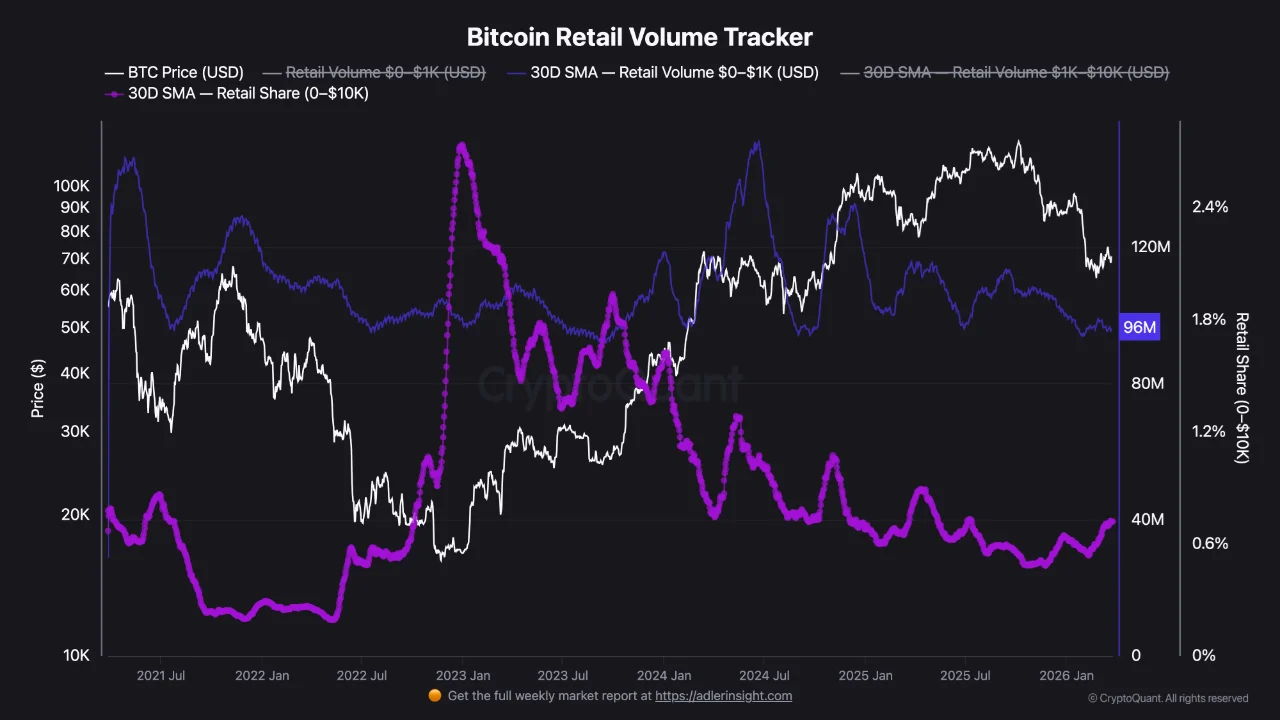
“In this context, retail participation is primarily concentrated in short-term reactive flows rather than sustained engagement,” Zizcrypto stated.
Therefore, Santiment’s view may hold in the short term. However, it is difficult to use it as a basis for predicting a reversal similar to early 2023.
The latest analysis from BeInCrypto indicates that if Bitcoin closes a daily candle below $68,930, the price could continue to decline toward $65,550.
The post Retail FUD Sentiment Rises as Bitcoin Falls Below $70,000: What Are The Implications? appeared first on BeInCrypto.


Intercontinental Exchange has now deployed nearly $2 billion into the onchain prediction market, underscoring Wall Street’s growing conviction that event-based trading is here to stay.
Intercontinental Exchange, the parent company of the New York Stock Exchange, on Friday announced a new $600 million direct cash investment in Polymarket, completing the exchange operator’s structured investment arrangement with the prediction market platform.
The investment is part of a broader equity capital fundraise by Polymarket, according to a press release from ICE. The company also expects to purchase up to $40 million in Polymarket securities from existing holders, which would close out its obligations under the deal first announced in October 2025. The valuation of Friday’s investment is expected to be disclosed after Polymarket completes its fundraising.
ICE made an initial $1 billion direct investment in Polymarket at that time, in what was the largest single investment ever made in a prediction market company. That deal valued Polymarket at roughly $8 billion pre-investment and established ICE as a global distributor of Polymarket’s event-driven data.
ICE’s interest in Polymarket extends beyond a passive equity stake. In February, ICE launched the Polymarket Signals and Sentiment Tool, a product that normalizes real-time and historical prediction market data into structured feeds for institutional traders. The tool packages Polymarket’s crowd-sourced probability assessments as market signals alongside traditional financial instruments.
Prediction Market Arms Race
The capital injection comes amid an unprecedented wave of institutional investment into prediction markets. Rival platform Kalshi raised approximately $1 billion at a $22 billion valuation earlier this month in a round led by Coatue Management. Polymarket is reportedly targeting a valuation of around $20 billion in its current round, according to The Wall Street Journal.
Prediction market monthly volumes have grown 130-fold since early 2024, making it one of the fastest-growing categories in finance. Open interest across platforms crossed $1 billion for the first time in February.
Regulatory Crosswinds
The investment arrives against a complex regulatory backdrop. The CFTC recently issued an advance notice of proposed rulemaking signaling its intent to build a comprehensive regulatory framework for prediction markets. Meanwhile, some lawmakers have introduced legislation that would block prediction markets from offering contracts on war and sports outcomes.
At the state level, regulators continue to challenge the industry — Arizona’s attorney general recently filed criminal charges against Kalshi, alleging it operates an illegal gambling business in the state.
Still, institutional capital appears undeterred by the regulatory uncertainty. For ICE, the completion of its nearly $2 billion investment arrangement signals that one of the world’s largest market infrastructure operators views prediction markets not as a passing novelty but as a category that may eventually sit alongside equities, futures, and fixed income.
This article was written with the assistance of AI workflows. All our stories are curated, edited and fact-checked by a human.
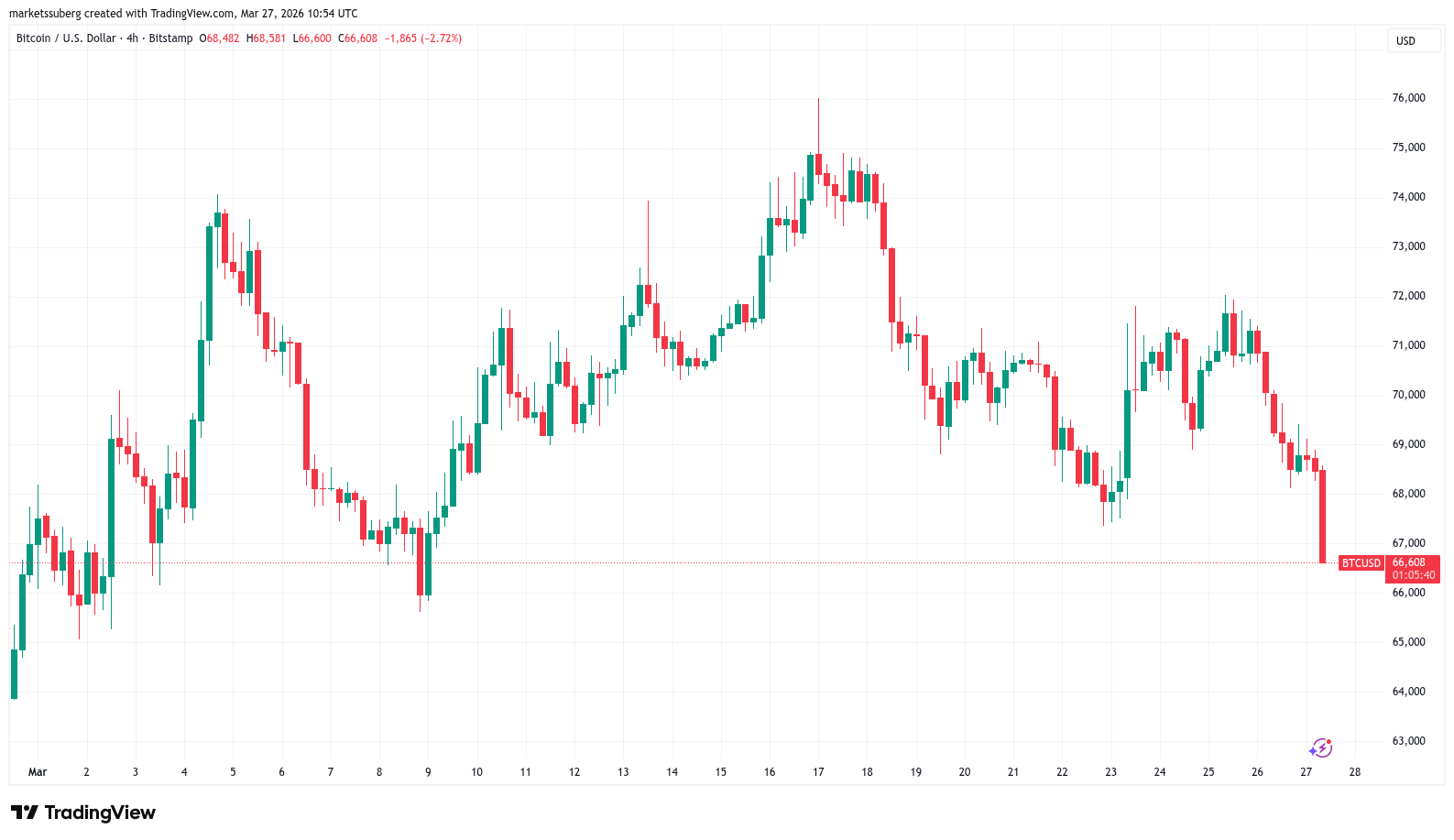
Bitcoin grabbed downside liquidity as oil-supply pressure sent BTC price action below $66,500 to its lowest levels since March 9.
Bitcoin (BTC) neared three-week lows into Friday’s Wall Street open amid reports of Iran closing the Strait of Hormuz oil route.
Key points:
-
Bitcoin reacts badly to fresh oil-supply threats ahead of Friday’s Wall Street open.
-
BTC price action hunts bid liquidity, continuing a week of low-time frame liquidity grabs.
-
Another bear flag threatens to send the market below $50,000, analysis says.
Bitcoin eyes range lows into monthly close
Data from TradingView showed BTC price action slipping below $66,500 ahead of the Wall Street open.

US stocks futures trended down and US WTI crude oil eyed $97 per barrel as geopolitical tensions refused to let up.
Data from CoinGlass showed BTC/USD eating into a ladder of bid liquidity extending down to $65,000, with a wall of asks keeping price pinned below the $70,000 mark.

“$70-71k confirmed as resistance again,” trader Jelle wrote in analysis on X the day prior.
“Still a bunch of liquidity built up below, generally not what you see at market bottoms. Expecting that liquidity to be taken out; sooner or later.”

The latest market moves continued a theme of liquidity grabs seen throughout the week.
Continuing, crypto trader Michaël Van de Poppe said that he would not be “surprised” about further BTC price weakness into the March monthly candle close.
“Especially given that we’re currently anticipating a potential sweep of the lows,” he told X followers on the day.
“In that case, I remain to be interested to be buying in the lower $60K regions.”

BTC price gets $41,000 “measured target”
On longer time frames, market participants focused on a potential bearish support breakdown from Bitcoin’s second bear flag construction of 2026.
Related: US recession odds near 50%: Can Bitcoin copy 2020 comeback gains?
Previously occurring in January, the current bear flag has produced targets below $50,000.
“Bitcoin setting up for a rising wedge sell signal,” veteran trader Peter Brandt warned on Wednesday, joining those calls.

In his own X update, trader and educator Aaron Dishner continued the bearish tone around the flag structure.
“BTC is doing exactly what the bear flag setup called for. Price broke below the cloud yesterday on the daily, and today opened below it – currently down just 0.32% but that’s not a recovery, that’s hesitation,” he commented.
“The measured target from the January 14th high to the February 6th low, applied to the current flag structure, puts the downside at $41K.”
This article does not contain investment advice or recommendations. Every investment and trading move involves risk, and readers should conduct their own research when making a decision. While we strive to provide accurate and timely information, Cointelegraph does not guarantee the accuracy, completeness, or reliability of any information in this article. This article may contain forward-looking statements that are subject to risks and uncertainties. Cointelegraph will not be liable for any loss or damage arising from your reliance on this information.


The US government’s crypto and AI czar, David Sacks, is stepping down from his special government employee (SGE) role to join Meta’s Mark Zuckerberg and Nvidia’s Jensen Huang on Donald Trump’s new tech council.
Sacks announced his departure in an Interview with Bloomberg that also covered the President’s Council of Advisors on Science and Technology (PCAST).
Sacks told Bloomberg, “In the first year of the Trump administration, I had that role as an SGE. I had 130 days.”
“We’ve now used up that time,” Sacks said, adding that his role as co-chair of PCAST means he’ll now “make recommendations on not just AI, but an expansive range of technology topics.”
Read more: David Sacks promised ‘market structure bill in 100 days’ a year ago
The council has been created to guide tech policies within government, and counts major tech executives such as Marc Andreessen and Sergey Brin among its ranks.
Tesla CEO Elon Musk was also a SGE under Trump’s administration, and also stepped down from the role after 130 days. He won’t be part of the tech council, however.
Sacks’ time as crypto czar was bittersweet
Under Sacks’ stewardship, the US administration loosened its grip on crypto regulations, the president launched a memecoin, and the government promised to implement a Strategic Bitcoin Reserve (SBR).
During this time, it gained a reputation for intense profiteering and crypto corruption. Indeed, Trump’s son Eric boasted very publicly about his family making profits of $1 billion from its various crypto enterprises.
Sacks promised in February last year that the market structures bill, aka the CLARITY Act, and stablecoin legislation, also known as the GENIUS Act, would have been passed through the Senate and House within 100 days.
While the GENIUS Act was passed, albeit well beyond the self-imposed deadline, the CLARITY Act is still struggling to join it.
Sacks was revealed by the New York Times to have held over 400 investments in various crypto and AI firms while still maintaining his SGE role in Trump’s administration, raising concerns about a potential conflict of interest.
The administration also signed into existence the SBR but it was watered down significantly when officials revealed that the US wouldn’t be buying any BTC to contribute to the it and would instead rely on the coins it had already seized and forfeited.
An audit of crypto assets intended for both the SBR and Digital Asset Stockpile was supposed to be complete by April 5, 2025. However, no such review has been published almost 356 days after the deadline.
Read more: David Sacks sends silly legal threat to the New York Times
Crypto traders happy about David Sacks crypto czar departure
Upon discovering Sacks’ departure yesterday, X users have remarked on the less-than-stellar effect he had on the crypto market.
Venture capitalist Adam Cochran mocked Bitcoiners who voted for Trump, asking “How’d that bitcoin reserve work out for you? Remember those day one promises?”
“Remember how Trump and Sacks promised you the world, and you told us we had TDS when we told you that you were getting played?” he added.
Others pointed to today’s BTC price of $66,600, and how it’s down 34% from the day Sacks was inaugurated as crypto czar.
Read more: US Strategic Bitcoin Reserve audit now 172 days overdue
Traders have also complained that under Sacks’ role, nothing was actually achieved, adding that he’s “the single most useless person of Trump administration [sic] (right there with Trump).”
Eleanor Terrett reports that it’s unclear whether or not Sacks’ crypto czar role will be replaced while major crypto legislation, such as the CLARITY Act, continues to work its way through the Senate.
If the Trump administration does decide to hire a replacement, at least one willing candidate has already thrown their hat into the ring on X. Despite currently serving a 25-year prison sentence, FTX fraudster Sam Bankman-Fried posted simply “dibs.”
Got a tip? Send us an email securely via Protos Leaks. For more informed news and investigations, follow us on X, Bluesky, and Google News, or subscribe to our YouTube channel.

The European Central Bank published a working paper on March 26, finding that governance in four major DeFi protocols was heavily concentrated.
The staff paper looks at Aave, MakerDAO, Ampleforth and Uniswap, and finds that while governance tokens are held across tens of thousands of addresses, the top 100 holders control more than 80% of the supply in each protocol.
Based on holdings snapshots from November 2022 and May 2023, the authors found that a large share of governance tokens could be linked either to the protocols themselves or to centralized and decentralized exchanges, with Binance the largest identified centralized exchange holder across the four protocols.
The authors said the findings challenge the idea that decentralized autonomous organizations (DAOs) are inherently decentralized, raising questions about accountability and complicating efforts to identify possible regulatory anchor points under the European Union’s Markets in Crypto-Assets Regulation (MiCA) framework. MiCA currently excludes “fully decentralised” services from its scope.
Top token holders dominate governance
The authors also look at who actually votes on key proposals, concluding that top voters are mostly delegates who wield delegated voting power from smaller token holders.
The top 20 voters in Ampleforth control 96% of delegated voting power, while the top 10 voters in MakerDAO hold 66% of delegated votes, and the top 18 in Uniswap hold 52%. Around one-third of top voters cannot be publicly identified, and among those that can, the largest groups are individuals and Web3 companies, followed by university blockchain societies and venture firms.
Related: DAOs may need to ditch decentralization to court institutions

Cointelegraph reached out to Aave, Uniswap, MakerDAO, and Ampleforth, but had not received a response by publication.
Kavi Jain, senior research associate at Bitwise, told Cointelegraph that many large DeFi protocols were not as decentralized in practice as they might appear, especially in the earlier stages, where a small group still has “meaningful influence over decisions.”
He pointed to the recent Aave governance debate that highlighted how, even with a DAO structure, voting power can “still be concentrated among a few participants.”
MiCA faces DeFi accountability problem
The paper catalogues what governance actually decides, finding that the largest share of proposals relates to “risk parameters” that shape the protocols’ risk profiles. That raises further questions about accountability, especially given that it is “not possible” to tell from public data whether protocol-linked holdings belong to founders, developers or treasuries, or whether exchange wallets are voting their own positions or those of customers.
Related: How a 2.85% price error triggered $27M in liquidations on Aave
There are some caveats with the methodology, and the paper itself warns that it does not capture the “full scope of the DeFi ecosystem,” due to insufficient data.
The paper also stresses that it reflects the authors’ views rather than official ECB policy, however, it warns that the difficulty of reliably identifying who controls major protocols makes it harder to lean on popular entry points such as governance token holders, developers or centralized exchanges, and says that the relevant anchor may differ protocol by protocol and require information that is not publicly available.
Its findings echo earlier warnings from the Financial Stability Board and others, cited in the paper, that DeFi’s promise of disintermediation often masks new forms of concentration and governance risk that resemble, and sometimes amplify, those seen in traditional finance.
Magazine: Ethereum’s Fusaka fork explained for dummies — What the hell is PeerDAS?
Intercontinental Exchange (ICE), the parent of the New York Stock Exchange (NYSE), said Friday it completed a new $600 million direct cash investment in Polymarket, deepening its bet on prediction markets as a new area of growth for exchange operators.
The company also said it expects to purchase up to $40 million of Polymarket securities from existing holders, adding to its previously announced investment commitment made in October 2025.
In that earlier deal, ICE said it would invest up to $2 billion in Polymarket, marking one of the largest institutional moves into the prediction market sector. The latest transaction advances that arrangement, though terms for the new investment, including valuation, were not disclosed.
The deal signals ICE’s intention to expand its exposure to prediction markets, even as the sector faces evolving US regulatory scrutiny.
Polygon Labs says Polymarket scaling highlights infrastructure role
Aishwary Gupta, global head of business at Polygon Labs, said ICE’s latest investment reflects institutional attention toward onchain market platforms.
Gupta told Cointelegraph that Polymarket’s growth on Polygon shows how blockchain infrastructure is being used to support high-frequency, real-time market activity.
Related: Lawmakers push another bill to curb prediction market insider trading
“Intercontinental Exchange’s investment in Polymarket highlights the growing institutional interest in onchain market platforms,” Gupta said.
He said Polymarket’s growth on Polygon shows how blockchain infrastructure can support high levels of real-time market activity at scale.
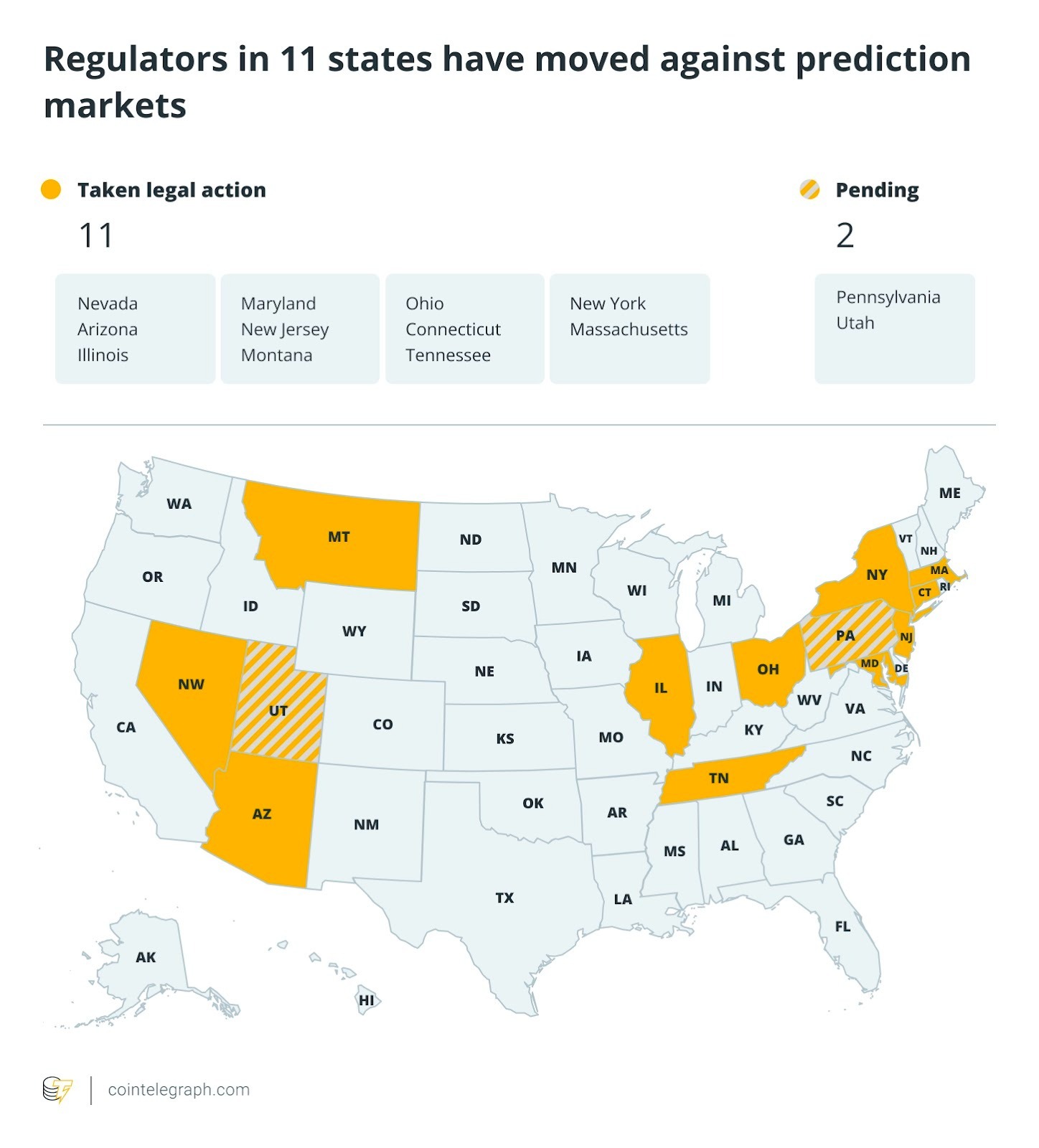
Regulators in 11 states made moves against prediction markets
The news comes as prediction markets face increasing regulatory pressure across the US.
At least 11 states are pursuing legal action against prediction market platforms like Polymarket and Kalshi.

Nevada has issued a temporary ban on Polymarket competitor Kalshi, while Arizona filed criminal charges alleging the platform operated an illegal gambling business. Several other states have sent cease-and-desist orders or are considering new legislation.
Polymarket recently updated its rules to more clearly prohibit trading on confidential information as lawmakers and critics raise concerns that prediction markets can be vulnerable to insider-style activity, especially around politics, sports and geopolitics.
Magazine: Banks want to run Vietnam’s crypto exchanges, Boyaa’s $70M BTC plan: Asia Express
Crypto stocks are getting hit hard Friday as weakness in U.S. equities rippled through high-risk assets, driving bitcoin below $66,000.
Crypto exchange Coinbase (COIN) and digital asset conglomerate Galaxy (GLXY) dropped nearly 7%, while exchange Gemini (GEMI) slid almost 9%, marking one of the steepest losses in the group. Crypto-friendly broker Robinhood (HOOD) also fell nearly 6% as increasing its stock buyback pace offered little help in arresting the downtrend.
Bitcoin-linked balance sheet plays also moved lower. Strategy (MSTR) and Twenty One Capital (XXI) plunged about 6%. Ethereum-focused treasury names such as Bitmine Immersion (BMNR) and Sharplink Gaming (SBET) were down roughly 5%.
Miners — many of which trade as leveraged bets on both bitcoin and AI infrastructure — extended their declines. Riot Platforms (RIOT), CleanSpark (CLSK), IREN (IREN), HIVE Digital (HIVE) and Hut 8 (HUT) all posted 5%-8% losses.
Even MARA (MARA) and Bitdeer (BTDR), which outperformed Thursday, have given back all their gains and were down 6% and 8%, respectively, joining the sector-wide plunge.
$17 trillion wipe-out
The Federal Reserve faces an increasingly complicated backdrop, weighing renewed inflation pressure from rising oil prices against signs of a deteriorating labor market.
Richmond Fed President Tom Barkin warned that higher gas costs could dent consumer spending while describing hiring conditions as “fragile.” Meanwhile, Philadelphia Fed President Anna Paulson said the war in Iran created “new risks to both inflation and growth.”
The 10-year Treasury bond yield, which hit nearly 4.5% earlier Friday, erased today’s rise following the central bankers’ remarks. The two-year yield, which is more sensitive to Fed policy, fell all the way back to 3.91% after earlier rising to 4.03%.
Still, investors have turned from predominantly expecting rate cuts this year to consider the central bank hiking rates in face of rising inflation.
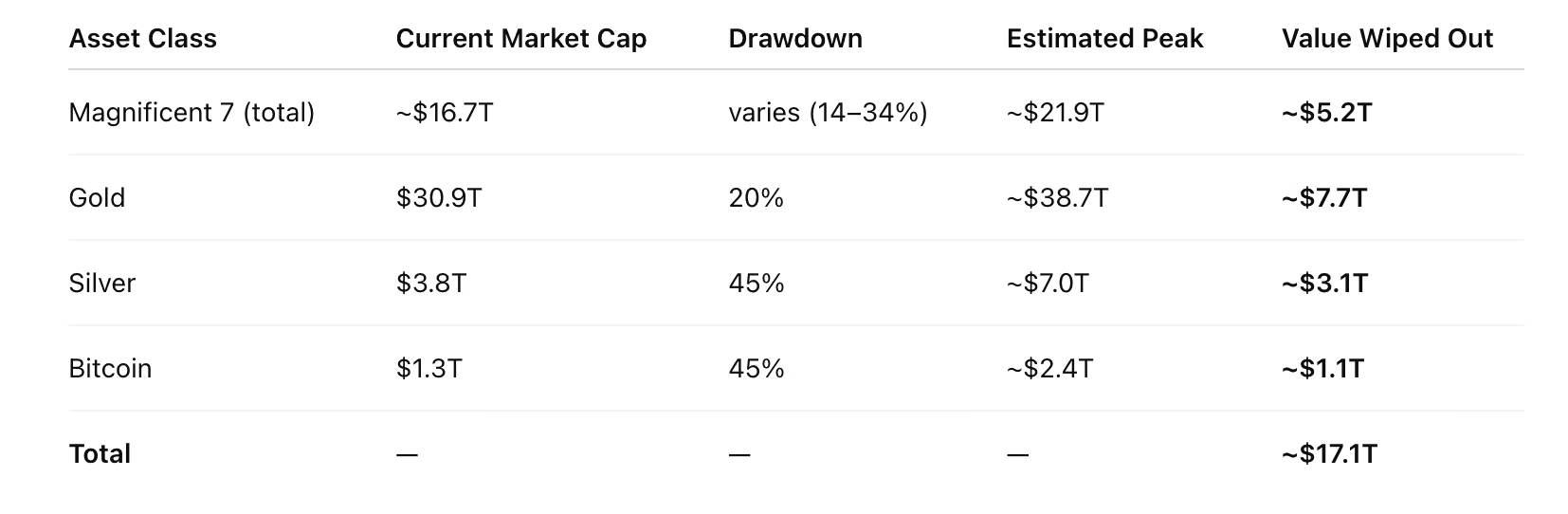
The selloff over the past months has been broad across equities, with roughly $17 trillion in market cap wiped out from peak levels across the Magnificent Seven — the seven largest tech stocks, including Nvidia (NVDA), Google (GOOG) and Microsoft (MSFT) — gold, silver, and bitcoin .
Bitcoin reached its all-time high in early October at $126,000, while gold, silver and U.S. equities peaked in late January before reversing sharply. Since then, bitcoin is down around 45%, silver has fallen 45%, gold roughly 20%, and the Magnificent Seven have all entered double digit drawdowns from their peaks.

The tech-heavy Nasdaq 100 index has now entered correction territory, trading more than 10% off its January all time high. The broad-based S&P 500 is inching closer to a correction, too, currently down 8.5%.
While bonds have also been hit hard, global fixed-income markets remain under broad pressure, with the iShares 20+ Year Treasury Bond ETF (TLT) down around 0.3% on Friday and 5% over the past month since the conflict began.
Over the same period, the S&P 500 has fallen roughly 6%, highlighting the underperformance of the traditional 60/40 portfolio as global yields continue to rise, weighing on sovereign debt markets.
Monday relief, Friday risk-off
This week has followed a familiar playbook seen since the Middle East conflict started in late February, with strong gains on Monday, partly driven by relief that “Black Monday” scenario did not occur, averaging around 3%, followed by steady profit taking into weakness as the week progresses, particularly as optimism fades around the Strait of Hormuz fully reopening.
By Thursday and Friday, performance typically deteriorates further as investors reduce risk ahead of the weekend amid ongoing geopolitical uncertainty.



Opinion by: Ilya Tarutov, founder of Tramplin
Crypto hasn’t struggled because the technology was flawed. Instead, it faltered as a result of the incentive structures the industry created, which have quietly turned it into something that works against the very people it was supposed to serve.
Since 2017, every crypto market cycle has followed the same pattern. Each cycle started with excitement, followed by retail inflows, a velocity trap and catastrophic drawdowns, and ended in an erosion of trust that takes months, if not years, to rebuild. Each cycle begins with optimism, peaks at overconfidence and concludes with panic and despair.
Most of the time, crypto users are quick to blame market conditions, macro headwinds and regulation. Yes, they’re important factors. What actually determines outcomes, cycle after cycle, is how the incentives are designed.
Crypto loses everyday users because the system quietly pushes them to take the biggest risks. This begins with psychology: Traders often adopt the mindset that “the higher the return desired, the greater the risk required.”
A small token balance earning just a fraction of a percent through staking doesn’t feel like real progress. Yes, the staking market surpassed $245 billion, but platforms generally offer 2%-10% APY, which, for balances of a couple thousand dollars or less, might yield less than $100 in annual profits.
Meanwhile, take derivatives platforms. They provide their users sophisticated and high-leverage trading opportunities and processed a record $85.7 trillion in trading volume in 2025.
“Just stake” isn’t enough anymore
Native staking is straightforward and relatively safe; rewards come directly from the network itself. Staking alone doesn’t fix the deeper problem. The platforms built around it still promote speculation, high leverage, trading driven by FOMO and risky looping strategies.
What retail investors need is a way to participate without constant exposure to risk or serving as exit liquidity for faster, better-informed market players.
Related: Hybrid governance program gives tokenholders a voice on this platform
What’s the solution? Creating a savings product with capital preservation as a core design goal.
The “savings layer” concept
A crypto savings layer needs to be built around a clear set of rules. These principles are non-negotiable, as they have a great, positive influence on user behavior. Examples of this include capital preservation, full transparency and rewards for discipline over speed or speculation. The savings layer should also work just as well for a 10-USDt (USDT) balance as for a 100,000-USDt one.
The “real” world already offers products designed around trust and capital preservation, rather than speculation.
Consider the United Kingdom’s Premium Bonds. They don’t promise high fixed yields. What they do is preserve your capital while giving you a chance at prizes.
According to NS&I, 71,722,056 prizes were paid out in 2025, totaling 4.95 billion pounds ($6.6 billion), with over 470,000 new accounts opened and eligible Premium Bonds holdings growing to 134.6 billion pounds.
Yes, it is not a blockchain product. It’s a well-designed savings program. The lesson is still simple: There’s a reason to participate, you understand how it works and your money stays safe.
In the United States, prize-linked savings has gained traction for similar reasons. This kind of incentive layer makes it easier for people to build consistent saving habits.
The mechanics of a “saving layer concept” in crypto must be simple enough to explain in one or two sentences.
If a person can’t explain in plain terms to their friends where their rewards come from, that means the design isn’t transparent enough. Whether rewards are generated from transparent sources or from a clearly defined chance-based model, the system must be honest about what it can offer people, and what it cannot.
The most crucial aspect is that incentives must work even with small balances. The system must reward consistency over speed, and discipline over speculation, so that staying involved matters more than getting in early.
Just as important is what the system should not do. Destructive risk shouldn’t be the default option, as the goal is to minimize losses, keep users in profit and encourage long-term participation.
That is what a savings layer actually means: a system designed to help everyday users stay in the game, not one that quietly pushes them out.
Rewriting the system
If the next cycle doesn’t introduce ways to protect everyday users, they will keep experiencing crypto as a story that always ends the same way: big hype, big promises and painful collapses.
What needs to change is not the technology but what the technology is optimized for. Products must be built to reduce losses, not to maximize turnover. These changes must take place now, unless industry players want to repeat the same mistakes over and over again.
Crypto’s future comes down to a single choice: protect everyday users or keep optimizing for short-term gains. Only one of those leads somewhere worth going.
Opinion by: Ilya Tarutov, founder of Tramplin.
This opinion article presents the author’s expert view, and it may not reflect the views of Cointelegraph.com. This content has undergone editorial review to ensure clarity and relevance. Cointelegraph remains committed to transparent reporting and upholding the highest standards of journalism. Readers are encouraged to conduct their own research before taking any actions related to the company.
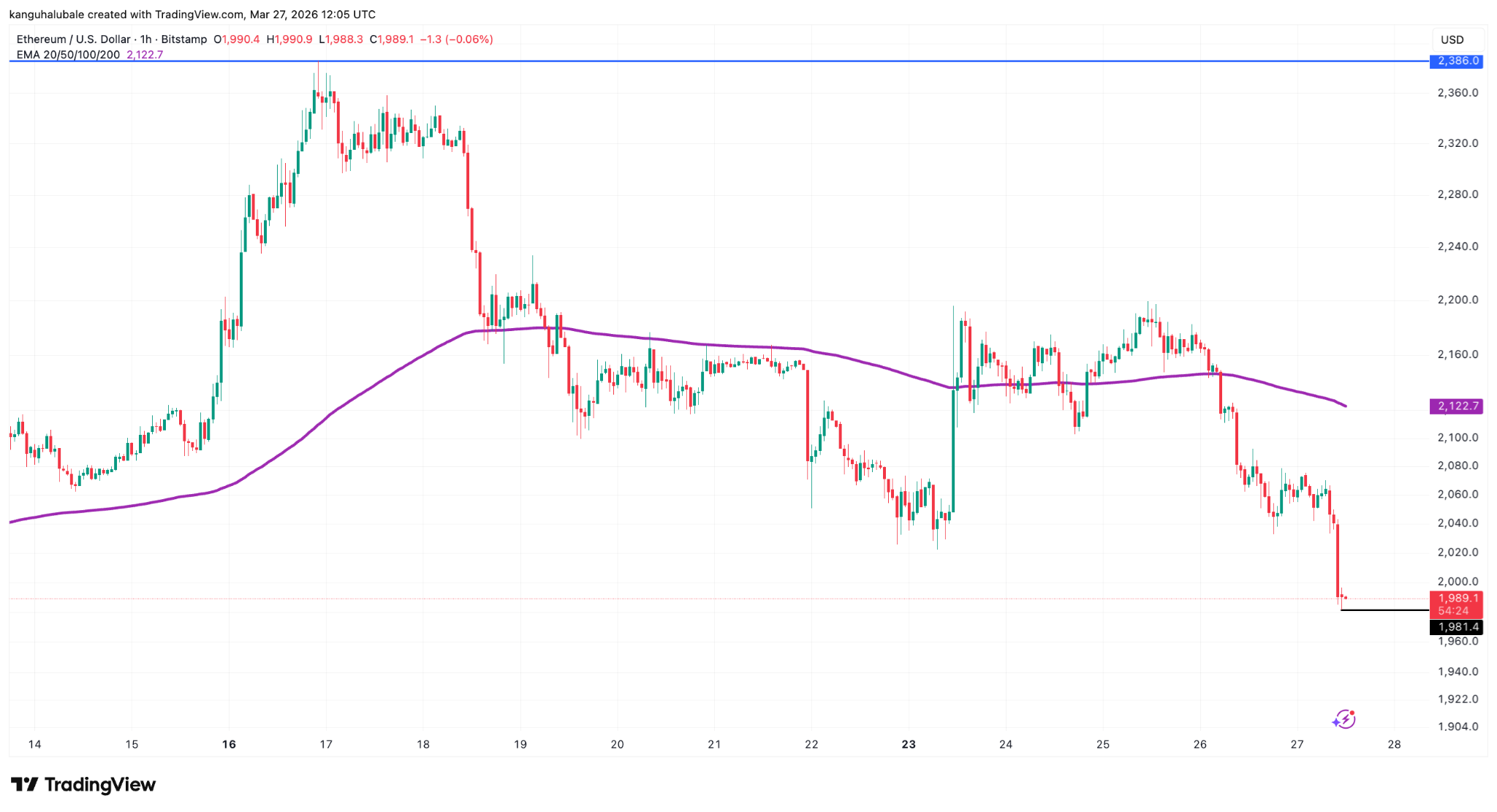
Ether’s (ETH) drop below the $2,000 on Friday put it at risk of a deeper correction in the coming weeks or months.
Key takeaways:
-
Ether’s price shows structural weakness as it fails to hold above the $2,000 psychological support.
-
Analysts say ETH price may drop further toward the $1,750-$1,850 support zone.
-
Ether’s demand stays negative, increasing its downward potential.
Ether traders anticipate a deeper correction
Data from TradingView showed ETH/USD trading at $1,975, down 5% over the last 24 hours. This drop was accompanied by more than $111 million in long ETH liquidations.
Related: Bitmine launches institutional Ethereum staking platform
The pair had failed to crack through resistance at $2,200 earlier in the week, as spot Ether exchange-traded fund (ETF) outflows, falling DEX volumes, and declining ETH futures premium derailed Ether’s recovery.

“$ETH keeps pressing into the same resistance, but the story sits beneath price action,” trader Onur said in an X post on Friday, adding:
“Even with strong long-term narratives, short-term demand still looks thin.”
Fellow analyst CryptoWZRD said a ETH could see a “further decline” toward the $1,800 support zone after the altcoin closed below $2,200 on Thursday.
“$ETH has dropped below the $2,100 level,” analyst and trader Ted Pillows said in a Friday X post, adding:
“This is a sign of weakness and shows what’s coming next for ETH.”
An accompanying chart suggested that the price could first drop toward the $1,800 support level, before rebounding.

As Cointelegraph reported, a close below the 50-day simple moving average at $2,000 may pull the ETH/USD pair to $1,900 and subsequently to the $1,850-$1,750 level.
Ether’s apparent demand hits 16-month low
Ether’s Apparent Demand has flipped negative after dropping to its lowest level since October 2024, as traders adopted a risk-off stance due to geopolitical uncertainty and macro headwinds.
Capriole Investment’s Ethereum Apparent Demand metric shows that the demand for ETH has been negative since March 3, bottoming around -58,000 ETH on March 16, marking 16-month lows. The metric has since improved to -23,475 ETH at the time of writing.

Meanwhile, spot ETH ETFs have recorded net outflows for seven consecutive days, totaling $391.8 million.

Global Ether exchange-traded products (ETPs) also recorded $27.2 million of outflows last week, reinforcing reduced appetite for ETH among institutional investors.
This article does not contain investment advice or recommendations. Every investment and trading move involves risk, and readers should conduct their own research when making a decision. While we strive to provide accurate and timely information, Cointelegraph does not guarantee the accuracy, completeness, or reliability of any information in this article. This article may contain forward-looking statements that are subject to risks and uncertainties. Cointelegraph will not be liable for any loss or damage arising from your reliance on this information.
Key Takeaways
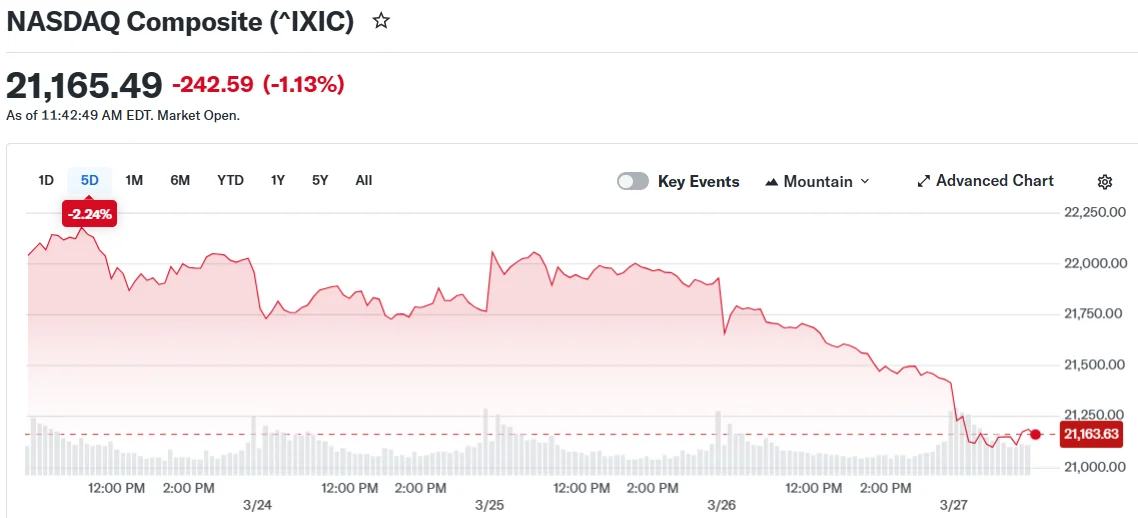
- The Nasdaq Composite tumbled 2.4% Thursday, confirming a correction after sliding more than 10% from its October 29 record peak
- Geopolitical instability from the U.S.-Israeli military action against Iran and concerns about escalating oil costs fuel the downturn
- American gas prices surged to $3.98 per gallon, marking a $1.00 increase within 30 days
- Meta Platforms plummeted 8% following dual court rulings holding the company accountable for damage to teenage users
- Major tech players Nvidia, Alphabet, and Tesla each declined between 3.4% and 4.2% during Thursday’s session
The Nasdaq Composite has officially entered correction territory following Thursday’s trading session. The tech-focused index shed 2.4%, placing it approximately 11% beneath the all-time closing high recorded on October 29, 2025. This represents the index’s first confirmed correction in twelve months.
Thursday’s decline represents the index’s steepest fall since April 2025, when President Trump’s “Liberation Day” tariff declaration triggered a worldwide market retreat.
The Nasdaq has now surrendered nearly 8% of its value in 2026 and trades at levels last witnessed in early September 2025.
The primary catalyst behind the market retreat centers on persistent uncertainty surrounding the U.S. and Israeli military engagement with Iran. Market participants remain unclear about the conflict’s duration and its potential ramifications for worldwide economic stability.
A recent Seeking Alpha community survey revealed that most respondents anticipate the operation lasting up to three months. White House officials have projected a four-to-six week timeframe. This disconnect between projections continues to fuel market anxiety.
Energy costs are climbing rapidly. American motorists now face an average gasoline price of $3.98 per gallon, representing a $1.00 jump from just thirty days earlier. Seasonal consumption patterns are anticipated to drive prices even higher as spring approaches.
Market analysts suggest the energy price spike could either accelerate inflation or dampen consumer spending sufficiently to decelerate economic growth. The ultimate outcome hinges largely on the conflict’s duration.
Technology Sector Bears the Brunt
Technology equities have experienced substantial pressure. Nvidia declined 4.2%, Alphabet fell 3.4%, and Tesla surrendered 3.6%. The Roundhill Magnificent Seven ETF dropped 3.3% and has now retreated 17% from the Nasdaq’s October zenith.
Market participants are increasingly scrutinizing whether the enormous artificial intelligence expenditures by corporations like Microsoft, Alphabet, and Amazon are generating returns quickly enough. The primary concern centers on whether substantial infrastructure investments have yet produced significant revenue expansion.
“There definitely has been an erosion in market enthusiasm since hostilities broke out,” said Steve Sosnick, market strategist at Interactive Brokers.
Meta Compounds Market Weakness
Meta Platforms emerged as one of Thursday’s heaviest drags on the index, plunging 8%. Two separate court decisions determined Meta bears responsibility for harm inflicted on young users, sparking concerns the social media giant may need to fundamentally restructure its advertising framework.
The widespread losses throughout Big Tech are magnified because these corporations now constitute a substantial portion of both the Nasdaq and the S&P 500. Any retreat in these stocks delivers an outsized impact on the broader indices.
Jim Carroll, senior wealth adviser at Ballast Rock Private Wealth, characterized the market’s volatile swings as sufficient to “make people seasick.”
The Nasdaq previously tumbled nearly 23% from its 2024 peak before rallying through October 2025. Investors are now monitoring whether this current correction will trace a comparable recovery trajectory, or deteriorate further.


BITCOIN IS GOING TO $40,000!!!?

Israel invasion of Lebanon finally called what it is

Alabama’s Aden Holloway is approved to travel out of state ahead of Sweet 16 game vs. Michigan


-
 Crypto World7 days ago
NIO (NIO) Stock Plunges 6.5% as Shelf Registration Sparks Dilution Worries
-
 NewsBeat2 days ago
Manchester United reach agreement with Casemiro over contract clause amid transfer speculation
-

 Fashion7 days ago
Weekend Open Thread: Adidas – Corporette.com
-

 Politics7 days ago
Jenni Murray, Long-Serving Woman’s Hour Presenter, Dies Aged 75
-

 Crypto World6 days ago
Best Crypto to Buy Now: Strategy Just Spent $1.57 Billion on Bitcoin During Fear While Early Investors Quietly Enter Pepeto for 150x Potential
-

 Crypto World6 days ago
Bitcoin Price News: Bhutan Sells $72 Million in BTC Under Fiscal Pressure, but the Smart Money Entering Pepeto Sees What the Market Does Not
-

 News Videos2 days ago
Parliament publishes latest register of MPs’ financial interests
-

 Sports4 days ago
Remo Stars and Kano Pillars Strengthen Survival Hopes in NPFL
-

 Sports4 days ago
Gary Kirsten Accuses Pakistan Cricket Board Of ‘Interference’, Mohsin Naqvi Responds
-

 Business5 days ago
No Winner in March 21 Drawing as Prize Rolls to $133 Million for Next
-

 Tech5 days ago
Give Your Phone a Huge (and Free) Upgrade by Switching to Another Keyboard
-

 Sports7 days ago
2026 Kentucky Derby horses, odds, futures, preview, date: Expert who nailed 12 Derby-Oaks Doubles enters picks
-

 Tech5 days ago
AI enters the chat: New Seattle dating app relies on tech to facilitate meaningful human connections
-

 News Videos4 days ago
Ch 9 Financial Management Part 1 | Detailed One Shot | Class 12 Business Studies Boards 2026
-
Business7 days ago
Columbia Sportswear enters $500 million credit agreement with JPMorgan Chase
-

 Tech6 days ago
Today’s NYT Connections Hints, Answers for March 22 #1015
-

 Business20 hours ago
Instagram, YouTube Found Responsible for Teen’s Mental Health Struggle in Historic Ruling
-
 Crypto World7 days ago
Small-cap Russell 2000 enters correction territory
-

 Business5 days ago
Will Duke Basketball Win It All? Duke Basketball Enters Second Round as Third Favorite to Claim NCAA Title
-

 Sports5 days ago
2026 Kentucky Derby horses, odds, futures, preview, date: Expert who hit 12 Derby-Oaks Doubles enters picks
You must be logged in to post a comment Login