
Entertainment
7 ‘House of David’ Season 2 Moments That Pay Off from Season 1

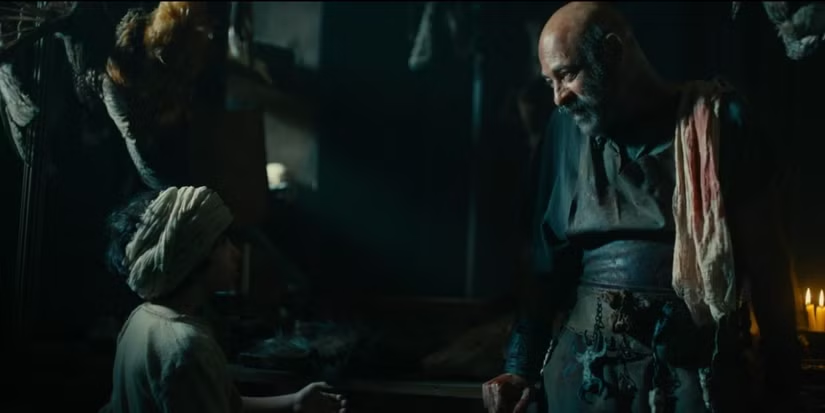
Spoiler Alert: This list contains spoilers for House of David Season 2After already dominating Prime Video’s watchlists this year, House of David Season 2 was globally released on March 27. As the binge-worthy series returns to mass audiences, there is plenty more drama and romance to enjoy this season. Based on the life of King David (Michael Iskander), one of history’s most beloved and influential leaders, the biblical biopic proves again why it is must-watch TV.
The writing in the House of David is spectacular, and Season 2 has some very rewarding full-circle moments that fans of Season 1 will enjoy. New, dynamic characters are introduced in this season as well, including Lyna Dubarry as a healer named Sara, and Joy Rieger as the independent and tenacious Dina. Whether you enjoy these full-circle moments in the overarching storyline or appreciate the capsule plots that begin and end in Season 2, House of David has plenty to offer everyone this season.
Doeg Is Punished

Doeg the Edomite (Ashraf Barhom) is an unsavory character who has committed several cruelties throughout the series. From torturing and killing animals to torturing and killing people, it seems there is nothing he won’t do to serve King Saul (Ali Suliman) and his own selfish motives. Played expertly by Barhom, Doeg has become an adversary viewers love to hate.
Doeg’s treachery is dialed up even further in Season 2 as he informs the Philistines that David and his men are coming, sending them to certain peril, and slaughtering an entire camp of innocent priests at Nob. Though several characters express that they don’t trust Doeg, including Saul himself, no one seems to keep him in check. That is, until he goes directly up against Samuel (Stephen Lang). Samuel is a prominent prophet and has God’s power on his side, so contending with him is a fool’s errand. Doeg, ever eager to dismantle things that are whole and cause pain and suffering, thinks he has the upper hand, but he is the one left in agony. As Doeg suffers a similar mental torment to the one Saul wrestled with for much of Season 1, it is a fitting punishment for a vicious villain.
Samuel Emotionally Separates Himself From Saul

Samuel and Saul have had a father-son or mentor-mentee relationship for most of Saul’s life. Samuel was the prophet who anointed Saul as the first king of Israel and had great joy watching him win many victories. However, as Saul became greedy, vain, and self-righteous, he drifted from obedience and humility. After God chooses another to sit on the throne and be king, Samuel risks his own life by anointing David.
Stephen Lang is perfect as Samuel. He captures the inner struggle of a mentor having to watch someone he cares about make horrible decisions and degrade into a much lessened version of themselves. An awesome moment comes in Episode 4, “Road to Attonement”, where Saul tries to threaten and influence Samuel at a public religious ceremony. Samuel stares Saul straight in the eyes and proclaims, “Saul, I do not fear you. I do not serve you. This altar is for priests, not kings.”
However, the final blow would come in Episode 8, “The Truth Revealed,” when Samuel blocks the path as Saul and his army try to pursue David to Nob. Samuel draws a line in the sand and will not allow Saul and his army to pass. As Saul and his men are struck with mental afflictions, Samuel and Saul exchange words and prophecies. Samuel looks on at Saul, seeing what is in his heart and mind, and says, “Darkness has prevailed. You have become what you have become, and I will no longer mourn for you.” This final separation between Samuel and Saul is a tragic but essential end for their relationship. Saul has become a completely different and corrupt person from the one Samuel knew and loved. Samuel letting go of any hope for Saul’s change of heart solidifies that events are running their course exactly as God told Samuel they would.
Queen Ahinoam Is Exiled

Ayelet Zurer is an extremely talented actor who plays strong, confident women well (Marvel fans will recognize her from her role as Vanessa Fisk in the Daredevil TV series). Zurer is captivating as Queen Ahinoam, the smart, conniving, and manipulative figure who always tries to stay a step ahead of the shifting power that comes with ruling a kingdom. Ahinoam has made several bold moves throughout the series, like exiling her son Eshbaal (Sam Otto) when he disgraced the family and sending David on a suicide mission when she sees him as a threat to her husband’s rule.
The one area where Ahinoam seemed to feel fairly secure was the reliance and devotion of her husband, King Saul, to her. In Season 2, as marital discord begins to develop between them, Saul makes their servant Kazia (Inbar Saban) his concubine. Kazia is an ambitious opportunist and seizes the chance to work her way up the social ladder.
Tensions come to a tipping point when Saul lets Kazia attend a feast for Jonathan (Ethan Kai) and his new wife, Sara (Lyna Dubarry), as a guest. Kazia makes an audacious move and shows up to the event wearing a necklace that used to belong to the queen. After the embarrassing and brash incident, Ahinoam and Saul have a heated argument and finally get their suspicions, doubts, and anger toward one another out in the open. After being pushed too far, Saul, unhinged as always, literally grabs Ahinoam by the hair and throws her out onto the street.
This is undoubtedly one of the more shocking plot twists of Season 2 and is a defining moment for Ahinoam. As she has spent the better part of her life manipulating and positioning herself for power and control, she becomes the one who is ultimately undone by another scheming woman. As Eshbaal helps her off the ground and embraces her, he delivers a bitter and parting blow, whispering in her ear, “Now you know how it feels… to be betrayed by those who claim to love you.”
Mirab Proves She Is Her Mother’s Daughter

Ahinoam is not only a clever and discerning queen, but an instructive and concerned mother as well. She shares a special bond with her daughter Mirab (Yali Topol Margalith), and a poignant scene comes in Season 2 when Ahinoam instructs Mirab on how to navigate her own path through political spheres. She instructs her daughter to be strong, tough, and have no time for tears.
When the queen is banished, Mirab feels the separation exceedingly. Her mother was her closest confidant, and having her gone leaves a vacuum. It is a heartbreaking moment. Ahinoam, outside the palace, looks at her daughter and reminds her to be strong, keep her chin up, and not to cry, all without saying any words, and Mirab takes this final piece of advice to heart.
At Mychal’s (Indy Lewis) and David’s wedding, Mirab gets her first chance to fill her mother’s shoes. Setting her personal feelings aside (after a failed attempt to manipulate David into marrying her instead), Mirab is present for her sister. Later, after witnessing Eshbaal murdering his wife Dina, she is forced to make a decision about whose side she is going to be on as the family descends into chaos. Again, Mirab is there for Mychal when the truth about David finally comes to light, and he flees after Saul tries to kill him. Mirab is every bit her mother’s daughter. With Ahinoam exiled, Mirab has become the one in the palace who is always plotting the next most advantageous course of action.
David Writes a Note to Mychal (After Their Wedding)

In Season 1, Mychal teaches David how to read. It is a perfect bonding opportunity for them as they get to share their thoughts, favorite scriptures, and spend quality time together. It serves as a subtle status reminder as well, that David is a humble shepherd boy and Mychal is a princess. Though David develops strong feelings for Mychal, it seems impossible to hope that they could ever be married. A full-circle moment that symbolizes their relationship’s past and future happens in Season 2 when David writes a note to Mychal.
Sadly, the note has to be delivered to her by Jonathan because David is hiding for his life. This moment is simultaneously tragic and rewarding. It is a reminder of how they first came to fall in love with each other, but it also comes as their relationship has been launched into sudden turmoil. Mychal is understandably confused and hurt when she finds out that David is the person Samuel anointed to be the next king. Feeling betrayed, she chooses to stay behind in the palace and not go on the run with David. David writing a secret note to her is instantly a symbol of how far they’ve come and the long road they still have in front of them.
Eliab Pledges Allegiance to David

Eliab (Davood Ghadami) is David’s eldest brother. The two have a strained relationship as they are only half-brothers, and Eliab never approved of David’s mother. Their relationship gets further complicated because not only is Eliab not chosen to be the next king as the first of his father’s house, but he must now serve and protect David, whose anointing puts their whole family in peril.
Throughout the series, Eliab has saved David’s life many times (even taking an arrow for him), but he has also been frustrated, fearful, and angry about David’s position. Eliab had doubts about whether David was fit to be king or even a commander of the army. In the very last episode of Season 2, Eliab gets some advice from their father Jesse (Louis Ferreira) and some time to reflect and ask for God’s direction. As the episode draws to a conclusion, a powerful scene happens when Eliab and Joab (Aury Alby) show up with a group of soldiers. Instead of capturing David, they pay homage to him and take a knee, showing their loyalty lies with him as the true king. It is a terrific full-circle moment for Eliab, who finally appears to be on board.
David Becomes the Commander He Was Meant To Be

At the beginning of Season 2, David has seemingly proved himself as the best of Saul’s warriors. After all, he was the only person who dared to fight the giant Goliath (Martyn Ford) and was victorious at the end of Season 1. However, Goliath’s defeat was a supernatural victory for David, and he never would have achieved it without God’s help.
David is a simple shepherd boy and has never seen battle. A grateful Saul, wishing to honor David, appoints him as commander of his troops. This is a shock for everyone, including David. He does not even know how to fight or hold a sword. His first few attempts at leadership are disastrous, and Eliab does not make things any better by blatantly refusing to obey him on more than one occasion. As David feels the weight of being responsible for other men’s lives, he cries out to God in the Episode “Road to Atonement.” This moment is pivotal as his men get to see a humbled side of David, and that his heart is after God, not his own glory.
When David tells Saul he cannot marry Mirab because he loves Mychal and wants to marry her, Queen Ahinoam uses the opportunity to send David on a suicide mission. David is tasked with killing 100 Philistines and bringing back a bloody token of his success. When the Philistines are clued in to David’s attack, it turns into an ambush that they are not likely to survive. David, showing his improving skills in battle, instructs his men to pile explosive jars near the door and tells them to run to safety because it is he alone the Philistines are after. Despite all the odds stacked against them, David and his men are successful, and he kills not 100 but 200 Philistines. Saul is left speechless, and David finally gets to marry Mychal.
David has come on a long journey since Season 1. From an outcast in his own family and an overlooked shepherd, to the husband of a princess and a confident commander of soldiers. As Season 2 ends with David’s life in jeopardy and Saul out for his blood, his character arc will undoubtedly be thrilling to watch as the series goes on. Hopefully, House of David Season 3 will be confirmed soon, and viewers can look forward to many more full-circle moments in this riveting drama.

House of David
- Release Date
-
February 27, 2025
- Network
-
Prime Video, Wonder Project
- Directors
-
Jeff T. Thomas, Jon Gunn, Jon Erwin, Lynsey Miller
- Writers
-
Jon Erwin, Jon Gunn, Jonathan Walker, Bekah Hubbell, Nathan Andrew Jacobs, Laura Kenar, N.D. Wilson
-

-
Alexander Uloom
King Achish

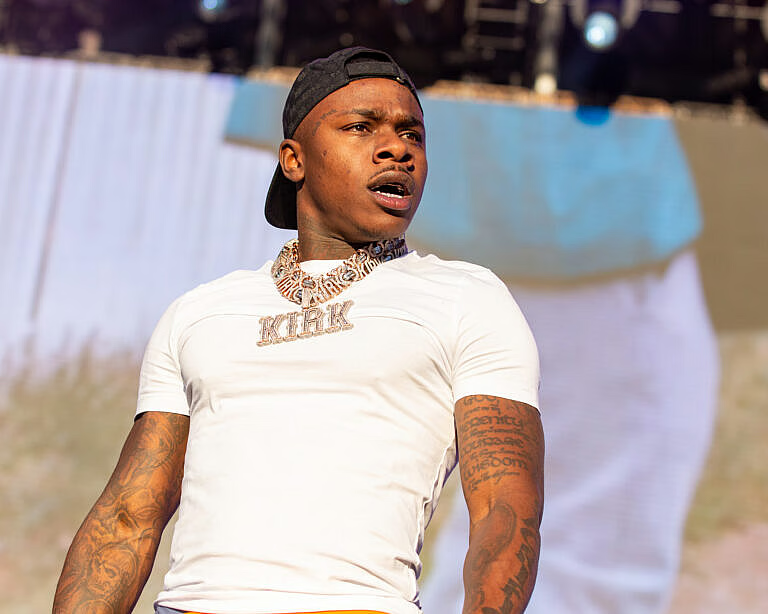
DaBaby recently spoke about the financial fallout from his past homophobic rant. The rapper, born Jonathan Lyndale Kirk, was on the rise from 2019 to 2020. His momentum stalled in 2021 after facing backlash from major brands, celebrities, and social media users. Now, he is opening up about the impact it had on his finances.
DaBaby Says He Missed Out On Hundreds Of Thousands Of Dollars After Being Canceled In 2021

While appearing on the “Million Dollaz Worth Of Game” podcast, DaBaby revealed he was making upward of $300,000 before being canceled in 2021.
“I had a calendar full of shows. 350K, 350K, 375K, 400K, 300K,” he said before revealing his fee dropped significantly to “$30,000.”
Despite the fee change, DaBaby said he wasn’t deterred. In fact, he told the podcast host that he was more than happy to accept those gigs.
“No, I went and got that,” he said.
Why Was DaBaby Canceled In 2021? His Homophobic Rant Went Viral
For those unfamiliar, DaBaby made headlines in July 2021 while performing at Rolling Loud Miami.
During his set, DaBaby made a series of homophobic and offensive comments. “If you didn’t show up today with HIV, AIDS, or any of them deadly sexually transmitted diseases that’ll make you die in two to three weeks, then put your cellphone lighter up,” he said.
“Ladies, if your p—- smell like water, put your cellphone lighter up. Fellas, if you ain’t sucking d— in the parking lot, put your cellphone lighter up,” he added.
DaBaby, of course, received pushback; however, he defended himself online, calling himself the “best live performer” before saying his comments were misconstrued.
“My gay fans, they take care of themselves. They ain’t no nasty gay n—as. See what I’m saying? They ain’t no junkies in the street. The hell you talking about, n—as? Then I said if you ain’t sucking d— in the parking lot, put your cellphone lighter up. You know what my gay fans did? Put that motherf—ing light up, n—a, ’cause my gay fans ain’t going for that. They got class. They ain’t sucking no d— in no parking lot,” he wrote.
Celebrities Slam DaBaby After Sharing Homophobic Rant
The backlash DaBaby faced wasn’t limited to social media users. Celebrities also spoke out, including Dua Lipa, who had recently released a remix of her hit song “Levitating” featuring the rapper. Fans called for her to pull his feature, which she did.
“I’m surprised and horrified at DaBaby’s comments. I really don’t recognize this as the person I worked with,” she said in a statement. “I know my fans know where my heart lies and that I stand 100% with the LGTBQ community. We need to come together to fight the stigma and ignorance around HIV/AIDS.”
Demi Lovato, too, blasted the rapper, writing on Instagram that “HIV is not a gay disease.”
Elton John and Madonna also condemned DaBaby’s statements, while the fashion brand BoohooMAN cut ties with the rapper following the release of their collaboration a month prior.
“Diversity and inclusion are part of the boohoo Groups DNA and we pride ourselves on representing the diverse customers we serve across the globe. We stand by and support the LGBTQ+ community, and do not tolerate hate speech or discrimination in any form,” their statement read.
Rapper Apologizes After Career Begins To Suffer
After his comments, three different festivals pulled DaBaby from their lineups, seemingly prompting the rapper to issue an apology.
“Anybody who done ever been affected by AIDS/HIV y’all got the right to be upset, what I said was insensitive even though I have no intentions on offending anybody. So my apologies,” he wrote.
Days later, he issued another apology on his Instagram, writing, “I want to apologize to the LGBTQ+ community for the hurtful and triggering comments I made. Again, I apologize for my misinformed comments about HIV/AIDS and I know education on this is important. Love to all. God bless.”
However, netizens noticed the apology had been deleted from his account less than a week later.
Other Rappers Speak Out And Show Their Support
Rapper T.I. defended DaBaby following the scandal, saying he had a right to live his “truth.” After the situation blew up, he added, “I think you guys have to understand that onstage, that’s not the place that rappers go to be sensitive and soothe everybody’s feelings.”
“It’s a place to go to have a good time,” he said, adding that DaBaby’s cancellation was like “bullying.”
Nick Cannon commented while appearing on “The Breakfast Club,” challenging those who were upset to use the moment to educate DaBaby rather than cancel him. “This is a moment where we should all gather around DaBaby and embrace him because if we can do that, watch how many mentalities will change in the hip-hop community,” he said.
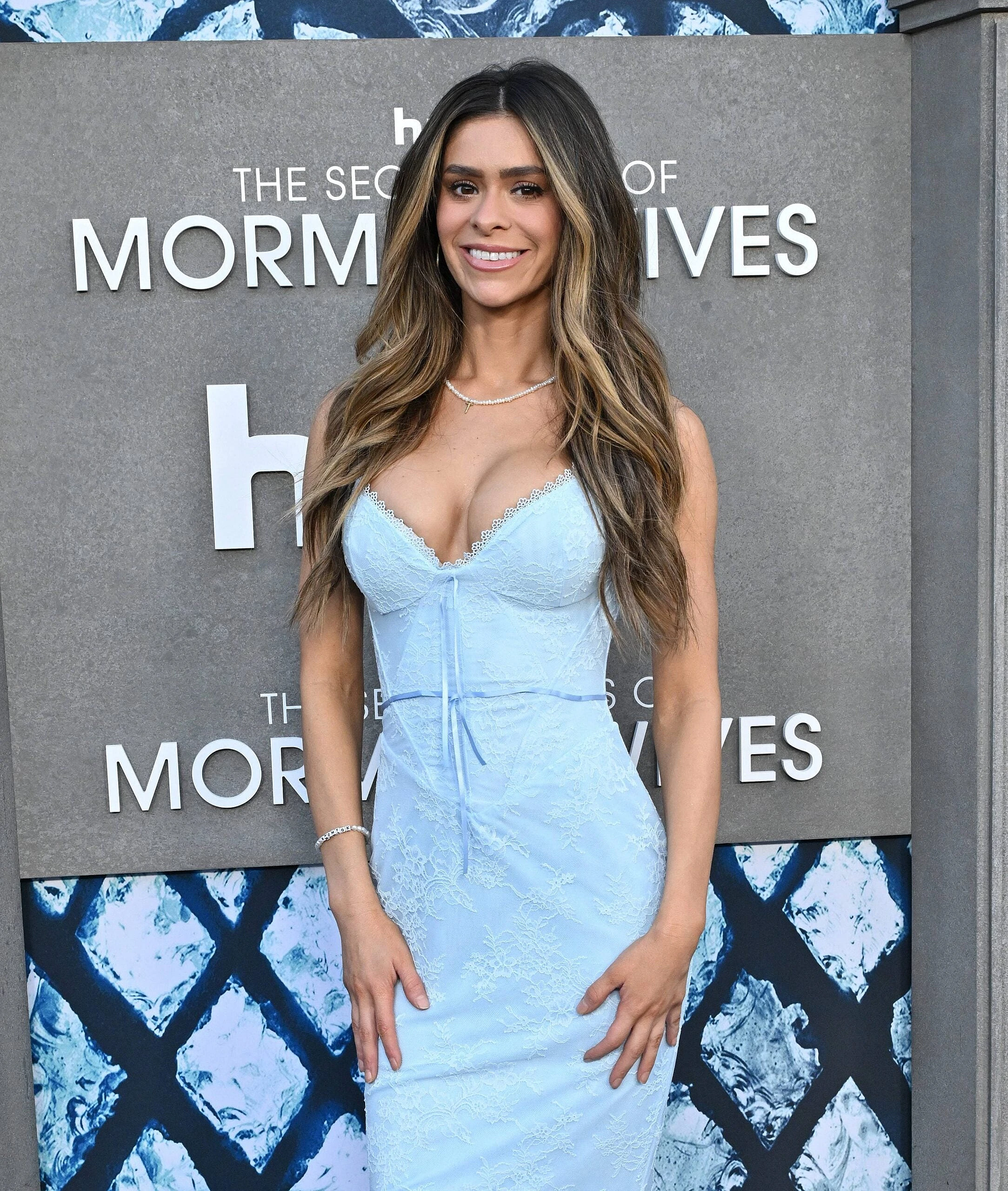
“Secret Lives of Mormon Wives” star Taylor Frankie Paul’s neighbor called the police moments before her 2023 arrest, according to a new report. The Hulu reality star was allegedly heard screaming and seen repeatedly entering and exiting her Utah home during a domestic dispute with her ex-boyfriend, Dakota Mortensen.
Taylor Frankie Paul Heard Screaming ‘Get Off Me’ Moments Before Her 2023 Arrest

Us Weekly obtained Paul’s neighbor’s 911 call the night of her arrest. During the call, Paul’s neighbor revealed that they had observed the reality star having an intense argument with Mortensen.
“First, there’s like domestic violence; somebody is screaming, ‘get off me.’ There is a woman screaming,” the neighbor said on the phone. “The garage door keeps opening and shutting. It sounds like she’s trying to get out.”
Paul’s neighbor explained that they noticed someone repeatedly coming and going. “Somebody’s getting in the truck,” the neighbor said. “So, it looks like the lady who was screaming might be leaving right now. … [She] actually didn’t leave. Now, she’s going back in the house.”
Paul’s Neighbor Didn’t Want Her To Know They Called The Police

Elsewhere during the call, Paul’s neighbor attempted to share more information about the reality star’s family life with the 911 operator.
“I know they have kids, [but] I don’t know if the kids are there right now, because I think she shares time with her ex-husband,” they said. “I would love to know if they’re OK. I mean, it looks like she’s OK right now. I don’t know if somebody else in there was screaming.”
While Paul’s neighbor admitted on the call that they were unsure what was actually happening, they were certain that they didn’t want to be involved. “But anyway, I don’t really want them to know that I’m the one that’s calling the police,” the caller said.
Taylor Frankie Paul Seen Throwing Chairs At Ex-Boyfriend In 2023 Video

The recovered 911 call comes weeks after a video appearing to show Paul striking Mortensen and pulling his hair went viral online, according to The Blast.
Elsewhere in the video, Paul is seen appearing to choke Mortensen before throwing several metal chairs at him, even hitting her own daughter in the process.
“This is called physical abuse. This is all you do,” Mortensen could be heard saying in the shocking video. “It’s the only thing you know how to do is hurt me. You think this is OK? It’s not OK. Holy sh-t.”
The release of the assault video also had major implications on Paul’s career, as ABC canceled her season of “The Bachelorette,” which would’ve been currently airing.
“In light of the newly released video just surfaced today, we have made the decision to not move forward with the new season of The Bachelorette at this time, and our focus is on supporting the family,” a Disney spokesperson said.
Cinanbon also backed out of its partnership with ABC and “The Secret Lives of Mormon Wives.”
“Cinnabon has made the decision to terminate its collaboration with ‘The Bachelorette’ and ‘The Secret Lives of Mormon Wives.’ Recent developments and allegations surrounding the lead cast member led us to reassess this collaboration as it no longer aligns with our brand values,” the company said to PEOPLE.
Taylor Frankie Paul Saddened By Ongoing Drama

While Paul may be used to dealing with conflict on reality TV, the mother of three got candid about how the ongoing drama between her and Mortensen had impacted her.
“Honestly, just like, my heart hurts to see it, to go through it, especially at this time,” she said. “Just the timing is hard, and it’s a big deal. I feel like every premiere that I’ve experienced, I’ve never enjoyed fully, so this is another one… it’s extremely hard, and it took everything to get me here today.”
Mortensen Breaks His Silence

In a statement to Entertainment Weekly, Mortensen’s rep said his primary focus was protecting his and Paul’s son, Ever.
The rep added that Mortensen’s plan has always been to stay out of the drama; however, after the latest series of events, he’s realized he has to speak up.
“He was just hoping that if he says nothing, as he usually does, it would go away. He’s never done any kind of sit-down interview about his side,” they said. “He kind of just lets it all happen to him, and I think he realizes with the severity of everything now that he just can’t do that.”
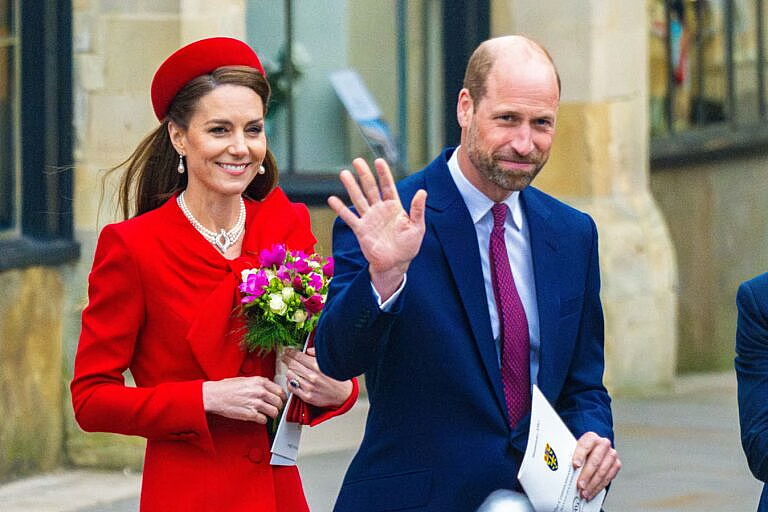
Prince William is reportedly taking a thoughtful approach to shaping the future of his children, Prince George, Princess Charlotte, and Prince Louis, as they grow into their royal roles.
Aware of the pressures tied to the monarchy’s “heir and spare” dynamic, the future king is said to be focused on ensuring all three children have balanced, independent paths.
Prince William is also learning from past royal experiences and prioritizing family stability, as he and Kate Middleton navigate a modern monarchy.
Prince William Reportedly Focused On Securing Independent Futures For Princess Charlotte And Prince Louis

William is giving serious thought to the long-term futures of his children, particularly the very different roles they are likely to assume within the royal family.
According to royal commentator Tina Brown, William is especially aware of the challenges tied to the monarchy’s tradition of primogeniture, where the eldest child inherits the throne while younger siblings often take on less defined roles.
Writing in her “Fresh Hell” Substack, Brown claimed William is determined to ensure Charlotte and Louis are equipped to build fulfilling, independent lives and “will not fall into the same cycle of thwarted freedom” that has historically affected “spares” within the royal family.
The dynamic has been closely associated with Prince Harry, who famously described his position as the “spare” in his 2023 memoir “Spare.”
In the book, he described feeling like “the shadow, the support, the Plan B,” highlighting the emotional weight of being “brought into the world in case something happened to Willy.”
Prince William And Kate Take Modern Approach To Raising Their Children Beyond The Heir And Spare Dynamic

While William and Harry remain estranged following the Duke and Duchess of Sussex’s departure from royal duties in 2020, the future king is said to be taking a more intentional approach with his own children.
He and Kate Middleton are gradually introducing George, second in line to the throne, to public responsibilities, including attending his first formal engagement in 2025 at a tea party with veterans.
At the same time, the royal couple is reportedly committed to protecting Charlotte and Louis from the pressures that have historically come with being younger siblings in the royal hierarchy.
The Prince Of Wales Wants To Make Royal Life Feel Less ‘Scary’ For His Children

Royal biographer Robert Hardman has previously told People Magazine that William sees it as a key responsibility not only to prepare for kingship but also to make royal life feel less “scary” and more balanced for all his children.
Parenting expert Jo Frost also echoed this perspective, suggesting to HELLO! Magazine that William and Kate prioritize the bond between their children over rigid royal labels.
She has expressed confidence that their household will move away from the traditional “heir and spare” mindset, focusing instead on raising all three children with equal importance.
Prince William Opens Up About Parenting, Vows To Give His Children A Healthy, Stable Childhood

William has also spoken personally about his parenting approach. During a conversation with actor Eugene Levy, he emphasized his commitment to “doing what’s best” for his kids and learning from his own upbringing.
He stressed the importance of balancing royal duties with family life, explaining that creating a stable, happy environment is essential to setting his children up for the future.
“If you don’t start the children off now with a happy, healthy, stable home, I feel you’re setting them up for a bit of a hard time and a fall,” he said. “We try to make sure we give them the security and the safety that they need.”
Reflecting on his childhood, the future king added that he hopes to avoid repeating the intense public pressures he and Harry experienced.
“I hope we don’t go back to some of the practices in the past that Harry and I grew up in. And I’ll do everything I can to make sure we don’t regress in that situation,” William stated.
Prince William And Kate Middleton Reportedly Weighing School Options For Their Children

Alongside these considerations, William and Kate are also said to be carefully evaluating their children’s future education.
Speaking on HELLO! ‘s “A Right Royal Podcast,” Melanie Sanderson from “The Good Schools Guide” suggested the couple is likely getting advice from close friends, particularly those with older children, as they weigh their options.
She noted that both William and Kate have firsthand experience of the British private school system, having attended institutions like Eton and Marlborough College, and are well-connected to networks of parents who can offer insight and recommendations.
For now, all three children are enrolled at Lambrook School, where they currently study together.
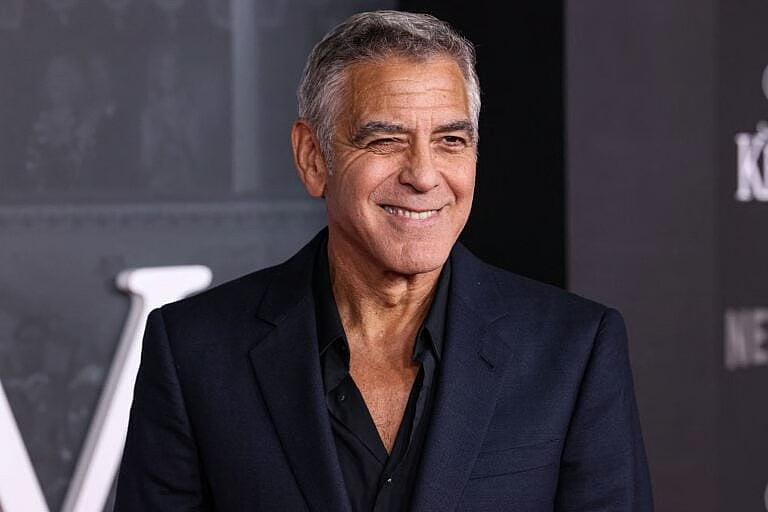
A growing number of Hollywood stars have begun trading Los Angeles for life in France, and experts are now offering a reason for this trend.
Stars like George Clooney and Natalie Portman lead the exodus, which is believed to be tied to the “pressure cooker” landscape in Hollywood.
In contrast, France is said to offer privacy, culture, and a quieter lifestyle, which these celebrities are reportedly drawn to.
Experts Claim Hollywood No Longer Offer The Same Appeal To Celebrities

In recent years, Hollywood stars such as George Clooney and Natalie Portman have left Los Angeles to build lives in France, while some have also chosen to relocate overseas despite already being well-established in their home country.
Although these departures have occurred at different times, experts say they are all driven by the idea that Hollywood no longer offers the same appeal it once did. did.
“Hollywood has become deeply political in recent years, and for some celebrities, that environment can feel like a pressure cooker,” cultural commentator Jonathan Alpert told Fox News Digital.
The Stars Are Under Constant Scrutiny In Hollywood

Alpert specifically pointed to the intense scrutiny celebrities face in Hollywood, where even the smallest actions are now often picked apart.
He suggested that this constant attention can become overwhelming, leading some stars to feel that stepping away from that environment is the best decision for their well-being.
“Every comment, role, or social media post is scrutinized through a political or culture-war lens, and that kind of atmosphere can push people to look for some distance,” the expert noted.
Celebrities Like George Clooney And Natalie Portman Were Drawn By The Privacy France Offers

Regarding Portman, she relocated to France over a decade ago with French dancer and choreographer Benjamin Millepied, whom she married in 2012. Meanwhile, Clooney and his wife, Amal Clooney, have owned a home in the country since 2021 and recently became naturalized.
While both couples had personal reasons for making the move, experts believe the decision is largely influenced by the level of privacy France offers, along with its many other lifestyle advantages.
“France has always had a special pull for artists and celebrities. Paris and the South of France offer culture, architecture, food, and history in a way very few places do,” Celebrity real estate agent Josh Flagg shared.
“But the biggest factor is privacy. In many parts of France, even major stars can live relatively normal lives compared to Los Angeles. There’s also a long tradition of creatives gravitating there.”
Experts Believe Only Established Celebrities Can Step Away From Hollywood

In the coming years, it is believed that more stars will follow in the footsteps of Clooney and Portman. However, those most likely to make the move are established names with enough reputation and industry pull to continue landing major roles even while living outside Hollywood.
“When you’re starting out, you need to be in Los Angeles. But once your career is established, you can fly in when you need to work. At that point, privacy, security, and overall quality of life become much bigger priorities,” said Flagg.
As of now, Clooney and his family still maintain strong ties to the U.S., and it’s likely that Portman does as well despite spending years abroad. This pattern is expected to continue for those choosing to step away from Hollywood.
“Most of these stars aren’t truly leaving the American entertainment world. They still work here and often maintain homes here. In many cases, it’s less an exodus and more about creating breathing room from the scrutiny and political intensity that surrounds Hollywood today,” Alpert shared.
The Reasons Some Celebrities Gave For Leaving Hollywood

Last year, Portman revealed in an interview with Net-A-Porter that she was particularly drawn to France because of the country’s value for privacy.
“They’re very good at privacy here. I feel like the biggest compliment is ‘elle est très discrète’ [‘she is very discreet’],” Portman told the outlet.
Meanwhile, Clooney told Esquire that fearing his kids wouldn’t enjoy the same kind of life he lived while growing up was a major factor for him.
“I was worried about raising our kids in L.A., in the culture of Hollywood. I felt like they were never going to get a fair shake at life,” he shared in the interview.
“Breaking Bad” star Aaron Paul told Travel + Leisure that the country’s food, history, and his desire for his kids to learn another language sold him.
Christina Milan, another star who lives in France, also shares similar sentiments and told People Magazine that she and her family may reside in the country for most of their lives.
Entertainment
Banned in Its Own Country and Filmed in Secret, the Best Thriller of 2024 Is Finally on Streaming
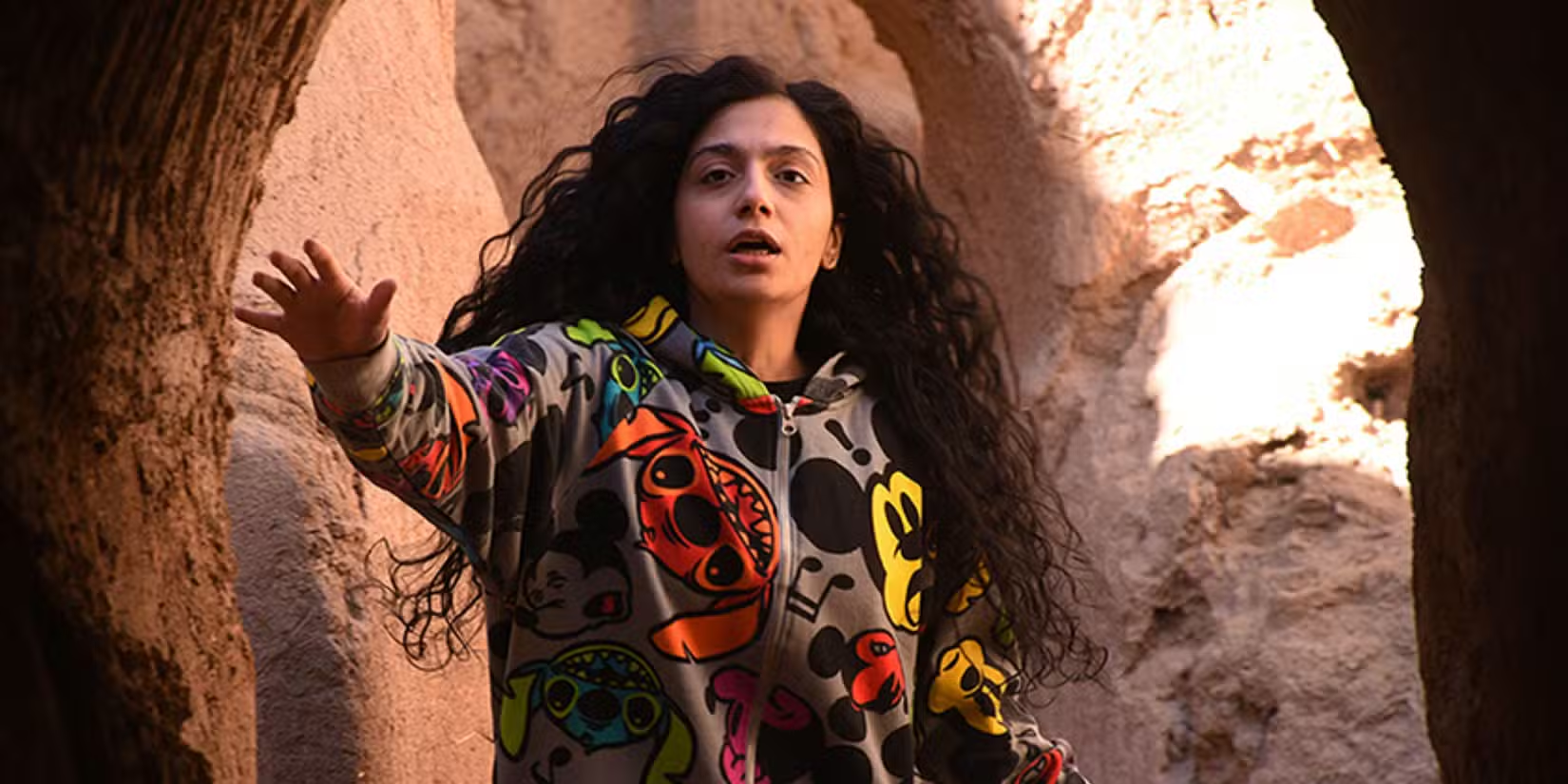
The word “bravery” is sometimes overused when describing the filmmaking process; while it does take stamina to put one’s creative ideas on display, making a film is rarely a legitimately dangerous act. However, the acclaimed Iranian filmmaker Mohammad Rasoulof was targeted by the government prior to the premiere of his film The Seed of the Sacred Fig, as it was deemed “propaganda” by the authorities. Rasoulof had previously been arrested for protesting the government but was released and able to film The Seed of the Sacred Fig in secret so that it could debut at the Cannes Film Festival. And now you can watch this powerful film on Hulu.
Although he was sentenced to eight years in prison, Rasoulof fled by foot to Europe and was able to complete editing The Seed of the Sacred Fig in Germany. Although The Seed of the Sacred Fig was submitted and nominated as Germany’s entry for the Academy Award for Best International Feature, it also stands as an important work of political filmmaking that should turn the eyes of the world to the horrific situation going on in Tehran.
What Is ‘The Seed of the Sacred Fig’ About?

Although the story of the film is fictional, The Seed of the Sacred Fig is set during the real Iranian protests in 2022, in which critics of the government took to the streets after a young woman was killed under suspicious circumstances; real footage from the events was incorporated by Rasoulof to provide contextual information. The film centers on the lawyer Iman (Missagh Zareh), who is appointed to be a federal judge within the Revolutionary Court and given a gun to defend himself. Iman begins to grow agitated about his work, as he learns that he will pass execution orders given to him by higher-ranking officials; he is also not allowed to pass along any information about the nature of his work to his wife, Najmeh (Soheila Golestani), who raises their adolescent children Rezvan (Mahsa Rostami) and Sana (Setareh Maleki). The situation spirals out of control when Iman discovers that the gun is missing, leading him to question the loyalties of the family he thought he could trust.
The Seed of the Sacred Fig explores how the governmental practices in Iran cause the splintering of one family, as the film is tightly focused on how paranoia and fear cause Iman to act irrationally. Iman is so used to being tracked by the government that he knows that any mistake on his part could cause significant consequences; since the gun was registered to him, its involvement in any crime could be traced back to him. Iman’s situation is more strenuous because he does not feel that there is anyone that he can trust; while he is afraid that any other government employees would inform on him to steal his position, he also comes to suspect his family, as Rezvan has become increasingly interested in the revolutionary movement. Although Iman is terrified of the power that the authoritative regime holds, he also fears that he could be targeted by protesters if they knew of his real employment.
What Impact Will ‘The Seed of the Sacred Fig’ Have?
The Seed of the Sacred Fig examines why Iran is in a period of political stagnation, as many people who disagree with the government are forced into isolation. While Rezvan discovers that there are many others on social media that share her resentment towards the law enforcement process, Iman is so obsessed with avoiding political conversations that he prevents the family from watching television news or having any active conversations about controversial topics. Although Iman acts in ways that may seem irrational, it’s easy to understand how a man with no support system would be willing to put his family in such intense situations.
The Seed of the Sacred Fig is a great piece of filmmaking, as it is rare to find a film nearly three hours in length in which every scene advances the narrative and reveals something new about the characters. However, the danger that Rasoulof experienced shows how powerful cinema can be, as there was genuine fear on the part of the Iranian government that The Seed of the Sacred Fig could inspire sympathy for the protesters. Rasoulof has earned his place among the great filmmakers working today, but he’s also helped to influence important conversations about an experience that many viewers may be ignorant of.
The phrase “hang it in the Louvre” has become commonplace for images so iconic that they are masterpieces in their own right. Now, imagine an entire film built on iconic shots, each image worthy of living in a museum. From arthouse films to big-budget epics, black-and-white masterpieces to Technicolor classics, when a movie looks that astounding, it should be celebrated.
The films that make this list are revered for an array of reasons, but from a visual standpoint, they’re extraordinary. Spanning all genres, from sci-fi to fantasy, the shots in these movies live rent-free in our minds. Some have even been turned into posters or inspired other artistic media. For this list, we are avoiding animated features, as they would be a part of a different celebration. When the film hall of fame calls for visual masterpieces, these titles will proudly hang on the wall.
1
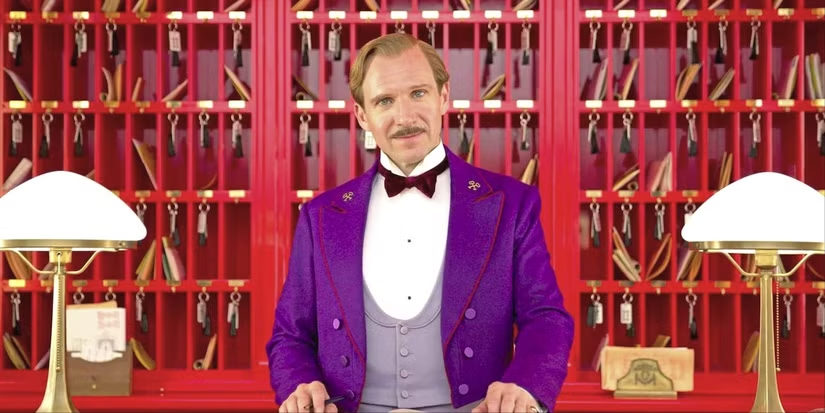
‘The Grand Budapest Hotel’ (2014)

This entire list could be a Wes Anderson tribute piece. As a lover of his distinct style, drawn to symmetry and color, I have a deep appreciation for the visuals in his films. The director’s vision has inspired social media, as it’s well-suited to photography. While all of his films utilize the Anderson effect, his most beautiful film is The Grand Budapest Hotel. A fast-paced, stylized caper, the story follows Monsieur Gustave H. (Ralph Fiennes), a legendary concierge at a famed European hotel between the wars, and his loyal lobby boy protégé, Zero Moustafa (Tony Revolori). The unlikely duo becomes embroiled in a battle for a massive family fortune, the theft of a priceless painting, and a murder mystery. A vibrant romp with a star-studded ensemble, The Grand Budapest Hotel may be Anderson’s greatest artistic achievement.
Harkening back to a 1930s aesthetic, Anderson meticulously chooses colors to reflect the period. Utilizing richly thematic colors, including beautifully muted pinks against the deeply bold reds, the color palette sets it apart from anything he’s done before. In a memory play, when the story hops back to 1968 as a young writer visits the dilapidated hotel, the colors are in sharp contrast to display the loss of a once-vibrant Europe. Visually, it’s as if Anderson tells his layered story within a dream-like dollhouse. Even with an aura of whimsy, the painstakingly pristine, symmetrical compositions are glorious. Whether straight-on or angled, Anderson blocks his performers so precisely that they become part of the set. Using adorable miniatures and switches in aspect ratio, The Grand Budapest Hotel is truly one of the most beautiful movies Anderson has ever made.
2
‘Amelie’ (2001)

When you craft a whimsically innovative film, chances are it’s going to turn out like a work of art. Such was the case for Jean-Pierre Jeunet’s Amelie. The French-language romantic comedy tells the story of a shy, imaginative waitress named Amélie Poulain (Audrey Tautou) living in Paris. After finding a hidden box of childhood treasures, she decides to anonymously improve the lives of the eccentric people around her, ultimately finding the courage to pursue her own love and happiness. A romanticized, colorful version of Paris, the backdrop becomes a character in its own right. The bricolage version of Amelie’s Paris allows for the film to stand on its own.
With a delightful performance from Tautou, it pairs perfectly with the charming color palette, and the optimistic mission of the story shines through. The warm, saturated color story evokes a dreamlike sense of nostalgia. From there, the cinematography by Bruno Delbonnel, when focusing on close-ups of small pleasures like cracking crème brûlée, becomes its own important cinematic moment. With surrealistic elements woven in, Amelie’s imagery is synonymous with the film, and there’s yet to be a film to match its splendor.
3
‘2001: A Space Odyssey’ (1968)

Perhaps the most important film ever made is Stanley Kubrick’s masterpiece 2001: A Space Odyssey. The breathtaking epic covers humanity’s evolution from prehistoric times to the future with mysterious alien monoliths. With an imposing black structure serving as a link between the past and the future, Dr. Dave Bowman (Keir Dullea) and his team of astronauts are sent on a mysterious voyage. Their ship’s sentient computer system, HAL 9000, begins to exhibit increasingly strange behavior, leading to a tense battle between man and machine that culminates in a mind-bending trek through space and time. An enigmatic film, 2001: A Space Odyssey, took audiences places they’d never seen before. And let’s just say, Kubrick’s brilliant vision is why.
Through single-point cinematography, Kubrick’s composition drew the eye to the center of the screen, creating a breathtaking photographic aura. You can even call it a moving painting. Using showing-not-telling visual storytelling, Kubrick allowed for long, mesmerizing takes to bring the audience along for the ride. A film made pre-CGI, everything is practical, using physical models. When you watch Bowman, dressed in a rich burnt red, walk inside the stark white Discovery, you understand why it’s the most popular shot in the film. Then, as he’s drawn into Star Gate, you’re taken by a vortex of colored light, bizarre landscapes, and inexplicable cosmic events. It’s a beautifully shot ending to a groundbreaking film.
4
‘8 1/2’ (1963)

Of course, a film about a filmmaker is going to be a good-looking piece, especially when it serves as your autobiography. Such was the case for Federico Fellini’s 8 1/2. The film follows a famous Italian director, Guido Anselmi (Marcello Mastroianni), suffering from intense creative blockage. As he tries to produce a science-fiction film, he struggles with his professional pressures, personal relationships, memories, and fantastical dreams. Blurring the lines between reality and fantasy and the pain and pressure of the creation process, Fellini masters the beautiful confusion of a director’s mind through extraordinary imagery.
Revolutionizing the way surrealism, dreams, and memory are integrated into the creative process, Fellini’s marvel brings meta-cinema to pioneering heights. Shot by Gianni Di Venanzo, 8 1/2 utilizes high-contrast black-and-white shots as an homage to films of the past. Then, the manner in which the camera moves is like a choreographed ballet, providing sharp shots that convey the narrative as characters move in and out of the foreground and background, building a new portrait within the mindscape. The spherical cinematographic process proved to be the magic touch. With every shot resembling a beautiful photography exhibit, 8 1/2 is all about pushing the bounds of what art can be. There’s a reason why 8 1/2 transformed seamlessly into a stunning musical.
5
‘North by Northwest’ (1959)

The crop duster in the cornfield scene. We could leave it just there, but we won’t, as there is so much to discuss. Directed by the legend himself, Alfred Hitchcock, North by Northwest is a finely tuned spy thriller. Roger Thornhill (Cary Grant) is a New York advertising executive mistaken for a government agent named George Kaplan by foreign spies. Pursued across the U.S., he tries to clear his name while caught in a deadly web of espionage, romance, and iconic action sequences. A man on the run story, Hitchcock takes viewers on a tour of America, from New York to the Midwest, with a conclusion at Mount Rushmore. With stylish suspense, Hitchcock’s visually driven action sequences have provided iconic shots that have gone down in history.
A top-tier Hitchcock film, it stands out from many others for the way he composes large-scale scenes with such profound mastery. Many films on this list are revered for their intimacy; North by Northwest bravely zooms out for grandeur. Now, one may think that the climactic finale was filmed on location, but it was not. Instead, Hitchcock and his team replicated the infamous landmark, thereby achieving a major technical feat. The specificity of the art direction imbues this film with a timelessness that continually marks it as one of the greatest cinematic feats.
6
‘Speed Racer’ (2008)

Image via Warner Bros. Pictures
There have been countless films that have tried to adapt cartoons into live action, abandoning their cartoon imagery. It’s a fine choice, but the allure and charm don’t always hold. But then, in 2008, the Wachowskis took a beloved cartoon and figured out just how to make the two-dimensional world shine in a three-dimensional world. Speed Racer, one of the most underrated films of all time, lifts Tatsuo Yoshida‘s manga series and drops it into a high-speed visual acid trip that maintains the integrity of its source material. The film follows a young, talented driver named Speed (Emile Hirsch), who navigates a corrupt, corporate-dominated racing world to save his family’s independent business. After rejecting a deal with the villainous Royalton Industries, Speed uncovers fixed races and teams up with his family, girlfriend Trixie (Christina Ricci), and the mysterious Racer X (Matthew Fox) to win the dangerous championship. Highly stylized, visually vibrant, and CGI-heavy, Speed Racer is a masterclass in filmmaking.
The Wachowskis have great reverence for the source material, yet avoid the potential corniness to build a neon-soaked universe that became the epitome of being “posterized.” Through pop art, cubism, and technical CGI enhancements, Speed Racer is a welcome sensory assault in which physical laws are pushed aside for maximum visual pleasure, going to the max with color saturation to craft a surreal universe that’s in perpetual motion. As someone who attended a midnight viewing on opening night, Speed Racer is a moving art installation straight from your wildest imagination.
7
‘The Wizard of Oz’ (1939)

Classic Hollywood’s journey from black and white to Technicolor was a glorious transition. Perhaps the film that defined that shift was the timeless classic, The Wizard of Oz. The film tells the story of Dorothy Gale (Judy Garland), a young farm girl from Kansas, who is swept away via a tornado to the magical Land of Oz, where she embarks on a quest along the Yellow Brick Road to find the powerful Wizard (Frank Morgan) in the Emerald City to help her get home. On her journey, she meets three new friends, each of whom is seeking something of their own from the Wizard (Frank Morgan) — the Scarecrow (Ray Bolger), who needs a brain; the Tin Man (Jack Haley), who needs a heart; and the Cowardly Lion (Bert Lahr), who needs courage. From a sepia reality turned colorful dream world, The Wizard of Oz’s iconography has already found itself in museums, because each shot is spectacular.
Directed by Victor Fleming, The Wizard of Oz was a technological innovation using tremendous production design that magically came to life. Every single set piece was meticulously crafted, reminding viewers that colors aren’t just a simple shade. With brilliant detail, the yellow-coated bricks pop. The perfect shade of green allowed the Emerald City to dazzle. Then, without that precise red, those famous ruby slippers wouldn’t be nearly as memorable. Bring all the colors together, and The Wizard of Oz transports you into this immersive world over the rainbow. The Wizard of Oz is the definition of why color is so integral. When we head back to Kansas and Dorothy awakes in bed to her friends by her side, returning to the sepia world serves as a reminder of how important our imagination is to us. Even that shot with the trio flanking Dorothy while in bed left a lasting impact. There’s not a single shot in The Wizard of Oz that hasn’t impacted pop culture and cinema since.
8
‘The Tree of Life’ (2011)

A profound, poetic exploration of existence, the Terrence Malick-directed film The Tree of Life looks and feels like a beautiful painting. The experimental drama centers on Jack (Sean Penn), who reconciles childhood memories of his stern father (Brad Pitt) and loving mother (Jessica Chastain) with the vast, humbling scale of existence. Of course, Jack’s parents represent a way of living. Mr. O’Brien represents the way of nature — selfishness and survival — while Mrs. O’Brien represents the way of grace, selflessness, and love. Through the cosmic significance of the mundane, as filtered through the memories of a reflective man, Malick evokes a symbolic vocabulary through which he crafts the visual story.
The Tree of Life’s cinematographer, Emmanuel Lubezki, uses the world around us to the film’s advantage. Through the mastery of natural light, Lubezki gives Jack a visceral image to remember. By staying away from artificial lighting, the shots feel believably lived-in, like a memory. Using the luscious colors of nature, The Tree of Life showcases the beauty we may take for granted. The fleeting moments, such as a hand touching a plant or the sun beaming through the trees, become a grand surrealist painting. Now, lest we forget, The Tree of Life also dives through the history of creation. In doing so, the story intertwines intimate shots of personal moments in Texas, juxtaposed with the massive shots of the universe’s creation. It helps to make those natural moments look simply majestic. Malick’s film is a reflective meditation on life, death, and divinity, heightened by the splendor of the images.
9
‘Apocalypse Now’ (1979)

The horrors of war may not sound like something that would be visually stunning, but then Francis Ford Coppola made Apocalypse Now. The visceral imagery was so perfectly reflective of the Vietnam War that it changed war films forever. A surreal look at the Vietnam War, Apocalypse Now tells the story of a river journey from South Vietnam into Cambodia undertaken by Captain Willard (Martin Sheen) during a secret mission to assassinate Colonel Kurtz (Marlon Brando), a renegade Special Forces officer accused of murder and presumed insane. Through the lens of war, Apocalypse Now is a psychological examination of the descent into the heart of darkness. To capture the sensational horror of war, Coppola shot the film with a meticulous, organic approach that then exploded into a surreal nightmare. As sanity is lost in the soldiers, the film opens up into a wonderland of images. Right from the start, the surreal montage of palm trees exploding into flame and bold shots of helicopters in flight set an instantly artistic tone for this war thriller.
Cinematographer Vittorio Storaro‘s use of color and light brought out a mesmerizing sense of storytelling. Specified by mastery of light and shadow, Storaro captured the characters’ inner turmoil. Just look at how Brando is framed, with only parts of his face in the light. The shafts of light that pierce through the dark, foggy jungle move the film from a simple war documentary to a phantasmagoria. One of the most famous shots in film history is of Sheen in the water. The brilliance of the warm amber light hitting his face is evocative. Through the use of color, each character had a color story to define them. Take, for instance, Robert Duvall‘s Colonel Kilgore. He’s often shown in scenes featuring vividly bright colors that match his larger-than-life demeanor and his insane reality. Apocalypse Now is a film that holds a mirror up to the feelings about the Vietnam War. With the perception being negative, Coppola crafted a living nightmare to provoke the trauma of the war.
10
‘Sin City’ (2005)

Sin City might be one of those films you’ve forgotten about, but the truth is, it’s a visual marvel that deserves more recognition. Directed by Robert Rodriguez and Frank Miller, and based on Miller’s comic book series, Sin City perfectly elevates the hand-drawn masterpiece into a three-dimensional world where every single original panel becomes the storyboard for the picture. The anthology film follows multiple interconnected storylines of violence, revenge, and redemption in the corrupt, fictional Basin City, featuring characters such as a brutish vigilante, a retired cop, and a hitman grappling with sordid crimes. With an all-star cast, including Bruce Willis, Clive Owen, Jessica Alba, Rosario Dawson, Brittany Murphy, Josh Hartnett, Benicio del Toro, and more, the faithfully crafted monochromatic pulp noir was a feast for the eyes.
The introduction of color into black-and-white film often serves as an essential storytelling device. Look at films like Schindler’s List and Pleasantville. When the colors emerge, it’s a sign for the audience that it’s important for the story. Here, color tends to represent corruption or innocence, separating good characters from the dark, gray world they inhabit. Watching Sin City is literally like seeing a comic book in motion. The close-ups, the camera swoops, the precise angles, all come together for a fascinating composition. The dark visual mode helped establish the noir tone of classic thrillers while preserving the comic’s integrity. Allowing the film to live in a surreal world amplified each shot into a comic frame. Through digital construction and vibrant splashes of color, Sin City is an atmospheric accomplishment.
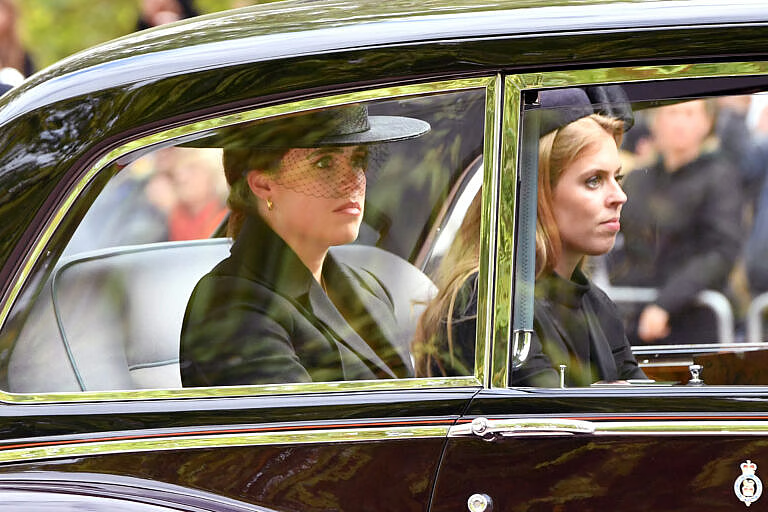
Princess Beatrice is reportedly considering a move to the US as she and Princess Eugenie navigate the fallout from their father, ex-Prince Andrew‘s, ongoing scandal linked to Jeffrey Epstein.
The situation has taken an emotional toll, prompting both sisters to step back from public life while focusing on their families.
With mounting pressure and scrutiny in the UK, a fresh start abroad is being considered as Princess Beatrice and Eugenie try to move forward.
Princess Beatrice Reportedly Weighs Relocation Amid Father’s Epstein-Linked Controversy

Princess Beatrice is reportedly considering relocating to the United States as she navigates ongoing fallout tied to her father, Prince Andrew, and his association with Jeffrey Epstein.
According to a Daily Mail report, Beatrice is said to be deeply affected by the situation and is trying to keep her personal life steady amid intense public scrutiny.
Sources claim the idea of moving abroad, once unthinkable, has become more realistic, especially with her sister, Princess Eugenie, having spent extended time living outside the UK.
A potential move could offer Beatrice and her husband, Edoardo Mapelli Mozzi, a chance at a fresh start while also helping them refocus on their marriage. Edoardo’s work in property, which frequently takes him to the US, is said to make the transition more feasible.
Insiders suggest the couple feels increasingly exposed remaining in the UK, with ongoing investigations and the possibility of further legal developments keeping the spotlight firmly on the family.
The situation has reportedly placed strain on their marriage, particularly during difficult moments when Beatrice needed support, and her husband was abroad for work.
Princesses Beatrice And Eugenie Step Back From Royal Duties Amid Ongoing Prince Andrew Controversy

Meanwhile, the controversy surrounding Andrew continues to cast a long shadow.
He was reportedly arrested in February on suspicion of misconduct in public office linked to alleged dealings with Epstein, and could face serious legal consequences if convicted.
Insiders say the development was particularly difficult for Beatrice, coming at a time when she was already under strain and without her husband nearby.
Since the arrest, both sisters have largely stepped out of the public eye. Reports indicate they will not take part in the traditional carriage procession or appear in the royal box at Ascot this June.
The Princesses Might Stay Away From Public Engagements For A While Due To Their Father’s Scandal

Beatrice and Eugenie’s absence has been noted at recent events, including the Cheltenham races, where senior royals such as Queen Camilla, Princess Anne, and Zara Tindall were in attendance.
Royal commentators suggest this reduced visibility may continue due to the amount of scrutiny plaguing the royal family because of their father.
According to author Phil Dampier and Majesty magazine editor Ingrid Seward, while Beatrice and Eugenie remain valued members of the royal family, the current situation has left them too closely associated with the controversy to participate in major public engagements for now.
Some experts are now suggesting that their absence could extend for much of the year.
Princesses Beatrice And Eugenie Lean On Family As They Cope With Emotional Fallout Of Ongoing Scandal

Behind the scenes, however, the sisters are said to be maintaining close relationships with both their father and their mother, Sarah Ferguson, choosing to spend time together privately while shielding their own families from the fallout.
Beatrice, who married Mozzi in 2020, is raising two young daughters while also embracing her role as a stepmother, while Eugenie, who wed Jack Brooksbank in 2018, is focused on her two young sons.
Sources say the fallout has been deeply emotional for both women, as they process the unfolding events while trying to shield their families. Insiders suggest “they’re also putting pieces of the puzzle together in real time, insiders claim, “and realizing they may have been used.”
The source continued: “That has to feel like a complete betrayal. They’re heartbroken — but a dad is still your dad, and a mom is still your mom. Love for a parent isn’t a light switch. It’s an incredibly painful and introspective moment for them.”
Princess Eugenie Reportedly ‘Frustrated’ As She Navigates Fallout From Prince Andrew Scandal

For Eugenie in particular, the situation has been especially difficult. According to sources, she feels unfairly caught up in the fallout, describing the experience as being “tarnished with a brush that’s not hers, that’s her father’s,” leaving her “very, very frustrated.”
While she and Beatrice are doing their best to stay positive, the situation has been described as “a s–t show, a never-ending s–t show.”
Reports suggest Eugenie has taken a step back from spending time with her father as she processes the ongoing scandal. However, insiders emphasize that this distance does not signal a complete breakdown in their relationship, describing the bond as strained but not entirely severed.
Entertainment
Where is the “High Fidelity ”cast now? See John Cusack, Jack Black, and more stars over 25 years later
:max_bytes(150000):strip_icc():format(jpeg)/HIGH-FIDELITY-Todd-Louiso-John-Cusack-Jack-Black-031826-ba360536e87948ae8162de273f2add21.jpg)
Like an old vinyl record, it’s time to dust off this 2000 romantic dramedy gem and give it a spin.
There’s something inherently entertaining when it comes to a thriller. With a large group of genres under the umbrella, audiences flock to films that keep them on the edge of their seats. Maybe it’s the story or the performances that keep you engaged, but a great thriller requires excellent direction.
Throughout, there have been extraordinary masterpieces, but among those, the films on this list are perfectly directed. From legendary visionaries to directors on the rise, they share an evocative power to make a lasting impact. With countless awards and inspiring new techniques in filmmaking, these directors helmed perfect films. For this list, we are keeping it to one film per director to share the wealth of praise! There are certainly many titles that could have found their place on this list, but these films are perfect.
1
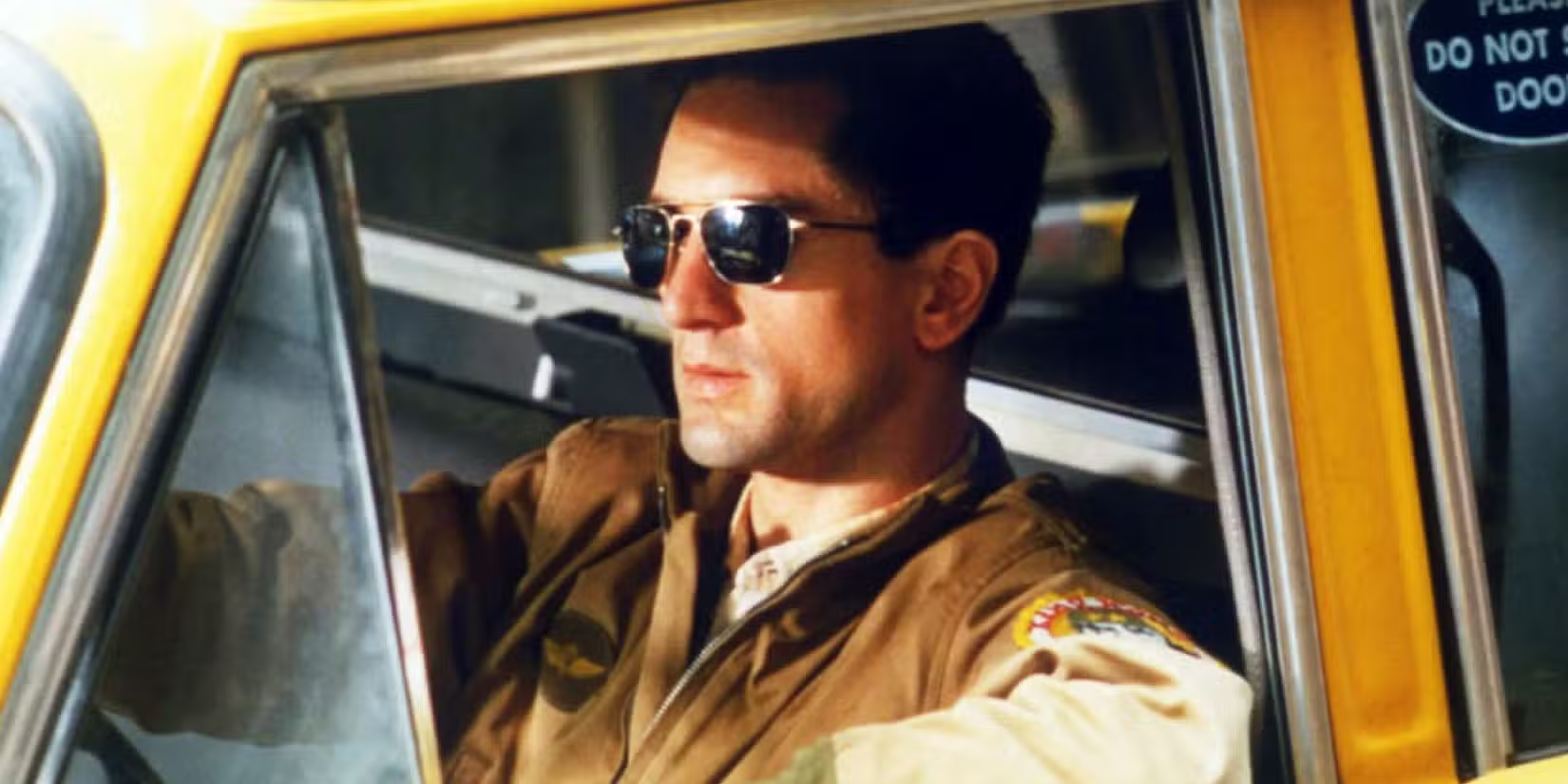
‘Taxi Driver’ (1976)
Director: Martin Scorsese

There are certainly a plethora of titles that could be considered Martin Scorsese‘s greatest work. Though he’s been nominated for several Academy Awards for Best Director, winning only one, his most impactful work, which set him on the course of an influential director, came with Taxi Driver. Also jumpstarting his long-term collaboration with Robert De Niro, Taxi Driver tells the story of Travis Bickle, an isolated, mentally unstable Vietnam War vet. He works nights as a taxi driver, due to his insomnia, in a decaying, crime-ridden New York City. As he spirals due to loneliness and psychosis, Bickle turns to violence in an attempt to clean up the city. Centering on vigilante violence, Taxi Driver captures a man’s decline through a nightmarish dreamscape of isolation.
Scorsese’s film is not an easy one to watch. There are moments that are destined to make you uncomfortable. Yet, Scorsese prevents those moments from being grotesque. Instead, they serve to exemplify Bickle’s state of mind. Using pan-away shots, you start with an image of Bickle, then suddenly pull back to reveal he’s alone. It may be subtle, but it’s effective filmmaking. Then, by distorting reality through slow-motion and dream-like lighting, Scorsese forces the audience to see the world as Bickle envisions it. Taxi Driver is a deeply intimate character study that showcases how Scorsese doesn’t always need a grand ensemble to tell an effective narrative. Taxi Driver is an iconic film with an iconic character who established the ’70s in cinema. None of that could have been done without Scorsese.
2
‘Get Out (2017)
Director: Jordan Peele

If you told anyone in the early 2000s that MAD TV star Jordan Peele would become a horror filmmaker who effectively changed the genre, they would likely laugh. And then, in 2017, Get Out debuted, and Peele established himself as a brilliant director audiences flocked toward to see what he would craft next. It all stems back to the brilliance that is Get Out. A sensational dissertation on how the horrors of our world are the things out in the open, Get Out became the modern psychological-horror standard. Peele’s tale follows Chris Washington (Daniel Kaluuya), a Black photographer, as he visits his white girlfriend Rose Armitage’s (Allison Williams) parents, Missy and Dean (Catherine Keener and Bradley Whitford), for the weekend. While there, he soon discovers, thanks to the weird behavior of the Black servants and awkward microaggressions, that the family lures Black people to their estate to transplant elderly white minds into their bodies, leaving victims in a paralyzing void known as the sunken place. Chris must get out before he’s next. A haunting, meticulously directed film, Peele’s social thriller relies on psychological discomfort rather than traditional horror tropes to create an effective masterpiece.
The horror of racism could have led to an overtly on-the-nose story that didn’t capture Peele’s mission. Instead, he holds a mirror up to society while amplifying the horror elements around it. Capturing the state of the world, Get Out had an essence of believability that made it scarily real. The anxiety of Black America is a profound theme, helped by putting the audience in Chris’s shoes. As the writer and director, Peele knew this film inside and out. He expertly fleshed out his universe by making it eerily real, so by the time the truth is revealed, there is a plausibility that psychological mind games might effectively be around us. In the end, the emotional payoff is satisfying and empowering, effectively wrapping up his directorial feature debut.
3
‘Uncut Gems’ (2019)
Director: Safdie Brothers

There have been many sibling duos who became legendary directors. In the 21st century, it was Josh and Benny Safdie who joined the extraordinary list. All it took was their crime thriller, Uncut Gems. The high-stakes film follows Howard Ratner (Adam Sandler), a charismatic, gambling-addicted New York City jeweler. Upon acquiring a rare Ethiopian opal, he must juggle mounting debts, angry loan sharks, and his complicated family life in a relentless, high-anxiety pursuit of the ultimate winning bet. With a precisely chaotic movie, the Safdies create an engaging yet stressful atmosphere that evokes the action of Howard’s journey.
The Safdies orchestrate a realistic pandemonium to effectively create the high-stakes adventure. From frenetic handheld cameras to overlapping dialogue, the controlled chaos leads to exposing Howard’s manic anxiety and addiction. Viewers are trapped on Howard’s thrill ride, only leaving when the deed is done. Working with cinematographer Darius Khondji, sound mixer Skip Lievsay, and Daniel Lopatin‘s synth score, the overlapping elements become harmonious while being erratic, heightening the heist. As far as acting is concerned, they pulled out a career-best out of comedian Sandler, proving he deserves to be taken seriously as a dramatic actor. Uncut Gems sparkles and shines thanks to the extraordinary work of the Safdies.
4
‘Parasite’ (2019)
Director: Bong Joon-Ho

For the longest time, foreign-language films seemed to be on the outskirts of mainstream cinema. Then, Bong Joon-Ho‘s Parasite arrived, and that separation ceased. A true masterpiece in direction, Parasite blends dark comedy with dark thriller elements to tell the story of the Kims, a poor family who infiltrate the wealthy household of the Parks by posing as unrelated, highly qualified servants. A scathing critique of modern capitalism through the lens of class conflict, inequality, and greed, Bong’s transition from witty scam comedy into suspenseful tragedy provided for an alluring film. Parasite‘s success as the first foreign-language film to win the Academy Award for Best Picture relies on Bong’s sheer brilliance.
Easily Bong’s magnum opus, Parasite takes a simple premise and turns it on its head. Like the sleek home the Parks take over, Bong meticulously builds Parasite from the ground up, using the architectural blueprint to construct a sleek film. His ability to cast a stark contrast of class through every production element — costumes, set, color — leads to a seamless composition of his vision. With so many genres and themes to balance, Bong maintains an effective tone that makes Parasite a shapeshifting thriller. The natural progression of the story falls into place without question. Through subtle changes in atmosphere, through sound and lighting, the Parks’ journey becomes even more thrilling. Parasite is unapologetic, as Bong does not allow outside influence to shape the narrative of classism in society. Parasite might be presented from a Korean perspective, but Bong’s ability to make it largely universal allowed the film to be the mainstream hit that it is.
5
‘No Country For Old Men’ (2007)
Director: Joel and Ethan Coen

Very few directors know how to make an atmosphere a thrill in and of itself quite like Joel and Ethan Coen. With a brilliant resume behind them, they made their mark in the 2000s with their neo-Western crime thriller No Country for Old Men. Using Cormac McCarthy‘s 2005 novel as inspiration, the story follows a trio of men: Llewelyn Moss (Josh Brolin), a Vietnam War veteran and welder who stumbles upon a large sum of money in the desert; Anton Chigurh (Javier Bardem), a hitman who is sent to recover the money; and Ed Tom Bell (Tommy Lee Jones), a sheriff investigating the crime while battling a changing world he feels ill-equipped to handle. Set in the vast desert landscape of 1980 West Texas, the Coen brothers’ masterpiece is a story that isn’t about who ends up with the loot; it’s about the chase between the hunter and the hunted, a role each of the main characters adopts throughout the film.
A masterclass in visual storytelling, the Coens’ ability to build suspense through silence and ambient natural sounds heightens the tension, dropping viewers into a bleak, desolate landscape that mirrors the grim, philosophical approach to their story. No Country for Old Men showcases how capturing the precise atmosphere leads to a perfect movie. As far as characters go, the collaboration between the directors and their star brought out one of the 21st century’s most recognizable villains in Anton Chigurh. Lifted effortlessly from page to screen, just his gaze alone strikes immediate fear. No wonder Bardem earned an Oscar for his performance! As did the Coens. They have made cult classics and impressionable offbeat dark comedies, but nothing has ever been quite like their achievement with No Country for Old Men.
6
‘Eyes Wide Shut’ (1999)
Director: Stanley Kubrick

It’s safe to say that Stanley Kubrick can do extraordinary work in literally any genre of cinema. For his final project, Kubrick took Arthur Schnitzler’s novella, Dream Story, and brought it to modern times in the erotic psychological thriller, Eyes Wide Shut. The ’90s classic follows Dr. Bill Harford (Tom Cruise), who spirals into a night-long, surreal odyssey of sexual obsession and paranoia after his wife, Alice (Nicole Kidman), admits to nearly abandoning their family for a fantasy encounter. Blurring the line between the couple’s subconscious desires and their actual actions through a journey between reality and fantasy, Kubrick’s masterpiece is smartly crafted and profoundly executed.
What Kubrick does well is create a hauntingly surreal, slightly off dream. Hidden in plain sight, Kubrick creates a symbolic vocabulary through imagery, light, and color. The vibrancy and its transforming palette represent shifting emotional states, jealousy, and danger. As a brilliant psychological thriller that visually shows the emotional state, it is a masterful way to tell the story. Kubrick united top-tier performers to create such perfect chemistry, it bled off-screen as well! Eyes Wide Story is sexy and erotic, and it is thought-provoking and gripping. A film that was misunderstood at first, only to age like fine wine, Kubrick left the world, making his favorite film in his storied career. Eyes Wide Shut is truly like nothing he’s crafted before.
7
‘American Psycho’ (2000)
Director: Mary Harron

The premise of American Psycho sounds terrifying, but when director Mary Harron brought Bret Easton Ellis’ novel to life, the result was an exceptional black-comedy psychological thriller. The film follows Patrick Bateman (Christian Bale), a wealthy 1980s New York City investment banker who hides his alternate life as a sadistic serial killer. The plot, centered on themes of materialism and alienation, tracks his descent into madness as he murders colleagues, including Paul Allen (Jared Leto), and strangers, while his superficial social circle remains oblivious. With a central character that has attempted to be replicated, but can only be referenced, American Psycho was an underdog film that became a classic overnight. Hatton took a sensational story and blew it up for the big screen. Balancing horrific violence with satirical comedy, she took the superficial 1980s and narcissism to critique the absurdity of the yuppie lifestyle and male vanity.
At its core, American Psycho is a slasher film about the most enigmatic serial killer. Perhaps the most shocking part about the film is the reaction to Patrick Bateman. Harron worked with Bale to find the rich nuances within Patrick that, for whatever reason, resonated with audiences, with some even idolizing him. As she told Letterboxd, she always saw the film as “a gay man’s satire on masculinity.” She notes how the idiosyncrasies of the character, like the meticulous rituals and obsession with image, are “men are prizing their extreme competition and their ‘elevating their prowess’ kind of thing.” She says, “There’s something very, very gay about the way they’re fetishizing looks and the gym.” Harron’s ability to give Bateman the room to deliver a precise, iconic performance as a narcissistic, detached psychopath made the film perfect. At the end of the day, American Psycho is a fantastic, bloody film.
8
‘The Manchurian Candidate’ (1962)
Director: John Frankenheimer

If there’s ever been a film that forces you to question everyone you once trusted, look no further than The Manchurian Candidate. Based on Richard Condon’s novel, John Frankenheimer brought to life the perfect Cold War neo-noir political thriller. The iconic film tells the story of an American Korean War platoon brainwashed by Communists. Sgt. Raymond Shaw (Laurence Harvey) is programmed as a sleeper assassin tasked with killing a U.S. presidential candidate to aid a Communist conspiracy managed by his mother (Angela Lansbury). Major Bennett Marco (Frank Sinatra) is on a mission to uncover the plot by any means. A darkly satirical film, The Manchurian Candidate, highlights themes of paranoia, mental manipulation, and political corruption through Frankenheimer’s sharply edited narrative.
To expose the paranoia at the film’s root, Frankenheimer deploys a disorienting, rapid-cutting editing style. Sensational examples include the brainwashing scenes, which transition seamlessly between a communist lecture hall and a New Jersey garden party, making the surreal feel real. Lionel Lindon’s cinematography is enhanced by black-and-white shooting and unique camera angles that heighten the thriller’s sense of paranoia. Perhaps one of the underappreciated achievements of Frankenheimer in this film is his hand-picked ensemble. He pulled out standout performances from every actor, exposing how going against type can deliver perfect shocks. Seeing how he led Lansbury to an Oscar nomination in her deliciously manipulative mother role underscores how crucial the relationship between actor and director is. The Manchurian Candidate is a deeply focused film that was truly ahead of its time due to Frankenheimer’s pristine vision.
9
‘Se7en’ (1995)
Director: David Fincher

When a film forces you to question the contents of a box delivered at your feet, you know you’ve done something brilliant. Such was the case for David Fincher’s Se7en. The film follows disenchanted, nearly retired Detective Lieutenant William Somerset (Morgan Freeman) and his newly transferred partner David Mills (Brad Pitt) as they try to stop a serial killer from committing a series of murders based on the seven deadly sins. A brutal and gruesome crime thriller, Se7en went beyond the typical police procedural to deliver something thought-provoking and intelligent through Fincher’s calculated control over tone, visual aesthetics, and the psychological manipulation of the audience through shock.
To capture the specific essence Fincher was searching for, he deliberately placed the film in an unnamed city, detached from time and space, creating a timeless, universal sense of dread. And nothing spells dread quite like persistent rain. Alongside cinematographer Darius Khondji, the duo used a “bleach bypass” chemical process on the film stock to deepen shadows and create a high-contrast, desaturated look. Further, the subtle use of color allows the eye to delve into the important details. For the story, the audience is well aware that the killer is playing with the seven deadly sins, and thus, we wait for each to be unleashed. It’s a slow burn built through tension during the investigation. By the time the climax culminates and John Doe (Kevin Spacey) drops his final twist, that slow-burning was more than worth it. Se7en is Fincher showing why perfectionism can lead to a sensation. Every single frame is curated, resulting in a stunning final product. A timeless classic, Se7en exemplifies Fincher at his finest.
10
‘Memento’ (2000)
Director: Christopher Nolan

If there is one director who has defined the 21st century thus far, it’s Christopher Nolan. Kicking off the new millennium, Nolan uses a short story by his brother, Jonathan Nolan, as inspiration for the exceptional psychological neo-noir thriller Memento. The film tackles the intriguing story of Leonard Shelby (Guy Pearce), a man with anterograde amnesia, a condition that causes short-term memory loss and prevents him from forming new memories. Using an elaborate system of photographs, handwritten notes, and tattoos, Leonard attempts to uncover the perpetrator, simply known as “John G,” who killed his wife (Jorja Fox) and caused him to sustain the condition. A sharply intricate film in which black-and-white tells one story moving forward, while color tells the story moving backward, Memento’s alternating timelines collide to create an immersive, cerebral puzzle.
The chronological and reverse chronological storytelling could have been a risky flop, but because Nolan’s painstaking focus and subjective perspective are executed to perfection. The audience is forced to question everything as the timelines converge, leading to a psychological breakdown because they no longer have a trustworthy narrator. Memento is a film to watch multiple times because Nolan’s usage of subtle clues is precisely placed. This is a film that demands attention, and the more closely you watch, the richer the film becomes. At the core of the film, memory, identity, and perception shape every technical choice that leads to Leonard’s psyche. Nolan’s work has been lauded over the past two decades for films like Inception, The Dark Knight, and Oppenheimer, but Memento proved his brilliance.
:max_bytes(150000):strip_icc():format(jpeg)/Peter-Alexander-Today-032826-64267d35fe94492b9206225560cef304.jpg)
The broadcaster joined the morning show in 2018 while simultaneously serving as the network’s White House correspondent.
TPI Composites earnings missed by $1.86, revenue fell short of estimates
How DaBaby’s Homophobic Rant Cost Him More Than Six Figures

NHS names five lifestyle changes to lower cholesterol ‘before’ statins


-
 NewsBeat4 days ago
Manchester United reach agreement with Casemiro over contract clause amid transfer speculation
-

 News Videos3 days ago
Parliament publishes latest register of MPs’ financial interests
-

 Sports6 days ago
Remo Stars and Kano Pillars Strengthen Survival Hopes in NPFL
-

 Sports6 days ago
Gary Kirsten Accuses Pakistan Cricket Board Of ‘Interference’, Mohsin Naqvi Responds
-

 Business7 days ago
No Winner in March 21 Drawing as Prize Rolls to $133 Million for Next
-

 Tech6 days ago
Give Your Phone a Huge (and Free) Upgrade by Switching to Another Keyboard
-

 Tech6 days ago
AI enters the chat: New Seattle dating app relies on tech to facilitate meaningful human connections
-

 Business2 days ago
Instagram, YouTube Found Responsible for Teen’s Mental Health Struggle in Historic Ruling
-

 News Videos6 days ago
Ch 9 Financial Management Part 1 | Detailed One Shot | Class 12 Business Studies Boards 2026
-

 NewsBeat1 day ago
The Story hosts event on Durham’s historic registers
-
 NewsBeat4 days ago
Tesco is selling new Cadbury Dairy Milk bar and people can’t wait to try it
-

 Business7 days ago
Will Duke Basketball Win It All? Duke Basketball Enters Second Round as Third Favorite to Claim NCAA Title
-

 Sports6 days ago
2026 Kentucky Derby horses, odds, futures, preview, date: Expert who hit 12 Derby-Oaks Doubles enters picks
-

 Tech5 days ago
Samsung will soon let you control smart home devices from your car’s dashboard
-
 Entertainment7 hours ago
Lana Del Rey Celebrates Her Husband’s 51st Birthday In New Post
-
 NewsBeat7 days ago
Update on Wisbech river crash as search for teenage boy enters fifth day
-
 Entertainment6 days ago
Cynthia Bailey Dishes on ‘RHOA’ Season 17, Discusses Kandi
-
 NewsBeat6 days ago
Colombian military plane with 110 soldiers onboard crashes following takeoff
-

 Fashion5 days ago
Does It Matter What You Wear When You’re Laid Off and Looking?
-

 Business5 days ago
More women enter wealth management, but few in advisory roles: study
You must be logged in to post a comment Login