










Connect with us
DAPA Banner

Tech

From Bot Signups to Account Takeovers

Published

on

A bot conducting fraud

Modern fraud attacks look like a relay race where different tools and actors handle each stage of the journey from signup to cash-out.

When you only inspect one signal at a time, such as IP or email, attackers simply shift to a different part of the chain and still succeed.

Bot characteristics

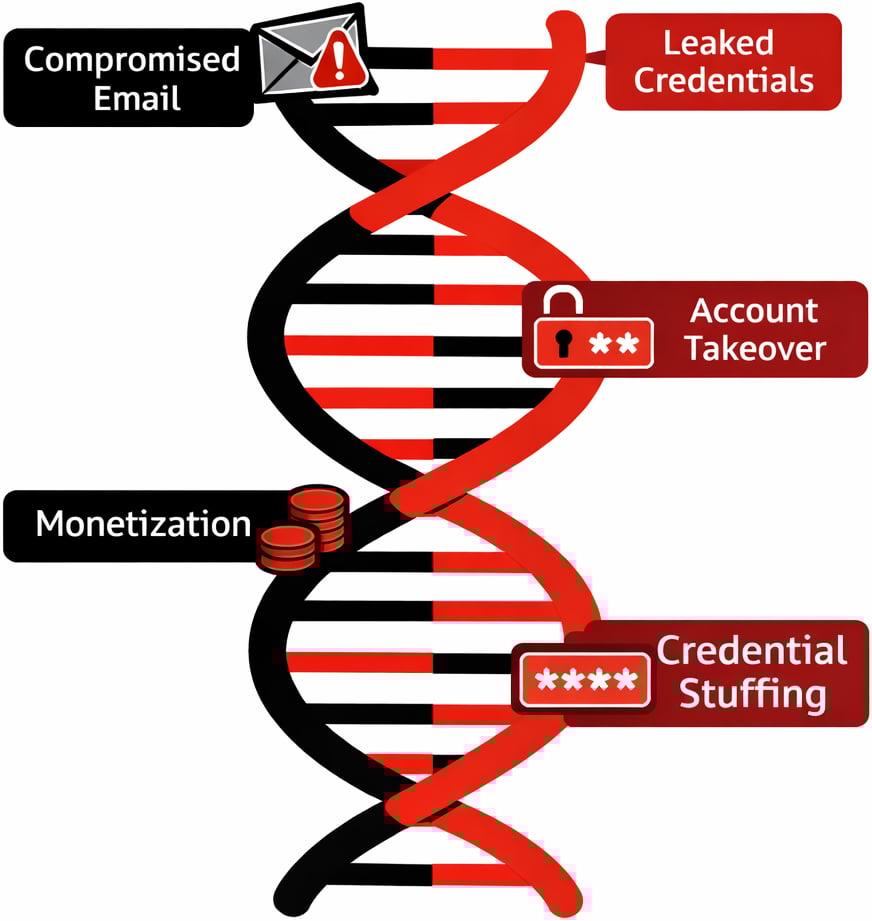
Anatomy of a Modern Fraud Chain

A typical attack chain starts with automation to create scale. Attackers use bots and scripts to open large numbers of accounts with minimal human effort, often rotating infrastructure to avoid rate limits and simple bot rules.

Those bots are usually powered by “aged” or compromised emails and leaked credentials so that every account looks like it belongs to a long standing user instead of something created yesterday.

Advertisement

Residential proxies then mask traffic behind real consumer IP ranges, making traffic appear like normal home users rather than data centers or known VPN services.

Once those accounts are established, they shift tactics from automation to slower, human driven sessions to blend into normal usage.

At this point the chain reaches account takeover and monetization, using malware links, phishing, and credential stuffing outputs to log in, change details, and push through high value transactions.

Throughout this lifecycle, the tools are mixed and matched. A single actor may move from a headless browser and proxy at signup to a mobile device emulator and different proxy provider at login, then hand off access to another party who specializes in draining funds or exploiting promo campaigns.

Advertisement

This is exactly why a point in time, single signal check rarely tells the full story

Bot DNA

False Positives from Siloed Checks

When teams lean on one dominant signal, such as IP reputation, false positives become a daily problem. Legitimate users on shared Wi Fi, mobile carrier NATs, or corporate VPNs can inherit the poor reputation of a small number of bad actors on the same ranges, even though their intent is clean.

Blocking by email alone has similar issues, since free webmail domains are used by both sophisticated attackers and completely normal customers.

Identity centric controls on their own also hit a wall. Static data checks, like simple name and document matches, are easy to spoof for synthetic identities built from real data fragments.

Advertisement

Device centric controls that only look for rooted phones or emulators can miss fraudsters operating on seemingly normal devices that have been compromised earlier in the chain. Even bot specific solutions can create blind spots when they work alone.

Once a credential stuffing campaign ends and attackers pivot to manual logins with the same stolen credentials, pure bot tools see only “human” traffic and approve it. The result is a pattern where high risk users are blocked while determined adversaries adapt and slip through.

Multi-Signal Correlation in Practice

Effective fraud defense comes from correlating IP, identity, device, and behavioral signals at every step of the journey instead of evaluating each one in isolation.

An IP that looks slightly suspicious on its own becomes clearly abusive when tied to dozens of new accounts on the same device fingerprint and similar behavioral patterns during the first session.

Advertisement

Likewise, a user with an apparently normal device and clean email reputation can still be high-risk if login behavior reflects credential stuffing patterns or access follows known malware distribution campaigns.

Modern decision engines improve accuracy by weighing hundreds or thousands of data points together rather than enforcing rigid rules on a single attribute.

For organizations, that means unifying what were once separate views. IP intelligence, device fingerprinting, identity verification, and behavioral analytics should feed the same risk model so that each event is scored in context, not as a disconnected log line.

This multi signal approach is the most reliable way to raise the bar for attackers while reducing friction for genuine customers.

Advertisement

Prevent chargebacks. Stop account takeover. Recover revenue. 

Leading enterprises use IPQS data to power their fraud prevention strategies, don’t leave yourself vulnerable. Seamlessly integrate with our APIs to reduce friction, prevent more fraud, and secure your business.

Free Sign Up

Case Study: Stopping Coordinated Signup Abuse

Consider a self service SaaS platform that offers a generous free tier and trials. As the product grows, abuse appears in the form of thousands of signups used to scrape data, test stolen cards, or resell access under the radar.

Early countermeasures rely on blocking certain IP ranges and obvious disposable email domains, but this only dents the problem and begins to impact small teams and freelancers on shared networks.

Advertisement

By shifting to a multi-signal model, the platform starts scoring signups across IP, device, identity, and behavior together.

New accounts that reuse the same device fingerprint with different emails, come from IPs recently seen in automated traffic, or immediately exhibit scripted behavior are grouped into coordinated abuse clusters instead of being evaluated one by one.

This lets the team apply precise responses, such as challenging only high risk clusters with additional verification or silently limiting their capabilities while letting low risk signups proceed without friction.

Over time, feedback from confirmed abuse and confirmed good users trains the scoring model, driving down false positives while pushing organized attackers to spend more effort for less return.

Advertisement

Outpacing Fraud Trends

Attackers are no longer tied to a single tool or weak point in your stack. They combine proxies, bots, synthetic identities, leaked credentials, and malware infrastructure across multiple stages, which means that single signal defenses will always lag behind.

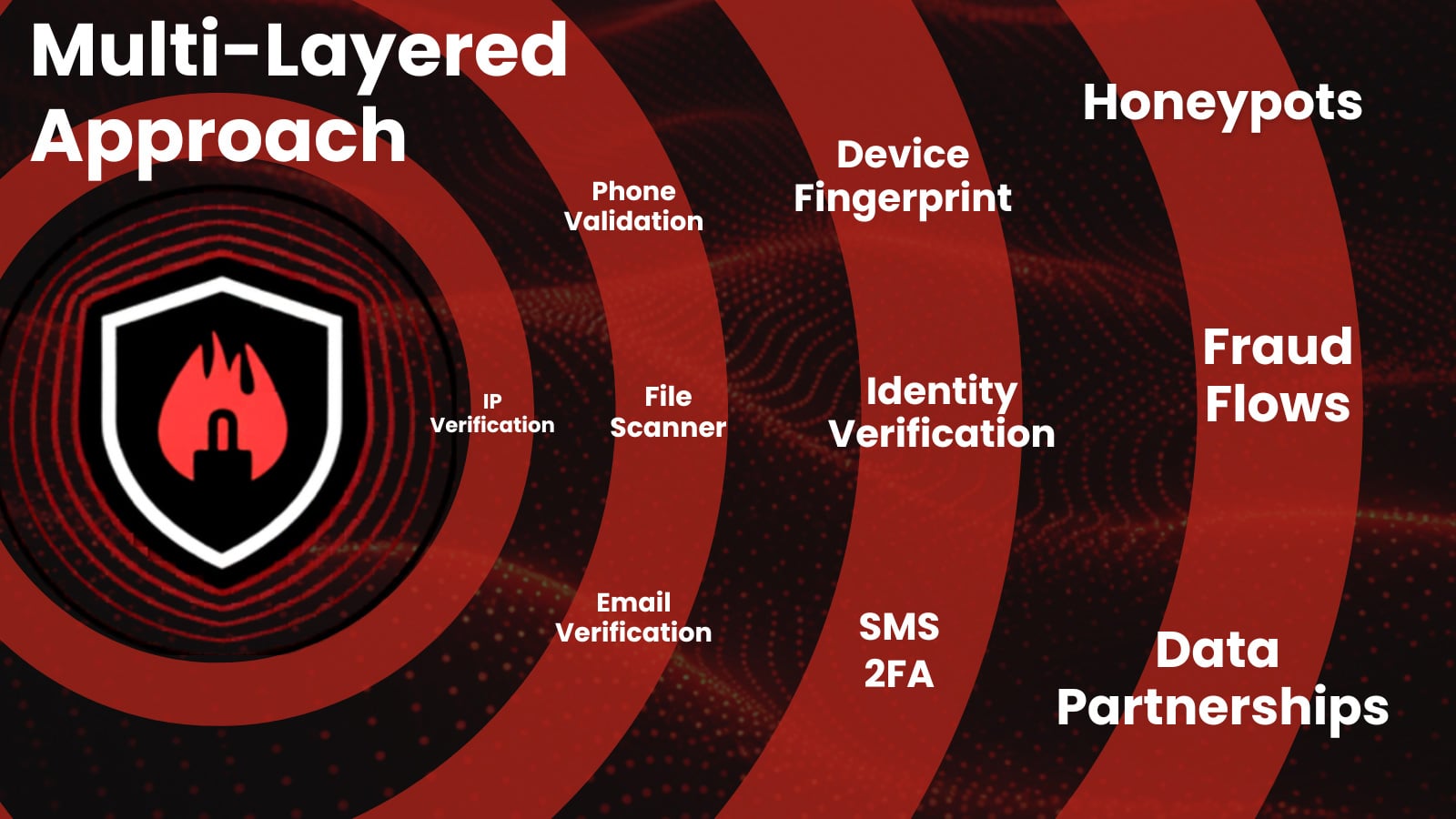
Multi layered approach

To keep pace, fraud teams need correlation across IP, identity, device, and behavior in one coherent risk view rather than a collection of disconnected checks.

From here, the conversation shifts to how to operationalize that unified model, integrate it into existing workflows, and measure its impact on both loss reduction and customer experience.

Book a free consultation with a fraud expert today!

Advertisement

About IPQS

IPQS is a founder-led, self-funded company built on a simple principle: fraud prevention should be driven by real intelligence and a multi-layered approach. From day one, we’ve focused on owning the full lifecycle of our technology—developing and maintaining our own global data network, honeypots, and fraud intelligence specialists. This approach gives our customers a distinct advantage: faster insights, greater accuracy, and complete transparency into how decisions are made. By staying independent, we prioritize long-term innovation over short-term gains, continuously evolving our platform to stop fraud before it starts.

Sponsored and written by IPQS.

Source link

Advertisement
Continue Reading
Click to comment

You must be logged in to post a comment Login

Leave a Reply

Tech

‘No more excuses’ as EU launches free age verification app

Published

on

European Commission President Ursula von der Leyen says the app is technically ready and will be available to citizens soon.

The European Commission yesterday (15 April) unveiled a digital age verification app aimed at shielding children from harmful content online, with European Commission president Ursula von der Leyen declaring there are “no more excuses” for platforms that fail to act.

Announcing the tool in Brussels on Wednesday (15 April), von der Leyen painted a stark picture of the risks children face in the digital world. “One child in six is bullied online. One child in eight is bullying another child online,” she said, warning that social media platforms use “highly addictive designs” that damage young minds and leave children vulnerable to predators.

Users set up the app using a passport or ID card, after which they can confirm their age anonymously. The free app, which the Commission says is technically ready and will soon be available to citizens, allows users to verify their age when accessing online platforms “without revealing any other personal data”, according to von der Leyen. “Users cannot be tracked,” von der Leyen stressed, adding that the app is fully open source and compatible with any device.

Advertisement

Drawing a comparison with the EU’s Covid certificate – adopted in record time and used across 78 countries – von der Leyen said the age verification tool follows “the same principles, the same model.” Seven member states, including France, Italy, Spain and Ireland, are already planning to integrate the app into their national digital wallets.

The announcement comes ahead of the second meeting of the Commission’s Special Panel on Children’s Safety Online, which is due to deliver its recommendations by summer. Von der Leyen was unambiguous about the Commission’s direction of travel on enforcement. “Children’s rights in the European Union come before commercial interest. And we will make sure they do.”

Platforms were put on notice that voluntary compliance alone will not suffice. “We will have zero tolerance for companies that do not respect our children’s rights,” she said, adding that the Commission is “moving ahead with full speed and determination on the enforcement of our European rules”.

Don’t miss out on the knowledge you need to succeed. Sign up for the Daily Brief, Silicon Republic’s digest of need-to-know sci-tech news.

Advertisement

Source link

Continue Reading

Tech

The Mac Mini is no longer a niche product, it's local AI infrastructure

Published

on


Consumer Intelligence Research Partners estimates the Mac Mini accounted for roughly 3% of Apple’s US Mac unit sales last year. That position has shifted quickly.
Read Entire Article
Source link

Continue Reading

Tech

Blue Origin’s New Glenn put a customer satellite in the wrong orbit during its third launch

Published

on

Jeff Bezos’ space company Blue Origin successfully re-used one of its New Glenn rockets for the first time ever on Sunday, but the company failed at its primary mission: delivering a communications satellite to orbit for customer AST SpaceMobile.

AST SpaceMobile issued a statement Sunday afternoon that the upper stage of the New Glenn rocket placed BlueBird 7 satellite into an orbit that was “lower than planned.” The satellite successfully separated from the rocket and powered on, the company said, but the altitude is too low “to sustain operations” and will now have to be de-orbited — left to burn up in the atmosphere of Earth.

The cost of the loss of the satellite is covered by AST SpaceMobile’s insurance policy, according the company, and there are successive BlueBird satellites that will be completed in around a month. AST SpaceMobile has contracts with more than just Blue Origin, and the company said it expects to be able to launch 45 more to space by the end of 2026.

But this represents the first major failure for Blue Origin’s New Glenn program, which only made its first flight in January 2025 after more than a decade in development. This was the second mission where New Glenn carried a customer payload to space, after launching twin spacecraft bound for Mars on behalf of NASA last November. The company did not immediately respond to a request for comment.

Advertisement

The apparent failure of New Glenn’s second stage could have wider implications beyond Blue Origin’s near-term commercial ambitions. The company is pushing hard to become one of the main launch providers for NASA’s Artemis missions to the moon and beyond. The space agency — and the Trump administration — has put pressure on Blue Origin and SpaceX to be able to put landers on the moon by the end of President Donald Trump’s second term, before advancing to returning humans to the lunar surface.

Blue Origin CEO Dave Limp has even said his company “will move heaven and Earth” to help NASA get back to the moon faster.

Blue Origin recently completed testing its first version of its own lunar lander, which the company is expected to try and launch at some point this year (without any crew). Blue Origin had suggested last year that it was considering launching this lander on New Glenn’s third mission, but ultimately decided to launch the AST SpaceMobile satellite instead.

Techcrunch event

Advertisement

San Francisco, CA
|
October 13-15, 2026

The third New Glenn launch seemed to start just fine on Sunday, with the the mega-rocket lifting off at 7:35 a.m. local time from Cape Canaveral, Florida. It was the first time Blue Origin re-used a previously-flown New Glenn booster — the same one that flew during New Glenn’s second mission. Roughly 10 minutes after liftoff, the booster came back down and landed on a drone ship in the ocean, just like it had last November. Jeff Bezos even shared drone footage of the booster’s landing on X, the social media site owned by his rival Elon Musk. (Musk offered congratulations.)

Advertisement

Roughly two hours after the launch, though, Blue Origin announced in its own post that the New Glenn upper stage placed AST SpaceMobile satellite in an “off-nominal orbit.” The company has not released any more information since that post.

Blue Origin spent a long time developing New Glenn, and it has been taken as a sign of confidence in that process that the company decided to start launching commercial payloads during these early missions. By comparison, SpaceX has spent the last few years flying test versions of its massive Starship, but has stuck with using dummy payloads as it works out the rocket’s kinks.

SpaceX did lose payloads deeper into its Falcon 9 program. In 2015, on the 19th Falcon 9 mission, the rocket blew up mid-flight and lost an entire International Space Station cargo spacecraft. In 2016, a Falcon 9 exploded on the launch pad during testing, causing the loss of an internet satellite for Meta.

Source link

Advertisement
Continue Reading

Tech

NYT Connections hints and answers for Monday, April 20 (game #1044)

Published

on

Looking for a different day?

A new NYT Connections puzzle appears at midnight each day for your time zone – which means that some people are always playing ‘today’s game’ while others are playing ‘yesterday’s’. If you’re looking for Sunday’s puzzle instead then click here: NYT Connections hints and answers for Sunday, April 19 (game #1043).

Good morning! Let’s play Connections, the NYT’s clever word game that challenges you to group answers in various categories. It can be tough, so read on if you need Connections hints.

Advertisement

Source link

Advertisement
Continue Reading

Tech

What Is The ‘Green Wave’ When It Comes To Traffic Lights?

Published

on


There are many drivers who often bemoan the very existence of traffic lights. Despite incurring the daily ire of commuters who are running late for work, even those haters have to acknowledge the traffic signal’s invaluable function in helping to keep our roadways safe.

Traffic signals have, of course, evolved considerably since they were first pressed into use in the late-1860s, with the first electric lights coming into play sometime around 1912. It wasn’t long until those signals started using colored lights, and have since evolved into the red, yellow, and green modes we are all too familiar with today. Even as safety remains the primary purpose of the hundreds of thousands of traffic lights currently employed throughout the United States, some theorize that the life-saving devices may one day cease to exist

Until that fateful day, getting stuck at red lights when you’re in a rush will remain a constant source of commuter frustration. On some occasions, however, a stream of greens opens up on the road ahead like the parting of the Red Sea. That stream of green has a name, with researchers dubbing it the “Green Wave.” While they may seem rare, the “Green Wave” is a common occurrence in certain parts of the world, and it serves a very important purpose.

Advertisement

What is the purpose of a traffic light Green Wave?

While it might seem like a weird sort of karmic intervention, that “Green Wave” of traffic lights was actually programmed for a specific purpose by whatever government organization is in charge of maintaining the traffic signals in your city, state or township. They are, however, far more commonly utilized on high-volume roads in urban areas. The purpose of a “Green Wave” is to improve the flow of traffic in those areas, particularly during times with increased traffic volume. 

At its core, the concept is very simple. The idea is to keep traffic flowing during peak volume times by simply reducing the number of stops at concurrent traffic signals. To enact a “Green Wave,” planners and engineers simply synchronize the traffic lights in congested areas to all turn green at the same time and stay that way for a specified period that ensures a steady flow of traffic in one direction. The method is, naturally, easier to manage on one-way streets with no turning lanes, though some cities have attempted to aid traffic flow further by simply outlawing left turns in metropolitan areas. Some have even taken to banning right turns too

Advertisement

In any case, on top of aiding the flow of traffic in congested areas, “Green Wave” traffic patterns are also believed to have a positive effect on the environment. After all, the reduction in stop-and-go traffic also reduces a vehicle’s idling time, which, in turn, leads to reduced greenhouse gas emissions.


Advertisement

Source link

Continue Reading

Tech

Digit Humanoid Nails a 65-Pound Deadlift and Reveals How Agility Trains Its Robots

Published

on

Agility Digit Humanoid Robot Deadlifting Weightlifting
Digit is seen performing deadlifts with a 65-pound weight in the center of a lab. Agility Robotics shared the video a few days ago, and to be honest, the robot maintains a fairly steady balance and completes the task from beginning to end. Someone mentions that the new version can lift significantly more weight than the previous one, while another laughs about how it can run all day without stopping.


The engineers designed the test so that Digit had to work harder than usual. Every additional pound it must lift causes the robot to modify its entire body at simultaneously, including its arms, legs, torso, and everything else. The system must keep the weight centered and avoid tipping over, therefore the legs, arms, and rest of the robot must all function together. These actuators and joints can withstand repeated load without breaking down. Digit’s video simply shows the robot grasping the weight, rising up, then effortlessly placing it down repeatedly in a standard indoor location built for people.


Unitree G1 Humanoid Robot(No Secondary Development)
  • Sleek & Durable Design: Standing at 132cm tall and weighing only approx. 35kg, the G1 is constructed with aerospace-grade aluminum alloy and carbon…
  • High Flexibility & Safe Movement: Boasting 23 joint degrees of freedom (6 per leg, 5 per arm), it offers an extensive range of motion. For safety, it…
  • Smart Interaction & Connectivity: Powered by an 8-core high-performance CPU and equipped with a depth camera and 3D LiDAR. It supports Wi-Fi 6 and…

Simulation is where all of the training takes place, because before it touches a real weight, an engineer creates a digital copy of the same thing in a virtual world. Then they anticipate what will happen when the weight shifts. The grip pressure remains constant, with no slipping or lowering. Any changes to the robot’s equilibrium are registered extremely instantly. The policy learns the perfect lift in the simulated environment with no complications before being transmitted directly to the real robot. When you see the real robot perform it, it looks fairly natural because it has already handled every potential variable thousands of times in the simulation.

Agility Digit Humanoid Robot Deadlifting Weightlifting
Engineers chose deadlifts for the test because the movement requires complete body control. A simple arm raise would not put the hardware under the same level of stress. By incorporating weight into the simulation loop, the team is able to handle balancing changes that a pre-programmed script cannot handle alone. As a result, Digit lifts consistently, with no wobbling or resets. This method is easily adaptable to other objects or larger loads in future tests.

Digit was built by Agility to manage long, repetitive jobs that wear people out, such as working in factories or warehouses where you must squeeze into tight spaces, pick up oddly shaped goods, and continue without taking a break. This deadlift test demonstrates Digit’s ability to lift weight on ordinary floors while remaining steady, which is ideal for picking up boxes, carrying tools, and stacking things in human-designed places.

Advertisement

It also illustrates how far they’ve come in teaching robots to perform physical tasks. Whole-body synchronization was originally a nightmare, with hand-tuned code for each joint angle. But now they can simply train a policy in simulation that adapts on the go. Digit detects weight using its sensors, corrects itself in real time, and completes the lift without assistance, while the hardware can keep up because the training has already taught the actuators and joints to be more durable.
[Source]

Source link

Advertisement
Continue Reading

Tech

Is the Iran War Driving a Surge of Interest in Electric Cars?

Published

on

In October and through November, America’s EV sales reached their lowest point since 2022 after government subsidies expired, remembers Time. “But first-quarter data for 2026 shows that used EV sales were 12% higher than the same time last year and 17% higher than the previous quarter.

“One factor likely helping push buyers toward these cars is high gas prices, which recently topped $4.00 a gallon for the first time in four years,” they write — but it’s not just in the U.S. Instead, they argue the conflict “is driving a global surge of interest in electric vehicles…”


In the U.K., electric car sales reached a record high, with 86,120 vehicles sold in March… The French online used-car retailer Aramisauto reported its share of EV sales nearly doubled from February 16 to March 9, rising to 12.7% from 6.5%, while sales of fueled models dropped to 28% of sales from 34%, and sales of diesel models dropped to 10% from 14%. Germany’s largest online car market, mobile.de, told Reuters that the share of EV searches on its website has tripled since the start of March — from 12% to 36%, with car dealers receiving 66% more enquiries for used EVs than in February.

South Korea reported that registrations for electric vehicles more than doubled in March compared to the prior year, due in part to rising fuel prices and government subsidies… In New Zealand, more than 1,000 EVs were registered in the week that ended on March 22, close to double the week before, making it the country’s biggest week for electric vehicle registrations since the end of 2023, according to the country’s Transport Minister, Chris Bishop.

In America, Bloomberg also reports 605 high-speed EV charging stations switched on in just the first three months of 2025, “a 34% increase over the year-earlier period,” according to their analysis of federal data. A data platform focused on EV infrastructure tells Bloomberg that speedier and more reliable chargers are convincing more drivers to go electric and use public plugs.

Advertisement

Source link

Continue Reading

Tech

La Dolce Audio Current Drive Tube Amplifiers Have a Different Take on Valve Amplification: AXPONA 2026

Published

on

Most loudspeaker designers don’t spend much time debating open versus closed the way headphone enthusiasts do. Cabinets are part of the equation for a reason, offering control, efficiency, and predictable performance. That’s the accepted playbook. But like any good rule in audio, someone is always trying to break it.

At AXPONA 2026La Dolce Audio showed what happens when you ignore that playbook and lean into experimentation. Founder Terry Gesualdo isn’t approaching amplification or speaker design from a traditional standpoint, he’s part of a growing group of builders exploring open designs and current drive amplification as an alternative to the usual voltage driven norm.

I met Gesualdo on the shuttle ride over to the show, which feels about right. This isn’t a polished, corporate origin story, it’s the familiar path of someone who started by modifying gear, then building his own tube amps for himself, then for friends and family. The difference here is that he didn’t stop at tweaking circuits. He kept pushing until the results looked and sounded like something entirely his own.

Current Drive Tube Amplification: Why La Dolce Audio Isn’t Following the Script

Having built a few tube amps, I’m always curious to see what others are doing, and Terry Gesualdo is not following the usual path. Most of his designs are single ended pentode circuits, not triodes, and not push pull designs chasing more voltage swing. That choice alone puts him in a different lane than a lot of tube builders.

Advertisement

Where things really diverge is the move to current drive. Most amplifiers are voltage driven. That’s the standard approach across both solid state and tube designs. Current drive shows up more often inside DACs where signal levels are extremely small, and occasionally in headphone amplifiers, but rarely in loudspeaker systems where current demands are far higher.

la-dolce-amps-rack-axpona-2026

The idea behind current drive is fairly straightforward. By controlling current instead of voltage, the amplifier reduces the impact of back EMF from the driver. That back EMF is the voice coil behaving like a generator as it moves through the magnetic field, feeding energy back into the amplifier. Reduce that interaction and, in theory, you reduce distortion and improve control over the driver.

It’s not a new concept, but it’s one that almost nobody is applying to loudspeakers in this way, especially with tube amplification. That’s what makes what La Dolce Audio is doing worth paying attention to.

Control Over Harmonics Instead of Chasing Purity

Circling back to that idea of ignoring the usual playbook, another aspect that reinforces how La Dolce Audio is taking a different path is the near exclusive use of pentode tubes instead of the more common triodes. Triodes are the simplest form of amplification with three active elements, anode, cathode, and grid. Fewer parts in the signal path is why many listeners and designers gravitate toward them. The assumption is less complexity means lower distortion and fewer unwanted artifacts.

But that’s only part of the story. Harmonic distortion doesn’t disappear just because the circuit is simpler. It just changes character. And not all harmonics are a problem. A lot of what people describe as tube warmth comes from second and third order harmonics, which many listeners actually prefer.

Advertisement

Terry Gesualdo leans into that reality rather than trying to avoid it. By using pentodes, which add additional control elements beyond what a triode offers, he can shape those harmonic structures instead of accepting whatever the circuit gives him. That includes adjusting the balance between second and third order harmonics and even their phase relationships.

It’s a different mindset. Instead of chasing the lowest possible distortion number, the goal is control over how that distortion presents itself, and giving the listener a way to fine tune the result.

Advertisement. Scroll to continue reading.

Some will find that approach a bit sacrilegious. There’s a large part of the hobby focused on removing as much of this behavior as possible, chasing lower distortion numbers and cleaner measurements. That’s not the goal here.

Advertisement

La Dolce Audio leans into a different philosophy. “If it sounds good, do it” is more than a slogan. It reflects the idea that listening is subjective and that not every system needs to be locked into a single interpretation of neutrality. By giving users control over harmonic structure, the design puts some of that decision making back in the listener’s hands.

UA2.5 and UA2.5M: Modular Power and User Tunability

ua-25m-angle
La Dolce Audio UA2.5M monoblock

La Dolce Audio offers two amplifier paths built around the same core ideas but with different roles. The UA2.5 is a dual channel amplifier rated at roughly 3 to 5 watts depending on tube selection, and it’s where most of the flexibility lives. With 24 possible sound signatures, it gives the user direct control over how the amplifier presents harmonic content and overall character.

The UA2.5M monoblocks step things up in output, delivering around 9 watts per channel, but they take a more focused approach. They are designed to be paired with the UA2.5, which handles preamp duties and sound shaping. As a result, the monoblocks do not include the same tuning controls, focusing instead on providing additional power while maintaining the same underlying design philosophy.

HPA2.3 Headphone Adapter

hpa-23-ua-25-front
La Dolce Audio UA2.5 Tube Amplifier (top) with HPA2.3 Headphone Adapter (bottom)

Alongside its amplifiers, La Dolce Audio offers the HPA2.3 headphone “amplifier,” although that label needs a bit of clarification. It’s not an amplifier in the traditional sense. The HPA2.3 is a passive device designed to work with the UA2.5, relying on it for signal processing and gain. In practice, it converts the UA2.5 into a headphone amplifier rather than operating as one on its own.

That means the HPA2.3 can drive a wide range of headphones depending on how the UA2.5 is configured, but it cannot function independently. No preamp, no sound.

Pricing reflects that modular approach. The UA2.5, which serves as the foundation of the system, runs between $1,799 and $2,499 depending on configuration and tube selection. The UA2.5M monoblocks are $1,999 each, and the HPA2.3 adds another $599. A full system lands in the $3,500 range, depending on how far you go down the rabbit hole.

Advertisement

The Bottom Line

La Dolce Audio isn’t trying to fit into the usual mold, and that’s the point. In a category where a lot of designs feel like small variations on the same theme, this is a reminder that there are still different ways to approach amplification and system building.

Beyond the amplifiers, the partnership with ABX Audiophiles on Discord to offer open baffle speaker kits adds another layer. It invites listeners to get involved, not just as buyers but as participants, with a community that shares ideas, solves problems, and pushes designs forward together. We’ll have more on that ABX side of things in a forthcoming article.

It won’t be for everyone. If you want plug and play simplicity, this isn’t it. But if you’re the type who likes to understand what your system is doing and shape it to your preferences, La Dolce offers something most companies don’t. A system you can actually interact with, not just listen to.

For more information: ladolceaudio.com

Advertisement
Advertisement. Scroll to continue reading.

Source link

Advertisement
Continue Reading

Tech

Hisense U7SG TV Review (2026): Better Design, Great Value

Published

on

Unlike previous years in what TV nerds like me call the “brightness wars,” the U7SG doesn’t outblast its predecessor, but it’s not a problem. It gets around three times as bright as anything you can stream (which is naturally capped due to compression), and has enough firepower for all but the flashiest 4K HDR Blu-rays. Its color processing shows a little more restraint than in previous models. It’s not quite what I’d call “accurate to the director’s intent,” like the best TVs I test, but it does keep itself from blasting your eyeballs most of the time.

The high brightness is matched by deep black levels, without much of the “blooming” or “haloing” around bright objects that can dilute the contrast of many budget-friendly TVs. It’s not as striking as OLED TVs, which can control each of their millions of pixels on demand, but it’ll wow you in deep space scenes just the same. I was pleased that the TV’s odd local dimming issue didn’t crop up in real-world content, but the picture does tend to flatten shadows in dark scenes more than expected, even as the matte-like screen does a good job keeping reflections at bay.

Image may contain Electronics Screen Computer Hardware Hardware Monitor Nature Outdoors TV and Scenery

Photograph: Ryan Waniata

There are some other notable flaws. Moving off to the TV’s side in my easy chair led to dimmer colors, washed-out contrast between the brightest and darkest images, and uneven backlighting, aka the “dirty-screen effect.” That stood out most in the green backdrop of the Masters on Sunday as Rory McIlroy held on for the win. It wasn’t an issue when viewing head-on, but even then, I noticed some dingy yellow lines along the screen’s left and right sides with light backgrounds. (I may not have noticed them much if I hadn’t been bombarding this TV with test content first.)

The U7SG still doesn’t feel quite like a premium model. But it’s a very clear, bright TV, and will feel more like it’s worth the money once RGB shows up on other Hisense models and the price on this one drops. If you want something brighter than a similarly priced OLED like the LG B5, the U7 is a great buy and has a few good upgrades over last year’s U75QG.

Advertisement

We’ll know more about the 2026 TV landscape once the new RGB TVs have landed, but if you need a powerful, classy-looking TV before then, the U7SG should be on your list.

Source link

Continue Reading

Tech

Opinion: Whither Microsoft? A view from the neighborhood

Published

on

Microsoft’s Redmond campus. (GeekWire Photo / Todd Bishop)

Feroze Motafram is an operations consultant based in Sammamish, Wash., and founder of Avestan LLC. This piece is adapted from a LinkedIn post.

Someone asked me recently what made me think about writing this. The trigger, I told them, was simpler than you might expect.

I live in Sammamish, in the shadow of Microsoft’s looming presence. Microsoft employees are my neighbors, my social circle, the people I run into at weekend gatherings. Over time I noticed that conversations with them had a distinctive gravitational pull — always inward, toward reorgs, internal politics, who reports to whom now, who’s ascendant, who’s out. Customers were rarely part of the conversation. This usually means navigating the organization has become more consuming than building anything within it.

Microsoft’s stock decline and the softening of real estate in this corridor (both affecting me personally) were the prompts to write it down. The material was already sitting in front of me.

I should be clear about what I am and am not. My formal training is in electrical engineering. The primary instruments of my early career were set squares and slide rules, which will tell you something about both my vintage and my domain. I have spent the intervening decades as a senior executive at Fortune 100 companies and, more recently, as an operations and supply chain consultant. I build and fix things: supply chains, organizations that have lost their way. What I can offer is not insider knowledge. It is 30 years of pattern recognition, applied to what is visible from where I stand.

Advertisement

This is the lens I am bringing. Take it for what it is worth.

The market is asking a question

Microsoft stock declined roughly 25% in Q1 2026, representing its worst quarterly performance since the 2008 financial crisis despite blockbuster results. The market may overreact, but it is not stupid. When the stock of a company of this scale underperforms that of its peer group by double digits, the question worth asking is not “is this a buying opportunity.” The question is: what does the market understand about this organization that the headlines don’t capture?

Part of the answer is visible in the financials. A striking portion of Microsoft’s forward revenue backlog is tied to a single counterparty, OpenAI, an unprofitable startup that has since signed a landmark cloud agreement with Amazon, directly challenging the Azure exclusivity Microsoft had treated as a cornerstone of its AI strategy. Meanwhile, Microsoft is building its own internal AI model as a hedge, an expensive bet layered on top of an already expensive bet.

But the part that does not show up in an earnings report may be the more consequential story. That is what I want to offer here.

Advertisement

The monopoly dividend, and its hidden cost

For the better part of three decades, Microsoft enjoyed something very few companies in history have had: a captive market. Enterprise customers did not use Office because they loved it. They used it because leaving was more painful than staying. That distinction between loyalty and lock-in matters enormously, and it is one that organizations rarely make honestly about themselves.

When your customers cannot leave, the feedback loops that drive genuine innovation go silent. The tendency is to stop asking “what does the customer need?” and start asking “what can we get away with?” Processes multiply. Committees proliferate. Bureaucracy thrives. The organization optimizes for defending territory rather than creating it.

This is not a character failing. It occurs insidiously and unconsciously. It is an entirely rational organizational response to a monopolistic competitive environment. But it leaves a mark. And that mark does not disappear simply because the competitive environment changes.

Satya Nadella earned his laurels, but the work isn’t finished

The Azure pivot was a genuine strategic achievement, and Microsoft CEO Satya Nadella’s cultural reset from “know-it-all” to “learn-it-all,” as he framed it, was real and necessary. The stack-ranking era that preceded him did generational damage to Microsoft’s ability to collaborate, retain talent, and take meaningful risks. He arrested that decline and deserves full credit for it.

Advertisement

But here one must tread carefully. Stack ranking was formally abolished in the final months of Steve Ballmer’s tenure. The announcement was celebrated, the headlines were laudatory. What is rather more interesting is what one hears in conversations since. Ask Microsoft employees about the performance review system that replaced it, and the response is rarely enthusiastic. Whether the underlying mechanics genuinely changed, or whether the organization simply learned to dress the same instincts in more palatable language, is a question I cannot answer from the outside. What I can observe is that the people doing the work don’t appear to believe the answer is reassuring.

Cultural transformation in a 220,000-person organization moves at a glacial pace. You can change the language in a decade. Changing the instincts takes considerably longer. One has to wonder how many of the engineers and managers who learned to survive the Ballmer years by navigating politics rather than building products have since moved on, and how many remain, in leadership positions, still oriented by instinct toward self-protection over bold action.

What I can observe is the output. Copilot (inarguably Microsoft’s most strategically critical product) has converted just 15 million paid subscribers from a captive base of 450 million Microsoft 365 users. That is 3.3%. When your own customers will not buy what you are selling at scale, it is worth asking whether the product is genuinely solving a problem or simply a feature in search of a use case.

Microsoft’s internal preoccupations do not stay inside the building. I have observed versions of this dynamic before, most vividly when I lived in Brookfield, Wis., in the orbit of GE Healthcare’s then-headquarters. But what I observe in this corridor is of a different magnitude. It is not just politics that dominates the conversation. It is the organization itself — its structure, its hierarchies, its shifting priorities — that has become the primary subject of intellectual energy.

Advertisement

The campus, in a very real sense, has become the product. When navigating the organization becomes more consuming than building anything within it, that is not a criticism of the individuals. It is a diagnosis of the system they are operating inside.

The human capital story no one is writing

There is a dimension to this that the financial press has largely missed, and I raise it because I see it in my community every day… including, in ways I did not anticipate, in my own backyard.

A significant proportion of Microsoft’s engineering talent (and the engineering talent of the broader Seattle tech corridor) consists of H-1B visa holders. These are exceptional professionals: highly educated, deeply skilled, often carrying decade-long career investments in the United States. They have built lives here. Many have children born here. They have been, in many cases, the intellectual engine of the products Microsoft is depending on to compete in the AI era.

That population is operating under a level of personal anxiety that is, in my observation, without modern precedent. Travel advisories from their own employers. A $100,000 petition fee for new visa applications. Proposed rule changes touching birthright citizenship. A policy environment that sends a clear and unambiguous message: your presence here is conditional, negotiable, and subject to revision without notice.

Advertisement

The behavioral consequence of that anxiety is not visible in a quarterly earnings report. But it is real and consequential. People operating under existential personal uncertainty do not take professional risks. They do not champion the bold new initiative. They do not volunteer for the high-visibility project that could fail. They execute reliably on what already exists and protect their position. In an organization that already has a cultural predisposition toward risk aversion, this compounds the pathology in ways that will show up — perhaps not this quarter, but in the product decisions made over the next eighteen months.

The effects are visible beyond the campus walls. Conversations with real estate professionals in this corridor tell a consistent story: demand from this community, which has historically been among the most financially capable buyers in the region, has softened measurably. Not because the finances have changed, but because the horizon has. When you are uncertain whether your visa will be renewed, or whether your children’s citizenship status may be revisited, you do not buy a house.

The softening of demand is not merely an abstraction for those of us who live here. But the more significant consequence is not measured in property values. It is measured in the quality of risk-taking inside those campuses. And risk-taking is precisely what Microsoft needs most right now.

The case for optimism, and why it requires more than patience

None of this is to suggest Microsoft is broken beyond repair. Betting against Microsoft has historically been an enterprise for the foolhardy. The balance sheet remains stellar. The enterprise relationships are genuinely extraordinary. Ripping out Azure, Teams, and the M365 stack is not a decision any CIO makes lightly. The installed-base moat is real, and should not be underestimated by anyone, least of all an operations consultant from the suburbs.

Advertisement

What I would offer, more modestly, is this: the bull case requires more than a great balance sheet and sticky products. It requires an organization capable of genuine innovation at speed. Which in turn requires a culture that rewards risk, retains its most creative talent, and executes with urgency. Whether Microsoft can summon those qualities at this particular moment is a question I cannot answer with conviction.

What I can say is that the market, which is considerably more qualified than I am, appears to be asking the same question. The valuation has compressed to levels not seen in a decade, briefly falling below the S&P 500 for the first time in a generation. That is not the posture of a market betting with conviction that the answer is yes.

Perhaps it should be. I honestly don’t know. What I do know is that the signals visible from outside the building — from the neighborhood, from weekend gatherings, from the casual conversations — are worth paying attention to. They usually are.

Source link

Advertisement
Continue Reading

Trending

Copyright © 2025