
Business
Viola Davis and James Patterson’s ‘Judge Stone’ Tops Fiction List


NEW YORK — “Judge Stone,” a new legal thriller co-authored by Academy Award-winning actress Viola Davis and bestselling novelist James Patterson, debuted at No. 1 on the New York Times combined print and e-book fiction best-seller list for the week ending March 29, 2026, capturing readers with its gripping courtroom drama set in a small Alabama town.
The novel follows Judge Mary Stone as she navigates an ethically complex case that tests the boundaries of justice, personal bias and community secrets in Union Springs. Its swift rise to the top spot reflects strong early sales driven by Davis’s star power and Patterson’s proven track record in the genre, marking one of the most notable debuts of early 2026.
The list, compiled from sales data across multiple formats and retailers, highlights a mix of established franchises, returning favorites and fresh celebrity entries that continue to shape American reading habits amid growing interest in legal thrillers, fantasy series and introspective memoirs.
Top 10 Combined Print & E-Book Fiction Best Sellers (Week of March 29, 2026)

- Judge Stone by Viola Davis and James Patterson (Little, Brown and JVL Media) — New this week. The high-profile collaboration delivers a taut courtroom tale centered on moral dilemmas and small-town dynamics.
- The Wings That Bind by Briar Boleyn (MIRA) — New this week. The third installment in the popular Bloodwing Academy fantasy series features a awakening dragon and shifting school power structures, appealing to young adult and adult fantasy readers.
- The Correspondent by Virginia Evans (Crown) — Holding strong after multiple weeks. Letters from a past acquaintance force the protagonist to confront unresolved history and pursue forgiveness in this emotionally layered literary novel.
- Theo of Golden by Allen Levi (Atria) — Approximately 15 weeks on the list. The Southern literary fiction standout, in which a man trades pencil drawings for personal stories in a small town, remains a consistent performer with its quiet charm and character-driven narrative.
- Kin by Tayari Jones (likely continuing strong sales from earlier momentum) — The acclaimed author’s exploration of family and identity sustains interest among readers seeking thoughtful contemporary fiction.
Other notable entries in the broader fiction category included lingering strength from C.J. Box’s “The Crossroads” (the 26th Joe Pickett novel, which topped earlier March lists after a dramatic shooting incident involving the protagonist), Andy Weir’s enduring sci-fi hit “Project Hail Mary,” and various romance and fantasy titles showing steady performance.
Nonfiction Landscape Reflects Celebrity and Personal Reflection
The nonfiction side featured prominent celebrity voices and timely cultural commentary.
“Kids, Wait Till You Hear This!” by Liza Minnelli (as told to Michael Feinstein with Josh Getlin and Heidi Evans) debuted at or near the top of combined print and e-book nonfiction or hardcover nonfiction charts. The EGOT winner shares candid highs and lows from her storied career and personal life, drawing significant attention from fans of classic Hollywood and Broadway.
“Getting Naked” by Valerie Bertinelli offered another high-profile memoir entry, with the actress and television personality recounting challenges and her journey toward self-acceptance following her multiple sclerosis diagnosis.
Earlier in March, titles such as “Stripped Down” by Bunnie Xo (host of the “Dumb Blonde Podcast”) and “Nobody’s Girl” by the late Virginia Roberts Giuffre maintained visibility, with Giuffre’s account of her experiences tied to high-profile figures continuing to spark discussion. Conservative commentary titles like Peter Schweizer’s works and personal political memoirs also appeared in rotating positions.
Long-running staples in paperback nonfiction, such as Bessel van der Kolk’s “The Body Keeps the Score,” demonstrated remarkable staying power with hundreds of weeks on the list, underscoring ongoing public interest in trauma, mental health and psychology.
Trends Shaping the March 2026 Best Sellers
The March 2026 lists illustrate several broader patterns in publishing and readership. Celebrity collaborations and memoirs continue to drive strong opening-week sales, as seen with Davis-Patterson and Minnelli entries. Readers appear drawn to stories blending high-stakes drama (legal thrillers, fantasy academies) with intimate character studies.
Fantasy and series books maintained a firm foothold, with entries from established universes like Bloodwing Academy performing well alongside perennial children’s and young adult series such as “Diary of a Wimpy Kid” by Jeff Kinney and “Wings of Fire” by Tui T. Sutherland, which routinely dominate dedicated category lists with hundreds of weeks of cumulative presence.
Literary fiction with strong regional or emotional resonance, exemplified by “Theo of Golden,” showed that slower-burn narratives can compete effectively against fast-paced genre fare when word-of-mouth and critical acclaim align.
Nonfiction reflected a hunger for personal authenticity — from redemption arcs and health journeys to reckonings with power, trauma and public life. Political and cultural commentary titles also found audiences amid ongoing national conversations.
Sales methodology for the New York Times lists incorporates data from a wide range of retailers and formats while applying proprietary adjustments to reflect broader market trends. Rankings represent aggregated sales for the reporting week and can shift rapidly with new releases, media appearances or viral moments.
Publishing Industry Context in 2026
As the book industry navigates evolving retail landscapes, digital consumption and competition from other entertainment forms, best-seller performance remains a key indicator of cultural resonance. Celebrity-driven titles often provide a boost to publishers, while genre stalwarts like Patterson’s collaborations and long-running series ensure steady revenue.
Independent bookstores and library circulation data frequently mirror or slightly diverge from national lists, with local preferences sometimes elevating literary or regional voices. Digital and audiobook formats continue to influence combined lists, expanding access for readers who prefer flexible consumption.
For book lovers, the March 29, 2026, edition offers a snapshot of diverse tastes: high-concept thrillers, heartfelt memoirs, imaginative fantasy and enduring classics. Whether seeking courtroom tension with “Judge Stone,” dragon-filled academy intrigue or candid life reflections from entertainment icons, the lists highlight titles capturing widespread attention.
Readers can explore the full New York Times Best Sellers — including dedicated hardcover fiction, nonfiction, paperback and children’s categories — on the newspaper’s website, where weekly updates and archival lists provide additional context. Many titles are available through public libraries, independent bookstores and major retailers.
As spring reading seasons approach, the current best sellers suggest audiences are balancing escapism with introspection. Future weeks may see further shifts with new releases from major authors, but the strong debuts and sustained runs in late March underscore the vibrancy of American book culture heading into the second quarter of 2026.
Disclosure: This post contains affiliate links. We may receive a commission for purchases made through these links at no additional cost to you.



Pokémon cards aren’t just childhood collectibles anymore.
Some owners are increasingly treating the popular 1990s and 2000s trading cards like alternative assets, with some of the rarest cards outperforming traditional benchmarks like the S&P 500 in recent years.
During key periods like the pandemic boom and another surge in 2025, trading card indexes tracking Pokémon sales posted gains that far exceeded the S&P 500’s long-term average annual return of 10% to 12%, according to trading card valuation tool Card Ladder. The comparison isn’t perfect — stock data spans decades, while trends in trading card values are shorter and more volatile — but the outperformance in certain windows is still striking.
The jump in prices come down to scarcity, grading and a surge of deep-pocketed buyers chasing a limited supply of top-tier assets.
At the high end, that dynamic is clear. A rare Pikachu Illustrator card, owned by influencer and wrestler Logan Paul, sold for more than $16 million in February, which set a record for the most expensive trading card ever sold at auction.
“There are certain individuals trying to acquire the rarest, highest-grade cards and taking them off the market for as long as they can,” said auctioneer Ken Goldin, whose online marketplace, owned by eBay, consigned and sold Paul’s rare Pokémon card. “It’s possible you may never see that card come up for sale again in our lifetime.”
Rare Pokémon card designed by Atsuko Nishida.
Courtesy: Goldin
That supply squeeze helps explain why prices can surge and why a small slice of the market is driving most of the gains.
The condition of a card in particular, which drives its grade on a scale of up to 10, can make or break value, Goldin added.
“You can have a card graded a 10 [perfect score] and nobody cares if the underlying card isn’t important,” Goldin said. “But when you have the right card, the condition become critical — especially in Pokémon, where there’s a massive premium for a 10.”
That premium can be extreme, Goldin said. A perfect condition $100,000 card evaluated by Professional Sports Authenticator, the premier authentication and grading company, might only get 1% or 2% of that value in a much lower condition.
Outside the most rare handful of cards, retail investors and collectors are flipping back open their dusty collection books from 20 or more years ago and hoping to strike gold. The boom in card sales accelerated during the pandemic as stimulus money and interest in alternative assets surged. Spending on non-sports trading cards, including Pokémon, jumped 350% between 2020 and 2025, according to market research firm Circana. At the same time, celebrities like Post Malone, Steve Aoki and Kevin O’Leary fueled mainstream attention.
“We are seeing people use this as an alternative asset and allocation of wealth,” said Goldin. “Whether that becomes more institutional over time is still to be determined.”
But risk remains for hopeful investors in the market. The same forces driving gains also create risk. Prices are volatile, heavily influenced by hype, and card prices lack the stability and track record of traditional markets.
Still, some highly sought after Pokémon cards continue to outperform the market.


My name is Myriam Hernandez Alvarez. I received the Electronics and Telecommunication Engineering degree from the Escuela Politecnica Nacional, Quito, Ecuador, the M.Sc. degree in computer science from Ohio University, Athens, OH, USA, a graduate degree in Business Management from Universidad Andina Simon Bolivar, Quito, Ecuador, and the Ph.D. degree in computer applications from the University of Alicante, Spain.Disclosure: I collaborate professionally with Edgar Torres H, who is also an author on Seeking Alpha. Our analyses are conducted independently, and we adhere to Seeking Alpha’s Shared Association Guidelines.
Analyst’s Disclosure: I/we have no stock, option or similar derivative position in any of the companies mentioned, and no plans to initiate any such positions within the next 72 hours. I wrote this article myself, and it expresses my own opinions. I am not receiving compensation for it (other than from Seeking Alpha). I have no business relationship with any company whose stock is mentioned in this article.
Seeking Alpha’s Disclosure: Past performance is no guarantee of future results. No recommendation or advice is being given as to whether any investment is suitable for a particular investor. Any views or opinions expressed above may not reflect those of Seeking Alpha as a whole. Seeking Alpha is not a licensed securities dealer, broker or US investment adviser or investment bank. Our analysts are third party authors that include both professional investors and individual investors who may not be licensed or certified by any institute or regulatory body.

TAMPA, Fla. — Fox News journalist Abby Hornacek was body slammed to the mat by professional wrestler Kennedy Blades during a live segment on “Fox & Friends Weekend” Saturday morning, in a demonstration that left co-hosts stunned but the reporter smiling and unharmed.

The moment unfolded as Hornacek, a Fox Nation host, joined the show to promote Real American Freestyle (RAF) Wrestling’s event later that day in Tampa. Blades, the RAF Middleweight champion and an American wrestler with Olympic-level background, was demonstrating her signature suplex move ahead of her matchup against opponent Milana Dudieva.
Hornacek, appearing enthusiastic but nervous, told Blades she was “nice enough” to show the move on her. The two squared off on a wrestling mat set up in the studio. “I’m so nervous,” Hornacek said moments before the action.
Blades then grabbed Hornacek around the hips, lifted her high into the air, twisted her body and executed a powerful suplex, slamming the journalist face-first onto the mat with a loud thud. Hornacek landed hard on her neck and upper body, leaving co-hosts visibly shocked as the clip quickly spread across social media.
Despite the impact, Hornacek quickly got to her feet, brushed herself off and reassured everyone with a laugh. “It looked worse than it was,” she said, adding that she felt “amazing” afterward. Colleagues on the set expressed concern, with one remarking it appeared “like being thrown off a skyscraper.”
The segment was intended to highlight RAF Wrestling, a rising freestyle promotion blending traditional wrestling with high-energy performances. The event featured several bouts, including Blades’ matchup, and was streamed on Fox Nation.
Hornacek, daughter of former NBA coach and player Jeff Hornacek, has built a career in sports and entertainment reporting. Known for her energetic style and willingness to engage in hands-on segments, she has covered everything from outdoor adventures to combat sports for Fox News and Fox Nation.
Blades, a decorated wrestler, used the moment to preview her aggressive style. “That’s what I’m going to do to my opponent,” she indicated during the demonstration, emphasizing the physicality of the sport.
Social media erupted with reactions ranging from concern for Hornacek’s safety to praise for her toughness. “Fox News journalist Abby Hornacek is one tough cookie … she got savagely body slammed by a wrestler, but made it seem like it was a walk in the park,” one viral post from TMZ noted. Clips of the suplex garnered hundreds of thousands of views within hours.
Some viewers and commentators criticized the segment as reckless, questioning whether a live television demonstration should involve such a high-risk maneuver with a non-professional athlete. Others defended it as harmless fun typical of promotional wrestling crossovers, pointing out Hornacek’s quick recovery and positive demeanor.
No injuries were reported. Hornacek continued her duties without issue, and Fox News has not commented publicly on any internal review of the segment.
The incident echoes past moments where journalists have participated in athletic demonstrations, sometimes with unexpected results. In wrestling promotions, such stunts are common to build hype, but the live nature of “Fox & Friends” amplified the drama.
RAF Wrestling aims to bring freestyle wrestling back into the mainstream with events that mix athletic competition and entertainment. Saturday’s card in Tampa included multiple title fights and drew attention from combat sports fans.
Hornacek has a history of adventurous reporting. She has previously joined segments involving physical challenges, aligning with Fox’s mix of news and lifestyle content on weekend mornings.
Blades’ suplex technique, a classic amateur wrestling move adapted for professional contexts, involves lifting an opponent and arching backward to drive them into the mat. Experts note that when executed properly on trained athletes, it is controlled, but the margin for error is slim.
Post-incident, Hornacek took to social media indirectly through shared clips, maintaining her upbeat persona. Supporters praised her professionalism, while wrestling enthusiasts debated the execution and safety protocols for such TV crossovers.
The viral video has sparked broader conversations about the boundaries between journalism and entertainment. Some analysts argue that in an era of declining traditional viewership, networks increasingly rely on shareable, dramatic moments to capture attention.
Fox & Friends Weekend, co-hosted by a rotating panel including Pete Hegseth and others, often features lighter segments alongside hard news. Saturday’s show balanced coverage of national issues with the wrestling promotion.
As of Sunday, the clip continued circulating on platforms like Instagram, X and YouTube, with reactions mixing shock, humor and admiration. “Hope she’s fine,” one commenter wrote, while another added, “This girl is tough I’ll give her that.”
Real American Freestyle officials expressed appreciation for the exposure, noting that such moments help introduce the sport to wider audiences beyond traditional wrestling fans.
Hornacek’s father, Jeff Hornacek, coached in the NBA for teams including the New York Knicks and Phoenix Suns. Her family background in sports may have contributed to her resilience during the unexpected slam.
No updates on any lingering effects were available, and Hornacek appeared set to continue her regular reporting schedule.
The episode serves as a reminder of the physical demands of combat sports and the risks involved even in controlled demonstrations. While Hornacek emerged unscathed and in good spirits, the moment underscored the importance of safety measures in live television.
RAF’s Tampa event proceeded as planned, with Blades delivering a strong performance that echoed the intensity shown earlier that morning.
In the competitive world of cable news, moments like this often transcend typical programming, turning a routine promotional segment into national water-cooler conversation.

Osaic chief market strategist Phil Blancato analyzes the latest trends from CES 2026, focusing on A.I.’s impact on Amazon’s future and more on ‘Making Money.’
Every spring, Coca-Cola bottles look a little different, sporting a bright yellow cap rather than the usual red. While social media has compared the seasonal product to Mexican Coke which uses cane sugar instead of high fructose corn syrup, the origin of the cap change traces back to a rabbi in Atlanta, Ga.
Rabbi Tobias Geffen, who led Atlanta’s Orthodox Jewish community and served as the rabbi of Congregation Shearith Israel, is credited with making the iconic beverage kosher and, eventually, giving it approval for consumption during Passover, according to The Atlanta Jewish Times.
Jews who keep kosher are forbidden from eating certain items, including pork and shellfish. They are also barred from eating beef that is not certified kosher. During Passover, these guidelines become more stringent, as many Jews refrain from consuming grain products, taking corn syrup off the table.
COCA-COLA’S SUGARCANE SHIFT: STATES THAT COULD BENEFIT FROM THE BEVERAGE GIANT’S LATEST MOVE

Coca-Cola bottles with yellow caps have drawn curiosity online as social media foodies compare the Passover product to Mexican Coke. (Rachel Wolf/Fox News Digital / Fox News)
In 1935, the Coca-Cola Company allowed Geffen to see the ingredients of the beverage, while preserving its secret by not revealing the proportions. He found that the beverage contained two items of concern: glycerin derived from non-kosher beef tallow and corn syrup.
While Coke failed Geffen’s initial inquiry, the company’s scientists found that glycerin derived from cottonseed and coconut oil could be used without altering the soda’s taste, solving one problem. After the ingredient change, Geffen gave it his seal of approval for consumption, but Coke was still forbidden during Passover. However, the company’s scientists were able to replace the grain-derived ingredients with cane and beet sugars, allowing Jews to enjoy the beverage during Passover and all yearlong.

Cases of Coca-Cola soda are displayed at a Costco Wholesale store on April 27, 2025, in San Diego, Calif. (Kevin Carter/Getty Images / Getty Images)
After Coca-Cola shifted to high fructose corn syrup in its standard U.S. formula in the 1980s, the Passover version remained a seasonal exception. Every year in the weeks leading up to Passover, shelves fill with Coca-Cola products with the bright yellow caps, signifying that they are sweetened with cane sugar, not corn syrup.
The renewed interest in the cane sugar soda came as Coca-Cola started to expand its use of the sweetener in the U.S. beyond the seasonal product. In October 2025, Coca-Cola began rolling out cane sugar soda packaged in glass bottles. The change garnered the support of President Donald Trump, who said the cane sugar soda was “better” than the high fructose corn syrup alternative. The product was introduced in select markets, though Coca-Cola has not indicated whether it plans to shift away from high fructose corn syrup entirely.

In this photo illustration, Coke beverages are displayed in an ice-cooler at a park on July 17, 2025, in Austin, Texas. (Brandon Bell/Getty Images / Getty Images)
GET FOX BUSINESS ON THE GO BY CLICKING HERE
In recent years, the yellow cap bottles have attracted more attention on social media as some began comparing them to Mexican Coke, which is sweetened with cane sugar. While Mexican Coke is typically sold in glass bottles, and generally costs more than the soda produced in the U.S., the version that is available around Passover has the sweetener without the higher price tag.
Some social media foodies have encouraged followers to stock up on the seasonal edition of the soda because of the lower price. The posts have sparked discussions about why the cane sugar version was not available year-round. This could be due to a supply issue, as Coca-Cola Company’s Chief Financial Officer John Murphy told Bloomberg News that there “is only a certain amount of cane sugar available in the United States.”
Coca-Cola did not immediately respond to FOX Business’ request for comment.
FOX Business’ Sophia Compton, Daniella Genovese and Alex Koch contributed to this report.

Analyst estimates highlight select BSE mid-cap stocks with strong upside potential over the next year. Based on Trendlyne data, these stocks offer projected gains driven by improving fundamentals and positive sentiment. With consensus Buy or Strong Buy ratings, they present compelling opportunities for investors seeking high-growth mid-cap ideas.


I am a stock analyst with over 20 years of experience in quantitative research, financial modeling, and risk management. My focus is on equity valuation, market trends, and portfolio optimization to uncover high-growth investment opportunities. As a former Vice President at Barclays, I led teams in model validation, stress testing, and regulatory finance, developing a deep expertise in both fundamental and technical analysis. Alongside my research partner (also my wife), I co-author investment research, combining our complementary strengths to deliver high-quality, data-driven insights. Our approach blends rigorous risk management with a long-term perspective on value creation. We have a particular interest in macroeconomic trends, corporate earnings, and financial statement analysis, aiming to provide actionable ideas for investors seeking to outperform the market.
Analyst’s Disclosure: I/we have no stock, option or similar derivative position in any of the companies mentioned, and no plans to initiate any such positions within the next 72 hours. I wrote this article myself, and it expresses my own opinions. I am not receiving compensation for it (other than from Seeking Alpha). I have no business relationship with any company whose stock is mentioned in this article.
Seeking Alpha’s Disclosure: Past performance is no guarantee of future results. No recommendation or advice is being given as to whether any investment is suitable for a particular investor. Any views or opinions expressed above may not reflect those of Seeking Alpha as a whole. Seeking Alpha is not a licensed securities dealer, broker or US investment adviser or investment bank. Our analysts are third party authors that include both professional investors and individual investors who may not be licensed or certified by any institute or regulatory body.


Ian Bezek is a former hedge fund analyst at Kerrisdale Capital. He has spent the decade living in Latin America, doing the boots-on-the ground research for investors interested in markets such as Mexico, Colombia, and Chile. He also specializes in high-quality compounders and growth stocks at reasonable prices in the US and other developed markets. Ian leads the investing group Ian’s Insider Corner. Features of the group include: the Weekend Digest which covers everything from new ideas to updates on current holdings and macro analysis, trade alerts, an active chat room, and direct access to Ian. Learn More.
Analyst’s Disclosure: I/we have a beneficial long position in the shares of U either through stock ownership, options, or other derivatives. I wrote this article myself, and it expresses my own opinions. I am not receiving compensation for it (other than from Seeking Alpha). I have no business relationship with any company whose stock is mentioned in this article.
Seeking Alpha’s Disclosure: Past performance is no guarantee of future results. No recommendation or advice is being given as to whether any investment is suitable for a particular investor. Any views or opinions expressed above may not reflect those of Seeking Alpha as a whole. Seeking Alpha is not a licensed securities dealer, broker or US investment adviser or investment bank. Our analysts are third party authors that include both professional investors and individual investors who may not be licensed or certified by any institute or regulatory body.


Anti-Trump ’No Kings’ rallies pop up in thousands of US cities

NEW YORK — Bitcoin rose steadily on Sunday, March 29, 2026, climbing 0.72% to trade at $66,808.99 as of 12:14 p.m. UTC, extending a modest recovery in the broader cryptocurrency market amid easing geopolitical concerns and steady institutional inflows.
The world’s largest cryptocurrency by market capitalization has now reclaimed the $66,000 level after fluctuating in a relatively tight range over the past week. The daily gain of $477.29 reflected renewed buying interest from both retail and institutional investors, though trading volumes remained moderate on the weekend..

Bitcoin’s market capitalization stood near $1.32 trillion, while total crypto market capitalization hovered around $2.45 trillion. Ethereum traded near $2,650, up roughly 1.1%, while Solana and other major altcoins posted similar modest gains.
Drivers Behind Today’s Move
Analysts pointed to several factors supporting Bitcoin’s price action. Diplomatic signals suggesting possible de-escalation in Middle East tensions helped reduce some risk-off sentiment that had weighed on risk assets earlier in the week. Additionally, continued inflows into U.S. spot Bitcoin ETFs provided underlying demand, with several funds reporting positive net flows in recent sessions.
Institutional interest remains a key pillar of Bitcoin’s current price support. Companies and investment funds have maintained their accumulation strategy, viewing Bitcoin as a long-term store of value and inflation hedge. MicroStrategy and other public companies continued adding to their Bitcoin treasuries, reinforcing confidence among large holders.
Technical indicators showed Bitcoin holding above key support levels near $64,000–$65,000. The relative strength index (RSI) remained in neutral territory, suggesting room for further upside without immediate overbought conditions. However, resistance around $68,000–$70,000 could limit near-term gains unless stronger catalysts emerge.
Broader Market Context
The cryptocurrency market has shown resilience in early 2026 despite macroeconomic uncertainties and regulatory developments. Bitcoin’s year-to-date performance remains positive, though it has traded well below its all-time high near $109,000 recorded in late 2025. The current price level represents a consolidation phase after significant volatility in prior months.
Ethereum continued to benefit from ongoing developments in its ecosystem, including Layer-2 scaling solutions and increased decentralized finance activity. Solana maintained strong performance in the DeFi and meme-coin sectors, while newer tokens tied to artificial intelligence and real-world asset tokenization also attracted attention.
Regulatory news remained mixed. In the United States, lawmakers continued debating clearer frameworks for digital assets, while several countries in Asia and Europe advanced pilot programs for central bank digital currencies. These developments have created both opportunities and uncertainty for market participants.
Institutional and ETF Influence
Spot Bitcoin ETFs have played a transformative role since their approval in early 2024. Cumulative inflows have exceeded $50 billion, providing a structural bid that many analysts believe underpins current price floors. BlackRock, Fidelity and Ark Invest remain among the largest holders through their ETF vehicles.
Corporate adoption has also accelerated. More companies are allocating portions of their balance sheets to Bitcoin, citing its scarcity and potential as a hedge against fiat currency depreciation. This trend has helped stabilize Bitcoin during periods of traditional market weakness.
Risks and Outlook
Despite today’s gains, risks remain. Geopolitical developments in the Middle East could still trigger volatility if tensions escalate. Macroeconomic data, including upcoming U.S. inflation figures and Federal Reserve policy signals, will likely influence risk appetite in coming weeks.
Some analysts warn that Bitcoin could face selling pressure if it fails to break decisively above $70,000 soon. Others remain bullish, forecasting prices could test $80,000–$90,000 by mid-2026 if institutional momentum continues and regulatory clarity improves.
For retail investors, experts recommend caution and dollar-cost averaging rather than trying to time short-term moves. Bitcoin’s historical volatility means sharp swings in either direction remain possible.
What This Means for Investors
Bitcoin’s move above $66,800 today reinforces its status as the market leader capable of driving sentiment across the entire crypto sector. As the 2026 bull cycle narrative builds, many observers see current levels as an accumulation zone before potential further upside later in the year.
The coming weeks will be critical. Key events include any fresh ETF flow data, corporate earnings from crypto-related companies, and developments around potential U.S. regulatory bills. Bitcoin’s correlation with traditional markets, particularly Nasdaq tech stocks, also remains an important factor to watch.
For now, the cryptocurrency market appears cautiously optimistic. Bitcoin’s ability to hold gains and push higher on relatively light weekend volume suggests underlying strength. Whether this momentum carries into next week will depend on broader risk sentiment and any headline catalysts.
Investors and traders should continue monitoring on-chain metrics, ETF flows, and macroeconomic indicators for the clearest picture of Bitcoin’s near-term direction. As always, cryptocurrency investments carry substantial risk, and participants should conduct thorough research and consider their own risk tolerance.


I am an avid investor with a major focus on small cap companies with experience in investing in US, Canadian, and European markets. My investment philosophy to generating great returns on the stock market revolves around identifying mispriced securities by understanding the drivers behind a company’s financials, and ultimately, most often revealed by a DCF model valuation. This methodology doesn’t limit an investor into rigid traditional value, dividend, or growth investing, but rather accounts for all of a stock’s prospects to determine the risk-to-reward.
Analyst’s Disclosure: I/we have no stock, option or similar derivative position in any of the companies mentioned, but may initiate a beneficial Long position through a purchase of the stock, or the purchase of call options or similar derivatives in LOVE over the next 72 hours. I wrote this article myself, and it expresses my own opinions. I am not receiving compensation for it (other than from Seeking Alpha). I have no business relationship with any company whose stock is mentioned in this article.
Seeking Alpha’s Disclosure: Past performance is no guarantee of future results. No recommendation or advice is being given as to whether any investment is suitable for a particular investor. Any views or opinions expressed above may not reflect those of Seeking Alpha as a whole. Seeking Alpha is not a licensed securities dealer, broker or US investment adviser or investment bank. Our analysts are third party authors that include both professional investors and individual investors who may not be licensed or certified by any institute or regulatory body.
Nestle fans can’t wait to try new Yorkie bar spotted on supermarket shelves

Pokemon card values rise amid Logan Paul Pikachu auction

Bittensor ecosystem tokens’ value hits $1.5 billion as TAO rockets 90% in March


-
 NewsBeat4 days ago
Manchester United reach agreement with Casemiro over contract clause amid transfer speculation
-

 News Videos3 days ago
Parliament publishes latest register of MPs’ financial interests
-

 Sports6 days ago
Remo Stars and Kano Pillars Strengthen Survival Hopes in NPFL
-

 Sports6 days ago
Gary Kirsten Accuses Pakistan Cricket Board Of ‘Interference’, Mohsin Naqvi Responds
-

 Business7 days ago
No Winner in March 21 Drawing as Prize Rolls to $133 Million for Next
-

 Tech7 days ago
Give Your Phone a Huge (and Free) Upgrade by Switching to Another Keyboard
-

 Tech7 days ago
AI enters the chat: New Seattle dating app relies on tech to facilitate meaningful human connections
-

 Business3 days ago
Instagram, YouTube Found Responsible for Teen’s Mental Health Struggle in Historic Ruling
-

 News Videos6 days ago
Ch 9 Financial Management Part 1 | Detailed One Shot | Class 12 Business Studies Boards 2026
-

 NewsBeat2 days ago
The Story hosts event on Durham’s historic registers
-
 NewsBeat4 days ago
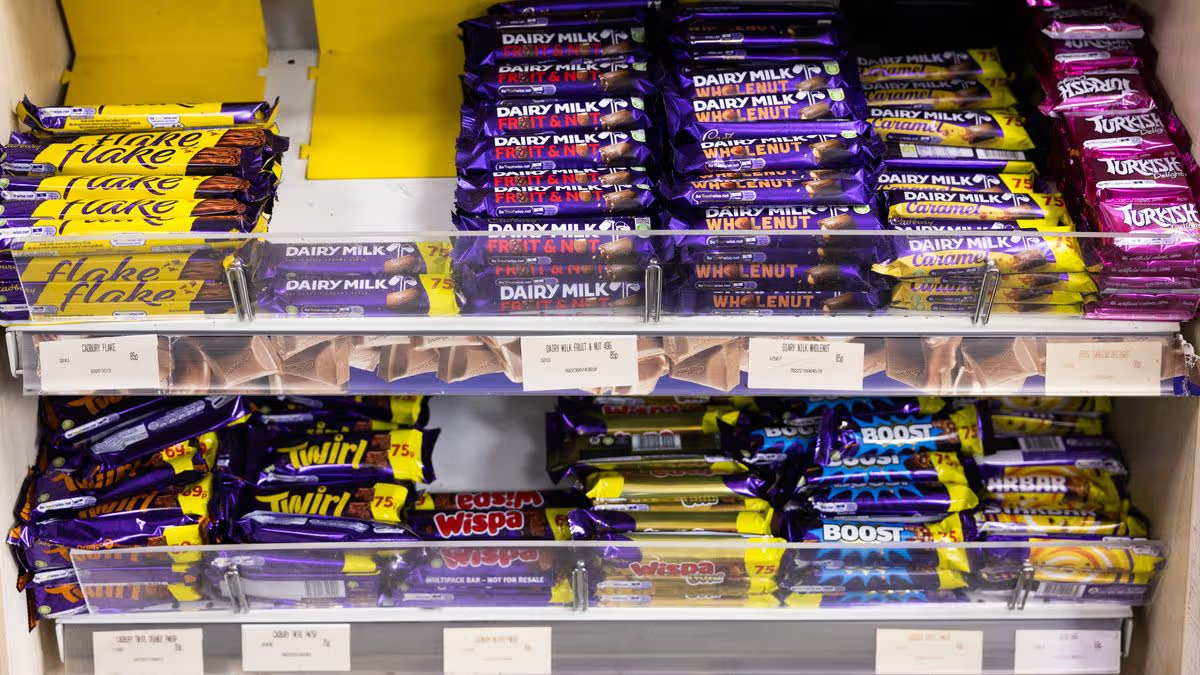
Tesco is selling new Cadbury Dairy Milk bar and people can’t wait to try it
-

 Sports6 days ago
2026 Kentucky Derby horses, odds, futures, preview, date: Expert who hit 12 Derby-Oaks Doubles enters picks
-

 Tech6 days ago
Samsung will soon let you control smart home devices from your car’s dashboard
-
 Entertainment15 hours ago
Lana Del Rey Celebrates Her Husband’s 51st Birthday In New Post
-
 Entertainment6 days ago
Cynthia Bailey Dishes on ‘RHOA’ Season 17, Discusses Kandi
-
 NewsBeat6 days ago
Colombian military plane with 110 soldiers onboard crashes following takeoff
-

 Fashion5 days ago
Does It Matter What You Wear When You’re Laid Off and Looking?
-

 Business5 days ago
More women enter wealth management, but few in advisory roles: study
-

 Sports4 days ago
Fantasy Baseball Week 1 Preview: Top sleeper hitters for both five- and 12-day period led by Munetaka Murakami
-

 Politics6 days ago
How Media Platforms Balance Performance and Accessibility in Image Delivery
You must be logged in to post a comment Login