ABOARD THE CRESCENT (AP) — There’s something melodic about watching the sun rise over a rural stillness broken only by the rhythms of steel wheels on tracks. Or so we tell ourselves.
In this case, being aboard a train at all owed more to politics than poetry.
Advertisement
This image made from an Associated Press video shows the Virginia countryside, as seen from an Amtrak train, Friday, March 27, 2026. (AP Photo/Bill Barrow)
Advertisement
This image made from an Associated Press video shows the Virginia countryside, as seen from an Amtrak train, Friday, March 27, 2026. (AP Photo/Bill Barrow)
Advertisement
Advertisement
Congress and Donald Trump were mired in their latest budget stalemate, one rooted in the Republican president’s immigration crackdown and the tactics of federal forces he has sent to U.S. cities. But this impasse has upended a foundational constant of American life today: easy air travel.
In Atlanta, my hometown airport, cheerfully marketed as the world’s busiest, had descended into organized chaos. Unpaid federal employees called out from work, leaving a diminished security staff to screen travelers frustrated by hourslong waits in line. I wanted to get to Washington for the NCAA basketball tournament. So I eliminated the risk of a missed flight and booked the train overnight and into game day across a 650-mile route.
Advertisement
In this fraught moment in U.S. politics, I slowed down and thought about things we take for granted. Who ever ponders the conveniences of that 20th-century innovation, the airplane, that makes 21st-century hustle possible? We book and board. An unconscious, first-world flex of modernity. It’s even rarer to grapple with the inconvenience.
My decision had taken me further back, to the 19th century and another defining innovation: the long-distance train.
Advertisement
The Amtrak station in Danville, VA, is seen Friday, March 27, 2026. (AP Photo/Bill Barrow)
The Amtrak station in Danville, VA, is seen Friday, March 27, 2026. (AP Photo/Bill Barrow)
Advertisement
Advertisement
Advertisement
A 14½-hour weekend train ride is time aplenty to appreciate how completely politics, economics, social strife and fights over identity and belonging have always affected the order of our lives, including how, when and where we move around in these United States. But Amtrak’s Crescent also allowed me to see the expanse of our collective experience.
I traversed the urban, suburban and rural breadth of East Coast America. I learned how other travelers came aboard. And in that, I found the portrait of people, past and present, who refuse to be as paralyzed as some of their elected leaders.
Convenience on the railways
There is little glamour late night in a crowded Amtrak station. Children are up past bedtime and tended by frazzled parents. Older adults struggle with luggage and stairs.
Advertisement
Airports are not red-carpet affairs either, of course. But there is a certain cache to Delta’s Atlanta-Washington flights. They typically take about two hours gate to gate. They often are slotted at a midpoint gate of the concourse nearest the main terminal. That is almost certainly a nod to members of Congress who use it — but who have lost some airline perks during this extended patrial shutdown.
In normal circumstances I can get from my front porch to Capitol Hill or downtown in as little as 4½ hours. Security lines these days could at least double my overall air travel time.
Advertisement
Union Station is seen Friday, March 27, 2026, in Washington. (AP Photo/Bill Barrow)
Union Station is seen Friday, March 27, 2026, in Washington. (AP Photo/Bill Barrow)
Advertisement
Advertisement
Advertisement
The train is still longer, and time is money, we are taught. But certainty has value, too, even if it means at 11:29 p.m. departure. And at the Amtrak station, there were no standstill lines, no Transportation Security Administration agents, no ICE agents as stand-ins.
Passengers who arrived mere minutes before departure made it on board and found seats quickly — assigned in boarding order, not predetermined zones that yield jammed aisles. There’s no in-seat service or satellite TV. But even coach seats, the lowest Amtrak tier, are as spacious as airline first-class – and there is Wi-Fi, so it’s not the 19th century or even 20th century after all.
On board, I heard one crew member joke, “I’m no TSA agent.”
Advertisement
The pathways of history
As a boy in rural Alabama, I counted train cars and wondered where they were headed. I’ve since read diary entries and letters from my grandmother and her sisters recounting World War II-era weekend trips to Atlanta.
The South’s largest city has a historical hook, too. Originally named “Terminus,” Atlanta developed in the antebellum era as a critical intersection of north-south and east-west rail routes. That is what drew Gen. William Tecumseh Sherman for one of the Civil War’s seminal campaigns that helped defeat the Confederacy.
A century after the Civil War, Delta chose Atlanta for its headquarters rather than Birmingham, Alabama, which was the larger city as of the 1960 census. The company’s decision was tied up in tax breaks for the airline, named for its crop duster origins in the Mississippi Delta region. According to some interpretations, Delta’s decision was made easier because of the more overt racism of Alabama’s and Birmingham’s leaders as they defended Jim Crow — a code that, among other acts, allowed states to segregate the passenger trains that predated Amtrak.
On this night, I heard many languages and accents, notable given the role that immigrant labor played in building the U.S. rail system and especially striking now with immigration — legal and illegal — at the forefront in Washington, my destination. I saw faces that reflected U.S. pluralism, a different mix from what my grandmother and aunts would have seen a lifetime ago.
Advertisement
Union Station is seen Friday, March 27, 2026, in Washington. (AP Photo/Bill Barrow)
Advertisement
Union Station is seen Friday, March 27, 2026, in Washington. (AP Photo/Bill Barrow)
Advertisement
Advertisement
Advertisement
The array of voices celebrated the freedom and ease of rail travel. So did Agatha Grimes and her friends after they boarded in Greensboro, North Carolina, as part of a long weekend trip to celebrate her 62nd birthday.
Advertisement
“I got stuck in the Atlanta airport last week,” Grimes said, as her group laughed together in the dining car. “It’s just nuts.”
Beretta Nunnally, a self-described “train veteran” who organized their trip, said, “There’s no worry about parking. No checking bags. You come to the station, you get where you going, and you come home.”
An era for planes, trains and automobiles
Still, that is not as easy in the United States as it once was.
Just as politics, economics and subsidies helped grow U.S. railroads, those factors diminished the network as auto manufacturers, oil companies, roadbuilders and, finally, airline manufacturers and airlines commanded favor from politicians and attention from consumers.
Advertisement
Riding hours across rural areas, I noticed the junkyards where kudzu and chain-link fencing framed rows of rusted automobiles. I saw the farmland and equipment that helps feed cities and the rest of the nation. I awoke to see the night lights of office towers in Charlotte, North Carolina, and its NFL stadium. I saw vibrant county seats — and I thought of countless other towns like them that are not thriving as they sit disconnected from passenger rail and far from the Eisenhower-era interstate system that we crossed multiple times on our way.
In each setting, voters — conservatives, liberals, the extremes and betweens — have chosen their representatives, senators and a president who now set the nation’s course.
When I arrived in Washington, I paused to enjoy Union Station’s grand hall and its Beaux Arts appeal, and I lamented how much splendor has been lost because so many striking U.S. terminals have been razed. I stepped outside and looked up at the Capitol dome.
While I had slept, the Senate managed a bipartisan deal to fund all of the Department of Homeland Security except immigration enforcement. As I continued northward, House Republican leaders rejected it. The stalemate continued.
Advertisement
I was a weary traveler but renewed citizen. I had a game to get to. And the train rolled on.
Brett Snyder, the president of flying-focused blog Cranky Flier, told Conde Nast Traveller: “You want to avoid anything that requires a specific temperature. The default snack of choice used to be peanuts, but all the concerns about allergy really quashed that one.”
You also need “something that’s either salty or sweet to really get people’s taste buds working — which they do differently at altitude than they do on the ground,” he added.
But what is that distinctive Biscoff flavour to begin with?
Advertisement
At first, I thought it was something like malt; but their ingredients list doesn’t include that.
I found out that spices aside, their real secret is sugar.
But don’t all biscuits have sugar?
You’d be right there ― but it’s about how they cook it.
Advertisement
The company’s own site lists “the distinctive caramelised” profile as a cause of its “unique taste and crunchiness of Biscoff.”
That tracks. Jan Boone Sr., who invented the cookie, was the first to create “a caramelised biscuit with nothing but natural ingredients” in 1932, Lotus says.
The biscuit’s modern-day ingredients are listed as “Wheat flour, Sugar, Vegetable oils (contains one or more of soybean oil, sunflower oil, canola oil, palm oil), Brown sugar syrup, Sodium bicarbonate (leavening), Soy flour, Salt, Cinnamon.”
That “brown sugar syrup” may be doing a lot of heavy lifting when it comes to the distinctive flavour profile of the cookie ― when you mix it with a fat like sunflower oil, it becomes a kind of caramel.
Advertisement
No, really, a LOT of it is the sugar
The more I look into this, the more seriously I realise Belgians (Lotus was invented by a Belgian baker) take sugar.
Speaking to The Guardian about speculaas, or speculoos, an early progenitor of Lotus, Belgian food writer Regula Ysewijn described the complexities of Belgium’s sweet stuff.
She uses a type which is hard to get in the UK called kandij, “white beet sugar slowly and repeatedly heated until it caramelises and crystallises,” in her speculoos recipes.
Advertisement
“In Belgium… sugar cane was historically unavailable, leading sugar beet refiners to develop a different sort of brown sugar, one made with refined sucrose and caramel,” pastry chef Stella Parks told Serious Eats.
“So, instead of the acidic, malty, slightly bitter, and vaguely fruity taste of molasses, Belgian brown sugar gives Biscoff a backbone of caramel flavour.”
She also cites Ceylon cinnamon as a cause of its instantly recognisable taste.
But when Professor Tze Min Wah, research and innovation lead for the interventional oncology programme at Leeds Teaching Hospitals NHS Trust and professor of interventional radiology at the University of Leeds, saw Mrs Iveson’s case, she realised that the pioneering treatment could offer hope to Mrs Iveson and her family.
Linda Emmeline Baggley was a reserve RUC constable who died in 1976, 10 days after being shot while on foot patrol with a colleague in the Waterside area of Derry.
Families of people killed in the Troubles have come together in a service of “remembrance, devotion and love” in Co Derry.
Advertisement
The Baggley family were among those who attended the service at Newbuildings Methodist Church near Lisnakelly.
Linda Emmeline Baggley was a reserve RUC constable who died in 1976, 10 days after being shot while on foot patrol with a colleague in the Waterside area of Derry.
Kenny Donaldson, director of victims’ group Seff (South East Fermanagh Foundation), said the service was “a wonderful representation of remembrance, devotion and love”.
“The Baggley family were foremost in our thoughts with Lorraine sharing a family reflection concerning the upcoming 50th Anniversary since the cruel murder of Linda who passed away on June 2 1976 after having been shot and seriously injured a number of days previously,” he said.
Advertisement
“Linda was aged just 19 years and was a Reserve RUC GC Constable, just two years earlier her daddy, William, who was also a Reservist Constable, was also murdered in Londonderry (just 100 metres separated the brutal crimes).
“Scripture lessons were read by Gillian McElholm, daughter of Michael McGinley who was murdered by the UDA/UFF in the Annie’s Bar attack, 1972, and Jennifer Millar, daughter of Charles McNaul who was murdered by the Provisional IRA, also in the city.
“And prayers were also read by Seff’s north west-based staff; Michael McKeegan, son of Lance Corporal John McKeegan who was murdered by the Provisional IRA; and Lara Burns, daughter of Robert Burns who was murdered by the IPLO.”
Children from the Newbuildings Primary School sang a number of songs and read prayers.
Advertisement
Part of the prayers read by the children included: “We also appreciate the responsibility on our shoulders to both carry forth the torch of remembrance but also to build a new society – a new Northern Ireland and a united community.”
Mr Donaldson, who closed the service, said Seff’s mission is the “recalibration of attitudes concerning how society divides”.
“We are clear that the religious denomination someone happens to be born into (or not) or where someone stands on the constitutional question, is not the fundamental division,” he said.
“Rather the core basis for division is where people stand on the issue of violence, in the context of the Northern Ireland Troubles – those who used, justify or seek to explain away violence are of one tribe, and those who do not are part of the other tribe.”
Advertisement
Seff’s memorial quilt exhibition will be hosted at the Newbuildings Methodist Church until Wednesday.
Breaking the cycle: Why prevention and rehabilitation are critical to safer communities
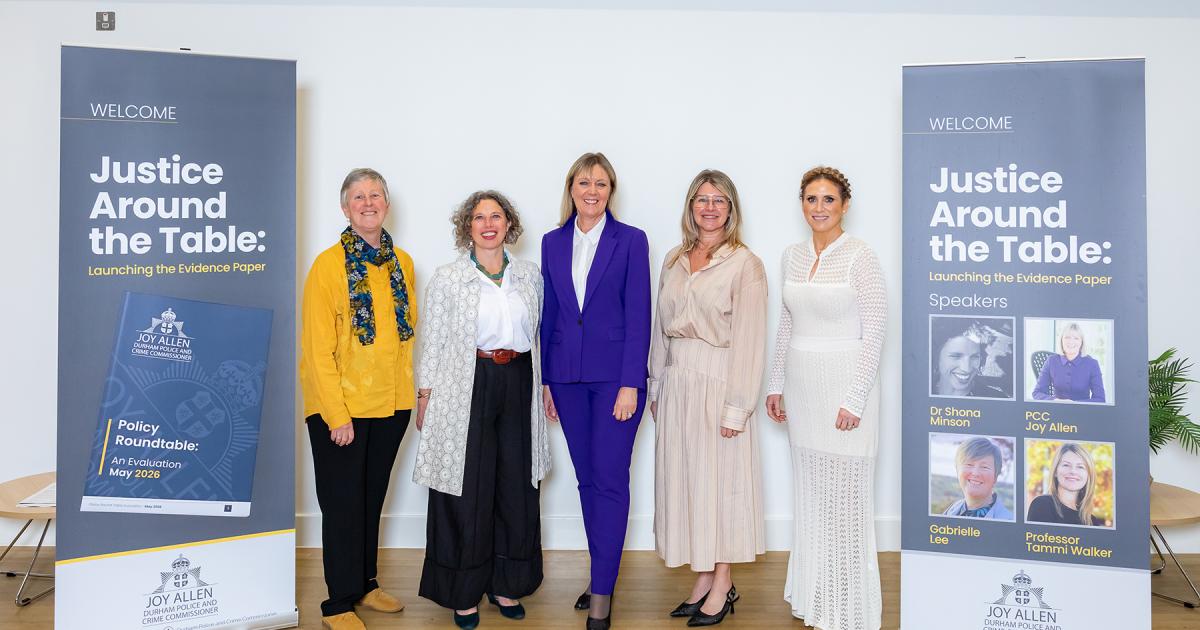
When I became Police and Crime Commissioner, I made a clear commitment to tackle not only crime itself but the root causes driving offending, addiction, anti-social behaviour, and repeat victimisation.
That commitment sits firmly at the heart of my Police, Crime, and Justice Plan 2025-2029 and my ambition to build communities that are safer, stronger, and more resilient to alcohol and drug-related crime and disorder.
Breaking the cycle (Image: Supplied)
It was this determination that led me to establish the Criminal Justice Policy Roundtable, bringing together policing, prisons, probation, health, housing, universities, charities, and people with lived experience to confront some of the biggest failings and pressures within our criminal justice system.
Advertisement
The Roundtable was never designed to be a talking shop.
It was created to challenge outdated thinking, drive practical reform, and identify evidence-led solutions that cut crime, reduce reoffending, and better protect victims and communities.
It was meant to add value to the excellent partnership working that exists around the Local Criminal Justice Board that I chair.
Because the reality is stark: we cannot arrest our way out of addiction.
Advertisement
Across the country, courts are overwhelmed, prisons are overcrowded, and reoffending rates remain far too high.
Meanwhile, communities continue to suffer the consequences of repeat offending, acquisitive crime, anti-social behaviour, violence, and exploitation linked to drugs and alcohol.
Behind many offences lie deeper problems: addiction, trauma, mental ill-health, homelessness, domestic abuse, and social exclusion.
If we fail to address those drivers, we simply trap people in a revolving door of offending, custody, and crisis while communities continue to pay the price.
Advertisement
The Roundtable examined these issues head-on.
One major focus was women in the criminal justice system.
Many women who offend are themselves victims of abuse, exploitation, and trauma.
Short prison sentences often fail to rehabilitate and instead worsen instability, break family ties, and increase the risk of reoffending.
Advertisement
The report calls for stronger trauma-informed support, earlier intervention, improved diversion schemes, and community-based alternatives that tackle the causes of offending while maintaining accountability and protecting the public.
Housing and homelessness were also identified as major drivers of repeat offending.
People leaving prison without stable accommodation are far more likely to relapse into addiction, become involved in crime again, or fall into exploitation and rough sleeping.
That is why the Roundtable recommended stronger “through-the-gate” support and far better coordination between housing, probation, healthcare, and treatment services.
Advertisement
The discussions also highlighted the enormous impact addiction has on crime and anti-social behaviour.
Around half of acquisitive crime is linked to drugs, while addiction continues to fuel violence, disorder, and repeat offending.
The Roundtable explored innovative approaches including Drug Testing on Arrest, recovery-focused treatment pathways, and diversion schemes designed to break the cycle of addiction and crime before more victims are created.
None of this is about being soft on crime.
Advertisement
It is about being smarter, tougher, and more effective in reducing crime long-term.
Every prevented relapse, every avoided reoffence, and every person successfully supported into recovery means fewer victims, fewer crimes, and safer streets.
The Criminal Justice Policy Roundtable was created to drive action, influence national debate, and deliver practical change that improves public safety and strengthens communities.
And this report is only the beginning.
Advertisement
You can read the full Policy Roundtable Evaluation Report and explore the recommendations in more detail by using the following link: https://bit.ly/PolicyRoundtableEvaluation.
Fresh testing has found that the children’s sand kits contain tremolite asbestos, which can cause severe lung diseases if inhaled
Rachel Vickers-Price UK and World News Reporter and Josie Clarke
02:36, 01 Jun 2026
Two further children’s sand kits widely available across the UK have been pulled from shelves after a consumer group discovered they contained asbestos.
One of the two latest recalls was marketed as a Montessori sand art tray, sold via Amazon Marketplace and TikTok Shop. The product is designed as a hands-on learning tool to develop fine motor skills, encouraging youngsters to draw in the sand using pencils supplied in the kit or with their fingers.
Testing by Which? revealed that the sand contained the banned substance tremolite asbestos — a dangerous naturally occurring mineral that can become airborne and trigger severe lung diseases if inhaled, even at minimal levels of exposure.
The International Agency for Research on Cancer has classified all forms of asbestos as carcinogenic to humans. Any products containing asbestos, including trace amounts, are banned from sale in the UK.
Advertisement
A second sand art tray examined by Which? was purchased from TikTok Shop and was also found listed by three separate sellers on Amazon Marketplace, reports the Mirror.
Which? revealed the product remained available on both platforms until May, despite the identical item having been subject to a recall by the Office for Product Safety and Standards (OPSS) in March owing to asbestos contamination.
The OPSS has since updated the original recall notice to incorporate Amazon and TikTok Shop. Which? researchers also discovered tremolite asbestos in the GL Style Sand Bottle Art Heart or Stars set, purchased from Asda and bearing the brand name RMS International Limited. However, the consumer group also identified what seemed to be the identical kit available on eBay from three private sellers.
Advertisement
More than 39 recall notices have been issued by the OPSS since November concerning asbestos-contaminated sand products. The problem has also resulted in the closure of schools and parks, most recently in North East England. It is understood the affected toys contain sand sourced from particular quarries in China, where naturally occurring asbestos is present.
Sue Davies, head of consumer rights policy at Which?, said: “It is outrageous that online marketplaces are selling products which may expose children to asbestos, especially when some of these products had already been recalled by the OPSS. Seemingly innocent items like toys and craft kits can have serious health consequences if there are not proper checks to make sure they comply with safety laws.
“The Government has published proposals that would require online marketplaces to exercise due care in preventing, identifying and removing dangerous products sold through their platforms, an area where regulation is currently far too limited.
Advertisement
“Ministers now urgently need to introduce legislation that makes these duties sufficiently robust and properly enforceable. The longer the Government delays taking action, the greater the risk that more dangerous products will reach consumers.”
A spokesman for Amazon said: “Customer safety is our top priority and we are taking this issue very seriously. We are in the process of removing all products in this category across our store while we investigate further, and as a result the highlighted items have been removed.”
Asda confirmed they initiated a complete product recall immediately upon learning the product had failed testing. They urged customers who had purchased the item to stop using it immediately and return it to their nearest store for a full refund.
A spokeswoman for eBay said: “We swiftly removed the items identified by Which? and are conducting further sweeps to identify similar listings.”
Advertisement
TikTok confirmed the product identified during the investigation had already been removed from TikTok Shop.
ROME (AP) — Danish cyclist Jonas Vingegaard won the Giro d’Italia on Sunday, becoming the eighth male rider to win all three Grand Tours.
Vingegaard, who rides for Team Visma-Lease a Bike, ended the three-week race with an overall advantage of 5 minutes, 22 seconds over second-place Felix Gall. Jai Hindley finished third, 6:25 behind.
“It’s amazing. It’s something I’ve dreamt of my whole life and to now be able to do it, it’s something special,” an emotional Vingegaard said in his first interview as Giro winner. “I’m lost for words.
Advertisement
“It was a really special day, with so many people on the side of the road, so many spectators, it was really incredible. To get the honor to wear the maglia rosa in the streets of Rome is something special. With these last three weeks, it’s just such a nice way to end this race.”
After crossing the line in Rome, the 29-year-old Vingegaard embraced his wife and two children, who were wearing replicas of his maglia rosa — the leader’s pink jersey.
“Yeah, that’s even nicer, it also gives me tears in my eyes, they’re always there for me,” said Vingegaard, who has celebrated his five stage wins at the Giro by kissing the photo of his family that is on the handlebar of his bicycle, before kissing his wedding ring.
Vingegaard also carried his children with him to the podium, where he was presented with the Trofeo Senza Fine (Trophy With No End).
Advertisement
Having dominated his first Giro — living up to his billing as pre-race favorite — Vingegaard will turn his attention to the Tour de France as he attempts to become the ninth man to complete the Giro-Tour double in the same year.
However, there he will face cycling’s top talent Tadej Pogacar. The Slovenian, who skipped the Giro to focus on adding to his four Tour titles, became the first man in 26 years to do the Giro-Tour double when he achieved the feat in 2024.
Sunday’s largely processional final Giro stage, that ended with eight laps through Rome, was won by sprint specialist Jonathan Milan.
The 131-kilometer route started in Rome and then went out the sea before returning to the Italian capital for the finishing circuit.
Advertisement
So relaxed were the riders that they were all seen sharing a box of sweets as they started the stage, before also being given glasses of Prosecco. They also all posed for team photos during the ride out to the sea.
Milan, who had seen other bids for stage wins end in disappointment earlier in the race, finally got his victory. The Italian edged out compatriot Giovanni Lonardi and French cyclist Paul Penhoët in a bunch sprint.
“I’m super happy to end this Giro in this way,” Milan said. “It’s beautiful. After three weeks that we were looking for this, winning the last stage in Rome means that we were keeping the head there, we never give up, we always keep fighting for the victory, we were always believing in it, we always believe in each other.”
The challenge will raise money for research into motor neurone disease (MND).
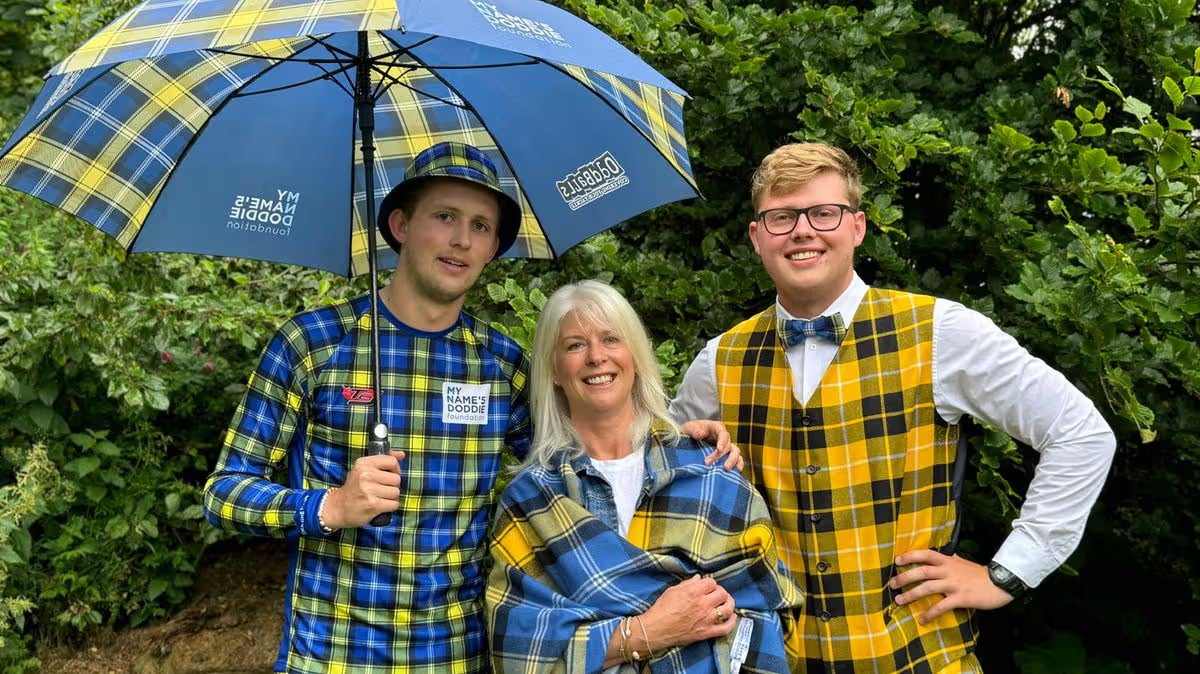
Doddie Weir’s wife and son will join former England rugby captain Lewis Moody on a gruelling 500-mile charity cycling challenge to raise cash for research into motor neurone disease (MND) this month.
Kathy and Hamish Weir will take part in the seven-day charity ride alongside the 2003 World Cup winner, who last autumn revealed he had also been diagnosed with MND.
Moody is raising money for the My Name’5 Doddie Foundation, founded by the Scottish rugby great and MND campaigner who sadly died in November 2022 aged 52 after a six-year battle with the disease.
Advertisement
Moody said having Weir’s family alongside him will be “incredibly poignant and powerful”.
“Doddie did so much to change the conversation around MND, and in many ways this ride feels like continuing something he started,”
Moody added. “There’s a real sense of carrying the baton forward. Doddie inspired people because he faced this disease head on with unbelievable courage, humour and determination, and I think all of us involved in the ride feel a responsibility to keep pushing that fight forward.
Advertisement
“When you see Kathy and Hamish there beside you, it’s impossible not to feel extra motivation.
This ride is about raising money, of course, but it’s also about showing the MND community that we’re still fighting, still driving awareness, and still refusing to accept that this disease cannot be beaten.”
The Lewis XV’s challenge will begin on Sunday June 14 at the northernmost Prem Rugby club, Newcastle Red Bulls, and will end at the Allianz Stadium in Twickenham, south-west London, on Saturday June 20 to deliver the match ball for the Gallagher Prem Rugby Final.
Moody and Kathy and Hamish Weir will be joined by a group of rugby stars during the challenge. “When you get diagnosed with something like MND, you very quickly realise how important people are.”
Advertisement
Moody said. “This ride is about mates coming together, communities coming together, and hopefully showing people living with MND that they are not alone.
“This disease affects families everywhere and we need people to rally behind the MND community in the same way rugby people always rally behind each other.
“If people can donate, come out and support us along the route, or simply help spread the word, it genuinely makes a difference. We want this to feel like something the whole rugby community is part of.”
Advertisement
Paul Thompson, director of fundraising at the My Name’5 Doddie Foundation, said: “Lewis has already inspired so many people through the way he has approached his diagnosis, and this challenge is another example of that courage and leadership.
“This is about much more than rugby. It’s about friendship, family, resilience and communities coming together behind a common cause. Every mile ridden and every pound raised will help us continue accelerating research towards effective treatments and, ultimately, a cure for MND.”
Get more Daily Record exclusives by signing up for free to Google’s preferred sources. Click HERE.
HONOLULU (AP) — Authorities in Hawaii have charged a 36-year-old man with murder in the killings of three people in a remote community known for its eclectic, communal lifestyle.
Jacob Daniel Baker was charged with counts of first- and second-degree murder Saturday, the Hawaii Police Department said in a news release.
Baker remained jailed without bond Sunday and police said his first court appearance was scheduled for Monday. It was not immediately known if Baker had an attorney who could speak for him.
Charges in the killings came two days after police apprehended Baker following a manhunt on Hawaii’s Big Island, where the three victims were found in the rural Puna community known for its tropical landscape and free-spirited residents.
Advertisement
Robert Shine, 69, was found dead Monday partially submerged in a cement pond, according to police. The second victim, a 79-year-old man, was discovered Tuesday a few hundred feet away. Friends identified him as Chitta Morse.
Police found the third victim, 69-year-old John Carse, late Tuesday at a property 19 miles (31 kilometers) from where the other two bodies were located.
Police have not given a suspected motive for the killings. Hawaii Police Chief Reed Mahuna has said investigators found no connections among the victims other than that two of them lived near each other.
In addition to the murder charges, Baker also faces counts of burglary, auto theft and criminal damage to property.
Advertisement
The killings left residents on edge in Puna, a community set amid lush jungle and barren lava fields where people seeking to live off-grid commonly trade work for lodging.
Puna resident Stephen Shaffer said that Baker had worked for his ex-wife, climbing coconut trees on land where she grows fruit, in exchange for a place to live. After several months, Shaffer said, his ex-wife sought a restraining order against Baker, saying she felt threatened by him.
Donald Hyatt, a friend of Shaffer’s ex-wife and of two of the men killed, said Baker left the cabin where he had been living months ago. Hyatt said that Baker recently returned claiming “squatter’s rights” and threatened Shaffer’s ex.
Just days before the killings, two women had requested temporary restraining orders against Baker, saying he had threatened and harassed them, according to court records. A judge denied both applications, saying there was not enough proof of harassment.
Advertisement
Court records showed Baker named in 20 other cases in the past two decades, many of them traffic infractions. In most of those cases, Baker had no attorney and represented himself.
The Scottish estate is said to be a ‘cherished home’ for the Royal Family.
Rosie Shead and Eilidh Farquhar Trainee Trends, Showbiz and Lifestyle Writer
00:01, 01 Jun 2026
King Charles has highlighted the importance of Balmoral to the Royal Family, saying is holds a “uniquely special place” in their hearts. Located in Aberdeenshire, the estate has been in the Royal Family since 1852 when it was purchased by Queen Victoria and her husband Prince Albert.
Writing in foreword in a new 80-page guidebook, the King describes the Scottish estate as a “cherished home” of his family, that boasts a “precious, almost sacred, surrounding landscape” along with “startling individuality”.
Over a century ago, Queen Victoria fell in love with the Highlands of Scotland and decided to build a castle on the land. Over the decades, Balmoral has been used as a summer retreat for the Royal Family, with many kings and queens adding their own stamp to the castle and its grounds.
Advertisement
Balmoral also became the property where the late Queen Elizabeth II spent her final days in 2022. After serving as the sovereign for 70 years, Queen Elizabeth passed away on September 8, aged 96.
Writing in the new paperback guide, Charles wrote: “Balmoral has been the cherished Scottish home of my family since the estate was purchased by Prince Albert, my great-great-great-grandfather, in 1852.
“With its buildings of startling individuality, which never fail to fascinate, and its precious, almost sacred, surrounding landscape, it is a place where there is constant change, yet everything remains unaltered, with a sense of timelessness which refreshes the soul.
“Since my earliest childhood, it has held, and continues to hold, a uniquely special place in the hearts of my family and myself, and my late mother particularly treasured her time at Balmoral. It was here, in these most beloved of surroundings, that she chose to spend her final days.”
Concluding, he added: “Whatever the circumstances in which you are reading this book, I hope that you, too, will be inspired by the rich complexity of the architecture and share in the magic of the surrounding countryside, whose ‘wild and majestic’ landscape has been the source of inspiration and enjoyment for so many.”
Alongside the foreword, the guidebook opens with an image of a watercolour of the Scottish castle, which was painted by Charles in 1989.
In the past, the only part of the Balmoral that was open to the public to visit was the ballroom, which is home to a different exhibition every year.
It is not only the Royal Family who have taken up residence in the castle as prime ministers are traditionally invited to stay with the Firm at Balmoral during the summer. It is said that Harold Wilson even joined members of the family for riverside picnics on the estate as he “got on like a house on fire” with Queen Elizabeth II.
The new guidebook, written by journalist and historian Mary Miers and titled Balmoral, shares some insights into the recent changes that have been made to the property. For instance, the King has introduced more furniture, carpets, paintings and objects, many from the Royal Collection, into the castle.
Meanwhile, outside the wrought-iron gates in the Queen Mary’s garden were remodelled in 2023 to celebrate the centenary of its creation, with Charles and Camilla cyphers included to mark their coronation. It is also noted that the King decided to replace the ballroom lawn with an intricate maze to reflect his interest in geometric patterns.
Advertisement
Ms Miers said: “Balmoral will forever be associated with Victoria and Albert’s love affair with the Highlands, but there’s so much more to the story, which I hope this guidebook reveals.
“Now that Balmoral is more publicly accessible, it’s possible to appreciate how central the Prince Consort’s interests in architecture, design, landscaping and estate management were to its creation, and how effectively the King, who shares these passions, has added a new layer of interest and style, while preserving and enhancing the original.”
Graham Platner’s wife called the media reports that her husband had previously exchanged sexually explicit text messages with several women “shameful” over the weekend, the latest controversy to hit the Maine Democrat’s whirlwind Senate campaign.
Platner, an oyster farmer and combat veteran, posted a video taken by his wife, Amy Gertner, who reportedly told his campaign of the text messages last year. In the five-minute video, Gertner avoided speaking directly about her husband’s reported texts, dubbing the broader coverage as “gossip” and saying that “being married is hard.”
“I find it really shameful that there’s a group of media outlets and people who are willing to spread gossip,” she said in the informal, selfie-style video where she walked along a road. “No marriage is perfect, and I don’t want a perfect marriage. I want my marriage.”
Platner is seeking the Democratic nomination for one of the most closely watched Senate races as Democrats hope to defeat longtime Republican Sen. Susan Collins in the party’s efforts to win control of the narrowly divided Senate. The Maine primary is June 9.
Advertisement
Genevieve McDonald, a then-campaign staffer for Platner, told the The Associated Press that the candidate was “sexting multiple women while married” and that “the campaign tried to assess that as an election vulnerability.”
Platner told reporters Sunday that what McDonald had said wasn’t true. Asked if he was confirming that the text messages didn’t exist, Platner replied, “I’m confirming that what Genevieve McDonald said in The New York Times is not true.” Platner didn’t provide any specifics. He was referring to a Times story that names McDonald Saturday, after The Wall Street Journal first reported the story.
Gertner had told the campaign in August about the messages, which she had discovered on his phone last year, to make sure they weren’t a liability to the campaign, according to the Wall Street Journal. Platner’s campaign team reportedly decided that the texts were private and being handled by the couple, who were married in 2023. The two are in counseling, Gertner has said.
Platner told reporters that he and Gertner spoke with the campaign about their marriage, but reiterated that McDonald’s claims were false.
Advertisement
Platner’s campaign on Sunday did not specifically confirm the text messages to the AP, but issued a statement from Gertner saying the disclosure of the conversations she had with a campaign aide was a betrayal that “deeply hurt.”
“I trusted this person with the most private chapter of our lives — the early days of our marriage before any campaign was on our mind,” she wrote.
It’s not Platner’s first controversy
Platner, who has never held public office, has a gruff, less buttoned-up approach on the campaign trail, fashioned a platform around economic equality and has already had to navigate statements that surfaced from his past.
The candidate had a tattoo recognized as a Nazi symbol, which he said he didn’t realize until he was several weeks into the campaign. There’s also been much attention on his former Reddit posts, which were dismissive of military sexual assaults and used homophobic slurs, for which he has apologized.
Advertisement
Platner’s campaign weathered those earlier revelations in what had been considered one of the most competitive Democratic primaries before Gov. Janet Mills dropped out of the race in late April due to a lack of campaign funds. Mills, a two-term governor, had been seen as one of the Democrats’ top 2026 recruits when she entered the Senate race before her campaign fizzled out.
Platner has still pulled support from big-name Democrats, including Sens. Bernie Sanders, Elizabeth Warren and Ruben Gallego as well as U.S. House Rep. Ro Khanna. The latter is scheduled to rally with Platner on Friday, and so far, it appears he hasn’t lost any endorsements with this latest texting revelation.
Two Democratic senators on Sunday declined to directly address the topic when pressed by reporters. Connecticut Sen. Chris Murphy told CBS’ “Face the Nation” that Platner had served his country and community, but “also made mistakes and he has admitted that.”
On CNN’s “State of the Union,” New Jersey Sen. Andy Kim sidestepped, too. “With any campaign in the country, the character and the transparency about the different candidates is going to come out,” said Kim, “and the voters are going to decide what they ultimately think.”
Advertisement
Barreling forward Sunday, Platner posted a video on X from an event “happening now” where he entered a room to a standing ovation from ecstatic supporters.
Questions over whether additional controversial information about Platner could still surface have added to some Democrats’ anxiety over his chances in a general election against Collins, who has represented Maine in the Senate since 1997.
In October, after the revelation that he once had a Totenkopf tattoo on his chest and promptly had it covered, the AP asked him if other scandals were on the horizon.
Platner said he was expecting his opponents were “going to keep dragging things up.”
Advertisement
“They’re going to keep making things up,” he said. “I fully expect people to just lie about me at this point.”
Voters are familiar with the couple’s struggles, including with infertility and traveling out of the country to afford IVF treatment, which they’ve discussed on the campaign trail.
In late April, Platner shared that Gertner had suffered a miscarriage, and he’s discussed his own mental health struggles and the role of his family and therapist in helping.
Former aide explains why she went public
McDonald initially worked on Platner’s campaign as his political director and resigned a few months later when his now-deleted Reddit posts began surfacing, saying she couldn’t stand behind him as a candidate. She later declined a severance offer from the campaign in exchange for signing a non-disclosure agreement.
Advertisement
On Saturday, McDonald wrote on Facebook that Platner’s campaign had “demanded” she retract her statements she had made to The Wall Street Journal or his team would accuse her of violating the couple’s trust. McDonald wasn’t named in the newspaper’s article, but after that exchange, she said she made the choice to be publicly named in a New York Times story.
“His consultants greatly overestimate how much I do not aspire to be them,” she wrote on Facebook.
After resigning from Platner’s campaign, McDonald moved to help Democrat Jordan Wood’s congressional campaign in Maine’s second district. McDonald submitted her resignation from Wood’s campaign Saturday morning, according to Wood’s campaign.
Wood endorsed Platner after Mills dropped out.
Advertisement
___
Bedayn reported from Austin, Texas and Kruesi reported from Providence, Rhode Island.















































You must be logged in to post a comment Login