

Crypto World
How ImpactFi Is Reshaping Decentralized Finance


The decentralized finance (DeFi) revolution promised a financial system without banks, borders, or gatekeepers. And to be fair, it delivered. Today, anyone with an internet connection can lend, borrow, trade, and earn yield through blockchain-based protocols.
But here’s the uncomfortable truth: most of DeFi ended up optimizing for profit… not purpose.
Enter ImpactFi—the evolution of DeFi that merges financial returns with real-world social and environmental impact. It’s not just about making money anymore; it’s about making money matter.
What Is ImpactFi?
ImpactFi sits at the intersection of DeFi and impact investing.
Impact investing itself focuses on generating measurable social or environmental benefits alongside financial returns.
Now combine that with blockchain—and you get a transparent, programmable, and decentralized system that aligns capital with global impact.
In simple terms:
ImpactFi = DeFi + Purpose
Instead of yield farming for pure profit, users can now earn while funding renewable energy, education, healthcare, or climate initiatives.
Why Traditional Finance Fell Short
Before ImpactFi, impact investing faced several bottlenecks:
- High entry barriers (big money only)
- Slow decision-making
- Lack of transparency
- Limited community involvement
Even with trillions flowing into the sector, capital distribution remained inefficient and often disconnected from the communities it aimed to serve.
ImpactFi fixes this—with code.
The Core Pillars of ImpactFi
1. Transparency Through Blockchain
Every transaction, allocation, and outcome is recorded on-chain.
No more vague “impact reports.”
No more “trust us” fund managers.
With blockchain:
- You can verify where funds go
- Track outcomes in real time
- Audit impact metrics transparently
This solves one of the biggest issues in traditional impact investing—accountability.
2. Smart Contracts = Automated Impact
Smart contracts power DeFi by executing agreements without intermediaries. ImpactFi takes this further.
For example:
- A portion of the yield is automatically redirected to climate projects
- Donations are triggered by on-chain events
- Funds are released only when impact milestones are met
This creates programmable philanthropy—no human bias, no delays.
3. Community Governance via DAOs
ImpactFi platforms often use DAOs (Decentralized Autonomous Organizations).
Instead of a centralized fund manager:
- Investors, communities, and stakeholders vote on decisions
- Governance tokens give real influence
- Funding decisions are democratized
This flips the script:
The people affected by investments finally have a say in them.
4. Impact Yield Farming
A standout innovation is impact yield farming.
Traditionally:
- You stake → you earn rewards
In ImpactFi:
- You stake → you earn and fund real-world impact
Some protocols even split yields:
- Part goes to the user
- Part goes to social/environmental causes via smart contracts
It’s like earning passive income… with a conscience.
5. Financial Inclusion at Scale
DeFi already removes intermediaries, making finance accessible globally.
ImpactFi extends this by:
- Funding underserved communities
- Supporting microfinance through decentralized systems
- Enabling grassroots participation in investment decisions
This is where things get powerful:
ImpactFi doesn’t just redistribute wealth—it redistributes opportunity.
How ImpactFi Is Changing DeFi Itself
ImpactFi isn’t just a niche—it’s reshaping the entire DeFi narrative.
From Speculation → Sustainability
DeFi has often been criticized for being overly speculative. ImpactFi introduces long-term, mission-driven capital allocation.
From Whales → Communities
Governance is shifting from large token holders to broader stakeholder groups via DAO models.
From Yield → Purpose
Yield is no longer the only KPI. Now we measure:
- Carbon offset
- Social impact
- Community development
Real-World Use Cases
ImpactFi is already being applied in:
- 🌱 Climate finance (carbon credits, reforestation)
- 🏥 Healthcare funding in underserved regions
- 📚 Education access through decentralized grants
- 🌍 Local economic development via community DAOs
Blockchain even enables faster capital flow by simplifying the verification and tracking of outcomes.
Challenges (Because Nothing Is Perfect)
Let’s not pretend this is all sunshine and green candles:
- Impact measurement is still evolving
- Regulatory uncertainty remains
- Greenwashing risk exists (yes, even on-chain)
- User experience is still… very crypto
But compared to traditional systems?
ImpactFi is already leagues ahead in transparency and efficiency.
The Future of ImpactFi
The impact investing market is projected to grow massively in the coming years, and decentralized models are accelerating that shift.
We’re heading toward a world where:
- Every transaction has a traceable impact
- Capital allocation is community-driven
- Financial systems are aligned with global sustainability goals
In other words:
Finance stops being neutral—and starts being intentional.
Conclusive
ImpactFi is what happens when DeFi grows up.
It keeps the best parts—permissionless access, transparency, automation—and adds something DeFi desperately needed:
a reason beyond profit.
And if DeFi was about removing middlemen…
ImpactFi is about removing meaninglessness.
REQUEST AN ARTICLE

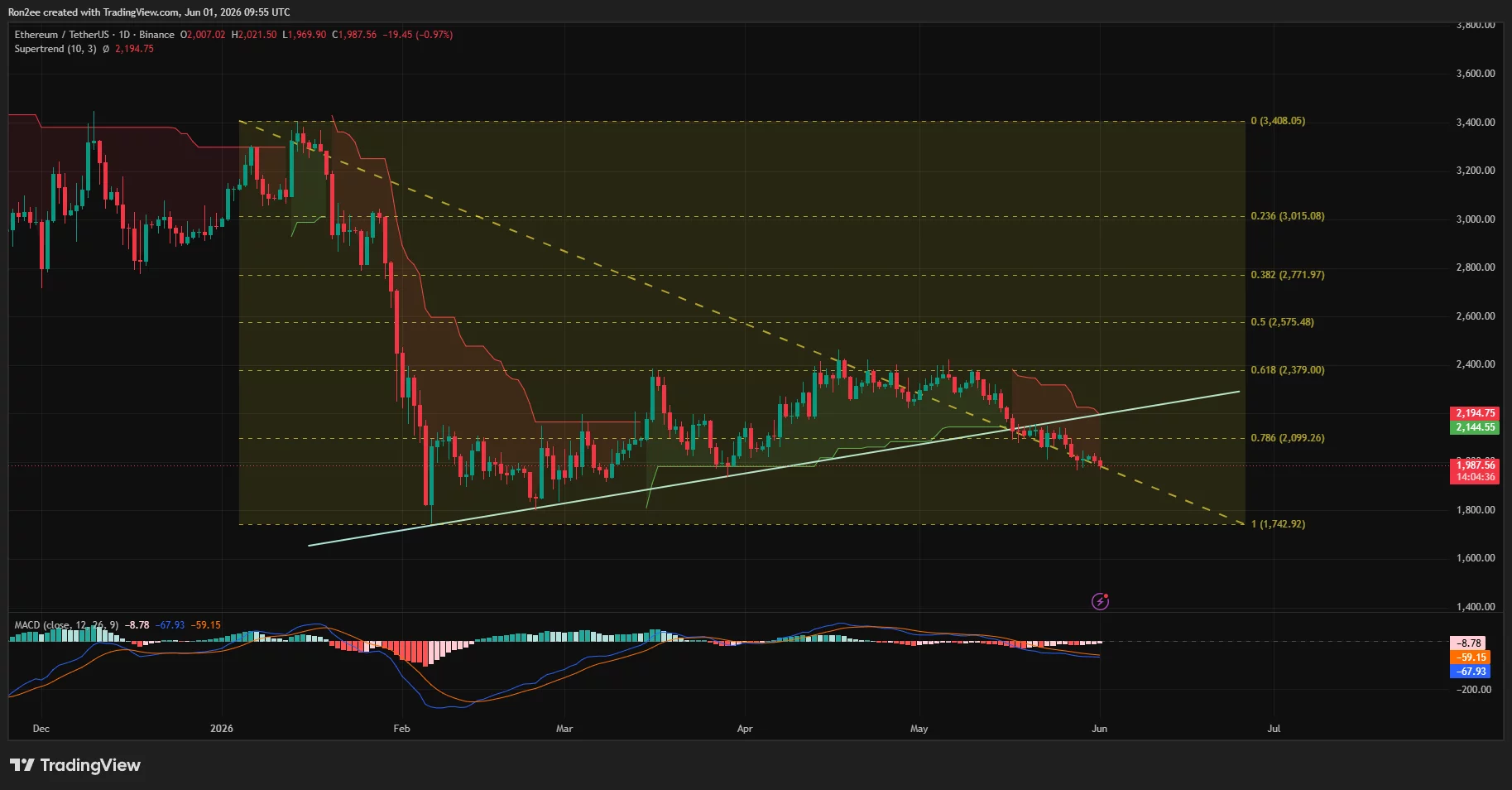
Ethereum price has fallen below the key $2,000 support level as institutional outflows, geopolitical tensions, and a bearish technical breakdown weigh on market sentiment.
Summary
- Ethereum price has fallen below the key $2,000 support level as spot ETF outflows, weak U.S. demand, and risk-off sentiment weigh on the market.
- A breakdown below a descending parallel channel has exposed downside targets near $1,900 and $1,825, with major support clustered around February lows.
- CoinGlass data shows large liquidation clusters between $2,100 and $2,150, while analysts warn a loss of the $1,900-$1,950 zone could trigger a deeper decline.
According to data from crypto.news, Ethereum (ETH) price traded near $1,990 at press time after slipping under the psychological $2,000 threshold for the first time in months. The move came amid persistent selling pressure across U.S. markets, with traders growing increasingly defensive as risk appetite deteriorated across both crypto and traditional assets.
A sharp decline in American spot demand appears to be one of the immediate drivers behind the breakdown. Market participants have pointed to a deeply negative Coinbase premium, a metric that compares ETH prices on Coinbase with offshore exchanges.
The premium’s move into negative territory suggests U.S.-based selling has outpaced global buying interest, removing an important source of support around the $2,000 area.
At the same time, capital continues to flow out of Ethereum investment products. SoSoValue data shows spot Ethereum exchange-traded funds recorded $241 million in net outflows over the past week, extending monthly withdrawals to roughly $540 million.
Outside crypto markets, rising geopolitical uncertainty has added another layer of pressure. Traders have remained focused on developments surrounding the United States and Iran, while elevated crude oil prices have renewed concerns about inflation.
Higher energy costs threaten to complicate the Federal Reserve’s policy outlook and reduce expectations for near-term interest rate cuts, a backdrop that has historically weighed on risk assets.
Digital asset funds have already begun feeling the effects. Recent industry data showed roughly $2.8 billion leaving crypto investment products over the past week, underscoring the cautious stance many investors have adopted amid macroeconomic uncertainty.
Ethereum confirms major technical breakdown below multi-month support
Ethereum’s latest decline has also completed a significant technical breakdown on higher timeframes.
The daily chart shows Ethereum breaking below the lower boundary of a descending parallel channel that has contained price action since January. Sellers forced ETH beneath both the channel support and the 0.786 Fibonacci retracement level near $2,100 before pushing the token below the psychological $2,000 mark.
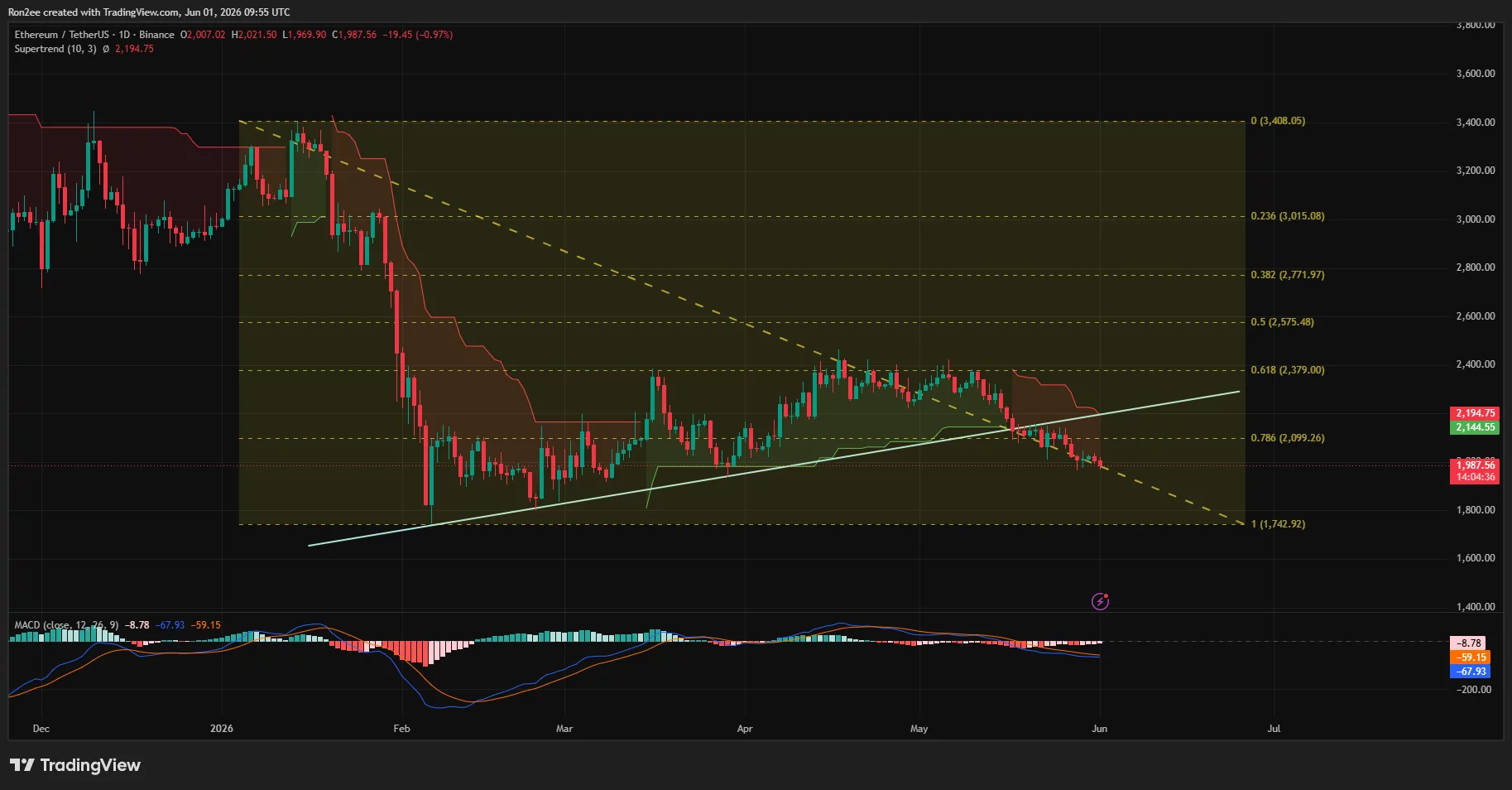
The breakdown leaves the February low near $1,825 as the next major downside target, while former channel support around $2,100 now acts as immediate resistance.
Several trend indicators continue favoring sellers. Ethereum trades below its Supertrend resistance near $2,195 and remains under the 20-day, 50-day, and 200-day moving averages. Those levels now form successive layers of overhead resistance between roughly $2,100 and $2,400.
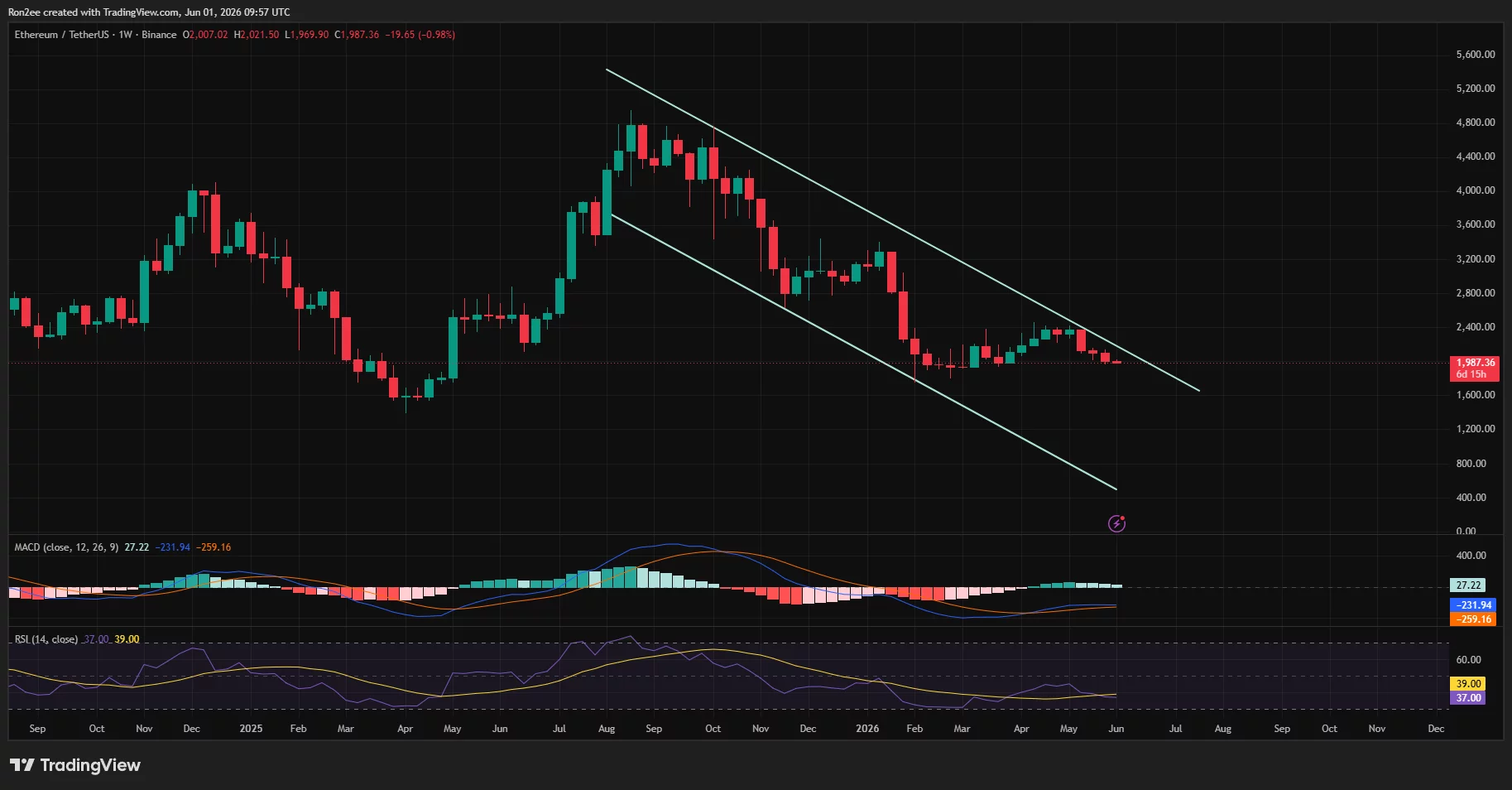
Momentum indicators have yet to show signs of a meaningful reversal. The weekly Relative Strength Index sits near 37, keeping ETH in weak territory despite avoiding oversold conditions. Meanwhile, the weekly MACD remains below its signal line after failing to produce a bullish crossover during May’s recovery attempt.
A longer-term chart structure also presents a bearish picture. Ethereum continues trading inside a descending channel that has contained price action since the second half of 2025. The upper boundary of that channel currently sits near $2,300, while the lower boundary intersects near the $1,750-$1,800 region.
Commenting on the setup, crypto analyst Ali Martinez argued that Ethereum is approaching an important support zone.
“Ethereum is approaching the bottom of its channel near $1,825. That area could offer a favorable risk-reward entry targeting $2,073 and $2,360, as long as price remains above $1,750 on a daily closing basis.”
Fellow analyst Ted Pillows identified $1,900-$1,950 as the next major support region following the loss of $2,000. According to Pillows, a failure to hold that zone could open the door to fresh cycle lows.
Derivatives positioning suggests traders are preparing for heightened volatility around those levels.
CoinGlass liquidation heatmaps show one of the largest nearby liquidity clusters concentrated between $2,100 and $2,150. A large amount of leveraged short positions appears stacked in that range, creating a potential magnet if Ethereum manages to reclaim lost support. Below current prices, notable liquidation pockets sit around $1,950 and extend toward the $1,900 area.
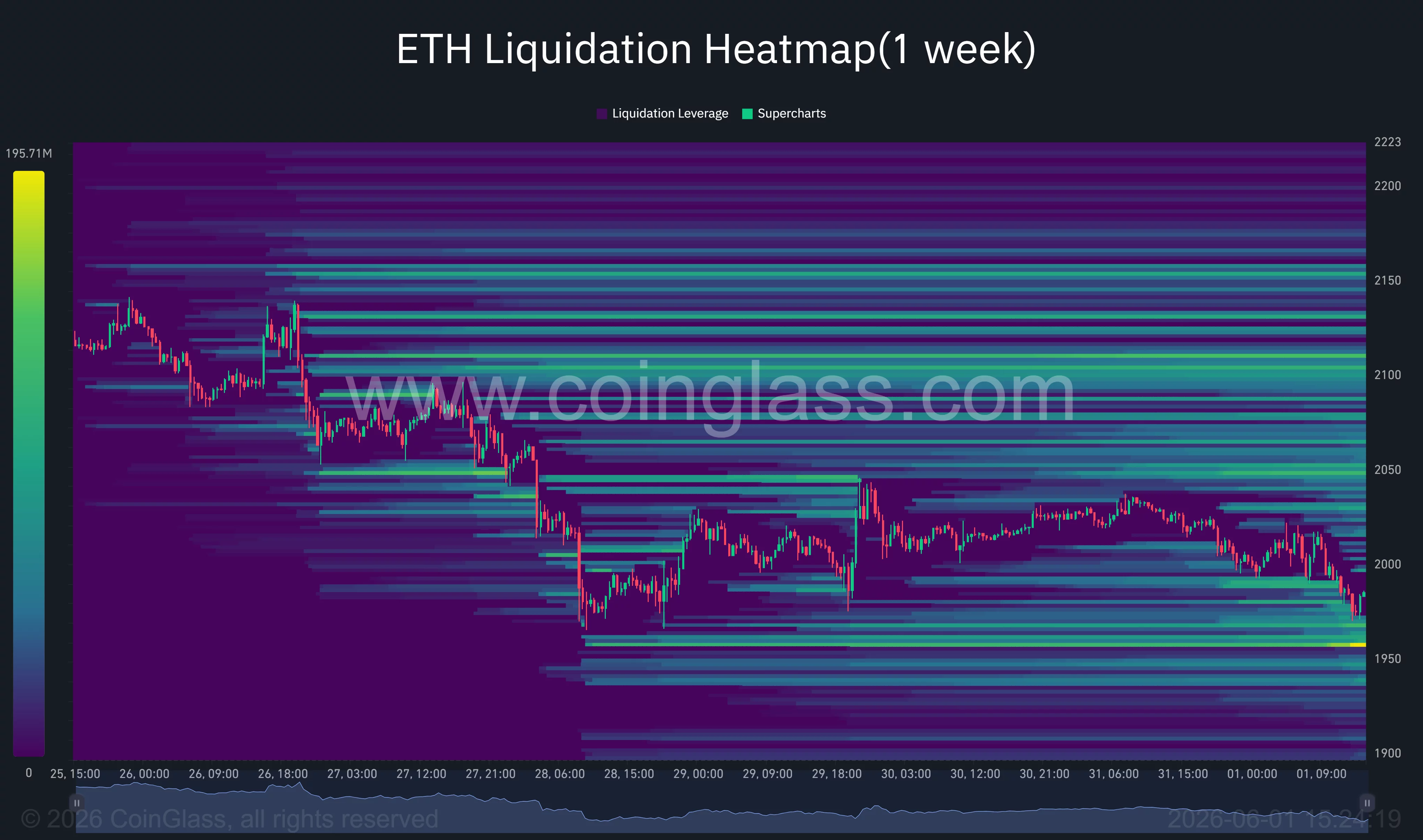
The concentration of leverage beneath spot price raises the risk of another liquidation cascade if support levels fail. Such events often accelerate downward moves as forced long liquidations add additional market sell orders.
ETF outflows and macro risks keep pressure on Ethereum
Institutional participation has weakened noticeably during the latest correction.
Spot Ethereum ETFs have now lost more than half a billion dollars over the past month, a stark contrast to the strong inflows seen earlier this year. Persistent redemptions have coincided with declining relative performance against Bitcoin, as investors continue to favor the largest cryptocurrency during periods of market uncertainty.
Capital rotation toward artificial intelligence-linked technology stocks has also attracted attention among market participants. Several analysts have noted that investors seeking growth exposure have increasingly shifted toward mega-cap technology companies rather than digital assets, reducing speculative demand across crypto markets.
Meanwhile, stronger-than-expected inflation readings driven by higher energy costs could force policymakers to maintain restrictive monetary conditions for longer. Such an outcome would likely keep pressure on liquidity-sensitive assets, including Ethereum.
A sustained recovery above $2,100 would weaken the immediate bearish case and place the $2,150 liquidation cluster back into focus. Breaking through that region could trigger short covering and expose resistance levels near $2,360 and $2,400.
For now, however, sellers retain control of the trend. Unless buyers quickly reclaim the $2,000-$2,100 region, technical targets around $1,900, $1,825, and potentially the lower channel boundary near $1,800 are likely to remain in focus.
Disclosure: This article does not represent investment advice. The content and materials featured on this page are for educational purposes only.
Disclosure: The author of this story owns shares in Strategy (MSTR).
Strategy, the world’s largest publicly traded corporate holder of bitcoin , has maintained the 11.5% dividend rate on its perpetual preferred stock, Stretch (STRC), marking the fourth consecutive month without an increase.
STRC has undergone seven dividend increases since its introduction in July 2025 with a 9% dividend rate. Strategy was able to hold the current rate this month after the stock’s volume-weighted average price (VWAP) reached $99.62, keeping shares close enough to their $100 par value, a key objective of the product’s design.
Strategy markets STRC as a short-duration, high-yield savings alternative. The perpetual preferred stock pays monthly cash distributions, with the dividend rate reset each month to encourage trading near par value and minimize price volatility.
Although STRC has not traded at its $100 par value since May 14, STRC recently rebounded after falling as low as $97.11 on Thursday, recovering to around $99.10. The next ex-dividend date, the cutoff at which investors must own shares to receive the upcoming dividend payment, is June 15. Similar to trading patterns observed in May, STRC could briefly return to par in the days leading up to the ex-dividend date.
Maintaining a stable price near $100 is important for Strategy because it allows the company to efficiently issue additional shares through its at-the-market (ATM) program. Proceeds can be used to purchase more bitcoin or address corporate liabilities, including debt obligations such as its recently paid down some of its 2029 convertible notes.
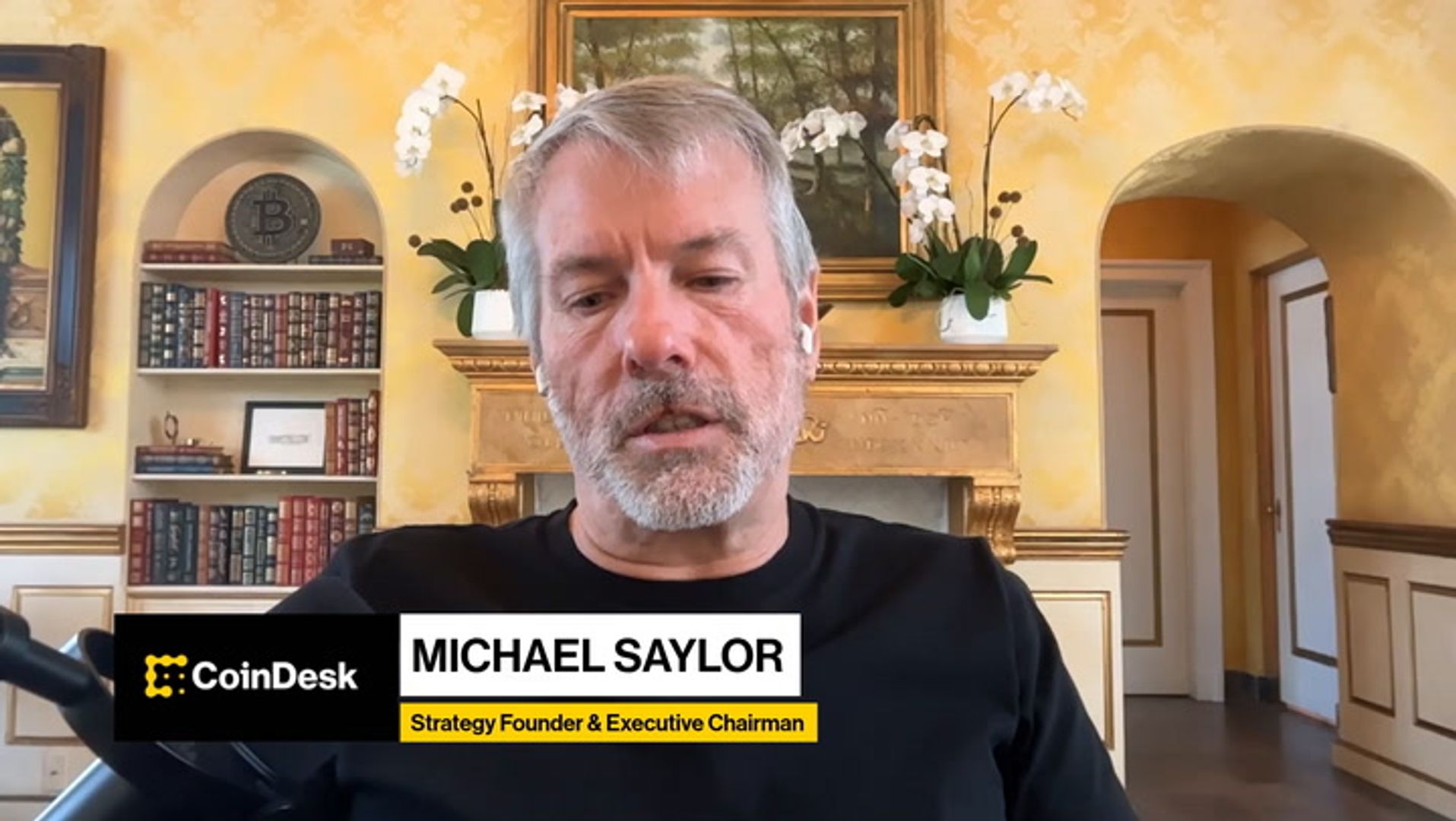
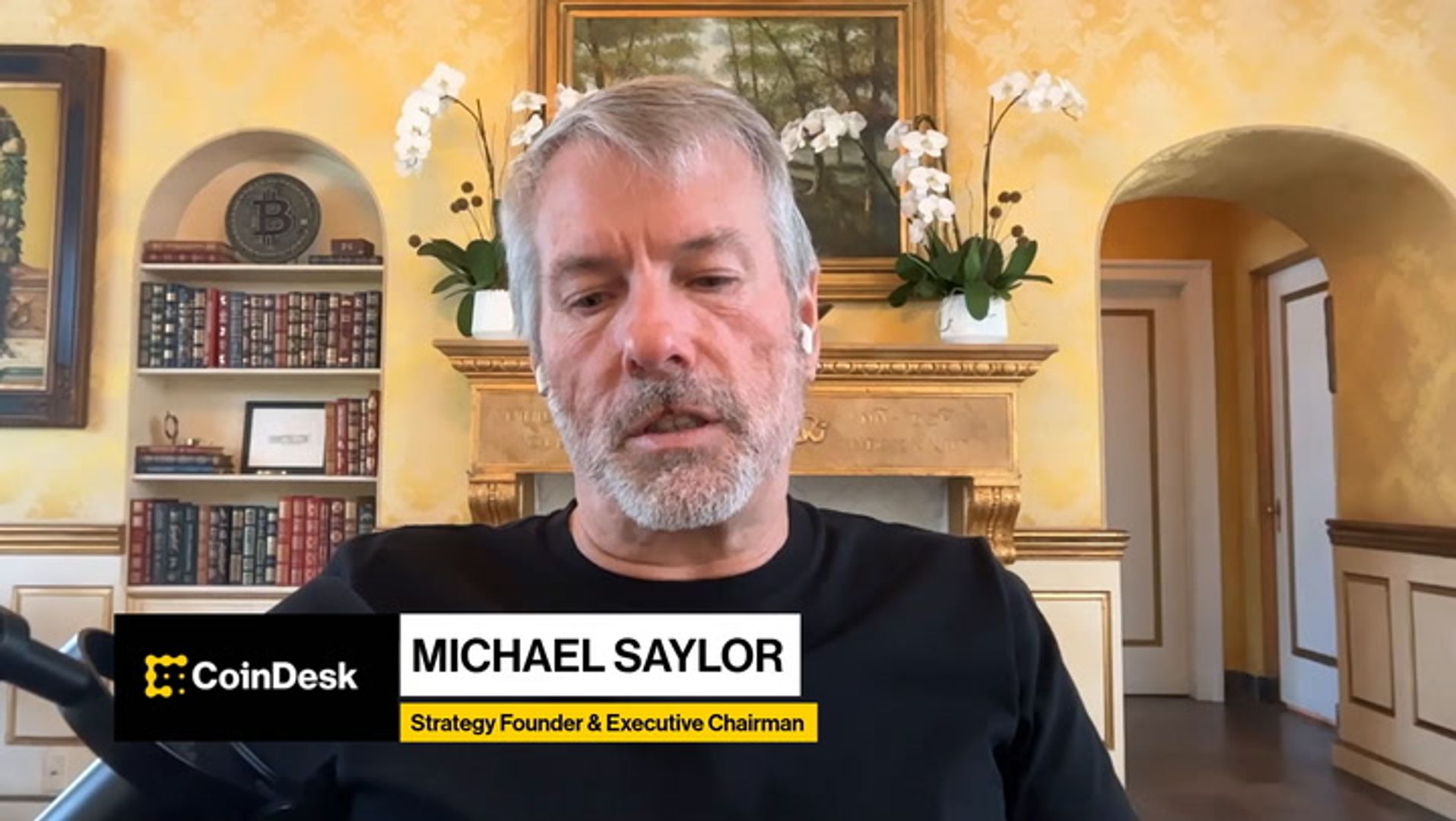
Meanwhile, Executive Chairman Michael Saylor continued his customary Sunday social media posts, writing “Working Better.” The message comes amid growing investor focus on whether Strategy may eventually sell bitcoin to meet debt or dividend obligations, or whether it will continue using capital raised through its securities offerings to expand its bitcoin holdings.


Binance opened access to more than 8,000 US stocks and exchange-traded funds for its non-US customers on Monday. The world’s largest crypto exchange framed the launch as a step toward becoming a multi-asset financial super app.
The move places Binance alongside rivals racing to merge crypto rails with traditional equity markets. Customers can buy fractional shares starting at $5, with zero commission, using stablecoins or the exchange’s own token.
Crypto Exchanges Chase Wall Street
The launch reflects a wider convergence between crypto platforms and traditional finance. Exchanges that once focused on tokens now want a slice of the equities business.
Co-CEO Richard Teng told Fortune that US stocks make up well over half of global equities. Yet many overseas buyers face high costs and friction when they try to access them.
Binance is not alone in this shift. Earlier, OKX moved to enter traditional finance through tokenized stocks, while Coinbase added stock trading in its everything exchange bid.
Wall Street is meeting crypto halfway. Asset manager BlackRock has issued Treasury bills as blockchain wrappers, blurring the line between the two markets.
How Binance’s Stock Trading Works
Share purchases on Binance will be arranged by a broker-dealer called Nest Trading. A New York firm, Alpaca, will handle custody, dividend payments, and corporate actions.
Customers can pay using the stablecoins USDC or USDT. They can also use a handful of other tokens, including Binance’s own BNB.
The push is not the exchange’s first step beyond crypto. Binance already offers derivatives tied to gold, petrochemicals, and pre-IPO share trading.
However, its record here is mixed. Binance halted stock tokens in 2021 after regulators questioned whether the products were unregistered securities.
Binance also outlined a plan for bStocks, which will let users tokenize the equities they buy. Customers can convert shares into digital tokens on BNB Chain in the coming weeks.
The design stands out because users can start the tokenization themselves. Rivals such as Kraken and Robinhood have launched similar products, with Kraken tokenizing US tech stocks for overseas markets.
Supporters point to speed. Blockchain-based trades can settle almost instantly, against the days or more that Wall Street intermediaries need.
In a statement, Binance described the aim of the new product.
“bStocks offering will provide a native bridge from traditional stock ownership to programmable, always-on tokenized assets at a global scale … This unlocks mobility and utility for real-world equities within and beyond the Binance ecosystem, enabling continuous on-chain access and potential DeFi applications, from lending to liquidity provision,” Binance stated.
Not everyone is sold. Some critics warn that tokenized stocks could add risk to the US equity market, even as the New York Stock Exchange and Nasdaq have announced tokenization plans.
Whether self-service tokenization draws real equity volume on-chain may become clearer in the weeks ahead as bStocks goes live.
The post You Can Now Trade 8,000 US Stocks on Binance Using Your Stablecoins appeared first on BeInCrypto.


Binance will allow non-U.S. users to trade more than 7,000 U.S. stocks and ETFs as the exchange pushes deeper into traditional markets.
Summary
- Binance will let non-U.S. users trade over 7,000 U.S. stocks and ETFs commission-free.
- Users can buy fractional shares from $5 using USDT, USDC, BNB and selected cryptocurrencies.
- Binance plans bStocks on BNB Chain as tokenized equities race gains more exchange backing.
Binance opens U.S. stock access
The new service will offer zero-commission trading and fractional share purchases starting at $5, according to Fortune. The feature will target users outside the United States.
Customers will be able to buy equities using USDT, USDC, BNB and selected cryptocurrencies. Nest Trading will provide brokerage services, while Alpaca will handle custody, dividends and corporate actions.
The rollout gives Binance users access to major U.S. equities without leaving the exchange’s platform. It also adds another asset class to a business that already offers spot crypto, derivatives and other market products.
Binance co-CEO Richard Teng told Fortune that U.S. stocks represent well over half of the global equities market. He said many overseas users still face high costs and friction when trying to buy them.
bStocks tokenized equities are planned
Binance also plans to launch tokenized stocks called bStocks in the coming weeks. The product will allow eligible users to convert supported equities into on-chain assets on BNB Chain.
The planned service would create synthetic versions of selected stocks in token form. Binance says this could allow continuous on-chain access and possible use in decentralized finance applications.
“Native bridge from traditional stock ownership to programmable, always-on tokenized assets at a global scale,” Binance said in a statement to Fortune.
The company said bStocks may support use cases such as lending and liquidity provision. The product has not launched yet, and Binance has not listed all supported equities.
Tokenized stock race widens
The move comes as more exchanges test tokenized exposure to public markets. As previously reported by crypto.news, Bitget launched Reality with more than 100 tokenized assets, including U.S. stocks and ETFs backed 1:1 through regulated brokers.
That report said Reality supports stablecoin dividend payouts, DeFi-compatible tokenized assets, and 24/5 minting and redemption. The platform also includes selected private-market and pre-IPO-linked products.
Coinbase has been building toward an “everything exchange” model, as previously reported. That strategy includes crypto, derivatives, options, tokenized stocks, equities, token sales and prediction markets.
These moves show that crypto exchanges are no longer limiting growth to digital assets. They are adding traditional market products while keeping stablecoins and blockchain settlement at the center.
Wall Street also moves on-chain
Traditional exchanges are also testing tokenized securities. Recent reporting showed that NYSE filed a rule change to allow eligible tokenized securities to trade beside regular shares on the same order book.
Under that proposal, tokenized assets would keep the same ticker, CUSIP, rights and privileges as the original securities. Clearing and settlement would remain within existing market rails during the pilot.
Binance’s plan is different because it targets non-U.S. users through a crypto exchange interface. It also links stock access with future on-chain conversion through bStocks.
The launch places Binance more directly in the race between crypto exchanges, brokers and Wall Street firms. The main test will be whether users adopt stocks and tokenized equities inside a platform best known for crypto trading.
Crypto World
Berkshire Hathaway (BRK.B) Strikes $6.8B Deal for Taylor Morrison in Abel’s First Mega-Acquisition

Key Highlights
- Berkshire Hathaway has finalized a $6.8 billion all-cash acquisition of homebuilder Taylor Morrison Home Corp.
- The $72.50 per share purchase price represents a 24% premium over Taylor Morrison’s $58.50 Friday close
- This marks Greg Abel’s inaugural major transaction as CEO following his January succession from Warren Buffett
- Taylor Morrison shares surged up to 23% in premarket activity; Berkshire Class B stock remained relatively flat
- Transaction completion is anticipated in the latter half of 2026
Berkshire Hathaway has finalized an agreement to purchase homebuilder Taylor Morrison Home Corp. through an all-cash transaction totaling $6.8 billion. The acquisition price stands at $72.50 per share, delivering a substantial 24% premium above Taylor Morrison’s $58.50 closing price from Friday’s session.
Berkshire Hathaway Inc., BRK-B
Taylor Morrison shares (TMHC) rocketed up to 23%, reaching $71.75 during Monday’s premarket session. Meanwhile, Berkshire’s Class B stock (BRK.B) showed minimal movement.
The transaction represents CEO Greg Abel’s inaugural significant acquisition since assuming leadership from Warren Buffett this past January. In a statement, Abel emphasized that the deal “reinforces our long-standing commitment to U.S. housing.”
This marks Berkshire’s most substantial transaction since acquiring Occidental Petroleum’s petrochemical division for $9.7 billion in January.
As of the conclusion of Q1 2026, Berkshire maintained an unprecedented $381.1 billion cash position in cash and Treasury securities. Market observers had been eagerly anticipating Abel’s capital allocation strategy.
Berkshire’s Class B stock has declined 5.6% year-to-date, contrasting with the S&P 500’s 10.7% advance during the identical timeframe. Some shareholders had anticipated that a major acquisition could provide momentum for the stock.
Abel’s remarks regarding the potential consolidation of Berkshire’s homebuilding divisions generated considerable interest. This approach would represent a departure from Berkshire’s historical philosophy of maintaining operational independence for acquired companies.
Christopher Davis from Hudson Value Partners characterized it as “a notable departure” from Berkshire’s established methodology, while noting that “investors will welcome that evolution.”
The Taylor Morrison Portfolio
Taylor Morrison ranks among America’s premier homebuilders. Operating from its Scottsdale, Arizona headquarters, the company maintains over 350 residential communities spanning 12 states throughout the nation.
Beyond construction, the company provides comprehensive financial services encompassing mortgage lending, title services, escrow management, and insurance products — creating an integrated service platform complementing its primary construction operations.
Current leadership, including CEO Sheryl Palmer, will remain at the helm. Palmer noted that Berkshire’s “long-term orientation is uniquely well-suited to the multi-year investment cycle of homebuilding.”
Berkshire maintains existing housing market exposure through Clayton Homes and an equity position in Lennar Corp. (LEN). The Taylor Morrison acquisition significantly amplifies that presence.
Transaction Context
The purchase arrives during challenging conditions for homebuilding companies. April witnessed a 2.8% decline in new residential construction activity. Single-family housing starts plummeted 9%, marking the sharpest contraction since August.
Mortgage interest rates have simultaneously risen to levels not observed since August, intensifying pressure on both prospective homebuyers and construction companies.
During Berkshire’s annual shareholder meeting held earlier this month, Abel revealed the company maintained a curated list of potential acquisition candidates. “There will be dislocations in markets that will allow us to act,” he stated during the proceedings.
The transaction is projected to reach completion during the second half of 2026. Goldman Sachs and Moelis & Co. are serving as financial advisors to Taylor Morrison throughout the transaction.
Separately, Berkshire revealed a fresh $2.6 billion investment position in Delta Air Lines during the first quarter of 2026.

Crypto World
BTC, ETH prices drop even as futures show growing taste for risk. XLM, HYPE gain: Crypto Markets Today


June kicked off in the red for crypto markets as the U.S. and Iran exchanged fire and peace talks failed to translate into reduced tensions in the region. The CoinDesk 20 Index (CD20) fell 2% since midnight UTC, with bitcoin and ether (ETH) both losing about 1%.
At $72,700, bitcoin is currently negative for a sixth time in seven days, following a 3.5% slide last month, usually a period with positive returns. It averages a 7.4% rise in May, according to Coinglass data. A record 10 days of net withdrawals from spot bitcoin exchange-traded funds (ETFs) saw $2.97 billion leave the investment vehicles.
The CoinDesk DeFi Select Index led the day’s decliners, dropping 2.6% since midnight, with all six members lower. Ondo Finance’s ONDO token fell 2.8%, and has now lost 17% since founder Nathan Allman died unexpectedly last week.
Hyperliquid’s HYPE stood out, adding 1.26% since midnight. A five-day streak of gains took it to a record high $73.94, its fourth in four days, as capital enters newly introduced ETFs based on the token, which started trading only last month.
U.S. stock indexes replayed Friday’s divergence, with S&P 500 and Nasdaq 100 micro-futures both adding about 0.2%.
Derivatives positioning
- BTC open interest sits at $19.5 billion, essentially level from a week ago, with speculative positioning also broadly unchanged.
- Funding rates are positive across multiple venues at 0%–10% annualized, with the prior Deribit spike now back to normal. The three-month annualized basis is 2.8%, up from 2.2% last week, pointing to a mild improvement in institutional risk appetite.
- Options positioning leans modestly bullish. Put/call volume over the past 24 hours splits 61/39 in favor of calls, while one-week 25-delta skew sits at 12.3% compared with 12.4% last week. Front-end implied volatility (DVOL) has ticked up to 37 from multi-month lows, suggesting the recent compression may be easing. The 1 month–6 month term structure remains in contango, with markets continuing to price near-term calm alongside longer-dated uncertainty.
- Coinglass data shows $282 million in 24 hour liquidations, with a 60-40 split between longs and shorts. ETH (59 million) and BTC ($48 million) were the leaders in terms of notional liquidations.
- The Binance liquidation heatmap indicates $72,280 as a core liquidation level to monitor in case of a price drop.
Token talk
- Stellar’s XLM jumped 40.4% in 24 hours to $0.2862, lifting market cap above $9.6 billion, on the back of a May 27 announcement that DTCC, Wall Street’s central clearinghouse, will connect its tokenized securities platform to the Stellar network in the first half of 2027.
- The deal makes Stellar the first public blockchain in DTCC’s multichain tokenization strategy.
- Open interest (OI) in XLM perps rose 10.9% to about $361 million as the rally unfolded, CoinGlass data show, with roughly $12 million in derivatives liquidations across the move. The combination of expanding OI alongside rising spot volume points to fresh long positioning rather than short covering doing the heavy lifting, even with the short squeeze underneath.
- Spot turnover hit about $2.3 billion on the day, up about 34%, showing the move was backed by real demand rather than a thin-liquidity spike. XLM outperformed every other top-20 token over the period.
- The breakout cleared a monthslong descending channel that had constrained the token since late last year, with the rally running from long-term support near $0.14 through prior resistance at $0.20 and $0.26.
- DTCC oversees more than $114 trillion in assets and processes about $2.5 quadrillion in securities transactions annually, putting Stellar’s selection at the center of how Wall Street brings tokenized stocks, ETFs and U.S. Treasuries onto a public blockchain.
- The partnership sits on the SEC’s December 2025 No-Action Letter authorizing the firm to tokenize real-world assets it custodies, with production testing targeted for July, wider rollout in October, and broader availability in the first half of next year.
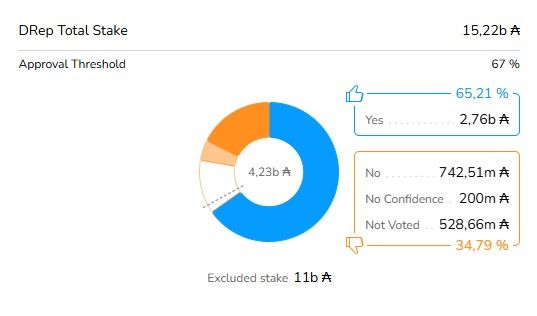
The Cardano Foundation has cancelled its annual Summit, which it had scheduled for Oct. 5–6 in Singapore. The Cardano (ADA) community stakeholders voted against funding the event from the network’s treasury.
The rejected proposal had requested 7.8 million ADA to cover the cost of the two-day event. This amount equals roughly $1.83 million. The vote outcome reflects Cardano’s on-chain governance model, under which treasury expenditures require community approval before funds are released.
Community Skepticism Sinks the Budget
Even a revised version of the proposal, which had already reduced the original ask by 22%, failed to win over enough delegates. Critics pointed to a significant gap between projected revenues and costs.
The event’s gross budget stood at $2.26 million against a revenue target of just $450,000, leaving the treasury to cover the bulk of expenses. Critics also raised additional concerns centered on the front-loading of funds. The network had slated 6.24 million ADA for release before delivering the event.

Some delegates who abstained acknowledged the revisions but said they did not believe the Summit format was the most cost-effective path to institutional adoption. Alternatives cited included smaller invite-only meetings, side events, and private roundtables.
The result adds to a pattern of contested Cardano treasury governance votes in recent months. Earlier this year, the community rejected a 32.9 million ADA research funding proposal.
EMURGO Steps In via TOKEN2049
Despite the cancellation, Cardano will maintain a presence in Singapore during the same week. A separate proposal by EMURGO to sponsor TOKEN2049, held Oct. 7–8, passed the governance vote. The Cardano Foundation said it is currently assessing next steps and evaluating future community engagement opportunities.
ADA is currently trading at $0.2327, down 1.8% over the past 24 hours, with a market cap of approximately $8.7 billion. The Hoskinson governance overhaul announced earlier this year may shape how similar proposals are structured and evaluated going forward.
The post Cardano Summit 2026 Cancelled After Community Vote Rejects Treasury Proposal appeared first on BeInCrypto.
Crypto World
These Altcoins Explode by Double Digits as Bitcoin Price Dips Below $72,000: Market Watch
The cryptocurrency market remained shaky over the past 24 hours. Bitcoin failed to build on its weekend recovery attempt and remained under pressure.
Several altcoins, however, delivered explosive double-digit gains, which creates a rather mixed picture across the broader market.
Bitcoin Price Struggles Near $72K
Bitcoin’s price action has worsened since yesterday’s market update, when it was trying to stabilize close to $74,000. Instead of reclaiming that level, BTC reversed lower and is currently found at slightly below $73,000 after dipping to an intraday low near $72,500.
The move shows that buyers continue struggling to regain control following last week’s volatility. Bitcoin remains very close to a key short-term support zone (around $72,000).
A decisive break lower could invite more selling pressure, considering that traders are already closely watching macro headlines, overall risk sentiment, and ETF flows.
It’s worth noting that the broader crypto market remains softened, with the total market capitalization hovering around $2.55 trillion. Bitcoin’s dominance remains above 57%, suggesting that traders are still cautious toward altcoins, despite isolated rallies.

These Altcoins Lead Gainers
The altcoin market was more divided. Several tokens posted very strong gains. Humanity (H) was the standout performer, surging by roughly 81% throughout the past 24 hours. LAB also jumped by more than 52%.
Worldcoin (WLD), which led yesterday’s altcoin rally, remained among the stronger performers, increasing by another 13% to around $0.38. This move extends its recent momentum and keeps the Sam Altman-linked token in focus.
On the downside, the biggest losers from the Top 100 include Morph, Algorand, and Bitcoin Cash, all of which lost between 6% and 8%.

The post These Altcoins Explode by Double Digits as Bitcoin Price Dips Below $72,000: Market Watch appeared first on CryptoPotato.
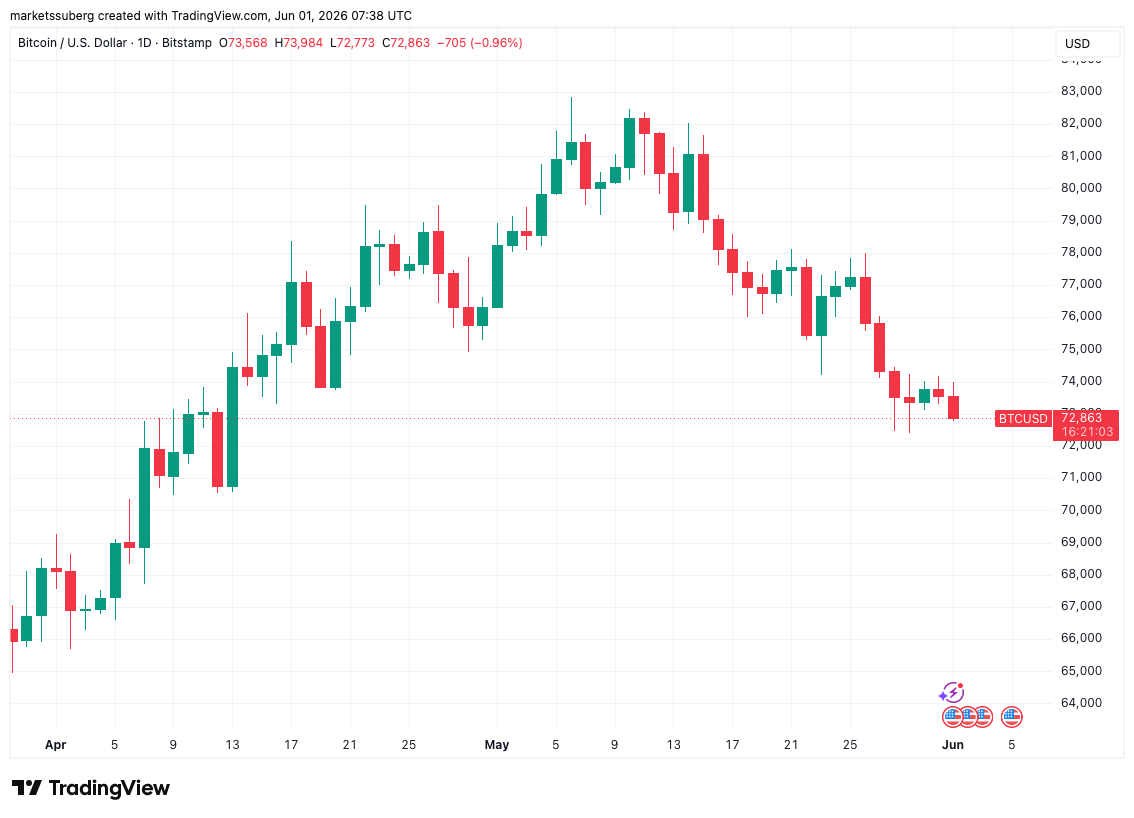
Bitcoin (BTC) heads into June with new local lows as the US-Iran war drives crypto market nerves.
- Iran ceasefire hopes hang in the balance as military strikes return, but US President Donald Trump appears confident that “it will all work out well in the end.”
- BTC price weakness quickly returns after the May close, with $72,000 liquidity on the radar.
- US employment data could still deliver a classic BTC price tailwind.
- Bitcoin long-term holders are putting February’s $60,000 lows in doubt as a reliable floor.
- Sentiment research calls for a flush of overly optimistic traders’ positions next.
Trump on Iran: “Just sit back and relax”
News of strikes on Iranian targets keep the Middle East conflict firmly on the radar as a source of crypto market volatility this week.
Exchanges of fire meant that BTC price action quickly came under pressure following the monthly close, dropping below $73,000.
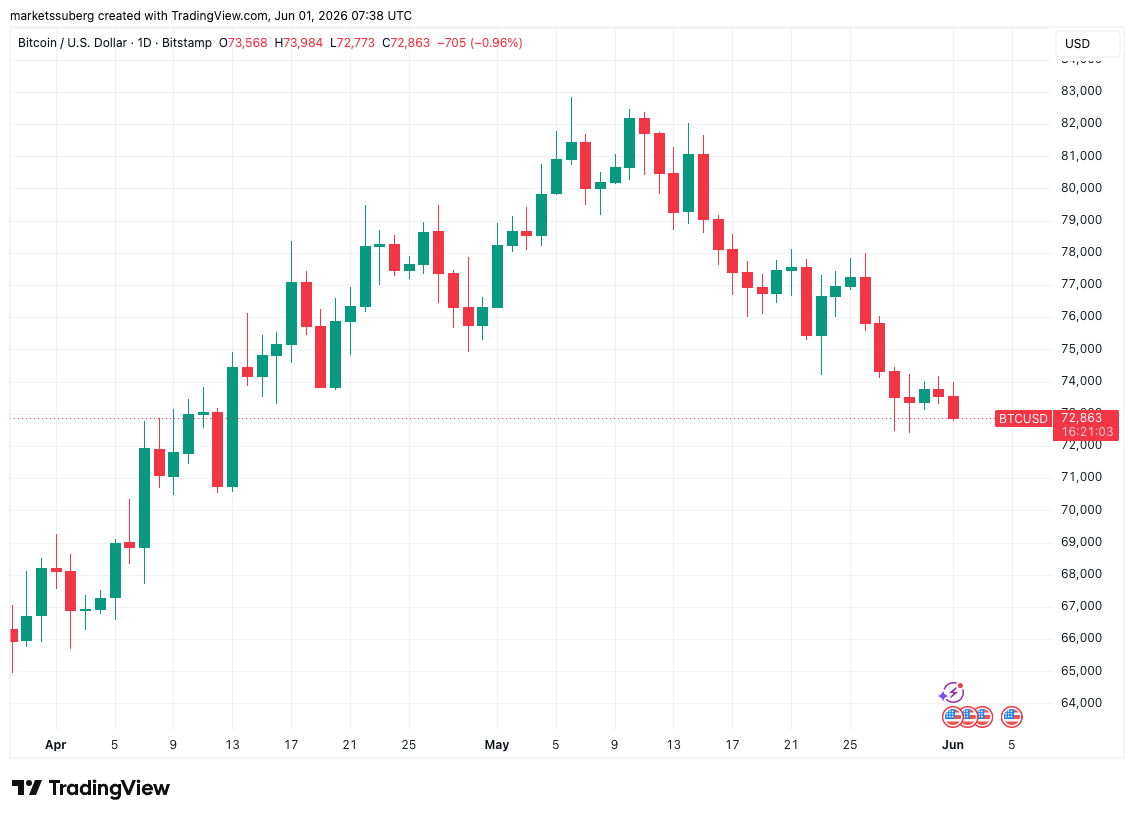
BTC/USD one-day chart. Source: Cointelegraph/TradingView
The latest events further brought into question the odds of a ceasefire being signed, with this notionally meant to last at least 60 days.
“Iran really wants to make a deal, and it will be a good one for the U.S.A. and those that are with us,” US president Donald Trump wrote in a post on Truth Social on Monday.
Trump referenced hurdles in the form of political dissent at home — rather than specific problems involving Iran itself — as the reason for the lack of progress.
He concluded:
“Just sit back and relax, it will all work out well in the end – It always does!”
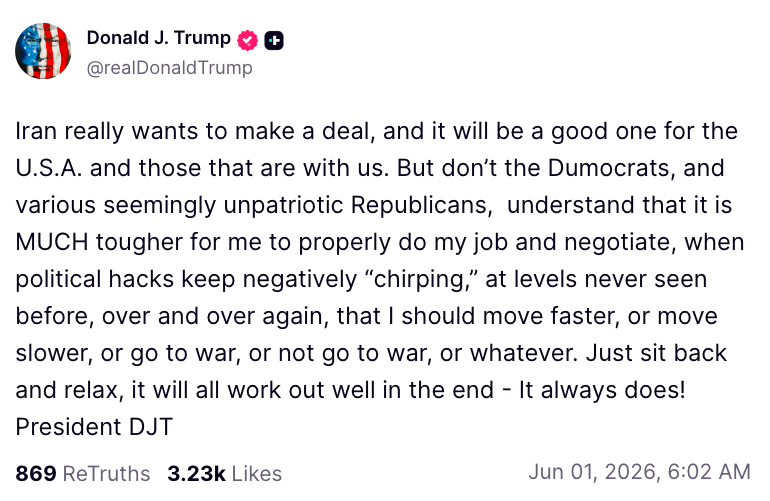
Source: Truth Social
Despite Bitcoin feeling the heat, US stocks looked set to continue a trend of divergence with crypto as the new week began. S&P 500 futures opened the week up by around 0.25%.
Commenting on the factors driving the equities rally, which last week saw repeat new all-time highs, trading resource Mosaic Asset Company put AI firmly in focus.
“The narrative driving the stock market has hardly changed in recent weeks,” it wrote in the latest edition of its regular analysis series, Mosaic Chart Alerts.
“Optimism around a potential peace deal between the U.S. and Iran helps to spark a rally in the major indexes. For the most part, there has been very little substance behind the headlines, but that hasn’t stopped the rally in stocks linked to the AI infrastructure buildout.”
Bitcoin price caught between liquidity and CME gap
Bitcoin started the first week of June with a bump as US-Iran war tensions quickly spilled over into BTC price action.
Data from TradingView shows a trip below $73,000 just hours after the weekly and monthly candle close.
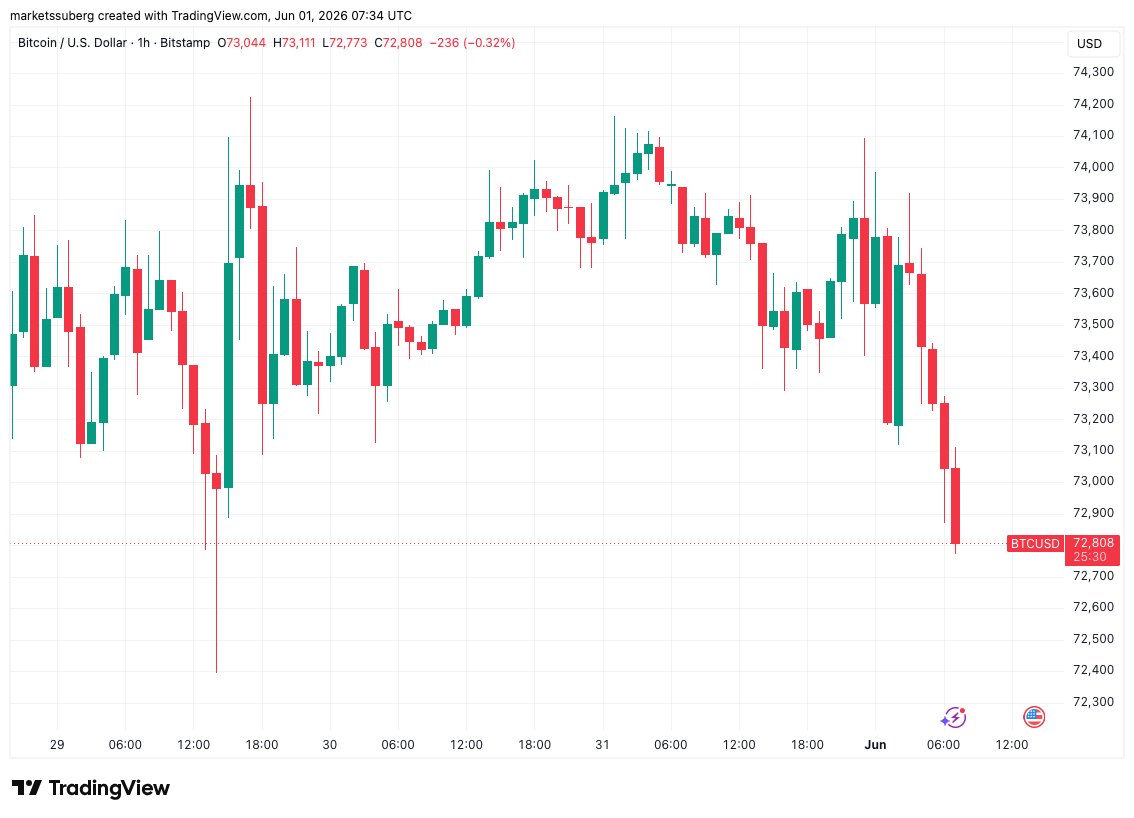
BTC/USD one-hour chart. Source: Cointelegraph/TradingView
“For now price is stuck within this mini-range since last week,” trader Daan Crypto Trades summarized in his latest analysis on X.
“~$74.2K keeps rejecting price as resistance while ~$72.7K is held as support. Those are the levels to watch in the short term.”
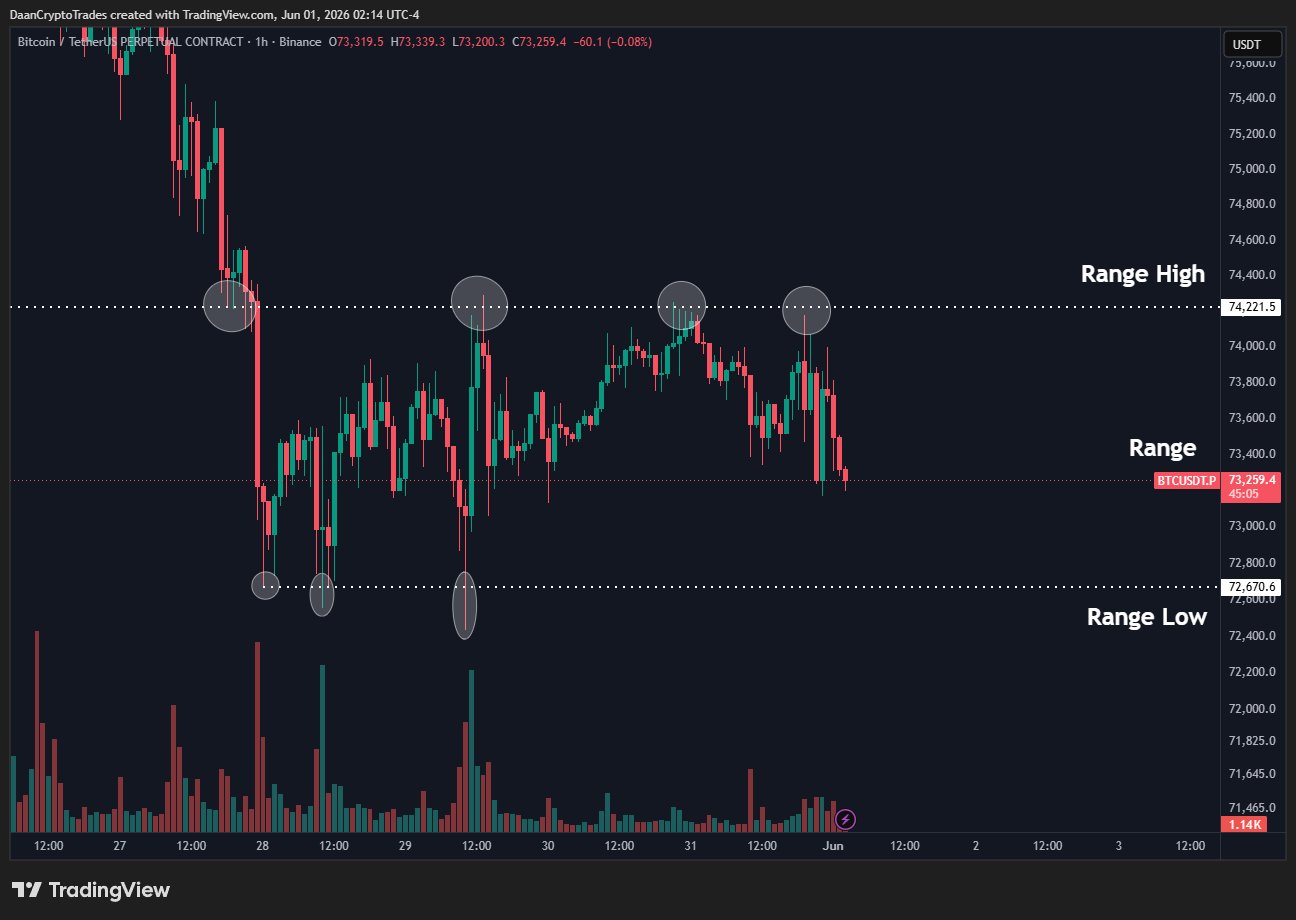
BTC/USDT perpetual contract one-hour chart. Source: Daan Crypto Trades/X
Trader CW suggested that the price was targeting nearby high-liquidity levels on exchange order books, notably a position closer to $72,000.
“The buy wall for $BTC whales is at 72k and the sell wall is at 80k,” they added.
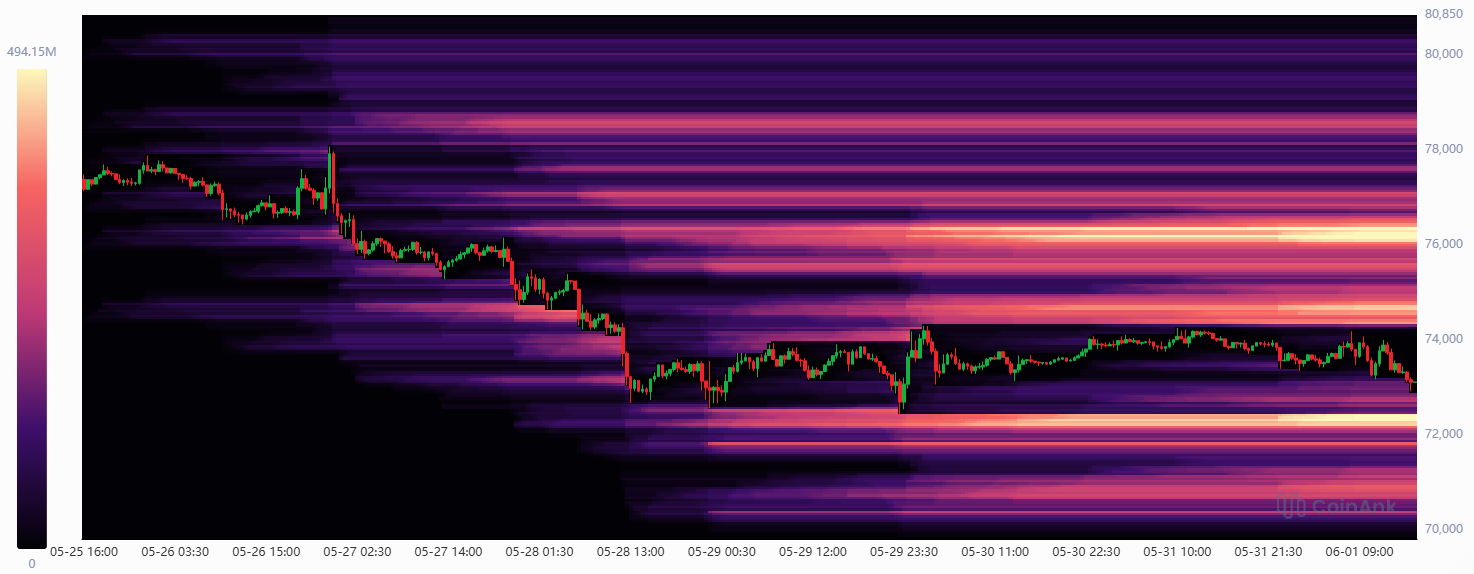
BTC order-book liquidation heatmap. Source: CW/X
A silver lining came from the weekly close itself, which preserved what trader and analyst Rekt Capital said would be a key level for bulls — $73,000.
“If Bitcoin manages to Weekly Close above $73k then price will be one step closer to confirming the Double Bottom breakout & be positioned to try to trend continue,” he told X followers at the weekend.
To the upside, trader CrypNuevo flagged a lone CME Group’s Bitcoin futures near $75,000 as a potential short-term BTC price target.
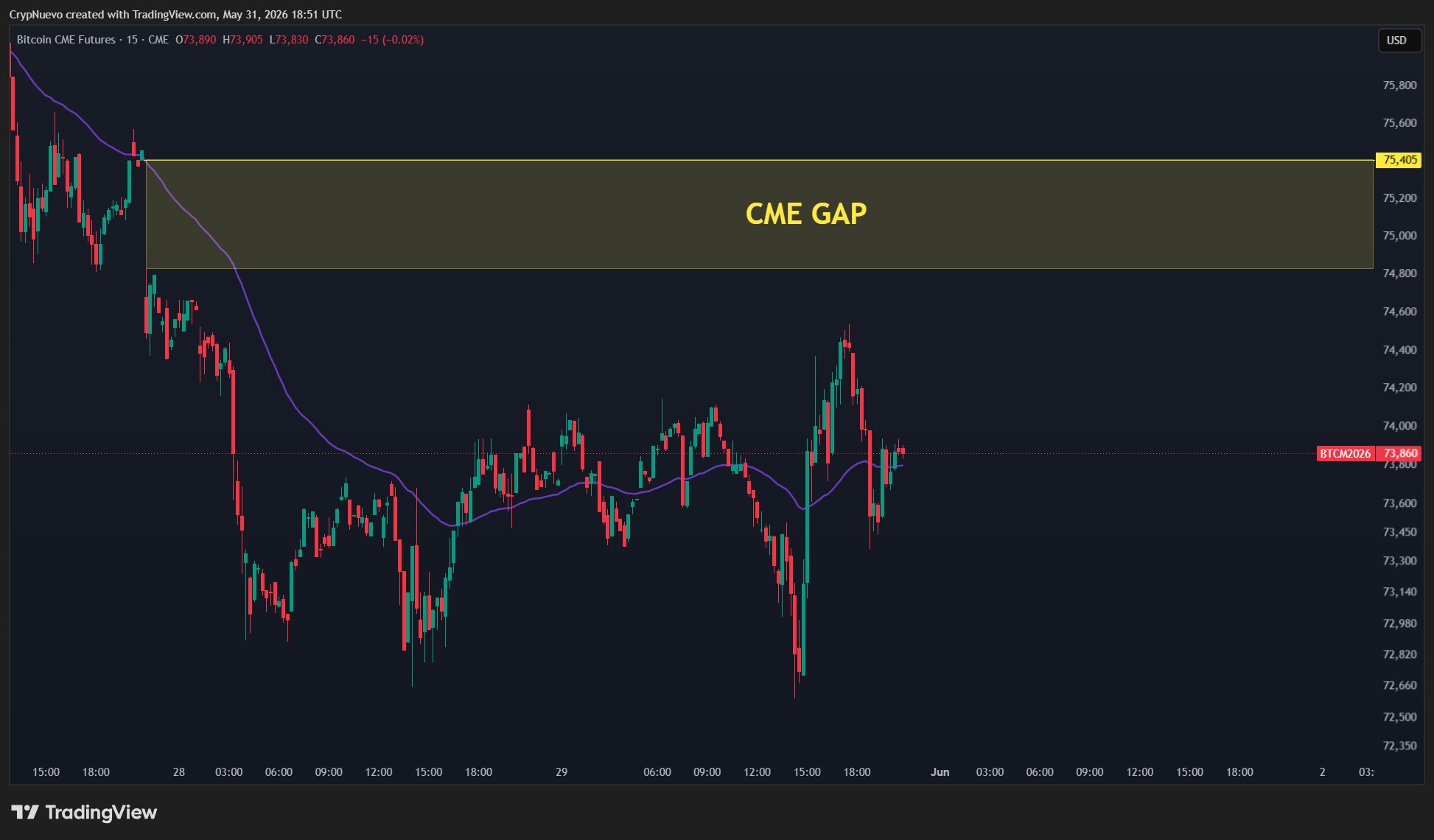
CME Bitcoin futures 15-minute chart. Source: CrypNuevo/X
As Cointelegraph reported, CME gaps became a thing of the past last week as its futures market started to trade 24 hours a day, seven days a week.
CrypNuevo said that they were looking for a “W”-shaped reversal pattern for price on low time frames.
PMI leads potential BTC price boost sources
The coming week sees inflation data yield to employment cues as the labor market becomes traders’ key focus.
Monday starts with the May print of the Institute for Supply Management (ISM) Manufacturing Purchasing Managers’ Index (PMI) — one of two core PMI releases this week.
ISM has been in a fresh uptrend since earlier in the year, when it ended a three-year period of contraction and immediately delivered a tailwind to Bitcoin price performance.
Commenting, entrepreneur and investor Mark Chadwick had some good news for crypto bulls. Based on business cycles, recent PMI figures could preclude a new period of gains.
“Expansion zones perfectly align with previous Alt Seasons – and we’re about to expand! The data backs it up too: ISM PMI has been above 50 for 3 straight months. Above 50 = expansion,” he wrote in an X post alongside data from pseudonymous analyst TechDev.
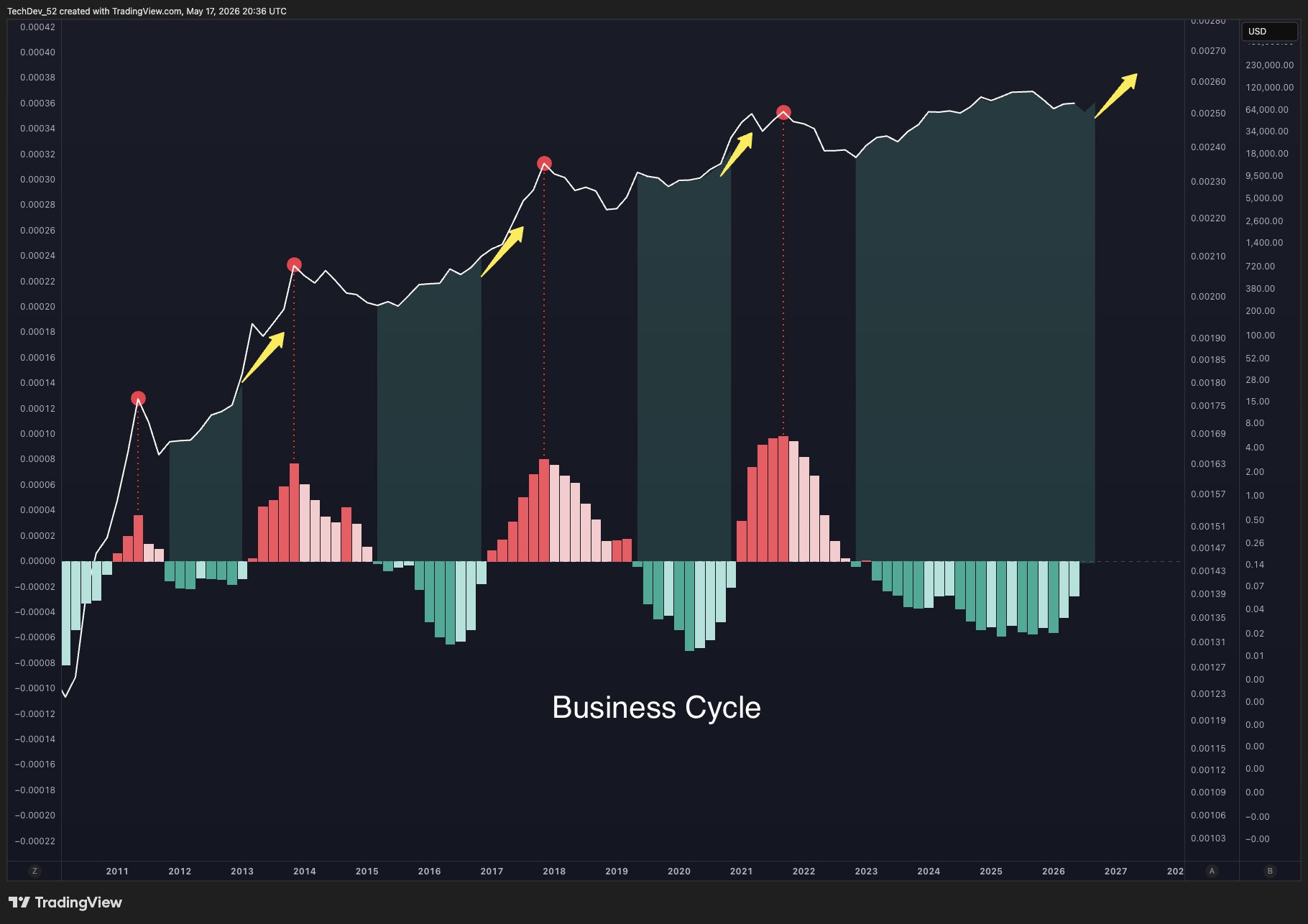
BTC/USD versus employment cycle. Source: Mark Chadwick/X
The coming days also see US nonfarm payrolls numbers, providing a snapshot of the labor market against a backdrop of rising inflation.
In a note of caution, Mosaic Asset Company reminded readers of last week’s high Personal Consumption Expenditures (PCE) inflation report.
“For investors hoping that the boost in inflation could be temporary from the jump in energy prices, the report contained bad news,” it continued.
“The core goods figure that excludes food and energy rose by 2.8% and is one of the biggest increases in decades outside of the pandemic aftermath.”
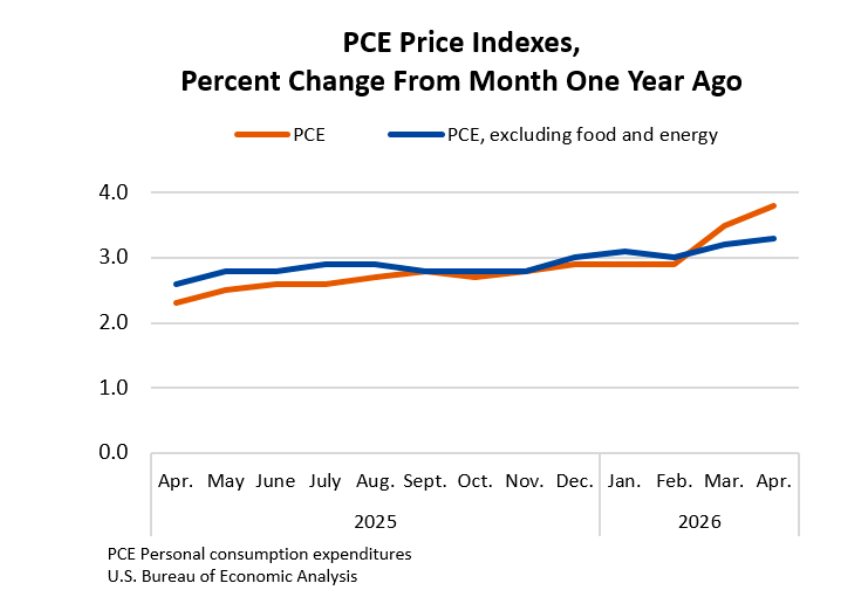
US PCE index % change (screenshot). Source: Bureau of Economic Analysis
Bitcoin long-term holders may produce a new bear-market low
Bitcoin holder trends mean that the BTC price bottom may well still be ahead in the 2026 bear market.
New findings from onchain analytics platform CryptoQuant cast doubt on the BTC price rebound from multiyear lows near $60,000.
“A rebound during a downtrend is hard to read as a bottom, because even within it the LTH (long-term holder) UTXO share keeps rising rather than declining,” contributor AbstractRyu wrote in a Quicktake blog post on Monday.
The post compares unspent transaction outputs (UTXOs) involving coins dormant for more than or less than six months, with the former classed as LTH coins.
“On Realized Cap – UTXO Age Bands (%), there are only two ways the LTH (6m+) share grows: existing holdings age in place without being spent, or STH (short-term holder) coins cross the six-month mark and reclassify as LTH,” it explains.
“Neither reflects fresh demand reviving turnover. That is why a rising share, on its own, is hard to read as bullish.”
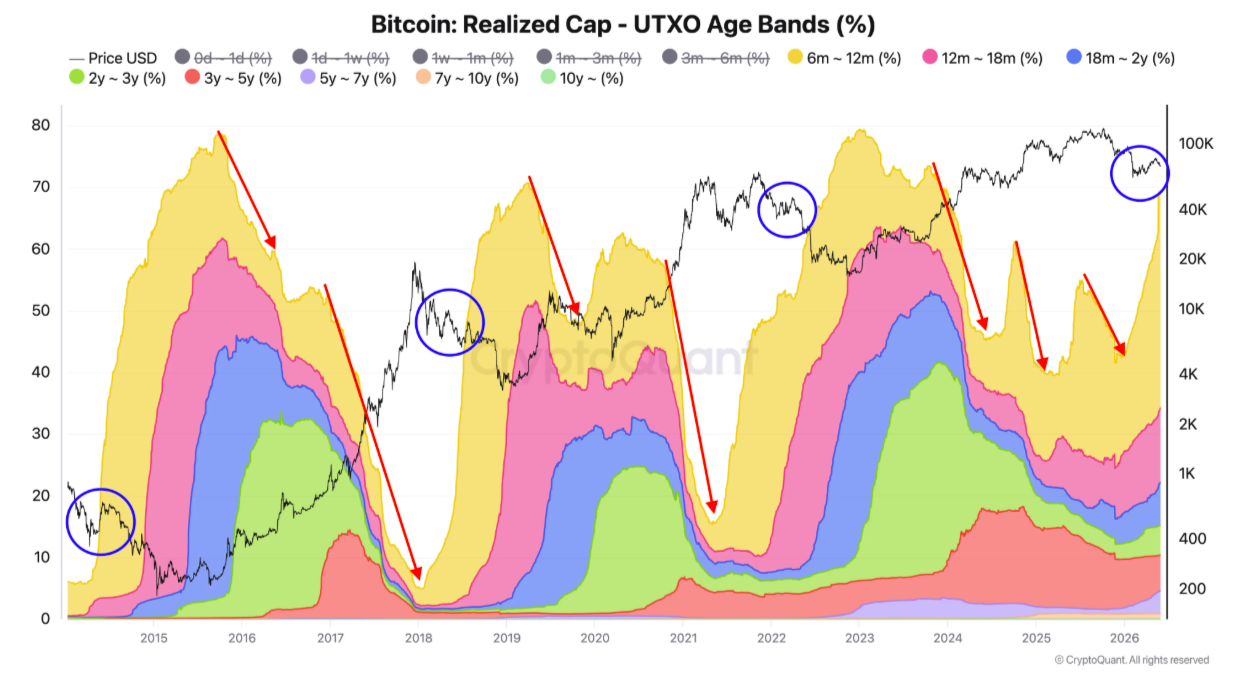
Bitcoin UTXO age data (screenshot). Source: CryptoQuant
As such, even BTC/USD rebounding by $20,000 versus its local lows is not enough to insure the market against a new macro floor. For this, LTH activity must pick up via some form of “distribution” phase.
“At present, the LTH band share has not declined at all, even through the rebounds marked by the blue circles,” AbstractRyu concluded alongside an explanatory chart.
“Distribution has not begun, and last month’s rebound, too, was likely a dead-cat bounce. The bottom is not yet in.”
Bitcoin “long-leaning bias” in need of a flush
Bitcoin continues to field concerns over a “long squeeze” thanks to overly bullish bets on BTC price action.
Related: Bitcoin price record 90-day uptrend ‘resembles bull market rally:’ New analysis
In an analysis over the weekend, CryptoQuant contributor Nino flagged positive funding rates as an ongoing signal to be “cautious” in the current market.
Funding rates, as Cointelegraph reported, have flipped net positive, indicating a “long-leaning bias” among traders.
Now, on a three-day rolling basis, funding is approaching its highest levels since the start of the year — even as price action itself tracks sideways.
“Recent market observations suggest that the 72-period moving average cluster for funding rates is showing a positive bias, approaching levels reminiscent of the peak seen in late January 2026,” Nino summarized.
“Coupled with the current stagnation in price action, this dynamic could imply an accumulation of long positions that have yet to translate into sustained upward momentum.”
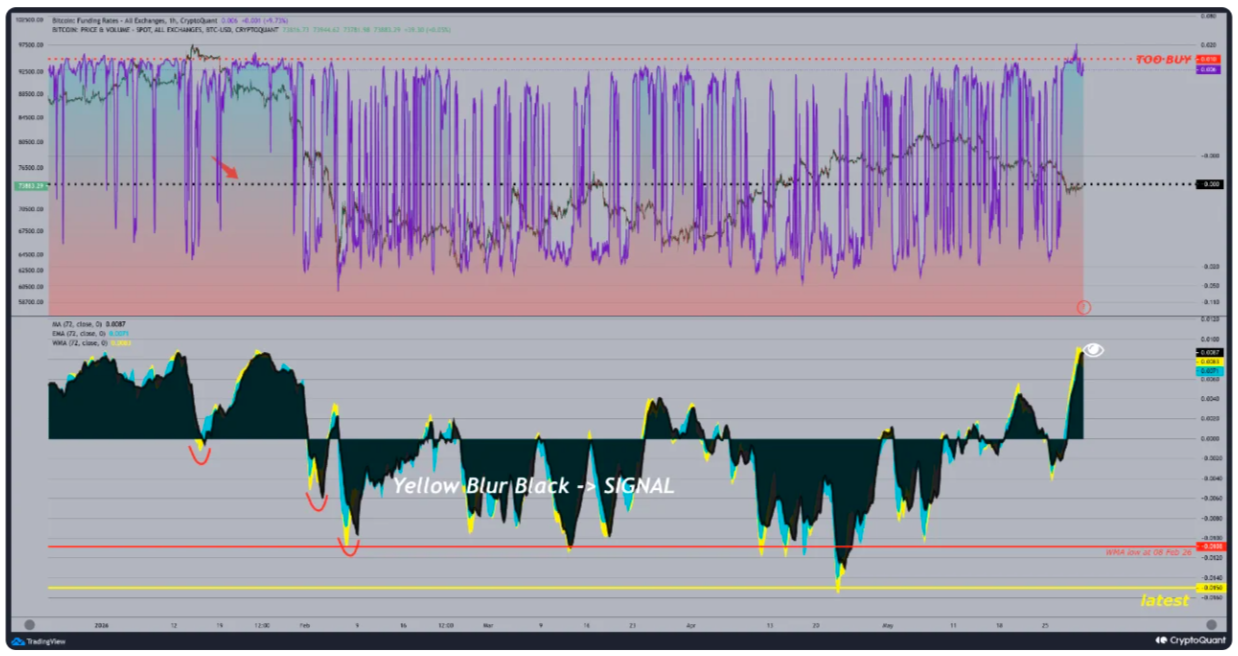
Bitcoin funding rate data (screenshot). Source: CryptoQuant
The implication is that price could redress the balance of longs and shorts by liquidating the former with a drop to new local lows.
“Consequently, the short-term outlook appears somewhat cautious, raising the possibility of a near-term downward leg as the market might need to clear potential excess leverage,” Nino added.
In its own analysis, crypto sentiment platform Santiment described the overall market mood as its most “lopsided positive” of 2026 so far.
“The current euphoria contrasts sharply with the bearish ETF flow picture and warrants caution,” it advised.
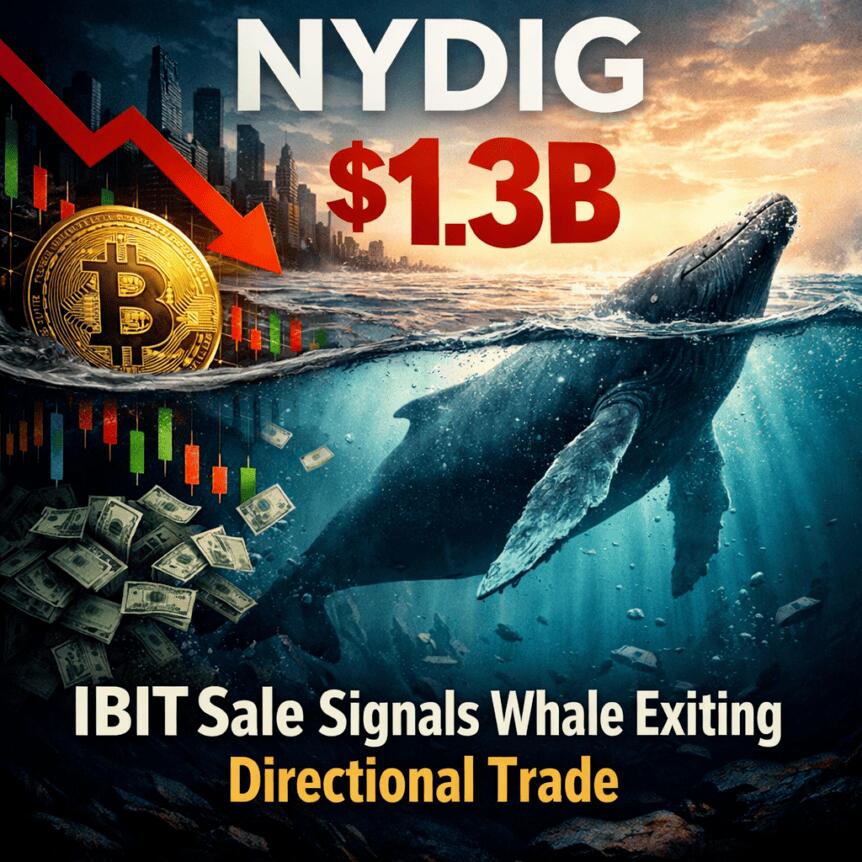
Last week Reuters? No. This article is rewritten. A $1.26 billion block trade in BlackRock’s iShares Bitcoin Trust (IBIT) was executed via a dark pool by an unidentified seller, according to analysis from NYDIG’s head of research, Greg Cipolaro. The move, involving 29.2 million IBIT shares, is interpreted by Cipolaro as evidence of a large directional holder exiting a concentrated bet rather than a routine unwind of a basis trade. The seller reportedly accepted the sale at about $1.01 below the prevailing market price of $44.17, effectively paying roughly $29.5 million in exchange for immediate execution.
The trade drew attention not only for its size but for the mechanics: a private venue, not a public market, and a sizable discount to immediate liquidation. Such characteristics are often associated with institutional liquidity needs, but Cipolaro cautioned that the available data cannot definitively distinguish between a forced liquidity event and a deliberate portfolio repositioning. “While the transaction details themselves cannot answer that question, they do demonstrate that at least one sophisticated holder was willing to pay approximately $29.5 million to eliminate a $1.26 billion bitcoin-linked position immediately,” he noted in his research release.
Bitcoin, meanwhile, faced a cautious reaction. The day of the IBIT block sale saw BTC retreat around 2.8%, though market observers noted that the move was absorbed without triggering a broader rout, a view echoed by Bloomberg ETF analyst Eric Balchunas. “The market absorbed the sale well,” Balchunas observed at the time.
“The key unanswered question is whether the seller was responding to idiosyncratic constraints or expressing a broader investment view.”
Beyond the immediate price action, the activity fed into a broader tailwind of ETF outflows. Farside Investors’ data show US-listed Bitcoin ETFs extending a streak of net outflows to 11 straight trading days, with a $333.6 million outflow recorded on the same day as the IBIT sale. In total, more than $2.9 billion has flowed out of these funds since May 14, marking a meaningful shift in near-term demand for BTC exposure through traditional exchange-traded vehicles.
The behavioral backdrop accompanying these flows is tepid at best. The Crypto Fear & Greed Index registered a score of 29 out of 100 on Monday, signaling fear in the market, and the index tracked an average “fear” rating for May. These sentiment readings dovetail with a period of uncertainty around large, liquidations and the durability of ETF-driven demand in the BTC space.
What to watch next: monitoring ETF outflow trajectories, liquidity conditions in dark pools, and Bitcoin’s price resilience as macro cues evolve will shed light on whether institutional demand for exposure through regulated products remains steady or continues to ebb amid ongoing market volatility.
Related coverage: Bitcoin’s price moves, ETF block sales, and market absorption dynamics continue to unfold as the crypto ecosystem recalibrates to a changing liquidity landscape.
Key takeaways
Market dynamics and what to watch next
Sentiment signals and investor behavior

7 Upcoming Horror Movies, Ranked by Anticipation

Massimo Dutti Takes Los Angeles Style into Daydream Mode

6 Financial Goals You Must Achieve Before Age 40 | Life-Changing Money Tips #motivation #elonmusk

Steven Gerrard disagrees with Gary Neville over ‘shock’ Chelsea and Arsenal claim | Football

US brings back mandatory military draft registration

Register Renaming | Hackaday
6 Financial Goals You Must Achieve Before Age 40 | Life-Changing Money Tips #motivation #elonmusk

JM Financial Expects 15-20% Loan Book Growth After Reset: CFO On IPO Pipeline, Housing Finance &More

CRYPTO TURMOIL: Trump blasts banks as CLARITY Act stalls again
-

 NewsBeat5 days ago
Israel says it has killed new Hamas military leader in Gaza City airstrikes
-

 Tech5 days ago
NASA taps Blue Origin to deliver lunar rovers for Moon Base initiative
-

 Politics7 days ago
Bridgerton Season 5: Cast, Release Date And Everything We Know So Far
-

 Sports6 days ago
2026 NBA Finals schedule, odds: Knicks await Thunder or Spurs after winning East
-

 News Videos5 days ago
XRP *JUST* SUCCEEDED!!!! CLARITY ACT EXPOSED!!! (SHE EXPOSED IT)
-

 News Videos3 days ago
This is BROKEN! INSANE 5x MONEY CAR WASH WEEK! The NEW GTA Online UPDATE Today! (GTA5 New Update)
-
 Crypto World6 days ago
Micron Crosses $1 Trillion Market Cap as AI Demand Reshapes Memory Sector
-
 NewsBeat7 days ago
Hottest May day ever as London hits 34.8C in 2C leap from previous records
-

 Business5 days ago
Selena Gomez Reportedly Upset Over Benny Blanco’s Comments on Her ‘Terrible’ Diet
-
 Tech6 days ago
China assigns ID codes to 28,000+ humanoid robots
-

 Business7 days ago
Nikkei 225 Surges Past 65,000 for First Time as Iran Peace Hopes Fuel Record Rally
-

 Tech7 days ago
Microsoft’s quiet Claude Code retreat and the real cost of enterprise AI
-

 Tech3 days ago
Waymo dominates autonomous vehicle registrations as Tesla trails behind
-
 Entertainment6 days ago
‘Breaking Bad’ Star’s Easy-to-Binge 6-Part Crime Series Spin-Off Is Finally Heading to Free Streaming
-

 NewsBeat7 days ago
Crowds find riverside shade in York as temperatures soar
-
Tech5 days ago
The Samsung pay deal is the moment Korean unions changed register
-

 Entertainment6 days ago
Days of our Lives 2-Week Spoilers May 25-June 5: Gwen Rages, Abe Confesses & 2 Tragic Anniversaries!
-
 Tech2 days ago
SpaceX just won a second Golden Dome contract. This one is $4.16 billion.
-

 Tech7 days ago
Westone Audio and Etymotic Acquired by Fidelity Collective in Major IEM Market Move
-
 Entertainment6 days ago
Taylor Swift Fans Label Travis Kelce’s Beer-Chugging A ‘Red Flag
You must be logged in to post a comment Login