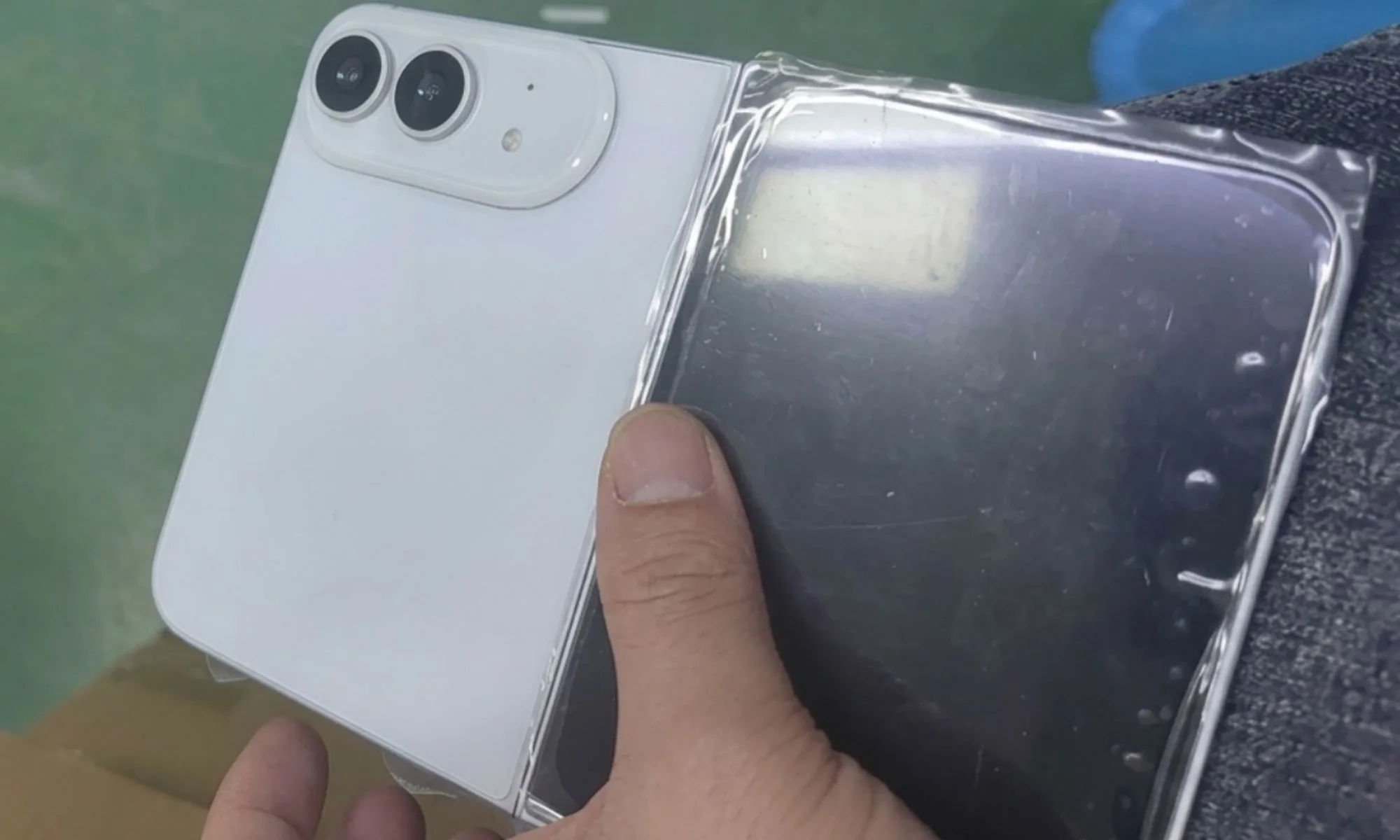
Apple’s long-rumored foldable iPhone may have just taken another step closer to reality – or at least another step closer to the internet’s imagination. A newly leaked replica model, believed to represent Apple’s upcoming “iPhone Ultra” foldable device, is now circulating online, revealing what could be one of the company’s boldest design shifts in years.
According to a report from Notebookcheck, the replica showcases a foldable phone with curved edges, a slim profile, and a surprisingly familiar design language that many users are already comparing to existing Android foldables.
If the leak turns out to be accurate, Apple’s first foldable iPhone may not look radically different from competitors after all.
Apple’s foldable iPhone may prioritize familiarity over reinvention
The leaked white replica model shows a book-style foldable design with rounded corners, curved side rails, and a dual rear camera setup positioned vertically on the back panel. The overall appearance has triggered immediate comparisons to devices like Samsung’s Galaxy Z Fold lineup and several foldables from Chinese brands.
Advertisement
That familiarity is especially interesting because Apple has historically avoided entering product categories until it believes the technology and user experience are mature enough. The company has reportedly spent years testing multiple foldable prototypes internally while delaying a commercial launch over concerns related to hinge durability, display creasing, and long-term reliability.
iPhone Ultra PrototypeIce Universe
The “iPhone Ultra” branding attached to the leak also aligns with previous rumors suggesting Apple may reserve foldable devices for an entirely new ultra-premium category above the Pro Max lineup.
Reports over the past year have repeatedly suggested Apple’s first foldable iPhone could arrive with a large inner display, titanium construction, and a significantly thinner hinge design compared to current foldable competitors. Some analysts also believe Apple is prioritizing minimal display creasing as one of the defining features of the device.
The replica itself, however, suggests Apple may be taking a more conservative design approach externally while focusing its innovation on refinement rather than visual experimentation.
Why this matters
Foldable smartphones remain one of the few major hardware categories where Apple still has no product presence. Meanwhile, companies like Samsung, Huawei, OPPO, and Honor have spent years iterating on foldable hardware.
Advertisement
iPhone UltraSourav/Twitter
Apple entering the foldable market could dramatically reshape consumer interest in the category, much like the company previously did with smartwatches and tablets. At the same time, the leak raises an important question: Does Apple still need to create visually unique hardware, or is perfecting usability and ecosystem integration enough?
What happens next
Apple has not officially acknowledged the existence of a foldable iPhone, and current reports suggest the device is still at least a year or two away from launch. Multiple analysts expect Apple’s first foldable device to arrive sometime around late 2027 or beyond, likely positioned as an ultra-premium product with a very high price tag.
For now, replica leaks like this mainly offer hints about Apple’s possible design direction rather than final hardware confirmation. Still, if the rumors prove accurate, Apple’s foldable future may look less like a sci-fi experiment and more like a refined version of a category Android brands have already spent years building.
The first robot in Nvidia’s new research line is a collaboration with three flags on it. The body comes from China’s Unitree, the hands from Singapore-headquartered Sharpa, and the computing brain from Nvidia.After Jensen Huang’s keynote in Taipei on Monday, ahead of the Computex trade show, the company said it plans to repeat the exercise with humanoid makers in the United States, Europe and South Korea.The machine announced this week is a standardised version of Unitree’s H2 robot, built as a reference platform for academic researchers. The idea is to give labs a common piece of hardware to develop on rather than each building or buying a different machine.
Researchers at Stanford University and the University of California San Diego are among those who plan to use it, along with Seattle-based Ai2, ETH Zurich in Switzerland, the Stanford Robotics Center, and UC San Diego’s Advanced Robotics and Controls Laboratory. Sales, primarily to research institutions, are set to start later this year.
The robot uses Nvidia’s Isaac GR00T platform, the software and reference-hardware stack the company has been building out for humanoid development, which is the connective tissue across these partnerships rather than any single chassis.
Nvidia executives told Reuters the company intends to pursue more partnerships like the Unitree one with robotics firms outside China. They did not name the prospective US, South Korean and European partners, and spoke on condition of anonymity because the plans are not public. That is the part of the announcement worth holding lightly. A stated intention to work with unnamed companies in three regions is a direction of travel, not a deal.
Advertisement
The timing is hard to miss. The Unitree robot landed the same week the Chinese firm itself moved towards a public listing, having outsold rivals including Tesla on humanoid units last year. Unitree has become the most visible name in a Chinese sector that shipped roughly 90 per cent of the world’s humanoid robots in 2025, which makes it both an obvious partner for Nvidia and an awkward one. The firm shipped more humanoid units last year than any rival, Tesla included, and is preparing a listing in Shanghai alongside compatriot AgiBot.
That awkwardness is the subtext of the wider plan. Nvidia’s pitch is that it supplies the brain regardless of whose body it sits in, and lining up American, European and Korean partners alongside Unitree spreads that bet across the geopolitical map rather than concentrating it in China.
For a company whose chips are already entangled in export-control politics, a robotics strategy that does not depend on a single country has obvious appeal.
For now, the concrete thing is one research robot with a Chinese body, Singaporean hands, and a Nvidia brain, heading to a list of named universities later this year. The rest is a plan, told to a wire service by people who would not put their names to it.
In Taiwan a few hours ago, Team Red revealed the return of the Ryzen 7 5800X3D for AM4 users, a cheaper Ryzen 7 7700X3D for AM5, and the global launch of the Radeon RX 9070 GRE. Read Entire Article Source link
A historian-turned-software engineer warns that “so little is ever written down” by professional programmers in a new article for Fast Company:
Perhaps there’s an early design doc, but then it turns out that everything was substantially revised before work began. Maybe there are a few wiki pages explaining known issues, some of which were solved a long time ago and others that have been left to molder in the codebase. Somebody might have left a comment in the code itself, but typically it’s a warning not to change something or else something else will break… Software engineering has an ambivalent relationship with documentation. Everyone agrees documentation matters in theory, but in practice it’s inconsistent, outdated, or missing entirely. Part of that is simple inertia. Writing documentation is usually less interesting than writing the code itself. But it’s also ideological. The Agile movement emerged in part as a reaction against the heavily documented Waterfall methodology, and one of Agile’s core values explicitly prioritizes “working software over comprehensive documentation.” In escaping bureaucratic overdocumentation, the industry also normalized underdocumentation.
High turnover at software jobs always brings “a constant drain of domain knowledge.” And he’s he’s skeptical that generative AI will be able to fill in those gaps:
[H]aving it generate documentation on the codebase itself might sound like a solution to the absence of other written information. LLMs can certainly summarize code back to you. But hold up with that idea. Beyond hallucinations, there’s a deeper problem: Writing documentation is itself part of the thinking process. Whether I’m writing history or software, putting an approach into words helps refine it before I sink hours into implementation. Documentation also captures intent. An LLM may be able to summarize what a codebase does, but it cannot reliably explain why a developer chose one approach over another, or what trade-offs shaped that decision…
Advertisement
An LLM can read code that I’ve written. It might even scan a large codebase and accurately summarize what it’s doing. But it can’t assess authorial intent. Thanks to long-time Slashdot reader smooth wombat for sharing the article.
By 2025, most experts had adopted the same position. “I think everybody now agrees that long Covid is a biologic disease,” said Igho Ofotokun, of Emory University School of Medicine, in his concluding comments at the Long Covid International Conference. “It’s not in your mind. It’s real.” Ofotokun also offered an explanation for the lack of scientific progress. “The big elephant in the room is just that we don’t have a gold-standard definition for long Covid. So it really makes it difficult to do all the things we want to do. Makes designing of clinical trials extremely difficult, following outcomes in clinical trials extremely challenging.”
Part of the definitional problem for long Covid is the absence of definitive biomarkers: genes, antibodies, any unique physiological signature of the illness. To discover biomarkers, researchers must first identify patients presumed to have a specific illness, then see what they have in common beyond their symptoms. Identifying a biomarker allows for the development of disease-targeting interventions—gene therapy, antivirals—and enables the sorting of people who have a particular condition from those whose symptoms mimic the condition but are caused by something else.
Scientific experts are in charge of the search for long Covid biomarkers. But their search depends on the essential question of how to classify someone as having long Covid in the first place, the answer to which has been strongly influenced by patient advocates. Deciding who to include in a study of long Covid requires a provisional set of exclusionary criteria. If the criteria are too strict, they will exclude people who have the condition; if they are too relaxed, they will include people who don’t have the condition. Each of these poses a risk to the accuracy of the science.
But for patient advocates, strict criteria have an additional risk. If they are implemented, some sufferers who believe they have long Covid won’t “officially” have it. This risk was front and center when, not long after the outbreak, the National Academies of Sciences, Engineering, and Medicine (NASEM) took on the challenge of producing a “uniform, core definition” of long Covid. At the time, basic questions remained unanswered: Does long Covid require a prior positive SARS-CoV-2 test? What symptoms are necessary? How long must they go on?
Advertisement
In 2024, with a “focus on the patient perspective and interdisciplinary dialogue,” the committee produced an “intentionally inclusive” definition, to “ensure that patients who experience long Covid will be included in the definition.” Long Covid, they decided, is “an infection-associated chronic condition that occurs after SARS-CoV-2 infection and is present for at least three months as a continuous, relapsing and remitting, or progressive disease state that affects one or more organ systems.” Among the possible symptoms: shortness of breath, cough, persistent fatigue, post-exertional malaise, difficulty concentrating, memory changes, recurring headache, lightheadedness, fast heart rate, sleep disturbance, problems with taste or smell, bloating, constipation, and diarrhea.
According to the NASEM definition, a single symptom from the list is enough. It can be mild or severe. Previous infection “may have been recognized or unrecognized”—that is, a prior test for Covid is unnecessary. Put differently: If you start having trouble sleeping, on and off, for three months, and you attribute that to an unverified case of SARS-CoV-2, you have long Covid.
“Around 570 cables (plus a further 80 planned) carry between 95% and 99% of the world’s intercontinental telecommunications data,” reports CNN (since fiber cables offer speeds of terabits per second, carry much more data than satellite links). And “networks of green energy cables carrying electricity are also starting to sprawl across the world’s seabeds.”
Now to protect them, the U.S., Australia and the U.K. “are planning to develop new unmanned undersea vehicles” as part of their trilateral security partnership.
Western governments see a growing risk of Russian and Chinese sabotage of undersea cables and are also concerned that Iran may seek to exploit the many data networks running through the shallow waters of the Persian Gulf. The “seabed is a battlefield” said Australia’s Defence Minister, Richard Marles, in Singapore, calling for tougher action against so-called shadow-fleet vessels… The programme will improve the three nations’ reconnaissance and strike capabilities, “and bolster superiority in anti-submarine and anti-surface warfare,” as well as mine countermeasures, [according to a statement from their trilateral AUKUS partnership]… The new AUKUS project will sharpen all three countries’ ability to respond to threats, including those targeting underwater cables and pipelines, through a range of “cutting edge sensors and weapons systems for undersea drones,” UK Defence Secretary John Healey said.
Marles said undersea internet cables — “the arteries of modern civilization” — were being cut at an unprecedented rate, with island nations like Australia acutely vulnerable. “Over the past 18 months, we have witnessed a series of attacks against subsea critical infrastructure at a scale and frequency that is historically unprecedented,” he said. The UK government has also highlighted the vulnerability of the world’s digital highways. “Every international payment, every cross-border trade executed in milliseconds, every flow of data between businesses here in the UK and markets overseas — all travel along the seabed,” Telecoms Minister Liz Lloyd said Friday… Last month, the UK said it had tracked three Russian submarines covertly surveying undersea cables in the north Atlantic… A UK parliamentary inquiry warned last year that UK infrastructure might be targeted in a crisis, adding it was “not confident that the UK could prevent such attacks or recover within an acceptable time period.”
The UK Navy is already exploring the creation of a hybrid force that incorporates the widespread use of underwater drones to combat Russian threats in the Atlantic.
It uses a nearly 6-foot tall humanoid chassis and tactile five finger hands.
NVIDIA
As part of his AI-palooza Computex keynote, NVIDIA’s Jensen Huang dove into the most relatable form of artificial intelligence: robots. The company announced the new Isaac Gr00t reference design humanoid robot platform that combines a Unitree H2 Plus humanoid robot, Sharpa five-fingered hands and NVIDIA Jetson Thor onboard compute. That’s tied together with NVIDIA’s Gr00t open software and models designed to help “researchers and developers accelerate humanoid development workflows.”
The platform uses a nearly 6-foot tall Unitree H2 humanoid chassis that weighs 150 pounds, with 31 degrees of freedom across the body. (The H2 model is listed on Unitree’s website for $29,900, though the company has only shown renders on its website). The Gr00t developer platform will also support the cheaper Unitree G1 humaoid robot. NVIDIA first revealed its Gr00t N1 foundational model in March.
The chassis is married to dual Sharpa Wave tactile five-finger hands with 22 degrees of freedom, multi-view sensing including a head-mounted stereo camera, wrist cameras and inertia measurement, along with whole-body control with arm torque of up to 120 Newton-meters (88 foot pounds).
Advertisement
Gr00t Isaac is powered by NVIDIA’s Jetson AGX Thor T5000 onboard compute with an NVIDIA Blackwell GPU, 128GB of unified memory and a configurable 40 to 130 watt power range . The 15Ah battery provides just under 1 kWh of capacity for about three hours of endurance.
As has been a theme with humanoid presentations, there was no physical robot to be seen. Rather, Huang touted Isaac Gr00t as an open foundation humanoid development platform. The company said that multiple institutions including Ai2, ETH Zurich, Stanford Robotics Center and UC San Diego will use the reference design. “Robotics moves fastest when researchers can build on open platforms, share code and test ideas on real machines,” said Stanford Robotics Center’s executive director Steve Cousins in a statement.
“Scientists have developed a solar desalination system that turns seawater into drinking water without creating environmentally damaging brine,” reports ScienceDaily.
“Special laser-textured metal panels use sunlight to evaporate water while automatically moving salt deposits away from the working surface, preventing clogging. The process was successfully tested with water from three oceans and can recover nearly all salts as solids. Those leftover materials could even become a source of valuable lithium for batteries.” (The research team was led by University of Rochest professor Chunlei Guo and published their results in the journal Light: Science & Applications.)
The technology uses solar panels made of black metal etched with femtosecond lasers to make the surface super light-absorbing and superwicking — or extremely attractive to water. The panels have a laser-treated active region that pulls a thin layer of water across the surface, absorbs nearly all solar radiation, distills the water, and deposits the leftover salts and minerals into the panel’s untreated sides or “passive” region so that the salt does not clog the active region and disrupt continuous desalination… Guo’s team precisely etched the black metal’s grooves so the various salts and minerals in ocean water would simply slough off… [I]t extracts nearly 100 percent of the salts in solid form.
Advertisement
This could not only produce an abundant supply of table salt, but it could also be used to extract more precious minerals, including lithium, which is used in the lithium-ion batteries that power electric vehicles and other electronics. In a related paper in the Journal of Materials Chemistry A, Guo and his colleagues show how they can use the same superwicking solar panels to separate lithium from the rest of other salts in desalination. Embedding nanoparticles made of hydrogen titanate in the tiny grooves of the black metal surface isolates the lithium from other salts and minerals…Using water samples from Great Salt Lake, the researchers extracted about 50 percent of the lithium from the salts left behind by the desalination process. Guo says now that the superwicking desalination technology has been demonstrated in proofs of concept on small-scale devices, he sees the technology inherently scalable, capable of improving global access to drinking water and building more sustainable supply chains for precious minerals. “The National Science Foundation, the Bill & Melinda Gates Foundation, and Worldwide Universities Network supported this research.”
Many people want to keep their smartphones protected without adding extra bulk to their pockets. This is what makes minimalist phone cases so popular among many consumers today. Minimalistic phone cases emphasize thinness, lightness, and a sleek appearance while ensuring the phone remains well-protected against scratches and even accidental drops. Manufacturers have developed higher-quality materials, such as aramid fiber and magnetic builds, to improve strength and usability. Below are the four best minimalist phone cases.
1. Pitaka Edge
Pitaka Edge is one of the most common minimalist phone cases among those who favor thin, lightweight protection. The case is quite slim at 1.4 mm and helps preserve the phone’s premium quality. The case is made of aramid fiber and offers decent durability while remaining lightweight.
Another prominent feature of the Pitaka Edge is the magnetic ring, which allows you to wirelessly charge the phone and attach accessories via the MagSafe technology. It comes in handy for those who own magnetic chargers, cases, and wallets. The raised edges of the cover are designed to protect the smartphone’s screen and camera when resting on any surface. Available in several colors and designs for iPhone, Samsung Galaxy, and Google Pixel phones.
Another reason many people like using the Pitaka Edge is its upscale finish, which provides a good grip when holding the phone. Another factor that attracts people to the product is its clean, unbranded design. Nevertheless, because of its sleek form, it works best as protection from scratches and light impact.
2. Totallee Scarf
Totallee Scarf is known for its emphasis on simplicity and thin protection. It is one of the thinnest cases out there at just 0.5 mm thick. Its slim profile does not alter the smartphone’s appearance, allowing it to retain its natural look. This is greatly appreciated by users who like the look of their phones.
The case by Totallee is made out of polypropylene material and thus has a flexible yet sturdy build. It allows users to wirelessly charge their devices, and there are also versions compatible with MagSafe accessories. Other impressive features include its logo-free design, which allows users to maintain a minimalist, premium aesthetic.
Advertisement
The company also provides a two-year replacement warranty, which helps increase customer confidence. However, some reviews note that the case can feel slippery due to its smooth finish. Others feel the clear version is not fully transparent as expected. The Totallee Scarf is mainly available for recent Apple iPhone models rather than Android devices.
3. Benks ArmorAir
Benks ArmorAir combines minimalist styling with stronger everyday protection. It is a slim 1mm protective case that preserves the elegant look of your smartphone while providing additional strength. Thanks to aramid fiber technology, the case is not only stylish but also durable enough to withstand daily wear and tear. The official claim is that the case provides shock protection even after a four-foot drop.
This case supports MagSafe accessories via a built-in magnetic ring, making wireless charging and magnetic accessories easier. Furthermore, Benks is keen on maintaining aesthetic elegance by keeping branding to a minimum. Instead of placing a large logo on the back, the company adds only a small “Designed by Benks” marking near the camera section. The ArmorAir lineup is available for iPhone, Google Pixel, and Samsung Galaxy smartphones.
Reviews also highlight the smooth finish and premium feel of this case during everyday use. However, because the case stays extremely thin, screen protection remains somewhat limited compared to thicker protective covers. It works best for users who prefer lightweight everyday protection over rugged durability.
4. Bare Naked
The goal of Bare Naked is to offer users a phone case that is practically invisible while using their phones. With a thickness of just 0.35mm and weighing under 10 grams, Bare Naked helps keep the phones as slim and light as when they came out of the box. Minimalism is the main idea behind this product, as some people want to protect their phones without compromising aesthetics.
The product also comes with covered buttons and raised edges to reduce the risk of scratches and damage to the phone. There are two types of Bare Naked cases: Classic models that have no magnetic capabilities, and models with MagSafe support. The Bare Naked case range covers various models of the Apple iPhone, Samsung Galaxy, and Google Pixel smartphones, priced between $35 and $65 depending on the model and its features.
Advertisement
Many customers like how discreet and lightweight the case feels while still offering enough protection for everyday scratches and minor impacts. Another reason the design is appealing is its clean look. Nevertheless, there are reports that the shipping period may be slightly delayed due to the product being shipped from China.
If you were making a multi-limbed symmetric nightmare of a robot, where else would you look for a name but Greek Mythology? The team at Duke University that came up with this particular multi-limbed creature had two obvious choices: name it for one of the Hundred-Handed giants, the Hecatoncheires, or lean on the fact that each limb has its own sensor and go for many-eyed Argus. Argus sounds better to a funding committee, so Argus it is.
Hecatoncheries would be a bit of a reach anyway, considering Argus only has 20 limbs in its current incarnation. It uses what the researchers are calling its ‘dynamic symmetry’ to get around– extending and retracting its many limbs to exert forces in any direction, it can bounce about like a beach ball on a windy day.
At least in the embedded demo video, it seems to work surprisingly well. If you want to try it for yourself but don’t have a robot-building research grant, you’re in luck. The team at Duke has an open-source simulator available on GitHub so you can explore the concept, including trying variants with more and fewer legs than the 20-limbed unit featured here. Given that it works with only a dozen effectors, you can imagine the Argus we see has a certain degree of redundancy, something funder DARPA is doubtless keen on.
Advertisement
It is an oddball idea, and something we might imagine seeing in Star Wars, but it’s obviously got its pluses. We can’t really imagine any of the humanoid robots we’ve seen doing parkour like this thing. Somehow it’s less creepy than the robot dogs that are becoming common — along with being security risks. (more…)
You must be logged in to post a comment Login