
Crypto World
Blue Owl private credit funds redemptions capped at 5% after steep requests

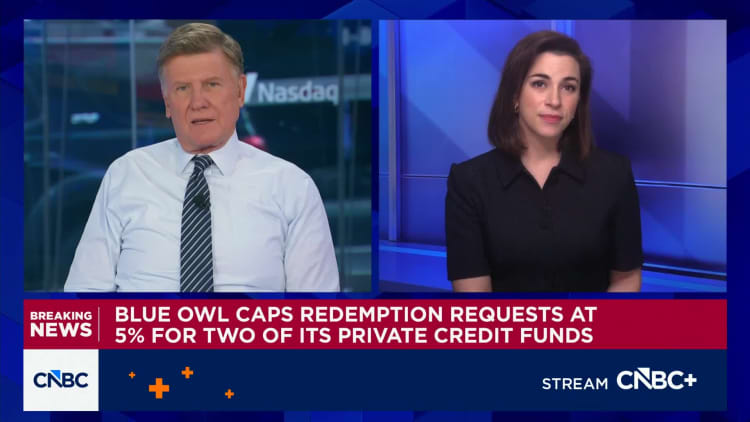

Blue Owl is experiencing elevated redemption requests for two of its private credit funds, according to letters to shareholders issued Thursday.
The firm’s flagship OCIC fund, with about $36 billion in assets under management, received redemption requests of about 21.9% of shares outstanding during the first quarter, the firm said. Blue Owl’s smaller, tech-oriented fund, OTIC, received redemption requests of 40.7% during the same period, it said.
In both of the funds, Blue Owl opted to cap requests at 5%. Blue Owl attributed the higher-than-usual requests to “heightened market concerns around AI-related disruption to software companies.”
“We continue to observe a meaningful disconnect between the public dialogue on private credit and the underlying trends in our portfolio,” Blue Owl said in the shareholder letters.
Shares of Blue Owl were down 1% in mid-morning trading Thursday after paring earlier losses.
The private credit industry has been roiled in recent months by concerns that it is overexposed to the software industry – an area that’s been under pressure over fears of disintermediation from artificial intelligence.
Software represents about 20% of portfolio exposure among business development companies, known as BDCs (a publicly traded proxy for private credit), according to Jefferies. Headline fears about default risk in the sector have driven a small but wealthy group of institutional investors to seek the exits from many of these funds.
“As public market dislocations and AI-related uncertainty reshape sentiment, dispersion is increasing across the sector, creating opportunities for experienced lenders to deploy capital selectively at improved terms,” the technology-focused letter reads.
Blue Owl, which is unique in having two of these nontraded private credit funds, is also among the last to report redemptions. The firm’s percentage of redemptions is multiples higher than its peers.
Most firms have opted to use the 5% cap, but some, including Cliffwater and Blackstone allowed slightly more redemptions.
Blue Owl’s OTIC technology fund saw redemption requests of 17% in the fourth quarter, which it fulfilled. OCIC’s requests were 5% in the fourth quarter.
The two funds previously drew interest from hedge funds Saba and Cox, which extended tender offers to locked-up holders at a steep discount.
Blue Owl said in the most recent quarter, its tech fund’s redemption requests were amplified by a more concentrated shareholder base, particularly within certain wealth channels and regions. For its flagship fund, the firm said the activity was driven by a “small minority of the investor base,” with 90% of shareholders electing not to tender.
Both funds saw gross inflows, which combined with the 5% gates resulted in modest net outflows.



In today’s newsletter, Paul Frost-Smith, CEO of Komainu, covers how institutional crypto is converging with traditional finance, but speed can introduce risk if legal and compliance layers aren’t aligned.
Then, in “Ask an Expert,” Sam Boboev, from the “Fintech Wrap Up,” details the key coordination risks institutions must solve for.
Beyond custody: why connectivity will define the next era.
Institutional crypto markets
Institutional adoption of crypto has matured rapidly. The challenge is no longer simply securing assets, but moving and managing them efficiently across a fragmented ecosystem of custodians, exchanges and counterparties. With assets under professional custody now exceeding $200 billion, the inefficiencies of siloed infrastructure have an increasingly material impact on trading, hedging and liquidity management.
Treasury teams often find assets stranded across multiple platforms, creating operational friction that slows trades, constrains intraday liquidity and increases risk exposure. Idle assets tie up capital, amplify counterparty risk and raise the cost and complexity of managing institutional portfolios. In a 24/7 market where speed, execution and real-time visibility matter, the ability to mobilise capital across platforms is no longer optional, it is a prerequisite for scale, efficiency and resilience.
The next phase of market evolution will be defined by connectivity. Platforms that link custody, liquidity and collateral in real time are no longer “nice to have,” they are critical infrastructure. Networked systems enable assets to move faster, collateral to be rehypothecated safely and positions to be adjusted instantly without the delays inherent in siloed setups. Institutions that can leverage integrated infrastructure gain a direct advantage in capital efficiency, risk management and operational agility.
Technologies such as Bitcoin’s Liquid Network illustrate the potential. By combining security, transparency, and near-instant settlement, these networks provide a model for institutions to operate efficiently while mitigating counterparty and operational risk. Assets that are digital-native and programmable can be pledged, transferred and released automatically according to predefined rules, bringing crypto markets closer to the operational standards expected in traditional finance.
The implications are clear. The efficiency and integration of underlying infrastructure directly affect portfolio outcomes. A digital asset’s value is no longer defined solely by its market price; mobility and utility are just as important. Firms that can connect these “pipes” of digital finance gain better liquidity, faster execution and strategic flexibility at scale, enabling them to deploy capital more effectively across trading, hedging and yield-generating activities.
This shift also signals a broader trend, with custody evolving beyond its traditional role. Once synonymous with storage, it now functions as a dynamic, active layer that validates, transfers, and interacts with assets programmatically. Institutional investors evaluating service providers should look beyond security and regulatory compliance to consider the ability to support fast, interconnected and reliable market activity.
Looking ahead, interoperability and network connectivity, not just regulatory clarity, will define which institutions can scale efficiently in crypto markets. Those that build their strategies around connected, integrated infrastructure will be positioned to capitalise on opportunities that siloed competitors cannot.
As institutional participation deepens, the competitive edge in crypto markets will increasingly come from how effectively firms can deploy and mobilise capital. Connectivity, interoperability and real-time collateral mobility will define the infrastructure institutions rely on to trade, hedge and manage risk at scale. Those that prioritise integrated systems today will be better positioned to navigate a market that is becoming faster, more interconnected and more operationally demanding.
– Paul Frost-Smith, CEO, Komainu
Ask an Expert
Q1: What defines the next phase of institutional crypto market structure?
The next phase is defined by convergence with traditional financial infrastructure. Crypto is no longer operating as a parallel system; it is being absorbed into existing institutional frameworks. This shows up in three areas: regulated custody, tokenized financial instruments and stablecoins as settlement rails. Institutions are not adopting crypto for speculation, but for balance sheet efficiency, faster settlement and programmable financial flows. The market structure is shifting from exchange-led liquidity to infrastructure-led integration.
Q2: Where is the real value being created right now?
The value is moving down the stack into infrastructure. Custody, tokenization platforms and stablecoin issuance are becoming the core control points. These layers determine how assets are issued, transferred and settled. Distribution still matters, but control over settlement and asset representation is where defensibility is forming. This is why we are seeing traditional players focus on tokenized money market funds, on-chain repo and institutional-grade stablecoins.
Q3: What are the key risks institutions need to solve for?
The primary risk is not volatility, but coordination across legal, technical and operational layers. Tokenized assets can settle instantly, but ownership rights, compliance rules and jurisdictional enforcement still operate off-chain. This creates a structural mismatch. Institutions need systems where the ledger, compliance logic and legal frameworks are aligned. Without that, speed introduces risk rather than efficiency.
– Sam Boboev, founder, Fintech Wrap Up
Keep Reading
- Bitcoin enters the public bond market as Moody’s gives a first-of-its-kind crypto deal a rating.
- Franklin Templeton is launching a dedicated cryptocurrency division, Franklin Crypto, anchored by its planned acquisition of crypto investment firm 250 Digital.
- Australia has passed its first comprehensive crypto law, requiring exchanges and custody platforms to obtain financial services licenses within six months.


Coinbase (COIN) said Thursday it had received initial approval for a national trust company charter from the U.S. Office of the Comptroller of the Currency, Bloomberg reported, marking a step toward it operating as a federally regulated crypto custodian.
The approval is not final. It is a conditional green light that sets out requirements Coinbase must meet before it can receive a full charter. These typically include building out compliance systems, hiring key personnel and undergoing regulatory reviews. The OCC also expects firms to show they can manage risk, protect client assets and follow anti-money laundering rules. Only after those steps are complete can the agency grant full approval.
“We still need final approval… our business will not operate under an OCC charter until we have that final approval,” Paul Grewal, chief legal officer at Coinbase told CoinDesk. “This next phase allows us to get into more detail on how we can extend our business in ways that are exciting and important for crypto’s development.”
If finalized, the charter would allow Coinbase to run a non-insured national trust company. That structure permits the firm to hold digital assets on behalf of clients but bars it from taking deposits or making loans.
Coinbase first applied for the charter in October, alongside firms such as Ripple. More recently, Citadel-backed exchange EDX Markets said it had filed for a similar structure. The cluster of applications points to growing demand for regulated custody as large investors enter crypto markets.
For institutions, custody is less about trading and more about trust. A pension fund, for example, may want exposure to bitcoin but needs a regulated entity to hold the asset securely. A federal charter can provide that assurance in a way state licenses may not.
The move aligns with Coinbase’s effort to rely less on trading fees, which can swing with market cycles. Custody offers steadier revenue. The company already acts as custodian for several U.S. spot bitcoin exchange-traded funds, holding the underlying assets on behalf of fund managers.
“The big opportunity going forward would be payments… custody-adjacent but separate,” Grewal said. “We think we’ll be able to offer a much wider range of products and services to our customers than ever before.”
UPDATE (April 2, 16:57 UTC): Adds comments from Coinbase chief legal officer Paul Grewal.
Disclosure: This article does not represent investment advice. The content and materials featured on this page are for educational purposes only.
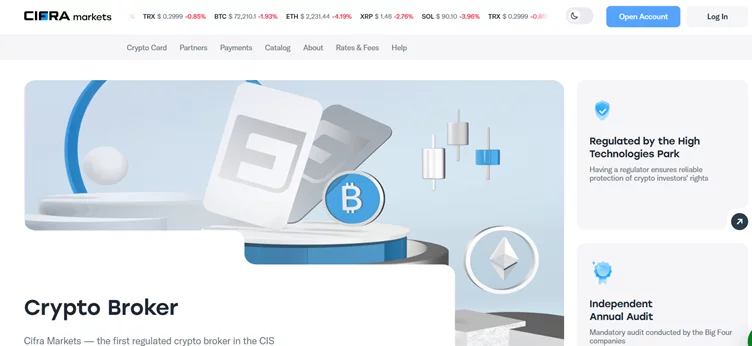
Cifra Markets aims to bring regulated, transparent access to crypto in a $2.55 trillion global market.
At the time of writing, the global cryptocurrency market is a $2.55 trillion market, yet millions of users still lack access to a regulated, transparent gateway into digital assets. Unverified peer-to-peer platforms, unregulated online exchangers, and offline dealers with questionable liquidity have long dominated the space. Cifra Markets is changing that.
In this project review, we take a deep dive into Cifra Markets to understand the unique features that set it apart.
Overview
Website: https://cifra.by/en/
Sector: Crypto broker
Supported coins: 300+ cryptocurrencies
Margin trading support: Yes
KYC verification: Required
Tokenized US stocks: Offered
What is Cifra Markets?
Cifra Markets is a licensed crypto brokerage firm operating from the Republic of Belarus, a country where cryptocurrencies have been legal and regulated at the state level since 2017. It was among the first brokers to get a license in the jurisdiction, a testament to its commitment to regulatory compliance, and establishing trust within a highly competitive financial market.
Cifra is positioned as a legal alternative to P2P crypto exchanges and operates in the Commonwealth of Independent States (CIS) region, Asian, and Middle Eastern markets. It also provides crypto trading through partnerships with regulated crypto exchanges.
What makes Cifra unique?
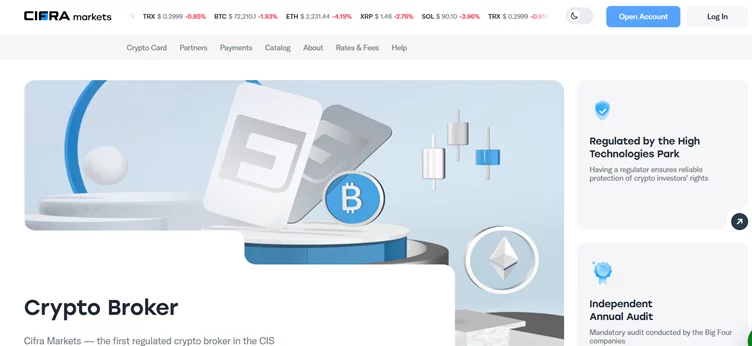
1. Security is at the heart of Cifra Markets. The company operates as a registered resident of the High Tech Park (HTP) in Belarus. By operating in this region, Cifra adheres to strict requirements on asset custody, cybersecurity, independent technical auditing, and client service quality. This helps the platform to bring institutional-grade compliance to crypto users, a combination that has historically been unavailable for brokers operating in the region.
2. Cifra Markets has built its infrastructure based on principles commonly used in traditional financial standards. The platform integrates with multiple partner banks to enable instant fiat deposits and withdrawals.
3. To ensure that every transaction on the platform is legal, Cifra Markets imposes strict AML standards for all deposited cryptocurrencies. Every transaction is screened by blockchain analytics firms, such as Elliptic, and Shyft, to verify the “cleanliness” of digital assets before they are credited to client accounts. If funds are linked to sanctioned addresses or illicit activity, they are rejected and automatically returned to the original blockchain address.
4. Users are able to purchase cryptocurrency using fiat through bank transfers. They can also convert fiat into crypto, or from fiat to crypto, by using any bank in the CIS. Users can choose to deposit and withdraw funds in US dollars, euros, Belarusian Rubles, or Russian Rubles.
5. The platform provides users with access to over 300 cryptocurrencies as well as tokenized U.S. stocks, such as AAPLX, GOOGLX, NVDAX, AMZNX, HOODX, CRCLX, and more.
6. Cifra offers margin trading with leverage of up to 5x, allowing traders to enter large positions with a smaller initial capital.
7. Cifra Markets has its own trading interface and technology stack, including a Mini App designed to simplify access for beginners. This aims to reduce the complexity often associated with large global exchanges, making the platform accessible for a wide range of users.
8. Fiat and USDT can be exchanged directly through the order book in the trading application, where prices are set by participants placing their orders. For larger transactions, users have access to an OTC desk.
How to get started
Getting started on Cifra is easy and straightforward.
Firstly, add a working email address and a strong password, and then click on sign up to continue.

Next, enter a valid phone number. A one-time password (OTP) will be sent to this number, which must be verified before proceeding to the next step.
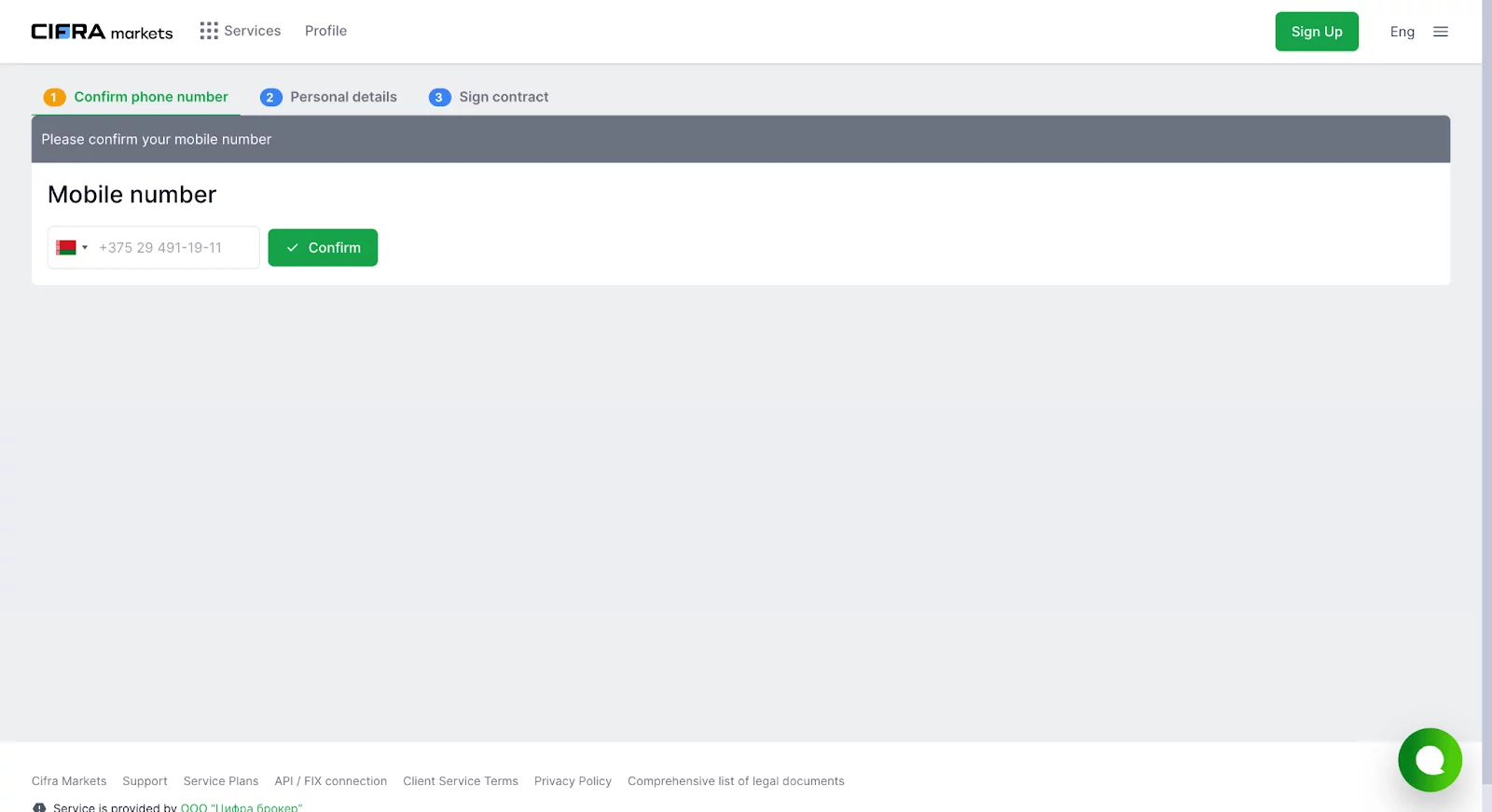
After an OTP is confirmed, the “Personal details” tab will open. Click on “Go to the next step” to proceed.
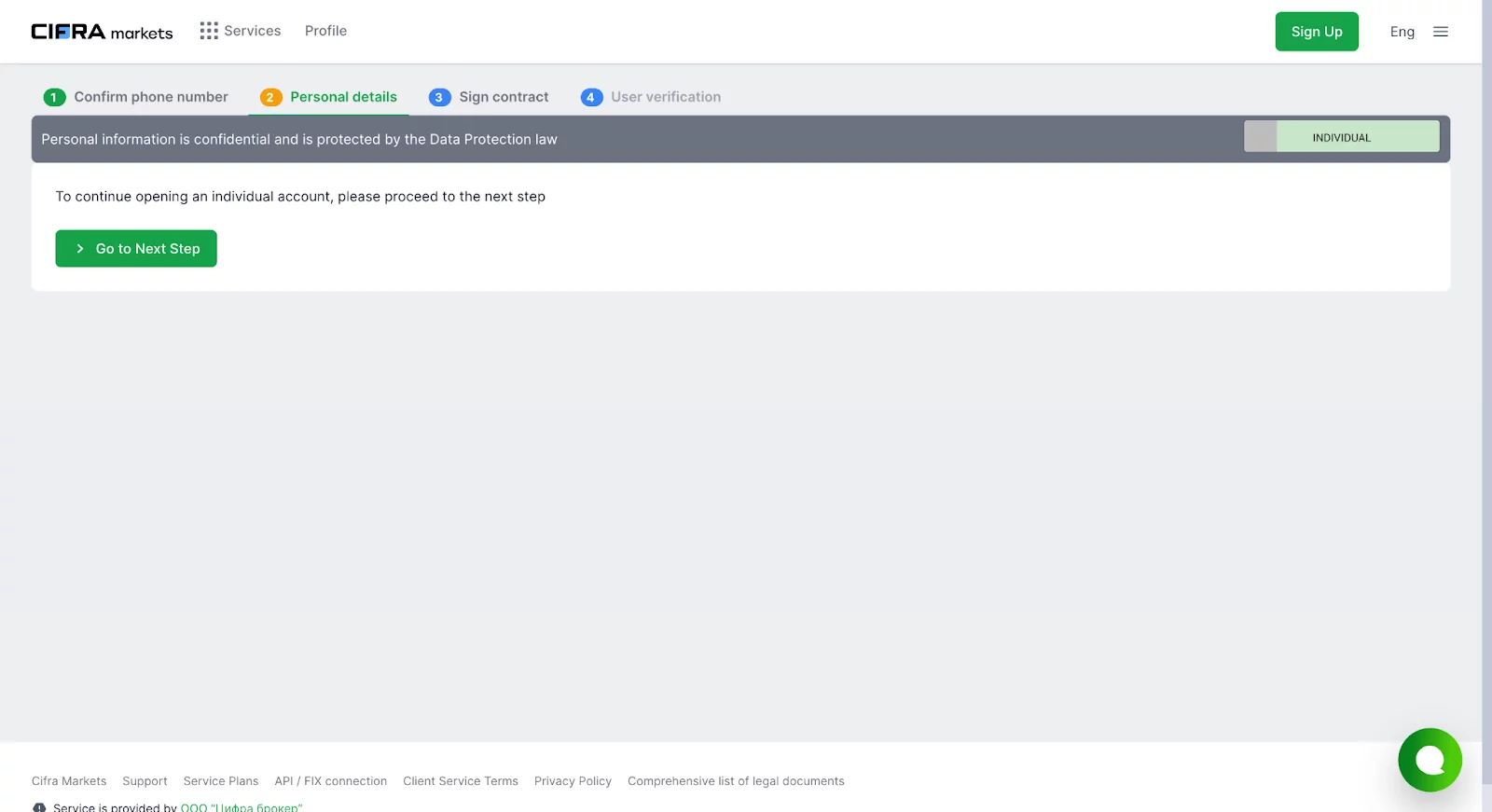
To open an account, enter additional details like citizenship, tax identification number, and location, then confirm that the data entered is correct. A progress bar at the top indicates how much of the required information has been completed.
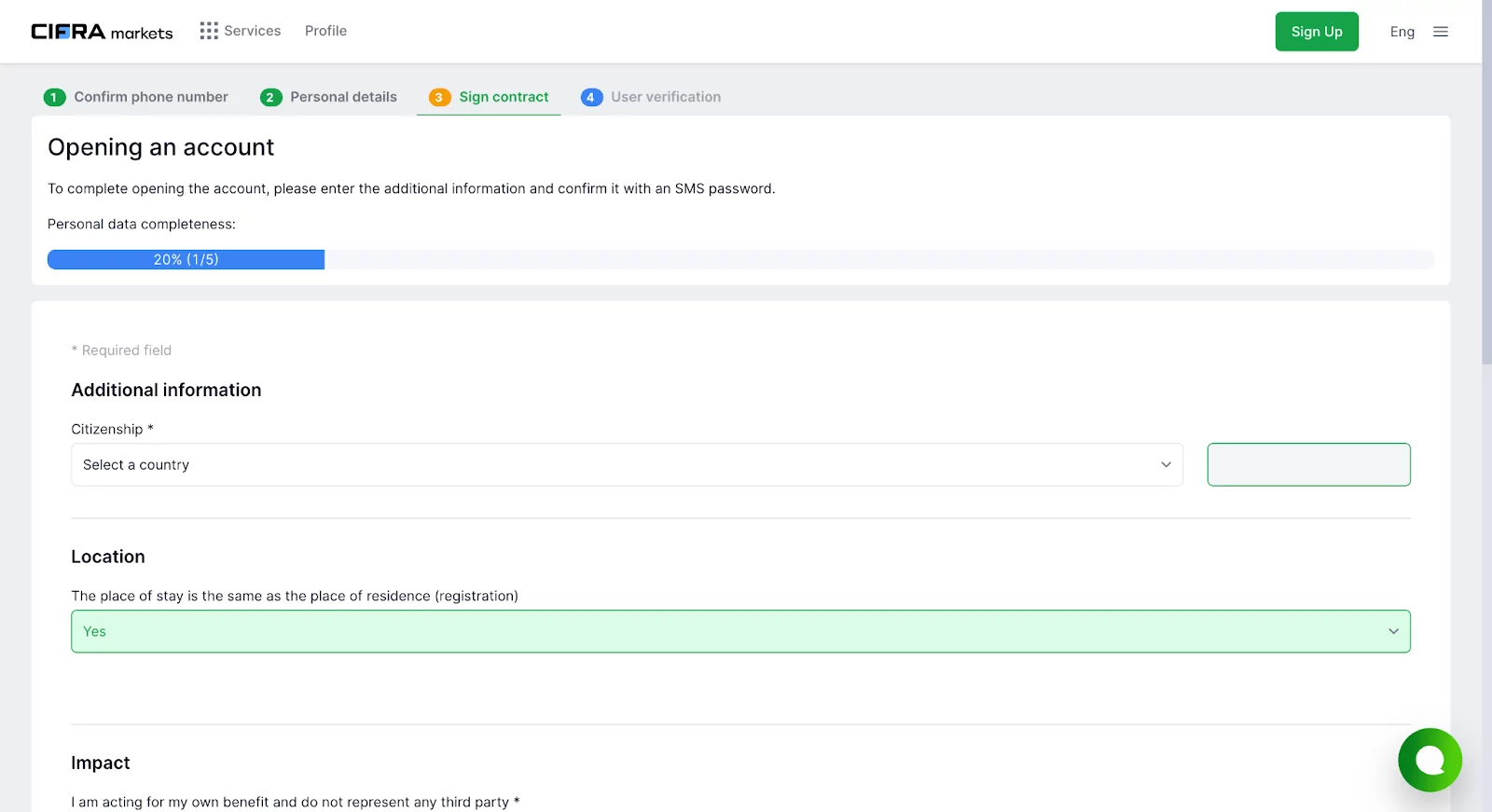
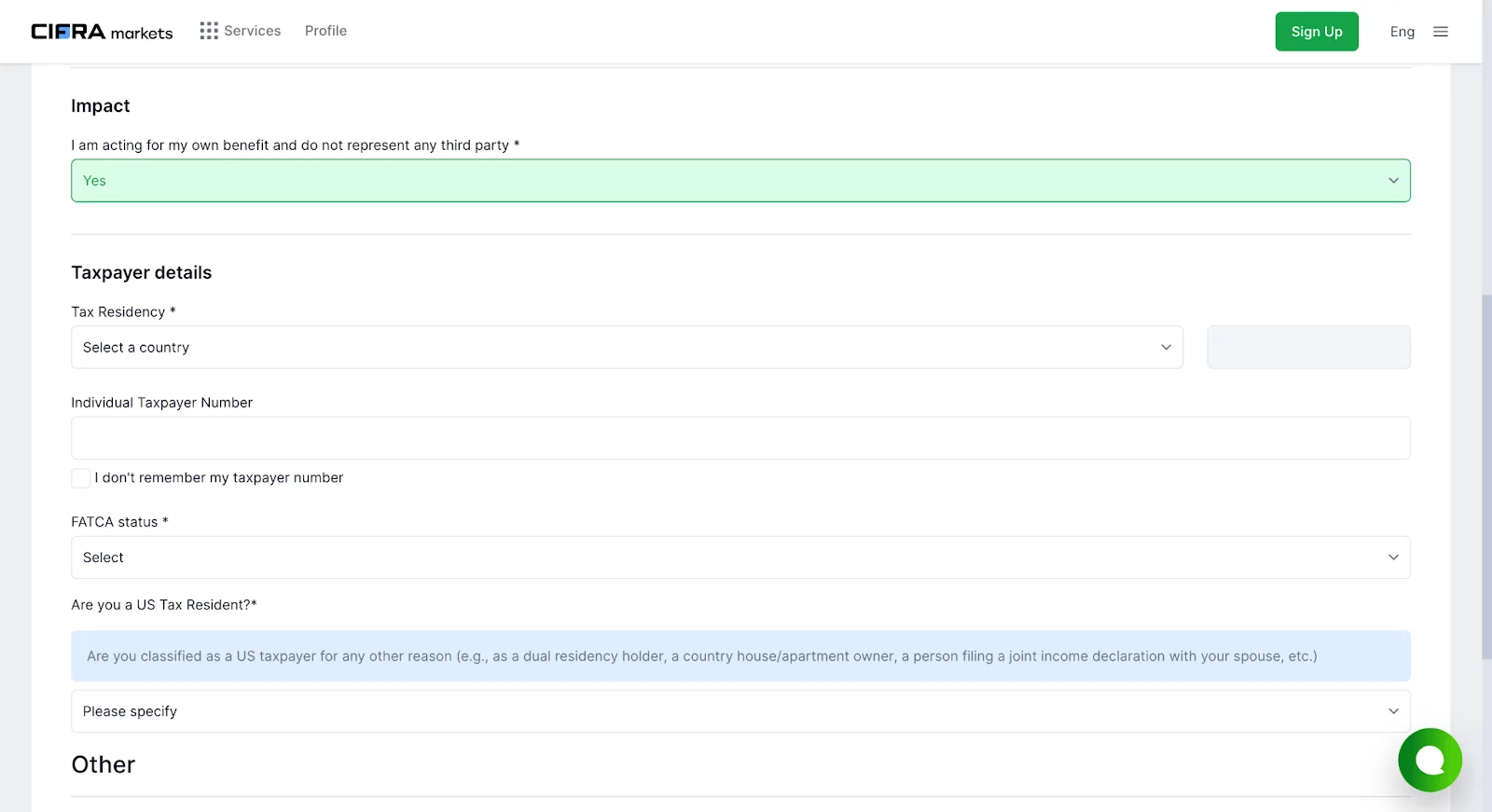
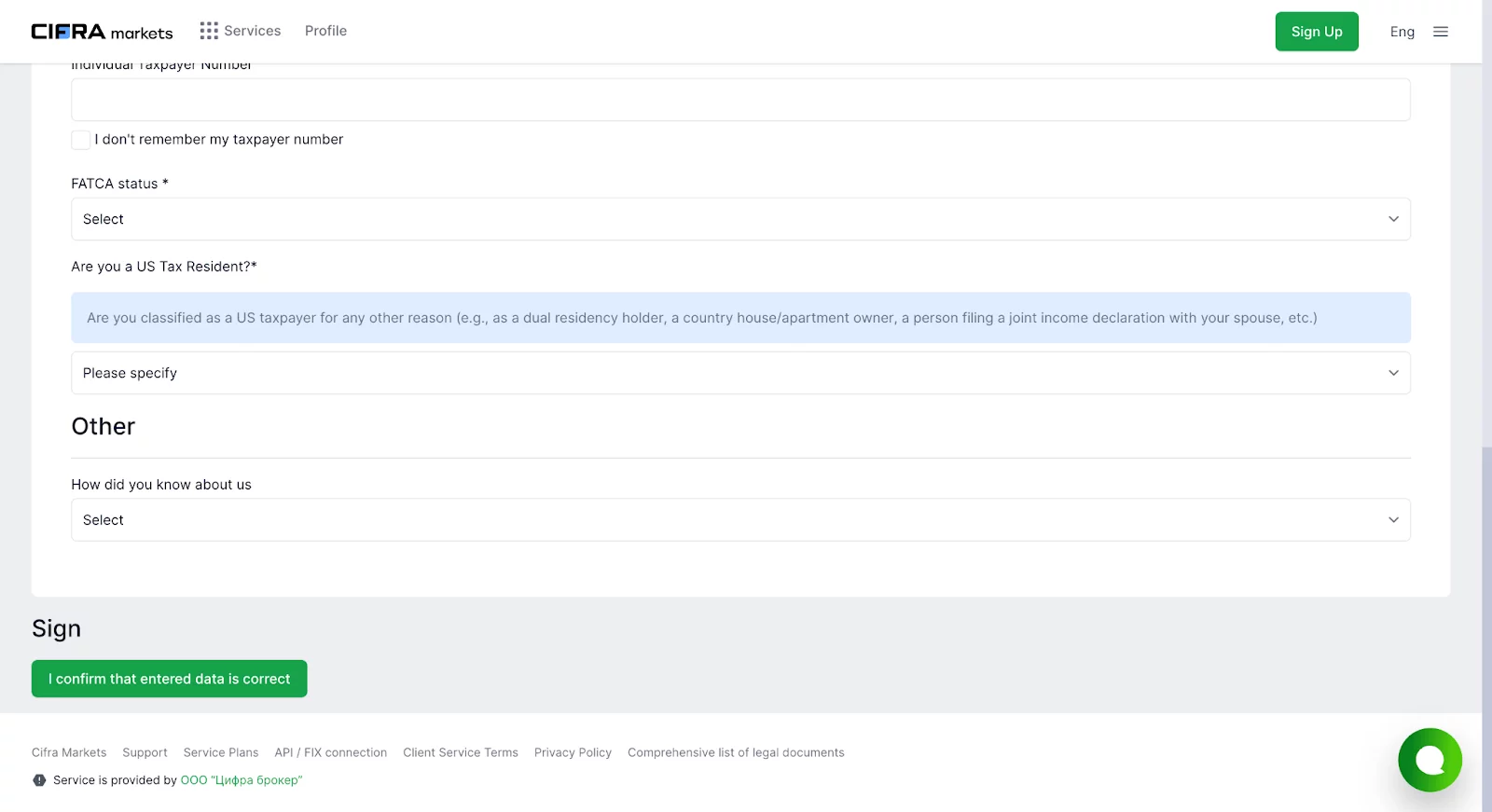
Once the personal information is entered, the next step is to sign the agreement and open an account.
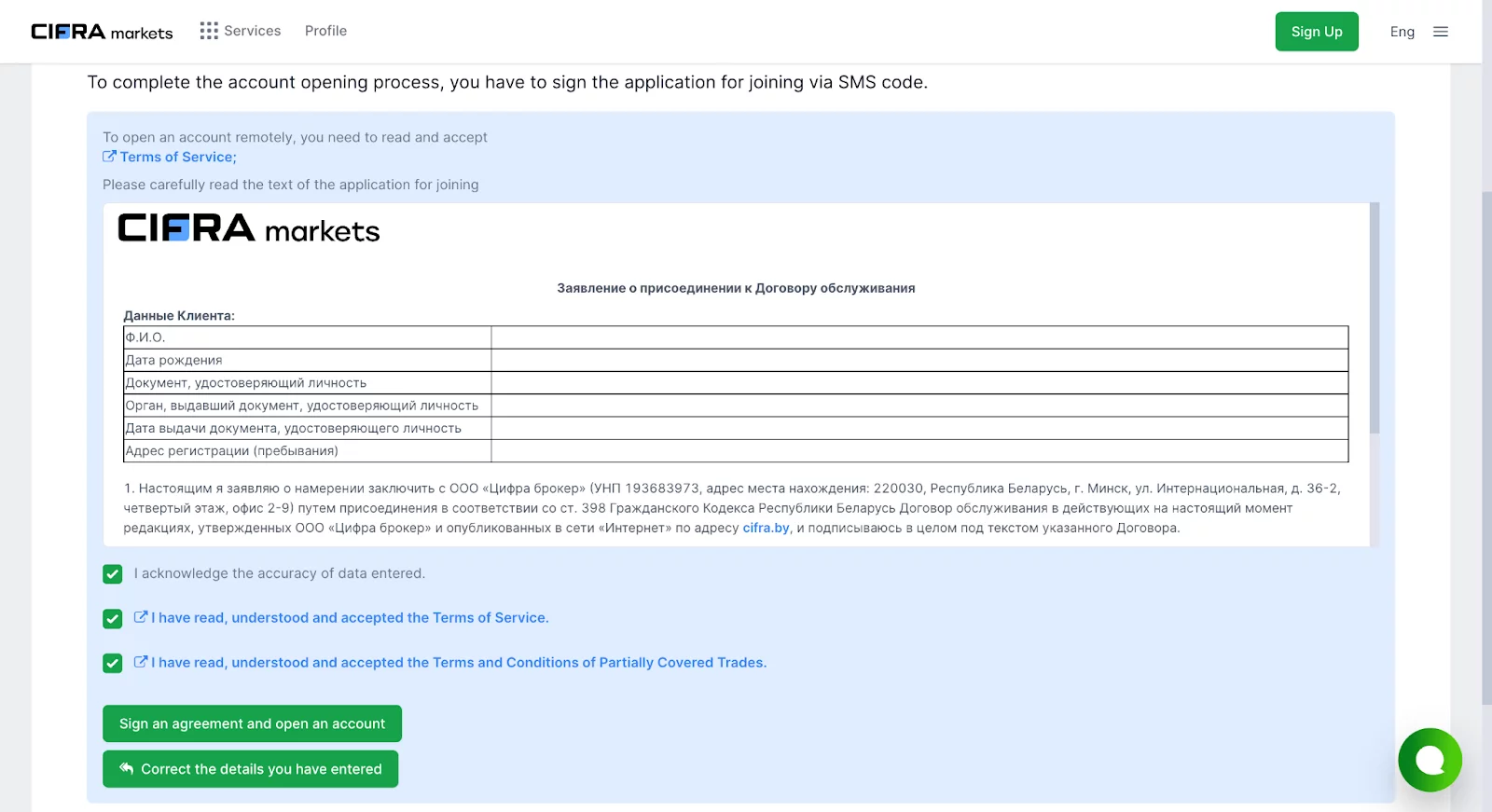
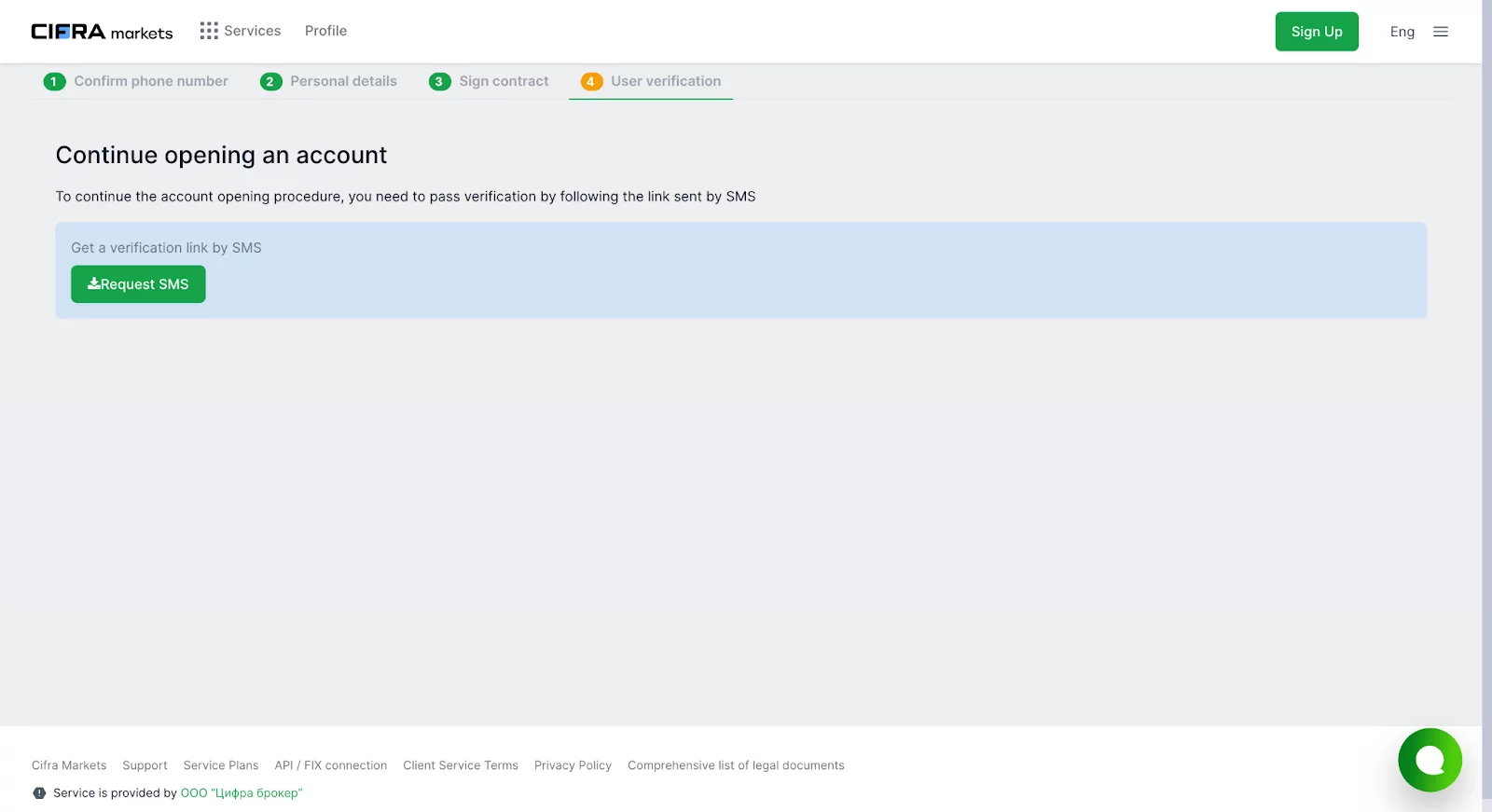
A new tab will open requesting a KYC link via SMS. The link will be sent to the phone number specified earlier. After successful KYC verification, the account will be ready to use.
Who is Cifra best suited for?
Cifra is well-suited for both retail and corporate clients, offering features that cater to individual traders as well as institutional or business-level needs. Retail traders can use the platform for straightforward activities such as buying and holding cryptocurrencies, while institutional clients can leverage advanced tools, including margin trading, tokenized assets, and portfolio management features.
Public review
With a 4.4-star rating on Google Play Store, the Cifra Markets app appears to be a reliable and user-friendly platform for cryptocurrency trading. In one of teh comments, a user said, “A convenient and user-friendly app for working with cryptocurrency. I liked that everything is official and transparent: it’s easy to open an account, there is access to popular coins, and different types of trading. Payments are familiar, support responds quickly, and using it is comfortable.”
However, one user said he was experiencing difficulties logging into the app. The issue was promptly resolved by Cifra’s customer support team, who guided him through the steps to access his account. This demonstrates the company’s responsiveness in addressing user concerns.
Conclusion
Cifra Markets stands out as a regulated, secure, and user-friendly gateway into the world of cryptocurrency. By combining state-level licensing in Belarus, robust AML compliance, and institutional-grade security standards, the platform offers a trustworthy alternative to unverified P2P exchanges that have long dominated the market. Its comprehensive infrastructure, including access to 30+ cryptocurrencies, tokenized U.S. stocks, and margin trading, caters to both retail and institutional users, making crypto trading accessible and efficient for a wide range of participants.
Beyond its technical capabilities, Cifra’s focus on transparency, ease of use, and responsive customer support reinforces its commitment to building confidence among users. For traders and businesses seeking a reliable, legally compliant, and fully-featured crypto brokerage in the CIS and beyond, Cifra Markets delivers a compelling solution that blends security, innovation, and accessibility in one platform.
Disclosure: This content is provided by a third party. Neither crypto.news nor the author of this article endorses any product mentioned on this page. Users should conduct their own research before taking any action related to the company.


Summary
- Coinbase’s x402 payment protocol has joined the Linux Foundation to push an open, standardized infrastructure for AI-native, internet payments.
- A new x402 Foundation has been set up with Coinbase and Cloudflare as co-founders, and Stripe as a founding member, alongside planned participation from firms including Google, AWS, Visa and Mastercard.
- Linux Foundation CEO Jim Zemlin and Google Cloud Web3 head James Tromans say the initiative will advance interoperable, AI-driven transaction standards under transparent, community governance.
Coinbase’s x402 protocol has formally joined the Linux Foundation, with the goal of turning its AI-focused payments stack into an open, standardized layer for internet-native transactions, according to reporting from CoinDesk. Designed to embed stablecoin payments directly into the HTTP 402 “Payment Required” status code, x402 lets APIs, apps and AI agents pay for services programmatically over the web without bolted-on billing flows.
To steward the standard, Coinbase and Cloudflare have created the x402 Foundation, with Stripe as a founding member and a broader coalition of payments and tech companies signaling plans to join. The ecosystem site lists Adyen, Amazon Web Services, American Express, Ant International, Base, Circle, Google, KakaoPay, Mastercard, Microsoft, Polygon Labs, Shopify, Solana Foundation and Visa among organizations that have expressed intent to participate as contributors or partners.
Linux Foundation chief Jim Zemlin said the x402 Foundation will drive development of the protocol “in an open, community-governed way,” emphasizing principles of transparency, interoperability and broad participation. The governance model is designed to keep x402 vendor-neutral: the specification is licensed under Apache 2.0, with “zero protocol fees, zero account creation, zero vendor lock-in,” and any server stack able to implement it in a short timeframe, as one analysis of the emerging payments race put it.
James Tromans, managing director for Google Cloud’s Web3 and digital assets business, said Google’s participation in the foundation reflects a commitment to “supporting interoperable, AI-driven transaction standards” that can work across clouds and networks. Stripe, meanwhile, has added x402 support on Base while also promoting its own solutions, effectively hedging by backing an open protocol alongside proprietary rails, according to recent ecosystem coverage.
Launched by Coinbase in 2025, x402 was pitched as a way to let AI agents, browsers and back-end services pay directly for APIs, content and compute by piggybacking on the existing HTTP request/response flow. A Coinbase developer post explained that a server can respond with a 402 code and payment terms, the client can settle in stablecoins such as USDC, and then automatically retry the request with a proof of payment, all without accounts, subscriptions or manual invoicing.
Cloudflare has already shipped x402 support in its Workers and AI Agents SDK, allowing developers to add machine-to-machine payments at the edge for use cases like model-to-model calls, paywalled APIs and streaming content. With the Linux Foundation now fronting governance and a cross-industry membership lining up behind the x402 Foundation, Coinbase is effectively betting that a neutral, open protocol can become the default way AI systems pay each other over the internet.
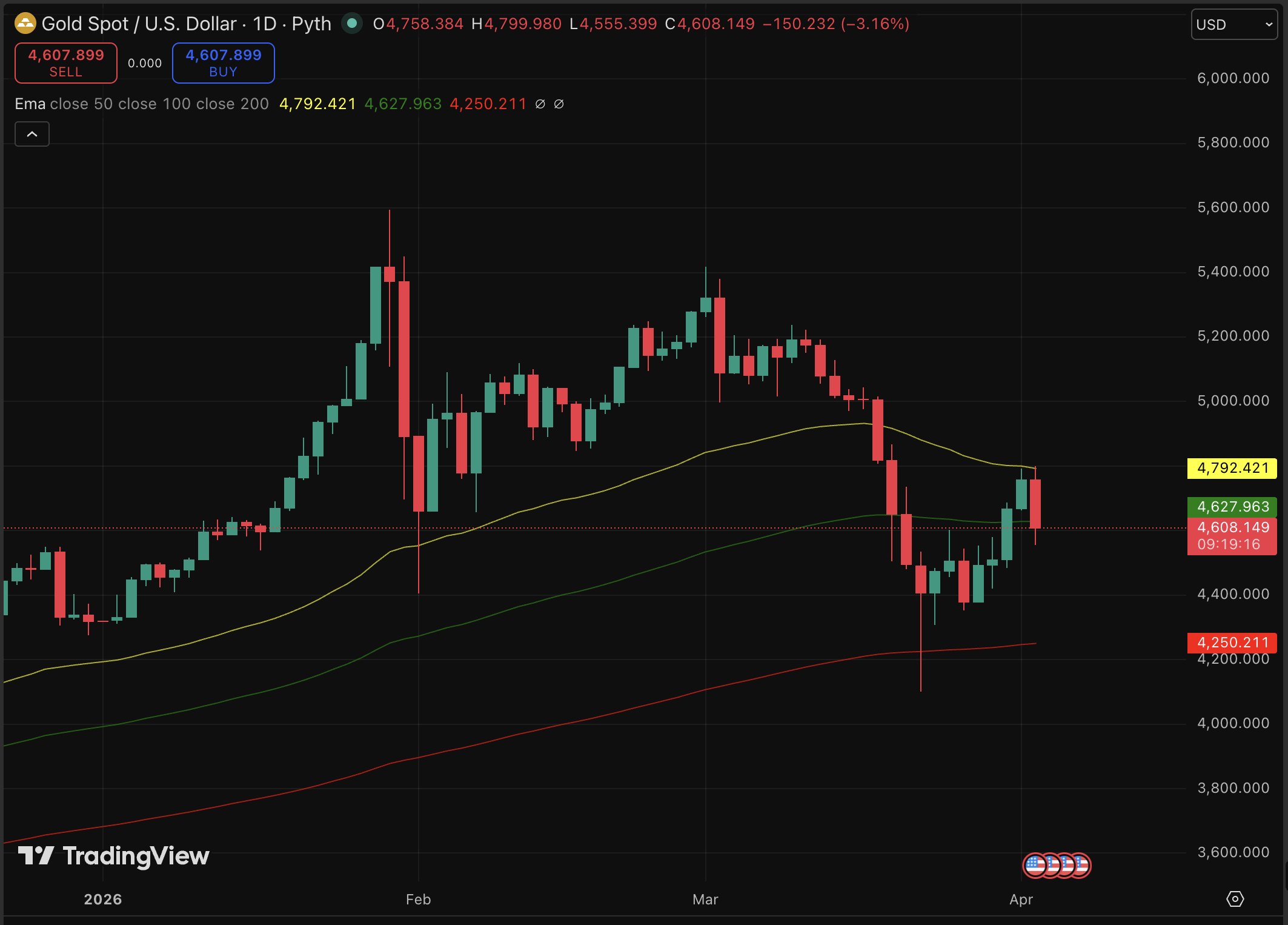
Gold is flashing conflicting signals in today’s prediction, softening price globally, yet renewed physical demand is emerging in key markets. In India, gold traded at a premium this week for the first time in two months, as lower spot prices triggered a surge in physical buying.
This is giving a mixed signal. Indian consumers are price-sensitive and move fast when dips arrive. Meanwhile, geopolitical pressure from the broadening US-Iran conflict continues to create safe-haven crosscurrents, typically bullish for gold. Yet oil is absorbing institutional hedging flows that would historically have landed in gold.
The metal is caught between its own fundamentals and political pressure.
Broader macro conditions, US equity recovery, persistent crypto ETF demand, and Middle East uncertainty are compressing gold’s near-term upside while keeping its floor intact.
Discover: The best pre-launch token sales
Gold Price Prediction: Metal Momentum Melting Away?
Gold spot prices pulled back sharply enough to trigger the first Indian physical premium in two months, signaling that lower prices are clearing demand but not generating fresh upside momentum. Volume patterns suggest buyers are opportunistic at the moment.
Key technical levels to watch: macro analysts tracking cross-asset flows note that gold’s ability to hold above its 50-day moving average will determine whether the current softness is a buyable dip or the early stage of a deeper retracement. Momentum indicators are flat-to-negative on the daily chart, with no clear catalyst for a reversal spike unless geopolitical escalation accelerates safe-haven demand.
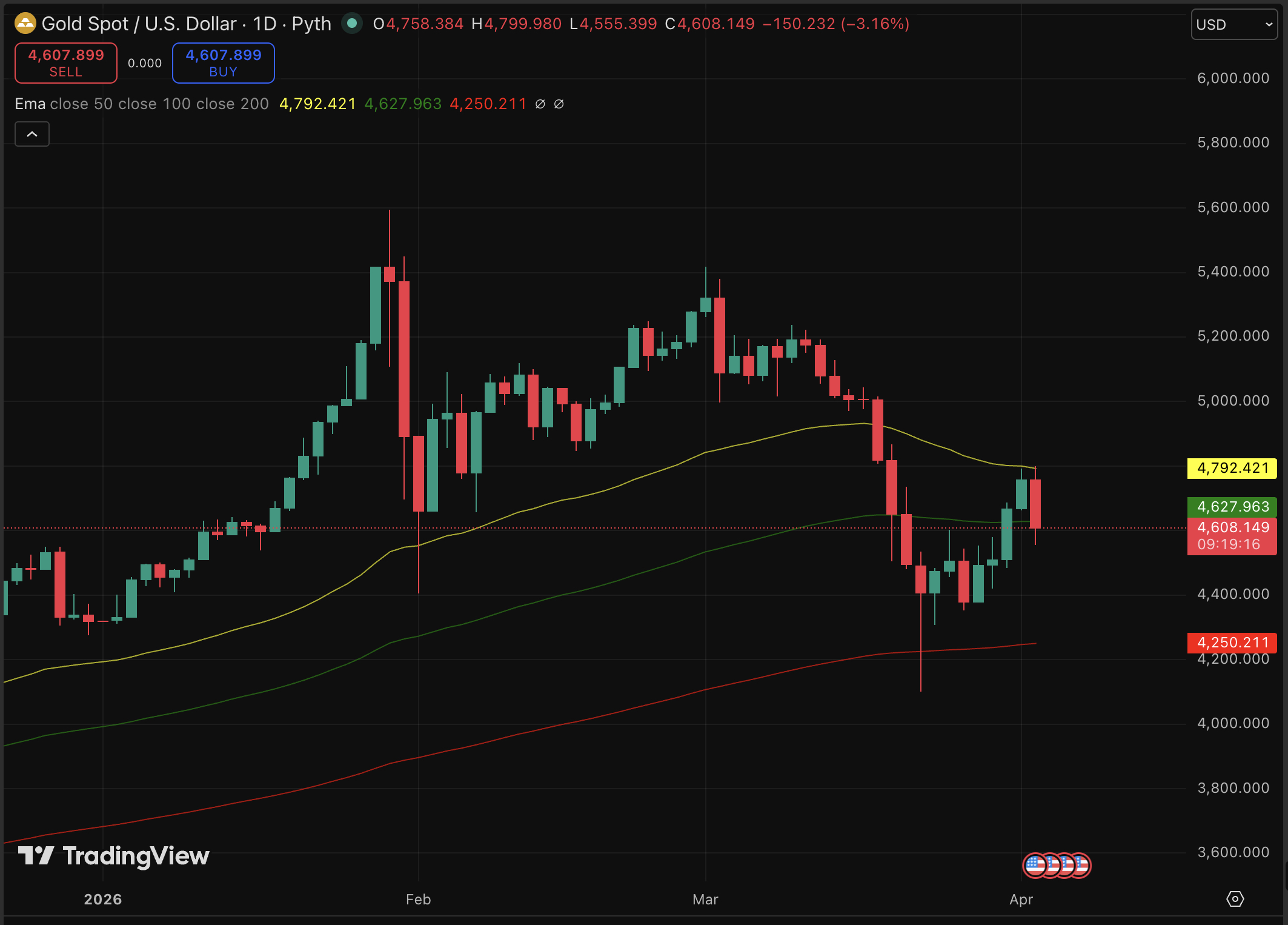
If US-Iran tensions escalate sharply, ETF outflows from equities resume, and gold rebounds toward recent highs on genuine safe-haven rotation. Physical demand provides a price floor, gold consolidates in a tight band, and directional conviction stays low while crypto dominates headlines.
The data points to the base case as most probable near-term. Gold isn’t collapsing.
Discover: The best crypto to diversify your portfolio with
Maxi Doge: The Dog That Eats Metals
Gold’s muted momentum is precisely the environment that pushes speculative capital toward higher-velocity opportunities. Those hunting asymmetric upside aren’t waiting for gold to find direction. They’re looking earlier in the cycle.
Maxi Doge ($MAXI) is an ERC-20 meme token built around a 240-lb canine juggernaut embodying 1000x leverage trading mentality.
The presale has raised more than $4,7 million at a current price of just $0.0002811, with 66% APY staking as a bonus for holders. Features include Holder-Only Trading Competitions with leaderboard rewards, a Maxi Fund treasury for liquidity and partnerships, and meme-first viral marketing with measurable community traction.
Research Maxi Doge before committing capital.
This article is not financial advice. Conduct your own research before investing.
The post Gold Price Prediction: Metal Price Melting appeared first on Cryptonews.

Speculation is growing online that Iran’s parliament speaker, Mohammad Bagher Ghalibaf, may be posting on X with help from inside the United States.
The theory stems from unusually polished English posts, US-focused messaging, and an account label showing “connected via the US App Store.” Some users claim the tone feels “too American” to be organic.
However, there is no clear evidence that the account is run from the US or by Americans. The App Store label can reflect device settings or routing, not physical location.
American commentators are overstating these details. X settings show that Ghalibaf’s account was most likely accessed via an iPhone using a US-region Apple ID, or a VPN / routing setup
So, it doesn’t prove physical presence in the US.
What is clear is the messaging itself has changed.
Ghalibaf, a former IRGC commander and now a central political figure in Iran’s wartime leadership, has begun speaking directly to American audiences.
He references gas prices, economic hardship, and political decisions in Washington. His posts increasingly mirror US political language and online culture.
At the same time, he has made comments that resemble market commentary. In one example, he suggested investors should interpret political signals as indicators of market direction.
These posts stop short of financial advice but frame the war through economic consequences.
This shift aligns with a broader strategy. Iranian officials are using English-language posts to shape foreign public opinion during the conflict.
By focusing on economic pain and market reactions, Ghalibaf’s messaging makes the war feel immediate to US audiences.
The bigger story may not be where the posts come from, but why they sound this way. Ghalibaf is not just acting as a political figure in the war.
He is operating in the information space, where influence over perception can matter as much as actions on the ground.
The post Why Iran’s Top War Operator Suddenly Sounds Very American appeared first on BeInCrypto.

Key Takeaways
- The OCC has granted Coinbase conditional authorization to establish a federally chartered trust entity
- This charter is limited to custody operations and market infrastructure, excluding retail deposits and traditional banking
- Final approval hinges on Coinbase completing multiple regulatory and administrative requirements
- The federal designation is anticipated to expand Coinbase’s reach among institutional investors
- Coinbase’s current New York state trust charter and BitLicense continue operating without interruption
The Office of the Comptroller of the Currency has issued conditional authorization for Coinbase (COIN) to launch Coinbase National Trust Company, a federally chartered trust institution.
This OCC charter is tailored exclusively for custody operations and market infrastructure services. The crypto exchange will not accept consumer deposits or function as a conventional fractional reserve banking institution under this authorization.
According to Greg Tusar, Co-CEO of Coinbase Institutional, the clearance provides “federal regulatory uniformity to the custody and market infrastructure business we have been building for years.”
Coinbase filed its national trust charter application with the OCC in October of last year. The platform currently operates under a limited-purpose trust charter issued by the New York Department of Financial Services, which authorizes digital asset custody services at the state level through Coinbase Prime, its institutional division.
The federal charter represents a significant upgrade. “We’re the custodian to over 80% of the world’s digital asset ETFs, but there are a number of other asset managers and hedge funds and others that would like to see the entity that they face have this kind of charter,” Tusar explained.
Essentially, the OCC certification unlocks opportunities that state-level authorization alone cannot provide.
Coinbase’s institutional division reported $245.7 billion in assets under custody as of June 2025 — representing approximately 7% of the entire cryptocurrency market, based on figures from its charter filing.
Outstanding Requirements for Final Approval
Conditional authorization differs from full approval. Before the charter becomes operational, Coinbase must convene its inaugural board meeting, implement corporate bylaws, set up payment infrastructure, and successfully complete a pre-launch examination by the OCC.
The company has committed to collaborating closely with OCC regulators to satisfy all outstanding conditions.
Meanwhile, Coinbase’s existing New York BitLicense and state-level trust charter remain active and unchanged. Coinbase, Inc. continues its operations under NYDFS supervision without disruption.
Other Applicants Pursuing Federal Charters
Coinbase isn’t the only crypto firm seeking this regulatory status. The OCC granted conditional approvals to multiple digital asset companies late last year, including BitGo, Circle Internet Group, Fidelity Digital Assets, Ripple, and Paxos.
Additionally, EDX Markets — backed by Morgan Stanley and Citadel Securities — along with World Liberty Financial, the Trump family’s most significant cryptocurrency initiative, have submitted national trust charter applications.
The federal charter also establishes infrastructure for emerging payment solutions and complementary financial services, targeting both institutional partners and retail users as primary beneficiaries.
While Congress has moved forward with market structure legislation, federal supervision of crypto custody providers has remained inconsistent. This OCC approval fills that regulatory void for institutional services without requiring completed legislative action.

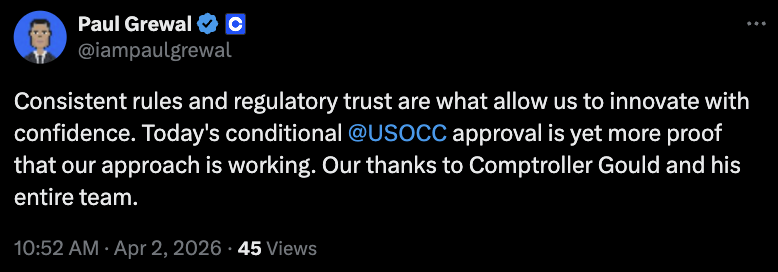
The US Office of the Comptroller of the Currency (OCC) has approved cryptocurrency exchange Coinbase’s application for a national bank trust charter after six months of consideration.
In a Thursday X post, Coinbase chief legal officer Paul Grewal said the company received conditional approval for the OCC application, following December approvals for Ripple Labs, BitGo, Circle, Fidelity Digital Assets and Paxos.
Although the company said in October it had “no intention of becoming a bank” if approved, the move by US regulators marks one of the most significant forays into bridging crypto and traditional finance.

“Coinbase is not becoming a commercial bank,” said vice president of institutional product Greg Tusar in a Thursday blog post. “We will not be taking retail deposits. We will not be engaging in fractional reserve banking. This charter is about bringing federal regulatory uniformity to the custody and market infrastructure business we have been building for years.”
Tusar said that the company would continue to operate under the Department of Financial Services in New York, where it holds a BitLicense and a state charter as a limited-purpose trust company.
The OCC approval, coupled with Coinbase’s state-level efforts, came as the company is in the middle of a debate on issues stalling a digital asset market structure bill in Congress, including over stablecoin yield.
CEO Brian Armstrong said in January that the exchange could not support the legislation as written. Lawmakers on the Senate Banking Committee later postponed a markup, which is necessary before a potential floor vote on the bill.
Related: Coinbase exec says Senate CLARITY compromise is close, but no markup date set
At the time of publication, the OCC website showed no change to Coinbase’s application, which it marked as received by the banking regulator. Cointelegraph reached out to the exchange for comment but did not receive an immediate response.
Coinbase faces legal pushback over prediction markets
The crypto platform rolled out prediction market bets for US-based users in January as part of a partnership with Kalshi.
In lawsuits filed preemptively against state gaming authorities in Connecticut, Illinois and Michigan, Coinbase argued that the US Commodity Futures Trading Commission, as a federal regulator, had the authority to oversee prediction markets. Many of the cases were ongoing as of Thursday.
Magazine: AI agents will kill the web as we know it: Animoca’s Yat Siu


The U.S. Commodity Futures Trading Commission and Department of Justice filed a lawsuit against Illinois and various state officials on Thursday over the state’s efforts to shutter prediction market providers.
Illinois sent cease-and-desist letters to some prediction market providers, arguing that the companies were offering sports gambling products that should be regulated under state law. The CFTC has argued that prediction markets are offering swaps products, which are regulated under the federal Commodity Exchange Act and therefore are under the “exclusive jurisdiction” of that regulator.
In the lawsuit, the CFTC continued this argument, saying Illinois’s efforts “intrudes on” the CFTC’s role, and that federal law preempts state regulations in this matter.
“Event contracts are derivative instruments that enable parties to trade on their predictions about whether a future event — which may relate to economics, or elections, or climate, or sports, or anything else of a potential financial, economic or commercial consequence — will occur,” the filing said.
The CFTC, especially under current Chairman Mike Selig, has argued that prediction markets are federally regulated, even as many of these companies expand to allow customers to place bets on sporting events. States, under both Republicans and Democrats, have pushed back. Nevada’s Gaming Control Board secured a temporary restraining order against Kalshi last month, with a hearing set for Friday.
The CFTC will participate in an appeals court hearing before the Ninth Circuit later this month, in a consolidated case involving the North American Derivatives Exchange, Kalshi and Robinhood.
Read more: Prediction markets backlash builds possible stormcloud for 2027


Anthony Scaramucci is openly backing Michael Saylor’s high‑yield Bitcoin strategy at the same time he jolts markets with a tongue‑in‑cheek X video announcing a 2028 presidential run, sharpening the line between his crypto advocacy and broader economic message.
Summary
- Scaramucci calls himself a “big fan” of Michael Saylor while dissecting Strategy Inc.’s roughly 11.5% perpetual yield tied to Bitcoin, warning that leverage and drawdowns remain real risks.
- In a previous crypto.news story, he linked that same wealth‑gap narrative to stalled CLARITY legislation in Washington and his long‑term Bitcoin thesis.
- His April 1 “Mooch 2028” video on X, framed as an April Fools’ gag, doubles as a campaign‑style address on inequality, debt and digital assets.
In a recent episode of the All Things Markets podcast, SkyBridge Capital founder Anthony Scaramucci and Galaxy Digital CEO Mike Novogratz pulled apart Strategy Inc.’s (NASDAQ: MSTR) use of high‑yield perpetual securities, which Scaramucci said can deliver “four quarterly dividend payments equivalent to a yield of approximately 11.5%” for Bitcoin believers. He was explicit about his own position: “I’m a big fan of Saylor, and obviously SkyBridge owns a lot of Bitcoin. We don’t hold any of those assets, but I just wanted to disclose that to people.”
Saylor’s 11.5% Bitcoin‑backed yield under scrutiny
Novogratz stressed the structure’s dependence on leverage: “It’s leverage on the strategy,” he said, arguing Saylor currently enjoys a “big margin of safety” because of his large Bitcoin corpus but that a sharp drop in BTC would “inevitably” eat into that cushion. He warned that if Bitcoin crashed to around $30,000, perpetual investors “naturally” fear losing principal, because they “don’t have the right to get their money back” and Saylor can theoretically halt dividends, which would likely push the instrument to a steep discount.
That nuanced pitch to yield‑hungry Bitcoin holders landed just hours before Scaramucci’s latest viral video on X, where he stood in his office wearing a “Mooch 2028” cap and declared, “I’m running for President of the United States in 2028… Join me and help me heal America.” The clip, posted on April Fools’ Day, was quickly framed by outlets like Benzinga and Breitbart as a prank, but it reads like a test balloon: he references his ill‑fated 11‑day stint in Donald Trump’s first White House and insists, “I do believe I can help guide this country in the right direction.”
In a separate BeInCrypto interview covered by BloomingBit, Scaramucci said that passing the CLARITY Act, Washington’s flagship crypto market‑structure bill, is “not an easy situation,” adding that “in the current political environment, securing 60 votes in the Senate is almost impossible.” Earlier comments to Coinness underscored how partisan rancor over Trump’s launch of a memecoin, which he said earned between $600 million and $700 million, has further poisoned the well for bipartisan crypto rules.
Price‑wise, Scaramucci has hardly turned cautious: in February he told Benzinga that Bitcoin “doesn’t reward being early, but being patient,” even as BTC traded near $70,981, down about 7.2% on the day, and more recently has floated scenarios of $2 million to $3 million per coin over the next decade. For a would‑be “Mooch 2028” candidate, the message is clear enough — leverage can juice returns, but the real bet is that Bitcoin outlasts U.S. political dysfunction.

Coffee Break: Santa Croce Tote

ICC prosecutor who issued arrest warrant for Benjamin Netanyahu facing disciplinary proceedings | World News

SpaceX prepares for largest ever IPO with potential $1.75 trillion valuation


-

 Business7 days ago
Instagram, YouTube Found Responsible for Teen’s Mental Health Struggle in Historic Ruling
-

 NewsBeat6 days ago
The Story hosts event on Durham’s historic registers
-

 Sports6 days ago
Sweet Sixteen Game Thread: Tide vs Michigan
-
Entertainment3 days ago
Fans slam 'heartbreaking' Barbie Dream Fest convention debacle with 'cardboard cutout' experience
-
 Entertainment5 days ago
Lana Del Rey Celebrates Her Husband’s 51st Birthday In New Post
-
Crypto World2 days ago
Dems press CFTC, ethics board on prediction-market insider trades
-

 Crypto World21 hours ago
Gold Price Prediction: Worst Month in 17 Years fo Save Haven Rock
-

 Tech4 days ago
The Pixel 10a doesn’t have a camera bump, and it’s great
-

 Sports2 days ago
Tallest college basketball player ever, standing at 7-foot-9, entering transfer portal
-

 Tech2 days ago
EE TV is using AI to help you find something to watch
-

 Fashion5 days ago
Amazon Sundays: Soft Spring Layers
-

 Tech3 days ago
Apple will hide your email address from apps and websites, but not cops
-

 Tech2 days ago
How to back up your iPhone & iPad to your Mac before something goes wrong
-

 Politics3 days ago
Should Trump Be Scared Strait?
-

 Tech3 days ago
Flipsnack and the shift toward motion-first business content with living visuals
-

 Crypto World3 days ago
U.S. rule change may open trillions in 401(k) funds to crypto
-

 Business7 days ago
Chinese universities with military links bought Super Micro servers with restricted AI chips
-

 Fashion6 days ago
Weekly News Update, 3.27.26 – Corporette.com
-

 Tech4 days ago
Elon Musk’s last co-founder reportedly leaves xAI
-
 Crypto World4 days ago
Bitcoin’s Six-Month Losing Streak: What On-Chain Data Says About the Market’s Next Move
You must be logged in to post a comment Login