More than $273 million in bearish crypto positions were unwound in under 24 hours on April 6, as reports of US-Iran ceasefire talks triggered a sudden and sharp shift in market sentiment.
Summary
Bloomberg reported that roughly $273 million in bearish crypto bets were unwound within 24 hours as ceasefire headlines hit, with short sellers accounting for the overwhelming majority of losses
Ethereum led altcoin gains with a 5.1% move, while Bitcoin climbed more than 3% and the total crypto market cap crossed back above $2.5 trillion
Rising open interest in both Bitcoin and Ethereum outpaced spot price gains, pointing to fresh capital entering the market rather than a purely mechanical short squeeze
Bears paid a heavy price on Monday. Bloomberg reported that roughly $273 million in bearish crypto bets were unwound within 24 hours, with short positions absorbing the vast majority of losses in a near 3-to-1 ratio over longs. The trigger was an Axios report that the US, Iran, and a group of regional mediators are discussing a potential 45-day ceasefire. Within hours of the report surfacing, risk assets snapped higher and over-leveraged bearish positions were forced to cover.
Bitcoin’s 24-hour range ran from $66,634 to $69,350, a $2,700 swing that caught the worst of the short positioning built up over the Easter weekend.
Advertisement
Ethereum led the major assets with a gain of 5.1%, the largest percentage move among top tokens and a direct reflection of how concentrated bearish exposure had become on the second-largest network. SOL added 2%, XRP climbed 2.2%, and ADA, AVAX, and LINK all posted double-digit increases in open interest alongside positive funding rates, extending the risk-on move well beyond Bitcoin.
The total crypto market cap crossed back above $2.5 trillion, recovering roughly $70 billion on the day.
Why the Short-Side Was So Crowded
Heading into the Easter break, sentiment had collapsed after weeks of escalating US-Iran war headlines and a string of ceasefire hopes that failed to convert into anything concrete. As crypto.news reported, the Bitcoin derivatives market had been sitting between a $1.143 billion long liquidation wall below $65,000 and a $754 million short pocket above $68,000. That structure left the market tightly wound and vulnerable to a sharp move in either direction.
Advertisement
Traders who had positioned for continued downside were essentially betting the $65,000 to $73,000 war range would hold or break lower. Monday’s ceasefire headlines upended that positioning in a matter of hours.
Open Interest Data Points to More Than a Squeeze
What separates Monday’s move from prior headline-driven spikes is how open interest behaved. In both Bitcoin and Ethereum, open interest climbed at a faster pace than spot prices, suggesting fresh capital flowing into the market rather than mechanical short covering alone. That distinction matters: a pure short squeeze exhausts itself quickly, while new capital entering can sustain a move.
As crypto.news noted in its analysis of Monday’s ceasefire developments, a confirmed deal could reduce oil prices and ease inflation pressures, improving the case for a more accommodative Federal Reserve stance. Caution remains warranted. Polymarket currently puts the odds of a ceasefire by April 30 at roughly 30%, and several major tokens including BCH and HYPE are still showing negative funding rates, signalling pockets of bearish positioning that have not yet been cleared.
April deadline set for Senate Banking Committee vote on comprehensive crypto framework
Legislators work to clarify jurisdictional boundaries between SEC and CFTC
Election cycle considerations accelerate timeline for digital asset legislation
Policy disputes over stablecoins and token classification near resolution
Committee markup process represents critical milestone for regulatory clarity
The United States Senate is positioning itself for a significant advancement in digital asset policy as April emerges as the critical month for legislative action. With the Senate Banking Committee preparing to restart formal proceedings, a comprehensive regulatory framework may finally transition from prolonged discussions to concrete legislative measures.
Committee Leadership Confirms April Restart for Digital Asset Legislation
Senator Bill Hagerty has publicly confirmed that the Senate Banking Committee intends to reconvene discussions on cryptocurrency policy during April. Committee leadership has expressed determination to advance the proposed legislation through formal markup procedures in the coming weeks. This commitment reflects a significant shift in momentum following extended periods of legislative inactivity.
Lawmakers temporarily suspended earlier initiatives following political challenges and persistent disagreements over fundamental policy elements. Nevertheless, committee participants now demonstrate greater consensus regarding the necessity of moving forward with structured legislative action. Consequently, the upcoming month represents a potentially transformative period for federal cryptocurrency policy development.
Before any consideration reaches the full Senate chamber, the Banking Committee must complete its comprehensive review and formal approval procedures. Additionally, collaboration with the agriculture committee remains essential given the overlapping supervisory responsibilities for commodity-related digital assets. Therefore, successful advancement requires sustained cooperation across multiple legislative bodies.
Advertisement
Regulatory Authority Division Remains Central to Legislative Framework
The proposed legislative structure focuses extensively on establishing clear jurisdictional boundaries between the Securities and Exchange Commission and the Commodity Futures Trading Commission. Presently, both regulatory agencies maintain competing claims over various categories of digital assets. This ambiguity has created an environment where enforcement actions substitute for comprehensive regulatory guidance.
The SEC’s approach typically classifies numerous digital tokens as securities requiring registration and disclosure compliance, whereas the CFTC designates prominent cryptocurrencies as commodities subject to futures market oversight. Such divergent interpretations have resulted in fragmented enforcement rather than coherent industry standards. Accordingly, the pending legislation attempts to establish definitive jurisdictional parameters and eliminate regulatory overlap.
Draft provisions include mandatory licensing frameworks for cryptocurrency exchanges and custodial service providers. Additional requirements would establish standardized disclosure obligations for entities issuing new tokens. These measures collectively aim to create predictable compliance pathways throughout the digital asset ecosystem.
Electoral Considerations and Stakeholder Engagement Shape Legislative Schedule
The accelerated timeline for cryptocurrency legislation reflects increasing awareness of digital asset policy as an electoral consideration ahead of 2026 congressional elections. Legislative leaders acknowledge the expanding political influence exercised by cryptocurrency advocacy organizations and industry coalitions. This recognition has elevated regulatory clarity to a matter of strategic political importance.
Advertisement
Coinbase representatives and allied industry participants have reported meaningful progress in resolving previously contentious policy matters. Outstanding concerns regarding stablecoin interest-bearing functionality and ethical questions surrounding asset tokenization appear closer to compromise. These developments suggest that major obstacles to bipartisan support may be diminishing.
Political action committees focused on cryptocurrency issues have substantially increased their financial participation and campaign engagement throughout recent election cycles. This expanding political footprint continues to influence legislative agenda-setting within Congress. Subsequently, digital asset regulation has become intertwined with broader electoral strategy considerations.
Lawmakers recognize the strategic value of securing committee approval before campaign activities intensify later in the year. However, several technical specifications and jurisdictional details require additional negotiation and refinement. Accordingly, while legislative momentum has clearly increased, final passage remains contingent on resolving these remaining complexities.
Achieving a positive committee vote would establish the first comprehensive legislative framework for digital assets at the federal level. Such progress would significantly reduce the regulatory uncertainty that has constrained domestic innovation and market development. Ultimately, this legislative initiative could fundamentally alter the United States’ approach to digital financial infrastructure and establish a model for coordinated regulatory oversight.
President Trump’s Tuesday deadline to Iran creates a pivotal moment for Bitcoin as it continues to decouple from gold.
While a ceasefire could boost equities, Bitcoin’s $75,000 path depends on its role as a hedge against fiscal instability.
BTC may benefit from (no) US-Iran ceasefire
There is a high probability that US President Donald Trump’s Tuesday deadline to Iran could be the catalyst needed for a Bitcoin (BTC) rally above $75,000.
Should a deal fail to materialize, Bitcoin’s risk perception could strengthen due to its unique decentralized properties. Conversely, a positive outcome in negotiations would likely propel risk assets, including Bitcoin.
President Trump issued an ultimatum to Iran on Sunday, warning the nation would be “living in Hell” if the Strait of Hormuz is not reopened by Tuesday at 8:00 pm ET. However, CNBC reports that Trump has been “vacillating” between productive dialogue and the intensification of military action.
Advertisement
Senior Iranian officials reportedly stated the strait will remain blocked until Iran receives compensation for war damages.
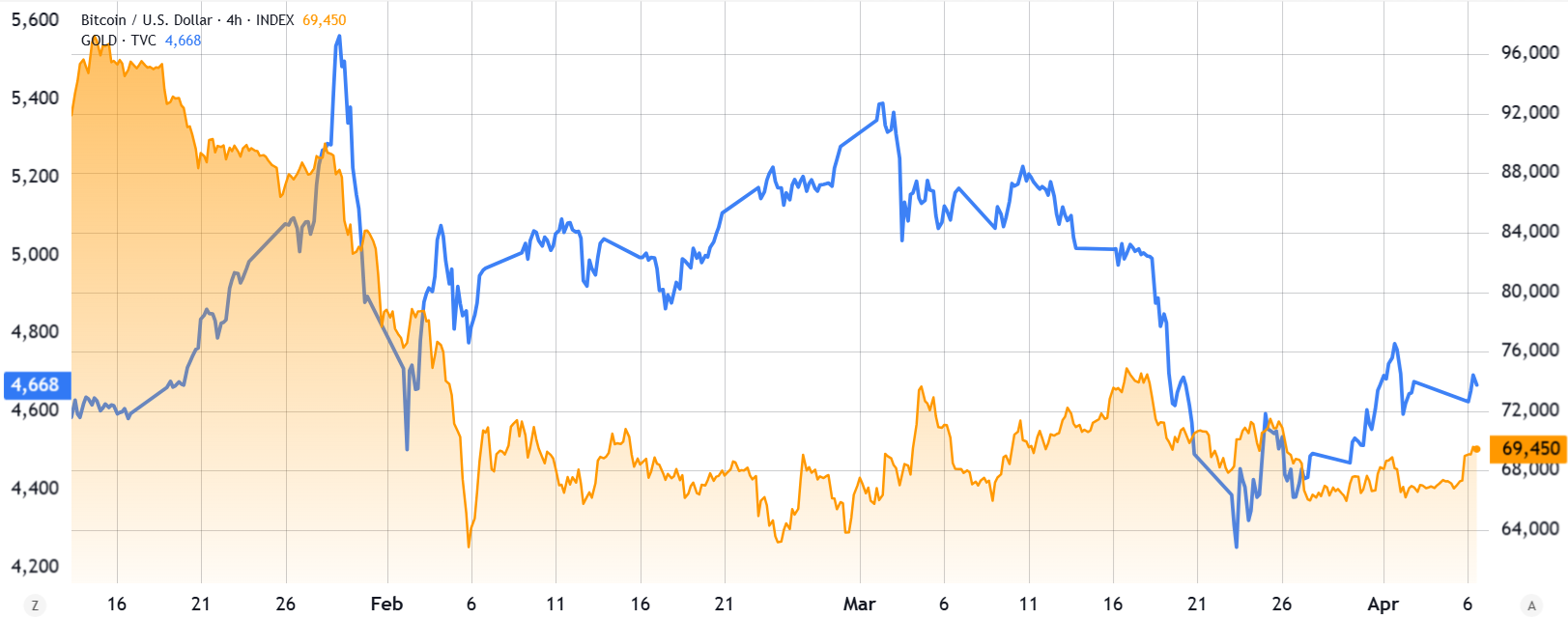
Gold/USD (left) vs. Bitcoin/USD (right). Source: TradingView
These mixed signals failed to convince market participants on Monday, as US stock markets traded mostly flat. In contrast, Bitcoin jumped above $69,000 for the first time in over 10 days—a trend made more notable by gold prices holding near $4,650, down 17% from a $5,600 all-time high.
Bitcoin slowly catching up to gold
Traders are increasingly concerned that central banks will be forced to liquidate their gold reserves. The Turkish Central Bank reported sales of 50 tonnes of gold for the week ending March 20, the sharpest decline in over seven years.
According to Reuters, Turkey has also sold $26 billion in foreign currencies to stabilize markets since the US and Israel-Iran war broke out in late February. Similarly, Russian gold reserves measured in tons have dropped to their lowest levels in four years.
A ceasefire in Iran, even if temporary, would almost certainly bolster risk markets, though the implications for Bitcoin are less certain.
Advertisement
Traditional corporations remain heavily dependent on energy costs and global logistics. Therefore, any reduction in geopolitical risk is immediately reflected in equity prices.
However, a deal between the US and Iran would likely have a less direct impact on Bitcoin, as a resolution would likely strengthen the demand for US Treasuries.
Crude West Texas Oil (left) vs. US 5-year Treasury yield (right). Source: TradingView
Yields on the US 5-year Treasury note surged to 4% from 3.55% in late February, signaling that investors are demanding higher returns to hold those bonds. While part of this selling pressure stems from fears of sticky inflation driven by high oil prices, there is also the added burden on the US fiscal debt due to increased spending on military operations.
An eventual ceasefire and renewed confidence in the US Treasury reduces the necessity for alternative hedges and independent financial systems such as Bitcoin.
However, even if the Strait of Hormuz is reopened, Mohit Mirpuri, an equity fund manager at SGMC Capital, warned that “the damage to confidence and supply chains is already done — things don’t just snap back to normal.”
Predicting that the Bitcoin price will rally 8% by Tuesday based solely on a potential resolution to the US and Israel-Iran war seems far-fetched. Investors are gradually adjusting to President Trump’s characteristic back-and-forth, especially when negotiations involve unreliable third parties.
Traders are unlikely to provide the benefit of the doubt in this instance, so sustainable bullish momentum for risk markets could take longer to materialize. Nevertheless, the case for a $75,000 Bitcoin rally remains possible in the event of a positive outcome by Tuesday.
This article is produced in accordance with Cointelegraph’s Editorial Policy and is intended for informational purposes only. It does not constitute investment advice or recommendations. All investments and trades carry risk; readers are encouraged to conduct independent research before making any decisions. Cointelegraph makes no guarantees regarding the accuracy or completeness of the information presented, including forward-looking statements, and will not be liable for any loss or damage arising from reliance on this content.
Prediction platform Polymarket is overhauling its exchange infrastructure in the coming weeks, introducing a new collateral token and upgraded trading system that give the platform greater control over settlement and risk as it moves toward closer alignment with US regulatory expectations.
In an announcement on Monday, Polymarket said it will deploy new exchange contracts — dubbed version 2 — designed to simplify how orders are structured and matched. The upgrade is intended to make trading more efficient and to make it easier for developers to connect apps and trading bots to the platform.
The new system will also support EIP-1271, an Ethereum standard that allows smart contract-based wallets, such as multisigs and automated trading systems, to sign transactions, expanding compatibility beyond traditional wallets.
A central component of the upgrade is the introduction of Polymarket USD, a new collateral token that will replace USDC.e, the bridged version of USDC (USDC) previously used on the platform. The new token is fully backed 1:1 by USDC, giving Polymarket more direct control over its settlement layer while reducing reliance on bridged assets.
Advertisement
For most users, the transition will be handled automatically through the platform’s interface, requiring only a one-time approval.
The upgrade is expected to roll out over the next few weeks, though the company has not provided a specific timeline.
Source: Polymarket
US regulatory approval shapes Polymarket expansion
The move follows Polymarket’s broader efforts to curb manipulation and insider-trading risks, as it seeks to strengthen market integrity and align more closely with US regulatory standards.
In November, Polymarket received approval from the Commodity Futures Trading Commission to operate an intermediated trading platform in the United States, clearing the way for its return after previously exiting the market.
Advertisement
Following that approval, Polymarket said it plans to onboard brokers and customers directly and facilitate trading through regulated US venues.
Interest in prediction markets has continued to grow, with users increasingly turning to these platforms to trade on real-world outcomes tied to politics, markets and policy. Industry data shows Polymarket’s fee revenue increasing in recent weeks after the platform expanded trading fees.
Polymarket’s fees and other revenue have climbed sharply since the end of March. Source: DeFiLlama
Cointelegraph is committed to independent, transparent journalism. This news article is produced in accordance with Cointelegraph’s Editorial Policy and aims to provide accurate and timely information. Readers are encouraged to verify information independently. Read our Editorial Policy https://cointelegraph.com/editorial-policy
JPMorgan CEO Jamie Dimon said “new technologies” are intensifying competition across the financial sector, with blockchain-based players emerging alongside traditional rivals.
In his annual shareholder letter on Monday, Dimon identified artificial intelligence, data and advanced technology as “key to the future,” signaling a shift toward more automated, data-driven financial services.
While blockchain and digital assets were not a central focus, Dimon acknowledged that “a whole new set of competitors is emerging based on blockchain, which includes stablecoins, smart contracts and other forms of tokenization.”
The comments come as JPMorgan continues to focus on its own blockchain initiatives, even as Dimon emphasized that the bank’s long-term success will depend largely on its ability to deploy AI across its operations.
Advertisement
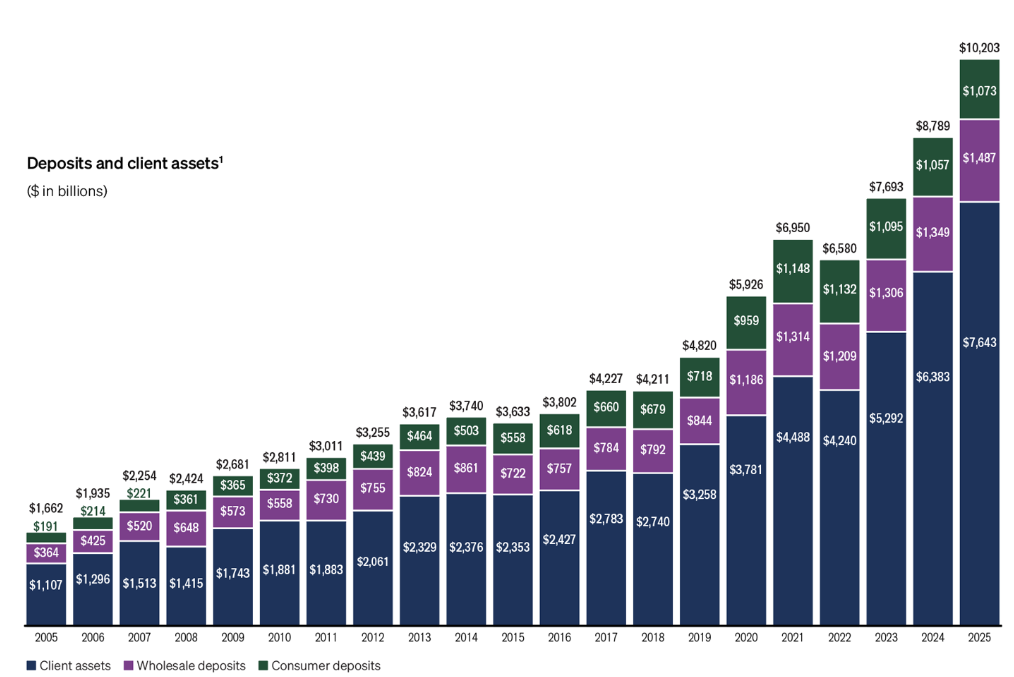
Dimon’s shareholder letter highlighted the bank’s scale, including client assets, wholesale funding and consumer deposits. Source: JPMorgan
JPMorgan has been expanding its in-house blockchain infrastructure, now known as Kinexys, which enables near-instant fund transfers without relying on traditional intermediaries.
The platform is targeting up to $10 billion in daily transaction volume and recently moved toward that goal by onboarding Japan’s Mitsubishi Corporation. Other clients include Qatar National Bank and major institutional players such as Siemens and BlackRock.
Kinexys is also being positioned as a broader tokenization platform, with JPMorgan aiming to expand into markets such as private credit and real estate.
Dimon comments come as stablecoin battle heats up in Washington
Dimon’s mention of blockchain and stablecoins comes at a contentious moment for the banking industry, as US lawmakers continue to debate digital asset legislation.
Advertisement
The passage of the GENIUS Act last year, which established a regulatory framework for stablecoins, is widely expected to accelerate adoption by providing clearer rules for issuers and institutions.
However, broader market structure legislation remains stalled in Congress. A key point of friction is yield-bearing stablecoins, which banking groups argue could undermine financial stability by allowing issuers to offer interest-like returns without adhering to the same regulatory requirements as banks.
The stablecoin market topped $315 billion in the first quarter. Source: CEX.io
Tensions have also spilled into the public sphere. Dimon and Coinbase CEO Brian Armstrong have traded criticisms over the direction of crypto regulation, with Dimon pushing back against claims that banks are attempting to derail legislative efforts.
Industry lobbying groups, including the American Bankers Association, have made opposition to yield-bearing stablecoins a key policy priority this year.
Cointelegraph is committed to independent, transparent journalism. This news article is produced in accordance with Cointelegraph’s Editorial Policy and aims to provide accurate and timely information. Readers are encouraged to verify information independently. Read our Editorial Policy https://cointelegraph.com/editorial-policy
President Trump’s DHS pay order has directed all Department of Homeland Security employees to be paid using redirected federal funds, but legal and budget experts say the administration may be violating a 150-year-old law that gives Congress sole control over federal spending.
Summary
Trump signed two executive directives — one on March 27 for TSA workers and an expanded memo on April 4 for all DHS employees — directing pay using funds from the One Big Beautiful Bill Act, sidestepping the ongoing partial shutdown
Legal experts warn the move may conflict with the Antideficiency Act, which bars the executive branch from spending money that Congress has not appropriated for a specific purpose
The administration has provided no detailed public justification for how it is legally connecting TSA operations to the bill’s DHS border enforcement funds, drawing criticism from budget analysts on both sides
President Trump’s DHS pay order, which directs the Department of Homeland Security to pay all its employees using funds redirected from last year’s One Big Beautiful Bill Act, has put paychecks back in workers’ accounts but opened a serious constitutional question that legal experts say the administration has yet to answer. Trump initially signed a directive on March 27 covering TSA workers, then expanded it on April 4 to include all DHS employees, citing “an emergency situation compromising the Nation’s security.”
The Antideficiency Act, a 150-year-old federal statute, bars the executive branch from spending money that has not been expressly appropriated by Congress for the specific purpose being funded. Trump’s order directed the DHS secretary to use funds with “a reasonable and logical nexus to TSA operations” from the One Big Beautiful Bill Act — a law that allocated $10 billion to DHS for border-related functions, with no specific mention of TSA.
Advertisement
Budget analysts flagged the ambiguity immediately. “The administration’s provided no real clarity about what they’re doing publicly that would allow someone to even figure out whether what they’re doing is legal or not legal,” Devin O’Connor, a senior fellow at the Center on Budget and Policy Priorities, told CNBC. “They haven’t made the case for it in any kind of public way.”
Where the Money Is Coming From — and Why That Matters
Administration officials confirmed the payments are being drawn from the One Big Beautiful Bill’s DHS fund, which gave the secretary discretion to deploy resources supporting DHS’s border mission. Bobby Kogan of the Center for American Progress estimated the cost of funding TSA runs approximately $140 million per week, suggesting the administration could sustain payments for nearly a year before that pool runs dry. But critics note that the bill’s language does not cover TSA, which handles airport security rather than border enforcement, making the legal nexus tenuous.
Senate Majority Leader Thune acknowledged the order as a “short-term solution” that “takes the immediate pressure off,” while noting it does nothing to resolve the underlying standoff between the two chambers.
Advertisement
The Constitutional Fault Line
As crypto.news reported, government shutdowns carry consequences beyond the immediate departments affected — including delays to economic data releases, stalled regulatory activity, and heightened uncertainty across financial markets. The constitutional issue here runs deeper than a funding dispute. Article I of the US Constitution vests the power of the purse exclusively in Congress. Trump’s move to unilaterally pay workers without an active appropriation mirrors actions that have historically invited legal challenge under the Antideficiency Act.
A second broader executive memo on April 4 extended the same approach to every DHS employee, not just TSA, including furloughed workers and those in agencies not obviously connected to the One Big Beautiful Bill’s border funding mandate. As crypto.news noted in its coverage of the DHS shutdown’s earlier market impact, prolonged fiscal uncertainty of this kind tends to weigh on investor sentiment and delay forward guidance from the Federal Reserve.
“America’s air travel system has reached its breaking point,” Trump said in his original March 27 memo. What remains unresolved is whether his chosen remedy is within his legal authority to execute.
Four U.S. economic releases between Wednesday and Friday will test whether Bitcoin (BTC) can hold above $67,000 or breaks lower into a deeper correction.
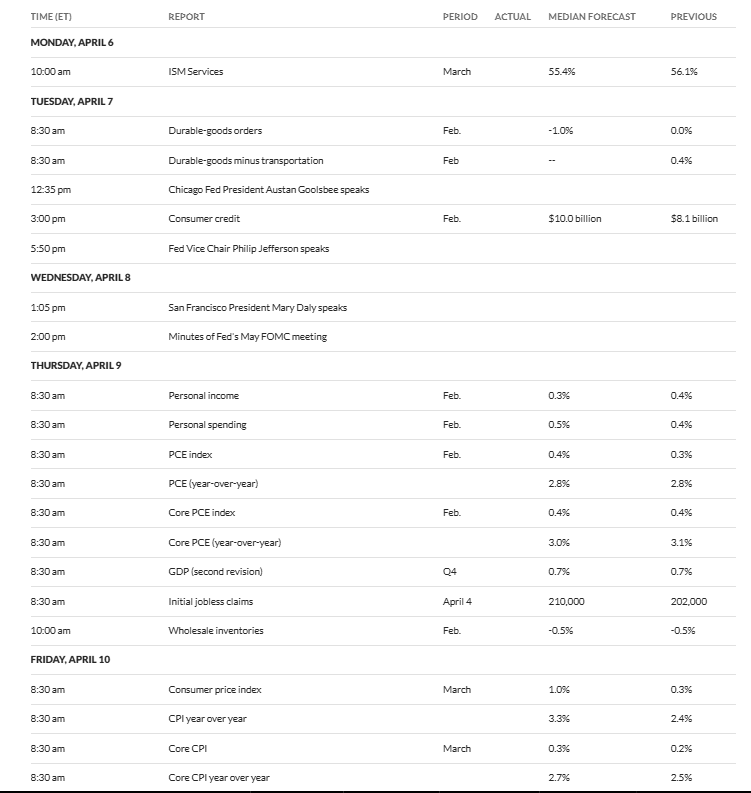
The sequence begins with the Federal Open Market Committee (FOMC) minutes on Wednesday, followed by February Personal Consumption Expenditures (PCE) inflation and Q4 Gross Domestic Product (GDP) data on Thursday, and ends with March Consumer Price Index (CPI) on Friday.
Why This Week’s Data Matters for Bitcoin
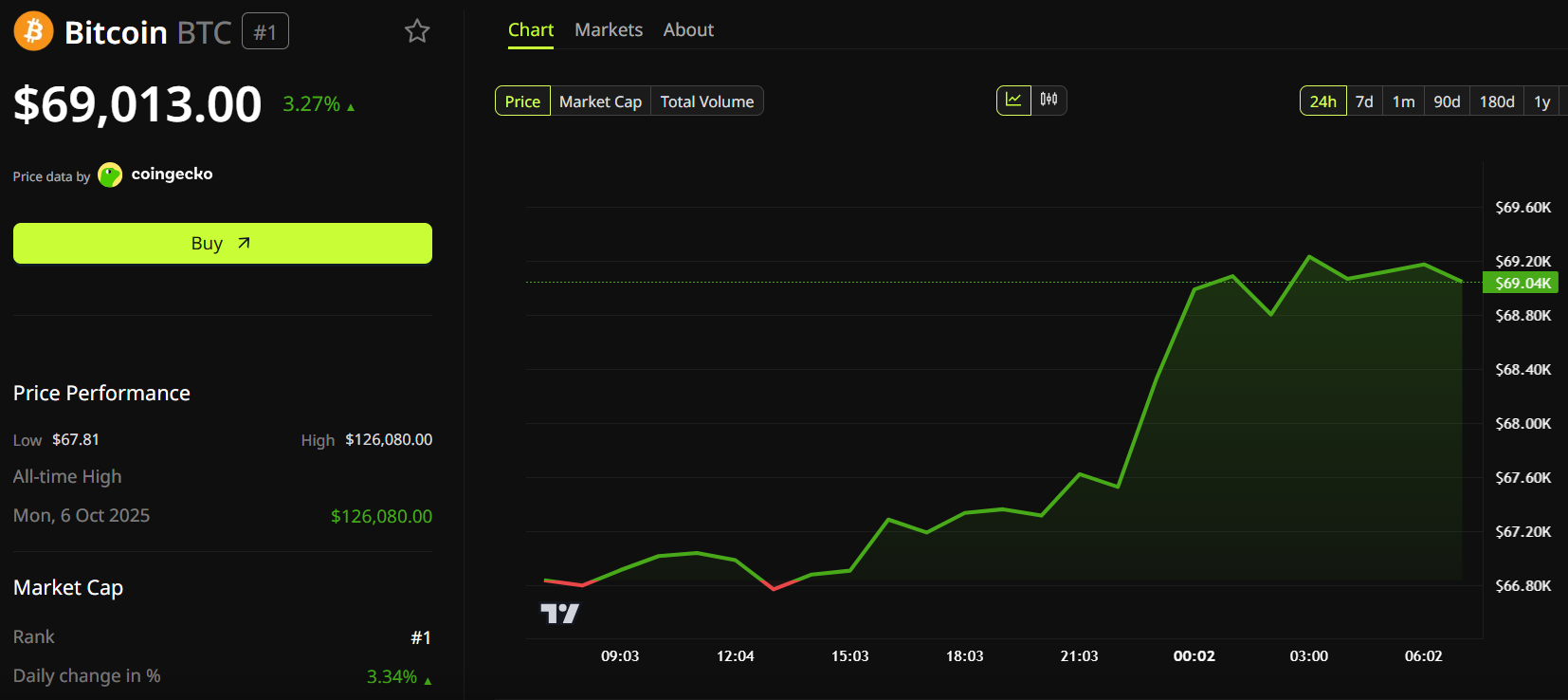
BTC entered April trading around $69,000, down roughly 23% year-to-date after the worst opening quarter for digital assets since 2018.
Bitcoin Price Performance. Source: BeInCrypto
The Crypto Fear and Greed Index has hovered between 8 and 14 for over a month, registering deep extreme fear territory.
The Federal Reserve held rates steady at 3.50-3.75% at its March 18 meeting, while the updated dot plot projected just one cut before year-end 2026. PCE inflation expectations for 2026 were revised upward to 2.7%.
The Energy Information Administration revised its 2026 WTI forecast upward by $20 per barrel. That energy shock now feeds directly into this week’s inflation prints.
How Each Release Could Affect BTC
Bitcoin’s 24-hour correlation with the S&P 500 recently hit 0.94, confirming its behavior as a high-beta macro asset. That linkage means every inflation surprise or policy signal this week flows directly into crypto pricing.
Traders will scan for hawkish language around persistent inflation versus dovish acknowledgment of growth risks.
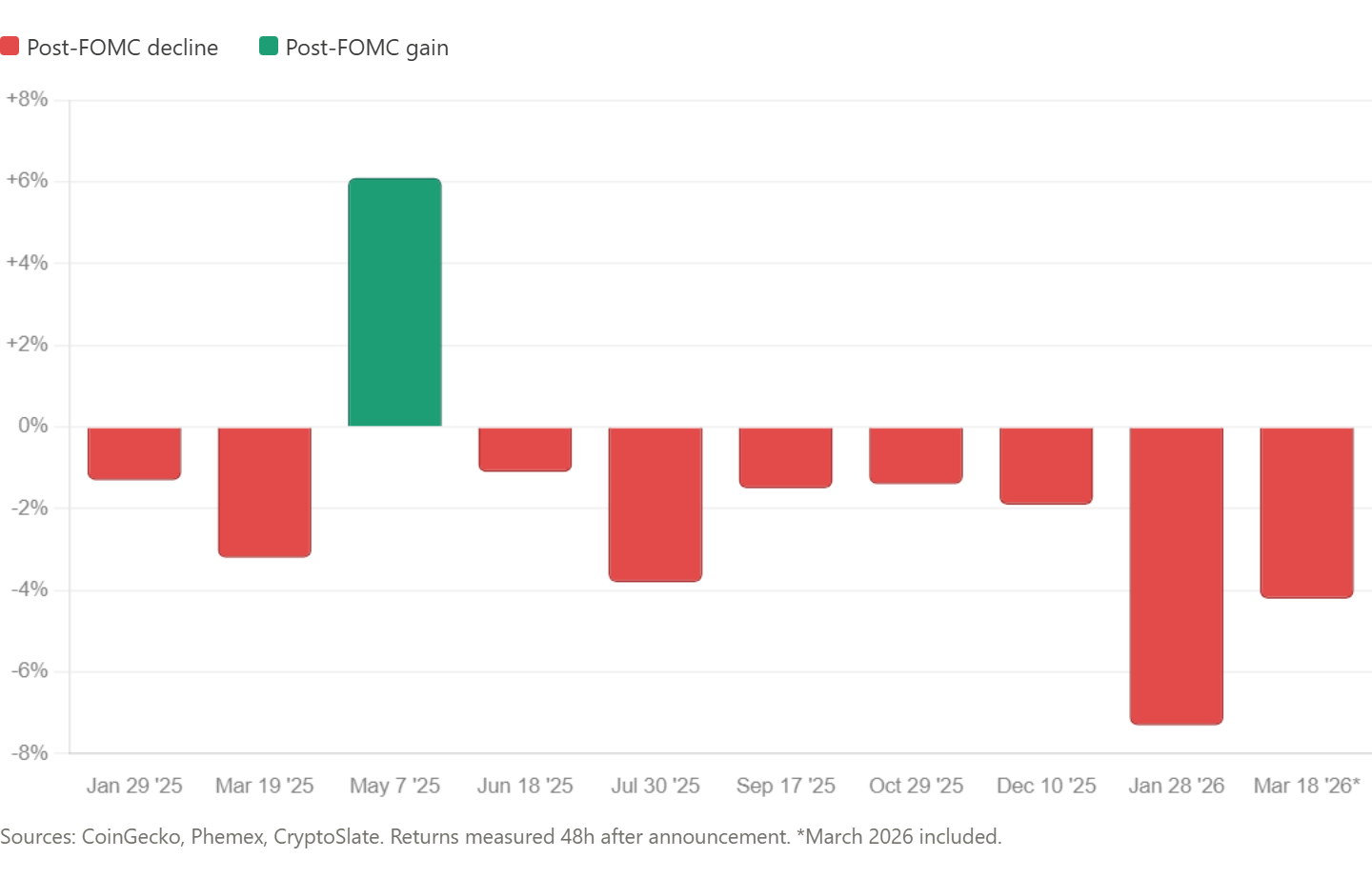
Historically, BTC has shown a consistent sell-the-news pattern around FOMC events. The pioneer crypto dropped after eight of nine FOMC events in 2025, with post-event declines of 5-10% common as positioning unwound.
Bitcoin FOMC Sell The News. Source: BeInCrypto
After the January 2026 minutes were released in February, BTC underperformed, while the dollar and bonds rallied.
A hawkish tilt this time would reinforce delayed cuts, pushing real yields higher and strengthening the USD.
A dovish surprise acknowledging transitory shocks could briefly lift BTC, with the pioneer crypto potentially going above $70,000.
Advertisement
February PCE Inflation, Thursday 8:30 AM ET
The Fed’s preferred inflation gauge carries consensus forecasts of 0.4% month-over-month and 3.0% year-over-year for core PCE.
US Economic Releases This Week. Source: MarketWatch
Returning to a 3-handle on core PCE is both symbolically and practically significant for rate expectations.
A hotter print above 3.0-3.1% year-over-year would reinforce the higher-for-longer narrative, tightening financial conditions further.
A cooler reading below consensus would boost rate-cut odds and could push BTC 2-5% higher, similar to the February 2026 soft print that lifted BTC roughly 2.75%.
Q4 2025 GDP Final Estimate, Thursday 8:30 AM ET
The third estimate carries a consensus of 0.7% annualized, already sharply revised down from the advance reading of 1.4% and Q3’s strong 4.4%.
Advertisement
Further weakness would signal an economy losing momentum, which paradoxically supports crypto by raising expectations for Fed easing.
GDP surprises typically drive smaller BTC reactions than inflation data, in the range of 1-3%. However, they amplify when they shift policy expectations alongside other releases on the same day.
March CPI, Friday 8:30 AM ET
This is the week’s most anticipated print. Consensus forecasts a headline jump to 3.3% year-over-year and 1.0% month-over-month, up sharply from February’s 2.4%.
That would represent the largest single-month acceleration since the 2022 energy crisis, driven almost entirely by gasoline and energy prices.
Advertisement
US Inflation Seen Spiking in First Snapshot Since War Economists are penciling in a 1% increase in the consumer price index for March — the sharpest one-month advance since 2022 — after the Iran war pushed gas prices at the pump up by about $1 per gallon. At the same time, the… pic.twitter.com/QA2Z58pojz
Core CPI consensus sits at 0.3% monthly and 2.7% annually. The market reaction hinges on that core figure. If core holds at or below 0.3%, traders will likely treat the headline spike as a transitory energy event.
If core prints 0.4% or higher, the transitory narrative collapses, and rate cuts could get repriced out of 2026 entirely.
Hot CPI prints have consistently pressured BTC short-term through higher rate expectations. Misses spark relief rallies. With expectations already elevated, any deviation in either direction becomes highly market-moving.
Advertisement
What Comes Next
The sequencing matters. Wednesday’s FOMC tone sets up Thursday’s PCE and GDP reaction, which then frames Friday’s CPI interpretation.
A dovish week with soft PCE, weak GDP, and contained core CPI would favor upside for crypto amid renewed liquidity hopes. A hawkish sweep with hot inflation prints risks a leg down toward the $65,000 support that BTC tested earlier in 2026.
That institutional bid provides a floor, but overall 30-day apparent demand remains deeply negative as large holders distribute aggressively.
Advertisement
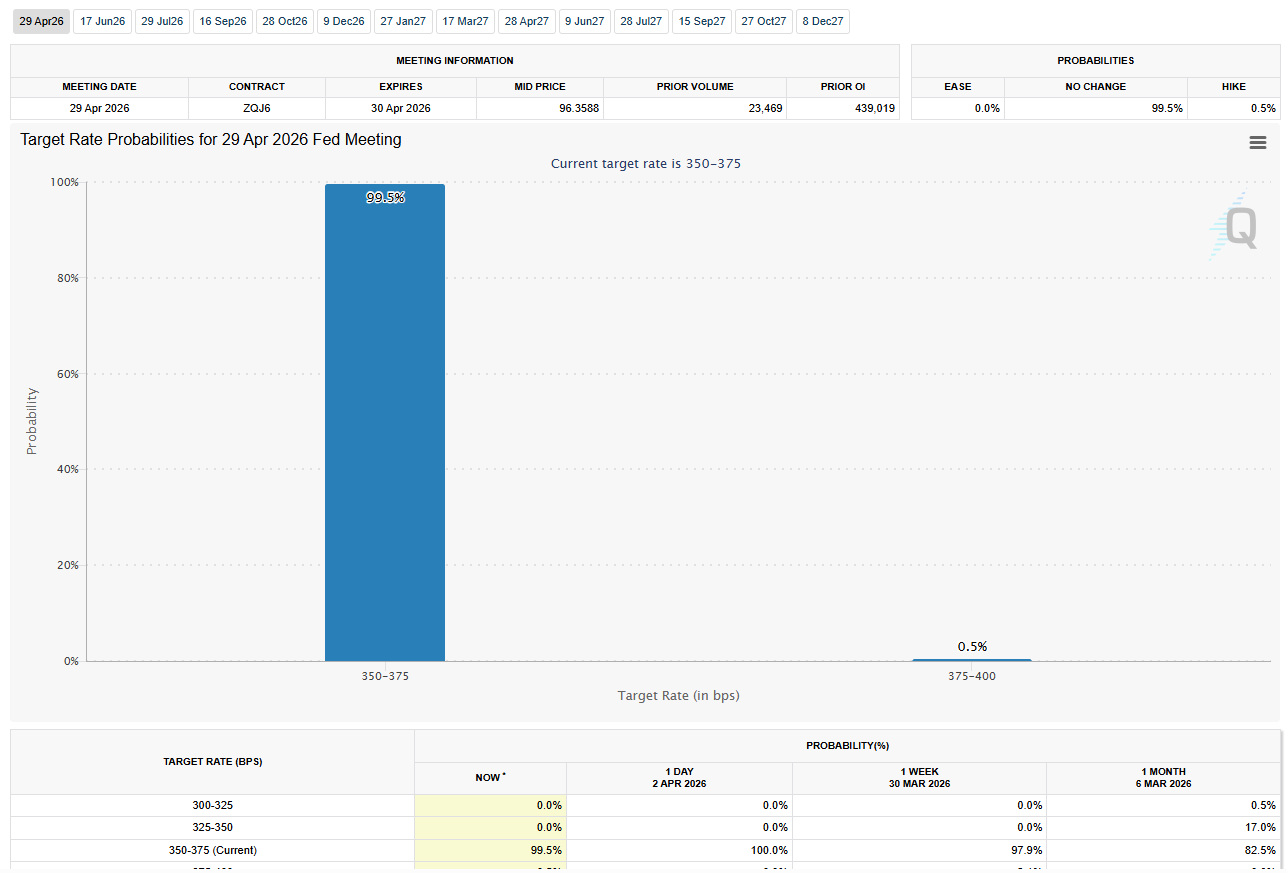
CME shifts and the DXY-BTC correlation will serve as real-time gauges of how each data point reprices rate expectations.
Fed Interest Rate Cut Probabilities. Source: CME FedWatch Tool
With BTC trapped between institutional accumulation and macro headwinds, this week’s four numbers will likely determine whether April lives up to its historically bullish seasonality or extends Q1’s pain.
Today, the Third Circuit Court ruled in favor of KalshiEX LLC, after the platform sued New Jersey regulators for trying to restrict its federally regulated prediction market operations.
The decision, handed down on April 6, 2026, reinforces the legitimacy of prediction markets and delivers a major boost to the industry.
The Kalshi Case Explained
Back in September 2025, Kalshi brought the case against Mary Jo Flaherty, a New Jersey state regulator, after facing restrictions on its operations at the state level.
Kalshi argued that it is already regulated at the federal level by the Commodity Futures Trading Commission (CFTC).
Advertisement
As a result, it claimed individual states should not have the authority to block or limit its services.
In response, state regulators maintained that prediction markets — particularly those tied to elections — could fall under state laws, including gambling-related restrictions.
This legal clash set up a broader question: whether federally regulated prediction markets can operate freely across the US, or if states can impose their own rules.
Today, the Third Circuit’s decision ultimately sided with Kalshi. It strengthens the argument that federal oversight takes priority in this space.
Advertisement
Fun Fact: Prediction markets have historically outperformed polls in forecasting election outcomes. Studies show they aggregate information more efficiently than traditional polling methods!
The Third Circuit ruled in Kalshi’s favor. People use prediction markets because they’re more fair, transparent, and reward being right. Free markets work. We should keep them that way. This is a big win for the industry and millions of users. pic.twitter.com/Ay0dLtgZdV
Prediction markets allow users to trade contracts based on the outcome of future events, from elections to economic indicators. Unlike traditional betting, these markets are designed to aggregate information and reward accurate forecasting.
Proponents argue that prediction markets offer several advantages over conventional information sources:
Advertisement
Transparency: Prices reflect real-time collective expectations, visible to everyone.
Accuracy: Participants have financial incentives to be correct, not just persuasive.
Fairness: Anyone can participate and benefit from accurate predictions.
Critics, however, have raised concerns about potential manipulation and the blurring of lines between financial markets and gambling. Regulatory agencies have taken different positions on where prediction markets should fit within existing legal frameworks.
What the Kalshi Ruling Means
The Third Circuit’s decision reinforces that prediction markets can operate within constitutional boundaries. For Kalshi, this means continued legal footing to expand its platform and offerings.
For the broader industry, the ruling sends a signal that courts are willing to recognize prediction markets as legitimate financial instruments rather than gambling operations.
Millions of users who rely on prediction markets for information and hedging now have greater certainty about the legal status of these platforms. As a result, the decision could accelerate institutional adoption and innovation in the space.
The prediction market industry just got its strongest legal endorsement yet.
A US appellate court has ruled against New Jersey gaming authorities for bringing an enforcement action against prediction market platform Kalshi over sports event contracts.
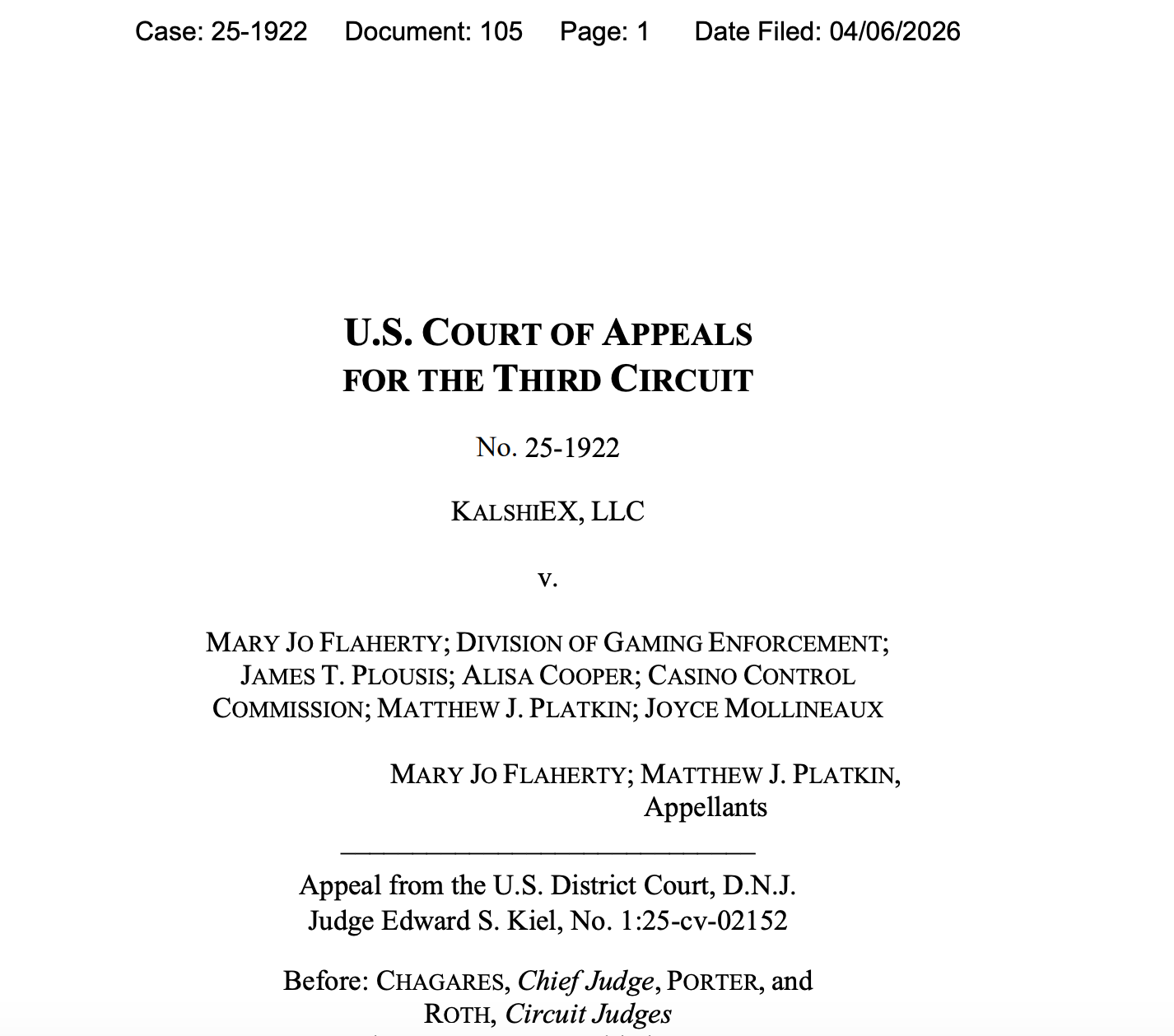
In a Monday-issued opinion, a panel of judges in the US Court of Appeals for the Third Circuit ruled 2-1 in favor of Kalshi’s argument that the company had a ”reasonable chance of success” claiming that the Commodity Exchange Act preempted state law, setting the stage for a potential battle over gaming laws in the US Supreme Court.
“This is a big win for the industry and millions of users,” Kalshi CEO Tarek Mansour said in a social media post on X.
The appellate court’s opinion affirmed a lower court ruling, in which Kalshi argued that the US Commodity Futures Trading Commission (CFTC) had “exclusive jurisdiction” in regulating sports-related event contracts as swaps that fall under its purview.
Advertisement
“Allowing New Jersey to enforce its gambling laws and state constitution would create an obstacle to executing the Act because such state enforcement would prohibit Kalshi, which operates a licensed [designated contract market] under the exclusive jurisdiction of the CFTC, from offering its sports-related event contracts in New Jersey,” wrote Circuit Judge David J. Porter. “This state regulation is exactly the patchwork that Congress replaced wholecloth by creating the CFTC.”
Monday’s Third Circuit opinion affirming lower court ruling. Source: PACER
The circuit court ruling came just days after a Nevada judge extended a ban on Kalshi offering event-based contracts, following several other state authorities cracking down on sports betting on prediction markets. The patchwork of state-level rulings could lead to the US Supreme Court taking up one of the cases, potentially changing its 2018 decision giving states the authority to regulate sports gambling.
In her dissent, Circuit Judge Jane Roth said the prediction markets platform’s actions were a “performative sleight meant to obscure the reality that Kalshi’s products are sports gambling,” adding that the company’s event contracts were “virtually indistinguishable” from those on betting websites:
“[T]he question of whether sports-event contracts are swaps is a thorny issue with the potential to radically upend the legal landscape governing the gambling industry, and I am not convinced the Majority’s analysis does this issue justice.”
CFTC chair reiterates agency’s position on prediction markets
CFTC Chair Michael Selig, the sole commissioner at the financial agency following the departure of acting chair Caroline Pham in December, has made prediction markets one of the commission’s central issues since taking office. In the last four months, Selig has claimed that the CFTC has “exclusive jurisdiction” in regulating event contracts on prediction markets, opened a proposed rule to public comment and filed an amicus brief supporting its position in the Ninth Circuit Court of Appeals in a case involving Nevada’s gaming authorities.
“Our definition of commodity and statute is very broad,” Selig said at the Digital Assets and Emerging Tech Policy Summit at Vanderbilt University on Monday. “It includes events on sports, it includes events in politics, it includes corn and grains and all sorts of things. It doesn’t really distinguish between if you’re offering an event contract on grains, you’re regulating that differently than an event contract on sports.”
The CFTC chair added that there were exceptions for event contracts that were “readily susceptible to manipulation.”
Cointelegraph is committed to independent, transparent journalism. This news article is produced in accordance with Cointelegraph’s Editorial Policy and aims to provide accurate and timely information. Readers are encouraged to verify information independently. Read our Editorial Policy https://cointelegraph.com/editorial-policy
As of 2026, about 25 US asset managers directly offer crypto products (ETFs, trusts, or funds). But the five largest crypto-focused asset managers now collectively oversee well over $100 billion in digital asset products.
Their dominance reflects how deeply institutional capital has embedded itself into crypto through regulated ETFs.
Five Firms Control Nearly $100 Billion in Bitcoin ETFs
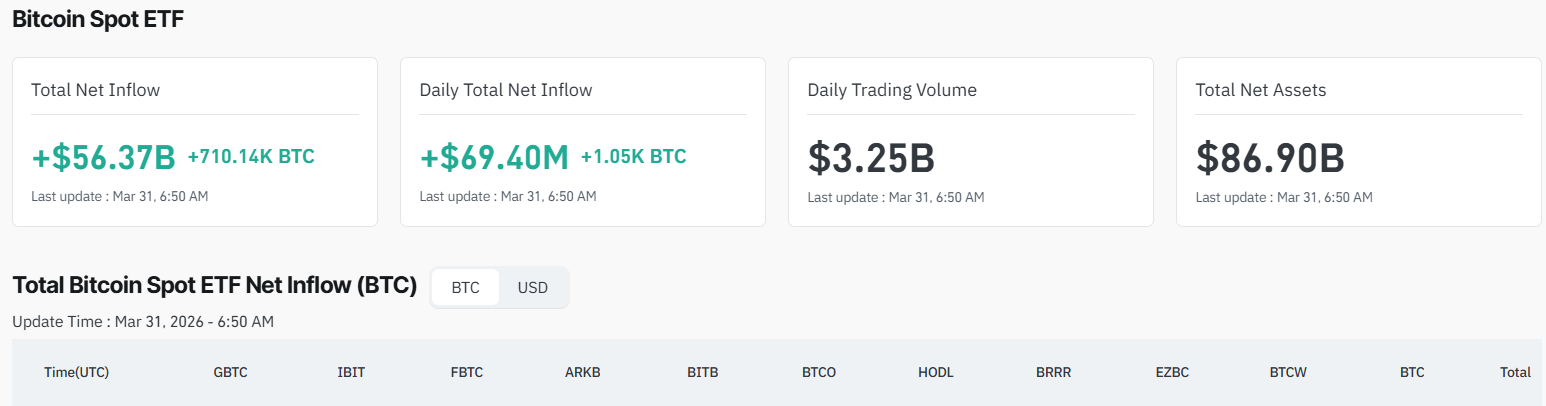
Spot Bitcoin ETFs alone surpassed $86 billion in combined assets under management as of this writing, according to Coinglass data.
Bitcoin Spot ETFs Total Net Assets. Source: Coinglass
The competition among issuers has intensified as fee wars, product variety, and institutional distribution networks determine who captures the most capital.
The fee on this will be very interesting. We should know soon. I’m setting over/under at 0.24% which is one bp lower than IBIT. What does @NateGeraci and @JSeyff think?
BlackRock’s iShares Bitcoin Trust (IBIT) sits at $51.9 billion in AUM, representing approximately 45% of all spot Bitcoin ETF assets, according to SoSoValue data. During Q1 2026, IBIT pulled in $8.4 billion in net inflows, more than double any competitor.
The fund held approximately 782,180 BTC as of March 27, 2026, with BlackRock’s iShares Ethereum Trust (ETHA) adding several billion more. This pushes total crypto ETF exposure near $60 billion.
BlackRock’s BTC Holdings. Source: BlackRock
Meanwhile, Fidelity’s Wise Origin Bitcoin Fund (FBTC) manages $12.8 billion in AUM, holding approximately 187,813 BTC as of early March, and its Ethereum Fund (FETH) adds over $1.3 billion.
Fidelity attracted $4.1 billion in Q1 2026 net inflows, ranking second behind BlackRock.
Advertisement
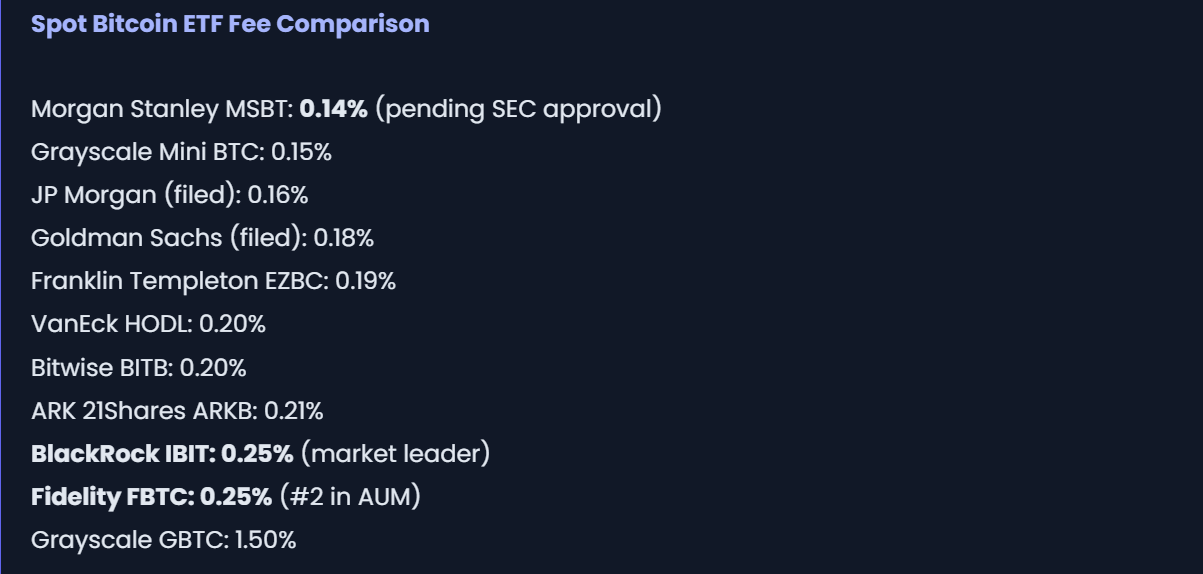
The firm’s self-custody model through Fidelity Digital Assets and its 0.25% fee structure have made it a preferred choice among compliance-focused institutional allocators.
Spot Bitcoin ETF Fee Comparison. Source: Fibo
Grayscale Defends Its Legacy
Still, Grayscale Investments remains the oldest and broadest crypto-focused asset manager, operating since 2013.
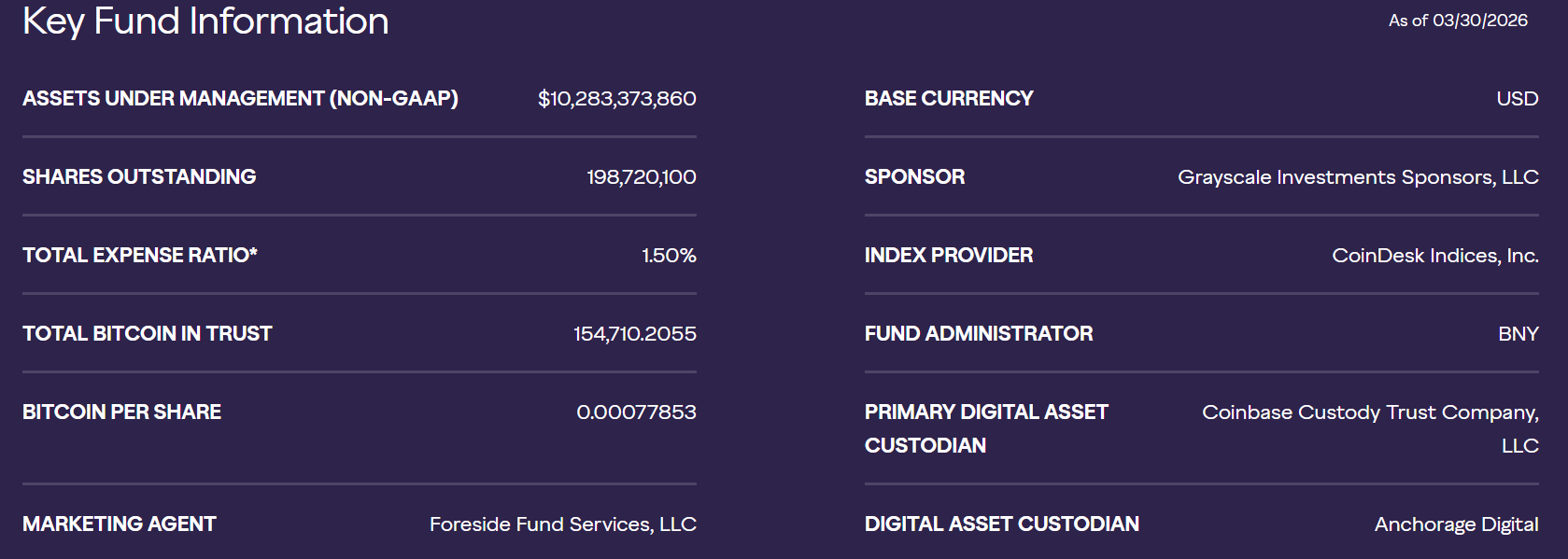
Its Bitcoin Trust (GBTC) held approximately 154,710 BTC as of this writing, valued at approximately $10 billion. The lower-fee Bitcoin Mini Trust (BTC) added another $3.4 billion, according to Grayscale.
Grayscale Fund Information. Source: Grayscale
GBTC outflows slowed to $1.2 billion in Q1 2026, a sharp decline from the multi-billion-dollar monthly outflows of 2024.
No Strategy buy announcement this week. But let’s talk about what just happened in Q1 2026. 🟠 📊 Q1 2026 Numbers: – 89,599 BTC acquired – $5.5 BILLION deployed – 2nd highest quarter in Strategy history – Buying ~2.5x faster than global mining – Supply vacuum: 53,149 BTC… pic.twitter.com/QbdzEPjw3n
Grayscale’s total platform exceeded $35 billion in AUM as of late 2025, and it maintains the broadest product pipeline, with a 36-asset watchlist for potential future ETF launches.
Advertisement
Bitwise Wins on Variety and Altcoin Exposure
Elsewhere, Bitwise Asset Management surpassed $15 billion in client assets across more than 40 products. These span ETFs, separately managed accounts, private funds, hedge strategies, and staking.
Its standout position is in Solana ETFs. As of early January 2026, Bitwise controlled approximately 67% of all Solana ETF AUM, capturing $731 million out of the $1.09 billion total.
Galaxy Digital operates as a full-service merchant bank rather than a pure ETF issuer. Its asset management arm reported $9 billion in AUM with $2 billion in quarterly net inflows by Q3 2025.
By the end of 2025, total platform assets reached $12 billion, despite reporting a $482 million loss in the fourth quarter.
NOVOGRATZ’S GALAXY POSTS $482M LOSS IN CRYPTO CRASH Galaxy Digital reported a $482 million loss in the fourth quarter, far worse than expected, as falling crypto prices hit its portfolio. Bitcoin dropped 23% during the period, trading volumes fell 40%, and the firm’s shares slid…
Galaxy partners with State Street Global Advisors on actively managed digital asset ETFs and maintains exposure across trading, lending, staking, and venture capital.
Its hybrid model positions it as the go-to for institutions that need more than passive ETF access.
Advertisement
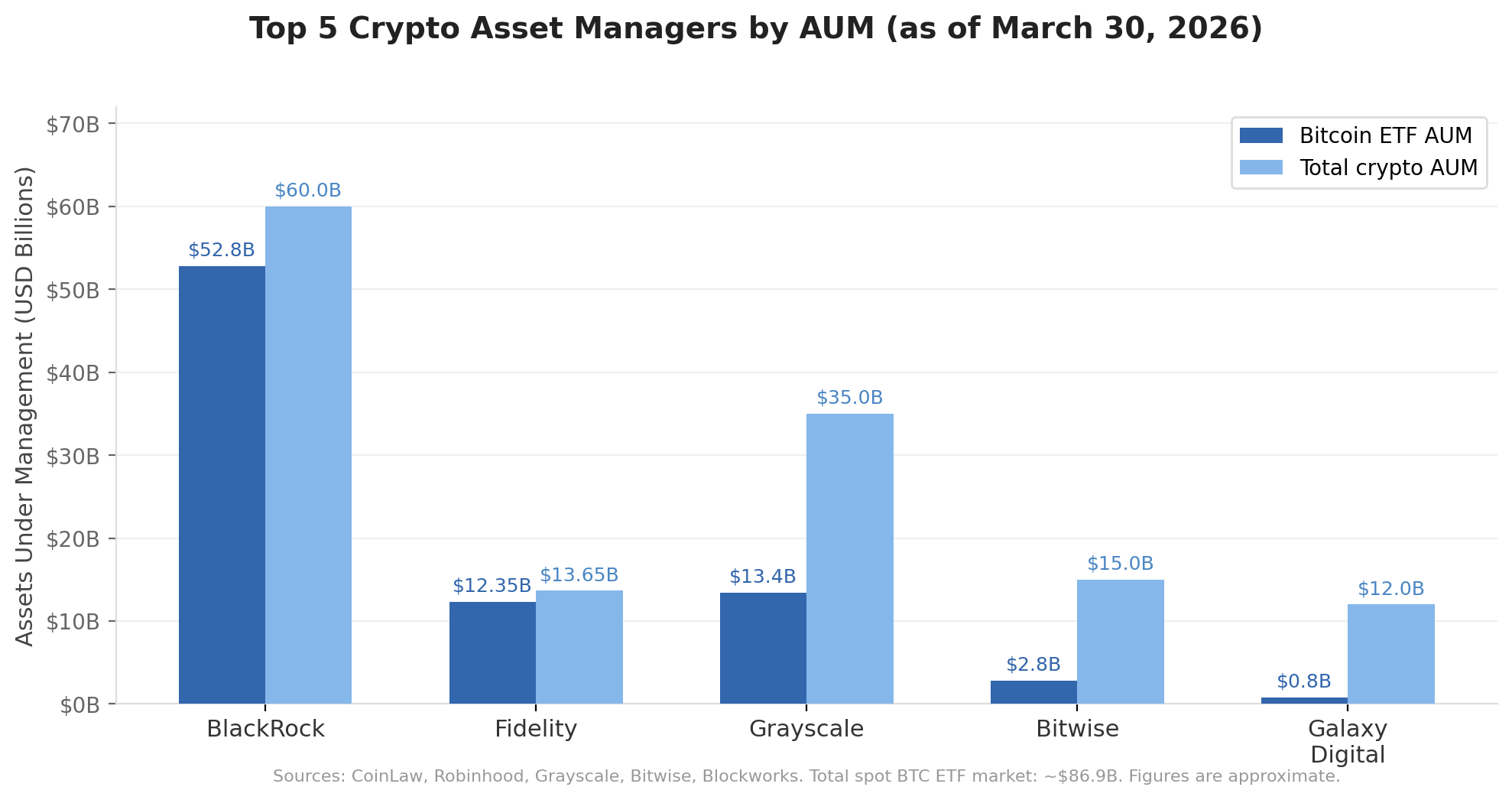
Bar chart comparing AUM of top 5 crypto asset managers in 2026, Source: BeInCrypto
The 2026 crypto asset management race has a clear hierarchy.
BlackRock dominates on scale
Fidelity on institutional trust
Grayscale on history and breadt
Bitwise on product innovation, and
Galaxy on full-service infrastructure.
And then there is Morgan Stanley, which is not yet in the race but could reshape it entirely.
Morgan Stanley’s $160 Billion Wildcard Could Rewrite the Entire Leaderboard
The bank filed an amended S-1 for its spot Bitcoin ETF, MSBT, with a 0.14% fee that undercuts every existing competitor, including BlackRock’s 0.25%.
It would be the first spot Bitcoin ETF issued directly by a major U.S. bank rather than an asset manager. However, the ETF is just one piece.
Morgan Stanley has also applied for a national trust bank charter through a new subsidiary called Morgan Stanley Digital Trust. This would handle custody, trading, staking, and transfers of digital assets under federal oversight.
With $8 trillion in wealth management assets and over 16,000 advisors, even a modest 2% allocation would represent $160 billion in potential demand, roughly three times the size of IBIT.
Morgan Stanley Wealth Management oversees about $8 trillion in AUM and recommends 0–4% bitcoin allocation. A 2% allocation would represent $160 billion, ~3X the size of IBIT. $MSBT: Monster Bitcoin. https://t.co/TNYLYRXPiz
If all these pieces come together, Morgan Stanley would not just enter the crypto race. It would be building the entire track.
Advertisement
“They’re not just offering exposure anymore, they’re building the full stack. BNY Mellon + Coinbase as dual custodians is smart redundancy,” one user highlighted.
With spot Bitcoin ETFs now past $128 billion in combined AUM, the question is no longer whether institutions will adopt crypto. It is the managers who will capture the next wave of capital.
House Democrats are convening a virtual caucus call tonight, April 6, to plot their next steps on the DHS shutdown, now 51 days old and the longest partial government shutdown in US history.
Summary
Punchbowl News reports House Democrats will hold a virtual caucus meeting tonight as the chamber returns from a two-week recess, with the DHS shutdown having been running since February 14
The shutdown broke the record for the longest in US history on March 29, surpassing the 43-day fall 2025 shutdown, and has left 480-plus TSA officers quitting, airport wait times exceeding four hours, and an estimated $2.5 billion in economic losses
The Senate passed a deal to fund DHS without ICE or CBP, but House Republicans rejected it last week, passing a 60-day stopgap that Senate Democrats called “dead on arrival.”
House Democrats are holding a virtual DHS shutdown caucus call tonight at the start of a critical week, according to Punchbowl News, as the chamber returns from a two-week Passover and Easter recess with no resolution in sight. The shutdown, which began February 14, crossed 51 days on April 6, making it the longest partial government shutdown in the country’s history. Democrats support the Senate-passed bill that funds most of DHS while excluding ICE and CBP, and leadership does not expect significant defections from that position.
The Senate passed a funding deal by voice vote in the early hours of last Friday after a marathon overnight session, threading the needle on Democrats’ core demand: funding the department without allocating money to ICE or the Border Patrol. Senate Majority Leader John Thune and Senate Minority Leader Chuck Schumer both backed the measure. But the House rejected it.
Advertisement
Speaker Mike Johnson instead put forward a 60-day stopgap that would fund all of DHS, including ICE and CBP. Senate Democrats immediately declared it dead. “Our position remains the same,” House Minority Leader Hakeem Jeffries said. “There is a bipartisan bill that every single senator, Democrats and Republicans, supported, that has the votes to pass today.”
The Real Costs on the Ground
The shutdown has produced measurable damage. The TSA callout rate is running five times above its normal level. More than 480 transportation security officers have quit since February, and some major airports are operating with 40 to 50 percent of their expected workforce absent on any given day. Wait times exceeding four and a half hours have been recorded at some of the country’s busiest terminals. Estimated economic losses now stand at $2.5 billion, according to Republican appropriators who cited the figure in a recent floor statement.
As crypto.news reported when the earlier DHS funding lapse rattled markets in February, the shutdown’s spillover into economic data releases and Federal Reserve signaling can create cascading uncertainty across financial markets well beyond the political standoff itself.
Advertisement
How Both Sides Got Here
The shutdown traces back to the killing of a US citizen by a Customs and Border Protection agent in Minneapolis in January 2026. Senate Democrats announced they would no longer support the DHS funding bill, which funds CBP, demanding reforms to immigration enforcement as a condition. Trump has repeatedly refused to negotiate on reopening DHS unless Democrats back the SAVE America Act, his voter ID and proof-of-citizenship legislation, which is a non-starter for the minority.
Tonight’s caucus call will test how unified House Democrats remain heading into the second week of return from recess, and whether any moderates are ready to move. As crypto.news noted when the 43-day fall 2025 shutdown finally ended, the resolution of prolonged political standoffs tends to produce sharp market relief rallies across risk assets.
“Throughout it all, Senate Democrats stood united — no wavering, no backing down,” Schumer said Friday after the Senate vote.

























 NewsBeat4 days ago
 Business4 days ago
 Fashion3 days ago
 Crypto World5 days ago
 Business23 hours ago
 Sports2 days ago
 Business5 days ago
 Tech7 days ago
 Sports6 days ago
 Tech7 days ago
 Sports7 days ago
 Crypto World7 days ago
 Tech7 days ago
 Politics7 days ago
 Tech7 days ago
 Business7 days ago
 Crypto World6 days ago
You must be logged in to post a comment Login