After years of trying to lose weight “the right way,” Jane Zuckerman realized that “putting in the work just wasn’t enough.”
Zuckerman, a 32-year-old data analyst based in Washington, D.C., said she lost 90 pounds in college and spent years cycling through nutritionists, therapy and strict routines — only to find herself at her heaviest after the pandemic, at 270 pounds.
Zuckerman said GLP-1 injections were out of the question, because she’s afraid of needles. But when the first GLP-1 pill for obesity became available in early January, Zuckerman called her doctor immediately, she said.
Almost a month after starting Novo Nordisk‘s new Wegovy pill shortly after it launched, she said, she had lost around 11 pounds.
Advertisement
Zuckerman is among tens of thousands of patients who drove an explosive demand for prescriptions for Novo’s pill just three months into its launch. Many of them share a common thread: They had long held off on using GLP-1s due to barriers such as high out-of-pocket costs for injections or a fear of needles.
That’s one of the earliest takeaways from the rollout: Novo’s pill appears to be expanding the obesity treatment market, largely drawing in new patients rather than converting existing ones from injections. CNBC spoke with five U.S. patients who recently started the pill following its launch, all of whom said they have not previously taken branded GLP-1 injections.
But it’s early days for the pill. Many patients have yet to reach higher doses of the drug, and their experiences vary. It will take more time to determine how effective the pill is in supporting patients’ long-term weight loss journeys, whether it helps keep users on GLP-1s for longer than injections do and whether demand for Novo’s product will hold in the face of fresh competition from Eli Lilly.
Novo has a head start in the pill arena over Lilly, which just won U.S. approval of its own GLP-1 drug for obesity last week. Analysts previously told CNBC they still expect that rival pill, called Foundayo, to capture a segment of the market, in part because it lacks the dietary restrictions that come with Novo’s oral drug.
Advertisement
Still, the Wegovy pill appears to have had the most explosive launch of a GLP-1 product yet. The latest number that Novo disclosed in February is that more than 600,000 prescriptions had been written since its launch, including for more than 3,000 patients in the first week.
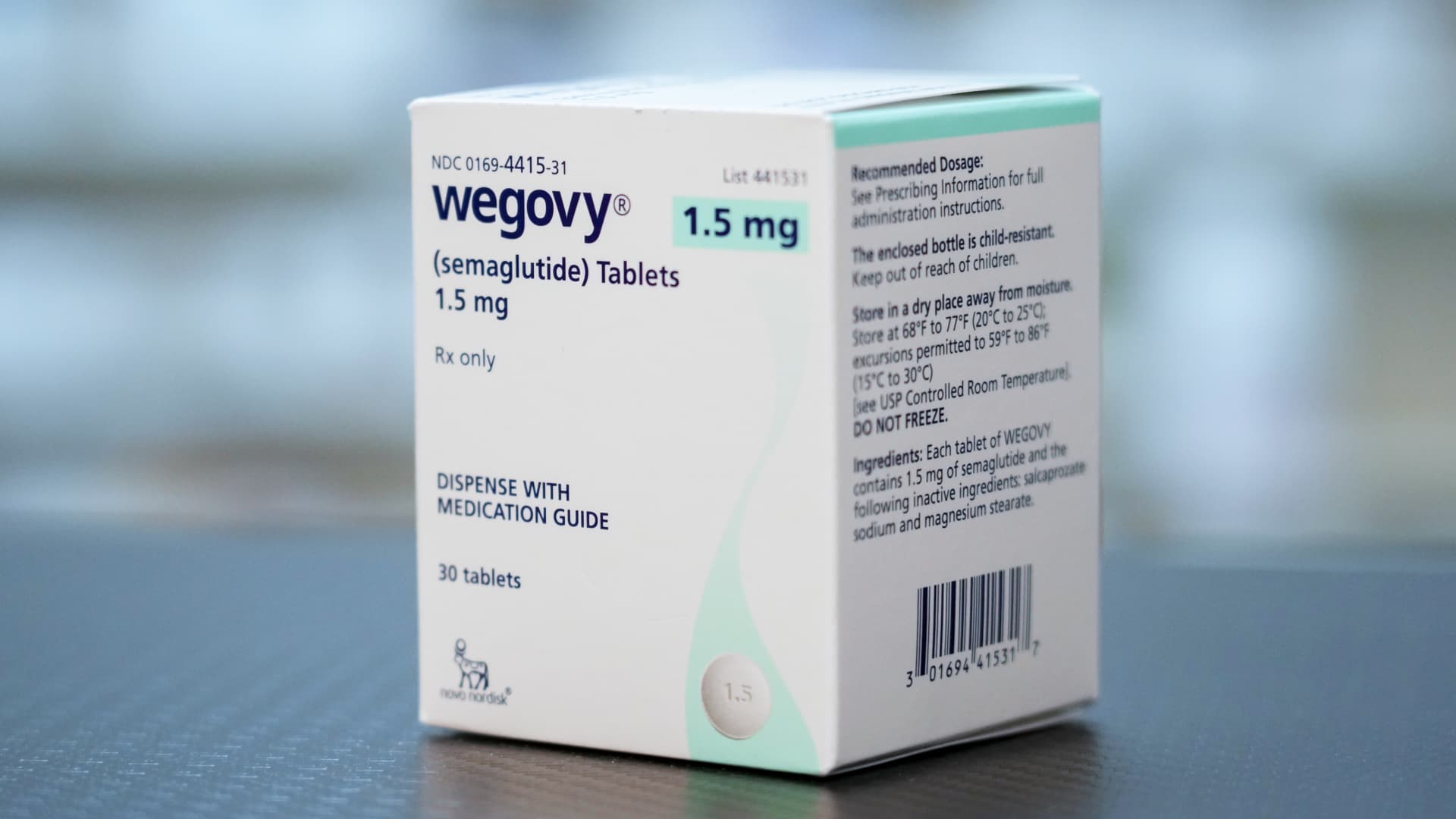
Analysts at BMO Capital Markets attributed some of the early uptake to an “attractive” entry price of $149 per month and its connection to the well-known Wegovy brand. The pill carries one of the lowest cash prices for a GLP-1 therapy, ranging from $149 to $299 per month, depending on the dose.
Even so, the pill’s launch has done little to boost Novo’s stock price, as the Danish drugmaker is struggling to win back market share from Lilly in the broader obesity space and convince investors that its drug pipeline can help it grow beyond its existing products.
Novo is expected to report first-quarter sales, which will include the pill for the first time, in May. But sales of the overall Wegovy portfolio are expected to increase from $13.5 billion in 2026 to $18.9 billion in 2031, with the pill contributing $2.76 billion, according to a March GlobalData report.
Advertisement
Reaching new patients
The Wegovy pill is attracting patients with a fear of needles, which is estimated to affect up to 25% of U.S. adults. But the drug is also an alternative for those who have had difficulty accessing branded GLP-1 injections or other medications.
“There are a handful of patients that don’t want to be stung by the needle in the case of a vial and syringe, or stung by the price,” Jamey Millar, Novo’s head of U.S. operations, told CNBC in an interview last week. “We’re appealing to both.”
Dr. Eduardo Grunvald, medical director of the UC San Diego Health Center for Advanced Weight Management, said the main reason he’s prescribed the Wegovy pill to some patients is cost, since its cash prices are slightly lower than those of injections. But Grunvald said overall, obesity medicine specialists like him will still be inclined to prescribe injections over oral drugs, in part because the shots are more effective.
A box of Wegovy pills arranged at a pharmacy in Provo, Utah, US, on Thursday, Jan. 15, 2026.
Advertisement
George Frey | Bloomberg | Getty Images
Cost was a deciding factor for Amy Sawyer-Williams, who works at a theater company in Raleigh, North Carolina, and has gestational diabetes. In 2023, a few years after her son was born, she said, she began developing prediabetes and met the criteria for obesity. She said she would have started using GLP-1 injections sooner, but her insurance would not cover them for her.
That was long before Novo and Lilly slashed the cash prices of their obesity and diabetes injections.
The list prices of their shots are roughly $1,000 per month before insurance and other rebates, or discounts for cash-paying patients — a sum that has long prevented many others from starting and staying on treatment. Novo has committed to cutting the monthly list prices of its drugs in the U.S. by up to 50%, but that change won’t go into effect until 2027.
Advertisement
High prices also shut Sawyer-Williams out from taking the branded weight management treatment Contrave, pushing her to combine two generic medications to mimic the drug’s effects, she said. But earlier this year, she said, her endocrinologist recommended the Wegovy pill, in part due to its lower $149 per month pricing for the starting dose.
Sawyer-Williams became the first patient at her doctor’s practice and local Walgreens to take the pill, starting in mid-January, she said.
Some Wegovy pill users are patients who wanted to switch over from injections, said Dr. Heather Hofflich, a physician and endocrinologist at UCSD Health. She said she’s prescribed the pill for some people whose insurance stopped covering the injections but who want to continue treatment.
Hofflich said she has also prescribed the oral drug to patients who lost weight initially on a shot but are now trying the pill to maintain that progress.
Advertisement
Early progress
While it’s still early, some patients said they’re already benefiting from taking Novo’s drug.
Zuckerman was initially skeptical of how effective the product would be, because it’s an oral medication. But, she said, “I swear I felt the impact on the first day,” particularly decreased appetite and disinterest in food.
“Things that used to give me enjoyment, or things I used to binge on, they just don’t taste as good anymore, and I just don’t see the point in eating them, honestly,” Zuckerman said, listing coffee, cheese, bread and fries, among other food and beverages.
She said she dealt with nausea — a common side effect of the GLP-1 class — but that became more manageable after the first two weeks on the pill.
Advertisement
Zuckerman also said what matters more than the weight loss or food urges is how she feels: “My clothes are looser, I have more energy, I genuinely feel better.”
Cherie Marcus, 72, a retired fabric designer and theater editor based in Brooklyn, said she’s also seen gradual progress — even on the lowest 1.5-milligram dose of the drug. She said that over the last 30 years, after her daughter was born, she’s gained weight and seen her hemoglobin A1c — a key measure of blood sugar levels — creep up.
Marcus said she started the pill on Jan. 24, and has lost about a pound a week while taking the lowest dose for seven weeks. Patients typically increase their dosage after a month, but Marcus said she’s still taking the lowest strength as of early April.
But her weight has “leveled off” over the past few weeks, she said, so she will likely move to a higher dose if she stops losing weight entirely. Marcus sees herself taking the pill long term, with a goal of losing around 30 pounds.
Advertisement
Novo’s Millar last week said some patients may start on lower doses and “be perfectly fine with that,” hitting their own personal goals for weight loss. But the company is monitoring how many patients increase to higher doses of the drug, particularly the 9-mg and 25-mg versions.
Courtney Kim, a stay-at-home mom based in Pittsburgh, is among the patients taking the Wegovy pill who have yet to experience notable side effects.
While she doesn’t qualify as obese, Kim said, the “weight would just not come off” after she had her three children. She started the pill around mid-February after struggling to lose weight with the use of other prescription medications and supplements, she said.
Kim started at a weight of roughly 158 pounds and has so far lost nearly 7 pounds on the pill, she said. She recently started the 4-mg dose of the drug.
Advertisement
“It’s actually working, and I’m shocked that the weight is actually like coming off and staying off,” Kim said. “So far I’ve had a positive experience.”
Some patients wait and see
The early experience with the pill hasn’t been smooth for everyone. UCSD’s Hofflich said she had one patient who could not tolerate the pill due to its gastrointestinal side effects, which is a common issue with the injections, as well.
Another patient had to switch to an injection because the pill’s dietary restrictions — which involve taking it with a small amount of water and waiting 30 minutes before eating or drinking — did not fit into their lifestyle, Hofflich said. Two patients who haven’t seen progress on higher doses of the pill are switching to injections, she said.
Hofflich said other patients who haven’t seen progress on lower doses are starting to take higher doses to see if that will make a difference.
Advertisement
That includes a patient based in New Hampshire named Amy, who said she began taking the Wegovy pill in early February. She asked CNBC not to use her last name, for privacy reasons.
Amy said she initially considered a branded GLP-1 treatment two years ago after her weight crept up to 190 pounds, but her doctor said her insurance wouldn’t cover it. Amy then turned to cheaper, unapproved compounded versions of GLP-1s for a year and lost 30 pounds before stopping in November.
She said the two lowest doses of the Wegovy pill — 1.5 mg and 4 mg — “did absolutely nothing for me” over two months.
Novo’s cash discounts allowed Amy to pay roughly $300 total for a month’s worth of each dose, but she said she feels “frustrated” that she still feels hungry and has noticed no changes apart from side effects including constipation. Amy said her weight is “hovering” around 170 pounds.
Advertisement
“It just kind of felt like a waste of time,” she said.
Amy said she plans to start the 9-mg dose of the pill soon, hoping that she’ll begin to see the benefits of treatment. She said if that doesn’t work, she’ll discuss with her doctor whether to try the highest dose, 25 mg, or potentially turn back to compounded GLP-1s.
Meanwhile, Sawyer-Williams is restarting the lowest dose of the pill after pausing the drug due to gastrointestinal side effects. She said she was nervous about starting the pill, because she’s always had a sensitive stomach.
During her first three weeks on the 1.5-mg dose of the oral drug, she did not notice any weight loss, but experienced nausea if she didn’t eat, Sawyer-Williams said. She started to feel less interested in food by her fourth week, she said, but began taking the next dose, 4 mg, shortly after.
Advertisement
On the seventh day of taking that dose, Sawyer-Williams said, she experienced “the worst” nausea, vomiting and dehydration, which caused her to stop treatment.
“I wish I had just stayed on the 1.5” dose, she said. “I was really, really sick. Even when I quit the pill, I just couldn’t keep down water.”
Sawyer-Williams started at a weight of 177 pounds and lost five pounds overall after taking the drug, she said. She’s been off treatment for a few weeks, but started the lowest dose of the pill as of early April with new habits, including staying hydrated and starting to lift weights, she said.
“We’re going to just have to hope that it’s enough to help me,” she said, referring to the lowest dose.
Advertisement
Dr. Andrea Traina, Novo’s obesity medical director, recommended that patients who are struggling with side effects talk to their health-care provider about strategies to mitigate them. For example, she said some people may benefit from staying on a lower dose until they tolerate the drug better before increasing to a higher dosage.
“Treating obesity, just like most chronic diseases, is kind of a marathon, not a sprint,” Traina said in an interview. “So adding an extra month or two to help with tolerability upfront can help with kind of long-term success.”
Unanswered questions
Several questions remain about the long-term use of the pill, especially on higher doses, and it may not be the best obesity treatment for every patient, experts said.
Traina said each patient has an individual response, and they may respond well above or well below average in terms of weight loss and side effects. That can be tied to their genetics, environment or dietary habits, and experiences can vary slightly across certain populations and age groups, she said.
Advertisement
“It’s very tough to know why one patient’s responding to something and another isn’t,” Traina said, adding that it’s “one of the many benefits of having multiple treatment options available.”
Having an oral option at lower cash prices that “can be attainable for a larger population is a very good thing, to help us cure or alleviate this chronic disease state,” said UCSD’s Hofflich.
She said in the coming months, particularly with the rollout of Lilly’s new drug, “we’ll have many more stories and outcomes” of pills to evaluate, allowing for clearer comparisons between the two pills as well as injections.
Patients such as Zuckerman may offer an early glimpse of those who stand to benefit most from the pill — and the cases where it resonates.
Advertisement
“I was in this boat of seeing the pill as cheating and feeling like I had to lose the weight the hard way,” she said. “But that doesn’t work for everybody, and eventually I got to the point where I was like, do I want to be stubborn and try to do this the ‘right way,’ or do I want to die from being obese?”
“Jumping on the opportunity to the pill at this stage in my life was the right decision,” Zuckerman said.
Steinberg family-backed fund Purpose Ventures has reached across the globe for its latest investment, a UK-based platform for software engineers founded by entrepreneurs from Perth.
The war with Iran continues to roil financial markets. At some point the risk will peak, providing context for deciding if the worst has passed. Estimating that point will be useful but also challenging
Today, I’m extremely excited to launchMain Street Alpha. This new investing service on Seeking Alpha was created to help investors focus on long-term wealth creation through macro-driven research, structural market trends, and high-conviction investment ideas.
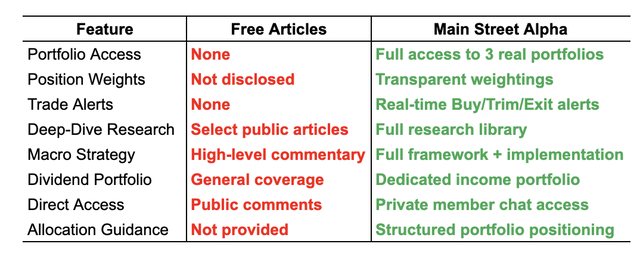
Main Street Alpha combines deep macroeconomic analysis, geopolitical insights, and company-level research to identify the opportunities that benefit from long-term trends instead of short-term market noise. Members receive exclusive research reports, high-conviction investment ideas, three model portfolios, direct access to me, and a private member chat where members discuss the markets and long-term investment strategies.
For a limited time, the first group of members for Main Street Alpha can sign up for the service at the price of $499. The price increases to $599 after this special offer expires.
Main Street Alpha represents the next stage of the journey my followers and I have been on together for more than 10 years on Seeking Alpha.
Advertisement
Introducing Main Street Alpha
I started investing at the age of 15. That was 15 years ago. As some of you may know (because I have brought it up so much in my research), what I did back then was flat-out gambling. I still remember how I felt when I nearly blew up my account on Christmas Eve and had to pretend everything was fine during the holiday.
This is obviously an incredibly silly story, yet in hindsight, all of these mistakes were terrific building blocks for what turned out to be a career in finance and publication. Moreover, because I experimented with almost every type of investing and trading style/strategy, I was able to early on figure out the best approach that fit my goals and strategy.
Fast forward to 2026. I have spent the past six years working professionally in the industry, advising a hedge fund, working for a number of third-party research companies, and building a dividend growth portfolio that has become the foundation of a serious long-term investment strategy.
That strategy is built around what I like to call the “Big Picture” approach, as it combines macroeconomic research, structural trends, political developments, competitive business models, and durable wealth-building strategies like dividend growth investing.
Advertisement
My goal has always been to help investors filter out the daily market noise and focus on the factors that actually drive long-term returns. Even if some readers disagree with a specific stock pick or a thesis, I want them to walk away with a better understanding of the bigger picture that helps them in their own investment process.
Now, it’s time to take all of this to the next level. I believe that everything I have done so far has led to this big moment, as I get to introduce my new endeavor called “Main Street Alpha,” which I’m launching here on Seeking Alpha with Albert Marko, my business partner, long-term mentor, and friend.
It’s everything we have done over the past 10 years, packaged and brought to a whole new level, to bring institutional-grade research to the masses.
Why We Created Main Street Alpha
The current market environment seems to be louder and more challenging than ever.
Advertisement
Every day is a bombardment of news headlines, economic numbers, and a ton of narratives that have the potential to change everything happening in the markets. Essentially, the financial media cycle is moving faster, which is further worsened by social media-fueled noise and artificial intelligence. It has created a data overload.
In my personal experience, some of the most successful investors are the ones who filter out that noise, maintain a focus on the Big Picture (there it is again), and build portfolios that work for them. One thing a former mentor always told me was, “It’s all noise.”
That philosophy has always been the core of my work here on Seeking Alpha.
However, over time, it became increasingly clear to me that my readers wanted more than just ideas on single stocks. They wanted a place to discuss ideas in a more in-depth way, at a higher frequency, and with more in-depth analysis. And personally, I also wanted more. It was time for a change.
Advertisement
This reminds me of the following quote from the 1987 movie “Wall Street”:
If you’re not inside, you are outside, OK?
We’re going to change that, as we’ll be that helping hand in a noisy market that helps you focus on the drivers that actually matter for long-term returns. To achieve that, we’ll combine macroeconomic analysis, structural investment trends, and individual company research.
To us, the goal is very straightforward:
Help individual investors approach markets with the same big-picture mindset used by professional investors.
Main Street Alpha (Main Street Alpha)
Advertisement
What You’ll Find Inside Main Street Alpha
Main Street Alpha is built on a number of core pillars, all of which have the goal to help you make better long-term decisions.
First of all, our members will receive high-conviction investment ideas. All of these are fully supported by detailed research and Big-Picture analysis. Our research is designed to find the best companies and discuss major macro and geopolitical trends. Essentially, in our service, we go the extra mile and tell you what the “big guys” on Wall Street and in Washington, D.C., are discussing. Suddenly, you’re an “insider” as well.
Second, we publish deep-dive research reports that go beyond the “traditional” articles you may be used to on the Internet. Our research deep-dives into various industries, macroeconomic developments, and niche investment opportunities that often go unnoticed.
Just think about the in-depth research I have written so far, taken to the next level.
Advertisement
Moreover, our members will get access to three portfolios:
Leo’s personal portfolio.
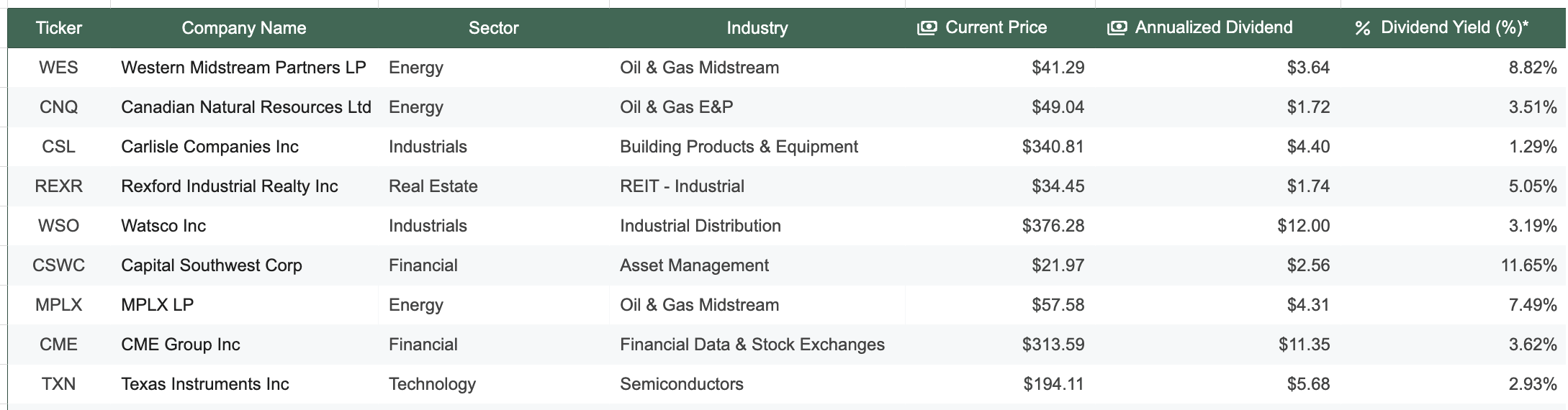
A dividend income portfolio with a >5% average yield and high-single-digit annual dividend growth.
A community portfolio that is funded with service proceeds and directly influenced by members who get a say in what we buy and sell.
Main Street Alpha (For Illustrative Purposes Only)
On top of that, members get full access to a private chat with direct access to me, the community, and any real-time investment alerts we publish.
Main Street Alpha
Advertisement
In other words, we’re going exclusive, to a whole new level, and you’re invited!
Who’s Behind Main Street Alpha
This service is run by Albert Marko and myself.
Most of you will be familiar with me. Not only did I just share my story with you, but I also spent the past 10 years sharing way too many details about my personal life. I’m sometimes surprised by how much people know about me and by how much people care.
Albert, however, is a name you may not be familiar with. Until now, of course.
Advertisement
I have worked with Albert for more than six years in various settings. He brings a different but highly complementary skill set, as he’s a political-economic consultant and investor with roughly two decades of experience in foreign affairs and geopolitical analysis.
Moreover, throughout his career, he has advised hedge funds, corporations, and institutional investors on political risk, legislative developments, and international relations. His work has also involved consulting policymakers and members of Congress on geopolitical strategy and economic policy.
For a Big Picture approach, there’s no better partner.
Hence, by integrating political analysis with macroeconomic research and equity strategy, Main Street Alpha aims to give investors a clearer view of the forces that truly drive long-term returns and generate long-term alpha and income for dividend investors.
Advertisement
Who Main Street Alpha Is For
This service is for everyone who has money invested or plans to invest.
However, to narrow it down, it’s especially ideal for readers who:
Focus on long-term wealth creation.
Want to understand macro and geopolitical trends.
Appreciate dividend growth and income investing.
Prefer research-driven investment ideas.
If you’re a short-term trader, this service may not be for you, as we help people achieve long-term goals and do not focus on short-term trading signals. However, even if you’re a trader and want to get a better understanding of the market, this service is for you as well.
After all, even traders need to understand the bigger picture.
A Quick Note on Expectations
Before wrapping things up, I want to make one more thing clear.
Advertisement
I’m a macro/equity strategist, not a salesman. This service is not about chasing the next hot stock or promising you quick gains. Markets do not work that way, and anyone who claims otherwise may be selling you something other than good research.
Some ideas will work extremely well. Others may take a while to unfold. And, occasionally, we’ll be wrong on things. That’s part of investing.
What matters is the process to increase the risk/reward and build something that works for you.
That’s what we are about.
Advertisement
Join Us On The Next Stage Of The Journey
Over the past 10 years, the Seeking Alpha community has played a major role in shaping the way I think about markets and investing.
Main Street Alpha is the next step in the investment journey.
It’s the place where we take everything we have been doing to a whole new level. Better intel, better research, portfolio management, and fruitful community discussions.
If that sounds like the investing approach you are looking for, we invite you tojoin us.
Advertisement
Main Street Alpha is available for $599 per year, with a limited launch discount for the first 400 members who will get the whole package for $499.
The steel castings group enjoyed a strong 2025, accounts show
Cook Defence Systems, Stanhope(Image: William Cook Group)
The owner of historic UK steel company William Cook has taken a number of swipes at politicians as his company announced rising turnover and profits.
Sir Andrew Cook, chairman of the County Durham and Yorkshire-based steel castings business used the group’s latest accounts to accuse law makers of “fiddling and flirting with costly and unreliable wind and solar while energy demand increases and black-outs loom”. The remarks came as the group – which supplies the defence, rail, manufacturing and structural engineering sectors – reported turnover of almost £100m and a rise in operating profits from £22.3m to £24.2m in the year to the end of June 2025.
It is not the first time industrialist Sir Andrew has aimed criticism at Westminster, having previously said Government efforts to promote a resurgence of UK manufacturing were “wishful thinking”. His group, which employs more than 600 across sites in the North East, Yorkshire and Cumbria, includes various subsidiaries including Cook Defence Systems Ltd, William Cook Rail and a newly created US-based company, among others.
The buoyant 2025 results were credited to the performance of the group’s defence business, which includes production of tank tracks. Sir Andrew said the “internationally unstable situation” was forcing increased spending by NATO members and allies. In addition to the firm’s work for the British Army, Cook Defence Systems also exported to more than a dozen allied nations during the year, serving more than 6,000 vehicles.
Advertisement
The group’s rail business was also said to have prospered, with separate accounts showing turnover falling from £14.5m to £13.8m but its gross profit margin increasing to more than 23% and operating profits up from about £71,000 to more than £556,000. It has contracts for different rolling stock operating across the country, including underground trains.
Sir Andrew said: “It is a testament to our persistence and determination – my motto – that rail has remained a key component of our business despite the sector’s neglect by successive British governments: a neglect which has led to there being no remaining domestic train-builder at all. Instead, taxpayers’ money is squandered on the absurd and truncated HS2 while the rest of the system, best described as ‘good second world’, labours on.”
The chairman added: “Our industrial business had a difficult year, with low order levels continuing. However, this was expected, which is why considerable investment has continued with the goal of making it fit for the future, manned, equipped and qualified to manufacture the ultra-high specification cast components which inevitably will be required when the nuclear industry finally gets its act together.
“In this respect the vacillation of politicians is beyond disgraceful, fiddling and flirting with costly and unreliable wind and solar while energy demand increases and black-outs loom.
Advertisement
“Appropriately, I reproduce an extract from my letter, first published in the Financial Times in 2003: ‘When in the flickering fight of wind and solar-generated power, the realisation finally dawns that nuclear energy is the only reliable way of supplying this planet with carbon-free electricity, the factories which could make nuclear power stations will be long gone and the engineers who knew how to make them, dead’. To which I have nothing to add, other than to reassure readers that William Cook is still alive and kicking and, thank God and medical science, so am I.”

















































You must be logged in to post a comment Login