NEW YORK — Security lines at John F. Kennedy International Airport moved briskly Friday morning, with most terminals reporting general TSA wait times under 20 minutes and TSA PreCheck lanes often clearing in five minutes or less, offering relief to spring travelers after weeks of volatile delays tied to staffing fluctuations and holiday surges.
Delta Air Lines planes are seen at John F. Kennedy International Airport on the July 4th weekend in Queens, New York City
As of mid-morning on April 10, the official JFK Airport website showed the following estimated wait times: Terminal 1 general screening at about 12-19 minutes with PreCheck around 5-11 minutes; Terminal 4 at 9-15 minutes general and 1-6 minutes PreCheck; Terminal 5 at 9-14 minutes general and 5-7 minutes PreCheck; Terminal 7 at 17 minutes general; and Terminal 8 at 24 minutes general with PreCheck at 7 minutes. These figures, updated around 11:25 a.m. ET, reflect real-time monitoring but come with the airport’s standard disclaimer that estimates are reliable only when lines stay within designated queue areas.
The relatively short waits contrast with earlier 2026 peaks, when spring break crowds and occasional TSA staffing issues pushed some lines to 45-60 minutes, particularly in Terminal 5, a major hub for JetBlue. On Easter Sunday, April 5, many terminals cleared general passengers in under 15 minutes, a trend that has carried into quieter mid-April days.
Port Authority of New York and New Jersey officials, who operate JFK, noted that TSA staffing has stabilized following a period of uncertainty earlier in the year. Travelers are still advised to arrive two hours before domestic flights and three hours before international ones, with extra buffer recommended during peak morning (5-9 a.m.) and evening (3-7 p.m.) rushes when waits can climb to 30-45 minutes.
Live trackers and third-party sites like TakeoffTimer and airline-specific dashboards reported similar conditions Friday, with overall airport averages hovering between 10-25 minutes for standard lanes. TSA PreCheck continued to deliver significant time savings, often under five minutes even when general lines stretched longer. CLEAR biometric lanes, available in several terminals, further expedited entry for enrolled members.
Advertisement
Terminal 4, the largest and home to Delta, JetBlue international operations and many foreign carriers, consistently showed the shortest general waits in recent updates, sometimes dipping to single digits. Terminal 8, primarily American Airlines, occasionally recorded the longest lines but remained manageable Friday. Terminal 1 and Terminal 5, serving a mix of international and domestic flights, fell in the middle range.
Travelers on social media and Reddit’s r/JFKAirport echoed the positive reports, with recent posts describing 15-25 minute experiences in general lines and near-instant PreCheck clearance. One passenger flying Delta from Terminal 4 on Thursday afternoon reported clearing security in under 10 minutes with two children and luggage. Another noted a 35-minute wait in Terminal 8 during a busier evening slot earlier in the week.
The smoother flow comes after the airport temporarily suspended official wait-time reporting in March due to inaccuracies during high-volume periods and staffing shifts. Data resumed in early April, and officials say staff now monitor queues more actively to provide better estimates. The MyTSA app remains a useful tool for crowd-sourced updates from fellow passengers.
JFK handled more than 60 million passengers in 2025, making it one of the busiest U.S. gateways, especially for international travel to Europe, Asia and Latin America. Security remains the primary bottleneck for many, but Friday’s conditions suggested a return to more predictable operations amid lighter post-holiday traffic.
Advertisement
Experts recommend several strategies to minimize delays. Enrolling in TSA PreCheck, which costs $78 for five years, allows eligible travelers to keep shoes, belts and light jackets on while using dedicated lanes. CLEAR, often bundled with airline status or credit cards, speeds up the initial ID check. Arriving early, packing liquids properly in a quart-sized bag and removing electronics in advance further smooths the process.
For international departures, additional time should be factored for customs and immigration on arrival, though outbound screening focuses on TSA. Passengers with disabilities or needing assistance can request expedited help through airlines or TSA Cares.
Weather and flight schedules also influence crowds. Friday’s forecast for the New York area called for mild spring conditions with no major disruptions expected, helping keep passenger volumes steady rather than compressed into narrow windows. Airlines reported normal operations with only routine delays unrelated to security.
TSA officials nationwide have emphasized that wait times fluctuate based on passenger volume, staffing and random additional screening measures. Unpredictable security protocols, including occasional pat-downs or bag checks, can add minutes even in short lines. The agency encourages downloading the MyTSA app for real-time alerts and prohibited-items guidance.
Advertisement
JFK’s five terminals each operate independent checkpoints, so travelers should confirm their airline’s location in advance. Terminal 4 and Terminal 5 handle the heaviest loads, while Terminal 7 and parts of Terminal 1 serve fewer but still significant international routes.
As the busy summer travel season approaches, the Port Authority and TSA plan to maintain enhanced staffing where possible. Officials have urged passengers not to arrive excessively early if lines are short, to avoid congestion in pre-security areas, but stress that individual experiences vary.
For those flying out of JFK today or in coming days, current data points to a traveler-friendly environment compared with recent months. Still, checking the official JFK website or reliable trackers shortly before heading to the airport remains the best practice, as conditions can shift quickly with sudden surges or lane closures.
The airport continues investing in technology, including more automated screening lanes and biometric options, to reduce friction. In the meantime, Friday’s lighter lines offered a welcome breather for the millions who rely on JFK as their gateway to the world.
Advertisement
Travelers are reminded to follow the 3-1-1 liquids rule, place laptops and large electronics in separate bins, and prepare for possible secondary screening. With waits mostly in the 10-25 minute range across terminals, many passengers reported having extra time for a coffee or last-minute shopping before boarding.
Whether heading to Europe on a red-eye or catching a domestic connection, today’s security experience at JFK appears far smoother than the longer delays seen during peak spring break weeks. As always at one of America’s busiest airports, a little preparation goes a long way toward stress-free travel.
Dalal Street is heading into a busy phase of IPO lock-in expiries, with a significant portion of pre-listing shareholder restrictions set to be lifted over the next three months. According to estimates by Nuvama Alternative & Quantitative Research, as many as 81 companies will see their lock-ins expire between April 7 and July 31, potentially unlocking stock worth nearly $70 billion.
The value refers to the total shares becoming eligible for trading as lock-up periods end. However, not all of these shares are expected to be sold in the secondary market, as a substantial portion remains held by promoter groups who typically continue to retain their stakes.
Among the notable names in April, Bharat Coking Coal will see its three-month lock-in end on April 15, with 59 million shares or 1% of equity becoming eligible for trading. Amagi Media Labs follows on April 20, with 11 million shares or 5%, while Shadowfax Technologies will have 35 million shares or 6% unlocked on April 23.
In May, Fractal Analytics and Aye Finance will see lock-in expiries on May 13, involving 7 million shares (4%) and 18 million shares (7%), respectively. Later in the month, Gaudium IVF and Women Health will unlock 3 million shares or 4% on May 26, followed by Clean Max Enviro Energy Solutions on May 27 with 4 million shares or 4%. PNGS Reva Diamond Jewellery will also see 2 million shares or 7% becoming tradable on May 29.
Advertisement
In June, Omnitech Engineering will have 4 million shares or 3% unlocked on June 1, while SEDEMAC Mechatronics will see 1 million shares or 3% become eligible for trading on June 8.
Live Events
A host of stocks will also witness six-month shareholder lock-in periods expiries over the coming weeks. Starting April 13, Tata Capital will see a significant 2,858 million shares, or 67% of equity, become eligible for trading. On the same day, WeWork India will have 60 million shares, representing 45%, unlocked. On April 15, LG Electronics India will see 441 million shares or 65% of equity become tradable. This will be followed by Canara Robeco AMC on April 17, with 110 million shares or 55% unlocking, and Canara HSBC Life Insurance on April 20, where 522 million shares or 55% will be released. Later in April, Midwest will see 6 million shares or 17% unlocked on April 24, followed by Capillary Technologies on April 28 with 0.5 million shares or 0.7%. Tenneco Clean Air India will also see 3 million shares or 0.8% become tradable on April 30.
In May, Lenskart Solutions will have 1,047 million shares or 60% unlocked on May 8, alongside Emmvee Photovoltaic Power with 5 million shares or 0.7%. This will be followed by Aequs on May 11 with 1 million shares or 0.2%.
Finally, Billionbrains Garage Ventures will see a large expiry on May 12, with 4,182 million shares, or 68% of equity, becoming eligible for trading.
While lock-in expiries are a routine part of the IPO cycle, clustered unlocks of this scale tend to attract attention and can weigh on stock prices in the short term. Nuvama noted that despite the headline figure of $67 billion, the actual market impact will depend on how much of the eligible stock is eventually offered for sale.
Advertisement
The upcoming lock-in expiries come at a time of heightened geopolitical uncertainty, with tensions in the Middle East still elevated and rising crude prices fuelling concerns over potential rate hikes. Although a two-week ceasefire is currently in place, its durability remains uncertain, leaving markets vulnerable to volatility if tensions escalate further.
(Disclaimer: Recommendations, suggestions, views and opinions given by the experts are their own. These do not represent the views of The Economic Times)
I aim to provide alpha-generating investment ideas. I am an independent investor managing my family’s portfolio, primarily via a Self Managed Super Fund. My articles deliver 5-Minute Pitches focused on the core fundamental and technical drivers of the security.I have a generalist approach as I explore, analyze and invest in any sector so long there is perceived alpha potential vs the S&P500. The typical holding period ranges between a few months to multiple years.I am very much focused on adding value via alpha generation. I always start with a Performance Assessment section for each follow-up article. I publish unusually detailed analytics on my long-only, zero-leverage global equity portfolio performance on my Hunting Alphas website every month.A bit about how I approach research and coverage of a stock:I build and maintain spreadsheets showing historical data on the financials, key metric disclosures, data on the guidance and surprise trends vs consensus estimates, time-series values of the valuations vs peers, data on key coincident or leading indicators of performance and other monitorables. In addition to the company’s filings, I also keep tabs on relevant industry news and reports plus other people’s coverage of the stock. In some cases, such as during times of a CEO change, I will do a deep dive on a key leader’s background and his/her past performance record.I very rarely build DCFs and project financials many years out into the future as I don’t think it adds much value. Instead, I find it more useful to assess how a company has delivered and the broad outlook on the 5 key drivers of a DCF valuation: revenues, costs and margins, cash flow conversion, capex and investments and the interest rates (which affect the discount rate/opportunity cost of capital). In some cases, especially for companies trading at very high multiples on a TTM or 1-yr fwd basis, I do a reverse DCF to make sense of the implied growth CAGR implications.Note: Hunting Alphas is related to VishValue Research on Seeking Alpha.
Analyst’s Disclosure: I/we have a beneficial long position in the shares of CLS either through stock ownership, options, or other derivatives. I wrote this article myself, and it expresses my own opinions. I am not receiving compensation for it (other than from Seeking Alpha). I have no business relationship with any company whose stock is mentioned in this article.
Seeking Alpha’s Disclosure: Past performance is no guarantee of future results. No recommendation or advice is being given as to whether any investment is suitable for a particular investor. Any views or opinions expressed above may not reflect those of Seeking Alpha as a whole. Seeking Alpha is not a licensed securities dealer, broker or US investment adviser or investment bank. Our analysts are third party authors that include both professional investors and individual investors who may not be licensed or certified by any institute or regulatory body.
Foreign investor appetite for Indian equities may be cooling sharply, if insights shared by Nithin Kamath are anything to go by. In a recent social media post, the Zerodha co-founder said feedback from a stock market insider suggests that global investors are increasingly turning cautious on India, citing a mix of macro, valuation, and policy concerns.
According to Kamath, India is currently viewed as geopolitically vulnerable—particularly to potential oil shocks—while the absence of compelling artificial intelligence-led investment opportunities has further dampened its appeal. Elevated valuations and concerns around the rupee have also added to investor hesitation.
He noted that many foreign investors who were sitting on gains have already booked profits and are reallocating capital to other markets such as Japan, Taiwan, South Korea, and parts of Europe, where relative valuations and growth narratives appear more attractive.
Policy-related factors are also playing a role. Kamath highlighted that India’s capital gains tax framework—especially the structure of long-term and short-term capital gains (LTCG/STCG)—along with the recent increase in Securities Transaction Tax (STT), has made the market less competitive versus global peers that are currently attracting stronger inflows.
Advertisement
With foreign portfolio investment (FPI) flows turning volatile, Kamath suggested that rationalising these tax structures could be a “low-hanging fruit” to improve India’s attractiveness and bring global investors back into the fold.
Live Events
“Asked someone from the industry whether foreign investors are still interested in allocating to India. The TLDR: Interest has pretty much died out. India is seen as geopolitically exposed, especially to an oil shock. There are no real AI plays. Valuations are rich. And the rupee situation doesn’t help. On top of that, investors who were sitting on gains have taken money off the table and are now looking at markets like Japan, Taiwan, Korea, Europe etc instead,” the tweet said. “He also pointed out that our LTCG/STCG structure and the increase in STT have made India less attractive compared to other markets that are seeing inflows. If we need to attract FPIs back, and we do, fixing this feels like pretty low-hanging fruit,” Kamath added.Nifty is down 9% this year, as FIIs continue to leave India. They have offloaded equities worth Rs 1,77,271 crore so far this year. In just six sessions this month, they have sold Rs 46,149 crore worth of stocks. Domestic markets ended with cuts today, ending their five-session gaining streak. They fell amid significant selling pressure in financial stocks along with auto and FMCG counters. Nifty plunged 222.25 points or 0.93% to finish at 23,775.10. Meanwhile, Sensex declined 947.22 points or 1.22% to settle at 76,615.68.
(Disclaimer: The recommendations, suggestions, views, and opinions given by the experts are their own. These do not represent the views of The Economic Times.)
New Delhi: India’s growth projection of 6.6% for FY27 faces downside risks from the Gulf conflict, but the economy remains well placed to navigate the global energy shock, supported by strong macroeconomic buffers, the World Bank said on Thursday.
The country is expected to remain among the fastest-growing major economies. Growth for FY27 reflects the impact of higher global energy prices due to the Middle East conflict and is expected to average 7.1% in FY28-29, it noted.
The World Bank has assumed oil prices at $90-100 per barrel for FY27.
Despite external risks, macroeconomic strength and policy measures are expected to provide some insulation. However, the multilateral lender flagged energy diversification, prudent fiscal management and trade liberalisation as key priorities.
Aurelien Kruse, lead economist for India at the World Bank, said the country entered the current fiscal year from a position of strength.
Advertisement
Live Events
“Substantial foreign reserves, low inflation, predominantly rupee-denominated public debt, a healthy financial sector, and trade diversification efforts play a major role in providing resilience from external headwinds,” said the World Bank. The Reserve Bank of India expects growth of 6.9% for FY27. Without the ongoing conflict, growth was estimated at 7.2%, supported by stronger-than-expected performance in FY26, the World Bank said.
India’s gross domestic product (GDP) growth is expected at 7.6% in FY26, driven by private consumption, manufacturing, exports and investment, despite high tariffs imposed by the US.
Inflation is projected to rise to 4.9% in FY27, according to the World Bank, due to higher food prices, partial pass-through of global energy prices and currency depreciation pressures. Elevated energy prices are also likely to raise input costs for industry.
“Boosting private sector-led growth will be critical to strengthening economic resilience and supporting more young people to enter the workforce,” said Paul Procee, acting country director for India at the World Bank.
He added that achieving the goal of Viksit Bharat will require a predictable, business-friendly environment to unlock investment and create jobs at scale in sectors such as energy and infrastructure, manufacturing, tourism, healthcare and agribusiness.
Advertisement
New Delhi: India’s growth projection of 6.6% for FY27 faces downside risks from the Gulf conflict, but the economy remains well placed to navigate the global energy shock, supported by strong macroeconomic buffers, the World Bank said on Thursday.
The country is expected to remain among the fastest-growing major economies. Growth for FY27 reflects the impact of higher global energy prices due to the Middle East conflict and is expected to average 7.1% in FY28-29, it noted.
The World Bank has assumed oil prices at $90-100 per barrel for FY27.
Despite external risks, macroeconomic strength and policy measures are expected to provide some insulation. However, the multilateral lender flagged energy diversification, prudent fiscal management and trade liberalisation as key priorities.
Advertisement
Aurelien Kruse, lead economist for India at the World Bank, said the country entered the current fiscal year from a position of strength.
“Substantial foreign reserves, low inflation, predominantly rupee-denominated public debt, a healthy financial sector, and trade diversification efforts play a major role in providing resilience from external headwinds,” said the World Bank.
The Reserve Bank of India expects growth of 6.9% for FY27.
Without the ongoing conflict, growth was estimated at 7.2%, supported by stronger-than-expected performance in FY26, the World Bank said.
Advertisement
India’s gross domestic product (GDP) growth is expected at 7.6% in FY26, driven by private consumption, manufacturing, exports and investment, despite high tariffs imposed by the US.
Inflation is projected to rise to 4.9% in FY27, according to the World Bank, due to higher food prices, partial pass-through of global energy prices and currency depreciation pressures. Elevated energy prices are also likely to raise input costs for industry.
“Boosting private sector-led growth will be critical to strengthening economic resilience and supporting more young people to enter the workforce,” said Paul Procee, acting country director for India at the World Bank.
He added that achieving the goal of Viksit Bharat will require a predictable, business-friendly environment to unlock investment and create jobs at scale in sectors such as energy and infrastructure, manufacturing, tourism, healthcare and agribusiness.
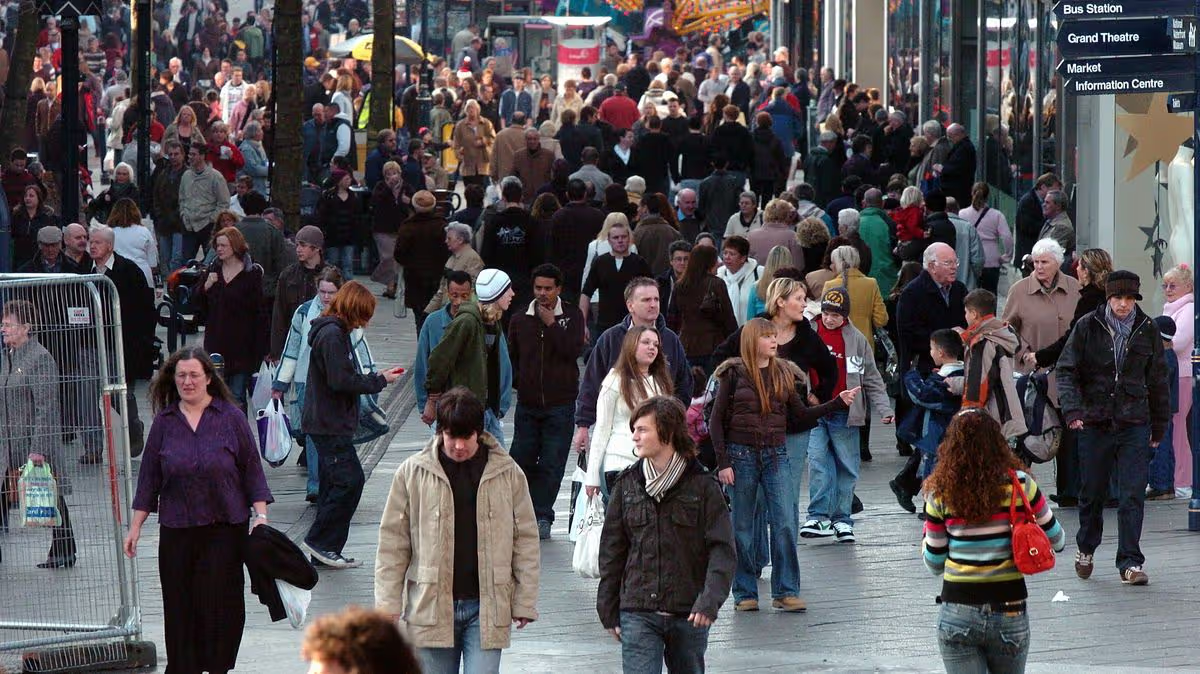
Retail footfall was up in March shows new figures from MRI Software.
Shoppers in Swansea..(Image: SWEP/John Corbett)
The retail sector in Wales has been boosted with a healthy rise in shopping numbers, shows new research.
According to data from MRI Software, based on a survey of 700 store managers, in the five week period from March 1st to April 4th, footfall increased by 6.3% on February across all retail destinations and was up 2.8% year-on-year. This sustained growth reflects the impact of key calendar events, including Mother’s Day, St Patrick’s Day and the early start to Easter trading, which encouraged consumers back into physical retail destinations.
High streets experienced the strongest growth up 8.7%, followed by retail parks, up 6.3% and shopping centres 1.6%. The broad uplift across the board highlights the strength of in‑person visits to retail stores and destinations as spring trading begins.
As expected, Mother’s Day played an important role in shaping March’s footfall patterns. The week leading up to Easter delivered a 1.8% uplift week on week. However, when compared with the same period last year leading into Mother’s Day, footfall was 1.6% lower, suggesting shoppers were more considered in their spending.
Earlier in the month, St Patrick’s Day celebrations combined with warmer weather also helped in driving activity, particularly on Wales’ high streets where footfall rose 7.5% week on week during mid-March. Strong weekday increases during that week suggest social occasions combined with warmer weather continue to shape how consumers combine retail, leisure and hospitality visits.
The upward trend continued into the early Easter trading period, with the week leading into the holiday delivering a 7.5% increase in footfall across all Welsh retail destinations week on week. High streets led the growth recording an increase in footfall of 8.7% highlighting Easter as one of the year’s major retail trading periods outside of Christmas.
When measured against the equivalent week leading up to Easter 2025, footfall declined slightly by 0.2% overall. This suggests that while seasonal events still drive strong bursts of activity, consumers are approaching holiday spending more cautiously this year.
Advertisement
Jenni Matthews, analyst at MRI Software, said: “Despite ongoing economic uncertainty, footfall growth across Wales suggests that consumers are continuing to prioritise physical retail visits, particularly where value, convenience and a clear purpose are evident.
With Easter falling earlier in the calendar this year, March effectively marked the starting point for spring trading. While footfall trends remain stable, the data shows that events, holidays and social activities continue to drive visits to retail destinations, but shoppers are becoming more intentional as economic pressures persist. For retail stores and destinations, the challenge will be in demonstrating value to its shoppers as they become increasingly deliberate with their purchases.”

























































You must be logged in to post a comment Login